Mentor Series
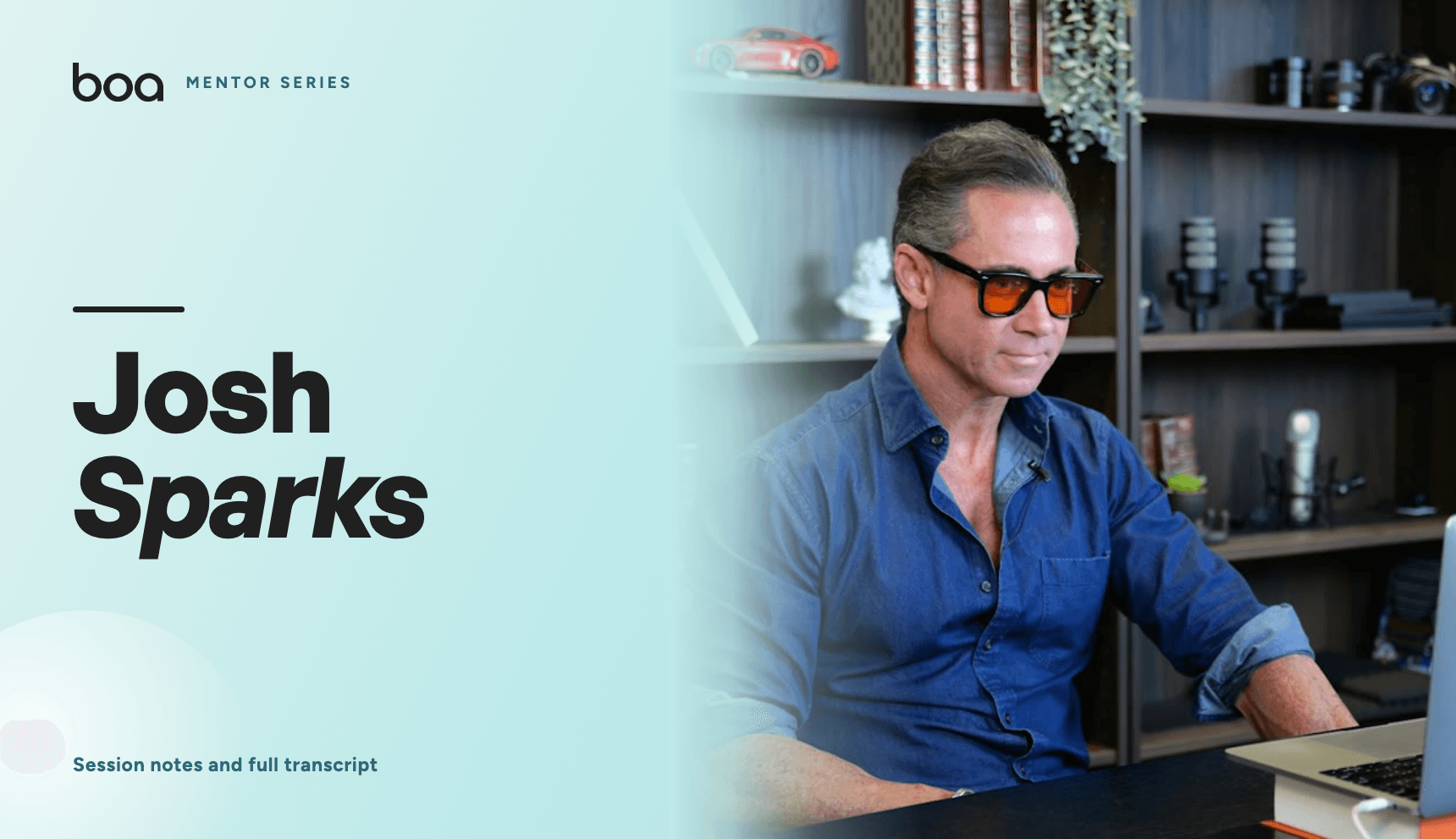
Josh Sparks on Building a Brand That Prices Higher
With Josh Sparks, Brand advisor and consultant · Hosted by Kirsten Scott · 1h 4m
What this session covers
Josh Sparks compresses a two-day brand workshop into 30 minutes: how to build a brand pyramid from points of parity up to promise, why emotional reasons to believe beat rational points of difference, how to pick one archetype, and how to run the WHAC word exercise. Then live Q&A with a broker, a lawyer launching leather goods, and a dog perfume founder.
Brand is not marketing, it is the promise your customers repeat when you are not in the room, and getting it right can shift your exit from a multiple of profit to a multiple of revenue.
Key takeaways
- 01
Build the brand pyramid from the bottom, not from the tagline
Start at points of parity (tangible ones like 'safe to use', 'delivered on time', 'servers up 99.9%', and intangible ones like 'I feel smart making this choice'). Then purpose or central organising idea, then rational benefits, then emotional benefits, then values, then persona, and only then promise. Josh's point is that promise is impossible to write in a sentence until you have answered everything under it. Promise is a North Star, not a tagline like 'Just Do It'.
- 02
Swap points of difference for reasons to believe
Josh argues most products and services have very few genuine points of difference once you strip out price and speed. Instead of hunting for a POD, ask what reason you give someone to believe your promise. Rational RTBs are price, service, delivery speed, returns policy, warranty, organic versus conventional cotton. Emotional RTBs are the ones that pay: will they feel smarter, freer, more creative, more beautiful, higher status.
- 03
Aim for the unfair advantage as your top emotional benefit
The highest emotional benefit, per Josh, is that buying from you confers what the customer perceives as an unfair advantage. Something others do not have. It can be internal confidence and certainty, or an outward symbol of status, or both, in the same way that working with Goldman Sachs on an IPO or McKinsey on growth makes an executive show up with more certainty. If you can distil your emotional RTB down to an unfair advantage, you are in a very strong position.
- 04
Push past the 15th word before you trust your own answers
When Josh runs word exercises with clients, they typically get to the 15th, 20th or 25th word before anything real emerges. Everything before that sounds like a marketing department or a Procter and Gamble ad. If he is not in the room, appoint an annoying counterparty whose only job is to ask 'are you sure', 'what lies underneath that', 'how would you feel if you got that' until you hit what you actually stand for.
- 05
Pick one archetype, or split 80/20 at most
The best brands in the world run on a single archetype. Most of Josh's clients end up with two because they cannot settle on one, and in that case he wants an explicit 80/20 split: for example 80% hero and 20% explorer for an athletic outdoor brand, or the reverse if exploration leads. The split matters because it is shorthand for how you show up, and it is what you hand to your marketing team, PR agency, digital agency and every ambassador.
- 06
Write down your archetype's shadow so your comms avoid it
Every archetype has positive attributes and a shadow. Josh's example is the Sage, embodied by McKinsey, whose shadow is arrogance: confident and reassuring tips into belittling, condescending and patronising, team members get marginalised, and the project goes sideways. Document the shadow attributes alongside the positives so your marketing and comms actively steer away from them.
- 07
Run the WHAC exercise on Post-its after the pyramid
One word per Post-it, no sentences, no copywriting, and 15 to 25 words per question. What do we do. Who do we do it for (past demographics into psychographics and motivations). Why do they love us, using the word love, not why they would transact once. How do we do it (channels, attract, retain, sell, deliver, re-engage, referral, community, unpaid ambassadors). Are you sure (Google reviews, testimonials, unpaid ambassadors, allied health partnerships, ingredient research). Can you do it, which is for suppliers and investors, not customers.
- 08
Use WHAC as a quality check on your pyramid
Josh's reason for doing WHAC after the brand pyramid is diagnostic. If the pyramid work is good, the WHAC answers come easily. If they are hard, the pyramid is not finished, so go back and do it again. Loop between the two until the answers feel strong.
- 09
Design retail from the promise, not from the rules of retail
Answering Henry, Josh described how Apple built stores by ignoring retail convention entirely: no checkout, staff at the door, a free Genius Bar at the back, open space, deliberately under-assorted, almost no third-party product. They did not start with revenue per square metre. They asked what the brand promise feels like if it magically appeared as a room. Contrast Ralph Lauren, which most retailers would call over-assorted, and which is equally correct for its brand.
- 10
Assume 15 to 25 touchpoints before your message registers
Josh cites research that consumers need 15 to 25 touchpoint incidences before the message even lands, which is why consistency across every channel matters more than any single execution. In store that includes staff scripting, how they greet, whether they hover or hang back, music, scent, assortment density, art and sculpture. If a customer gets your world in three or four visits instead of fifteen, that is a strong signal.
- 11
Get famous for one thing before you move into adjacencies
Niching is a shortcut to promise because it forces the question of what you will be famous for. Josh's rule: the consumer must associate you with one domain first. Once you have proven expertise there, you earn permission to move outward in concentric circles into adjacent categories and services. For the consultant in the room, that meant reinforcing exit advice for family businesses and then producing content across succession planning, normalising financials, and what performance culture looks like after the founder leaves.
- 12
Model brand across all three financial statements
Cash flow: better trading terms, better creditworthiness, more pricing power, less discounting, better gross margin. P and L: more consistent profitability, greater lifetime value, less churn. Balance sheet: brand is an appreciating intangible asset and is usually the most valuable thing in the business. Josh has done exits at 5, 6 and 7 times EBITDA, and one at 10 times revenue, which on 10 to 15% net margin is several times more valuable.
How the session runs
- 0:00Why brand is not marketing
- 12:48Values, and asking the annoying follow-up question
- 28:40Archetypes, personas and shadow attributes
- 28:47Brand's effect on cash flow, P and L and balance sheet
- 31:40Q&A: creating emotion for a brand new retail customer
- 37:40Q&A: niching, personal brand and being uncopiable
- 42:58Q&A: a mortgage broker building an emotional point of difference
- 47:29Q&A: launching a luxury leather brand on a small budget
- 54:03Q&A: three content categories for a new social feed
- 58:26Q&A: turning a non-necessity product into a must-have
Mentioned in this session
- Apple
- Nike
- McKinsey
- Goldman Sachs
- Carl Jung
- Joseph Campbell
- The Hero with a Thousand Faces
- The Hero and the Outlaw
- Catcher in the Rye
- Star Wars
- Shakespeare
- Dickens
- Ralph Lauren
- Garmin
- Apple Watch
- Lululemon
- Shopify
- MJ Bale
- Substack
- YouTube
- Procter and Gamble
- Spain
- Papua New Guinea
- Loewe
- Polene Paris
- Romanticy Games
Questions founders ask
Josh Sparks defines brand as the promise you make your community, carried through a narrative that evolves over time to stay fresh. Marketing is downstream of it. The practical test is what your customers say about you when you are not in the room, meaning when they are not responding to your ads, standing in your store or watching an influencer reel. If they are not buying into the promise, you become dependent on mid and bottom of funnel spend, which is getting more expensive and less effective.
Start with the rational ones (price, service, delivery speed, warranty, ingredients, materials) and then keep asking what those deliver emotionally. Josh names desires to feel worthy, loved, smarter, more creative, more beautiful, more free, higher status, more agency. His test is that almost every discretionary purchase is made for how it will make you feel afterwards, not for the stated reason. The strongest version is an unfair advantage: something the customer perceives others do not have.
One. Josh says the best brands in the world run on a single archetype, and only settles for two when a client genuinely cannot choose. If you use two, define an explicit 80/20 split, such as 80% hero and 20% explorer. The reason is operational: the archetype is shorthand your marketing team, PR agency, digital agency and ambassadors all use to know how the brand shows up.
Josh's advice to Claire, launching a leather goods brand, was to start with you and the people you know, then work outward in concentric circles. He used MJ Bale as the example: the founder sold handmade shirts to his banker friends in their offices, and it grew into a business turning over $110 to $120 million. Film everything behind the scenes, cut it into reels, and change each version by about 10% so Instagram tests new audiences at no cost.
Brand shows up on all three statements. It improves trading terms and pricing power (cash flow), lifts consistent profitability and lifetime value while cutting churn (P and L), and sits as an appreciating intangible asset (balance sheet). Josh has personally been part of exits at 5, 6 and 7 times EBITDA, and one at 10 times revenue. On a 10 to 15% profit margin, a revenue multiple is worth several times more than a profit multiple.
Full transcript
The complete conversation, as recorded, with every speaker attributed.
Josh Sparks0:00
Hi guys, welcome. Delighted you could make it today. I thought I might start off just with a bit of a high-level perspective on brand and why it's so important. And then we're going to duck into just a couple of brief slides to give you a sense of, you know, how I think about it and how the clients that I work with have successfully built brand over time. So any questions, by the way, that come up from what I'm discussing, please do get them in the chat because I'm going to try to do what we would normally unpack over a day or two in a workshop. I'm going to try to deliver in half an hour, so it might feel like drinking from a fire hose. So forgive me if I move quickly. So why is brand so important? Brand is largely misunderstood by a huge number of entrepreneurs. I'm not suggesting that's you, but it might be just good to speak to what is often misunderstood about brand. Brand is not marketing. Brand is the promise that we make our community, the promise that evolves through a narrative that we develop over time to keep it fresh and interesting. It is the key to building trust and confidence, and ultimately, Ultimately, it supercharges everything downstream, not just in terms of the customer, in terms of their ability to tolerate slightly higher prices, the permission they give you to move into other categories, the loyalty that they show over time that of course results in lifetime value, but also your internal business. A brand is key to attracting and securing the best people. I personally myself have joined brands and taken a very significant pay cut because I was so enthused and excited about the brand. It's also important externally in terms of partners, and they range from investors who you are trying to attract capital from, board members who you might want to put on an advisory or a true board, suppliers that perhaps aren't inclined to work with a small or an upcoming brand on anything other than punishing terms. You might be able to secure better terms, better payment terms, lower prices, etc. So brand really supercharges everything that you do. It's not just about the top of the funnel marketing. It impacts your entire enterprise. So let's unpack it a bit further. So when we talk about brand as a promise, there's two points here. Internally, we spend a lot of time talking about what we think our brand is, and we'll turn in a second to a brand pyramid and a couple of exercises that you can do to really formulate the way that you think about and the way that you communicate brand internally. But at the end of the day, what brand really is, is what our customers say about us when we're not in the room. So by by being not in the room, what do I mean? They're not responding to marketing that you've just sent them. They're not in a retail store or a wholesale account that you're working with. They're not watching a reel or a storey from an influencer that you've engaged. They are not in direct contact with your brand at all. They're talking to their friends or family. They're talking about a purchase they've made. They've been complimented on a shirt or a pair of sunglasses or a new car, and they're explaining why they made that purchase. So We've got to be really clear that just because we understand what brand is internally and we spend an awful lot of time talking about it doesn't mean by any stretch of the imagination that we're connecting with customers on brand. And if we don't, if they're not buying into the promise of a better life, a collective shared purpose that ultimately is the promise of the brand, then we're going to be very reliant on mid-funnel and even more so bottom of the market, bottom of the funnel marketing, which as we know is becoming increasingly expensive and unfortunately less effective for everyone. So brand brand's super important. So what we might do is just look at a quick slide, which is a brand pyramid. I'm sure you guys have seen versions of this before. So, you know, forgive me if I'm teaching you to suck eggs, but I thought it just might be good to talk through the way that we think about brand. Now, where we're trying to get to is promise. So we don't start there because it's really hard to articulate promise in a sentence or two. Promise isn't a tagline, although it may over time evolve into a tagline. So don't try to of a just do it or think different or just ride or whatever. Think about the promise as the guiding light, the North Star, the, the, the collective shared higher purpose that we have with our community. It guides everything that we do below and it guides our customer on that journey with us as we move through a relationship with them over time. So we start at the bottom. So at the bottom, think of it as kind of permission to play. This just gets you on the field. So these are the attributes you have, that you have to have to even show up. It's not about points of difference. It's not about points of parity at this point. It's certainly not about unfair advantage. It's just almost stating the obvious to a certain extent. So points of parity can be tangible and they can be intangible. What do I mean by that? Tangible could be this product is safe to use. This product is well packaged. Packaged. This product is, or this service is delivered consistently on time. Our servers are up 99.9% of the time. You know, it's that they're tangible. I can speak to them and test them factually. Intangible points of parity are more around how the product makes me feel, but it's at a very low level. So I feel smart making this decision because it's a safe product. You know, I'm reassured that no one's going to laugh at me for wearing this product. It's, it's, it's, it's no way offensive. So they're just kind of really basic points of parity. When we talk about the other side, we're talking about purpose, reason for being, central organising idea. These are the same ways of saying the same thing, but it's really starting to speak to why we exist, but it's not really addressing why the customer should and will fall in love with us. So it's the central organising idea that really underpins why did we start this business in the first place? Like, why are we all here? What What change are we trying to make to the world? Now, often at this level, it can be as pragmatic and practical as, I hate my job and I want to start a side hustle that may turn into a business, or I have a skill set that within an employer-employee relationship is undervalued, so I want to hang out my own shingle. I want to create economic security for my family. I want to show agency over my future. I want to manage my time to be more family friendly. They're all completely valid at this level. They're not going to be compelling to a consumer, but they're compelling to you. So these are still attributes that we want to understand and we want to document. As we start to move up through the pyramid, we're starting to move closer and closer to the customer. When we talk about rational benefits and emotional benefits, we're now talking about benefits to the customer. Now I've put PODs, points of difference, but I prefer the term RTB, which is reason to believe. The reason I prefer reason to believe is that In honest truth, a lot of products and services don't have too many points of difference. Like, you've really got to search hard if we're being really candid around points of difference, unless you're talking about price or speed or something like that, which would be a rational point of difference. So distinguishing between rational and emotional. Rational, again, are those that when I'm up in my head, so it is price, service, speed of delivery, returns policy, warranty, um, uh, specific ingredients that are scientifically improved, uh, perhaps an organic cotton versus a, uh, conventionally farmed cotton, etc., etc., or very rational in nature. The emotional benefits is where we're starting to get in the really good stuff. As we all know, 20, 30 years of MRI research has proven that we all make decisions emotionally first. The prefrontal cortex is informed anything between half a second and a second after we have formed a decision, and what we're doing rationally is just justifying the decision we've made emotionally. So your emotional benefits is where we're starting to get to the money, where we're starting to get it to the real, the real good stuff. Again, think of points of difference if you can. If you've got genuine points of difference, that's great. But I prefer that you focus on reasons to believe. Why should someone believe my, my promise? What is it going to deliver to them emotionally? Are they going to feel smarter? Are they going to feel empowered? Are they going to feel more free, a greater sense of freedom and agency? Are they going to feel more creative? They're going to are they going to feel more beautiful? Are they going to feel, uh, as if that they, that they have greater, um, use of their time? Um, all of these are speaking to emotional needs. A desire to feel worthy, a desire to feel loved, a desire to gain status, uh, to feel more agency and power. If we think about it pretty well, everything we're motivated to do that is non-compulsory, that is truly discretionary, whether it's a purchase in our own lives, a service that we engage with a hobby that we have, we're engaging them because of how they make us feel. You may exercise, for example, because your doctor's told you to exercise, or you put on a couple of kilos over the holidays, but ultimately you're not doing it for that reason. You're doing it because of how you think you will feel on the other side of that journey. So how am I going to feel when I have lost that weight, or I can run that little bit further, or lift that little bit more weight, or I've purchased this new outfit because I an important event coming up, you're not really buying that outfit just because of the event. You're buying that outfit because you want to feel a certain way when you walk into that room. You want to feel confident. You want to feel like you're putting your best self forward. So I can't stress this enough, but I will stop talking about it because we're out of time. But we could spend an hour talking about how critical identifying the true emotional benefits are. And I want to give you a little challenge on this. The highest and best emotional benefit is an unfair advantage. So by working with you, by purchasing your product or service, by partnering with your business, you are conferring upon your customer what they perceive to be an unfair advantage. I've got something that others don't have. It could be an internal sense of confidence and certainty. It could be an outward symbol of status or success. It could be some combination of the two. It could be and advise, you could work with the smartest, you could be working with Goldman Sachs on your IPO, you could be working with McKinsey on advisory for growing your business. And you know that that gives you an unfair advantage that makes you show up with more confidence and more certainty. And that, as we all know, tends to be contagious. So if you can identify emotional reasons to believe, you're well on your way. If you can distil that even further to an unfair advantage that you deliver your customer or your consumer or your client, depending on the sector that you're in, then you're really playing with fire. It's a magical place to be. Next level up, let's talk about values. So these are your core values as a brand, but those that you hope and you will end up sharing with your community. So let's just pause on this for a second and think about the importance of shared values or shared vision. So as we all know, there is nothing more powerful than an idea which time, which time has And people march into war for an idea. People sacrifice their lives for an idea. People will basically make every single sacrifice they are capable of making right up to sacrificing their own life for an idea that's powerful enough. Now, I'm not going to suggest that your idea is quite the same as one of the world's major religions or perhaps as the notion of nationhood, but it can go close. You can create a movement where what you are really selling is an idea, and that idea is the promise of a better life. And the product or service that you offer is just one way in which that idea of a better life is manifested. So we start to explore this by saying, well, well, what are our values? What are the principles upon which we stand? What are the beliefs that support those principles? And how would they translate into a set of core values that we would share with our community?
Boa host12:48
In.
Josh Sparks12:50
With all of these, I should have probably said this at the outset, with all of these, if I'm sitting there with— you've got to pretend that I'm sitting there with you asking the annoying follow-on question, just probing deeper, probing deeper, probing deeper. Um, typically when I'm doing this with a client and we're writing out words, it's like a word exercise, we might get to the 15th or the 20th or even the 25th word before we're really starting to get to the nub of it, because they're giving me the answers that we all think we're supposed to give. And it sounds like a marketing department. It sounds like corporate gobbledygook. It sounds like something that would be on an ad for a Procter Gamble product. It's not getting to the real heart of it. So I'd encourage you, if I'm not there, find someone who is going to be that annoying counterparty just to probe, are you sure? What lies underneath that? But how would you feel if you got that? So you want to go beyond until you get to, this is what is at the very heart of what I stand for. And then you've got something really powerful to communicate. Okay, then the question becomes, how are we going to communicate it? So a lot of people talk about tone of voice. I like to think of it more in terms of personas and personalities. Tone of voice is a byproduct of persona. Now with personalities, and I'm going to flip to a separate slide in a second, which is an archetype slide. Actually, no, let's, we'll stay on this one for a tick. In fact, I don't have the archetype slide for you today. So sorry about that. We won't go into that. We decided we didn't have time to go through the full archetypes. Archetypes. I'm sure most of you are familiar with archetypes. They've been super popular in branding and marketing for the last 15 or 20 years. But the reality is that archetypes predate what we know as history. Archetypes pop up in biblical storeys and they pop up in pre-biblical, uh, religions. They pop up in Roman Empire storeys prior to the time of Christ. They pop up in Hindu stories, in Buddhist stories. They've been around forever. Carl Jung is the one that I think probably introduced the 12 primary archetypes to the West through the lens of psychology and psychotherapy. It was greatly expanded upon in Joseph Campbell's work. If you've got the time and the patience, Joseph Campbell's book, The Hero with a Thousand Faces, is kind of my, it's my, my Catcher in the Rye, my, my Bible. It's a go-to. I go back to it constantly. But the, the short version on this is there's 12 primary archetypes that continue to show up in narratives that we know and love from ancient times through to modern film, through to Shakespeare literature, whether it's Dickens or Shakespeare or Star Wars, let alone the Bible. These archetypes continue to show up. The hero's journey is probably the best known of all the archetypal journeys, but there are 12 primary archetypes, which I won't, I won't list off now. And if you Google Google around, you'll, you'll find them very quickly. There's another book that's, that's a much quicker, simpler read that's probably worth having a look at called The Hero and the Outlaw. It was written by two very senior New York advertising execs, I think back in the early 2000s, but it's still very current. It's very, very good read, and it walks you through why these archetypes are important in great detail. The short version is whether you believe in the Jungian collective subconscious thing or whether you just enjoy some of the ways that these have been brought to life through modern film and modern literature, you start to recognise these characters, whether it's the hero, the outlaw, the magician, the sage, the caregiver, you know, the list goes on. There's 12 in total. The best brands in the world, and now I'll get to my point, the best brands in the world have one primary archetype. In fact, the best brands in the world only have one archetype. Most brands that I work with end up with two, a primary and a secondary, because because they struggle to identify one single archetype. If you're going with two, I'd suggest an 80/20 type relationship where 80, let's say you're going, let's say you're an athletic outdoor brand and you love Nike and the hero archetype that Nike is so famous for is attractive, but you've also got a sense of adventure to your brand. It's about exploring nature. Then you might have 80% hero and 20% adventurer or explorer as it's known in the archetypes. Or you might flip it and you might say, really, it's more about exploration, but there is a sense of self-discovery in marching off into nature on your own. So I want a little bit of hero. So we're 80% explorer, 20% hero. Why is this important? It's important to you and everyone in your marketing and comms team. It's important to your PR agency, your digital agency, every influencer ambassador you're gonna work with because it's shorthand for how we're going to show up. So this particular character, this archetype that we're developing is that which embodies your promise. Later on, we're going to talk about how we develop a narrative so it feels fresh and relevant week in, week out, season in, season out. But we're going to start with what is the persona? What is the archetype? Now, every archetype has a persona and a shadow. You can read all about this in Jung's work if you like. By that I mean every archetype has positive attributes and negative attributes. So we're gonna pass out the positives. We're gonna make sure that we're not, for example, Sage. So what's a good example of a Sage archetype? Probably the best in the world would be McKinsey or potentially Goldman Sachs. But let's talk about McKinsey. McKinsey, the consulting group I'm sure you're familiar with, known as the smartest guys in the room. These days, smartest guys and girls in the room, but originally back in the day, it was the smartest guys. I guess everyone's pretty sexist back in the '60s. The point is that you go to these consultants when you want a massive amount of intellectual firepower at the table because you're dealing with a thorny problem. You've done your best to workshop it and resolve it internally, but either you can't come up with a solution or there's 3 great ideas and you can't choose between them or whatever the challenge is. McKinsey comes in, they unpack the entire business, they identify the value levers, they extract the things that aren't working, they put it back together by maximising the high-value levers and repackage your business for That's all great, that's super smart, but one of the shadow attributes of the Sage is arrogance. That they move from being confident and smart and giving you a great sense of reassurance that you're working with people who know what they're doing to coming across as belittling, condescending, patronizing, and overbearing. And that arrogance is a turnoff. They marginalise some of your team. People internally don't want to work with them, and all of a sudden the project starts going sideways. So every archetype has its attributes and its shadow, and you want to make sure that in your marketing and comms, we're really highlighting, obviously, what's great about the archetype whilst ensuring that we don't show up with any of those shadow attributes. So again, I could rave on for ages, but that's probably a good introduction for, for now to archetypes. Now, where we're trying to get to in all of this and why we start at the bottom and build up is we've been asking ourselves some really tough questions and hopefully answering them. We've been challenging ourselves the whole way through with those annoying follow-up questions that I would be asking. It's like, are you sure? I don't think you're quite there yet. Dig a little deeper, get more vulnerable, get more honest. You've asked yourself all those questions and now we're up to what is our promise? This is the single most important thing to— this is the hub of your entire enterprise. You have lots of spokes that hang off this hub, but if we cannot articulate what we stand for, the promise that we are delivering to our customers, consumers, and clients, then all that other stuff doesn't matter too much. You're going to be very vulnerable to being outcompeted. So spend some time on that. This is ultimately your version of a better life. It's the higher purpose within which your brand is one part of the solution. Why do I say one part of the solution? Because it's frankly dishonest to pretend otherwise. If it's a big enough, exciting enough, shiny enough higher purpose, then your consumer and client is gonna work with a bunch of different brands, but you will be one of their trusted partners and you will bask in the reflected glory of those other brands that they associate with. You're you're putting yourself in quite exalted company, and that's a good thing. Not being the sole solution, being part of a composite of great brands that are delivering a better life is a wonderful thing. So if we think about the kinds of brands that we love and the kind of world that they operate in, I mean, Nike would love to be the only shoe that you wear as an athlete, but they work really well with Garmin. Their running app is native designed to work with Garmin and Apple Watch. They recommend workout and training and recovery equipment. They don't make a whole bunch of this stuff themselves. They create a world within which they are saying you can be better every day, you can be the hero you've always wanted to be, you can get up at 3 or 4 AM and run. It's about investing in yourself, etc., etc. And then they naturally assume that your world incorporates other great brands. So don't try to solve for everything. Identify what that higher purpose is, that world that you want your consumer to be a part of because you know they deserve it, and then make sure that you provide a key component of the solution to that world. It comes across as more honest and authentic, and frankly, it's a more exciting world. It's not a one-note song. It's not a single-brand world. It's a world within which you have a natural place and you sit next to other great brands. So I guess at that, I should pause, shouldn't I? Because I'm going to run out of time. Let's duck down to the whack exercise. So once you, this next slide, Kirsten, if we could jump into that next slide. Okay. So this is just a great exercise to do after you've done the brand pyramid. The reason I like, and I'll quickly explain what it is and I'll tell you why I like doing it. If I'm doing this with a client, it'll take 3 to 4 hours. It's a word association exercise. For each one of these questions, we're getting a Post-it note and we're writing one word on the Post-it note. Don't try to create sentences. Don't try to be a copywriter and don't think too much. This should be more intuitive. What do we do? Single word. What do we do? Single word. What do we do? Single word. We want 15 to 20 words per question and think broadly. Like it can be everything from a description of the product itself to the feeling that that imbues in your client to your service offer to the way that you think about how your culture operates. Like it's just, what do we do? Word, word, word, word, word. Who do we do it for? Yes, get down the standard demographic stuff that everyone lifts from Shopify these days, but try to get into psychographic and try to go even beyond that. Try to speak about the motivations of the individuals that you're working with, those individuals that you want to sell to. Think about what really drives them. What do they really want? How would they define a great life? How do we earn currency as a partner within that great life? And then why do they love us? Like, I've specifically used the word love. I'm not looking for why would they buy us once, why would they transact with us because they need us on that particular day. I'm talking about why would they love us. And if we can't answer that question, then that's really insightful That's going to tell us that we've got more work to do in terms of communicating all the benefits that we bring to them. But I bet you can come up with a few reasons. If you've done consumer insights work, that's great. But I really want this to come from you and a couple of key members of your team. Next question, how do we do it? How do we do it is how do we make this promise real? How do we manifest this in the real world? So what are our channels? How do we attract? How do we retain? How do we sell? How do we deliver? How do we re-engage? How do we drive referral? How do we create community in the real world? How do we drive ambassadors and influencers without paying them? How do we attract brands that are great compliments to what we do? I mean, go broad, like 20, 25. The more words we get, the more effective this exercise is. Are you sure? So this is no longer your opinion. This is give me third-party validation, Google reviews, customer testimonials, ambassadors and influencers that work for free, that work for the product, that don't need to be paid because they love it. Any, if you're in the health and wellness, it could be any partnerships you have with Allied Health, any scientific validation for what you do, any research that backs up the product that you make, anything that goes into the product that has research around it, the benefits of organic or regen fibres if it's clothing, or ingredients if it's food, or elements if it's supplements. So again, go broad. It's anything that, that tells us that what we're doing is worthy, and not just worthy, it's going to be something that our customers love. Now, C is can you do it? This is not super important until you're looking to raise money or engage partners. The reason I've got this on this, on this slide is that this whole slide guides how we communicate communicate what we're all about to different audiences. W, H, and A are critical for customers and clients. C is more important for business partners, so suppliers. So we're sitting down with the supplier, the minimum water quantity is 10,000 units. I want to buy 1,000 units. They've said no. I now to go and I need to convince them to give me the price and terms they would normally give a client who's ordering 10,000 units. They want to know that I'm actually capable of executing this plan. I've sold them a I've told them how my business is gonna grow. I'm gonna be a great partner to you guys. It's like, okay, sounds great. I sort of understand the concept. I like the customer you're talking to, sounds like a good customer. You've clearly got some proof of concept, but you're talking about 10xing. I need to believe that you can actually do it. So are you the executive to lead this business? If you're not the executive to lead the business, who have you got? Are you founder or are you CEO? Are you gonna employ a professional CEO? Do you have a team beneath you? And if you don't, what could that team look like? Do you have a board? Do you have advisors around you? So that's really directed at you proving that you're capable of executing the plan. It's not so important for the brand piece. It is important in other times. So the reason I like doing the WH&A exercise, W-H-A, is what we answer after we've done the pyramid. Because if we've done the pyramid well, these should be easy. If they're not easy, we should go back and do the pyramid again. Meat again. And we just get on this little loop until it feels really, really strong. That is a really fast, super high-level introduction to the way that I think about branding. I want to throw over to you guys for questions. Kirsten, did I go overtime or under time? Do I have more time to go?
Boa host28:40
You can go a couple more minutes if you've got some more to share. Just, I think that'll help spark some more questions as well.
Josh Sparks28:47
Okay, there is just one, one last thing I would love to touch on. Brand impacts your three-way financial statements in a way that nothing else does. So when we think about cash flow, profit and loss, and balance sheet, brand from a cash flow perspective improves your trading terms, which improves your creditworthiness, which improves your cash availability to grow. It improves your pricing power and therefore your gross margin. It reduces your discounting and therefore your gross margin. So immediate impact on cash flow. When I say immediate, when you've got the brand right, takes a while to get the brand right, but then it starts to flow through. That obviously shows up on your profit and loss. It shows up in enhanced and more consistent profitability, greater lifetime value, less churn, all of which impacts your P&L. But the beautiful thing is brand is also an asset that appreciates on your balance sheet. And as you all know, and you could very quickly validate by perusing the financial statements of your favourite brands, typically the most valuable thing in the business is brand. The intangible value of their brand. I mean, it's obviously true of the Apples and the Nikes and the Lulus and the, you know, the list goes on. It's also true of a remarkable number of just average companies that you see out there. So they're not being valued on their plant and equipment, their cash on hand and their inventory and their work in progress. They're being valued on their brand, their intangible value. So if you get this right, you're not just improving your quarterly and annual profitability and providing you more free cash flow to fund growth, without diluting your equity or taking on too much debt, which is a massive issue at the moment because debt has been so available. So many of my clients are just drowning in debt. Like it's, it's, it's a real issue. But it also creates an asset that over time is likely to give you a multiple of revenue when you exit, not a multiple of profit. And it's simple maths. You know, if you get a multiple of profit and you're doing 10%, 15% profit versus a multiple of revenue, it's 2, 3, 4, 5, up to 10 times more valuable as a, a business. And I've been part of those transactions personally. Like I've done exits at 5, 6, 7 times EBITDA and they weren't too bad. And I've done exits at 10 times revenue and they were phenomenal. So the clients that got 10 times revenue were very, very happy with the effort and energy they put into brand. But you don't have to wait 10 years. It'll start impacting your cash flow and P&L very quickly. But that, that opportunity compounds over time.
Boa host31:22
Josh, that was incredible. I think we can all agree. We are going to go straight into Q&A now. I can see a few in there. The first one I have in there is from Henry. So would you like to ask Josh a question?
Josh Sparks31:40
Come in, Henry.
Boa host31:43
Sorry, Henry, can't quite hear you.
Audience member31:48
Is that better now? That's awesome. Yeah.
Boa host31:51
Thank you.
Audience member31:51
Awesome. Hey, Josh, thanks so much. And I love that bookshelf.
Josh Sparks31:56
It's not mine. It's not mine. I'm in a studio. I can't claim credit. I can't claim credit.
Audience member32:01
Right. Well, just a quick one. When you're, when you've got customers that are just walking through the door, they're brand new, what are the drivers that will allow them to get emotional response to your brand? So I think like when I walk into the doors of Apple, I feel I feel an emotion, but that's been developed because I know Apple. I'm like, I've been a customer for like over 10 years. But when you first enter the doors, what are sort of the drivers that you could create for an emotional response?
Josh Sparks32:29
And are you thinking, just to clarify the question, are you thinking about 4-wall retail specifically, or are you talking more generally?
Audience member32:35
Well, yeah, for, for retail, because I think it's been tricky with a software company. So let's just— yeah, for retail. Okay.
Josh Sparks32:42
So it's a fantastic question. So the first thing I'd say is that— and Apple's a wonderful example because it's a, it's It's a business we all know so well, so it's a great one to speak to. Apple was very, very, very different 30 years ago, as I'm sure you're aware. I started using Apple products in the '80s. The brand has evolved enormously. We see them today and we think they just emerged that way, but it was very much a deliberate and very strategic build over time from near bankruptcy in the mid-'90s to the colossus that they are today. They weren't in retail for a really, really long time, and they created a sense of affinity with the brand through resellers, which is really tough. And then Steve Jobs was convinced in the mid-'90s that, uh, although actually it was the late '90s when they started to execute, I think their first store was like 2003, 2004, whatever it was, that to really bring the brand to life, they needed to control a three-wall environment, a three-dimensional environment, sorry, a four-wall environment, a three-dimensional environment. So the first answer to your question is there is no single touchpoint that creates brand affinity. It happens over time, and it happens across multiple touchpoints, which is why consistency is so important. So what Apple did when they launched their retail, they, they reimagined retail. They didn't follow any of the rules. Again, like if you weren't looking at them at that point in time, you wouldn't realise how revolutionary it was what they did. No checkout, staff immediately at the door, a Genius Bar at the back that doesn't cost anything, total open space, not over-assorted, under-assorted, no third-party products or a tiny, tiny assortment of third-party products in the back corner, total revolution at the time because they didn't start from what are the rules of retail. They started from what does our brand promise and how do we bring that brand promise to life within a four-wall environment? So they, they didn't even throw the rules out. They didn't even consider the rules. They just imagined if in a perfect world, what we want Apple to represent in the minds of consumer, what it does represent in the minds of consumer, if it magically appeared in a location, how would it look? Don't worry about store economics. Don't worry about revenue per square meter. Don't want, don't park it. We'll take care of that by creating such a phenomenal brand environment that people are compelled to linger. And when they linger, that will increase brand affinity. And when we increase brand affinity, they'll buy more products. So the short answer to your question is there is no single thing, but don't start from the perspective of, you know, I'm doing a, a hipster menswear brand. Should I have a bar? You know, should I have vinyl playing in the background? Or I'm doing a women's jewellery brand that's gonna focus on ceremonial engagement. Should I have a lounge? Where the happy couple can sit down. Like, don't start from the perspective of what pieces of furniture or what design should it start from, the emotion that we're trying to create. What is the promise of the brand? When we deliver that promise, how do I feel? And then with a blank sheet of paper, what would that environment look like? So what we're trying to do is, is reinforce the brand promise that you've created or are creating in your social media, in your digital marketing, in any of your affiliations with ambassadors or influencers, any real-world events. Everything that you're doing is reinforced by the store, or you start in the store and then the world that you create there is reinforced everywhere else. But it's the consistency of pointing back to that North Star. Everything you're doing is pointing back to that promise. And the research suggests that consumers now require 15 to 25 incidences of touchpoints before they even resonate, before it's even registered what you're trying to tell them. So you've got to be super consistent the way you try.
Audience member36:34
How many, how many touchpoints?
Josh Sparks36:35
15 to 25. So staff scripting. So what are the staff saying? How are they greeting? How are they interacting? How forceful? How not forceful? Do they linger back? What music is playing? Are you pumping scent through the store? How open is it? Do you have art? Do you have sculpture? Is it more densely assorted? Like, there's no rules. I mean, you walk into a Ralph Lauren and most retailers retailers would say it's over-assorted. There's too much stuff in there. You know, there's Americana, there's flags, there's half a horse, there's a saddle, there's— but then you walk into an Apple Store and most retailers would tell you it's massively under-assorted. So just tune out the rules, work out the world that you're trying to create and ensure that when I enter your world, I get it. And if I can get it with only 3 or 4 visits instead of 15, then that's a really good sign.
Audience member37:26
Thanks, Josh.
Josh Sparks37:26
Thanks, Henry. Good to meet you.
Audience member37:28
You too.
Boa host37:28
Thanks, Henry. Guys, we do have quite a few questions coming through, so we'll try to move through them quite quickly. Steve Shandall, did you want to ask Josh your question?
Audience member37:40
Yeah, thanks.
Josh Sparks37:41
Can you hear me all right?
Audience member37:42
Hi, Steve. Yeah, thank you. Josh is fantastic, sparked a bunch of synaptics in my brain.
Josh Sparks37:50
So that's good.
Audience member37:51
I'm in PNG, so the hence the internet's pretty dodgy up here. But, um, just the connection between, uh, you know, category of one or uncopiability. So I'm in a very competitive, uh, world, uh, of, um, management consulting broadly, but specifically around giving advice to family business owners who are exiting. So that's the niche that I'm in, and I'm, and I'm creating narrative and language around exit strategy specifically. So is brand? What's your thoughts on, you know, what's the difference between brand and niching down and being uncopiable? I—
Josh Sparks38:31
so first of all, I love niche because it really solves for— it doesn't solve for, but it is a shortcut to promise. It allows you to really focus your energy around what, what am I going to be famous for? And that's it. That's another way, you know, I should have mentioned that earlier. It's another way to ask the same question. You know, you have to get famous for one thing first. There's this tendency to want to move into multiple categories really, really quickly. And what I mean by fa— I'm using famous euphemistically, obviously, but what I'm saying is that your consumer needs to associate you with one thing first, that you have real domain expertise in one specific thing. Once you've proven expertise in that one specific thing, then you get permission to move out in concentric circles, and we call them adjacencies, adjacent categories, adjacent services, whatever. So the good news for you is that you are famous for one thing, you are focused on one thing, so that allows you to lean very heavily into really positioning yourself as the go-to guy for that. I'm sure you've read it, but Wiese's book, The Consultant's Bible, he talks a lot about this notion of building up personal— as a management consultant, your brand is largely your personal brand because what you're selling is your personal wisdom, your personal capacity and capability. So I think you're going to probably lean into more around how do I establish, or it sounds like you've already established, how do I reinforce domain expertise in focus focusing with family offices and high net worths and, you know, family-owned businesses to support their exit. And so you're going to be thinking about obviously the LinkedIn's of the world, but where else, you know, should I have a Substack that speaks to the challenges of succession planning for family business? I mean, one of the big challenges with selling a family business that I found when I've been part of those transactions is solving for succession and all the questions around succession. You know, a lot of, a lot of individuals, I've got a couple of boomer clients who want to exit their business and they just haven't solved succession. It's really, really hard to sell a business if you don't have a credible succession team in place. So you can, what I'm saying is you don't have to keep singing that same one song. You can speak to all the issues around what exit looks like for a business of that nature and bring a specific lens to it. So it could be succession planning, it could be around, you know, the right shaping of financials, the stripping out and the normalisation of financials and what that can mean when a family has owned a business and put a lot of their family expenses through the business? You know, what is a fair, reasonable, transparent approach to stripping out and normalising accounts? It could be, what does a performance culture look like? What does an enduring performance culture look like when you take out a founder or you take out a family member that has an emotional attachment and an emotional reason to overperform? What does culture look like? So I mean, they're just silly examples that I've just come up with the top of my head, but the The idea is that your brand is you. We're establishing and reinforcing you as the go-to guy in that space, and we are presenting evidence. The narrative that I was talking about around that brand that evolves over time is you speaking to all the different components that go into that. And you don't have to be right. You don't have to have a completely original perspective. You just have to have an opinion that is well-researched and that you can present in a cogent and persuasive way. Because even if they don't agree and they're like, well, you know, we think about kind of succession planning a little bit differently, they're going to want to engage with you because you presented a really strong perspective and you presented good reasons for it. So I'm not sure if that exactly answers your question, but that's the way I think about it when I think about businesses like yours.
Audience member42:19
That's maybe validation of where I'm going. And thank you for the brainstorming.
Josh Sparks42:28
I didn't expect that. So I really appreciate it. No worries. No worries. Personal branding, you know, it's just so important for what you do. You know, how you build your personal brand in a way that is authentic and true to you, doesn't feel corny or weird, but is clearly establishing you as the domain expert. But all the very best, Deb.
Boa host42:48
I love that everyone's saying you're sparking ideas for them, no pun intended. So I will move on to Mark. You've got a great question.
Audience member42:58
Yeah. Hi, Josh. Thank you for sharing so many great points. With us. Pleasure. So my business, I'm a mortgage broker, so service-based business. I'm thinking, how would a business like mine be able to inspire a movement and sort of generate a feeling that we are a part of the client's higher purpose and getting to where they want to be?
Josh Sparks43:21
Your business in many ways I think is perfect for that because I think for most of us, the purchase of property, whether it's our principal place of residence or an investment, typically represents, for the vast majority of us, the largest purchase decision that we will make. One that is also imbued, particularly if it's a PPR, but even if it's an investment portfolio that's going to benefit the family, there's an emotional component that is very strong when it's a PPR and is maybe secondary when it's an investment portfolio. But at the end of the day, typically we're doing it to support our family and our loved ones and create some legacy. So there's a lot of emotion in that. So what people would like to believe is a rational decision, even if it's a PPR, I'm buying here because the schools are good and it's close to transport and it's got the right size backyard. And the reality is we're going to fall in love with the kitchen and bathroom, and all of our rational ideas will be thrown out the window. Or our wife or husband just loves the fact that there's a, a great cafe down the road, or whatever it is. So in terms of inspiring a movement, I think if you can kind of— how's the best way for me to put this? If you can position yourself as someone who is genuinely empathetic and, and compassionate, uh, around just how much emotion goes into this and how much is at stake for your clients and that you bring to the table. Of course, the point of parity is that you have relationships with all the banks, that you understand what a great deal looks like, that you're constantly pushing for lower rates, that you've got a newsletter that speaks to the opportunity for refis and for ongoing investment and suburbs that are popping. And that's point of parity in your business. So the point of difference, I think, has to be emotional. And I think this notion of it's hard to buy a property in Australia right now, like it's really hard. And I think that for so many people, it feels like like a dream that's slipping out of reach. And for so many parents, they are kind of heartbroken by the idea that they're not going to be able to be assured of the fact that their children are going to have a better life than they did by buying into property and riding that wave. There is so much emotion in this that you can play into. And if you are someone that comes at it with a sense of real understanding and emotion of the emotion and genuine compassion and empathy, see for the challenges, but a sense of real hope that you can solve for that. So you understand just how much is at stake here and how hard it can be. And no one wants to make a dumb decision. You know, no one wants to buy just before, you know, a downslide or no one wants to over-leverage, but everyone wants to get the best house they can or whatever it is. But equally, you have the souls for that and you can create space for those conversations to occur. I mean, I know I've got a couple of friends who are mortgage brokers and they're like, it's hilarious that how How many times they're almost acting as marriage counselors, sitting as husband and wife, sit there debating what is most, how far do we stretch and does that mean we'll never travel again? Do we have to pull the kids out of private school? And so to kind of really speak to that, like I get it, I see this every day. It's really hard. But what we do is focus on da-da-da and the way that we deliver solutions is da-da-da and how does that show up? Well, don't believe me, believe my clients and here's some testimonials. And so you kind of create, you go through the whack to really kind of create that story, that you offer something that is truly different. But I don't think you can compete purely rationally because brokers do have access to the same deals and they, you know, they do understand you're well-trained, you're a smart guy, you understand what a good deal needs to look like. It has to be somewhat emotional, I think, upon which you create a point of difference.
Audience member47:00
Awesome. That makes a lot of sense. Thank you, Joe.
Josh Sparks47:02
And don't be afraid of getting onto social media and speaking about about this stuff. Like, don't, you know, don't, and you know, I'm just getting used to this myself. I've been advising clients to do it for years and I'm just starting to do it myself. It's so uncomfortable. I hate it, but you just got to, you just got to do it. It's the way people want to see you.
Audience member47:20
Wonderful. Thank you.
Josh Sparks47:21
Cool. Pleasure.
Boa host47:22
Thanks, Mark. Claire, did you want to ask your question? Thanks, Kirsten. Hi, Josh. I'm Claire.
Audience member47:29
Lovely to meet you.
Josh Sparks47:30
Likewise. Good to meet you.
Audience member47:32
Great, great session. Um, so I do a couple of things. I've got a law firm that I've been running for a few years, but I'm going into launching a luxury leather goods bag brand.
Josh Sparks47:43
Awesome.
Audience member47:45
And the launch is happening soon. But I guess my question really comes down to, I'm at the very beginning. Um, I don't want to take on too much debt. I'm looking at doing the pre-order strategy. Um, and I guess the question for really is brand awareness early on and where the best place is to start, you know, putting my money. Is it, you know, creating an exclusive in-person event for, you know, having a list of, you know, many influencers that, you know, or what kind of using your network, but how do you branch into networks you kind of know, but not quite sure, you know, we doing cold messaging, are we like, how am I approaching these kind of people? Is that the What's the right approach for an e-com platform to start and just brand awareness with, I guess, trying not to spend too much money, but also obviously knowing that, you know, you've got to spend money to make money.
Josh Sparks48:40
Yeah, exactly. It's always a fine balance in the early days, Claire. So I think the short answer to your question is that you start with, we start with you and who you know. And so, you know, we start working out in ever greater concentric circles based on a small cohort of people you know. There's a, you know, I've got clients who started really, like for example, MJ Bale, okay, one example. So $110, $120 million turnover business. He started selling handmade shirts to his friends who were in banking, literally going into their offices, fitting them up and making them handmade shirts. And of course those bankers got compliments from their friends in the office. They can, and it's a, it's a very old school organic way to build, but you can then supercharge that in real, in real life activity, of course, with all the social media. So you're filming all the behind the scenes stuff, you're getting the candid grabs, you're getting the little quotes of the, the, the girls or the, and the guys playing with the leather and going, oh my God, it feels beautiful. And look at the stitching here. Blah, blah, blah. So the great news is that in real world activity that we all used to have to do because social media didn't exist 20 years ago, it still works. And in some ways it works better in terms of really, you know, you've read that piece, I'm sure, A Thousand Raving Fans, that like, you know, with a thousand raving fans, you can build a $10 million business fairly promptly. You just need those thousand raving fans. And of course you start with one. So in real world, in real life activity is a fantastic way to start. You're supercharging it by filming everything and then cutting and slicing and picking out bits. You're then using social media inexpensively, using the reels, testing on Insta. You, you know, every time you do a slightly different— it's going to be 10% different every time, but then Insta will test new audiences at no cost. So you're doing all the hacks you can do to basically spread the word at very low cost or almost zero cost. I think with the in real life stuff, if there's elements that you're doing with the bags where you can customise it in some way, is there any sort of custom element? Can you 'Can I get it, my name on it?
Audience member50:55
Can I get—
Josh Sparks50:55
is there anything like that?' Not to begin, no. Okay. So I was going to say, if there were little any elements like that, then that's just another little bit of novelty.
Audience member51:05
It's more about the exclusivity. Product is being manufactured in Spain. So creating this allure of a European brand.
Josh Sparks51:16
Perfect. Perfect. So like, and I'm sure the factories that you're working with in Spain will be working with some of the bigger names. Lueve or whatever. So you can reference the kind of brands that I think they still make in Spain if they're from Spain. Yeah.
Audience member51:32
Yeah. Pauline Paris is the same manufacturer that I'm using.
Josh Sparks51:35
Right.
Audience member51:35
I'm allowed to disclose that.
Josh Sparks51:36
So perfect. So you can reference the fact that you're working with the very best makers. It's designed, you know, it's ideated, conceived, whatever, you know, designed in Australia. And it's designed and whatever elements are going into the bag that you, that it's, you know, that it's luxury, um, it's luxury design, luxury quality, but, you know, made for the real world. Or that it's, you know, that it's big enough to carry everything you need, or it's rugged enough, or it's elegant enough for whatever it is that you feel are your sort of points of difference. So we've got our, our rational points of difference are going to be around manufacturing quality, leather quality, durability, price point compared to the Europeans, anything around your service offer, anything about warranties. And all that's rational. We need to work out what are the emotional reasons to believe. And I think it's, you know, female founder, female-led, uh, Australian designed, you know, um, designed with kind of a European aesthetic that to survive the rugged Australian whatever, you know, like it's, it's whatever that— and of course I'm making this up, it's all wrong, but that, but just sort of brainstorming out what is it. And juxtapositions work really well. It's, it's this but also this, or is this but not that. And because particularly early on when you're trying to educate consumers around a brand, they need a bit more guidance. You don't want to be too obtuse. And one of the things with fashion and lifestyle brands is we're very tempted to be very arty and very obtuse. And you definitely need an element of that because that's what creates aspiration. I want to feel like I'm in— like, your world's a beautiful place to be. I'm entering your world. The gateway or the bridge to that world is this product. There has to be some ethereal element to it. But because it's a new brand and it's not going to be cheap, I would imagine it's going to be, you know, good value, but it's not gonna be cheap, then don't be too obtuse around how it's different and better to the competitor set as well. Do it in an artful or a lyrical or a poetic way. You know that with luxury and lifestyle branding, it's all about poetry, not prose. But don't be too— don't make it a Japanese haiku. Like, I need to understand it. So it's poetry, but not too obtuse.
Audience member53:51
Amazing.
Josh Sparks53:51
Thank you so much. Pleasure. We could go for hours, but hopefully that's a start.
Audience member53:56
Thanks.
Josh Sparks53:57
Thanks, Claire.
Boa host53:58
Thank you. Now, Josh, we have 2 questions that I'd love to get through.
Audience member54:02
Cool.
Josh Sparks54:02
I'll be quick.
Boa host54:03
Do you want to go first? And then Rachel, we'll do you. Hi guys.
Audience member54:09
My name is Monica. I, my brand is called Romanticy Games and it's a spicy couples game to help people to express and explore their desires that were sparked from reading spicy books.
Josh Sparks54:20
Great.
Audience member54:21
And so my, my question is kind of if you had to distil build the brand into 3 core, you know, the pinned posts on social media, what categories from the brand pyramid and the WAC exercise would you group together? So like, for instance, like an About Us post, how to use our products post, and social proof post.
Josh Sparks54:42
Okay, okay, that's a— okay, that's a, that's a big question. So I think what I'll try to do is give you the clearest answer I can in the time I've got. So I do have one qualifying question. Are you, are you talking content pillars? So we've got a brand promise and these are the pillars that support the promise, how you're going to communicate on social.
Audience member55:00
It's more that like if I, if no one has ever heard of you before and then they go to your social media feed, they want to know who you are, why you made it, and then what it is, and then why they feel confident to buy it. So I guess, you know, kind of not necessarily content pillars, but kind of like the overview of like everything about your business in 3 categories.
Boa host55:21
Yeah.
Audience member55:21
Do you make those categories?
Josh Sparks55:23
Totally get it.
Boa host55:23
Okay.
Josh Sparks55:24
So the first thing we need them to do is stop scrolling. So we're not doing a deep educational insights to her on social, we're wanting them to stop scrolling and click through. So I'll separate out what's going to be a deeper dive on who you are and what it's all about. And that's, that's for the website and for longer form content that might sit on YouTube or whatever. For if we're talking about social media, all we need them to do is stop scrolling. So that first hook, the first 5 to 7 words is what is going— all the research says if we don't get them in the first 5 to 7 words, they keep scrolling. And by words, I mean it could be audio if they're listening, or it could be the the copy that's coming over a video, or it could be the couple of words underneath your post. The most important thing for you is what is it and why do I love it? So I have to understand that this is going to make my love life better. This is going to, you know, I was gonna say something rude, but this is gonna make my life a lot happier, that my relationship with my wife or my significant other or husband or whatever is gonna be more fun. It's gonna be spicier, it's gonna be sexier, it's gonna be more playful. It's going to, We're going to interrupt the pattern of same same and it's gonna bring something new and fresh. It's gonna solve for novelty. It's gonna bring in a sense of the unexpected. It's gonna be more like what it was when we were dating and it was all a bit of a surprise and the mystery of the unknown and the excitement of that interaction that wasn't predictable yet. So if you can think about in your world, you're gonna come up with better words than me, but really that sense of, if I think of, and I've been divorced and remarried, so I know a little bit about relationships can go south. If we think about what it is that typically happens in a relationship is it just becomes very familiar, and that's comforting and it's nice and it's great in a bunch of ways. But a lot of us miss the novelty and the playfulness and the unexpectedness, the mystery, the surprise of a fresh relationship. And if your game is going to remind a couple about what they were first attracted to each other and reignite that sense of playfulness and risk and excitement, I mean, you've got a tonne to work with there. And that's going to speak to not just what it is, but also why I'm going to love it. Like, and I would actually leave with why I'm going to love it. Like, I think if you can speak to the outcome and then speak to how you get to the outcome, that's probably the order I'd put yours in because you're in, you're in the business of, uh, sexuality, sensuality, playfulness, connection, emotion, um, the, the, the best relationship that you can possibly have in your life, which is the intimate romantic relationship with the person you're, you, you truly connected with. So you've got a lot to work with there, and I'm speeding through it. Sorry, Monica, but I'm excited for your product. Like, that sounds super cool.
Audience member58:16
That's amazing. Thank you so much, Josh.
Josh Sparks58:18
It's a start. Thanks, Monica.
Audience member58:19
No, amazing. Thank you.
Boa host58:22
That was great. Thanks, Josh. Um, and Rachel, just the final question for this morning.
Audience member58:26
Awesome. Thank you. And nice to meet you, Josh. Amazing.
Boa host58:29
Thank you.
Audience member58:31
Um, so I have a, like, a non-necessity product. It's a luxury dog perfume. It's packaged really beautifully, and the scents are really, like, inspired by human fragrance, so it's really different from what you find in the pet store. It's definitely not a necessity. So it's like once you've taken that, all of the work that you've just taken us through, how do you then translate it, or how do you advise your clients to take it from that into starting to feed it through to the community and making it like, "God, that's a must-have.
Josh Sparks58:59
I need that." So I think it's, first of all, I think you're in a great category because, you know, all the research suggests that, you know, after our young children, our pets get greater spend and more attention and more care than everyone else in our life, including our romantic partners, which is extraordinary. So I think you're in a great category. I would be really looking at building up a library of content that speaks to both the inspiration for using this product. It's an expression of love. It's an expression of, you know, if we are anthropomorphizing, morphologizing, whatever the term is, if we are doing that with our pets and we're thinking them of extensions of our family and another little furry person in the family, then a natural extension of that is to start to bestow upon them the little luxuries that we indulge in ourselves. So I think there's a whole component that you can speak to that is around why would I do this? It's gonna make me feel better that I am giving my pet through this product. I'm demonstrating just how deeply I care for them. That they are, they're no different to everyone else in the family. They deserve the best. They should look and feel and smell their best just like the rest of us. So there's a real kind of feel-good motivator there. It's almost a test of authenticity really. Like if I truly love my pet, why wouldn't I be, you know, taking the extra step? I think there's a whole bunch of downstream really practical rational reasons for doing it. Not, excuse me, I've got the hiccups. Not everyone loves the smell of a dog. Guests sometimes people sometimes comment when they come into the house, some dogs tend to smell more than others. So they're all rational sort of reasons to believe that, you know, you spend a great deal of time decorating a home to reflect your aspirations. You've got scented candles, you may use room scents, you personally obviously use perfume or body oil or body mists. We use perfume, shower gels, and shampoo, et cetera, et cetera. We go to a great deal of effort in every area of our life, and then we have this wild romping beast that storms through the house and smells like, uh, the outdoors at its best and worst. It makes sense that if you have this wonderful furry child living with you to not just demonstrate your love in an authentic way, but then it also has a whole bunch of really practical benefits in terms of, you know, you, you, it just, it reflects your vision for your ideal life. In a complete way. And if this, if this animal, if this pet, this dog is truly a member of the family, you, why wouldn't you extend your vision for what a great family looks and feels like to your pet? But I think this sort of fun, I mean, I can just see so much fun social media stuff out of that. Like the, you, so a lot of, a lot of that content and really, I'm sure you're doing this already, but incenting UGC. So I'm sure you're doing that anyway, but you know, get, getting your customers to really feed back to what it is. Are you using any influencers at all, any pet influencers?
Audience member1:02:11
Um, we only do gifted collabs at the moment. I did talk to a proper influencer the other day and it was quite expensive, so I've kind of pulled back from that. And I think it's maybe those micro-influencers that we're just gonna keep trying to take that, um, gifted approach and see what we can get away with.
Josh Sparks1:02:27
And I think those, um, I'm sure you've tried this already, but those rare breeds, you know, like the, the— if someone's spending $8,000, $10,000, $15,000 on a dog, then, you know, the likelihood that they would be offended by the idea of spending on perfume for a dog is low. And there are a lot of micro-influencers in those rare, in the rare breed space that might have 5,000 followers, 10,000 followers. I'd be amazed if they charge. So yeah, yeah, yeah, yeah. It's a, it's both. It's a tough question to answer in 3 minutes, but it's a great question. And you're asking the right questions of yourself. How do we make this feel real? How do we bring it to life in the, in the real world?
Audience member1:03:03
Yeah. Amazing. Thank you so much.
Josh Sparks1:03:04
Sorry we didn't have more time.
Audience member1:03:06
No, that was amazing.
Josh Sparks1:03:07
Pleasure. Pleasure.
Boa host1:03:10
Guys, thank you so much for joining this morning. Honestly, just incredible insights from you, Josh. We really appreciate it. Now, a reminder, session 2 is next week. Have your questions ready. As you can see from today, we do move through it quite quickly. But thank you so much, Josh, for today, and we will see you all soon.
Josh Sparks1:03:29
Pleasure. Cheers, guys.
Boa host1:03:30
Thank you.
Audience member1:03:31
Bye-bye.
Boa host1:03:31
See ya.
Watch the full sessioninside Boa.
Session notes are free. The recordings, the live advisories and the founders in the room are for members.