Digital Advisory
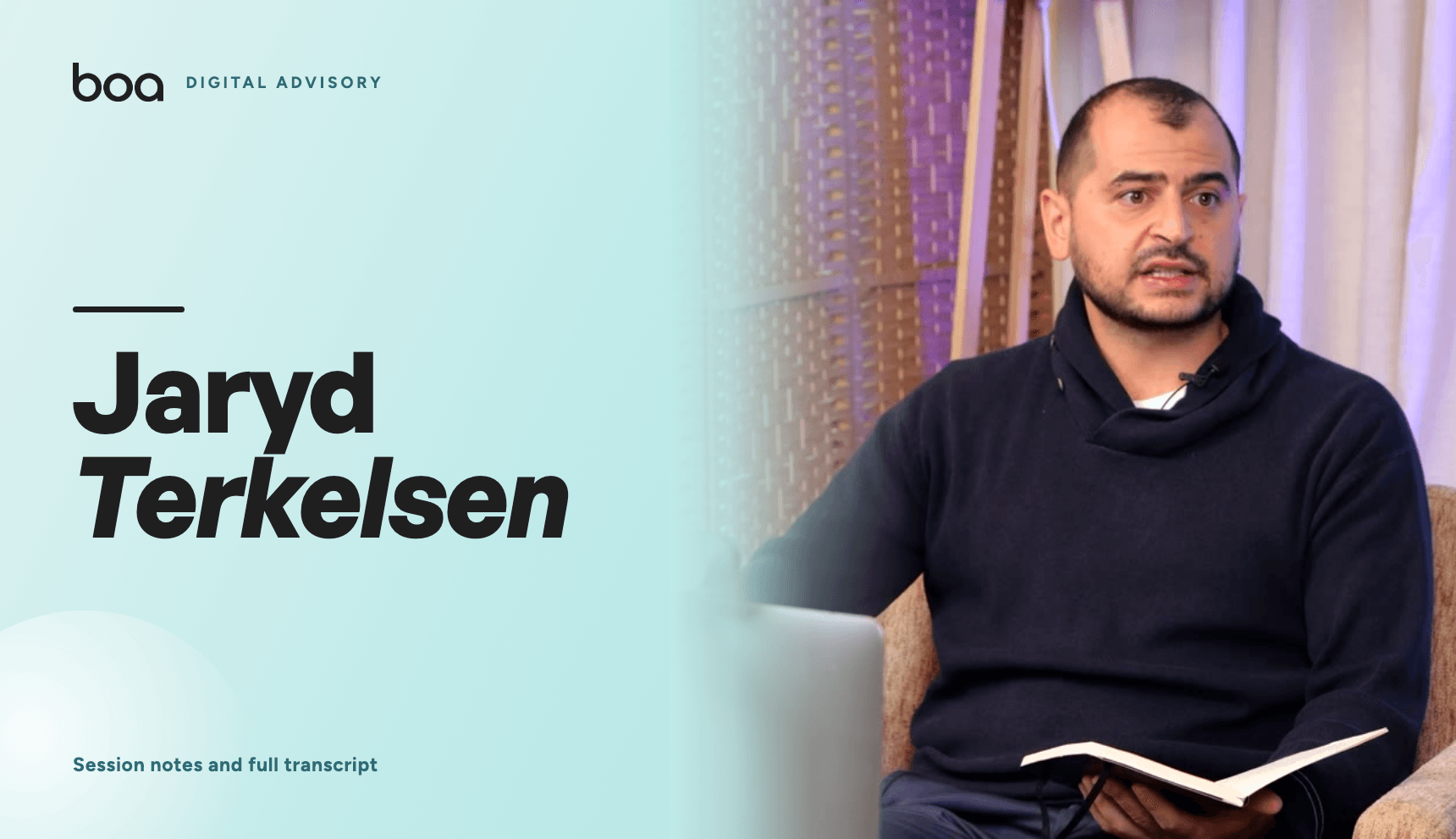
Jaryd Terkelsen on Selling a Product Into Woolworths
With Jaryd Terkelsen, Co-founder at Before You Speak Coffee · Hosted by Boa host · 32 min
What this session covers
Jaryd Terkelsen built Before You Speak Coffee from one product into 1,500 retailers and a national Woolworths listing. He covers launch focus, customer acquisition maths, sale of return and trade marketing clauses that sink brands, and how partnerships with Formula 1 opened petrol and convenience doors. For product and e-commerce founders.
Build the e-commerce channel first so you have cash flow, data and negotiating power before you sign anything with a major retailer.
Key takeaways
- 01
Improve an existing daily habit rather than replace one
Jaryd's starting question was "what's going to replace coffee?" He changed it to "why replace it when we can just improve it?" Coffee is the most widely consumed beverage behind water and people do not skip their morning cup, so adding vitamins and minerals means the customer gets the upside without changing behaviour. If you want a big brand, pick something already inside a daily habit or routine.
- 02
Launch with one product and one audience
Before You Speak launched with a single performance coffee, still its number one seller today. With limited resources you are the marketing team and the customer service team, so pushing multiple messages to multiple audiences makes your own life harder. Get one product moving, then use customer feedback to guide what you build next. The unsweetened range and other SKUs came later.
- 03
Do not order 10,000 units on your first purchase order
Their initial PO was 10,000 boxes. It took roughly nine months to sell through, which Jaryd calls not the smartest move on cash flow. Size your first order against a realistic sell-through window, not against your ambition, because that inventory is cash you cannot spend on acquiring customers.
- 04
Formulate for the market, not for your own palate
Neither Jaryd nor his business partner drank coffee with sugar or sweetener, but market research showed most people take coffee with milk or sugar, so they built the product with stevia. They did not love the first samples. It grew on them, and it became the best seller. Build for how the majority actually consumes the category, then niche later.
- 05
Run a daily P&L on your e-commerce numbers
Before You Speak still runs a daily P&L for e-commerce, looking at sales and marketing spend each day to work out what they can afford in customer acquisition cost. Know your product cost, fixed and operational costs, and the margin you need to reinvest into the next customer. That is what lets you move fast when feedback comes in.
- 06
Accept a loss on the first order if the buyback maths works
They spend $60 to $80 to acquire a customer on a product that often costs less than that. It takes two to three purchases to reach customer buyback. Because a 30 serve box lasts a one to two coffee a day drinker about a month, they build email flows and touchpoints in Klaviyo and Shopify around the reorder timing. Profits come from the reorder, so the follow-up is the business.
- 07
Check for sale of return clauses before you sign with a major retailer
Sale of return means if the product does not sell you pay to take it off the shelf and back into your warehouse. Jaryd has seen it sink businesses. A Woolworths worth of stock coming back is cash tied up in your warehouse, and without strong e-commerce or another channel to move it you cannot pay your bills.
- 08
Never let a retail promo put you in the red
Trade marketing clauses commit you to a set number of promotions a year, often deep discounts. When you see 30, 40 or 50 percent off, the brand is frequently funding all of it. If those discount weeks are when most of your units move, you are losing money per unit. Before You Speak made co-funding non-negotiable and still got the deals.
- 09
Say no to retail deals whose structure does not work yet
Nearly eight years in, Before You Speak was only starting conversations with some retailers because of how those deals were structured. Timing is everything. In the early days you will have to say yes to some deals and back yourself, but only ones where you can mitigate the risk.
- 10
Bring an advisor into big retailer negotiations
Jaryd still works with people to get deal structures right on the bigger Woolworths negotiations. Start with your own network and business networking groups to find someone who has done a similar deal, or engage a professional service. Walking into a first supermarket negotiation cold is how brands fall for the clauses.
- 11
Go into every partnership with a defined outcome
Begin with the end in mind: credibility, exposure, audience crossover or direct sales. Partner with non-competitive brands that have spent years and serious money building trust with a similar audience, and that goodwill transfers to you. Do the work for the bigger partner to make their life easy, which also lets you shape how the partnership runs.
- 12
Use one credibility partnership to open a whole new channel
Signing Formula 1 driver Jack Doohan led to a deal with the Alpine F1 team for three seasons. Before You Speak used that brand authority as part of the conversation to get ready-to-drink cans into petrol and convenience, rolling out with Ampol and Caltex. Treat brand outreach like sales: keep knocking, keep turning up, and once the first few land, momentum snowballs.
How the session runs
- 2:18Magnetic Island, a carpentry trade and the pivot
- 4:06Spotting the functional green tea trend and applying it to coffee
- 6:46Point of difference, premium pricing and one product
- 7:55The 10,000 unit first order that took nine months
- 8:21E-commerce first, then inbound from supplement retailers
- 10:07Building a network from zero: it's a sales process
- 11:21Jack Doohan, Alpine F1 and opening petrol and convenience
- 14:19E-commerce versus retail: cash flow, data and control
- 17:55Sale of return clauses and why brands go under
- 19:01Trade marketing, deep discounts and who funds them
- 21:15Using advisors for supermarket deal structures
- 22:26Formulating for the market, not your own taste
- 23:59$60 to $80 CAC, reorder flows and buyback in 2 to 3 orders
- 25:46Q&A: nailing flavour with a contract manufacturer
- 27:41Q&A: staying focused on one product
- 29:04Q&A: the right way to approach brands for collaboration
Mentioned in this session
- Before You Speak Coffee
- Woolworths
- Coles
- Magnetic Island
- Townsville
- Bulletproof Coffee
- Dave Asprey
- Australian Sports Nutrition
- Nutrition Warehouse
- Jack Doohan
- Alpine
- Formula 1
- Ampol
- Caltex
- Shopify
- Klaviyo
- Moccona
- Mark Bouris
- KUBB
- Boa
Questions founders ask
Jaryd recommends e-commerce first. You own all the data, the cash conversion cycle is much faster, and feedback comes quickly enough to make adjustments. Retail brings scale and helps build the brand, but you get less control, longer payment terms and heavy upfront inventory cost. Building e-commerce first also gives you leverage when you finally negotiate with a major retailer.
Two things Jaryd flags are sale of return clauses and trade marketing commitments. Sale of return means you pay to take unsold stock back into your warehouse, which ties up cash and has sunk businesses. Trade marketing clauses commit you to a set number of promotions, and the brand often funds the entire discount. Before You Speak insists on co-funding any deep promo so they never end up in the red per unit.
Before You Speak spends between $60 and $80 to acquire a customer on a product that often costs less than that, because the customer pays it back over two to three orders. The maths works because coffee is a daily habit and a 30 serve box lasts about a month. They run a daily P&L on e-commerce, watching sales and marketing spend, and build email flows around the reorder point.
Jaryd says any channel is fine, including a direct message, but go in with the end in mind. Be clear on whether you want credibility, exposure, audience crossover or sales. Do as much of the work as you can so it is easy for the bigger partner, which also lets you shape the partnership. Then treat it like sales: keep knocking on doors, because momentum snowballs after the first few say yes.
Before You Speak worked with contract manufacturers, giving them rough flavour profiles and iterating with back and forth. Their own manufacturer does not drink coffee, so the taste calls were on the founders. Jaryd's advice for others is mass sampling with the exact audience you intend to sell to, since flavour is subjective and what you like someone else may hate.
Full transcript
The complete conversation, as recorded, with every speaker attributed.
Boa host0:00
Thank you all for being here today. And guys, I've been talking to Jared for— we've actually been sitting here for about half an hour just catching up, and he's an incredible human being. He's actually a bit of a small town country boy who's gone out to build, like, really what's become quite an iconic brand. Before You Speak Coffee is his business. He founded it in 2017. And it's now in over 1,500 retailers nationally. And in fact, this week he was just telling me this week they're putting a full product range across all Woolworths nationally. So it's a big week for Jared. So very lucky to have him here. As you all know, our mission at BOA is to, is to make the highest quality networking advisory accessible to every entrepreneur, no matter what stage of business you're at or where you're located. And today, Jared's really given us his time to share his big lessons in his journey and hopefully give us all some snippets of wisdom in today's conversation. As always, this isn't a podcast. This is an open conversation. So please get involved, ask your questions in the chat. And after I ask a few questions, I'll just call you out and you can ask Jared questions directly as well. So please don't forget, as we, as we're speaking, you might think of something, put in the chat. And I highly encourage you to do it no matter what the question is. Um, because if, if it's something you're interested in, I'm sure it's something someone else is as well. And it can be about your business and specific advice too. That's kind of, that's the whole point of these things. Um, Jared, welcome and thank you for being here today.
Jaryd Terkelsen1:43
Thank you for having me.
Boa host1:44
Um, now I, I just think it'd be a nice place to start, uh, like you've be, you've built this innovative brand, um, in a, like a traditional market, coffee. Everyone loves coffee, and it's been around a long time, so you wouldn't think there's room to kind of, you know, create a business in it. But somehow you did. And I think it's really special too that you were telling me about, you know, where you're from and kind of how business was something really like unique in your, in your environment. Do you want to just maybe share about where you're from and kind of how you started the business? What inspired you to do it?
Jaryd Terkelsen2:18
Yeah, sure. So I grew up in North Queensland on a little island called Magnetic Island off the coast of Townsville. So I spent the first 17, 18 years of my life on the island. I kind of grew up in a family where I was like, you either get a trade or you go to university. I didn't really understand anything about entrepreneurial life or what that could look like. So I ended up getting a trade. So like, I'm a carpenter by trade. I did that for 6 years, like building residential homes to start with and building mining camps, working out at the mines, and just really did not enjoy the work, to be honest. So I wanted to find something where I could move into, I guess, health and fitness, something I was passionate about. I, um, I first started working in sports nutrition, uh, like supplement stores, for maybe about 6 months. So I'd run my own construction company Monday to Friday, then Saturday, Sunday I'd work at the a pop-up store on the weekend. And then eventually, like, I moved out of doing that when an opportunity came up to just manage that full-time. And that was kind of a fairly big pay cut to kind of go backwards from running your own construction company to working in retail. But it was a step in the right direction for me. I did that for about 6 months, and then I moved into— I started my own personal training company with my partner at the time. We grew that to a reasonable size business and like they still do really well in Australia. But then as I was doing that, I kind of started working on the coffee brand with my business partner now who also worked with me in Australian sports nutrition at the time.
Boa host3:56
So, and how did you get the idea though for, for like a performance coffee, like a healthy coffee alternative? I mean, not that coffee is probably not healthy, but you know what I mean?
Jaryd Terkelsen4:06
Yeah, like I, um, I have lots of business ideas and this was kind of one of them, but being in, I guess, the personal training space, I was up at 4:00 AM every morning. Um, I was drinking like shitty Macona, which is horrible at that time of morning, but it was like just something to give you a kick. Um, having worked in sports nutrition and in that space, I'd seen what was happening with kind of like green teas and there was some functional green teas starting to come out that were doing really well. Um, I always wanted to build a really big business or a really big brand, and then to do that, I kind of realised like you need to find something that people are going to use every day or become part of a habit or routine. So I kind of looked at what was happening with green tea, um, thought, why is no one doing this with coffee? At the time, probably, uh, the only people doing it were Bulletproof Coffee in the US. So David Asprey, who was kind of early days, like the grandfather of biohacking, um, seeing what was happening with their brand, which is really just mixing like butter and MCT or like fats into your coffee, uh, was starting to kind of really take off over in the US. And I thought, well, there's so much more scope than just doing fats into coffee. Um, like there's so many vitamins and minerals, like how can we use this as a vehicle to kind of address different elements of health, well-being, and performance? And I guess that's where the idea started.
Boa host5:30
So really you saw a trend that, like, you saw a wave, a trend that was happening in the market and you just took your own, your own flavour of it in the sense like you saw, okay, but we could do that better.
Jaryd Terkelsen5:45
Yeah. Like my original thought was like, I wonder what's going to replace coffee. Like it's the, I guess, most widely consumed beverage behind water. I was like, what's going to replace coffee? And I was like, why do we have to replace it when we can kind of just improve it? Yeah.
Boa host6:01
So yeah, so sometimes when you're starting a business, it's not about changing someone's habit in the sense, it's maybe about making their existing habit better for them.
Jaryd Terkelsen6:11
Improved. I really like that coffee. Like your morning coffee is one habit that people just don't skip. So if we can add the vitamins and minerals into that, you're kind of getting the upside.
Boa host6:21
Now, creating a product-based business or a retail or e-commerce-based business, a lot of people want to do it and get into it, but it is notoriously hard to do because you've got to sell a lot of units. What are the, what do you think were the most important things you did at the start of the journey that allowed the business to be successful that other people could take away?
Jaryd Terkelsen6:46
I think having a clear point of difference with our product. So we launched with a single product, which was our performance coffee. It's still our number one selling product today. But having a point of difference with the product or the market that we were going into, like you said, coffee is obviously, it's a huge industry, but there's a lot of players in there. So for us, it was like, how can we position ourselves as something unique or something as an elevated experience? We wanted to go the premium route so we could charge higher than I guess most products on the market and kind of give us those margins. As well.
Boa host7:20
Do you think it was also a clever idea to only go in with one product? So like it was more potentially financially, um, it made the business more financially accessible to yourself, uh, focusing on one product as opposed to trying to start like launching a whole range?
Jaryd Terkelsen7:35
I think so. Um, it's a lot easier to pick a single customer, a single audience, and kind of build upon that. Um, we definitely weren't smart about it at the start with where our initial purchase order, we ordered 10,000 units, so 10,000 boxes. So we're probably a little bit ambitious.
Boa host7:55
Ambitious.
Jaryd Terkelsen7:56
And that took us probably 9 months to sell, I think, to get through. But cash flow-wise, that probably wasn't the smartest move either.
Boa host8:04
And so you've got the product, you've built your brand, you've ordered your 9,000 units, you've got your product. How did you actually sell it? Like, how did you get it into— were you in retail stores? Did you, did you start online only? Like, how did you actually start moving that much product?
Jaryd Terkelsen8:21
So we started, like, to be honest, we only wanted to be an e-commerce only brand to begin with. Um, I liked the element of just having control with everything that we're doing. Um, but because of our relationships within, I guess, sports nutrition and the retail space, after about 3 or 4 months, the guys from Australian Sports Nutrition, Nutrition Warehouse, did reach out to us and said, hey, like, we want your product in there. Again, they've probably seen how well the functional tea and stuff went.
Boa host8:52
And how did they discover it? Online or just socials?
Jaryd Terkelsen8:56
Like, they were in our network, which was kind of lucky for us. So we were able to leverage our network a little bit in the early days. But when we started with e-commerce only, we also had quite a few connections, I guess, in the call it fitness influencer space. So we were able to kind of leverage those in the early days. And I'd spent a fair bit of time in that with my previous business in the personal training, like helping to like build partners' profile at the time. So I'd like, I'd spent a lot of time in that Instagram marketing space as well. So we leveraged that audience and people in our network to get the brand name out there early. And that kind of helped us with the conversations with the retailers.
Boa host9:33
So really a lot of the brand's initial, success or what, what caused a lot of the initial success were, existing relationships in relevant places like fitness influencers, supplement stores where you, you may have worked. So really you leveraged your existing network. Were there any, or do you have advice, for people who, may not have an existing network, like for influencers or things? How would you approach it if you didn't have those existing relationships?
Jaryd Terkelsen10:07
Um, I think first things first is like, if you create a quality product and you find a niche in the market that you're going to go after, there's going to be people that want it. So your role then is to go and find those people that would find your product valuable. Um, it's just lots of outreach. It's the same as any sales process, like sales outreach, reaching out, like doing stuff on your own socials. Um, as many touch points as possible. It's kind of building those relationships.
Boa host10:36
I like that though. I like, I like the fact that you look at partnerships and brand alignment, whether it be with influencers or retail stores or whatever it may be. You look at that as it's a sales process, and anyone that's been in sales before knows that sales is a lot of outreach, a lot of phone calls, a lot of nos. And until you tweak your systems, like you said, you found— you find your ideal customer and then you can start getting the yeses. Now you've used— partnerships have been a big part of the business. Can you share an example or multiple of partnerships that you've made that have had a tremendous impact on the business's success that's helped the business grow or whatever the benefits were for it?
Jaryd Terkelsen11:21
Yeah, sure. Like I guess over the years we've done lots, I guess, in the influencer space as we've kind of mentioned, but I guess probably more notably over the past 12 months, so where we've kind of signed on with Jack Doohan, Formula 1 driver. With that, we've actually built relationships and we ended up signing with Alpine Formula 1 team for the next 3 seasons. So relationships like that have already been a game changer for us. So we're currently rolling out products. We've got the Woolworths range that goes national this week. With our new instant latte sticks, but we've started rolling out our ready-to-drink cans as well that I showed you earlier. Now going into retails like petrol and convenience channels, it's an audience where we've been able to leverage those Formula 1 brand partnerships to kind of open up doors. The doors. Yeah.
Boa host12:12
Okay. So you basically went to service stations and the big brands and basically said, hey, we're partnered with the Formula 1 or with the Formula 1 team. We're the real deal. You should stock us.
Jaryd Terkelsen12:23
It gives us— it's given us, I guess, a lot of brand authority and credibility in the market with these new products. So like we're rolling out with Ampol and Celtex at the moment and like having that as part of the conversation, we're able to kind of leverage to get our foot in the door.
Boa host12:41
Yeah, I kind of relate that to like when Mark Bouris got involved at KUBB and of course with Boa too. It's like it gives you that street cred. And once you have that, you can really— it opens the door. So as an up-and-coming brand, you know, fine, it's obviously hard to do, otherwise everyone would do it, but finding a way to find a partnership that gives you a bit of street cred, whether that be with an influencer or with whatever organization, that had a tremendous impact on your business's success.
Jaryd Terkelsen13:09
100%. I think like partnership is an easy one to try and leverage as you're growing the brands. Like I always look at it like try to leverage up with whoever you're working. It's like when you start, obviously you start small, but you kind of, any partnership or collaboration you go into, go into with an outcome that you're trying to get. So going like, and that might just be brand awareness and credibility. It might be audience crossover. And like if you've been partnered with another brand that's non-competitive that has a similar audience to you, they may have spent of thousands, millions of dollars and years building relationships and trust with their audience. And you then kind of get to come in and automatically get that goodwill from those customers to come across to your brand.
Boa host13:57
Now you, um, you, uh, have successful sales channels both online through e-commerce and in physical stores. What is the difference between the two? Like, not in the stupid sense, but in the sense of as a business handling, which one do you prefer? What are the unique attributes of selling online as opposed to selling in store?
Jaryd Terkelsen14:19
Sure, I think in the early days it's a lot easier to focus on e-commerce. What I like about e-com is you control all the data, all the data is yours. It moves a lot quicker, like your cash flow conversion cycle is a lot faster. So it is good for cash flows, like you can get faster feedback, make adjustments. And if you know your numbers, it allows you to move quite quickly. Retail—
Boa host14:48
What do you mean by know your numbers? Like your marketing conversion rates and things like that?
Jaryd Terkelsen14:53
Yeah, I guess all of that stuff. So obviously your product costs, your fixed costs and operational costs within your business, what you can afford to spend on marketing to acquire a customer upfront, obviously. Everything from having the product, going through the product experience for them to receive the product, and working out what your margins need to be to then reinvest to acquire another customer. And that becomes a cycle. So it's like if you're dialled in with your numbers, you can almost run a daily P&L, which we still do today for our e-commerce. Like we look at the sales, we look at the marketing daily and understand how much we can afford to put into customer acquisition costs. Knowing that our customer lifecycle will kind of pay itself back over 2 to 3 orders.
Boa host15:41
Okay, wow. And sorry, I interrupted, but you were about to talk about in-store sales? Yep.
Jaryd Terkelsen15:48
Retail is a great one because you then allow them to help build your brand. The most challenging thing with retail is a lot of the time you don't have full control. So like what they want to do in their stores, they will. It's also most of the time you're going to be on longer payment terms, so it's a longer cash flow conversion cycle. And the volume of just upfront cost into inventory to then supply these guys at the start can put a lot of cash flow pressures onto the business. But if you get it right, I guess for especially for us, like CPG company, just get to the scale that we want to, we, we definitely need retail to be in the mix.
Boa host16:32
So it, it sounds like, so if you were starting the business again, you would start online. Yep. Because it's easier, uh, less cash, cash intensive, and you can, you have more control, uh, and, uh, access to the data, which means that you can then learn what's working, what's not working. You're closer to your customers, so you can get a lot of feedback. Um, but, uh, what retail does, it's more cash intensive, I guess, but what it does is it gives you that scale. So once you get to a certain point, in online, then it basically enables you to get into the big retail chains. And the way you also got into the big retail chains was in some part, other than having a quality product that had, that is unique in the market and that's very sellable and that would sell frequently because it's coffee, you leveraged partnerships to, to help open those big retail doors.
Jaryd Terkelsen17:22
Yeah. And I think Having built in the e-com space, it's allowed us to build a brand and kind of gives you a little bit of upside when you do have negotiations with retailers. If you go into retail too early, and it could be a big deal with a bigger retailer wanting to stock your product, if you don't have the sales channels outside of that, and if they have sale of return clauses, which means if they take the product, it doesn't sell, you actually have to pay to take it back off the shelf and put it back in your warehouse.
Boa host17:55
That would suck.
Jaryd Terkelsen17:56
It would, it would. And it, it sinks businesses all the time when they get it wrong. So I was like, if you have to take, I guess, a Woolworths full of product back into your warehouse, that then becomes cash tied up that's sitting there. And if you don't have existing or strong e-commerce sales or sales through another channel to move that product, you've got no cash flow to pay your bills, like people go out of business.
Boa host18:18
And so what are some key lessons you learned in negotiating with the big retail chains? Obviously one you mentioned is don't go too early and watch out for tricky clauses like that, but what are other things you've learned that other people should consider when speaking to the big retailers?
Jaryd Terkelsen18:37
Sure, I guess timing is everything with these guys. It's Some of the retailers were about to tick over 8 years in our journey. We're only having some of these conversations now. We've deliberately stayed away from them because of, I guess, the structure of some of these deals.
Boa host18:55
Oh, so you actually said no to some? You're like, nah, nah, I'm not doing that. I'm not falling for that trap. Yeah. Oh wow.
Jaryd Terkelsen19:01
Just like timings and like a lot of them, we will go in, you'll have trade marketing clauses where you need to commit to X amount of promotions through the year. And some of those will be deep discounts. For the brand. Um, like, for them it's good because they— when they put you on sale or on discount, a lot of the time that's not them paying for it, that's you paying for it as a brand. So I didn't know that. Yeah, I was like, if you see, um, 30, 40, 50% off in somewhere like, yeah, Woolies or your Coles, sometimes they will co-fund it, and that's kind of part of the negotiation that you need to really be on top of, but sometimes brands will have to fund that whole lot themselves. So if they're doing a 50% off and that's the only time you're selling majority of your units, a lot of the time you'll actually be losing money on that deal. So that's another one. We've made sure any deal like that we've actually co-funded with them because one of our things is we never end up in the red. Mm-hmm. What they present to you initially is you will end up losing dollars per unit on those deep promos. But for us, we're like, that's non-negotiable because that's too much risk in the business.
Boa host20:13
And by holding strong on that clause, you ended up getting the deal anyway. They did come through.
Jaryd Terkelsen20:19
Yep. Yeah.
Boa host20:20
And did it take a lot of courage potentially to say no to some retail deals, or was it an easy decision?
Jaryd Terkelsen20:30
I think in the early days, for sure. I think as we've grown, it's just your risk profile changes as well. It's just smart business. I guess in the early days, you want to say, and you do have to say yes to some of these deals and just back yourself, but just make sure they're ones that you can kind of mitigate the risk so you're not putting yourself in a tricky position.
Boa host20:55
Yeah. And did you have advisors? Do you get advisors when negotiating with retailers? I mean, walking in without ever having done it, I imagine you'd fall for a lot of traps. So did you just fall for the traps at the start and then learn, or did you have an advisor that would come in with you on the negotiation?
Jaryd Terkelsen21:15
Yeah. So wherever we can, we've leveraged relationships. With these bigger deals with Woolies, we do work with people to help us get the deal structures and stuff right still.
Boa host21:25
So you would recommend people use kind of advisors for that type of thing?
Jaryd Terkelsen21:29
100%, yeah. Reach out and it may just be people in your network to start with. Again, I guess being in business networking groups, I guess perfect example to be able to reach out to people and find people that have done something similar or yeah, look for a professional service that does this.
Boa host21:46
Now guys, please throw, I can see lots of questions coming in. Put more, we're about to go to questions now. I just have a couple more questions I want to ask. One is on, uh, you, so it sounds like the e-commerce is the more important part because if you don't get that right, you're not getting the retail anyway. So I just wanted to focus quickly on the e-commerce. And also you mentioned having a quality unique product is essential, which of course I, I agree. So I wanna talk about how you actually did that. Um, uh, let's start with the product. Um, how did you actually, when, when developing your product, how did you know it was good? Like how did you know what people would want and, and, and, and what they would like? Did you base it off yourself or test it?
Jaryd Terkelsen22:26
No. And this was the interesting thing. So our performance coffee, like OG, which is still our number one seller, um, we knew from a product formulation standpoint what we wanted with effective dosages of specific ingredients in there, um, having a background in sports nutrition. But when it came to the actual coffee product, like where we use a natural sweetener, stevia in there, So neither myself or my business partner drunk coffee with any kind of sugar or sweetener prior to our product. But it was like looking at, I guess, doing market research and seeing how most people consume their coffee either with milk or sugar. We knew we needed to make it not for ourselves.
Boa host23:10
So you made it for the market. You didn't focus on yourself, you focused on the market and what the market wanted.
Jaryd Terkelsen23:14
Correct. Which was tricky at the start because the first time we tried it, it was like we didn't really like it, but it grew on us. It grew on us. And I'm glad we did. We've obviously got an unsweetened range and stuff now. Yeah, we—
Boa host23:28
but I think what's important there is you focused on the majority of the market first for the first product. Once that was successful, you then niched the product to service other people's tastes, flavour variations.
Jaryd Terkelsen23:41
And then like now we've got a range of different, I guess, products to use.
Boa host23:45
And then in terms of e-commerce, You did do partnerships, you did use influencers, but what are the most important lessons you've had in becoming successful with a consumer product online?
Jaryd Terkelsen23:59
Um, I think having a clear point of difference, just getting your systems right. And what I mean by that is like understanding what your customer life cycle is. So for us, being a coffee product, um, we know it's like, it's a daily habit. So we sell a box of 30, you're going to assume that people, depending if they're a 1 to 2 a day coffee drinker, that they all have within a month roughly that they're going to kind of finish that box. So I was like, then a lot of our backend, what we do with our email marketing systems, and like we use Shopify, which is very, I guess, user-friendly. We use Klaviyo for our emails. So it's like having our email flows and just like customer touchpoints. Making sure like everything's about the reorder in business. Like that's where your profits come from. We might spend even now between $60 to $80 to acquire a customer on a product that costs less than that a lot of the time. So it'll take us 2 to 3 purchases to get to our customer buyback. Okay. So it was like knowing your numbers on those things and what you can afford to spend upfront to acquire a customer. Are critical. And then making sure you're actually doing the follow-up and nurturing those relationships and the customer to make sure they have a positive experience and they actually do come back and purchase.
Boa host25:20
So interesting. I always learn so much talking to product-based business owners. It's so different to my style of business, but there's so many just learnings and lessons that are unique to product businesses. It's so interesting. I do want to get to questions, and I'll, I'll ask Christy. Christy Hooper, do you want to go first and, and ask Jared your question?
Audience member25:44
Sure.
Boa host25:45
Yep, yep.
Audience member25:46
It was more about— I think touched a bit on it— taste of the product and how you obviously, um, coffee, I guess it get the right flavor. So many varieties, how did you go about nailing the taste of it?
Jaryd Terkelsen26:04
Good question. So like, where we obviously work, we work with contract manufacturers. We kind of gave them rough profiles that we wanted and they kind of did the magic work in the flavouring and stuff. But there was a bit of back and forth because even now, it's funny, our manufacturer doesn't drink coffee, so he's like, I think it all tastes like shit. So like, when he gave it to us, it was kind of on us, on us, like, but Making sure we got like really high quality ingredients and stuff. In the early days when you're, especially with what we were doing, it was like you tell people you've got coffee with 4 or 5 other ingredients, they're like, oh, it's gonna taste like rubbish. So it was important that we got that right or we probably wouldn't have a business.
Boa host26:46
Kristy, what's your business?
Audience member26:47
I didn't.
Boa host26:49
What business you—
Audience member26:49
I'm a mortgage broker, but I'm working with a lot of startups. Start their business. So, um, and there's a lot of questions that I don't have. So obviously I can help them with finances, but then things like this when it comes to product packaging, flavor, all those things, I, I'm not an expert in it. So it's really just about finding channels to kind of help guide them down those channels to get that help. But yeah, I'm just— I'm working with someone similar at the moment on a product where it's like an energy performance drink, organic one. And again, they've got the questions around just nailing the flavour and then obviously the packaging.
Jaryd Terkelsen27:24
Amazing. And it's tricky, right? Flavor's subjective. I was like, what you might like, I might hate. 100%. So it's like maybe just getting enough to do, I guess, mass sampling for the audience that you're going to try to sell to. It's probably the best way to do it.
Boa host27:41
Thank you, Christy. I hope that was helpful. Kate's question is, how did you stay focused on just launching one product initially and knowing which was the right to start with?
Jaryd Terkelsen27:51
Good question. Focus isn't my strong point.
Boa host27:55
A lot of business owners.
Jaryd Terkelsen27:56
ADHD all over the place. It was not only focus with a product, but I was like, I've created probably 4 or 5 other businesses within the timeframe of doing BYS, which none of them are still going. So there's a lesson in that. But I think for us, we knew, again, it's probably a big part of it is cash flow and cost, right? It's trying to do too many things at once. And having limited resources, especially when you start, it's like you're the marketing, you're the customer service. Like, to then have multiple messages that you're trying to push out to multiple audiences, um, probably just makes your own life a little bit more difficult. So if you can get one product moving right and then kind of start to get customer feedback to help guide the decisions for, I guess, next products and stuff, like, that's kind of the, the strategy that we followed.
Boa host28:47
Awesome. And finally, I got one more question from Kirsten. How do you approach brands to collaborate with? In your experience, what is the wrong or right way? We see so many people directing direct messaging on Instagram and socials these days to start the conversation. What advice do you have around that?
Jaryd Terkelsen29:04
Um, I think reaching out through any channel makes sense, to be honest, wherever you can get in contact. But again, for, for us, it's Going into any partnership or collaboration with, uh, like beginning with the end in mind, like knowing what you want to get out of that. And it might be credibility, it might be just more exposure, it might be growing your audience, like wanting new sales and customers. Um, so it's like being clear about what you're trying to get out of it. And then even going into those conversations, even if they are bigger than you, the easier you can make their life by doing a lot of the work, but it's also good for you to kind of control as much as you can in that narrative and in that process because you get to then shape how that partnership works as well.
Boa host29:53
How would you get them? What if you're trying to get to them and they're not replying? How do you get their attention? Was there ever a time you couldn't get attention and then you got it?
Jaryd Terkelsen30:02
Good question. Nothing immediately comes to mind, but I'm sure there has been. Especially the early days, if you are the little guy, you have no leverage in the conversation. So it's like sales, right? Again, bringing it back, it's just knocking on doors frequently, often.
Boa host30:22
So treat it like a sales process.
Jaryd Terkelsen30:23
Yes. Just keep turning up. 100%. Keep turning up, keep knocking on those doors. Eventually you will get people and you may not get everyone, but you're going to get people that respond to you and leverage that, do that and just keep going.
Boa host30:37
And for you guys, did it build slowly? Like it was hard to get the first, for example, 3, but then once you got the first 3, then it started happening faster and faster or?
Jaryd Terkelsen30:44
100%. Everything's momentum, right? So people kind of see that and it's like the more activity that you're doing, that just kind of snowballs.
Boa host30:52
Yeah, I love it. Jared, thank you so much for today. On behalf of myself and everyone here in the whole BOA community, we're so grateful for your time and your advice. Your business is incredible and I'm going to be high on heaps of cans of coffee for the next week because he gave me a box. But guys, also important to note, all of these events, or pretty much all BOA Advisory events, whether they be in-person or digital, will next month be live on the app. So you will have access to all of our events. So if you attend and you want to re-listen for lessons or if you couldn't attend one, You missed it, you can then watch it and listen to it through BOA. That'll come out next month with the premium version of BOA, and that'll include in-person events. So if there's an in-person keynote or advisory session anywhere in the country, everyone will have access to it. Finally, I say it all the time, but make sure you join your local networking chapter on BOA. It is so important knowing other business owners in your area and having the convenience to catch up once a month with them is really going to change— it'll change your life as a business owner. I can promise you that nothing changes your business, like surrounding yourself with the right people. And Jared, thank you so much again for today.
Jaryd Terkelsen32:08
Thanks for having me, guys. Thank you for logging in.
Boa host32:10
Have a great day, guys. See ya.
Watch the full sessioninside Boa.
Session notes are free. The recordings, the live advisories and the founders in the room are for members.