Digital Advisory
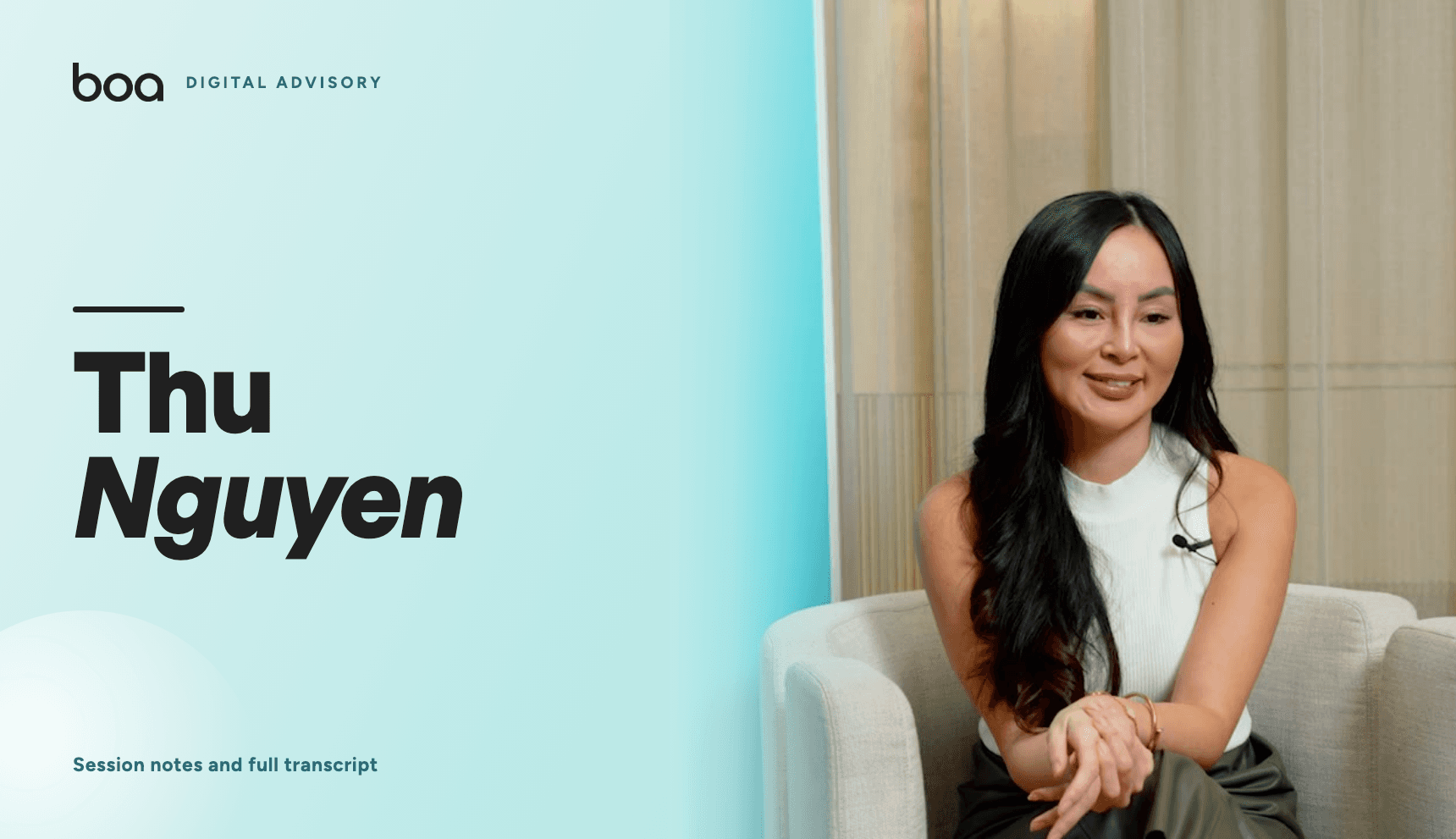
Thu Nguyen on Scaling Brands Into Overseas Markets
With Thu Nguyen, Founder, COO and Board Advisor at Unhinged Business · Hosted by Boa host · 36 min
What this session covers
Thu Nguyen breaks down what separates brands that scale from brands that stall: profit over revenue, a short list of strategies held with conviction, and honest maths on overseas expansion. Covers testing markets through distributors, trademarking in China before you manufacture there, wholesale versus D2C, and the channels beyond Meta ads. For product founders eyeing global growth.
Pick three to five things and do them at 100 percent, because 20 strategies at 20 percent is how brands plateau.
Key takeaways
- 01
Do five things at 100 percent instead of 20 things at 20 percent
Thu says the brands that scale well pick a strict strategy and stick to it with conviction, while the ones that plateau chase 20 different ideas at once. Her advice to visionary founders who arrive with 10 ideas is to filter down to three, execute those fully, then move to the next. Also know when to quit a strategy that clearly is not working rather than staying fixated on it.
- 02
Judge growth on EBITDA, not the revenue headline
Founders proudly report 100 percent year on year revenue growth while their spend has gone up 400 percent. Thu's framing: there is no point making an extra dollar if it costs you two dollars to do it. Protect profit as the number, and treat revenue growth as meaningless without the margin behind it.
- 03
Bank a few quarters of profitability before you scale
Thu's test for readiness is several consecutive quarters of stable profitability, not appetite or ambition. She sees founders raise capital during a plateau and then use that money to survive rather than grow. Before you take investment, ask honestly whether the capital funds growth or just keeps the lights on.
- 04
Market beyond LA and New York when entering the US
Thu notes the rough industry benchmark that every dollar made in Australia can be $15 in the US, but most founders she speaks to have only ever visited LA or New York. The Midwest, Southwest and East Coast are culturally different markets, and states like Wisconsin, Ohio and Utah often generate serious money. Target the regions where your customer actually lives instead of the flashy cities.
- 05
Sort your US tax and entity structure before you land the deal
Thu warns that founders overlook federal, state and local tax layers, and that accountants operate differently state to state. Many only discover this when the IRS bill arrives. Decide up front whether you need a US entity or can trade as an Australian business, and get the structures solidified before entering the market.
- 06
Price the hidden cost of trading with a big retailer, not just landing them
Getting into Sephora or a department store is one thing, trading there is another. Thu points to retailer requirements you fund yourself: mandated spend, in-store activations and displays. Retailers also dictate change, including branding and colour, if it clashes with an existing brand on shelf.
- 07
Test new markets through distributors, not your own cash
Answering a founder with roughly $10K to test the US, UK or UAE, Thu recommended finding distributors first. They buy the stock from you, so they carry the risk, and they already have 3PL and sales staff on the ground. Find them at trade shows and through direct outreach online, then work to identify the right one rather than the first one.
- 08
Audit a market by counting the retailers and the me-too brands
Start with who actually buys your product, then check whether that person exists in the target market and how big that group is. For a $200-plus product aimed at women 40 and over entering the Middle East, Thu's method is to map which retailers that customer shops and how many competing brands already sit there. That tells you if it is white space or already saturated, and lower hanging fruit may be a market you have not touched.
- 09
Trademark in China if your product is made there
Thu has seen people in China buy trademarks off the back of export documents, then charge the brand once it grows. One company paid around USD $300,000 to get theirs back. Without the trademark you can be stopped at customs and blocked from manufacturing or exporting, and remember trademarks cover product names within your range, not just the business name.
- 10
Cap Meta and Google at 30 to 40 percent of your e-commerce mix
Thu argues Meta and Google should only be about 30 to 40 percent of e-com now, with the rest coming from TikTok Shop, live shopping, Pinterest, community building and out-of-home activations. TikTok Shop needs a US entity, though agencies can work around that, and only about 30 percent of Americans even know it exists. She also flags GEO, optimising so your brand is the answer inside ChatGPT and Claude.
- 11
Value your own hour at $500 and delegate anything below it
Thu's rule of thumb is that a founder's time is worth $500 an hour, so every hour should generate around that in revenue. An hour of data entry belongs with a VA. Founders should work on the business rather than in it, especially while capital raising, which is a full-time job on its own.
- 12
Check your manufacturer can survive your best-case order
One brand Thu worked with was running 3,000 unit production runs, then signed a large retailer needing 100,000 units their manufacturer could not make. Sourcing a replacement manufacturer takes roughly 16 months, and retailers will not wait because shelf space is one in, one out. Map every stakeholder against where you plan to be, not where you are.
- 13
Match your D2C and wholesale split to where conversions actually happen
Thu moved one client from roughly 80 percent wholesale to 80 percent D2C over 12 months after the data showed conversions were coming from direct. If your buyer is Gen Z, wholesale is probably not your channel. Wholesale also carries retailer demands and funding obligations that D2C does not.
How the session runs
- 0:31Back It or Bin It: fast calls on founder advice
- 2:48From Myer buyer to FMCG and consultancy
- 5:33Why some brands scale and others plateau
- 7:21Revenue vanity versus EBITDA
- 7:56When a business is genuinely ready to scale
- 9:20US expansion: regions, entities and tax
- 12:14Hidden costs of landing a big retailer
- 13:38Wholesale versus D2C: choosing the model
- 16:17Operational foundations before growth
- 18:35TikTok Shop, Pinterest, community and GEO
- 20:52Getting the founder out of the bottleneck
- 23:50Q&A: entering an industry you don't know
- 26:45When TikTok Shop reaches Australia
- 28:08Testing a market with $10K
- 31:14Trademarks, China and a $300K lesson
- 32:52How to audit a market before you commit
Mentioned in this session
- Myer
- Zara
- H&M
- Nordstrom
- Neiman Marcus
- Walmart
- John Lewis
- Sephora
- TikTok Shop
- Meta
- Google Ads
- ChatGPT
- Claude
- YouTube
- Discord
- Twitch
- Shopify
- Gary Vee
- TBH Skincare
- The Breakout Pack
- Unhinged Business
- New York Now
- IRS
- Australian Fashion Council
- Hong Kong
Questions founders ask
Thu recommends going through distributors rather than setting up yourself. A distributor buys the stock from you, so they carry the inventory risk, and they already have 3PL and sales people on the ground. Find them at trade shows and through direct online outreach, then take time identifying the right partner. Testing a market yourself is high risk because you only learn it was the wrong market after you have spent the money.
Yes. Thu has seen people in China buy trademarks after spotting export documents, then charge the brand once it becomes successful. One company paid around USD $300,000 to recover theirs. Without the trademark you can be stopped at customs and blocked from manufacturing or exporting from China.
Thu's marker is a few quarters of stable profitability before you push for growth. She sees founders raise capital during a plateau, where the money funds survival rather than expansion. Before raising, ask whether the capital genuinely accelerates growth or just keeps you afloat.
Thu says from what she hears from TikTok, it is not in their three year plan for Australia, largely because of complexities within the company. When it does arrive she expects it to change the game, particularly for Gen Z impulse buying and live shopping. Even in the US, she says only around 30 percent of people know TikTok Shop exists.
Thu's view is that Meta and Google should account for roughly 30 to 40 percent of an e-commerce business now, not the whole plan. Meta has become saturated and harder to make work. She points founders towards TikTok Shop, live shopping, Pinterest, community building, out-of-home activations and GEO, which is optimising so your brand surfaces as the answer inside ChatGPT and Claude.
Full transcript
The complete conversation, as recorded, with every speaker attributed.
Boa host0:00
Hi guys, thanks for jumping on with us this morning. We're joined by the beautiful Thu Nguyen. She is a COO, a board advisor, and the founder of Unhinge Business World. Couldn't get that one out. Um, but yeah, she's amazing, and I honestly, I love your content. I love everything that you do, um, and I actually know that a few founders in our community work with you, which is super exciting.
Thu Nguyen0:25
I, um, recognise some names. Hi, Taryn. She's beautiful.
Boa host0:31
Now, in true fashion, we are going to start off with a little game. Yeah, this one is called Back It or Bin It.
Thu Nguyen0:37
Okay. Okay.
Boa host0:38
So if you back it, yell out back it. Okay. If it's not for you, we're binning it.
Audience member0:42
Okay.
Boa host0:43
Ready?
Audience member0:43
Yeah. Okay.
Boa host0:44
Starting a business before you feel ready.
Thu Nguyen0:47
Bin it. Why? I think you should be ready. Okay.
Boa host0:51
Yeah, I love that.
Thu Nguyen0:51
Or feel ready.
Audience member0:53
Okay.
Thu Nguyen0:53
And not start you know, just because. Yes.
Boa host0:56
Yeah, I love that. Taking business advice from TikTok.
Thu Nguyen1:00
Um, yes. Yeah, I agree. I support that.
Boa host1:04
Cool. Yeah. Um, are you giving business advice on TikTok?
Thu Nguyen1:08
Um, am I giving business? Yeah, I should be, but I'm not a TikToker. Yeah, yeah, a unique platform. Yeah, but I do give business advice on Instagram. Yeah, yeah, even better.
Boa host1:18
Uh, hiring before you've nailed your offer.
Thu Nguyen1:21
Um, can it? Yeah, yeah, bin it!
Boa host1:25
Chucking it out. No, no, all good. Saying yes to every opportunity—
Audience member1:31
Yes.
Boa host1:31
Yeah, we're backing it.
Thu Nguyen1:33
Yep, backing it up.
Boa host1:34
Saying no to clients who aren't the right fit—
Audience member1:37
Yes.
Boa host1:38
Yeah, I love that. I think it's true, right? Like, it has to be an alignment for you, and then like, yeah, it's easy to work with them.
Thu Nguyen1:45
Yeah, for sure.
Boa host1:46
Chasing revenue over profit—
Thu Nguyen1:49
No, bin it.
Boa host1:50
Yeah, chucking it out.
Thu Nguyen1:51
Bin it.
Boa host1:52
Discounting to win customers.
Thu Nguyen1:55
Oh, it's a really hard one because it really depends on which customer. I would say if it was between the two, I'd say bin it. Okay. Yeah.
Boa host2:05
Building a personal brand alongside your company.
Thu Nguyen2:09
Hard one with that one. It really depends on if you're planning to sell it quickly.
Audience member2:15
Yeah.
Thu Nguyen2:16
So I would say if I had to pick between the two, I'd say—
Boa host2:20
what was that?
Thu Nguyen2:21
Back it away. I'll say back it, but disclaimers. Yeah, with that.
Boa host2:26
Yeah, okay, there's a little— yeah, next to it. Treating ChatGPT like your co-founder.
Thu Nguyen2:32
Yes, yes, 1,000%. Yes.
Boa host2:35
And Claude, manifesting your goals instead of creating a plan to achieve them.
Thu Nguyen2:42
Ah, um, no, we need a plan.
Boa host2:48
All right, so to start us off, tell us a bit about your journey across fashion, beauty, and FMCG, and what shaped how you think about building and scaling brands.
Thu Nguyen2:58
Yeah, so I, um, have been in these industries now for, um, almost 17 years, 16 years. Um, so So I started off as a buyer in Myer, so in a department store. So very, a very long time ago before, you know, even Zara was here, H&M was here. So it was very in its very, I guess, glory days before e-com was the thing. So we were all shopping at department stores. And then after that, I went over to be category managers for fashion brands. So really expanding Australia, but also international as well. A lot of my experience is actually expanding towards the US, Asia, and China. Um, and then after that, I, I traveled— back then when I was in, um, in fashion, I travelled probably about 30 weeks in a year for a good 8 years. Wow. Uh, before COVID hit. So after that, when COVID hit, we kind of realized, well, we didn't really need to travel that much, could have been on a Zoom.
Boa host4:02
So, um, really famous words.
Thu Nguyen4:04
Yeah, yeah. So Really worked with all the retailers across the US like Nordstrom, Neiman Marcus, Walmart, even in the UK like John Lewis. I really worked with everyone back then. And then during COVID I wanted to kind of move out of fashion. I've been in fashion for over a decade. So I went more into FMCG manufacturing, food businesses as well. So I went from selling, you know, the first thing off the catwalk, from Paris catwalk, to selling metric tonnes of erythritol, um, and beverages. It was such a wild— it was such a different, different two ends of the spectrum. Yeah, but it's, it's so interesting because, and which we'll talk about in, in this, um, session, there's still so much alignment between all these industries in terms of how founders work and how founders scale. And then I went into more wellness wellness events, um, such as like sound healing. I was the CEO for a couple of those businesses, um, a lot of startups. I went from more your big companies to startups. And, um, just under 2 years now, I started my own thing in consultancy called Unhinged Business, where I do— great name— yeah, where I do consult for brands and businesses those industries.
Boa host5:29
Yeah, so yeah, quite an experience.
Thu Nguyen5:31
Yeah, yeah.
Boa host5:33
Okay, so you've seen businesses at every stage of growth. What separates the brands that successfully scale from those that seem to plateau?
Thu Nguyen5:40
I think the brands that scale really, really well do have a very strict strategy and stick to it. I find that, you know, some brands where, you know, founders are, I guess, wanting to do 20 different things and 20 different strategies tend to do plateau. And the reason why is I think it's always better to do 5 things but do it at 100% than 20 things at like 20%, always. Um, and really stick with your pillars with conviction and go with it. But in saying so, you know, also know when to quit a strategy, because sometimes founders, they are quite fixated in a strategy and it might not be working, but they still want to keep on doing it. Really know where the line is to kind of go, you know what, let's re-strategize, let's do something else, and really focus on that.
Boa host6:32
Yeah, I think as a founder it can be really hard to let go when you've put so much energy into one line of strategy. Yeah, that pivot, it's such a, like, a pivotal moment. Yeah.
Thu Nguyen6:42
And I also think as well, you know, and it really depending on industries, and I can only talk about the industries that I work in, is it's really that first to market where, um, you know, a lot of founders kind of just really get fixated on a certain product, a certain brand— once again, that strategy— but not really seeing what the competitors are doing. Just because you're the first one who made the product doesn't mean that you're going to be the best, right? So it's really about seeing who else is coming and really taking over your space. Yeah, I love that.
Boa host7:14
Okay, so where do you see founders getting growth wrong most often, and what should they be focusing on instead?
Thu Nguyen7:21
Definitely they are looking at just the revenue. A lot of founders just look at the revenue. They look at, oh, you know, we've grown 100% year on year.
Boa host7:31
I've seen that a lot lately.
Thu Nguyen7:32
Yeah, but they've spent over 400% from last year. So at the end of the day, you know, EBITDA and profit is, is more important than your revenue. There's no point, you know, making an extra a dollar if it's going to cost you $2 to do it, right? So it's really about keeping and protecting that profit. Um, yeah, that's why I think that's a good answer.
Boa host7:56
Okay, so a lot of founders feel pressure to grow quickly.
Audience member7:59
Yeah.
Boa host7:59
How do you know when a business is genuinely ready to scale versus when it's simply chasing growth?
Thu Nguyen8:05
Yeah, so that's a really good question because I think that, you know, in businesses now everyone wants to grow so rapidly, right? And I think that you really need to have a very stabilise probably about a few quarters of profitability before you are actually ready to grow. I think a lot of the time founders kind of really get into their mind, oh my gosh, we need to go get capital, we need to get investors in. And you know, they go and pump in investment money and get investors, but a lot of the time that capital is not really for growth, it's really to survive. So they go into a growth path, but then they're kind of starting to plateau in their profit, and then they get capital in, but the capital is just so to sustain them survive. So it's really about what you— if you are getting investment, do you actually need investment? Is it really going to help you grow, or is it really just going to help you survive?
Boa host8:58
Yeah, I feel like there's a lot of pressure. The word scale, growth, all these things, particularly around COVID, it became like a hot topic.
Audience member9:06
Yeah.
Boa host9:07
And it was like almost a competitive landscape for businesses to grow, scale, get to this thing. But I think you kind of have to keep your eye on the end game just for your business alone.
Audience member9:16
Yeah.
Boa host9:17
Not look outside your lane.
Thu Nguyen9:19
Exactly.
Boa host9:20
Yeah. Okay, so let's talk about expansion. What are some of the biggest mistakes brands make when entering new markets, and how can founders avoid burning cash in the process?
Thu Nguyen9:29
Yeah, so I think, um, when it comes to entering international markets, I think, you know, probably the top market that a lot of Australian brands want to go into, it's the US. Um, from a standard point of view, in, you know, your FMCG, beauty, and fashion brands, every dollar that you make in Australia, they say you make 30 $15 in the US. You know, if you think about even from a population point of view, the US is a beast. But funnily enough, when I talk to founders about entering the US, a lot of them have only been to LA or New York. Yeah, but if you actually think about the US, it's massive. You've got your, um, your Midwest, Southwest, East Coast, right? They're all very different, um, cultures really. And you know, my advice to founders is actually go to, I guess, the regions that you're probably going to have more of a target market. It could be Wisconsin, it could be Ohio, it could be Utah, but people don't really think about that. A lot of their marketing is very geared towards, you know, LA, New York, um, just the flashy. But, you know, funnily enough, most states that actually make a lot of money are the random states you don't think about. Like I said, like Wisconsin, Ohio, Utah, like the random states. It's really understanding who your target market is to go into international, but also structure setups, the entity setups. I think not a lot of founders also think about tax structures as well, especially in the US. You know, you've got your federal tax, your state tax, your local tax. Even the accountants that you work with are all different in different states because they kind of operate so differently, and they don't really see that till later and they get a big bill from the IRS.. And it's like, you know, do you need to set up an entity in the, in the US, or can you still function as an Australian business? So I think it's all those structures that really need to be, I guess, solidified before you even enter into a market. But even before that, does your product really need to be in that market, right?
Boa host11:37
What's the driver behind it?
Thu Nguyen11:39
Yeah, so like, uh, your customers in that market needing the product, right? Is your product locified enough for that market? A lot of time people just want to go into the US because they want to get into, you know, Nordstrom, they want to go into Sephora, but do they need it, right? It's not— I guess in terms of getting into these retailers is one thing, but trading is another thing. Um, people get so excited that, you know, they, they landed a deal at Sephora, but after that, it's all the hidden cost that comes after, how much it's going to cost to trade.
Boa host12:14
Exactly. And And also, like, I guess the other thing, for example, if you have a product-based business like a beauty brand, do you set a warehouse up over there? Do you ship it from Australia? Like, there's all those little costs in that as well.
Thu Nguyen12:25
Yeah, yeah, exactly. Um, setting up a 3PL, setting up all the operations, um, the resources as well. Um, another example as well is when I worked with a business that is entering China and Asia, which is completely different base because in the apparel scene, if you enter, for example, in China, all your sizing needs to change. So they don't think about that.
Boa host12:51
I was literally having this conversation with my Uber driver yesterday.
Thu Nguyen12:55
So the cost in terms of redoing your product development for these markets, even entering the Canadian market for beauty, all your labelling needs to change, the compliance needs to change. I've entered businesses into the Middle East, just totally different, like a whole entire different world. So it's almost like it might seem like a great idea— oh, I want my product in, um, Asia, I want my product in the Middle East, I want product in Canada— but do you have the right capital to enter there? And do those people actually need your product?
Boa host13:30
Yeah, we also saw that thing with TBH Skincare, and they ended up having to rename their brand The Breakout Pack.
Thu Nguyen13:36
Yeah, exactly. Yeah.
Boa host13:38
Um, okay, so one of the biggest decisions founders face is wholesale versus e-commerce.
Audience member13:43
Yeah.
Boa host13:43
How should they think about choosing the right growth model for their brand?
Thu Nguyen13:47
Once again, it also really depends on, um, your target customer. I'm very big on you can't be everything for everyone, and sometimes I think founders, they get quite excited about the brand, they want to be for everyone, right? If you are a brand, for example, that your target market and who's spending is your Gen Z, you're probably not going to be gearing to more towards your wholesalers, right? It really depends on the nature of your product. I'm working with a, a brand right now where they were probably 80% wholesale, and then I've switched them over. Now it's the other way around, it's actually D2C 80% in the last 12 months. And that's because we found a lot of those conversions are from D2C. So it really, once again, depends on your end goal. There are a lot of cost that is involved in wholesale in terms of retailer demands as well. So for example, if you want to get a product in, let's say, Sephora or a department store, have you actually understood what their requirements are? How much that they require you to spend? You know, even an activation, even an in-store display, all that you're going to be funding for.
Boa host14:59
So I've also heard of people going into Sephora and Sephora have said, love the product, you have to change the branding. Yeah, like the colors, because we've already got another brand that's this color, which is crazy.
Thu Nguyen15:12
Yeah, yeah, yeah. So it's, it's the cost around that too.
Boa host15:15
So yeah, yeah, all the hidden things.
Thu Nguyen15:18
Yeah.
Boa host15:19
Uh, looking back, what are the go-to market and positioning fundamentals you wish more founders understood early in their journey?
Thu Nguyen15:25
Um, it's It's once again that, that target market, um, in terms of actually going into the right market and the right country.
Audience member15:33
Yeah.
Thu Nguyen15:34
Um, go once again, like, is your product— should your product be in the US or should it be in Asia, or should you really have a look at where it actually should be? Yeah.
Boa host15:45
How many founders do you see going into like Europe, the, like, the European market?
Thu Nguyen15:49
A lot of founders do want to go into— Europe is such another beast as well because there's so many implications because I think also a lot of founders just think Europe is just Europe, but it's not Europe. There's so many countries and everything is so different across all countries. Even setting up your 3PL, like where would you set up 3PL? There's so many different countries that you need to set up 3PL, not only to talk about VAT taxes as well. Um, so yeah, so Europe as well. Yeah.
Boa host16:17
Okay, so across the brands you've worked with, what What operational foundations need to be in place before founders start pushing for significant growth?
Thu Nguyen16:25
Definitely have a really good plan in terms of cash flow and capital and cash flow, but also the backend operations. Um, do you have enough resources, right? So how you manage your company where it's turning over $1 million a year would be very different if it's turning $10 million a year. That comes with people as well. So who you have in your team when you're only turning $1 million, we're very different to 10. And will be very different to 50. Unfortunately, not always those people would be suitable along those lines, and you actually have to see, you know, when it even comes to people who would kind of, I guess, slow you down in that growth and who you need to bring externally to kind of keep your momentum of growth.
Boa host17:07
Yeah.
Thu Nguyen17:07
Um, backend operations, so like setting up the right ERP system, the inventory management, making sure, working with your manufacturers, that they can scale. I had a, you know, one of my— a brand that I work for, they went from just working with their manufacturer, 3,000 units, and then they have now signed a really big deal with a really big retailer who needs 100,000 units, but their manufacturer can't sustain that. So, and to find another manufacturer, it's about 16 months.
Audience member17:40
Wow.
Thu Nguyen17:41
So it's a, it's a big game. So you actually have to see, really map out who your stakeholders are and whether or not they are actually going to be suitable for you for every journey that you're planning, where your end goal is. Yeah.
Boa host17:55
And in your experience with the retailers, are they happy to wait until— No, no, they want it on the spot.
Thu Nguyen18:01
Yeah, you've got to think when it comes to retailers, it's real estate space, right? One in, one out. You're just another number. If you can't, you know, let's say you have a skincare brand, if you can't fulfill, how many other skincare brands can are really in the back burner, yeah, that have cash, that really can pay themselves into the retailers. Yeah.
Boa host18:22
Now guys, just a reminder, if you have any questions, just pop them in the chat and you'll be able to ask directly shortly. Okay, so what are you seeing work particularly well in today's market, and where do you think founders should be paying closer attention?
Thu Nguyen18:35
I think founders should really be paying closer attention to more the digital space, yeah, um, and what is upcoming, what different channels there are to grow. Yeah, so that's a base. I work with TikTok Shop and that's a base in itself. So I know that obviously traditionally D2C, all we think about is Meta ads, right? Um, or Google Ads. But in theory, Meta ads and Google Ads in this day and age should only probably take up about 30 to 40% of your e-com business. There is such so many other channels like TikTok Shop in the US.
Boa host19:08
I heard Gary Vee mention it on one of his podcasts.
Thu Nguyen19:10
I'm like, oh yeah, yeah, TikTok Shop is wild. It's hard for an Australian business to be on TikTok Shop because you actually have to be a US entity, but there are ways around that if you have agencies to do that. So TikTok Shop, live shopping, Pinterest is, is pretty new now. That is getting a bit of a return on some brands. Um, GEO as well. I don't know if you've heard of GEO. That's a new— I'm obsessed with— that's a new thing. So where, um, you know how like we have like Google Ads and meta ads. GEO is a new thing where it's, um, on ChatGPT and Claude. So if you kind of type in, hey, what's the best membership program, you'd want Bawa to come up. Definitely. So how do you get that come up? You actually manipulate the AI to give you that answer.
Boa host20:01
Okay.
Thu Nguyen20:02
So across Chat and Claude, which is called GEO. So that's a new thing.
Audience member20:06
Wow.
Thu Nguyen20:07
Once again, there's so many new avenues, and I suggest like founders really look at things other than Meta and Instagram.
Audience member20:13
And as—
Boa host20:14
and Meta is so expensive. Yeah, like I think the return on your Meta ads—
Thu Nguyen20:19
exactly—
Boa host20:19
particularly when you're starting out, um, one founder said, you know, if you're only— if you don't know the right messaging to put out there, you're essentially just throwing slop. Exactly.
Thu Nguyen20:28
And Meta is making it a bit harder now. It's not like before. Um, it's, it's very hard. It's so saturated.
Audience member20:35
This—
Thu Nguyen20:36
yeah, so my advice would be find other channels. Um, you know, build a community, build a loyal community. Obviously community is like a number one thing now. Um, out-of-home activations— there's, it's, it's, there's so many other things other than just Meta ads. Yeah, I love that.
Boa host20:52
Okay, so as businesses grow, founders often find themselves becoming the bottleneck. How can leaders evolve their role as the company scales?
Thu Nguyen20:59
Yeah, that's, that's also a really good one as well. I think, you know, as a founder, you need to get to a stage where you can't do everything. Um, you need to think of it as if you were away, you need to have somebody to step up and do your job.
Audience member21:15
Yeah.
Thu Nguyen21:15
Um, you've got to also think about the business as well. For— I always put a founder, their rate is $500 an hour. So if you're doing something for an hour, you should be able to generate as a founder probably $500 revenue. So if you're sitting there data entry for a whole hour, could you actually go and find like a VA or someone else to do it? Because you should be out there generating $500 $100 an hour sales, anything as a founder. Yeah, yeah. So, um, learn to— and it's hard because like it's your baby, especially more the startup founders. It's, it's kind of your baby. It's hard to kind of then trust somebody to go into your business, look at the back end. But it's, it's very important to really release you out of that because as you grow, founders shouldn't really be working in the business, they should be working on the business, especially if you are capital raising or trying to go get funds, which is a full-time job in itself.
Boa host22:14
Yeah. What would be your first hire if you were starting out? Like, what do you think that focus should be? Would it be a VA? Would it be someone in sales?
Thu Nguyen22:23
It, it comes down to, I guess, the skill set of the founder, because founders are different. You know, you have founders that are very strong in the marketing, but they wouldn't be able to read a P&L. Right, and you have founders that are very, very, um, technical heavy, so they, they would, you know, they, they know their P&L, they know their numbers, but they wouldn't be able to create a Reel on Instagram. So it's really where you find— yeah, exactly. Yeah.
Boa host22:50
Okay, and finally, if you leave with, uh, if you leave our audience with one piece of advice to build a stronger, more sustainable business, what would it be?
Thu Nguyen22:59
Um, I would say don't always try and do everything. Pick 3 to 5 things and do something at 100%, then try spread yourself across so many things. Um, focus on just a few things and do it, do it well.
Boa host23:16
Yeah, I love that answer because I find sometimes if I'm doing 20 things and I'm like, you know what, I'm just going to focus on 3, majority of the time letting go of those other things actually doesn't change or move anything forward. No.
Thu Nguyen23:30
Yeah. And I work with, um, you know, a lot of founders, and, and, you know, that they're visionaires. Yeah, right.
Audience member23:35
They're—
Thu Nguyen23:36
they'll come to me and they'll be like, 10 ideas, I want to do this, I want to do this. And it's kind of— you have to filter and be like, no, pick 3 things, do those 3 things first. Yeah. Um, and then we move on to the next.
Boa host23:49
Yeah, yeah, I love that.
Audience member23:50
Yeah.
Boa host23:50
Okay, we are going to move on to the Q&A. So the first one I have is from Michael. He's on a train, so I'm going to ask his question for him. Um, you've had a lot of experience in different aspects of your, uh, particular industry when you're starting out on your own. How do founders who are starting out their business in a different industry, and even in the same industry in a different country to one that they've come from, gain that experience and knowledge and contact quickly enough to enable them to succeed?
Thu Nguyen24:18
Sorry, I can't read that again.
Boa host24:19
I know, that was a bit of a tricky one. Okay, so he's saying that you've had a lot of experience in different aspects, um, in your industry.
Audience member24:26
Yeah.
Boa host24:27
Um, how do founders that are just starting out in a different industry or even a different country to one that they've originally had their experience in and knowledge and contacts, uh, quickly enable them to succeed?
Thu Nguyen24:39
So like, if, if you— you're saying like if you wanted to start a business that you don't know anything about.
Boa host24:47
Correct. So either a different industry, or I think what he's saying here is if you've moved countries and you're starting maybe that same business or a new business in that country, yeah, um, what would be the best way to enable them to succeed quickly, right? It's a bit of a tricky question. A tricky question.
Thu Nguyen25:04
But look, I think, you know, we're living in, um, an era where resources So there's resources everywhere, right? It's easy for me to say, right? Yeah. Imagine this was 30 years ago when you— or even 10 years ago when you didn't have ChatGPT. Those, those businesses there, how, how, how did they do it, right? It's not just AI. I mean, of course I can just say networking, but networking is just one thing, right? Because if you're starting in a, in a business that's so niche, you're not going to always have a networking that's relevant to you. But my advice would be, you know, there are so many channels out there on the internet YouTube, Discord, Twitter, Twitch, that, and communities that you have to really spend time finding that person and finding a community, a lot of time to do that. But like I said, we are in an era where the world's our oyster with digital.
Boa host26:01
Yeah, I love that.
Audience member26:02
Yeah.
Boa host26:02
Okay, so you're saying if you were to start a new industry, really like lean into the digital, whether it's AI or, um, like the social networks and everything else.
Thu Nguyen26:11
Yeah, I think there's always, you know, you just have to spend a lot of time investing and finding the right people to talk to. For example, let's just say tomorrow I wake up, I want a fridge company. Yeah, right. You're like, you know what, you know what, I'm gonna start a fridge company. You know what I would be doing? I would go and find who those fridge manufacturers are, have conversations with them. I'll find who's stocking those fridges, what's going on in the market, Who's— yeah, that's what I would do. Build up your contact, build up your knowledge, like all the pillars that go into starting your business.
Audience member26:44
Yeah.
Boa host26:45
Okay, Michael has another question for us. Why do you think the impact of TikTok Shop will be when it becomes available in Australia?
Thu Nguyen26:53
Yeah, it will be very, very— it'll be a game changer. Um, from my understanding, TikTok Shop isn't going to be in Australia anytime soon. I think from what I hear in the grapevine from TikTok, it's not even in their 3-year plan, so it's going to be a time, and that's only because of the complexities of the TikTok company in general. But when it does come to Australia, I think it will definitely change the game, um, especially for your Gen Z purchases. Cuz the thing with TikTok, it's such impulse buys.
Audience member27:25
Yeah.
Thu Nguyen27:25
And the live stream and the live shop— Instagram gets me already, so I can only imagine what TikTok is going to be like. I mean, statistically, in the US, only 30% of the people in the US know TikTok Shop exists. In the US. So that's very low. Yeah, right. So you think about that, it's, it's still a long way to go, but I think maybe in the next 3 to 5 years it'll be the next thing.
Boa host27:47
Yeah, yeah, I agree. Um, again, I heard Gary Vee say it. Not that I'm a huge Gary Vee fan, but I will say that he has always been ahead of what's going to be successful. Yeah, and like without a doubt. So if he says it I'd say it's pretty much on track. Wanda, do you want to ask your question?
Audience member28:08
Hi, good morning. Hello. I love Gary Vee.
Boa host28:11
He's good, right? Maybe let us know a little bit about your business as well.
Audience member28:16
Oh yes, I have a sort of premium beauty accessories business here, sorry, based in Sydney. And yeah, I obviously looking at being looking for a, you know, US, UAE, global sort of expansion only because I've had the interest organically. So I guess my question to you is how do I test a market? So the strategy is to be overseas, but like you say, as a founder, you want to be everywhere all at once and I don't want to be. So I really want to be into a certain niche. If it's the UAE, if it's UK or US, But how would you go about testing that if you say had only, you know, $10K worth of capital to start with? Is that social commerce? Is that Meta ads? Or would you just focus on retail, like reaching out and, you know, going to trade shows or things like that?
Thu Nguyen29:09
Yeah, I mean, testing a market is— could be a very expensive exercise, especially if it's not the right market and you don't know that until you test it, right? So it's very high risk. One of the things that you can do is Have a look at distributors. Try and find distributors, 'cause at least they kind of then hold a bit of that risk for you, because they're buying the stock off you, rather than doing it yourself directly, because they'll have a 3PL, they'll, they have their sales staff on the ground. So really, and how do you find these distributors? Yes, at trade shows, doing trade shows. Also reaching out online as well, having conversations, 'cause there are so many distributors, but you've gotta find the right one. That would be what I would do to test those, those markets first.
Audience member30:02
Amazing. Uh, yeah, I went to New York now in my first year. Yeah. And, um, lucky enough I was picked up by Nordstrom, but my trademark wasn't accepted. Oh, so that's a big lesson. Yeah. Um, and also, I'm just hearing from you now, I probably wasn't ready. I, you know, had one colorway.
Thu Nguyen30:22
Yeah, yeah.
Audience member30:23
And it's such a massive thing to go into the US, and I probably wouldn't have had enough capital as well.
Thu Nguyen30:28
Yeah.
Audience member30:28
So they're all lessons, and I believe in divine timing and all of that. So, um, years later now, I think I'm more ready. Um, so yeah, I— and whilst I was at New York Now, distributors did come to me. Yeah.
Thu Nguyen30:40
So yeah, yeah, yeah.
Boa host30:43
I always say this because Wanda asks great questions, but she has got this beautiful luxury makeup bag. You basically open it up and you can see everything that's in it. Um, so I do think it'll do very well overseas.
Thu Nguyen30:56
Yeah, yeah, thank you.
Audience member30:59
I appreciate you.
Boa host31:00
Yeah, I do want to ask, so like, I want to obviously mention the thing about trademark. It's something that we hear about a lot. Like, how do you think companies can kind of get ready if they are looking to go into another market, like, and having the trademarks all set up wherever that might be?
Thu Nguyen31:14
Yeah, trademark is such another expensive exercise. Yeah, we've got to talk about it. Yeah, it's, it's, there's so much capital that needs to deploy in trademark, right? Because it's not just the name of your business, it's also the name of certain products if you're wanting to trademark that as well, um, especially across the board, right?
Boa host31:33
I didn't even think of that, that it's the actual product within your range as well.
Thu Nguyen31:37
But the big one thing I'd also like to mention as well, if your business or your brand is made in China, you should actually be trademarking in China because I think a lot of people forget about China. And the reason why is I've actually heard really, really crazy storeys where if you don't actually have a trademark in China, what they can do in China is get that trademark in China, which means that you'll never actually be able to manufacture or export out. So I've had businesses where they've had to pay, I think it was like $300 grand.
Boa host32:09
Oh my God.
Thu Nguyen32:10
You know how you have— there are people out there that just buy trademarks for fun? Yeah, in China.
Boa host32:15
Okay, I didn't know that.
Thu Nguyen32:16
And they'll know because they'll say from export documents that you've, you've exported from China, and then they just buy all your trademarks.
Audience member32:24
Wow.
Thu Nguyen32:25
And then when they know that you're big— I've had a company, yeah, they paid like $300 grand USD. Otherwise, they will get stopped at customs because you technically don't own that, that, um, the product. Yeah, yeah. So a huge thing.
Boa host32:40
Yeah, that's a really important one to share. Yeah. Um, guys, does anyone else have any other questions? Yes, you can be as selfish as you like.
Audience member32:52
Sorry, can I ask another one?
Boa host32:53
Please.
Audience member32:54
In terms of like, is there some sort of way you can audit each market? So organically, like US, yes, I've had sales also from the UK and Europe, and just by people DMing me or Shopify going, oh my God, do you ship here and there? And also in the UAE. So not wanting to go everywhere, how do you audit your business for a certain market?
Thu Nguyen33:20
Um, I think, well, that, that really comes down to your product, right? Because as a product, the first thing is your target market. Who is the person that is buying your product? It really comes down from that. Who's the person that's going to buy your product? And then have a look at each market and whether or not that person is in that market. Pretty much, and, and how big that market could be. So it's, I guess it's hard to say because it's almost like, so for example, with the UAE, um, UAE, you have to look in, in, let's say your, your business, um, your target market. What wage group is your target market, if I can ask?
Audience member33:57
Um, so 40-plus women. Okay. And it's $200 plus.
Thu Nguyen34:01
Yeah, yeah. So let's say, yeah, the 40-plus women, and you want to go into the Middle East You have to have a look in regards to the Middle East market, the retailers that your customers are gonna go into. How many retailers are your customers gonna go into? And how many, I guess, other brands that are selling into there that's a me too for your customer, right? That's kind of where you can eliminate, you know, whether or not it is a white space or whether or not it's maybe a bit saturated already in that market and maybe lower hanging fruit are markets where you don't have your product yet.
Boa host34:38
Yeah.
Audience member34:39
Okay, thank you. I appreciate that.
Boa host34:41
Awesome, that was great.
Thu Nguyen34:43
But I actually think you'll do really well in Asia, just to add it in. If you actually explore, I actually think you'll do really, really well in Asia.
Audience member34:52
Thank you. I just, um, yes, somebody else from the Fashion Council, I'm part of that as a member now, and they're like, please apply for that Hong Kong, yeah, contingent that go over. But I did get my trademark for China because whilst US was happening, they've gone do UK, do UAE, do China as well. So yes, yeah, thank you.
Boa host35:15
Awesome, great work. All right guys, well thank you so much, that was incredible. Um, guys, you will be able to watch the full video, um, on our video content library in a few days' time, but thank you for joining us this morning, and thank you too.
Thu Nguyen35:28
Thank you so much for having me.
Boa host35:29
Thank you. Bye guys.
Watch the full sessioninside Boa.
Session notes are free. The recordings, the live advisories and the founders in the room are for members.