Fireside Chat
The Iconic CMO Jo on Brand Building Beyond Paid Performance
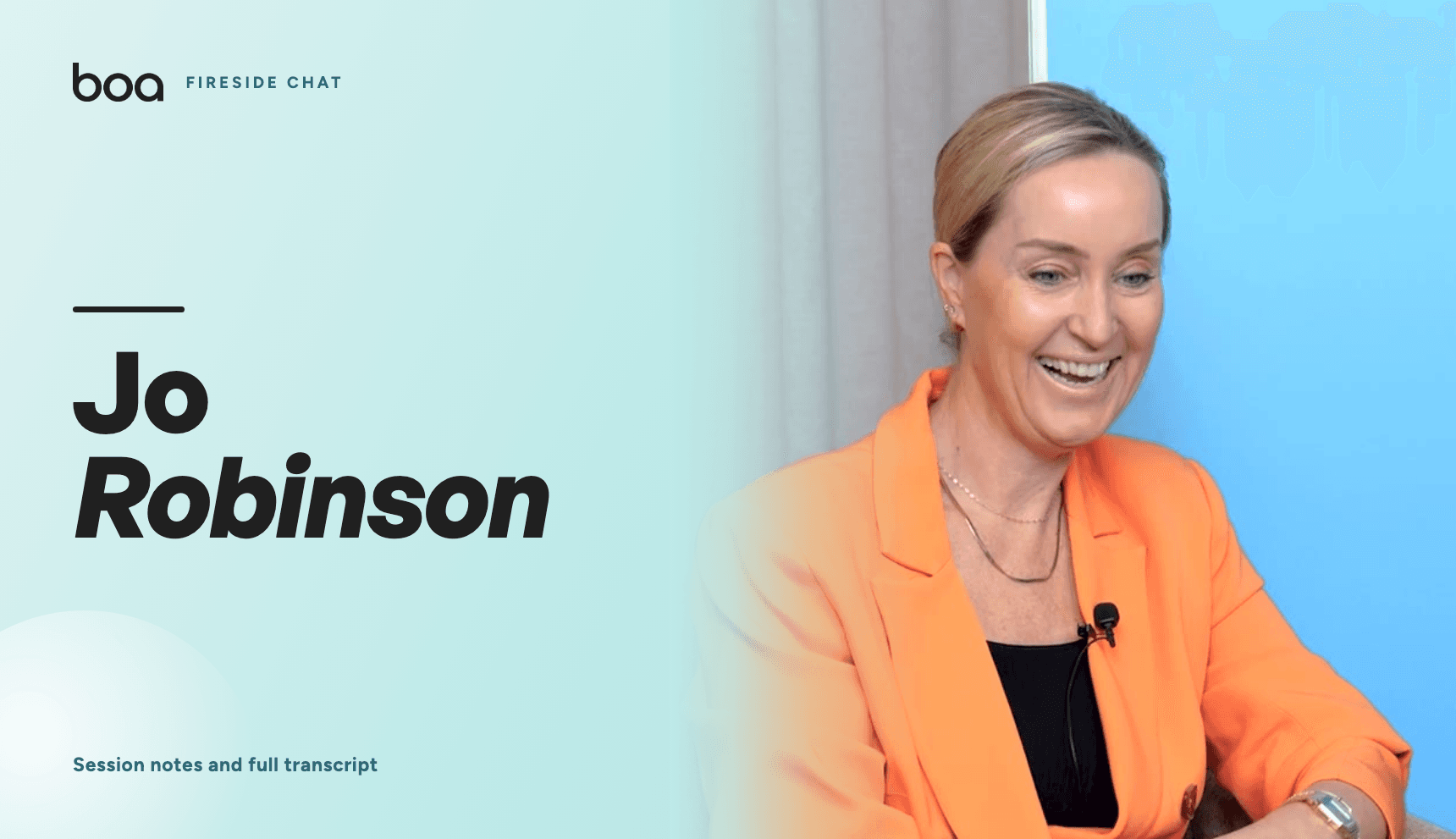
With Jo Robinson, Chief Marketing Officer at The Iconic · Hosted by Kirsten Scott · 38 min
What this session covers
The Iconic's CMO on rebuilding a brand that had become addicted to paid performance. Covers the 5 Ps, psychometric customer profiling instead of age brackets, picking specialist agency partners, using AI to kill reporting work, and proving marketing is a growth engine with marketing mix modelling. For founders balancing short-term sales with long-term brand.
If you only spend at the bottom of the funnel you end up buying customers who churn within 12 months, so some budget has to move up the funnel even though the payback takes six to twelve months.
Key takeaways
- 01
Fix the 5 Ps before you optimise a single ad dollar
Jo argues small budgets get wasted because founders jump straight to ROI optimisation without the fundamentals. Start with proposition (what do you actually stand for, in the way The Iconic settled on "a better way for people to shop") and people (exactly who you are for). Getting those right is what drives the efficiency of every dollar afterwards. Trying to be all things to all people dilutes the brand, even on a large FMCG budget.
- 02
Watch for churn as the signal that paid performance has topped out
The Iconic counts a customer as churned if they do not purchase again within 12 months of acquisition. Jo found they were spending heavily on paid performance, acquiring customers once, then losing them, which she describes as literally buying customers. Track first-purchase-to-repeat over a 12 month window. If acquisition spend keeps rising while repeat rate stays flat, more paid budget will not fix it.
- 03
Use unprompted brand awareness as the metric that justifies brand spend
The Iconic's unprompted awareness was declining quarter on quarter because they had done nothing beyond Google, banner advertising and a little SEO. Jo used that decline as the board argument for shifting spend to the top of the funnel. She warned it could dent short-term sales and would take six months to a year to show. Awareness has since moved up 4 basis points against competitors who outspend them.
- 04
Profile customers psychometrically, not by age bracket
With research partner Retail Doctor Group, The Iconic ran limbic profiling of its customers. Jo's point is that a 25 year old and a 50 year old can be near identical on personality, how they approach life, whether they are extrovert or introvert, and what brands they like. That is far better targeting territory than "25 to 35". Layer it over behavioural data like heat maps, browse patterns and wishlist behaviour.
- 05
Define competitors by share of wallet, through the customer's eyes
Jo's test is not who sits in your category, it is who your customer is also shopping with for the same discretionary dollar. In tight economic conditions people become very considered about spending, so the competitive set is whoever else is competing for that wallet. Map that set from the customer's lens, not from an industry map.
- 06
Automate the backward-looking reporting so the team works on the so what
Jo's team spent three days building heavy data decks for a Wednesday weekly sales review. She wants AI automation to produce those decks quickly so the team's time goes to the interpretation: what did we learn, what do we do differently, what do we dial up, what do we stop. Her framing is that she wants the team focused more on what is coming than on what has been.
- 07
Set AI usage KPIs and measure adoption across the business
The Iconic has around 200 people at head office and has KPIs around AI opt-in and utilisation, so they can see on any given day who is using it and how. Adoption is led by tech but applied in marketing for briefs, in programmatic media and in customer service via their AI chatbot Tilly. Jo's advice for individuals is to use the large volume of free courses and tools rather than waiting for investment.
- 08
Brief agencies on your pain point, then choose on partnership fit
When selecting a loyalty program partner, Jo found several candidates matched on capability, cost and delivery time. The deciding factor was whether they felt like an extension of her team and would partner on where the business is going. Write the brief around the problem you need solved, take it to market, then let human fit break the tie.
- 09
Hire specialists over generalists, in-house and agency side
Jo runs a hybrid model: a strong in-house creative and media team plus agency partners, with a preference for independents because you get more for your money. Rather than one agency doing everything, she picks partners with a specific area of specialism. Her line for team building is the same, generalist marketers are a weaker bet than someone who is genuinely excellent at one thing.
- 10
Interrogate the good weeks as hard as the bad ones
When results are strong most teams gloss over it and move on. Jo pushes the same diagnostic either way: was traffic down, did we underinvest in paid performance, did they browse without converting, is there an assortment problem, were they adding to wishlists. Then overlay consumer psychology, for example people holding onto money ahead of an election.
- 11
Talk to actual customers even when you have all the data
Jo calls this one of the dangers of the e-commerce world. You can have complete behavioural analytics and still not know why. She is a big fan of focus groups and qualitative research: take the insights the data gave you and bounce them off the human beings at the other end of what you are doing.
- 12
Build storytelling out of brand identity, not the other way around
Jo cites Bonds' US campaign by Special, which parodies what Americans know about Australians, as storytelling that only works because the brand's Australianism is already deeply embedded. The Iconic's Got You Lookin' work leans into its bold colours and existing brand identity. Decide what the brand is first, then the storeys follow.
How the session runs
- 0:00How saying yes shaped Jo's career, from Perth to Dubai
- 3:44Standing out: getting off the paid performance drug
- 6:07Small budgets: fix the 4 Ps and the fifth P, proposition
- 8:13The biggest branding mistake and share of wallet
- 10:41AI as a leveller, KPIs on usage, automation
- 14:45Storytelling that sells: Bonds and Got You Lookin'
- 17:48Paid versus organic, and the psychology behind sales results
- 21:34Choosing specialist agency partners over one-stop shops
- 23:33The non-negotiable rule: purpose and the human customer
- 24:55Q&A: room for new labels among 1,600 brands
- 27:23Q&A: martech stack, loyalty partner selection, the CMO remit
- 32:28Q&A: Doug on balancing instant ROI with long-term brand
Mentioned in this session
- The Iconic
- Procter and Gamble
- Colgate-Palmolive
- Unilever
- Coles
- Dubai
- Perth
- Sydney
- Retail Doctor Group
- ChatGPT
- Tilly
- Optimizely
- Braze
- Zendesk
- Bonds
- Special
- Crocodile Dundee
- Amazon
- Myer
- David Jones
- Zoom
- Pioneers Guild of Marketers
- Lick Your Phone
- BOA
Questions founders ask
Jo separates two ROI horizons. Short term is measured against forecast, including a 3+9 reforecast three months into the year that actualises performance and projects the rest. Long term is measured on unprompted brand awareness, which at The Iconic had been falling quarter on quarter until they invested above the line. She warned the board that shifting money up the funnel could hurt short-term sales and would take six months to a year to show, and it moved unprompted awareness up 4 basis points.
Go back to fundamentals rather than starting with ROI optimisation. Jo says the 4 Ps are the same as they were 30 years ago, plus a fifth P for proposition: what you actually stand for. Then get clear on people, meaning exactly who you are targeting, because trying to be all things to all people dilutes the brand. Getting those right is what makes the budget efficient.
AI is embedded across the business with KPIs on opt-in and utilisation for the roughly 200 head office staff, so they can see daily who is using it and how. Marketing uses it for briefs and it already exists in programmatic media. Customer service runs Tilly, an AI chatbot. The next target is automating the heavy weekly sales decks that currently take the team three days to build.
Write the brief around your specific pain point and take it to market rather than asking for a general pitch. When The Iconic assessed loyalty program partners, the shortlist matched on capability, cost and time to deliver. Jo's tiebreaker was whether they felt like an extension of her team and would partner on where the business is heading, because that relationship is what makes the work good over years.
Jo says yes. The Iconic carries 1,600 brands and is always looking for more, because wide assortment is part of its USP alongside fast delivery and free returns. The condition is brand alignment: any new label has to be anchored by what the master brand stands for. New brands also feed the funnel by staying relevant to customers across different life stages and pain points.
Full transcript
The complete conversation, as recorded, with every speaker attributed.
Kirsten Scott0:00
A really interesting storey how Jo and I were introduced. I was at my local hairdresser and I guess it's the power of your network and chatting with a mutual friend, we were talking about female founders and women in leadership and Jo's name came up and I just thought, I'm gonna shoot my shot here. I've read a lot about Jo, she is an absolute powerhouse. And here we are today having this awesome digital fireside. So Jo, you've had an amazing career in marketing. What were the key moments that led you to becoming the CMO at The Iconic?
Jo Robinson0:31
Firstly, thank you for the lovely intro. And yes, the power of networking. I think it's been really beneficial in my career, and it's still— particularly women. I just think women, you know, we can be each other's biggest advocates. And I'm so lucky to be surrounded by women both personally and professionally that are real, you know, sort of cheerleaders, I guess, for my career and for me personally. So, the power of a good network, super important. Pivotal moments, one of the things I always say is to say yes. I think that opportunities land in front of you in many different ways, and a lot of the time I think we hold ourselves back because of the fear of, you know, what's on the other side. And I kind of talk about that right back to the beginning of my career. I'm a Perth girl, so I was raised in Perth, and when I graduated from uni, there were Obviously, they kind of talk to you about what kind of career could lie ahead, and Procter Gamble were on campus kind of talking about careers with Procter Gamble, and I didn't really even know who Procter Gamble were at the time, but I remember my dad saying, "Oh, they'd be an amazing company to work for." And so I did say yes, lent into that, put an application in, did a long interview process, and got a role with them. And really, that shaped the rest of my career because they were an amazing company to start with, I was a Territory Rep for 2 years, so I was looking after pharmacies and I had 100 pharmacies I had to get around. And this is back in the days when we did everything kind of like manually. There was no digital, so you had to go and drive real relationships. After 2 years, I got transferred to Sydney and I looked after the Coles account for them. So, and then I ended up moving then into consumer marketing. So I've kind of done the gamut of sales. Trade marketing and also marketing. But I link it back to the just say yes, so just saying yes to moving over to Sydney, and then at the time, kind of 12 years ago, I was working for Colgate-Palmolive, and I put my CV on an international kind of, you know, sort of the site to get transferred internationally and was picked up by Unilever in Dubai. And I remember being offered that job after, you know, a very long interview process, ringing my husband and saying, "How do you feel about moving to the Middle East?" And we had a little 3-year-old then who's now at college. But it's that fear of, you know, letting go of fear. And it was interesting because a lot of my friends and family were like, "You've never even been to Dubai. What if you don't like it?" And I said, "Well, we pack up and we come home." But what did happen is we spent 6 amazing years there. I had my son over there. We were exposed to so many different cultures and so many different people and the opportunities and the travel opportunities, again, personally and professionally, but it was such a junction point for me and my career and my life, and it came off the back of just saying yes. So it's a long-winded answer to your first question, but it is just the, you know, letting go of fear and saying yes to opportunities.
Kirsten Scott3:31
Yeah, 100%. And just like confidence, action brings confidence, right?
Jo Robinson3:36
So just throwing yourself in. Yeah.
Kirsten Scott3:38
So The Iconic is a major name in Australian e-commerce. What's the key to making a brand stand out in a crowded market?
Jo Robinson3:44
I think it's really important to be more than just the products and services that you sell. I talk about this a lot. I'm a proud brand builder. I love the power of getting people to fall in love with brands and the art and science of marketing. And I think that one of the things that probably, I think, has gotten in the way in the last few years with regards to marketing is that we lost the art a little bit and the craft, and we were so focused with the advances within data and analytics and the ability to analyse everything to within an inch of its life, which is amazing in terms of optimising your budget and super important, but we forgot about the importance of simply telling storeys and shifting people on that emotional level, because at the end of the day, we're human beings and we wanna be entertained and we wanna be, you know, related to in a way that goes far beyond just kind of data and analytics or a segment that we sit in. So I think, you know, one of the journeys we've been on at The Iconic is that when I took over kind of 2 years ago, we had got addicted to the pay performance drug. So if we couldn't measure it, it didn't count. And I had loved this brand from the outside as a tier 1 consumer for— Oh my God, the whole, yes, yeah. I mean, I just spend, still spend far too much money, but definitely did in the past. And for me as a marketer, it was a really good challenge because I was like, this brand has so much longevity, so much love of this brand, legacy love. All I have to do is kind of recapture the essence of that and go back to what the iconic really stood for when it first launched onto the markets, you know, 14 years ago. And just bring that back. And we called it kind of a re-announcement. It was a relaunch back into the market. It was simply going back to the DNA of what the brand really represented when we first started. So I think we had forgotten that. As I said, we got very addicted to the paid performance drug. You need an element of both. I mean, the marketing funnel is a funnel, and you need to make sure that you're balancing at all levels, you know, the awareness, the consideration, and then the purchase conversion. But you just, are going down a very slippery slope if you're only focused on the bottom of the funnel.
Kirsten Scott5:56
Yeah, 100%. So, for a small business owner with limited budgets, which I know a lot in our community, we're startups, we're small business owners, what's the best way to create a memorable brand?
Jo Robinson6:07
I think it's to go back to the essence of what the brand stands for. Again, I really feel like, especially with a smaller budget, you're probably very focused on how do you get ROI and how do you optimise the dollar, That is super important, and I think these days there are so many ways that you can do that, either, you know, by learning it yourself or by employing some amazing digital agencies and having the agility, I guess, to be able to respond to what's happening in the market. But I think you have to go back to the basics. I think if you're gonna go down that path, straight away you're missing some of the core fundamentals. And, you know, I talk about this a lot. The 4 Ps are still the 4 Ps that they were, God, 30 years ago when I first started. So, and in fact, in FMCG, we talk about the fifth P, which is around proposition. What do you stand for? So, what do you stand for, which is, you know, what is your brand really about? You know, at The Iconic, we, our purpose is around creating a better way for people to shop. So, we stand for, yes, fashion and elevated fashion and inspiration and personalization and kind of all those beautiful things that people really, that really resonates for people. But I think that proposition piece you have to get right. And then the second part of that is the P around people. Who you actually going after? You can't be all things to all people, particularly if you have a smaller budget. But even from the FMCG days where we had very, very substantial budgets, you will dilute what you stand for if you're trying to be all things to all people. So my advice would be rather than trying to sort of maximise every dollar in terms of ROI, you will be able to do that far more effectively if you really focus on getting the 4 Ps or the 5 Ps, the proposition, P is right, the elements, the fundamentals of marketing, get those right first, because then that will drive the efficiencies in terms of how you're utilising your budget.
Kirsten Scott7:59
Exactly. Now guys, just a reminder, any questions you have throughout the chat, please put them in the Zoom chat and we'll call on you in the Q&A. So what's the biggest branding mistake you see often and what should founders do instead?
Jo Robinson8:13
I think it relates to the question we just kind of talked about, to be honest. I think the biggest branding mistake is not having a brand, um, or being too cognizant of what's happening in the market in terms of competitors. I think it's a mistake to not be aware of your competitive set, but from the lens of your customer. So who is your customer shopping apart from you? Who are your direct competitors? So it's all about share of wallet. Consumers, particularly in, you know, current economic times, they're going to be very considered about how they're spending their money. So who is in the competitive set for the share of wallet for that customer? I think that's super important. I think the biggest branding mistake is exactly what I spoke to earlier, which is around what does your brand stand for, and really importantly, who are you going after? And then you've got to really understand them from far more than just a demographic perspective. And one of the things that I've loved about kind of the evolution of marketing in the last few years has been the ability to utilise data to really add another layer of understanding. So obviously we do a lot of behavioural analytics. We can see exactly how long people stay on our site, whereabouts, you know, we have heat maps in terms of where they're spending their time. And obviously we look at all the behavioural analytics in terms of how they're shopping. So there's algorithms there. In terms of how they've shopped before, how they browse, what they're putting in their wishlist, how we can now surface up things that are complementary to that or alternatives to that. So I love the power that that brings. But another really interesting project that we've done in the last couple of years has been with our research partner, Retail Doctor Group, and we've done limbic profiling, which is psychometric profiling of our customers. And that is really getting into the hearts and minds of them. So, gone are the days of simply putting people into an age demographic, because a 25-year-old and a 50-year-old, actually, from a personality profiling point of view, can be very, very similar. And in fact, what they want out of life, how they approach life, whether they're an extrovert or an introvert, how they shop, what kind of brands they like, that is far more powerful territory to target as a marketer than simply saying that they are 25 to 35. So it's, I love the multi-layering and the lenses that we can apply now in terms of really understanding our customers and what makes them tick and how we can target towards that.
Kirsten Scott10:41
100%. So the digital world moves quickly. What marketing channels or trends should founders focus on now?
Jo Robinson10:48
Look, I can't go past, we're all talking about AI, and I think that's whether you're in e-com or not. I mean, I'm really lucky that I get to work with some really smart tech people, I'm blown away by some of the, you know, the projects that they work on. So I think, but I would say that I think AI is such a great leveller for everybody. I mean, obviously in the tech space it's been around for a while, but, you know, I'm on this Pioneers Guild of Marketers and it's all about how are we really going to implement AI within the marketing world rather than kind of more generally. So what's the martech stack? Back behind that. What I love about AI though is we're all learning it together. So I think whether you're, you know, someone who's just kind of coming out of university or you're people like us that have been working for kind of like 30 years or whatever, whatever level you're up to, the sooner you can lean into this because it's not a trend, it is here to stay. You know, I was listening to a podcast where they were saying we're going to advance 100 years in the next 5 years. Because of these tools. Sorry, I don't know how that happened. You're on mute again. Sorry, guys.
Kirsten Scott11:56
Technical issues.
Jo Robinson11:57
Technical issues maintained. Yeah, so look, I think any way that you can lean into AI as an individual. Oh, it's so interesting.
Kirsten Scott12:09
Sorry, guys.
Jo Robinson12:12
Should we keep going? Yeah. Any way that you can lean into AI, and I think we all need to be individually responsible for that. So we're doing it a lot as a company, and in fact, we can, you know, we actually have some KPIs around the opt-in or the utilisation across our whole business. So, you know, we have kind of 200 people at head office, and we can see at any given day kind of who's using it and how they're using it. It is being led by tech, but for my customer team, we're very much making sure that we're using it for briefs. I mean, obviously it exists in programmatic media, and there's so many. I also look after the customer service team where we use Tilly, our chatbot, which is all AI generated. But I think as individuals, it's about, there is so, there's so much free stuff out there as well, whether that's courses or tools. You don't have to be investing in AI to be able to really lean into it and kind of glean your own learnings and insights around it. So I think that is going to be one of the most powerful tools that anybody has, and it's kind of democratised because it is available in all shapes and forms to all of us. But from a marketing perspective, I think the way we can utilise AI better is around personalization. It's everything I linked to before in terms of really understanding the customer. AI tools are going to be able to enable us to better personalise towards the customer now that we really understand her or him better. There's automation. I get really excited about the automation piece because my team spend 3 days preparing a, you know, some really substantial heavy data-driven decks where we look as a team on a Wednesday at how we went in terms of our sales the week before. Now, if we can actually extrapolate out the development of those decks and they're done really, really quickly by automation AI tools, we can spend more time on the important pieces, which is the so what. So gleaning, you know, very top line, what did we learn? What do we do differently? What do we dial up? What do we stop doing? I want very much my team to focus more on what's coming than what's been. And I think AI is really gonna kind of change that for us.
Kirsten Scott14:21
Yeah, I couldn't agree more. AI is just a whole other beast. We actually have a little joke that every time we put something into ChatGPT, we say please and thank you.
Jo Robinson14:29
Yes.
Kirsten Scott14:29
Just in case for future.
Jo Robinson14:31
But it's actually really interesting because that's that whole ethical lens as well. I always say please and thank you because if I was talking to someone in my team, I would be saying please or thank you. But it does make me laugh when it says, you're welcome. Exactly. Like I'm talking to a machine. Exactly.
Kirsten Scott14:45
Um, okay, so storytelling is a big buzzword in marketing.
Jo Robinson14:48
Yeah.
Kirsten Scott14:49
How do you make it actually drive sales?
Jo Robinson14:51
Yeah, that's a really interesting one. Um, look, I think again it comes back to the 4 Ps, the art, and also the art and craft of, of storytelling. The storytelling is the fun bit in marketing. Um, there's been some really good campaigns. It's a really good Bonds campaign that the Special have done at the moment, um, and they've launched into the US market, and they're really telling the storeys of Australians. They've really played up the Australianism of us. There's like crocodiles and, you know, tarantula spiders, and it's kind of like Crocodile Dundee on steroids. But it's, it's a very clever campaign because it's parodying kind of Australians and what Americans know about us. And I just think, you know, Bonds is an amazing brand that really kind of captures that. I mean, at the end of the day, they're just cotton essentials. That's how they started. But the power of that brand and the Australianism of it is so deeply embedded that they're able to take that, and this is what I mean about getting the 5 Ps, or 4 Ps, 5 Ps right, is that the storytelling comes off the back of that. You know, the Got You Lookin' campaign that we've just done with the Iconic over the last 2 years, that is kind of leading into the, leaning into the bold colours of the Iconic, and the Iconic being something really substantial and kind of powerful and compelling. And so the storytelling comes from the brand identity, not the other way around. How do you commercialise it? I think it's then about, like, I obviously have a marketing budget that I've gotta make sure I'm optimizing. There's a big, there is, I think one of the eternal challenges within marketing is making sure that we are seen as a growth engine and not a cost center. So we are now, the CMOs have a seat at the big table because we are able now to prove our value in terms of the commercial outcomes. It was harder to do that before, particularly with things like brand awareness, because that is about future demand. So it was more difficult for the business to show that you invest, and it's substantial investment, that's one of the things about brand, but yet it's about kind of the future demand. So it's about how we're playing out in next year's sales as opposed to this year. So it's gotta be a balance of both. And I think that with the advance of things like MMM, which is marketing mix modeling, We're now able to have tools that help us really commercialise the value of marketing, and that's helping me have a completely different conversation in the boardroom because we have forecasting models and tools that enable us to say, if we invest another $5 million in Above the Line Advertising, we'll be able to see out, you know, see that play out in terms of the upside of both revenue and profit because of the power of the tools that we have that enable us to prove that commercial value. So I really thank God that we're in a, you know, as marketers, we're in a really exciting space right now where gone are the days where we used to say, you know, half of your advertising budget is driving sales and half isn't, but you don't know which half. Now we know.
Kirsten Scott17:42
You can measure it.
Jo Robinson17:43
You can measure it. So it enables a completely different narrative in the boardroom. Yeah, I love that.
Kirsten Scott17:48
So it's exciting. Now we've touched on this slightly, but paid versus organic, how do you balance short-term growth with long-term brand health? Brand building?
Jo Robinson17:57
Yeah, I think it's more of the above. I mean, you've really got to kind of holistically look at your budget and say, okay, so there is an element that needs to go around paid. I mean, you cannot not be, you know, with Google and using your SEM. And look, I have an amazing— we have a hybrid model. I'm a big fan of a hybrid model, meaning that we have a very strong in-house team, and that whether that's creative or my media team, they're really, really smart, amazing humans. However, what we've also done is made sure that we've got really good agency partners, so we're using a, you know, a hybrid agency model. So we're able to really optimise what we do on the paid performance side, and we have tools that enable the testing. So we're very about experimentation, we're doing A/B testing all the time, and we're driving efficiencies and optimizing, and there's a whole team both internally and externally that do that. But then you've got to make sure that your owned channels are really doing the storytelling and some of the heavy lifting for you. But again, there's a lot of science behind that, so you've got to make sure that your content is optimized. You know, part of SEO is making sure that you've got really good visuals, that you're doing the storytelling, that you're linking it to really good content. Your influencer strategy, which can be both obviously paid and also organic, you need to be making sure that you're kind of holistically looking at every single channel. And I think one of the things I love about marketing is it's so dynamic. You'll never get it 100% right.
Kirsten Scott19:21
And it's always changing.
Jo Robinson19:22
It's always changing. It's always changing.
Kirsten Scott19:24
And some—
Jo Robinson19:24
so one of the things I love about, you know, looking at the sales results is some days we have some really phenomenal results and none of us know why. That's way better than when you've had some really shit results and nobody knows why.
Kirsten Scott19:35
We don't want to know.
Jo Robinson19:36
Yeah, exactly. But I always think it's interesting. And what happens when the sales are good is everyone tends to just kind of gloss over it and move on instead of going as we would if the sales are not good Let's have really kind of dig into that. What happened? It was traffic down, you know, did we not invest enough in paid performance? Did we not see the conversions? Were they browsing and not conversions? Is there something wrong with our assortment? You know, were they putting in wishlists? And it could also be going, it could be really closely correlated with what is going on for the consumers at the time. So we know at the moment with the election looming, people start to kind of hold on to their money for a lot longer because they're not sure how it's going to, end up on the other side. So I love the psychology of kind of overlaying what are we seeing in terms of our sales results and our, you know, our profit margins and what have you. But how does that correlate with how our consumers are feeling? Because we at The Iconic are in obviously a high disposable income, well, meaning that they've got to choose. It's a discerning thing to— they've got to spend their money on discretionary items when it comes to fashion. We're not a necessity item. So you kind of need to work even harder. But it's very, very much linked to how they're feeling about what's going on in the world and the economy at the time. So I love that if you ignore that, I mean, we are selling and marketing to human beings, and that's— you've got to keep coming back to that. And that's one of the dangers of the e-com world is I often say, okay, great, we've got all the data and analytics, but have we actually gone and spoken to our customers? Um, like focus groups, uh, qual research, I'm a really big fan of. Go talk to them, go bounce off what you're gleaning and the learnings and the insights that you've got, but go talk to the human beings that are actually at the end of what we're doing.
Kirsten Scott21:18
100%. And I know that a lot of what we're doing here at BOA is exactly that, just talking to the people and finding out what your guys' needs are. Now, you kind of touched on this next question already, but a lot of brands chase quick wins. How should founders shift their mindset towards long-term sustainability?
Jo Robinson21:34
Yeah, I mean, I really, it comes down to that kind of the full funnel, really, you know, and again, there's no one answer because it's so dynamic. As we said before, it can change, it can change every day. I really do think that if I was a small business owner, rather than trying to learn it all myself, I would be utilising the amazing agency partners that are out there to be able to do that. You know, I've had the luxury of working with some amazing agency groups, both global and also local, big fan of the indies, I think independent agencies, you know, you get a, you get a lot more for your money. I'm not saying that the, that, you know, the other ones don't do some amazing work that are part of the bigger groups, but I do— I need agencies that are an extension of, of us. So they need to be in the trenches with us helping solve problems, but they're also about optimising my marketing dollar. Um, so they've been able to strip out a lot of the, the kind of traditional costs that were really kind of, you caught in that model between agencies and clients. So I think in this day and age, there are so many amazing agency partners out there, whether it's digital agencies or creative agencies, you know, influencers. I'm a big fan of kind of finding the different partners that can really kind of optimise your dollar in areas of specialism rather than necessarily having one agency that does it all. You know, it's a bit like saying, well, I only need a handful of people in my team because they can do it all. I think generalist marketers, I think you've got to be a specialist in, in, in an area and become really good at it.
Kirsten Scott23:15
Yeah, we always say like focus on your niche. So if you're bringing contractors or whatever else in, allow them to focus on their niche and bring that into the business. So last question, Jo, before we move into the Q&A. If you had one non-negotiable marketing rule to a founder looking to scale, what would it be?
Jo Robinson23:33
I think it relates to what we were talking about at the beginning in terms of really understanding your customer, you know, and understanding that they're a human being. I love the storeys of particularly small businesses that have kind of just got that bit right. And also it's been driven by a need to do something beyond just making money. This is one of the things that I say about my career. I'm so blessed to do what I do. My real purpose is around mentoring and developing the next generation of young female leaders. And I, whilst I love my job, I love even more that it gives me the platform to be able to do the purpose-driven work. Because one of the things that I love about getting older is that you get to an age where you appreciate that it's far more than just the paycheck that you get. It's about the purpose and the legacy you want to leave. And, and I, you this is one of the things I love about entrepreneurs and small business owners, is that they've already got the purpose about why they're doing what they're doing, you know, why they're doing what they're doing. And I think I would encourage you to hold on to that.
Kirsten Scott24:40
I love that. It's a great answer. All right, guys, we're going to jump into the Q&A. So if you're on, I'm going to call out your name and you're able to ask Jo your question directly. So, Taryn, I've got you first if you're still on. Um, you're welcome. Did you want me to read it out for you, Taryn, or would you like to ask?
Jo Robinson24:55
Sure. No, go ahead.
Kirsten Scott24:56
Okay, so do you feel there is a place for new labels in such a saturated market?
Jo Robinson25:02
Yeah, that's a really interesting one because we have 1,600 brands on The Iconic. That's just a few. Yeah, 1,600, and we're always looking for new brands. Um, I— so the answer to that is yes, because I think that you've got to make sure— for us, part of our USP is a wide assortment. So we want to make sure that we're, that we're attracting the right brands. There's got to be that brand alignment. So again, it comes back to your proposition and who you're actually targeting as your core customer base. But then again, kind of for the longevity of a company and a brand, you've got to think about feeding the funnel. So whilst I don't directly talk about demographics, we do know that— and you learn this in FMCG— you want to get, you want to get your consumers in, you know, from kind of the beginning of their consuming career, if you like, and then you want to find reasons to keep them and show up and be relevant for them across the different life stages. So bringing brands in to appeal to different customers at different life stages, but also different to satisfy different pain points in their life, you've got to stay relevant. What you need to make sure you do though is that anytime you're bringing in new brands, it's still anchored by the proposition of what the master brand stands for. And then I think you've got to work, so for us, we work really closely with our tech team to make sure that we are able to personalize. I mean, if we were showing 1,600 brands to every single one of you, it would be overwhelmed. And in fact, we still, I still think that we have a job to do in terms of the overwhelm that a lot of our customers talk about. So how do we show up for each one of you the curated showcase of the relevant brands because we know how you shop and how you've shopped before and the algorithms of kind of all of that purchase behaviour so that we make it very, very relevant for you. So you're seeing new brands, but you're seeing them because they're relevant for you and they line up with how we've seen you shop before. I think that's the bit that maybe is missing sometimes and is yet a really important part of it.
Kirsten Scott27:05
Yeah, definitely. I must admit I've been using The Iconic for like, not to show my age, but over 10 years. So like it just shows that you provide like value to everyone of all life stages.
Jo Robinson27:15
Yeah. Is that all good? Well, that's good to hear.
Kirsten Scott27:19
Now Rita, I've got you next if you want to ask your question.
Jo Robinson27:23
Hi. Hi. Thank you so much, by the way. Amazing insights and feedback. Thank you.
Kirsten Scott27:29
The question, so I'm Rita from Lick Your Phone, and the question that I have is I had two. I hope that's okay.
Jo Robinson27:37
What software tools do you use to analyse the data? So, and what would you recommend? What have you used in the past? And the second question is, as a CEO, as a leader, how much of your time is invested in the marketing space in the company compared to all the other departments that you would also have to— of my CEO? Okay. Okay, well, let's hold that one. So the first one is really difficult to answer because we, we do a lot of our— we, again, you know, we, we are a tech and fashion company and we are very much an e-com. So we, how we show up offline, uh, is through pop-ups or out-of-home advertising, but we do not have any plans to become a bricks-and-mortar retailer. Um, so our— because tech is how we started and we invest very heavily in tech. We've built a lot of our own data analytics tools. So there are many available. We use, I mean, we do partner, we use Optimizely, for example, in terms of our A/B testing. You know, we use Braze as our CRM, we use Zendesk as part of our, is one of the servicing platforms for our customer service. So we have a whole martech behind what we do. However, a lot of the tools that we use for the data analytics is, is built internally by The Iconic and by all the smart tech people. I think there are so many options available, you know, I think that you need to kind of really articulate what your problem is and then go do some research and get people, get agencies to come, partners to come and present to you with your brief being what's your pain point, you know, what's the problem that they need to solve because it's, hard to give you a single answer because there are so many great options. And the other thing I say too, because we're very excitedly launching a loyalty programme this year, you heard it first. So in the, in the press, hot off the press in quarter 3, we will be launching a loyalty program. So we've been in communications and we've just partnered with a partner to be able to do that. And we went to the market and really assessed. So we wrote the brief and then we went to the market in terms of what would be the options out there. And one of the things I said to my team, because there were some great partners that we could have partnered with, to be honest. Capability-wise, they all can do the job and pretty similar costs and pretty similar in terms of the time to deliver. The secret sauce for me is, are they the kind of humans that you're really connecting with and that are going to be an extension of our team? Because that people element, like, I've been very loyal to my agencies over the last 30 years and vice versa, because at the end of the day, we do great work, but we also really like working together. So for me, that's a differentiator. So you'll have to go and do your own exploration, I guess, in terms of what's going to deliver to your particular pain points and how it's going to optimise your dollar. And then the second, and I think almost more important, which is, are they going to partner with me, truly partner, in terms of where I want to take my business for the future?
Kirsten Scott30:41
Amazing.
Jo Robinson30:41
So that would be my answer to the first one. The second one is really interesting, and it probably links to what we were talking about earlier in terms of the value now that marketing has. My role is, is kind of way more expanded than just marketing. So I look after customer service. I also look after partnerships revenue, which is the ad sales part of our business. Retail media, you know, is a massively growing area. And then obviously I have creative production and production as well, e-production. So even the fact that the CMO role now goes far broader than just marketing is, I think, recognition that what we do really ties into being a growth engine and not a cost center. And in fact, the CEO, I'm very lucky, the CEO came from our Russian business and he's actually worked in tech and he's kind of had this, you know, very varied background. Him and the CFO, who's ex-Coke, they are very big advocates for brand and for marketing. So I find otherwise you can spend a lot of your career trying to validate what we do and educate around what we do, because what happens when they're set, you know, when sales are down or profits are down, in the past is that the first line that goes is marketing. And I think now that we, we are able to demonstrate commercially how we add value and the growth engine orientation of what we do, that number one means that we are able to kind of have a different level of narrative. But I also think at the same time, there's been a real understanding at that CEO level about the value that marketing and customer, you know, brings to the table. So I feel very fortunate that I have a CEO and a CFO that really support and understand what I do, what my team does.
Kirsten Scott32:23
Great, thank you so much.
Jo Robinson32:25
You're welcome.
Kirsten Scott32:26
Um, Doug, did you want to ask you a question?
Jo Robinson32:28
Doug, is that Doug Doug? Yep. I love you in orange, by the way. Oh, thank you. The benefit of having a stylist for work, a work stylist. So there's a huge dichotomy here between fast and slow.
Kirsten Scott32:48
Yeah.
Jo Robinson32:49
So I'm interested in how do you balance the short-term performance marketing? Yeah. The long-term brand building, especially when ROI is instant. Yeah, I think you, I think it's around the definition of the ROI because there is immediate ROI in terms of what have we spent, And we spend, you know, a huge amount every week in terms of our paid performance, for example. So how are we spending? What's the immediate ROI that we have? And we measure that based on our forecasting. So we've just done a reforecast. It's called the 3+9. We're 3 months in. How did we go versus budget? We actualise and then we kind of go, this is how we think we're going to end up, you know, for the rest of the year. So there is the immediacy of the ROI of how are we going with the, the our investment and the cost basis sits under everything, not just marketing, and versus our forecast. So are we doing what we said we would do? But then there is the longer ROI, which are the things like, are we shifting? So fully iconic, and I know Doug, you've seen my presentation when I talk about this, but we had lost relevance in terms of unprompted brand awareness. So the iconic, unless we were kind of prompting people and saying, have you heard of the iconic, it was basically declining rapidly, kind of quarter on quarter. We just did not have any relevance. Now that was because we had not done any out-of-home marketing. We hadn't done anything that wasn't performance marketing, that wasn't basically Google advertising or banner advertising, a little bit on SEO, but we really hadn't reminded the customers or told storeys or gone back to the DNA of what The Iconic was about. So that was a really good metric for me to say, we're at a point of no return here. If we don't invest in the brand building, what will happen, and we were hitting this point, is that it was becoming ineffective. No matter how much money we spent on paid performance, we were not gonna see basically the returns. The other interesting thing is when you get addicted to that paid performance drug is that what you see is you're buying those customers. So the idea is to bring them into the funnel and then get them to repeat purchase as often as possible and also just to spend more. We call it a churned customer if they do not purchase within 12-month period of us acquiring them. Now what we were saying is that we were spending a shitload on paid performance and then basically they would come in once and then they would churn because we weren't doing a good enough job of retaining them. Like we literally were buying customers. So the other, so it's a good question, Doug, because it was a way harder argument for me to have kind of 2 years ago when I was saying, okay, we need to pull some money out of the bottom here where we're not gonna see the returns, you know, immediate and it may have a short-term negative effect on sales. But we're going to have to reinvest it at the top of the funnel. And you're not going to see the results of that for at least 6 months to a year, generally a year. So it was a really, really big kind of argument that I and the team had to kind of face. But I think The Iconic was at a tipping point where it was like, we need to do something differently. You know, it was getting— we've got competitors like Amazon who are upping the ante. Myer and David Jones have now got pretty good propositions from an e-com perspective that all kind of caught up. So we were— it was a— I always say it was a perfect storm because I'm not an e-commerce marketer, I'm a traditional FMCG marketer and a brand builder. But I feel like I landed at The Iconic at the right time when they had to think differently, and I came in and said, I think we need to do some brand building. So, and I was supported by, you know, an amazing CEO and CFO that kind of got that as well. So it's a really difficult one. I'm in a way better position now to keep going on the brand awareness stuff because we've shifted that unprompted awareness by, well, we've basically gone up 4 basis points, which is quite a lot in a really competitive market when we're outspent by the likes of Amazon, for example. So just, it makes it a much easier rationale to prove now because we've got the results. So now we've got the short-term working and that's all humming and we're getting more efficiencies there because we've got the top of the funnel working as well.
Kirsten Scott36:51
Definitely. I mean, I would easily say The Iconic is the go-to online retailer for like everything.
Jo Robinson36:57
Well, that's, that's what we— I love hearing that because that's what we aim is to be the one-stop shop, or at least the first place that people go. They may go elsewhere then to compare prices and what have you. Now everyone's motivated by price, so we do— our USPs are the same that they were 14 years ago: fast delivery, free returns, wide assortment. So we protect those at all costs.
Kirsten Scott37:18
Yeah, I love that. Now guys, does anyone have any other questions?
Jo Robinson37:24
Sorry, I do tend to bang on. No, we love—
Kirsten Scott37:26
honestly, like, so much information. But thank you so much this morning, Jo. Like, we're so grateful for you coming in and joining us. Um, so guys, we thank you for joining us this morning, and we obviously can't wait to see you at the next one.
Jo Robinson37:40
Thank you everyone.
Kirsten Scott37:41
See you later.
Jo Robinson37:42
Bye.
Watch the full sessioninside Boa.
Session notes are free. The recordings, the live advisories and the founders in the room are for members.