Fireside Chat
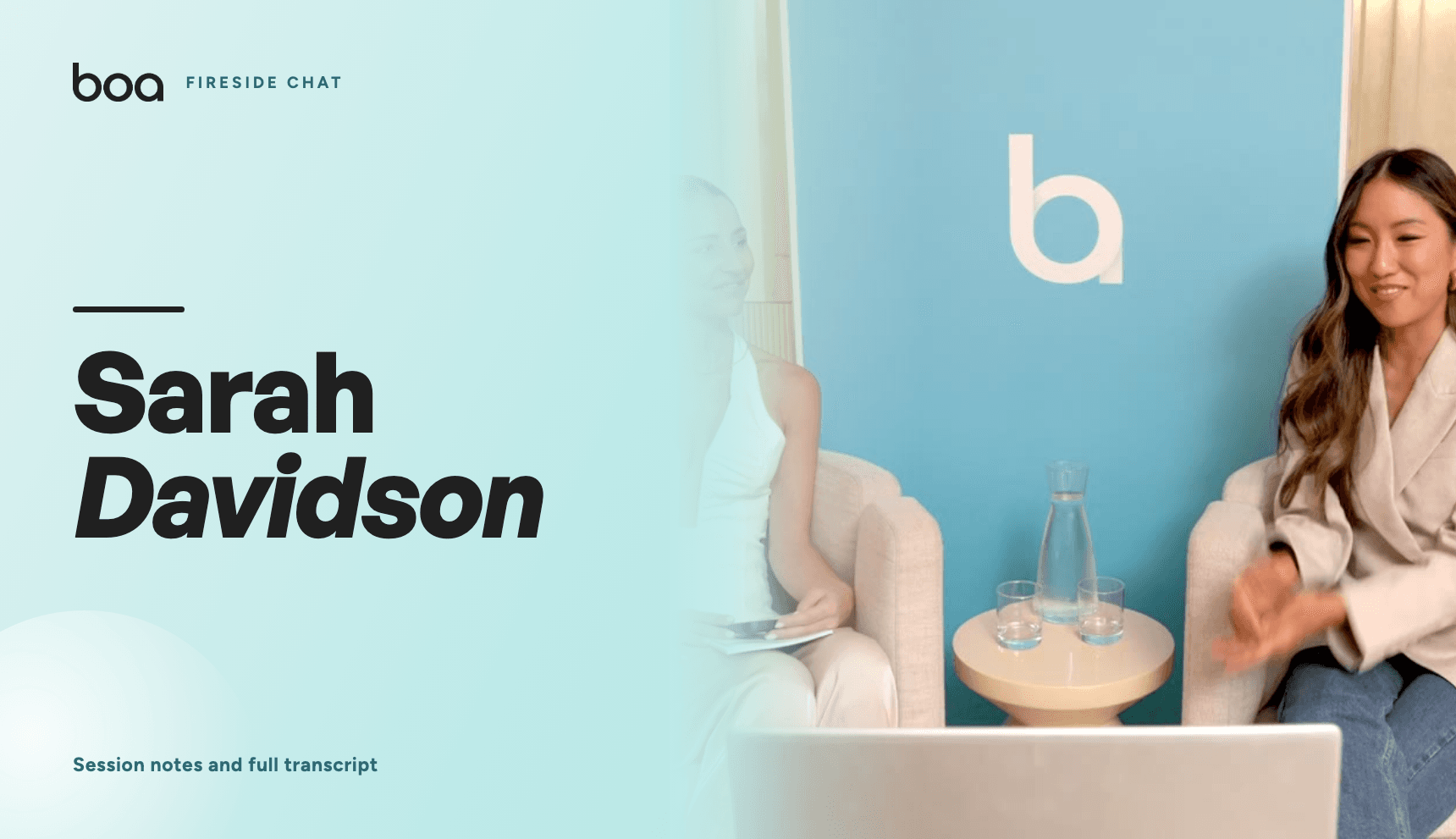
Sarah Davidson on Scaling Matcha Maiden Globally
With Sarah Davidson, Co-founder at Matcha Maiden · Hosted by Kirsten Scott · 52 min
What this session covers
Sarah Davidson built Matcha Maiden from a law-firm side hustle into 300 US stores, then withdrew from supermarket pitches that would have grown revenue tenfold. She covers scaling speed, collaboration deals that grew databases by 15,000 emails, US versus Australian pitching culture, supplier bargaining power and spending money to make money.
Before you chase a bigger business, decide whether you actually want to run the business that size makes you run.
Key takeaways
- 01
Use a future regret test to make the big, scary calls
Sarah calls it her future regret management matrix. When Urban Outfitters placed an order she could only fill by leaving her legal job to pack for roughly seven days straight, she asked what 80-year-old her and 10-years-from-now her would regret more. Trying and failing while first to market, or staying safe and watching the window close. Law would still be there a year later, the retailer would not.
- 02
Split your list into today, tomorrow and later, and only work today
Sarah physically writes a list every day and sorts every item into three buckets. If it is not a today job, it moves off the page so she does not carry it. Her rule against distraction came from her husband: she was worrying about shipping matcha to Afghanistan when they could not yet ship to Caulfield North. Be discerning about what is genuinely urgent, because busy work like fixing the font on a post going out in two weeks gives you the tick without the progress.
- 03
Partner with brands that own the other moments in your customer's day
Matcha Maiden stopped marketing as though matcha was the customer's whole identity. They mapped the rest of that person's day: fitness, activewear, plant-based milk. Then they ran joint giveaways, events and goodie bags with those brands, including repeated activations with Lululemon. Ten businesses running one competition could each pick up around 15,000 new email addresses off a shared consumer.
- 04
Collaborate with your closest category rival instead of fighting them
Golden Grind sold turmeric powder, a product close enough to look like a competitor, and the two brands were eventually bought by the same company. Matcha Maiden worked with them constantly and ran deals selling both products together, on the logic that a customer drinks matcha one day and turmeric the next. Same principle applied to collaboration partners generally: choose slight difference in audience, not an exact overlap, or you keep marketing to the same people.
- 05
Stop scoring collaborations 50/50 on every single activation
With repeat partners like Lululemon, sometimes they supplied the venue and everything else while Matcha Maiden just turned up. Other times Matcha Maiden ran the whole event and the partners arrived. Sarah's view is that it comes out in the wash over a long-term relationship, and insisting on an even return each time gets in your own way.
- 06
Read the marine insurance clause, and every other clause
Sarah scaled too fast in the early years and signed contracts without proper review. She missed a small clause about marine insurance, stock went overboard on its way to Australia, and there was no cover. Her framing afterwards: better it happened in year one on small volumes than in year four when orders were far bigger.
- 07
Do not overcorrect into slowness after a mistake
After the insurance loss, Sarah swung to being overly measured and sat on a packaging rebrand for two years, chasing a waterproof, travel-friendly bag. By launch the matcha category was crowded, the minimal white angular look everyone had adopted no longer stood out, and she did not even like the design anymore. Too fast and too slow both cost you. Find the middle.
- 08
Rewrite your pitch for the market you are pitching into
Australian buyers responded to Sarah's humble, happy-accident story. Woolworths wanted to hear she was open to feedback and advice. In the States, saying it was accidental read as having no strategy, and Whole Foods wanted a founder who was infallible with the answers already worked out. Matcha Maiden lost early US pitches purely because the pitch had not been rewritten for the culture.
- 09
If you are going to be a global business, build the global infrastructure early
Matcha Maiden went from zero to 300 US stores but Sarah did not believe they were big enough to set up separate distribution there. Shipping everything from Australia meant three years of logistical pain, including US customs problems because a heroin ring was smuggling through green tea, and FDA organic certification issues from not packing in an American facility. A US pick and pack would have cost more upfront and, in her view, could have got them to 1,000 stores instead of stalling at 300 to 350.
- 10
Test ad spend in $50 increments before you trust bigger numbers
For founders protective of self-funded money, Sarah's advice is to build the risk muscle with small amounts. Do not put $10K behind a big influencer first. Test micro-influencers, or run YouTube tutorials on Meta ads and put $50 behind one post and $50 behind another to see which performs. Track it. She got comfortable once she could see $1,000 with an influencer returning $2,000 in sales, which reframed it from throwing money at a wall to an investment.
- 11
Get another founder to audit your supplier terms
Small order quantities mean genuinely low bargaining power, and Sarah accepted poor early terms just to get product out. What helped was asking non-competing founders to look at the numbers, without demanding their own confidential pricing, and just answer whether the terms were normal for that order size. Matcha Maiden leaned on the Frank Body team because their bags were similar but they were not in food. Then schedule regular reviews and renegotiate as volumes climb, for example from 100 bags to 10,000.
- 12
Set your own success metric, because there is no performance review
In law, Sarah knew the trajectory, the salary bands and got quarterly feedback. In business there is no feedback at all and no equal peers. She now measures whether she feels fulfilled, whether she is inching closer to where she wants to be, and whether she is delivering value slightly better than yesterday. That avoids the "I'll be happy when" trap where the destination arrives and it is still not enough.
How the session runs
- 2:02Why she left corporate law by accident
- 3:30The real fear was perception, not failure
- 4:52The Urban Outfitters order that forced the leap
- 8:04Changing your risk appetite after law
- 8:49Scaling too fast, then too slow
- 11:42Managing overwhelm with a today list
- 14:57Partnerships built on the customer's whole day
- 19:57Do you actually want a global business?
- 20:43The Chobani accelerator and withdrawing the pitches
- 25:25Traits of successful founders from the podcast
- 27:55Backing yourself with global infrastructure
- 32:42Pitching in the US versus Australia
- 33:42Q&A: rebuilding an audience from scratch
- 39:17Q&A: fear of spending your own money on ads
- 44:09Q&A: measuring success without a performance review
- 48:12Q&A: supplier terms and bargaining power
Mentioned in this session
- Matcha Maiden
- Urban Outfitters
- Chobani
- Lululemon
- Golden Grind
- Frank Body
- Whole Foods
- Woolworths
- Meta
- YouTube
- Women's Health
- The Archive
- Rosalia Ruschan
- Lana Wilkinson
- Japan
- Caulfield North
- Melbourne
- FDA
Questions founders ask
Sarah's first question is whether you actually want to run a business at that size, not whether you can. Matcha Maiden went global early by following demand, which was great for the brand and logistically a nightmare. When supermarket contracts would have grown revenue tenfold but required changing suppliers, dropping their Japanese tea farm and sacrificing product quality on margin, she withdrew the pitches. Bigger is not always better.
Do not reuse your Australian pitch. Sarah found Australian buyers like Woolworths responded to humility and openness to feedback, while US buyers like Whole Foods want you to project that you are infallible and have already figured out your go-to-market. Framing her story as a happy accident cost Matcha Maiden pitches in the States, because accidental read as strategy-free. Speak to Australian businesses who have already entered that market before you go.
Sarah says it is a risk tolerance muscle you build by repetition, not by thinking your way through it. Start with small tests: micro-influencers rather than a $10K name, or $50 behind two different Meta posts to see which performs. Track the return so you can see a $1,000 influencer spend producing $2,000 in sales. Holding onto every dollar keeps you stuck at one level.
Map the rest of your customer's day rather than fixating on your own product. Matcha Maiden's buyer was also doing fitness, buying activewear and choosing plant-based milk, so those became the partner brands for giveaways, events and goodie bags. Choose brands with a similar consumer but not an identical one, so you reach new people. Ten brands sharing one competition each picked up around 15,000 email addresses.
Sarah admits Matcha Maiden accepted poor terms early because small order quantities give you almost no bargaining power. The fix was asking non-competing founders, including the Frank Body team, to look at the terms and simply say whether they were normal for that volume. Then run regular supplier reviews and renegotiate as your quantities grow, for example from 100 bags to 10,000.
Full transcript
The complete conversation, as recorded, with every speaker attributed.
Audience member0:01
Hi guys!
Sarah Davidson0:02
Oh, getting that content, bit of BTS for everyone this morning. So good to see you all.
Kirsten Scott0:12
Um, now look guys, we'd love to hear where you're tuning in from, so please put your name, location, and business in the chat. Um, so I am here with the incredible Sarah Davidson this morning. She is the co-founder of Matcha Maiden and the incredible host of CZ-A. Um, if you haven't listened to her podcast, I am telling you, get on there today and start listening. It's one of my favorites.
Sarah Davidson0:34
It's very kind.
Kirsten Scott0:35
And I've been lucky enough to do a few events now with Sarah, and honestly, it just keeps getting better and better. So without further ado, let's jump in. I want to start off with a quickfire round of This and That. I did it last time. I really enjoyed it. It kind of puts you on your toes a bit.
Sarah Davidson0:51
Nice.
Kirsten Scott0:52
So no pressure. Don't overthink it. Just whatever word or makes more sense, just yell out that.
Sarah Davidson0:57
Okay, well, one thing you know about me already is quickfire is not my strong point. Question 1, we'll be here for 50 minutes.
Kirsten Scott1:04
Yeah, let's go with it. Um, okay, so coffee or matcha?
Audience member1:08
Coffee.
Kirsten Scott1:09
Okay, play it safe or dive in before you're ready?
Sarah Davidson1:11
Dive in before you're ready.
Kirsten Scott1:13
Texting or calling?
Sarah Davidson1:14
Texting, always.
Kirsten Scott1:15
Oh, never call me. Um, I would say actually morning hustle or late night grind? Both. Uh, podcast or book?
Sarah Davidson1:23
Oh, oh, book. Yeah, if I was on my— like, if it was life or death, book.
Kirsten Scott1:29
Okay, love that. Structure, routine, or flow and intuition?
Sarah Davidson1:34
Flow and intuition.
Kirsten Scott1:35
Uh, big vision goals or small daily wins?
Audience member1:40
Um, both.
Kirsten Scott1:41
You can have both on that one.
Sarah Davidson1:42
Yeah, time and a place, I think.
Kirsten Scott1:44
Yeah, I love that. Uh, share the journey or highlight the outcome?
Sarah Davidson1:48
Oh, share the journey.
Kirsten Scott1:50
Love that. Um, okay, so let's dive in.
Sarah Davidson1:54
Is that the shortest answers I've ever done in my life?
Kirsten Scott1:56
I think so.
Sarah Davidson1:57
I drew that out of you. Yes, you bring out the best in me.
Kirsten Scott2:02
Um, okay, so what drew you to entrepreneurship after working corporate law?
Sarah Davidson2:07
An accident, if I'm honest. Yeah, I think that I had always thought one day I would be drawn to starting my own business. I always wanted to have that challenge somewhere along the way, but I thought it would be at least another decade before I had the opportunity. I thought I'd need more experience. I definitely thought you'd need more years under your belt before the opportunity came up, and I thought that you'd need a more wholesome idea— not wholesome, a more well-rounded idea. I thought you'd need—
Kirsten Scott2:38
a lot of people think that though.
Sarah Davidson2:40
Yeah, I had absolutely no idea how quickly you could jump on an idea, how quickly you could reskill yourself to actually turn an idea into something successful. And then Once I— I mean, again, this is how much of the storey do you want to hear? We could be here for hours, but it really was me getting sick, discovering a gap in the market, jumping on it, and by accident realising that the opportunity was here a lot earlier than I had anticipated. And I think one thing that I implore anyone who has— who lands themselves in that situation to remember is the risk-averse version of yourself wants to say no, this is not what I thought would happen, I'm not ready, you have to have it all figured out, it's too early. It's never too early, you can figure it out.
Kirsten Scott3:23
Yeah, I love that.
Sarah Davidson3:24
Yeah.
Kirsten Scott3:24
Okay, so when you first started Match Made In, what was your biggest fear and how did you overcome it?
Sarah Davidson3:30
I think my biggest fear was the imposter syndrome internally, and on the flip side of that, the perception of failure if it didn't work out. Because I had such an objectively successful job, I never had to prove myself to anyone. You just say you're a lawyer and people assume certain things about your intellect, your capacity, your success. And your worthiness of your career. Whereas when you say, I'm— I've got a startup, that's only cool if it's doing well. And so I had a really big fear that firstly my legal colleagues would be like, you've given up so much, if it doesn't look like that was worth it. I worried what they would think. Yeah, I actually interestingly wasn't that worried about failure for myself. I thought if I wasn't worried about it not making money, I wasn't worried about that. It was the perception, which is awful, like that, that was such a big factor.
Kirsten Scott4:23
A lot of founders go from that corporate space into their own startup feel the exact same way.
Sarah Davidson4:28
Yeah, yeah, yeah. And then it was also that I wouldn't be able to do it. I've thought, if I give this business a go and it doesn't work out because the market's not ready, that's okay. But if I give it a go and it doesn't work out because I'm bad at it, that was a much bigger fear for me.
Kirsten Scott4:43
Totally. Yeah, I think a lot of people can relate to that.
Audience member4:46
Yeah.
Kirsten Scott4:46
Um, okay, so looking back, what was the defining moment early in your business that set the direction for growth?
Sarah Davidson4:52
I think it would be about 6 months in when I had the, the sort of sliding doors moment, or that fork in the road of that first 6 months. I was able to do both.
Kirsten Scott5:05
No one at the law firm knew that I was doing it, kind of under wraps.
Sarah Davidson5:09
I was— yeah, it was like, not just was it a secret, it was also low risk because I was still employed. Financially, I had security still, and I was able to dabble in both without much without really taking any kind of leap of faith. It was still a side hustle that we could close down anytime and no one would be the wiser. It was that 6-month mark where we had somehow gotten onto the radar of Urban Outfitters in the States, and it was the first big order that really meant something. So if we screwed this up, firstly—
Kirsten Scott5:39
wow, so you're still working in corporate up until that point?
Sarah Davidson5:42
Yeah, so I mean, we'd grown exponentially, but mainly mainly like D2C. So if we kind of delayed one order to one consumer, we could apologise and send them flowers, you know, we could deal with it. But if you fail to get your product, like 10,000 units into the States to a massive retailer, there are consequences. So suddenly it went from this la la la, this is really fun, to this is a really serious—
Kirsten Scott6:06
this is serious. Yeah, we need to turn our full attention to this.
Sarah Davidson6:09
And also if we I don't know, suddenly there was a big financial risk. And also the only way we could fulfil that order is if I left to pack it full-time, because we didn't have a packer. We didn't have enough of a time frame to find a packer. We were still packing it ourselves. The only way to do it was if I— even if I just took leave, I would have needed, I think it was like 7 days of packing basically non-stop to get the bags done. And that was the moment of, am I going all in? Am I going to actually risk my reputation, my momentum and reputation that I'd, you know, the networks that I'd grown in the legal career and put that all on the line? Or will I play it safe and say, actually, no, Urban Outfitters is a great dream, but it's not the career path I want?
Kirsten Scott6:55
Yeah.
Sarah Davidson6:56
And I think leaning in and going— I've said this to you before— the way I make big decisions like that is what's— it's called a— I call it a future regret management matrix. I think of future me. What will I regret more? And I thought, I will probably never regret trying something when we were the first to market, when we've got the biggest retailer we could have ever dreamed of. Even if it doesn't work, I doubt future me would go, that was silly.
Kirsten Scott7:21
100%, no more. Like, the ducks had aligned.
Sarah Davidson7:25
Yeah, like, if you didn't take the chance then and there, I never would have. Yeah. Whereas I think future me would look back if I had stayed in the law firm and thought, you could have always gone back to law, you were never going to lose the prestige you built, the skill set you've built. You might have been a year or so behind your colleagues, but who cares? Lots of people take sabbaticals and, and take a, you know, break, and they find that momentum back again. I would look back and think that was a really silly missed opportunity. So I decided from like 80-year-old me, and, or even now, even this me, because this was like 10 years ago, I thought of 10 years' time me, would I look back? And now I look back and I'm like, you you were right. Yeah, yeah, I don't regret— I could never regret that decision.
Kirsten Scott8:04
I agree, and it's all worked out now.
Sarah Davidson8:06
Yeah, and I think it was the start of personally changing my risk appetite from very, very risk-averse. Lawyers are good at their job when they're—
Kirsten Scott8:18
oh, they literally have to assess every single risk. That sounds like back and forth 20 million times before they even come, and even then avoid the risk.
Sarah Davidson8:27
Yeah, or manage it.
Audience member8:28
Exactly.
Sarah Davidson8:29
Yeah, it was the first point of me being like, I have to let go of that and I have learn that a higher risk tolerance is where the magic happens in business, not necessarily if you're a corporate. And that was when all of my decision-making strategies changed.
Kirsten Scott8:44
Exactly, I love that. Okay, so have you ever made a decision that didn't work out, and how did you recover?
Sarah Davidson8:49
So many, so many along the way.
Kirsten Scott8:52
What's the biggest one that stands out to you?
Sarah Davidson8:55
I think probably the rate at which we tried to scale. We were either too fast and too aggressive, and then we couldn't keep up with it financially. We didn't have the cash flow to back that up. Um, or I made decisions on a whim because we needed to make them quickly, and I sort of wouldn't do enough research. I'd just sign stuff. Like, again, I kind of—
Kirsten Scott9:15
maybe sometimes you really just have to make it on time. Yeah, yeah. And you learn from making those quick decisions, and whether it works out or not, like, it actually helps you in the future.
Sarah Davidson9:24
Because if you sit on things for too long, yeah, it's Yeah, I think I would. I never, in that first maybe 4 years, I never got the speed right. I mean, in the end it all, it worked out because there was a lesson learned. I always say you either win or you learn. Either it works out or it doesn't, but you've learned something that saves you from making a bigger mistake later. But the beginning was probably too fast, the scaling, and that meant a lot of things fell through the cracks. So for example, as a lawyer, you would think that I would have gone through our contracts with a fine-tooth comb. I missed a small clause about marine insurance. A whole lot of stock fell overboard on its way to Australia, and we weren't insured for it. So we lost a little bit.
Kirsten Scott10:00
Also, half your luck.
Sarah Davidson10:01
Like, I know, as if that— as if that happens. It's like just the mattress falls into the ocean, and it's just that clause that I didn't look at. Um, so that was a really big lesson. And even though obviously it was a huge financial setback, I sort of think I'm glad that happened in the first year, because if it happened in the fourth year, the loss— because our orders were so much bigger, it saved us from a much bigger loss. And then on the flip side, then we slow down. I was like, no, we need to go back to being a little bit more measured. And we lost a few opportunities because I was like, no, no, we need to kind of scale this back, do lots of research. So we were really slow on getting a packing facility and upgrading our, um, all our packaging. So we originally had these brown paper bags, and then we wanted to do a big rebrand after we'd figured, you know, out our position in the market. We wanted them to be more waterproof, more travel-friendly, and we sat on making those perfect for 2 years. And by the time it came out, we'd sort of missed— there were so many other matcha brands on the market by then. By the time they came out, I didn't like the design anymore because I was like, well, I liked this 2 years ago, but now I've moved on.
Kirsten Scott11:13
I've changed person.
Sarah Davidson11:14
And the marketing landscape, the aesthetics of brands have changed. We'd gone quite minimal and angular and white, and then it didn't stand out on the shelves by then because everyone was doing that. And that was another lesson of, okay, well, you've overcorrected, just find somewhere in the middle. Yeah, but that was a good lesson as well. It was like, you don't want to go too fast, you don't want to go too slow.
Kirsten Scott11:34
Yeah, it's, I guess, figuring it out as you go. Yeah, yeah. Okay, so how do you stay focused on a vision when things get overwhelming?
Sarah Davidson11:42
Oh, I mean, I think that's one of the most difficult mental challenges in running your own business because you go from being someone who was employed to do a very delineated role. So yes, I got overwhelmed as a lawyer, but there were people you could delegate to. There were really clear structures around how to manage your workload. Whereas suddenly as a business owner, you're accounting, you're HR, you're taxes, you're everyone.
Kirsten Scott12:08
Which everyone in this call can definitely understand.
Sarah Davidson12:11
Yeah. And that is, I think, the, the constant challenge is that the work that you actually want to do or need to do, the stuff that lights you up, is the last thing that you get time for. And the way that I manage overwhelm in those situations, particularly now because I have like 4 different businesses and none of them overlap and they're all competing in different ways, is, uh, the quote that I want— you can guys can tell I love quotes. So I haven't even looked at you this entire time because she's just so beautiful. I'm just like, oh, this is just a nice chat. Um, so the quote that I always come back to is you don't have to see the whole staircase. You just have to take the first step. And so I will often— this is, I say this all the time about when we first started, I was like, oh my God, to my husband, who's my business partner. 'How are we going to ship matcha to Afghanistan? Like, I don't even know how we're going to do that.' And he's like, 'Well, you can't ship to Caulfield North. Like, why are you so concerned about being an international global business that can get into every jurisdiction?' And I'm like, 'Because that's the size of the business I want to end up in.' And he's like, 'But that's not the size of the business we are now.' And so he's really helped me realise that the only thing that you can do right now today is the immediate next thing. On your list. So make a list, and I do this every single day. I've got like a crazy notepad. I actually physically write it down where I do all the things that I need to do, and you divide them into today, tomorrow, and in the next little while. And if it's not a today job, move it, because then you don't even have to think about it. And I feel like that firstly gets things off your shoulders so you're not burdened by everything you have to do. It also allows you to hyperfocus in on today. I can Google marine insurance and call my lawyer. Like, that my job today. I can't do anything else except that today. And suddenly you've, you've narrowed your focus down because the Afghanistan thing— I don't even know why I said Afghanistan to him, like, as if we were ever going to ship there. But I mean, it just shows that, like, silly level where— of where your brain can get distracted sometimes. Move things off your plate and be really, really discerning about what is truly urgent, what is truly a today job, because not everything is, and it's very, very easy to get the gratification of busy work. Like, oh my God, I've got to fix the font of the Instagram post that's going out in 2 weeks because that's easy and fun, but it's not what you need to do today. So, or some— sometimes it is, but yeah, I think sometimes I try and do things just to be able to tick a box, but I haven't actually done the important stuff.
Kirsten Scott14:40
We're all guilty of that, I can tell you that much.
Audience member14:42
Yeah.
Kirsten Scott14:43
Now guys, just a reminder, if you have any questions for Sarah during our conversation, just add them to the chat and the team will send it through to me. Um, because we would love to hear them. So how do you approach finding partnerships that actually help your business grow?
Sarah Davidson14:57
Yeah, that's a great question. We grew so much more through partnerships and collaborations than we ever did by—
Kirsten Scott15:05
I always say collaboration is king. I know people say content is, but at least like leveraging each other's communities, it's like a larger scale of people you're like having access to.
Sarah Davidson15:14
Yeah, and I think you have to acknowledge the reality of a consumer is businesses often get really bogged down in speaking to the customer like your product is the only thing they ever buy and like that's their whole entire identity and like they're thinking about matcha all the time. Like their, their consumption of matcha was a moment in their day. And where we really made headway in growing was when we acknowledged that they have other moments in their day, but thought about who that person was and what other moments in their day they might have. So a matcha drinking person at the time who was putting matcha in their smoothies or starting their day that way, was probably also doing some kind of fitness activity and then was probably also buying some kind of activewear and was probably looking at some kind of plant-based milk at the time. Like, there were so many things that logically would fit into that customer's day that if we could also speak to them from all of those angles, firstly, they felt understood, but secondly, they could see, oh my God, they are all my favourite brands doing a giveaway together, or they're all doing an event together. Of course I would go to that, or If we would host an event, we'd do a goodie bag that had all of those things in it, and we'd regularly work with those same brands across different categories. So you, you weren't really like competitors at all. Even turmeric at the time, which was, you know, quite a close powdered product— Golden Grind and Matcha Maiden actually ended up being bought by the same company— you would think that we were competitors, but we worked together all the time because one day you might drink a matcha latte, the next day you drink turmeric. So why not buy the two products together? So we'd actually do like deals on our products together. And I think that, yeah, collaboration over competition meant that our databases all grew. We do competitions where 10 different businesses would get like 15,000 new email addresses because all of us have a similar consumer. But why not cross-promote? And also it makes the workload a lot less for big activations. Share it with other founders. We're all feeling often isolated, often lonely, and it's almost like getting colleagues that you don't really have. You kind of create your own little working team. And I still to this day have a lot of friends and business people who I work with or just enjoy, you know, catching up with, who I met through those very early days finding other businesses that were at the same level.
Kirsten Scott17:35
Yeah, I love that. And it's honestly why we have BORA as well. So if you are a solopreneur, you feel like you've got those colleagues in your community. 100%. I want Going back to the partnerships thing for a moment. So like you spoke about people with Matcha, they're like fitness people, like they're like, it's essentially like the psychology of the buyer.
Sarah Davidson17:52
Yeah.
Kirsten Scott17:53
They're the brands that you would probably look to work with and do the partnerships with because they're like in the consumer's daily regime.
Audience member18:03
Yeah. Yeah. Yeah.
Sarah Davidson18:04
I feel like it's easy to— one of the things that I probably fell into a bit of a trap with at the beginning is I wanted to work with the brands that I love. Even though I was our target consumer, and I did that equally with hiring. I wanted to hire people that I loved working with who were fluffy and had the same energy as me, but that was just hiring copies of the same person. Yeah. And actually the best thing you can do is hire in the gaps.
Audience member18:27
Yeah.
Sarah Davidson18:28
Similarly with any kind of collaboration, you don't have too much overlap in, in terms of the exact same person. You don't want to be marketing to the exact same people over and over again. You want it to be slightly different so that there is a little bit of a point of covering a little bit more landscape. Yeah, a little bit more landscape. And I think the other thing that I would say about collaboration is that you, you don't need every single thing. Like, a lot of the partners we worked with, we would work with multiple times. It wasn't ever just one time. So there's a temptation to be like, oh, but you're getting more out of it this time than I am, and it's not strictly even. Or you're like— I would often, um, we did a lot of events with Lululemon. They were a partner that we worked with often because there was such a strong alignment, and they did need smoothie tastings at events, or we did need Activewear to do a giveaway for, or whatever it may be. And sometimes it would feel like they were providing the venue, they were providing everything, and I felt really bad that we were only just kind of rocking up. And, you know, and then on the flip side, like, sometimes we would run the whole event and then everyone else just got to turn up. But it kind of all comes out in the wash as well. I think you don't need to strictly get a 50/50 return every single time if you're going to be working together over a longer term. Sometimes except that you might do a little bit more work this time, but then next time they might, and it all works out because you can really get in your own way if you're like, they're not getting enough back.
Kirsten Scott19:48
Definitely.
Audience member19:49
I could—
Kirsten Scott19:50
don't overthink it.
Sarah Davidson19:51
Yeah, yeah, yeah.
Kirsten Scott19:52
Okay, so what lessons have you learned about taking a business from local to global?
Sarah Davidson19:57
Oh, that's a really good question. Um, the first lesson is maybe a little bit counterintuitive and maybe not what I'm supposed to say.
Kirsten Scott20:08
It's all right, they all need to hear it.
Sarah Davidson20:10
Yeah, but I think the really, really big question that a lot of people don't ask themselves first, and where people get into trouble, is do you actually want to be a global business? And that seems really silly because of course you want to be bigger and of course you want to be better all the time. But I think the breaking point for me with Matcha Maiden was where we went global quite early because we just followed demand. And that was an amazing part of our business. It allowed us to do so many wonderful things. The States was a huge market for matcha and there were no competitors.
Kirsten Scott20:43
Distributors.
Sarah Davidson20:43
So for us, it was a really positive thing. Logistically, it was an absolute nightmare. But in a similar vein, it was around the 5 or, 5 or 6 year mark where we were already global, but we weren't in the major retailers. And we did an amazing accelerator with Chobani, who are very supermarket focused and very FMCG expert level operators. So slick, their operation. We had this opportunity to sit down with CEO, CMO, CTO, like all of their C-suite would— we opened our books and they literally sat with us and gave us their time and wisdom. So a dream for a business like ours to go to that next level. Hamdi, the founder, also sat down with everyone and kind of groomed us to do our pitches to the majors. And if we had gotten those contracts, I think our revenue would have like gone 10 times bigger in one contract. So I mean, on paper, that is extraordinary growth, and like, why wouldn't you do But the process of that grooming over the 6 months, every day that we got further into the process, I was like— and I didn't quite know what it was at the time, but I was like, something's going in your gut, was something just funny. I don't know what it was. And I realised by the end of it that as that the business got to that scale and to be able to operate at that scale, it became something that was not what I personally wanted for the business. I wanted to be able to sit with customers. I wanted to do local activations. I wanted to be like a small family-run business, and I could get really good margins doing that without the majors. Whereas as soon as we had to get those kind of margins, we'd have to change our supplier, which we'd never done. The quality of the product would have to sacrifice a little bit to be able to maintain the price. The tea farm that we cultivated this beautiful relationship with in Japan, we would have to drop them. And all of those things, for me personally— not for everyone, but for I was like, I'm the one that actually has to live this day to day. And I often make decisions based on the macro, like what does that look like up here, which is amazing. But here, the day to day of what I actually have to live, I'm in a high-vis vest, I'm basically corporate, which is what I left. I don't get— I'm getting further and further away from the customer and our agility is suffering. And agility is what I love. I love the startup phase where there's like no— it's the Wild West. You're just like, yeah, let's do everything. You have to learn what kind of business you like to run. And it's not always the biggest. So we actually withdrew our pitches. And financially, I'm— a lot of business people would be like, that is the dumbest thing you've ever done. But I was so happy. And then by the time we realised someone else, like, that, that is the direction that it needs to go, we had investors who became buyers and were like, well, you can be the guardians at this stage because that's just sort of not, you know. And that was really hard for your ego, but sometimes you have to take your ego out of the decision. And yeah, bigger is not always better. That was a really, really long way Do I need to say the intro to this question?
Kirsten Scott23:39
No, but I understand, like, it's ultimately like staying aligned to your truth and your brand. And even if you do eventually like exit the business or sell it, you want to make sure that what you are leaving is essentially what, like, the truth of what you've built.
Audience member23:52
Yeah.
Sarah Davidson23:53
So yeah. And then if you— sorry to everyone listening who does want to go global, I would say that, um, it's an incredibly exciting thing to do. The biggest mistake I see people make is not truly understand the differences in the new market that you go to and try and roll out what you have here over there. So I think you really do need to kind of get on the ground, speak to a lot of people, speak to other Australian businesses who have gone into the jurisdiction that you've gone into, that you are aiming for, because there's funny little cultural differences in the US and the UK, particularly the English-speaking markets are probably the ones you'll aim for first, that you would not expect in firstly pitching to other businesses, wholesale suppliers, everything at the business level, but then to consumers as well. The way you speak to them, what their tolerance is for humor, like all those kinds of things can make or break your initial launch. So I think really do your research, um, have your go-to-market strategy worked out really well, not just around Australian marketing and the influencers that you work with here or the kind of platforms that you work with here, Um, yeah, I would do a little bit more planning than I would on a, on a new launch in the country that you are already really familiar with. Yeah, that makes sense.
Kirsten Scott25:11
That's great advice. Um, now I want to shift the focus a little bit. So you obviously interview a lot of incredible guests on your podcast, CCA. Um, what are some of the common traits or habits that lead to some of these people's success?
Sarah Davidson25:25
Oh, that's a great one. I think the biggest thing I see is a willingness to be a beginner over and over again.
Kirsten Scott25:36
Yeah.
Sarah Davidson25:36
And you see all these really successful people and think they must have a lot of ego in what they do to be able to get to that level, which is true in the sense that they have to learn to get over imposter syndrome quickly so that they can act quickly. But I think there is actually a humility in realising they're not the best at everything and you can never get tired of A) learning and B) learning from other people. Yeah, I think the thirst for continual learning is the thing that shines through. And yeah, the ability to bounce back if they're not very good at something, or if they try something and it doesn't work. That's something that I'm always surprised by, to see how many times people have reinvented themselves. And to think that, but you're so successful, I wouldn't have thought you'd be okay.
Kirsten Scott26:20
It's not always I'm the biggest, best at everything. Like, obviously you have to have confidence, but I guess the confidence comes from knowing it's okay to like fail or make mistakes. Yeah, yeah.
Sarah Davidson26:30
And also to not know the answer and to say that. I expect a lot of business owners to kind of present, and they're at the top of their industry and the top of their market, to come and say like, here are my expert tips, which is one level of what they say. But there's also, but I don't know everything. I learned from this mentor and I'm constantly upskilling in this area. And I'm like, wow, you're really— your humility of knowledge is what keeps you non-complacent. Like you're always trying to be better. Perhaps to a fault even. Like, it's like, just chill and enjoy your success. That's another trait. The flip side of that is I think they don't celebrate. Yeah, they don't really feel successful. And I often ask that question: do you feel successful, and do you feel happy? And I think there's a lot of, uh, conflation of those two things, which is why I'm so obsessed with the whole concept of CZEA— that people won't be happy until their business reaches a certain level of success. Or they forget to ask if it's making them happy, and they've got to kind of really untangle that mess of the way they measure their life and don't stop to celebrate enough. And then you sort of get to this breaking point where you're like, what is it all for if I'm extremely successful but burnt out and unhappy? So there's a lot of that. That's my favourite area of conversation.
Kirsten Scott27:45
Yeah, that's so powerful. Okay, so if you could take— if you could give one piece of advice to founders ready to grow globally, what would it be?
Sarah Davidson27:55
Oh, I guess I think sometimes— and this again is so cliché, but I think it's cliché for a reason— as much as I just said you need to do a lot of research and really get on the ground in the market that you want to launch into globally, there's also something about like, have the mindset that you want to have. Like, fake it till you make it, in the most cliché kind of way. But I think sometimes you don't think— you think too small, you don't think big enough, and you don't think that you'll have the success that you'll have. So for example, one of the things that we did when we were going into the US, we'd kind of got Urban Outfitters, we had 300 stores, we went from 0 to 300 overseas, and I wasn't confident enough in the fact that we could actually make it in the States. I had gone and done all the research, we'd travelled there exhaustively, we made sure we had local cafes where people could, you know, experience the brand on a local level. We've done all the right things, but I didn't think we were big enough to set up a separate distribution facility. And I think I needed to have the— we're going to be a global business, I need to have a global mindset.
Kirsten Scott29:04
Seeing the vision.
Sarah Davidson29:05
Yeah, I didn't see the vision. I just saw it as a really small jump that like, let's sort of suss out what happens. And I didn't kind of back— having made all these decisions to back ourselves, I didn't back ourselves. And that created maybe 3 years of really difficult logistical challenges because we shipped everything from here. Very unfortunately for us, there was a heroin ring that was shipping their heroin in green tea. So getting through American customs was just a nightmare. And we could have circumvented all of that if we had a pick and pack in the States, if we packed it in the States, if we had like our organic certification with the FDA was just a nightmare because we didn't do it in an American facility. Like there are so many things that if I'd just done it at the start. It would have been a bigger risk, a bigger outlay, and involved a lot more planning. But the next 3 years, we could have gotten into 1,000 stores, but we really stuck at that kind of 300, 350.
Kirsten Scott30:04
But it's a scary leap to make. And I guess it's from people like yourself sharing these experiences that others kind of learn from it. Or even yourself, if you ever decided to do a different venture in that space, like, you would have the knowledge to do it. Yeah.
Sarah Davidson30:18
And you know, it's interesting, maybe I wouldn't even still take that risk. Like, what's really difficult is then on the flip side, the advice I would give people is grow into it. Like, let it have a test run. And it's really— it depends on kind of what time you're at in your life, what the market's doing at the time, what the industry that your product's in is doing at the time, and also how available packing facilities and that kind of thing are, what your financial situation is, if you have investors or you're bootstrapping. We were bootstrapping and we didn't have investors, so it would have been our own money. But I also could have looked into investment maybe around that stage.
Kirsten Scott30:51
Yeah.
Sarah Davidson30:51
And it perhaps would have been easier to get from American investors who— there are a lot of MCG, FMCG investors who maybe would have throughout— Chobani connections and stuff who might have helped us. But I just didn't look outside the box because I hadn't thought we would have that level of success. So yeah, perhaps I could have backed myself a bit better by going, we are going to be a global business and therefore this is the infrastructure we need to have set up. Yeah, I think I don't know if that's actually good advice though.
Kirsten Scott31:20
I think it's, it just, it's relatable for founders. Like I think everyone, whether they're going global or whatever they're doing in their business, you're always going to have that moment of doubt and it's kind of like leaning into just, I envision that this is going to be the outcome and taking that leap. Easier said than done.
Audience member31:37
Yeah.
Sarah Davidson31:38
And perhaps if I had a one-on-one, I might give you different advice based on, you know, your business, your business and your, your matrix. But it is a really hard one. And I think the other piece of advice I would come back to is what I said before, which is that just don't assume that everything that works here will work where you're going, even if the markets seem really similar. Because one of the things I found really difficult about the States is their attitude towards pitching. And that's one of the biggest things you'll do when you're trying to expand overseas is pitching to, to new people, especially if you're doing wholesale. There is something about Australia and our kind of tall poppy syndrome that we have inbuilt that makes us love of self-deprecation. Like, we gravitate to a humble king. Like, we are all over him if he's making fun of himself, you know? And, and women, we want them to be humble. And I love telling the storey of, I kind of winged it, I had no idea, and like, which is true, it was a happy accident. That's the way I tell the story. In the States, they're like, well, if it was accidental, like, why would I invest in you? Because you didn't have a strategy.
Kirsten Scott32:42
And your culture is so different in what you do.
Sarah Davidson32:44
They want you to exude confidence. And that to that gives me the ick. I'm like, ew. But they want— I mean, they want a power shoulder. They want you to come in and be like, this is why I'm amazing and this is why you invest in me. And we lost a couple of pitches at the beginning because I didn't know that culturally your pitch has to be completely different. They don't want to hear— like, Woolworths wanted to hear that I was humble, ready for feedback, ready to like accept advice on growth. Whereas, you know, Whole Foods want to hear that you're infallible. That you, you've learned everything you need to learn. You've already figured it all out and this is your, your go-to-market and it's going to work. And I like did not know how to say those words out of my mouth.
Kirsten Scott33:22
Yeah.
Sarah Davidson33:22
So little things like that.
Kirsten Scott33:24
That's good advice, honestly. And it's always good to hear someone's experience firsthand. Now I do want to move to Q&A because we've got quite a few questions here, which is awesome. Um, so if I call your name out, we'd love for you to ask Sarah directly. Um, I've got Marie C. Oh, hi.
Audience member33:42
Hi. I have a couple of questions for you, Sarah, if that's okay. The first one is your community. So if you were rebuilding your audience from scratch, what would you prioritise first to grow this community?
Sarah Davidson33:58
Oh, that's a really interesting question. And I often think about this. It's been 10 years. Like, what would I do differently? At the time it was purely social media because it was so untainted by the algorithm. The work you put in was the work that, you know, the results you got back out. I still think today, as a, a product-based e-com business, I would spend a lot of time online. I still think that you get a lot of return from really cleverly created partnerships with— I still think influencer marketing is really impactful if you can do it the right way. You definitely have to put a lot more thought into it. You probably also have to invest a little bit more budget in it. But I have—
Audience member34:45
I've—
Sarah Davidson34:45
and again, it really depends on the product that you have or if it's a service, but I still do see businesses launching and selling out exclusively through the power of the right influencer, online e-com based partnerships. I think you have to invest a little bit more money in Meta ads as well at the same time, which you didn't have to do when I first started. So, and this is all e-com. If you don't have an e-com business, um, I think it would be quite different. But yeah, I think they would be the first two places that I would put my money. And I don't know that I would do anything I don't know, it's a really hard one. We also did a lot of community grassroots, like going to do smoothie tastings in local gyms and local Lululemons to create a lot of noise. I'm not sure I would do that now. I'm not sure that you need it as much. I think you need more the perception of doing things like that to be able to share again online.
Audience member35:45
It is—
Sarah Davidson35:46
it— everyone lives online more than they live at kind of physical activations. So I think it would be looking at really strategic influencer partnerships or online partnerships, and then the ad spend that you can put at the same time. So when you do go to market, you've got that huge impact from like both sides all at once. It's really easy to target your consumers in the industry that you want to target. I think that's where I would put a lot of my money at the beginning. If you were a physical— is it an e-com business?
Audience member36:16
Podcast? Yeah. Oh. And I'm Swedish, trying to grow my podcast. So just getting—
Sarah Davidson36:25
Okay, well, even still, if I was launching a new podcast, which I actually have been producing, The Archive with Rosalia Ruschan and Lana Wilkinson.
Kirsten Scott36:32
I love that too.
Sarah Davidson36:33
Which is amazing. But, and our strategy, it is similar to an e-com business in that all your consumers are listening on a device and they're finding out when new episodes drop. They're finding out that it's launched to begin with online. They're still living in that space.
Kirsten Scott36:47
That's how I find all of that information. Yeah. And it's again, like sharing other people's communities. Doesn't matter how big they are, whatever following they have. Obviously Rosalia and Lana have like a lot of followers like yourself.
Audience member37:00
Yeah.
Kirsten Scott37:00
But even like the people that you've been interviewing, very like leveraging their community is a great way to bring on people to like follow and listen.
Audience member37:07
Yeah, absolutely.
Sarah Davidson37:08
I would say put a lot of effort into making your assets of each guest look amazing and increase the likelihood that they'll share it with their audience. So I would invest a little bit more time in that, which I really try to do for CZAs. 'So I invest in really good video so that they're more likely to post.' I would also try and pitch to other podcasts in your genre so that you could be a guest, which means that they'll kind of be able to talk about the new podcast that you have. Seed out to Women's Health, you know, Stella magazine, if you could write an article or contribute something on a topic that's related to your podcast, because they are really excited. You don't have to have a big following to be able to write something really interesting. And then I don't think you need to have a launch event. We did for that because their audiences were really big, but I think I would really look at other podcasts that you could go on and podcast communities that you could join. There are a lot of Facebook groups, even there's Podcasts in Melbourne, Podcasts in Australia, and other people are really willing to give you a shout out on their show or on their Instagram so that you might do the same when you've grown. It's kind of like a pass, you know, pass on What is it? Pay it forward. Pay it forward. That's the one.
Kirsten Scott38:18
Yeah, that's great advice. Now, um, sorry, Marie, I want to move on just because we've got a few more questions coming through.
Sarah Davidson38:25
Just, um, send me a DM and I'll, I'll answer the other question.
Kirsten Scott38:28
Yeah, she's amazing. She's got a fantastic podcast.
Sarah Davidson38:31
Oh yeah, amazing. Well, yeah, if you want to talk about— yeah, we'll take it offline.
Audience member38:37
Um, okay, so Domi Hi, my name is Zoe. I'm sorry, sorry, sorry, I'm not showing my face today. I'm a little bit unwell. You know, as you know, Sarah, I have a background in law. I have a video commentary about the bidding uni, Viscaverse. So I have some questions when it comes to sort of financing. I have bootstrapped the development of my own app, and now that I've launched I am so protective over every dollar that comes in because obviously that's like the— my life savings that I've poured into this.
Sarah Davidson39:17
Yeah.
Audience member39:18
How do I overcome the fear of, I guess, it not growing and making more money, and the fear of spending everything that I make on advertising to grow?
Sarah Davidson39:32
It's a really hard one, and I think you do have a very different attitude towards your own life savings versus investment, even though of course you still have so much responsibility with any dollar no matter what it is that you spend. I think it is a risk appetite thing. It does take a little bit of time to adjust the tolerance that you have for risk, but also the more that you do it and the more that you get returns from it, the more you can drive your dollar to go harder. Like, I never had to invest in Instagram or Meta ads because you would get results without it. At about the 4-year mark, that stopped, and I had to suddenly be paying for something that used to be free, which was a really, really hard thing to do because again, it was still our money, and it was money I felt like I was throwing at nothing because we never had to have a category for expenses like that. But also, I had to take that budget from the next stock round or from staff or from um, you know, MPD or whatever it was. And it was really just the process of doing it and doing it really well and seeing that if I would spend this much money, say like I'd put $1,000, um, into an influencer posting, but they would make back $2,000 in sales, and being able to track that and really getting across the data to show myself and to remind myself that you do have to sometimes spend money to make money, that then it sort of felt like it was a bit easier the next time because I was like, no, this is an investment. I'm not just throwing money at the wall. I am throwing money at something that will throw me more money back, which of course not every time is it going to land at such a huge return. But I think if you do have that scarcity mentality where you hold onto every dollar, you do get stuck at this one level where you can't get further ahead without actually investing. So maybe even as you get used to it, you could practise with smaller amounts. Like I wouldn't go and spend $10K on a huge influencer the first time if you haven't tested with micro-influencers or, or tested even if you don't have an ad agency, but you want to play around, do a few YouTube tutorials on doing your own Meta ads and maybe put $50 behind this post and $50 behind a different post and see which one goes better so that the loss is easier to take. But you're still getting useful data about how to make the next investment work a little bit harder for you. I do think it's just practice. If it's a mentality thing, it's just the more you do something, the easier it gets for you to get your head around the importance of doing it. Similarly to public speaking, most people like, how do you get over the nerves? I'm like, there is literally nothing you can do except keep doing it more often. You will never get through it by not doing it. You can't just talk yourself through those things. You do need to actually— it's like a muscle. You need to— you're not going to get abs unless you do something to get abs. Like, they won't just— I mean, unfortunately, they're not just working on themselves, just sitting here, you know. Like, I think it's, it's like a muscle you need to Yeah, absolutely.
Audience member42:32
I just spent about 5 business days cleaning up my Meta Ads Manager and sorting it all out and put lots of math. So I'm definitely on the track. It's just that for, I don't know what the ROI gonna be in this pivot sort of pathway, but absolutely. I, um, I'm on board if you have to spend money to make money. Pretty much easy. I was borrowing it. Yeah. But now it's, it's funny, this change of, um, sort of mentality since it's brought to me. Yeah, fantastic advice.
Kirsten Scott43:07
Yeah.
Sarah Davidson43:07
Do you know, the other thing I would say is when you get stuck in a rut, the big thing for everyone on this call and everyone in business is the lack of colleagues. And even if you have team members, you're the founder, it's often they're not at the same mental level in relation— the relationship they have to the business and to the spending money. So that is the time where I would be surrounding myself with other BOA members as much as possible, because they're the ones that you have this conversation with and be like, I just feel like I don't want to spend any money. And you need to hear from them about what's worked for them. Like, maybe you can learn from someone else's mistakes without having to make those mistakes yourself. And that's where the huge benefit of business networks are. You can kind of become one brain.
Kirsten Scott43:47
The reason we started BOA.
Sarah Davidson43:49
Yeah, yeah. So that you don't have to— like, you need to bounce off somebody when you're feeling the doubt around decisions. So speak to someone who has a similar, similar style business, or it's maybe a bit further ahead of you who's done this before, that's also really helpful.
Audience member44:03
Awesome, great, thank you so much.
Kirsten Scott44:05
Thank you.
Sarah Davidson44:06
Michael?
Audience member44:09
Yeah, hi, look, my friend Sam Gray is talking about EOA and this is the first event that I've joined.
Kirsten Scott44:15
Oh, welcome.
Audience member44:16
What a great topic and really good discussion. You mentioned earlier about being able to kind of see success in your former career quite easily. So I just had a question around how you kind of define and measure your success as an entrepreneur and how did that compare to how you viewed success in your former career?
Sarah Davidson44:41
That's an amazing question. It's been a full journey with lots of breakdowns along the way. My legal career, I found success very, very clearly delineated, really easy to identify. And you have such a clear trajectory. You start as a first year, then you're a second year, then you're a third year, then you're a fourth year, and you know the wages everyone in every other firm should be making. You know when your promotions are coming, you know when you should make senior associate and when you should make partner. So it's really easy to determine whether you're doing well or not. And if you don't know, you have a performance review every quarter where they'll tell you pretty bluntly whether you're doing well or not. So I think it was really hard to move away from that level of clarity into business where there's no levels, there's actually no equal peers unless they're doing the exact same business as you at the exact same time. Time. In one way, that's really liberating.
Kirsten Scott45:33
There's really no feedback.
Sarah Davidson45:34
There's no feedback ever. And there's no feedback on where you should be at year 1 versus year 2, because it all depends on what, what you want, what your business is, what you're aiming for. Like, there's so many different variables. But I've learned to see that as liberating rather than restrictive. It's actually amazing that you're not on someone else's timeline. It does make it really hard to measure where you are, but that means that I kind of think one of the big benefits of running your own business— it comes with a lot of extra stress, but the big benefit is the flexibility that you have, the control you have over what you do. The only problem that gets in the way of business owners is that they stop enjoying those things, and it's like, well, then what's the point? And so I think my metric has changed a lot from, yes, the numbers are really important, the growth year on year is really important, whether our customers are happy is really important. But actually, for me— and this sounds really sort of self-centered, but it's actually helped me be a better businesswoman and deliver better results— my biggest metric is, am I happy? Not happy toxic positivity, every day is amazing happy. There's still stuff that goes on, but am I feeling fulfilled every day that I am fulfilling a purpose, that I'm inching closer to where I wanna be, that I'm providing the value to the people I want to provide that value to, and that I'm doing it a little bit better than I was doing yesterday. And I think if that is more your metric, if it's more an internal satisfaction, then firstly, you never have that problem where it's like, I'll be happy when, and then you're never happy, or you do get to when and then it's not enough, because then what do you do next? I think that destination approach to success and happiness is vacuous and is why no one in Hollywood is actually ever happy, because they have everything. I think it does— you have to come back to that internal sense of like, why am I doing this? And yeah, shit's hitting the fan, there are fires everywhere, but overall, am I, am I fulfilling the purpose that I want to be fulfilling. And I think that's been— it takes a lot of work. And yes, still, when I'm not, you know, delivering the same numbers as I was yesterday— like, having a podcast, it's a popularity contest. People say it's not, it is. Social media, it's a popularity contest. You have followers, there's a number, literally a number that goes up and down. And like, your posts come out, they go well or they don't. Like, it's quite binary. Um, it's difficult to pull that, your brain out of that. But it's whether I'm, yeah, really enjoying it and feel like people are being impacted in a positive way or not.
Kirsten Scott48:00
Awesome, it's a good answer. Um, now we are out of time, but Sarah— uh, sorry, Emily, maybe if you just want to ask one of your questions quickly, um, I'm sure Sarah wouldn't mind answering it for you.
Audience member48:12
Hi, thank you so much. Conscious of time, so I will make it very short. Um, so I just wanted to pick your brains a little bit Sarah, over the sourcing side of things. So I just really wanted to ask and understand, so when you were going through those initial conversations with suppliers and factories, how did you approach those conversations in terms of just making sure that they weren't taking you for a ride and you came off as, you know, somebody who knew your shit even though you were really just winging it? Obviously just making sure that, you know, they kind of were taking care of your interests as well as their own, obviously. But yeah, I guess just how to protect yourself being so—
Sarah Davidson49:01
yeah, that's a really great question. And I would say at the beginning I didn't hide well enough that there was a huge power imbalance when we first began. And there is— I mean, many of you will have experienced this before— when you have small order quantities, you really actually don't have that much bargaining power to begin with anyway, even if you present like you do, if you're not ordering that much and not putting that much money down, it is really hard to kind of redress that. So I think my best advice would be at the start, we didn't really have the luxury of doing that much research because we were just trying to really act. So we did settle for some terms that weren't as amazing, and that might be what you have to settle with at the beginning just to get your product out there. Um, the biggest thing that helped us was talking to people and hoping that they were who are going to be a little bit generous and share some of the confidential parts of, or even if they wouldn't share what they did, maybe getting them to have a look at the terms of what you're doing and just say, you don't have to give me too much detail, but am I being taken for a ride here, or is this normal for my order quantities? We leaned really heavily on the team at Frank Body, for example, because we weren't competitors, we weren't in food together, but our bags were very similar. So it wasn't going to compromise their performance to help us with bags and to have a look at the pricing and, you know, stuff like that. So definitely ask around. And then the next thing is, don't forget that once you've grown into— maybe 1 year in or 2 years in— you do have more bargaining power. And we would revisit those terms. So we would have like regular reviews and say, look, now that we're— we've increased our ordering with you from like 100 bags to 10,000, you're really going to have to do a better price. Or we do have the luxury now of researching a little bit more and going elsewhere. And you will find that you'll start to get better terms. And it's okay to not expect them on day one. It does, it does take a little while to kind of get more confidence. But yeah, when I look back at the like unit price for everything, our stickers, our everything, the printing makes me shudder, but we couldn't have got started without that either. So I think it's, yeah, you definitely don't want to walk into an absolute exploitation on day one, but you can kind of, yeah, grow into those, those lower quantities.
Kirsten Scott51:13
Quantities.
Sarah Davidson51:13
I mean, lower prices.
Audience member51:16
Perfect. Thank you. Thank you.
Sarah Davidson51:17
No worries.
Kirsten Scott51:19
Oh, well, thank you so much for this morning. You're honestly one of my favourite guests.
Sarah Davidson51:22
Oh, you're one of my favourite people. Yeah, please.
Kirsten Scott51:25
Oh no, she's honestly amazing, guys. And I would definitely cheque out her podcast, CCA. She— I honestly think you cover every kind of corner there is to cover in terms of guests, so you'll be surprised each time. Um, but thank you for joining us this morning, guys, and we hope to see you at the next event.
Watch the full sessioninside Boa.
Session notes are free. The recordings, the live advisories and the founders in the room are for members.