Fireside Chat
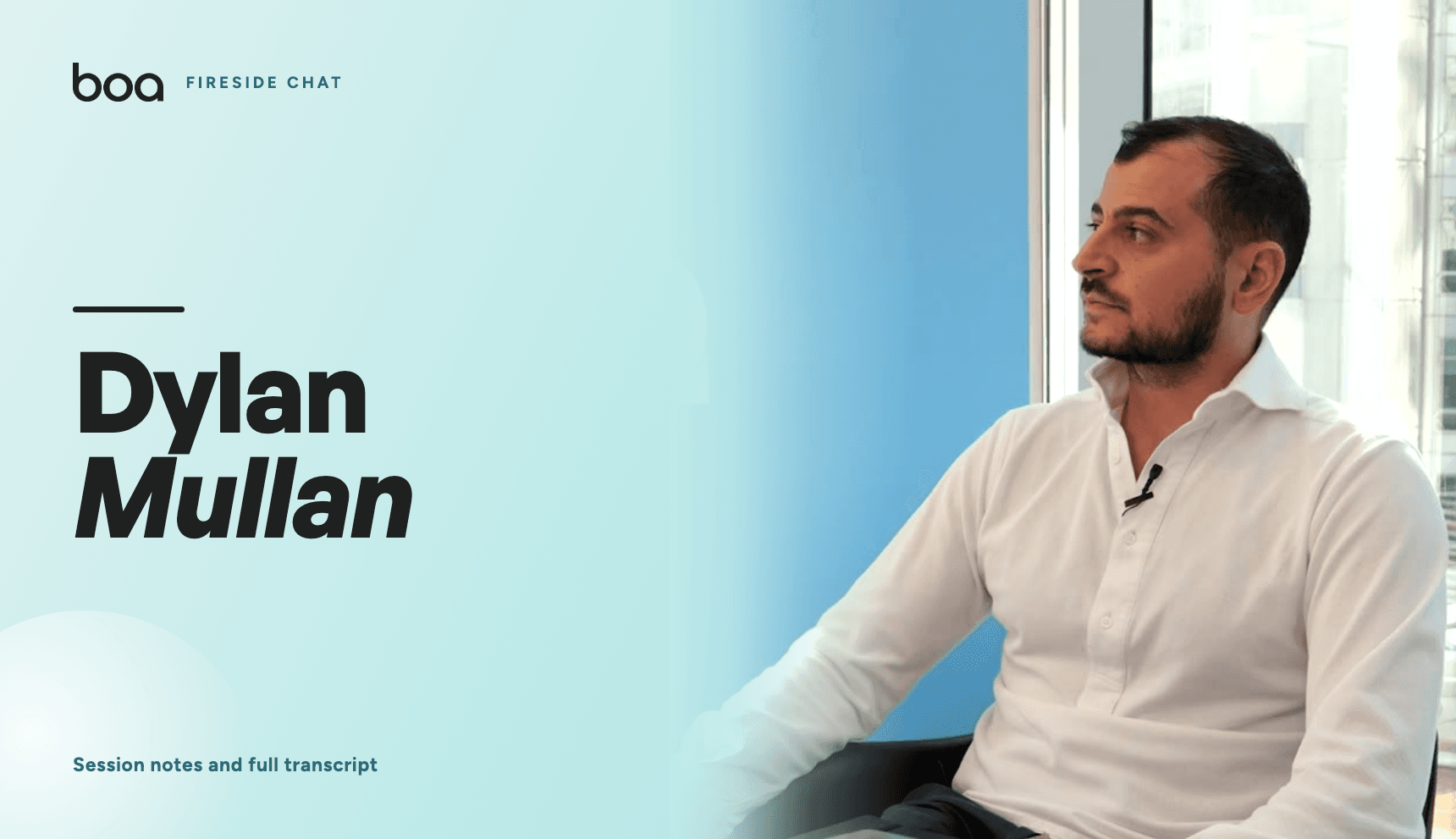
Dylan Mullan on Picking Products and Organic Content
With Dylan Mullan, Founder at Happy Skin Co · Hosted by Daniel Hakim · 48 min
What this session covers
Happy Skin Co founder Dylan Mullan breaks down how he chose an at-home laser hair removal product, the criteria he now uses to screen any ecom product, where to find trends before they saturate, and a monthly organic content system built on three winning videos and five variations each. For ecommerce founders and anyone marketing a physical product.
Pick a product that already has proven demand but is not yet saturated, then win on the volume and variety of content you make about it.
Key takeaways
- 01
Screen every product against a five-point criteria list
Dylan asks: does it solve a problem or is it genuinely unique, is there demand, is it saturated, can content be easily created and shipped to creators, and are competitor reviews positive. The final test is whether you can add products later to lift average order value and lifetime value. A product does not have to solve a problem, the viral light-up ducky lamps were just a unique take on something people already owned.
- 02
Use Page Transparency and Google Trends to prove demand
Dylan does not chase being first to market, he looks for recent competitors already selling. Go to a competitor's Facebook page, click Page Transparency, and if an ad has been running over three months it is a strong signal it is profitable, because nobody leaves a losing ad on. Cross-check with Google Trends (above 50 or clearly trending up) and main keyword volume over 10,000.
- 03
Two quick tests for whether a product is already saturated
First, check how long the competitors have existed. If a brand and its hero product have been around more than three years, the product is likely saturated. Second, walk into Big W, Kmart or Officeworks. If they have a home brand version on shelf, Dylan guarantees it is saturated.
- 04
Find products on TikTok, filtered to the last three months
Dylan searches category terms like "beauty DIY" and "beauty tools" on TikTok, then filters by most recent. TikTok Creative Center lets you filter by engagement and shares. The paid tool Sell Account goes more granular. Always filter to the last three months, because you want what is starting to go viral now, not what won last year.
- 05
Interview 100 customers before you commit to a product
Before launching Happy Skin Co, Dylan and his co-founder interviewed roughly 100 women, including friends, family and shoppers in Westfield centres. They asked what their laser hair removal experience was like, why they stopped, and the biggest pain points. Three answers came back: too expensive, too much hassle to maintain, too painful. Those three complaints became the product brief.
- 06
Follow the at-home convenience pattern in a growing category
Dylan copied a pattern rather than inventing one. Teeth whitening moved from the dentist chair to HiSmile at home. Spray tanning moved from a beautician's pop-up tent to Bondi Sands in your bathroom. He picked a growing category (beauty), then found the service inside it that was still expensive and inconvenient, and brought it home.
- 07
Start with Alibaba white label, customise later, build from scratch last
There are four routes: dropship (fine short term, not a long-term play), white label an existing Alibaba manufacturer's product with your branding, customise a manufacturer's product, or build from scratch. Dylan does not recommend building from scratch as a beginner unless you have $10,000 to $20,000 for stock, because of high minimum order quantities and development costs. Progress up the ladder as revenue funds it.
- 08
Post daily for three to six months before judging organic content
Dylan says organic content is the channel currently over-indexing on value, the way cheap Google clicks and 90% email open rates once did. Paid ads are now an amplification tool for scaling, not a starting point. Post a video every day, even if each takes 30 minutes to two hours, and commit to a minimum of three to six months before deciding whether it works.
- 09
Run the 3 x 5 monthly content review
At the end of each month, pull your three best performing videos, work out the idea behind each and what made them different, then plan five variations of each for next month. That is 15 pieces. Do the same exercise on three outperforming videos from other brands for another 15. Dylan says the best brands find an angle that works and recreate it many different ways.
- 10
Choose one of three proven organic angles
Dylan points to three styles you can study. Aliabottle documents the founder journey daily on TikTok, on the basis that in 10 to 12 hours of work there is always a 60-second piece of content. I'm Proud of You (the Let It Go journal) runs product-focused content with the founder's face out of it. Midday Squares mixes founder story with a David versus Goliath narrative against the four companies that sell 90% of the world's chocolate.
- 11
You only need a phone, a $20 to $40 ring light and CapCut
Lighting is the one thing worth spending on, either a ring light or a clip-on rectangle light from Amazon for $20 to $40. Edit in CapCut, the free phone app content creators use. Dylan notes Aliabottle's videos with millions of views were all edited in CapCut, not Adobe. Then build a Google Sheet with columns for idea, description, example and category, and populate 50 ideas so you never wake up wondering what to film.
- 12
Go live weekly and put followers inside your decisions
Instagram Lives put you at the front of everyone's story queue, where a normal story might be 30th in line and get 100 views off 5,000 followers. Go live at the same time each week. Even 7 to 20 viewers who stay 30 to 60 minutes become super fans. Ask them to reply with a keyword to join close friends, poll them on the next colour, because people involved in the decision are far more likely to buy the result.
- 13
Hire for the tasks that do not touch growth, not for content
Dylan's first hire advice for a solo operator is part-time or contract help on customer service and content scheduling, the work that does not shape strategy. Content itself cannot fall down the priority list, so if you cannot film it, use an agency that produces around 30 pieces a month. Daniel Hakim adds the test for any hire: if you spend $8,000 on a wage you want at least $30,000 back.
- 14
Test 5 to 10 new ads a week using organic winners
Asked how to go from $100K to $1M months, Dylan says the biggest variable is the volume of content you test, 5 to 10 new ads every week across different angles, pain points and styles. Use organic as the free testing ground: if a video performs organically it usually performs paid, because Meta rewards content people actually watch with lower CPMs. Boring creative still gets shown, it just costs you far more.
- 15
Do not start a second business until the first can run without you
Both Dylan and Daniel told a founder doing $100K months to stay on one business. The energy you put in directly correlates to results, so a second venture risks the first and usually produces two flops instead of one winner. Wait until you have a team running it and you only need a day a week of meetings and agenda setting. If you want out, spend a year preparing it for exit, sell, then start the next thing.
How the session runs
- 2:11From Prestons to corporate to ecommerce
- 4:19Changing the inputs when nobody around you is in business
- 7:03Handling setbacks and why a co-founder helped
- 11:14Health as the foundation for long hours
- 14:12How the at-home laser hair removal idea was found
- 15:50The product criteria checklist
- 21:41Where to find products before they saturate
- 22:42Dropship, white label, customise or build from scratch
- 24:39Three brands crushing organic content
- 28:26Building community and founder-led content
- 30:37The starter kit: phone, ring light, CapCut, 50 ideas
- 32:42The monthly 3 x 5 content review system
- 34:19Q&A: what to do at the moment you want to quit
- 38:25Q&A: scaling from $100K to $1M months
- 41:15Q&A: first hires and content while pregnant
- 44:10Q&A: should you start a second business
- 45:22Q&A: building community after you have launched
Mentioned in this session
- Happy Skin Co
- Life, Money and Love
- HiSmile
- Bondi Sands
- Gary Vee
- Tony Robbins
- TikTok
- TikTok Creative Center
- Sell Account
- Facebook Ads Library
- Google Trends
- Alibaba
- Big W
- Kmart
- Officeworks
- Westfield
- CapCut
- Adobe
- Amazon
- Meta
- Aliabottle
- I'm Proud of You
- Let It Go journal
- Midday Squares
- Be Seen Socials
- The Cub
- mycaboodle.com.au
- Elon Musk
- Richard Branson
- Steve Jobs
- VaynerMedia
- Prestons
- Liverpool
- Gold Coast
Questions founders ask
Dylan Mullan uses two fast checks. Look at how long the main competitors and their hero products have existed, and if it is more than three years the product is probably saturated. Then walk into Big W, Kmart or Officeworks, because a home brand version on the shelf is close to a guarantee that the window has closed.
Organic, says Dylan. Paid ads have become much more expensive and now work best as an amplification tool for scaling rather than a launch channel. He believes you can get from zero to around $100K a month reliably on organic alone if you do it well, then use paid to push past that. Organic also doubles as a free testing ground, because content that performs organically usually performs as an ad.
Aim for a video every day, even if each one takes 30 minutes to two hours. Dylan says not everyone gets traction in week one, so commit to three to six months minimum. Review at the end of each month, take your three best performing videos, identify the idea behind each, and plan five variations of each for the following month.
A phone you already own, a ring light or clip-on rectangle light from Amazon for $20 to $40, and CapCut, the free editing app on your phone. Dylan notes brands he mentors have edited videos with millions of views entirely in CapCut rather than professional software. Build a Google Sheet with idea, description, example and category, and fill it with 50 ideas so you are never stuck on filming day.
No, not until the first can run without you. Dylan says the energy you put into something directly correlates to the results, so a second venture puts your proven business at risk for something with no guarantees. Wait until you have a team running the business and you only need about a day a week on meetings and agenda setting. If you really want to move on, spend a year preparing it for sale first.
Full transcript
The complete conversation, as recorded, with every speaker attributed.
Daniel Hakim0:00
As you probably know by now, our mission at BOA is to make the highest quality networking and advisory accessible to entrepreneurs at every stage and in all locations. And today we're going to be learning, and learning from the journey of, of Dylan, who is an incredibly successful e-com entrepreneur. Dylan started his business at what age?
Dylan Mullan0:23
I was 24.
Daniel Hakim0:24
At 24, after dropping out of uni. And he had a revenue in his first two years— sorry, his business is called Happy Skin Co., which is an at-home laser hair removal company. In their first two years, they generated $25 million in revenue, and they did so bootstrapped. They did so with very little money invested into marketing and other things. And a lot of today's conversation is going to be about how we actually achieve that, talking about his mindset, product, and organic content and marketing to build community and to drive sales. He's literally an expert in those topics. Dylan also has his own podcast, which is kick-ass. It's amazing, especially the episode that I was on. And what's your podcast called?
Dylan Mullan1:15
It's called Life, Money and Love. And yeah, we had a great chat, but probably about 2 months ago, you were on the podcast. If anyone wants to cheque that out, scroll back maybe 8 episodes and you'll find Dan's episode.
Daniel Hakim1:23
Life, Money and Love. It's a great podcast. Today's conversation, like I said, is gonna be on mindset, product, and organic marketing. I'm gonna have a short interview with Dylan, and then we're gonna open it up to Q&A. So, as we're doing our Q&A and kind of open conversation, we'd love to hear your questions. So please have some great questions because anything you ask is gonna be valuable to everyone else here. And pop them in the chat and I'll be able to call them out. But let's kick off this shindig. Let's do it. Now I just want, I would love just to start with you sharing a bit of your personal background, who you are, where you're from, and kind of what gave you the, what motivated you to actually get into the entrepreneurial journey?
Dylan Mullan2:11
Yeah, it's a really good question. Obviously having a podcast, I have these conversations with people all the time and often people get asked, you know, when did you first start thinking about business? And they talk about having the lemonade stands or they're selling Pokémon cards in school. I never thought I was going to be an entrepreneur in school. I thought I was going to, you know, be a lawyer. As you mentioned, I thought, you know, all the way through school that was going to be my path. And I went to uni and I tried it and I realised pretty quickly it wasn't for me. So that set me on this whole other journey of self-discovery that would go for 4 or 5 years before I would find business. Did spend a few years acting, which we won't get into today. And then I tried the corporate world again. I got— I thought, I don't have a uni degree, but I'm quite smart. I'm quite ambitious. What's an industry I can get in that still I can earn a lot of money? Which was obviously the goal as a young, you know, young person to make money and create financial freedom. You ask where I come from, I grew up in the Southwest Sydney suburbs. So I didn't come from a lot of money. So I didn't have, you know, family members that were in business or that could, you know, give me $10,000, $20,000 to start anything. So I had to do it myself. And then when I was working in corporate, I met someone for the first time that had their own little e-com, like side hustle. And once I met that guy, he was selling like ties, pocket squares, things like that. Men's accessories and it blew my mind that someone who was doing the same job as me, who came from the same background as me could start their own business. So did a lot of research there and then eventually, you know, found e-commerce and you asked me why business? After going through that journey, it could be nothing else.
Daniel Hakim3:35
Isn't it funny though, when you meet someone who's doing something and no one else in your existing network is doing that thing, it's like that thing becomes possible.
Dylan Mullan3:43
It changes everything.
Daniel Hakim3:44
If he can do it, I can do it, you know?
Dylan Mullan3:46
It just opens your mind to the possibilities and that's why I think, places like BORA are so good. So you can hear other people's storeys and open your horizons because not everyone's lucky enough to be surrounded by people with friends and family in business. So I think it's really important to hear other people's stories. It really opens your horizons to what can be possible for you.
Daniel Hakim4:03
Amen. And so the mindset between being an employee and being an entrepreneur are two very different mindsets. How did you have to shift your mindset personally in order to succeed in business.
Dylan Mullan4:19
Yeah, there are, there are a few major like pivots I made in my mindset. I think the way that changed was, as I said, I grew up in— it's an area called Prestons in Southwest Sydney near Liverpool. So again, it's not really seen as an area where a lot of successful people really come from. So I had to change the words that were coming into my, my head because like the people around me weren't having these conversations about business, about growth, about content, anything like that. So it started by changing what I listened to. So instead of listening to, you know, random entertainment podcasts, it was Gary Vee, it was Tony Robbins, it was these sorts of people that were shifting my internal, like the thoughts, the words inside your head. You know the saying, you're the product of the 5 people closest to you. Well, if you didn't have successful people around you, what can you do? You can listen to podcasts, you can watch YouTube, you can join events like this to learn and change the information coming in. So that was a big part. I think the major thing that changed for me was the self-belief factor. I always had a lot of self-belief, but like you said, I feel like when people think about getting into business or achieving their dreams, people may see people like me and they see my story. We made over $10 million in our first year and think, wow, that's so lucky. That can never happen to me. Like we see people achieving their dreams, like they won some imaginary lottery that we weren't invited to enter, that it can't happen to you. But I was just some kid from the area, like literally the area is what it's known as. And once you realise that dreams do come true and I'm, I'm not special, you're not special. You just had a vision and a dream and decided I'm going to do everything in my power to try and make it happen. Those are the people that get to live their dream lives. So that was the major shifts I think that made me realize, hey, I can achieve my dreams.
Daniel Hakim5:52
I completely agree. I mean, I obviously speak to thousands of entrepreneurs on an annual basis and, and self-belief, I reckon, is the number one.
Audience member6:01
Yes.
Daniel Hakim6:01
Is the number one, but it's the most important thing anyway. Also, that's interesting. No one's ever said that if you haven't got access to other success successful people, other business people, you can listen to them. So if you don't have anyone in your media network, you can enter that world with podcasts.
Dylan Mullan6:15
Like the HiSmile guys. Yeah, two guys that started a mainly female-orientated business in Queensland. They put like 10 grand in each, $20,000, and they built a massive empire. They were a massive inspiration for us. We needed to hear storeys like that to realise it was possible.
Daniel Hakim6:29
Yeah, yeah. Oh, it's awesome. Now, when you start a business, at the very start there's a lot of setbacks. And often— I mean, you ended up generating a lot of revenue in your first year, which I want to talk about later on. Yeah. But there's a lot of setbacks. Often it feels like maybe like, ugh, it's not working or something's not right or, you know, bad things happen. And when you get more experienced in business, you learn that that never stops. You know, it just becomes how you handle them.
Audience member6:53
Yes.
Daniel Hakim6:54
But how, how did you, how were you able to handle setbacks and how were you able to not be discouraged while maintaining motivated to achieve your vision?
Dylan Mullan7:03
It's such a great question. I think there's a few things I'll say to that. The first thing I will say just to, you know, come off the back of what you were saying, is that is business. I realised pretty quickly that business is about overcoming challenges and solving problems. And if you don't like doing that or you feel like you can't doing that, you might not be in the right game. So that is the first thing, right? And you do get used to it. Um, and then the other thing was like, you go through these challenges and then you can think of like, you know, why me, why me, why me? The biggest perspective shift I had is life is happening for me, not to me. It sounds simple, but, and it feeds into something I'm a big believer of, and there's no factual evidence that I can point to that everything happens for a reason, but I choose to believe that because if I chose to believe that everything was random and there was no point of anything, I just feel like that's a, there's nothing to gain from that perspective. So having the perspective of life is happening to me, not for me, these challenges are a part of business. If I want to be successful, that's what it takes. And then when things get really hard, and I'm close to wanting to give up, and I have this realization, this thought, this is where most people give up. So by me continuing to find a way through here, this is the difference between being successful and not successful. So the moments it gets hardest, I notice that I have that thought and I smile to myself. I'm like, this is what it's about.
Daniel Hakim8:19
That's so funny. That's literally the same thing that, that, that I do exactly word for word. Like, yeah, if it was easy, everyone would do 100%. Like, when it's hard, that's literally what I say to myself. And I said, do I want to be with one of the people who don't want to do it, or do I Like, it's supposed to be hard. That is the point. That's so funny. And, but I guess, just to go a bit deeper in that then. So, you do learn in business that setbacks just become almost forever. Like, they're always happening constantly. But at the start, how did you, before you had that kind of wisdom, how did you overcome them and stay motivated to the journey?
Dylan Mullan8:59
I tell you what was a really important factor looking back, and obviously you don't realise it when you're in it because you're in the thick of it. You get the best lessons reflecting back on what you have gone through because, you know, now I've been in business for almost 7 years, or over 7 years if you count the pre-launch phase. So you learn a lot and you have those clear perspectives. But back then, I didn't know how to find products. I didn't know how to do research. I didn't know what good marketing was. I had an idea of things, but I didn't know. Looking back, one of the best things we did is I launched the business originally with a business partner because we're all human beings. One day he won't be motivated, but I will. And I'll be like, come on, bro, we gotta meet up, we gotta push through and vice versa. And there'll be challenges where maybe my skillset isn't great at solving that. And I just think about it, think about it, think about it, and I can't figure it out, but he will and vice versa. So having people in your team, whether it be advisors, whether it be business partners or co-founders, having those people in your team to be able to bounce off so you don't feel isolated. 'Cause as you know, if you're in business, you don't have friends and family in it, it can feel very lonely and isolating. So having other people to bounce off and feed off their energy was really important in that first year.
Daniel Hakim10:05
Yeah, I agree, everyone here. I think if you can either have a co-founder, but it doesn't have to be a co-founder, it could be friends in business, could be people you meet through BOA, could be advisors, but having people who have actually done it before or who are going through the journey to make things like to say basically that is normal. That's what it's supposed to be like. That just kind of helps you like, okay, I'm not doing a bad job. Like, this is normal. Yeah, this is— I completely agree. Now I just want to— the last question in terms of mindset was, at the start of business, you're literally, it's your whole life.
Audience member10:40
Yeah.
Daniel Hakim10:40
You know, most of the time, like it, as the business grows, you have more luxuries because you got more money. You can pay for things and you do have more time.
Dylan Mullan10:48
Pay for team to do things, right? Exactly.
Audience member10:49
Yeah.
Daniel Hakim10:49
But at the start, you're literally, it's your whole life. You're doing big hours, you're stressed all the time. You're doing every role, even the roles you're not good at doing. How do you manage like health, mental health and health, but let's say mental health, like they're both, both. How do you balance health and mental health with, while staying ambitious and trying to hit your goals?
Dylan Mullan11:14
I tell you the first 2 years in business, right? I think it wasn't a challenge at all. It was my whole life, but I was so consumed by it. I was so excited by it. When you realise for the first time you're working on your own thing and it comes back to your why, why are you doing this? Why do you want to be successful? Why do you want to be in business? What sort of life do you have? And I'm very connected to my goals. Visualization has been a major part of my journey and my success. So always going back to why you're doing it and what can happen if you do do the hard work. So that wasn't a challenge for me in the first year. It was long hours, but I loved every minute of it. That has become a challenge as I've, you know, spent more years in business because as you know, if you want to be successful, you need to be able to do like long-term, you need to be able to do things sustainably, right? So I think that's the million-dollar question for every entrepreneur. How do you balance that? I think I've had times where I haven't balanced that over the last few years and it has had an effect on my health. And I think the biggest thing, one of the learnings I've had probably over the last 12 to 24 months is that health is the foundation, is the number one priority. Because the temptation can be, when you're really busy, when you're really stressed, when you have a lot of problems to solve, wake up in the morning, straight into work, and then you work all day and then you go to sleep. But it's when you're at the most busy, when you're at the most stressed, your health and your energy levels are the most important. So it's actually like counterintuitive when you think you should be, you know, spending all your time in work. That's when you need to make sure you're doing your, you know, 45 minutes to an hour of physical training. You do a walk, 10, 15 minutes on your lunch break to get the blood flowing. I feel like, yeah, I feel like health as a foundational element for like long-term sustainable success is something that can't be underestimated. And I'm only 30 and I've learned these lessons many times. So if you're anything older than that, like I started when I was 24. So you have that like unlimited energy, but very quickly as you get a little bit older, you have to take that into, Very serious consideration. Yeah.
Daniel Hakim13:06
I also find too that you do have more energy when you're younger, but also you're more naive. So you're not thinking about other things. When you get older, you might not be about age, but it might be more about like experience and time in business. You actually start noticing more things and being aware of more things. So you get more stressed because you're actually looking at a bigger picture. Ignorance is bliss.
Dylan Mullan13:29
You need a bit of that.
Daniel Hakim13:29
Mm, mm, mm.
Dylan Mullan13:31
Naivety. Daniele stumbled on that word.
Daniel Hakim13:33
Yeah, yeah, yeah. Now, you obviously have a very, very successful e-commerce business and you did it with what I would call a random product. You know, like if you're going to start a business, like, how did you actually get to, I'm going to start a business that does, that sells a product that does at-home laser hair removal. Like, first of all, I want to know how you actually came to that decision, and then can you share a formula that you've learned through that process that other people could, um, use in order to choose the right product or to choose which product they have to focus on?
Dylan Mullan14:12
Uh, it's a great question. I'll kind of answer it in two parts, I think, to, to do it justice, because I'll explain how it actually happened, which again, I didn't have a formula, I didn't have a framework, I didn't really know. All we knew was We looked at patterns, right? I already gave the HiSmile example. Teeth whitening used to be done in a dentist chair. A couple of guys from, from Gold Coast thought, hey, how do we create a product— not even create a product, the products existed— how do we build a brand around a product where people can do something that used to have to be inconvenient, book an appointment, it's quite expensive, go out of your way to do that, and whiten your teeth? We also saw Bondi Sands. Remember back in the day, all the beauticians that come over that They'd build up their little tent, they'd do a spray tan and you know, it was annoying, it was expensive, you had to go out of your way. Then someone created like a fake tan that you could do at home, rub it on yourself in your own time. So we identified that, we knew we wanted to be in beauty because the amount, like the beauty industry was growing year on year was massive. So just looking at trends and then DIY beauty more specifically. So that's all it was for us, a couple of key things. And we thought, hey, we actually interviewed probably 100 women, friends, family, people on the streets, people in Westfield shopping centres and asked them, hey, Do the laser hair removal. What's your experience been like? Have you stopped? Why did you stop? What was the biggest pain points about that experience? And it was too expensive. Couldn't be bothered to maintain, you know, going out of my way to do it or it's too painful. Right. Those were the main ones. So that's as simple as it was at the beginning. But obviously I've been in, you know, e-com space for close to 7 years now. I've mentored, consulted to probably 100 businesses as well. So now I have a bit more of a framework in the way I look at the product selection piece, right? Because it's the most important.
Daniel Hakim15:50
Any—
Dylan Mullan15:50
regardless of how good you are at marketing, if you pick the wrong product, it's going to be very difficult to succeed, right? The product needs to tick a few boxes. Now there's 3 steps, right? The first one is the product criteria. So what are we looking for in a good product? Now there's a few different elements we want to be looking for in a product when we're building a brand in e-com. So the first one, really simple: does it solve a problem or is it a unique product? Right, so obviously it's really— I don't need to explain, does it solve a problem? Does it solve a problem for someone?
Daniel Hakim16:16
Yes.
Dylan Mullan16:17
Or is it a unique product? And I like to use that as an example. So one product I used to explain this, it doesn't always have to be a problem-based product. Now, let me ask you a question. Do you have any lamps in your house?
Daniel Hakim16:29
You got a lamp in this office, you got a lamp right here.
Dylan Mullan16:31
Most people already have lamps, so it's not really solving a problem. Like, if you launch a lamp brand, it's not really solving a problem. But a product that went super viral last year was those cute light-up ducky lamps. Now, is it unique?
Daniel Hakim16:42
Yes.
Dylan Mullan16:42
Do people already have lamps?
Daniel Hakim16:44
Yes.
Dylan Mullan16:44
So it wasn't solving a problem, but it was unique take on something that already existed, and that product crushed it for about 12 months. So is there demand for— like, does it solve a problem or is it unique? Is there a demand for the product? So a couple ways we can see that: is there any competitors? Have they been running ads profitably? Now, if you can— people can always want to be first to market, but that's really unrealistic. If we're looking for products and we're only going to be first to market, you're going to limit yourself dramatically. So are there competitors that are pretty recent, right? Have they been selling the product profitably? And how do we know if they're selling the product profitably? We don't really know, right? But if we go on their Facebook page, click Page Transparency, if they've been running an ad for over 3 months, pretty good indication that it's profitable. They're not going to leave it on if it's losing money, right?
Daniel Hakim17:28
Or they're going to go broke very soon.
Dylan Mullan17:29
Or they're going to go broke very soon. We can look at Google Trends. Is it, you know, above 50 on Google Trends, or is it at least trending upwards? We can look at some, like, the main keywords around that product. Is it over 10,000? So that's some things we can look at. Okay, so is there demand? We've established there's demand for the product, but with demand also on the other side is saturation. Is the product too saturated? Now, a couple really simple ways to see if a product is saturated— that those competitors we're looking at, have they been around for, for over 3 years? So like Happy Skin Co, at-home IPL hair removal. We've been around for, you know, close to 7 years now. If a brand has been around and their hero product has been around for over 3 years, there's a good chance that product is saturated. Another really good indication, if you walk into Big W, if you walk into Kmart, if you walk into Officeworks and you see their home brand versions of that product, I guarantee it's saturated. And then we want to look at things like more on the ecom side. Can, can content be easily created, right? Because we live in a very visual society. Can we create content and Part of that, can content be easily created? Can it be easily shipped to content creators? So if you're getting into business for the first time and you're thinking of doing like big furniture, there's gonna be a lot of challenges in the logistics part. So I wouldn't recommend something that's really expensive and hard to ship for a beginner. Then looking at the competitors, is most of the reviews you can find on their site and third-party review sites positive?
Daniel Hakim18:49
Yes.
Dylan Mullan18:50
And the final thing we wanna look at in selecting a product is if we start here with the hero product, we always wanna think of the big picture, the brand that will come from beyond that. Can I add new products to increase lifetime value and increase the AOV in the future? Yes, so that's the product criteria.
Daniel Hakim19:05
So just to summarise that, 'cause I actually think, I loved what you said, especially the very start, it's like identify a trending market. So like for you, it was like at-home beauty.
Audience member19:17
Yeah.
Daniel Hakim19:17
You saw Bondi Sands and the— HiSmile guys. And HiSmile. So you were like, okay, wow, there's at-home beauty is a big market. What's an available niche within that market? Yeah, or no one's doing at-home laser, laser hair removal. Like, it's actually really clever, like that whole thinking process, how you got there. But anyone can do that. What's the trending— what's the trending thing at the moment, and what's a segment of that that isn't yet established?
Audience member19:43
Exactly.
Daniel Hakim19:44
That's really a great way to do it. And then I also loved, um, because content and social media is so important for e-commerce businesses Can that product be very content, easy to generate content with? Can you make amazing videos? Can influencers do it? Can, you know, is it a contentable product? Yes. Um, I like that word, contentable. That's what it would—
Dylan Mullan20:07
trademark.
Daniel Hakim20:08
I don't know if it's a word or not, but it makes sense.
Dylan Mullan20:10
Yeah, 100%.
Daniel Hakim20:12
Um, I, I, I, I agree. But, and also it's about catching that wave, so you don't want to be too late on the wave. You have to really keep your eye out for what industry do I want to get in And what's the current wave that's happening at the moment? And of that wave, where is there a spot for my surfboard to fit?
Audience member20:27
Yes.
Daniel Hakim20:28
You know, where there's no other surfer there. Like, it's, it's, it's, it's actually quite simple.
Dylan Mullan20:32
It is. Now I gotta, I gotta add one, one thing before we move on, because it's great to know. Now we know what we're looking for. We need to know how do you find it? And that's something we really struggled with at the start as well. So how to find it? There's a few different ways to do that because we find your product, find the product, actually build it. How do you, how do you know? How do you, how do you get an idea? You're not going to sit there and think of, ah, beauty, It's like, that's, that's something, that's a strategy, but it's not really a proper strategy that's like repeatable, scalable, that you can really rely on. Yeah, so we need to find the products before they're oversaturated, right? A few different places we can use, some are free, some are paid. Now obviously TikTok is going to be a great product discovery platform. We can just search, we have a list of different, you know, search terms: beauty DIY, beauty, beauty tools, anything you're interested in. Search that on TikTok, right? You're gonna see loads of great content. You can filter by the most recent videos. You can look at TikTok Creative Center. That's essentially the same thing, but you can put in a couple of different search parameters and it'll let you filter by engagement, by shares, by those sorts of things. So TikTok's a great place. If you want to get more granular on TikTok, there's a paid platform called Sell Account, which really lets you go granular on searching for different products.
Daniel Hakim21:41
What's it called?
Dylan Mullan21:42
Sell Account. Because it's going to give you— you can put on your different search parameters, it'll show you all the best videos, all the trending things. And we obviously want to filter for the last 3 months because we're not looking for what went viral last year, what's just starting to go viral now. Now we can do that as well on Facebook. There's a really good one, a paid— like, obviously we can go on Facebook Ads Library, um, facebook.com/ads/library, and then we're going to do the same thing there.
Daniel Hakim22:05
So it does beg the question though, so you're looking on— like, I'd imagine TikTok's probably the best place to look for very to find quick trending things. Yeah, but when things are trending and you have to catch a wave, it then— what did— what makes it possible to do is the speed of which you're able to basically build a brand and product.
Dylan Mullan22:24
Yeah, exactly.
Daniel Hakim22:25
So how are you able to get— if, you know, you want to catch this wave, you can see it, it's at home beauty, it's at home beauty, uh, you know, you're gonna fit in in the laser hair removal part. How do you actually get your product built and made and the brand? How do you do it all quick enough to actually catch that wave?
Dylan Mullan22:42
That's a really good question, and again, something I didn't know at the start. Now, there's a few different ways that you can start a product. You can— well, there's 4 different ways. You can dropship a product, which again is decent in the short term but isn't a long-term strategy in my opinion. There's private label, so you can use a platform like— again, let's not even overcomplicate it— Alibaba.com. All it is is a website full of manufacturers who list their products, thousands and thousands and thousands. So you can white label a product, use exactly their product, put your branding on the packaging, put your branding on the product. That's the way most people do it. Or you can go to manufacturers on Alibaba, find a product and make some customizations to that. There's going to be costs. Or you can make a product from scratch. If you're a beginner, I wouldn't really recommend making a product from scratch unless you have $10,000-$20,000 to spend on stock because they're going to be high MOQs. And there's gotta be development costs as well.
Daniel Hakim23:32
So that's actually a really beautiful way to look at like the journey in business. When you're starting for the speed to just to trial it, it's kind of like the, you know, the MVP. It's kind of like, well, I can just get a product from Alibaba and put my brand on it and sell it. If it starts going well, I've got more money now. I can now customise that same product. I keep selling and make more money. Oh, you know what? Now I can actually build my own product that is— you know, that might be patentable or might be whatever it is. Exactly the way you did.
Dylan Mullan24:00
That's our journey.
Daniel Hakim24:01
That's a really nice flow. I wanna get to marketing because, okay, now we have our product. Yeah. And we've got our mindset, we've got our product that we wanna sell. Now we actually need to sell the thing. You could have the iPhone, but if you didn't have great marketing, it might not sell. So I guess, where's my question? I mean, you've built a huge business, basically from organic content to a large extent. Can you give some examples of organic content strategies that have worked for you guys? So like actual examples that, that everyone here could be like, okay, I could do something similar.
Dylan Mullan24:39
Yeah, I'll give you a few examples. And the one thing, if I told you what— so what, what Happy Skin Co was built on was influencer marketing and paid ads. But we launched over 6 years ago. So there's no point in me explaining like the nitty-gritty of what happened then, right? It doesn't, it's completely changed. The reason I like organic marketing is what is working today. Now Gary Vee speaks about this a lot and the way digital marketing works, there's always going to be some channel that over-indexes in terms of value. Once upon a time it was email marketing when you'd get 90% open rates, then it was Google Ads when you could get clicks for 5 cents, 3 cents, 4 cents, then it was paid ads, influencer marketing, Right now it's organic content. Now I'll give you 3 great examples of brands that have absolutely crushed it in organic content, and they've got 3 different styles. And you can go— I suggest you jump on Instagram and TikTok and have a look at these brands. One of them, so one of the brands, one of my, one of my good friends, one of the brands who mentor as part of my e-com mentoring, Alia Bottle. It's the one, you, the producer of the podcast, him and his partner. So Alia Bottle, look them up. Their organic content strategy, which has been extremely successful. I won't reveal the numbers, but extremely successful, um, is they've just documented their journey. They're not so much thinking about random trends. Every day you spend 10 to 12 hours working, there's a 60-second piece of content in that every day. So they document their journey and capture the highs, the lows of their moment, and they put their personality into it. So that's one option.
Daniel Hakim26:06
And where do they share it?
Dylan Mullan26:07
On TikTok. Predominantly TikTok.
Daniel Hakim26:09
TikTok where it's at.
Audience member26:10
TikTok where it's at.
Dylan Mullan26:11
Yeah, TikTok where it's at. So have a look at them, they document the journey. Another one of the brands I mentor, really, really great entrepreneur, she's from the UK. Her brand is called I'm Proud of You, which is a mental health prompt journey. So the Let It Go journal, her focus hasn't necessarily been documenting the journey, it's been on product-focused organic content. So have a look at hers. Her name in her TikTok, I believe, is like shop. I'm proud of you. And that's really great product—
Daniel Hakim26:37
like, what do you mean by that? What's product-focused organic?
Dylan Mullan26:40
So I mentioned Yue and Daniel with Aliabottle. They're documenting the journey. It's about the humans. Yeah, people are mainly, you know, following along their journey. You know, they'll be packing orders and telling stories. Oh my God, our shipment arrived! Ah, that sort of stuff. Valquise, the founder of I'm Proud of You, is— you have a look at their content, it's all about the product themselves. Now I could try and explain a couple videos, go do the research and it'll make sense. It's all about the product. She'll be writing the journal on different sort of things about the product. So her face isn't in it. She's not putting herself into it. Another one, it's a big company, it's a pretty big company in the US. They're a startup, they're going against the big major players in the chocolate space. They're called Midday Squares. Midday Squares is, they're great, they are crushing it. They're probably one of my favourite brands in the world right now for organic content. And their strategy is, it's a mixture of documenting the journey and the founder story, but they tell a storey with all their content. As I said, they're going up against the major— like, all the chocolate, 90% of the chocolate sold in the world is from 4 big companies.
Daniel Hakim27:43
So what's the storey they're telling though?
Dylan Mullan27:45
David versus Goliath.
Daniel Hakim27:47
Okay, so they're sharing their journey fighting the last—
Dylan Mullan27:51
fighting the large companies.
Daniel Hakim27:52
Oh good, interesting.
Dylan Mullan27:53
Have a look at Midday Squares, killing it. A little bit higher production value, as in they'll probably be— have an editor who's spending time making it look really cool. But they're 3 different examples, different strategies, different budget levels that you can look at, and they've all crushed it with organic.
Daniel Hakim28:06
And they should cheque it on TikTok.
Dylan Mullan28:08
TikTok. TikTok or Instagram. Yeah, but TikTok is, is obviously where people are probably going to get most reach.
Daniel Hakim28:13
Yeah. Now I would say the holy grail— and correct me if I'm wrong— but I'd say the holy grail of marketing is building a loyal community. Yeah. That supports your brand and product. How do you do that? Yeah. Um, and how do you do that with using organic content? Yeah.
Dylan Mullan28:26
So there's, there's a lot of great ways we can do that. Now, one I mentioned One of the best things that brands can do— two of the three examples that I mentioned had their founders very heavily in the content. So people, some people will say to me, Dylan, you know, I'm interested in e-com, but I'm an introvert. I don't want to put myself out there. Now, you don't have to, but you're limiting yourself if you don't. Now, if we think about some of the biggest brands and personal brands in the world, who we think of— Elon Musk, we think of Richard Branson, Steve Jobs, Gary Vee. I mentioned no one knows Gary I mean, VaynerMedia, it's GaryVee. So putting yourself— exactly, Steve Jobs— putting yourself out there and being transparent about the business journey, the ups and downs of putting your face there is one of the biggest cheat codes that you can use. Now, also in terms of building community, we've seen the likes of run clubs pop up, of yoga in the park pop up, of those sorts of activations where you can physically build community. Now, those things that are gonna take a lot of time and they're long-term investments. But also some things that get overlooked nowadays, because we all think about these things, it just starts with one good experience and then it builds on top of that. And a good experience can be on the website, can be in the live chat, can be someone commenting underneath your videos and the way you handle all your customer interactions. So it starts with one interaction and it builds from there.
Daniel Hakim29:39
But I also like the idea, like if your company was like, if you were selling yoga, um, activewear in a sense, hosting a yoga in the park event, for your clients, of whom you have their details, database. Yeah, could be a nice little activation. And you'd be surprised because if you get 10 people come and they're 10 people that you meet personally, you become friends with, you ask them, can you please comment, can you leave a review, you know? And then when you post, they start commenting. And once, you know, people go where other people are, see, people see people commenting on posts, then, then they start commenting too. So it's really about like, you want the snowball to roll, but you, you almost have to manually build it first.
Dylan Mullan30:16
100%. You need to create that initial wave of momentum. Like, you walk past the cafe and there's 10 people lining up at the front versus one that's quiet, where are you going to go? The one with people. And by doing those events, you're creating super fans, and they'll tell a friend, and then they'll tell a friend, and it snowballs.
Daniel Hakim30:31
But for new businesses with a small budget, what's the best first step to start organic marketing?
Dylan Mullan30:37
Yeah, so first step, we're going to need a few things to do that. Not much, you don't need a big budget for this. You're gonna need a phone. Most people already have a phone. Gonna need a ring light. $20, $30, $40 from Amazon, you can get a good ring light because the ones— the lighting is important.
Audience member30:52
You can—
Dylan Mullan30:52
it doesn't have to be a ring light. You can get the little clip-on rectangle ones that clip onto your phone, but you need good lighting. You don't— like, you can shoot like right now, we've got great lighting, but you're not always going to have that. And we want to make the content look as high quality as we can on a low budget. Um, and then CapCut, free app on your phone. That's all we need in terms of the tools.
Daniel Hakim31:09
What's that? CapCut.
Dylan Mullan31:11
It's a really good editing tool on your phone.
Daniel Hakim31:14
It's free.
Dylan Mullan31:15
Like it's what all the content creators use.
Daniel Hakim31:17
CapCut.
Dylan Mullan31:18
CapCut.
Daniel Hakim31:19
CapCut. It's like video editing.
Dylan Mullan31:20
Video editing on your phone. You can do everything with it. Yewi, I mentioned who you met, who they've absolutely killed it. Like multiple videos, like millions and millions and millions of views, all edited on CapCut, not Adobe.
Daniel Hakim31:30
Wow.
Dylan Mullan31:31
Proper editing software. So it's great. And then starts with a plan. Now it starts with doing a bit of research. So I already gave you 3 brands that you can really look into. So we want to think about, okay, what's my angle here? You asked a really good question. Midday Squares, what's their angle?
Audience member31:46
Mm-hmm.
Dylan Mullan31:46
David vs. Goliath. What's your approach? And you don't need to be black and white. This is my first idea. We're going to stick with this for a whole year.
Daniel Hakim31:53
Yeah.
Audience member31:53
It's flexible.
Dylan Mullan31:54
It's fluid at the start. You know, it's about testing. So come up with a bunch of different approaches you can take. Do a lot of research, have a Google Sheet where you have idea, description, example, and category.
Daniel Hakim32:06
Yeah.
Dylan Mullan32:06
And populate that with 50 different ideas. So then you don't have to think every day, what am I going to film? And then you can start filming there. Or you do what Ewen Danielle does, go about your day, film everything, get to the end of the day and think, what's the storey from today?
Daniel Hakim32:18
Yeah. I mean, basically buy one of these lights.
Dylan Mullan32:22
Exactly.
Daniel Hakim32:22
Yeah. Um, get CapCut, do some research. Yeah. Of brands doing great things and make a content plan.
Dylan Mullan32:28
And don't expect to be perfect month.
Daniel Hakim32:30
And also, how consistent would you say people need to be to start generating traffic? Like, you know, what, how long that should— because it's not going to just blow up the start, you need to be consistent. What's that period?
Audience member32:42
The—
Dylan Mullan32:43
again, and I understand people have full-time jobs and it's difficult, but like, if you're a startup brand with not a lot of budget, which a lot of people in that boat— because paid ads are a lot more expensive to run than they used to be, they're more of a tool for scaling than, than starting. They can be from the start, but they're really an amplification tool nowadays, is you should be posting. You should do your best to post a video every day. Now, it might take you 30 minutes to do a video, might take you 2 hours. That is going to be the most important things you can do. Now, you, you gave a really good point. Not everyone's going to be successful week 1. Right now, organic content, it's not, oh, I'm not sure, is this a good channel? It is the best channel. So stick with it, give it 3 months, 6 months minimum. And the way I do the content, you got your list, you try things, you want to review it at the end of every month. So the way I get my brands to think about their organic content at the end of the month, let's say you've posted every day, you've been consistent, look at your best 3 performing videos. What were your best 3 performing videos, right? From those best 3 performing videos, what's the idea behind them? What makes them different? For the next month, plan 5 different variations of that video. Because that's what all the best brands do. They find an angle that works.
Daniel Hakim33:52
Well, whatever works, do more.
Dylan Mullan33:53
They recreate it in many different ways. So do that. That if you do your 3 best videos and 5 different variations, that's 15 pieces of content. Then do the same thing, research other brands, you know, killing it. Look for 3 videos that outperformed the rest relative to their engagement and views. What makes that video? And do 5 different of those top 3. And then you've got your content plan for as long as we need.
Daniel Hakim34:15
Fantastic advice. We're going to get to questions. Paul, would you like to go first?
Dylan Mullan34:19
Hi, I'm here. Hi, I did write a question on there. Thanks for bringing it up. The moments you were really about to give up. I've had a few moments of those too, but obviously you've had more experience than me. What did you do at that moment? What exactly helped you push through? Yeah, it comes back to what me and Daniel was speaking about before. I've had those thoughts that crossed my head when You know, it's 1:30 in the morning. All your friends and family are asleep. Like, you've got to be up in 6 hours. You're still in the office. But for me, giving up isn't really an option. I know deep down I'm never going to give up. So I give myself 1 minute, 2 minutes. I feel sorry for myself. And then I realize, hey, is this the life I want? Yes or no? And you've got to be honest with yourself. Business can be hard. And, you know, Dan— Daniel might not like me saying this, but business isn't for everyone, right? But then it comes back to your why. Why do you want this? And then think about, okay, what is the alternative? Going back to that job you hate, waking up every day depressed, living for the weekend. Is that really what you want?
Daniel Hakim35:18
Yes or no?
Dylan Mullan35:18
And just weighing up that decision because business comes at a cost, but for me it's worth anything. So it comes back to your why and it's okay to have those thoughts and important to know everyone has those thoughts. Everyone has those thoughts, no matter if they're worth $100 million or $10. We all have those thoughts at times, but you can't let them win.
Daniel Hakim35:37
Yeah, and I would also add to that, you'd be surprised how quickly your mindset changes. It might be the morning and you're like, oh, fuck this, I'm giving up. Like, I, I, I really— I'm— it's just not working. And then you just work and you do some meetings, and by the afternoon you've got this like new wavelength where you're just like, okay, I've got a plan, I'm doing it. You know, like, it changes so quickly. Like, you can't ever let one little moment just set you in. That's, that's not what it is. It's just that's how you're feeling that short moment. I guarantee in like 5 hours time it's it's, it's going to be very different at the very least the next day.
Dylan Mullan36:06
One other thing I'll add just quickly before I move on. I mentioned visualisation has been a big part of my journey. When you're feeling low, like you're feeling like the world is against you, like it's not happening, visualise for not for 1 minute, not for 2 minutes, go deep, a 30 to 60 minute visualisation of what your ideal life looks like. Live it, experience it, the wife, the kids, the family, the cars, live that experience and let your body feel the emotions. And then tell me if you want to give up.
Daniel Hakim36:33
Thank you, Paul. Bella, would you like to ask your question?
Audience member36:37
Hi, how you going?
Daniel Hakim36:39
Good, thank you.
Dylan Mullan36:39
Hey, Bella.
Audience member36:41
Hi, I'm, I'll just quickly tell you a little bit about my business. I'm the founder of mycaboodle.com.au, like a growing Aussie e-commerce brand, like niching in the pet industry. Yeah. So focusing on like poodles, cavoodles, like that breed, like to help people like find the best information and the best products for them. So actually my hero products manufacturing an Aussie-made shampoo and conditioner. Like, it's quite unique, and I, um, you know, came up with a formula myself and stuff like that. So been running that for 3 years. Um, I did— like, started while I was, um, a corporate marketing manager, and I built it up as like a side hustle. And then eventually I managed to quit my corporate job about a year and a half ago and take it full time. Um, and the last months I've like heavily invested in like Meta ads and like an e-commerce like coaching group and it's just taken my business like to the next level. I used to think like $20K last year was great and now I'm like reaching heights of like $100K months which I never thought was possible so quickly. Um, and what I wanted to know is that I wish I knew that secret like beforehand. Like, um, I hadn't been connected to like too many like e-commerce owners or anything like that before. So in order to scale my brand to like million dollar months and things like that, you know, where should I be putting my money? Like if you had to do something similar again, what are like the 3 other things you would do like in your business? I know you talked about organic strategy. I did that for quite some time and like grew it organically like that, but I'm like, bah, Hey, you can put a bit of money into things now. I want to grow a bit more quickly. So if you had any advice.
Dylan Mullan38:25
Yeah, I think it's still going to be content because the way that Meta works now, if we look at the way the ad platform worked, say 5, 6 years ago when we started, it was a lot more manual. There was a lot more— you could do things really like granularly and you could up and down budgets every day. You could 10x the budget the way The meta algorithm has changed, as you would know. Facebook, it gets funny if you increase your budgets by more than 20% of the time. They're trying to push, as you know, between like it's more algorithm-based things, more AI. They want everything like CBO, so campaign budget optimization, rather than at ad set level. We have obviously Advantage+ campaigns that Facebook are really trying to push. But the one thing, regardless of what happens with the algorithm right now, the biggest variable for success and by the way, congratulations on being able to be in the position to quit your job. No matter how much money you make, I guarantee that's going to be your favourite day from the whole experience, um, is content. Now, how much content you can test, different angles, different pain points, different styles of content, that's going to be the differentiator from how successful you can be and how much you can scale your content. So if you can be testing 5 to 10 new ads every week and spending money on that content, That's the way you're really going to be able to scale, as well as looking at how do we increase AOV and LTV. So what products can we bring in to increase that? Those are probably the, the two major things you would do. And on that content testing piece, organic content can still be a testing ground for that. If a piece of content does really well organically, there's a great chance it's going to do well in a paid setting, because if you have a piece of content that people enjoy watching and they spend time watching Facebook or Meta, they reward that with lower CPMs because they want to show content that people enjoy. So if you've got a really boring piece of content that people don't like, Facebook will show it to people, but you're going to have a much higher CPM. So I think the content piece and testing different content creatives and styles is going to be a massive part of that for you. And then look at how do we increase our AOV, our product offering, and, and have more upsells there. But you've done the right thing in finding these groups that people can support you on your journey.. So I think double down on the things that have worked and then the content testing piece I think is going to really be the thing that'll allow you to go from $100K a month to $1 million a month.
Audience member40:39
Yeah, perfect. And did you hire like anyone to help you? So I'm still like a one-woman business. Like I've outsourced my like packaging to like 3PL, but like I do all the customer service, marketing, all that kind of still Facebook, all that. And I've got a baby on the way, so, but I don't want to like slow down too much. So I'm just wondering what I should do in that instance where content might be hard to create in that time. If you've got any avenues, should I be looking into, or when did you hire someone to help out, I guess, in the business as well?
Dylan Mullan41:15
Yeah, we hired someone pretty quickly, but as I said, it's not a good example. We did $1 million in our first 3 months. So we hired someone. The first thing I do, I would hire— you have to bring someone in. I think bring someone in to do like the lowest value, like the not lowest value task, but the things that don't really add value to the strategy, to the growth of the business, customer service, scheduling your content, those sorts of things. Bring someone in part-time or on a contracted basis to do that. You don't necessarily have to run straight into a full-time agreement if you can find someone. And then content, you mentioned it's going to be hard to film content, get content. That's not something that in my opinion can fall down the list of priorities. You need to find time to make that a priority, not just in the organic content piece, because from organic content alone, you're right, it's going to be difficult to go from $100K a month to $1 million a month just off the base of organic content. You can go to $0K to $100K off organic content pretty, pretty reliably if you do it right. But content and that content testing piece, it needs to remain one of your biggest priorities. So if you don't have time for that yourself, finding, you know, people that can support you with that, someone who I know is involved with The Cub, like we've had them on a podcast, we've worked with them. Be Seen Socials, go to agencies that can create you 30 pieces of content a month and even potentially manage that function of your socials while you're, you know, by the way, congratulations on baby on the way, while you're spending time on that. So don't let it, don't forget about it, but find the right people that can help facilitate that for you while you step back to obviously have a child.
Daniel Hakim42:49
And also, I, I'd add to that, Bella, if you got $100 grand a month coming in or thereabouts, you can afford to hire someone, and I would. But when you're hiring people, especially at the very start, I mean, I always think it's best to hire people that are going to produce you more money. So like, in my style of business, it would typically be salespeople, but in your style of business, it would be someone in marketing. Now, if you're the best person for the marketing and you want to do that, you're the best at it, then I would hire someone to do the, um, what Dylan said, like the lower value stuff, that, that, you know, that, that then you can focus on the marketing, make more money. But, but in your situation, maybe it might be better to start just getting a great marketing person on, or content person, whatever it is, someone that makes you money. If you're going to spend $8 grand on a wage, you want to be getting back at least $30 grand from that person. And that way they're not— you're not actually spending money, you're actually making money by hiring that person.
Dylan Mullan43:41
It's a great point.
Audience member43:43
Yeah, no, that is a good point. And sorry, I've got another one. I always have like other product and brand ideas, but like I get conflicted advice from like friends and family about like, you know, focusing on like the one business that I have now and putting like 100% into it. But like I want to duplicate my e-commerce success like now that I have more skills that have, you know, um, stick to your one business in a mass market. So like, what's your thoughts on that?
Dylan Mullan44:10
I've, I had the same thoughts. I've launched many businesses, many different things. 100% stick with the one business, always.
Daniel Hakim44:18
Never ever do 2 or 3. Stick with one unless that one is making you tonnes of money and you don't have much to do with it at all anymore.
Dylan Mullan44:26
You think you're going to duplicate it, but you're not. The amount of energy you put into something directly correlates with the results you get. So you're going to be risking, risking your number one business by starting on something that there is no guarantees on. So like, yeah, like Dan said, I wouldn't be doing that at this stage. I think you're still a couple of years away from, from doing that when you have a whole team that run it and then you can spend a day a week, you know, having meetings, catching up, setting, setting the agenda before you do that. I think double, triple down on this business, even get it to the point if You wanna go do something else, spend a year, get it ready to exit, sell it, make some money, then do something else.
Daniel Hakim45:00
Yeah. You'll end up, you'll go from one successful business to two flops is what would happen if you open. That's what happens. I've seen it so many times. Whatever you focus on is what works. Now, Wanda?
Audience member45:12
What was that, sorry?
Daniel Hakim45:13
No, sorry, next person. But thank you, Bella, you're awesome too. I checked out your business when you joined Bower and it's incredible.
Audience member45:20
Hi Dylan, nice to meet you.
Dylan Mullan45:22
Hi, nice to meet you.
Audience member45:23
My question was, I've been told a lot about community and obviously I've launched a brand now, I'm in my first year and it's a premium makeup bag. Um, and so I wanna focus on that, but a lot of the founders that I've met already had a community before launching and have had phenomenal success.
Dylan Mullan45:43
So I'm wondering how you would do that post Yeah, like, yeah, I think as well, um, one of the biggest hacks— if someone, if an 18-year-old came to me right now and said, I don't have any money but I want to start a business and be successful, what should I do? I would say don't even think about starting a business for a year, build a following, because it's the biggest hack. Influencer-led brands, uh, have a massive— because their organic reach from the start is really strong. So we mentioned some of the things you can do. One thing that really does well for building community is going live, like consistently, same time every week, go live, have conversations. Even if there's only 7 people watching or there's 20 people watching, you are— if someone's on that live for half an hour, an hour, you are making super fans.
Daniel Hakim46:27
So what do you mean? Go live on what?
Dylan Mullan46:29
TikTok, Instagram. Like if you go live on Instagram, you're the first storey in everyone's thing. Everyone will see you. Like you might have, say, 5,000 followers on your business and you post a story, you only get 100 views because, you know, there's the whole algorithm. People, your storey is like the 30th one. Who goes through 30 stories. If you go live, you're the first one there. People are going to be seeing you, so you're going to be up there. Actually engage with your community about real business issues. So, hey guys, thinking of launching a new product, super secret thing. If you want to be part of this, like, reply back with X word and I'll add you to the close friends. I'm going to poll you guys on the next colour we do. And if someone's involved in that decision-making process, then they're going to be 10 times more likely to purchase it when you do launch it. Um, but also at the same time, Community is great, and this is going to sound a little bit controversial, but if you have a product that is a once-off purchase rather than repeat purchase, community is great and it's something to have in the back of your mind. But I would focus on conversion and sales optimization before you spend too much time thinking about community.
Audience member47:28
Thank you.
Daniel Hakim47:30
Guys, we want to thank you all for being here today. I know we did run a little bit over time, but we're so grateful for your time and for your involvement in BOA. We hope you enjoyed the session and we'd love for you to share. BOA is going to make a post about today's event. We'd love for you to share your experience today so other BOA users can see it too. And Dylan, thank you so much again, brother.
Dylan Mullan47:49
Appreciate it.
Daniel Hakim47:50
All right, thanks everybody.
Watch the full sessioninside Boa.
Session notes are free. The recordings, the live advisories and the founders in the room are for members.