26 sessions
Mindset
What Boa members have been told about mindset, by founders who have already had to solve it.
 Premium44 min
Digital Advisory
Frank Greeff: Lessons From a $180M Exit, Applied Again
21 September 2025
 Premium58 min
Panel Event
Boa Live Panel: Brand, Team and Staying Power
12 June 2025
 Premium33 min
Fireside Chat
From $500 to 200 staff: how Andrew Raso scaled an agency
 Premium53 min
Mentor Series
Ari Galper: the one-call sale and how to stop chasing leads
 Premium32 min
Fireside Chat
Chontel Duncan on validating a digital product cheaply
 Premium26 min
Fireside Chat
33 years of relationship selling, from D'Leanne Lewis
 Premium59 min
Mentor Series
Master Your Mental Game: regulate the body first
 Premium54 min
Mentor Series
Worry time: the clinical method for founders who overthink
 Premium48 min
Fireside Chat
Dylan Mullan: product selection and organic content for ecom
 Premium51 min
Mentor Series
From operator to CEO: strategy, teams and tactical autonomy
 Premium32 min
Fireside Chat
Kivari's founder on delegation, brand filters and saying no
 Premium36 min
Fireside Chat
Building Dr. Dough and preparing a business for sale
 Premium50 min
Digital Advisory
Laura Higgins: sell by serving, and find your real constraint
 Premium39 min
Mentor Series
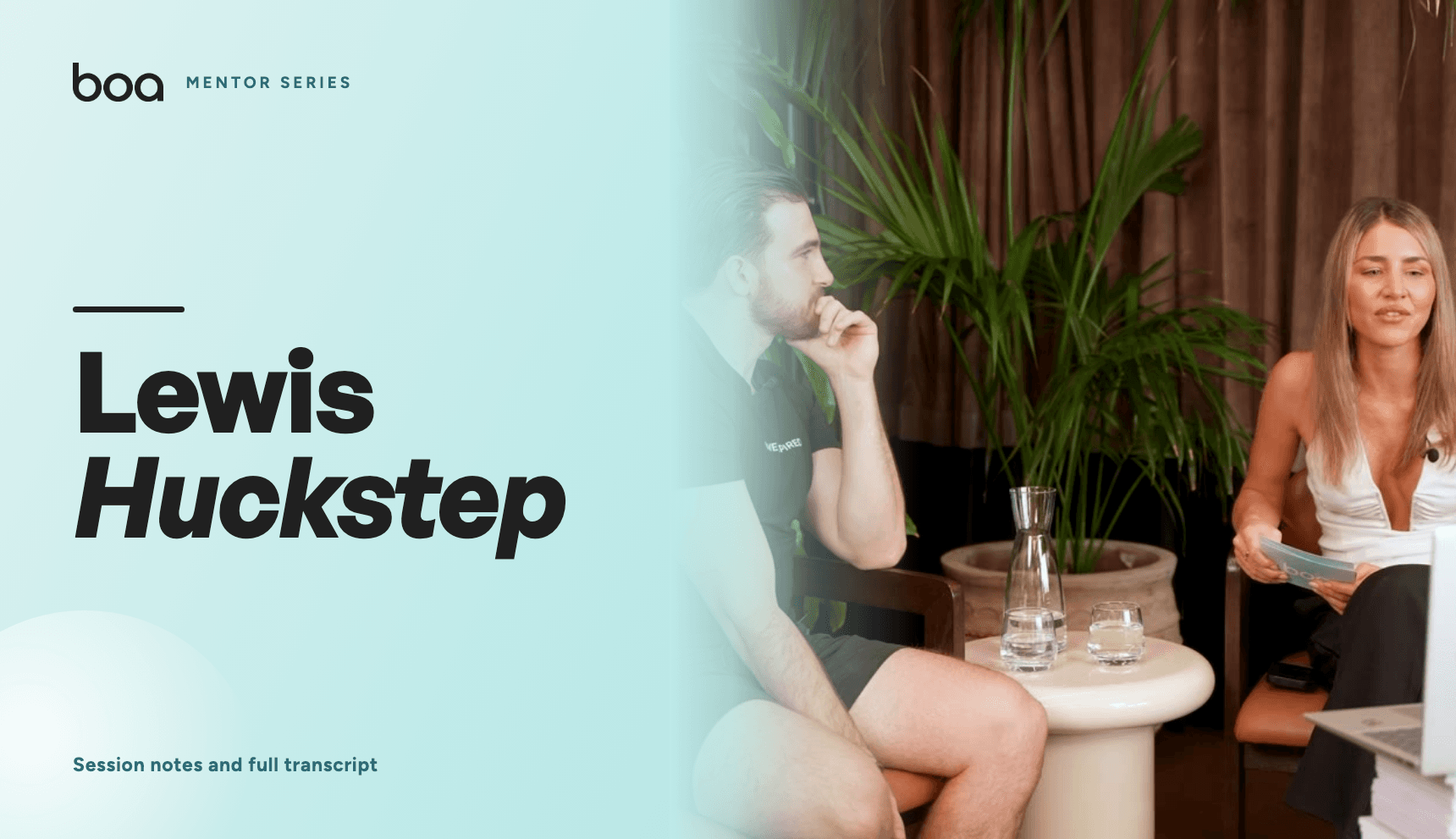
Lewis Huckstep: purpose, values and the founder ego trap
 Premium45 min
Fireside Chat
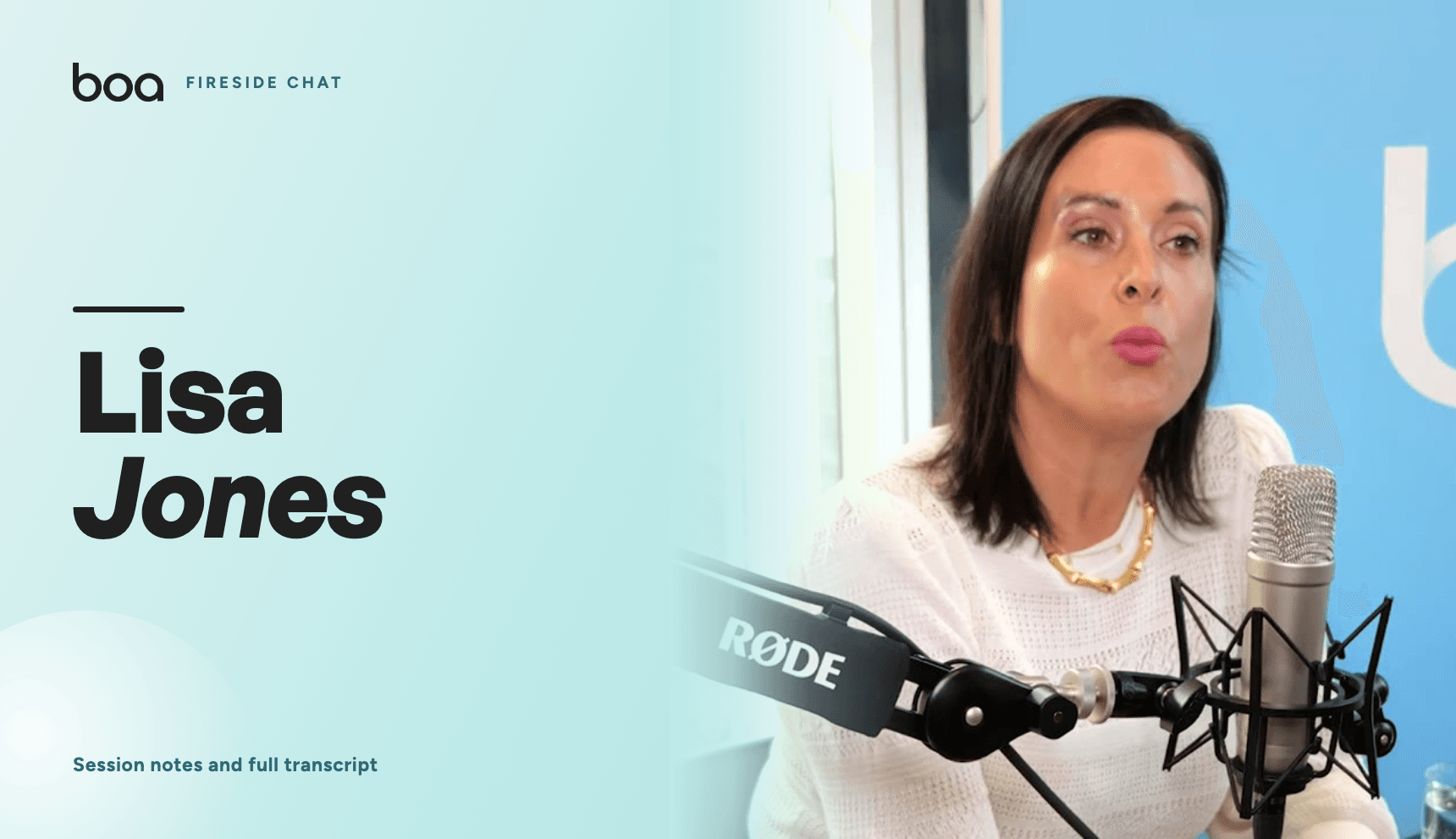
Lisa Jones: pick one lane and let customers write your copy
 Premium47 min
Fireside Chat
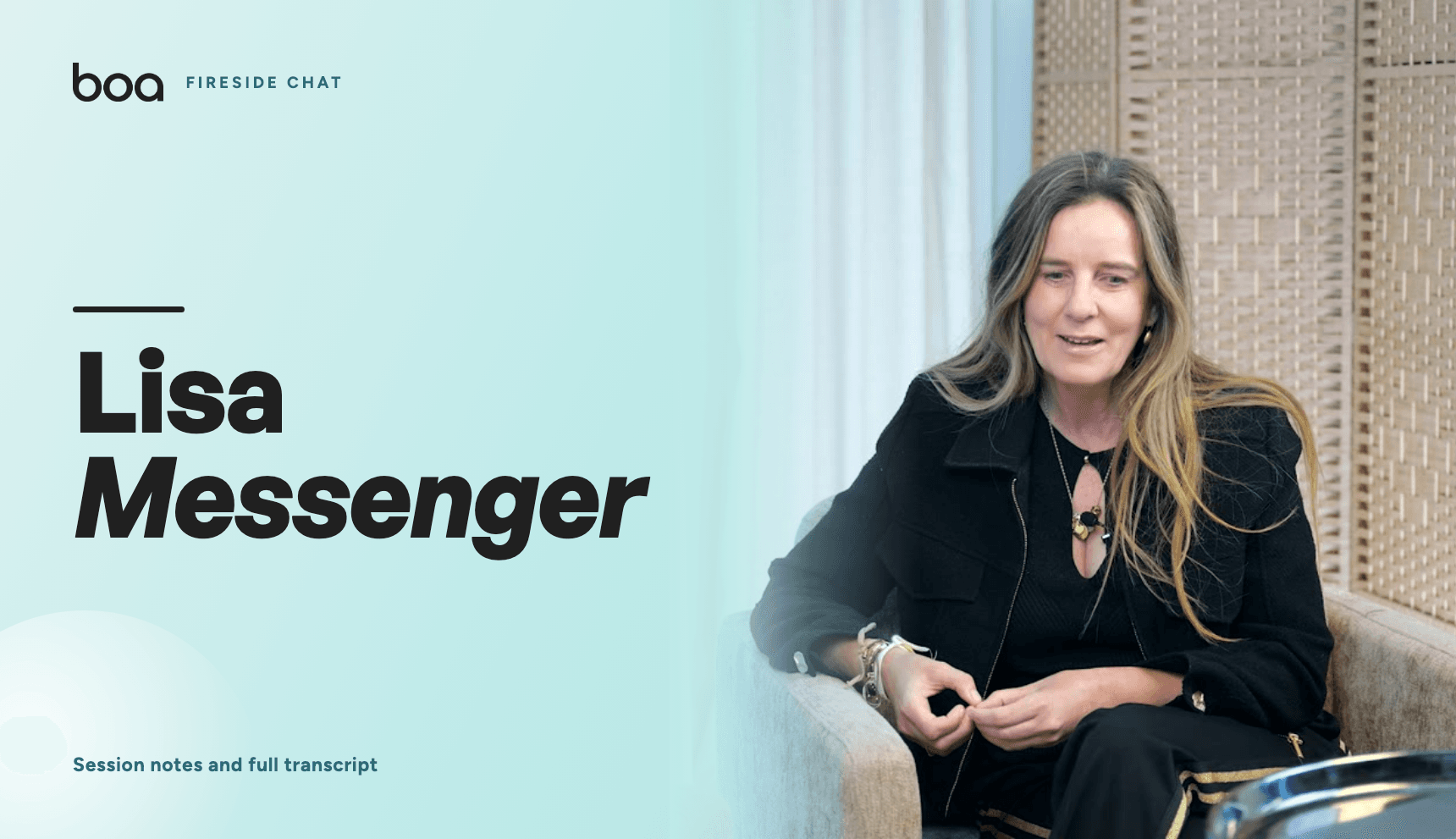
Lisa Messenger: pre-sell it, value stack it, then build it
 Premium42 min
Digital Advisory
Lisa Teh on building a founder brand with LinkedIn and AI
 Premium55 min
Digital Advisory
Delegate to systems and people, then scale on partnerships
 Premium55 min
Fireside Chat
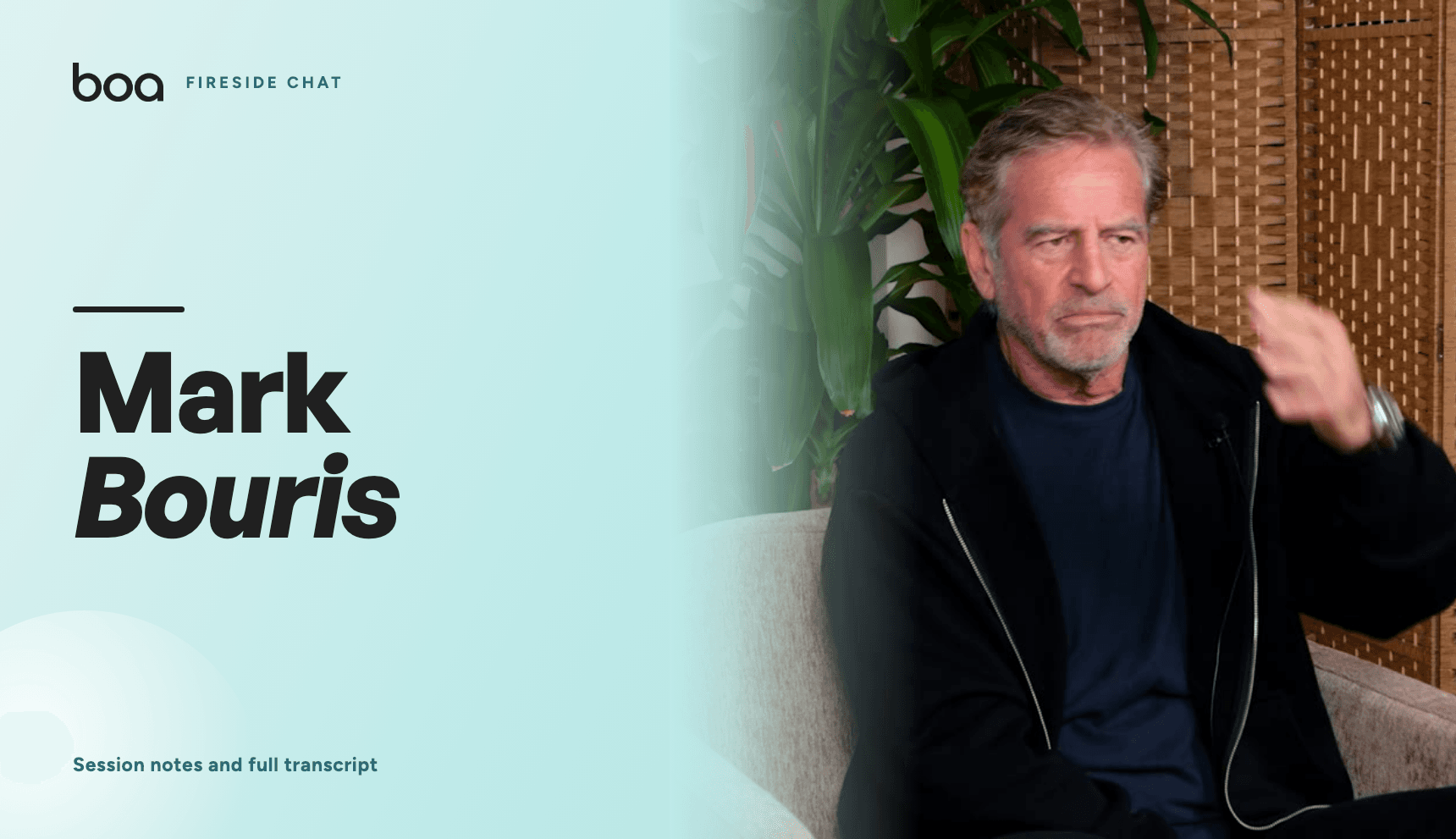
Mark Bouris: Staying Calm, Clear and Commercial in a Downturn
 Premium1h 3m
Digital Advisory
Mark Bouris on Costs, Cash Flow and Pricing for 2026
 Premium48 min
Fireside Chat
Mark Bouris on branding, networking and surviving the down cycle
 Premium42 min
Fireside Chat
Milly Bannister: storytelling, Gen Z and founder burnout
 Premium49 min
Fireside Chat
Morgan Nelson on fear, self-worth and how to actually sell
 Premium52 min
Fireside Chat
Sarah Davidson: going global, partnerships and knowing when to stop
 Premium52 min
Fireside Chat
De-risking your business with commercial property
 Premium1h 8m
Panel Event
Beyond the Logo: Building Brands That Last
What the sessions actually say
Balance speed with a pause before you build
Frank credits compressing the gap between idea and execution for Realbase's growth, but says they took it too far. They launched the Realbase tech product and rebuilt it three times inside a year because they had chased the wrong customer and wrong product market fit. At Kinzo he is spending 10 to 20 times more time on user experience and design than he did at Realbase, deliberately celebrating thinking time while still moving at pace.
Frank GreeffFrank Greeff: Lessons From a $180M Exit, Applied Again →
Run a three-month trial before you hand over equity
Frank's rule for any co-founder or joint venture: if you have never worked together, do not sign. Instead set up a three-month window where you work together exactly as you would as equity partners, with clearly agreed levers on both sides for either party to walk away. Everything looks like blue skies on paper. The realities of business are what break partnerships, and he has seen VC-backed businesses go insolvent purely because two founders split.
Frank GreeffFrank Greeff: Lessons From a $180M Exit, Applied Again →
Treat a shareholder as forever, because at exit they hold the pen
At sale, Realbase had a shareholder who had not worked in the business for four years but still owned 7 percent. The team chased that person for six weeks with no reply, and could not complete the sale until they signed. Apply the same seriousness to equity given to employees. No handshake deals, and as Daniel Hakim's lawyer put it, contracts are not for when things are going well, they are for when things go bad.
Frank GreeffFrank Greeff: Lessons From a $180M Exit, Applied Again →
Raise capital instead of waiting to save the fit out cost
Caitlin and her co-founder were 25 with about $1,000 in the bank and a shopfront concept that needed over half a million dollars. They stalled for months assuming they had to save it. The unlock was pitching venture capital with three things: the problem in the market, their business as the solution, and the addressable market and opportunity for the investor. That raise is the only reason Facechelle launched.
Say the words 'what does that mean' in the investor room
Once the raise closed, Caitlin sat in board meetings feeling like an idiot, too embarrassed to admit she did not know a term, so she went quiet and let the conversation run past her. Jules does the opposite: she stops the conversation and asks what a word means, even if it looks silly. The cost of looking uninformed for ten seconds is far lower than the cost of agreeing to something you did not understand.
Cold DM the person one step ahead of you
Before launching Figur, Jules messaged the owner of Budgy Smuggler, a person she had never met, and asked to meet up. He said yes and shared what he had learned building an Australian apparel brand overseas. Jake Jaggard hired someone who found her through LinkedIn DMs and hustled her into a coffee. Her rule: you will not get a yes unless you ask the question.
Build a referral engine with businesses that serve your customer but do not compete
With no ad budget, Raso cold called web design companies, creative agencies and PR firms because they had clients who needed SEO but could not deliver it. He paid them a commission once the deal was signed, not on the lead. That channel grew the agency for years before it ever spent on paid ads. Ask who already sells to your customer and cannot do what you do, then offer them either a commission or a lead swap.
Andrew RasoFrom $500 to 200 staff: how Andrew Raso scaled an agency →
Make a retainer or membership your first business model, at any price point
Raso says the first thing any owner should build is recurring revenue, whether that is $50, $100, $1,000 or $2,000 a month. Predictable monthly income is what gives you the confidence to budget and, more importantly, the confidence to hire. Without it you stay stuck doing everything yourself. He points to e-commerce brands like pet food that moved customers onto subscription as the ones now winning.
Andrew RasoFrom $500 to 200 staff: how Andrew Raso scaled an agency →
Test unglamorous cash flow mechanics like gift vouchers
Raso cites his friend Babak Moini of Laser Clinics, who made most of his early money by putting laser clients on memberships. Selling gift vouchers turned out to be a second cash engine, because a large share of vouchers were never redeemed. The point is to actually trial these mechanics in your own business rather than assume they will not apply.
Andrew RasoFrom $500 to 200 staff: how Andrew Raso scaled an agency →
Be the doctor, not the pharmacist, on the first call
A doctor asks where it hurts, diagnoses, writes a prescription and gets paid for the diagnosis. The chemist dispenses the medicine. Ari's point is that most business owners play both roles at once and hand over the solution for free before trust exists. On a first meeting, diagnose only. Do not discuss your solution.
Ari GalperAri Galper: the one-call sale and how to stop chasing leads →
Open with the permission script, then put your fingers over your mouth
After a short "nice to meet you", cut all chitchat and say: "If it's okay with you, if you wouldn't mind, take a step back for a moment and walk me through your background, your situation, your business model, and your current challenges, and we'll go from there. Is that okay with you?" Ask permission twice. Then sit back, put your fingers over your mouth as a physical cue to stop talking, and listen.
Ari GalperAri Galper: the one-call sale and how to stop chasing leads →
Crystallise the core issue before you go anywhere near a solution
Once they have finished downloading, summarise back: "So what I'm hearing from you is your core issue is X, Y and Z. Is that right?" When they say "exactly", you have proven you listened instead of pitching. Ari says most owners spend only 10 to 25 per cent of the conversation on the problem and the rest on their solution. Flip that ratio.
Ari GalperAri Galper: the one-call sale and how to stop chasing leads →
Validate with free ebooks, then charge for the next one
Chontel started NuForm's concept testing with free ebooks posted to her community and a comment-to-claim mechanic. Free downloads show genuine interest and grow the algorithm. Then she charged for ebooks, which showed what people actually placed value on. It costs nothing to run and it is still effective.
Chontel DuncanChontel Duncan on validating a digital product cheaply →
Use newsletter behaviour as a live demand signal
Track lifetime value on your email list, not just list size. Chontel watches how long subscribers stay, whether the response rate changes and whether people are still opening at all. When she pivots the content, subscriber and open behaviour tells her which one or two areas to feed and nourish.
Chontel DuncanChontel Duncan on validating a digital product cheaply →
Sell a physical product to learn what you are not
Chontel dabbled in apparel and a resistance band for at-home training around the start of COVID. It sold well, but it confirmed the business was best at training programs and nutrition. A side venture either pivots you in the right direction or signals what to stay focused on. Both answers are useful.
Chontel DuncanChontel Duncan on validating a digital product cheaply →
Kill the commission breath before you walk in the door
D'Leanne says clients can smell when a call is about your commission, not their outcome ("here come the shiny shoes"). Her fix is to spend the first part of any meeting on things that have nothing to do with the transaction, because the connection is what makes the relationship real. If you cannot do that honestly with a particular client, tell them you are not the right person for the job rather than performing a false version of yourself.
D'Leanne Lewis33 years of relationship selling, from D'Leanne Lewis →
Make people think of you first, even for a plumber
Her mentor Billy Bridges taught her that if someone is thinking about real estate, they should be thinking about you. D'Leanne extended that: she wanted people to call her if they needed a gardener, a plumber, or help for their mum. She worked Sundays and seven days a week, not to build a brand, but to make her name the default in one category.
D'Leanne Lewis33 years of relationship selling, from D'Leanne Lewis →
Beat experience with enthusiasm and a call funnel
With no runs on the board against shinier, older competitors, D'Leanne competed on effort: hardest working, most enthusiastic, best service, not stopping until the job was done. Practically, that meant hundreds of calls out of the office to get 10 people through, working those 10 to bring 5 back, working the 5 to get 2 back. If you are new, the numbers and the hours are the only proof you have.
D'Leanne Lewis33 years of relationship selling, from D'Leanne Lewis →
Stop trying to eliminate stress and aim for the Goldilocks level
Dr Lillian uses the Yerkes-Dodson Law from a 1908 mouse study, where weak shocks produced slow learning, strong shocks produced distress and poor performance, and moderate arousal produced the best learning. Anything meaningful (a business, a relationship, children) carries stress. So the target is a moderate level of physiological activation, not zero, and every strategy should be chosen to move you toward that point rather than flatten you out.
Dr Lillian NejadMaster Your Mental Game: regulate the body first →
Run the two minute short form of progressive muscle relaxation
Tense and release muscle groups in sequence: squeeze the thighs and release, extend the fingers as far as they go and release, lift the shoulders to the ears and release, then cross the arms and hunch forward before opening the chest and sitting up straight. Notice the feeling after each release. Finish by scanning the body for any last remaining tension. Relaxation is incompatible with tension, and PMR has the strongest evidence base of any relaxation technique, dating to the 1930s.
Dr Lillian NejadMaster Your Mental Game: regulate the body first →
Dose PMR twice a day for a week, then once a day for four weeks
The long form takes 15 to 30 minutes, sitting or lying comfortably somewhere relaxing. Dr Lillian's protocol is twice daily for the first week, then once daily for four weeks, then grade it down. The point is that you learn the difference between tense and relaxed, so eventually you can just tell yourself to relax and the body follows without the full 20 minute exercise.
Dr Lillian NejadMaster Your Mental Game: regulate the body first →
Book a daily 15 to 30 minute worry time and hold it like a meeting
Dr Lillian's core strategy is to set aside a specific slot every day, ideally at the same time, for 15 to 30 minutes. Treat it exactly like a work meeting: a set time, a set place, and your worries as the agenda items. After a couple of weeks of doing it habitually you can adjust the timing to suit your schedule.
Dr Lillian NejadWorry time: the clinical method for founders who overthink →
Choose an evening slot before dinner so worry does not follow you to bed
Many people pick something like 5:30pm to 6:00pm, after work and before dinner. It catches the worries that accumulated during the day while you still have free time to do something about them. Dr Lillian says this also helps sleep, because you have already dealt with the things on your mind before you lie down.
Dr Lillian NejadWorry time: the clinical method for founders who overthink →
Pick a worry place that is not your bedroom and not too comfortable
Choose somewhere you can access every day, such as a particular table and chair, a corner of a room, or a spot at work. Deliberately avoid the bedroom so you do not train your brain to associate bed with worry. Avoid anywhere too comfortable, because worry time is meant to be short and focused, not a place you settle into.
Dr Lillian NejadWorry time: the clinical method for founders who overthink →
Screen every product against a five-point criteria list
Dylan asks: does it solve a problem or is it genuinely unique, is there demand, is it saturated, can content be easily created and shipped to creators, and are competitor reviews positive. The final test is whether you can add products later to lift average order value and lifetime value. A product does not have to solve a problem, the viral light-up ducky lamps were just a unique take on something people already owned.
Dylan MullanDylan Mullan: product selection and organic content for ecom →
Use Page Transparency and Google Trends to prove demand
Dylan does not chase being first to market, he looks for recent competitors already selling. Go to a competitor's Facebook page, click Page Transparency, and if an ad has been running over three months it is a strong signal it is profitable, because nobody leaves a losing ad on. Cross-check with Google Trends (above 50 or clearly trending up) and main keyword volume over 10,000.
Dylan MullanDylan Mullan: product selection and organic content for ecom →
Two quick tests for whether a product is already saturated
First, check how long the competitors have existed. If a brand and its hero product have been around more than three years, the product is likely saturated. Second, walk into Big W, Kmart or Officeworks. If they have a home brand version on shelf, Dylan guarantees it is saturated.
Dylan MullanDylan Mullan: product selection and organic content for ecom →
Plan backwards from 3 years, then 12 months, then 90 days
Start by describing what great looks like 3 years out across business metrics, brand positioning, market share, consumer perception, assortment and channels. Pull that back to 12 months with specific milestones you must hit to have conviction the 3-year picture is on track. Then pull back to 90 days and name the projects, the outcomes, the owner for each, how success is measured, and how it flows into team KPIs and incentives. Josh's point: the 3-year layer is your job, the 90-day layer is what you delegate.
Josh SparksFrom operator to CEO: strategy, teams and tactical autonomy →
Aim for three conditions: strategic clarity, team alignment, tactical autonomy
Strategic clarity means everyone knows what you are moving towards. Team alignment includes investors and board, not just staff. Tactical autonomy means the team runs the business day to day. Josh's line for the shift: you lead, coach and hold accountable the leadership team, and the team manages the business.
Josh SparksFrom operator to CEO: strategy, teams and tactical autonomy →
Destroy your old idea of leadership before you can grow into the new one
Josh uses the Buddhist cycle of growth, maintenance and destruction. When you are maintaining and want growth again, something must be destroyed first. For most founder CEOs the thing to destroy is a love of micromanagement and the fear that the team is not ready. The usual excuses (the team's not ready, I'm the only one who knows the detail, the systems aren't mature) are all solvable problems expressing the same underlying fear.
Josh SparksFrom operator to CEO: strategy, teams and tactical autonomy →
Hire to take jobs off the founder, not to fill a job title
Kirstin-Lee pushes back on the standard advice to hire a head of marketing or an e-commerce manager. Instead, open your calendar and ask what is clogging your focus, then employ someone to take those specific jobs away. Her reasoning: the most valuable person in the business is the founder, and buying back headspace is what lets the vision grow.
Kirstin-Lee KeysersKivari's founder on delegation, brand filters and saying no →
Use the 80 per cent rule to force yourself to delegate
The rule she keeps coming back to: if someone else can do the job at 80 per cent, that beats it being done at 100 per cent by you. She still catches herself wanting to jump back in and repeats the rule to stop herself. It works as a live filter every time you are tempted to take a task back off a team member.
Kirstin-Lee KeysersKivari's founder on delegation, brand filters and saying no →
Audit your week on paper, then circle the two or three jobs only you can do
Write down everything you did this week, including gym, cleaning the house and the school drop-off, not just work tasks. Then circle the jobs only the founder can do. Kirstin-Lee guarantees there will be two or three. Everything else gets delegated, systemised or deleted, and she says deleting is her favourite of the three.
Kirstin-Lee KeysersKivari's founder on delegation, brand filters and saying no →
Compress your two to five year plan when a shock hits
When COVID arrived, Kristy had just launched and already had the infrastructure in place. Rather than freeze, the team executed everything in their two to five year plan inside two weeks so they could handle the volume, reaching 50,000 doughnuts a week. Her mentor's line when she thought she had lost everything: "it's not an adventure if you know where you're going, so get on with it."
Kristy ValentineBuilding Dr. Dough and preparing a business for sale →
Hire a real accountant, not a cowboy, from the start
Kristy is blunt that finances must be in order from day one: compliant, up to date, ATO happy, payroll never skipping a beat. Her point is that this is not something you can switch on later when you want to sell. An acquirer turns over every stone in due diligence, and if something is not right you will not even be considered.
Kristy ValentineBuilding Dr. Dough and preparing a business for sale →
Pay for a CFO earlier than feels sensible
A doughnut shop with a CFO sounds absurd, and Kristy admits it was very expensive and a heavy line on the P&L. She invested anyway. Without it, Dr. Dough would not have been in a position years later to be considered for acquisition at all.
Kristy ValentineBuilding Dr. Dough and preparing a business for sale →
Find the actual constraint before you buy more leads
Laura's example: you feel short on clients and immediately decide you need more leads. Break the customer journey and funnel into numbers first. You may find that lifting conversion by 10 percent puts you exactly on your goal, so the fix is conversion, not traffic. Solving the wrong problem keeps you busy without moving the needle.
Laura HigginsLaura Higgins: sell by serving, and find your real constraint →
Make the sales call about them, not you
Laura's rule: when you make it about you, you are selling. When you make it about them, you are serving. She opens with "what is the big problem for you right now, how can I help?" Her analogy is someone struggling with grocery bags and a baby on their hip. Offering to carry a bag is not pushy, it is what a decent human does.
Laura HigginsLaura Higgins: sell by serving, and find your real constraint →
Aim for a 6 or 8 out of 10 close rate, not 10
Laura says a 100 percent conversion rate means you are either not niche enough or not expensive enough. She wants people to push back on price and to occasionally say it is not the right fit. She also tells prospects when she is not the right fit for them. Rejection is part of the process, not a signal you are bad at selling.
Laura HigginsLaura Higgins: sell by serving, and find your real constraint →
Audit the fuel source before you audit the strategy
Lewis splits every action into two drivers: inspiration (pulled towards something, grateful, aligned) or desperation ("I'm not enough, I need this to be enough"). No behaviour is inherently unhealthy, the reason behind it is what matters. Before committing to a new offer, hire or raise, ask which of the two is driving it. If it is the second, the number you hit will not fix the feeling.
Lewis HuckstepLewis Huckstep: purpose, values and the founder ego trap →
Build the personal plan in this order: purpose, mission, vision, values, outcomes
Lewis works clients through a fixed sequence. Purpose is an expression of your greatest core wound and is not measurable (his is to heal and raise consciousness). Mission is the measurable version of it ("coach 100 million people to live a life that inspires them"). Vision is what life looks like once you hit the mission. Values are the areas of life that fulfil you. Outcomes are the master plan: five to ten year mission, then three year, two year, twelve month, quarterly, monthly, weekly and daily goals.
Lewis HuckstepLewis Huckstep: purpose, values and the founder ego trap →
Find your purpose by asking what you needed at your lowest
Lewis says your purpose comes from your core wound. His father punched holes in walls and physically hurt his family, so he felt unsafe and hurt, and Asperger's meant he felt misunderstood and struggled to make friends. That produced a mission to heal others and help them understand themselves. Sit with the question "where was I at my lowest, and what did I need back then?" then ask how you give that back. Lewis says you get tears of inspiration when you land on the real one.
Lewis HuckstepLewis Huckstep: purpose, values and the founder ego trap →
Be the boob doctor, not the general practitioner
Lisa coached electricians, carpet layers and any small business that came her way, and it satisfied nobody. A mentor asked her whether she had ever seen the cars a boob doctor drives, because specialists get paid like specialists. She niched entirely into women running DTC brands and the business took off, because she could speak to one group's pain points intimately instead of applying general logic to everyone.
Lisa JonesLisa Jones: pick one lane and let customers write your copy →
Choose a market you have already been part of
Daniel Hakim quotes Mark Bouris: make your market someone you are, or someone you have been before. Lisa agrees, adding that most women build a product because they solved their own problem, whether that is skin, gut health or a baby product. You need a real story attached to the business, because people sniff out inauthenticity and do not buy.
Lisa JonesLisa Jones: pick one lane and let customers write your copy →
Check the market is big enough to pay your price
Passion is only half the test. Lisa's second filter is whether thousands of people will pay the price you need to make money. If only about 1,000 people in Australia need the product, and they need it once, you will always be doing a hard sell. Premium pricing is fine, cheap is not the point, but there has to be real appetite so the product is easy to sell rather than a grind.
Lisa JonesLisa Jones: pick one lane and let customers write your copy →
Sell the idea before you build it, then underwrite the build
Lisa calls it selling vaporware. She comes up with a concept, pre-sells it, and only creates it once the market has shown it will eat it up. She has done this with all 40 of her books and with the magazine itself, which gave her both confidence and speed to market. She has never borrowed money for a business in 23 years.
Lisa MessengerLisa Messenger: pre-sell it, value stack it, then build it →
Value stack one big sponsor instead of selling small ads
The industry model was a flat ad on a page for $10,000. The first issue of Collective Hub cost $350,000, so she would have needed 35 pre-sold ads just to break even. Instead she asked CommBank's CMO Andy Lark for $200,000 and stacked physical copies, advertorial, editorial, speaking and written articles on top, roughly $600,000 of value for his $200,000. It was sponsorship and advertising dollars, not a loan.
Lisa MessengerLisa Messenger: pre-sell it, value stack it, then build it →
Make 79 calls and stalk the one person who fits your thesis
Lisa made around 79 phone calls before she got to Andy Lark, chosen because people told her he loved entrepreneurs and still liked print. She chased him for about three months through multiple angles, then sent a tweet at 10pm and got a 2pm meeting the next day. She almost did not go. Go to the knife-edge meeting.
Lisa MessengerLisa Messenger: pre-sell it, value stack it, then build it →
Send 400 targeted connection requests a month, spaced out daily
Lisa says LinkedIn allows around 400 connection requests a month, roughly 100 a week. Do not fire them all off at once or the platform will read you as a bot, so spread them across the days (she suggests doing a batch while you are watching Netflix). The algorithm favours showing your content to new connections, because it assumes you have just met and are interested in each other, so every accepted request lifts the reach of your next post.
Lisa TehLisa Teh on building a founder brand with LinkedIn and AI →
Fix the five parts of your LinkedIn profile people actually judge
Use a clear photo with your eyes visible (no sunglasses, no toilet selfies), because humans connect through eyes. Put your business name in your banner on the right side, since mobile crops the left and hides text behind your head. Put Founder in your headline, as almost nobody outranks a founder and it lifts acceptance rates. Make the About section about you rather than the company, with the first three lines interesting because that is all anyone sees, and use the Featured section for your best posts.
Lisa TehLisa Teh on building a founder brand with LinkedIn and AI →
Post on your personal page, not the business page
Lisa focuses on personal page content because the LinkedIn algorithm favours it over business page content. If you cannot post, comment instead, because commenting is content too. Do not leave "great post" or fire emojis. Write something substantive or provocative, do it consistently on the profiles of people you want to know, and by the time you land in their DMs they already recognise your name and will usually reply.
Lisa TehLisa Teh on building a founder brand with LinkedIn and AI →
Split leverage into three buckets, not just borrowed money
Most people hear leverage and think financial leverage, using someone else's money to buy assets. Lloyd defines it as capital leverage, people leverage and systems leverage. Long hours happen when a founder has none of the last two. Audit which of the three you actually have before blaming your workload.
Lloyd James RossDelegate to systems and people, then scale on partnerships →
Write the can't, don't want to, shouldn't list
Lloyd's delegation filter is three columns: things you can't do, things you don't want to do, and things you shouldn't do. The shouldn't column is anything priced below your average hourly rate as an entrepreneur. Those go first. He points to Dan Sullivan's Who Not How: delegate everything but your genius.
Lloyd James RossDelegate to systems and people, then scale on partnerships →
Start delegating outside the business before you touch the business
The cheapest first step is getting someone else to wash your car and clean your house. Low-value personal tasks are the training wheels for delegation. If you never build the habit, Lloyd says you end up working 60 to 70 hours a week for the same money you would have earned in a 9-to-5.
Lloyd James RossDelegate to systems and people, then scale on partnerships →
Re-cut your cost base to today's revenue, not last year's
Bouris says the first move in a downturn is the one thing you control: costs. Your cost structure was geared to revenue from six months ago, so if you are seeing lower revenue, delayed contracts or postponed projects, re-gear costs to the revenue you have now. Cut the cloth to suit.
Mark BourisMark Bouris: Staying Calm, Clear and Commercial in a Downturn →
Work out your cash runway on flat revenue and a fixed cost floor
Asked how to tell if a business will survive, Bouris pointed to burn rate. Assume today's revenue line does not improve, then work out which costs you genuinely cannot reduce. If that maths leaves you with less than six months, and you have no savings, no bank borrowing and no investor, that is the point to consider closing the books for a while or taking a job rather than burning to zero.
Mark BourisMark Bouris: Staying Calm, Clear and Commercial in a Downturn →
Get your economic data from the ABS, not the papers
Bouris says ignore politicians and go to abs.gov.au yourself, any hour of any day. The three numbers that matter are unemployment, GDP growth and inflation. He notes normal GDP growth should sit around 2.75 to 3.5 per cent per annum, and Australia is sitting just above zero, with a per capita recession meaning living standards are falling.
Mark BourisMark Bouris: Staying Calm, Clear and Commercial in a Downturn →
Run a cost refresh every couple of years, not just in a crisis
Bouris says if you assume revenue stays flat, the first lever is cost, not sales. In March 2020 he cut overheads at his lending business by 30%. When volumes then doubled, he discovered he had been carrying people and space he never needed. He recommends a full cost refreshment every couple of years because of what it exposes about where you spend without need.
Mark BourisMark Bouris on Costs, Cash Flow and Pricing for 2026 →
Cut the space you are not using and keep the saving
Bouris gave up one of his two floors in Chifley Tower during COVID and saved a million dollars a year. He never took the second floor back. For the month of January the business wrote $3.5 billion, against roughly $1.8 billion pre-COVID with two floors and 30% more staff. Test whether your fixed footprint is sised for the business you had or the one you have.
Mark BourisMark Bouris on Costs, Cash Flow and Pricing for 2026 →
Be direction ready: cut costs now, build capacity for the upswing
Bouris expects rate rises to flatten the economy, then the Reserve Bank to reverse and stimulate again. His instruction is to control costs today while getting the business ready for revenue to turn up. That means more innovation, AI in the business, building inventories, or more efficient delivery systems, so you can take the opportunity when it arrives rather than starting from scratch.
Mark BourisMark Bouris on Costs, Cash Flow and Pricing for 2026 →
Cut cost relative to revenue, then hunt the efficiencies that fall out
Bouris says he does this in his own business: cut the cloth to suit, then use the process to discover where efficiencies actually sit. When money is loose everyone adds subscriptions, six more employees, across the board increases. A tight cycle exposes all of it. His framing is not "cut costs" for its own sake, it is keeping costs proportionate to revenue and then looking for what the exercise reveals.
Mark BourisMark Bouris on branding, networking and surviving the down cycle →
Market hard now because everyone else has pulled up stumps
Bouris expects the tough conditions to run at least another six to eight months. His point is that when the cycle turns next year it is too late to start marketing, because everyone will be doing it then. Use digital channels through the quiet period and make the content genuinely valuable, so the audience finishes it thinking that was good information about my industry.
Mark BourisMark Bouris on branding, networking and surviving the down cycle →
Improve everything, not just sales, while demand is low
When there is huge demand you spend every day just doing. Bouris says the down cycle is the time to work on the business: sales processes, employment processes, inductions, annual conferences. Fewer clients means more hours available to rebuild the machine rather than run it.
Mark BourisMark Bouris on branding, networking and surviving the down cycle →
Ask your youngest customers for a feed tour
Milly hosted two 15-year-old work experience students for two days and used the time to ask a million questions, listen to how they spoke, and get a tour of what was actually showing up on their algorithm. Her rule: if you are targeting young people, hire young people, and if you are targeting new mums, hire a mum. There is no point guessing when your customer is sitting right there and usually happy to tell you.
Milly BannisterMilly Bannister: storytelling, Gen Z and founder burnout →
Run customer calls about the brand, not just the product
Milly pointed to Davey from Boring Without You Skincare, who runs calls with customers who want to give feedback. Not about the formulations, which are already sorted, but about the brand and the way it speaks to people. Ask questions you cannot guess the answer to, like whether they want the newsletter the day before a launch or on launch day.
Milly BannisterMilly Bannister: storytelling, Gen Z and founder burnout →
Co-create the joke instead of borrowing it
Big brands come off cringe when they use Gen Z language without knowing where the meme came from or being in on the joke. Milly's point: young people are marketing machines who create culture themselves, so the brands that land are co-creating culture with their demographic rather than tapping into it after the fact. She named Rhode by Hailey Bieber as the extreme example of a brand creating culture rather than chasing it.
Milly BannisterMilly Bannister: storytelling, Gen Z and founder burnout →
Run the three steps: awareness, understanding, reconditioning
Morgan's model for changing any behaviour has three parts. First, notice the pattern as it happens ("I'm doing that self-worth thing again"). Second, trace where the story came from, because most 40-year-olds are being run by a decision a 7-year-old made. Third, recondition through repetition, like the gym, doing the scary thing again and again until your brain has evidence you are someone who acts anyway.
Morgan NelsonMorgan Nelson on fear, self-worth and how to actually sell →
Peg your self-worth to the action, not the outcome
You cannot control whether a prospect says yes, so never make that the measure of you. Morgan puts his self-worth on the behaviour he can control: pushing through the fear and asking. If you close 20 percent and you need four sales this week, do not chase a better close rate, book 20 conversations instead. Conversions usually lift anyway because you feel better about yourself.
Morgan NelsonMorgan Nelson on fear, self-worth and how to actually sell →
Test your self-worth by asking a stranger to buy you something
In Morgan's Mind Money program he sends people out at lunch to ask a stranger to buy them something. Some come back thrilled with a free dinner. One person cried after asking for a free cup of water at Hungry Jack's. His point: if you cannot ask a stranger for a cup of water, you will not ask a client for $5,000. Use the exercise as a mirror on what you believe you deserve.
Morgan NelsonMorgan Nelson on fear, self-worth and how to actually sell →
Use a future regret test to make the big, scary calls
Sarah calls it her future regret management matrix. When Urban Outfitters placed an order she could only fill by leaving her legal job to pack for roughly seven days straight, she asked what 80-year-old her and 10-years-from-now her would regret more. Trying and failing while first to market, or staying safe and watching the window close. Law would still be there a year later, the retailer would not.
Sarah DavidsonSarah Davidson: going global, partnerships and knowing when to stop →
Split your list into today, tomorrow and later, and only work today
Sarah physically writes a list every day and sorts every item into three buckets. If it is not a today job, it moves off the page so she does not carry it. Her rule against distraction came from her husband: she was worrying about shipping matcha to Afghanistan when they could not yet ship to Caulfield North. Be discerning about what is genuinely urgent, because busy work like fixing the font on a post going out in two weeks gives you the tick without the progress.
Sarah DavidsonSarah Davidson: going global, partnerships and knowing when to stop →
Partner with brands that own the other moments in your customer's day
Matcha Maiden stopped marketing as though matcha was the customer's whole identity. They mapped the rest of that person's day: fitness, activewear, plant-based milk. Then they ran joint giveaways, events and goodie bags with those brands, including repeated activations with Lululemon. Ten businesses running one competition could each pick up around 15,000 new email addresses off a shared consumer.
Sarah DavidsonSarah Davidson: going global, partnerships and knowing when to stop →
Use a 3 to 1 rule before you touch commercial property
Scott's sequence is two or three residential houses first, held for three to five years, then one big deposit into a commercial asset. Residential lets you borrow more, has a lower barrier to entry and is harder to stuff up while you learn. He is blunt about entry-level commercial: under $500,000 cash, buy resi all day. Above roughly $700,000 you are in the game for commercial.
Scott O'NeillDe-risking your business with commercial property →
Judge a commercial yield against the market cap rate, not in isolation
Scott's range is 5 to 9 per cent, with most good deals between high 5s and 7 per cent. Anything above 7 per cent implies more risk: regional market, shorter lease or inflated rent. The real test is buying at a yield above the suburb's natural capitalisation rate. Buy at 6 per cent where the market cap rate is 5 per cent and you have bought 20 per cent under value.
Scott O'NeillDe-risking your business with commercial property →
Run the return-on-equity maths before you park profit in property
Scott's worked example: a 6 per cent yielding asset at 65 per cent leverage and a 6 per cent interest rate returns about 5 per cent pure cash flow after debt. Add 5 per cent per annum capital growth and you are at roughly 16 per cent return on the equity you put in. A 7 per cent asset takes it to about 21 per cent. If your business margin beats 15 to 20 per cent, keep the money in operations instead.
Scott O'NeillDe-risking your business with commercial property →
Narrow to one demographic and watch the floodgates open
Leah's biggest trajectory change with Kaya was drawing a line in the sand: women only, over 40. Before that she was trying to be everything to everyone. Jessy backed this from the agency side, saying the brands Hive HQ works with see takeoff at the moment they get really specific about their demo. Pick the customer you can serve better than anyone, then say no to the rest.
Post one titled reel every night, no scheduling, no exceptions
Talitha has released one 30-second video a night for close to two years. Each one carries a big blunt title on the front, like "Diamonds Are Not an Investment", rather than the moodboard aesthetic the rest of the jewellery category uses. Some hit 3 million views, some get 20,000. That single habit drives all website traffic, leads and appointment bookings, and she only started Meta ads about six months ago.
Get someone to interview you on camera instead of talking to yourself
Talitha's first videos took a thousand takes filming alone in her bedroom. The format only clicked when another journalist offered to ask her questions off camera while filming. Answering a real question is easier than performing a monologue. If solo pieces to camera stall you, book a friend for an hour and film ten answers.
Watch the full sessioninside Boa.
Session notes are free. The recordings, the live advisories and the founders in the room are for members.