Mentor Series
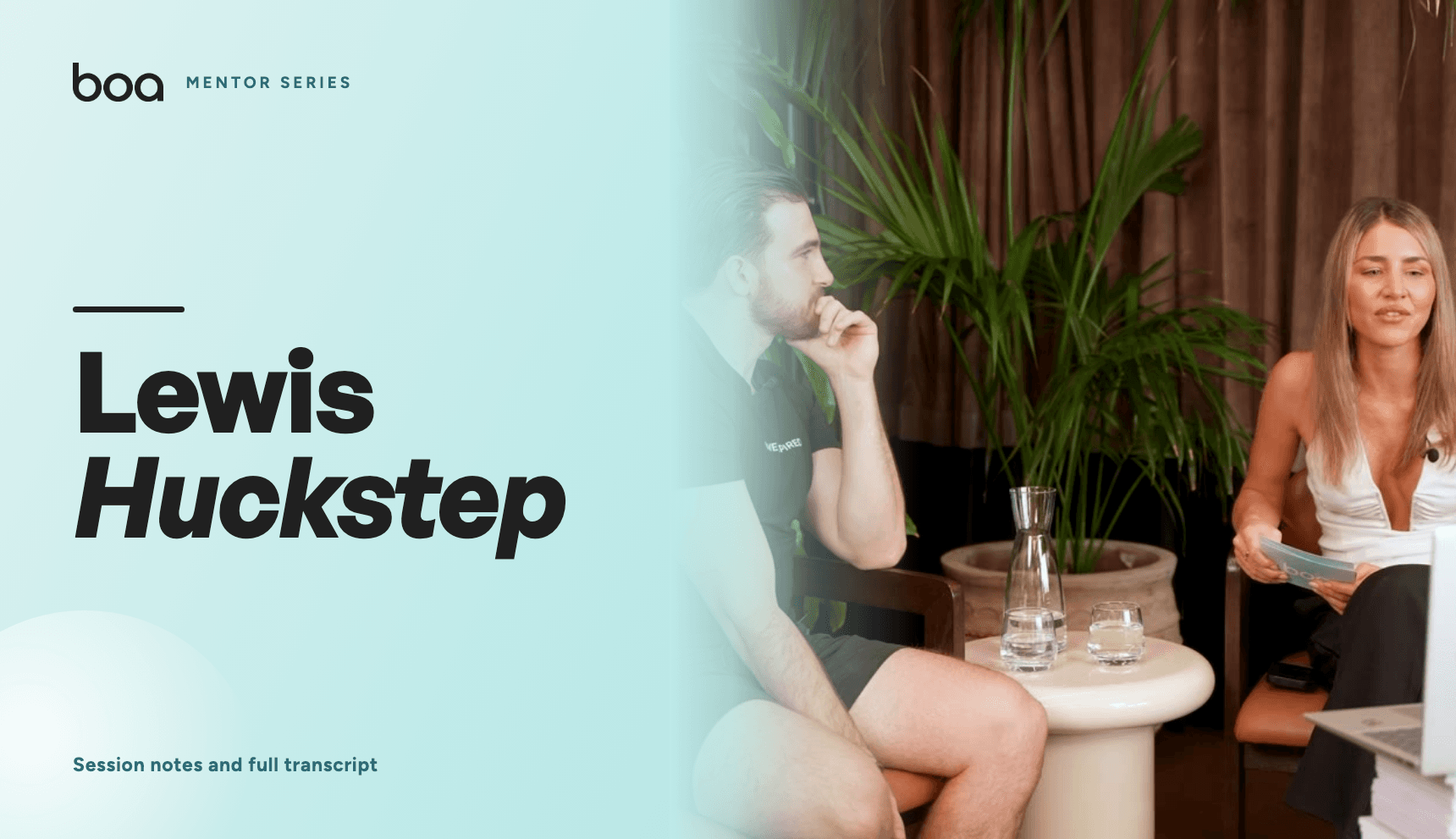
Lewis Huckstep on Building From Inspiration, Not Ego
With Lewis Huckstep, Purpose and Identity Coach, Author at The Inspired Life Method · Hosted by Boa host · 39 min
What this session covers
Purpose coach Lewis Huckstep gives founders a structure for working out what to chase and what to drop: purpose, mission, vision, values, then outcomes. He covers the quarterly reset he has run for seven years, regulation versus integration for handling triggers, and matching team values to job descriptions during onboarding.
Check the fuel source behind every business decision: inspiration builds sustainably, "I'm not enough" burns you out no matter how big the numbers get.
Key takeaways
- 01
Audit the fuel source before you audit the strategy
Lewis splits every action into two drivers: inspiration (pulled towards something, grateful, aligned) or desperation ("I'm not enough, I need this to be enough"). No behaviour is inherently unhealthy, the reason behind it is what matters. Before committing to a new offer, hire or raise, ask which of the two is driving it. If it is the second, the number you hit will not fix the feeling.
- 02
Build the personal plan in this order: purpose, mission, vision, values, outcomes
Lewis works clients through a fixed sequence. Purpose is an expression of your greatest core wound and is not measurable (his is to heal and raise consciousness). Mission is the measurable version of it ("coach 100 million people to live a life that inspires them"). Vision is what life looks like once you hit the mission. Values are the areas of life that fulfil you. Outcomes are the master plan: five to ten year mission, then three year, two year, twelve month, quarterly, monthly, weekly and daily goals.
- 03
Find your purpose by asking what you needed at your lowest
Lewis says your purpose comes from your core wound. His father punched holes in walls and physically hurt his family, so he felt unsafe and hurt, and Asperger's meant he felt misunderstood and struggled to make friends. That produced a mission to heal others and help them understand themselves. Sit with the question "where was I at my lowest, and what did I need back then?" then ask how you give that back. Lewis says you get tears of inspiration when you land on the real one.
- 04
Run a quarterly reset, not just a quarterly business review
Lewis has done this every three months for seven years and has only missed one (his baby was born that day). Get an Airbnb, get out of the concrete jungle and near nature if you can, or do it at home if resources are tight. Redo your values, purpose, vision and master plan, because values shift, vision expands and the available tools change. This is what stops the slow drift into burnout.
- 05
Separate the two toolkits: regulation and integration
Regulation is emotional hygiene that widens your window of tolerance: breathwork, grounding, eye gazing, movement, yoga, meditation, sauna, ice baths. Integration is doing a belief, perception or nervous system process on the actual wound so the trigger stops firing. Regulation gets you through the moment. Integration removes the trigger permanently, so your capacity keeps growing and bad news stops knocking you sideways.
- 06
Follow the resistance back to its root cause
Lewis works from the line "to the degree you resist reality is the degree that you suffer", plus "if it's not life-threatening, it's identity-threatening". When something triggers you, zoom in and it will be one of three things: a values mismatch (you are trying to live in someone else's values or expecting them to live in yours), a belief such as "I'm not enough", or a wound such as abandonment. Name which one and you have something you can actually process.
- 07
Stack four regulation practices instead of doing one
Lewis quotes Bruce Lee via Kerwin Rae: there is no ultimate martial art, only the ultimate martial artist who uses the right one at the right time. On the morning of this session he sat in the sauna with his baby, played sound frequencies, meditated and did breathwork, four things at once, because he knew he had a demanding day. Build a combination that suits you rather than forcing a single practice you resist.
- 08
Tell the difference between resisting something good and something misaligned
Lewis does not like ice baths but does about three a week anyway, because that is resistance to something good for him. He does not value travel, so declining six invitations to Queenstown is not avoidance, it is alignment. His test for imposed values: whenever you hear yourself say "I have to", "I ought to", "I should", "I must" or "I'm supposed to", someone or something is projecting their values onto you.
- 09
Schedule your values into the calendar or they will not happen
Lewis says low self-worth is feedback that you are not living into your values, and what does not get scheduled does not get done. He had to physically move things in a high performer client's diary because there was no gap for three weeks. He also links unmet values to numbing: scrolling, porn, drugs, partying and overworking are often overcompensation for an area of life you have stopped prioritising.
- 10
Put a values exercise into your hiring onboarding sequence
Lewis now systemises what he used to do by instinct. Candidates complete their values as part of the onboarding sequence, and those values are matched against the job description. If they do not align, the process stops there. The values conversation itself takes about 30 minutes.
- 11
Make your mission big enough that a team member's mission fits inside it
To influence someone you have to know what influences them. Lewis asks team members for their values, their vision for their life, and how being part of this business helps them get there. One trainer, Jackson, wanted to be a Broadway star, so they built a growth plan for the six months he would be there. Another, Mason, wanted to own a gym, and Lewis wanted to sell one, so the missions matched and Mason bought it. When it lines up, people go well beyond what they are paid to do.
- 12
Define business values as behaviours you reinforce, then run them on the day
Lewis takes his definition from Alex Hormozi: business values are the behaviours you want reinforced. Document them, embody them, hold people accountable, and reward the behaviour when it shows up. For his events he gives the crew a run sheet requiring them to do their own processes and meditations before doors open, because one of the values is take your own medicine and prioritise yourself before you assist anyone else.
How the session runs
- 0:01Who Lewis learned from and the quickfire round
- 2:02Three gyms by 22 and the "I'm not enough" fuel source
- 4:45Authentic self versus ego: checking the fuel source
- 7:47The framework: purpose, mission, vision, values, outcomes
- 11:05Why founder chaos mirrors the chaos inside you
- 14:22Regulation and integration: two toolkits for stress
- 18:28Building an emotional hygiene routine that fits you
- 21:40Leading people by matching their values to your mission
- 24:03Stopping a bad month from wrecking your confidence
- 25:50Scheduling values and spotting numbing behaviours
- 28:50Giving away a $250k gym and choosing the right vehicle
- 31:50The quarterly reset Lewis has run for seven years
- 33:02Q&A: leadership lessons and values in onboarding
- 37:11Purpose does not change, the expression of it does
Mentioned in this session
- The Inspired Life Method
- Kerwin Rae
- Dr John Demartini
- Joe Dispenza
- Peter Crone
- Wayne Dyer
- Tony Robbins
- Netflix
- Herbalife
- Alex Hormozi
- Jocko Willink
- Simon Sinek
- John C. Maxwell
- Bruce Lee
- Queenstown
- Airbnb
- Daniel Kirkbride
Questions founders ask
Lewis says the tell is attachment. If your happiness, fulfilment or sense of success is tied to a bank balance, monthly revenue or headcount, that is ego. Ask what the fuel source is underneath the action: are you inspired and grateful to be doing it, or are you doing it because you feel you are not enough and need the result to prove otherwise. Nothing external will fix an internal feeling.
Once every three months, disconnect from the business for a day or more. Lewis suggests an Airbnb near nature if you can afford it, or doing it at home if you cannot. Redo your values, purpose, vision and master plan, because values shift over time and vision expands. He has run this for seven years and credits it with keeping him out of burnout.
Lewis splits it into regulation and integration. Regulation is emotional hygiene that widens your window of tolerance: breathwork, grounding, movement, sauna, meditation, sleep and food. Integration means finding the belief, values mismatch or wound that caused the trigger and running a process on it so it stops firing. Regulation manages the moment, integration shrinks the number of things that trigger you at all.
Lewis says get the foundations first: purpose, mission, vision and values. Then ask whether the current business is actually the best vehicle for that purpose. It might be, in which case you scale it, sell it or hire yourself out of it. Lewis gave away a gym worth about $250,000, sold a second and hired himself out of the third for $2,000 to $3,000 an hour of work, which gave him space to work out what he actually wanted.
Find out their values, their mission and their vision for their own life, then show how being part of your business helps them get there. Lewis says your business mission needs to be big enough that their personal one fits underneath it. The values conversation takes about 30 minutes. He now builds it into the onboarding sequence and matches candidate values against the job description before moving to the next stage.
Full transcript
The complete conversation, as recorded, with every speaker attributed.
Boa host0:01
Thanks for jumping on with us this morning. I am here with Lewis Huxstep. He is a purpose and identity coach and author of The Inspired Life Method. You've also worked with some pretty incredible entrepreneurs. We were just discussing it before, Kerwin Wey. Like, do you want to roll off some of the names?
Lewis Huckstep0:17
Uh, the people I've learned from, um, I love Dean Martini. I worked with him. I've done his certifications. I've done a lot of Joe Dispenza's work. Love Peter Crone's work. Wayne Dyer, the late great Wayne Dyer. Um, Kerwin started me on the journey. Tony Robbins, I lied, Tony Robbins started me on the journey. So I started with him. He's the gateway drug to self-development. Yeah, he's so good. So I started with him 11 years ago, that was my first event that I went to. Um, but yeah, I, I'm, I'm a drug addict for self-development, so I love it.
Boa host0:44
So I love that, that's definitely going to stick. Yes. Um, now in usual Bow Wow fashion, we are going to start off with a quick fire round of this or that. Are you ready? Okay, coffee or matcha?
Lewis Huckstep0:55
Oh, coffee.
Boa host0:56
Early mornings or late nights?
Lewis Huckstep0:58
Early morning.
Boa host0:59
Podcast or book?
Lewis Huckstep1:00
Oh, probably podcast.
Boa host1:02
Okay. Uh, discipline or motivation?
Lewis Huckstep1:05
I don't like either of them, to be honest.
Boa host1:07
Um, what's your third?
Lewis Huckstep1:08
Inspiration.
Boa host1:09
Inspiration.
Lewis Huckstep1:10
We can talk about that later.
Boa host1:10
I'm gonna roll with that. Uh, solo thinking time or mastermind conversations?
Lewis Huckstep1:15
These are good questions.
Boa host1:17
Solo.
Lewis Huckstep1:17
I like my own thoughts.
Boa host1:19
Yeah, put a ringer in there.
Lewis Huckstep1:20
Yeah.
Boa host1:21
Uh, fast growth or slow sustainable growth?
Lewis Huckstep1:23
Sustainable.
Boa host1:24
Yeah, I think that's everyone. Yeah. Uh, work-life balance or work-life integration?
Lewis Huckstep1:28
Integration or balance, depending how you look at it.
Boa host1:30
We're just chatting about this. It's important. Back yourself early or wait until you're ready?
Lewis Huckstep1:34
Back yourself early.
Boa host1:35
One thing you can't leave the house without?
Lewis Huckstep1:37
My water bottle. Got it right there.
Boa host1:38
Please show off.
Lewis Huckstep1:39
Yeah, I'll show it off. My wife got me this as well.
Boa host1:43
And one word to describe your founder journey so far?
Lewis Huckstep1:46
Founder journey so far? Chaos came up first. So at the start.
Boa host1:52
Okay, I am not kidding you. Everyone says the same word.
Lewis Huckstep1:54
At the start it was. It doesn't feel like it now, but definitely at the start it was just like uninformed optimism. Like, this is sick, this is fun. And like, I don't know what the fuck I'm doing. And yeah.
Boa host2:02
And then the roller coaster. So yeah, awesome. Okay, so we're chatting about this before, but can you take us back to the beginning? How did you first get into business, and what were the biggest lessons you learned early on from years of building?
Lewis Huckstep2:13
Uh, I— my fuel source to get me into business was I felt like I wasn't enough, and I wanted to prove that I was worthy to the world, especially my dad. Um, I love Tony, as I mentioned, Tony Robbins. He— have you watched his documentary? No, it's on Netflix, I think. I think it's still there. Uh, right at the end, like during the credits, it says, which parent did you love the most? Or no, which parent did you crave love from the most? Mama's dad. And who did you need to be for that parent? And the achiever. So if I achieve, I get love. So my fuel source was very much like, I'm not enough. I'm going to prove my worth to the world and I'm going to show you how successful I am to the world. So it was a fuel source and I wanted to be a teacher and a personal trainer. That was my grand vision back in the day. That's what I thought success was back then. I had some amazing teachers that changed my life and I enjoyed fitness because I trained a lot. So long storey short, I applied to like 7 or 8 gyms. They all said no. Then I ended up just asking for work experience at a gym. I worked for free for 2 and a half years. I actually paid for a gym membership, so I paid for a job for 2 and a half years. That's a conversation for later. But it was actually a network marketing business. So you'd get them into the gym, but then you'd build a network marketing business through the gym. So I was making good money through the network marketing. So I hit a high achiever level when I was 20, and they flew me around the country. Herbalife was the network marketing company. And then eventually the gyms started to take off and the network marketing just fizzled away and just like became nothing. And then opened a second gym when I was 21, got the keys to that on my 21st birthday, opened a third one when I was 22. So I had 3 gyms at 22, very Alex Mosi. I was in Alex Mosi's Facebook group back before he had a brand. So I was very much hustle, hustle, achieve, achieve, achieve. But I was very insecure, very overcompensating, very unbalanced. My relationship, health, personal life was terrible. But I was like, I'll be happy when, and that was like the fuel source. So. Lessons I learned was hard work. Definitely like just put in the volume, like put in the work that's needed. Fear of rejection. Like I started posting content back then. So I was doing live videos when the first feature came out for live videos. It used to be on the very first version of a live video was Facebook, but you had to get like a third-party app to connect to it. Like that's when we first, when it first came out, we started doing it straight away. So you've been doing content for 11 years now. So the fear of rejection, people's opinions. I remember my first video, I played it at my event because it's so cringe, but I turned my phone off for 48 hours because I didn't want to see the comments. I was so scared of what people thought about me. So yeah, there's a sort of lesson today.
Boa host4:29
I love that. Wow. And it's well and truly before like the, the realm of like social media and everything else. Yeah, yeah, yeah. Okay, so what are the first signs as a founder is building pressure from ego or, um, instead of clear strategy? And how does that actually usually show up in the business?
Lewis Huckstep4:45
So how are they building from pressure? Yeah. And ego instead of clear strategy? So for me, I define there's two versions of you. There's the authentic self, and this is like your soul, your spirit, your higher self, the higher mind, your soul's gift. And then we've got the ego, which is the human meat suit. And this is like the limitations, the beliefs, the perceptions, the nervous system. It's the human identity. So your authentic self is inspired. That's why I used the term inspired before, say live inspired. So this version of you is pulled towards something, and that's what it opens your heart up. It puts tears in your eyes. You're inspired. You're grateful. You're abundant. We've got a newborn child, so baby's a great example of this. This. I've never met a child whose first words were, I'm not enough. That wasn't their first ways of thinking. I say we're born limitless, but we're programmed out of it. So we're born perfect, whole, complete, but then we develop an ego, a human meat suit, which has all fears, insecurities, trauma, limitations, I'm not enough, all the bullshit. So this ego is generally driven by I'm not enough and I need to have more. So that's where most people start. That's where I started. 99% of people start like this. But you become so, don't become so broke all you have is money. Hopefully people start to wake up where they realise nothing you achieve externally will make you happy internally. And some people just take a long time to figure that out. I hope, gratefully figure that out earlier rather than later. So the signs that people are doing it is they're attached to things. They think their happiness or fulfilment or success is a number of their bank account, how much revenue they're doing per, per month, how much team they've got versus Everything you want is inside of you right now. And how do you come back? You might have heard the term come back home to yourself, or come back to wholeness, come back to completion. So it would be, what's the fuel source? Is generally the frame I look for when I'm coaching someone. It's like, well, are you inspired to do this and you're grateful to be doing this and this is alignment for you? Or I'm not enough and I need this, so I'm enough. So it's probably what's the fuel source. Are they inspired? Or is inspiration or desperation? What's the fuel source underneath their actions? Because nothing someone, quote, does is necessarily unhealthy. It's the fuel source. I use sex actually as an example. Is having sex a bad behavior? Not necessarily, but what's the reason you're doing it? Is it because I've got all these daddy issues and mummy issues from childhood stuff and I'm numbing myself through it? Then that's probably not a healthy expression.
Boa host6:59
Exactly.
Lewis Huckstep6:59
Versus like, I'm inspired to do this, I'm fulfilled through doing this, I'm aligned with this. So it's generally the fuel source in which people are doing that, and most people are just doing it out of past hurt, trauma, childhood stuff. I'm not enough, I'm going to prove to the world that I'm worthy.
Boa host7:12
Or the ego.
Lewis Huckstep7:12
Or the ego. So human meat suit is the ego that I guess is where all the bullshit is, all the challenges are. And then all the fulfillment, gratitude, love, abundance, ironically where you actually then attract more stuff is your true self. So I like the quote, we're all being the best version of our limited self. So we've got this huge expression of who we truly are and it's limited by our ego. So how do you remove those limitations of the ego to let your fullness shine through? That's essentially the work that I'm doing.
Boa host7:36
I love that. Yeah, it's an easy way to break it down as well. Thank you. Okay, so often founders say yes to too many opportunities. What filter or framework should founders use to decide what's actually worth pursuing?
Lewis Huckstep7:47
Great question. So I do, yeah, there's business requirements and then there's personal fulfillment. And they, this is where Alex Moser, fucking mood, follow the plan, is more important for what does the business require, but from a personal fulfillment, I'm going to answer that question there. So in order, what I, how I work with clients, generally I'll do purpose first. Excuse me. What your purpose is, an expression of your greatest core wounds. That's a big rabbit hole we can go down if you want. Your purpose is what gives you the most amount of direction, meaning, fulfillment. It's your big lighthouse that you are just pulled towards, and it puts the most amount of inspiration into you. So for me, it's to heal and raise consciousness, which comes from me being hurt and misunderstood. So my dad would hurt physically my family, punch holes in walls, and really aggressive. So I felt really unsafe and hurt around him, and I felt misunderstood because Asperger's autism, I couldn't really connect with people. I struggled to make friends. I was the loner at school. So I'm on a mission to help heal others and make others understand themselves. So that pulls me the most. And you get tears of inspiration when you're perceiving your purpose. You become who you needed when you're at your lowest. If anybody just lets that drop in for a moment, where was I at my lowest? And what did I need back then? How do I give that back to the world? So that's going to pull you in a direction. Then we have mission and vision. This is where business people will probably understand a bit more. What's the mission for you personally? So we've got the business stuff. So business, this is not a business conversation. What's your mission? The measurable goal, the BHAG, to fulfil your purpose. Purpose is not measurable. If I said heal and raise consciousness, how do you measure that? It's not measurable in the way that it's said. But if I said I'm going to coach 100 million people to live a life that inspires them, that's a measurable goal. So I can shoot towards that. And then we have vision. So mission and vision are on the same timestamp. So vision is what does your life look like once you hit the mission? It's like a vision board. Most people are quite familiar with that. Then we do values. Values are the areas of life that fulfil you. Most people don't understand values. They think honesty, loyalty, integrity, control, or freedom. Very very much like business values are— there's business values, that's a different conversation. Personal soul values, completely different. Your soul's values are areas of life that fulfil you. And low self-worth is feedback you don't live into your values. So if anyone running business, chasing goals, but they're unfulfilled, they're unhappy, they, they're depressed, they're anxious, they feel like something's missing, they don't know their purpose and they're not fulfilling their values. And then we get into outcomes. That's where you get planning, master planning. I got that from Kern Ray, who you mentioned earlier. Um, and yeah, that's where you go, okay, mission is a 5 to 10 year goal. 3-year goals, 2-year goals, 12-month goals, quarter-monthly, weekly, daily goals. And that's where you structure it down to actually take action. So do that from a personal level. That will give you a good framework of, okay, that's my future and that's where I want to head towards. And then you can ask a more strategic question of what's the best vehicle for me to get there? Because some people, I used to own gyms, as we said, were the gyms the greatest expression of my purpose?
Boa host10:28
No.
Lewis Huckstep10:29
Was it a good way for me to have some freedom to Actually know who I am, figure out what I want to do, and then move beyond. Absolutely. So then you figure out, well, what's the vehicle for you, for you to actually fulfil your purpose? It might be in the business that you've got. You might just like scale it, sell it, use the money, do something else with it. You might hire yourself out of it. Or some people do have the realisation where like, shit, this is not for me. I've just been gritting my teeth, but I don't want to be here. This doesn't fulfil me. I'd rather sell this thing and do something I'm actually fulfilled by it. It just depends the individual. There's no right or wrong with that question.
Boa host10:56
That's so interesting. Yeah. Okay. So a lot of founders constantly feel overwhelmed. In your experience, what are the biggest things founders are doing? That create unnecessary chaos in their business?
Lewis Huckstep11:05
Yeah. Uh, I would say two things. They're not prioritising the things that are actually meaningful to them, as I mentioned. So low self-worth is feedback you're not fulfilling your values. So if you're feeling off or you're feeling just not yourself, there's probably something you're not fulfilling internally that actually lights you up. The other part is the chaos that you're experiencing is a mirror to the chaos within you. So that's where the internal work comes into it. So that's the ego stuff. So what's the hurt or chaos or beliefs or part of your identity that's creating the chaos? This quote is probably the broadest way I work, and then you can sort of zoom in on it. To the degree you resist reality is the degree that you suffer. And when you understand what that means, it means any resistance, suffering, overwhelm, stress, fear, guilt, shame, any negative emotions or mental experiences of life, outside of survival. We have survival instincts. If a tiger rolled into this office right now, we would get triggered. We would have resistance to the tiger, right? So, so the quote is, if it's not life-threatening, it's identity-threatening.
Boa host12:08
Yeah.
Lewis Huckstep12:09
So if we're not in survival, any resistance is us. And that's the opportunity for us in the mirror of life. Life's just a mirror. That's the mirror of, okay, what's the belief? What's the part of my identity? What's the trauma? What's the shadow? What's the shit I haven't healed from that I've attracted or projected into my life to reflect it back to me to give me an opportunity to heal? So that's a deeper rabbit hole to answer that. But I would ask, I'd have to talk to the person individually, but I'll ask them, what's the thing that's causing you chaos? And then zoom into it. It's either going to be one of three things. It's a values mismatch. So you're trying, it's like, if I expect you to live in my values or I expect me to live in your values, I'm going to feel like shit and we're both going to suffer from it.
Boa host12:47
Yeah.
Lewis Huckstep12:47
Because you're trying to be someone that you're not, or you're trying to get someone to be someone that they're not. So that's one of them. Second is a belief. It's like, I'm not enough. And then someone reflects that back to you or Something like that. Or it can be trauma. Trauma is a perception. We can go down that rabbit hole. But say you've got a wound around abandonment. If someone abandons you or you think they're going to abandon you, you'll have resistance to that environment. So the question I'll generally be asking myself, what's the root cause to this resistance? We just need to follow that vein and then we find it. It's a good light bulb moment. You're like, oh, that's from childhood. That came when I was—
Boa host13:17
I know exactly.
Lewis Huckstep13:17
Oh my God. That's the fucking ex-partner that hurt me or whatever the thing is. I got betrayed by this person. I've got another person reflected back to me. So it's good when you have the epiphany, you're like, oh fuck, that all makes sense now. So you just got to follow the breadcrumb trail of resistance. The resistance is a breadcrumb trail revealing to your fullness, revealing to your oneness, revealing for you to come back home to your full self. So again, it's a straitjacket. We're just constantly taking off our own straitjacket. How do you do that? Wait till you get triggered. Wait till you have resistance. Zoom in and find it. That's the hardest part. A fish doesn't know it's in water. So it's hard. You don't see things the way they are. You see things the way you are. Wayne Dyer said that. So whatever resistance is you're having in life outside of survival, it's you. We got to figure out what's wasn't it? That's the slipperiest part. As soon as you find it though, you just do a process on it. You do a belief process, a perception process, a nervous system process to dissolve that or to remove that condition of your identity. Then that resistance goes away. Then you rise to the next one and then the next shit pops up. So yeah, that's, that's, that's the journey that we know.
Boa host14:12
It's all like clearing your path.
Lewis Huckstep14:13
Yes. Well said.
Boa host14:15
Okay. So what practical habits help founders stay calm and make better decisions during stressful periods like low sales, team issues, or uncertainty?
Lewis Huckstep14:22
Oh, good stuff. Good question. Uh, so there's two types of tools that I bucket them into. One is regulation, one is integration. So regulation, think of it as emotional hygiene. What do we do to look after our own emotional home? What do we do to look after our nervous system? Do you meditate? Do you journal? Do you do breathwork? What do you do to— so you might have heard the term emotional capacity. Emotional capacity, without going too deep into it, there's sections of your nervous system, the parasympathetic, sympathetic, and then there's your window of tolerance in the middle. Well, it's part of your sympathetic— sorry, parasympathetic. Um, window of tolerance. It's essentially how you, how you feel when you're safe. So when you feel— think of kids and they're playing and enjoying themselves, when they're not in survival, that's them in their rest and digest and connection nervous system. So we want to increase that zone. How do you increase it? You regulate. So you do things to soothe your nervous system, such as breathwork, grounding, eye gazing, movement, yoga, ice bathing. That's more challenging to expand it. Just doing things to look after the nervous system would be one. Regulation exercises. And then second, it's integration exercises, which is back to what I was just talking about. So the more regulated you are— think about like, think of a time when like you were so chilled, like you had a girls' day, maybe went to the spa, got a massage, moved the body, did some yoga, and you're like, oh my God, I feel amazing, fuck, I can handle anything. You tell me the worst news right now and I'll be sweet with it. But if your capacity is really short, especially now having a fucking child recently, so me and my wife's capacity has been challenged right recently. When your capacity is down where it's like you've been, um, you've had some bad news in your personal life, you haven't trained well, you haven't slept well, you've been eating shit food, you haven't been looking after your body, like you're just more irritable. So the capacity is smaller, so you're more likely to get triggered. It's still opportunity to heal though. So there is a benefit of being more irritable as you get to heal more because you see your shit more.
Boa host16:03
It's kind of like what's your baseline as well.
Lewis Huckstep16:04
Great question. Great work. Well done, you're picking this up. So regulation and integration. Integration is again addressing what caused you to get triggered. I'll use an example for people. So I normally get people to say, what's one thing What hurt have you been through in your life? Use one-word answers. Some, for people that are listening to it, you can answer it yourself, such as abandonment, control, manipulation, absent, unseen, unheard, unloved, anger, controlled, manip— there's 4,628 traits. There's a lot of things we can go through. Those, I'll use abandonment because most people can relate to it. You've had past hurt, future fear. I've had hurt before and abandonment. I then have fear of it and then I create it because I'm trying to run away from it. I run into it. So I then get triggered when someone abandons me. So say you get triggered, we want to regulate and get out of that triggered response, increase our capacity. But if you actually then integrate that into a process on that abandonment trauma or wound, then that trigger goes away. So you're triggered less, so your capacity goes up again. So regulate, soothe your nervous system, have a good emotional hygiene, and keep integrating your shit so you're less triggered and your capacity gets even bigger. And that's when the shit just bounces off you. People tell you the worst news on the planet, like, fair enough, cool, doesn't fuck with me.
Boa host17:11
Yeah, it doesn't actually like impact you as much.
Lewis Huckstep17:13
So yeah, that Big— have that answer the question.
Boa host17:15
Yeah, and I actually love that you've kind of said that because I think from the perspective of a founder, we're triggered every day by the things and the hats that we have to wear. But if we can like regulate in that moment, then it becomes easier on a day-to-day.
Lewis Huckstep17:27
100%. Yeah, the more— how regulated can you stay throughout your day? If you could just sit with that and even challenge yourself to do that, and it's easy to just say that, how do you do that? Do some breathwork, do some grounding, have a sauna, move the body. Slow things down, to take a breath. Everybody like— and this is something I'm learning to practise more. Again, I've been more irritable lately because my sleep has gone down a lot. So just like literally this morning before I came here, so I actually, I checked the time to get the traffic here and it went up by 20 minutes. I'm like, fuck, I'm running late now.
Boa host17:57
Yeah.
Lewis Huckstep17:57
So I'm like, just hold up, take a breath. Why don't you do that before every meeting? When you brush your teeth, when you go to the toilet, just take a breath. Just like just slow down, just calm the nervous system, calm your, um, increase the capacity. And again, keep working on your stuff so you're less triggered by stuff, by the world. That would change, change people's lives.
Boa host18:19
I agree, I'm definitely going to implement that. Okay, so how can founders structure their week in a way that protects their energy instead of constantly reacting to everyone and everything around them?
Lewis Huckstep18:28
I pretty much build upon what we just said. So I would have an emotional hygiene routine. So what do you do emotionally, energetically throughout the week to soothe yourself? And that's different everyone. Again, I've just mention the same ones that I do myself. But journaling, I'm not a journaler personally. My handwriting's horrible.
Boa host18:44
You want to read it if I try?
Lewis Huckstep18:45
I can't, I can't. It's funny, we have whiteboards at our events. I've never used it once. So I have it there, but I don't touch it. So if you're a journaler, journal. I use AI now, so I actually just talk to AI. So I'll just brain dump on it and help process things. So I guess that's a version of journaling. I like meditation personally. That's like my favorite. I like to, I use this quite a lot. There's no ultimate martial art, only the ultimate martial artist who knows every martial art and uses the right one at the right time to get the right result. I got that from Kieran actually. It's from Bruce Lee, but he taught me it. Um, and I like to combine different tools together. So this morning, um, woke up, um, grabbed Bubba, went out, jumped in the sauna, uh, put some frequencies on. So, um, sound frequencies or sound healing if you want to use that term. Uh, I was doing a meditation and I was doing breathwork. So I was doing 3 together plus a sauna, 4. So I did 4 things together just to look after my nervous system because I knew I was coming up here and I do it regularly anyways. So find an emotional hygiene routine that works well for you. Everyone's different. If you don't like ice baths, there's a difference between resisting something that's good for you versus not aligned with you. So sit with that. I don't like ice baths at all, but I do about 3 times a week just to like shut the fuck up, get in the pool, get it, get it, get it done. Yeah, eat the frog. So have something to do regularly, daily, weekly, monthly, that allows you to just look after yourself. And then it would go to values. So that's where, what are the things and the areas of life you're not prioritizing? And you're only not prioritising them because you're not aware of them or you think that you can't, which is bullshit. Be like, oh, but I have to whatever, whatever the excuse is would probably be an ego reason. Oh, but I have to make more money. Or what? You're not enough? Like that's, that's going to be the answer to it. So what are the areas of life you're not fulfilling? So that's where I'll do your values, figure out what they are. So for example, I spoke to someone the other day about it. Um, there was a new client I've got actually, Ryan. So we got clear on his values. Doing most of them, but there was one that he wasn't prioritizing. And it's like, I just feel a little bit off. Like, how would you feel to give yourself the permission to actually do that? He's like, oh my God, I feel amazing. Go fucking do that. Crazy concept. It's a crazy concept. Know who you are, be that version of you. So regulate yourself, look after the nervous system, and then prioritise the areas of life that fulfil you. That would be top tier shit.
Boa host20:53
I love that. It's funny that you said the, uh, the sound frequency thing. I've actually like read the scientific, how it's backed and everything else.
Lewis Huckstep21:00
Oh, love it. Yeah.
Boa host21:01
And even having it in the back ground of like while you're working really helps.
Lewis Huckstep21:04
We do sound bowls at our events. So my wife does sound bowls and they are magical. Like we've had people, we've had, oh, we had this one and like the whole room was crying. This woman, like she had a daughter, a child passed away and like she did it and started crying and she felt the daughter's present. And my wife doing the bowls, because this person was right in front of her, she said, well, during the bowls I was going to come talk to you. I felt like something come into the room and I felt it right there. And then it was, the whole room was crying. It was beautiful. But love frequencies, big fan.
Boa host21:30
That's amazing. Um, what are the biggest mindset shifts founders need to make as the business grows from doing everything to actually leading people well?
Lewis Huckstep21:40
To influence someone, you need to already know what influences them, which actually comes back to values. So for me, I would get clear on, for someone to join your mission and vision, their mission and vision needs to fit underneath yours. So they, the, your, the business's mission is so big that their own personal ones can fit underneath yours. So I would be taking the time to get clear on what your team members' values are, what their mission and vision is, and see how they're able to get that from this business. I'll use an example. I had a team member back when I owned the gyms, and he wanted to be a Broadway star. He's actually— he's not to that level now, but he's pursuing that right now, which is really cool. Name's Jackson. And he was a great trainer, great energy, great human being, but his long-term mission was not aligned with us, which is fine. So we're like, no worries, let's just come up with a growth plan for when you— because he was going to be with us for about 6 months, but he was a like great culture fit, so we held on to him. Um, but we just knew eventually he's going to grow apart from us because it's just not the venture for him long term. But if we have like a long-term one like Mason, who I ended up selling the gym to, he's like, mate, I want to own a gym. I'm like, well, I happen to want to sell the gym long term. So it's like, well, your mission and this mission aligns with each other. So what's your team member's values? And the process takes like 30 minutes. It does take that long to find them. Um, what are their values? What's their vision for their life? And how are they going to be able to fulfil their vision by being a part of this mission? So then they're actually intrinsically driven. So this is the difference, as you said, about discipline and motivation. I'm not a fan of those. It's what are you inspired to? Some people would say I'm discipline when it comes to my coaching. I, I just want to do it. Like, what else would I fucking do? Like, that's fulfilling to me. So how do you get someone intrinsically bought in and so lit up by the business, if that's kind of the question? It's how are they going to get everything that's meaningful to them out of this business because of the mission. And when you get those things aligned, holy shit, you'll get more performance than you'll ever seen before. Like, we had team members that were like other trainers paying rent to be a part business, some people on payroll, but they would go well over and beyond what they were paid to do because they were like so lit up to do it. So yeah, you get such a level of unlock of bought-in performance, inspiration, just energy of the team as well when people know their values, they're prioritising them, and they, they can see how they're able to fulfil their life by being a part of this mission. You do that, home run.
Boa host23:50
I love that, guys. We are going to move to Q&A shortly, so if you have any questions, please pop it in the chat. Okay, so many founders tie their confidence to business performance. How do you stop one bad week or month from completely throwing you mentally?
Lewis Huckstep24:03
It's similar to what we said, so I'll try to frame it a little bit differently. You can't get anything externally that's going to fulfil you internally. So that kind of ties into what we've already said a couple of times, but your fulfillment— I'll use— I'll go the second. So When a child is born, I'll ask you, when a baby is born, what does a baby need to have, achieve, or be to be perfect?
Boa host24:28
Food, love.
Lewis Huckstep24:30
What achievements do they have to have?
Boa host24:32
Absolutely nothing.
Lewis Huckstep24:33
Fuck all.
Boa host24:33
Yeah.
Lewis Huckstep24:34
So we are born whole, perfect, complete, abundant, joyful, authentic. Yeah. And we pass that way too.
Boa host24:40
Yeah.
Lewis Huckstep24:40
The whole journey in between, it's when we perceive that we don't. We create the belief that I need to achieve to be enough.
Boa host24:46
Yeah.
Lewis Huckstep24:46
I'm not loved if I don't have a million dollars in my bank account. Uh, I've got trauma about being a failure, so I have to be seen as successful. Otherwise, I'm fucking shit, or whatever the thing is. So it's just your self-worth never changes, your wholeness and perfection never changes. It's the perception that it does. So then again, we just got to figure out what that is. So, and when people have that epiphany and like, oh my God, there's nothing I need to be absolutely the best version of who I am right now in this moment with me right now, then what am I inspired to do? Then, okay, well, I'm now pulled towards this because I want to make a difference in this world. Maybe I want to make a lot of money because that's fun for me and I'm enjoying the journey, not I need the money because I'm a piece of shit. Like, there's a big difference between those, those driving forces. So come back to that point where you don't actually need anything and you are so content and full and whole right here, right now. And then what are you inspired to create for your life? And then you'll be pulled towards that. And ironically, you'll probably achieve more because there's less resistance. It's more flow. You're flowing towards it.
Boa host25:40
I love that. Yeah. Okay, so what are some, uh, behaviours or routines you see high-performing founders consistently prioritise that most people overlook?
Lewis Huckstep25:50
Okay, back to my answer right before, uh, I'd say they make time for their values. I'm going to try to say it a little bit differently. They, to give you more, maybe zoom in on that a little bit more, get clear on the areas of life that are most meaningful to you and schedule them into your calendar. What doesn't get scheduled doesn't get done. So true. So what are the things? And they may be—
Boa host26:07
Particularly as founders, your diary is so back to back, you actually have to put it in there.
Lewis Huckstep26:10
I got a new client who came on. He's a high performer. You know his name and his business. We're trying to book a one-on-one session. He's doing private clients with me. He's like, bro, my calendar's fucked. And I pull it up and I'm like, bro, there was nothing for like 3 weeks. So we had to like move some shit around. Um, so yeah, 100%. So schedule things in, schedule in the things that are meaningful to you. If you, you, you make time for things that are meaningful to you, and if you don't, this is where numbing or addictions can come into it. Very often, it's not always the case, but very often people's addictive outlets, like they're numbing themselves with scrolling, with porn, with sex, with drugs, with partying, with overworking, overachieving for you guys, um, is very much— can often be, sorry, overcompensation from unmet values. So for example, I have a high value on friendships, but I haven't been able to prioritise my friendships and I feel shit. I'm going to go numb myself with something else. I don't have a— I have a high So I personally, Lewis does not have a high value on travel and experiences. Do you like travel? I love travel. So there's a perfect example. So whenever you hear the words you have to, you ought to, you got to, you should, you must, you're supposed to, someone or something is projecting their values or beliefs. Religion does this a lot. Society does this a lot. Friends, family, parents, business, social media does this a lot. If you told me, Lewis, you have to travel the world, you should, you've got to, you must travel the world, it's, you're a piece of shit if you don't. If I did that instead of doing my values, I'd feel it because I'm trying to be you. I'm not being the best version of me.
Boa host27:28
You're actually taking on someone else's pressures.
Lewis Huckstep27:30
Yes, someone else's worldview and values and who they are. So you're trying to be number 2 of someone else. So, um, it's kind of the same answer as what, what you said, uh, what I said earlier. It would be prioritise the nervous system, prioritise your emotional hygiene, whatever that is— health, sleep, good food, good nutrition, um, good environment— and schedule time in for your values. Because if you don't, you will feel shit because like you've got an internal thermostat or compass trying to bring you back into authenticity. So you feeling off is feedback. Okay, I'm not doing something that's meaningful to me. If I stop doing, so I said I don't travel, I don't, sorry, value travel or experiences too much. I do a little bit. So we go out to like dinner or something, maybe once a month, maybe once every 2 months. But like I've got mates, Daniel Kirkbrides, he's actually probably a good person to get onto this. He loves travel. He's like, look, he's asked me like 6 times to come to Queenstown with him for New Zealand for a ski trip. And I just can't be fucked. I just don't, I don't want to do it. I'm not inspired to do it. But if you said, hey, do you want to come to a Joe Dispenza thing and learn from him and do consciousness and coaching, all that stuff? We're like, fucking no, let's do it. So yeah, look after yourself and look after your values. It would be amazing.
Boa host28:33
I love that. Okay, so if a founder feels disconnected from the business they build, what questions should they ask themselves before making major changes or walking away? Which a lot of our founders are in that early stage of startup environment. It's really hard. It's high pressure. Every day you're like, should I be doing this?
Lewis Huckstep28:50
Yep. Um, I would get the— I like to give them the foundations and then I would ask them questions. So I'm going to assume the foundations— I'm going to, I'm going to answer after— is, you know, your values, you know your purpose, you know your mission, you know your vision. So I'm going to assume you've got that in place. If you're feeling off, I'd say, um, are you living in alignment right now? What aren't you prioritising right now? What are you overcompensating for right now? If people don't know what those are, I'd pretty much just be asking questions to get them clear on that. So, oh, I just don't know if this is for me. Okay, well, what's your purpose? I don't know. Well, let's do your purpose. It's like, okay, great. Well, say you're clear on purpose, but you're not clear on the mission. Oh, sorry, you're clear on the mission, sorry, but you don't know the vehicle. So I think that's kind of the question there. I'll use my example again. So there was a period where I had 3 gyms, hit a breaking point, dark night of the soul. I gave a business away. It was about worth $250 grand. Just gave it away because I couldn't handle it anymore. Had 2, went through COVID with 2 gyms. That was fucking wild. We won't talk about that. Then I sold a second and then I had a third and I hired myself out of it. I had $2,000 to $3,000 of income for an hour of work. So I could like fucking breathe for a moment. And I was like, okay, what's my purpose? Where am I heading? What's my future? What does a life on my terms, what's an inspired life look like to me? And that's where I got clear on all these things that I'm teaching right now. And I was like, okay, let's go this direction. And then my ex-business partner who was the franchisor came in and there's a big, big storey behind this, but I'll give the short version. He pretty much, he tried to sell me to come back into the gyms because me and him were actually like business partners. I became a franchisee. He became the franchisor and then the franchise collapsed. And then it was a big shit show. But he's like, bro, I should have brought you with me. You should have come and ran the franchise with me. Let's do it again. And he tried to sell me back into it. And he's a good salesman. He was like selling ice to Eskimos. So I was like, he's like, bro, we'll do this for 3 years. We'll get another person in. We'll do this. We'll sell it for $50 million. We'll make $10 million each. I'm like, oh, fucking, the dream. And like ego, money, money, money. And I was like, I was conflicted. I was like, hmm. I was like, fuck. And I had a lot of friendship wounds. He was my best mate. So I had all this like friendship bullshit. Like going on as well. I was like, man, give me a weekend. I want to do some mushrooms. Not that you need to do mushrooms to answer the question, but it's a good, um, it's a good, uh, fast ticket to the conscious level, if you want to just put it that way. So bypasses the ego, goes straight to fucking the goods. Anyways, I took it. If anyone's done psychedelics and it started to hit— have you done mushrooms before? Uh, question for later. Question for later. You don't have to admit it.
Boa host31:10
Maybe later.
Lewis Huckstep31:11
We'll talk about it later. I took it and like, I started to like shift and you start, things start to warp and blah, blah, blah, blah, blah. And I closed my eyes and I was like, within 0.1 of a second, I was like, what's my path? It knew the fucking answer. It was to go down here because that's what I want to do. Then like the ego was like, oh, money, money, money, money, money, and all this stuff. Um, so did I need to do mushrooms to ask myself that question? No, you could have just taken a breath, did some meditation and did it without the psychedelics.
Boa host31:36
Give yourself the space away from the business for the weekend. I think so many times when you're a founder, you're working these 12, 14-hour days, 24/7 some people, because you're just non-stop. Yeah, giving lots of time, like even 2 days over the weekend, just to kind of reset and ask that question.
Lewis Huckstep31:50
I got this from Kerwin and I've built on it. Do a quarterly reset for yourself. Every— like, business does a quarterly review. Do a quarterly reset. So once a quarter, disconnect to reconnect. Get out of the rat race, get out of the hamster wheel. Um, ideally, if you've got the— just do it at home if you haven't got the resource to do it. Ideally, get an Airbnb, get out of the concrete jungle, go get near nature as best you can. Redo your values, purpose, vision and master plan. So realign because your values do change over time. Your vision will expand over time. Resources and things change like technology, AI, obviously. Yeah, Mr. Hacker on this the other week. Like AI is coming in hot. So like the strategy is going to change. So you want to keep up to date with the strategy. I'm not neglecting the sort of action part of this conversation. So every quarter, I've been doing it for 7 years. I missed one because Bubba was born on the day I was meant to do it. So I've missed one in the last 7 years. Is every 3 months disconnect, redo values, purpose, mission, vision, come back into alignment, and that's where you won't get burnt out because you're, you're, um, you're, you're staying on top of it before you slowly drift out.
Boa host32:50
You can let go of things that you're not aligned to anymore.
Lewis Huckstep32:52
Love it, 100%. So yeah, I don't know what your question was.
Boa host32:56
No, that's actually perfect. Yeah, I do want to get to the Q&A because we've got a few coming through. Uh, Purnita, did you want to ask your question?
Lewis Huckstep33:02
What a beautiful name, Purnita.
Boa host33:04
Purnita.
Lewis Huckstep33:04
About that.
Boa host33:08
Oops, you're just on mute.
Lewis Huckstep33:11
I like your little system.
Boa host33:12
It's good, right? Hello, both of you. Thank you very much for the insights. Um, I'm definitely a fellow spiritual soul, so appreciate all the lovely—
Lewis Huckstep33:23
got my crystals on.
Boa host33:26
Um, and Lewis, I'm also a fellow, well, a business and mindset coach and a CPA, certified practise accountant. So I love understanding and I guess, you know, the insights that other fellow sort of mindset coaches or coaches give back. So I appreciate it. I have a few questions if that's okay. So question 1, looking back, what is one lesson about leadership or purpose you wish you understood earlier in your journey?
Lewis Huckstep34:01
It's similar to what I've said before. Um, I got introduced to leadership through Cohen Ray, so I did Jocko Willink. He introduced me to Jocko. Um, Simon Sinek, um, John C. Maxwell were my 3 kind of leadership mentors that I learned from. And that was more like sort of the actionable things around leadership, like how to talk to people, how to communicate in a healthy way, how to lead them in certain ways. I'd probably say what my answer was earlier, like actually understanding the person that I'm involved in actually Not that I didn't care because I naturally would care about the people that I'm speaking to, but how do I really understand them and their values and what they want from, for their future and then align that with the business faster? I kind of unconsciously did it just because I would, I would just always ask questions about my team. So like, what's your future look like? What do you want to do with your life? And blah, blah, blah. Rather than like, here's the onboarding sequence we do before, like when we hire people now, they have to do their values on the onboarding sequence. And then we match up their values to the job description to make sure they're aligned. And if they're not even aligned, we don't go to the next stage. So now it's a lot more systemized to do that in a replicatable way.
Boa host35:00
Okay. So that's understanding people, right? That leadership journey. Yeah. Very much aligned. Um, question 2, how do you ensure your business reflects your values and not just commercial outcomes?
Lewis Huckstep35:13
Good question. Uh, know them first and foremost. Um, depends how you, uh, this is where are you talking souls values, human values, or business values?
Boa host35:23
I guess, um, both, if you want to reflect on that.
Lewis Huckstep35:27
Um, I'd say know the mission, what is required to get to the mission. So, oh, you— so the way I categorise business values are behaviours that you reinforce. So that's Alex— I got that from Alex Manzi. So like, what, um, because he says what's culture, so I kind of use similar terms. So people's business values are the behaviours of the business that you want to reinforce. So having those clearly documented, but then reward that to people as you do do it. So like, we've got an event on the weekend, so before we do that, I've got a team, a crew, that we're ready to rock and roll. So then we do a run-through of the day. We've already done that a couple of times, but on the day of, we're going to go through how to handle people. So we do like a, a transformation process in the room. So how do we regulate our own nervous system before we go and assist someone else? So take your own medicine is one of the values that we take, is prioritise yourself. So how I've got them like a little run sheet for them to do before the event. Make sure that they have to do their own processes, their own meditations, their own things to make sure they're really in tune for the day. So no, know what they are, know what behaviours you want for the business to demonstrate, have it documented, and then live them, embody them, and hold people accountable to them would be my answer.
Boa host36:35
Yeah, that's fantastic. I mean, the reason I asked that question, um, as you'll probably both gauge, a lot of business owners, they're getting caught in the shiny light, the external expectations, as opposed to, you know, your, your theme today was about the self and you're authentic and then projecting out, right? So that's why I just thought that was valid. But I want to hear. Thank you so much. Um, question 3: What has helped you stay connected to your original purpose as your business has grown and evolved?
Lewis Huckstep37:11
I would refine one thing. When I say original purpose, I don't think your purpose changes. I think you get clearer on it, and I think the way you express it changes. So even when I did the gyms, we would do a fitness challenge, but I didn't care too much about squats and calories and like burpees. I didn't care too much about that. I care— I would do a 6-week challenge and we'd do mindset workshops and breathwork and all this stuff that was unconsciously at the time aligned with my purpose. I just wasn't clear on it back then. So I think the purpose doesn't change. I don't think someone's core wound— because that's how I figure out someone's What's their core wound? We find it, how to express it and give it back. So I don't think the core wound changes. The way you express it changes. And your, yeah, I'll just say the way, because of the way the world is, is going to change. So say 20 years from now, who fucking knows what the world's going to look like. So am I going to be running my business differently 20 years from now? Probably. But is my underlying purpose and drive behind it going to be the same? Probably. So just get really clear on it is, get clear on how you're going to bring it to the world, but then be flexible and moldable with the world that we live in would be my take.
Boa host38:18
Perfect. Totally agree. Thank you. Thank you. Well, this has been amazing.
Lewis Huckstep38:24
Thank you so much.
Boa host38:24
I'm really grateful that you jumped on with us this morning. Um, so thank you everyone for joining us and we'll see you all soon.
Watch the full sessioninside Boa.
Session notes are free. The recordings, the live advisories and the founders in the room are for members.