Mentor Series
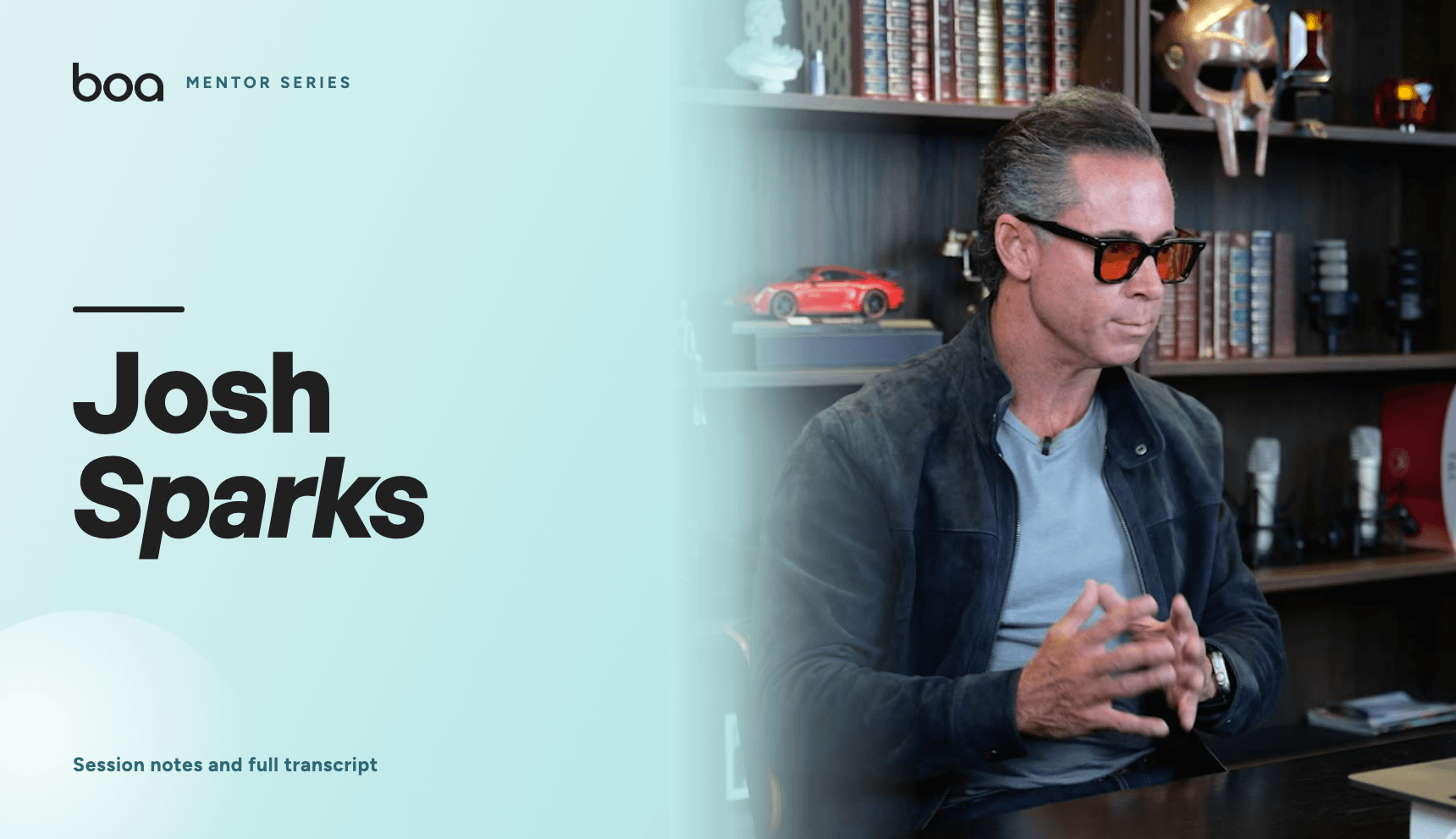
Josh Sparks on Getting Out of the Weeds as a Founder CEO
With Josh Sparks, Executive Coach and Strategy Adviser · Hosted by Kirsten Scott · 51 min
What this session covers
Josh Sparks walks founders through the move from hustle-phase operator to genuine CEO. Covers the 3-year, 12-month, 90-day planning cascade, the difference between leading and managing, how to hand over tactical autonomy without losing control, using equity when cash is short, and why a strong leadership team is what makes an exit worth anything.
You cannot become a CEO while you still love micromanagement, so the first thing to destroy is your own attachment to being the person who knows every detail.
Key takeaways
- 01
Plan backwards from 3 years, then 12 months, then 90 days
Start by describing what great looks like 3 years out across business metrics, brand positioning, market share, consumer perception, assortment and channels. Pull that back to 12 months with specific milestones you must hit to have conviction the 3-year picture is on track. Then pull back to 90 days and name the projects, the outcomes, the owner for each, how success is measured, and how it flows into team KPIs and incentives. Josh's point: the 3-year layer is your job, the 90-day layer is what you delegate.
- 02
Aim for three conditions: strategic clarity, team alignment, tactical autonomy
Strategic clarity means everyone knows what you are moving towards. Team alignment includes investors and board, not just staff. Tactical autonomy means the team runs the business day to day. Josh's line for the shift: you lead, coach and hold accountable the leadership team, and the team manages the business.
- 03
Destroy your old idea of leadership before you can grow into the new one
Josh uses the Buddhist cycle of growth, maintenance and destruction. When you are maintaining and want growth again, something must be destroyed first. For most founder CEOs the thing to destroy is a love of micromanagement and the fear that the team is not ready. The usual excuses (the team's not ready, I'm the only one who knows the detail, the systems aren't mature) are all solvable problems expressing the same underlying fear.
- 04
Separate the growth people from the maintenance people
Maintenance work suits a steady, detail-oriented, calm personality with strong managerial skills. Growth work suits the more entrepreneurial, high-energy type who spins up ideas fast but does not stay on one task indefinitely. Map which parts of your business are in growth and which are in maintenance, then put the right personality against each rather than expecting one person to do both.
- 05
Hire people who want your job and might leave to start their own
Josh says the best outcome is when direct reports leave to start their own business, because it means they got confident enough through their work with you. When interviewing, look for that hunger and drive. Those are the people you can trust with tactical autonomy, because they will operate with agility inside a clearly defined framework and be managed on outcomes rather than inputs.
- 06
Check in weekly, not daily
Set very clear outcomes, milestones and KPIs, then run a measurement and management system that reviews progress weekly. Josh is explicit that this is weekly, not daily micromanagement. Give people clearly defined boundaries and real freedom inside them, and be prepared to move them on if the results are not there.
- 07
Know the split: leaders tell the story, managers hold the numbers
Josh's definition of a leader is a storyteller articulating a promise and a shared vision for a shared future. By definition you are not a leader if nobody is following, and people follow emotional reasons to believe, not pinball machines and Bali retreats. Managers take that vision and convert it to 90-day rolling milestones, KPIs, partners and deliverables, working shoulder to shoulder inside a function and also cross-functionally. Josh hates the board report where a functional lead says "I did my bit" and blames another function.
- 08
Carve out a deliberate budget for initiatives you cannot measure
Some opportunities have clean maths (automate this and save this cost, bring 3PL in-house at this point on the U-shaped efficiency curve). Others (brand, customer experience, wining and dining a US distributor who may not buy for two seasons) have no traceable ROI, and Josh says the digital marketers who claim a line of sight are making it up. Decide with your team and mentors what percentage of time, money and people goes to the non-calculable bucket. Spending everything there is a one-way ticket to heartache and bankruptcy, but spending nothing caps what you can become.
- 09
When you have conviction, move, and when it stops working, move again
Josh's mindset formula from watching clients who exited well and stayed happy: deep in-your-bones conviction, then immediate inspired action. Sitting on a decision erodes your own confidence in it and then your team's confidence in you. Equally, do not be stubborn if it needs a new call in 6 or 12 months. Decisiveness going in and going out both beat hesitation.
- 10
Use an ESOP, shadow equity or a promissory note when cash is tight
You set your own valuation, and unless an external round has set one, there is no arbiter to say it is unfair. A formal Employee Share Ownership Plan will cost $40,000 to $80,000 in legal fees, so if that is 5% of annual revenue, do not do it yet. Alternatives include a promissory note entitling the person to X once an ESOP is established, shadow equity where they benefit on an exit event as if they held shares, or a cash exit bonus tied to valuation (though that is taxed at the top marginal rate rather than getting CGT treatment). Whatever you choose must give a real legal right, not a handshake.
- 11
Build the leadership team before you try to sell
Josh describes a client with a $10 million plus wellness app, nice EBITDA, outsourced everything, tiny head office, who followed the run-lean advice and had no succession plan. Nobody believes a founder will turn up on Monday after a $20 to $30 million payday. Without a credible team underneath you, you are limited to a trade sale, which is a small part of the market and typically the least generous on valuation. His fix: spend 3 to 6 months installing a credible leadership team and let them prove themselves over a quarter or two.
- 12
Consider selling to your own executives
A trade sale can be underwhelming and a financial investor who overpays usually wants you to stick around. If you want to walk away quickly, a management buyout to an executive or group of executives who know the business inside out can be lucrative and clean. You might retain a chairperson role or a slice of equity. Josh's summary: building an exceptional team kills several birds with one stone.
How the session runs
- 0:00Why the founder to CEO transition is self-directed
- 9:15Where a CEO's attention should sit: outward and on growth
- 10:11Leaders are grown, and what holds founders back
- 12:42Freedom within a framework and hiring people who want your job
- 20:22Claire: the difference between leadership and management
- 26:35Prioritising opportunities when ROI is not measurable
- 31:03Rachel: the mindset of a scary but right decision
- 33:47Steve: unblocking owners who are comfortable in the weeds
- 38:30The reapply-for-your-own-job hack, every six months
- 38:55Book and podcast recommendations for mindset
- 45:26Equity versus cash: valuation, ESOPs and shadow equity
- 48:52Why the best leaders have exceptionally high EQ
Mentioned in this session
- Diary of a CEO
- Zen and the Art of Making a Living
- Lawrence Boldt
- Hero with a Thousand Faces
- Joseph Campbell
- Carl Jung
- Internal Family Systems
- Richard Schwartz
- No Bad Parts
- Zen Mind, Beginner's Mind
- Thomas Merton
- Zen and the Birds of Appetite
- Laura Day
- The Prism
- MIT
- Stanford
- Oprah
- Jennifer Aniston
- Demi Moore
- New York Times
- MJ Bale
- Tom Brown
- ChatGPT
- ATO
- Papua New Guinea
- New York
- Bali
- Bondi
Questions founders ask
Josh deliberately refuses to give a single number. He says it could be sub-$1 million or as high as $5 million depending on your gross margins and cash flow. If you are willing to be more generous with equity you can secure strong talent earlier and make the shift sooner. The trigger is having a leadership team that can hold tactical autonomy, not hitting a revenue milestone.
Leadership is articulating a compelling vision and telling the story of a shared future, internally to staff and externally to investors, distributors and customers. Josh's test is blunt: you are not a leader if nobody is following. Management is converting that vision into 90-day rolling milestones, KPIs and deliverables, working shoulder to shoulder inside a function and holding people accountable to numbers. Managers also have to think cross-functionally rather than defending their own patch.
A proper Employee Share Ownership Plan will cost $40,000 to $80,000 in legal fees, which is unrealistic if that is a meaningful share of your revenue. Josh's alternatives are a promissory note entitling the person to a defined stake once an ESOP is set up, shadow equity where they are paid as if they held shares on an exit event, or a cash exit bonus tied to valuation. The cash bonus is taxed at the top marginal rate rather than receiving CGT treatment. Whatever you pick, it must be a real legal right they can hold, not a handshake.
Josh describes a client with a $10 million plus wellness app who had outsourced everything and run extremely lean, then wanted to sell. No buyer believes a founder will still turn up on Monday after a $20 to $30 million payday. Without a credible leadership team you are pushed towards a trade sale, which is a small slice of the market and usually the least generous on valuation. His fix is spending 3 to 6 months installing a leadership team and letting them prove themselves over a quarter or two.
Josh splits opportunities into those with clean maths (automation savings, bringing 3PL in-house at the right point on the efficiency curve) and those that are genuinely fuzzy (brand, customer experience, courting distributors who may not buy for two seasons). He warns that digital marketers claiming a line of sight on top-of-funnel brand work are making it up. Decide with your team what percentage of time, money and people you will deliberately allocate to the non-calculable bucket, and hold that line in both directions.
Full transcript
The complete conversation, as recorded, with every speaker attributed.
Josh Sparks0:00
Hi everyone, very happy to be back again. Thanks for joining. So today, the topic of today's session is one very close to my heart because I think it's incredibly challenging. So the first thing I wanna do is just offer some empathy for how difficult it is as you progress from pure hustle startup phase and move into scale phase to begin to assume true CEO-level ownership type responsibilities and direction, as opposed to being someone who has the title but is really operating more at an executive or sometimes down in the weeds level. So it's a journey. I think that's the first thing I wanted to really acknowledge and be clear about. So wherever you are on that journey, that's okay. You might be at a very, very early point. You might be running a $10 million, $20 million business, but wherever you are on that journey, there is always a next step. So what I'm gonna try to do is run through pretty quickly what we would normally do over like an 8 to 12 week coaching engagement. So again, I'm gonna have to move pretty quickly and please ask questions at the end if any of it it didn't make any sense. So, the first thing, just to start at the top, most of my clients who are operating at a level I think that is aligned with the kind of level that you're operating at now have not been given the role of CEO or the title of CEO by anyone else other than themselves. And what I mean by that is they haven't gone through a process and they haven't been subject to the kind of training often that you would see in a larger corporate where you're being groomed for a CEO role, or even in a smaller business where you've got a well-established board of ex-CEOs who are there to really to coach and to help you become everything you can be as a leader. And as a consequence, the transition from founder to many-hat executive to quasi-general manager to CEO is one that is largely self-directed, which is really tough. So if you're anything like most of my clients, you're relying on books and podcasts and maybe some mentors and groups like this to sort of figure it out on your own. So what I'm gonna try to do today is not solve for all the detail, but just give you a couple of ideas on key milestones that you want to achieve as you move through that progression. Okay, so I'm going to start with a framework that is really a strategic framework, but it's going to be helpful because it's really what you as a CEO, as you start to assume true CEO role and get out of the weeds so that you are, you know, on top of the business rather than in the business. From a strategy perspective, we like to start 3 years out or 5 years out sometimes, but typically 3 years out, and we move back, So we design a framework for what great would look like 3 years out from now across a bunch of different areas, from business metrics to brand positioning to market share to consumer perception, the assortment channels, et cetera, et cetera. So to the level of detail that we can, and it's pretty broad brushstrokes 3 years out, we flesh out what would great look like. And that's aligned to our higher purpose as a brand, which we touched on a little bit last week. And that really contextualises what we're gonna do between here and there. We pull that back to 12 months 12 months and we get a little more granular. And at that point, we are articulating very specific milestones that we as a business need to achieve in 12 months in order to have a very high level of conviction that we're on track for those 3-year milestones. And then we pull right back to 90 days and we look at what are the actions that we need to take, what are the projects that we need to deliver, uh, what are the outcomes that we need to achieve in the next 90 days, who is going to own it, How do we measure success? And how does that still into KPIs and incentives for the team? The reason I use that framework is that strategy is really where you wanna be spending most of your time. So as you're marching back to ever more granular levels, that's really what you wanna be able to delegate. And of course, the question becomes in a small business, well, you know, I'm working with, you know, Sally who used to make my coffee down the road, and I'm working with Bob who I went to school with, and I've got a co-founder who sort of came in 3 months ago because I needed a bit of capital. I haven't hired these people have people with a 3-year vision in place, mapped out an organisational chart, designed role and responsibilities and KPIs. You may have, but lots of my clients haven't at the sort of $1 to $5 million level. So what we're trying to do then is say, okay, what does great look like in terms of what we're moving towards? So we want strategic clarity, we want a level of executive alignment, and really that, call it team alignment, and that could also include your investors or your board. And then we want tactical autonomy. Now what I mean by that is you as a CEO or as a leader need to be focused on true strategy. Your role is to lead, coach, and hold accountable the team. The team runs the business. So again, this is not where you are now, but this is where you're getting to. So your job is to lead, coach, and hold accountable your leadership team. You manage the team, the team manages the business. And this is a really significant shift and one that you can normally achieve somewhere around the kind of the, I mean, look, it could be multi-millions, it might be sub-$1 million, it could be as high as $5 million depending on your gross margins and your cash flow. You can also secure some great talent earlier if you're perhaps a little more generous with equity. So I'm not gonna put a specific revenue or gross profit number against it, but at that point in time when you're starting to develop a leadership team that can and should have tactical autonomy, then you can start to separate out between what your role is as a leader and what the team's role is in terms of running the business. So that strategic clarity, executive alignment, and let's be a bit broader, talk about team alignment, which could include investors and board, and tactical autonomy is the framework within which we look at it. I wanna kind of step out of that for just a second and just give you another framework, another analogy that I use. So, and just bear with me 'cause it might sound a bit weird, but just, it'll make sense in a second. The Buddhists talk about growth, maintenance, destruction, and that is an endless cycle. And when you're growing, you're not maintaining, well, you individually aren't, different parts of the business can. When you're growing, you're not maintaining. When you're maintaining and you wanna get back into growth, you have to destroy something. So it's kind of a universal law of nature. Like think of the jungle canopy, like something has to be destroyed in order to make way for new growth. The reason that I mention this, apart from the fact that it's a really great way of looking at your business, because there is a growth market somewhere. There's gonna be a part of your business that at a certain point you're gonna be focused on maintaining. Then you can start to differentiate between who is responsible for maintain— There's a certain personality that is great at maintenance. They're just a steady set of hands at the wheel. They're exactly the kind of details-oriented, very calm, you know, great sort of managerial skills. Then you've got someone who's really great at growth, which is typically someone more entrepreneurial, more like you, high energy, lots of ideas, can spread themselves thinly, not necessarily great at staying focused on any one task indefinitely, but very, very good at spinning up new ideas fast. So it's a great framework and I'll leave that with you. I'm not gonna spend too much time on it. Growth, maintenance, destruction. The reason that's an important framework for today's discussion, and I wanna be a bit brutal and honest here, is that typically what we have to destroy in order to become better leaders is our prior assumptions of what great leadership look like and our prior role and responsibility. Like, you cannot grow into a CEO-level style leader whilst hanging on to a love for micromanagement or hanging on to a fear that your team isn't ready for tactical autonomy, or if you take your hands off the wheel, things are gonna go haywire. So when I encounter that kind of concern or that kind of fear in a founder CEO, it leads to a really nuanced and really productive discussion around what is it that is in them that is kind of holding them back, what kind of fears or uncertainties or doubts are they harbouring that we need to work through, and separately, what is it about the team or their operational supports or their systems or whatever it is that means that they are unwilling or unable to hand over tactical control. Because if we don't get to that delineation between you are at the strategy level, you are leading the executive team and they are responsible for running the business, then you just won't be able to get out of the weeds. As an entrepreneur, and I know, and I'm actually gonna go slightly quicker today so there's more time for questions because I think I'm gonna be really interested to hear the nuance across your different businesses. But the reality is there's people on this call that are just getting going. There's people on this call that are seasoned entrepreneurs. It might be their second, third, fourth business. There's people on this call who have come from a corporate background who have a lot of the training, that I said typically a lot of my clients don't. So it's challenging to give you any universals. But I think if we think of some really clear milestones, one, where you want to get to is true CEO-level responsibility and operating at a—
Steve9:15
your—
Josh Sparks9:15
a lot of your attention should be focused externally. Candidly, you should be looking for new growth opportunities. You should be looking at products or services that are adjacent to what you're currently offering. The simplest way to increase revenue is raising prices. The second easiest way to increase revenue is to sell more to your your existing customers, et cetera, et cetera. You guys all know this. So what else can we do in order to increase the size of the business? And that's an external focus. Now, of course, your response may well be, if you've got a team of 3 or a team of 1 or a team of 5, it's not something we can do right now today. But there needs to be delineation between what the leader is doing and focused on, which is external and growth and partners and investors and channels and new markets and products, et cetera, et cetera. And then distilling that out in terms of what needs to be executed. So distilling that into milestones, owners, and KPIs so the executives can then go and execute it. So I'm sure you've got this point.
Kirsten Scott10:11
I'm—
Josh Sparks10:12
I don't want to kind of flog a dead horse, but it's a, it's a really important framework to start working towards. And if you think of that 3-year, 12-month, 90-day delineation, it's a really simple way in your own mind, on a piece of paper or whiteboard with the team, to start separating out Roles and responsibilities for you and for the team, and then for whoever the team manages, whether they're internal, external contractors, freelancers, or whatever. I think that leaders aren't born, they are grown. I mean, I've seen this a million times over. In fact, probably I've also seen the opposite where someone feels that they're a born leader and are not open to different ways of looking at what they're doing or different platforms or constructs or context for how they might improve what they're doing. I'm doing. That to me, and in my experience, is much more dangerous than someone who says to me, I just don't feel like I'm a natural leader. Like, I've had the idea and I've got it off the ground, but there's an awful lot about leadership I don't yet understand. That's all of us. Like, we're all still learning what great leadership looks like. And there's a bunch of resources out there that can help you with that. There's coaches like me. There's a bunch of books. There's online courses. There's all sorts of things. But if you are not internally ready to start separating out what is genuinely strategic and therefore your focus from what the team should be, even if they're not today capable of executing independently with some real agility and autonomy, that's more of a challenge. So we can learn all sorts of stuff about how to be a great leader, but we have to address internally what is holding us back. From giving up a little bit of control. And typically in my experience, it is as much about personal growth and development within the founder CEO themself, him or herself, than it is around the excuses I normally hear, which the team's not ready. I'm the only one that knows all the detail. Uh, the systems aren't mature enough. There's, there's too many variables that are in my head. All those problems are solvable and they're just ways of expressing the same fear. So we need to get over that. If you've got any of that, then I'd really encourage you to, to dive into it because overcoming that is a massive unlock. Like, true, true success and wealth is generated through the agency of others. We want teams that we are incentivizing and very clearly directing in terms of what we need in terms of outcomes. And then we want to let them do their thing.
Steve12:42
That will—
Josh Sparks12:42
you will get the best work out of your team. If you allow them to spread their wings. And I was reflecting on this recently with a friend in New York that the best possible outcome for me, and he was, he was saying the same from his business, is when my direct reports leave to start their own business. 'Cause that means to me they have done their best work because they've got so confident and so validated through that process, they now feel they're ready to start their own business. So look for people people who you see, like Paul, if you see a little bit of PW in someone that you are interviewing, that's a good thing. We want to see a little bit of Mark. If you see a little bit of Mark, a little bit of that hunger and that energy and that drive. Rachel, you know, I can't see all the names, but as I go through the screen, when you're interviewing someone, you want someone ultimately who wants to do what you're doing because they want to learn from you. They want to deliver their best work and then they want to move on. Why am I hammering this point? Because those are people you can trust with tactical autonomy. You want them to operate with real agility and you do it within a clearly defined framework. So, you know, that kind of, you know, risk within a framework, freedom within a framework is probably a better way to put it. You establish the framework and then they are free to deliver and you are managing based on outcomes, not inputs. All this stuff I know is obvious, but it's really important to not just know it intellectually, but to really embody it in the culture of the business. Couple of other quick things before we move on. If you want to innovate, if you wanna do something truly original, if you wanna disrupt a well-established market with very well-capitalized and highly motivated incumbents, and let's face it, that's just about everyone. And if you wanna grow faster than 3% a year, which is about the GDP rate in Australia right now, then you need to take someone else's business. The customers currently, if you want more than 3% growth, then that money has to come from somewhere else. They're either spending that money with a competitor or they're spending it with a different sort of business or service entirely. But you have to convince them to stop doing that and come to you. And all of those competitors who are well capitalised and highly motivated do not want you to do that. So it's really hard. So how do we de-risk it as much as possible? We get super clear on strategy, we develop a team, and I would encourage you, if you can't afford it through cash, to be a little bit more generous with equity. You will get get superstars with Airquadet. You give them very clear outcomes, very clear milestones, you give them KPIs. We have a measurement and management system to ensure that they stay on track. We're measuring that and managing it weekly, but you're not micromanaging them daily. You're getting out of their way, you're letting them do their thing, and then you're looking for the what's next. Where is the pocket of customers that are not yet fully tapped out? Where is— another friend of mine in the US, a great strategist, always says there is always a growth market somewhere. So this notion that, you know, the market slowed down or it's tough, or, you know, there's people undercutting us or whatever, it's like, we'll find the growth market. And as CEO, you don't have the time to do that if you're buried in the weeds. So you are super smart, you're super motivated, you've identified white space, that white space very quickly becomes crowded and you have to apply the same level of rigour and discipline and energy and passion to go find the new white space. And you can't do that if you're buried in the weeds for 60 hours a week. So again, I know I'm making a really obvious point here, but you have to shift your own perspective in terms of where your focus needs to be. And if there are excuses or reasons that you can't do that, then we need to march through those one by one and figure out how to solve them. So there's tonnes and tonnes of other stuff that I want to talk about with respect to leadership, but it might actually be better to hand off to you guys for questions. And I know the topic was, how do I emerge from being deep in the business to being above the business? And what I'm telling you is that the first step is to assume a true CEO perspective and start to assume a true CEO level of role and responsibility. Then the next step is from that amazing group of executives that you've secured through generous equity compensation packages, if you don't have the cash or cash, if you've got the cash, who have proven themselves are gonna want your job because then the next part is succession planning. You, like one of the first things I do when someone comes to me to help with an exit, I mean, literally I've got a client who's doing this right now. Great little business, not a one-man show, but almost a one-man show. It's a wellness app. I can't get into the detail 'cause I signed an NDA. It's turning over $10 million plus. It's got really nice EBITDA. And he's done exactly what every single podcast tells you to do. He's outsourced everything and he's using AI in a really intelligent way. He's got a tiny head office for a business of that size. He's like, I wanna sell it. I'm like, okay, so someone's gonna pay you, you know, 2, 3 times revenue if we're on a good day. So that you've got $20 or $30 million in your back pocket. No one believes you're gonna turn up to work on Monday. So what's our succession plan here? And he just hadn't thought of that because he'd been following the advice that we should run super lean. We should hold all the equity back for the big investor that's going to come in at some point in a year or two. And there was no credible succession plan at all. So therefore we're limited to either a trade sale where someone already has the executive team and they're just going to bolt it onto a bigger group, which, which actually is a very small part of the market and typically the least generous when it comes to valuation. Or we now need to spend 3 to 6 months putting in a really credible leadership team that can sit underneath him, that can prove themselves with a quarter or two of great numbers, and then we have a credible pathway to an exit. So jumping around a bit, I know, and I'm gonna hand off for questions, but job one in terms of getting you out of the weeds is to recognise that success is in the agency of others. We have to build a fantastic team. And if you don't have the money, there's other ways to do it. With that team, we want to provide them real clarity— strategic clarity, executive alignment, tactical autonomy. So they need to know exactly what they need to do. Within that framework, they have freedom to execute. We're checking in with them weekly. Are they on track? Are they not on track? Needless to say, if they're not delivering the results, we move them on. But typically, you might be pleasantly surprised what people are capable of when you give them clarity of their boundaries, like their framework is clearly defined. But within that framework, you give them some real freedom. And then as you start to assume the role that you always imagined you were going to have, which is true CEO leadership, 70% outward focus, 30% internally, looking for the next growth opportunity, looking for the right investors, looking for the right strategic partners internationally, then we're starting to get to the point where you can imagine an exit with one of those executives stepping up into a leadership role. The last thing I'll say on the executives, and I've seen this happen multiple times in my career, one of them could well buy your business. If they are good enough and strong enough and they know the business inside out and backwards, a trade sale can be a not so great option. A financial investor can overpay, but typically want you to stick around. If you wanna walk away quickly, one of the best ways to do it is to sell to an executive or a group of executives through an MBO, a management buyer. And that can actually be quite a lucrative outcome where you can genuinely walk. You might take on a chairman or chairwoman's role, chairperson's role. You might retain a bit of equity. So anyway, my point is that we kill a bunch of birds with one stone when we build an exceptional team. Sorry for talking so fast. Should we jump to questions?
Kirsten Scott20:22
That was amazing, Josh. I have a few questions myself, but On the list I've got Claire. Would you like to go first? Thanks, Kirsten. Hi again, Josh.
Josh Sparks20:32
Hi, Claire.
Kirsten Scott20:34
Great start to the session. Just on your point about CEOs to lead, coach, hold accountable the team.
Josh Sparks20:39
Yeah.
Kirsten Scott20:39
And the strategy and, you know, looking at the growth opportunities, etc. I guess I wanted to ask and understand, can you distil the difference between leadership and management of people? I find that I I sit in that leadership strategy piece really well, but as soon as it comes to like managing people, it's completely not my strength. So I guess for me, just to get your view on the difference between those kinds of roles and what we would be looking for, I guess, in hiring the right people.
Josh Sparks21:09
So it's a fantastic question and there's a bunch of different ways to answer it and there's a whole bunch of different theories on it. The one that I personally subscribe to is I'm a big believer in that, that, you know, there's nothing as powerful as an idea whose time is— that time has— which time has come, you know what I mean? Your job as a leader is to articulate that idea. So you've got a compelling vision for the future. You know, we are gonna take that hill. In terms of what that looks like internally and externally, it's— you're a storyteller. I mean, leaders are really storytellers. More than anything else, you are articulating a promise and weaving a storey around that promise that makes it as inspiring and compelling as it could possibly be. There is, of course, an element to it that is much more detailed and numbers-focused and structurally focused than that. But first and foremost, if— by the very definition of the word, Claire, you're not a leader if no one's following. And we follow people who we find inspiring, and we follow people who we believe that that inspiration that we're feeling is indicative of their probability of success to lead us to a better place. So it's not just they're revving us up, they're revving us up about a vision for the future, a shared vision for a shared future that we are prepared to work 80 hours a week for, for 20% less than we would make down the road. So I think a lot of leaders default to management, and I'll get to that in a second. A lot of leaders default to management and they forget how important it is that absent that vision, your very best people could get a job tomorrow, right? Probably 10 offers tomorrow. Absent that vision, it's just another job. So what are we competing on when it's just another job? Well, you know, is there a pinball machine? How much am I being paid? Is the bonus structure competitive? Are our retreats in Bali or, you know, at Bondi? We're competing on all these kind of rational reasons to believe, and we want to get back to emotional reasons to believe. I need to believe that what you are creating has, has real substance and meaning for me on an emotional level. It's not just a way to pay my bills. So a chunk of your time as a leader, 100% has to be focused on that. You don't just do it internally, you're doing it externally with investors, with distributors, with agents, with wholesale accounts if you're in that business, et cetera, et cetera. So the better you get at telling that story, story, the cheaper the money is when you go to raise it, whether it's debt or equity, the lower cost great employees are compared to your competitors, and the more likely that customers are going to get really excited by the story. Because the end result of all this is that that storey's got to be compelling enough not just to bring everyone in to build and ship or to develop the service and offer it, but to compel a tribe of customers to really fall in love with you. Management's a different thing. Management is okay, the leader has articulated our end goal. In 3 years, we're gonna take that hill. In 3 years, we're gonna be a top 3 player in this market, whatever it is. Managers then at a team level, I mean, you've got a general manager, which I'll talk to separately, but at a team level, a manager is to go, okay, you heard her. Claire's clearly articulated what we need to do. Our job now is to transfer that vision into a set of 90-on-90-day rolling milestones KPIs, partners, deliverables, etc., etc., and I'm going to work with you directly as the manager to support you wherever you need support. And the manager basically hops between areas of their functional responsibility to lean in and support shoulder to shoulder wherever they need to, and the man— because the manager is ultimately responsible for delivering the numbers, however articulated, for that function. So the key distinction is is the manager is defaulting to, I'm with you shoulder to shoulder, down in the weeds if need be. If you don't need me shoulder to shoulder, I'm the one holding you accountable to these numbers. And then the manager also needs to work cross-functionally. So they're down within the function, and they're also, 'cause most things aren't a single functional output, right? Like they're cross-functional. So the manager is also working cross-functionally. Because ultimately, if you've got a great incentive package, the team, the business has to do its numbers before the bonuses are paid. So cross-functional, and that's a whole other topic actually, but you might have a percentage of the bonus that's paid for pure functional outcomes, but you want people to think cross-functionally. 'Cause I hate it when someone turns up at a board meeting or we've got reports from, so I'm in there with the CEO and the board and the different functional leads are coming in and saying, well, I did my bit, you know, Sally led it, down and, you know, John messed up the ordering, was 10 days late, and Italy didn't, you know, China went on New Year, you know, blah blah, China New Year, it all fell apart. It's like, that's actually not good enough. So there's a functional level to management, there's a cross-functional level to management, of course there's a reporting up and a distillation of the numbers to support the CEO. But the leader needs to be about, as I said before, in my experience, 70 to 80% externally focused because your job is is to, you're gonna have to lead and no one's gonna follow if you're not leading. So you need to demonstrate, I've identified this new market, I brought this new partner to the table, we've got investors lining up at the door. So I could keep going, I'm gonna rave on for half an hour though. But that's a start and just message me separately if you want a few resources to look at.
Kirsten Scott26:31
Yeah, thanks Josh, really appreciate it.
Josh Sparks26:33
Pleasure.
Kirsten Scott26:35
Awesome, thanks Claire. Hannah. Thank you so much for this Josh and I really love that explanation. Even though it wasn't my question, just understanding that distinction, I'm sure that that served the room also amazingly.
Josh Sparks26:47
Thanks, Anna.
Kirsten Scott26:48
Appreciate you explaining that and Claire for your amazing question.
Josh Sparks26:51
Thanks, Anna.
Kirsten Scott26:51
Mine was to ask you, what are the criteria that you use to determine which tasks or opportunities in business will move you forward?
Josh Sparks27:00
Okay, so like prioritisation of opportunities or prioritisation of tasks towards a defined opportunity?
Kirsten Scott27:07
More likely the opportunities to start with, to then reverse engineer the tasks.
Steve27:11
Okay.
Josh Sparks27:12
Okay, it's a really good question 'cause it's actually quite a nuanced discussion. So the simple answer is, well, you focus on the highest ROI opportunities. And I've read in a description of a CEO is that, you know, the CEO's job is to optimally and most efficiently deploy resources, resources being time, money, and people. And that's a nice little throwaway line. But the question then becomes, in service of what? So there's going to be opportunities perhaps that are very good for your brand that we have no line of sight to in terms of a revenue outcome. Your digital marketers will tell you they've got a line of sight, but they're making it up. It's so far at the top of the funnel. It is something that you passionately believe is going to support the brand, but how that translates ultimately into awareness, consideration, conversion, repeat purchase, referral, Who knows? So there's going to be some things that you consider important from a brand perspective or a customer engagement or customer service— excuse me— perspective that we can't assess on an ROI basis because there's just too many variables between the initiative and how it's going to show up in the numbers. And of course, there's going to be other opportunities that are really easy to track through. So, you know, if we automate this process it's going to take out this amount of cost. Or if we, if we're at the point now, like a 3PL for example, like you typically want to start with a 3PL, you then want to bring it in-house, and then you want to go back to a 3PL. There's a U-shaped curve on the efficiency of UPLs. So you can say, well, here we are on that U-shaped curve, it now makes sense to consider doing it in-house to give us greater flexibility. And we've, you know, we've covered our fixed costs, we're at a point now, blah blah blah blah blah. So there's going to be decisions like that that are more mathematical in nature. And when you're looking at a given pot of resources on a weekly, monthly, quarterly basis, I'd really encourage you to carve out a chunk that, you know, for what Google would call moonshots, but for us, they're not moonshots because they're absolutely related to the core business, but they're a little bit fuzzier in terms of what the ROI looks like. Because if you don't invest in brand, if you don't invest in customer experience, experience, if you don't invest in wining and dining prospects who are agents or distributors or wholesale accounts in the US that maybe won't buy you for another 2 seasons, then you're just never going to achieve everything you might achieve. Equally, if we spend all our time and money and deploy all our people into opportunities where we have no clear line of sight to the ROI, that's a one-way ticket to heartache and bankruptcy. So I, I think you just need to decide for your for your particular business, what does that look like? Time, money, and people are the 3 resources available to us. It's all any of us get. Typically at early stage, we've got more time, although we do need to sleep occasionally, and we might have more people and less money, sort of depending on where you're at in the cycle. So how we deploy them is incredibly important. I'd also encourage you to discuss that with your team. So, and any mentors you have, like the discussion around what is the appropriate percentage that we put towards non-ROI calculable efforts that we believe in, we have a high level of conviction in, but we just don't know how it's going to eventuate in terms of ROI. It's worth spending some time on that. The easy ones are what's the ROI? This gives us a 3x, that gives us a 2x. I mean, they're the easy ones.
Kirsten Scott30:35
Beautiful. Thank you so much.
Josh Sparks30:36
Thanks, Anna.
Kirsten Scott30:39
Rachel, I know you didn't necessarily have a question, but is there anything you wanted to touch on? Yeah, um, and I guess maybe I've thought about it, and my question is maybe more around mindset than anything, because we're looking at an opportunity of moving manufacturers so that I'm not sort of in the warehouse filling and like supporting, um, the team fill the bottles and things like that, which pulls me away from those higher-level tasks.
Josh Sparks31:03
Yeah.
Kirsten Scott31:04
But it's kind of, it's feeling a bit scary and I know it's gonna be increased costs and different payment terms and I know everything always works out, but it just feels like it's a bit of a scary move. But I feel like it's the right one for a number of reasons, but particularly for pulling me out of the weeds, as you say.
Steve31:22
Yeah.
Josh Sparks31:23
Yeah, yeah. I think the deep conviction And I was actually doing a little thing on mindset yesterday. Like I did a little video clip for a client. I was like, okay, 3 things about around mindset. So I'm thinking of my clients who have gone on to exit for really healthy numbers, but just as importantly, are really happy, fulfilled people. You know, they've enjoyed the journey. So yes, they've had a big financial payday, but I honestly think we focus on that a little bit too much 'cause it may or may not happen and it will be 5 to 10 years from now. So you really have to kind of enjoy it. It along the way. So the 3 things that I typically see amongst those that I consider most successful in a holistic way, one is that, like, that deep, deep, deep conviction, like, in your bones, you know it's the right decision, and you've got a bit of fear, there's a bit of uncertainty, there's a bit of doubt, but you know it's the right call. You've got to have that level of conviction. When you've got that level of conviction, then just act. And I think of that as just inspired action. You know, it's both more inspired and more inspiring to those around you when you're decisive. So once you've developed that level of conviction, don't sit on it too long because it erodes your own confidence in your own conviction. And ultimately when you've got a team and others around you, it starts to erode their confidence as well. And we spoke before about what does great leadership look like? One of the qualities of great leader is once they've made a decision, they move. There's not sort of sitting around rethinking it, endlessly debating it. And then the last thing I'd say is tactically though, we have to be open to how that opportunity then manifests. So it may sort of come together exactly how you think it's gonna come together, or it may look a little bit different. So don't hesitate if you, if you need to make a new decision in 6 or 12 months, don't be stubborn. So, you know, try to avoid the fear, uncertainty, and doubt, and equally don't be too stubborn down the track because sometimes things change and we need to make a new call. And that decisiveness, both going in and going out, is a lot more impressive than either rather sitting on an opportunity because we're just, you know, a little bit fearful and equally being stubborn about not reverting. It's a sunk cost at that point. If it's not the right call, move out.
Kirsten Scott33:24
Yeah, no, that's awesome. And I definitely have that like unwavering belief that like we're going to do what we need to to make it work and love what I do. So I'm so happy to kind of wait out that 5 to 10 years for the big payday.
Josh Sparks33:36
But that's awesome. That's, that's great to hear.
Kirsten Scott33:40
Thanks, Josh.
Josh Sparks33:41
Thanks, Rachael.
Kirsten Scott33:43
Thanks, Rachael. Steve, are you on the call? There you are.
Steve33:47
Yeah, I am, and I'll keep my video off because I'm still in Papua New Guinea.
Josh Sparks33:51
No worries, Steve. Can you hear me okay? Yep.
Steve33:55
Yeah, great. Josh, everything that you spoke about, I'm ex-corporate. I'm actually in PNG doing, building a competency framework for a 200-person company. Employee business. So it's natural for me. What I find is unnatural for particularly older generation business owners who maybe started off in some sort of technical skill, they were a good salesman and they're now running a warehouse, they're running the business themselves. They're actually quite comfortable in the weeds because they've been successful accessible by being in the we. Yeah. And so, you know, I've got a particular approach that I talk to people about, you know, work from the inside out. But typically when you start talking about, you know, structure, strategies, org charts, job descriptions, you know, leadership management, the shutter comes down because of their insecurity of potentially failing at that. Just your, what have been your experiences around, do you see those blockers and how do you overcome those?
Josh Sparks35:11
Absolutely see them all the time. And sometimes they can be overcome, sometimes they shouldn't be overcome. So what I mean by that is that if someone is open to being coached and I don't think it's a generational thing, I don't think it's an age thing. I've got clients in their 70s I have clients in their 60s who are enormously coachable and I have clients in their 20s who are extreme, they pay me, but they don't follow any of my advice. So I don't know that it's an age thing necessarily, although often we do think of it as a generational thing. If someone is not open to being coached, then it's very, very difficult. I mean, you can lead a horse to water and you can provide all sorts of reasons and justifications and rational business cases for someone to, to move and develop their own career or their own competency in a certain way. But if they don't wanna do it, they don't wanna do it. And what that presents is an opportunity to say, actually, this is a great girl or a great guy for this particular role. And now what we need to do is find someone to come in a level above and open up that opportunity rather than trying to force a round peg into a square hole. Give someone an opportunity who is a perfect fit for what you need done. And again, I know you guys know all this. I'm sort of preaching to the converted. But when it comes to an organisational chart, I start with what is the business trying to achieve? What competencies will be required in each role to achieve those outcomes? What kind of cultural fit do we need? What kind of background? And then we go find that person. That person could be within the business today, or it could be a new person. Person. Now, I'm not suggesting that you go around, you know, firing people and don't giving them the opportunity to grow and develop, but equally I'm not suggesting the opposite, that you should automatically promote someone who's been in a chair for a certain period of time to the next rung up the ladder, because some people are really happy and like genuinely fulfilled at a level that you might look at or I might look at and go, wow, you know, why aren't they pushing themselves for more? It's not for us to judge.
Kirsten Scott37:08
Judge.
Josh Sparks37:09
So I think we just need to differentiate between, is this an individual who I can unblock, they're coachable, and I can help work them through why they're, they're blocked, and I will give that a period of time, or is this someone who it's just silly, we're just pushing this uphill and they're really happy where they are. So let's give that opportunity to a superstar girl or guy who's in a different organisation or maybe in a different function in the business to come in and blow us away. I think the incumbency bias is a real issue because someone's there doesn't mean they should be there. And it certainly doesn't mean they don't deserve the next level. They do deserve the next level up. I think we all have to earn it. And I hate to sound too Darwinian about it, but that's just the nature of the universe.
Steve37:56
Thanks, Josh.
Josh Sparks37:57
I'll just make a point.
Steve37:58
This is not my idea actually. Actually, a client of mine came up with it, and what he does is every 6 months he applies for his job because the business has gone from, you know, it's a SaaS business. He had 5 employees, now he's got, you know, more than 50 globally. So each 6 months he applies and we have a conversation around whether he's the right person for the role. And we got a couple of times, we got very close to sacking him as that person. Until he built up his thing. So that's, you know, that's another hack, I guess.
Josh Sparks38:30
For sure. Yeah, that's—
Steve38:32
Thank you very much. Really appreciate it. Love this, the patience.
Josh Sparks38:35
Our pleasure, Steve. Thank you.
Kirsten Scott38:39
Steve, I'm Krish. Thank you. Hi, Josh. Thank you so much. I've learned so much and I love all the analogies that you've given us. I've got a question for you. What's one podcast or book that you would recommend recommend we all read or listen to by the end of this year?
Josh Sparks38:55
Wow. Okay, so there's a bunch of great podcasts out there and I'm probably just gonna reel off the ones you're familiar with. I love Diary of a CEO a little bit earlier in its evolution. I've found it's got a little clickbaity and a little bit doom and gloom about the end of the world type stuff recently. But his stuff, like really from about probably 12, 18 months ago, when he was very focused on the entrepreneurial journey, I thought was really, really good. There's, I mean, God, like, let's go to books. There's too many podcasts. I've just launched a podcast, but I'm not gonna plug that. So books, I think it really depends kind of what you, tell me where you think you have the greatest opportunity for development.
Kirsten Scott39:47
I guess mindset. Okay. Thinking bigger.
Josh Sparks39:50
Okay. Okay, so I'm glad you said that 'cause I've got about 10 of those. So there's a really good one that changed my life. I read it a long time ago, but it's been progressively updated. It's called Zen and the Art of Making a Living. It's written by a guy who's a career consultant called Lawrence Bolt, like the god of career consultants, but it's about reframing the way you think about your life's work, the craft of your work. Really, I guess, your expressive craft, your expressive, how you self-express, aligning that to higher purpose, figuring out where the commercial opportunity is, what you can bring to it that is unique and different, blah, blah, blah. It's a career guide, but it's really a self-help book. And it just, it helps remind us what— life is fleeting. We are some kind of weird individuation of some universal energy. We're here for a reason. What is that reason? How do I align that to what I do on a day-to-day basis? Because God knows we spend more time working than anything else. It's just a really great reminder of the basics. But there's also a whole bunch of exercises that you do throughout it and some really inspiring quotes from spiritual traditions, from Buddhism to Islam to Christianity to Zen to blah, blah, blah. A lot of psych stuff, a lot of Carl Jung stuff, a lot of Joseph Campbell, Hero with a Thousand Faces, Hero with a Thousand Faces stuff. That's actually another great book. So if you're interested in psychology and like the Carl Jungian sort of collective subconscious thing, Joseph Campbell's book, Hero with a Thousand Faces, it's a bit of a heavy read, but it's really, really good. I think if you're also interested in mindset, I'm not sure if you've heard of Internal Family Systems, IFS, but it's an approach to psychology. It was developed by Richard Schwartz. His book, No Bad Parts, is excellent 'cause basically the idea is we got a whole bunch of parts of us internally. We've all had some kind of trauma. We've all got some kind of blockage. And it's a really interesting way to frame what that looks like internally and what's holding you back from being the best version of you on a daily basis. What's triggering you to sort of regress a bit and maybe act a bit impulsively or be a bit, you know, be a bit angry or a bit sad or whatever it is, however it shows up in your life. It's just a really great way of framing it. And because I'm a huge fan of the Zen stuff, I think Zen Mind, Beginner's Mind is just a fabulous book. But if you're more of a Christian background, I grew up I grew up Christian, so I sort of like mixing it up a bit. There's a book by Thomas Merton, who's a Catholic mystic, called Zen and the Birds of Appetite, which is basically what is in common between Zen and the Christian mystics. And it turns out quite a lot. And it turns out there's quite a lot in common with the Sufi Islams and the Kabbalah Jewish. And so the idea is that underneath all of these traditions, there's some universal truths. And if we have some kind of relationship to those universal truths, it's enormously grounding and stabilizing, and it makes the day-to-day stuff that we all encounter a lot easier to put into perspective. Actually, one other, one other person, because I'm thinking of her, because I'm going to New York to interview her in a few weeks, Lara Day. She's a, she's an intuitive, but, and just run with me on this, but she's an intuitive. She works with worked with multiple billionaires in New York. She worked with Jennifer Aniston, Demi Moore, and blah, blah, blah. They've guided their career for the last 20 years. She charges $25,000 US an hour for intuition. And she's written multiple New York Times bestsellers. She's been tested by MIT and Stanford, and her intuition is off the charts, like way beyond what would normally be chance or whatever you wanna call it. And, you know, she's, Regular guest on Oprah and blah, blah, blah. Anyway, she is fantastic and she's just written a new book called "The Prism," which is really, it's really mindset. It's around how do you get yourself in the best possible place day in, day out? How do you tap the higher reaches of your consciousness and get out of the weeds? And how do you intuit and imagine and then funnel that into innovation? So if you imagine like the creative process is some combination of intuition and imagination. That's all great, but until it's actually channelled into some form of innovation, whether it's art or business or music or film or fashion or whatever it is, the world doesn't get to share it and you don't get the commercial rewards that you deserve from it. So she's got a whole process where you move from this kind of ethereal and whatever kind of belief system you have, like what's out there, how do you channel that? How do you tap it? How do you turn the antenna on to tap it, and how do you turn it into something that you can commercialize.
Kirsten Scott44:33
Awesome, my God, thank you so much, thank you.
Josh Sparks44:36
I know they all sound really weird, but I promise you they're great reads.
Kirsten Scott44:39
No, they sound like really exciting, I can't wait. Good. Thanks, Josh. Claire, I know you had another question. Yeah, just if time permits, it was just on your point about when looking at getting the right team and looking at equity versus cash. If you don't have the cash, you're looking at equity, bringing on the right people to obviously grow and build. Yeah. At that point in time, um, what would be the metrics, um, in terms of how much equity at that point in time? Um, because I do see the value in it, but also as somebody who's had a business and now starting a second business, I like to keep a hold of a obviously control, but I also see the benefits of the team and how much more growth you can have with the right people.
Steve45:26
Yeah.
Josh Sparks45:27
Okay. So the good news is that the valuation that you set on the business is whatever you want. It's your business. So you can, you can really self-value it if you've got external people valuing it, like you've done an investment round. So if you had an angel round or a seed round or whatever, then there is a valuation set. But of course, Of course, you can set a valuation above that if it was in the past and you've since moved on and you've achieved some new goals, et cetera, et cetera. But when you're starting, you can value, I mean, I've seen business, well, we all have, I've seen business plans at, you know, a $20 mil valuation. I've seen this, you know, if you're in the tech world, business plans can go for $50 or $100 mil, not just pre-revenue, pre-anything. So most categories don't support that kind of valuation, to state the obvious, but if you wanted to take your business today and say, I think it's worth $10 million, I think it's worth $5 million. For the purpose of an employee coming on board, it's really just a matter of whether or not they agree with that. You don't have to justify, there's no arbiter externally that is going to step in and say, that's not a fair valuation. So that's point one. Point two, in Australia, equity is a pain in the ass. Like it's, you have to develop some kind of, either they're coming in early as, co-founder, if the business isn't worth anything yet, then you can issue equity and it doesn't cause a tax issue for the recipient. The ATO is a complete nightmare with this, as I'm sure you're all aware. The alternative is to offer, establish some sort of ESOP, which has relatively ATO-friendly treatment. But an ESOP, which is an Employee Share Ownership Plan, for those of you not familiar with it, that will cost you $40,000 to $80,000 depending on how helpful your lawyer is. I would hazard a guess, Clare, you're a lawyer, I bet you could do it for a lot less. But there's also this wonderful thing, ChatGPT. So you get an awful lot of drafting done now before you take it to the lawyer. I know, Clare, you won't want me saying that. Lawyers hate it when I say that.
Kirsten Scott47:23
No, I don't have anything against ChatGPT if people are using it correctly.
Josh Sparks47:26
Exactly. Okay, great. So you could look at an ESOP. ESOP. The other thing you can look at, if you just want it, you're at a point where, look, I can't, I don't have the time or the money to figure out an option share plan or an equity share plan for my staff. You can do a promissory note of some description whereby as and when an ESOP is established, they will be entitled to X. You can do something called shadow equity. I won't bore you with the detail, just Google it or ChatGPT it and it'll give you a good idea of what shadow equity looks like that's another way to do it where they don't actually own real equity, but upon an exit event or a transfer of control or however you define it, they benefit as if they did hold equity. And you can also have something as simple as a cash exit bonus based on valuation. The problem with that is that they pay the top marginal rate and everyone would prefer CGT exemption for obvious reasons. So there's different ways to do it. And, but to really simplify it, if you're pre-revenue you're super early in revenue and it's gonna be, you know, the 5% of your annual revenue to go and brief a lawyer, then don't do that. Find a way to do it that doesn't require a lawyer today, but still gives the staff member real legal rights. Like it's, you know, it's not just a handshake deal. They've got something that they can take away and feel really good about because we want them to break their backs for us. And they won't do that on the back of the handshake. Well, they won't do it for long.
Kirsten Scott48:51
Thank you.
Josh Sparks48:52
Hey, just quickly back to the mindset stuff. I should have said this when I was answering Chris's question. The reason I've dived so far into this, other than the fact that I find it really personally interesting, is the best leaders I've ever worked with have exceptionally high EQ. They know themselves inside out and backwards. They are not easily triggered. They do not suffer irrational fear, uncertainty, or doubt. Out, and they are incredibly intuitive when it comes to reading the room. And that could be a room of investors, it could be a room of disgruntled staff, it could be a room of potential customers if you're pitching a conference or whatever. But they are really, really good at the EQ thing, and I've seen that pay off in spades financially. So while you might think it's woo-woo and fluffy, if we have to distil it— and I hope we don't— but if we have to distil it to a real rational reason to dive into this. It makes you a better leader and it will help you secure better, better staff, better investors, more customers, etc., etc. I just think if you're not, if it's not something you're focusing, focused on, you do not yet know what you're capable of.
Kirsten Scott50:03
That's awesome, Josh. I'm honestly blown away. I'll be rewatching this one indefinitely. If no one has any other questions, we will finish up there, guys. I have put a link in the chat to Josh's new podcast, if you're interested. I'd highly recommend going and having a listen. It's just launched, and I know that one of his first guests was MJ Bale, which is huge.
Josh Sparks50:25
Tom Brown. Tom Brown.
Kirsten Scott50:26
Tom Brown, sorry.
Josh Sparks50:28
Yeah, yeah. Actually, can I just— I'll quickly add— I just want to quickly add to that, guys. First episode is with Tom, He's a tricky guy and it starts off a bit slow because he's not someone that feels compelled to share his wisdom. He did it the hard way. He went broke, he's built up, now he's a billionaire. He's not feeling super compelled to help everyone out, but I did pull out some real great insights from him and there's a couple coming up that I'm really excited about that I genuinely think, 'cause there's no money in it for me, so I'm not selling you anything. I genuinely think there's some really good advice in the episode already up, Tom's, but particularly over the next couple of weeks. So anyway, let me know what you think.
Kirsten Scott51:11
Awesome, I'll definitely be listening. Well, thank you everyone. It's great to see you all today and we will see you all soon.
Josh Sparks51:18
Thank you.
Kirsten Scott51:19
Thanks.
Josh Sparks51:19
Thanks guys.
Kirsten Scott51:20
Thank you. See ya.
Josh Sparks51:21
Bye-bye.
Watch the full sessioninside Boa.
Session notes are free. The recordings, the live advisories and the founders in the room are for members.