Fireside Chat
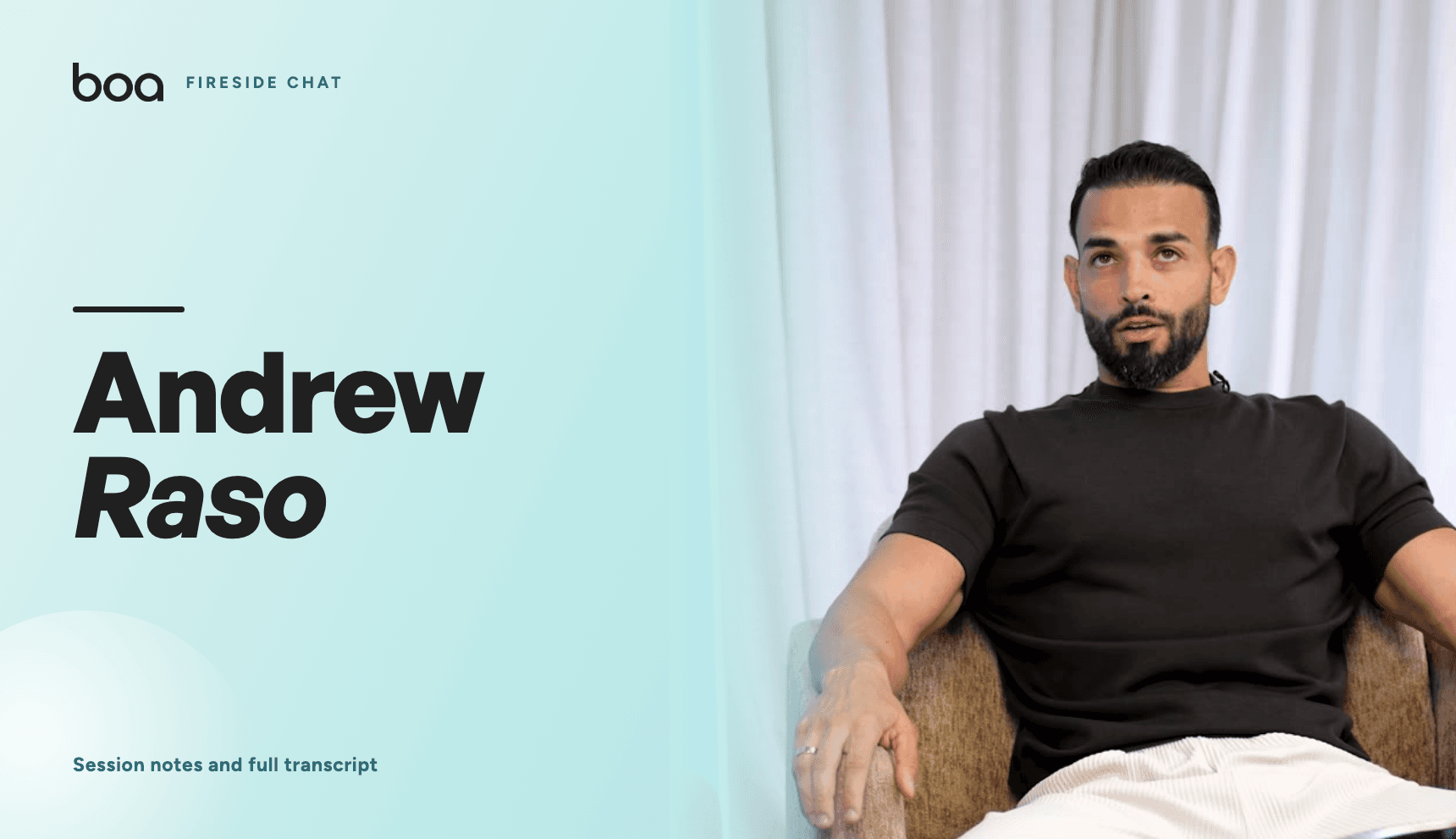
Andrew Raso on Growing an Agency From $500
With Andrew Raso, Founder at Online Marketing Gurus · Hosted by Kirsten Scott · 33 min
What this session covers
Andrew Raso built Online Marketing Gurus from $500 to 200 staff across four countries. He explains the commission-based referral engine that grew the agency before it ever ran ads, why a retainer model is the first thing to build, when to make your first hire, and how equity tied to KPIs keeps country leaders invested.
If you have no marketing budget, pay commission to the businesses that already serve your customers but do not sell what you sell.
Key takeaways
- 01
Build a referral engine with businesses that serve your customer but do not compete
With no ad budget, Raso cold called web design companies, creative agencies and PR firms because they had clients who needed SEO but could not deliver it. He paid them a commission once the deal was signed, not on the lead. That channel grew the agency for years before it ever spent on paid ads. Ask who already sells to your customer and cannot do what you do, then offer them either a commission or a lead swap.
- 02
Make a retainer or membership your first business model, at any price point
Raso says the first thing any owner should build is recurring revenue, whether that is $50, $100, $1,000 or $2,000 a month. Predictable monthly income is what gives you the confidence to budget and, more importantly, the confidence to hire. Without it you stay stuck doing everything yourself. He points to e-commerce brands like pet food that moved customers onto subscription as the ones now winning.
- 03
Test unglamorous cash flow mechanics like gift vouchers
Raso cites his friend Babak Moini of Laser Clinics, who made most of his early money by putting laser clients on memberships. Selling gift vouchers turned out to be a second cash engine, because a large share of vouchers were never redeemed. The point is to actually trial these mechanics in your own business rather than assume they will not apply.
- 04
Chase revenue before you perfect the product
Raso will not spend ten years perfecting a product because that produces no revenue. In the early days his team sold services they did not yet know how to deliver, then worked out delivery afterwards. With AI moving as fast as it is, an app or platform founder should have launched years ago and taken revenue on an imperfect product. Ship at 80 to 90 percent, let things break, fix as you go.
- 05
Hire your first person into delivery so you can stay on sales
Raso's first hire was delivery, not admin or ops, because he was managing around 100 clients himself and could not focus on selling. His rule: find where your time is being eaten, whether that is fulfilment or account management, and hire for that so you stay on the revenue line. He is blunt that even with 80 percent client churn, more selling keeps the business alive.
- 06
Run one throat to choke per department
Raso insists on a single accountable person for each function, never multiple CEOs or multiple sales leaders, because mixed priorities create arguments and mess. You hire heads of finance, HR and operations and hand systems building to them. You still hold that person accountable and stay across the detail, and you develop them rather than letting them run wild, because what worked at their last company may not work at yours.
- 07
Forgive failed decisions, never forgive sitting on hands
Raso tells his leaders to make the call, right or wrong. If someone comes to him and says something broke but they gave it a go, that is fine and they fix it together. If someone waits for him to decide for them, he has the wrong leader in place. He looks for people who care and want to learn over people with manager titles, and recently promoted a sales manager with no people management experience on that basis.
- 08
Give equity on KPIs when you launch new business units or countries
Raso resisted giving away equity for years. When he expanded into new countries and launched his Academy brand, paying higher salaries alone did not produce the motivation he needed. Equity tied to specific achievements did. His framing: better a small piece of a bigger pie than a big piece of nothing, and no one messages you back at 10.30pm without skin in the game.
- 09
Pick one niche and go deep instead of selling ten services
Early on the agency sold SEO, PPC, social and websites. A botched Muscle Milk website build, and 50 missed calls from an angry client, convinced Raso to drop the rest. His worst outcomes came from offering ten services where one failure caused the client to cancel everything. Sell one service to one vertical, plumbers, dentists or cosmetic clinics, get very good, then expand.
- 10
Become the visible expert in your niche when you have no budget
Raso says there are almost no recognisable public experts in SEO or paid ads in Australia, which is the gap. Talk about your one thing on every channel, consistently, until people identify you as the leader in that field. He compares it to following watch accounts on Instagram: most followers are not ready to buy now, but if they follow you long enough they eventually buy from you.
- 11
Keep a running notes list per head of department
Raso has no minute-by-minute calendar system. He keeps a notepad in Apple Notes organised by head of department, and when an idea occurs to him he writes it down against that person. It gets actioned in their next one-on-one. He notes his doers do not generate that creative input, so capturing and routing ideas is the founder's job.
- 12
Block time weekly to learn AI tools, and default to Claude for building
Raso says if his heads of department are not using AI right now, he has the wrong heads of department. He uses ChatGPT for quick answers and Claude for building, including apps in 15 minutes, proposals and automating processes. He references private equity backed tech businesses running on four people with $10 million in annual recurring revenue as the margin structure this makes possible.
How the session runs
- 0:00Intro and rapid-fire round with Andrew Raso
- 1:40Growing from $500 with commission referral partners
- 3:45Build a retainer model before you hire
- 6:34The warped sense of reality high performers share
- 7:56How Raso structures a week and makes fast calls
- 10:01Chase revenue, do not perfect the product
- 11:47Stop reminiscing, just launch
- 13:10One throat to choke per department
- 15:44Decision-making: fail fast beats mediocrity
- 18:20Giving equity based on KPIs in new business units
- 20:29Signs the founder has become the bottleneck
- 22:36First hire was delivery, because sales solves everything
- 24:36Marketing channels for founders with no budget
- 26:35The Muscle Milk website disaster and finding a niche
- 28:18Q&A: which AI platforms to learn now
- 31:34Do not give up, you are closer than you think
Mentioned in this session
- Online Marketing Gurus
- Dubai
- Singapore
- UAE
- Laser Clinics
- Babak Moini
- Ryderwear
- Uber Eats
- White Fox Boutique
- Muscle Milk
- ChatGPT
- Claude
- Emma Grede
- Microsoft Word
- Apple Notes
Questions founders ask
Raso grew Online Marketing Gurus by cold calling businesses that served the same customers but did not offer his service, including web design companies, creative agencies and PR firms. He paid them a commission once a deal was signed. He also points to building an organic audience on social media as a slower but free option, and to becoming the recognised expert in one narrow field.
Raso's first hire was in delivery. He was account managing around 100 clients and could not focus on selling, so he took delivery off his own plate. His general rule is to identify where the bottleneck sits in your business, whether that is fulfilment or account management, and hire into that so the founder stays on revenue.
Raso says yes for new business units and country expansions, tied to KPIs rather than given away willy-nilly. He tried launching countries on higher salaries alone and found the motivation was not there. His view is that people are never fully invested without skin in the game, and a small piece of a bigger pie beats a big piece of nothing.
Raso says the answer changes every few months. Currently he uses ChatGPT for quick answers and Claude for building things, including apps in around 15 minutes, proposals and process automation. He warns that if a business is not developing around AI now, it may not have a company at all, citing tech businesses running with four people and $10 million in annual recurring revenue.
Raso says the clearest sign is a founder who cannot make a decision, or who insists on being across everything. He describes his father's small electrical business, where nothing was ever let go, as the pattern to avoid. The fix is one accountable head per department, holding them accountable while still developing them, and accepting that the people who got you to the start may not be the people who take you to the next stage.
Full transcript
The complete conversation, as recorded, with every speaker attributed.
Kirsten Scott0:00
I'm going to kick things off. So we're joined this morning by Andrew Russo. He's the founder of Online Marketing Guru, a business he started with just $500. It now has over 200 specialists and offices across Australia, the US, Singapore, and the UAE. That's pretty impressive. Thank you. Yeah. So look, we are going to jump straight into it. We're going to do a round of getting to know you. So just yell out the first word that comes to you. Sure. Are you ready?
Andrew Raso0:28
Let's do it.
Kirsten Scott0:29
Awesome. Coffee or tea?
Andrew Raso0:31
Uh, coffee.
Kirsten Scott0:32
Early mornings or late nights?
Andrew Raso0:33
Early mornings.
Kirsten Scott0:34
Calling or texting?
Andrew Raso0:37
Calling.
Kirsten Scott0:37
Podcast or book?
Andrew Raso0:39
Podcast.
Kirsten Scott0:40
Uh, routine or go with the flow?
Andrew Raso0:41
Routine.
Kirsten Scott0:42
Control or delegate?
Andrew Raso0:46
Uh, much more delegation now.
Kirsten Scott0:48
Yeah, some people they're like, oh, I can't decide.
Andrew Raso0:50
It's a little bit of both.
Kirsten Scott0:51
Controlation, I think one of them's a bit of a mix. SEO or paid ads?
Andrew Raso0:57
It has to be a mixture of both. You can't do one or the other.
Kirsten Scott1:00
Perfect. Long-term brand building or short-term performance marketing?
Andrew Raso1:05
So to begin with, short-term performance marketing, but always long-term brand building. Cool.
Kirsten Scott1:10
One thing you can't leave the house without?
Andrew Raso1:13
It's a really good question. I usually always have some sort of gym bag on me because I need to be, if I'm going training or doing something, I need to, yeah, whatever.
Kirsten Scott1:23
Yeah. Um, and your go-to way to reset?
Andrew Raso1:27
Sometimes it's good just to get off social media, right?
Kirsten Scott1:29
100%. I think we can all agree with that. Um, and your one word to describe your founder journey?
Andrew Raso1:35
Chaotic.
Kirsten Scott1:36
That's actually my word as well. I think we can all relate to that.
Andrew Raso1:39
It's a good word.
Kirsten Scott1:40
Definitely. All right. So you started All By Marketing Guru with just $500. In the early days, what were the first things you focused on that actually drove growth?
Andrew Raso1:49
So. We didn't have much money when we first started. Like we said, we started with $500. So we needed to find ways to do things a little bit better. So walking down the street, walking into retail stores, asking if they needed marketing, digital marketing wasn't that big.
Kirsten Scott2:02
Banging on doors.
Andrew Raso2:03
Back then, yeah, it was like, it was all about retail. So it was a little bit harder. So me and my business partner at the time, we sat down and we go, okay, cool. We can continue to go cold as much as possible, but there's got to be a better way to do things. And we don't have any money to do paid ads. So we didn't do paid ads for many, many years. So our way to grow was we, we started cold calling businesses that didn't offer our services. And that's probably a good thing that a lot of founders need to identify their sort of collaboration approach with other companies. So what we did is we called, because we only did SEO to begin with, you know, SEO was, was still a big, it was still a big thing back then, but we only did SEO and you could get away with running a company by just doing SEO. There wasn't paid ads were big, but it wasn't as important. So what we did is we only did SEO. So we started calling like web design companies, creative agencies, PR companies, anyone that could refer us work and we'd pay them commission for the lead. So once we signed the deal, we paid them. So we did that for many, many, many years and that's how we grew our company initially. So whatever business you have, I'm sure there's people that can refer you work, but whether they want, you know, to swap leads, whether they want you to give them money, whatever it might be, If you have no money for marketing, that's probably the best way to start and grow.
Kirsten Scott3:18
Yeah, I love that. I always say collaboration is king, whether it's like, yeah, the money, referral, or just like word of mouth or community, whatever it might be.
Andrew Raso3:26
Exactly. Because the thing is, right, is that now it's a little bit different. You know, you can build an organic audience on social media. That might take a little bit of time. So there's a plethora of different ways that you can grow a company right now without actually having marketing dollars.
Kirsten Scott3:42
Yeah, it's a whole different landscape.
Andrew Raso3:43
It is, it is.
Kirsten Scott3:45
At what point did you realise this could become a much bigger business and how did you change operating as a founder?
Andrew Raso3:51
So I think initially you're trying to do a little bit everything yourself, you know, which I was trying to be the account manager. You know, there was those cool storeys back in the day where we were sending out invoices, but because it was only invoice 1, 2, and 3, there was a website that I used to go on. It was called, I think, PDF Cloud and you could export the PDF to Microsoft Word. And then when I converted it to Microsoft Word, I just changed the invoice number to like 1 to 50 to 100. So eventually you can't do that stuff anymore, right? It was a much more of an automated process.
Kirsten Scott4:26
So it's always a bit scrappy.
Andrew Raso4:28
It is. It is. And I think a lot of business owners right now and a lot of small business owners I find is they're so, they're so stuck in the weeds to back themselves to go hire someone. So there's two things I look at business owners. When business owners start, when a business owner starts, I say the first model you need to create is you need to create a model that is a retainer or there's some sort of monthly membership. There's something, whether it's $50 a month, $100, $1,000, $2,000, whatever it might be. The first thing you need to do is you need to create some sort of business model where you need to get a retainer model going. That will give you the confidence to know how to budget and then that will give you the confidence to know where to hire people. So they're the two things any business owner needs to look at initially. And then obviously then you can get finance people so they can automate your invoices going out every month, or you can get account managers to help you manage clients and so on and so forth. So I think step number one is getting a retainer model where you're confident there's money coming in every month and learning how to budget and so on and so forth. And then from then on in, it's all about hiring people and making sure you can hire the right sort of people and build them up rather than getting stuck in the weeds and staying such a small small business for such a long period of time.
Kirsten Scott5:37
Yeah, that's great advice because it actually applies to every single business no matter what industry you're in.
Andrew Raso5:42
It's crazy, like if you look at e-commerce businesses like, you know, pet foods and stuff like that, the ones that are succeeding are the ones that go, okay, let's put them on a retainer model. Let's do stuff like that. Exactly. It's even, you know, even I have a good friend, his name's Babak Mohini, he started Laser Clinics and he said the most of the money he made from the initial start was when he started doing laser clients, but he put them on memberships. But what he also do is he also found that when he started selling gift vouchers, that a majority of the time when people bought gift vouchers, they didn't even redeem them. So there was all these different ways to create cash flow and to create money in a business that people actually don't even think about. Well, you just need to try them. It might work in your business, it might not, but it's very important you give a lot of these different tactics a go. Yeah, because they might change. Yeah, they've exactly, they might, it might change the plethora of the business for the future.
Kirsten Scott6:34
So yeah, I love that. Okay, so when you look at founders who operate at a high level, what habits or discipline do you think makes the biggest difference?
Andrew Raso6:42
So it's funny because like when I've now started my own podcast and I'm speaking to a lot of great business owners, they all follow the exact same, it's like they have this warped sense of reality. And what I mean by that is that every business owner, every great person that I know that's created awesome businesses, they're like, I'm going to just do this and I'm going to make it work. And they're all exactly the same.
Kirsten Scott7:06
Yeah. They see the end goal and they just rock it.
Andrew Raso7:07
They're like, I'm just going to like, okay, I'm going to open, you know, I'm going to open a gym and I'm going to, I remember, so I've got another good friend who owns a company called Rider Wear. It's a massive gym clothing brand. And he said a few years ago, I'm going to open gyms. It was like, you're going to open gyms? Like, yeah, I'm going to fuck, fuck, I'm going to do it. I'm just going to do it. And I think he's got like almost 10 or 12 gyms in the moment. They're massive. Yeah. Yeah, he's doing really well. And he's like, I'm just going to open gyms. I'm going to do it. And these people are very, they're very contagious to be around. And they literally all offer the same sort of advice. It's like, if I'm going to say it, I'm going to do it. If I'm going to open this business, I'm going to do it. It might work. It might not. It doesn't matter. You get back up and you give it another shot. A lot of business owners follow that same rule. It's like, I'm going to try. I'm going to give it a go. And if it works, it's going to be much better than if it fails.
Kirsten Scott7:52
Definitely. And if you don't try, you never know.
Andrew Raso7:55
100%.
Kirsten Scott7:56
Okay, so how do you structure your week so you're focused on things that actually move the business forward, not just reacting to problems?
Andrew Raso8:02
See, it's a very good point because I have a lot of people in my business now that run it. And even when I moved to Dubai for many, many years, it still ran without me. It was very successful, made a whole heap of money, and that worked out very well. But at the same time, I'm not structured in the sense that you know, I have my meetings every day. I come in and do my own thing, but like, people think it's this crazy, you know, crazy way you structure your day and, you know, you have to be to the minute. Yeah, no, I'm not like that. Like, I literally have a notepad, you know, in my notes in my iPhone or on my Mac, and it's got all my head of departments. And if I think of something, I just write it down. So whether I have my one-on-one or whatever it might be, I go, okay, we're doing this, this is my idea. If I have my account managers or my sales team, here's my idea of what I, here's my idea of what I want to do. Let me bring it up in the next one-on-one and I action things where a lot of other people that I work with, a lot of my doers, they don't come up with that creative thought process. And that's probably how I differ from everyone else is that if I come up with an idea, okay, I'm going to launch this business or I'm going to have this idea or we should try this with clients, I just do it.
Kirsten Scott9:14
Yeah.
Andrew Raso9:14
And that's where I've always been. And it's got me into trouble sometimes where people say that speed is the most important thing.
Kirsten Scott9:23
Yeah.
Andrew Raso9:23
But the most problems I've ever had in my life is when I've done things too fast or too slow. And when you look back at all the— and this goes for the majority of people— when you look back at all the problems that you've created in your life, you've either done too fast or too slow.
Kirsten Scott9:36
Yeah.
Andrew Raso9:37
You'd always should take your time a little bit, but just make a decision. Just make it. Don't sit in a boardroom and go, oh, I should do this and do that. It's like, make a decision, roll with it. That's how I've always, that's how I've always been. And I think that's a big part of my success.
Kirsten Scott9:50
Yeah. I want to go a bit deeper on that because like you've obviously created this incredible business, like a global business. Yep. Like what? So you're saying that you've always been like that even from like the scrappy days?
Andrew Raso10:01
Yep.
Kirsten Scott10:01
Because I think it's a lot harder like in the beginning when you are wearing so many hats just to like go ahead and do things when you've got all these like competing priorities. Do you think you just like ran at the one that like you gravitated catered towards the most?
Andrew Raso10:14
Yeah, look, it really depends. You need to look at every decision that you make and you need to see, you need to have an idea of what the outcome is going to be, right? So I'm not going to sit here as a business and go, I need to perfect my product. Because if I'm always focusing over the next 10 years to perfecting my product, I'm never going to bring any revenue.
Kirsten Scott10:32
Totally.
Andrew Raso10:33
So every sensational business owner that I've ever worked with, will follow what brings the money in, right? So whether it's sales, marketing, whether it's sales, whether it's marketing, whatever it might be, you should always focus on that.
Kirsten Scott10:47
Yeah.
Andrew Raso10:48
You know, I know great business owners, you know, they might be focusing on great, creating a great, great product, but you look at AI and you look at how quickly things develop. If I was an app builder right now, or if I was a tech building or some sort of tech platform, I should have launched it many, many years ago and tried to bring revenue without creating the best product because things change so quickly. So number one focus should always be bringing in revenue. You know, even if you can't deliver it, bring in revenue. When, when we first started, we were selling shit we didn't have no idea how to deliver. We were just like, oh, fuck it. We'll bring in some money and then we'll work it out. We'll make, we'll work it out in the long run.
Kirsten Scott11:24
And kind of like 80, 90% is better than perfect. Like just get it done.
Andrew Raso11:28
100%. Yeah, 100%. And it's never going to be perfect. No. You know, you always think you're going to create this product that's going to be perfect. It's never going to be perfect. And at the same time, you're never going to be ready for launch. So just shoot, let things break and work it out as you go.
Kirsten Scott11:41
I love that. It's great advice. Okay. So what's one thing founders should stop doing if they want to operate at a higher level?
Andrew Raso11:47
Just stop reminiscing. Stop reminiscing on the past where you think you could have done and make a decision. Like, okay, cool. I can, I can sit there and reminisce of every bad decision I've ever made, but When you look in hindsight, you always look in hindsight and you think, oh, I always could have done it. I could have done it better.
Kirsten Scott12:01
Let it go.
Andrew Raso12:02
I could have done it right. It's like, let it go. You're never going to be, you're never going to be ready. Just launch the product, launch the service. If it works, great. If it doesn't, does not matter.
Kirsten Scott12:13
Yeah. You pivot.
Andrew Raso12:14
Yeah. It's everyone had this great idea of launching Uber Eats, right? Cool. Did you do it? No, but at the same time, I'm sure that there's someone that did it and someone that's doing very, very well. So, and that's the thing, right? Businesses come and go all the time. You know, what might work in your business right now might not work in a few years. You know, SEO might be dead in a few years, I don't know. But I've got other businesses, I've got other revenue streams and it won't necessarily really matter. People thought 12 months ago that AI was going to crush a lot of different spaces. It's only created more opportunities for us and it's only creating a lot more opportunity for other businesses. So be quick to develop, be quick to move and have a lot of speed. I think that's the most important thing. People should do.
Kirsten Scott12:58
I love that. Guys, just a reminder, if you have any questions for Andrew throughout, just pop them in the chat and the team will send it through. Okay, so as a business grew, what systems or processes helped you scale without everything relying on you?
Andrew Raso13:10
Yeah, so if I look at every single different department, I've worked in them all, from finance to HR to the SEO department to the account management department, everything was relying on me at one point. You have to really determine what you're really, really good at and you have to focus on that. And that's where I've always been the case. I'm not good at the operations side of the business. I have a great operations person. Now I have great CEOs in every single country that we operate in.
Kirsten Scott13:39
A lot of founders I speak to say the same thing.
Andrew Raso13:41
Yeah, I don't like it. You know, sales is always going to be the number one focus of any business owner and of my business as well. So I think that's the most important thing. But at the same time, you need to step away from every department. At one point if you want to scale. And that means you find great people. You always, I've always lived by this rule is you always need to have just a single source or one person, one throat to choke. And what I mean by that is you always have need to have one person of every head of department. If there's multiple CEOs in a company, multiple sales leaders, it's always going to create issues. You have one person and that person will focus on what they need to focus on. And that's how I've always been. As soon as there's mixed priorities, that's when things become messy and that's when people start to argue. So whatever you're focusing on, if you're the founder and you want to focus on the sales team, you focus on the sales team. You hire someone else for finance. You hire someone else for HR or whatever it might be. That doesn't mean you take your eyes off that individual department, but you always focus on what you're really good at. So when we then started creating systems and started putting technology in places to scale, I always outsourced that to different heads of that department. And I think that's really, really important. So if that person then quits, you either promote someone from within or you get someone from outside to help build that team. You also need to hold that person accountable. You can't let them run wild. You know, I've had this issue where I've brought someone who I thought was great and had a huge amount of experience and they just stuffed everything up. It's very important you hold that person accountable, but let them help do things your way as well and make mistakes along the way.
Kirsten Scott15:27
Yeah.
Andrew Raso15:27
Because if you let someone run wild, what work— what, what work— what will work in one business might not work in another business. So you bring that person in, you hold them accountable, but you also develop with them because it can break very easily if you just let them go crazy.
Kirsten Scott15:44
100%. Okay, so how do you structure your decision-making in the company so the team can move faster without everything coming back to you?
Andrew Raso15:51
That's a good question. So I always live by the rules that I would much rather let someone make a decision and fail, but I will never accept mediocrity in the sense that if people just sit on their hands and they don't make a decision. So if someone comes to me and say, Andrew, I'm so sorry, this broke. But I gave it a go. Beautiful, mate. We'll figure it out and fix it. But if someone just sits in their hands and they wait for me to make the decision for them, I've got the wrong leader in place.
Kirsten Scott16:21
Definitely.
Andrew Raso16:22
So I said this for all the leaders in the business, guys, just make a decision. Right or wrong, who gives a shit at this point? Just make a decision. Because if you make a decision and you go with a crack, there's nothing wrong with that. And I will always forgive you for something breaking and something not working out. But if you sit there and you sit on your hands and you, you know, you start shivering, okay, cool, maybe being a leader is not the right thing for you.
Kirsten Scott16:47
Definitely. Yeah. And there's nothing wrong with hiring people that aren't necessarily leaders. Like everyone thrives in different roles within the business and you need to just ensure that they're in the right place.
Andrew Raso16:55
Exactly. I mean, not everyone's built to be a manager or a leader. I used to think everyone can be trained for that. You need to have it in you. But, you know, I recently brought someone in in-house as a sales leader and as my sales manager. And he has no experience in managing people, but I guarantee you'll do exceptionally well because he cares. He puts in effort. He wants to learn. He wants to grow. If you have that inside you, you will be successful and you're going to do well in whatever you do. If you're a lazy piece of shit, I'm sorry. You know, the truth of the matter is, is that you won't be successful. A lot of people sitting in complaining about the economy and sure, the economy sucks. No one's saying it's great, but the government isn't going to come to save you. The government's not going to be like in the hand, you know, hands out. Some of the biggest and biggest issues and mistakes that I've made is by listening to the government. We sat there in 2020 or '21 or whenever it was, '22, and the government said, oh, we're not going to raise interest rates.
Kirsten Scott17:51
Cool.
Andrew Raso17:52
Let's go buy a whole bunch of property and get in a huge amount of debt. And then what? And then they did it. And the same thing's going to happen now and the same is going to happen in the future. No one's coming to save you, whether it's the government, whether it's a leader or whatever it might be, your friend, your family, no one's coming to save you. You know, go out there and make a decision and save yourself and take some risk.
Kirsten Scott18:13
Yeah, I love that. That's great advice. Okay, so as the company scaled, what were the things you personally had to let go of as the business grew?
Andrew Raso18:20
So It's funny because as the business has become a lot more successful, even as of recent, is that I never wanted to give away equity. And that's not necessarily equity in my main business because I think as you grow a company, the only way you give away equity is if people buy in, right? I don't think you should be giving away equity willy-nilly. However, when I opened different business units outside of the business, I never thought I would give away equity, right? So as I launched my Academy brand, as I launch more countries and expand that part of the business, I think it's important is that you give away some sort of equity based on achievements. And as I've done that, it's been very successful. So when I've tried to in the past launch countries and different businesses without giving away equity and pay more and just pay more salaries, the motivation isn't there. So a lot of people will come to me and they, then they will ask me, it's like, how do you keep staff motivated? And so how do you do all these great things? They need to, they're never going to be 100% invested into your company unless they have skin in the game in some way, shape, or form. So I can't expect even my, even my, my guys on huge salaries, I can't expect them to message me back at 10:30 at night or to message me back at 5 o'clock in the morning when I'm working. I can't. But if you have a vested interest in a company, the game changes altogether. So I think that's a very important, um, a very important mode to think is you eventually you're going to need to let go. And especially when you create multiple business units or you create great things outside of your business or you made your money or whatever and you want to look at ways that you can scale your enterprise and create different, different products, different companies, whatever it might be. You need to be, you need to find a way to let go. That doesn't mean you just give equity to anyone. No, of course not. There needs to be KPIs that need to be achieved, but that will give a bigger kick in the butt for people to succeed. And I'm always just now, and now I'm a big strong believer, it's better to have a small piece of a bigger pie than to have a big piece of nothing.
Kirsten Scott20:29
Yeah, I couldn't agree more. You know, so it's good advice. Um, so what are some of the early signs that a founder is becoming the bottleneck in their own business?
Andrew Raso20:37
They just can't make a decision. Yeah. You know, I've, I've, um, there's You know, and I tend to try and be very careful with my words here, but when we founded the company, there was very, very important things that I needed when I needed a business partner when I founded that I don't need anymore. So people outgrow each other all the time. Um, and I think it's very important that at each stage of the business, you're bringing in the right people to help you scale to the next level. The people that were there in the beginning stages of the company, you may not, may not need now.
Kirsten Scott21:10
Yeah, we hear that a lot.
Andrew Raso21:11
It's, it's, it's so, it's so important. Like the people that I've met now, um, business owners aside, whatever it might be, have taught me things that I would have never learned from, you know, the beginning of my journey. Yeah.
Kirsten Scott21:25
It's kind of like fresh eyes that help you like innovate and move the business forward.
Andrew Raso21:28
Yeah. Yeah, absolutely. It's just, it's very important as you scale and grow, you're going to need new strategies and new tactics and you're going to need to level up as a business owner to take the business to the next level. You know, a lot of things when I look back at my dad, obviously he runs a very small electrical business, but if I look at his bottleneck, he always wanted to be across everything. You know, he could never let go. My mom still does the accounting, you know, and still does the invoices and so on and so forth. He never wanted to let go and that obviously held his business back. A lot of small business owners, they're very much the same. They can't think big picture because they're so in the day-to-day running of the company. Sometimes you need to let go. That doesn't mean you let go completely, of course.
Kirsten Scott22:11
It's so hard to trust, though.
Andrew Raso22:12
Oh, it's wild. Some of the worst decisions I've ever made is by hiring the wrong accountant or the wrong lawyer or letting them do their own thing. You need to be across the detail. There's a very important part. You need to be across the detail with everything you do. But you also need to let go at one point. Otherwise, you're just going to be stuck in the mud.
Kirsten Scott22:32
Definitely. You're never going to be able to achieve any kind of growth.
Andrew Raso22:35
Exactly. Okay.
Kirsten Scott22:36
And final question. If a founder listening today wants to operate at a higher level over the next 12 months, what's one thing you'd change or recommend they start doing now?
Andrew Raso22:46
So there's a lot of, there's a lot of things that you could do. There's, there's a multitude of things that you could do to move the needle. I think it's very important to find where the bottleneck of your business is. So whether it's, you know, you're finding a lot more time in fulfilment in your company, or you're finding that you're spending a lot more time in sales. Sales or whatever it might be and hire for that. So the first thing that I did when I wanted to scale and move away from the business is, okay, I'm account managing 100 clients at the time. Okay, I need an account manager. Otherwise I'll never be able to focus on sales.
Kirsten Scott23:20
Who was that your first hire?
Andrew Raso23:21
My first hire was delivery. So my first hire was delivery because I was wearing so many different hats. I couldn't be bothered delivering the product and I wanted to focus more on sales. And I knew sales solves everything. Let's be real here. You sell more shit.
Kirsten Scott23:36
You just kind of find your feet after you've made the sale.
Andrew Raso23:38
If you're losing 80% of your clients, as long as you're selling more, what does it matter?
Kirsten Scott23:41
Yeah.
Andrew Raso23:41
Right? Okay, cool. It's not ideal that you're churning 80% of your clients, but as long as you're selling more shit, there's no problem. You know, sell more. If there's one thing I can tell everyone, just sell more, right? Do as much marketing as you can. You know, marketing solves all problems. You know, you look at White Fox Boutique. Um, the clothing brand, they're on bus, they're on bus stops everywhere. They just sell more shoes.
Kirsten Scott24:04
You actually can't miss them.
Andrew Raso24:05
You can't miss them, right? Marketing solves all problems. So if I can, if I can tell one founder to focus on, do all marketing channels you can, find out what works and double down on that. I think that's a very important, very important. It's very expensive. Like I spent $100 grand on, on programmatic and TV ads and I tried it for 4 weeks and it didn't work. For my business. It works for a lot of others, but I tried it. Definitely. You know, um, and I've burned a lot of money spending, you know, spending money on marketing, but I know it works.
Kirsten Scott24:36
So actually, I know that was meant to be the final question, but I have another one for you. Sure. A lot of our founders are really in that early stage startup kind of environment. What are the top 3, like, marketing channels you think they should focus on, given that they have such little spend?
Andrew Raso24:50
Yes, if you have such little spend, become the expert in your field. The good thing is right now is with your device, you can reach billions of views if you really want to. If you, you'd be surprised on how easy you can break into any market just by becoming some sort of expert in the field. You know, you look at the experts in the field in SEO in Australia and it's very few. Paid ads, very few. There's no one like that comes to mind. You're like, okay, that is the expert in that field.
Kirsten Scott25:18
Because they're really like in that niche and like they've set themselves apart.
Andrew Raso25:22
If you're, you know, and I don't want to tell my competitors, my secret, but if you're selling digital marketing and you really want to focus on SEO, go become the expert in the field in SEO and talk about it as much as you possibly can on all channels. And someone will be like, okay, that person is the expert. I follow them for a while. Eventually I'm going to buy off them. Like, you know, when I buy, when I buy my watches, I follow, I follow people on Instagram or social media that are cool. And eventually I'll buy a watch off them. You know what I mean? Someone, not everyone wants to buy now, but if someone follows you long enough, they'll end up buying something from you. So just become an expert in whatever field you're, you know, whatever field you're talking about for long enough, and people will see you as the leader in that field. And I think that's the beautiful thing about this day and age is that you don't need a whole lot of money to be successful. There is so many ways you can skin the cat, like it's so many different ways. And I think if you really focus on your product or your service, don't, you know, a big, big fail that we had is when we first started, we'd do anything to make money, but like, you know, we'd build your websites. You know, I don't know if anyone remembers the company Muscle Mills back in the day, but I remember that.
Kirsten Scott26:35
I bought from them.
Andrew Raso26:36
I'll tell you a funny storey about Muscle Mills, right? I was working for my competitor, for a competitor at the time, and we just started our company. And we were selling SEO, PPC, social media, websites, the whole lot. Muscle Mills was massive back in the day. For some reason, someone decided to give us the contract to build their website. I have no idea. His name was, the owner's name was Luke Shambury. Big guy. Anyway, they're like, can you build a website? We go, yeah, no worries. And I was working for a competitor and my web developer that I outsourced all the work to stuffed up and he He launched the website and the card broke or something or something along those lines. And I was getting like 50 missed calls from these massive bodybuilders saying our website's broken. I was in an office. I was working for a competitor in office. I was 3 people. And he's like, who's calling you? Like some crazy woman was calling me. It wasn't the case. It was him. And then after I did that, I'm like, ah, stuff that. I'm not going to offer 1,000 different services. I'm going to focus on one thing. I'm going to do it very, very well. And I think for anyone, you find a niche. You know, whether it's SEO, if you're selling SEO, cool. Sell SEO and do it for plumbers or do it for dentists or do it for the cosmetic. Find your niche, do very, very good at that niche and then expand. Don't feel like you need to offer 400 different services and then, you know, let something break and then something else mess up because the worst decision that I've made is when I try to offer 10 different services they didn't like one or one didn't work, that broke and then they cancelled everything. So it's very important you find your niche. You don't need a huge amount of money, become the expert in that niche and then expand from there.
Kirsten Scott28:18
That is great final advice. Um, all right. So we are going to move to Q&A. Guys, don't be shy. Please feel free to add any questions in the chat. Um, the first one I have is from Tom. He says, as a solo marketer, which 3 AI platforms should I prioritise learning right now to stay competitive?
Andrew Raso28:34
See, it's, it's funny because like The answer that I would give you a few months ago is not the answer now.
Kirsten Scott28:40
Do you think that's because AI is changing so quickly?
Andrew Raso28:42
It's adapting so fast. Yeah, it's adapting so fast. Like every, there's so much, there's multiple AI platforms that you can use for different things. But like, you know, a few weeks ago everyone used ChatGPT and now people laugh at you. People call you like an app.
Kirsten Scott28:58
I'm embarrassed to say, I'm like, I'm on Cloud or Cloud or whatever. I can't even pronounce it.
Andrew Raso29:01
You know what I mean? Like, it's like, you're called an unc. Like the kids call you unc. They call you old for using ChatGPT right now. So it's like everyone's using Claude.
Kirsten Scott29:11
Yeah.
Andrew Raso29:11
And everyone's using Claude. So, um, it's different things, you know, if you want quick answers, you use ChatGPT. If you want to start building out some technology, you want to build out, you know, proposals, if you want to do audit, you know, like my, um, automate processes. Yeah. It's like Claude's like, it's, it's unstoppable, but Hey, in a month or two, there might be a new tool. So it really depends on what you want to use it for.
Kirsten Scott29:34
Do you think it depends on what industry you're in as well?
Andrew Raso29:36
No, I don't think, I think you can, I think Claude is now can be used for a lot of different industries. Like there's no way you'd be able to build a website or a landing page or tech, you know, we're building apps in 15 minutes using Claude. There was no ways you can do that in the past. Right. So. I don't think there's any set and forget platforms you should use, but if I were to focus on one, it would be Claude.
Kirsten Scott30:03
Yeah, that's great advice. I actually read somewhere, actually I listened to a podcast with Emma Greed, and she interviewed this person that basically saying like, if every, if you're not blocking out time as a founder each week, like a minimum of 2 hours and trying to upskill in AI, you're already behind.
Andrew Raso30:19
Oh, absolutely. Like if my head of departments aren't using some sort of AI right now, I've got the wrong head of departments. Like the scary thing is guys, like there's going to be a lot of jobs that, that are cut in the future. Like it's some of the, some of the stuff my AI and tech guys show me, I'm like, it's, it's, it's going to be scary if you don't use it now. If you're not developing your company around it, not only are you going to be left behind, you're not going to have a company. So there's, there's, you know, I'm hearing a private equity companies having you know, tech businesses that are running with 4 people and have $10 million in annual recurring revenue. So there's, there's ways to make money as, as an employer right now and to make stupidly high margins by using tech. If you don't use it, you're going to be in trouble. So very important.
Kirsten Scott31:13
Guys, do we have any other questions? Don't be shy. Okay. Well, is there anything else that you think would be really valuable to share on today? Like particularly for early stage founders or anything that you look back to that you focused on in your early days that you should share?
Andrew Raso31:34
I think that a big, a big word, a big piece of advice that I can give to a lot of founders and I say it a lot is I go by a pretty simple statement. And I say it many, many times over because I wish I told myself more of it when I started. And it's don't give up, you're closer than you think. And a lot of founders right now, they think in 3 months or 6 months or 12 months, if it's not working, you quit. You might have that one big break. You might get that one client who just out of nowhere, just brings in a huge amount of revenue. So yeah, don't give up. Like, and it's a very cliché word, don't give up, but it's true. Like, I thought I was going to give up 10, 15 times. I'm lucky I had a good founder, a good co-founder in the beginning because he always stuck by me. But if he didn't tell me to snap out of it, like a lot of the time I would have just thrown in the towel. So you could be much, much closer than you think. Just don't throw in the towel. You know, a lot of great people have not been successful because they gave up too early. So, um, even if you're, if you're in early stage, it's absolutely fine. You're going to, you're going to win eventually. Just, just keep pushing.
Kirsten Scott32:51
Yeah, I think that's such a great thing to finish on. And I honestly couldn't agree more because some of the most successful storeys you hear of, it's like one morning they woke up and something went viral or something just clicked or you got that client that just drove the real revenue.
Andrew Raso33:03
Exactly right.
Kirsten Scott33:04
Yeah, awesome. Well, thank you so much, guys, for joining us this morning, and thank you, Andrew.
Andrew Raso33:09
Thank you for having me. Appreciate it.
Kirsten Scott33:11
See you guys.
Watch the full sessioninside Boa.
Session notes are free. The recordings, the live advisories and the founders in the room are for members.