19 sessions
Sales
What Boa members have been told about sales, by founders who have already had to solve it.
 Premium49 min
Fireside Chat
Sabri Suby: how to build an offer nobody can resist
8 June 2026
 Premium55 min
Fireside Chat
Dain Walker: Brand Strategy That Actually Scales
18 December 2025
 Premium49 min
Fireside Chat
Bootstrapping to a $180M sale to Domain
21 September 2025
 Premium42 min
Fireside Chat
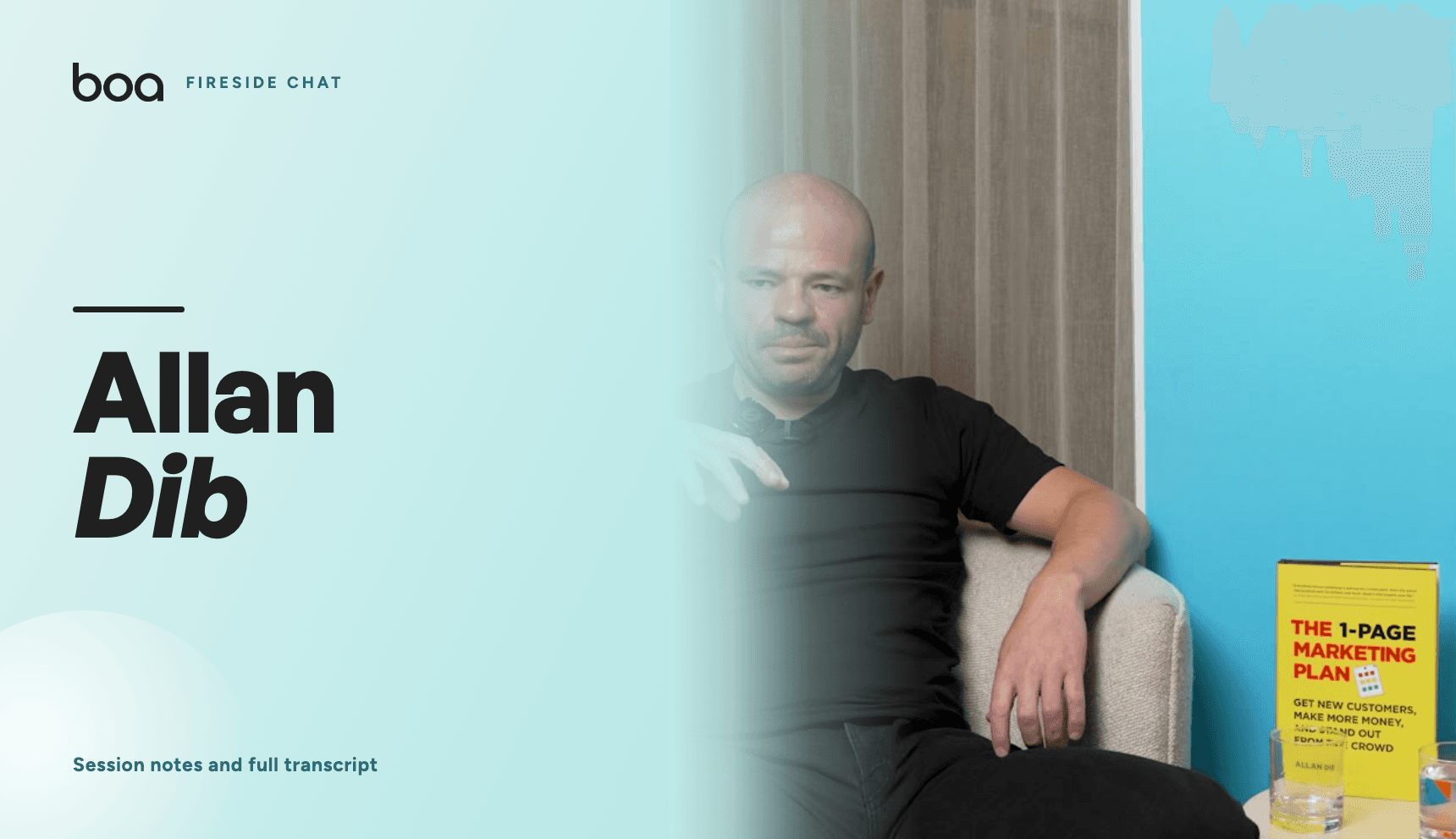
Allan Dib: get the message right before you amplify it
 Premium58 min
Mentor Series
Website optimisation that actually moves conversion rate
 Premium51 min
Mentor Series
The weekly routine that keeps your brand top of mind
 Premium33 min
Fireside Chat
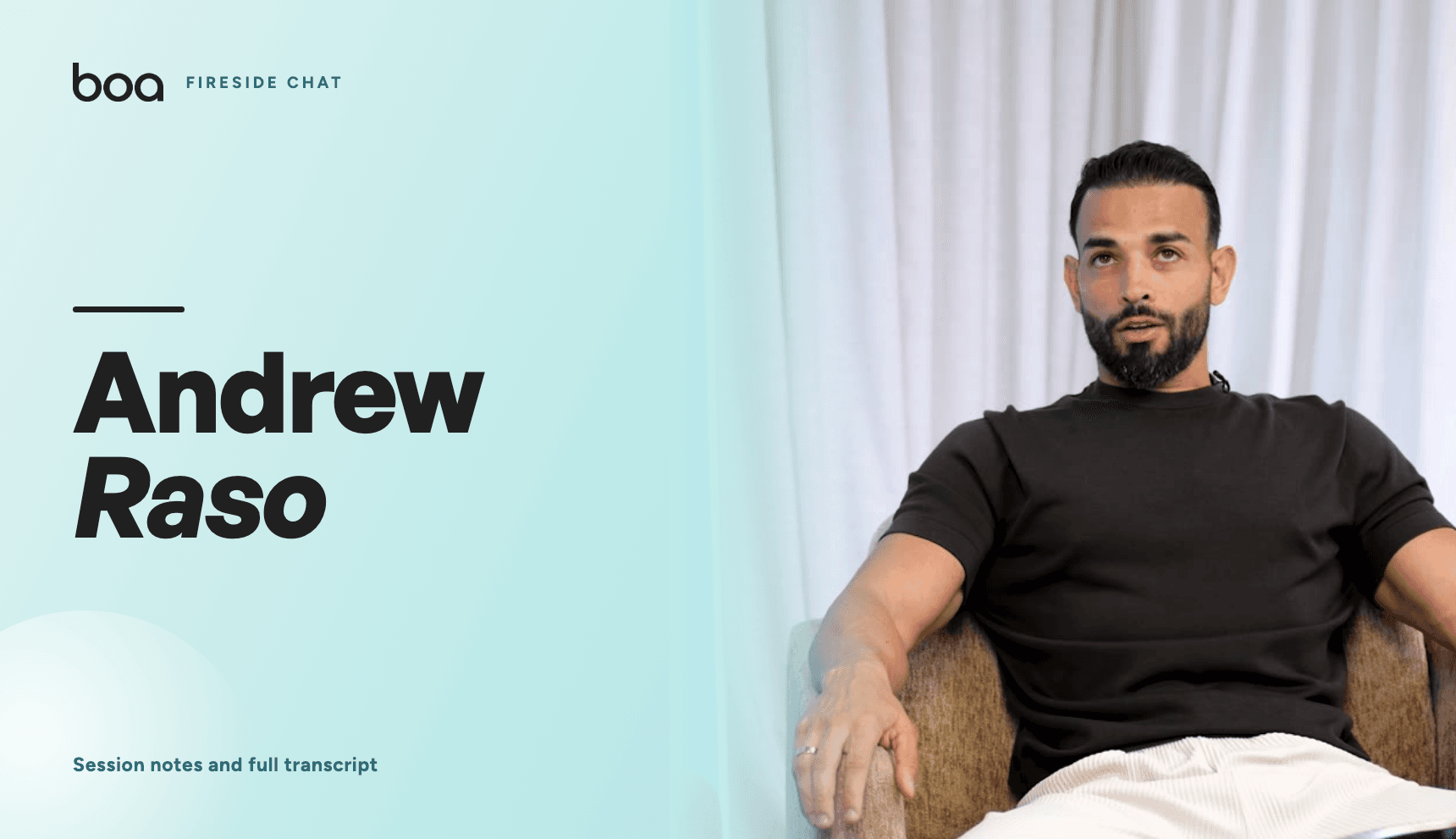
From $500 to 200 staff: how Andrew Raso scaled an agency
 Premium53 min
Mentor Series
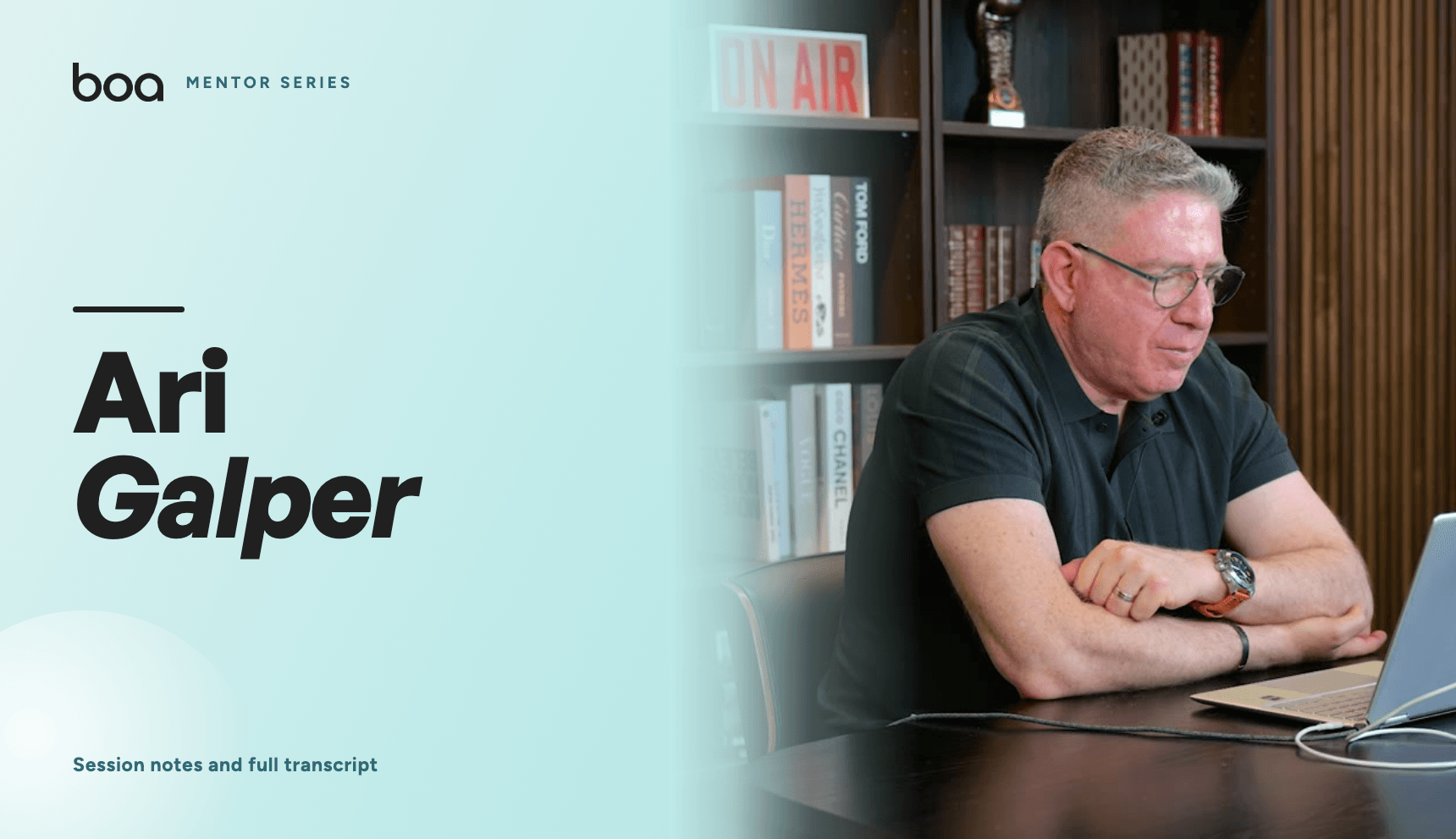
Ari Galper: the one-call sale and how to stop chasing leads
 Premium58 min
Mentor Series
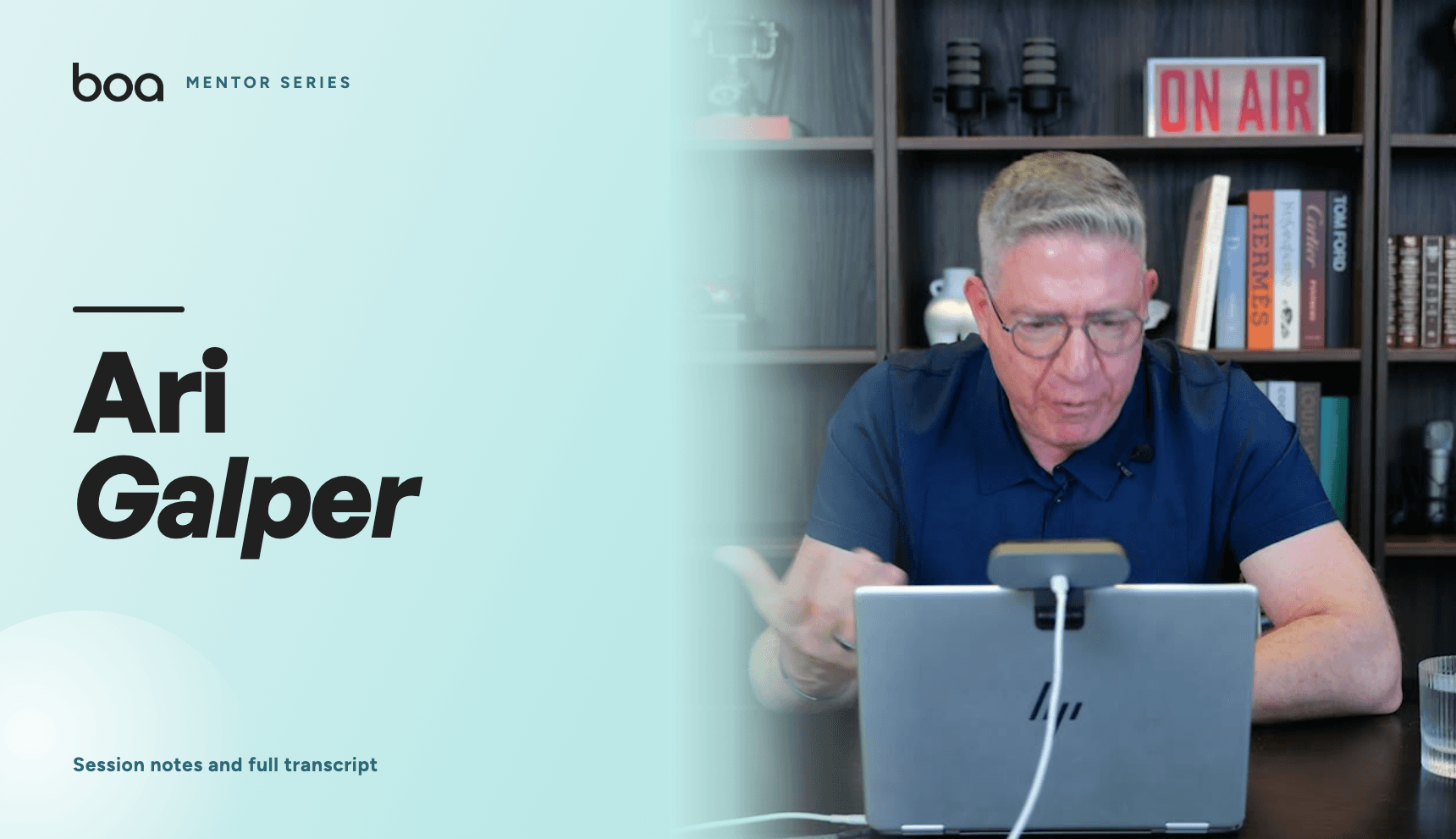
Ari Galper: the targeted book that books your calendar
 Premium26 min
Fireside Chat
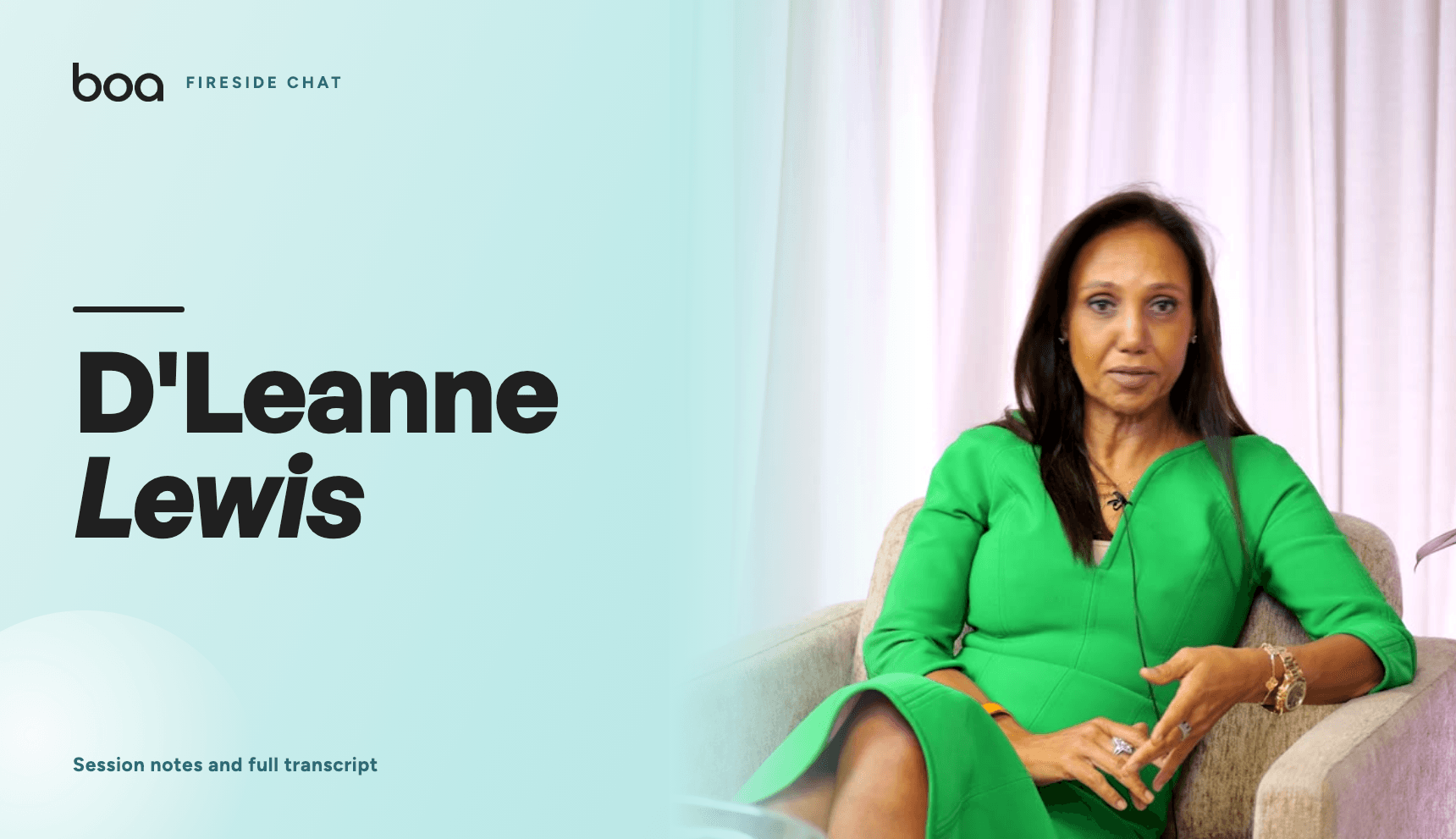
33 years of relationship selling, from D'Leanne Lewis
 Premium57 min
Fireside Chat
Fred Schebesta: cheap tests, boring categories, big content
 Premium38 min
Digital Advisory
Kelly Slessor: the ecommerce fixes that actually move revenue
 Premium50 min
Digital Advisory
Laura Higgins: sell by serving, and find your real constraint
 Premium52 min
Digital Advisory
Lexie Murray on organic social, influencers and content pillars
 Premium55 min
Fireside Chat
Mark Bouris: Staying Calm, Clear and Commercial in a Downturn
 Premium1h 3m
Digital Advisory
Mark Bouris on Costs, Cash Flow and Pricing for 2026
 Premium48 min
Fireside Chat
Mark Bouris on branding, networking and surviving the down cycle
 Premium49 min
Fireside Chat
Morgan Nelson on fear, self-worth and how to actually sell
 Premium40 min
Fireside Chat
Theo Chambers on property, super and debt recycling
What the sessions actually say
Sell what the market is starving for, not what you feel like selling
Sabri's first businesses failed because he picked the product he was interested in, then went hunting for buyers. Reverse it. Research what is already selling in irrational quantities, what people would crawl across crushed glass to get, then work out what spin or angle you can bring to that. You get the wind in your sails instead of swimming upstream.
Sabri SubySabri Suby: how to build an offer nobody can resist →
Make the offer so strong it keeps you up at night
Most businesses have resistible offers: buy my thing, and if it doesn't work, oh well. Sabri launched King Kong with a guarantee to get clients onto page one of Google or he worked for free. The test is whether the prospect asks how you can possibly deliver on it. If they don't ask that, it isn't irresistible yet.
Sabri SubySabri Suby: how to build an offer nobody can resist →
Expect a refund rate under 5% on a guarantee
Founders freeze at the thought of guaranteeing results. Sabri's benchmark: if more than 5% of customers claim on your guarantee, you are not doing a good enough job of delivery. Treat the claim rate as a quality signal, not a reason to avoid guarantees. A compelling offer beats a convincing argument every time.
Sabri SubySabri Suby: how to build an offer nobody can resist →
Mine your sales calls for the line that actually activates buyers
Dain's shortcut to a core message: rewind to the moment in a sales conversation where the prospect lit up and said yes. Ask what exactly you said just before that. That phrase, not a brainstormed tagline, is the emotional core of your messaging. His team opens strategic workshops with "take me through the sales process, what's the sales language, what activates people".
Dain WalkerDain Walker: Brand Strategy That Actually Scales →
Treat trust as an output of relevancy plus credibility
Dain argues you cannot chase trust directly. Trust is what happens when the market sees you as relevant (same language, same beliefs, same problem) and credible (proof that counts in your category). Credibility in financial services looks nothing like credibility in beauty, so define what proof your specific pool respects before you build assets.
Dain WalkerDain Walker: Brand Strategy That Actually Scales →
Ask your audience what they want, then bucket the answers
Before writing his book, Dain posted a mock-up cover on Instagram asking what people wanted to learn about personal branding. Over 1,000 comments came in. Cam sorted them into buckets and they collapsed into five problems: I'm scared to start, where do I start, is it worth the time, people will judge me, and I'm overwhelmed. Run the same exercise and let the buckets become your messaging pillars.
Dain WalkerDain Walker: Brand Strategy That Actually Scales →
Fund the first product from a services business, not a raise
Frank's signage and brochure business gave him paying customers, gross margin and intimate knowledge of the industry's pain points before he built any software. He recommends the same reverse order: pick the sector, run a services business that needs no capital, then build tech for the inefficiencies you have personally suffered. He cites Relume (now 50,000 users) which started as a website agency before building its design and component library.
Hold off a funding round until you have around 10 paying customers
Frank's view is that each stage of funding trades a disproportionately larger slice of equity for a smaller cheque. His advice to a founder self-funding a SaaS product out of her marketing agency was that if you can prove product-market fit with roughly 10 paying customers first, you buy yourself a significantly better valuation. He points to Antler's model of 10% of a company for $170,000, valuing it at $1.7 million, as an example of how cheap early equity is.
Create optionality before any partnership or merger negotiation
Frank negotiated a 50/50 merger with a company doing $37 million revenue when Realbase was doing $4.5 million, because he genuinely did not need the deal. He warns against putting all your eggs in one basket, citing a founder who spent 2.5 years in due diligence on a single $350 million buyer and had it fall through. Even if the first co-founder or investor turns out to be the right one, tease out other options first so your confidence is real and felt.
Fix target market and messaging before any tactic
Allan calls these foundational, which he defines bluntly: if you get this wrong, you are stuffed. SEO hacks, pay-per-click and content all fall flat on top of a bad message and wrong targeting. Treat marketing like building a house and get the architectural blueprint down before you lay bricks.
Allan DibAllan Dib: get the message right before you amplify it →
Interview your clients instead of guessing why they buy
The first thing Allan's accelerator makes people do is interview their customer base. He says he has never seen a business owner not be surprised by the real reason people buy. Owners think it is their technical skill, but Allan changed accountants three or four times and never because the next one was better at accounting, it was because they were more responsive and proactive.
Allan DibAllan Dib: get the message right before you amplify it →
Mine three sources for the exact words customers use
One, sales calls, which you should be recording and reviewing with AI transcripts to find the most common questions. Two, customer service and the help desk, for the most common complaints and sticking points. Three, client interviews. Capture the phrasing verbatim rather than paraphrasing it into your own jargon, then use those exact words back in your marketing.
Allan DibAllan Dib: get the message right before you amplify it →
Run Google PageSpeed Insights on mobile and chase 85 out of 100
Anaita says 80 to 90% of traffic is mobile, so test the mobile score, not desktop. Aim for 85 to near 100. Watch two metrics specifically: first contentful paint (the first thing that loads) and largest contentful paint (the last thing that loads). Anything over 2 seconds is too long.
Anaita SarkarWebsite optimisation that actually moves conversion rate →
Pay a freelancer $100 to $150 every three months to strip JavaScript
Anaita rebuilds speed roughly quarterly because she keeps adding Shopify apps. The brief is simple: remove all the old JavaScript and speed up the site. She hires on freelancer.com or fiverr.com, posts the job, waits 24 hours for responses, then picks on review count and portfolio examples. It is not a technical job to brief.
Anaita SarkarWebsite optimisation that actually moves conversion rate →
Do the speed maths on your own traffic before you write it off
Anaita ran Step One underwear through PageSpeed Insights and got 34 out of 100, with first contentful paint at 3.2 seconds and largest contentful paint at 27 seconds. With 60,000 organic visits a month and 40% of people abandoning a site that takes over 3 seconds, that is 24,000 recovered visitors. At 2% conversion and a $100 average order value, that is about 485 extra orders and $48,000 a month.
Anaita SarkarWebsite optimisation that actually moves conversion rate →
Do one interesting thing a week and document it as a content series
Anaita starts every Monday by deciding on one interesting thing the brand will do that week. Redecorate the office, run small guerrilla marketing at Bondi, surprise a staff member, organise a mini founder event. She documents it on stories Monday to Wednesday, then posts the outcome on Thursday, including if it failed, because people back you when you fail publicly. Her line: if you do interesting shit, you'll have interesting things to talk about.
Anaita SarkarThe weekly routine that keeps your brand top of mind →
Map seven content ideas per platform on Monday, storyboarded not dot-pointed
Seven ideas for Instagram, seven for TikTok, seven for LinkedIn if you post to all three. Reposting the same piece counts as one. Anaita does not stop at a list, she storyboards each piece: green screen screenshots ready, images ready, all banked. She then films at least two pieces on Monday so the week starts with content in the bank. She does not batch create because too much changes day to day at Hero Packaging.
Anaita SarkarThe weekly routine that keeps your brand top of mind →
Review your ads manager yourself across four time windows every Monday
Anaita checks the last 3, 7, 14 and 30 days to see the trend, not a single snapshot. She looks at whether CPA is climbing on specific creatives and whether ROAS is moving up or down, then cuts creatives, optimises campaigns and switches some creatives back on. Her position: no agency report will teach you what your ads manager will. Go in yourself.
Anaita SarkarThe weekly routine that keeps your brand top of mind →
Build a referral engine with businesses that serve your customer but do not compete
With no ad budget, Raso cold called web design companies, creative agencies and PR firms because they had clients who needed SEO but could not deliver it. He paid them a commission once the deal was signed, not on the lead. That channel grew the agency for years before it ever spent on paid ads. Ask who already sells to your customer and cannot do what you do, then offer them either a commission or a lead swap.
Andrew RasoFrom $500 to 200 staff: how Andrew Raso scaled an agency →
Make a retainer or membership your first business model, at any price point
Raso says the first thing any owner should build is recurring revenue, whether that is $50, $100, $1,000 or $2,000 a month. Predictable monthly income is what gives you the confidence to budget and, more importantly, the confidence to hire. Without it you stay stuck doing everything yourself. He points to e-commerce brands like pet food that moved customers onto subscription as the ones now winning.
Andrew RasoFrom $500 to 200 staff: how Andrew Raso scaled an agency →
Test unglamorous cash flow mechanics like gift vouchers
Raso cites his friend Babak Moini of Laser Clinics, who made most of his early money by putting laser clients on memberships. Selling gift vouchers turned out to be a second cash engine, because a large share of vouchers were never redeemed. The point is to actually trial these mechanics in your own business rather than assume they will not apply.
Andrew RasoFrom $500 to 200 staff: how Andrew Raso scaled an agency →
Be the doctor, not the pharmacist, on the first call
A doctor asks where it hurts, diagnoses, writes a prescription and gets paid for the diagnosis. The chemist dispenses the medicine. Ari's point is that most business owners play both roles at once and hand over the solution for free before trust exists. On a first meeting, diagnose only. Do not discuss your solution.
Ari GalperAri Galper: the one-call sale and how to stop chasing leads →
Open with the permission script, then put your fingers over your mouth
After a short "nice to meet you", cut all chitchat and say: "If it's okay with you, if you wouldn't mind, take a step back for a moment and walk me through your background, your situation, your business model, and your current challenges, and we'll go from there. Is that okay with you?" Ask permission twice. Then sit back, put your fingers over your mouth as a physical cue to stop talking, and listen.
Ari GalperAri Galper: the one-call sale and how to stop chasing leads →
Crystallise the core issue before you go anywhere near a solution
Once they have finished downloading, summarise back: "So what I'm hearing from you is your core issue is X, Y and Z. Is that right?" When they say "exactly", you have proven you listened instead of pitching. Ari says most owners spend only 10 to 25 per cent of the conversation on the problem and the rest on their solution. Flip that ratio.
Ari GalperAri Galper: the one-call sale and how to stop chasing leads →
Make the book problem-centric, with no solutions and nothing about you
Ari's rule for a targeted book: every chapter describes a problem the reader knows they have but has not made a priority. No frameworks, no IP, no company story. The point is the reader thinking "he gets me, he understands my world", which is what he defines trust as. Solutions are commoditised and buyers do not care about them pre-sale.
Ari GalperAri Galper: the targeted book that books your calendar →
Bolt the consultation onto the book offer so there is no gap to chase
Everyone else runs free lead magnet, form fill, we call you. Ari removed the hole between ordering and scheduling. The button says "yes, mail me the free book and I want to talk to one of your consultants", the form repeats it twice more, and clicking through shows a calendar. Books ship only after the consultation is confirmed.
Ari GalperAri Galper: the targeted book that books your calendar →
Post a real book, not an ebook, because the mailbox is empty
Ari argues nobody prints a 100-page ebook or scrolls it on a phone. Physical post gets 100% deliverability versus download rates he calls unproductive for a low volume, high margin business. Recipients hold it, show it to partners and staff, keep it on a shelf, and some post about it on LinkedIn before they have even spoken to him.
Ari GalperAri Galper: the targeted book that books your calendar →
Kill the commission breath before you walk in the door
D'Leanne says clients can smell when a call is about your commission, not their outcome ("here come the shiny shoes"). Her fix is to spend the first part of any meeting on things that have nothing to do with the transaction, because the connection is what makes the relationship real. If you cannot do that honestly with a particular client, tell them you are not the right person for the job rather than performing a false version of yourself.
D'Leanne Lewis33 years of relationship selling, from D'Leanne Lewis →
Make people think of you first, even for a plumber
Her mentor Billy Bridges taught her that if someone is thinking about real estate, they should be thinking about you. D'Leanne extended that: she wanted people to call her if they needed a gardener, a plumber, or help for their mum. She worked Sundays and seven days a week, not to build a brand, but to make her name the default in one category.
D'Leanne Lewis33 years of relationship selling, from D'Leanne Lewis →
Beat experience with enthusiasm and a call funnel
With no runs on the board against shinier, older competitors, D'Leanne competed on effort: hardest working, most enthusiastic, best service, not stopping until the job was done. Practically, that meant hundreds of calls out of the office to get 10 people through, working those 10 to bring 5 back, working the 5 to get 2 back. If you are new, the numbers and the hours are the only proof you have.
D'Leanne Lewis33 years of relationship selling, from D'Leanne Lewis →
Test demand with a domain, a blog post and a PayPal link
Before Finder scaled, Fred bought findlostsuper.com.au, put up a single blog post asking people to send $50 and their details, and waited. Money landed in his account before he had built anything, so he manually found people's super afterwards, sometimes three weeks late, and nobody complained. That was his proof of product market fit. Run the cheapest possible version that takes real money from a real customer before you build.
Fred SchebestaFred Schebesta: cheap tests, boring categories, big content →
Define the right path as the one you can repeat, not the easiest one
Fred's test for a good business model is whether it lets you do the same thing over and over. At Finder that meant publishing content, so he tracked pages published on a whiteboard and the team clapped for each other. He points to burger chains cutting chips the same way every morning and just pumping out cash. If a new direction cannot be repeated at lower cost and higher output, it will not scale.
Fred SchebestaFred Schebesta: cheap tests, boring categories, big content →
Let the vision move as the model proves itself
Finder's vision changed four times: help people with credit card content, compare everything like Amazon's everything store, help people make great decisions, then help people build wealth. Each shift only happened after the previous model worked. The wealth shift, driven by people going into stocks and crypto in 2020 and 2021, changed the org structure and the PR messaging from saving money to deploying money.
Fred SchebestaFred Schebesta: cheap tests, boring categories, big content →
Rescue a dying email list by mailing only your engaged segment
One brand Kelly works with slid from a 30% open rate to 15-16% over six months and assumed email was dead. It was not, the platforms had started flagging them and their quality score was degrading. She cut the send list back to engaged subscribers only, sent about three campaigns to that segment, hit a 40% open rate, then slowly reintroduced the unengaged. They are back at 32%.
Kelly SlessorKelly Slessor: the ecommerce fixes that actually move revenue →
Aim for a 40% open rate, treat 60% as the stretch
Kelly's benchmark is simple. Thirty per cent is what most brands sit at, 40% is a good, healthy place to be, and she has one brand running at 50 to 60%. If you can get to 40%, your list health and content alignment are working.
Kelly SlessorKelly Slessor: the ecommerce fixes that actually move revenue →
Kill the double opt-in on your welcome flow
Double opt-in is the default setting in a lot of email platforms and Kelly says it is awful. Someone has just given you their email, which is the digital equivalent of agreeing to a first date, and you reply by asking them to confirm they really meant it. Turn it off and make the welcome frictionless.
Kelly SlessorKelly Slessor: the ecommerce fixes that actually move revenue →
Find the actual constraint before you buy more leads
Laura's example: you feel short on clients and immediately decide you need more leads. Break the customer journey and funnel into numbers first. You may find that lifting conversion by 10 percent puts you exactly on your goal, so the fix is conversion, not traffic. Solving the wrong problem keeps you busy without moving the needle.
Laura HigginsLaura Higgins: sell by serving, and find your real constraint →
Make the sales call about them, not you
Laura's rule: when you make it about you, you are selling. When you make it about them, you are serving. She opens with "what is the big problem for you right now, how can I help?" Her analogy is someone struggling with grocery bags and a baby on their hip. Offering to carry a bag is not pushy, it is what a decent human does.
Laura HigginsLaura Higgins: sell by serving, and find your real constraint →
Aim for a 6 or 8 out of 10 close rate, not 10
Laura says a 100 percent conversion rate means you are either not niche enough or not expensive enough. She wants people to push back on price and to occasionally say it is not the right fit. She also tells prospects when she is not the right fit for them. Rejection is part of the process, not a signal you are bad at selling.
Laura HigginsLaura Higgins: sell by serving, and find your real constraint →
Give every weekday a fixed content pillar and stop deciding
Lexie's core practical advice is to map your week: Monday education, Tuesday promotional, Wednesday testimonials, and so on, then repeat it every week. She argues generic advice like "be consistent" never gets applied, but a Monday-to-Friday formula makes content bite-sised and actually doable. Pick the pillars that suit your business and lock the days in.
Lexie MurrayLexie Murray on organic social, influencers and content pillars →
Post promotional content Thursday night or Friday
Lexie schedules selling posts to land when people have been paid. She noted that a lot of the Big Four pay salaries on those days, so people are ready to spend on a Friday. Feed the timeline when the money is in the account, not on a Monday.
Lexie MurrayLexie Murray on organic social, influencers and content pillars →
Use the four content pillars if you refuse to be on camera
Around half of Be Seen Socials' clients fit four pillars: promotional (what you sell), educational (the problem area, not the product), aspirational (the brand world and lifestyle around it) and influencer/customer (testimonials and creators). All four can be executed with no founder face. Build consistency across those four and you get enough relatability to carry the brand.
Lexie MurrayLexie Murray on organic social, influencers and content pillars →
Re-cut your cost base to today's revenue, not last year's
Bouris says the first move in a downturn is the one thing you control: costs. Your cost structure was geared to revenue from six months ago, so if you are seeing lower revenue, delayed contracts or postponed projects, re-gear costs to the revenue you have now. Cut the cloth to suit.
Mark BourisMark Bouris: Staying Calm, Clear and Commercial in a Downturn →
Work out your cash runway on flat revenue and a fixed cost floor
Asked how to tell if a business will survive, Bouris pointed to burn rate. Assume today's revenue line does not improve, then work out which costs you genuinely cannot reduce. If that maths leaves you with less than six months, and you have no savings, no bank borrowing and no investor, that is the point to consider closing the books for a while or taking a job rather than burning to zero.
Mark BourisMark Bouris: Staying Calm, Clear and Commercial in a Downturn →
Get your economic data from the ABS, not the papers
Bouris says ignore politicians and go to abs.gov.au yourself, any hour of any day. The three numbers that matter are unemployment, GDP growth and inflation. He notes normal GDP growth should sit around 2.75 to 3.5 per cent per annum, and Australia is sitting just above zero, with a per capita recession meaning living standards are falling.
Mark BourisMark Bouris: Staying Calm, Clear and Commercial in a Downturn →
Run a cost refresh every couple of years, not just in a crisis
Bouris says if you assume revenue stays flat, the first lever is cost, not sales. In March 2020 he cut overheads at his lending business by 30%. When volumes then doubled, he discovered he had been carrying people and space he never needed. He recommends a full cost refreshment every couple of years because of what it exposes about where you spend without need.
Mark BourisMark Bouris on Costs, Cash Flow and Pricing for 2026 →
Cut the space you are not using and keep the saving
Bouris gave up one of his two floors in Chifley Tower during COVID and saved a million dollars a year. He never took the second floor back. For the month of January the business wrote $3.5 billion, against roughly $1.8 billion pre-COVID with two floors and 30% more staff. Test whether your fixed footprint is sised for the business you had or the one you have.
Mark BourisMark Bouris on Costs, Cash Flow and Pricing for 2026 →
Be direction ready: cut costs now, build capacity for the upswing
Bouris expects rate rises to flatten the economy, then the Reserve Bank to reverse and stimulate again. His instruction is to control costs today while getting the business ready for revenue to turn up. That means more innovation, AI in the business, building inventories, or more efficient delivery systems, so you can take the opportunity when it arrives rather than starting from scratch.
Mark BourisMark Bouris on Costs, Cash Flow and Pricing for 2026 →
Cut cost relative to revenue, then hunt the efficiencies that fall out
Bouris says he does this in his own business: cut the cloth to suit, then use the process to discover where efficiencies actually sit. When money is loose everyone adds subscriptions, six more employees, across the board increases. A tight cycle exposes all of it. His framing is not "cut costs" for its own sake, it is keeping costs proportionate to revenue and then looking for what the exercise reveals.
Mark BourisMark Bouris on branding, networking and surviving the down cycle →
Market hard now because everyone else has pulled up stumps
Bouris expects the tough conditions to run at least another six to eight months. His point is that when the cycle turns next year it is too late to start marketing, because everyone will be doing it then. Use digital channels through the quiet period and make the content genuinely valuable, so the audience finishes it thinking that was good information about my industry.
Mark BourisMark Bouris on branding, networking and surviving the down cycle →
Improve everything, not just sales, while demand is low
When there is huge demand you spend every day just doing. Bouris says the down cycle is the time to work on the business: sales processes, employment processes, inductions, annual conferences. Fewer clients means more hours available to rebuild the machine rather than run it.
Mark BourisMark Bouris on branding, networking and surviving the down cycle →
Run the three steps: awareness, understanding, reconditioning
Morgan's model for changing any behaviour has three parts. First, notice the pattern as it happens ("I'm doing that self-worth thing again"). Second, trace where the story came from, because most 40-year-olds are being run by a decision a 7-year-old made. Third, recondition through repetition, like the gym, doing the scary thing again and again until your brain has evidence you are someone who acts anyway.
Morgan NelsonMorgan Nelson on fear, self-worth and how to actually sell →
Peg your self-worth to the action, not the outcome
You cannot control whether a prospect says yes, so never make that the measure of you. Morgan puts his self-worth on the behaviour he can control: pushing through the fear and asking. If you close 20 percent and you need four sales this week, do not chase a better close rate, book 20 conversations instead. Conversions usually lift anyway because you feel better about yourself.
Morgan NelsonMorgan Nelson on fear, self-worth and how to actually sell →
Test your self-worth by asking a stranger to buy you something
In Morgan's Mind Money program he sends people out at lunch to ask a stranger to buy them something. Some come back thrilled with a free dinner. One person cried after asking for a free cup of water at Hungry Jack's. His point: if you cannot ask a stranger for a cup of water, you will not ask a client for $5,000. Use the exercise as a mirror on what you believe you deserve.
Morgan NelsonMorgan Nelson on fear, self-worth and how to actually sell →
Recycle your home loan debt to halve your interest cost
Theo's method: park savings in the loan account redraw (not the offset), then draw that money out for investment purposes. On a $1.3 million home loan, pulling $300,000 out of redraw to buy property, shares or another investment makes $300,000 of that loan tax deductible. On the top tax bracket, 6% interest effectively costs you 3%. He calls making the entire home loan deductible over time one of life's biggest hacks, and notes it is general advice you must validate with an accountant or financial planner.
Theo ChambersTheo Chambers on property, super and debt recycling →
Contribute to super yourself, because nobody else will
Business owners skip super because it is voluntary for them, then hit 50 with nothing in it. The concessional cap is $30,000 a year. In the top tax bracket you get roughly half back as a rebate, so $30,000 in costs you about $15,000. Earnings inside super are taxed at 15% and 10% on capital gains, and in retirement phase both income and gains are tax free.
Theo ChambersTheo Chambers on property, super and debt recycling →
Show a profit or the bank will not lend to you
Theo's step one before buying anything is making sure the business actually shows profit, because that is what drives serviceability. Growing revenue on digital marketing spend, followers or engagement means nothing to a lender. Banks will not lend against revenue growth. If you suppress profit to avoid tax, you also suppress your borrowing capacity.
Theo ChambersTheo Chambers on property, super and debt recycling →
Watch the full sessioninside Boa.
Session notes are free. The recordings, the live advisories and the founders in the room are for members.