Digital Advisory
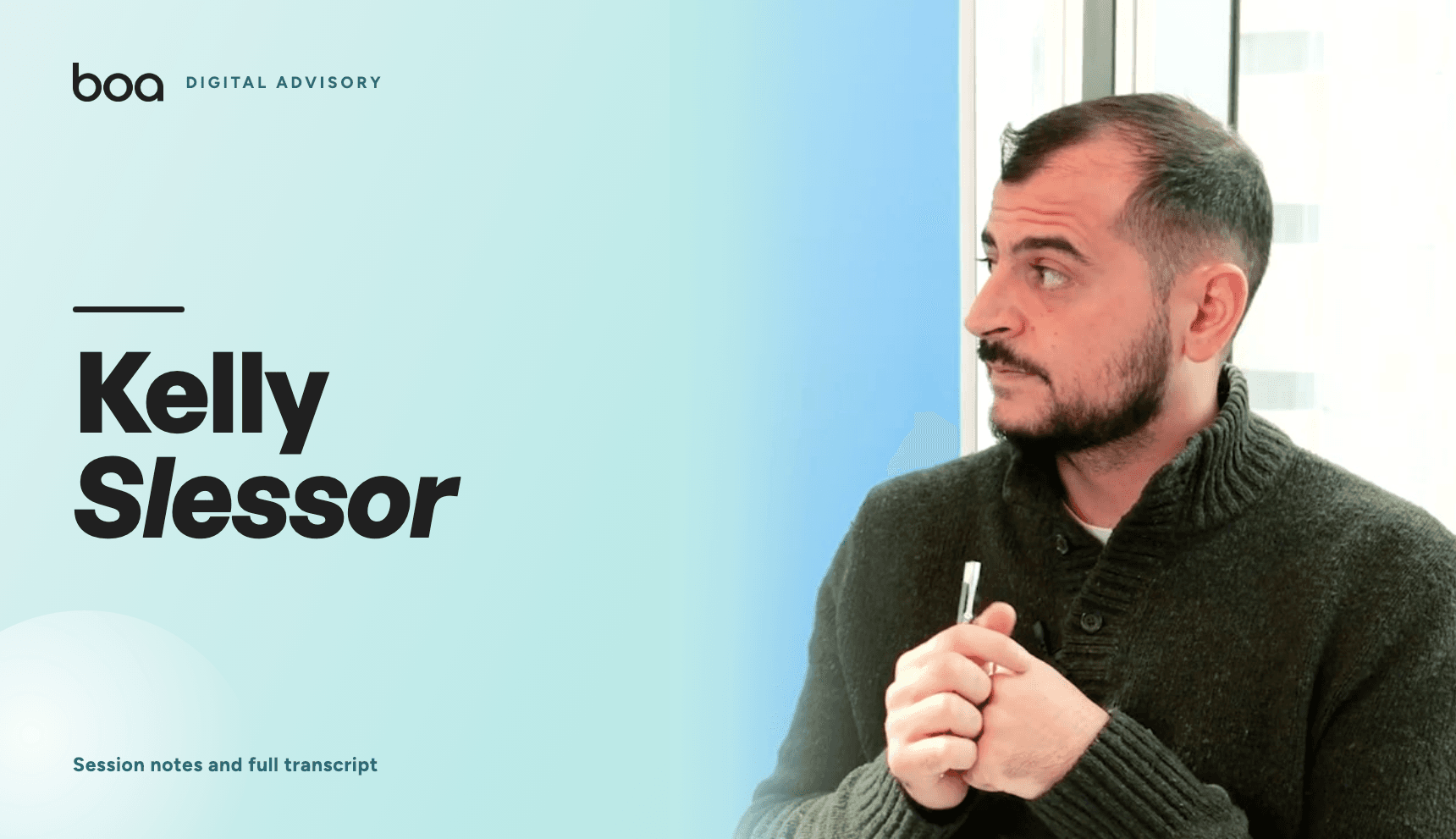
Kelly Slessor on Fixing Email, SEO and AI in Ecommerce
With Kelly Slessor, Founder and CEO at Ecommerce Tribe · Hosted by Boa host · 38 min
What this session covers
Kelly Slessor shows Australian e-commerce owners how to grow without burning cash on ads: rescue a dying email list by mailing only engaged subscribers, prime AI with a customer persona prompt before asking for content, climb the top three organic spots, and audit the mobile journey where 70% of your traffic actually sits.
If paid is your number one acquisition channel in Google Analytics, you do not have a sustainable brand, you have a rented one.
Key takeaways
- 01
Rescue a dying email list by mailing only your engaged segment
One brand Kelly works with slid from a 30% open rate to 15-16% over six months and assumed email was dead. It was not, the platforms had started flagging them and their quality score was degrading. She cut the send list back to engaged subscribers only, sent about three campaigns to that segment, hit a 40% open rate, then slowly reintroduced the unengaged. They are back at 32%.
- 02
Aim for a 40% open rate, treat 60% as the stretch
Kelly's benchmark is simple. Thirty per cent is what most brands sit at, 40% is a good, healthy place to be, and she has one brand running at 50 to 60%. If you can get to 40%, your list health and content alignment are working.
- 03
Kill the double opt-in on your welcome flow
Double opt-in is the default setting in a lot of email platforms and Kelly says it is awful. Someone has just given you their email, which is the digital equivalent of agreeing to a first date, and you reply by asking them to confirm they really meant it. Turn it off and make the welcome frictionless.
- 04
Build the welcome series as your biggest money moment
The welcome email is sent when the customer is warmest and closest to buying, so it has to do three jobs: tell them a bit about you and your why, introduce the brand, then connect them to product. Kelly points to Culture Kings and to HER, a women's health brand whose welcome series introduces the founder, as examples worth studying.
- 05
Write abandoned cart emails to reverse the buying guilt
Kelly's view is that when someone lands on a checkout, their neurological pathways tell them spending is wrong, because we are raised to believe wasting money is bad. So an abandoned cart email should not just remind people the cart exists. It should reiterate why they should buy and how the product solves their problem.
- 06
Prime AI with a customer persona prompt before you ask for content
Beige input gives beige output, and generic AI content gets picked up by the platforms. Kelly's method is to run a customer persona prompt that points ChatGPT at your website, has it analyse your content and produce a persona, then generate emails and content off that persona in your brand and tone. She offered to share the prompt via the Boa app.
- 07
Use the persona output as a diagnostic on your own content
When AI reads your website and describes a customer who is not the customer you think you have, that is not an AI failure. Kelly treats it as evidence you have a content problem. Same test applies to reviews: if you have enough product or service reviews, analyse them to work out what customers actually love and what problem they are hiring you to solve.
- 08
Align content to the customer and expect roughly 30% more conversion
Kelly has seen conversion rates lift by about 30% once content starts using the customer's own language and problems. Her example is Icy Bear Dental in the UK, where the insight was that people want beauty but have no time. The content became a video of someone whitening their teeth in the car after school drop-off, speaking directly to time-efficient beauty.
- 09
Check your traffic acquisition report for the paid red flag
Open Google Analytics, go to traffic acquisition channels and look at the ranking. Kelly says she can read brand health off that one screen. If paid sits at number one, the brand will keep running until the algorithm shifts, acquisition costs rise, and revenue declines quickly. Email and SEO are the two channels she builds first for sustainable growth.
- 10
Chase the top three organic spots, not just page one
Super Butcher in Queensland used to rank fourth to sixth, sometimes page two, for searches like butchers near me. Over about two years the work has been moving keywords into positions one to three, going from around 600 to around 1,700 terms in those top spots. They are up about 35% year on year, with organic and email as the biggest factors.
- 11
Run a monthly mobile friction audit, not a desktop one
About 70% of customers arrive on a mobile device, yet most teams build and review everything on desktop, so your customers are having a different experience to the one you think. In the Ecommerce Tribe they walk the mobile journey monthly, hunting friction points that block purchase. It can be as small as an Add to Cart button sitting too far down the page.
- 12
Learn SEO in-house first so you cannot be ripped off
Super Butcher and Good Day People, a hamper gifting site up around 40% year on year, both run SEO in-house. Kelly's argument is that even if you eventually outsource, knowing how it works means you understand what an agency is doing and why. She points to Mike Friedman and the SEO Pub as a place to learn.
How the session runs
- 2:00From BT and Sainsbury's to Westfield and AI
- 6:20Why 18 to 65 is not a target market
- 8:21Using AI and reviews to define your customer
- 10:41Email and SEO before paid acquisition
- 13:26Welcome flows, double opt-in and abandoned cart
- 17:59Rescuing open rates with engaged-only sends
- 21:15Priming AI and the customer persona prompt
- 24:40ChatGPT, Perplexity and Meta AI in practice
- 26:14The biggest mistake: paid as channel number one
- 27:23Super Butcher's organic growth and community
- 29:4970% are on mobile and you are not looking
- 31:49Learning SEO in-house
- 33:32Q&A: CRM choice, Klaviyo and Hotjar
Mentioned in this session
- British Telecom
- Sainsbury's
- Woolworths
- Coca-Cola
- David Jones
- Westfield
- Ecommerce Tribe
- Victoria Woods
- Julie Mathers
- Snuggle Hunny
- Sandra Dee
- Semper Forte
- Culture Kings
- HER
- Icy Bear Dental
- Super Butcher
- Good Day People
- True Alliance
- Speedo
- Lacoste
- North Face
- ChatGPT
- Perplexity
- Meta AI
- Google Analytics
- Klaviyo
- Mailchimp
- Omnisend
- Hotjar
- Mike Friedman
- SEO Pub
Questions founders ask
Kelly Slessor treats 40% as a good, healthy open rate and says she is happy if she can get a brand there. Thirty per cent is common, and 50 to 60% is a stretch goal she has achieved with one brand. If your rate is drifting down towards 15-16%, that is usually a deliverability and quality score problem rather than proof that email does not work.
Stop sending to your whole list. Kelly narrows sends to the engaged segment only, runs about three campaigns to that group to rebuild the quality score, then slowly reintroduces the unengaged. One brand went from 15-16% to 40% on the engaged segment and settled back at 32% across the list.
Prime it first. Kelly runs a customer persona prompt that points ChatGPT at your website, analyses the content and produces a persona covering who the customer is, what sites and Instagram channels they use and how they talk. Only then does she ask for emails or content, so the output is in your brand and tone and aimed at a real person. Beige input gives beige output, and generic AI content gets picked up by the platforms.
No. Kelly says if paid is the number one channel in your Google Analytics traffic acquisition report, the brand is not sustainable. Ads keep working until the algorithm shifts and the cost of acquisition rises, then revenue declines fast. She builds email marketing and SEO or organic traffic first because they deliver ongoing revenue.
Kelly encourages founders to learn it in-house first. Super Butcher and Good Day People both run SEO internally and are up around 35 to 40% year on year. Even if you later outsource, understanding how it works means you know what an agency is doing and why, so you are far less likely to be ripped off.
Full transcript
The complete conversation, as recorded, with every speaker attributed.
Boa host0:00
First of all, hello and thank you all for being here today. As you know, our purpose of BOA is just to make sure that you have access to the highest quality networking advisory and to be honest, just business community in general. And today we're gonna be learning from one of our country's kind of greatest e-commerce business minds. No pressure. Pretty good. But it is true. And in our typical, I'm sure a lot of you have been to some of our digital advisory sessions before, before, but I'm going to run a very short interview with Kelly, um, and we're going to follow it up with open conversation and questions. So as we're talking, if you, if you think of questions, write them down and I'll call— the team sends them to me and I'll call you out at the appropriate time and you can ask the question directly yourself. And these can be questions about your business, like advice or opinion that you'd like to seek, or questions to get more insight into Kelly's experience and journey. Anything you ask is probably going to be valuable to someone else as well. Kellie's been in the e-commerce world and space for over 20 years now. And in fact, something really interesting is she's been utilising AI for, for around 8 years. Yeah. And using AI to get ahead and to succeed in e-commerce. So I really wanted that to be a really important focus of today as well. Kellie's the founder and CEO of the E-Commerce Tribe, and she's actually working on a new book, which I'm sure she's going to mention today as well. I hope she does, because it sounds like an amazing book. But Kelly, thank you for being here today.
Kelly Slessor1:37
No, thanks for having me. Good morning. Now we're looking forward to this.
Boa host1:42
My first question for you is actually about properly understanding your target audience. So actually, you know what, before that, could you maybe share a little bit more about your journey in e-commerce and sales online and give a bit more insight than what I just did? Yeah, sure.
Kelly Slessor2:00
So, I'm obviously from the UK, or maybe, maybe not, I don't know. But I started my journey in the UK working for a big telco called British Telecom. And, you know, fresh out of uni, I got the opportunity to work on a project called Sainsbury's, the store of the future, which is kind of the equivalent to Woolies here. And at that time, we were looking how we could integrate digital into the customer journey. And that was really where I found my love of all things technology, all things retail, and it was also where I realised that what I really love is really working with customers, understanding customers, understanding customer needs. If I rewind just a little bit, you know, a bit of backstory, when I was around about 8, my dad had a— my dad actually was a— he was— he worked worked in a— he was a CNC engineer, which was a computer engineer. He worked in a looming— well, a weaving company. And at the age of about 8, he had an accident which left him disabled. He broke— he did his back, and as a result of that, couldn't go to work. So at 8, 9, I became his carer and had to look after him. Now, because my dad was a super, super smart, intelligent guy and had worked on computers, he got himself a computer, and that became his connection to the world. And so from the age of about 8 or 9, we had this massive— it was like a big mainframe, it took up a whole desk. Um, from the age of about 8 or 9, I was watching this man using, you know, my dad using this technology and, and, and sitting on his knee watching blue dots go, green dots go across the screen. So I, from a very early age, I was kind of ingrained in technology. I went into BT, I left there, I came over to Australia, I ran one of Australia's first mobile agencies and I got to work with FMCG like Coca-Cola, I got to work with David Jones and I got to work on some really great innovative projects. Then I decided when I had my first child that I wanted work-life balance, which I've now realised is, it doesn't exist. Mentally, it's just not there for me. So I decided to start my own company and I ended up working for Westfield as a consultant, but then basically worked full-time for Westfield. And I would drop into each of their retailers and help them with their digital channels, help them grow online, help them grow e-commerce stores before really e-commerce was, was a thing. When I was at Westfield, I got really frustrated with the lack of connection to customer. So, I keep going back to this connection to customer piece, and I'll talk a bit about that today. I got really frustrated with the lack of connection to customer and the fact that we were just trying to shove product down people's, you know, just walk in, get a product, get online, get a product. And so, I started to research into AI and how we could use AI to personalize, and I ended up building out in the small hours an AI personalization shopping tool. And so, Over the years, I've spent a lot of time really using AI to personalise the customer journey. I now work with a plethora of brands from, you know, big brands like Victoria Woods right down to butchers, bakers, and candlestick makers and helping them build out their e-commerce stores.
Boa host5:46
And so I'd like to focus then on the audience. So that was obviously something that was very important to you. It was, it was very much like we're not talking to our— we're trying to shovel product, but we're not actually potentially attracting the market to the best product for them. So how can— and I think e-commerce always starts with who am I— or business really always starts with who, who am I selling to, who is my target demographic. So I guess my question is, how do you identify and understand who or your target demographic?
Kelly Slessor6:20
Yeah, so it's the biggest, most fundamental shift I think you can make for your business if you, if you haven't got it already. And I hear a lot When I speak to e-commerce brands, you know, it's everyone between 18 and 65. Well, it can't be because we all know the cost of acquisition is ridiculously high. And if you're targeting everyone in Meta between the ages of 18 and 65, you're going to spend a lot of money and you're going to go out of business pretty quickly. So for me, customer understanding, your customer is absolutely fundamental and revisiting that regularly. Is really part of the e-commerce journey. And if I go back to where my journey started and just connecting the dots a little bit, you know, one of the things I think about with my dad was, you know, I got firsthand at the age of 8 or 9 to see that the other side of every digital experience is a real living, breathing person with real problems to solve. And I think as e-commerce people, as e-commerce brands, We often forget that. We often just really focus in on what we're trying to sell and we forget. And when I look at some of the gurus and some of my best friends in the industry that have grown amazing e-commerce brands like Julie Mathers from Snuggle Honey, like Sandra Dee from Semper Forte, what they have done is really connected into community and understood what, what their consumer needs, the consumer wants are.
Boa host7:52
Do you want to keep going? I just, I wanted to say I really loved that, the idea of think about who's on the other side of the screen, you know, what are they experiencing by, with what you're interacting, like what, what are they thinking, or, you know, don't think about yourself and what you're trying to do, think about them and what they're trying to solve or what they're trying to do by being there. I just really love that switching perspective. But what about, uh, what tips do you have in terms of actually identifying who they are? Who they are?
Audience member8:20
Yeah.
Kelly Slessor8:21
Okay, so A couple of things. So old school, we'd do lots of research, we'd look at reviews, we'd, you know, analyse customer, we'd do focus groups. That's all, you know, been replaced by AI. So what we do is use a lot of AI to basically understand the customer. And one really quick and dirty way to do it is I have a customer prompt. So I've mentioned that I've been working in AI for a long time. I've developed a lot of prompts. Over the last year, I've been refining a particular customer persona prompt, which basically, when you ask AI who your customer is, you can upload your website, it analyses your website, and it can tell you who your customer is based on your website content. Now, what I do find sometimes is that doesn't align with who you think your customer is, which means you've got a content problem. But my first port of call to really understand who your customer is and who you're talking to is to use AI to understand your customer and to use it to do an analysis of, you know, what sites are they on? What Instagram channels do they look at? What's their language? How do they talk? The other thing we do is we do analyse reviews. So if you've got product reviews or customer service reviews or feedback on your product, You know, if you've got enough of them, we can analyse those to get an understanding of the types of things your customers love. The next stage of that is then understanding, well, based on that, what problem are they trying to solve? What keywords are they going to search for in Google to try and solve that problem?
Audience member10:02
And I think—
Kelly Slessor10:02
sorry, you go.
Boa host10:03
No, no, no, keep going, please. Yeah, okay. Um, so no, what I was going to say is I do want to dive very deep into AI because I want it— I want to share with everyone the actual things you're doing in AI that everyone else, that we can do also. But before we do that, I wanna focus also on generating sales. So what are the techniques and strategies people can use to actually increase their sales? And then we can talk about how AI can actually tailor the experience to each person. But so what are the best techniques someone can do to increase their sales or traffic to their e-commerce store?
Kelly Slessor10:41
Okay, so number one thing is understanding the customer. So I absolutely go back to what I just said and reiterate how important that is, because if you're not talking in your customer's language, if you're not using content that aligns with them— and I've seen increases in conversion rates by about 30% when we start to use content that is aligned with the customer.
Boa host11:03
Wow.
Kelly Slessor11:04
So that's the number one first port of call, because I can give you lots of tactics about how to drive more traffic to your websites, how to get, you know, more people there. But if A, they're not the right people, and B, the content doesn't align with them when they get there, we're just filling a funnel that's going to leak. Yeah, basically. So that's the first thing. Second thing is, um, I look at it from an acquisition, um, kind of point of view. So I go, okay, well, where are my customers coming from? The biggest channels that I find most cost-effective are email marketing, and secondly, SEO or organic traffic. So again, you know, customer journey, understanding the customer, looking at what they're searching for online, and then matching that search and making sure that you're at the top of Google. That's where I see the biggest gains in e-commerce. Yes, we can pay for Facebook ads, Yes, we can pay for Google Ads. Yes, you will get increased revenue from them. But if you want ongoing sustainable revenue, those are the two key areas that we focus on first to get that sustainable growth.
Boa host12:18
So it's almost like you obviously have to confirm that your website, what you're communicating, how it looks, is an exact fit to your customer.
Audience member12:26
Yep.
Boa host12:26
Then you need to get people. Now you could go spend money and blast money on Facebook and Google and all these things. But I mean, you can limit what you're wasting by having a good target market, but either way, you're spending a lot of money. So maybe the best way to start then is what you're saying is doing the things that are almost free, which is, which is your email marketing, which actually we use very successfully. And I always tell people the same thing, email marketing, but also SEO. Sorry guys, we just have to put someone on mute if someone's not on mute. Kicks. But is also SEO. And so with your email marketing, because I think that's wildly underused, the email marketing, and it's effective. And if you don't spam them too much, it's really effective because they're not unsubscribing. Do you have any, have there been any really impressive or great email marketing campaigns or tactics that you've run before that you've seen have had success?
Kelly Slessor13:26
Yeah, so there's a number of things with email marketing. Firstly, it's just making sure you've got the flow, the standard flows set up correctly. What I find fascinating though is that the amount of retailers I go into and I look at their flows, and when I say flows, I mean things like your welcome series. So if a customer signs up to your website, the first engagement they get with you, they're warm, they're hot, it's like a first date. And I always use this terrible analogy, I suppose it's because I'm married and I don't go on first dates anymore. But anyway, it's like that first date, you know, you've already got that connection. So, so, you know, build on that. You know, I find a lot of those welcome series that we do. So they've put their email address into your website. Firstly, a lot of e-commerce brands will do a double opt-in, which is just awful. What's that? So it's when— and it's a default in a lot of email platforms. So what it means is I will put my email into your website and I'll say, I'm really, like, really interested in having a first date with you. And then you come back with, can you just reconfirm that you definitely want a first date with me? And I'm like, oh my God, now that's too insecure.
Boa host14:35
Yeah, you've got issues.
Kelly Slessor14:36
Yeah. Um, so I'm not— I'm gonna get off this path and track because it could go all pear-shaped before, before lunchtime. Um, so, so the first thing is making sure that when you welcome them, you don't make it hard, you make it a really frictionless experience. So, so that welcome email tells them a little bit about you, your story, your why, tells them a little bit about your brand, but also connects them to your product. I find, you know, the brand— and if you go to, you know, some of the, some of the really cool brands, the Culture Kings, the Showpoise, the, you know, all of those brands, and have a look at their welcome series. You know, there's a, there's one called HER, which is a, um, it's a women's health brand, and they do a beautiful welcome series introducing the founder. And that is your biggest opportunity to make money in that first instance, because it's the point at which people are thinking about buying and they've already given their email address. So that's the first stage. Second stage is looking at Things like your abandoned cart. Again, I'm really hot, I've already put my, you know, products in your cart, I'm about to jump over the line and the dog screamed, the cat barked, and the kid meowed, and all of a sudden I'm totally distracted and I've jumped off. And then next day or next hour I get that email that just reminds me you're there, but also reiterates why I should buy. Because neurologically, if you think about when you go to a website to buy anything, your neurological pathways immediately tell you what you're about to do is wrong. That's, that's the way we're wired, you know, because we're brought up— our parents tell us not to spend money, spending money is bad, wasting money is bad. So our neurological pathway kicks in. So what we're trying to do is reverse that neurological pathway. So, so abandon cart, making sure your, your flows are set up properly, But then just thinking about again that content that aligns with the customer. What's the problem? What are they trying to solve? Then they don't just want your product, they want to solve a problem. How do you solve that problem for them with your product and how do you put in key messaging in order to do that? One of the, one of the little tips and tricks for those people that have already got an email database, um, that have um, you know, that are sending out and getting low engagement rate, one of the things we do is we really focus on the engaged segments. So I'll give you a really, a real example of a brand that I'm working with at the moment. They sent an email marketing campaign out, they got about 30% open rate, and then it started to go down. Over about 6-month period, they got to about 15-16% open rate. And they were like, this email stuff just isn't working for us. I'm like, no, it is. What's happened is you've been picked up by, you know, the big platforms as spam and it's degrading your quality score. So what we now need to do is just send it to engaged people. And then we'll send like 3 emails to just the engaged. And lo and behold, what happens with the engaged, you get a 40% open rate. And then we'll slowly reintroduce the unengaged people again. And now they're back at 32%.
Boa host17:59
Wow, that's an amazing tip. I've never heard anyone say that before. So, so you're saying, when you say engage people, you're saying send the email to the people that are opening your emails existing. Yep. And then just slowly introduce the others so that the big, uh, email platforms aren't viewing you as spam. Wow, yeah, that's a fantastic tip.
Kelly Slessor18:18
Makes a huge difference.
Boa host18:19
Yeah, that would. And so what's a good open rate? What should people expect to be their open rate with email marketing? So you said 30%, is that good?
Kelly Slessor18:27
Yeah, 40% is good. 40% is good.
Boa host18:30
What's great?
Kelly Slessor18:31
I've got a brand sitting at 50 to 60% at the moment.
Boa host18:34
Yeah. And so that's great. So, but as long as you— so 30% where you're aiming, 40% is, is really good.
Kelly Slessor18:40
Yeah, I'm happy with 40%. If I can get you to 40%, we're in a good place. 60% is awesome, a bit of a stretch goal, but yeah.
Boa host18:50
And, um, so I also loved the concept of that first, that initial email. When someone signs up, they've almost agreed to go on a date with you. Now It's your job to not screw up that date.
Audience member19:01
Yeah.
Boa host19:01
You know, so don't get too salesy, don't get too pushy. Yeah. And I love what you said, which was, um, make them like you more by showing them how you can solve their problem. Yeah. You know, or, and doing it in a way that's more kind of inclusive rather than, you know, you have a problem and I can solve it.
Kelly Slessor19:16
Yeah.
Boa host19:17
Because I always feel sometimes with the problem solution thing, I feel like sometimes people come on too strong and I want to get your opinion on it.
Audience member19:24
Yeah.
Boa host19:24
Like someone said to me the other day, like, what problem can I solve for you? You know, get out of my face. I don't know what you're talking about. How do how do you think people should go about, um, framing that situation in a way that's kind of soft and, and, and, and seamless for the customer?
Kelly Slessor19:40
So it does depend on the product, you know, um, and again, we'll talk about this in a minute, but this is where we can use AI to really personalise that journey. But if it's, you know, if it's, um, let's say a brand that I'm working with at the moment is, um, it's It's called Icy Bear Dental in the UK, and they do dental products, hygiene products, teeth whitening kits, basically. And one of the things we've tapped into is that people don't have time to whiten their teeth. Like, it's a, it's a real, you know, it's a real thing. And it's a— but, but that, that need and want for beauty is there. So what we've got is Hannah's just done an amazing video with people doing it in the car after she's dropped the kids off. You know, and that really speaks to the problem that we're trying to solve, which is time-efficient beauty. Like, that's it. They're the 3 things that their customers are coming to them for. They want that, that hit. They want to look amazing, but they don't have time. And so that speaks to the problems.
Boa host20:44
That's a great example. I do have a question from Patricia. She just asked if you could say the name of that really great women's company that has the great sign up Welcome.
Kelly Slessor20:54
Her, her, it's H— I think it's H-E-E-R, but I might have to come back to that because that'd be great to cheque out what they do, everybody.
Boa host21:02
Now let's get into the AI part because I was really interested about this. How, how can people like today, if they want to start today, how can people use AI to, to tailor or amplify their customer experience?
Kelly Slessor21:15
Yeah, so, um, all the brands I work with, we're just using it on steroids every single day. It's like, it's crazy. And what I am seeing with the brands that are using it effectively, they're increasing their saving time. Time saving, we've done an analysis, is about 20%. So reduction in time spent on things like content, content delivery, uh, content, um, building, um, you know, analysis. They're reducing that time by about 20%, and they're increasing their revenue by around about 10%. So the first bit is going back to what I was talking about earlier with the customer persona and prompting it properly. So if you put into GPT, and I'm using GPT as an example, there's lots of tools out there. If you put into GPT, you know, beige information, you're going to get beige information back. So if I say, I would love you to build a customer, you know, a content email for Samir. You're just going to get the same as everybody else. And that's when, you know, platforms start to pick up you using AI. The key to AI is priming it, which is why I use the customer prompt so it understands the customer so that when I start asking it for content, it understands who I'm talking to, understands the problem that I'm trying to solve for them. It understands what their needs are. So that's probably the biggest place, or the biggest kind of first step to AI.
Audience member22:51
Just—
Boa host22:52
this might be the world's stupidest question, but what is priming AI?
Kelly Slessor22:56
So priming it is giving it a prompt to understand what it is that it has to output. What's, what's the, what's the fundamental information that it needs to give you the best output?
Boa host23:08
So all the information you give it before asking it to actually do the thing?
Kelly Slessor23:11
Absolutely. And so teach it, yeah, like a child.
Boa host23:14
And so what are the ways people people can do that? Do they just type it, or can they take from their website, or what, what can they upload onto there?
Kelly Slessor23:20
Yeah, so I'm happy to share my customer prompt if anyone wants it. So I don't know how I do that. I can put it in the BOA app. I can put a link to it. So, so I put in a customer prompt that then links to your website. So the, the, the AI goes out and has a look at your website, looks at your content, and then off that it will produce a customer persona. Then I can say, based on that, now start bringing— producing content. So it will produce it in your brand and tone, but based on the customer persona.
Boa host23:54
And can you— is there a system that you can, um, take it even further? For example, where some people, like, in, like, one category of customers gets one email, another category customer is another?
Kelly Slessor24:07
Absolutely, yeah. Yeah, so, so a very base level, we're using it for content. You can now start to integrate it into your email channels and start to personalize. So we can personalise it based on your customer segments, we can personalise it based on products they bought before, we can— which is the beauty of AI, is that you, you can, you know, pump out huge bits of information using the priming inputs that you've, that you've used.
Boa host24:37
And what platforms do you use to do that?
Kelly Slessor24:40
Yeah, so predominantly I'm using ChatGPT. You can build integrations into that. Meta have just launched an open source, Meta AI, they've just launched open source. That's a really interesting platform that I'm watching at the moment because it means you can build things into it and you can train it yourself. Perplexity is another one that I use quite a lot.
Boa host25:07
Uh, what's Perplexity?
Kelly Slessor25:08
Perplexity is a— it's an AI tool. It's another language, large language model. But Perplexity is really good for getting up-to-date information. So each of the models I use for different things. And what I try— I, I did a programme for True Alliance last— a couple of weeks ago, which has Speedo, and they've got Lacoste, and, you know, North Face, and all of that. And what we did was we built out a plan for them that basically puts in their organization, they now have kind of, you know, they're looking at having heads of each of these AI tools. So, people that are just on a day-to-day basis, on a week-to-week basis, are playing with each of these tools to understand the nuances between each of them.
Boa host25:54
Fantastic. And what are the biggest mistakes you, the most common mistakes you see companies make when trying to sell online? So outside of, you know, not being aligned with the customer and the thing.
Audience member26:07
Yeah.
Boa host26:08
What are some of the biggest mistakes people should be avoiding when trying to be successful with online sales?
Kelly Slessor26:14
Having the paid channel as the highest acquisition channel.
Boa host26:18
So focusing on paid is a big mistake as making it your highest acquisition channel. Huge.
Kelly Slessor26:23
So if you go into your Google Analytics, you've got— you go into your traffic acquisition channels and it will show you which, which acquisition channels. I can tell you by looking at that what a healthy brand, sustainable, healthy brand is. So if paid is number one, I know that that's not a healthy, sustainable brand.
Boa host26:43
Yes.
Kelly Slessor26:43
Like, they will continue until the algorithm stuffs them and the cost of acquisition goes up. And then that they will start to decline quite rapidly.
Boa host26:51
It's interesting because you're right, that would, that would insinuate or assume that the brand hasn't built almost like a loyal community or customer, but customer base. It's almost having to, it's almost having to buy people to come to its page rather than building organically. Yeah. Which then begs the question though, building organically is a slow process or can be a slow process.
Kelly Slessor27:12
It is.
Boa host27:13
Do you have any tips in how to build that kind of, I don't know if you call them a community or a customer base or an interest base.
Kelly Slessor27:20
Yeah.
Boa host27:20
Do you have any tips on how to actually do that?
Kelly Slessor27:23
Yeah. So, so there's kind of two sides to organic growth. There's the, there's the natural kind of SEO organic growth, making sure you have all the right keywords, making sure you have the right content on your site. And I'll, I'll give you a great example of a brand that we've been working, that I've been working with now for about 3 years. Um, it's called Super Butcher. They are based up in Queensland. They've, they're up 35%, I think it's about 36% year on year. And if we look at their organic traffic, that has been one of the biggest factors, email as well, but it's been one of the biggest factors. And when we look at their journey of growth, if we go back about 2 years ago, when you go to Google and you search for Butchers Near Me, for instance, they would come up in the top maybe 4 or 5 or 6, or maybe on page 2. What we have worked on over this last year, or last 2 years, is getting them to feature more in those number 1 to 3 spots. They've now gone from about 600 to about 1,700 in those top 1 to 3 spots. And they're up 35% year on year.
Boa host28:37
Oh, wow.
Kelly Slessor28:38
So there's that organic, there's that natural organic traffic that they're getting from SEO. Then you add on top of that nurturing that community. So they're getting people to their site through natural practices. So people are already interested. That's great. First date, we're already there. We're locking in for the first date. Then they get there, they jump on their pop-up and they put in their email address. Then we start to nurture them through nurture sequences. And, you know, Butcher's is very transactional, so it's quite an easy one to do. Other brands, you know, slightly harder. But we then nurture them, then we put them into a community, and they've got a Facebook page community where they share their specials, they get exclusive offers, they get to try products, they get recipes, and we build from there.
Boa host29:25
It really actually does sound simple. I mean, get them to your site organically for that first date, get them, get them to put in the email. Once they put in their email, make them be part of something. Yeah, be part of a community, part of other people like themselves. Yeah, that are involved in the brand in some way, can choose colours or can do whatever. It really does sound simple when you, when you kind of say it like that.
Kelly Slessor29:49
Can I just add the other biggest mistake? That was your original question. The other biggest mistake I see is You know, if again, if you look at your analytics, and I'm a big data geek, I love looking at analytics, I could spend way too much time in data. If you look at your analytics, you will find that about 70% of your customers, for those of you that have e-commerce brands, and actually not, about 70% of your customers are coming to you from a mobile device, yet we build everything and look at everything on desktop. And so, your customers are having a different experience to the one you think they're having. So, one of the things we actively encourage, and in the Ecommerce Tribe we do this on a monthly basis, we analyse the journey on mobile and we look at the friction points that stop people from going to the purchase point. And it can be really, really simple things like your Add to Cart button is too far down the page, and again, the dog's barked and the cat screamed and kids have annoyed me.
Boa host30:48
You lost them for a second.
Kelly Slessor30:48
I lost them for a second and I'm off. Yeah, you know, it can be really simple things like that. So just the customer journey on mobile is, is another reason that I see brands failing.
Boa host30:59
It's almost a bit scary that you can lose a sale from something so small as the placement of a button. But, but a final question, because I do want to move to Q&A, and guys, I'd love for everybody to think about their current biggest challenge biggest challenge that they're having in their business. And if you could type your current, your biggest current challenge right now, type it in the chat because the team's gonna send it to me and I wanna ask Kelly or to be honest, I'll probably call you out to ask if you want as well. But so do that right now. But I guess my final question was just on SEO. So obviously organic attraction, very important. That is SEO, SEO creates that. That. What advice do you have on people being good at SEO? Do you think they should— can you do it yourself, or is it best for them to use an SEO company? Because obviously there's companies that specialise in that.
Kelly Slessor31:49
Yeah, so the, um, the butcher company, um, Super Butcher, and there's another brand that I work with who are up, I think, 40% year on year, Good Day People, a beautiful, um, hamper gifting site. They've done it in-house.
Boa host32:05
They've done in-house.
Audience member32:06
Yeah.
Kelly Slessor32:07
So I'm sorry if there's any SEO people on, on here, I'm not trying to take away SEO jobs, but I think actually just having the knowledge and understanding of how it works is such a powerful thing. Then if you do decide to outsource it to an SEO agency, you know you're not going to get ripped off because you know what they're doing and you understand why they're doing it.
Boa host32:27
So you would encourage people to actually, when they start it, give it a go and learn themselves. Are there any places you direct them to learn about SEO?
Audience member32:35
Yep.
Boa host32:35
Um, there's even your— would your website have anything?
Kelly Slessor32:38
Yeah, mine's got some stuff on it about SEO. Yeah, definitely. And I do obviously the Ecommerce Tribe, I do a course and we, we focus on SEO. There's also the SEO Pub, a guy called Mike Friedman who is like the godfather of SEO. I'm in his little gurus group and, um, it's, it's just an amazing forum.
Boa host32:56
What's his name?
Kelly Slessor32:56
Mike Friedman. Mike Friedman.
Boa host32:57
Who's that? I've never heard of him.
Kelly Slessor32:58
He's based out in the US. He's worked with some amazing brands, but he's an absolute guru geek.
Boa host33:04
But essentially people can learn how to do SEO, apply that into their business to start, so that way they're not, you know, they can save money, they're not paying another company. And when they get bigger, I assume then they may either outsource.
Kelly Slessor33:17
And some do, some of the brands that I've worked with keep it in-house.
Boa host33:21
Awesome. Well guys, I wanna open up to Q&A now. Sorry, I get sent things on my phone. But Claire, would you like to ask your question?
Kelly Slessor33:32
Hi, Claire.
Boa host33:34
If not, I can ask. So Claire is asking, she'd love to know more about your recommendations for CRM platforms. That's a fantastic question.
Kelly Slessor33:45
Yeah, so the question back would be, Claire, if you can come off, what are you using it for? What's the purpose? Purpose of the CRM platform. Is it for, you know, is it, is it to be able to monitor where customers are at in the process, in the journey? The majority of brands that I work with, we use Klaviyo for all of our customer data. We use it to find out where they are in the journey, to personalise and to segment. And it is by far— I've used pretty much all of the tools out there in terms of email marketing platforms: Mailchimp, Omnisend, It's by far my favorite, but it does depend, Claire, on what your goal is. So if you could tell me your goal, I could probably give you—
Boa host34:32
are you able to come on the screen, Claire? Relevant. Sorry about that.
Audience member34:36
That's okay. But I'm here now. Um, so I am just getting to that stage of my business where exactly what you've said, or you've touched on, um, where I'm— I've got a leaking funnel. Yeah, essentially I've got people that are, um, signing up to my app, but then there's no— they're not offloading it. I don't have a high churn rate. They're not deleting it, but there's— they're not, uh, continually opening the app. So I'm trying to find, um— I haven't got any customer journeys aside from Welcome to Binge. Yeah. So trying to find a good platform to to, you know, engage them, saying, showing them how they can use my products in a number of different situations. So whether it be a birthday party or game day or, you know, a bunch of different ways. I don't know if that really answers the question, but yeah.
Boa host35:34
Yeah.
Kelly Slessor35:34
And what, um, what are you using at the moment?
Audience member35:39
So I've only sent out a few EDMs, like a month I just do an update on features. I just use Mailchimp, so I haven't gone down the route of any other, um, any other platform yet.
Boa host35:52
Do you say using Mailchimp?
Audience member35:54
Just Mailchimp at the moment, yeah.
Kelly Slessor35:56
Yeah, so, so I mean, for understanding customer journeys, where the customer's at in the stage for e-commerce specifically, Klaviyo is, is my preferred option because I can really highlight where they are. But it sounds like there's a step before implementing a CRM, which is more about understanding customer and understanding, you know, what their needs are and why they're dropping off. I don't know if you've used, and if this is possible, but things like Hotjar are really good for seeing what the friction points are along a customer journey. What's Hotjar? Hotjar is like a tool that basically, it's a bit of a stalker tool, I love it. It basically stalks your customers and watches their journey online. So you can see where they're dropping off, where they're getting rage, where their friction points are. And you can also ask them exit survey questions. So it's really useful for understanding why they're jumping off your platform.
Audience member36:56
Yeah. Awesome. Thank you.
Boa host36:58
Thank you, Claire. Does anyone else have a question that they'd like to read out? I'd love it to be also— oh shit, I just screwed up my microphone. I'd love it to also be about the current biggest problem you're having in your business in e-commerce, because I'm certain there'll be other people that have a similar problem. I hope you have enjoyed today's conversation. Kelly, thank you so much for coming in.
Kelly Slessor37:19
Oh, no, it's my pleasure.
Boa host37:21
And thank you all. And if you do have a question and you do want to ask, just email it through, we'll get the answer for you.
Kelly Slessor37:26
I'm also on the BOA app. So if anyone's got a question they want to ask, and if anyone wants that customer prompt Prime that I use.
Boa host37:35
Is it on your website as well?
Kelly Slessor37:37
No, it's not.
Boa host37:38
Okay, we can post it on BOA, and also you can message Kelly directly on BOA. I hope you guys do.
Audience member37:43
See you.
Boa host37:44
Thank you. Thank you.
Watch the full sessioninside Boa.
Session notes are free. The recordings, the live advisories and the founders in the room are for members.