Digital Advisory
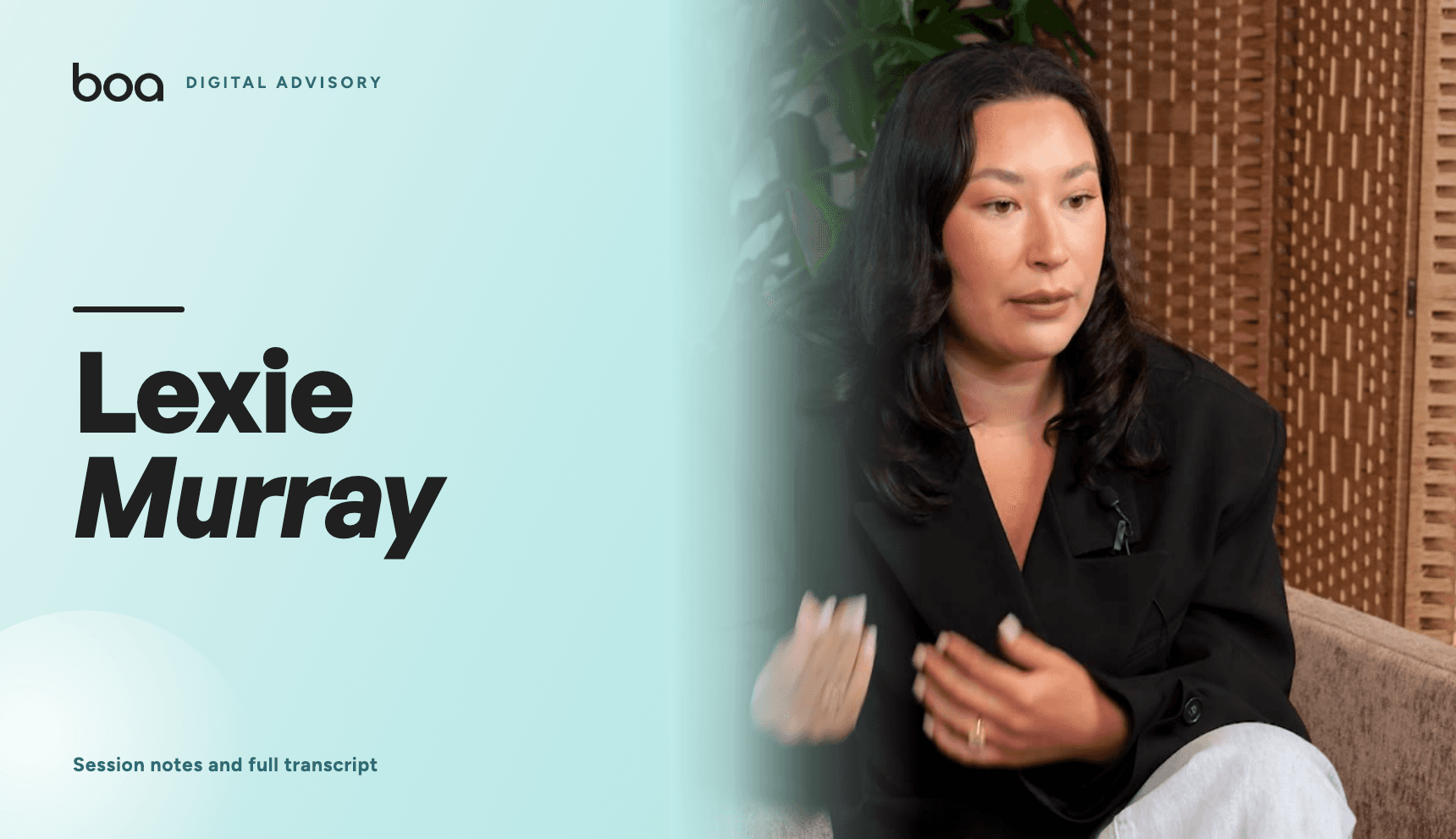
Lexie Murray on Building Social Content Without a Big Budget
With Lexie Murray, Founder at Be Seen Socials · Hosted by Kirsten Scott · 52 min
What this session covers
Lexie Murray, founder of Be Seen Socials, shows Australian founders how to build a social presence from zero: four content pillars, a day-of-the-week posting formula, when to gift versus pay influencers on a $4,000 budget, how to run a launch event, and what to do if you don't want to be the face of the brand.
Assign each day of the week a fixed content pillar so posting stops being a decision and starts being a routine you can actually keep.
Key takeaways
- 01
Give every weekday a fixed content pillar and stop deciding
Lexie's core practical advice is to map your week: Monday education, Tuesday promotional, Wednesday testimonials, and so on, then repeat it every week. She argues generic advice like "be consistent" never gets applied, but a Monday-to-Friday formula makes content bite-sised and actually doable. Pick the pillars that suit your business and lock the days in.
- 02
Post promotional content Thursday night or Friday
Lexie schedules selling posts to land when people have been paid. She noted that a lot of the Big Four pay salaries on those days, so people are ready to spend on a Friday. Feed the timeline when the money is in the account, not on a Monday.
- 03
Use the four content pillars if you refuse to be on camera
Around half of Be Seen Socials' clients fit four pillars: promotional (what you sell), educational (the problem area, not the product), aspirational (the brand world and lifestyle around it) and influencer/customer (testimonials and creators). All four can be executed with no founder face. Build consistency across those four and you get enough relatability to carry the brand.
- 04
Be talked about in third person if first person feels wrong
For founders who want the credibility of a face without doing "hey guys, day in the life", Lexie recommends having someone else speak about you as the founder, whether that is an agency, a team member, or you writing in third person. It creates the relatability people buy from without the daily vlog burden. Her line: people buy from people, they don't buy things anymore.
- 05
Split a $4,000 influencer budget three ways and pick one
Option one, run an event: 20 aligned creators in a beautiful venue, you present in person, and you hold their full attention for two hours. Option two, gifting: if you have lots of stock and little cash, send to around 50 creators and spend the money making the unboxing beautiful, treating it as PR and brand awareness rather than sales. Option three, pay for deliverables: buy the specific TikTok, feed post or story frames.
- 06
Do the unglamorous relationship work before you invite creators
Lexie, wearing her influencer hat, says the effort visible on your account decides her yes or no. Don't invite anyone until your feed clearly shows the product. Follow the creator and engage regularly for about a month first. Being messaged "we've been following you forever" by an account that has never followed her kills the invite.
- 07
Build the event around the product experience, not a cocktail stand-up
For a refillable candle brand relaunching, Lexie's instant answer was 20 creators refilling their own personalised candles at the venue, everyone home with a candle. She also suggested making the room 50 percent community and 50 percent influencers, and timing it to a buying moment like Mother's Day (bring your mum) or Christmas in July. There are endless stand-up cocktail events, so the experience is the differentiator.
- 08
Treat Instagram as people who know you and TikTok as people who don't
Lexie reintroduces herself in every single TikTok as if the viewer has no idea who she is. Instagram is closer to a Facebook feed now: slower growth, but loyal followers who recognise you, with reach often limited to roughly 10 percent of your following. TikTok carries the virality, one of her videos hit 5 million views while another sat at 60,000.
- 09
Repurpose Instagram content onto TikTok rather than skipping the platform
Lexie has publicly changed her advice: she used to say don't post on TikTok unless you have a separate strategy, and no longer believes that. Now she would rather clients take the content made for Instagram and push it to TikTok just to be present. Even stuck at 200 views, she'd rather 200 people saw you than nobody, which is more than the 90-person panel room she recently spoke to.
- 10
Study five accounts, only one of them in your industry
For solo founders building a formula, Lexie picks: one direct competitor or industry peer, one brand whose values and tone of voice you want to learn from (hers was a New York social agency), one individual expert who talks about your category, and one brand with great graphics that sells something completely different to you. Pull the pieces that fit and build your own formula. Done is better than perfect, especially on TikTok.
- 11
Send a personal thank you and a 20 percent code to every real new follower
Lexie's answer to standing out when barriers to entry are low: do what other owners won't. Message each genuine new follower, thank them, offer 20 percent off, and offer to get on the phone and personalise their order. She accepts around 80 percent won't use the code, but when they run out of moisturiser in a month or two they remember it and buy.
- 12
Win agency work with an unrequested four-slide pitch deck
If she were starting Be Seen Socials again without her influencer following, Lexie would list her dream brands and send each one a four-slide deck: slide one what you know about the brand, slide two what they're currently doing, slide three what you would do for them, slide four proof of what you do for clients and what others in their industry are doing. Any prospect is tendering to two or three agencies, so the one who did the work unasked wins. Never overpromise what you can't deliver in it.
- 13
Hire someone for 12 hours a week the moment quality slips
Lexie's first hire, Chelsea, came in about eight or nine months into the business when demand was high but her ability to fulfil was low. She started at 12 hours a week doing every job under the sun, then grew into the role over three to six months. Lexie hires on personality and teaches skill after, with non-negotiables: bring energy no matter how bad your day was, make each client feel like the only client, and be adaptable when Monday's plan is dead by Friday.
- 14
Sell a service by filming your process end to end
For a B2B AI automation founder, Lexie's advice was to pick two or three typical clients and film the whole engagement as video case studies: stage one, stage two, stage three, result. Do early work in return for a testimonial and permission to film. Then run a recurring free Q&A, for example every Friday at 10am across LinkedIn, TikTok and Instagram. Even four attendees a week are four people who will come to you when they're ready to buy.
How the session runs
- 0:49From accidental influencer at 16 to agency founder
- 3:19Where to start with no content and no following
- 4:39Organic versus paid, and why content is the scaffolding
- 7:21The four content pillars for founders who won't be the face
- 10:19Splitting a small influencer budget three ways
- 13:18Service and B2B: becoming a key opinion leader
- 14:29The Monday to Friday content formula
- 16:01Instagram is for people who know you, TikTok for those who don't
- 20:02Five accounts to study and building your own formula
- 23:51Resilience and doing what other owners won't
- 26:41Q&A: marketing a taboo topic like sex education
- 32:58Q&A: running an influencer launch event for a candle brand
- 37:18Q&A: winning agency clients with a four-slide pitch deck
- 40:51Q&A: first hires and going from solo to agency
- 45:52Q&A: content and lead generation for a B2B AI agency
Mentioned in this session
- Be Seen Socials
- Alexandria
- TikTok
- Meta
- Double Bay
- Sydney
- New York
- Runaway Label
- Europe
Questions founders ask
Lexie defines organic as everything you get for free: pressing post, the five posts a week, going out and shooting the content. Paid is money you give to Meta, Facebook or TikTok for ads. She sees content creation as the scaffolding, because without strong content and a good organic strategy your paid ads may not perform. Her most successful clients value both.
No, but something needs to be there for people to resonate with, because people buy from people rather than things. Lexie suggests being spoken about in third person, by an agency, a team member or an ambassador, so you get relatability without daily first-person content. Her four content pillars (promotional, educational, aspirational and influencer/customer) can all be run without your face.
Lexie says you generally don't need to pay if the creators genuinely align with the brand and the product. What matters more is the visible effort in the event and your account, plus real relationship work: follow them, engage for a month beforehand, then invite. For a small brand she'd target creators between 5,000 and 10,000 followers with high engagement in a main city.
Yes. Lexie used to advise skipping TikTok unless you had a separate strategy, and has changed her mind. She now tells clients to repurpose their Instagram content onto TikTok simply to be present, because any presence beats none, even if you sit around 200 views. TikTok is where virality lives, while Instagram reach is largely limited to your existing followers.
Lexie puts these in the B2B bucket and says you need to become a key opinion leader through education. Structure it: Monday an education piece, another day your practice's point of difference, another day new technology or developments in your field. Film in a structured, repeatable way and stick to the weekly formula so it stays doable.
Full transcript
The complete conversation, as recorded, with every speaker attributed.
Boa host0:00
Hi everyone, if you can pop your cameras on, um, and in the chat we'd love for you to put your name, your business, and where you're tuning in from.
Lexie Murray0:10
I also— forgive me, I don't have my contacts or my glasses on, so I can't see that far.
Boa host0:15
So we'll just have to zoom in.
Lexie Murray0:17
So hey guys, come right up here.
Boa host0:20
Wow, so many faces, it's great to see you all.
Lexie Murray0:24
This is so much fun, I love this. This is like a just kind of like a little FaceTime with everyone. Awesome.
Boa host0:29
All right guys, well I'm gonna jump into it, um, this This morning I have with me Lexi Murray, the founder of Be Seen Socials. She started her business at the age of 21, which is crazy to me. So Lexi, I think we just jump straight in. You started as an influencer and built a serious agency. What was the moment you knew it was time to take the leap?
Lexie Murray0:49
Okay, so I feel like I didn't really have like one of those, you know how in business they have like most founders have this storey of like I woke up and I just like knew. I definitely didn't have one of those, but I guess I'll kind of give like a long storey short. So if we haven't spoken before, you haven't really looked into kind of what we do. Um, Be Seen Socials is based in Alexandria. We're a creative social media agency, so you'll definitely learn the ins and outs by the end of this. But we're very organic, so what that means is everything that's like not paid. Why I stepped into that space was because when I was about 16, 17, um, in year 12 I think it was, I started the whole like influencer marketing thing completely by accident. So obviously back then I think it was I'm really showing my age here, like 2015, 2016 was when I was kind of exploring, like taking photos on social things like that.
Boa host1:45
And when it was all quite new.
Lexie Murray1:46
Yeah, yeah. And it was quite ironic though, because obviously back then influencer marketing wasn't really a thing. But my— also my parents were really against me posting myself online, so I had to be quite savvy about the way that I was like posting for brands. And by the way, when I say posting for brands, like I was paying for these brands and then talking about them. It was never like—
Boa host2:07
she actually be paying them.
Lexie Murray2:08
Yeah, technically, technically. So yeah, so I guess, um, fast forward to now, I, I really pushed that influencer side of my career quite early on, 16, 17, 18, 19, 20. Um, and that's when I really, I finished my university degree and felt that there was a really big gap between really strong content creation and the brand itself. Because obviously with influencers, like, we, we can definitely talk about the pricing, and I would love to obviously be able to ask, answer any questions about influencer marketing if that's something you're wanting to explore for your business, because that's my favourite topic. But I think what you may find is like these prices, you would fall on the floor. And a lot of the time we're not looking necessarily always for the influence that that person is actually providing as in the audience, but we're actually looking at the content that we need for the brand. So that's social proof, that's seeing the face talking about the brand.
Boa host3:07
Well, that kind of leads us into the next question. Yeah, perfect. For a founder starting from scratch, which is a lot of our demographic, no following, no content, what's the first thing they should focus on in building a real presence online?
Lexie Murray3:19
It was no what? Content and no—
Boa host3:21
Yeah, so no content. So no, they have nothing, like they're starting completely from scratch.
Lexie Murray3:26
I'll do— I'm not gonna like pitch BC, but I'm just gonna build the question around this because obviously, I mean, the answer around this. So we have a package called the Launch Package, and it's because businesses do not have anything. And when you are looking at your business and you are looking at all the competitors that are in your industry, it is the most overwhelming thing to— and because I feel overwhelmed. Yeah. And so I'm like, oh my God, there's so much on, there's so many, so much noise. We call it just noise.
Audience member3:56
Yeah.
Boa host3:56
And trends and everything else.
Lexie Murray3:57
Social noise. And you're like, do I put my face on the brand? Do I, um, just get a bunch of content creators to do like UGC for me? And then like I'm not in the brand and then there's not an ambassador, it's just like a bunch of random faces. Like, there are so many routes you can go down that what we do is we actually look at the business, we slow it down, we look at what your point of difference is, which a lot of the time is the founder, which I think we'll talk about soon, and we break down what that strategy is going to be like for you, and we build that with the company. And that's all through organic. There's also an element of paid, which is really important. We'll talk about that. I will preface firstly, I'm not an expert in the paid, but I'm an expert in the content creation and just online behind that.
Boa host4:39
Like, what is the difference between like organic and paid? Because so many people are like so new to this.
Lexie Murray4:44
I really love that question because I feel like it's a very— when I started my agency at 21, the marketing and the world of social media was all one. Do you know what I mean?
Boa host4:56
Yeah.
Lexie Murray4:56
And now it's starting to like, we are starting to see professionals and niches in social media as a whole because people are seeing how big of a, big of a topic or a big of an industry it is. So organic means everything that you can get for free. So it means posting organically for free. So pressing post, doing the 5 posts a week is what we do. It's the content creation. It's going out and shooting the stuff. It's the— it's all of the things that social media— sorry, I need to throw my phone away. That was really loud.
Boa host5:28
I wish we could film.
Lexie Murray5:29
I literally just chucked my phone on the ground. Organic marketing. And then obviously you've got the paid element, which is paying Meta, Facebook, TikTok for ads, which is very, very important. But the content creation side for me is like the bread and butter. It's the scaffolding that builds the business out. Like without really strong content, without a good organic social strategy, your paid ads may not perform as well.
Boa host5:53
Yeah.
Lexie Murray5:54
So I think it's really important to like differentiate the two and see value in both. The clients that come through the door that are the most successful with us are the ones that value both of those things. And so I found myself in my favorite, which is all about the organic side. So we are— I can't even tell you right now. I say we're out shooting for like we do roughly say like 9 shoots a week, which means the girls are— yesterday they were out on location at Double Bay shooting a clothing brand. We do skincare brands where we'll go and shoot on location or we have a beautiful natural light studio where we'll go and shoot content constantly. And we do that with a very, very particular creative process. So I will say that to answer that, I think both are super important. We need to talk about both, and I would love to— obviously, like, we'll get in touch after this if you feel like it's the right time.
Boa host6:47
On that, like, guys, if you have any questions throughout the discussion, pop them in the chat because we will move to the Q&A, um, and you'll get to ask Lexi your questions directly.
Lexie Murray6:56
That would be perfect because I feel like there's a lot to dive into, and I would love to go down, like, specifics.
Boa host7:00
It's a whole rabbit hole.
Audience member7:02
Yeah, yeah.
Lexie Murray7:03
And I think, like, sometimes it's overwhelming to have so much to look at that we want to kind of niche it down to exactly what you're—
Boa host7:10
one of the 3 high-level things.
Lexie Murray7:12
And then yeah, yeah.
Boa host7:13
So I'll move into the next question. Um, what's your advice to business owners who know they should be on social but don't want to be the face of the brand?
Lexie Murray7:21
Okay, so I think you can do so many things, and I feel like I would need 7 hours to go through every single one. And I feel I'm such a, such a yapper, so like tell me to like wind this up. But firstly, like if you don't want to be the face of the brand, that is okay. But just be aware that there needs to be something that people, someone that people resonate with, with the business because people buy, buy from people, they don't buy things anymore. And I think it's really powerful to have some kind of ambassador and some kind of relatability behind your business. I by no means feel that you need to constantly be like day in the life, hey guys, follow me around as a founder. That can be really difficult and very daunting. I will say something that we as an agency would recommend and can do, which people and business owners really love now, which is to have it— have you spoken about in third person, whether that's you secretly pretending to be the third person or having, you know, an agency or someone that can talk about you as the founder can always create that really relatability if you don't want to necessarily like talk about yourself in first person. If being even seen, being seen around this business is a complete no-no for you, then obviously there's other ways of going about it too. Look, going back to like the very simple things, which is like your 4 content pillars. We have 4 content pillars that we base a lot of strategy around. Definitely not all of them, but I would say maybe 50% of our clients can fit comfortably in this. You've got promotional. That's what are you selling? Educational, which is education around not what you're selling, but the topic or the area that you're problem solving. The next is going to be— it's probably like, I guess, almost like aspiration. So it's like creating this like really aspiration around your brand. If it's a skincare brand, it's kind of that brand, it's kind of that branding wellness space. Like it's creating that aspiration. Then you've got your influencer and customer. So that is your testimonials, your customers, your influencers that are talking about the brand. All of those 4 can be done really, really well without a face to the brand. But having those pillars and using those and creating consistency with what those are without your face in it should provide you with enough content and enough, I guess, engagement and relatability to kind of push the brand without you being the face. That's my recommendation if we're kind of talking about you running the socials purely on your own. But also, mind you, there are ways of obviously doing that with, I guess, like a team behind you as well.
Boa host10:04
Yeah, I guess you kind of answered the next question as well, so which is great. Okay, we're seeing you. Yeah, exactly. So I will ask it anyway though. When money's tight, how should a founder think about organic versus paid versus influencer strategy? What actually like keeps things moving?
Lexie Murray10:19
Yeah, I want to say that there's, there's never like going to be the right answer for it. Like not every business is going to be the same. My recommendation for a skincare brand is going to be incredibly different to a clothing brand. That's going to be very different to a luxury brand. So you're going to have to, you know, look at your market, look at what the competitors are doing and find what works for you. And that's going to be a lot of testing. But my biggest thing is what my biggest thing is, obviously, to create this organic brand around what you're doing, have paid, elevate that and see the numbers and then have influencers when the time is right. I think if you're able to put your face behind the brand or you're about— you can have an ambassador, influencers might not always be the right route. Obviously, I I've been in the influencer space for a long time.
Boa host11:07
For a mortgage broker.
Audience member11:08
Yeah, yeah.
Lexie Murray11:09
I think it also depends on like what your business is. I love influencer marketing. I still think it's very powerful, but I also think that it's the long game. I think going and gifting a bunch of influencers and hoping for the best might not be a sales strategy, but it might be a brand awareness strategy. I think, but then I think having— and we love doing this with our launch packages, we love doing events. I think it's really powerful. I think it's like where the budget can be spent best if we're looking at, say, someone's got $3,000, $4,000, which in a business world isn't a lot when it comes to influencer marketing. I can break that down into 3 different ways we would work with that budget. One is have an event, have you be there to meet the influencers, be the face of the brand, meet the influencers in person, have the influencers post at this beautiful lunch for talking about the product, smiling with the product, and you have their full attention for a 2-hour period. Very difficult to do now. That, that's option 1. That's one of my favourite options. Option 2 is obviously your gifting side. So that's say you have a large amount quantity of product but very little cash. So that's where we want to pretty much reach out to say 50 influencers and just gift that product. That's where we kind of look at that as like more of a PR effort. And then, and then that budget would go towards making the boxes really pretty. You know how influencers do like the unboxing and it's got like all the other products around the main product. That's that type of effort. And then you've got last product, the last one, which is all about paying for deliverables. So, you know, paying for the TikTok, paying for the post, paying for the storey frames. I will say openly that for $4,000, which is the budget I've fully made up for myself, but I think because we work in full startup, we have a lot of the time we are the first company to post for the brand. We're the first person to hold the product.
Boa host12:59
Sometimes it's kind of almost like you're giving that that brand confidence, you know, to start pushing themselves. What I will ask though, so you're talking a lot about like product-based businesses. Yeah, we do have a lot of service-based businesses like in Boa, and I know you've also done stuff for Cub. What would be your best advice for like people that are in like legal or mortgage broking and those ones?
Lexie Murray13:18
Yeah, well, so I would put them in like slightly the B2B category. I think for that you need to be a key opinion leader in your space. I think a lot of the time people, they— this is— this goes down the route of like, oh, you know, I I don't want to be the face of the business, but, you know, I'm a one, one-man show, or I'm a, I'm a dentist and I don't want to be the face of it. Well, the thing, the thing with that is, I mean, they'd have great teeth.
Audience member13:43
Yeah, they would.
Lexie Murray13:44
Exactly. So I feel with that, like, there is a lot to be done in terms of like your key opinion leader being an educator, being like value-add in an educational piece. So jumping on camera every, in a really structured way and being like, Monday I'm going to talk about tips of like dental hygiene. The second is going to be about your practise differentiation. So that's your promotional. The third is going to be another education piece. So it's going to be the new technology in the dental space. And by the way, if you are a service-based industry, this in this service, you should be almost like taking notes of these like Monday, Tuesday, Wednesday, Thursday, Friday, because I think it simplifies everything and it just makes everything like bite-sized and actually doable.
Boa host14:29
As in like schedule it in.
Audience member14:31
Yeah.
Lexie Murray14:31
And like, because the thing is, is I can give all the advice in the world of just like consistency. And I feel I've done these kind of talks so much and been like, you know, consistency is key, like just get on the camera. But people are like, they're not going to actually apply that. Like what I want to do, I guess, differently today, or I guess what I would like to listen to if I was on the other end of this is applicable advice that I can go and work on after this. And my biggest for that is no matter what your business, no matter what your business is, service or product, is look at your socials as the day of the week and think every single week on a Monday I'm going to make it educational. So for a dentist or a skincare brand, education is my Monday, promotional is my Tuesday. I always say promotional is really good to do on a Friday because a lot of the time people like a lot of like the Big Four, I'm pretty sure potentially pay salaries on those days. So like a lot of people like to spend their monies on Fridays.
Boa host15:30
Well, they get paid on a Thursday night. Yeah, Friday they're ready.
Lexie Murray15:33
I've heard, I read an article about that and I've kind of like, I've seen success from that. So I'd say like promotional, as in talking about your product, I'm saying like feeding into the timeline.
Boa host15:43
Yeah.
Lexie Murray15:43
So doing that on a Thursday night or a Friday and have that be your, your formula that's going to work for you no matter what your business is. That's always, and you can then do I know we're about like going into a whole new world. That's what you do on TikTok as well. Just like having these really strong pillars that work for you.
Boa host16:01
So just on that then, so not every platform suits every business. You obviously got TikTok, Instagram, all these things. How should a founder choose where to pay and like where to show up?
Lexie Murray16:11
Yeah, so I want to say that Instagram is for people that know you and TikTok are for people that don't. So when I'm looking at my TikTok, I am constantly reintroducing myself every time I post a TikTok as if someone has no clue who I am. I've seen Frank Grief do that time.
Boa host16:27
He actually made a joke about it and he was like, yeah, I give the same intro every time, but you never know who's like starting to follow you.
Audience member16:32
Yeah.
Lexie Murray16:32
Because truthfully, my follow— like, my followers on Instagram, they follow me, they know who I am. It's kind of like I don't grow as fast on Instagram, but when I do, it's loyal because I think it's like very much— it's kind of like I— going back to like, I mean, I— it's not that long ago, but Instagram is like your Facebook feed now. Like, you know, the moms of Facebook.
Boa host16:55
Like, that really is it. Yeah, they recognise you.
Lexie Murray16:58
They recognise you, they know who you are. But then TikTok is almost like when you're watching the TV and there's just like a random ad and there's just—
Boa host17:06
when I want to feel mindless, I go to TikTok.
Lexie Murray17:09
So with TikTok, like, you need to— if I will say, if you have a customer, you should be on TikTok. That's my answer there. Very blunt, very straight up. Whether, like, how you combat that and how you actually like have a strategy for that is obviously a different story. And I'm so happy to answer questions about that. That or chat about that outside of this. But I think there's a lot of difference between that. So for me, TikTok is introducing myself. It's as if I do— these people do not know me. Instagram is very much about captivating an audience, bringing them back to the platform again, bringing them back to me, having them kind of call to action, that type of thing. So it's like, of course there's different platforms for everything. I think you need to be across both very strongly and And I also had different advice, which is really like, it's not the same advice that I was giving a year ago, which is funny, but I think we always evolve. Is I used to say—
Boa host18:04
and the platforms evolve.
Audience member18:05
Yeah.
Lexie Murray18:05
And I used to say, don't post on TikTok unless it's a better— it's a different strategy to your Instagram. I don't agree with that anymore. And I might have even the last time we spoke might have been a different type of advice. But my actual advice now is I would rather my clients use our content creation that we focus purely on Instagram and repurpose that on TikTok just to be there. Yeah, because any presence is better than none.
Boa host18:30
Yeah.
Lexie Murray18:30
And you might be in like TikTok jail, which is where you're on 200— 200— 200 views. I actually did a panel the other day and there was 90 people in the audience and I was like, there, I feel like there's so many people looking at me. If you're doubling that and there's 200 people looking at you, I would rather that 200 people see you than not at all by not posting.
Boa host18:50
100%.
Lexie Murray18:51
It's a little bit of a change from what I used to say, you know, go TikTok, like, get on TikTok hard. I will also say, sorry, final thing on the different platforms. I'm such a yapper.
Boa host19:01
I love it.
Lexie Murray19:03
So I know I like breathe through my ears at these things. So I will say when you're doing, when you're looking at TikTok, think about virality because Instagram will not, will very rarely provide you with any type of like virality around your content. So most of the time Instagram will really limit you to just who follows you with a percentage of 10%, give or take. And then TikTok, I had a video go viral for like 5 million views last week and then another one gets 60,000. That's more than I have followers. So it's always like in mind TikTok has that virality. Instagram is a little bit limited, but you still see value in both.
Boa host19:48
I agree. Now guys, I can see a few questions coming through. Don't forget, add them in the chat because we are going to move through to the Q&A very soon. Um, so what are a couple of tools or systems to make content and social easier to manage for small teams or solo founders?
Lexie Murray20:02
Yeah, so for solo founders, what I would do is I would really start planning out what is doable for you. I feel sometimes it's very easy to compare a skin— if I'm a skincare brand, or we just work a lot with like beauty and skin those are incredibly noisy industries. I would go and find 5 social accounts that work really, really well for you and what you feel you could do really well.
Boa host20:24
Same industry, or you think whatever?
Lexie Murray20:27
So what I would say, one's going to be in your industry, one that you really feel like aligns with your values and maybe what you sell, so you could learn the tone of voice. So what I do with social— our social media account, I don't run it anymore, but when I did, I had one social media agency that I felt aligned with us, and they were based in New York. That— and I would kind of look at what they were doing from a promotional how to talk about my products, that type of thing. The next would be a personal— a person that really just talks about your industry. So for me, if it was a skincare brand, it would be an industry expert in skincare. The next would be someone that really does well with graphics but does not sell what I do. And so it would be something like in the industry, like color— colours I love. It could be like a clothing brand that does really cool, like, graphical, like, stuff of selling the product. The— and then I guess what I'm saying with that is looking— and I'm not going to go into like the other ones, but pretty much just looking outside of just you and looking what other people are doing and start building out a formula for yourself. I think a lot of time people kind of want to make sure it's perfect, but I always say done is better than perfect. 100%. I think that still rides deeply more so on TikTok. On Instagram, if you still really want to be curated and whatnot, then obviously you still want to make sure like each piece of content like follows a flow. But going back to the Monday, Tuesday, Wednesday, Thursday, Friday. I think if you look at it in your steps of like one step at a time and you plan everything out the way you want it to look, and then you go out and— I mean, shooting content's really hard. I kind of feel like, I feel like I don't have enough time to give all the tips in the world of like how we shoot, how to shoot content the best you possibly can, because when I tell you it is a skill that takes time.
Boa host22:09
I remember Laura and I trying it with like some products and we're like, this is hard. Fun, yeah, very hard.
Lexie Murray22:14
Just like for some context, my partner, we will be 4 years in October, and he now can shoot my content really well. So like, it is a long game.
Audience member22:23
Yeah.
Lexie Murray22:23
Um, but yeah, just like learning, practicing, looking at the angles, the lighting, all of those things that other people are doing, finding something that works for you. I will also say my final, like, I guess takeaway with that is figure out a way of you being involved in the business somehow, whether that's the front or from a, like, you talking to the camera or being a third person, third party interview or something, because people buy stories. And I see being a very, very powerful thing now. I, for one, love clothing brands where I can resonate with the owner, and I feel like that's really important. And I think that that's something that we're moving in the right direction with. Like, it's not just— I actually don't know many brands that I don't know the owner for that I shop regularly.
Boa host23:07
Yeah, I definitely feed into the founder story, like, and I actually love seeing like the raw, yeah, uncurated kind of version of what's going on.
Lexie Murray23:15
Yeah, yeah. And I don't think it necessarily works for everyone. I think there's obviously that employee-generated content side. There's having, you know, obviously agency works really well for when you want to be involved but you want to step away from being like the only person on the social. I think that's really powerful too.
Audience member23:33
Yeah.
Lexie Murray23:33
Um, so there's a lot of ways to do it. Um, but hopefully the questions are like specific around that.
Boa host23:38
No, that it's been great. You've actually answered a lot of them. So final one, because we will move into the Q&A. I've got a few coming through. What's one mindset that served you well as a founder? Are? And what would you say to someone just getting started?
Lexie Murray23:51
My mindset thing at the moment, which is so funny because I did come back from Europe last week and I got straight into it, and I remember I was like almost like I got reminded of this again because I had a break and then I came back. And my biggest thing that I've like really thought about in the last literally 12 hours is that resilience has been everything for me. I think there are so many things that will go wrong with in business.
Boa host24:14
Like, yeah, there are people you can never plan for a day.
Lexie Murray24:16
No.
Audience member24:17
Yeah.
Lexie Murray24:17
And like everything will go wrong. Like, yeah, everything will wrong. Like, when they say business is hard, they don't say that lightly, because if, if business wasn't hard, everyone would do it. And I also— my biggest takeaway, um, that— and I've been— I kind of have been saying this to a lot of, like, our clients that are very, very early on, and they're like the first— they're just in their very early stages— is that if you want to stand out, there are so many businesses there now. Like, found a bit— launching a business has almost, like, less barriers to entry now than it ever did before. So you need to be willing to do what no one else will do. So So even the little things like getting on the account every single time someone follows, that's a real account, not like a bot. Go and say to them like, thanks so much for the support. Here is 20% off if you're ever looking at like buying something on the website. And I'd be happy to like—
Boa host25:04
this is extreme loyalty.
Lexie Murray25:06
Yeah, this is extreme. But just jumping on the phone and like personalising your skincare with you, like, because at the end of the day, like most of us on— most of people on today, they're probably not doing seeing like 100 sales a minute. So like, if you have that time and you have that drive around you, do the things that other business owners aren't prepared to do, and that will already push you further than what everyone's already doing. So I always think like, if you want to make it work and you're like, okay, I'm launching this business, failing is not an option, then you have to be willing to do all the things that are a little bit embarrassing or like a little bit cringe or uncomfortable and like put yourself in situations. Like, I can tell you, 80% of people will will not, will not go and use that discount code. But when they run out of moisturizer, they will remember, yeah, oh, I got that 20% discount code off that skincare brand I was wanting to try anyway. Like, let me go find that. That will get you a sale in a month, 2 months' time. So I think with social, like, it's not just posting frequently, it's not just posting every day, it's not getting a TikTok strategy that works. It's actually doing those little things that, that you can do for free with the platform. 100%.
Boa host26:15
Yeah, I love that. It's a good way to finish. Now guys, we actually do have quite a few questions So I'm going to call your name out and you can ask Lexi directly. Um, the first one I have is Amanda.
Lexie Murray26:26
Hi, how are you?
Boa host26:28
Um, there we go.
Lexie Murray26:30
Can you hear me?
Boa host26:30
Yeah. Oh yeah, she's got an amazing, um, skincare brand. Oh, perfect.
Lexie Murray26:35
I was referring to that.
Boa host26:37
Oh, sorry. Oh, I've—
Audience member26:38
wrong one.
Boa host26:39
Sorry.
Lexie Murray26:41
Um, I, I am a sex educator and I'm building an online platform, an online sex education platform for young kids.
Audience member26:50
Yeah.
Boa host26:50
Um, for them to be able to go on there, learn at their own pace.
Lexie Murray26:54
It's going to be age-appropriate, developmental stage appropriate.
Boa host26:59
Yeah.
Lexie Murray26:59
And then, and then their parents or caregivers can come along and be part of the journey.
Audience member27:04
Yeah.
Lexie Murray27:05
So given that sex is such a taboo topic, and then I'm talking about sex education, right? Yes.
Boa host27:11
With children.
Lexie Murray27:13
How do I navigate that on social media so that I can be out there without— See, I love— see, I really love this. I feel like you, because you're the expert in this, no one is going to know this topic better than you, right? I can't— you should confidently know that building out this platform. So already ahead of, ahead of already looking at the marketing, you should specifically have about 20 areas, topics that work for you that are not inappropriate or uncomfortable for the majority, and you're going to write exactly what those are and you're going to have a topic headline of every single one of those. And that's going to be what's going to create this like educational ongoing, I guess, what would like formula of social that's going to work for you as well. I think with what you're actually targeting, you're looking more so— I truly, and correct me if I'm wrong— the parents. I don't think myself at 11, 12 was probably like researching this type of thing. So that means that you're already, you already know who your customer is and you already know and should understand the tone of voice of what they're looking at. As well, I think another thing that you would be aiming for potentially is looking at an institutional social strategy. So that's actually talking about your platform and talking about your services to schools and other areas of that. So that's where you would need a combination strategy. This is already making me overwhelmed because I already have so many ideas of like how you would plan that, right? So you've got number 1, this— so you've got your Monday through to Friday. Mondays is all about institutions. So you're going to talk about the opportunities in schools and why your services are required for schools and ages between 13 and 18. So that's all promotional, and you should already have like 20 answers to that, right? Because like you'll— you know what you're selling. That's Monday. And that's going to be a beautiful graphic in color, in colors, or it's going to be you jumping on in maybe even like this type of setting.
Boa host29:14
Yeah.
Lexie Murray29:15
Um, and talking about, hi guys, it's Amanda from something health.
Boa host29:21
Yeah.
Lexie Murray29:21
Um, like, happy Monday. As always, every Monday I'm talking to you, I'm talking to the universities, I'm talking to the schools, and I'm talking about why it's essential we talk about XYZ matters. That's Monday. Tuesday is going to be a bit of like a fear factor in terms of things that we need to talk about. So topics in the industry, it's not going to be selling your product. You're not going to ever once talk about what you sell. It's going to be all about education. The Wednesday is going to be testimonials. Have your friends' kids, have your, have friends write in a few sentences about their experience with you and give them the platform for free in order to build that out. And then also So do what you need to do in terms of getting customer feedback and get a lot of it because every Wednesday for 52, like you're gonna need 52 in a year. So that's gonna be a lot of quotes. So that, and then Thursday is going to be all about your par— the parents. So it's gonna be selling your product to parents and it's gonna be talking about, you know, parents like this is the platform for you. And then the other one is gonna be a challenge. I think if you are talking about 12 to to their 12-year-olds and whatever, every Friday is going to be like a fun challenge that is going to get people's minds thinking, and it's going to be shareable, and it's going to be interesting, and it's going to be— it's going to like almost provide like people with kind of the fun factor of what you're doing. Because at the end of the day, 12-year-olds need to be interested. Um, I've even got one for Saturday just because, like, throw it in there, just throw it in there. Saturday, Sundays is all going to be about expert opinion. So it's going to be getting quotes from experts in your field that are not you and have them validate why it's important. So it's going to be about like what— and it could be stats. Actually, no, stats is going to be Sunday. So now you've got 7 posts. Fuck. And then I'm like, Monday we're doing 2 posts now. So that's what I would do if I was like in your position.
Boa host31:20
I love that. That's great advice.
Lexie Murray31:22
Thank you so much. And is there anything around the fact that the topic is, you know, it's sex, it's taboo in terms of, um, you know, using it on social media, whether it be LinkedIn, TikTok. No, obviously, obviously with a lot of things, there's like that TGA side of things that we've had issues with, which is obviously like, um, cosmetic work, doctors, um, false claims and things like that. Like, I would definitely go on to the Advert— the Australian Advertising Agency website and just triple check. But then the biggest thing as well is that there will be other people talking about these topics slightly. So have a look at like where that goes. And also at the end of it, I would also say like seek professional blah blah blah if something's happening to you. There are lines in the advertising— yeah, in the Australian Advertising Committee that will actually— and there is a— oh, I don't actually— you probably wouldn't know, but I'm pretty sure there's also a chat room which— or there's an email address that will allow that you to get some actual direct, I guess, feedback or like what you should put under each one. Because education and in—
Audience member32:26
in—
Boa host32:27
I mean, you could even go to AI to ask those questions.
Lexie Murray32:30
And like institutional, like I would just be like, you know, um, www. like, please like, um, cheque if this is right for you, like that side of things first as well. Yeah, I love that. Um, great advice. Thank you so much.
Boa host32:42
No, that's okay. Awesome. Um, okay, next I have Hamish. Are you on the call, Hamish? So we'll come back to his question. Um, Krish, are you on the call? Yes, hi. Hello.
Lexie Murray32:58
Thank you so much. Um, my question's about having like an influencer launch party like you mentioned. Um, what— how does that really work? Do you pay them for attending? And also the main part of the question was if you're still you're a small brand that doesn't have much presence or they don't know about you, do you think these influencers would still come to an event?
Boa host33:16
Chris, do you want to also give her a little bit of insight to what your business is as well?
Lexie Murray33:21
Yeah, so I have a refillable candle business and we're sort of doing a mini relaunch in August since we're getting new jars, new packaging, new colors, new branding. So I really want to launch with a bang. Yeah, I love that. I mean, firstly, you've literally just answered exactly what your event will be, which will be 20 influencers at like a beautiful venue refilling their own personal candles, like done. You've obviously supplied the candle itself. Everyone can go home with a personalised candle. I also think that if you're relaunching and you have a community, I would make 50% of it community, 50% influencers. One thing I will say is, like, as an— I'm going to put my influencer hat on as if I'm the influencer rather than the agency. Now, when I'm invited to a brand event, the effort that goes in that I can see from the social speaks volumes to my yes or no. I personally don't feel you need to pay for these influencers. I feel if they're aligned with the brand. If they're a home blogger, if they're, you know, a lifestyle influencer and they genuinely love the product, I don't think you need to pay for it.
Boa host34:21
When you say influencer, like, what kind of following are you thinking? Like, what would you—
Lexie Murray34:25
well, I think that if I was like in Krish's like, um, position, my thing would be finding genuine home influencers that have a really high engagement between 5 and 10K. I would find— I would probably do it in a main city. I'm not sure if like Business Australia— I'm assuming it's like Australia-wide. Obviously in Sydney we're pretty lucky to have a lot of creators and a lot of influencers of every type of niche. I would go and engage in those people first as well. So first, step by step, like step by step is one, make sure the socials are at a good level. So making sure that, you know, you're making an effort with them. Don't reach out to influencers inviting them to an event when you don't have, you know, like a whole feed worth of like content that shows what your product is. So the smallest little thing as well, make sure you follow the influencer. Make sure for about a month before you—
Boa host35:17
I listened to this on one of your podcasts.
Lexie Murray35:19
Yeah, I feel like sometimes it's like the simplest thing. Like there's a, you know, I'll get a message and I don't mean to be this way. I just think it's the little, little things that make a difference. Like, hey Lex, we've been following you forever. We would love for you to come to this event. And they've just like never followed me. So I'm just like, I think along with when we do have the time, those little relationships do go a long way. So engaging regularly, following the person. Like, if I see someone's been commenting on my account really regularly and then they invite me to an event, like, the chances are I will free up my schedule to go. Um, I think it's those little things. Obviously, um, it is a little bit scary, like, if you were kind of wanting to just cut straight through all of that. Obviously, there is like, you can hire like agencies to actually invite on your behalf. So obviously when you have that, like, an agency, they'll kind of cut through the noise and be like, hey, like, we're representing this brand, they've like handpicked you to come to this hand— hand—
Boa host36:16
um, organized—
Lexie Murray36:17
yeah, organised like event. Um, let us know if you'd like to come and bring a friend, like that type of thing. I also think what would be really amazing for you is to go around a time that is people are buying your product. So for me, like, for what I would look at right now is maybe like, I know that Christmas feels— okay, Christmas in July, pouring a candle, or like a financial— yeah, yeah, something around that. So for me, like Mother's Day would be a big one, so bring your mom. Anything that like you could— that's different, we try and angle now. So like there are— we— I can't tell you how many like stand-up little cocktail events there are. Going that little bit further and thinking about like the entire, like the entire, I guess, journey of what that experience will be for the event's really important Yeah, we do have quite a few to get through.
Boa host37:06
Thanks, Krish. Um, so Bianca, I've got you next. Hey guys, how are you? Oh, that's— hello! So she actually— I'll let you tell your story, but, um, we love Bianca. She's helped us a lot with our socials.
Lexie Murray37:18
Oh, perfect. Um, congrats on your engagement, Lexi.
Boa host37:22
Oh my God, thank you. You're welcome. Um, yeah, so as Kirsten mentioned, um, I run like an organic agency. Perfect.
Lexie Murray37:32
Um, content creation like Reels and TikToks, um, of a viral nature for businesses featuring their founders and staff and things like that.
Boa host37:40
Um, and my question was, if you had to start from scratch again, where would you focus to build your client base?
Lexie Murray37:49
So I mean, I'll tell you like a little bit like how obviously I built it up, which was like through my own personal following. I'm gonna answer it as if I wasn't able to do that completely, because I completely understand I'm in a very privileged position to have been in the influencer space for a long time. So I will like proudly say we actually have never put a dollar into marketing. What I would actually do better in order to get the clients that I want is put the time into an, an actual really good pitch deck. So we've always been really lucky to, you know, have like these clients, you know, come through the door and we we then get them on and then we do the, a bit of a strategy. What I would do differently if I was to kind of start again and really work myself from the ground up is look at my dream brands that I feel like I personally resonate with and feel like I could do a really, really good job for. And I would build out a pitch deck that's not really long. I'm talking like 4, 4 slides. And I would actually write down and present what I would do for that business. And I would have a lot of fun with it too. Like, I would go that little bit more and do like page 1 would be like what I know about the brand, page 2 what they're doing, page 3 what I could do for you, and then page 4, this is like what we actually do for our clients, but what, um, other businesses in their industry are doing and what they could be doing. And like, that's what I would do if I was starting again, kind of angling at like— we're very lucky we work with the clients that we love. Um, we don't really work with any brands that I don't love. So if I was to kind of start again and only wanted to work with the, with the brands I really, really wanted, that's what I would do. Like, just go that extra mile with the sales process. It kind of goes back to like what Kirsten was saying just before about how— and we were saying how there's so many people out there, like there's a lot of agency, there's a lot of business, there's a lot of, a lot of everything. What are you going to do to stand out and make sure that your business is better than the other business that's next door, or the other person that they're client. Because another thing with us, um, you and I, Bianca, is that like every business will not just be talking to just you. Like if I'm an agent, if I'm a company, I'm, I'm scoping out and tendering this out to like 2, 3 agencies. Why are they going to you? Is it the one that created that pitch deck without me asking? Probably. But also another thing, sorry, don't, don't do the pitch deck with things that like never— like another thing is always always to never to overpromise on those because I think that was another thing like, um, we've obviously seen before if we're ever looking to like hire or work with another agency or partner with another agency is always making sure with that pitch deck it's always true to what you will actually achieve as well, which I, I'm, I like 100% trust you would already know that.
Boa host40:41
Yeah, thank you Bianca. Um, so I've still got a few to get through, so Laura Rappa. Hi Laura!
Lexie Murray40:51
Hi, I love it so far.
Boa host40:55
Awesome.
Lexie Murray40:56
I wanted to know what your transition looks like from being on your own to obviously to a point where you were getting a lot of clients and you'd have to transition into being an agency.
Audience member41:08
Yeah.
Lexie Murray41:09
Yeah, what that looked like and who were the first hires to your agency? I love this question. I feel like I haven't answered like the team building stuff in a really long time and it's like one of my favourite topics because I think it's one of the hardest things to do. Because obviously once you're an agency, you go from being like that individual consultant doing all the work yourself to then like delegating and having trust in like other people to do the work for you. And then you're looking at like what you do best and what they do best. My first hire was my head of influences now, Chelsea. So she's worked with me for 4 and a half years and my agency is only 5 years old. So about, about 6, I wouldn't like say 8 months, 9 months into starting the company, I knew that the quality of work was going down because of the fact that demand was high, but my ability to fulfil was low. So what I started to, I had her on 12 hours a week and what she would do is she, she would come in and just do every job under the sun. And it wasn't until about maybe her being like 3 to 6 months in the business that I introduced introduced her into it. I will say as well, I always started the agency as Be Seen Socials as an agency. I never put myself— I was the face of the brand, but I never actually was a consultant first. It's only now that I do consultancy work separate to Be Seen. So I've actually kind of done it the other way around. Um, but yeah, I would say get someone in for 12 hours a week, make it affordable for yourself, and have them kind of be an everything, like a head of everything. So be able to like run around to do little things. Um, they you need to understand the clients and what you do really well. And then obviously eventually that 12 hours will become 24 hours, which will then become 48, which will— wait, actually, is 48 a week? That's a lot. I think it's 38.
Boa host43:03
36, isn't it?
Lexie Murray43:04
38.
Boa host43:05
Yeah, yeah.
Lexie Murray43:06
I'm like, work them like a dog. No, so obviously then, and then you've got your second person. So then my second, my third hire, sorry, my second hire was Charlie, who is now my creative. So I think as well, one of the things is that you are learning a lot alongside them. So your business is made up of people when you're a consultant or you're in service, and so you need to make sure that person is 100% right. And that doesn't always mean the skills. I also— and other people are going to have a different opinion to me, which is so fine— but I really hire based off personality and teach skill after because I truly— we are BC, and I'm really proud to say that like 50% of what we provide is our, like, our paid deliverables. Like, yes, of course we have to do the things they— they're required to— we're required to give that client, but the other 50% is genuinely like the friendship, the vibe, the energy, like all of those things that you can't really put a price on. So like, that's always something to keep in mind when you are hiring, because like you have built something strong and the right team. Yeah, gorgeous.
Audience member44:16
Yeah, yeah.
Lexie Murray44:16
And like you need, like, if someone— I'm very strict on the fact that, like, when I'm hiring someone, I have, like, my 3 or 4 non-negotiables. Do I have time for them?
Audience member44:24
Yeah.
Lexie Murray44:25
Okay, sorry, my, like, non-negotiables when I'm hiring is, like, you have to be— you have to, like, no matter how shit of a day you've had, treat that— like, that client needs to be, like, your best friend. Because, like, genuinely, like, we are so lucky to— we're in social media, like, it's already fun. Like, that you— and a lot of the time our clients are just a one-man show. So, like, we're the only person that are going to— like, we give the business, like, all of that energy. So like show up with the energy. And then the other is always to make the client feel like they're the only client. And obviously that's easier said than done. And a lot of the time clients don't wanna feel that way. Like it's obviously you have to match the energy.
Boa host45:03
Yeah. You understand the needs.
Lexie Murray45:04
Yeah. And then it's also like respecting like you as well. And like they need to, like early on in the, early on in the business, you need someone that's gonna be able to understand that Monday was like this, but Tuesday's gonna be like this. And actually we've decided not by Friday that what we did on Monday is not going to work. Like, it's adapting to all the problems. Like, obviously now, 5 years in, we have these processes that are completely like— they're almost borderline. They, they're kind of— there's no issue. There's pretty much no issues with like within these processes. But before that, like, I was like trialling services and trialling this and what— like, they have to be adaptable to at such an early stage.
Audience member45:42
Yeah.
Boa host45:42
Now I do want to get to this last question. Yeah, sorry, Laura. Thank you. Jack Ryan. Yes, you're still on the call.
Audience member45:52
Hey guys, how are you?
Boa host45:53
Hey Jack.
Audience member45:54
Thanks for today, it's been really good. Yeah. I just had a question around kind of your B2B. I run a small AI automation agency that's been running for about 6 months now. Yeah. And kind of just getting into the content space to kind of get eyes on the brand. Any kind of hot tips, tricks? I'm kind of doing a lot on LinkedIn at the moment.
Boa host46:16
Yeah.
Lexie Murray46:16
So when you say content to get some eyes on the brand, are you talking about your clients or are you talking about you as an agency?
Audience member46:23
Kind of more so trying to get more like kind of leads come in. Yeah. Without— because I'm running paid ads and stuff at the moment. Yeah.
Lexie Murray46:31
Paid ads for your agency. So you're right now just an agency that works direct. You're just selling. You're selling. Like, tell me, like, in like short, kind of what your process of is.
Audience member46:42
So essentially I set up automations for businesses. So like repetitive tasks that they have. Yeah. Yeah. And I essentially will set up something that they can plug and play into.
Lexie Murray46:51
So it's one-on-one AI consulting. Yeah.
Boa host46:54
Perfect.
Audience member46:55
Yeah.
Lexie Murray46:55
So my biggest thing would be for that is to have 2 to 3 client, like typical clients. And I would film what exactly what you do from like start to finish on that and kind of have like video example case studies of like what that would look look like and have them kind of like rinse and repeat that same method. So like for me, obviously we're actually— you and I are in a very similar position, and the sales that come through for us when we just talk about our processes from like, hi guys, like this is like stage 1, this is stage 2, this is stage 3, and this is the result— like that's what we've been doing really, really well. And we're in a very similar space because we kind of consult to our clients too, and then we actually have an end result. Like you have a great end result. Like, you're not just consulting to make someone feel like— you're not like a therapist. Like, you actually have something, like, tangible things. Yeah, it's like a tangible thing you can show. So I mean, I'd be even happy to— if you want to like do something together, like, you could come AI our stuff and film like the process start to finish of like integrating stuff into like our business, put that on ad, and then people will start to see that a little bit better. But I would also try and look at the industries you can service to. That's why at the start, like, I did a lot of stuff kind of in, in return for testimonial. Obviously, I was in a position where I was still doing like the influencer thing full-time, so I was able to kind of get an income from that. So putting hours into like doing content creation for free wasn't too detrimental to my time. But obviously, if you could say like, hey, I'm going to come in and consult you on an AI, um, one-on-one, in return, like, would love to just film the process and kind of get your testimonial at the end, that would be be great.
Audience member48:37
Okay, cool. Yeah, because it's definitely one of the things where I've dropped prices to get more in at the moment. Yeah, which is good. So I guess it's just testimonials that—
Lexie Murray48:48
yeah, I think testimonials are a huge thing, like, because you want to build out that social proof. Like, people really— they're really— I guess for me, like, if when we have clients come through, they can see all the clients we've worked with, they'll be like, oh, you know, you did like who, like some, like who was Elijah? Like, oh, like Runaway Label, I love that. Like I shop from them. Like there's that, yeah, that social proof element that I think is really important. So like building that out from, and I think that goes actually, that would be my answer with Bianca as well, as well, because obviously if I was starting again, I did do it actually. So maybe that's not the answer, but yeah, that's the type of thing I would do.
Audience member49:24
One other part, would you be focusing more TikTok, Instagram, or LinkedIn?
Lexie Murray49:30
I think LinkedIn is important for you from a B2B strategy. So I think like you would still need to put that energy into that. But then I also think that if you're going to be on Instagram, you can be on TikTok with my new advice, which is that you can utilise the same content and move the platform over. So right now we've got two cameras on us. Marnie, my EA, was filming. I know that from this I've got myself a link to LinkedIn clips. I've got a LinkedIn post. I've I've got probably 3 to 4 TikToks. I've got a day in the life getting ready today, um, Kirsten and I like having a chat before, gonna go off to lunch later, like that type of thing. But then on Instagram I've got like a really nice still with swipes of like me and Kirsten sitting out here today. So it's like you repurpose the same thing multiple times.
Audience member50:16
Yeah, so the more minutes the better, really.
Lexie Murray50:20
Yeah, I mean, again, like eyes as well. Yeah, I think more eyes, but then also like still that quality thing. So like, don't, you know, I— please, Jack, like for the love of God, don't post like a 2-minute like straight video talking about AI because I think people cheque out.
Audience member50:34
Yeah, yeah, yeah.
Lexie Murray50:36
But I think that, you know, little clips of you like doing what you do best. Um, AI is a huge topic right now though, so making sure that you're like educating people on it. Yeah, yeah.
Audience member50:47
I think the education piece is one of the things that I'm definitely—
Lexie Murray50:49
oh yeah, I, I would even love to like learn more about that because I feel like anyone in denial is a—
Boa host50:57
you should even—
Lexie Murray50:57
sorry, just quickly, you should actually do a little thing like that where you do, um, say every Friday at 10 AM you do like a free AI Q&A and like you build out that through LinkedIn, TikTok, Instagram where you do exactly what me and Kirsten are doing today but it's just you and like even if you get 4 people on per week, that's 4 people that are only probably going to go to you when the time Yeah.
Audience member51:21
Yeah.
Boa host51:22
Sorry guys, we are out of time. And that was honestly amazing. I think we can all agree. It was great having you all on this morning. And just a reminder, guys, Premium is launching soon and we have so many exciting things, including a full content library where you can watch and rewatch this and all of the content we've ever filmed. So yeah, look out for it and we look forward to seeing you soon. Perfect.
Lexie Murray51:47
Should I like leave info or anything, uh, or is it already there?
Boa host51:51
We can share some stuff up to HR. Thanks guys. All right, see ya. Thank you.
Watch the full sessioninside Boa.
Session notes are free. The recordings, the live advisories and the founders in the room are for members.