Digital Advisory
Grace Garrick on How to Hard Launch a Brand
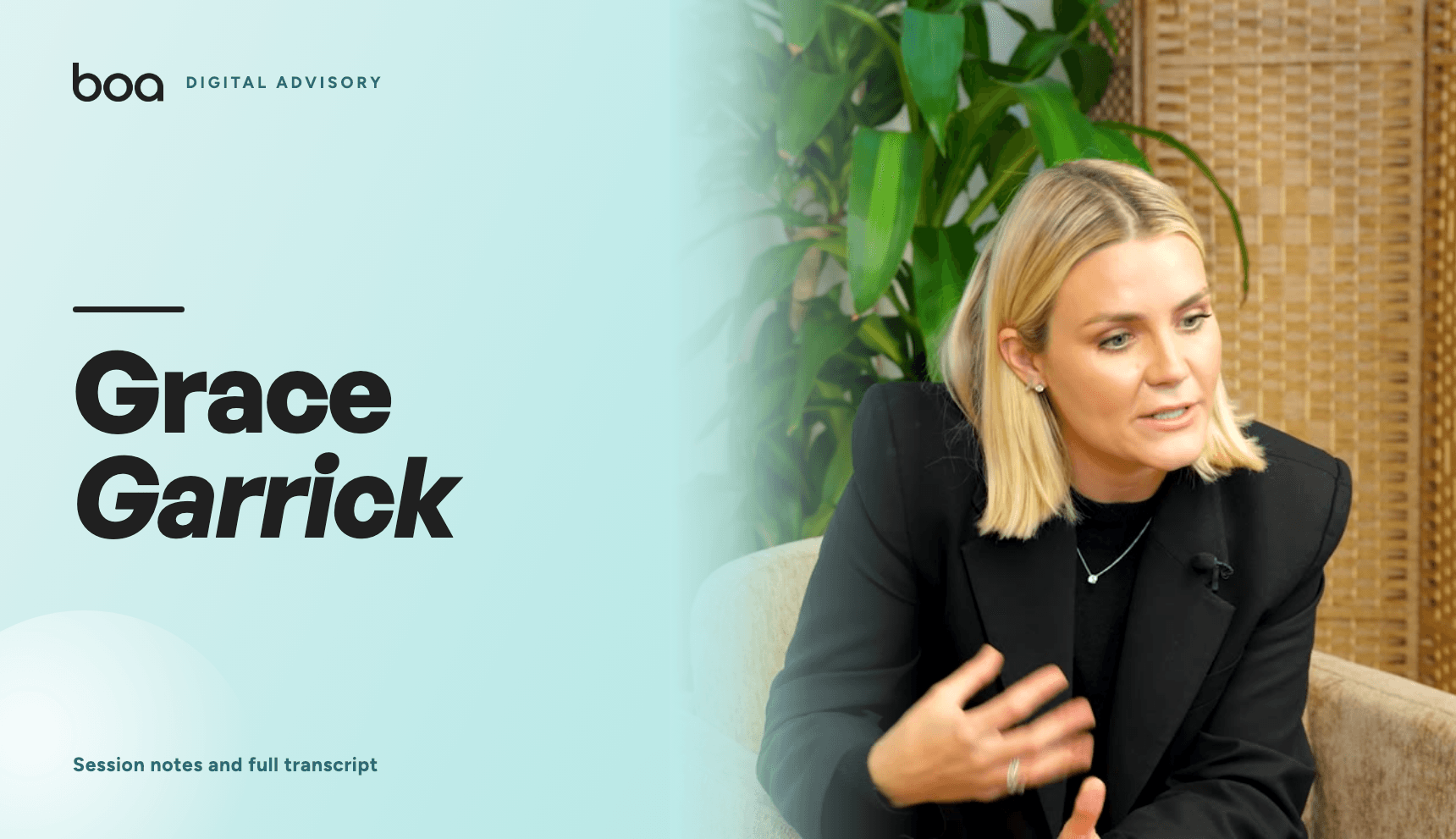
With Grace Garrick, Founder at Movement Agency · Hosted by Kirsten Scott · 46 min
What this session covers
PR founder Grace Garrick shows Australian business owners how to launch loudly on a small budget: cap your soft launch at three months, fire all channels on one day, use your personal network as micro influencers, pitch journalists with value not vanity, and run cheap physical activations that turn into free content.
A hard launch is not a bigger budget, it is compressing everything you were going to say over six months into one short, unmissable window.
Key takeaways
- 01
Cap the soft launch at three months, then go
Grace still backs building in public because it holds founders accountable. But she would never stretch the coming-soon phase past three months. Beyond that, the audience loses interest and moves to whatever is trending next, and you have spent time and money on content that no one can buy from.
- 02
Define a hard launch as a compressed window, not a big budget
Grace clarified this mid-session: a hard launch does not mean a launch event, paid talent or a large-scale campaign. It means everything you would have drip fed over six months goes out in a very short window. Same content, same spend, far more impact, because the density of the messaging is what makes it feel big.
- 03
Lift the embargo, post the content and open the site on the same day
If you are launching by PR, set one embargo date so all media coverage goes live together, then repurpose and amplify that across your socials. Do the same for your key launch content, your website and your EDMs. One day, all channels, no staggering.
- 04
Two days out is the sweet spot for a teaser
If you are using a face for your campaign, do not run three months of behind-the-scenes and can you guess who it is. Grace suggests one to two days out, then drop the full campaign: who the face is, what you are selling, where to buy. Any longer and the intrigue dies before the product arrives.
- 05
Nail your why and three unique selling points before the logo
Grace sees brands launch with beautiful branding and no key messaging. Before anything ships, be able to state your why, the problem you solve, and three unique selling points that separate you from competitors in market. If that is clear, the branding and content flows from it. If it is not, no website design will save the launch.
- 06
Always include an obvious call to action
A common misstep Grace sees on Instagram and TikTok: brands talk constantly about what they are doing, but the viewer has no idea how to become a customer. Every piece of content and every pitch should answer what value it adds to the end consumer or reader, and then tell them exactly what to do next.
- 07
Treat your personal network as your first micro influencers
Reach out to your own community before launch, validate the idea with them, take their feedback and bring them along. They become brand advocates and word-of-mouth spokespeople. For a secondary product, Grace would give existing brand-loyal customers free samples and treat them as the talent rather than paying influencers, even if their followings are small.
- 08
Pitch journalists by studying their last five stories, not your own press release
Pick the outlet, look at how competitors in your category have been covered and what angles ran. Read what your target journalist writes about and match their tone. Journalists run editorial to convert clicks, so give them data, stats and a value angle for their readers. Grace uses ChatGPT to draft the pitch by feeding it the category, positioning, value proposition and USPs, then researches the right journalist herself and offers a product sample.
- 09
Follow up once, then rework the angle
Grace's rhythm: send the pitch, wait one to two weeks, send one follow-up. If nothing, offer a coffee to run them through the idea. If still nothing, park it and build a new angle to retarget with. Never be disheartened by silence on the first pitch, the power is in the follow-up, but do not harass.
- 10
Get physical when your product only lives online
For apps and online-only products, Grace says digital is pay to play and biggest budget wins. Her alternative: QR code stickers, poster campaigns and street activations. For a pet grooming brush, set up a branded doggy stop at dog parks with uniformed staff, free brushing, treats, branded bandanas and QR cards. Film it all with your own team so the activation doubles as free content, and move to the next park if council asks.
- 11
Build a stunt around the pain point, tongue-in-cheek
Grace shared an unused campaign concept: pole-wrap punching bags in the street reading punch here if you have ever been personally victimised by a real estate agent, with a QR code straight to the offer. It stops people, gets photographed and shared, and names the problem you solve. Find the emotional pain point in your category and make it fun.
- 12
Batch your product updates into one founder's letter
For an app founder worried about update fatigue, Grace advised against announcing every bug fix. Hold minor changes and release them together in a larger moment: an EDM written as a founder's letter, plus a piece to camera for non-subscribers. Frame it as we heard this feedback and here is what we changed, not here are our updates.
- 13
Skip the retainer PR and the launch party when you are starting out
Grace told a jewellery founder that traditional press office placement is a waste on a small budget, because it takes about six months of monthly retainer to produce measurable results. On launch parties, she would not run one from the outset, only later when you have a pre-existing network that guarantees attendance and every dollar can be accounted for.
How the session runs
- 1:51Soft launch versus hard launch, and why drip feeding fails
- 4:24Where soft launch still works, and the three-month cap
- 5:36What a hard launch actually looks like on the day
- 7:23Creating hype with no following and no media contacts
- 9:31The biggest launch mistakes: no why, no call to action
- 12:20Relaunches and being transparent about what went wrong
- 15:15Personal branding: the upside and the risk to the business
- 18:56How to pitch journalists and follow up without harassing
- 23:11Q&A: launching a secondary product with a dog park activation
- 26:34Q&A: launch parties and the punching bag stunt idea
- 29:59Q&A: what budget a solo founder needs to launch
- 32:25Q&A: making a launch feel big without big money
- 37:19Q&A: app updates without annoying your subscribers
- 42:09Q&A: what comes after the hard launch, and why not ads
Mentioned in this session
- Movement Agency
- No Boundaries
- Disco Stick
- Justin Bieber
- PEPPR Beauty
- news.com.au
- ChatGPT
- TikTok
- Apple App Store
- Google Play Store
- HomeHive
- Meta
- Pitt Street
- The Commons
Questions founders ask
Grace says yes, but keep it short. Building in public holds you accountable as a founder and gets your audience invested before you sell. She would not extend the soft launch phase beyond three months, because after that people lose interest and engage with someone else's content instead.
Compress the timing rather than increase the spend. Grace says a hard launch is simply everything going out in one small window instead of spread over six months. Shoot your own iPhone content, seed around 20 micro talent so they all post in the same period, and have your website, EDM and socials all live on the same day.
Identify your three unique selling points, then research the outlet and the specific journalist who covers your category. Look at how competitors were covered and what angles worked. Build a pitch around value for their readers using data and stats, use ChatGPT to help draft it, and offer a product sample so they can test it themselves.
Grace says founder-led branding is powerful because people connect with people and it gives you a competitive advantage against legacy brands with no personality. The risk is that anything negative in your personal life hits the business. She keeps her personal life and political views out of it, only shows up in a brand setting, and deliberately builds her team as spokespeople too.
Be transparent. Grace advises naming the consumer feedback and the specific things you got wrong, then explaining what you have changed and giving a clear call to action. She cited PEPPR Beauty doing exactly this and said it made her want to support them. The exception is if nobody knew you existed, in which case just do a clean relaunch and say nothing.
Full transcript
The complete conversation, as recorded, with every speaker attributed.
Kirsten Scott0:01
All right, thank you everybody. Guys, I'm sure most of you have been to these advisory sessions before, but the purpose of them, as is BOA, is to make quality advice and networking accessible to every entrepreneur and business owner in Australia. And today we are, we're gonna be learning from someone very funny actually, I've just recently found out she's hilarious, but someone very special. Today we're joined by Grace Garrick, one of Australia's most influential PR powerhouses and founder of Movement Agency, No Boundaries, and the viral beauty brand Disco Stick. Grace has a reputation for bold campaigns and headline-grabbing launches. Grace believes in showing up loud, clear, and unforgettable from day one. And that's what today's conversation is gonna be all about. It's gonna be about hard launching your business or hard launching your brand. So making sure you get out there from day one, make a splash, get some attention, and ride that wave to your business ambitions and goals. Welcome.
Grace Garrick1:02
Thank you.
Kirsten Scott1:03
Thanks for having me. Thank you so much for being here today. And guys, please pop in the chat where you're located and a little bit about your business. We'd love to read that. We'll also have open Q&A at the end. So as we're talking, write down your questions, write them in the chat, the team will text them to me and I'll call you out to ask you a question directly. And you know, the question could be personalised about your business. So you can ask for personal advice about your business and trust me, it doesn't matter how silly you think the question is. Someone else here will find value in it as well. So make sure you ask it. We want you to. Um, Grace, why don't we start the conversation with— so today's all about launching your, your brand and your business. Um, like the reference hard launch always comes up, um, and it's something that we were talking about before. In your opinion, what exactly, what is a hard launch? Okay, as opposed to a normal launch?
Grace Garrick1:51
Yeah, so opposed to a normal launch, look, you'll see in today's current climate a lot of brands, particularly on social media, will do something known as a soft launch. So A soft launch, which was primarily sort of coined off the back of people coining a soft relationship launch on social media where they'd show a little hand at the dinner table instead of sort of announcing who their partner was. But when it comes to a brand sense, basically what that looks like is a soft launch is where a brand will sort of drip feed their announcement and/or what they're doing. And you'll see this time and time again, particularly as brands and/or people or profiles build in public. And I think that when it comes to the soft launch, it used to work really effectively sort of 2 years ago when you weren't in competition with so much content that was existing on a social media-based platform or online forums. However, now I do believe that because, as we know, it's so increasingly hard to cut through that noise. So when you are doing a soft launch and you're sort of elongating that sort of launch-based announcement or communicating exactly what you're doing and generating and pushing lots of resource into that soft launch, I personally do not believe that it is as effective as a hard launch. The reason for that is I feel that a lot of brands get into this sort of, um, almost like a little bit of a routine where they're starting to push lots and lots of resources, so time, into developing content, into developing messaging, captions, etc., and sort of saying, you know, coming soon, etc. Yet the consumer who's actually viewing that content, if it does land and get to them, are unable to make that purchase. So I think that you're putting a lot of resource into something that you're not actually generating a lot of return on. In addition to that, I feel that if you haven't got that product there or that service there for purchase, or the messaging isn't really clear 'cause you're just doing little drip-fed sort of pieces about, you know, coming soon, et cetera, I personally believe that you lose interest in what is being communicated, you lose that customer versus when you are actually doing that hard launch, you build this instant momentum, you're able to sort of reach and capture an audience instantly, and you're also able to generate a bit of a return on investment because you have that distribution-based channel set up. In addition, when you're looking at that soft launch as well, you're competing against so much content now in this day and age. So it's really, really hard to sort of cut through that noise, especially doing it in a soft sort of launch format.
Kirsten Scott4:10
But so some people, well, I mean, most people, they want a soft launch just to get the business up, to like practice, you know, often it's to get a bit of courage as well. Like I want to get it up there. So is there still a place for soft launch?
Grace Garrick4:24
Absolutely.
Kirsten Scott4:24
And if so, then, How do you think soft launches in today's world should be?
Grace Garrick4:30
Yeah, so definitely, because I don't want— and we'll probably talk about this later on today as well— is about building in public. I am a massive believer about building in public because it holds you accountable as a founder as well. But I think that when you're looking at that soft launch phase, I would never extend it beyond that 3-month period because I truly believe that you lose the sort of interest and intrigue with that consumer, and that's the last thing you want to do. You want to sort of get um, them invested, get them on board with the journey, and then have them sort of convert into that next phase so that you can take them on that journey with, with you, um, and also generate that sort of momentum as well.
Kirsten Scott5:05
But basically, in essence, the world's busy. Having a soft launch like, hey, I'm doing this, and then it's taking too long for you to actually do it, people lose interest, they're on to the next trending thing anyway.
Audience member5:14
Yeah.
Kirsten Scott5:14
And financially, it's more efficient to put the dollars into one big hard launch than drip feed them into an elongated soft launch.
Grace Garrick5:23
Without question.
Kirsten Scott5:24
Somewhat the summary. So then, um, if a soft launch is kind of announcing something's coming, or hey, I'm doing this, or whatever it is, what is a hard launch? What does that actually look like, and how do you, how do you do it?
Grace Garrick5:36
Okay, so exhibit— I actually was thinking about this last night. So what is a hard launch? Exhibit A is looking at Justin Bieber's latest album release that he launched last week. No one expected it was coming, he just did a drop, hard launch, here we are, we're live and racing, etc. Obviously we're not all going to have the same platform that Justin Bieber has, but it's just the best way way to sort of utilise that as an example. Another really, really strong example is, is say for example you're utilising someone as a face for your brand, uh, instead of sort of drip feeding being that coming soon, or you can do that one day prior and then release the campaign that next day rather than have it sort of, we've got someone working BTS behind this shoot, etc., can you guess who it is? And it sort of launches 3 months down the line and then you drop it. I think doing it sort of 1 to 2 days out and then dropping exactly who it is that is the face behind their campaign, what you're doing, what's on sale, etc., that's a really strong way to do it.
Kirsten Scott6:28
So basically just putting it all out there, bang, 100%. Don't try to hide and be clever.
Audience member6:33
Yep.
Grace Garrick6:33
So if that's, say for example, if you are a new business and that's by way of you doing your announcement by way of PR, so traditional-based media outlets, so that would be looking at really like lifting that embargo date all on the same sort of day and having that all go live and then repurposing and amplifying that across your social media. If that's your social media, also having everything go live on the same day So that might be all of your key content, um, and sort of launch-based collateral. Same thing for your website, etc. EDMs.
Audience member7:01
Okay.
Kirsten Scott7:01
And so if, uh, how can a founder create hype? Like, how could everyone here create hype? So we're launching a product, uh, or a brand. If we don't have a following like Bib's, mm-hmm, um, and we don't have a lot of media connections because maybe we're new in business, mm-hmm, um, how can we actually create hype around our brand or product through a launch?
Grace Garrick7:23
So I definitely think, particularly in this day and age, you need to really, really value the people who are around you. They become your number one supporters. So looking at what your actual personal network and community is, reaching out to them, connecting with them, validating the idea with them that you are— what and what you are looking to launch. Have them come along on that journey so that whatever you are putting out, they can provide feedback. They are invested. They ultimately become brand advocates. So they are very across what you're doing and also can act as spokespeople from like a word-of-mouth-based piece. You never want to sort of ever like sort of over— it's the word I'm looking for, I don't even know what the word I, what I'm looking for is— but you don't want to sort of— I think that a lot of people will forget about sort of how important word-of-mouth-based announcements are, so you don't want to overlook— that was the word I was looking for, I'm glad it came to me some 2 minutes later.
Kirsten Scott8:16
You want to recognise the power of your personal network posting about the launch and telling people about it.
Grace Garrick8:23
Yeah, that number one. I think number two is what we discussed earlier is bringing them along the journey, being post, sort of posting in public and very much showcasing the highs and lows of the business. But I would not be doing that super early. I'd be doing that sort of maximum 3 months prior to the launch.
Kirsten Scott8:40
But I love the concept of you don't wanna, yeah, you don't wanna overlook the power of your personal network in sharing and posting for you. They've got a vested interest in you. They want you to be successful 'cause they're your friend or family or someone some sort of stakeholder in your life, um, and, and they've got audiences, they've got friends, and they know people. So when they post, people are going to be like, oh, what's that? I'll cheque that out because they trust that person. It's essentially micro influencer marketing.
Audience member9:06
Exactly.
Kirsten Scott9:07
With your personal network. And I guess it does bring up, um, an important point, which is that you want to be constantly growing that network. You want to be putting yourself in business communities so that those people can also post and share for you, and other businesses can see. Um, what are the big What are the big mistakes you see brands make when they're doing a launch? Like, what are the big no-nos when launching?
Grace Garrick9:31
Okay, the, the number one thing is I think that a lot of brands will launch without any sort of key messaging around who they are, what the why is, what they're actually selling. I think so many people can get caught up in the actual like logo, branding, all of the fun beautiful things because it's fun, but I think the reality is you need to make sure that you're really clear on the why. So what is the why behind your business? Why should I be investing or putting my money into your product and your service. I think that's a massive thing. I think that gets lost sometimes in the pretty sort of content and aspects like that. Um, in addition to that, I think that distribution— I think a lot of the times for me personally, if it's not really clear on how I can actually make, um, or there's no clear call to action is probably a better word to say, if I don't know how I'm going to actually be able to be converted as a consumer, I think that's a massive, massive misstep, and it's something that happens all of the time. And then I just think it comes back to that key messaging-based piece. I think the number one thing that founders And people who are looking to launch a business, you need to be really clear on what your unique selling points are as a business and what your why is, because everything else comes back to that. And I think a lot of people miss that from the outset in this day and age because they're too focused on building that amazing website and the content and things like that.
Kirsten Scott10:41
Looking good.
Grace Garrick10:42
Yeah, the branding aspect, which, yes, that's important, but I think if you have a really clear understanding of your why and the unique selling points of what you're looking to do and the problem you're solving, I think that that naturally will be built into the branding and key aspects like that.
Kirsten Scott10:56
But so basically though, you don't launch anything until you've nailed your why, which is somewhat your core message. Um, and it's what people are going to— it's good, it's what people are going to, um, connect with your brand with. They're going to rely— oh, that's me, I relate to that, or I like that why, I share that shared value, so I want to buy from that brand. And that which leads you to the next thing, which is the call to action.. So don't just say, this is our why, this is our product. They need to say, now press this link, do this, and you'll receive it in 2 days, whatever it may be.
Grace Garrick11:27
Because you'll see lots of brands will launch, and it's still to this day, I see it all the time on Instagram or TikTok. People are constantly talking about what they're doing, but then there's no key message. I don't know what their unique selling point is versus the competitors in market. I'm not across why it would benefit me, um, and what's the sort of value add. I think you need to always look at whatever you're putting out on a social standpoint or from a PR standpoint, what value are you adding to that end consumer or the reader?
Audience member11:51
They are.
Grace Garrick11:51
And so I think that that's a massive, yeah, massive thing that's overlooked.
Kirsten Scott11:54
Guys, if you have any questions about how, like, if you want to ask a specific question about how to launch your business or relaunch your business or launch a product, put it in the chat because I'll call you out and you can ask Grace yourself. You can ask Grace personally your question. But that actually brings up something for me as well. Relaunches. Like, I've done that a lot of times. Like, I launched something, it was a bit of a flop, I did it all wrong, like, you know, and then we're like, oh, okay, now we're launching and we launch and we launched again.
Audience member12:20
Yeah.
Kirsten Scott12:21
What's your opinion on relaunches and can they be just as effective as launching in the first place?
Audience member12:25
Yeah, absolutely.
Grace Garrick12:26
We've had loads of clients, particularly say for example, have clients who they started, they had no budget from the outset, so they did everything themselves and they will be really, really transparent in that, you know what, I got X, Y, and Z wrong because there weren't a lot of resources when they sort of launched a few years ago. And I think that relaunches are absolutely fantastic. I think there's really, really smart and strategic ways that you can do that. Some of those being, I think the number one thing is being really transparent and acknowledging sometimes perhaps this is why we're looking to relaunch., and I think it comes back to that feedback piece, is looking at what the core consumer feedback is or what were the key sort of failings or key learnings, and then looking at those as opportunities and addressing them in that relaunch-based rollout plan. So I think when you are doing that relaunch, you're saying, this is why we've decided to relaunch X, Y, and Z, because we noticed that when we did launch, we made X, Y, and Z sort of key faults, or we know that we could have done this better. I think that when you are relaunching, you need to be really transparent because I think the consumer in this day and age, because there's so much content there across everything, they are very, very savvy.
Kirsten Scott13:26
So they know that you're relaunching.
Grace Garrick13:27
100%.
Kirsten Scott13:28
So you've got to say like, hey, I'm relaunching.
Grace Garrick13:30
I think, I think it's the best way to do it personally. I think that the number one thing is you need to not view your consumer as an idiot. You need to bring them along for that journey, be really transparent, really open and honest. Again, it's case-by-case basis because you might be a brand that you're relaunching because no one actually even knows that you exist. That would be a different story. I wouldn't even address it. I just do a complete relaunch. So it just, it very much depends on, yeah, what your initial launch strategy was.
Kirsten Scott13:54
But I do like the idea of being transparent and then therefore taking the— taking your customer on the journey with you. Like, oh wow, they're doing another launch now because they've reached a certain level and they're better and they're whatever it may be.
Grace Garrick14:05
Yeah, I've read actually a post last night from a— it was a beauty brand that's just launched. It's P-E-P-P-R Beauty, and they're not a client of ours, but I did— I thought it was very, very smart what they did last night. They announced that, hey, you know, we've taken on the feedback, we know there's some product learnings that we need to take on board, we're doing X, Y, and Z, and then just provided what their call to action was moving forward. And it made me, as a consumer who's actually purchased the brand, go, I want to support them. That takes a lot of courage. I love how vulnerable they are, and I want to support them along that journey. I think that's really, really powerful, and I think it's how brands should show up in this day and age.
Kirsten Scott14:37
And it's just being different to what anyone else would do.
Audience member14:40
It stops—
Kirsten Scott14:40
which is kind of a scroll.
Audience member14:42
Yeah, it does.
Kirsten Scott14:43
Yeah.
Audience member14:43
What—
Kirsten Scott14:43
how are they employed?
Audience member14:46
I'll use that.
Kirsten Scott14:47
Um, now a lot of people talk about personal branding. Yeah, it's a big topic on BOA. We, a lot of the advisors we have, we talk about personal branding. Obviously personal branding can play a role in, in a launch, in a successful launch. We see a lot of influencers launch businesses and they get a lot of instant kind of clout for it. And what's your opinion on personal branding and are there any concerns or things you think people should be careful of with personal branding?
Grace Garrick15:15
Yeah, I think personal branding is absolutely incredible if it aligns to the brand. So Say, for example, if you are a founder that sits in your core target audience and what you're looking to offer and/or push and promote, there is no better spokesperson than yourself. You know the brand inside and out. No one can sell your brand like you can. Also, the reality is people connect with people, and naturally, as a founder, you build the personality for your brand. And I think that's why it's really, really powerful. However, I do think that it's not something that's an absolute must. However, we always do encourage it because it allows you, when you are up against key legacy brands who may not have personality or a founder behind the brand, it allows you to have a competitive advantage, particularly when you are dealing with a low budget. However, again, it does very much depend case by case. Back to the question on when can it become— is there any sort of issues surrounding that? There are. It works very similarly to an ambassador. So when you do deal with one key ambassador, you are then reliant upon how that sort of founder and/or the ambassador shows up in the community. So say, for example, if something negative happens in your personal life and you are the key the spokesperson behind the brand and/or business, then naturally that is going to cause negative impacts on your actual business. So I think that you need to have a really, um, sort of strategic play in regards to ensuring that your personal life is not too heavily aligned to that founder and/or profile of the brand and business. Something that I do personally at my business called Movement Agency, which is a PR agency, is I'm really, really strong on not pushing myself on the social media platforms and channels all the time. Because later down the line, I want to make sure that my team who work day in, day out across the business are also seen as key spokespeople, and then that our clients trust them. So I think that's really, really important. I also think that you need to ensure that no matter what happens, that you keep your business safe and you safeguard it. And really strong ways to do that is to ensure that whenever you are making commentary as a founder and profile of the business, that you're never making it too personal and about your personal life and your personal interests and bits and pieces like that. You are only ever showing up for the brand in the brand-based setting whereby it's actually reaching out to that target audience and that you're not trying to be your very own influencer. Because I actually made a joke earlier, at the moment you'll see on TikTok a lot of, um, sort of business leaders are becoming these large-scale influencers off the back of building business because that's becoming the next sort of creator economy, or the creator aspect. They love an entrepreneur. So I think you need to be really, really careful about not showing too much of your personal life if it's heavily aligned to the business, cuz you wanna create a clear divide.
Kirsten Scott17:51
So basically if you wanna create a personal brand for your business, it has to be for your business. It's not for you. And that's actually hard to do because you, it's very, very hard. You would want to say things that aren't exactly for the business that are your own opinion, but you can't. In your opinion, it's best to speak for the business. Otherwise you can get in trouble.
Grace Garrick18:09
100%. Cuz say for example, if something negatively happens, like you, you lose your license.
Kirsten Scott18:12
You say something stupid and it comes up, the media picks it up. Up and it goes.
Grace Garrick18:16
Yeah, or you have different political views, etc. It does have a negative impact on the business. So I think you just need to be very, very mindful about who you are as a person, how you show up in the community, etc.
Kirsten Scott18:26
Um, now another way to gain credibility and traction and eyeballs when launching your business is obviously through PR, which you're the queen of. Um, what advice do you have for people to be able to to get some publication or media recognition, whether it be big or small, and how can they then use that to, um, to benefit their business or to kind of solidify the fact that they're legit? Yeah, which is what, in my opinion, media does.
Grace Garrick18:56
No, it does. So basically, just as a really short background, traditional media or PR, say press office, is really great in regards to building out that credibility because you're having a publication sort of really talk to their audience and solidify exactly where you are in market, position you, and then ultimately you're able to generate leverage off the back of their existing audience. So it's really great in regards to that. Also building SEO, etc., if it's online. Um, in regards to if you are doing it yourself or you're launching a business, some of the top tips that I recommend are really, really brilliant are identifying what your 3 unique selling points are. So how do you show up and how are you positioned in the market compared to your competitors? What value are you adding? To both a consumer and then also a media or a journalist. So say, for example, if you are looking to get some traditional press office placement for yourself and your business, what I would suggest doing is really honing out, say, for example, it is news.com.au. I'd be looking at really sort of relevant articles that sit in your existing category. So say, for example, if you are in the activewear space, I'd be looking at your competitors. How they've shown up on those publications and/or outlets, what were the key angles and what was the story. I'd then be looking at, okay, great, bring it back to your brand. What can I do to add value to this journalist so that they're enticed to write about me? Because you have to remember that journalists only look to run editorial-led placement, which they're running it in the hope that they're going to be able to convert clicks. And how they do that is by adding value to their audience. So you need to think about how that journalist is going to look at your storey and go, this is going to add some really great value. And how you can do that is through data, through key stats, through your unique selling points. And then you would draught a pitch. And if you're unsure about how to draught a pitch, we've got this fabulous thing now called the internet, but also ChatGPT. And I would type in, hey, I'm looking to do X, Y, and Z. This is my sort of value proposition that I'm going to provide to the publication. This is the category I sit in. This is my key positioning and these are my unique selling points, and then can you please help me generate a pitch? And I get that to help me generate a pitch. I would then go and do my own research on the actual website itself, see what journalists write about fitness because you're writing about an activewear brand, and then pitch that to the journalist and always offer them a product and/or sample so that they can actually test and experience it themselves in the hope that they might be able to cover it. So that's just one easy way to do that.
Kirsten Scott21:23
But I love the perspective of you've got to understand the journalist has a job and their job is to get clicks. That's what they're getting paid to do, right? Things that get people to click so that they can sell ads. So if you focus on that and not focus on yourself trying to win for yourself, you focus on trying to win for the journalist, journalist more likely to select your article.
Grace Garrick21:42
And also I think having a vested interest in what they're doing. So the journalist, so if you are in the wellness space and you are, or fashion, you're pitching out an activewear brand, look at the fashion-based, um, publications. Look at what the journalist you're pitching to has written about before. See what their tone is, what language, what resonates with them, and then target it and tailor it to them. And never, ever, ever be disheartened if you do not get a reply off the first pitch. It is very rare that that happens. And I say this time and time again, the power is always in the follow-up. And PRs are really, really good at never taking no for an answer. So how that sort of works, I do the first pitch, I'd allow 1 to 2 weeks, and then I do a follow-up pitch. If that hasn't worked, I would then ask to take them out for coffee, etc. Can I please run you through my idea? Or then just, okay, parking that, we need to rework the angle and then coming up with a new angle to then retarget.
Kirsten Scott22:29
So it's essentially like a sales process. You're not gonna, you know, hit someone with one ad and hope they buy. You want to get them with 3, you know?
Audience member22:37
Yeah, exactly.
Kirsten Scott22:38
So if you contact a journalist and they don't reply the first time, well, you follow up in a week or 2.
Grace Garrick22:43
If they don't follow up again, and then stop, and then retarget the angle because you don't want to also harass them.
Kirsten Scott22:49
Delicate line between being good and being hated.
Grace Garrick22:52
Yeah, we can't have We can't get on harassment charges for pitching. Okay, we have to be mindful.
Kirsten Scott22:57
I do want to move to questions. I know there's a few questions through. So, um, um, Rachel, do you want to ask the first question?
Grace Garrick23:08
Hey guys, hey Daniel, hi Grace.
Kirsten Scott23:09
Hello.
Grace Garrick23:11
Um, super quick question, just this is like a really tactical— we're about to launch some new groom, like a brush and a comb, so it's a secondary product offering to our core range, which is like dog perfume and 2-in-1 conditioning shampoos for dogs. Um, if it's like that secondary product, um, and you're a bit time-spread, like, is it— is there any smart launch tips for a product like that where it's— you don't want to sort of go too big, but you also don't want it to have no attention and just float under the radar? Yeah, any tips, I guess, on launching something like that? 100%. I would look at who your core bread and butter consumer is existing. You're saying it's a secondary product, so I would look at who who are the ones that purchase from me from the outset? Who are those brand loyals? I would reach out to them and provide them either a free sample— rather than doing it through by way of influencers, I would see your own community and your own people who already have purchased and invested in your business as those sort of key influencers. I would utilise them as part of a key campaign whereby they are communicating what the unique selling points are of this new product, getting them to talk to their community even if they don't have large-scale followings. I think so much more powerful. You're also almost like bringing them on on that sort of creative-based journey. Ask them for key feedback as well and see them as your very own sort of talent. I would then, um, did you say it was a dog brush or a pet grooming? Yeah, I would go down to key sort of dog-based parks. I would actually do an activation whereby you have your very own like doggy stopping-based area and do it as like a little bit of a guerrilla stunt. Come for a brush and have people completely dressed in really awesome unique uniforms where they're offering these sort of like pet grooming service. Um, you can promote it on your socials, promote it on LinkedIn, in, talk to it on TikTok, really build up the hype and awareness, do it as a guerrilla stunt, and then if the council asks you to move, move on. You did not hear that from me.
Kirsten Scott24:56
To the next dog park.
Grace Garrick24:57
Yeah, and then have it so you actually get to showcase the product in action. You then utilise that as a content generating piece whereby you've got your team on the ground or yourself on the ground filming everything, so you're not having to pay for content. And then I would give them the product sample, and then you can also have like QR codes and bits and pieces there. I would do just little cards as well, doggy treats, do cute little branded doggy bandanas, have a little bit of a moment and create that as a bit of a content piece and have that as like your hard launch.
Kirsten Scott25:26
That was some incredible free advice.
Audience member25:29
We love. Very good.
Kirsten Scott25:33
Rachel, are you happy with that or should we— are you happy to move to the next one?
Grace Garrick25:36
Amazing, thank you so much. Appreciate it, Grace.
Kirsten Scott25:38
And nice to see you.
Audience member25:39
Ben?
Grace Garrick25:39
You too.
Audience member25:44
Hey guys, thank you. Um, I think I've answered my own question just from what you said after I actually posted it. Um, we've been filling up— what we're doing is we're automating the self-employed income part for mortgage brokers. It's very niche, just for the mortgage brokers. We have content which we started yesterday. We're launching in a month. Um, so we're actually speaking to business owners about their experience of applying for loans because you kind of know what the answer will be, like, oh, go back and forth, this and that, whatever. But there's no— because I'm not paying clients at the mortgage brokers, we should be interviewing the mortgage brokers, I think, too, for content to put out there. But I guess your opinion on launch parties, like, do you think if we held a launch party and we invited all the mortgage brokers there and stuff, we get content there, do you think that's worth it or you think it's maybe not the best use of money?
Kirsten Scott26:34
Did you hear the whole concept?
Audience member26:36
Yeah.
Grace Garrick26:38
Sorry. Yeah, no, I do. I get it like a general understanding. I personally, hi, sorry, that's so rude of me. I personally don't think that it depends. Launch parties can be really, really great if the core objective is to say, for example, you're an app and you wanna get out and about in a physical sense and you're sort of generating momentum and traction that way. Also, they're really, really great if you've already got a preexisting network whereby you know that people are going to show up and every dollar is going to be accounted for off the back of a return. I probably would not do it from the outset. I would do it later down the line once you've got a preexisting audience, you've ironed out any of the key learnings and you're able to then sort of make sure that your product's really slick and et cetera. What I would do, something that I find particularly in the finance space space and how you can sort of bring it into a bit more of a mass-based market is I would look at what are the key pain points and what's that problem that you're solving. And if that problem that you're solving is, say for example, I'm just going to do it to something that I know, I don't really work in your sort of space, so I'm, I do apologise if I'm not very, very clear on your space. But if, say for example, it was a real estate agent, one of the key pain points with real estate is that people feel that they're not very trustworthy, right? I don't know if it's the same with loans, etc. So what I would do is I would do some sort of stunt and/or campaign that really targets that pain point from the outset. So like Have you ever been burnt off the back of a real estate agent or off the back of X, Y, and Z? And this is what we're doing to address it, blah, blah, blah. We actually came up with a really cool campaign and I can talk about it because we didn't deploy it. So you're welcome to use this if you want. We actually came up with these, I saw it on Pinterest, there were these punching bags that you can wrap around poles and it was like, please punch here if you've ever been, it was like a pole punching bag. So it was like taking the anger out of it. It's like, please punch here if you've ever been personally victimised by a real estate agent. And it had a QR code where you could go directly direct to the thing. I thought that was really, really smart and unique because it captivates an audience straight away. You're like, what's a punching bag doing here? People take photos of it, so it's really smart and unique. And then it also had a QR code direct to what they were offering. So I would look at ways, like, can you do something like that where you are identifying the problem from the outset, what you're doing to solve it, and then make it fun and tongue-in-cheek so that you can actually communicate to that sort of audience? I hope that— is that— does that sort of answer your question, or could I be better?
Audience member28:52
That's amazing. Yeah, that's brilliant. Yeah, I didn't even ask that. You gave me something much better.
Kirsten Scott28:56
I might even steal that, to be honest. I'm going to put punching bags all over the city. Punch here if you're a business owner and need to let out some steam. I know, actually, that's a great idea.
Grace Garrick29:04
Maybe we should—
Kirsten Scott29:04
sorry, sorry.
Audience member29:07
Um, thank you very much.
Kirsten Scott29:10
Thank you.
Grace Garrick29:11
Lana?
Audience member29:14
Hi. Hi, Grace. Hello. Sorry, I'm not having my video on. The internet bandwidth's not great.
Grace Garrick29:19
So fine.
Audience member29:20
My question, uh, is I'll give some context firstly. I make clip-on earrings in costume jewellery space. So a bit different to everyone else. What sort of budget should I prepare for launch? I've got a massively broad ideal customer base from kids to older ladies, drag queens, you know, and everything in between. I know where all my market— target markets are as well., and I think there's an opportunity with ladies whose lobes have stretched. But thinking, I'm startup, I've got no money, solo— yeah, what am I looking at, um, for a launch?
Grace Garrick29:59
Are you, are you primarily selling online, or will you have like some sort of physical store?
Audience member30:04
No, I don't have a physical store, primarily online. I've been doing markets, I'm transitioning to online. Awesome. And I'm also starting to approach stores to stock my jewellery.
Grace Garrick30:15
Fantastic.
Audience member30:15
So, a bit of omnichannel, basically.
Grace Garrick30:17
Yeah, awesome. So, your question was in regards to budget. It is really, like, it's very difficult to sort of communicate exactly what budget you can do from the outset, but I think if your budget is limited, I can provide— would it be better if I can provide strategies or direction in regards to what you could look to execute on a minimal budget, or would you like me just to say this is what I would recommend? Because from a PR standpoint, I would probably not do traditional press office placement. So, that would be what we do on a regular basis. I think that would be a waste of money. Just because you basically what you do, you need to allow sort of 6 months for that to generate into actually sort of measurable results. And you're going to spend a monthly retainer, which is going to be ridiculous for what you're going to get in return. So is that sort of how did you want me to answer that? Would you like me to provide strategies or?
Kirsten Scott31:08
Sorry, Lana, maybe your internet. Well, while we wait for Lana to come back, Josephine, do you want to go?
Audience member31:17
Yeah, sure. Yeah, hello, Daniel. Hello, great. Thank you for that. Um, just two questions. Um, you know, obviously, is, um, every product is different. So when you say first 3 months, uh, you know, word of mouth and feedback, sometimes it's, it's not enough. So we need more than that for people to know, especially if it's something new. That's the first thing. The second thing, it's similar to Lana, where when you say big launch, what kind of budget we are looking for? Because obviously if it is like PR or, you know, Meta ads, that's at the start, we're gonna be like $20,000, $30,000, $40,000, for example. For example, just to make a big launch. So as a startup brand, it's a big challenge. So how can we manage something like this while we are still starting up and we want to launch it as a big one?
Kirsten Scott32:25
I think another way to ask that is how can you make a launch look big without spending big money?
Grace Garrick32:29
Yeah, which is such— yeah, and thank you for asking that question because it's clearly something I didn't address. That is such a brilliant question. When I say hard launch, a hard launch doesn't need to be, we have launched with the biggest, boldest, large-scale campaign. It's just more so meaning rather than drip feed the content that you would do over a 6-month period and beyond, which a lot of brands do, I would suggest doing it in a really short window and launch-based period. You do not need to do a launch event. You do not need to pay talent. You know, you don't need to do anything like that. It's just about that, like, making that launch scale and that window smaller so that it feels more impactful to that end consumer. So it might be, say for example, you want to have your rollout plan over the scale of a 3-month period like we did discuss. I know you said before that it's not a long enough time to get an understanding of key feedback, etc. I'm purely just talking about what you're doing from an external communication standpoint, not what you're doing in regards to behind the scenes, in regards to feedback, etc. I think that when you are doing a launch, you want to make sure you've got sort of that 3-month window where you're bringing them along for that journey, you're showcasing what you're doing from a behind-the-scenes standpoint, and then you might say within 2 weeks time or 2 weeks out from launch, we're doing this, coming soon, blah, blah, blah, sign up to our waiting list. And then you've got that audience already captivated. And then so then when you launch on the launch day, they are across exactly what you're doing. It's not sort of spread out where they've already lost interest. Interest and engage with someone else's content. I think then what you're doing from a launch-based standpoint, I would just be heavily driving your very own content. That does not need to be super expensive. It could be finding some really unique people in your very own network to wear— say, for example, I can see that you're an eyewear brand— wearing the sunglasses, showcasing what the unique selling points are. Maybe doing a day— welcome to a day in my life with Venn Eyes. I'm going to show you exactly what I get up to, and you can the day through my lens, or see my day through my lens, etc., and they can do something really unique just shooting iPhone-based content. I would then look at some micro-based talent and look to send to, say, 20-based talent. They don't have the biggest followings, but they will actually take the sort of communication and the content seriously, get them posting and talking about your brand and the product and why it's so unique and beneficial and why people should be investing interested and ultimately invest in your brand, that's what I'd be looking to do. But I would be looking to do it over a small window so that I would already reach out to the talent prior to launch so that when you launch, they're all posting about it in that one period of time. So I think probably what I didn't do correctly from the outset was identify what a hard launch is. A hard launch is just making sure that everything that you've got going out in terms of your marketing, your communications, it's all going out in a really small window versus spread out over a really long period of time. Because you want to make sure everything you do has large-scale impact despite it being on a small budget. And that's how you create that large-scale impact, is you do it in a short window over a short period of time. You can get large-scale impact, and that allows you to then compete with these large-scale budgets.
Audience member35:42
Yeah, I think what I get as well, I mean, whatever, after 3 to 6 months when we go to another, for example, event or a big launch with, you know, some of the talent or whatever. And then we— so this is something new to the social media and to my followers, what we are doing. So, and that maybe like 1 month or 2 months until we talk about it, and then another one with another event or something. So that's small steps but new ideas and really related to what we are doing and new perspective how people deal with it, something like this.
Kirsten Scott36:29
Is that a question or is that what you've summarized?
Audience member36:31
Yeah, what I got here.
Kirsten Scott36:33
Okay, good, excellent. Thank you, Josephine. Amanda?
Audience member36:37
Thank you for that.
Kirsten Scott36:38
Thank you.
Grace Garrick36:40
Good morning, Daniel and Grace. So my business is HomeHive, which is an all-in-one family app. It's just launched on Apple and Google Play Store last Friday, but it's definitely a soft launch that we kind of built up over 3 months. But now that it's launched, obviously there's features and updates that are required. Is a hard launch best for my business, and how often is too often? Because I probably want to, you know, engage in my customers or people that are currently on it that there's bigger and better things, but I don't want them to kind of die off on my subscription as well. So yes. No, that's a really great question. Firstly, congratulations. That's a mammoth effort to be able to release a tech app and have it on both platforms. So well done. I can imagine how long that's taken you. One thing I would say is like, I don't want anyone to take away that the like soft versus hard. I think just making sure that that soft launch is the 3-month window is absolutely perfect. That's incredible. From what I'm hearing from you is that you just want to make sure that you don't want to sort of alienate and sort of push customers away by constantly being like, hey, by the way, we've got a new update, blah, blah, blah. And they're like, okay, we get it. Enough, enough. Maybe Daniel might even be able to relate to this too. I think I would just like, I would definitely identify what is really important. What are the most value-adding base sort of changes and updates that you're providing to that consumer? What are they going to appreciate the most? If it's minor tech things, like, um, hey, like something that you've noticed. So it could be little bugs that you have on the app and things like that. I don't think that they need to be, um, sort of announced as an announcement on their own. I think I would hold it to a bit more of a large-scale format about, hey, we've heard feedback, um, in regards to X, Y, and Z, and I want to update you. And I do it by way of, um, I would do an EDM, um, as like a founder's letter, and then I would also do a piece to camera as well for your audience on who aren't subscribed to the actual platform themselves, and I would address it all in one go. I would be very, very mindful. You do not want to keep going, "Hey, we've got another update," every sort of 2 weeks. I think that's far too much. I would save it and look at it like the hard launch, but have it all in one thing so everything that you do has impact, has value, and they can actually take it away and go, "Wow, that's really insightful." But when you do that, I wouldn't just go, "We've done these updates." I think that the best thing you can do as a founder is be very clear that you've listened to the consumer about what those key pain points and problems were that they were facing, because I think that especially with apps, people might be like, oh, that app is so— it's done X, Y, and Z, and it's annoying me, blah, blah, blah. I think I would identify those key problems and how you've addressed them, because you want to show that you're bringing them on that journey and that you're listening to them, and then you're making relevant changes. But then also, I think outside of that— I hope that answered the question— if you want like key launch ideas and strategies, I think that with apps, the hardest thing that you'll face is that you're primarily only online, and that is the hardest I I personally believe in this day and age, the hardest way to sort of really cut through the noise and convert consumers in this day and age, because it's all just pay to play, it's the biggest budget sort of wins. And that's why I was talking about that sort of hard launch being really impactful. I would do really unique things that would align to what you're offering, and it could be like by way of just QR codes on stickers and doing unique poll posters and doing things that are like in a physical sense, and or getting on the ground and handing out key things that align to your unique, um, service offering. No, 100% agree. I actually went to a community market and was— had a stand with it and did feedback there. Then local MPs came up to me, so I've been able to be approved with maternal health centres as well.
Audience member40:23
Awesome.
Grace Garrick40:24
For one council. So it's just that, yeah, I 100% agree with you, is actually being there. Yeah, providing those launch codes too, and QR codes, because Agreed. Yeah, that will be your biggest sort of competitive advantage, just bringing it out of the digital space and going physical with it, because that's— yeah, that's awesome. How exciting. Thank you.
Kirsten Scott40:44
Thanks, Amanda. Daniel.
Audience member40:49
Hey, how's it going, Dan?
Kirsten Scott40:50
G'day, Maddy.
Audience member40:51
Hello. A lot of the questions have probably answered some of mine in pieces anyway, but I'm conscious of time, so I'll dive straight into to it. I'm basically launching a product which is kind of in phase 1, which is kind of— I'm thinking about this whole soft-based, if I'm doing it in a phase basis, but essentially a non-clinical breathing test that allows the everyday person to understand how their breathing is impacting sleep, stress levels, etc. The idea is actually to build that database first, and I've been working with a lot of kind of more medical professionals to help validate a lot of the findings as well. So the idea is just trying to get as many people taking the test, right? So let's say I go out to LinkedIn, Meta, the mailing list, all the people I've worked with so far, throw it out there, gets a few captures, but maybe not enough to really generate as much as is needed. What's next after that? How do you start to build on that initial hard launch? Should I be thinking about paid ads straight away? I think you mentioned trying to time things together. Yeah, that's really kind of what my biggest thing is. It's like once it's out there on a hard launch, what next?
Grace Garrick42:09
Who is— that sounds really like so interesting. I feel like I need to learn how to breathe properly. I sound like a pit bull half the time, breathing out my mouth. That's so interesting. I think that— who's your target audience that you're going after?
Audience member42:25
So, so far I've been targeting kind of like the high paced individuals in the tech companies and things like that who maybe don't get enough time to cheque these things. So I've made it really quick, easy, and simple for them to have those light bulb moments.
Grace Garrick42:38
Yeah, awesome. I think that like a really great way to build momentum from the outset, unless you have like schoolions and schoolions of budget, which I'm sure we— who has that? No one in this day and age. Hello, cost of living crisis. Um, I would find— I would probably like, like, Carb is the ultimate example of this. I would be going into key networking-based sort of houses whereby you know that you've got your target audience sitting there, you've got them in a moment whereby you can captivate them and capture them and talk them through exactly what you're doing. Because I think what you're going to find is it's really hard to provide that education-based piece and the sort of value and why you're doing what you're doing online. It is very, very hard because you need them to be really engaged. So how I would do that is I would be leveraging off pre-existing communities in the market that already that following of your target audience. So Cub is perfect. In addition to that, I'd be getting on the ground and just connecting with inner city workers who might be high performers in the city. So I'd be going down to Pitt Street and having some sort of like, um, it could just be something that stops someone in their tracks. We're handing them out just a little A5 card that's like, hey, did you know that X, Y, and Z, um, you could have had X, Y, and Z sleep at night, or whatever it is, because you're speaking to an audience who who in their day-to-day life would be naturally tired working in the city. They're in their lunch break. I would go down and do something like that, or I would offer them—
Kirsten Scott43:58
even the co-working spaces, brilliant.
Grace Garrick44:00
Yeah, co-working spaces, that's such a good idea, like The Commons, etc. I would be going down there and handing them a QR code or doing something, or like a little info sort of poster that targets that pain point that you're solving, um, and something that's going to be relatable to them. Like, I would definitely talk to sleep, etc. Um, then also like you could tie that in with like giving them something, so like a pay-it-forward-based campaign so it actually resonates with them. But I'd be getting on the ground and providing that education-based piece that way. I'd also look at any podcasts or key platforms you can get on that will also talk to that education-based piece, because I think that putting your money into ads, it will be very, very difficult to convert that consumer from the outset if they do not have the understanding of the education-based piece from the outset. And so that's very hard to do. So I think getting out in a physical sense, selling it, and then finding platforms where you have a sort of long-form content ability to talk them through what you're doing. That's what I'd be doing. I probably wouldn't be putting a lot of money into ads because I think it's hard. You end up throwing lots of money at these brand awareness-based campaigns, but because it's so heavily reliant on credibility and education, you need to do it in different avenues.
Kirsten Scott45:10
Thank you, Daniel. Guys, unfortunately we are out of time. I know there were more questions, but we can't go longer than this. We appreciate you all for being here today. Grace, thank you so much. Hi, thank you. For sharing some awesome ideas. And guys, we love you. We love all business owners. That's what BOA is about. It's about giving us all the network and the mentors needed to make our dreams and ambitions a reality. So we appreciate you so much and we'd love for you to share about BOA on your socials and anywhere because we're working really hard to create a product that we I think is going to make a big impact for business owners across Australia. So thank you all and have a wonderful day.
Audience member45:47
Bye!
Watch the full sessioninside Boa.
Session notes are free. The recordings, the live advisories and the founders in the room are for members.