Digital Advisory
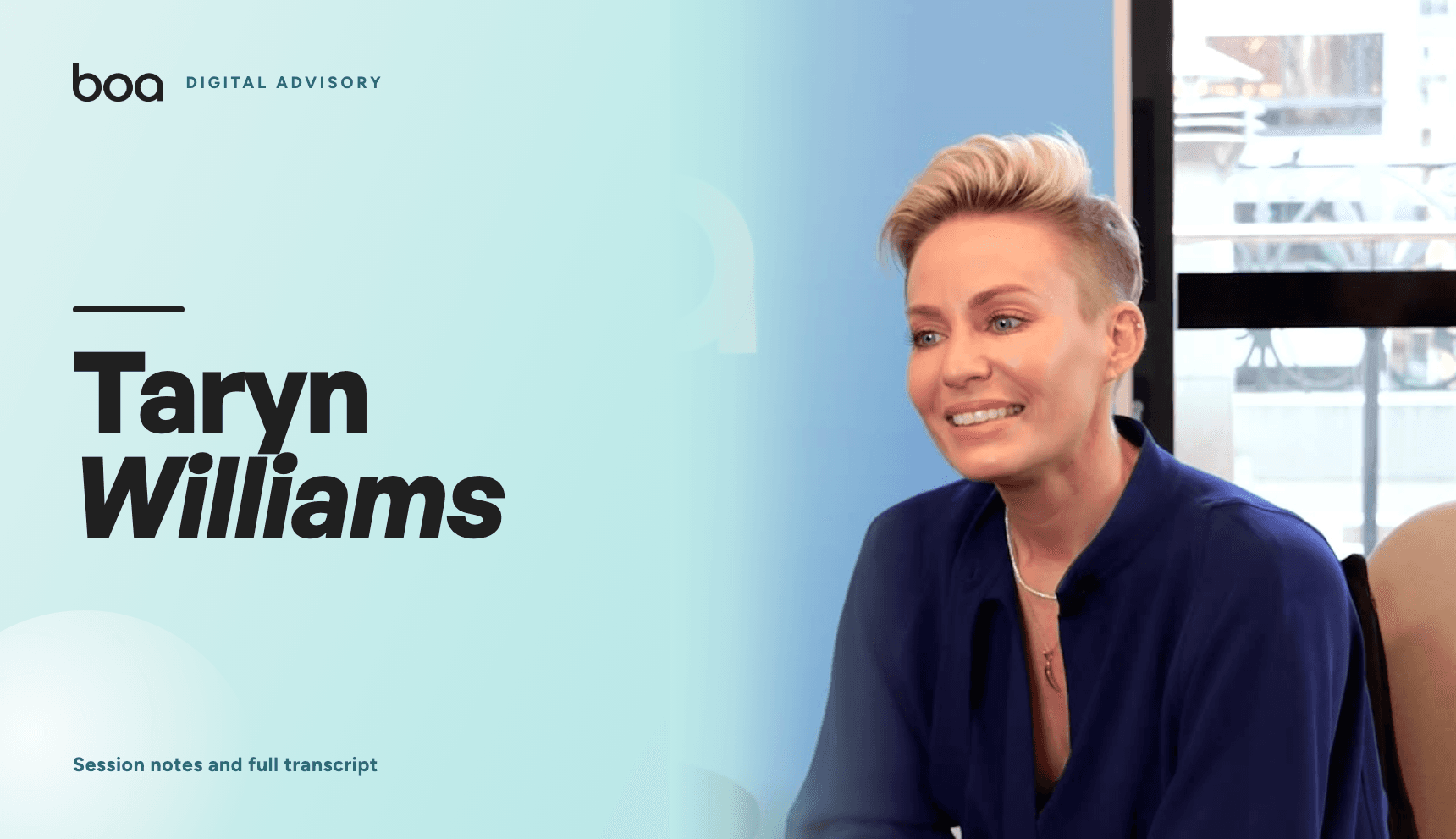
Taryn Williams on Cheap Ways to Grow Brand Visibility
With Taryn Williams, Founder at #Gifted · Hosted by Boa host · 40 min
What this session covers
Taryn Williams explains how to grow brand and personal brand visibility without a big budget: use new platform features early, pick niche creators over vanity metrics, build a personal CRM of contacts, fix mid-funnel conversion for new products, and start investor conversations a year before you raise. Practical for Australian founders and marketers.
Platforms reward you for using their newest features, so dabbling in Reels or LinkedIn video lifts the reach of everything else you post.
Key takeaways
- 01
Use every new platform feature the week it drops
Taryn says LinkedIn, Instagram and TikTok penalise accounts that ignore new features. When Reels launched, non-users saw the rest of their content suppressed. LinkedIn currently wants video, so post video even if it feels awkward. The platform reads you as a good user and amplifies your other content for free.
- 02
Chase niche creators, not follower counts
Instagram's algorithm is shifting towards TikTok's model, where the content itself is classified and served to people interested in that niche rather than to your existing followers. So stop paying lifestyle influencers with what Taryn calls vanity metrics. Find creators making very specific content (parenting, vegan food) that matches your category, because that content now gets the bigger reach.
- 03
Book one networking coffee every Friday at 8am
Taryn ran a standing rule of an 8am Friday coffee with someone new, went to every event she could, and joined clubs. She also cold messaged people on LinkedIn. She kept that up for roughly two years before the inbound enquiries started, so treat it as a two-year build, not a quick win.
- 04
Cold outreach works when you bring one narrow question
Taryn messaged a CTO with: I need to build a payment gateway, can I have 30 minutes, I've narrowed it down to Braintree, PayPal or Stripe, why should I pick one? He took the meeting and later became a mentor, advisor and chairman of her board. Vague asks like "help me grow my business" get ignored. A structured, specific question gets a yes.
- 05
Run a personal CRM with a weekly-to-yearly cadence
Taryn spent Saturdays in the office writing one op-ed to pitch to media and updating a personal CRM of contacts sorted by how often she needed to speak to them: weekly, fortnightly, monthly, quarterly, bi-yearly and yearly. The list covered potential investors, mentors and advisors. Many of her biggest wins came from people she'd had one or two coffees with over six to eight months.
- 06
Keep a bench of one backup person for every key role
For each senior role (CEO, CTO and so on) Taryn always had one person identified on the bench. If someone was headhunted or moved overseas, she had a candidate to call. Even if that person can't join, they usually know five others in their network who could fill the role.
- 07
Start investor conversations a year before you need money
Taryn's rule: if you want money, ask for advice; if you want advice, ask for money. Begin coffee meetings about 12 months out with a clean "I don't want anything from you, I'd love to show you the business" framing, then send updates over three, six and twelve months before making the ask. It builds referral paths and sharpens the pitch because people interrogate the idea early.
- 08
Own the financial model, not just the big idea
Investors will ask for total addressable market, how active your user base is, growth metrics and where projections land in 2.5 years. Taryn's point is that being able to talk fluently to those numbers is what shows a data-driven ability to execute. Know the pushbacks and the likely nos before you walk in.
- 09
Write your personal values down and use them as a filter
Taryn brought in an external consultant roughly 15 years ago to map company values, and did her own personal values at the same time. Every media, investment, speaking or networking opportunity then got a simple test: does this align with my personal values, and my company's values? If no, decline.
- 10
Control your search results before someone else does
Taryn's publicist told her people will form an opinion from whatever they find online, whether she manages it or not. The first thing anyone does before a meeting or a date is Google you. If you don't publish, the gap gets filled with old Facebook photos and other people's framing, so be deliberate about what you attend, how you show up and what you post.
- 11
Use AI as a sparring partner, never a ghostwriter
Taryn uses ChatGPT for ideation ("give me three talking points on social media trends in Australia"), for data analysis on new customer cohorts, and to stress test plans by asking "challenge me on these assumptions, what flawed assumptions can you see". Then she writes the content herself. The Boa host tested the opposite: an AI-written LinkedIn post about an awards announcement didn't sound like him and got far less traction than his usual posts.
- 12
For a first-to-market product, spend on the middle of the funnel
Advising a founder selling luxury wheelie bin covers, Taryn said viral top-of-funnel content isn't the problem when buyers have never seen the category. Interview potential customers to find the actual objection, then fix conversion: product photos in situ, ratings and reviews with customer photos, free shipping, one-step checkout, video content, plus cart abandonment and lifecycle flows in a tool like Klaviyo.
- 13
Build the website before the audience if you sell services
Taryn told an aspiring e-commerce educator to build a high-performing website first (Wix or Squarespace, cheap and fast) as the destination for long-form op-eds and proof, with TikTok and Instagram as snackable traffic drivers. Then pick one narrow thing nobody in your sector owns, map the 30 days of content and distribution for it, and measure blog click-through, LinkedIn click-through and TikTok watch time to decide what to repeat.
- 14
Find the drinking holes where your buyers already gather
For a Brisbane personal branding and fashion photographer, Taryn's advice was to identify the physical and online places the creative community aggregates: local magazines, coworking spaces, events. Then partner with the key players (leading modelling agency, production companies, hair and makeup agencies, stylists, freelance producers) in mutually beneficial ways, and chunk the networking across Brisbane, Gold Coast and Byron Bay.
How the session runs
- 1:19What #Gifted does and why gifting is cheap content
- 2:46Bootstrapping vs VC: why business three is different
- 4:08How Taryn built her network, Friday coffees and cold DMs
- 5:32Use new platform features or get penalised
- 6:56Instagram copies TikTok: why niche beats followers
- 8:49Staying current: newsletters, AI trends, weekly discovery
- 10:01Personal brand vs business brand and why LinkedIn feels cringe
- 12:06Mapping target personas before you make content
- 13:30Using AI as an ideas partner, not a ghostwriter
- 14:53Values mapping, hiring a publicist, controlling your Google results
- 16:56Build the snowball manually: offline first, then online
- 18:21Personal CRM cadence and keeping a bench for every role
- 19:54Raising capital: start a year early, know your metrics
- 22:05Q&A: first 30 days of a new personal brand
- 26:54Q&A: selling a first-in-world product buyers don't understand
- 30:49Q&A: which AI tools marketers should be testing
- 34:06Q&A: growing reach as a photographer in a new city
- 36:37Q&A: how much of the week goes to relationship building
Mentioned in this session
- #Gifted
- Wink Models
- The Right Fit
- CUB
- BOA
- TikTok
- Reels
- Braintree
- PayPal
- Stripe
- ChatGPT
- Wix
- Squarespace
- Klaviyo
- Midjourney
- TrackSuit
- Mutiny
- Dane Walker
- Luxe Bins
- Potts Point
- Sydney
- Melbourne
- Brisbane
- Gold Coast
- Byron Bay
- TikTok Shop
- App Store
- Google Play
Questions founders ask
Taryn says use whatever feature the platform is currently pushing, because the algorithms penalise accounts that ignore them and amplify accounts that adopt them. LinkedIn is pushing video right now. She also suggests testing platforms where eyeballs are still cheaper, such as TikTok compared to Meta. Then make the content genuinely niche so the algorithm can classify it and serve it to interested people.
No. Taryn calls high follower and engagement numbers vanity metrics. Because Instagram is moving to a TikTok-style model where content is matched to interest niches rather than to your follower graph, creators making very specific content in your category will now get bigger reach. A parenting or vegan food creator relevant to your product beats a generic lifestyle influencer.
About a year before you plan to raise. Taryn's framing is that if you want money you ask for advice, and if you want advice you ask for money. Start with coffee meetings where you explicitly want nothing, show them the business, then keep them updated across three, six and twelve months before making the ask. By then you'll know the objections and your pitch will be sharp.
Taryn uses it as a copilot: generating talking points, spotting trends in customer cohort data, and challenging the assumptions in a marketing or sales plan. She still writes the final content herself. The Boa host described running one of his LinkedIn posts through AI and getting noticeably less traction than usual because it didn't sound like him.
Taryn says the sales cycle is longer when you also have to educate people on why the product exists, so build out the middle of the funnel. Interview prospects to find the real objection, then add user-generated content, testimonial videos, reviews with customer photos, product shots in situ, free shipping and a one-step checkout. Layer on cart abandonment and lifecycle marketing through a tool like Klaviyo.
Full transcript
The complete conversation, as recorded, with every speaker attributed.
Boa host0:00
Today we are very lucky to have my very good friend who I've known for many, many, how many years now? Maybe like 9, 10 years.
Taryn Williams0:06
Makes us sound really old. So let's like say 3.
Boa host0:09
Yeah.
Taryn Williams0:09
Like, so we sound like really young.
Audience member0:11
Yeah.
Boa host0:11
Well, I had more hair. I had more hair when we met, but Taryn is, like I said, we've been friends for many years. We met through Cub back in the early days and Taryn, which I know many of you being here already probably may already know Taryn, but She's one of the best people I've ever met in brand exposure, personal branding, and basically how to hack the system and maximise brand visibility. And that's what we wanna focus today's conversation on, maximising brand visibility. And we wanna talk about how to do that, like on a budget, cost-effectively.
Audience member0:45
Amen.
Boa host0:46
I was just talking to Taryn before we started and I said, the more implementable lessons that we can share or that Taryn could share with us anyway, on ways we can actually do that, the ways we can actually maximise our visibility, whether it be our brand or personal brand. That's really the purpose of today. Tara is a serial, Taryn, sorry, is a serial entrepreneur. She's had many businesses, Wink Models, The Right Fit. She's involved in many businesses and the most recent is called Gifted. Is it #Gifted?
Taryn Williams1:19
#Gifted.
Boa host1:20
#Gifted.
Audience member1:21
Debatable.
Boa host1:22
Which, why don't you do a quick introduction for Gifted as well? Just because I know it's the new one.
Taryn Williams1:27
Yeah, and it might be helpful for you guys because the whole idea was about democratising content and making it affordable for brands. So, um, it's a platform that connects brands and influencers and content creators purely for contract collaborations. So only unpaid gifting, so experiences, obviously products. Um, you get to choose the creators that you work with. The creators, it's like a dating app. They swipe left and right on products and services that they might want to receive, and then The two of you match, you chat directly, agree what they're going to do, whether it's user-generated content for you or social media posts, TikTok videos, whatever it might be. And then we capture all the content in the platform for you as well. So you don't have to worry about missing storeys on the weekend or anything like that. So it's a really great, really, really low-cost way for you to start experimenting with influencers and content creators and also build up banks of content that you can use for your ad sets in a really affordable way.
Boa host2:20
Yeah, that sounds amazing. We should use that. You should. Totally. We'll talk about that after. Before we get into maximising brand reach, I just wanna talk about, now you've had many successful businesses, but Gifted is your new business. Yeah. Now, what are the challenges? Like you're an experienced entrepreneur, you know how to, well, you've done it before, you know how to do it. Does it get easier starting a new business or are they still the same challenges?
Taryn Williams2:46
Yeah, it's really interesting. I think, you know, the challenges that you're going to face. I think now I'm probably much more aware. I think in the first business, my first business, Wink Models modelling agency, I was really blissfully naive about how hard it was going to be to build company culture, hire a team, build out a really good go-to-market strategy, all of those things. In the second business, The Right Fit, it was venture capital backed. So the challenges then were like just expedited because you've got to grow at such an exponential rate.
Boa host3:16
Because you've taken people's money and they're like, hey, give me a return.
Taryn Williams3:18
Hit those targets that you said you were going to deliver. So you get less time to experiment and figure it out. So this time I was much clearer that I wanted time to bootstrap the business. Obviously the ability to finance that myself allowed me that decision for a period of time, um, because I wanted more time to experiment. But it, it, it does get easier in the sense that I have a better network now. Like the power of building a network is so, so important because so much of my business journey gets easier because I have people that I can call on now and say, I know a great CMO that can help with that, or I know an amazing cybersecurity person or whatever it might be.
Boa host3:52
And I mean, this is slightly off topic, I guess, but relevant to BOA in general. What do you think, now you have a very strong network, what do you think some of your tips to building a network that suits yourself as a business person and entrepreneur, how did you do that?
Taryn Williams4:08
Yeah. As you probably remember, I was like out there hustling and networking any hour God would send. So I went to every single event. I joined clubs like BOA and, and CUB, like it was so important for me to be able to find those experts that could just make my journey 10% easier. I also had a rule of Friday morning coffee meetings, 8:00 AM every Friday morning, I would go out and I'd do some sort of networking with someone. I was a big LinkedIn stalker too. So I would reach out to someone, you know, an amazing CTO, for example, I reached out to, I laugh when I look back on it now, 'cause it was so cringe. I was like, I need to build a payment gateway. Can I have 30 minutes of your time? I've narrowed it down to Braintree, PayPal, or Stripe. Why should I? And he kindly took my meeting and ended up becoming a mentor and advisor, the chairman of my board for a period of time.
Boa host4:56
So reaching out to people, yeah, reaching out to people can, can be, you don't, you never know where it's going to go.
Taryn Williams5:02
And I like to believe that people are inherently good and they want to help other people. So obviously you can't just come to people and say like, oh, help me grow my business. I don't know what I'm doing. But I think if you come with a really structured, structured question, like, hey, you know, I've narrowed it down to these two social media tactics. I'm really concerned about this. Could you give me some advice on that? I'd be happy to say, yeah, of course. Jump on a call for 30 minutes, give you some advice.
Boa host5:23
Like, So speaking about maximising your brand's reach, what is currently your favourite way to maximise a brand's reach?
Taryn Williams5:32
Okay, so I think there's two things. With social media, I really like exploring new platforms and new channels. So whilst TikTok isn't exactly new, it is more probably cost-effective for you to get higher eyeballs than it is than necessarily the sort of meta platform at the moment. So the other thing is understanding the algorithm changes. And format changes. So really making sure any of the platforms— so LinkedIn, Instagram, TikTok— they will all penalise you if you don't use new features and if you don't understand the algorithms. So for example, if Instagram changes their algorithm to prefer a particular type of content or they release a new feature and you don't use it— so like, let's say Reels back in the day when that first got introduced— if you don't use it, then they will penalise all of the rest of your content. So even though it can seem a little bit intimidating or a little bit scary, so LinkedIn's another great one with video. LinkedIn really want people to start using video and trying video. So just get in and dabble with it and try it because the platforms will then go, this is a good user, let's amplify the rest of their content.
Boa host6:36
That's a very, very good, uh, piece of advice. So basically you've got to remember these platforms want you to do something correct.
Taryn Williams6:43
They want more time on platform, they want more content created. They want you spending more time on their engagement.
Boa host6:49
So if you do essentially what they want and promote that new feature and do that new feature, they're going to lift you up for free, essentially.
Taryn Williams6:56
Exactly, exactly. That's fantastic. And the other thing is understanding the algorithm changes. So for example, at the moment, Instagram's algorithm is changing to become much more like TikTok's. So it used to be based on your, your content would be seen by the people in your networks and then the second order effect of those people. It's now changing to be much more niche-specific. So in the same way that TikTok, an individual piece of content can— I hate saying it, but like go viral or reach a larger audience— is because TikTok looks at that piece of content and says, what is this piece of content about and who would be interested in that type of niche? So that's why your algorithm on TikTok when you scroll through is like all things that you are liking and interesting— interested in. And my algorithm is going to be really, really different. So they've realised that's actually really powerful and people see more and more content that they like and that they care about. So Instagram are trying to recreate that. So what it means is trying to find, as opposed to going broad with lifestyle influencers, you need to try and find people that are really making niche content in your specific area. So instead of maybe engaging with people who necessarily just had what I call like vanity metrics, really high followers, really high engagement rate, Actually, you're better off finding people who produce niche content in a very specific area, I mean, parenting or vegan food or whatever it might be that's relevant to your business, 'cause that content's now gonna start getting a lot bigger reach.
Boa host8:18
So yes, it's really specialisation on these platforms, but it's no longer, or they're moving away from just your following being who views it, it's people interested in a specific topic. Exactly. And therefore the more specific you can be on your topic and the better the content is on that topic, the more reach you have. And if you can share that content on the latest trend on the platform that the platform wants you to promote, then that's the holy grail.
Taryn Williams8:41
Yeah, exactly.
Audience member8:41
That's incredible.
Boa host8:42
So, but how do you know this stuff? Like, how do you, how does one actually learn about, um, what's going on, what's changing the algorithms?
Taryn Williams8:49
So I spend a lot of time reading newsletters, engaging with content online, and going on a super deep discovery every single week. Actually, my new, like, current obsession is AI. So going really, really deep in AI trends because it's really important in any sector or any industry to understand what's changing. And the landscape changes so quickly in all things digital marketing, right? So, you know, there used to be this idea that you could only do a brand campaign or a performance campaign, that those two things like couldn't go hand in hand. And now platforms have changed so much, you can do brand and performance all in one. Um, the type of content that performs well on each platform changes, so it's really important to stay up to speed on all of the different changes and whatever's relevant in your industry. But then if it's tools that you're using for work, so there's so many amazing new AI marketing tools that you can use, just subscribe to newsletters, spend time on LinkedIn, ask other people in the industry and just try and stay up to speed with, you know, what's changing.
Boa host9:47
Yeah, just study really. Now, speaking about maximising brand reach and exposure, Does it differ when it's a personal brand as opposed to a business brand? Is there a better— is there a way that works better for personal and a way that works better for business?
Taryn Williams10:01
It sort of depends on how you're thinking about conversions. So usually as a brand, you're trying to sell something and get people to convert on either particular items or do, you know, do repositioning strategies. As an individual, you're probably looking for longer-term brand establishment to make you a key opinion leader or an expert. And so the type of content you're probably going to make is going to be slightly different, but you still want to follow all of those basic things of like, let's make really high-performing content. It needs to educate, inspire, entertain. Like, you need to have something that's going to cut through. All of us see that horrible content on LinkedIn that is just like regurgitated AI, annoying blog content that just, you know, is it's nothing.
Boa host10:45
Why do you think that is the case? Why do you think LinkedIn's content is so much more— I shouldn't say this, but like cringe.
Taryn Williams10:52
Cringe is the exact right word.
Boa host10:54
You know, than, than the other platforms. Why, why has that happened?
Taryn Williams10:57
I think that when people think about building a personal brand, they start thinking about making really contrived decisions. So as a business, I think it's a little bit easier to go, who are our target personas? Who are we trying to talk to? And getting really, really clear. I always recommend to people like map out those personas and be able to talk to them. Like, um, this is our target persona is Jenny. She's 37. She lives in Potts Point. She loves this type of restaurant. She eats out here. She reads these publications. Um, and so when you're making content for your brand to try and talk to that target media, you'd go, would we do a video about, I don't know, this dance trend? Well, probably not, because it's not going to appeal to our target persona. Persona. When people start trying to make content for themselves as a brand, I think that they lose sight of who am I really truly, what are my values, what do I stand for, and who am I making content for.
Boa host11:48
Yeah.
Taryn Williams11:49
And they start going down this path that feels really, really contrived, and that's where you get this content that feels really forced and really unnatural. I think because people are just less comfortable in going, this is who I am, this is what I care about, and this is what I want to share, and I know that that's going to really appeal to my particular target audience. Yeah.
Boa host12:06
So my kind I mean, be authentic. Don't just adapt yourself to the current trends.
Audience member12:11
Yeah.
Boa host12:12
But, but also, um, think of yourself as a brand and as a business and think, okay, who is my target market? Yeah. Like who will find value in me or find most appealing to me? And how, how can I communicate with that type of market?
Taryn Williams12:25
And is this adding value? Because I think there's such a plethora of content and noise out there, and even more so now with AI and generative AI where brands can just spin up content, content, content.
Audience member12:36
Yeah.
Taryn Williams12:37
It makes it really powerful. If you can have an opinion on things, if you can be really true, really authentic and create content that's actually mean, whether it's, you know, just because it's humorous or just because it's really entertaining or really educational, if you can carve out that niche for yourself, people love knowing the people behind brands. Like when you look at some of those really big brands, they always have a figurehead.
Boa host12:57
I also think that authenticity The AI's gotten in the way of it as well because like I rarely post on LinkedIn only when like Cub's doing something big and you know, it's part of the comms plan that I have to do so. And I made a post yesterday about our awards and like I thought it was pretty well written, but anyway, we AI'd it and like it would typically get a lot of traction, but we AI'd it and it didn't sound like me and it didn't get anywhere near as much traction as like I would like typically get. And I thought that's interesting. So like maybe you gotta be careful of that.
Taryn Williams13:30
Yeah. And I think using it as like an ideas partner to riff on is really good. Like, tell me some current trends on LinkedIn, like what kind of content in my verticals are trending? Like, can you give me some information? What's topical? What's happening in the media right now that I could have an opinion on? Using it as a collaboration partner to get started and maybe like, give me 3 talking points around social media trends in Australia at the moment, or social media legislation. Once you've had that, then you still have to go and do the hard work of creating the content yourself because otherwise it does come out.
Boa host14:01
Okay, so you like to use AI more as like an idea ideation.
Audience member14:06
Yep, basically. Yeah.
Taryn Williams14:07
And having someone to validate my ideas as well. So I'll often put content that I've either written, or if I'm doing like— I use it a lot for data analysis as well. So like, walk me through, like, what, what trends can you see in this data? This is a cohort that we've just acquired at Gifted. What are some of the trends that you can see in it? So I use it a lot for that. Um, but then I'll go away, I might write content, or I might write, might write like a marketing plan or a sales plan, and then I'll come back to ChatGPT and I'll say like, challenge me on some of these assumptions. What are some of the things that you can see in this that might be flawed assumptions? Or, you know, are there things that I've missed in this plan? So using it as, yeah, that sort of copilot, I guess, as opposed to outsourcing, write me a blog that does.
Boa host14:48
And so you have, I mean, you've always had a big brand, personal brand, since I've known you.
Taryn Williams14:53
It's true.
Audience member14:53
Yeah.
Taryn Williams14:53
Which, I mean, I'm sure that's played a big role.
Boa host14:57
Like, so I guess what are your thoughts on building a personal brand and what do you think you did well that worked? Hair, I guess, step one, right? Yeah, yeah, yeah.
Taryn Williams15:07
So I spent a lot of time, I actually had an external consultant come into my businesses really early on and sit down and work with me on mapping out the values of the businesses. And we spent a lot of time going through, okay, like what do I want the companies to stand for? What are their values? And then as part of that, I did my own personal values. And this is probably 15 years ago. And it made it really, really easy for me to identify when any sort of media opportunities came up or investment opportunities or whatever it might be, even networking opportunities. I would go, does this align to my personal values? Yes or no? Does this align to my company's values? Yes or no? And if no, don't do it. And so I was really considered about the things that I did. And then I was really mindful that I was gonna have a personal brand, whether or not I wanted to control it. So I actually hired a publicist and she was really, really good with me and said, people are either gonna perceive you to be a particular way if you don't control this, because you're out there, you're doing public speaking gigs and building businesses. If you don't control it, people will form an opinion of you that is shaped by what they see. And then it's out of your control. And the first thing we all do when we meet someone or go to meet someone is we look them up online, we Google them. Even if you're going on a date with someone, the first thing you do is Google them, right? So if you don't control what people are seeing on that side, it's going to be populated with information that's outside of your control. Photos from Facebook when, you know, when you're—
Boa host16:33
when you're 18.
Audience member16:35
Exactly.
Taryn Williams16:35
So I was really conscious of going, okay, I want to make sure I really control my personal brand. I've got really clear values that I stand for. How can I show up online and offline in a way that represents my personal brand? So that is partly like, I do put thought into what I attend, how I show up, what I look like, you know, being really mindful in my responses.
Boa host16:56
And I think the offline thing is really important. Like one of the Boa investors actually said to me, he goes, and this was like at the very, very start, I'd still say we're at the very start, but at the very, very start, he said to me like, you know, before this snowball rolling down the hill and accumulating snow and getting bigger and bigger, you have to manually build the snowball. Yeah. But you have to build a ball to kick off the mountain. He was saying it in terms of growing a user base, starting a user base. But I think it's relevant to personal brands as well because I see it happen all the time with networking is you go, you meet all these people, you make great friends, they know who you are. You kind of end up with like a team of business people who support you and that you're friends with. And then when you, when you post and you create content, they're commenting on that content and they're supporting it. And they're, so it's almost like you, before you can gain traction potentially online, it might be best to build the snowball manually in person. And I think a lot of people skip that step.
Audience member18:01
Yep.
Taryn Williams18:01
And I think it doesn't happen overnight. Exactly as you were saying, like I spent a lot of time every Saturday, I would come into the office, I would lock myself in until I had written one op-ed that I could send out to the media until I'd updated my personal CRM. So I had a personal CRM of people that I needed to catch up with weekly, fortnightly, monthly, quarterly, bi-yearly, and yearly.
Boa host18:21
Media contacts or just contacts in general?
Taryn Williams18:23
Um, potential investors, um, potential mentors, advisors. I always had what I called a bench. So for every key role in my team— CEO, CTO, whatever— I always had one person on the bench. So if any of those people got headhunted, had to move overseas or whatever, I knew, okay, I've got a CTO who may not be available to join my company— hopefully they are— but they'll probably know 5 other people in their network they can help me find for this role. So I made a lot of really conscious effort to go out, do the networking, put in the time, reach out to people on LinkedIn, attend the events, write the content, pitch content out. I probably did that for the first 2 years before it turned into inbound inquiries. So yeah, you really have to build that manual piece first.
Boa host19:09
I actually do the same, particularly with potential team members, when you find someone that you think would be great, whether or not you're ready, like you may not have the money for them yet, or you may not be ready for them yet. But I had like a little board where I had people on it. It looked like a hit list, but it was actually like, I want you list.
Taryn Williams19:27
Yeah, exactly. And it's so important to keep those leads warm because so many of the amazing things that have happened to me in business have come through people who I'd had maybe 1 or 2 coffee meetings with over a 6-month, 8-month period. Who have then referred an amazing client to us or who have helped with a key hire or, you know, a strategic partnership. So I think building those relationships online and offline is so important.
Boa host19:49
One last question. Now, you mentioned that you raised capital, I think it was with The Right Fit, yes?
Taryn Williams19:54
Yes, yep.
Boa host19:55
What advice, like, how were you able to do so? What advice, what would be your key pieces, key lessons or key pieces of advice you'd share with someone who was thinking about raising capital for the first time?
Taryn Williams20:07
Absolutely, so start before you're ready. So the most important thing I think is if you want money, ask for advice. If you want advice, ask for money, is always how it's gonna work. So if you actually genuinely want to raise capital, you need to start like a year out from when you're ready. And you need to start going, having those coffee meetings, reaching out to people and saying, hey, this is what I'm building. This is the business. I don't want anything from you. I'd just love some advice. I'd love to come in and show you through the business. Get on their radar, keep them updated through the course of the next, you know, 3, 6, 12 months until you're ready to raise, and then go back with an ask. Firstly, it helps you build a network of people who maybe they're not gonna be the person who invests, but they might have a referral for you.
Boa host20:49
Yeah.
Taryn Williams20:49
But it also helps you sharpen your pitch. So you're really, really good at nailing that messaging. And people are gonna interrogate your business, interrogate your ideas. And so by the time you come around to capital raising, you're like, I've got a really good hit list. I know the pushbacks, I know the nos that I'm gonna get, and I really know how to present this business in a way that makes it as appetising as possible for investment.
Boa host21:10
You're a genius. That's great. That's amazing. That's amazing advice. And really a lot of it is just start being friends with them before you actually, you know, like, if you're talking, you're understanding what they want, they're building trust with them. Like, yeah, a lot of it is that.
Taryn Williams21:23
And know your metrics. Like we were just chatting before offline, before we started the session, and your ability to talk to the metrics of your business is so, so important. So, It's always great to have, you know, a big idea. And, but investors are gonna wanna know what's the total addressable market? How active are your user base? What's your growth metrics? Talk me through like in 2.5 years time, like where are your projections? Be able to own that financial model and talk to those things so that they can really see if we give you this money, this person has a data-driven ability to execute against it.
Boa host21:53
I love it. Guys, I'm not on my phone. It's just all your question, the questions are on my phone. So I'm using that to read them out. But Bella, do you wanna ask, the first question. Hi, Karen.
Taryn Williams22:02
Hey, I'm good, thank you. How are you?
Audience member22:05
Thanks. I'd just like to know some advice you might have for me. I'm going to be starting my own personal brand, so I'd like to open up like a new Instagram, TikTok account, start from fresh. And basically my background is corporate marketing and I have a background in e-commerce now for a couple years and a bit of knowledge to share. What should I do in the first about 30 days to grow my audience? I guess I have a goal in about a year's time to hopefully get the accounts up to like 10K+ followers.
Taryn Williams22:37
I'd also be wary of getting too attached to having— I call them vanity metrics because it's great to have, you know, think about the idea of having high numbers of followers and things like that. But what's more important is that they're revenue drivers for you. I assume you want to be able to consult in that space and you're using it to grow as a lead gen for people who want to work with you. So I'd be careful of— you can end up with a lot of followers who are not people that are ever going to engage your services. So sometimes they can just be vanity metrics, especially in the B2B space, which it sounds like you are. So I'd focus on building a really great high-performing website as a number one thing. So a place to house your content that are the things that are going to, I guess, help someone if they were trying to decide whether or not to work with you. So Small bits of snackable digital content on TikTok and Instagram are really important, definitely. But you need to have a place where you're generating traffic to go to so that you're directing those people to come to your website and learn more about you. Read long-form op-eds, for example, long-form content where you're sharing really key information. So definitely get a really good website and they're super cheap and super easy now, like Wix, you know, There's so many easy Squarespace ones out there. So I definitely have that. And then I would try and think about if you're going to— obviously e-commerce and marketing is now such a broad field. What is the sort of— in a 30-day period, what can you really go deep on that no one else in your sector is currently owning? So whether that's like TikTok Shop hasn't launched in Australia yet, but if you were like, okay, I'm going to— I really want to own TikTok marketing and explaining to people how to grow a brand on TikTok, and I'm going to map out in 30 days, here's the pieces of content that I'm going to make, here's how I'm going to distribute it, um, so that you're really becoming known for one particular thing. Because you don't want to go— obviously, if you're all things to, to everyone, then, you know, you're no one to anyone. So I think if you can get really clear on some, um, very clear niches and topics that you're going to go after and test and iterate, see what works for people. So see what works in terms of topics, see what works in terms of formats as well, and then test and try across all the platforms and make sure you're making really data-driven decisions. So looking at those metrics, like what are the click-through rates on your blog, what are the click-through rates on your LinkedIn channels, what sort of watch time are you getting on TikTok, so that you can craft different strategies and, and use different hooks in your marketing.
Boa host25:07
And Bella, I've got a friend I made him through BOA. His name is Dane Walker.
Audience member25:12
Ah, Dane Walker.
Boa host25:12
Do you know him? Yeah. Yeah, he's a good dude.
Taryn Williams25:14
I think I introduced you guys.
Audience member25:15
Did you?
Boa host25:15
Oh, well, thank you.
Taryn Williams25:16
I'm the epicentre of all the content.
Audience member25:18
Well, he's a good guy.
Boa host25:18
He's amazing. And he's got a book. I only thought of him because you mentioned like the first 30 days. He has a book, I think it's called like 90 Day, like the first 90 days or 90 Day Brand Plan. Just type Dane Walker 90 Day in Google.
Audience member25:30
Yeah.
Boa host25:30
And I read the book. It was a good book. It was a really good book.
Audience member25:34
Yeah.
Boa host25:34
And I think that would be good to create an initial plan as well.
Taryn Williams25:38
Yes, and I think he did a session on BOA, right?
Boa host25:39
Yeah, he's done lots of BOA bits.
Taryn Williams25:41
And he's on Boa, so you can reach out to him.
Boa host25:42
Yeah, you can message him on Boa, he'll reply.
Taryn Williams25:44
Yeah, he's brilliant at this stuff. Yeah, he's a good guy.
Audience member25:47
I think I'm actually going to a table talk, maybe he might be there today with Frank. Yep.
Taryn Williams25:51
Ah, cool.
Audience member25:52
Amazing. Hoping to, yeah, maybe meet a few other people and network there today.
Boa host25:57
Yeah, Frank's great as well.
Audience member25:59
Yeah, I'm looking forward to it. But yeah, I really like that idea about the website. I guess the whole idea was that I did want to create a course, but I think I was in my own head about, oh, I need to create the course first, but maybe I should create the website first, sell myself and what I'm going to be doing. Yeah. And that way people come on the journey with me. So yeah, I really love that.
Taryn Williams26:18
And go through and do a critical analysis of who you're competing against as well. Like go and look at that, that e-commerce coaching space is really cluttered now. Like there's so many providers, there's so many different courses, there's so many experts, consultants. So go and do a really critical analysis of is there space in the market? How are you going to differentiate yourself? What's your sort of point of difference?
Audience member26:39
Um, I think it'd be more like a mom entrepreneur kind of thing because, um, a lot of them are like young guys, and I think I'm going to come at it from more of like a female, that kind of aspect.
Boa host26:48
So that sounds great. Thanks, Bella. Um, Jane Ellen.
Taryn Williams26:52
Hi guys, hello.
Audience member26:54
Today I appreciate it's been really great listening in. Um, I have a product that's IP protected worldwide first in the world, luxury wheelie bin covers. So it's called Luxe Bins. Cool. Essentially what it is, is that some people totally love it and some people don't get it at all. But essentially, if you have wheelie bins in front of your beautiful luxury home, or like, you know, a terrace home in Sydney where you can't actually hide them, these are covers which you can put on, which are outdoor, high-quality product for you to cover them so they look nice. And they blend into your exterior of your house. So essentially, I'm sort of wanting to know— I've had so much interest, so like gone viral online multiple times, um, people are really coming through talking to me wanting our product, um, but I think the confidence in the product is not there yet because they've never seen it before. It's not here or international, so, and sort of trying to figure out how it works, and obviously I'm doing all those sort of things online. How do you build the confidence in consumers to, if it's a new product particularly, to actually buy your product?
Taryn Williams27:59
Yeah, I think user-generated content really comes into play here. So, this is things like online reviews, testimonial videos. When you map out that marketing funnel, thinking about awareness at the top of the funnel, which it sounds like you've got, maybe if you've said you've had content go viral, it's hard to know without— is that converting through to website traffic and conversions?
Audience member28:19
Yeah, it's been converting for sure. Amazing.
Taryn Williams28:22
That's great. That's great.
Audience member28:23
But the sales are there. People don't, you know, it takes them a while. Yeah.
Taryn Williams28:28
And I think that's the case when you're always building, if you're first to market with a, and you're having to deal with the education piece as well. So you're educating people on why they might want this product. It's not like they're deciding between this lipstick and that lipstick where everyone knows how lipstick works. Why to buy it, when you use it. So you've got to do an education piece as well. So your sales cycle is probably going to be longer and you're going to have to build out more pieces in the middle of the funnel to help with conversions. So that would be like objection handling. So going and looking, working with potential customers and going, what is it that's stopping them? And then how can you make that slippery? So can you use video content, for example, use generative video content to help with conversions? What's on your website to help with conversions as well. So do you have product photos in situ? Do you have lots of trusted ratings and reviews that have got photos with the reviews as well? Do you have things like free shipping, like all of those basic things that can stop someone from converting? Is it one-step checkout? Is it a long checkout form? All of those things. So definitely, if you've already got high-performing content at the top of the funnel, I'd focus on all of those things in the middle of the funnel that can help with getting people people pass the barrier to purchase.
Boa host29:39
And often conversion is very much like, are you solving a big enough problem for them? So like, if you're someone who loves everything looking perfect and your house looks ugly because it's a bin out the front and looks, you know, looks horrible, like this is the solution. Like, yeah, I'm sure you're already saying that, but often conversion is like, are you communicating that you're solving a big enough problem for that person to actually make that investment? So it might also be in the communication of the problem.
Audience member30:03
I think for me personally, like, it's a problem that I've had in my house. I have a terrace-style home, it might be sitting at my front door, and a lot of people in Sydney do. So, but yes, it depends on how much it bothers them, right? And people realise that it does bother them from seeing my content.
Boa host30:18
Yeah.
Taryn Williams30:19
Yeah. And that performance marketing piece in the middle, I think, can be really powerful as well. So that's where, like, looking at lifecycle marketing, cart abandonment marketing, like, like there's Klaviyo, all of those amazing tools out there now that can really help with like the really pure performance piece in the middle. So if you've got the top, you know, brand awareness and interest, it really becomes like a much more just performance-driven piece.
Boa host30:43
Thank you, Jane. I hope that helps. On Market, I know that's a company, not a person.
Audience member30:49
Okay, this is Cassandra speaking. I am not going to turn my camera on because I've realised that we were turning cameras on and I put a hair mask in and a face mask on.
Taryn Williams30:59
Oh, nice. Perfect way to start the day.
Audience member31:01
My question is just, I have recently in a few, um, so I run a marketing agency and in a few discussions I've been to a fair few networking events recently, really making it a priority. And I've sort of come to realise the importance of AI and how it's really shifting the digital marketing space.
Taryn Williams31:19
Oh yeah.
Audience member31:19
And so I have been doing a bit of my own research and and sort of subscribe to relevant marketing news, I just stay on top of that. But I'd love to know what you think, or what are the top tools in that, in finance analytics online, given you've been deep diving on that recently.
Taryn Williams31:36
Yeah, and I think marketing is gonna be the first industry that's heavily impacted by AI.
Audience member31:41
Absolutely.
Taryn Williams31:42
Zero regulator, it's not like self-driving cars and so many other places where there's high levels of regulation. Marketing, zero regulation, low barriers to entry. High amounts of already digestible data and information that can make these tools really powerful. So, um, yes, I think so. Firstly, I would explore all of like the really obvious ones like Midjourney for content creation, really understanding how you can make great prompts to be able to create— get great videos, um, and great static content, um, to be able to fill that middle of the funnel. I still think top of the funnel stuff, to get cut through, you're still going to have to have amazing creative ideas. So, I think investing in the ideas piece to get cut through is still going to be really valuable. So, I'd probably shift some of your spend towards an amazing creative director who can make, come up with super engaging, entertaining, funny ideas, whatever it might be. And then the mid piece of the creative process. So, making, you know, 400 different versions of cutdowns, for example, or repurposing content. So getting a long-form video content, using AI to cut it up into multiple different versions that you can split test really easily. There's a bunch of other softwares like TrackSuit has a lot of AI power in it. The guys from Mutiny are doing really interesting things with AI. They're another Australian-based company. But then there's a huge number of like I've been doing this deep dive, there's like a Reddit AI platform that allows you to find relevant Reddit comments using AI that are targeted to like people asking, um, I don't like the bins out the front of my house, or like, what are some of the best interior design services that you've seen out there? And you can get in and you can hack the comments by promoting your business. So there's all sorts of like— so it really depends on like what your go-to-market strategy is and what kind of tools you would recommend to customers, um, based on sort of where you are in the process. But I think anything generative AI as a marketer, you need to be using. Things like cold outreach emails can all now be done with dynamic IP rotation using AI software, writing and editing in real time. All of those emails can be done with AI now. So there's so many, just sort of depending on what sort of marketing services you offer. Yeah, I would definitely go deep.
Boa host34:00
Thank you.
Audience member34:01
Yeah, thank you.
Boa host34:03
Sorry, I just need to keep going. Marie Gold.
Audience member34:06
Morning guys, hi! Hi! Um, Taryn, huge fan.
Taryn Williams34:10
Oh, thank you.
Audience member34:12
With Wink and The Right Fit for many years now.
Taryn Williams34:15
Amazing.
Audience member34:16
So you're awesome.
Taryn Williams34:17
Thank you.
Audience member34:18
Um, I moved from Melbourne up to Brisbane and I'm just looking to extend my awareness. I'm a personal branding and fashion photographer. Yeah. Um, and I'm, I know that it's a really small community, especially up here Brisbane's a little country town. Yeah. And so I'm just kind of wondering, I'm thinking about gifting a shoot and what you think might be the most beneficial for the other person and myself. What would create that reach? Well, yeah, anyway, any advice?
Taryn Williams34:48
Yeah, absolutely. So a few things I would find where the creative community, I always call them like drinking holes. So like, what is it that these, these people, where do they go? What do they do? Is it that they all read a particular publication? Like I know there's a Brisbane, I can't remember what it's called, but it's like a Brisbane magazine that goes out to retail stores there and they shoot in Brisbane. So I would find like, what are the physical places and then the online places or publications that these people all aggregate around? And then how can you partner with those people? So if there's like a really well-known, I don't know, production company or hair and makeup artist agent agency or like the leading modelling agency in Brisbane, for example, like how can you partner with them to add value in a mutually beneficial way? And then how can you just show up more in those places? So whether it is networking events, I'm sure there's great coworking spaces up there. And who in the ecosystem up there are the key opinion leaders? So I'm sure there's like, you know, really important power players in the scene, whether it's like the best production companies, the best freelance producers, the best stylists, and just carving out that time to ask for a coffee and go and do the networking. So, but yeah, I think if you're a photographer and specifically looking for how can I build my personal brand, I think the good thing is, is that whilst geography matters, I think there's a huge amount of work across Brisbane, Gold Coast, and Byron Bay. So I think going in like chunking off how can I network in each of those locations, what are the drinking holes for those people, Um, yeah, and just carving out time to really show up there.
Audience member36:25
Yeah, I definitely shoot as much in the Gold Coast as I do up here, for sure.
Taryn Williams36:29
Yeah, and Byron's a huge growth area of content. Yeah, it's massive.
Audience member36:33
Awesome, thank you so much. Pleasure.
Boa host36:34
Thank you, Marie. Julia.
Audience member36:37
Hi everyone. Hey Taryn.
Taryn Williams36:38
Hello, how are you?
Audience member36:40
Good, thank you.
Boa host36:41
So I've—
Audience member36:43
we've got a few different businesses now, so I'm actually getting of the tools and going out there and creating strengthening relationships. So I wanna know how much time you actually spend working, you know, towards catching up with these people, you know, your investors, your mentors, your advisors, the people that you are working with, seeking out new people. What, how much of your week would you spend on that?
Taryn Williams37:08
Yeah, it's a great question. And it, it does change week to week based on, as a business owner, you'd know there's weeks where work can just be an absolute dumpster fire. And despite all of your best attempts, you've got someone who's been headhunted to go to a new company. So now you've got an open role, you've got some sort of tech crisis that you need to deal with, and all of your best laid plans go out the window. That still happens to me in my businesses despite, you know, 20 years of trying to build operations to avoid that stuff. It still happens. So there's some weeks where I have to go, oh, sorry, no external working you know, there's working on the business or in the business. I get completely sucked back into working in the business. There's other weeks like this week I've had zero time working internally, but that's because I spent a lot of time building out— like, all of my businesses have CEOs, they have good sort of reporting mechanisms, key metrics, strategies, OKRs. So my time is less relevant. I'm here more for sort of domain expertise, like quarterly strategic planning. And so I get to spend almost 100% of this week on external sort of networking and customer-facing stuff. It also depends on what the key inflection points are in the business. So if I know I'm going to have to raise capital in 6 months' time, I would be spending a lot more time being really strategic about who I'm catching up with. Or if we're in a huge user growth, like, acquisition piece of time, I would be spending a lot more time catching up with sort of CEOs of advertising agencies or whatever that would be more relevant around thinking about customer acquisition. So yeah, yeah, I try and probably make— I make a quarterly plan and then I have an underlying list of people that I catch up with that are mentors, advisors who work across, you know, various parts of my life personally and professionally that I catch up with probably every quarter.
Audience member38:56
Okay, great. Thank you. Part 2 of that was my husband's a plus-size model.
Taryn Williams39:03
Oh, that makes me so happy.
Audience member39:06
Amazing.
Taryn Williams39:06
What's his name?
Audience member39:07
Yeah, Nathan.
Taryn Williams39:09
Oh my gosh, he's amazing. What a small world.
Audience member39:13
Love that. Cheers, thanks for that, guys.
Boa host39:16
That is the end of today's session. I want to thank you all for not just being part of BOA but for giving us your time to come today and to be part of this session. We are trying to build up our reviews on the app App Store or Google Play. So if you have even a moment today and you could leave us a positive written review, we'd absolutely love and appreciate that, and love and appreciate you even more than we already do. Thank you all and have a really good day.
Audience member39:37
Thank you.
Taryn Williams39:38
Chat to you on Bali, guys.
Audience member39:39
See ya.
Watch the full sessioninside Boa.
Session notes are free. The recordings, the live advisories and the founders in the room are for members.