11 sessions
Raising Capital
What Boa members have been told about raising capital, by founders who have already had to solve it.
 Premium49 min
Fireside Chat
Sabri Suby: how to build an offer nobody can resist
8 June 2026
 Premium49 min
Fireside Chat
Bootstrapping to a $180M sale to Domain
21 September 2025
 Premium44 min
Digital Advisory
Frank Greeff: Lessons From a $180M Exit, Applied Again
21 September 2025
 Premium58 min
Panel Event
Boa Live Panel: Brand, Team and Staying Power
12 June 2025
 Premium40 min
Digital Advisory
How to build an MVP without blowing your budget
 Premium47 min
Digital Advisory
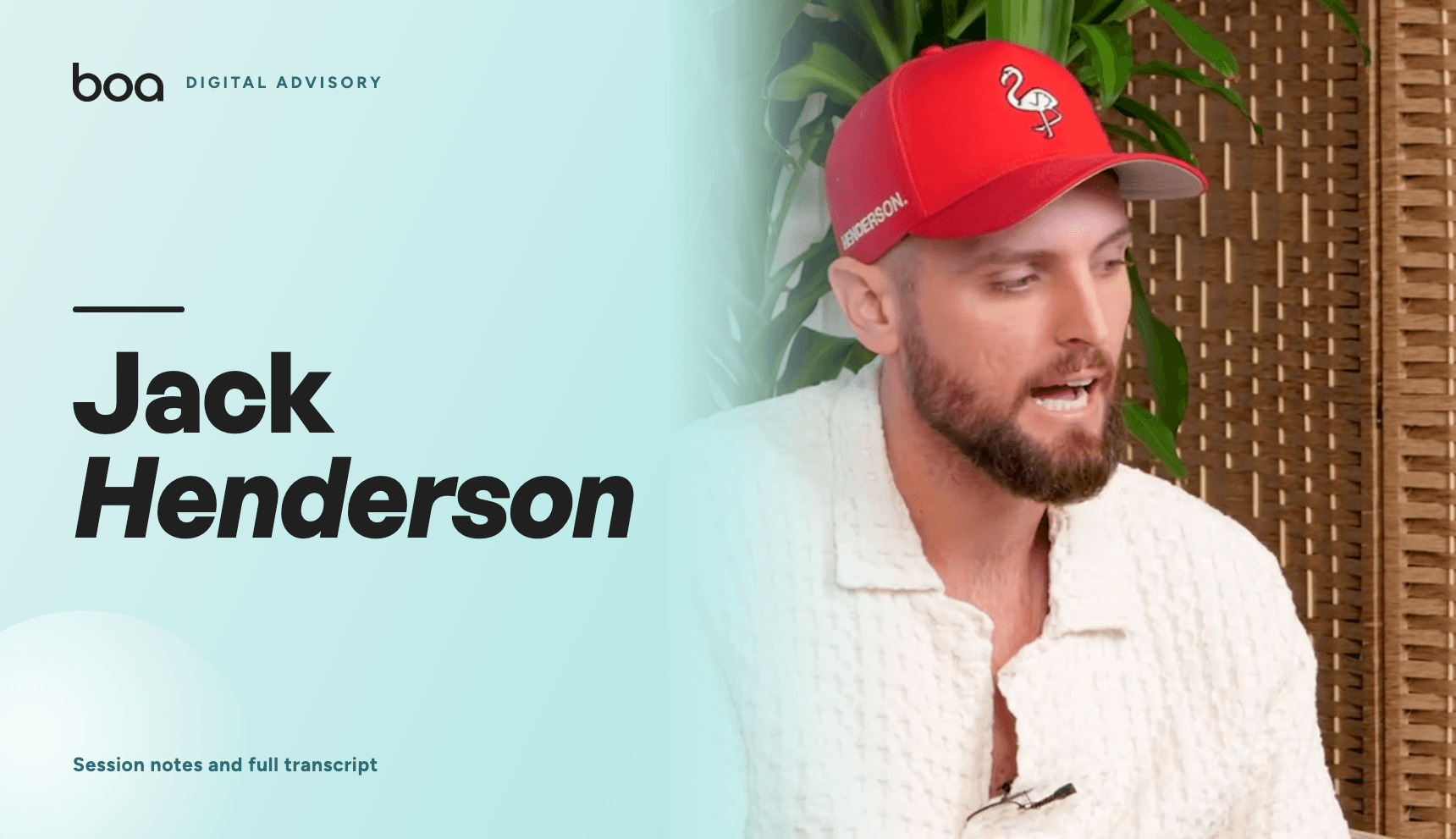
Jack Henderson: content, hiring and buying your first property
 Premium36 min
Fireside Chat
Building Dr. Dough and preparing a business for sale
 Premium55 min
Fireside Chat
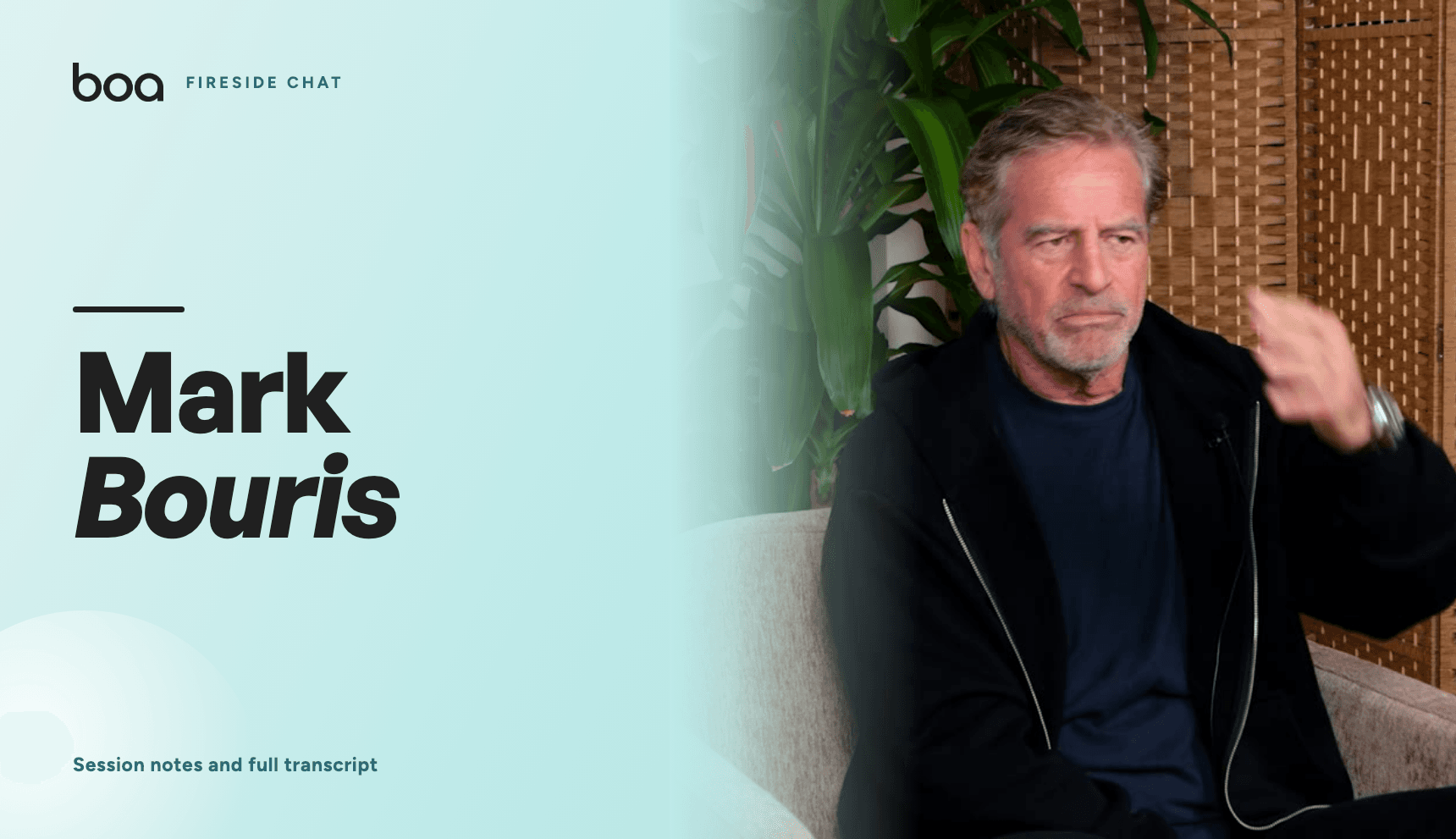
Mark Bouris: Staying Calm, Clear and Commercial in a Downturn
 Premium52 min
Fireside Chat
De-risking your business with commercial property
 Premium40 min
Digital Advisory
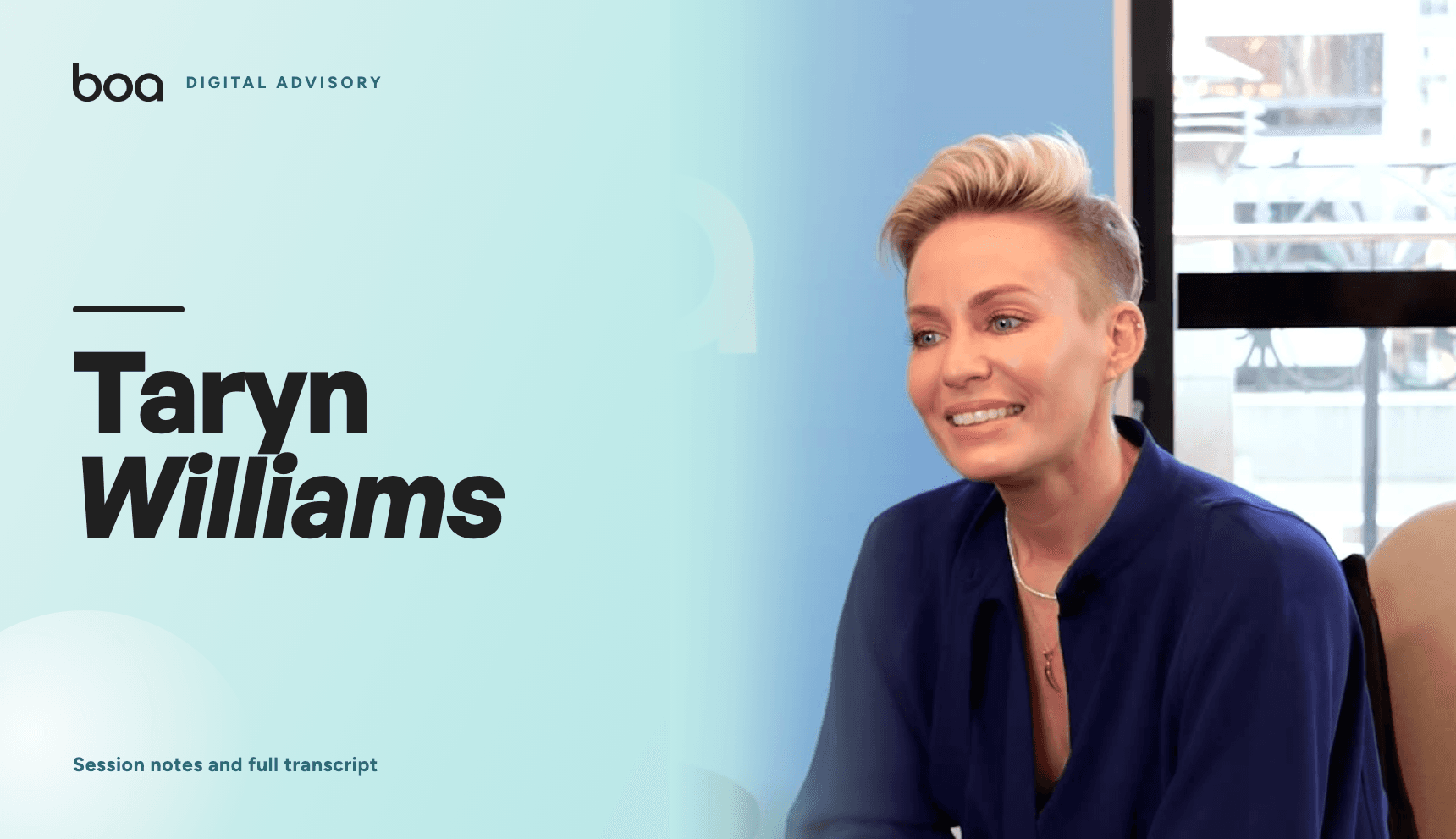
Taryn Williams: maximising brand reach on a small budget
 Premium40 min
Fireside Chat
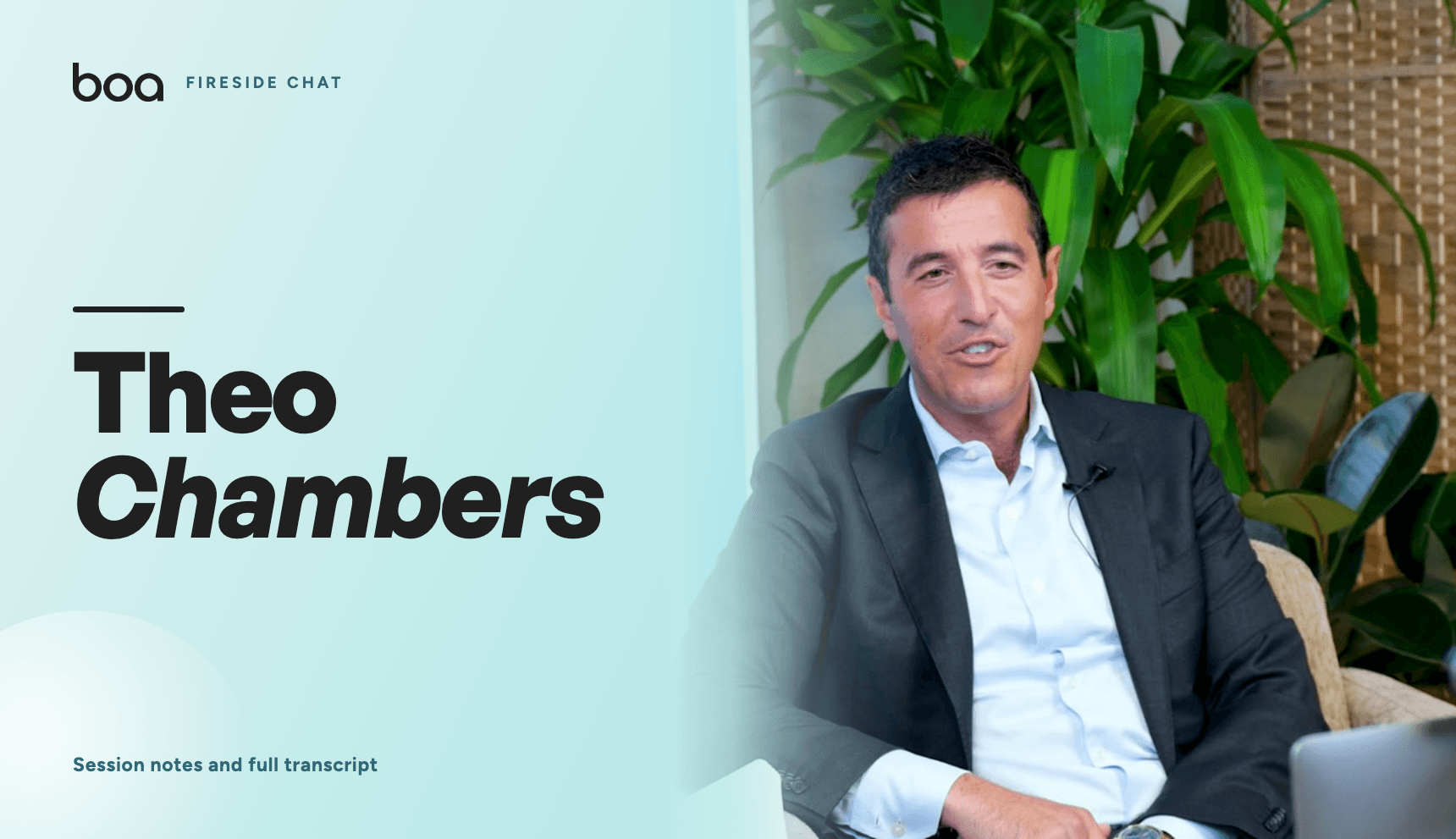
Theo Chambers on property, super and debt recycling
What the sessions actually say
Sell what the market is starving for, not what you feel like selling
Sabri's first businesses failed because he picked the product he was interested in, then went hunting for buyers. Reverse it. Research what is already selling in irrational quantities, what people would crawl across crushed glass to get, then work out what spin or angle you can bring to that. You get the wind in your sails instead of swimming upstream.
Sabri SubySabri Suby: how to build an offer nobody can resist →
Make the offer so strong it keeps you up at night
Most businesses have resistible offers: buy my thing, and if it doesn't work, oh well. Sabri launched King Kong with a guarantee to get clients onto page one of Google or he worked for free. The test is whether the prospect asks how you can possibly deliver on it. If they don't ask that, it isn't irresistible yet.
Sabri SubySabri Suby: how to build an offer nobody can resist →
Expect a refund rate under 5% on a guarantee
Founders freeze at the thought of guaranteeing results. Sabri's benchmark: if more than 5% of customers claim on your guarantee, you are not doing a good enough job of delivery. Treat the claim rate as a quality signal, not a reason to avoid guarantees. A compelling offer beats a convincing argument every time.
Sabri SubySabri Suby: how to build an offer nobody can resist →
Fund the first product from a services business, not a raise
Frank's signage and brochure business gave him paying customers, gross margin and intimate knowledge of the industry's pain points before he built any software. He recommends the same reverse order: pick the sector, run a services business that needs no capital, then build tech for the inefficiencies you have personally suffered. He cites Relume (now 50,000 users) which started as a website agency before building its design and component library.
Hold off a funding round until you have around 10 paying customers
Frank's view is that each stage of funding trades a disproportionately larger slice of equity for a smaller cheque. His advice to a founder self-funding a SaaS product out of her marketing agency was that if you can prove product-market fit with roughly 10 paying customers first, you buy yourself a significantly better valuation. He points to Antler's model of 10% of a company for $170,000, valuing it at $1.7 million, as an example of how cheap early equity is.
Create optionality before any partnership or merger negotiation
Frank negotiated a 50/50 merger with a company doing $37 million revenue when Realbase was doing $4.5 million, because he genuinely did not need the deal. He warns against putting all your eggs in one basket, citing a founder who spent 2.5 years in due diligence on a single $350 million buyer and had it fall through. Even if the first co-founder or investor turns out to be the right one, tease out other options first so your confidence is real and felt.
Balance speed with a pause before you build
Frank credits compressing the gap between idea and execution for Realbase's growth, but says they took it too far. They launched the Realbase tech product and rebuilt it three times inside a year because they had chased the wrong customer and wrong product market fit. At Kinzo he is spending 10 to 20 times more time on user experience and design than he did at Realbase, deliberately celebrating thinking time while still moving at pace.
Frank GreeffFrank Greeff: Lessons From a $180M Exit, Applied Again →
Run a three-month trial before you hand over equity
Frank's rule for any co-founder or joint venture: if you have never worked together, do not sign. Instead set up a three-month window where you work together exactly as you would as equity partners, with clearly agreed levers on both sides for either party to walk away. Everything looks like blue skies on paper. The realities of business are what break partnerships, and he has seen VC-backed businesses go insolvent purely because two founders split.
Frank GreeffFrank Greeff: Lessons From a $180M Exit, Applied Again →
Treat a shareholder as forever, because at exit they hold the pen
At sale, Realbase had a shareholder who had not worked in the business for four years but still owned 7 percent. The team chased that person for six weeks with no reply, and could not complete the sale until they signed. Apply the same seriousness to equity given to employees. No handshake deals, and as Daniel Hakim's lawyer put it, contracts are not for when things are going well, they are for when things go bad.
Frank GreeffFrank Greeff: Lessons From a $180M Exit, Applied Again →
Raise capital instead of waiting to save the fit out cost
Caitlin and her co-founder were 25 with about $1,000 in the bank and a shopfront concept that needed over half a million dollars. They stalled for months assuming they had to save it. The unlock was pitching venture capital with three things: the problem in the market, their business as the solution, and the addressable market and opportunity for the investor. That raise is the only reason Facechelle launched.
Say the words 'what does that mean' in the investor room
Once the raise closed, Caitlin sat in board meetings feeling like an idiot, too embarrassed to admit she did not know a term, so she went quiet and let the conversation run past her. Jules does the opposite: she stops the conversation and asks what a word means, even if it looks silly. The cost of looking uninformed for ten seconds is far lower than the cost of agreeing to something you did not understand.
Cold DM the person one step ahead of you
Before launching Figur, Jules messaged the owner of Budgy Smuggler, a person she had never met, and asked to meet up. He said yes and shared what he had learned building an Australian apparel brand overseas. Jake Jaggard hired someone who found her through LinkedIn DMs and hustled her into a coffee. Her rule: you will not get a yes unless you ask the question.
Write the one-sentence version of your product before anything else
Gael's first step is a piece of paper: what does the idea do, who is the audience, what is the target market, what is the business model. Then compress it to a single sentence, for example "a solution for business owners and entrepreneurs that lets them network and meet each other". That sentence becomes the test every feature has to pass.
Gael DonnayHow to build an MVP without blowing your budget →
Work backwards from your feature wish list to find the MVP
Take every feature you have imagined and remove them one at a time. For each, ask whether the solution still does what it needs to do and still delivers the value it has to deliver. What survives is the lean MVP. Gael quotes Steve Jobs: simplicity is the ultimate sophistication.
Gael DonnayHow to build an MVP without blowing your budget →
Sort features with the MoSCoW matrix and only build the must-haves
When scope gets hard and budget is fixed, split every feature into must have, should have, could have and won't have. Only the must-haves belong in the MVP. Could-haves come later if budget allows, and Gael's view is that they generally should not. Be honest in the sorting, and expect your tech partner to push back.
Gael DonnayHow to build an MVP without blowing your budget →
Hire a videographer before an assistant
Jack's first hire at Henderson was a videographer, not an associate, PA or EA. He started with an iPhone and a camera on a tripod with his partner filming, editing on a laptop, which he found too slow to do volume. Bringing media in-house early meant marketing sat at the top of the funnel from day one, even when he had 600 followers and people thought walking around with a videographer was strange.
Jack HendersonJack Henderson: content, hiring and buying your first property →
Separate reach content from converting content
Jack's best performing posts are controversial or mass-market topics (a post on the new $3 million super contribution cap did very well) but they do not book calls. The content that converts is specific to his niche of small business owners and high-paid PAYG earners, and it usually gets fewer views. Track the direct correlation between content and booked calls, and do not let a social media hire optimise purely for views.
Jack HendersonJack Henderson: content, hiring and buying your first property →
Post two to three times a day across three platforms
Jack aims for one post in the morning, one at midday and one at night. Instagram and TikTok take the same short form content, so one asset covers both. LinkedIn gets written content, where he says organic reach with no connections or followers is unusually strong. A copywriter reviews his best performing video content and writes LinkedIn copy off the back of it, which he sometimes edits before posting.
Jack HendersonJack Henderson: content, hiring and buying your first property →
Compress your two to five year plan when a shock hits
When COVID arrived, Kristy had just launched and already had the infrastructure in place. Rather than freeze, the team executed everything in their two to five year plan inside two weeks so they could handle the volume, reaching 50,000 doughnuts a week. Her mentor's line when she thought she had lost everything: "it's not an adventure if you know where you're going, so get on with it."
Kristy ValentineBuilding Dr. Dough and preparing a business for sale →
Hire a real accountant, not a cowboy, from the start
Kristy is blunt that finances must be in order from day one: compliant, up to date, ATO happy, payroll never skipping a beat. Her point is that this is not something you can switch on later when you want to sell. An acquirer turns over every stone in due diligence, and if something is not right you will not even be considered.
Kristy ValentineBuilding Dr. Dough and preparing a business for sale →
Pay for a CFO earlier than feels sensible
A doughnut shop with a CFO sounds absurd, and Kristy admits it was very expensive and a heavy line on the P&L. She invested anyway. Without it, Dr. Dough would not have been in a position years later to be considered for acquisition at all.
Kristy ValentineBuilding Dr. Dough and preparing a business for sale →
Re-cut your cost base to today's revenue, not last year's
Bouris says the first move in a downturn is the one thing you control: costs. Your cost structure was geared to revenue from six months ago, so if you are seeing lower revenue, delayed contracts or postponed projects, re-gear costs to the revenue you have now. Cut the cloth to suit.
Mark BourisMark Bouris: Staying Calm, Clear and Commercial in a Downturn →
Work out your cash runway on flat revenue and a fixed cost floor
Asked how to tell if a business will survive, Bouris pointed to burn rate. Assume today's revenue line does not improve, then work out which costs you genuinely cannot reduce. If that maths leaves you with less than six months, and you have no savings, no bank borrowing and no investor, that is the point to consider closing the books for a while or taking a job rather than burning to zero.
Mark BourisMark Bouris: Staying Calm, Clear and Commercial in a Downturn →
Get your economic data from the ABS, not the papers
Bouris says ignore politicians and go to abs.gov.au yourself, any hour of any day. The three numbers that matter are unemployment, GDP growth and inflation. He notes normal GDP growth should sit around 2.75 to 3.5 per cent per annum, and Australia is sitting just above zero, with a per capita recession meaning living standards are falling.
Mark BourisMark Bouris: Staying Calm, Clear and Commercial in a Downturn →
Use a 3 to 1 rule before you touch commercial property
Scott's sequence is two or three residential houses first, held for three to five years, then one big deposit into a commercial asset. Residential lets you borrow more, has a lower barrier to entry and is harder to stuff up while you learn. He is blunt about entry-level commercial: under $500,000 cash, buy resi all day. Above roughly $700,000 you are in the game for commercial.
Scott O'NeillDe-risking your business with commercial property →
Judge a commercial yield against the market cap rate, not in isolation
Scott's range is 5 to 9 per cent, with most good deals between high 5s and 7 per cent. Anything above 7 per cent implies more risk: regional market, shorter lease or inflated rent. The real test is buying at a yield above the suburb's natural capitalisation rate. Buy at 6 per cent where the market cap rate is 5 per cent and you have bought 20 per cent under value.
Scott O'NeillDe-risking your business with commercial property →
Run the return-on-equity maths before you park profit in property
Scott's worked example: a 6 per cent yielding asset at 65 per cent leverage and a 6 per cent interest rate returns about 5 per cent pure cash flow after debt. Add 5 per cent per annum capital growth and you are at roughly 16 per cent return on the equity you put in. A 7 per cent asset takes it to about 21 per cent. If your business margin beats 15 to 20 per cent, keep the money in operations instead.
Scott O'NeillDe-risking your business with commercial property →
Use every new platform feature the week it drops
Taryn says LinkedIn, Instagram and TikTok penalise accounts that ignore new features. When Reels launched, non-users saw the rest of their content suppressed. LinkedIn currently wants video, so post video even if it feels awkward. The platform reads you as a good user and amplifies your other content for free.
Taryn WilliamsTaryn Williams: maximising brand reach on a small budget →
Chase niche creators, not follower counts
Instagram's algorithm is shifting towards TikTok's model, where the content itself is classified and served to people interested in that niche rather than to your existing followers. So stop paying lifestyle influencers with what Taryn calls vanity metrics. Find creators making very specific content (parenting, vegan food) that matches your category, because that content now gets the bigger reach.
Taryn WilliamsTaryn Williams: maximising brand reach on a small budget →
Book one networking coffee every Friday at 8am
Taryn ran a standing rule of an 8am Friday coffee with someone new, went to every event she could, and joined clubs. She also cold messaged people on LinkedIn. She kept that up for roughly two years before the inbound enquiries started, so treat it as a two-year build, not a quick win.
Taryn WilliamsTaryn Williams: maximising brand reach on a small budget →
Recycle your home loan debt to halve your interest cost
Theo's method: park savings in the loan account redraw (not the offset), then draw that money out for investment purposes. On a $1.3 million home loan, pulling $300,000 out of redraw to buy property, shares or another investment makes $300,000 of that loan tax deductible. On the top tax bracket, 6% interest effectively costs you 3%. He calls making the entire home loan deductible over time one of life's biggest hacks, and notes it is general advice you must validate with an accountant or financial planner.
Theo ChambersTheo Chambers on property, super and debt recycling →
Contribute to super yourself, because nobody else will
Business owners skip super because it is voluntary for them, then hit 50 with nothing in it. The concessional cap is $30,000 a year. In the top tax bracket you get roughly half back as a rebate, so $30,000 in costs you about $15,000. Earnings inside super are taxed at 15% and 10% on capital gains, and in retirement phase both income and gains are tax free.
Theo ChambersTheo Chambers on property, super and debt recycling →
Show a profit or the bank will not lend to you
Theo's step one before buying anything is making sure the business actually shows profit, because that is what drives serviceability. Growing revenue on digital marketing spend, followers or engagement means nothing to a lender. Banks will not lend against revenue growth. If you suppress profit to avoid tax, you also suppress your borrowing capacity.
Theo ChambersTheo Chambers on property, super and debt recycling →
Watch the full sessioninside Boa.
Session notes are free. The recordings, the live advisories and the founders in the room are for members.