Panel Event
Boa Live Panel on Building Brands That Last
With Panel Event, Marketing and brand leader at Ecommerce fashion business (previously Procter and Gamble, Unilever) · Hosted by Mia · 58 min · 12 June 2025
What this session covers
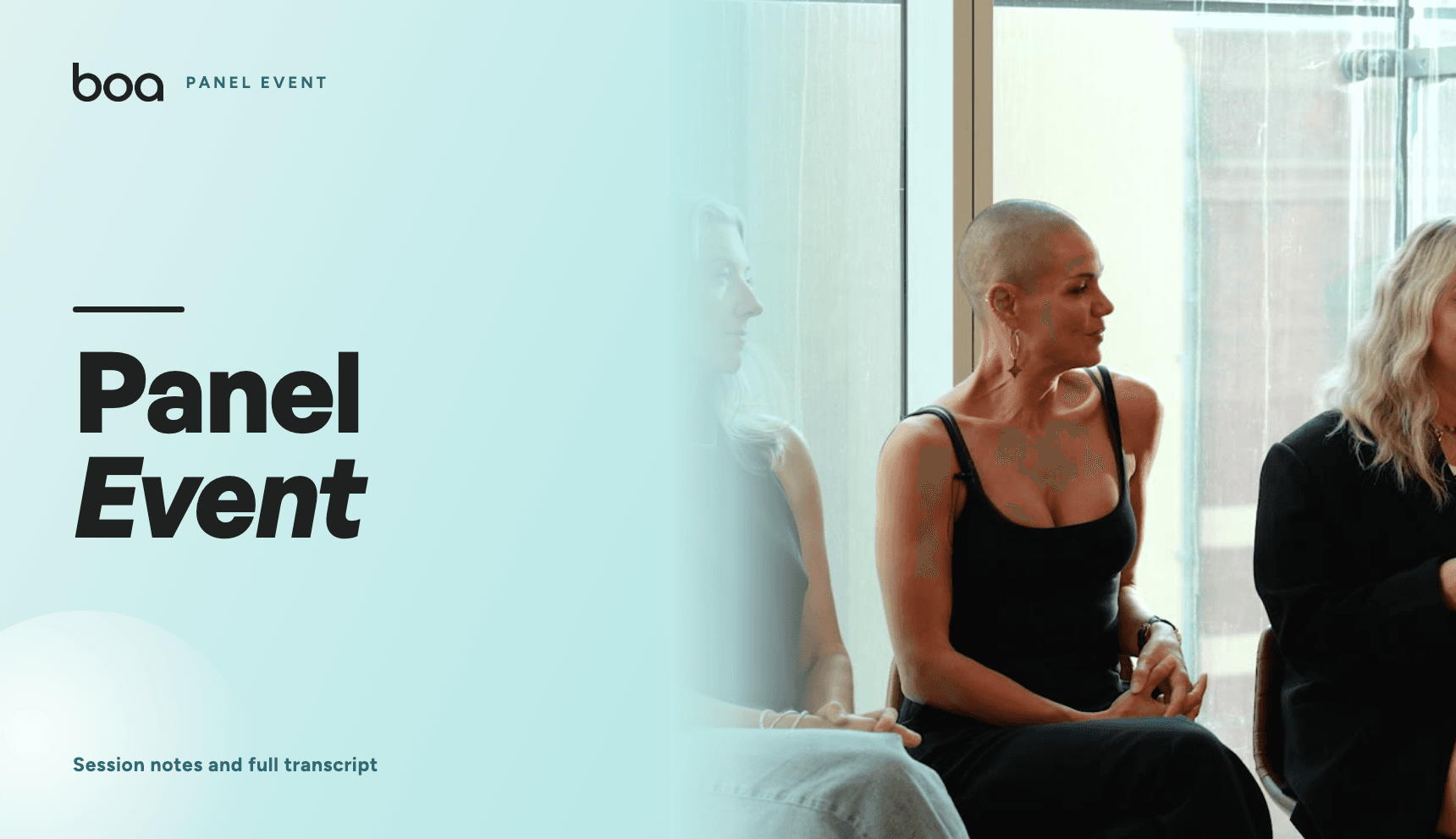
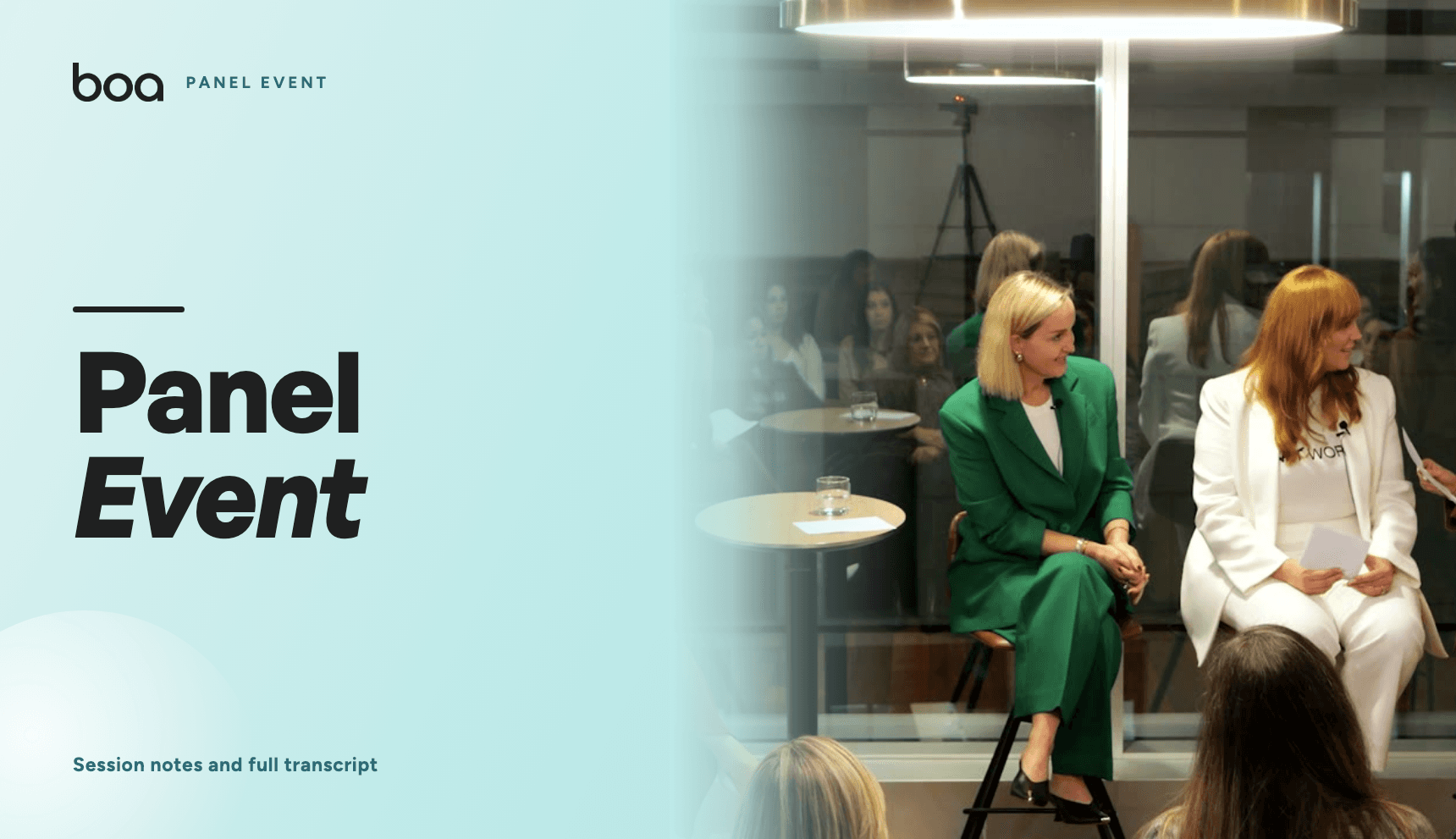
A live Boa panel with Jake Jaggard, Jules from Figur and Caitlin from Facechelle on funding a fit out you cannot afford, rebuilding a business model off customer surveys, hiring a manager better than you at people, and protecting time so ambition does not eat you. For founders scaling past the first team.
Ask for the thing (the capital, the coffee, the mentor) because the only person capping your business is you.
Key takeaways
- 01
Raise capital instead of waiting to save the fit out cost
Caitlin and her co-founder were 25 with about $1,000 in the bank and a shopfront concept that needed over half a million dollars. They stalled for months assuming they had to save it. The unlock was pitching venture capital with three things: the problem in the market, their business as the solution, and the addressable market and opportunity for the investor. That raise is the only reason Facechelle launched.
- 02
Say the words 'what does that mean' in the investor room
Once the raise closed, Caitlin sat in board meetings feeling like an idiot, too embarrassed to admit she did not know a term, so she went quiet and let the conversation run past her. Jules does the opposite: she stops the conversation and asks what a word means, even if it looks silly. The cost of looking uninformed for ten seconds is far lower than the cost of agreeing to something you did not understand.
- 03
Cold DM the person one step ahead of you
Before launching Figur, Jules messaged the owner of Budgy Smuggler, a person she had never met, and asked to meet up. He said yes and shared what he had learned building an Australian apparel brand overseas. Jake Jaggard hired someone who found her through LinkedIn DMs and hustled her into a coffee. Her rule: you will not get a yes unless you ask the question.
- 04
Hire someone whose only job is your team
Caitlin and her co-founder went from a two person podcast to a team of eight overnight with no management experience. Their fix for problems was a team event or drinks, which she calls a Band-Aid solution. They hired a dedicated manager, Pandora, whose sole focus is that the team feels heard and that issues get actioned instead of sitting on a founder's to-do list. Culture changed dramatically.
- 05
Stop hiring people who pass your wine test
Jake Jaggard used to hire people very much like herself, judged on whether they passed her informal wine test. She learned a whole team of you gives you one perspective. Be strategic about representation across views, opinions, cultures and genders, and treat diversity of thought as a deliberate hiring brief rather than something that happens naturally.
- 06
Survey your customers, then be willing to break the model
Facechelle launched with three facial tiers (basic, advanced, ultimate) and 30 minute treatments designed to fit a lunch break. Regular client surveys surfaced three consistent requests: stronger treatments, longer time in the room, and small luxuries like hot towels. New services like laser did not fit the three buckets, so they scrapped the tiers for one facial plus paid enhancements such as skin needling. Caitlin is blunt that the software change behind it was a nightmare.
- 07
Book strategy time into your week like a shift
Caitlin worked 14 days straight and stopped to realise she did not know what she was chasing. It is easy to spend a full day in the clinic shooting content because it is fun, and never sit down with the strategy. Her fix: plan the week with explicit boundaries around when she does busy work in the business, and protect quiet time to think about direction and what the team needs from her as a leader.
- 08
Say yes to the move, then set boundaries on everything else
Jake Jaggard's mantra is just say yes: yes to Sydney at 25 with Procter and Gamble, yes to Dubai without ever having visited, on the logic that if it was terrible they would pack up and come home. They stayed six years. The flip side she learned later is that saying yes to everything crowds out the day job, the kids and the friendships. She now protects time deliberately and keeps a core group of about ten girlfriends rather than a thousand acquaintances.
- 09
Watch customers use the product, do not just ask them
At Unilever in the Middle East, Jake Jaggard ran Consumer Connect: visiting customers' homes, talking through a translator, then watching them actually use the detergent, because what a customer says and what they do can be very different. Sitting over tea afterwards, the shared ground was motherhood and stress, not the product. In her ecom role she still runs consumer focus groups so the business remembers there are human beings at the end of every data set.
- 10
Reframe a trolling problem as a cultural conversation
Jules posts herself and her ambassadors in minimal clothing and gets commentary and trolling. Her first instinct is to delete comments to protect community members who do not have her shield. She now weighs that against the fact that visible diversity, ages up to 90 and sises 6 to 24, makes people uncomfortable and starts conversations, which is the point of the brand. She reads the thousands of campaign entries herself to keep close to why women join.
- 11
Pivot to what you can still do when the market disappears
Jules launched Figur 12 days before COVID hit Australia, having put every cent she had saved for a home into the business, while three months pregnant. Nobody was going out, so nobody was buying shapewear. She pivoted to what she could control and created We Will Figur It Out: gifting product, donating Woolworths vouchers from sales, and holding a space where women shared what was happening to them. It cemented the community that the brand still runs on.
- 12
Treat the tax bill as a success fee
Jules will complain about BAS and the ATO to anyone who will listen, and friends outside business dismiss it as a rich person's problem. Her reframe is that tax is a success fee: if you are paying it, you are making it. It does not make the payment fun, but it stops the bill reading as a punishment.
How the session runs
- 0:28Raising capital at 25 with $1,000 in the bank
- 2:16Sliding into DMs and asking for help
- 4:53Jules on fear before hosting her first workshop
- 6:52Trolling, inclusivity and the soul of a brand
- 9:16Going from two people to eight overnight
- 13:53Just say yes, then learn to set boundaries
- 16:18Launching Figur 12 days before COVID
- 18:1314 days straight and losing the strategy
- 21:50Toxic bosses and swapping external for self validation
- 23:56Why entrepreneurship feels lonely
- 28:23Scrapping three tiers after customer surveys
- 31:25Burnout, rest and asking your partner hard questions
- 34:29Consumer Connect in Egypt and emotional brand building
- 42:23Audience Q and A: does imposter syndrome ever stop
- 45:18The why behind Figur and Facechelle
- 49:52Handling rejection when you are starting out
- 53:10Self care, mum guilt and quality over quantity
Mentioned in this session
- Facechelle
- Figur
- Budgy Smuggler
- Procter and Gamble
- Unilever
- Rexona
- Dubai
- Perth
- Sydney
- Brisbane
- Melbourne
- Central Coast
- Bali
- Ubud
- Married at First Sight
- Real Housewives of Sydney
- The Iconic
- Woolworths
- Australian Taxation Office
- Bumble
- Jacinda Ardern
- Tom Hanks
- Boris Johnson
- Synergy Skin
- Egypt
- Philippines
Questions founders ask
Caitlin and her co-founder needed over half a million dollars for a fit out and had roughly $1,000 between them. They raised venture capital instead of waiting to save, pitching the problem in the market, their business as the solution, and the addressable market and opportunity for investors. She says raising was the only reason Facechelle got off the ground, and that at 25 she had no idea it was even an option.
Caitlin's signal was going from two people to eight overnight with no management experience, then patching problems with team drinks and events. She calls that a Band-Aid solution. They hired a dedicated manager whose only job is the team, which meant issues got actioned rather than sitting on a founder's to-do list. Her framing: the best skill in business is spotting the gap and hiring someone better than you at it.
Facechelle ran regular client surveys and found three consistent requests: stronger treatments, longer appointments and more small luxuries. New services like laser did not fit their three pricing tiers. Caitlin's test was longevity, not short term performance, so they moved to one facial with paid enhancements. She warns the operational side, particularly the software change, is painful.
No. Jake Jaggard says it is there every day and that anyone claiming otherwise is lying, and she relies on a small group of trusted people she can message when she is beating herself up. Jules reframes the fear as evidence she is stepping into something bigger than before, and does a Wonder Woman stance and breathing in the bathroom before speaking. Caitlin notes that three days out of seven can involve tears or very late nights.
Jules was knocked back by The Iconic and says it genuinely hurt, but she came back to her why and kept going. Jake Jaggard reframes losses as learnings and returns to the line that life happens for you, not to you, pointing to every job she did not get leading to something better. The panel's shared advice: treat a no as a business no, not a personal one, and keep the energy up because the right people will join the vision.
Full transcript
The complete conversation, as recorded, with every speaker attributed.
Boa host0:00
It's like your vibration. I think if you attract the right people into your life and you, you'll continually like elevate together and you'll notice that the whole room will lift. Like I can only speak from, you know, my business when I had, you know, there was a period where I had like quite an unhealthy dynamic. It's like when you have a, what do they say? It's like a bad apple and it rots the whole whatever. And I find that as soon as you start to really surround yourself with those right people, everything elevates your mental health as well as your business. So it's Love that.
Caitlin0:28
Yeah, I couldn't agree more with both of your points. But yeah, reflecting for me was, I think, just really reminding myself that you can achieve anything that you put your mind to. And particularly when I was reflecting on this question, to put it into context, when we first had the idea for Facechelle, um, it was this massive crazy idea. And when you're starting a business, there is a lot of money that needs to go into it. Particularly when you're starting a business that is a shop front and has a fit out. Yeah, it's probably always going to be about over half a million dollars. And I just remember when I was so young, feeling so defeated and so unmotivated because we had this huge big vision and dream, but we didn't know at all how we were going to bring it to life because we were 25 years old and probably had $1,000 in our bank account.
Boa host1:17
Yeah.
Caitlin1:18
And then, so this kind of delayed us and it really stopped us from trying to bring this alive because we thought this was something we were going to have to save for until we could start the business. And then someone said to us, did you know that, you know, you could take this idea and you can go and talk to people like venture capital that will invest in your idea if you really show them what the problem in the market is and then the solution that your business is gonna be to that problem. And of course the addressable market and the opportunity that they would have with your business. And that was something that instantly, as soon as we did that, it's actually how we ended up launching our business was through raising capital. So we could bring it to life. And reflecting now, I always love to share that when I am talking to other people that are thinking about starting a business because it really was the only reason we could have started Facechell. And back then when I was a young 25-year-old passionate woman wanting to start a business, I just had no idea it was even an option.
Boa host2:16
Yeah.
Jules2:16
I think that's a really valid point that just like we're in a world of social media where you can just slide into someone's DM and what's gonna hurt by asking? Asking for help. We've got these amazing communities. I left school super young. There are some words I don't know, and I always say like, what does that mean? And not having the fear to be like, I don't understand that, to ask the question, what does that mean? Like, I'll stop a conversation and go, what does that mean? And maybe look silly, but I'm learning. And I think that's really important is to say like, just put your hand up and ask, or just ask someone, ask them for help. When I started FIGR, I actually never met him before, but I asked the the owner of Budgie Swagger to meet up with me. And he did. And he met up with me and he told me some more stories. I mean, what a legend. Like, yeah, I was like, underwear, like apparel, like what I was doing. And I thought, he's Australian, he kicked, you know, England, like he's done so well over there. And he did. And he said yes. And I was like, that now, that full circle of now giving back to people when they ask me, like, that's what it's about.
Caitlin3:12
So yeah, I think you realise you're the only person that limits yourself when you don't take, go for the opportunity. You prevent yourself from then having it. Yeah. And that's a big big thing that we learned because when we, we did raise money and then all of a sudden we're in a room full of investors and we've got a board and I just remember feeling like an idiot.
Jules3:28
I'd be like, what's that word mean?
Caitlin3:29
Yeah, but because you're so embarrassed you don't admit it and you kind of just go quiet and you let it continue, but you just realise that, you know, everyone's human, everyone's learning along the way, just be honest and open and it's completely fine.
Panel Event3:41
Yeah, I'm gonna add to that on the corporate side because I think LinkedIn is such a great tool these days because I get a lot of people sliding into my DMs, and I mean, I hired someone, Ella over there, who— how long ago was it? 2 years ago when you managed to find yourself into my DMs on my LinkedIn. And my LinkedIn gives me so much anxiety, but she was a hustler. It worked, and she managed to get me to have a coffee with her. And then I was like, you know, going to my team, we need to hire her.
Caitlin4:06
Yes, Ella is also a FaceShell member. I know you, Ella. She's a regular.
Jules4:12
I love you.
Panel Event4:13
LinkedIn to reach out to me. And I do get— and because I'm so about, you know, the next generation of female leaders as well, I do get approached by people that say, can I just have a coffee? I want to understand how you've driven your career.
Boa host4:24
And generally—
Panel Event4:25
and I did the same thing— and people will do that for you. They can't do it all the time, but you won't get a yes unless you ask the question. So reach out. Like, LinkedIn, if you're in corporate, great tool.
Boa host4:37
Yes, I agree. Wow, motivating. Um, Jules, So you have built a brand that empowers women to feel confident in their bodies. Was there ever a moment where self-doubt crept in, and how did you push through and reconnect with your mission?
Jules4:53
Sure. So, I mean, I would say the brand is absolutely about feeling confident in your body, but also feeling confidence within who you are, like completely who you are. And just recently, Figga, even though it's a shapewear brand, we've just launched our first workshop, which was in April in Sydney, and it was amazing. And it was all about manifestation, authenticity, self-love, yoga, movement, uh, just showing up as who you truly are and what you do for joy. Like remembering what you do that makes you who you are and organising that. And basically it's all the values of figure, of a figure woman. Like that's, you know, what it represented. And obviously I put the event together and then I was actually presenting two of, two of the topics in the workshop. And I, that fear stepped in of like, oh my God, can I be doing this? And then I just had to remember that I didn't build a brand on perfection. I built it on truth, which is about putting on your big girl pants, literally put on my figure and just went for it, you know? And that's what I represent myself is just giving it a red hot go. And I think that my mission is bigger than my fear. And the day was absolutely amazing. And I just think you've got to remember your why. And if you can remember your why, then that's what makes it, makes you push through it. But yeah, I was absolutely shitting myself. And then at the end it was amazing. And so now September I'm doing Sydney, Brisbane, and Melbourne. So it was really, um, like when you just see your purpose in action, and it was just amazing. It was absolutely amazing.
Panel Event6:21
And you pushed through the fear. Yeah, amazing.
Jules6:25
On the other side of that, so it's not like natural habitat to get up and speak, but I was like, um, but no, I did it. And yeah, it was really, really good.
Boa host6:32
I think when you started your business as well, it was kind of when social media was shifting a lot, and like the authenticity was more the key. It wasn't about these perfectly curated images. So you kind of, I think I'm your biggest fan, led the way in a way. Like you were really authentic and you celebrated yourself and people were really engaged by that because they could relate to you.
Jules6:52
Yeah, to be honest in that space. So obviously when I'm sharing myself in not many clothes and my ambassadors and my figure tribe, that comes with commentary, that comes with sometimes trolling. And you really have to step into that to own it. But I also, as much as for me, I've got a very, you know, shield around me from kinesiology and my little bubble that protects me., but I know that some of the women in the figure community don't, you know. So my first instinct is to go, oh my God, delete it, get it down, so to protect them. But I'm also like, this is creating awareness. This is actually cultural shift. It's making people uncomfortable to see diversity in other ways, and it's making conversation. And that to me is making a difference. So, you know, I'm, I'm all, you know, I'm used to it.
Caitlin7:32
Yeah.
Jules7:32
But I know that being part of that community, these women go, no, you said that about me. Like, I'm here and I love myself and I'm gonna be like that. So that's always been a challenge because depending on what, how you feel that day, you you're going to react differently on social media. And that's why, you know, digital intelligence is really important.
Panel Event7:49
Yeah.
Jules7:50
But yeah, that's always been a challenging thing with Figar. But as I said, the positive is that it is creating conversation of, you know, and I feel really proud to have been, you know, a brand that truly represents inclusivity from up to age 90, one of my ambassadors, size 6 to 24, and sharing women with their reasons of being part of the community. Because when I get all my entries for my campaigns, which is to use the public, I like them want to share something about themselves. And for me, that is women seeing themselves in reflection. And when I honestly read these thousands of applications, which I do, hand on my heart, yeah, we are all the same. No matter what age, size, color, shape, we are— every woman is just doing their best to feel the best that they can. And it makes me really emotional because I really believe in that. And, um, you know, your product is your body and the brand is the soul. And when people believe in the soul of my brand, like, that is the world.
Panel Event8:43
Yeah.
Jules8:44
Yeah.
Boa host8:44
You're making us all look really bad.
Jules8:48
I believe in it. No, that's beautiful.
Boa host8:51
Caitlin, so you moved from, like I was saying before, podcasting, which your podcast was amazing. I remember we got one of our clients at the time, Synergy Skin, and she got like the most conversions she had ever gotten in any podcast. But you moved from podcasting, which was a very successful podcast, into skincare. So two very different worlds. What's something you expected to come easily that turned out to be challenging?
Caitlin9:16
There is one thing that comes to mind straight away, and that is managing people. I remember—
Boa host9:22
very hard.
Caitlin9:23
Yeah, I remember before starting the business, everyone warned me. They were like, the hardest thing you will ever do is managing a team, um, and managing people. And I just remember laughing and thinking, we're two young girls, we're really cool, we're fun, we're gonna have a young team of girls, you know, everyone's gonna like us. And I could not have been further from the truth. It was the biggest challenge that we had because we basically went from running a podcast, a small team of 2, to a team of 8 overnight, and we just had no idea what we were doing. We had no experience in managing people, and when it comes to managing people, there's so many different personalities and expectations and skill set. And then there's another layer of when you're a founder, you're wearing so many different hats in the business and you're trying to juggle everything at once that we were spreading ourselves far too thin to actually be there for our team and be that one person the team needed to feel heard and feel understood. So that was a very bitter pill to swallow because I realised that how I was trying to lead was just being a people pleaser. Yeah, I just wanted everyone to like me, and I thought if there was a problem in the business, I would just throw a team event or take them out for drinks and everything would be okay. But like, can work too. I mean, it worked a little bit, but it was a fun night. Yeah, we had a few good nights, but it was a Band-Aid solution. Yeah. And the reality was we ended up hiring an incredible manager, Pandora, who's here in the audience tonight. And she's solely there for our team to make sure that they feel listened and understood and that if things need to happen in the business, they actually are actioned rather than going on a very long to-do list of mine that never gets actioned.
Panel Event11:06
Yeah.
Caitlin11:06
And it's dramatically changed our culture. The team are so happy. They, you know, they've all really loved Pandora and they love what's happened in the transition of the team. But I guess the key takeaway for that for me as well was understanding that you can't be great at everything in the business and accepting that the best skill set you can have in business is actually seeing where the gaps are and hiring someone that is way better than you.
Panel Event11:35
Yes.
Caitlin11:35
And when you put your ego aside and you realise that that's actually what is going to help you grow. Yeah, um, it completely transforms the business.
Boa host11:43
I love that. I think as well, because I was obviously, um, similar age to you when I started my business, I feel like, like, um, trying to put boundaries in, in terms of your staff, so they can't be your best friend. I don't know if you—
Caitlin11:56
they're still all my best friends.
Boa host11:57
Yeah, yeah, sorry, I'm still setting boundaries. You know, like drink, like, you know, that's a really tough one I found personally for me was you know, because people do move on and, you know, that's life. And you— I got so emotionally attached to people that I, you know, could never have seen moved on. And I think that was to my detriment. And I think that was my age because I was young and I wanted to have fun and they were also the same age. So I feel like— did you ever experience like parts of that?
Caitlin12:22
Totally. And I'm still learning that today.
Boa host12:24
She's like Mia, yes, we're going out tonight with all of them.
Caitlin12:27
No, I'm learning along the way and I think there's a very fine line between making decisions to be a people pleaser and make people happy, but then you also have to remember the reason that you're all in the room together, and that is you are running a business, and the decisions you make need to be for the best interest of the business, not them. So that's something that I'm still learning and figuring out.
Boa host12:49
Yeah, um, but yeah, well, you're doing an amazing job at it.
Panel Event12:52
I think the diversity thing is super important. I mean, you were talking about it from a brand perspective, but from a team perspective, and I feel like that takes a while as well. I mean, I used to hire people that were very much like me, so I'd be like, oh, they passed my wine test, you know, yeah, then I realised you can't have a whole team of just you because you're only getting one kind of perspective. Yeah, so, you know, I think that identifying where the gaps are but also having diversity of thought, you know, is super important, and you've got to be strategic about that. So you've got to say, how do I have a team that has representation across different views, different opinions, different cultures, different genders, the whole lot, you know. And I think you get better and better at that as you, as you, you know, develop in your leadership as well.
Boa host13:34
Yeah, well, that leads into my next question. Because you are an incredible leader and you're leading a huge business, I mean, what's one— they do, they do. Um, what's one boundary or habit you wish your younger self had known to set earlier, and how did that shape your leadership style?
Panel Event13:53
Yeah, I was thinking about this because one of my mantras is just say yes. So I do a whole talk around just saying yes because that's really— I was a Perth girl that I worked for Procter Gamble when I was 25. They said, do you want to move to Sydney? And when you're from Perth, you want to move to Sydney. So I was like, yeah, take me to Sydney. I knew no one. I've now been here 25 years. You know, I met my husband over here. We've got a family here. 12 years ago, we moved to Dubai. I looked after Rexona for North Africa, Middle East, and Turkey for Rexona, um, for Unilever. And I remember ringing my husband and saying, how do you feel about moving to Dubai? And he said, yeah, you know, let's do it. So, and I remember people saying, are you from Dubai?
Jules14:34
Oh, you were there?
Panel Event14:35
Yeah, it was like the heyday too. It was, it was really fun. But a lot of people, my Australian friends and family, were like, but you've never even been to Dubai? What if you don't like it? And I said, well, we'll pack up and we'll come home.
Boa host14:46
Yeah.
Panel Event14:47
Um, but what happened was we stayed for 6 years. I had my son over there. We had the most amazing experiences, both professionally and personally. And it was all because I said yes. So I think that yes, just say yes is a real mantra for me. But the flip side of that, as I've gotten older, is set boundaries. And we talked about that a little bit as well, because it's just saying yes to everything, because I get so excited about everything.
Boa host15:09
Yeah, so do I.
Panel Event15:10
And then I'm like, why can't you get out of here? My bottom director, even my boss I was like, well, you just need to make sure you've still got time to do your day job.
Boa host15:16
Yeah.
Panel Event15:17
Because I'm a mentor here. I mean, because all this stuff lights me up and I think that's what's so wonderful about life. But now I'm really trying to carve out space for, you know, my friends and family, particularly because your kids, I mean, anyone who's got older kids, before you know it, they're suddenly second year at college and it goes so quickly. So, you know, with younger kids, like, you honestly need to be there in the moment with them.
Boa host15:39
Yeah.
Panel Event15:39
Because before you know it, they've they're not there, you know. And so then you have all that career guilt, like, I've got this amazing career, but was it at this expense of my kids? So I think setting boundaries— now I'm really protective of the time with my friends. I've got beautiful Mel over there as well, you know. And I've also— I used to be friends with 1,000 people, and now I've got my 10 girlfriends. Yeah, part-time out for. So the boundary thing, I think, is super important as well.
Boa host16:04
Yeah, I love that. Um, okay, for all of you, so what's one personal turning point, whether in mindset, confidence, or relationship that deeply impacted your business or leadership approach?
Jules16:18
I'll go first. Um, I launched Figuerre in 2020, like 12 days before COVID hit Australia, and I put everything into this business, like every cent I had, like to buy my first home, like it went into this business. And because I believed in it and I knew that I was creating something different to any other shapewear out there, which has now gone on in multiple awards, by the way, um, because it doesn't roll down or up and you can go to the toilet in it. And it works. But so I put everything into it and then COVID hit. And as everyone was just like, oh my God, and then Tom Hanks had it and it was like, then Boris Johnson had it. I was like, this is real. Like, this is an actual nightmare. So I remember sitting there like 3 months pregnant, crying for the world, crying for myself, and just thinking, oh my God, what is going to happen? And people weren't going out, people weren't wearing shapewear. So I really had to pivot the word of 2020, which was to focus on what I could do and which was to help, to help other women. And in this crazy time, it actually really cemented the core of FIGR, which is women supporting each other, showing up vulnerable, being really honest, being who you are. So we created We Will FIGR It Out, which I thought was very clever.
Caitlin17:27
I love that.
Jules17:28
Um, disco lots of brands to, you know, gifts one thing. And then I also donated from any sales that I got and we did like Woolworths shopping vouchers. And so women showed up on socials to be like, this has just happened to me, you know, like someone's really sick or someone's died. And it was a really beautiful space that really just women supported each other. And off the back of how I launched, which was through the body positivity campaign of age and size inclusion, it just all meshed together really nicely. And I said, I always knew that what that was, what it was going to be about, but it just all came together and Yeah, it was a really, really special time, like, through that. Yeah, yeah. So people weren't wearing shapewear, but at least people came to that space to feel, you know, just felt safe there.
Boa host18:11
That's amazing.
Panel Event18:12
Yeah. Caitlin?
Caitlin18:13
Yeah, um, so mine was more a recent mind shift that I had at work. And basically, we're about 2 and a half years into running the business, and we're still very much so in that, like, hustle and run as fast as you can and constantly be in the business and get everything going. And particularly given that we are a service-based business, we are in the physical location a lot of the time. And it was about a month ago or so, and I'd worked 14 days straight, variously, you know, within the clinic and then, um, at home as well. But it was just 14 days straight with no break. And I remember just stopping and pausing and thinking, I don't even know what I'm chasing at the moment. It's just, you get, it's so easy when you run a business to just get stuck in the busyness of the business and you can work so many days straight and then realise like, what is the actual end point that I'm working towards? And it really made me step back and think, when we started the business, we had this big vision, we had this big goal, but where we're kind of losing sight at the moment is the strategy and the execution to get to that big goal because it's so easy to be in the clinic for a full day and want to just shoot content because it's fun that you forget to do the important stuff, like sit down and think about the strategy and think about the direction that you want to take your business and your team. So a big mindset shift I've had recently is stepping back and really making sure I plan my week and have boundaries around when I'm going to be doing that busy work in the clinic, because the reality is I'm still wearing a lot of different hats. Across the business, but really prioritising time and giving myself quiet time to sit down and think about the strategy of the business and what the team actually needs as a leader from me, because that is so important to lead the team in the direction you want to take it.
Boa host20:05
Yeah, I agree. It's like getting on a treadmill and you can't get off. So love that.
Panel Event20:10
Joanne? Um, I would say, God, over the particularly the last 10 years, um, well, actually, when I came back from Dubai, I was exposed to, as a lot of people are, a lot of toxic work environments. And I had some really bad boss experiences, so much so that, you know, I got my first tattoo, which is Fearless, which is a reminder to be fearless, to speak your truth, to speak up when you see stuff that isn't okay, um, because we all have to make a difference. And I think up until that point, and I've said this to my exec coach, I was so focused on external validation. I wanted a boss to say, 'You're doing a great job.' And then, you know, it was such a learning experience to have these really toxic people that I was reporting into. And something reset in me which said, 'I'm going to stop looking for an amazing boss and just focus on trying to be one.' And I think it's really important. Like, I, I am very about doing the right thing by people. I really believe that if you get culture right and if you treat people with kindness and compassion that that will drive the commercial outcomes. It doesn't go the other way around. And I stopped caring so much. I referenced this earlier, I've got a great boss now. I actually care less about what he thinks. He's not here, so I can say that. I've got self-validation now. It's like, I know I'm doing a good job. I know there's some areas, of course, with development, but I don't need him to be saying to me, you're doing a great job. Yeah. You know, so I think that would be— there was some real pivotal moments. And of course you learn so much from the shit times. Yeah, they're really shit at the time, but they're the best turning points in your life when you really kind of reset and redefine where you want to go from there and who you want to be, which I think is super—
Caitlin21:50
it's almost my favourite points are when you're really in the trenches and everything's on fire and you just know that you're going to have the most personal growth and business growth because you can only really go up and it really tests you.
Boa host22:03
Yeah.
Panel Event22:04
My exec coach always says, life doesn't happen to you, it happens for you.
Boa host22:07
Yeah, I love that.
Panel Event22:08
That's another tattoo I wanna get.
Jules22:10
I love that. You're covered in it.
Boa host22:12
She's gonna be covered in tattoos. I love it. Well, the next question is my question, and I think I'll start that. So I think for me, entrepreneurship can feel, it has felt very lonely, I think because I grew up on the Central Coast. So I grew up, you know, nearly 2 hours away. I moved to Sydney when I was 21. I, at the time, had no friends here. I had no family here. I was really trying to do something on my own. I didn't have any financial support. I didn't have any network, you know, none of— no one around me was really into business. So they were kind of like, what the hell is she doing? This girl is so determined, like, what is the end goal? Um, and it was really hard for me because I found that over the years that, you know, I would have these amazing wins or losses, or things would happen, or I'd win a client, and it was really hard for people to kind of understand what you were going through. And I felt like I was always either downplaying my amazing successes or I guess my journey wasn't as validated to what the traditional journey would be. Like if you have a baby or you get married, people are really happy for you because they get it. Whereas in a business sense, you've got this dream and you've got this passion. And whilst it's beautiful, you should be happy for people in those journeys. I think from a business perspective, because it is so lonely, a lot of people don't really understand what you're going through, and therefore you're not as validated, I think. And so for me, that was definitely the hardest thing, is that I always felt alone. I never had a business partner, and I didn't have anyone around me, and I had to create, you know, that for myself. So I think, um, yeah, for me it was really difficult to have people that understood and could validate your journey, and your journey for what it is. It doesn't have to, you know, because it's different to what other people have.
Jules23:56
Yeah.
Boa host23:56
Um, and for people to be genuine genuinely happy for you and what you've done rather than, you know, because they just can't understand it. So I think, do you guys relate to that at all?
Jules24:07
Yeah, absolutely. I mean, it's like not everyone's going to clap for you, right? Yeah, you're just going to clap for yourself.
Boa host24:12
Yeah. Yeah.
Jules24:13
Um, I mean, it sounds so random, but like I will bitch and moan about tax and BAS to anyone that will listen, like anyone that will listen. And I made like a stupid reel the other month and it's had hundreds of thousands of reels and just to paint the picture, I'm on my laptop and there's like piano poetic kind of music playing and it basically says like, and I'm like a bit like, oh God, and it says over the top, when things get a little bit stressful, I just like to remind myself why I'm doing this. And then the camera comes around and I pick up a frame and it has Australian Taxation Office, the ATO, you know, and I hold it. So, and the thing is, when I talk about that to friends who aren't in business, they just kind of think, oh, it's like a rich person's problem. I'm like, trust me, this girl ain't rich, you know. It is literally what goes in comes out and, you know, and that's, that's it, right?
Caitlin24:57
But they—
Jules24:58
some, you know, you're not in it, you don't, you don't understand it, right? So, yeah, um, they just kind of roll their eyes, but I'm like, to me it's a big problem for sure.
Boa host25:06
And I think a lot of people perceive business as a little bit selfish, maybe.
Jules25:10
Yeah, perhaps.
Boa host25:10
So I think it's—
Jules25:11
it can be really lonely, but I think a really clever way to reframe it is it is a success fee. That's what it is. So if you start reframing it that way, then you're like, it's okay, it means I'm doing good. But it's no fun paying tax.
Boa host25:22
Dubai or Singapore, that's where it's at. Yes. Do you agree with entrepreneurship, how it's been lonely for you, Caitlin?
Caitlin25:35
Yeah, I definitely can understand how it can feel lonely. I do, however, feel incredibly lucky that I started a business with my best friend. Yeah, so we were best friends, we met at college, we had this big vision of having a podcast which eventuated into Faychelle, and we basically just dove straight in, um, and spent all the time working on it together. And because we were business partners but we also had that friendship, it felt like I was getting that from both ends, so I didn't really feel like I was missing out. Um, so it was great because we were able to like celebrate all of the wins together.
Jules26:15
Yeah.
Caitlin26:15
But then also when I was going through the really, really, really bad times, I I was like, oh well, it's Ella's problem too. Like, it wasn't something that I felt was— I was— I wasn't able to share with someone that I was really close to because she could understand that. Yeah, I definitely feel like when I talk to some of my other friends that aren't as involved and they try and give a compliment, I just shut it down and deflect a little bit because I don't want to feel like I'm gloating about business the whole time.
Boa host26:43
Yes, for sure.
Caitlin26:45
But yeah, I think for us the big thing has been just making sure we celebrate all the small wins. Because when you have all these goals and you've got a big vision for your business, something amazing can happen like featuring on Real Housewives of Sydney.
Boa host26:59
Sydney, yeah.
Caitlin27:00
And then 10 minutes later you're just rushing for the next milestone.
Boa host27:04
Totally.
Caitlin27:04
And it's not even a big thing. Like I kind of go, oh, that, like, you know.
Jules27:07
Yeah, I mean, that's a really good point. Like celebrating your wins, even if it's just small, like you just don't, when you're so driven, you go, oh, tick, and then you go to the next thing. And yeah, to stop and actually appreciate the moment and what you've done.
Boa host27:18
Yes.
Jules27:18
Like, even if it's just a small little, like, just make sure you do something for yourself.
Boa host27:22
It's really important about the journey, not just the destination.
Jules27:25
But we're going back to the first question when you're saying, like, around people. It does. It's so— I always think it's okay to change, you know. Some people, you know, I went on a TV show and overnight my life drastically changed. And, you know, friends would be like, don't change. Like, I had to change. I had to because I'd be so healthy taken back by commenting and trolling that I had to really step into, like, who I am. So I had to really change. And become more confident and be that person. So when we're with question 1 about who you are around and who supports you, your tribe, like really you shouldn't have those feelings, right? But it goes into that place of like, oh, you don't wanna feel like you're coming across that way. But so like sometimes your circles change.
Caitlin28:05
Of course.
Boa host28:06
And it's healthy to do that for sure. Yeah. Alrighty. Caitlin, so Facial is doing something totally new in this, in the skincare space. Have you had to pivot personally, um, or professionally, and how did you know it was time?
Caitlin28:23
That's a great question, as we have just completely changed our business model. Um, for context, Facechelle is a membership-based skin clinic, and everything is customized. So when we launched, we had 3 different tiers of facials that you could come in for: basic, advanced, and ultimate. And within those tiers were different strengths of treatments that our facialists had access to. So the whole idea was we were simplifying skincare for our customers and they could just sit back and relax and get great glowing skin. Fast forward 2 years, we found it was really important to constantly understand what our clients' feedback was. So we were doing regular surveys and we started to realise that there was 3 common things that our clients were asking for. Number one, they wanted more strengths of treatment so they could get better results. Number two, they wanted longer treatments. So when we launched, our treatments were only 30 minutes because our whole philosophy was making facials more accessible so they could fit it in their lunch break. But the feedback was they wanted a little bit more time in the treatment room. And number three, they wanted more little luxuries in the treatment. So whilst we were a very results-driven clinic, they wanted more hot towels and things that made it more of a self-care moment. So we went back to the drawing board and we were like, okay, the main feedback is we want more treatments. But if we bring on things like laser and Reduron, they don't neatly fit into these 3 little buckets that we've set up. And if, while in the short term it's been a really successful business model, if we want our business to have longevity and long-term success, there's going to be a few little things we need to change. Yeah, so we came back from America in January and we said to our team, we are completely changing the business model. There's no more 3 tiers, we're just having one facial, and if anyone wants to do anything on top of that, it's an enhancement. So anything more advanced, they would just pay a small price on top. For example, if they wanted to do something like skin needling. And going through such a big structural change is painful, I'm sure My team here today would agree it was a lot of behind-the-scenes work, and you know, everything looks fun on social media, but doing a software change is a nightmare. But I think it is so important to understand your customer and get their feedback, because you know, you're serving people in your business, and you want to be able to set up a company that has that long-term success. So it is important to constantly pulse cheque with how they're feeling and see if there are any changes that need to be made along the way.
Jules31:00
Sign me up. Your skin's amazing.
Panel Event31:03
I know.
Jules31:03
It's glowing.
Caitlin31:05
I mean, I have to be a walking advertisement.
Panel Event31:06
I know.
Boa host31:07
Gracia, no, you look amazing. Jules, so you juggle motherhood, content creation, running a business, and just a lot. What's one lesson, in the best way, your younger self didn't realise about balancing ambition but also taking your well-being into consideration?
Jules31:25
Yeah, that's a very good question. I think my younger self didn't acknowledge that rest is, that is a big part of success and being ambitious. Like, it has to come in there. I have had burnout before. Like, I took myself to Bali and I walked into this room, sat down to do some yoga, and I was in Ubud, which is a very magical place anyway. And I just, oh my God, it was just coming out of my body. I was just crying.
Boa host31:53
Not like something about Ubud.
Jules31:54
Yeah. And it's just my body was just going, you just need to to stop.
Panel Event31:57
And for that moment, like, I really have taken wellness very seriously.
Jules32:01
Like, it's part of, you know, physically, emotionally, spiritually. Fun is a part of wellness for me. Like, that's a very big part of my life that makes everything run better.
Panel Event32:10
Yeah.
Jules32:10
Um, and just slowing, slowing down and taking that step back actually means I'm going to be more productive later, you know. And, and when I rest, oh my God, my husband just loves it. He's like, I'm so proud of you. So, and I think I have my best moments when I come back from there. So, and that, that's, as I said, that's been a couple of years now, like, really taking wellness a part of my journey because, uh, it's no fun and, you know, good to anyone. But yeah, it's still— I'm working on it. I'm not going to say I've nailed it at all, which is a great, you know, evolving of who I am. But it's, uh, yeah, the juggle is real. Yes, for sure. And having— I have an amazing partner. Um, but if people do say, well, you know, any advice, and all I could say is absolutely no, I have I've got any advice, but if you are planning to have children with someone, if that's how it's going to happen, I would say ask those hard questions. You know, what does it look like for you once we do this? Like, yeah, because I couldn't do what I do and be who I am without my partner being how he is, which is he lifts me up and lets me do it, and I do the same for him, and we co-parent our children together. And that's a big part of me being able to sit here right now. So yeah, that's my only advice, you know, for for that motherhood if you're doing it with a partner.
Boa host33:21
It's amazing. I think there's a period where you have to sacrifice and you just have to kind of burn your— I shouldn't encourage it, but there is a period where you just have to kind of go. But then I think what you, you know, when you've kind of hit that point where you're like, okay, I don't need to exhaust myself as much anymore, I can say yes to the things that are true to me and are right for me. And, and then when you can do that, because I know it's quite addictive to say yes to everything. And but when you do that, I think that's when you'll really reap the rewards, which it sounds like you already are.
Jules33:50
Yeah, getting there.
Boa host33:53
Yeah, to finally get a lesson.
Jules33:56
Get it. Yeah, fun.
Boa host33:58
Burnout is my middle name. Yes, for sure. And Jo, building a real brand loyalty is tough in a very saturated market, which obviously in your industry, like fashion and beauty. It is— they are the most— you too, like, you guys, that's the most saturated space, let me tell you. Some clients come to me and I'm like, oh, Jesus, I don't know what to say.
Caitlin34:19
It's so competitive.
Boa host34:21
Um, what's one thing you've learned about authentic connection, um, that your younger self wouldn't have known yet?
Panel Event34:29
Um, I mean, I love building brands, but the, the reason that I love that is it's basically about how how you connect with your customers on an emotional level. Yeah, you really, you know, get them to feel something about the brand. And when I went to Unilever in the Middle East, one of the things we did was Consumer Connect. So I was working on detergents, so it's not really sexy category.
Boa host34:49
I love it.
Panel Event34:50
To customers' homes, and we would talk to them about the product through a translator, and then we'd watch them use the product because sometimes what the customer says and what they do can be very different things. And also You glean so many insights from watching how they use the product. So after watching her do the laundry, which was super exciting, we then sat and had some tea together and with a translator. And I was from Perth with then one little young one and my husband, and we'd moved over there. And she was from kind of regional Egypt, a tiny little village, and we were connecting through the translator. And I was thinking, we will have nothing in common. And I walked away thinking we have so much in common because she was a mum, she was a female, she wanted to be happy, she just wanted them to be joyful, she wanted them not to have stress in their life.
Caitlin35:39
And the biggest—
Panel Event35:40
that was the biggest learning for me about connecting with customers is about what, what connects us on an emotional level. And their insights, you know, it's not about selling the detergent. Yeah, it's about talking to her as a mum and the struggles that come with that and the juggle. And it put us on the same level even though we had completely different backgrounds and lives. And yet through the translator, we were able to connect as human beings and wives and mums. And that was a really good learning for me quite early on in my career that I've really taken through. And now I work for an e-com, which I love, but I have to remind the business sometimes that at the end of those data sets that we analyze, to within an inch of their life are human beings. And my favourite part of my job is actually doing consumer focus groups where we get to take all the data and then we get to talk to people and say, what do you love about our products? What do you not? So I, I love the, the human factor of brand building. Yes. Because you can't forget that if that's what you're trying to do. And sometimes, you know, you'll do that really well and other times you won't. Um, and I think you've got to then be really honest authentic with yourself as well. So yeah, that's what lights my boat about the whole branding.
Boa host36:49
I love it. I love it. Kirsten's looking at me like, "Mia." So, so one more question, which is to all of you. So what's one thing professionally or personally that you've achieved or become today that your younger self would be proud of?
Caitlin37:06
I'll lead this one. Definitely one thing that I would be proud of and it might sound cheesy, but it's even sitting up here on this stage today with such incredible powerhouse women. I remember when I was just starting out on the journey, I would come to a lot of talks and events, and I always thought, one day I just want to be up on stage and inspiring people, because I had received so much knowledge and information that inspired me along my journey. And I think it was the people that I looked up to, like even when I first met Mia back at the networking event, Mia had this this incredible PR business, which she still has today. And I just remember thinking, Mia is such a hustler, she's so inspiring, like, I want to be like that. And it's so nice to be able to, like, have gone along this journey with you. But it's definitely something my younger self would be proud of.
Jules37:55
Yeah, yeah, it's nice.
Boa host37:57
You should be very proud of yourself.
Jules37:58
Um, my younger— I think mine would be that I genuinely like who I am. I, I leave with love, I'm kind. And I think that I probably spent a lot of my youth not liking who I was, and that came out of a place of insecurity. And I think when you get to that point of— when you say, 'Hey, no fucks,' I love that.
Boa host38:18
Um, you should get that tattooed. I know, right?
Panel Event38:21
Yeah, really big.
Jules38:23
Like, uh, it's a really great place to be in. And that comes with integrity. With everything that I do comes with a place of integrity. That means from working with any brand that comes with a place of integrity. Do I love it? What does it mean to me?
Panel Event38:34
What is the messaging?
Jules38:35
How do I have, you know, that connection with people with that? So, um, and that's how I do everything in that, in that space. But I think that would be it really, because, um, I had a troubled high school. I had to change schools and I left school. Um, you know, that was hard and those scars stay with you for a long time. Um, and that's something that I I've completely overcome. And yeah, that's a lot of personal work and growth. But yeah, I think, yeah, I think I'm pretty fabulous.
Boa host39:03
You are. What does your shirt say?
Jules39:08
Self Network.
Caitlin39:09
Love it.
Boa host39:10
Yeah, love it.
Jules39:11
Yeah, I think there's nothing wrong with that, you know. Yeah, to get dressed, look in the mirror and be like, I look great today.
Boa host39:15
Yes, yes, yeah, yeah. Beautiful.
Panel Event39:20
Um, I I would say that you don't know what you're capable of until you're doing it. And I think don't second-guess yourself. And I say this to everyone in the room, but particularly women, because I think we find 5 million reasons as to why we can't do it.
Boa host39:32
Yeah.
Panel Event39:32
And I remember thinking, I heard Jacinda Ardern talk recently and she kind of very quickly became the Prime Minister of Australia and she didn't really have time to think about whether she could do it. She said, "Suddenly I was just in it and I was doing it." And you said it earlier, giving a red-hot go. And I remember when I got this role, it was a big step up for me. It was 160 people and another 120 in the Philippines. It was like a massive team, way bigger budgets. And I came in as an interim. It was an 11-month contract originally. And I, you know, it all happened within a matter of a few days. Recruiter rang, went for the interview, suddenly I was in. And I didn't have time to second-guess. I didn't have time to go, can I do this? Big team.
Boa host40:09
Yeah.
Panel Event40:10
I just did it. And now I've been doing it for 2 and a half years. You know, and won a few awards on the way. And I'm really proud of that journey because I think you don't know what you're capable of until you're doing it. So just fucking do it.
Jules40:24
Work it out along the way.
Boa host40:26
You backed yourself. Love that. Well, I will finish it off by saying, I think for me, it's definitely the people that I'm surrounded by. I think I never thought I would meet a man like Hamish.
Caitlin40:38
No.
Boa host40:40
Sorry. You know, I had had a really bad run with, um, lots of bad men and really bad experiences, like we all bloody do. Um, I mean, my mum's like, Jesus Christ, Mia, like, kiss another frog before you meet the prince. It was, you know, it was a bad— it was a bad run. And then I think, um, yeah, I met Hamish, and I think my amazing friends and my amazing family, in particular my mum, um, you know, I think it's about really stopping and looking at how much you've grown and the people around you and how, like we were saying before, they are important. And I think for me, um, you know, there was a period where I was really struggling and I didn't have the right people in my life, and I had to change that, and I had to welcome in better energy to elevate myself. Like, there's Serafina over there who's filming, and she is just the best employer you will ever meet. She is such a hustler and she's amazing. So I think for me it's been about opening my eyes to the incredible people in my life and how incredibly grateful I am because they've been there and they've celebrated me on my lows, and now we can be there for each other on our highs. So definitely the people in my life. Yeah, amazing. So, um, where is Kirsten? I need my glasses. Um, yes, yes.
Jules42:02
Yeah, I'd love one.
Panel Event42:03
Thank you.
Jules42:03
Don't be scared.
Boa host42:06
Oh yes, thank you, honey. Go girl.
Panel Event42:10
Um, thank you guys, that was amazing and inspirational.
Caitlin42:15
The four of you, um, seem to have had your adversities but you've now got it all sorted out.
Boa host42:20
Definitely not.
Caitlin42:23
I'm really, I'm really quite interested in, you know, does imposter syndrome still exist?
Jules42:29
Do you go into the toilet and have a cry?
Panel Event42:31
Are there moments of self-doubt, or do you think that that's behind you now? Yeah, well, first of all, Mel's one of my very dear friends and is a CMO fucking extraordinaire. Yeah, I'm just going to tell a storey because I was like, oh, shall I introduce myself? My exec coach was just like, just fucking message her. Yeah. Anyway, we went for lunch about 3 years ago. I had a very long lunch, and we've been very friends ever since. So the imposter— and you are so authentic and real, which I just love because you're one of the most successful women I know. I draw so much inspiration from her. But the imposter syndrome is there every day. Yeah, you know, and I think it comes back to the people that you have that when you're really low and you're one of my people and I'm one of yours, you can kind of reach out and say, hi, I'm feeling really shit and I'm beating myself up. And yeah, so Yeah, I think, I think anyone who says they don't fight imposter syndrome is lying.
Boa host43:25
Yeah, yeah, yeah, yeah, absolutely.
Jules43:27
I was talking about hosting my event the other week and, you know, it's not like, you know, the fear is so big, but it's because you're stepping into something bigger than what you were before. Yeah, best way to look at it.
Boa host43:38
Yeah, gotta get comfortable with being like, you know, nervous.
Jules43:41
I was like, yeah, but I love—
Boa host43:43
you could not tell.
Jules43:44
Yeah, and I love having that butterflies because it means I'm doing something that makes me feel alive. But absolutely, like, when I'm done speaking, I'll go into the toilet, I'll do my Wonder Woman stance, and I'll breathe, you know, like all the things. Absolutely. All the, like, things happen that it's not always gonna go smooth.
Boa host44:00
Yeah, yeah.
Jules44:00
Check yourself and be like, just find your why and hang on to that.
Boa host44:04
100%.
Caitlin44:05
Yeah. I think one of the other questions we discussed was like, what was something about entrepreneurship that is a myth? And one of those things for me is it looks like this big glamorous lifestyle online. Social media definitely paints all the highs that people have when they go through it. But there's a very big reality that 3 out of 7 days of the week, there's tears or there's really late nights.
Boa host44:27
So many tears.
Caitlin44:28
And you're constantly beating yourself up. But like Jewel said, those low moments or the moments where you're scared or you think it's something that you're gonna be nervous about that, that is when you have the most growth.
Panel Event44:40
Yeah.
Caitlin44:40
So you do learn to be really grateful for that. And it is really learning to be your number one supporter and always coaching yourself through the situation to really positively think about it. But you will have those moments and, you know, everyone's still human.
Jules44:55
Yeah.
Panel Event44:56
Yeah.
Boa host44:56
You are your greatest asset. You should always continue to invest in yourself.
Jules45:01
Love it.
Boa host45:02
Any other questions? I don't know which one to go to. Kirsten, this one?
Panel Event45:08
Yes.
Jules45:18
Oh, okay. So for myself, so with relation to Figur, like the brand that I was talking about, um, how that came about, like the why and how I was so passionate about making the values of this brand be about inclusivity and body positivity. When I came on, I was on Married at First Sight and met my husband like 7 years ago now. And when I came off the show, I had so many horrible like trolling and body shaming for being a curvy woman. But on the other side, I was kind of glorified for being a curvy, healthy woman. And I had women message me like thousands. And at at that time, you cheque your DM, which is a big rookie error. Yeah, but so many women reached out to say, oh, I've got a body like yours, where do you get your clothes? I wish I dressed like you, I wish I had your confidence. And through all these messages, it was so clear to me that so many women in Australia felt like they weren't enough because of their body. And I just was like, I've never even in my life went on there to change my life. I went on there because I loved the whole bloody world and I couldn't find And I felt like I was the face of Bumble. I would say it was my first ambassador role. And so I just literally woke up one day, I was like, because I was on the show and I wore shapewear for 3 months filming and it rolled down and rolled up and, you know, it was just uncomfortable and I couldn't go to the toilet. I'm going to make the most amazing pair of shapewear, but I'm going to make the brand about that. Like, just get up and work it and go for what you got. And also like that, that's who I am. Yourself into it. So that is definitely my, my why in that, in that regard, which I hold really close because it's from a personal space as well. And also, like, you know, it's trolls.
Panel Event46:58
Yeah, yeah, yeah.
Caitlin46:59
I think going on from there, my why as well very much is linked to that personal experience. So when we had the podcast, I remember I had the most awful skin, or at least I thought that myself. And the lack of confidence that I felt going through that and feeling embarrassed and ashamed and not being able to wear makeup. But then at the same time, we had this audience, um, on our podcast, and I started to realise that I wasn't the only one that was feeling that way. And it was along the same amount of time when we were learning a lot about the facial industry, and we saw that facials and looking after your skin just wasn't that easy. It was really expensive to go and get a facial. It could be this 1 to 2 hour experience that no one really had time for. And it was overwhelming when you stepped inside a clinic and there was like 40 different treatments on the menu and they expected you to book in for a treatment, that it really felt like there wasn't an easy solution out there to help people have makeup-free confidence, which was something I really was after. So that was how the business idea came to Freocean. And it just reminds me that yes, my skin might be a lot clearer today, but there was a girl that did feel that lack of confidence, and it really inspired me to want to be able to share a business model that could give people the confidence that they felt they needed.
Panel Event48:22
Love that. Um, my why has always been around people and leadership, and I think you can lead from any level. It's not about hierarchy. I try and be the most authentic, kindest, and compassionate leader that I can be. So how I show up in the business and how I show up in the world, in the world. And my purpose is very much around nurturing and developing the next generation of young female leaders, because I've had some phenomenal men and women in my life that have helped get me to this point. So for me, my why, no matter what industry, what country, what culture, it's always been about how do I show up to be the best possible leader and pave the way, I guess, for the future generations of leaders.
Boa host49:06
I love that. Oh, God. Okay, this is hard now. I think I'm one of those really annoying people that kind of always knew what I wanted to do. And like, I was like, I want to sit on— well, I'm not actually doing it, but I was like, I want to sit on the couch with Kochie. Like, that's me. I want to be a television presenter. That was like everything that I wanted to do. So I'm kind of doing that because I'm in the media space. But I think for me, as I I've, you know, grown up, I think it's been about being proud of who I am and being proud of the woman that I am and I think everything that I stand for. So I think that is just fundamentally my why that I continue to show up and be true to myself and be my best self and I guess make those people that I love proud. Brilliant.
Caitlin49:52
To add to that, when you are starting out, they talk fail fast, fail often.
Jules49:57
Rejection is not personal. But when you are showing up as your authentic self and you're new and you do fail or get rejection, it really hurts. Like, how do you combat that when you are in the beginning of building something? Oh, I mean, I've had that many times. I actually applied to, like, to be on Iconic, and they wrote back, no. I should show you the email. That hurt.
Panel Event50:25
I was like, oh.
Jules50:29
And then, you know, that happened and I was like, oh, that hurt. But you know what? Like one day you come knocking at my door and ask for me.
Panel Event50:35
Yeah.
Jules50:36
Like, you're just going to keep in your—
Caitlin50:38
believe in—
Jules50:39
I just believe in what I'm doing and pushing forward through it. Absolutely. I've had so many setbacks. Like, that was one. And I just think Come back to you, why, why am I doing this? And stay with that on that path, and then all the right things will jump on. But yeah, I mean, that happens, doesn't it?
Panel Event50:56
Yeah.
Boa host50:56
And I think when you close one door, you'll find that better ones will open. So like, when you do get— like, I've found when I put myself out there and you've lost a client, or you wanted to win that deal, or a relationship falls down, whatever it might be, you do realise that in the long run you're winning because it actually wasn't right for you to begin with. So I find, yeah, to remind yourself that it's probably not meant for you because if it was for you, it probably wouldn't pass you.
Panel Event51:19
And they're not failures, they're learnings.
Jules51:21
Yeah.
Panel Event51:22
I think you just go, I just come back to life doesn't happen to you, it happens for you.
Boa host51:26
Yeah.
Panel Event51:26
So every time that I've lost something and gone, I didn't get that job or I didn't get that, there's been because of something better.
Boa host51:33
There's something better. Yeah.
Panel Event51:34
Really believe that.
Jules51:35
I did a panel of International Women's Day. One of the questions was very similar, but it was is like, how do you show up on social media and get the phone out? And, you know, I just get scared of judgement that people are going to say something or whatever, or my business. And, and I'm like, what have you got? Just give it a go. You know, I— hands up, if I go on holiday for a week and I have digital detox, I find it hard to get back into it because I'm like, well, this feels weird. Yeah, but you just gotta give it a go, and like, you're just gonna get better at it. And is that kind of what you were talking about as well?
Caitlin52:03
Yeah, putting yourself I've done all the hard work, I've done that, I know I'm ready, but it's just coming out and dealing with the nos to get to the yeses and not taking it too personally. Like, then it's a business no, not you.
Jules52:16
Yeah, I think it's backing yourself, isn't it? Believing in it.
Caitlin52:20
When you have that energy and that vision and you're trying to bring something to life, the right people will jump on the journey and they'll believe in that vision and join you. So if it is a no, then they just weren't right. And like like Mia said, like the next door will open and something great's coming, but you've just got to continue with that energy and that ambition and passion because you know that the idea or the vision or the why that you've got has no choice but to come to life.
Boa host52:45
Yeah, and even if it's a thousand nos or one no, sometimes you can get lucky, sometimes it takes a while, but I think if you can be patient and push through that, you, you will get there. It's just like, I think that the most successful business owners are the ones that continue continuously put themselves through it and sit with the uncomfortable, even though it's extremely uncomfortable, to get to the other side. The other side. Um, yeah, amazing. Any—
Panel Event53:10
okay, yes, backtracking with what you were saying, um, I think Caitlin was saying, or you've all mentioned it, being your own cheerleader.
Caitlin53:21
What is one thing, especially being as well, a mum of young children, I feel quite torn and stretched.
Boa host53:27
And am I doing anything right?
Caitlin53:29
Am I doing nothing productive? Am I, you know, trying to have my finger in too many pies? What sort of self-care things do you do when you're hitting that lull, like when things don't feel great at that point in time?
Jules53:44
What do you do? One thing I do with my kids that fill that cup of like okay, I'm doing a good job, is that generally it's a Friday and I will go, okay, it's either half a day or a full day, that that's my time with them and nothing else matters. If the world's falling down, it does, but that's my time and that is the, the only people there. Um, and that, you know, then I've got the weekend with them as well, but I mean, like, really I'm present with them 100%. That fills my cup of a mum because I am, as I said, my husband and our relationship it, it is different and we make it work, but it's not conventional by any means. But that fills my mum cup, definitely. And that's just going, okay, this is it, let's be realistic, it might be a half day. And do it, do an experiment. Like, I go, okay, for the next 4 Fridays we're going to go to the zoo, that one, this one, that one. And it's not— it's an experiment, so it's not locked in as a schedule. So we have a baby, you do a birth wish, because never a birth plan, nothing goes to plan. So you make a wish. So the same kind of thing. And I do that to then feel my mum card because it's such an— it's so important to feel like you're, you know, doing the right thing with your kids. And because it's so easy to feel like you're just not there because you're working. But that's something that I do in that regard, and I find it's helped me a lot.
Caitlin54:56
Yeah, I think adding to that, it's removing yourself from the situation and realising when you are really down on yourself or stressed about things that you can just remove yourself from the situation. The whole world isn't going to burn down and stop and actually reflect. And I think sometimes the moments where I've really felt that has been when I have been a little bit burnt out and I haven't actually taken time to pause and give time to my space— time to myself, sorry. So it is just making space for your personal life too, because you can be hard on yourself and want to do a million things, but if you're not filling up your cup, then what's really the point? Like, you've got to have a life too.
Panel Event55:34
And when it comes time to the the mum juggle, like mum guilt is real. And I think when you're trying to drive a career and also be a super mum, we put so much pressure on ourselves and it is about quality, not quantity. I mean, I've got two great kids, got a great relationship with them, but I've also had a fantastic career and I'm seeing my daughter who's at second year uni and she's going to like, they're both going to set the world alight, but particularly her because she's a female. So I love, you know, and I remember when she was like in her 15s. Well, just because there's so many more opportunities now. He is as well, but I just mean it's a different world because we're making a different world for them, but particularly in corporate, you know. But I've just tried to be the best mum I can be, quality moments rather than quantity, and be there for the important things. So if they've had carnivals, you know, graduations, whatever it is, I've always said to work, even in a board meeting, I'm like, I won't be there in the afternoon because I'm going to Summer's orientation at uni. So you have to be really clear on those boundaries as well. And that's also how I manage my team of parents. It's not just females. I'm like, you have to be at your kids' most important moments, you know. This is what we do for a living, we sell dresses.
Jules56:43
Yeah, we're not curing cancer.
Caitlin56:45
I love that.
Jules56:47
Beautiful. Oh, thank you. Gems in there that quite a few of you would find very relatable.
Caitlin57:00
And, um, yeah, we're just grateful for everything tonight and sharing a part of your journey.
Jules57:05
Um, so we would love you all to join us in some post-networking.
Caitlin57:08
Um, so yeah, ladies, thank you again, and we'll see you all at the bar.
Jules57:13
Thank you, thank you.
Boa host57:15
I didn't have any water, so I'm very parched.
Caitlin57:18
Oh my God, I was like, can I steal your
Watch the full sessioninside Boa.
Session notes are free. The recordings, the live advisories and the founders in the room are for members.