Fireside Chat
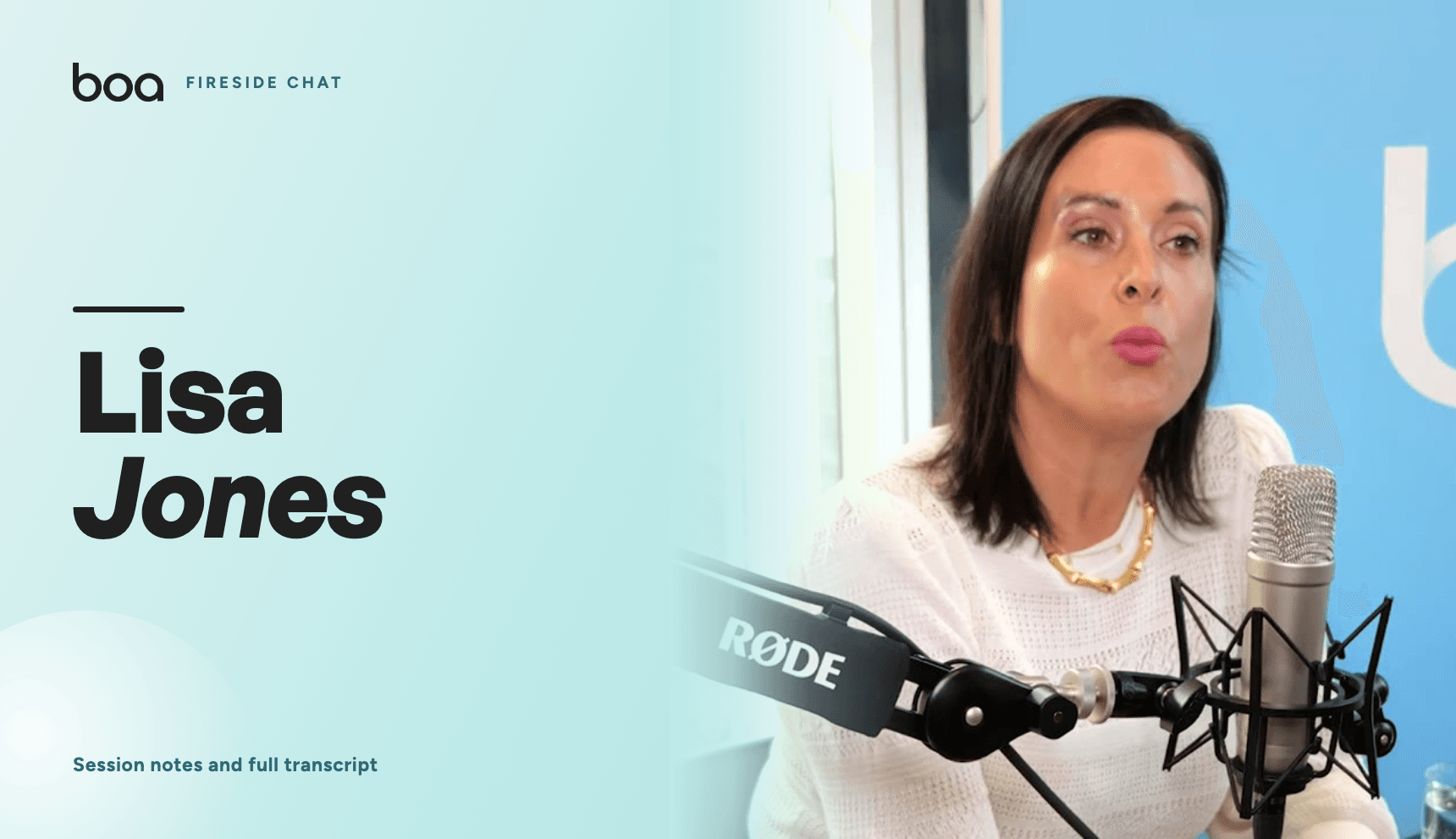
Lisa Jones on Niching Down and Testing Product Demand
With Lisa Jones, Founder and CEO at SheComm · Hosted by Daniel Hakim · 45 min
What this session covers
SheComm founder Lisa Jones explains how she went from coaching electricians and carpet layers to owning one niche, how she pre-sold $100,000 of nappies before ordering a container, and how to reorder website copy around the pain points customers actually name. Useful for e-commerce and service founders deciding who to serve and when to hire.
Stop being a general practitioner and become the boob doctor: pick one lane, then let customers tell you, in their words, which problem to sell against first.
Key takeaways
- 01
Be the boob doctor, not the general practitioner
Lisa coached electricians, carpet layers and any small business that came her way, and it satisfied nobody. A mentor asked her whether she had ever seen the cars a boob doctor drives, because specialists get paid like specialists. She niched entirely into women running DTC brands and the business took off, because she could speak to one group's pain points intimately instead of applying general logic to everyone.
- 02
Choose a market you have already been part of
Daniel Hakim quotes Mark Bouris: make your market someone you are, or someone you have been before. Lisa agrees, adding that most women build a product because they solved their own problem, whether that is skin, gut health or a baby product. You need a real story attached to the business, because people sniff out inauthenticity and do not buy.
- 03
Check the market is big enough to pay your price
Passion is only half the test. Lisa's second filter is whether thousands of people will pay the price you need to make money. If only about 1,000 people in Australia need the product, and they need it once, you will always be doing a hard sell. Premium pricing is fine, cheap is not the point, but there has to be real appetite so the product is easy to sell rather than a grind.
- 04
Pre-sell before you order the container
For Eco Originals, Lisa took large stands at five baby expos around Australia with only a prototype. The hook was a competition to win 12 months of nappies, entered by filling in a paper form and dropping it into big acrylic boxes. She collected 32,000 parent email addresses and sold $100,000 of nappies before pressing go on the first container of stock, which she calls reverse crowdfunding.
- 05
Write down customers' exact words, then use them as your copy
At those expos Lisa's team ran absorbency tests in front of parents, asked what they wanted to pay and what it should look like, and furiously wrote notes on the language parents used. Founders are too close to their product to describe it well, so their own copy misses the market. Every line, from the hero image above the fold to the footer, should use the customer's words.
- 06
Rank your pain points in the order customers rank them
Lisa says your product probably solves five to ten core problems, and it is arrogant to assume you know which is number one. Eco Originals assumed the main driver was that a nappy takes 500 years to break down in landfill. It was actually not wanting plastic wrapped around a baby's private areas. Ask enough people, then reorder your site so their number one appears first, not yours.
- 07
Phone your top repeat buyers and record what they say
Pull a report from Shopify or your platform and filter for customers who have bought more than three or five times. Pick five to ten of these advocates, ring them, thank them for their support and ask what keeps bringing them back: customer service, product range, something else. Take notes or record the call, then reframe your positioning in their words.
- 08
Sell one clear problem, park the rest as upsells
For a broad range of products, Lisa says the brand itself must solve one specific problem, such as being the one-stop shop for a defined customer. If only 20 of your 100 SKUs serve that pitch, that is fine. Put the rest behind clever category tiles on the homepage and an upsell app so they work as average order value top-ups discovered later.
- 09
Fix your niche and keep the cash coming at the same time
Asked how to resist taking on off-niche clients in a low revenue month, Lisa's answer is to do both simultaneously. You cannot give up the revenue while you fix your niche, and you cannot keep taking the revenue and never fix the niche. Work out which clients you gravitate to and why, set criteria, promote that niche, and let the wrong clients filter out over time. She has sacked clients before and says that is okay.
- 10
Hire out the $30 an hour tasks first
Lisa's test is hourly rate. When she was worth about $150 an hour, answering customer service emails, picking orders, cleaning her house and sometimes cooking were all $30 an hour jobs, and they were chewing 50 to 70 per cent of her available week. Customer service and social media are usually the first two to outsource, to a VA agency here or overseas, or to a customer who is a mum wanting $100 to $200 a week for an hour a day clearing your inbox.
- 11
Test demand with 20 real prospects before fearing IP theft
For a pre-launch founder worried about copycats, Lisa (not a lawyer) says patents are hard and expensive, so confirm the appetite first. Post in a local Facebook group, a women's group or the Boa app and ask 10 to 20 people in your exact niche to trial and survey the product. If you cannot find 20 people who say yes, question whether the market is big enough. She flags Amazon sellers as the exception, where copying is a recurring legal battle.
- 12
Beat overwhelm with a walk and a list of three
Lisa names overwhelm as the single biggest thing holding women back, and paralysis as its usual result: shut down, eat chocolate, watch Netflix, do nothing. Her method is to physically step away from the desk, go for a walk, call your mum, sit in the sun. Then write a list of only one, two or three things you can actually achieve that hour, day or month to get back to a sense of progress.
How the session runs
- 1:29Why Lisa started SheComm after exiting Eco Originals
- 3:20The boob doctor story and picking one lane
- 5:45How to choose a target market you have lived
- 7:47Checking there is enough market share at your price
- 9:34Five baby expos, 32,000 emails, $100k pre-sold
- 13:58Defining your own version of success
- 18:46Overwhelm, paralysis and the list of three
- 21:03Community over networking, and ShePods
- 25:30Q&A: taking off-niche clients for revenue
- 27:13Q&A: selling a broad range without losing focus
- 30:32Q&A: testing a product without getting copied
- 33:19Q&A: what product market fit actually looks like
- 34:51Q&A: when to make your first hire
- 39:36Q&A: leading young in a male-dominated industry
- 41:50Q&A: building a personal brand alongside the business
Mentioned in this session
- SheComm
- She Talks E-Commerce
- Eco Originals
- Solahart
- Mark Bouris
- Boa
- Shopify
- Amazon
- Netflix
- Finding Nemo
- Deja Mart Jewellery
- We Are Routine
- Sydney
- Melbourne
Questions founders ask
Lisa's test is whether there is enough market share willing to pay the price you need. If only around 1,000 people in Australia need the product, and they only need it once, you will always be selling a small number of units and it will be a hard sell. A premium price point is fine, but the appetite has to be big enough that selling feels easy rather than a constant grind.
Assume your product solves five to ten problems and that you do not know which is number one. Survey or interview enough customers to find out, and write down the exact language they use. Then reorder the site, from the hero image above the fold to the footer, so their top-ranked pain point comes first. Eco Originals learned that parents cared more about plastic against their baby's skin than about 500 years in landfill.
When you are at capacity putting out fires and cannot work on the business, and money is flowing relative to your hours. Compare your effective hourly rate against the task: if you are worth $150 an hour, customer service, order picking and cleaning are $30 an hour jobs. Lisa says those tasks often eat 50 to 70 per cent of a founder's week, and customer service and social media are usually the first two to outsource.
Lisa says yes, at some point it becomes relevant, because people buy from people. At minimum, get in front of your business with a strong about page, occasional on-camera Instagram posts or rough behind-the-scenes stories. Building a personal brand alongside the business also travels with you: she has had seven companies in 14 years, and Lisa Jones as a brand carried through all of them, now earning keynote fees and media invitations.
Lisa is not a lawyer and recommends checking with one, but notes patents are hard and expensive, so confirm demand justifies the cost first. Ask 10 to 20 people in your specific customer niche, via a local Facebook group, a women's group or the Boa app, to trial the product and complete a survey. If you cannot find 20 people who agree, that itself tells you something about the market. Amazon is the exception, where copying is a frequent legal problem.
Full transcript
The complete conversation, as recorded, with every speaker attributed.
Daniel Hakim0:00
On behalf of myself and Team BOA, we wanna thank you for being part of BOA at this early stage in our journey. Our goal and mission is simple, and that is to provide the highest quality networking advisory and community for business owners at all stages in all locations. And today we're having the opportunity to learn from really one of our country's like leading minds in e-commerce and B2C companies and brands. Lisa, first of all, Lisa, thank you for being here. We know how busy you are.
Lisa Jones0:33
Thanks, Daniel.
Daniel Hakim0:34
I will do an introduction even though I'm sure many of you already know lots about Lisa, but she's the founder and CEO of SheComm, which is Australia's largest e-commerce women's business community. In addition to that though, Lisa is a serial entrepreneur. So she's had like 7 businesses, 3 of them have become multimillion-dollar brands. Lisa's a podcast host. Actually, the podcast name, do you want to say it?
Lisa Jones0:58
She Talks E-Commerce.
Daniel Hakim0:59
She Talks E-Commerce. She's a keynote speaker, uh, she's a mother, so she's very busy. So, which— so thank you again for taking time to be here for us today.
Lisa Jones1:09
It's an absolute pleasure. And hi everyone, that I can see your gorgeous faces. Good morning.
Daniel Hakim1:14
Um, why don't we start with just SheComm? Could you just give us just a quick overview of why you started it, where it is now, and, uh, perhaps what you've become an expert in as an entrepreneur in Australia?
Lisa Jones1:29
Oh, I love that. Um, and of course it's always a difficult question to answer because it depends how far back we go in the journey as to why I started SheComm. But I'll say that I came out the other end of building a big eco-nappy brand and had to exit the company, and as part of my divorce from the co-founder, and luckily our investor bought out the whole company. And so the, the business Eco Originals has continued to grow, which is a nice thing to have left a legacy. And I had about I don't know, maybe 12 months sitting around twiddling my thumbs thinking, oh my God, what now? And what I observed over time is that people kept coming to me asking me questions about like, how did you solve this problem? Or what did you do at this moment in your journey? And mostly it was women coming to me and asking me. And over time I realised I loved to coach. And then of course, as a serial entrepreneur, it kind of became a thing and it's become a really big movement now where we have around 30 staff at SheComm and about 20,000 women in our extended community. And we really, at its core, our community. I mean, yes, it's a profit business, it's not a not-for-profit.
Daniel Hakim2:31
We do—
Lisa Jones2:31
we are here to make money and grow, but, but it's, it's so much more than that. It's, it's rich in its ability to connect women to each other, to connect them to strategies that help their businesses to grow, to physically connect them at retreats and events that we run, and also virtually because we are spread throughout pretty much most of Australia. We do have a few clients overseas, but we're very much Australian.
Daniel Hakim2:53
Yeah, one thing you said to me yesterday was, and I want to talk about it today, was the very start of Chiccom. You know, I asked you, how did you make, like, how did you make Chiccom successful? What was the very start like? And you, you spoke about how it took you time to really figure out who you're serving, like who your target market is and what your lane was. Can you talk about the importance of identifying a very niche market when starting a business?
Lisa Jones3:20
Oh, 100%. It's a, it's an interesting storey because this all kind of occurred at one of my companies I had before I had the nappy brand was a trades business.. So I had a Solar Heart dealership and we sold all kinds of energy efficient products for people's homes, like completely unrelated to a D2C brand. And we had 19 staff, we were turning over $3 million a year. It was the business I made all the mistakes in, but we have to learn those somewhere. And then when I went to start coaching, I, I became really broad as a coach. I had electricians, I had carpet, you know, laying companies. I had such a broad and diverse range of clients I was trying to help and support. And I was applying my logic and my strategy and approach to business, but to a really wide variety of businesses. And what I realised is that that doesn't feel satisfying to me or anyone else. And do you want me to— shall I share the boob doctor story?
Daniel Hakim4:07
Yeah, yeah, I think it's funny. Great example too.
Lisa Jones4:10
So I was sitting there one day with a mentor and he said to me, Liz, I can't help but observe that you're being a general practitioner, not a boob doctor. I was like looking at him thinking, what the hell, mate? And he's like, have you ever seen the cars that a boob doctor drives? It's like, have you ever witnessed that they are so specifically niched in all that they do any day? Is literally the specialist role, not the generalist and it was like a light bulb went off and I was like, oh my God, okay, so instead of servicing everybody, what about if I picked a lane, one lane, and nailed that lane? And the minute I did that and I completely niched into women in DTC brands, it kind of took off like wildfire. It was like suddenly people, I was talking their language and I was able to share my story, which I always do in a really real and vulnerable way, but in a way that spoke to their pain points very intimately. And then when you do that, And this applies to all of you, of course, that's why we're talking about this, is when you nail your customer's problem in a way that they understand it, well, magic happens. And that's what happened for us at SHECOM by being really specific.
Daniel Hakim5:15
So I wanna ask then, so obviously, yeah, being specific at who your customer is and then being able to focus on a problem for them. Can you give advice on how to actually choose who your customer is? Like how you decided that, you know, this is my customer. And then I wanna talk about also identifying how to identify the right problem? 'Cause often when you have a company, you're like, oh, you know, like my company solves many problems. So choosing one kind of key problem, but before that, let's, how do you actually, how did you choose your target market?
Lisa Jones5:45
Well, I feel it has to come from somewhere deep inside of ourselves first. I feel in my particular situation with so many incredible women around me that have, you know, product brands, most women have created a brand, whether it's a product or a service, because they've solved their own problem. So usually, in particular, a lot of women create products when they have babies. It's like a very common thing. It's either solving, you know, like perhaps they've got a skin outbreak, so they create a skin, uh, you know, beauty brand. Or perhaps it's actually a gut brand. There's a lot of women that will create then like, you know, microbiome products. Or, or maybe it's a baby product. Whatever it is, I feel that, uh, it's important because you need to have an attachment to it. It needs to have a meaning for you because I'm such a fan of, you know, purpose over profit. Look, both preferably, but certainly I believe life is really short and we don't want to spend our days doing something that we can't emotionally attach to. It feels better because, let's be honest, being a business owner is really hard and tough and has plenty of shitty days. You want to be doing something that you're deeply connected to. I think that's the first piece, is choosing a problem that you can actually personally bring your experience, passion, and your solution to that you've solved for yourself because storytelling is a really big part of having a business. If you have no storey to tell that attaches to the business you're trying to share, then it's inauthentic. And unfortunately, humans tend to follow businesses that they feel have some authenticity. So if you're inauthentic in a business in any way, people will usually sniff it out and not buy.
Daniel Hakim7:17
A tip actually Mark Bouris, um, who we were just talking about, gave to me. He's an investor in Bowen. He said when you create a business, it's best to make your market someone who you are, like someone like you, or someone you have been before. Yes, you know, and I thought that was a really clever way of kind of—
Lisa Jones7:36
that's a perfect way of summarising my big long ramble. Thank you, Danielle. I should have just asked you the question.
Daniel Hakim7:41
So, so once you've found the market though, how do you identify what the big problem you're solving for?
Lisa Jones7:47
Well, and the interesting piece of second half to that, apart from having a passion or an alignment with it, is that you have to cheque that there's a big enough market for what you're trying to create. So I also find this a lot with incredible women who've got such an incredible product that they've created. However, they've forgotten that they are actually not their customer, that it doesn't really matter whether, you know, if I create something, I can like it and rave about it till the cows come home. But if there isn't thousands of other people who also— sorry, it's been a big week and I've had a lot of public speaking gigs, and I knew my voice was going to be a problem this morning. Apologies, everyone.
Daniel Hakim8:23
Which shows how hard you're working to write a sitcom.
Lisa Jones8:27
It's like my 6th public speaking gig this week alone, I think. You need to make sure there's market share that will pay the price that you need in order to be able to sell enough of the product to make money out of it. The examples of that are something that's so niche that there are maybe only 1,000 people in the whole of Australia that need that product once. Well, you're only ever going to sell a small number of units. It's going to be a difficult sell as opposed to choosing a product in a market where there's an enormous appetite for the product. Then you sell it in a way where it's in the right price point. And that's not always cheap, to be clear. It might be that the product is a premium product and that is okay. It's not about making things cheap or putting them on sale, but you just— there just has to be an appetite for the product and enough of an appetite that it is what I might say easy to sell as opposed to really fucking hard to sell, which I see products all the time who hit that spot.
Daniel Hakim9:19
And you mentioned something to me as well yesterday, which was that you actually did a lot of work, I think was with SheCom, in interviewing and, um, um, what's it called when you send people like surveying?
Lisa Jones9:34
Yeah, that was actually my nappy brand, and it's a really good story. So, um, you know, this is like we're talking 13 years ago now when I launched Eco Originals, and we actually took, uh, I suppose a big gamble if you like, because we picked 5 baby expos, the PBC expos around Australia, and we actually took a large stand at them. And, um, we didn't have a nappy yet. We actually had the prototype And we did something a little bit outrageous, if you like, where we did a one-year— it was a win 12 months worth of nappies, enter your details. And this was before you had scanners on stands. There were people, they were like queued up down the hallway filling in their bits of paper. And we had these massive acrylic clear boxes for everyone to put their bits of paper into. And we actually, over 5 expos, we gathered 32,000 parents' addresses, email addresses. But more than that, we had the opportunity to speak to thousands of those parents in person and saying like, right, what do you wanna pay What do you want it to look like? Like, here's an absorbency test. Is this enough? And they'd be like, yep, that'd be a pretty normal wee. Oh, that's not enough. Or like, can't spill. And the reason this was really important, I mean, there's a bunch. We sold $100,000 worth of nappies before we had pressed go on the first container of stock. So reverse crowdfunding. But the thing that was actually really important is that we were able to understand what their— first of all, what language they used, not what we used, because also a lot of A lot of people in business make the mistake of writing their own copy the way they would describe the product and it doesn't meet the market. People go, "I don't really know what you're saying," because it's hard to describe your own product. We're too close to it. Every conversation we had, we would be furiously writing notes about the way they described their problems so that when we created copy, we talked to their problems, not what we thought their problems were. The piece I'm coming back to for your question, Daniel, is often we think when we have a business solution to a problem that our audience faces. We know the number one, right? We were talking about this yesterday and you're like, uh, how do I know what the number one problem my audience faces is? And I'm like, well, there's never just one. First of all, there's usually somewhere between 5 and 10 core problems that your product or service could solve for people, but you couldn't be so arrogant as to assume you know which one is their number one. How could we? So the only way to know is to ask lots of people, like survey in the way that I did it, or, you know, send out— there's a million different ways you could do that. There's even and incredible automated versions these days to understand what people think about your product. But I believe then that it's reordering your copy from your hero image on your website above the fold right through to your footer and all of the pieces in between. You need all of those pain points outlined and how you solve it, but you need to put it in a hierarchy that they tell you is their number 1, number 2, number 3, not what we think it is. And the example of that is at Eco Originals, we assumed that everybody's number 1 reason they would buy an eco nappy was because they cared that it took 500 years to break down in landfill, which is actually not true. That's actually not people's primary motivation for buying an eco-nappy. It's actually not wrapping plastic around their child's private areas. That's actually, it's inherently the selfishness of us as humans where we're like, I don't really care about the earth, I care about my baby. And like, no judgment, that's just what it is. So it's reordering it in a way that they believe it to be, not what we think it is.
Daniel Hakim12:48
But basically, I love the concept of, you know, you can solve lots, your product might solve lots of problems. The most important one you think it's solving may not be the one.. Right. And you're only gonna find that out by talk, by speaking to as many customers as possible.
Lisa Jones12:59
Deeply talking to people.
Daniel Hakim13:00
Now guys, I just wanna remind everyone that if you think of questions, like if you have a question that's about your business, something you're stuck on, pop it in the chat because we are gonna get to it and, and Lisa will, will, will assist you and, and, and answer the question the best she can as well. If I have anything smart to say, I'll try and jump in too, but please throw the questions in. Now Lisa, a big thing with, with, uh, starting a business or operating a business is basically personal satisfaction. And, and like, a business— success in business is different for everybody. Not everybody wants to build Apple, you know. Some people just want to build— most people just want to build a great business that might give them some freedom, some extra time, ownership over the lifetime with the family, whatever it may be. So I wanted to ask you, what is success to you? And how important is it for, for an entrepreneur or business owner to understand for themselves what success is?
Lisa Jones13:58
Well, I think it's— first of all, I think it's extremely important because otherwise we drive ourselves, you know, often relentlessly as business people with no real understanding of at what point am I going to have reached some kind of goal, right? But I will preface anything I'm about to say by saying don't copy me in the sense that I run a million miles an hour. I am constantly exhausted. I think that I'm unable to relax and unwind. And this is not a forever thing. I've got like a 2 to 3 year goal and then I plan to sell SheComm. And I'm very upfront about that with team that start working with me, with my executive team in the business, everybody is, and even my clients, they're on the journey with me of understanding that I didn't get the exit from my nappy brand I hoped to get because I ended up getting divorced and that kind of put a cloud over everything. But I do want to get to a place where I've built security for my daughter and I. And of course I'm happily married, so I should include my beautiful husband in that too for us and financially that's on my shoulders. That's just the journey that I've picked in this life. So I have a desire to build a really big wealth asset. And for me, that means I drive myself relentlessly to build SHECOM into a global entity that I can then sell and have a successful exit from. But will I relax after that? Probably not. But that's my curse and something I keep working on, trying to understand how to tell myself to rest more.
Daniel Hakim15:18
Valium. No. But the point there is that, you know, everyone has different versions of success.
Lisa Jones15:27
Yes, exactly.
Daniel Hakim15:28
And understanding your version of success is what's gonna make you feel comfortable as an entrepreneur because, you know, it's not about, oh, I have a, like, I always hear people say things like, oh, I've got a, it's just a small business or it's a little business. Like, the size of the business means nothing. It's how is the business serving you as the founder?, you know, as the owner, because that is what success is. It's like, is— have I achieved the goals I wanted to achieve from my business? And that is when you feel really proud. I mean, you should feel proud when you start anyway, but, you know, really proud when you actually see your, your success, your image of success come, come to fruition.
Lisa Jones16:06
Oh, absolutely. And I'm really quite outspoken about this, is that like, how arrogant would I be to say that my version of building a global empire needs to be your version, right, of success? So you might say, well, if I could earn, you know, $50,000 this year in profit from my business but work only 15, 20 hours a week, like, that would be a win for me. Or for some of my beautiful community, it's like, I've been able to retire my husband from his role and now he works in the business, and that is success. Like, honestly, it's— there's so many versions of people's success. Please don't ever let anybody else's cloud yours, and equally, don't get imposter syndrome about somebody else's perceived success either. I feel it with women in particular. I can see a lot of women on the screen right now. It's a big problem for women that we feel less than other women or less than anyone else in business. I had it even this week. I went to something else and I sat there. Actually, it was a conference I was a keynote at this week. The panel before me, I shouldn't have listened and I did. I stood at the back of the room and I thought, "Oh, 'Oh, fuck, what have I got to offer when I listen to these people talk?' And like, it's just not true, right? So I had to like give myself a verbal slap on the wrist and say, 'Come on, girl, like, you know, let that crap go.' And I think for a lot of you, it's very relevant, is this imposter syndrome stuff. Let it go. Be really proud of your, your version of success. Stick to it and, and make it happen.
Daniel Hakim17:33
Imposter syndrome is something that like I hear a lot about, and, and a lot of it, I think, yeah, is, is like comparing to someone else. But you know what, I think the best way to get over imposter syndrome is just doing it and making the success just attempting, just trying. You know, like if, yes, I just won just because I tried, as opposed to like, oh, I had to do really well, or I had to, you know, pull this amazing sale off for the week. Or, you know, just trying is the success because like 99% of people just won't even try. So just, yeah, you know, just taking that any step forwards is just such a huge success.
Lisa Jones18:05
And bravery and confidence, you know, like lots of women too will also sit in the place of humbleness, which I'm all for humility, but I think sometimes women don't push themselves out there enough of saying, I can do anything. I'm just gonna go for it. Instead, staying stuck at home and playing small. And I think I would just wish for every woman that they could take a bigger step today than the one they took yesterday.
Daniel Hakim18:28
And on that topic, so I'd love to focus on the women in business and the particular challenges that you may see are common. In women entrepreneurship. Are there any, I guess, what are the most common challenges you feel women have in business and how can they overcome them?
Lisa Jones18:46
Yeah, I mean, look, by far the number one problem that I see hold women back across every business type, size, geography, you know, ethnicity, race, location, anything is overwhelm. And I'd love, I can see a bunch of heads on the screen. Anyone gonna nod if you guys feel overwhelmed a a lot. What I feel happens for women, and I'll outline the problem, is that we do— first of all, we do a lot as women. We, we do. We're incredible at multitasking. But unfortunately, that then means that we end up often mothers, family members, sometimes we still work for other people while we have our own businesses on the go. And we end up in this kind of juggle, right? Like, we're constantly juggling things. And what can happen often is the overwhelm sets in and then a couple of things happen. And the most common one is paralysis. So when we get really overwhelmed, we shut down and we think, well, either I'm not good enough, I can't do this, I'm going to go and eat chocolate and watch Netflix, or I'm going to drink a bottle of red wine, or I'm just not going to do anything because I'm so overwhelmed. I actually can't see the path forward from here. And I mean, this happens to— it happens to me, it happens to everybody that I know that is a female in business at any stage of business. So First of all, I guess it's acknowledging that that is, is a really big thing for women. And then I think in that moment in which you feel that huge sense of overwhelm, it's actually— I, I, my guidance is always step away from the desk and the computer in the business in that moment. Go for a walk, call your mum, have a cup of tea, sit in the sun, just like break it because that's, that then gives us perspective and then make a list of only 3 things that you need to do. It might be 1 if you're really overwhelmed, but just 1, 2 or 3 things that you can achieve that minute, that hour, that day, that month that lead you back to a place of feeling like you're achieving success. And I think, I just think overwhelm is honestly, it's one of the biggest killers of women's motivation in business.
Daniel Hakim20:35
Um, and obviously I know that you believe, uh, having a community and a strong network of others in a similar position is very important. Um, in fact, it's basically both what we both do with our businesses, but But is there a tip or like a philosophy that you have towards networking or relationship building? Like, how do you feel that people should approach building that kind of safe community of fellow entrepreneurs?
Lisa Jones21:03
Yeah, interestingly, we don't use the word networking ever at SHECOM. It's just, it doesn't, it feels to me to be a masculine word. Sorry, Daniel.
Daniel Hakim21:10
It's just an ugly word.
Lisa Jones21:11
It's kind of an ugly word. And I've been part of networking groups in the past that were a bit cold and I don't like that. We don't do that at all at SheCon. So what we do and focus on really heavily is that, like, I suppose it would be like more of a heart-to-heart connection between women. And so, for example, last night we took 100 women out for dinner in the city, in here in Sydney. And I would say the majority of women in the room didn't know each other before they arrived at the event. And we do things like we have ShePods where before our big conferences, we'll ask women if they don't know anyone, would they like us to put them in a pod of 5 women on WhatsApp, and then they can actually arrive together, like meet for a coffee before the event. And I think all of the cocktail party last night and everything, it's designed so that when you meet another woman in SheComm, it's like, um, I am you and you are me, and there's no ego. It doesn't matter what size your business is, but there's a recognition almost of like, you're like just like me, Something like, right, we're exhausted, we're tired, but fuck, it's nice to get out of our house and meet other women and like have a laugh. And, and that actually is how we do everything at Chic Home. So, so it's never about, hi, I'm Lisa, what do you do? That is like just not a thing. Um, it's actually very much about like, oh my God, hi, like, like let's have a hug. And like, what products do you sell? So that's supposed to some extent there is, what do you do? But it's not the, I don't know, it's, it's a very Chicon way of doing it.
Daniel Hakim22:33
So when you're both business owners, it is easy to talk because you have something in common. Like, you can talk about business, and so of course you want to talk about each other's business. But I think the lesson really there is that you're, you're approaching it in with the perspective of building a real, like, a friendship, a humanness. It's a human, as opposed to like, what do you do, how can I benefit from you, right?
Lisa Jones22:51
And we don't really do that, like, what do you need that I can solve? Like, I know a lot of networking groups do, but we find that happens organically. But we focus far more on like two women who essentially, you're exactly right, Daniel, they become friends first. And then of course what often happens, and like I've got so many examples last year at our conference, we run a big 3-day conference every September. And the last one, uh, one of my coaches actually came to that cold. She, we didn't know her before the event, but we put her in a ShePod and like she still talks every day on WhatsApp to her ShePod. Like they live all over Australia and they're just like, like, oh my God, I just found this software platform and like, fuck, a sale's down today, what are you guys doing? And like, oh my God, I just did this segmentation on email and holy shit, look at my results. Like, it's not really about, hey, who's bored and wants to chat, because we don't have time for that. It's actually just sharing the bits of gold with each other that is like, it can change the course of everything because suddenly you're not alone and isolated anymore. And women are not as good at coming into places like Clubhouse. You know, we stay in our homes often. We often don't have a friend or family network that understand what the hell we do every day when we have our own businesses. So I feel like this is— this becomes your family.
Daniel Hakim24:02
And now I want to move to questions, Q&A, because we have a lot of them. But while I'm looking at them and organising myself, perhaps would you be able to share what your greatest lesson, or even potentially what your hardest lesson that you've learned in your, in your entrepreneurial journey has been thus far?
Lisa Jones24:19
Like, I don't even know where to start on that. Um, There's been so many. And I do think I don't necessarily want to have a business partner again. I feel like that didn't work for me. And I see that happen not very successfully with a lot of people. So that, so that is a lesson that a lot of people learn the hard way. But I honestly, if I was to summarize, I suppose all of that, what you asked in one piece, for me, it would be about my husband has a bit of a famous thing he says about me, and it could be construed as a criticism, but it's the greatest compliment he could give me. And that's that he says I'm like Dory. You know Dory the fish in Nemo? I wake up every day and it doesn't matter how shit the day was the day before. Let's face it, there's a lot of shit days as a business owner. I wake up like, "It's a new day. What am I going to do today?" That, I have to say, has been probably my greatest gift because business is tough and relentless. I need to have every day as like a cup half full. Right, it's a new day. What am I going to conquer today? That would probably be. My advice.
Daniel Hakim25:18
Yeah, no, it is, is don't let bad things weigh you down. Like, it's a fresh day, it's a fresh wind. Now I want to start by asking, uh, Sarah Petty. Do you want to ask your question, Sarah?
Lisa Jones25:30
Hi, Sarah. So I run a virtual CFO business, and I'm just— my question was in regards to what you were talking about earlier of getting your niche and your ideal clients. And I find with my clients, as well as if I'm on a honest with myself, there's often a temptation to just take a client on because especially in those months when you're having a low revenue month or, you know, you're just starting out. So how do you avoid that temptation? And, you know, should you, or is there, you know, how did you kind of get that niche, stick to it? And is there any point you felt like you've done something just to kind of get the money in the door? Um, and how do you stick to that? Yeah, it's a really good question. And, and first of all, I love virtual CFO business., that, that is needed by most of my community, I will say, because a lot of women who create businesses are not very good at the numbers. Um, but to answer your question, and I answered something so similar to a client last night who asked me something similar about, Mark, should I keep doing markets while I'm building my e-com? And the answer is the same to both of you, which is you need to do both for a while because you can't give up the revenue while you fix your niche, but you can't keep taking just the revenue and not fix your niche. So you need to do both at the same time. And I I think for you, I would say like in the different clients you look after, which are the ones you gravitate to helping the most? Is there a particular criteria that you could set that you're like, I like these people? Why do you like them? Like, what is that niche? And then start to promote that niche and just slowly over time your clients will filter through. We can let go of the ones you don't like. And I have had to sack clients over the years. That, that does happen. That's okay. Basically do both at the same time simultaneously. Makes sense, thank you.
Daniel Hakim27:10
Liz, do you want to ask your question?
Lisa Jones27:13
Hi, I run a nature and sensory play business selling toys and educational resources, and I'm kind of a one-stop shop, which is great for parents who only want to pay shipping once, right? But I find that because I have such a diverse range of products, I find it really hard to know how to effectively let people know that I have all of these amazing things. So I guess my question is, what's the best effective way to show people my range without, you know, them just thinking I do one thing or another? Yeah, I love that. And it's something Daniel and I were talking about yesterday, actually, on his other podcast, which is around you have to solve a problem, your business now. So like, you will obviously have many products individually that will solve a problem, but your business in general, you know, your brand name and what it is that you're doing as a platform must solve a specific problem. So it could be that, you know, you're the food delivery service for busy parents, for example, or it could be whatever it is. You need to create the pitch to somebody that solves their problems. So it could be the one-stop shop for XYZ, right? Like whatever it is, it needs to have a focus. And when you sell it to them, you're selling the problem that they face. You're selling their exact solution to that problem. Now you might say out of of 100 SKUs, there's only 20 SKUs that specifically solve this problem, but that's okay because then you have really clever category tiles on your homepage where you have extra things that you could sell that are almost superfluous or AOV topper-uppers, and they're things that can be added in later. They could— you could have a really clever upsell app on your, on your e-com site that allows people to see what those products are later, like they're later things. But, but your core product range has to solve a really unique problem for people. Otherwise, otherwise you risk being too broad where you don't actually solve any specific problem and then you're not potentially front of mind for people. So, um, look, I could talk for hours around this issue in many different ways, but hopefully that is just something you could take away today.
Daniel Hakim29:17
But perhaps, could then she— it could, um, Liz, should she be interviewing a lot of her like current customers to figure out, you know, especially the ones that are purchasing the most, to figure out?
Lisa Jones29:28
100%. And what I would and this applies to everybody, but specifically with e-com, like, I'd love you to pull a report from Shopify or whatever platform you're on and like look for any customers that have purchased more than a certain number of times. So it might be anyone who's purchased more than 3 times or 5 times, or, you know, like we've got a client who's had a— one client who's purchased more than 1,000 times from her, right, in her time in business. It is possible. But, but pick what I might call your, your real advocate customers, the ones who, who love your brand for a reason, and try and find 5 to 10 of them and then literally pick up the and introduce yourself. Say, "I really wanted to thank you for your support in my business, and I'm really interested in understanding, like, what brings you back to continue to buy from me. Like, is there a couple of things? Is it our customer service? Is it our product range? Like, what is it?" And then use their words by furiously write notes or record it so that you can reframe what it is that you do but in their words. That's a really good place to start, and that's for all of you when you're trying to understand what drives people to buy from you.
Daniel Hakim30:27
Thank you so much.
Lisa Jones30:30
Pleasure.
Daniel Hakim30:30
Raquel, do you want to ask your question?
Lisa Jones30:32
Hi, yes, sorry, I'm a bit sick, so I'm just, um, off camera. Uh, but my question was, I have a company, it's called We Are Routine, that I'm hoping to launch end of this year or early 2025, um, and it's made from recycled plastics. It's really to solve a problem of, uh, travelling with vitamins and liquids and all of these It's made from recycled plastics as well, so made in Sydney. But congratulations, and my product is essentially finished. And you're talking about getting feedback from potential customers and seeing what their feedback was and if there's any changes to make. How do you go about my product being, you know, open to patenting and everything like that? How would you give them your product without them essentially stealing your idea or taking that to like, I don't know, manufacture and make it themselves and launch it before you do? Yeah, got it. It's a very good question, and a lot of people are quite fearful, and, and most of the time, uh, without grounds to be scared, because it will have taken you a really long time and probably a fair amount of trial and error and money to create the product that you've got. So I mean, yes, we do need to protect our IP, and I'm not a patent lawyer, so, so this is not professional legal advice, but definitely cheque that out with a lawyer and see what you could protect. Patents are hard and tough and expensive, so you'd want to make sure there's enough appetite for your product to justify the expense of doing that. But I think in all honesty, sometimes we have to trust as humans. Fortunately, in my situation, I feel like by being a little Dory and very trustworthy, I've never really been particularly screwed over. I'm not saying it doesn't happen, but I think you just have to trust. What I would do in that situation is Go into your local Facebook group or go into a group of women or go to the BOA app and ask for 10 or 20 people that are this specific niche that you think that is your customer niche. So like women who travel regularly for business or whatever it is that the problem that you've created this product for and ask them would they do a survey for you if you send them out a product. This is a really common thing to do and you need to get— if you can't, by the way, get at least 20 women who say yes to surveying it for you, then you may need to consider whether there's enough market for your product. But, but that's how I would approach that and just trust.
Daniel Hakim32:49
Yeah. And I would certainly—
Lisa Jones32:51
so smart. Thank you.
Daniel Hakim32:52
I think what you said about, you know, the legal side as well, it gets so expensive so fast and, and 9 times out of 10 you don't even need it. So you just burn the money. So I would definitely do the product. I'd be— I agree with that. The only—
Lisa Jones33:05
I will differentiate that though, for some women who end up selling on Amazon is that can be a different kettle of fish. We've got quite a few clients and even some of my coaches who sell on Amazon and end up being copied all the time. And it is a legal battle that does become a problem regularly.
Daniel Hakim33:19
Jane, do you want to ask your question? I will ask it if that— if Jane can't get on. But it's about product market fit. So people always talk about market fit. How would you actually go about finding your product market fit and how do you know when you have it?
Lisa Jones33:33
You know when you have it, when you have enough people buying your product. Like. So the other day on my podcast, I interviewed a really cool chick in Australia who launched a lash serum and went to 8 figures in 12 months. Now she has market fit. She's created a product, she's done it at an affordable price point, and there's enough appetite for her product that her sales have literally gone gangbusters. So that is a really fabulous example, perhaps extreme, of really good market fit. And I think, um, like we suggested to Raquel, like deeply testing your market before you invest in the product is also a really important component in this. But, but there is no perfect answer to this. You actually have to be a bit— like I call it— be a bit Sherlock Holmes-like, and you have to be really quite deeply inquisitive. And I'm going to be really honest, ladies, you have to be open to constructive feedback that hurts your feelings. So one thing that I will say is that I know I am Nautique Originals and I am not SheComm. They are like their own businesses and they're not me. So on the weekend when I want to do work or I want to think about or solve all the problems at I'm like, dude, you're not SheCom, take the fucking weekend off, right? So the same thing exists for your product. You are not your product, your product is not you. So take criticism, it isn't personal, it is about the product. And that is like one thing women do quite badly, if I'm really honest.
Daniel Hakim34:50
And Justine?
Lisa Jones34:51
Hi guys, I'm Justine. I have a digital sewing pattern business, so we create sewing patterns. Yeah, my business has been running for about 4 or 5 years now, but we've scaled it in the last year. Congratulations. Staffing, and we're kind of at the stage where like we need to hire someone really badly, but I just don't know, do people normally like bank their whole salary for a year before you go and take that plunge? Or like how much of a buffer do you do? Yeah, I just, I'm at a loss with that. Got it. Um, look, I, I like to think that at some point when we as the business owner are at capacity, being I'm actually just putting out fires all day and therefore unable to work on my business, then we actually have an obligation to the business, as long as the money is flowing in relation to our hours that we're putting in, that we need to bring people underneath us that are on lower hourly rates than we could be investing in our business. The perfect example of that is like I say, most women who've got the MVP, the minimum viable product, in their business growing and they're busy and there's money coming in, then like, don't do your own cleaning. That's a $30 an hour role. I, you know, sure, I'm like a couple of grand an hour on my head now, but I used to be like, maybe I was like $150 an hour.
Daniel Hakim36:03
Right.
Lisa Jones36:03
And it's like, if I'm $150 an hour, I shouldn't be like answering customer service emails. I shouldn't be picking orders because they're also $30 an hour roles. And I most definitely shouldn't be cleaning my house or even potentially sometimes cooking food. Right. So when you see it that way, you realise that all those tasks, they're probably chewing 50 to 70% of your week of your available hours. And in actual fact, your hourly rate at $150 an hour would be far better spent being strategic about your business, finding collaborations to get new audience, building new marketing strategies and learning Facebook ads so you can run lean marketing campaigns. That's a far better use of your time. In that situation, you're a digital e-com business, so you probably don't pick and pack orders, but customer service, social media, they're usually the first two to outsource. You can do that to overseas VA agencies, Australian VA agencies, Or simply, and my favourite place, is to find either a customer who's a mom in your area— whether it needs to be in your area or not is dependent upon whether they're picking orders or not. But inside of our own customer database often sits really clever women who've had really great careers, who've ended up raising kids at home, who are just a little bit bored and would really like $100 or $200 a week in their pocket to do a couple of hours a week work. It might be an hour every day where they log on and clear out your customer emails. Like, there is a plethora of women who will be really happy with picking up some of the pieces so you don't have to do it.
Daniel Hakim37:26
And in terms of finances, like, the general consensus for any business is to have 3 months of your fixed cost, of your, your fixed monthly costs in the bank account. So if you can get that, that's, that, that, that's being pretty safe. That's like a pretty good result.
Lisa Jones37:40
I will say most e-commerce brands don't ever have that, but, um, that's probably something that my new friend the virtual CFO would be far better at answering than me because is we as e-commerce brands usually suck at running our money because as you would know, if you have digital, uh, virtual, physical products, you pay for a stock order, you have no fucking money. Then sales come in and then you have to pay some digital marketing bills and it's like this, it's like a roller coaster. It's a little bit different to service businesses.
Daniel Hakim38:05
Hey, good one. I'm learning.
Lisa Jones38:07
I'm lucky that we don't have to pay for stock because I make the product.
Daniel Hakim38:11
Fabulous.
Lisa Jones38:11
Yeah, we've got a bit of an edge on that, but yeah, I really appreciate Thank you so much. Thank you.
Daniel Hakim38:17
Um, Danielle, Danielle's asking— oh, there you are.
Lisa Jones38:22
Oh, it's a bit, um, alien-like, Danielle.
Daniel Hakim38:25
So Danielle's asking, you're a busy woman, what's your personal routine to reduce burnout?
Lisa Jones38:31
That's a really good question too, and I, I say that as I roll my eyes because I'm not sure I've nailed this. Um, I do, as I said, I do have some boundaries with work times at which I say, like, you know, just no. I also have an incredible team, and, um, I, uh, I look— I do, I do have big holidays every year, several of them, where I try very hard to switch off. And I find, as a, as someone with 30 staff and a lot of clients, a lot of events, it's very difficult, um, it's very difficult for me to switch off when I'm working. So I have to have a couple of really big holidays each year where I deeply rest and that is kind of how I top up. Like, for me, December, January are pretty quiet in, in our business community, so I, I have— try and have 6 weeks off then, and then a big one in the middle of the year. But yes, um, I think a lot of women find that very challenging.
Daniel Hakim39:23
Anastasia, guys, by the way, these questions are awesome, so thank you so much for asking, because every question you ask, like, I'm— the, the answer helps everybody here, so it's so awesome. So thank you. Sorry, Anastasia.
Lisa Jones39:36
Hello, I work in the pool and spa industry and we are mostly male-dominated. So basically we're in the process of opening a second retail store, which is quite exciting, but also I'm a little bit nervous for that. But I just wanted to know your advice as like a young female in this sort of industry, like what, what would be the best leadership advice that you have because I'm quite young and like new into the business, so I kind of want to know what your advice would be for that. Look, as somebody who spent 10 years in the male-dominated property industry, commercial property industry, I understand what you're talking about. And of course I had a trades business too. I think, first of all, thank you for calling me young because most days I don't feel young and I'm 46 this year, so I think that's a compliment and I'll take it. I think that the— in answer to that, I think it's about being really confident inside yourself and not actually allowing anyone else's opinions or perceived opinions to infiltrate. And I would describe it as imagining yourself as a rock and everything else is around you just washing away. And that sounds a little bit hippie, but I guess what I'm trying to say is that, you know, you will get sexism, ageism, all those kinds of things from other people, and you have to just not take that on. Like, It's just, that's their shit, not yours. So stand strong, develop yourself as a business person, like undertake extra studies of business strategies, get a mentor, join a community, like further professional development will continue to allow you to feel very confident in your role. But just don't like let their shit be like arrows falling into a coat of armor. It just doesn't, don't let it penetrate and don't let it become part of anything you think about. About.
Daniel Hakim41:27
Guys, this is going to have to be the last question just because we are out of time and Lisa does have team outside who are probably going to bust in and take her to her next meeting pretty soon. But it's a fantastic question actually, and it's so relevant for today's world. Rosie, do you want to ask the question?
Lisa Jones41:41
Hello, sorry, I am multitasking on all levels this morning. Can you guys hear me okay? We can.
Daniel Hakim41:49
Cool.
Lisa Jones41:50
So my question is, so my name is Rosie, I am the founder of owner of a business called Deja Mart Jewelry. So we specialise in getting your little baby's fingerprint on high-quality jewelry. And my question is, in a world where you're told that in order for your business to be as successful as possible, you have to build your own personal brand, how— what are your thoughts on that?
Daniel Hakim42:13
How do you navigate that?
Lisa Jones42:14
Because it's not something that I am personally fully comfortable and confident in, but I obviously want my business to continue to grow.
Daniel Hakim42:21
And I'm in a very relevant life stage now, actually, for my business.
Lisa Jones42:25
So yeah, look, I'm a big fan of developing a personal brand, and it doesn't happen for everyone at every stage in their journey, but at some point it'll become relevant. But there's, there's two quick parts to this. The first is that I believe that every woman needs to get in front of their business, um, to— and it can be as simple as have a really great about page, right? Or show up on camera sometimes on Instagram, or even just do rough behind-the-scenes storeys because people buy from people. It's as simple as that. On a second part of that, I would answer that building a personal brand to the side of your business is clever because it allows you to navigate— I've had 7 companies in 14 years, but Lisa Jones as a brand remains through all of them. It allows me now, fortunately, through the successes I've had, to be able to earn fees as a keynote speaker or to be invited to media. People can't find you if they don't know who you are.. So I do believe that we have an obligation to tell our storey and to be seen, and that is both in your business and separate.
Daniel Hakim43:22
And, and a few people also asking, is she— does she come to events in Melbourne?
Lisa Jones43:29
We have an event in Melbourne next week. We take 100 female founders out for dinner next week, and there are still tickets available for that. And it's actually completely free to join us because we get our partners to pay. Very clever. Yes, I look after you guys, but I make the corporate partners buy the dinners. So, um, if you head to the SheComm website or even better, what's probably the best for anyone who has any questions about SheComm, our conference events, programs, any of it, just head to Instagram to shecomm.co and, um, one of, or one of two of my beautiful team members sit in there full time and we'll answer any questions you have. So if you just say, hey Hannah, Lisa said, what's the event in Melbourne next week? And can I get a link to come and join you for a free dinner with a bunch of epic chicks? And she will say, hell yes, this is the link.
Daniel Hakim44:12
Please register now.. And to make it easier for you guys, after this, me and Lisa are talking about making the SheComm events available on Boa. So when you're on there and you're looking at your events, you'll be able to RSVP and do everything as well. So that'll be really easy. Now I feel really bad going over time, but Jane, who wasn't able to jump on, um, the team has texted me, said Jane wants to ask her question. Maybe we didn't go deep enough. Jane, are you still here by any chance? Okay, I'm sorry, Jane, but I am thinking of you, and we did get you. So we're trying— and if there's something you want more information about out, maybe even ask your question, just post it onto the Q&A feed on BOA and Lisa will, will respond there as well. Maybe some other BOA as well as well.
Lisa Jones44:55
And you can find me at Instagram on Lisa Jones underscore Co. So if anyone wants to say hi and share their brand, please feel free to come follow me over there. And I do share some of the personal brand storeys that I do as opposed to the SheCom underscore Co.
Daniel Hakim45:08
Thank you all for joining us today. We absolutely love you for being here and for being part of BOA and for loving Lisa and loving SheCom. Thank you all. And Lisa, thank you so much.
Lisa Jones45:17
My pleasure. Really nice to see you all today.
Daniel Hakim45:19
See you guys.
Watch the full sessioninside Boa.
Session notes are free. The recordings, the live advisories and the founders in the room are for members.