Fireside Chat
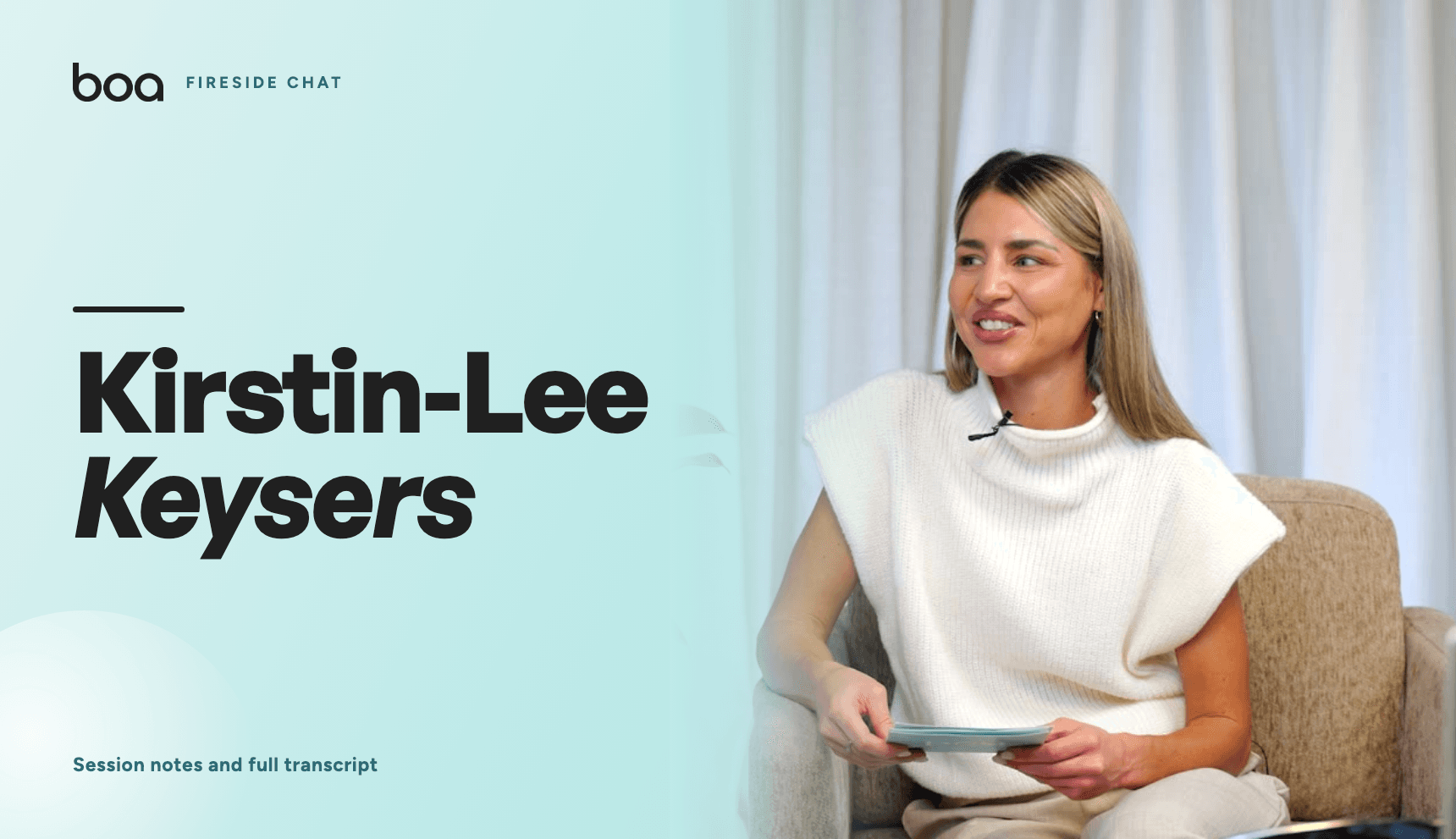
Kirstin-Lee of Kivari on Letting Go to Grow a Brand
With Kirstin-Lee Keysers, Founder at Kivari · Hosted by Kirsten Scott · 32 min
What this session covers
Kivari founder Kirstin-Lee explains how she went from $200 of leather wallets in Bali to an Australian contemporary label, why a $100,000 wholesale order became a COVID liability, and the exact audit she uses to strip her week back to the two or three jobs only a founder can do. For product founders building brands that last.
If someone else can do a job at 80 per cent, that is better than you doing it at 100 per cent, because the founder's headspace is the biggest asset in the business.
Key takeaways
- 01
Hire to take jobs off the founder, not to fill a job title
Kirstin-Lee pushes back on the standard advice to hire a head of marketing or an e-commerce manager. Instead, open your calendar and ask what is clogging your focus, then employ someone to take those specific jobs away. Her reasoning: the most valuable person in the business is the founder, and buying back headspace is what lets the vision grow.
- 02
Use the 80 per cent rule to force yourself to delegate
The rule she keeps coming back to: if someone else can do the job at 80 per cent, that beats it being done at 100 per cent by you. She still catches herself wanting to jump back in and repeats the rule to stop herself. It works as a live filter every time you are tempted to take a task back off a team member.
- 03
Audit your week on paper, then circle the two or three jobs only you can do
Write down everything you did this week, including gym, cleaning the house and the school drop-off, not just work tasks. Then circle the jobs only the founder can do. Kirstin-Lee guarantees there will be two or three. Everything else gets delegated, systemised or deleted, and she says deleting is her favourite of the three.
- 04
Turn down money that is off-brand, even at $100,000
Pre-COVID Kirstin-Lee accepted a $100,000 wholesale order in a print she did not like and knew was not on brand. She was swayed by the money. COVID hit and she was left holding the fabric liability for a product she hated. Her rule since: if it does not fit the vision, the answer is no regardless of the number attached.
- 05
Filter big decisions with 'will I be proud of this in five years?'
Her long-term brand filter is a single question: would I be proud of this in five years, or does it just make money in quarter two? She points out the wrong partnership, wholesale account or collaboration can damage brand trust in weeks and take years to rebuild. Fast growth is easy to chase and expensive to undo.
- 06
Run gut instinct and data in parallel as the business gets bigger
Early on, Kirstin-Lee ran almost entirely on intuition and says founders should listen to it. But past a certain size it becomes too risky. Her approach now is to look at the data and what the customer is telling you first, then overlay gut instinct on top. The two run alongside each other rather than one replacing the other.
- 07
Draw a line in the sand when you outgrow your original positioning
Kivari started as a coastal boho brand using cheaper rayon fabrics. Kirstin-Lee made a deliberate decision to become an Australian contemporary designer brand, switching to flax European linens and broderies, and moving from all-over prints to designer prints. Prices had to rise with the fabric costs. She acknowledges the risk that customers do not follow you, and most of hers did.
- 08
Define your customer visually so brand decisions become yes or no
Rather than a written brand doc, Kirstin-Lee pictures a specific woman: feminine, sophisticated, coastal, in Positano, Noosa, Byron or at Scorpios in Mykonos. When designing a store or a garment she asks whether she can imagine her in it. As a visual person, that gives a fast, honest yes or no against all the noise on social media.
- 09
Hire for attitude and cultural fit before skill set
Kirstin-Lee's first employee was the only person who applied. She stayed five years, became her running buddy, and had the best attitude. Her advice for early hires is to hire for a can-do attitude and someone you actually vibe with, because you can teach skills but you cannot teach attitude.
- 10
Treat plateaus as a founder burnout signal, not a market signal
Asked about plateaus, Kirstin-Lee said they show up when the founder is burnt out and their mind is occupied by emails and small tasks, leaving no room to look at the business from above. Her fix is to physically leave: a holiday, a walk, a swim. She says her biggest unlocks came in those switched-off moments, when the ideas arrive and she writes them straight into her notes.
- 11
Pre-revenue, put your time where the money comes fastest
Answering a founder launching a beauty booking app with no capital, Kirstin-Lee said to focus energy on whatever makes money the quickest. Once that cash lands, hire someone to take the admin, even two days a week. She suggested sharing an EA or PA with another business rather than waiting for a full-time budget.
- 12
Build community through hosted tables of 10 to 15, at least quarterly
For a premium accessories brand, Kirstin-Lee suggested gifting to other brands' events and hosting your own dinners: a big table of 10 to 15 women, influencers or community members, who come together, talk, post and share. Every quarter as a minimum. She also runs a private Instagram group, the Kivari Collective, with a few thousand members where she can speak more freely than on the main feed.
How the session runs
- 0:32Warm-up game: so wrong it's right
- 1:59The $200 Bali wallets and the $13 kimono
- 3:57Coming back to your why and who she is
- 5:15Building deliberately: boho to Australian contemporary
- 6:54The $100,000 wholesale order she should have refused
- 7:57Hire to take jobs off the founder
- 9:16When the founder becomes the bottleneck
- 11:38Proud in five years, or money for quarter two
- 12:45Gut instinct and data running in parallel
- 13:39The 80 per cent delegation rule
- 14:45Hiring for attitude over skill set
- 17:37Freedom as the point of the business
- 20:03Q&A: plateaus, burnout and the time audit
- 22:56Q&A: where to focus when capital is tight
- 25:26Q&A: early investors and options packages
- 27:08Q&A: building community from markets to Instagram
- 30:39Wholesale as brand exposure and lower MOQs
Mentioned in this session
- Kivari
- Bali
- Australia
- Positano
- Noosa
- Byron
- Scorpios
- Mykonos
- Tasmania
- ChatGPT
- Kivari Collective
- Retail Fest
- Mecca
- Estetica
- Boa
Questions founders ask
Kirstin-Lee spent $200 in Bali having small leather wallets made on the spot, brought them home to Australia and sold them. She repeated that loop for a couple of years. The turning point came when a floral print caught her eye from her motorbike in Bali and she had a kimono made, then 50 more. It sold out, went viral and she eventually sold thousands, buying at around $13 and selling at a much higher price, which funded the brand's growth.
Kirstin-Lee's view is to hire based on what is clogging your calendar rather than a textbook role like head of marketing. If capital is tight, focus first on whatever generates revenue fastest, then bring someone in even for two days a week. She also suggests sharing an EA or PA with another founder rather than waiting until you can afford full-time.
Kirstin-Lee has never taken investment in Kivari and owns 100 per cent of the company, though she acknowledges it has been a slow grind. With hindsight she might consider a small sum, not a large one. Host Kirsten Scott added that if you do bring on an investor, the vision and values need to align because they will hold some control, and that a bank loan can be a better early option, with investment more suited to scaling.
Kirstin-Lee says the majority of the time it is actually the founder blocking growth. Write down everything you are doing, work out where you are the bottleneck, circle the area where you are spending too much time, and hand it to someone else to run with. That diagnosis usually comes before deciding whether product or marketing is the issue.
Kirstin-Lee built her original community selling at markets one Sunday a month for years, and customers still message her about wallets they bought over a decade ago. Now she runs a private Instagram group, the Kivari Collective, with a few thousand members where she can talk more openly. She also recommends in-person events, Instagram Lives and gifting, and points out that online you have access to far more people than market foot traffic ever gave her.
Full transcript
The complete conversation, as recorded, with every speaker attributed.
Kirsten Scott0:00
Morning guys, thanks for jumping on this morning. Now we do have a little bit to get through, so we are going to dive right in. I'm joined this morning by Kirsten, uh, Kiza, from beautiful founder from Kivari. We did joke before because we both called Kirsten and we said we'd call her Kiki, but here we are. Um, now as I usually do, I am going to start off with a quick game. Um, this time it's wrong or so wrong it's right. So either it's a wrong answer or it's so chaotic that of course it's right. So, so wrong it's right.
Audience member0:30
Okay. Yeah.
Kirsten Scott0:30
Are you ready?
Kirstin-Lee Keysers0:31
Tongue twister. I'm ready.
Kirsten Scott0:32
I'm ready. Easy for a Tuesday morning. Okay, so starting a brand without fully knowing your long-term vision.
Kirstin-Lee Keysers0:38
So wrong that it's right.
Audience member0:39
Yes.
Kirsten Scott0:40
Googling how to run a business after you've already launched.
Kirstin-Lee Keysers0:44
Definitely so wrong that it's right.
Kirsten Scott0:45
Yeah, I mean, there's ChatGPT now, right?
Kirstin-Lee Keysers0:47
I know, look at it, easy these days.
Audience member0:48
Exactly.
Kirsten Scott0:49
Saying yes to every stockist or early— sorry, stockist or opportunity early on.
Kirstin-Lee Keysers0:55
No.
Kirsten Scott0:56
Yeah, I agree.
Kirstin-Lee Keysers0:57
Whole brand.
Kirsten Scott0:58
Waiting until everything feels perfect before launching a collection.
Kirstin-Lee Keysers1:02
So wrong that it's right.
Kirsten Scott1:05
Saying yes will make it work with zero real plan.
Kirstin-Lee Keysers1:08
So wrong that it's right.
Kirsten Scott1:10
Every founder. Building an entire range around one piece you're obsessed with. Yes.
Kirstin-Lee Keysers1:15
So wrong that it's right.
Kirsten Scott1:16
I want to hear more about that. Trying to expand too quickly into new categories or markets.
Kirstin-Lee Keysers1:23
Um, no, don't do that.
Kirsten Scott1:25
No.
Kirstin-Lee Keysers1:25
So wrong.
Audience member1:26
So wrong.
Kirsten Scott1:27
Yeah. Ignoring data before your gut is louder. Because your gut is louder. Oh, doing my own tongue tying.
Kirstin-Lee Keysers1:34
Yeah, I know, I know, I know.
Audience member1:35
You're really confusing me.
Kirstin-Lee Keysers1:36
Uh, so wrong that it's right. Okay.
Audience member1:38
Yeah.
Kirsten Scott1:39
Uh, holding on to control for too long instead of building the right team.
Kirstin-Lee Keysers1:43
Well, you've got to build the right team.
Audience member1:45
Yeah.
Kirstin-Lee Keysers1:45
So, so wrong that it's right.
Kirsten Scott1:48
Uh, using ChatGPT to write half your emails.
Kirstin-Lee Keysers1:51
Oh, so wrong that it's right.
Kirsten Scott1:53
Yeah, I think every founder on this call could agree with that one.
Kirstin-Lee Keysers1:55
Polish this for me.
Kirsten Scott1:57
Exactly. And put my tone.
Kirstin-Lee Keysers1:58
Yeah. Yeah.
Kirsten Scott1:59
Um, can you take us back to the early days of Kivari? What were the key decisions that shaped the brand in the beginning?
Kirstin-Lee Keysers2:04
Oh my gosh. So the early days were like so, so messy. I literally had no idea what I was doing. I had no brand, no investors, no marketing degree, no fashion degree, no podcasts, no communities, like no social media, no social media. It was like zero. It was just pure guts and instinct that got the brand up and going. I went to Bali, I spent $200 getting some small leather wallets made, literally on the spot. It's like, this is what I'm going to do.
Audience member2:34
Did it.
Kirstin-Lee Keysers2:35
I came back home again and sold them. And to my surprise, they actually sold. So I was like, wow, okay, people want the product. So went back to Bali again and just repeated the process until it would have been a couple of years in. And I was on my motorbike in Bali, just zooming around. It's like, if you've been to Bali, it's the hot and the beeping and the horns and like, it's crazy, right? Yeah. And I was on my bike. And this beautiful print caught my eye, and I was like, oh. So I pulled my bike in, and it was this gorgeous white print with this big floral print on it. And I got a kimono made. I loved it so much that I decided that I would then get another 50 made. I brought them home to Kava— I brought them home to Australia, and they just— it went viral. It sold out. So went back to Bali, got another 200 made, came back again, went back, got more made. Like, it just was— I sold thousands of this piece. It cost me $13, and I was selling them for like $70 $29. So at this, the huge cash injection, and I was able to use that money then to fund the future brand growth. Um, and why I love telling this storey is I feel like the universe wants you to win. It does want you to win, and it gives you these little signs and these little things, and you just need to recognise them and take them and go for it.
Kirsten Scott3:54
Yeah, just run with it. Action brings confidence.
Kirstin-Lee Keysers3:56
100%.
Kirsten Scott3:57
Yeah, yeah. Okay, so you've built a brand with a very clear identity. How did you hold that clear, uh, when Bari was, um, getting started.
Kirstin-Lee Keysers4:05
Yeah, I think it just always comes back to your why. Like, why did you start the brand? Um, for me, I wanted to create beautiful products and I wanted to share it with the world. I'm a coastal girl. Um, our customers, feminine, sophisticated. So I always come back to when we're growing, when we're scaling, like, is that, you know, is this the why? Is this why we started? Because it's very easy to get sidetracked or pulled different directions, social media, and, oh, there's the noise, noise, noise around. Um, so I believe that, but there's also like, you know, who is she? And so if I were designing something, whether it's a store or a piece of clothing, like, is that the customer? Like, do we imagine her in there? Because our customer, she's, you know, she's in Positano, she's in Noosa, she's in Byron, she's traveling, she's Scorpios in Mykonos, you know, she's like at these places. So it's very visual, as visual people. It's very visual to know, okay, this is our customer, does this align, yes or no?
Kirsten Scott5:08
Yeah, I love that.
Audience member5:09
Yeah.
Kirsten Scott5:10
Okay, so a lot of founders build reactively. What does it actually look like to build a business with intention from the start?
Kirstin-Lee Keysers5:15
Okay, yes. Okay, I think building with attention is making deliberate decisions about the brand or where you're going.
Audience member5:25
Yeah.
Kirstin-Lee Keysers5:26
So deliberate, I guess, for Kivari in the early days was We were a very— I was a very coastal lifestyle brand. We had kimonos, we had like the oversized caftans made from like a beautiful fabric, but it was a cheaper rayon TT fabric. And there became a point in the Kavari journey that I was like, right, I don't want to be just a boho brand anymore. I want to be Australian contemporary designer brand. So it was a very clear personality, it was evolving. Yeah, you gotta grow. You can't just do the same. So, um, I made a very clear line in the sand of where we're going, um, which is scary. Uh, it can be dangerous because the customers may not come on that journey with you. Um, thankfully a lot of ours have, which is awesome. And yeah, we pivoted. So our fabrics changed. We didn't use rayons anymore. We were using, um, flax European linens and like broderies and like even the print placement has gone from all over print to designer prints with that comes. Obviously a cost involved as well because you've got to increase your prices. So it's risky, but that was a vision, um, and a very clear decision of building to where the vision and the brand and where I wanted to go with it.
Kirsten Scott6:41
Exactly. And a lot of brands do this, right? Like, you can't start where you were and never evolve. Like, if you want to grow the business, move forward, and even you as a founder, yeah, individually, and the brand kind of needs to align with that as well.
Kirstin-Lee Keysers6:54
Yeah, yeah. But you've all, I guess in that as well, there's also, you know, you can be presented opportunities that can come along and it's just been very clear on saying no or yes. And I could tell the storey of one of these, which it was before COVID and I had this massive wholesale order, right? So it was $100,000 and I was like, okay, really good money, but they wanted this print and I didn't like.
Audience member7:20
The print.
Kirstin-Lee Keysers7:20
I was like, it's not on brand, I don't like it, I don't want to do it. But I was swayed by the money and I said yes. And what happened was COVID hit, so who was stuck with all this liability fabric? You know, I was.
Kirsten Scott7:34
And stuff that you didn't even love.
Audience member7:35
I hated it. I was like, it's not even on brand, why have I done that?
Kirstin-Lee Keysers7:38
And I guess from then on I've been very, very clear and strict with— if it doesn't feel right and it's not on brand and doesn't fit in the vision, it's a no. It doesn't matter how much money you want to pay? Yeah, the answer is there is a same lesson.
Kirsten Scott7:53
If it's not a hell yes, it's a hell no.
Kirstin-Lee Keysers7:55
Yeah, I love that. Yeah, yeah, yeah.
Kirsten Scott7:57
Okay, so you've spoken about building infrastructure early. What are the key things founders should put in place sooner than they think?
Kirstin-Lee Keysers8:04
The key things, um, I think there's 3 major big ones. Uh, for me, definitely starting a business, people tell you to hire for a role But I honestly think you should hire to take jobs off the founder. Yeah.
Kirsten Scott8:23
Like, I think everyone on the call would agree with this.
Audience member8:25
Yeah.
Kirstin-Lee Keysers8:26
Like people say, oh, you need a head of marketing, you need an e-com, but like really just look at your calendar and say like, hey, what's clogging my focus up? And just employ someone to take those jobs away. Because honestly, the most valuable person in your business is you as the founder. And if you can get that headspace, you have room to like breathe. You have room to like grow the vision, and that is the biggest asset in any business. And once you can do that, you'll watch your business like take off tenfold.
Audience member8:58
100%.
Kirsten Scott8:58
100%. I think so many times you get bogged down in like the daily tasks. Yeah, the creativity just goes, and there's no strategy, there's no vision, because you're just so like clogged up. Yeah, yeah. Okay, so where do you see founders pay the biggest price for not setting that foundation early?
Kirstin-Lee Keysers9:16
Um, I think the biggest price I see founders pay, and I've been there myself, is when you actually become the business. Yeah, or burnout. Oh, when every decision, it goes by you, like an EDM sign-off, an Instagram post, um, approval of a $20 spend on a piece of marketing paper, which may or may not make any difference whatsoever.
Kirsten Scott9:47
No.
Audience member9:47
Yeah.
Kirstin-Lee Keysers9:48
Um, So when every decision is running through you, it's, it's, you can't scale. You just get stuck and bogged down like in the day to day and it's so hard to get yourself out of there. So I guess I think that's the biggest one for any founder. And I've seen like awesome founders completely burn out because of this, because they can't actually let go and delegate to their team to then grow.
Kirsten Scott10:19
That's exactly right.
Kirstin-Lee Keysers10:20
Yeah, it's sad because like people have got such incredible businesses and so much energy. You start with all this passion and like you just get bogged down in the day-to-day putting out fires and answering emails and it's just, it's not really that fun.
Kirsten Scott10:34
No, I mean, thank God for AI in that sense as well, right? Yeah, it is alleviating some of those pressures, particularly if you're not in a position to start hiring.
Kirstin-Lee Keysers10:43
Yes.
Audience member10:43
Awesome.
Kirstin-Lee Keysers10:44
Um, so yeah, let go, delegate. To grow your business.
Kirsten Scott10:47
Yeah, I love that. Yeah, little pointers.
Kirstin-Lee Keysers10:50
Yeah.
Kirsten Scott10:50
Okay, so if someone's not growing, how do they know if it's a product problem or a marketing problem?
Kirstin-Lee Keysers10:56
If they're not growing, um, how do they not know? Probably make a list down.
Audience member11:06
Yeah.
Kirstin-Lee Keysers11:06
And I'd say the majority of the time it's actually the founder who is stopping that growth. So if you could potentially write down a list of everything you're doing and then work out, you know, where are you bottlenecking? Is it the marketing or the product that you're bottlenecking? Yes. And have a look at that and then circle the one that you think you're spending too much time and get someone else to take it and run with it.
Kirsten Scott11:29
Yeah, I love that.
Kirstin-Lee Keysers11:30
I think that could be a good, yeah, little hack. Excellent.
Kirsten Scott11:34
Okay, so fast growth is easy to change. Uh, sorry, easy to chase.
Audience member11:38
Yeah.
Kirsten Scott11:38
How do you make decisions that protect long-term brand value instead?
Kirstin-Lee Keysers11:43
Um, long-term brand value. So I'd always come back to the question of would I be proud of this in 5 years' time?
Audience member11:53
Yes.
Kirstin-Lee Keysers11:53
Or is it just make me money for quarter 2?
Audience member11:56
Yeah.
Kirstin-Lee Keysers11:56
Like, am I actually going to be genuinely proud of it? Yeah. I think that's one kind of really good filter to use in your business.
Audience member12:03
Yeah.
Kirsten Scott12:04
I think that's so true. Even if you're like a startup or early stage founder. Really sticking to those values early on from the get-go.
Kirstin-Lee Keysers12:10
Yeah.
Kirsten Scott12:11
Choosing who your clients are, not just saying yes to everything.
Audience member12:14
Yeah.
Kirstin-Lee Keysers12:15
Because I think fast growth is very easy to chase.
Audience member12:18
Yes.
Kirstin-Lee Keysers12:19
But if you do something, if you destroy that brand, it can take weeks to destroy it with the wrong partnership, the wrong wholesale, the right, wrong collaborations. And it will take you years to rebuild that trust with the customers.
Audience member12:31
100%.
Kirstin-Lee Keysers12:32
So, so powerful.
Kirsten Scott12:34
Definitely. Okay, so when you're faced with a big decision, what's the simple framework or filter you use to decide quickly? And I mean, it's quite interesting for you, right, because your business has evolved over so many years.
Audience member12:45
Yeah.
Kirsten Scott12:45
Um, so it'd be interesting to see how your decision-making has changed over the years. So say again, so like, yeah, so when you're faced with a big decision, what's a simple framework or filter you use to decide quickly? Is it like more on gut instinct? Is there certain data that you're pulling to look at?
Kirstin-Lee Keysers13:01
Yeah, look, I think earlier on as founders we have so much intuition and gut instinct. So always listen to that, but there will become a point when the business is a lot busier, busier, a lot bigger, the business is a lot bigger, and you need to rely on your data. You know, you can't, it's too risky not to. So it's really great to look at the data, look what the customer's telling you, and then overlay it with your gut instinct as well. And I think the two can run parallel really, really nicely together.
Kirsten Scott13:31
Yeah, I love that. Okay, so how have you transitioned from making instinct-led founder decisions to building a team that can make those calls without you?
Kirstin-Lee Keysers13:39
It's hard.
Kirsten Scott13:41
It's so hard. The delegating. Delegating.
Kirstin-Lee Keysers13:44
The let go to grow.
Kirsten Scott13:45
The dirty word.
Kirstin-Lee Keysers13:47
Yes, yeah. I mean, yeah, the delegating. It's so hard to do, but honestly, you cannot grow the business forward if you cannot delegate to your team. And I still struggle with it. I still am like, oh, like, but I I just come back to this little rule that I was taught. So it's the, um, the 80 and 100% rule. So basically, if someone else can do that job for you at 80%, that is 110% done by me. 100% for the founder.
Audience member14:18
Yeah.
Kirstin-Lee Keysers14:18
So I try to come back to that all the time. If I'm in between, I want to jump in, but I can't, just really try. 80% done by someone else is 100%, 110% done by you.
Audience member14:28
Totally.
Kirsten Scott14:28
It's interesting as well. Like, I always wonder at what point when you feel comfortable, and what is that first hire as well, right? Because a lot of the time we don't necessarily hire because that person's 100% like the perfect skill set for that. More of it's because like they're hungry for the role or they are a cultural fit.
Kirstin-Lee Keysers14:45
Yeah.
Kirsten Scott14:45
Um, and you build trust quicker with that than what you do a skill set without really connecting with that person.
Kirstin-Lee Keysers14:50
Oh, 100% agree. I think especially earlier on, I think definitely hire for a can-do attitude and someone that you are vibing with. Because nothing worse than working with people that you don't like or not your, you know, your feel tribe.
Audience member15:05
Not fun.
Kirstin-Lee Keysers15:05
You can have fun at work, right?
Audience member15:06
Yeah.
Kirstin-Lee Keysers15:06
I'm building. So yeah, high for can-do attitude.
Audience member15:09
Yeah.
Kirstin-Lee Keysers15:10
It just changes everything because you can teach people. You can't teach them attitude, but you can teach them skills. 100% willing to learn.
Audience member15:17
Yeah.
Kirsten Scott15:17
Particularly in a startup environment, there's no better time to like really build someone in that space.
Kirstin-Lee Keysers15:22
Yeah, I was very lucky when I first started. I hired my first employee. I was so scared. She was actually the only one who applied for the role, but she was with me for 5 years and she was my running buddy and we just did everything together and she had the best attitude and best outlook on life. So find a little gem like that to like, and it's fun too, right?
Kirsten Scott15:43
Totally. And I think particularly in those early days, like you need that person that's really in it with you.
Kirstin-Lee Keysers15:47
100%.
Audience member15:48
Yeah.
Kirsten Scott15:49
Okay. So what have you had to change about yourself as a founder to keep growing the business?
Kirstin-Lee Keysers15:54
My gosh, everything. Absolutely everything. Um, the version of Kiki 10 years ago at the markets is a completely different version who is sitting here today. I've had to reinvent her over and over and over again. Um, in the beginning, I guess my fingerprints and I was like on everything as we discussed, you know, you're doing accounts, doing finance, you're doing, uh, HR, you're doing marketing, you're doing e-com, you're doing production design. Travel, it's like it's your baby and slowly, step by step, you need to let that go. And it's so hard to do for founders. Um, but honestly, from experience, it's the only way to grow your business.
Kirsten Scott16:37
Yeah. And as a person, because it allows you to build confidence in other areas and expand the brand.
Kirstin-Lee Keysers16:43
Yeah. So you just got to trust your team, um, learn to let go. Um, and yeah, 110% done by, um, 80% done by someone else, 100% done by you. So I just kind of keep coming back to that. And I guess getting mentors and coaches and being around different groups of people also helps you grow to a new level as well.
Kirsten Scott17:07
Yeah, just like Boa.
Kirstin-Lee Keysers17:08
Yes.
Kirsten Scott17:10
Okay, so if you're sitting one-on-one with each founder here today, what's the biggest shift you push for them to make in building something that actually lasts?
Kirstin-Lee Keysers17:18
Biggest push I get them to do that actually lasts.
Kirsten Scott17:22
Um, I feel like particularly with your content and what you share, like there's so many value-driven things. What do you think are the top 3 things that you'd share from that?
Kirstin-Lee Keysers17:33
Um, from pushing to grow a business?
Kirsten Scott17:36
Yeah.
Kirstin-Lee Keysers17:37
I think it's freedom over everything. I'm a big advocator for build a life that you love, build a life of freedom. Always. I feel a lot of, I believe a lot of founders, they start businesses because they want the freedom. They want a freedom to live a life they love. They want freedom to choose who and where they work. And along the journey, this freedom that they go out looking for becomes so blurred. The lines aren't clear. And next minute they're at their desks, 11 o'clock at night. They are drowning in emails, they're putting out fires, and they can't even breathe.
Audience member18:12
Yeah.
Kirstin-Lee Keysers18:12
And that is not, you know, why we built businesses for.
Kirsten Scott18:16
That doesn't make the journey enjoyable either.
Kirstin-Lee Keysers18:18
And I just see so many founders go down that path. But, uh, you know, I'm sitting here today and I feel like I've built an incredible life. I've built a profitable business. I have just taken a month off my family, travelled around Tasmania and 4 months last year. Um, so I've built this incredible life that I love and I believe if I can do it, you know, anyone has the ability to do that as well.
Kirsten Scott18:43
I love that.
Kirstin-Lee Keysers18:43
But there are non-negotiables.
Kirsten Scott18:45
Definitely.
Kirstin-Lee Keysers18:46
You need to let go and trust your team.
Audience member18:48
To grow.
Kirstin-Lee Keysers18:49
Yeah, that's number one.
Kirsten Scott18:50
That's great advice. Yeah, thank you.
Kirstin-Lee Keysers18:52
You're welcome, guys.
Kirsten Scott18:53
We are going to open it up to Q&A, so if you have any questions, pop them in the chat. That's okay. Is there anything else you think would be really valuable to share today?
Kirstin-Lee Keysers19:13
Someone's gonna ask me a question.
Kirsten Scott19:14
Yeah, don't be shy, guys.
Kirstin-Lee Keysers19:18
Are there any fashion businesses?
Kirsten Scott19:19
We do have, so we've got Wanda who's a beautiful luxury leather bag.
Audience member19:24
Beautiful.
Kirsten Scott19:25
Uh, Diana.
Audience member19:27
Hi, sorry, I've just joined. Thank you so much. I'm a long-term fan of your brand, so sorry for arriving late, but I wanted to just meet you and say, yeah, thank you. Your journey I've been watching and I just think it's incredible and you're such an inspiration, um, to so many other founders. Thank you. I don't have a question yet.
Kirsten Scott19:51
That's okay, honey. Sorry to call you out.
Kirstin-Lee Keysers19:54
No, let's ask what it is, bottlenecks are.
Kirsten Scott19:56
Yeah, that's a great question. We can come back to you, Wanda, but Diane, I know that you had a question.
Audience member20:03
Oh, I popped it in the chat, but just on reflection, I suppose, have you had any periods where you felt like the business was plateauing and what were these sort of unlocks to kickstart you into the next phase of growth.
Kirstin-Lee Keysers20:15
Yeah, definitely. There's been a lot of levels of plateauing, I guess, but I really truly believe that plateau comes out when the founders are burnt out, uh, and their mind is too occupied by doing your emails and doing all the little tasks, and they don't have enough space, enough time to sit back and actually look at the business from above. That's why, like, I, I've I just really believe people need to take holidays and just go somewhere, just some time out of the business, because you're not in the business, you're actually working on the business when you take a step out. And I feel like those moments have been the biggest unlocks for me.
Kirsten Scott20:56
Yeah, I always feel like the business is the energy of the founder, right? Like when you're like feeling burnt out or like it's plateaued, it's because like you're feeling flat.
Kirstin-Lee Keysers21:05
Yeah, yeah. So take some time out, get some energy, and it gives you space. Even just like going to Bali or taking a walk or going for a swim, it gives you like— you get all these ideas. I don't know if anyone else has this, but I get all these ideas come and then I'm like, oh, I'm gonna write them all down in my notes. Yeah, when you're switched off. So that would be my advice: book a holiday, Diane.
Kirsten Scott21:27
It's always one of those things, like, I know how caught up I get in the day-to-day and you end up working weekends and all these things, but yeah. That one day where you're like, no, I'm not going to look at this or that, and you come back and it hasn't impacted anything. And in fact, you come back fresher and able to like move through things quicker because you've given yourself space, yourself that space, time. Yeah.
Kirstin-Lee Keysers21:47
And I do, I do find a lot of founders, they will just work, but 80% of that work isn't actually productive. Productive. You're working because you think you've got to work.
Kirsten Scott21:54
Yeah, it's busy, it's not productive.
Kirstin-Lee Keysers21:56
Yeah, yeah. What you can do actually is if you're feeling like that, literally just get out a piece of paper and a pen and just, just audit your life. Like, I'm talking like, what did you do this week? Put in gym, put in clean the house, put in like all your work tasks, drop off the kids to school, everything. Yeah, put it all in there and then just get a pen and like literally circle the jobs that only you as a founder can do. And I guarantee there's only 2 or 3 of them. Yeah, that you actually need to do. And all the rest you can delegate it You systemize it, or my favourite one, you just delete it because you don't actually need to be doing it. And that's a really clear audit of like where you're spending your time and what you can like delegate or move off your plate.
Kirsten Scott22:43
I love that. It's great advice.
Audience member22:45
Yeah.
Kirsten Scott22:45
Thank you. Thanks, Diana. Um, did someone else want to have a—
Kirstin-Lee Keysers22:52
Fawn?
Audience member22:53
Hi, sorry I put the camera on so you can see me, not just look at it.
Kirsten Scott22:56
No, this is great. Do you want to tell us a little bit about your business?
Audience member23:01
Sure. I have a, a Curated Beauty Network app. So it's basically your word of mouth beauty technicians, everything from Botox to hair and everything. So just to give context, I don't know about you, but women are very loyal to their technicians, not to a salon. Yes. And my platform enables people to be able to work independently and get 100% of their profits.
Kirstin-Lee Keysers23:28
Right. I love that.
Audience member23:29
Um, that's my really quick elevator pitch. What it is, it launches in July. Um, it's really exciting. Um, I will be all around telling everyone about it once it's all ready to go. Um, but my question to you is, um, you talk about delegating, which is amazing, and I love that. I'd love to give all my work to somebody. But when you're, um, kind of in that startup phase and that launch phase and you've got so much happening and you're wearing all those hats um, and capital's not there, how and where do you focus your time and energy? And what is the best approach? I would do that.
Kirstin-Lee Keysers24:05
Yeah, it's a good question. I would focus my time and energy in what is going to make the most money the quickest, because the quickest— the quicker you can get some more money actually into your business, you can then afford to pay someone to do all the admin. Because you're obviously visionary. You've got the idea, you've got the drive, you've got, you know, outward facing of the brand and what you're doing. So yeah, I would definitely try and make those first dollars as soon as you can. And as soon as you get that, then start delegating and hire someone, even if it's 2 days a week to help you. You could share an EA or PA with like someone. Yeah, I don't mean it doesn't have to be full-time either, it could just be a couple of days a week.
Kirsten Scott24:45
Yeah, I know it's such a hot topic as well, but I can't like stress AI enough. Um, yeah, I've done a deep dives like recently. Yeah, we've obviously got like workshops and that as well, not just Bold but other companies. And I think founders are really exploring that because like I think delegating to someone that can essentially do the admin and EA work, even like your support email boxes, you're like kicking things off. Like if there's certain things that are like ongoing replies, you can automate that. Um, so I also think leveraging AI—
Kirstin-Lee Keysers25:13
it's actually a great idea.
Kirsten Scott25:15
It's scary though.
Kirstin-Lee Keysers25:16
Yeah, you can plug it into your emails, like draughts the email for you and then you just proofread, send, proofread, send.
Kirsten Scott25:22
Yeah.
Kirstin-Lee Keysers25:22
And there's virtual VAs as well.
Audience member25:26
Sorry. So with that, um, what is your positioning? So with delegating and all that sort of stuff, um, what is your thought and positioning on bringing on those like early contributor investors? Like someone can come in with an options package to kind of help you with that overflow to give that, you know, to help you get a bit of leg up?
Kirstin-Lee Keysers25:51
I've never had investment in Kivari, so for me I would— but I mean, I've done the hard yards, right? It's been a slow grind to where I am today, but I own 100% of the company and I don't have anyone else in there. So that's for me back then. Now, would I choose differently? Potentially, because I know what I'm doing now. I would choose definitely not a large sum, but you could potentially get a small sum.
Audience member26:17
Yeah.
Kirstin-Lee Keysers26:18
To help you going.
Kirsten Scott26:19
I think. But yeah, I mean, it depends, right? But I think if you are bringing on an investor, you have to ensure that the vision and the values really align.
Kirstin-Lee Keysers26:27
Yes.
Kirsten Scott26:27
Because they are going to have an element of control in that. If you can, like, I always think you're better off getting like a loan from a bank just to help you kick it off a little bit and putting back into that. My personal view is that having like investors is more of like a scaling thing as opposed to like starting up. Everyone has like their own opinion, of course, but yeah, that would be mine.
Audience member26:50
Yeah, thank you. Yeah, I love your brand, by the way.
Kirsten Scott26:54
Where, where, where? Yeah, it looks great. Yeah, thanks, Bon. Awesome, guys. Anyone else have a question? Wanda?
Audience member27:08
Yes. Can I ask, I guess I go back to this a lot, it's community. Did you start off with one or was it just you on your own starting your brand, getting the retail— sorry, um, yeah, online and then opening up your first store? Did you already have a community or is that something that you've built along the way? And yeah, what sort of advice would you give for a community?
Kirstin-Lee Keysers27:33
Yeah, so I guess I built one when I was at the market. So I was selling products at the markets one Sunday a month for like years, right? And so I built this like loyal, amazing, beautiful following person. Yeah, yeah, way back then. So I guess I've built that community and they've kind of followed the journey and obviously it's, it's growing. But I still have people reach out to me going, I've still got one of your leather wallets I bought at the markets, like it must be 12 years old.
Kirsten Scott27:57
I mean, also the quality.
Kirstin-Lee Keysers27:59
Yeah, it's lasted, right? Which is just awesome. But I think nowadays it's different. Like I have an in-person, you know, event. But I do feel like you can build a really strong community on social as well, um, especially in your like groups on Instagram. You know, you've got your like your little— I call it Kavari Collective. It's like a private— got a few thousand members in there where you can talk a bit more freely and openly to them. So I do feel there is space to still build a community. I do think it is important to do that. I mean, you can host events as well.
Audience member28:33
Yeah, no, we, um, I was just up on Retail Fest and I think everyone's thinking about AI. Yeah. And there was a big shift towards, great, AI is really great for us as a tool, but nothing's got a big community and that.
Kirstin-Lee Keysers28:47
Agree. Yeah. Oh, good.
Audience member28:53
Yeah.
Kirstin-Lee Keysers28:54
Congrats.
Kirsten Scott28:55
Pop it in the chat.
Kirstin-Lee Keysers28:57
You do.
Audience member28:58
Starting with the markets when you first started was like, okay, people are going to remember you. So it's never too late, I guess.
Kirstin-Lee Keysers29:04
No, no, it's never too late. And you're actually— you've got more people online. You've got access to— I don't just have a market foot traffic. You've got like, you've got the whole world if you wanted to get that exposure and build that community.
Kirsten Scott29:15
That's exactly.
Kirstin-Lee Keysers29:16
Yeah. And just interact with people and you can hold events or live Instagram Lives as well, right?
Audience member29:24
Okay. And what's your, um, how often do you suggest doing things like for events, for instance, or things like that? Is it once a month? Is it once a quarter?
Kirstin-Lee Keysers29:33
Like, oh, as much, I think as much as you can afford. Or so what business was yours?
Audience member29:42
Oh, sorry, Estetica. It's a beauty accessories brand. So quilted, yeah.
Kirsten Scott29:48
So makeup bags, gorgeous. They're very luxurious. You open it up and you can see everything in the makeup bag.
Kirstin-Lee Keysers29:53
Oh, that's a dream. I'm always like this stuff exactly what you create.
Audience member29:59
Yeah.
Kirstin-Lee Keysers30:00
So you could do gifting, like if brand, other brands have events, like you just, I don't know, depends on RRPs and cost price, but you could, um, gift them or hold like events. Like get a bunch of big, beautiful table together, um, like 10, 15 ladies, whether they could be influencers or just people in the community to come together and just talk and post and share it. Cause that creates community and it gets your brand out there as well. Yeah, amazing. So every quarter minimum you could do that.
Audience member30:30
Okay.
Kirstin-Lee Keysers30:30
Yeah.
Audience member30:31
So it's generally 45 plus because they're more premium products. Yeah. So yeah, I feel like that's some, yeah, great advice. I'm going to definitely do that.
Kirstin-Lee Keysers30:39
Yeah. And, and, and wholesaling is another channel as well, which we didn't really touch on, but I mean, wholesaling, you don't get the same margin, but it's definitely brand exposure.
Audience member30:48
Yeah.
Kirstin-Lee Keysers30:48
And it gets up your MOQ, so then your cost price comes down.
Audience member30:52
I've just started, and Diana here as well, we've used the same wholesale outreach. So just to follow up. Awesome. So that's, yeah, year 3 now I'm starting to do that. Great. To get the product right. So yeah, make sure customers are really excited and happy with the product.
Kirstin-Lee Keysers31:10
Yeah.
Audience member31:11
And then I can sort of go out to wholesale feeling confident that—
Kirstin-Lee Keysers31:14
Great. We'll see you in Mecca soon. I love that.
Audience member31:17
Yes. Yes.
Kirstin-Lee Keysers31:18
Yeah. Well done.
Kirsten Scott31:21
Thanks, Wanda. Any other questions, guys? Awesome. Thank you so much for jumping on this morning.
Audience member31:29
That was amazing. That was fun.
Kirsten Scott31:29
That was amazing. We could have gone deeper.
Kirstin-Lee Keysers31:31
Like, that was awesome. No, really great.
Kirsten Scott31:33
Thank you.
Kirstin-Lee Keysers31:34
Lovely to meet you all.
Kirsten Scott31:35
Thanks, guys. Have an amazing week.
Watch the full sessioninside Boa.
Session notes are free. The recordings, the live advisories and the founders in the room are for members.