Fireside Chat
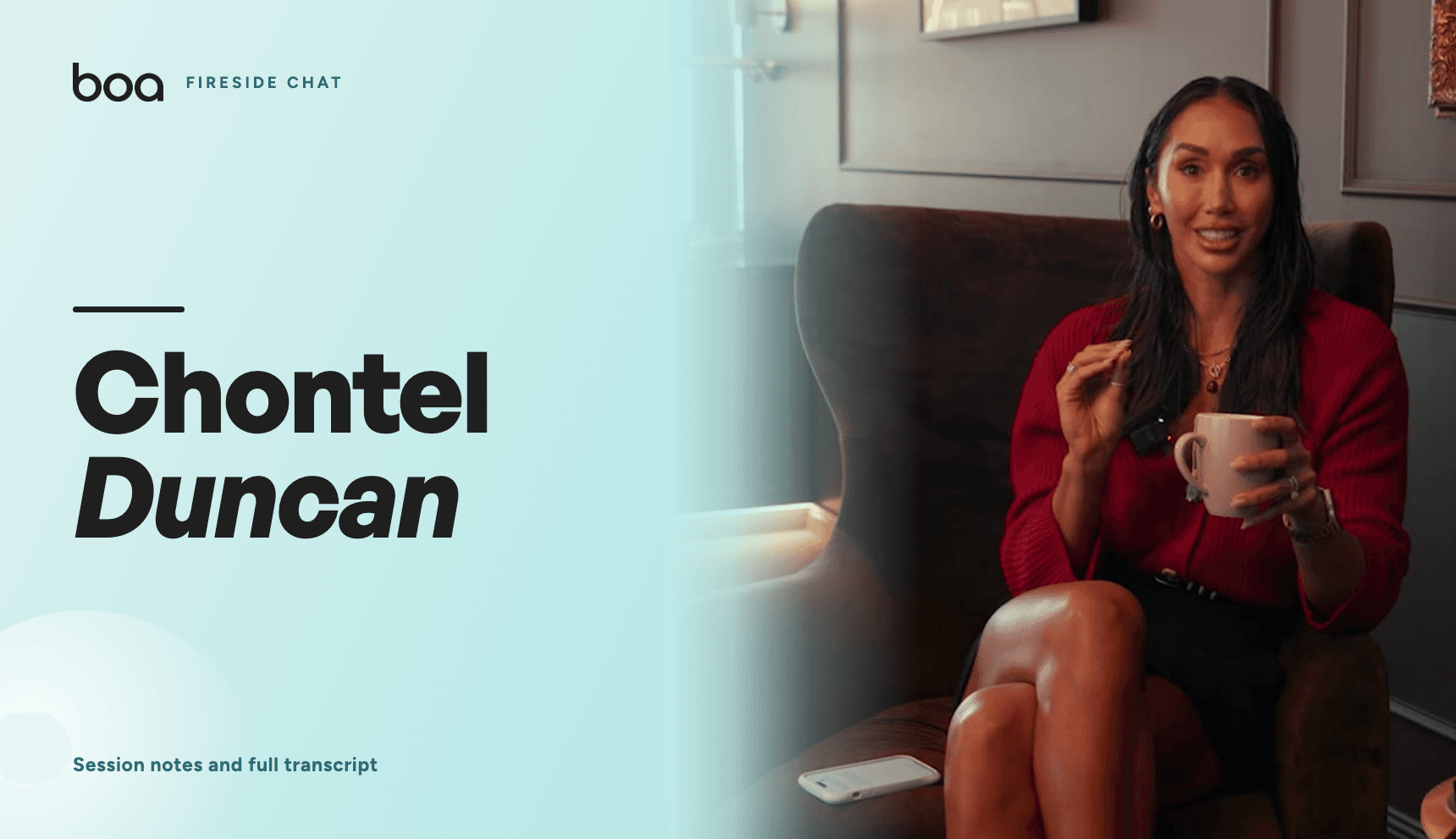
Chontel Duncan on Testing an App Idea Before You Build
With Chontel Duncan, Founder at NuForm · Hosted by Boa host · 32 min
What this session covers
Chontel Duncan built NuForm after a decade of free online coaching. She explains how to validate a digital product with ebooks, newsletters and product sales, why rushing app design in Figma cost her tens of thousands, how she reads lifetime value against acquisition cost, and how voice memos keep a scaling brand personal.
Test demand with free then paid ebooks before you spend a dollar on an app, because what people pay for tells you what they value.
Key takeaways
- 01
Validate with free ebooks, then charge for the next one
Chontel started NuForm's concept testing with free ebooks posted to her community and a comment-to-claim mechanic. Free downloads show genuine interest and grow the algorithm. Then she charged for ebooks, which showed what people actually placed value on. It costs nothing to run and it is still effective.
- 02
Use newsletter behaviour as a live demand signal
Track lifetime value on your email list, not just list size. Chontel watches how long subscribers stay, whether the response rate changes and whether people are still opening at all. When she pivots the content, subscriber and open behaviour tells her which one or two areas to feed and nourish.
- 03
Sell a physical product to learn what you are not
Chontel dabbled in apparel and a resistance band for at-home training around the start of COVID. It sold well, but it confirmed the business was best at training programs and nutrition. A side venture either pivots you in the right direction or signals what to stay focused on. Both answers are useful.
- 04
Slow down on app design or pay tens of thousands to fix it
Chontel's team designed NuForm in Figma, where each screen is a static screenshot rather than a video, so it is hard to interpret how the flow will feel. She and her husband made rushed decisions, then had to go back and move gadgets, change faces and reposition elements. That rework cost tens of thousands of dollars. Focus on nothing but the design while you are designing, and have the conversation at every single click.
- 05
Judge marketing on LTV against acquisition cost
Chontel's husband keeps her across one number: lifetime value. Her worked example: if LTV is $300 and acquisition cost is $50, that is a good number and marketing is tracking. If acquisition is $250 against a $300 LTV, marketing needs attention immediately. She also tracks LTV movement around each launch to see which programs and features are worth repeating.
- 06
Reply with voice memos instead of typed DMs
Text with emojis gets read differently depending on what the customer is going through, and Chontel's audience is often coming back from something hard. She records a voice memo instead, kids audible in the background, naming the customer, explaining that customer care is off because it is Sunday but will reply from 8am Monday, and inviting them back if no one responds. It takes the same time as typing and it stops the message going cold.
- 07
Ask one question of every new idea: is this helping people or making noise?
Chontel puts this question to herself and her team before committing. It decides whether to invest in a movement, pause everything else to focus, or walk away. It cuts to the root fast and keeps the brand aligned while the business evolves.
- 08
Prioritise by what you can do exceptionally well right now
When you have too many ideas, write them all down where you can see them and ask the team or your partner what you can do exceptionally well right now that solves a problem. Chontel's answer recently was at-home training and nutrition, so that is what they built. Everything else waits.
- 09
Use technology for onboarding, humans for the moments that matter
Chontel maps where customers feel something: a milestone, a setback, a win, a challenge finishing. Those get human interaction. Everything else runs on tech that is consistent and simple enough to feel like autopilot. Where she knows confusion is coming, she drops in a video of the founder or expert explaining which program to choose, then hands back to the tech.
- 10
Hand the socials to your team so you can build the next thing
To build NuForm, Chontel had to step out of the gym, which meant replacing herself as the face on social. She gave the crown to her team and accepted they would bring different personalities and tones of voice. The test was whether the content still helped people. The gym now runs self-sufficiently and she can operate two businesses at once.
- 11
Hire through networking and competitor referrals, not smooth talkers
Chontel wasted time and money on people who could talk the talk but did not deliver. Her fix was networking with other business owners for references: who they used for accounting, video, paid ads. She says even competitors will often share who they rate. A single referral can save tens of thousands of dollars.
- 12
Book school holidays as forced breaks and let the team work around them
Chontel's hack is locking in a family holiday every school holidays. The team knows to hustle and get everything out of her before she leaves, because she is barely contactable while away. Her kids avoid constant vacation care and do not miss school. She knows a break is never far off when the days get heavy.
How the session runs
- 0:39From free coaching in DMs to a wellness app
- 2:23Testing the idea: ebooks, product, newsletters
- 5:13Sitting in the seat where you actually thrive
- 7:36Redesigning the customer experience for digital
- 9:50Free marketing: daily posting, trends, micro-influencers
- 13:32Voice memos and keeping community connection personal
- 15:44The Figma mistake that cost tens of thousands
- 17:38Helping people or just making noise?
- 18:27Prioritising what you do exceptionally well
- 20:10LTV versus acquisition cost, explained simply
- 23:26Hobbies, morning exercise and avoiding burnout
- 24:50Q&A: delegating without losing your values
- 27:44Building trust in a saturated industry
- 29:02Boundaries, school holidays and the myth of balance
Mentioned in this session
- HIIT Station
- NuForm
- Figma
- ChatGPT
- TikTok
- Sweat App
- Domino's
- Uber
- The Cold Start Problem
- COVID
Questions founders ask
Chontel started with free ebooks promoted through social posts with a comment mechanic, which showed genuine interest and helped the algorithm. She then charged for ebooks to see what people actually valued. She also used newsletter metrics (retention, open and response rates) and a short run of physical products to work out where the real demand sat.
Chontel's answer is lifetime value measured against acquisition cost. Her example: a $300 LTV with $50 acquisition is healthy, while $250 acquisition against the same LTV means marketing needs fixing straight away. She also compares LTV before and after each launch, since every launch costs money, and treats a flat or falling LTV as a signal to rebuild community or clean up onboarding.
Rushing the design phase. Chontel's team used Figma, where screens are static screenshots rather than video, making the flow hard to interpret, especially when you are not technical. Decisions they thought were confirmed had to be reversed later, costing tens of thousands of dollars. Her advice is to focus on nothing but the design while designing and to walk through every click with the developers.
Chontel replies in Instagram voice and video messages rather than text, because written messages can be read differently depending on what the customer is going through. She names the person, explains what will happen next and when, and invites them back if no one follows up. She says businesses get desensitised as they grow, and the strength is remembering there is a real person and a story behind every purchase.
Through networking and referrals rather than pitches. Chontel has been burned by people who could talk the talk but did not deliver. Speaking to other business owners, including competitors, gets you named recommendations for accountants, videographers and paid ads specialists, which she says can save tens of thousands of dollars and a lot of time.
Full transcript
The complete conversation, as recorded, with every speaker attributed.
Boa host0:00
This morning I have with me the amazing Chantelle Duncan, the founder of HIIT Station as well as NuForm, which is a new tech platform and mum of 5. So a true powerhouse.
Chontel Duncan0:12
Or crazy.
Boa host0:13
Yeah, well, either or. But yeah, like, you're honestly incredible. Thank you. But let's dive into things. You began your business in fitness, running gyms, and now you've built NuForm, a wellness tech platform. Plus, I know you've got a few other exciting things in the works. Major magazines, food collaborations, and everything else. What inspired that shift, and what did those first steps into something totally new look like?
Chontel Duncan0:39
Uh, hi everyone, uh, thank you for having us. Thanks for the question, and I just wanted to let you know that I'm going to keep it to the, the key golden nugget for each question so we can get through it, uh, quite quick. But Yes. So firstly, the— it all just began because I wanted to help people. At the end of the day, I just wanted to help, and that has never changed since day one to now. Obviously we've evolved, but for almost a decade I was working online for free. I was either doing one-on-ones, working with the community in groups through live chats, through content, and of course one-on-one in DMs. And I was doing coaching and support for free for so long. It was evident that as things grew and as my life became busier— 5 children later— these elements and personal touch points that I was having with the community was becoming hard, and it was growing, and I was one person. So it was evident that it was time to jump online. And that is as simple as it really is for me. It is just helping as many people as I can. And now I can do it in a controlled manner with really good quality training, support, and now nutrition.
Boa host2:10
Yeah, I love that. So, so many founders sit on great ideas because they don't know where to start. How did you test the concept of NuForm before going all in? And what's a simple, low-risk way others can do the same?
Chontel Duncan2:23
Okay, really, really good. Get a pen, write it down. You can, and this is how we started, it was with ebooks. So we started off doing free ebooks and that's a good gauge to see the interest of your community online. And then we started to charge for our ebooks and then you'll know what people see value in.
Boa host2:42
100%.
Chontel Duncan2:43
That is really, that's free and it's not old school. It still is So exciting to give out a free ebook, do a post, get everyone to comment, um, and people like, oh, it's free. Yeah, people, and you'll— that's genuine interest, and that's the, that's the number— they're the people that you want to get the algorithm to grow with. Uh, the next one, which I don't think you have to do it, but we doubled into it and we did product sales. So we definitely got excited by— I call it like the shiny concept. Uh, we sold apparel and we also sold a resistance band, so it was for at-home alternative, especially coming into— it was around the COVID or just before COVID but at-home training was going through the roof and we dabbled into that. It was successful, definitely successful, but I am— I know what we're really good at and that is training programmes and nutrition. So it was an interesting venture, and it may pivot you in the right direction, or it may actually just signify what you need to stay focused on. So yeah, that was an option. And then online coaching. Now, back when I was doing it, I was doing it for free, but nowadays there, there's platforms, there's apps that you can sign up through, and it's systemized, it gives a really good customer service experience, and you you can do online coaching and get paid for it through under the banner of another app. And yeah, it's very, very common and they can interface it with your logo. And then the other one which I wanted to share is your newsletter. So your email subscriptions, you can really test the waters here on how long they're staying. So the LTV on the newsletters. And then if you pivot your information Is the, like, are the subscriptions going down?
Boa host4:41
Yeah.
Chontel Duncan4:41
Is the response rate changing? Yeah. Are they even opening up your emails now? So it's really good to gauge where are they interested and then really feed and nourish that one or those one or two areas.
Boa host4:56
Yeah.
Chontel Duncan4:56
And that's really cheap and affordable options, I believe. And that's what's worked for us. Yeah, I agree, actually.
Boa host5:02
So you didn't come from a tech background, but you've built a digital product that's huge. How did you go about finding the right people to bring your vision to life? Because we all know how expensive tech can be.
Chontel Duncan5:12
Oh my goodness.
Boa host5:13
Yeah.
Chontel Duncan5:14
Okay. So I'm going to be really honest. I do not thrive in the tech business accounting space. I really, it bores me. I don't get excited by it. And I do think it's important for business owners and entrepreneurs, the ones who are the driver of the creation to sit in the right seats because if your creator or your entrepreneur is thriving, then the business is thriving. You put them in the seats where they make the best revenue or build the best revenue and move the needle faster and you buy back time by basically hiring to do the things that you don't love.
Boa host5:55
100%. And you can focus on more of the high-level stuff. Yeah.
Chontel Duncan6:00
20-year-old Shonnie had an ego and she believed she needed to do it all, and it was such a slow grind. 36-year-old Shonnie is very okay to just sit in the seats where she thrives and be honest that I don't love business. But in saying that, my husband, he loves it. He gets off on this. And yeah, that, that, and then networking is so underestimated. Networking is elite, and I love people. I am an extrovert. I generate more energy and I fill my battery by connecting with others. And you will be surprised if you aren't confident in networking yet how generous and honest and open people can be with business. Definitely their time and the generosity to just have a free coffee with you.
Boa host6:54
Yeah, which is kind of what BOA is all about as well, right?
Chontel Duncan6:57
Like, 100% is why I love networking. You should want to help lift and raise people in business. You shouldn't want to encourage people to get into business because, uh, one, help— it helps people, but two, it's exciting to rub shoulders with people within the same interest and realm and Yeah, have that secondary circle of people around you.
Boa host7:22
Yeah, definitely. Now guys, just a reminder, if you have any questions for Sean throughout the conversation, just pop them in the chat. So moving from in-person to digital is a huge shift. How did you reimagine the customer experience?
Chontel Duncan7:36
Okay, this one was very tricky. It didn't happen naturally at the start, but Working as a gym owner and being so hands-on and capturing the moments and being able to be in control of the energy and experience and then going to a tech space, it was so important that we focus on using technology to support them but not replace human interaction. Yes. Now, how does that work?
Boa host8:07
So that authenticity piece almost. Yeah.
Chontel Duncan8:09
Yeah. So where are the opportunities to do that and how does that work? It's looking at the moments that matter most so that they feel heard and seen. So this could be a milestone, it could be a setback, it could be negative, it could be a win and celebrating those wins. Find where those moments are and that's where you channel your interactions, but utilising the technology to potentially make the onboarding experience really smooth and seamless. Make sure that your, technology focus is very consistent and very simple. You want to almost create this autopilot experience so they don't have to think. There's no overwhelming concept. And when you know there's going to be a question or there's going to be a confused situation, interface it with a video of the owner, founder, or the expert explaining so that they understand what direction they should choose or what programme they should go into, and then go straight back to utilising utilising the tech, and then you can get into the human connection, whether that be interacting with them through the wins, the weeks, the challenge, the end celebration, the DMs, the customer service moments. Yeah, try use your energy wisely, and that has definitely changed the game for us since we started focusing in those areas.
Boa host9:38
Awesome. So early stage budgets can be tight, which I know a lot of people in our community can definitely relate to. What's one affordable marketing move that actually worked for you and could work for someone else starting out?
Chontel Duncan9:50
Social media. Social media is free, and again, don't worry about it being perfect. You just need to start and you need to put yourself out there. Stop trying to articulate perfect grids and aesthetic posts. Just post, keep them on the journey. It definitely needs to be daily, if not multiple times a day. Create a story. And when I started social media, we didn't have features like ChatGPT available to help support. Lean into it. Give it the prompts so it understands your business to a T and ask it to create a storyline for you just to get you moving because you could spend way too much time thinking and trying to create. Whereas you should just be out there starting. Just start and the momentum will come, the confidence will come, and the interaction will slowly build. But interaction takes time. Uh, you know, if 300 people view your, view your post and 20 people comment on it, imagine if 20 people walked into your store and complimented your store. That would be huge. Don't worry about the distraction of how big other pages might be, just really lean into the ones that you got. But yeah, that's the— that's a free service. And, uh, the other one that I wrote, which it has to be on brand, is trending audios or trending videos. Your team is your brand. So if they're confident, get them on there and lean into creating some sort of personality behind the brand. And as long as it works with the ethos of your business, do it. Don't be afraid to be yourself. And micro-influencers, if your product or service is at a good value, like obviously a $20 hairbrush is not going to excite a micro-influencer to do a free swap. Maybe you could, yeah, have a look at what you could offer them that would be a good value exchange, but that might be an option so that they can start talking about your product to a consumer because a lot of people have an emotional attachment towards purchase, and if they have an emotional attachment or relationship to that influencer, then there's a stronger chance that they might be more inclined to, to click and cheque it out.
Boa host12:11
Yeah, definitely. And just back to the teams thing, you do see a lot of people now, their teams are on there on TikTok and everything else, like showing behind the scenes, and it's essentially like telling the founder's story, but it's like the business sharing that storey as well. So it's the authenticity piece coming through that people feed into, they build trust, and then they start purchasing the product. That's right.
Chontel Duncan12:30
And for us to be able to do New Form, I had to step out of my gym. To step out of my gym meant I needed to replace me. That meant I needed to stop being the person on the socials. I needed to stop announcing everything and being the face behind the ideas. I needed to give that crown and that control to my team. And be okay that they are going to come in with all different personalities and different tones of voice. As long as we stick to the whole core, which is helping others— are we helping people?— then that will be enough. And it has allowed me to fully have a step away, and it operates and is self-sufficient. And now I can build the online community and have two things running at once.
Boa host13:16
Yeah, I love that. Yeah. Um, okay, well, about community, you've built a really engaged one. First in person, now online. What's one simple founders can create that same kind of trust and connection around their brand. So I guess this is feeding back to like the socials and that as well.
Chontel Duncan13:32
So there are really cool features on different platforms, and I'm just going to relate to our main one, which is Instagram. Instagram, you can video message back, you can voice memo back instead of writing. Writing, even with emojis, can be taken in so many— you can read it differently and dependent on the person and what they're going through. And for us, our consumer is someone who is trying to get into fitness or is coming back from something that might be quite traumatic or just, yeah, they're not, they're not at their peak. So the way they might interpret things is more than likely going to be in a darker or a harder energy. And for you to get onto your voice message and they hear a tone and they feel that nurturing energy, it just spills and it sends that message that you care. And it is actually so much easier to do because I'm sitting there, they can hear my kids in the background. I'm like, hey Jess, thank you so much for checking out New Form. Honestly, it means the world to me and my family. And they can hear my kids in the background. I am just running away from the kids for 5 minutes. I just wanna quickly get through some of my DMs and I wanna say, yes, that can happen. Can you please email, email, da da da da da, for our customer care. I will also message them now. They're actually off because it's Sunday, but they'll return 8 AM on Monday and I'm sure they'll get back to you. But if they don't, please come back here and I'll help you further. That is so much more meaningful and it took me the same amount of time it would be to write. But it's better than me leaving it cold until Monday when my staff might get to it by like midday or the end of the day if they get time because we are a lean team. We're growing a business and we're in our first year, we don't have every hand on deck. And that is so doable for me to just do it on the go. And I don't need to take time away from the kids either.
Boa host15:31
Yeah, I love that. Yeah. Okay, so let's talk lessons. What's one challenge or learning, I guess we'll call it, that you've run into while launching the Newform, which I'm sure there's quite a few that ended up teaching you something really valuable?
Chontel Duncan15:44
I wish someone said this to me. If you are building an app don't rush and don't focus on anything else, nothing else. Just focus on the design while you're designing the app, which we use a, uh, programme called Figma, and it basically shows every— if you click here, that's the tree, and you start following that. But then if you click there, that's what they'll see, and this is what the feature is. And it's not We use this as well. Yeah, and it's not a video, it's just a screenshot, so it can be quite hard to interpret exactly. And also, you're talking to the geniuses behind developing an app to someone who has no idea. I had no idea what I was really doing, and my husband and I— and he's more advanced than I— and we have made some rushed decisions where we've had to go back and say, no, we just need a gadget here, we need to change the face there, it needs to be in this position. And that is, I'm telling you, tens of thousands of dollars we have spent in fixing things that we thought were confirmed, but we didn't physically have that conversation at each little click. Take your time, don't be distracted at trying to do it all at once, just focus on the design so that you can save some money.
Boa host17:13
Yeah, I agree. I've definitely been there a few times.
Chontel Duncan17:15
It is so expensive. They get you because I can't code.
Boa host17:19
Yeah, and you don't know what it looks like until it's come to life and you need like that button slightly smaller or bigger or whatever it is.
Chontel Duncan17:25
Yes.
Boa host17:25
Um, okay, so you've stayed true to your brand while growing. Is there a go-to tool, question, or habit that helps you stay aligned with your values while you're evolving your business? So you obviously got a few things going on outside of New Form as well.
Chontel Duncan17:38
Yeah, I sit down with my team And I also ask myself, is this helping people or is it just making noise?
Boa host17:49
Mm-hmm.
Chontel Duncan17:49
That is the easiest way and quickest way that we can get to the, the answer and the root of it. Are we going down that path? Are we going to invest in that movement? Are we going to put a pause on everything else to focus on that, or are we not? And that question is so simple. And yeah, so whatever it is your business is, ask that question.
Boa host18:10
I love that. Now guys, just a reminder, we're going to move through to the Q&A shortly, so if you have any questions, pop them in the chat and the team will send it through to us. So it's easy to feel like you need to do everything at once while you're building. How did you decide what to launch first, and what's a good way to prioritise when you're starting small?
Chontel Duncan18:27
Yes, because you want to do it all and you have so many big ideas, and I feel that my ADHD brain thrives under chaos.
Boa host18:35
I'm sure there's a few of them in the community. Yeah, including myself.
Chontel Duncan18:38
It is a superpower, I tell you what, it is a superpower. It allows to have a million tabs open at once. But okay, so my best advice is what can you do exceptionally well right now, right now, exceptionally well that solves a problem? That's the first thing you wanna focus on. Out of all of them, write 'em down, visually have it on there, throw shit at a wall and see what sticks and say, out of all of this, to your team or your partner, what can we do exceptionally well that solves a problem right now and then lean into that. For us recently, as an example, was at-home training. So we went straight into it and nutrition. We are so good at nutrition and getting someone the right way of movement for whatever their goals may be. So that's what we're doing.
Boa host19:32
I love that. Yeah. And it actually is like Everybody's so different as well. So really just honing on those niches, I guess.
Chontel Duncan19:39
Yeah. Me and my husband are polar opposite. Yeah, everything. Body type, diet habits, everything. So it's really good because it helps us not stay narrow-minded with what we think works. Yeah.
Boa host19:50
And knowing that there's people out there exactly like you guys.
Chontel Duncan19:53
Yeah, yeah, yeah.
Boa host19:55
Okay, so we're going to start talking stats and a few things like that, particularly with any business, right?
Chontel Duncan20:00
I know, but it bores me.
Boa host20:03
So what's one number or data point you always keep an eye on, and how can founders use that kind of insight to make clearer decisions?
Chontel Duncan20:10
So as I explained before, I don't thrive in the data side of things, but I do have to dabble into it. I do have to understand it, and my husband is really good at keeping me in the loop, in the, in the mildest way. And the main thing that I hear all the time is LTV. Your lifetime value. And that is, if there's anything he wants me to be on top of, it is the LTV and why and how and what parts we need to know. And that does and is information I need to know because I am the one creating the launches. I'm creating the change in the app and what's to come. I'm creating the costs. But okay, so with LTV, I'm going to put it here. If your lifetime value, as an example of a consumer, is $300 and your acquisition or your marketing is $50, that's a really good number. That's perfect. That's— we're happy with that. Even if it gets better, like, great. We're tracking. We know that our marketing is good. But if our marketing acquisition is $250, our marketing needs attention. We need to go back in there. We need to find out where we've made a pivot or what we're doing, and we need to assess that and change it straight away. Another way that LTV can be tracked is if you're launching something. So you— so I really want to launch a new version of a program, or I want to launch a completely different program. We're going to track that and we're going to see if our LTV goes up, if it doesn't change, and if it goes down. Because every time you launch, it costs. And it's important for us to know when we launched this programme versus when we launched this programme or we launched this feature, these are the variances. So we need to maybe do more of these and less of these. So that's really good information to know. And then also, if your LTV is just coasting or it's going down, then potentially you need to look at building your community back up. It could be community-based. It could also be that your onboarding might need a bit of cleaning up.
Boa host22:26
Totally. Yeah. There's so many variances, isn't there? Yeah.
Chontel Duncan22:29
So I do understand how vital it is. It just doesn't excite me.
Boa host22:34
But yeah, and not just in tech. I mean, we were discussing before, like when we do our stats, We go down into like user activity, how many members are engaged. Like, I think in any business you really need to be tracking each of those just to ensure that it's all aligned and that you're like focusing on the right areas.
Chontel Duncan22:51
Yeah, feedback is your, your best source of growth if you can get that feedback. And you want to make sure when they're leaving your platform that there is a prompt to get that feedback and where in their experience or their journey did they leave?
Boa host23:08
Yeah.
Chontel Duncan23:09
At what point were they leaving? So if there is a trend, then have a look at that and investigate that further.
Boa host23:13
Yeah, that's exactly right. Okay, and so to wrap things up, what's one daily habit, mindset shift, or grounding practise you'd recommend to founders who want to grow without burning out? Which I'm sure a lot of people have been there.
Chontel Duncan23:26
Yeah, my best advice, which I just hand on my heart cannot express more, that it works is find the hobby that you desire, that you love, and go do it. It doesn't need to have any benefit to the growth of your business, but it will. You need to ensure that you are just as important as paying wages. And exercise, exercise, if not daily, but exercise in the morning, exercise before you start your day, because that attitude change and energy shift that you bring to your desk or to your team or to that meeting can really start to bleed into your business, and it can set the bar or the standard for your team. And yeah, it can really help shift energy fast, and that's what we need to do. We need to get over shit quickly so that we can keep moving and pivoting, and exercising is that. Also read books.
Boa host24:27
Yeah, I agree 100%. I'm actually reading, um, The Cold Startup Problem, um, at the moment. It's about networking and it actually is around like Uber and how that started. And anyway, I'd recommend it. Um, so yeah, we're going to move into Q&A. Um, so Rahul, you've got a question if you want to pop your camera on and ask Chantelle.
Chontel Duncan24:50
How can you see?
Boa host24:51
He's just down the bottom there. Hi, uh, can't open my camera right now, but I'll just use the audio feature. I just wanted to ask, um, when you're someone who wants to do everything on your own, um, how do you find the middle ground of delegating to the right people so that core values are upheld? In other words, how do you find the right people to work with you and delegate in a way where you're also confident that what you actually want done is getting done.
Chontel Duncan25:24
Yeah, networking. Networking has been the biggest game changer for us within the last year, if not less. We so often— and I think having a platform, I was attracting a lot of people that may have had the wrong intention, but I have definitely fallen in the trap of believing and thinking this is it, this is the one. They're, they're really good at talking, they can talk the talk, and you end up wasting time and money, and you feel a little bit more disheartened when you invest in someone that doesn't actually provide and doesn't deliver what they say. So when you network, the difference there is you're speaking to business owners who might have a recommendation or reference. I worked with, or I know someone who's good in this area, and that is so valuable because that could save you tens of thousands of dollars and a lot of time. So networking and reaching out to even your competitors, you might shock yourself, your competitors might be open to say, oh, 'Best accountants are these people here,' or 'I worked with this videographer,' uh, 'This person here was really good to set up my online paid ads.' Yeah, awesome.
Boa host26:52
So referrals essentially as well.
Chontel Duncan26:54
Yeah, yeah, yeah. People who can give a reference or like, you know, it's like a resume.
Boa host27:00
Yeah, it's a little bit more personal.
Chontel Duncan27:02
Yeah.
Boa host27:02
And I think when you are in like that startup environment, particularly like what you're in as well, um, you really do need those trust-based referrals in order to have the right people on your team.
Chontel Duncan27:13
Yeah, yeah.
Boa host27:13
And culture fit as well. Yes. Yeah. Um, so I actually have a question from someone in our team.
Chontel Duncan27:19
Okay.
Boa host27:19
Uh, so, and as an industry that's super personal and often saturated, how, how have you approached building trust and long-term engagement with your own audience beyond the hype? So I know like there's like Sweat App and a few of these really like great apps there, but yours definitely— I mean, I've tried it, it definitely stands out. Thank you. Like, how do you go about that, making it different and like maintaining the hype, I Yes. Yeah.
Chontel Duncan27:44
Again, keep it personal. So sometimes people can grow so big that they, they desensitise themselves from human interaction and that there is a human behind that purchase. Yeah, there is a, there is a storey behind each purchase. And your greatest strength is giving a fuck and actually putting time into caring that these are real people. And this is how we grew our gym, is that there was no, no one should ever walk into my gym and say, I've felt like a number. They are a human being, and the people behind your Instagram are human beings as well. The biggest thing that I found is people were getting desensitised the bigger they got. And yeah, we were leveraging off being really personal.
Boa host28:33
Yeah, I love that. Um, and another one, so as a business leader and mom of 5, by the way, um, how do you set boundaries to protect your time and energy while still showing up for your community and team? Like, for me, I just think it's incredible. Like, I've looked after my nieces and nephews, which is only 3, and even that was a lot. So being a full-time, like, mum of 5 and showing up all the time, not only for, like, yourself but your clients and everything else, how do you, like, do that?
Chontel Duncan29:02
Okay, honest truth, sometimes I am a really good mum. I'm a dope mum. I'm so present. I'm On top of everything, I am cutting up little carrot sticks and my kids are eating the most wholesome meals. And at the same time, I am dropping the ball with my team. There's other times that I am an incredible entrepreneur and I'm driving and leading my team and providing opportunity and I am launching everything and I'm in every bit of PR and my kids have eaten out of a Domino's box that night. It's just the way of life. And I guess for me, the way that I can ensure that I'm not ever gonna go too far in one direction is every, I use school holidays, which is my little hack. And that is where I point or I lock in a holiday with my family. And that can be with my friends and their kids as well. But just knowing that I'm working towards that break and my team know they need to hustle and get everything out of me before I go away. Because when I'm away, it's very much like limited interaction with me. And then for me, I know my kids aren't in vacation care every school holidays. I know that they're not falling behind at school because I'm not taking them out of school. And I know when the days are long and the situations are really heavy that I'm going to have a break very soon. And I'm giving my kids and providing them with opportunities that is not very standard and And to me, that weighs out why I do what I do, because I can then experience life with my kids in a way that I could only dream of myself.
Boa host30:45
Yeah. So I guess the advice out of that is it's okay not to have it all figured out.
Chontel Duncan30:50
There's no balance.
Boa host30:51
No, there's not. And there's always going to be one side or the other that's like getting more or whatever it is. But it's all like just the flow, I guess.
Chontel Duncan30:58
And your circle need to support you. It takes a village to raise children. You can't do it all. It takes a village.
Boa host31:03
Make—
Chontel Duncan31:04
like, your partner needs to be on board, and your close network of people need to be able to support. Like, last night I got stuck in traffic coming home from a photo shoot, and my husband needed to go to training. Um, he plays rugby, and he had to quickly cut dinner short, drop my kids off at our friend's house, and then I came 20 minutes later and picked them up. And like, it honestly is just— you gotta— it's not going to be perfect. It's moving and pivoting like business.
Boa host31:31
I was gonna say, I love it. All right guys, well, if no one has any other questions, um, we like— yeah, thank you so much for joining us this morning. And yeah, amazing.
Chontel Duncan31:43
Thank you, it's been a pleasure to sit down with everyone, and I hope that you were able to take something away. But if not, please reach out to me in my DMs. I'm always available, and I would love to speak further.
Boa host31:55
Awesome. All right guys, see you later. See ya.
Watch the full sessioninside Boa.
Session notes are free. The recordings, the live advisories and the founders in the room are for members.