Fireside Chat
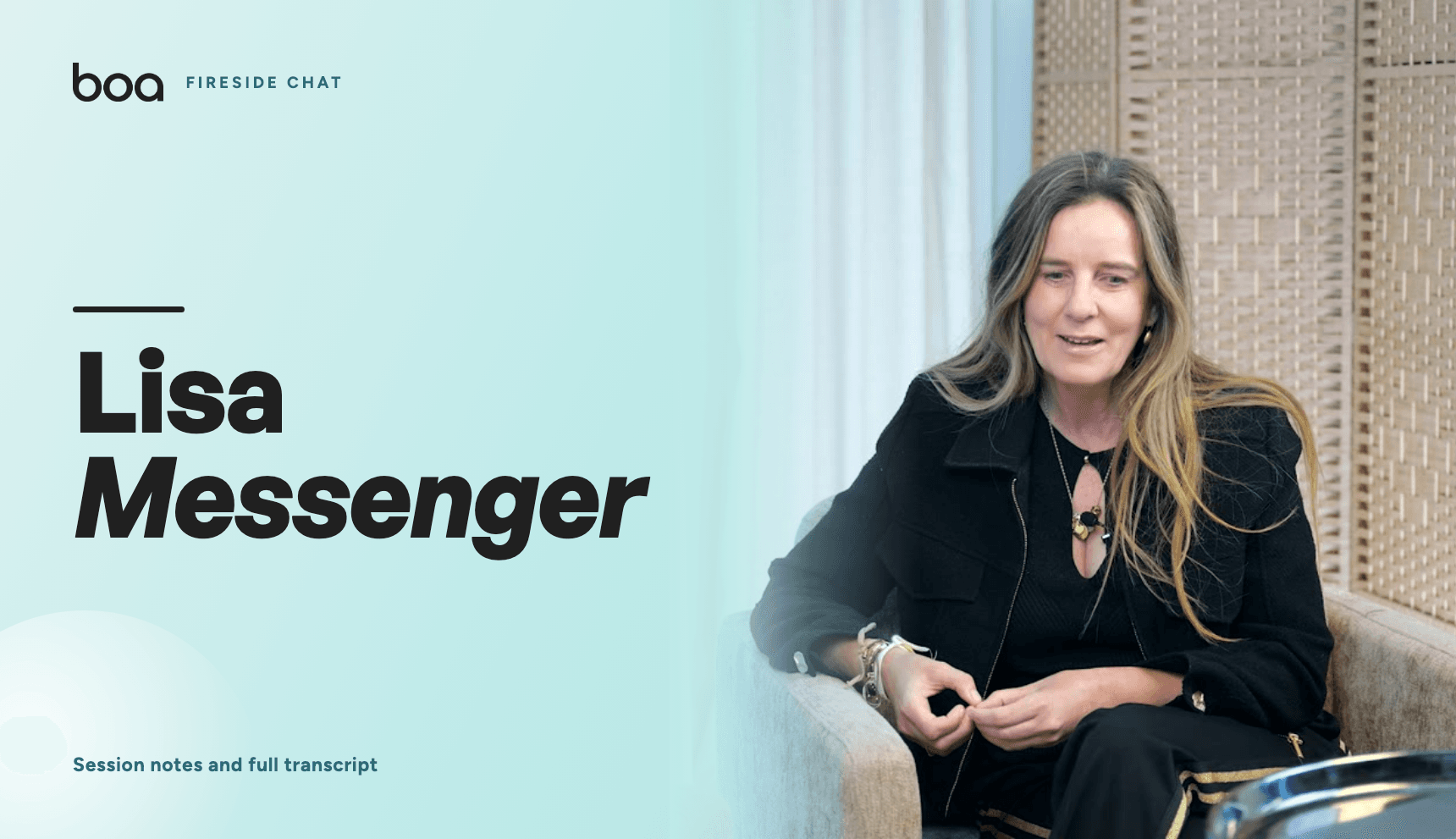
Lisa Messenger on Value Stacking Sponsorship Deals
With Lisa Messenger, Founder and Author at Collective Hub · Hosted by Daniel Hakim · 47 min
What this session covers
Lisa Messenger built Collective Hub into 37 countries in 18 months, then shut it at its peak. She explains how she pre-sells ideas before building them, value stacks sponsorship instead of selling ads, borrows business models from outside her industry, and now runs a zero-staff business with AI. For founders scaling, pivoting or closing something.
Instead of selling a $10,000 ad, Lisa Messenger asked one sponsor for $200,000 and stacked roughly $600,000 of value against it, which funded the launch of a magazine everyone told her was dead.
Key takeaways
- 01
Sell the idea before you build it, then underwrite the build
Lisa calls it selling vaporware. She comes up with a concept, pre-sells it, and only creates it once the market has shown it will eat it up. She has done this with all 40 of her books and with the magazine itself, which gave her both confidence and speed to market. She has never borrowed money for a business in 23 years.
- 02
Value stack one big sponsor instead of selling small ads
The industry model was a flat ad on a page for $10,000. The first issue of Collective Hub cost $350,000, so she would have needed 35 pre-sold ads just to break even. Instead she asked CommBank's CMO Andy Lark for $200,000 and stacked physical copies, advertorial, editorial, speaking and written articles on top, roughly $600,000 of value for his $200,000. It was sponsorship and advertising dollars, not a loan.
- 03
Make 79 calls and stalk the one person who fits your thesis
Lisa made around 79 phone calls before she got to Andy Lark, chosen because people told her he loved entrepreneurs and still liked print. She chased him for about three months through multiple angles, then sent a tweet at 10pm and got a 2pm meeting the next day. She almost did not go. Go to the knife-edge meeting.
- 04
Treat a saturated market as proof of appetite
There were already 5,500 print magazines and everyone told her print was dead or dying. Lisa's read was the opposite: if a market is saturated, there is demand. She looked for the model that no one in the category was running rather than a category no one was in.
- 05
Steal your growth model from outside your industry
The idea for global distribution came from a man with an umbrella company she met in Istanbul through EO three years earlier, who had gone to a distribution conference and picked up distributors. Lisa says almost every idea she has had came from outside the industry she was working in. Look at unrelated businesses and ask how that thinking applies to yours.
- 06
Book a trade conference and run back-to-back distributor meetings
She googled where the global print distribution conference was, found Toronto, and flew there. The format was a meeting every half hour. She took 13 meetings in one day and closed 13 distribution deals, largely because everyone else in the room was jaded and she was hungry and had never done it before.
- 07
Guarantee the retailer profit to get ranged
Told she would have to wait seven years for range in Coles, Woolworths, Newslink or WH Smith, Lisa went straight to Shane McNally, then head of NewsLink. When he said others pay to be in store and she had to wait her turn, she said she believed in the product so much she would guarantee him profit. He gave in, and she ended up with light walls in every airport.
- 08
Borrow credibility with a cover you can get for free
Her first three covers were friends and school contacts (Lorna Jane, Mia Freedman, Layne Beachley), then she ran out of famous friends. To go global she approached Danish jewellery brand Ole Lynggaard, whose ambassador was Helena Christensen, and asked for existing shots for a cover. For them it was effectively a free ad. For her it was international credibility.
- 09
Close the thing at its peak rather than hanging on
By April 2018 Collective Hub was in 37 countries and turning over tens of millions, but haemorrhaging cash, with the CFO asking for another $100,000 a day. Lisa closed it after 55 issues while it was still the hottest brand on everyone's lips. She says closing is harder and more expensive than starting, and too many founders hang on out of fear of losing identity.
- 10
Own the shutdown story yourself in one video
Rather than let the media frame the closure, Lisa recorded one video with her editor at the time and made that public. She felt sick before releasing it. The result was that people fell more in love with her and the brand because she had been courageous enough to say it herself.
- 11
Train one LLM properly instead of buying prompt packs
Lisa's advice on the prompt bundles sold via Instagram and ManyChat: once your LLM is trained well you do not need them. Just tell it "hi, I'm new here, what do you need to know about me for me to train you in my voice" and it will produce the prompts for you. She treats ChatGPT as the generalist that knows everything about her, and builds custom GPTs as specialist mini teams for editing books, producing content and so on.
- 12
Use "act as" to replace whole layers of contractors
Lisa says the two most important words in an LLM are "act as". For a manuscript she prompts it to find the best five editors on the planet for commercial women's fiction, act as an amalgamation of those, then rate the work, and it comes back with a score out of 100 and what to sharpen. She runs fact-checking, proofreading and legal framing the same way. She now works about two days a week with at least 10x the output.
How the session runs
- 1:10Growing up on 4,000 acres in Coolah
- 2:02Getting fired, $4,000 and starting Messenger Group
- 3:32Eleven years of overservicing and never scaling
- 5:46Why the 11 years were the preparation
- 10:22The $200k CommBank deal and value stacking
- 13:56Thirteen distribution deals in one day in Toronto
- 20:44The email from the office of Anna Wintour
- 25:03April 2018: burning Collective Hub to the ground
- 28:42Going to zero staff and learning AI
- 30:40Gamma, HeyGen and the tools she uses daily
- 35:28Reinvention is excruciating, do it anyway
- 40:39AI, fractional roles and what humans still do
- 44:08Winning trust as a new player against big names
Mentioned in this session
- Collective Hub
- The Messenger Group
- Cirque du Soleil
- The Wiggles
- Barry Humphries
- Lorna Jane
- Toby's Estate
- Anna Wintour
- Condé Nast
- Vogue
- Grace Coddington
- Chuck Townsend
- Daring and Disruptive
- Andy Lark
- CommBank
- Mia Freedman
- Layne Beachley
- Kirk Pengilly
- Helena Christensen
- Ole Lynggaard
- Toronto
- Istanbul
- Amsterdam
- Entrepreneurs Organization
- Coles
- Woolworths
- NewsLink
- WH Smith
- Shane McNally
- Matthew Stanton
- Bauer
- Work From Wherever
- Byron Bay
- Coolah
- New York
- ChatGPT
- Gamma
- HeyGen
- Canva
- Zapier
- ManyChat
- Vanderbilt University
- Urban Outfitters
- Abercrombie
- Simon Sinek
- Danielle LaPorte
- PwC
- Devil Wears Prada
- The September Issue
- Boa
Questions founders ask
She self-funded and pre-sold. The first issue cost $350,000, and rather than selling 35 individual $10,000 page ads she pitched one sponsor, CommBank, for $200,000 in sponsorship and advertising dollars. She value stacked physical copies, advertorial, editorial, speaking and articles to give roughly $600,000 of value in return. It was not a loan, and she says she has never borrowed money for a business.
Lisa googled where the global print distribution conference was held, found it was in Toronto, and flew there. The event ran back-to-back half-hour meetings with distributors, and she did 13 meetings and 13 distribution deals in a single day. She had first heard of distribution conferences three years earlier from a man with an umbrella company she met through EO in Istanbul.
By April 2018 the business was turning over tens of millions across 37 countries but burning cash, with her CFO asking for another $100,000 what felt like every day. She describes herself as a great founder but not necessarily a great CEO, without the data-driven C-suite alongside her. She closed it after 55 issues while the brand was at its consumer peak, and says closing something complex is harder and more expensive than starting it.
ChatGPT is her main LLM, trained heavily on her voice, with custom GPTs acting as specialist teams for editing and content. She uses Gamma (gamma.app) daily to turn meeting notes or a transcript into a full pitch deck in about 30 seconds, and the free tier gives up to 10 slides. She also uses HeyGen for lip-synced translation across 175 languages, though she declines to build an avatar of herself because she thinks a fake version would dilute trust.
Lisa's answer is that people buy people, and this is the one thing AI cannot replace. Get in front of people and be explicit about your unique selling point, your point of difference and your lived experience. Show you are tenacious, resilient and able to find solutions. Use AI to increase output, but not at the expense of the human element.
Full transcript
The complete conversation, as recorded, with every speaker attributed.
Daniel Hakim0:00
As most of you know, our mission at BOA is to make sure quality networking and advisory is accessible to every entrepreneur in Australia. And today we're going to be learning and hearing the storey of someone very special, Lisa Messenger. And I was just saying when I was on mute that me and Lisa were having a very good conversation before the camera turned on. I was hearing some amazing storeys that I'm excited to share with everybody. But Lisa is a very well-known Australian entrepreneur. She's an author, she's an investor, and she's a media founder. And her storey in growing like a rapid-fire media empire is one that I think we're all going to learn a lot from today. How she took a magazine in the times when magazines were dead and in 18 months it was distributing through 37 countries and sitting down with Anna Wintour, who's actually my favourite businessperson. So I was very jealous. But Lisa, thank you so much for being here today.
Boa host0:56
My pleasure.
Lisa Messenger0:57
I'm excited. Hi, everyone. So good to see you all. Dan and I were just having an amazing business conversation. You know, when you're an entrepreneur and you're like, oh, we could do this and we can do this, but now we're doing this. So welcome.
Daniel Hakim1:10
Now let's start at the beginning. How did you actually get into business? I read that you're actually from the country somewhere. Yeah.
Lisa Messenger1:22
Oh yeah. I mean, I grew up in Coolah, which no one would know where Coolah is. It's like central west New South Wales. I grew up on a 4,000-acre property farming sheep and cattle and wheat. And I, I rode a horse every single day after school since I was 3 years old and I grew up riding motorbikes and it was— I won't show my age, but I am like a thousand. It was before technology and yeah, we were really isolated and yeah, it was a very different and beautiful grounding upbringing.
Daniel Hakim1:58
And how did you go from the farm to entrepreneurship?
Lisa Messenger2:02
Oh, that's quite a leap, although In a way, not like— I think that is something that helped me build early resilience. And also, I mean, there's a whole lot of stuff, you know, around, um, my parents got divorced when I was 3. There's all sorts of things that form us, I think, in terms of how we take on the world and, um, you know, tackle different things. Entrepreneurship, though, I always had something to prove, uh, and so for the first years of my life I was trying to prove that I was good enough to my mother. And it wasn't until I did a lot of therapy that I was like, actually, I don't need to do that now. I can do it for myself. Um, but really, I started my first business on the 22nd of October 2001, and the reason I started was I was working for a business, a sponsorship company back then. I was doing sponsorship for Cirque du Soleil and The Wiggles and Barry Humphreys, and my boss at the time fired me. Um, it was the most kind firing I could ever imagine, and it was one of the best days of my life because I was one of those little punks who always said, I want equity, and I want this. And I didn't even know what equity meant back then, but I just knew that I wanted more. And, um, his name was Adam, and he said to me, I think you should go do your own thing. And so I kind of took a leap. I had $4,000 to my name and, um, I was on a $65,000 salary, I think. So the only way was up, and I just started.
Daniel Hakim3:32
And that was the Messenger group?
Lisa Messenger3:34
That was a Messenger group. And I started, and you'll all be at different stages of your business and entrepreneurial or founder journeys. Um, I then made a pretty big mistake. I, for the next 11 years, I overserviced, undercharged, was everything to everyone, um, couldn't work out how to scale. For those 11 years, never had more than 3 staff, and back then I thought, um, the number of staff that you had was kind of a measure of success. And, um, I did in that time start writing books, um, and then I started helping other people to custom publish. Um, so I did over time work out— I sort of had an integrated marketing agency slash custom publishing business. It was quite one-dimensional, but I did get to a point where it was like, okay, there's a system. It's like, you know, take someone like Dan, you want to write a book, we get a ghostwriter, an editor, a proofreader, designer, fact-checker, printer, distribution, and plug you in. So I did end up, um, publishing about 400 books for other people. So I did all of Lorna Jane's— I can see her there on the wall. I did her first books, and she's a very good friend of mine. And I did the Toby's Estate coffee book, and like lots and lots of books. Um, But when I really first had some success was 2013, when I was surrounded by so many entrepreneurs and intrapreneurs and thought leaders and risk takers and game changers. And I was just very frustrated by the media because I just kept reading like, Dan's amazing. And I was always like, but how? But how? But why? But why? Like, what's his supply chain? Like, I was always asking these questions that we want to know. And in 2013, I felt like there were conversations much like what we were just having before we were on air. Around, oh, but how did you do that? And like, you know, really interesting, fascinating things. And so my idea was as simple as, why don't I get all these people that I know, smoosh them— very technical term— together into a format, which ended up being a print magazine.
Daniel Hakim5:42
And, uh, and that was The Collective Hub.
Lisa Messenger5:44
That was Collective Hub, yeah.
Daniel Hakim5:46
And so before we get into The Collective Hub, because it plays a huge part in your entrepreneurial journey, um, I just wanted to touch on a couple things. Now, you mentioned, so you were actually in business for 11 years before you kind of found that way to scale, before you found that kind of bigger hit of success. And I think that's, I think that's an important point because a lot of people think that it should happen fast or 11 years might be too long. But I guess the big lesson there is that you enjoyed it for 11 years. You might have been frustrated. It sounded like it because you were measuring success by how many staff and you couldn't get past 3, but you never stopped. And, uh, well, you never stopped business. I guess you did though change the business path you were on and enter the Collective Hub. And I just thought there were a lot of good lessons there.
Lisa Messenger6:38
Thank you. So many things. And I think in hindsight, like when I launched Collective Hub, which we will get into, cuz that's important, like so much of it just was like, oh, aha, of course I should be doing this. But actually. Um, and I think this is really important lesson for anyone at whatever stage of business you're in. I wouldn't have been ready. Like, I hadn't had enough failures, I hadn't taken enough risk. Like, everything led me to that point. Funnily enough, um, when I look back, I had bought, um, I'd registered a business name 5 years prior called, um, Messenger Magazines. I'd bought a book that I found years later, um, How to Start a Magazine. Like, all of these little things were kind of peppering through, but leap that I took in 2013 to do it was so enormous that I really had to have a lot of life and lived experience in order to be able to do the magnitude of what I took on. So much so that my, um, I had a business advisor who had been at PwC for like 20-something years, and he actually fired me because he was like, I've never seen someone take so much risk, I just can't work with you anymore. But I was ready, like I was really ready to do something big by then, and I think probably the most important lesson here, and a lot of people will relate, and it's very much a Simon Sinek, Danielle LaPorte way of thinking, but it's, um, you know, I just had this like in every single cell in my body. I knew what I wanted to do and the why, and my purpose was just so clear. And I think when you get to that, like, I was just like, I just want something that tells the storey behind the storey of entrepreneurs and lifts the hood on it, and it's the raw and the real and the relatable and the attainable. And We talk about the financials and we talk about the supply chain and we talk about, you know, lift the hood on everything. And so because I was so clear on that, then the synchronicity and the serendipity and the how just kind of showed itself. So it was like a flow state or alignment. Even when things are hard, these doors just keep opening. And I know that feeling now. And I think when you get there, it's pretty extraordinary as an entrepreneur or founder what happens.
Daniel Hakim8:57
Yeah, totally. And guys, if you have any questions for Lisa, regarding this early days of the business or managing that first 11 years before reaching that scale or reaching that point of success, please throw them in the chat or any other questions, just throw them in the chat.
Lisa Messenger9:11
And there's nothing off limits. You can ask me anything about anything. I am a complete open book.
Daniel Hakim9:17
And so the Collective Hub, that was a print magazine that you created because you said you saw a gap in the market. So you looked at all the media and you said, well, I'm seeing this person successful or this thing's amazing, but I'm not seeing how they became it or what they did or what lessons were. And so that was the premise of the mag. It was to go deeper into the storeys and actually give people how-tos.
Lisa Messenger9:42
That was the absolute premise. It was like I would see in the media, Dan's done this and it's amazing. And I was always left trying to reverse engineer and be like, but why? But why? But how?
Boa host9:52
But how?
Lisa Messenger9:53
It's the same line of thinking that got me thrown out of classrooms at school, by the way, you know, because back then it was very convergent as opposed to divergent learning. And so those questions would see me sitting sitting out on the stairs, thrown out of the classroom. So it's the same thing. I'm always like reverse engineering and problem solving and trying to work out what's under the hood, as you may have guessed from our conversation before we started this. Um, so yeah, that was the entire premise of it.
Daniel Hakim10:22
And what gave you the courage though? So why did you think magazines were going to work when at that time magazines were not working for anyone else, including Anna Wintour.
Lisa Messenger10:33
They weren't working, and people said, um, you must be mad, they're either dead or dying. So this is another really good lesson. I'm the queen of selling vaporware, people have called it. I sell things always as an idea before I've done anything. So I was out there pitching, um, a concept to a bunch of corporates beforehand. So I think I You know, I made something like 79 phone calls and had meetings until I met Andy Lark, who was then the CMO, Chief Marketing Officer of CommBank. And people had said to me, Andy loves entrepreneurs and he still likes print. And I stalked the guy for about 3 months. And finally, I remember people were like, oh, he's really big on Twitter back then when it was still Twitter. And so I tried to get to him through so many different angles. And I sent him a tweet, 10:00 one night, said, hey, Andy, you know, blah, blah, blah. And he goes, oh, how about 2:00 tomorrow? And it was one of those knife-edge moments where I almost didn't go. You know, when you're on the edge of something and you just feel that and you're like, oh my God, this could be it. And I went and I had this meeting and I explained the concept and he just said, I love it. How much do you need? And I said, oh, $200 grand. Now, it was a deal that had never, ever been done in Australia and possibly never globally. And this is a really important point in terms of business models, listen to the similarities, not the differences, and what applies to your business. But most people were selling— the revenue model for a magazine was sell a flat ad on a page, $10,000. The first issue of the mag cost me $350,000. So I would have had to sell, pre-sell 35 ads just to break even. And no one had ever heard of me. Highly saturated market, 5,500 print mags already. People said it was dead or dying. So I thought differently and I didn't ask for $10,000. I asked for $200 grand and I value stacked. We all have value, right? So I was like, what can I give them? So I was like, Andy, I can give you physical copies of the print magazine when it comes out. I can do advertorial, editorial, I can come and speak, I can write articles for you. So for his $200 grand investment, I basically value stacked to about $600 grand worth of value. Business is a dance, right? We start out and we're like, here, I'll give you this much. And as I got more and more successful, it kind of goes like this. And so that's what I do with everything. Every time I write a book, and now I've authored 40 of them, I come up with a concept, I pre-sell it, and then once I know that the market is ready and it's going to eat it up, then I actually create it. And so that's given me confidence and speed to market. And I've always underwritten anything. By the way, that $200 grand from Commbank was not a loan. It was sponsorship and advertising dollars. And people are like, what? I've actually to this date never borrowed any money for my business. I've self-funded everything.
Daniel Hakim13:30
Well, but what I like about that is you're finding patterns and gaps and innovations is obviously something you do. You looked at print at a time where no one wanted to look at print and you saw a gap. You looked at the business model of print and you saw an issue. So and you went to a completely different business model, completely different offer. Yeah, still sponsorship, but a completely different offer.
Boa host13:56
Yeah.
Daniel Hakim13:56
So I guess the big lesson there for me is that, you know, however your industry or business typically runs, there is an alternative. And is that alternative something that you're looking at at the moment? Now, Collective Hub became hugely successful. It was in 37 countries. Can you actually tell us how that happened? How did you get it to the point where you were distributing Globally?
Boa host14:20
Yes.
Lisa Messenger14:20
How many hours have you got?
Daniel Hakim14:22
Lessons in scale do you have?
Lisa Messenger14:23
So by the way, I've actually written, um, 7 books that charted that journey because I, I decided that if I was doing, um, the magazine, then I should be writing in real time, unpacking all of the lessons. So I started writing books in conjunction, which is why I've written so many books, because I wrote in real time as things were happening. So firstly, a highly saturated market is a really great place to start. A lot of people think, oh no, I'm going to reinvent the wheel, I'm going to start somewhere completely different. If the market is already saturated, it means there's appetite. So that's what excites me. I never look within my business vertical. I always take lessons from outside and I look at completely different businesses, and then I apply those same ways of thinking to whatever I'm tackling. The reason it worked was manifold. Um, where do I even start? So The first person that I had on my cover was Lana Jane, cause she was a good friend of mine. And then I had Mia Friedman because I went to school with her and she was really anti-magazines at the time. So I was like, this will create some stir. And then the third cover I did was Lane Beachley and Kirk Pengelly cause I knew Lane. Then I ran out of famous friends, so it wasn't a good strategy. So my thinking changed when I was like, I want to go global with this. And so. I mean, it's— maybe she's a great thing, right? Um, Ollie Lingard, which is a Danish brand, had Helena Christensen as their ambassador. So I approached them and said, hey, do you have any shots of Helena I can use for a cover? Little did I know, of course, they were like, this is amazing. She's wearing their jewelry. It was basically like a free ad. I then Googled back in the days before ChatGPT, and I found where the global distribution conference was for print magazines. And it turns out it was in Toronto in Canada. And I got my ass on a plane to Toronto and I went to this conference where literally it's one of those places where you have a meeting every half hour with global distributors. And if you can imagine, most people who were in print at that time were either just working for another publication and they were jaded and they rolled up to this thing and they were like, hi, here we are again. Whereas I was like hungry and entrepreneurial and passionate and never done this before.. And so I had 13 meetings on one day and I did 13 different distribution deals. And the idea for that, funnily enough, had come from again, 3 years earlier I'd been in Istanbul with EO, the Entrepreneurs Organization, and I'd met a guy who had an umbrella company and he lived in Amsterdam and he had planted this idea around global distribution because he was like, oh, my umbrellas are in however many countries. And I was like, How? Because before then I'd always been quite peripheral and thought Australia is my market. And he said, I went to a distribution conference, I got all these distributors. And so it was just like, again, outside of my industry, I just started thinking. So that's how I started expanding overseas. I got one celebrity that I could, you know, hustle on a cover, gave me a bit of credibility, went and did these deals. But in Australia, And this is probably as of equal importance. Most people said to me, oh, you don't get range. I didn't even know ranging was a thing in Coles or Woolworths or Newslink or WH Smith for 7 years, right? And I was like, what do you mean, this antiquated industry? And so I just started making phone calls in my naivety, and I found this guy Shane McNally, who was the head of of NewsLink in Australia at the time, and I was like a squeaky wheel. And he was like, no, no, no, we can't put you in the store. Anyway, I ended up having a meeting with him, and I think there's a saying, it's not the big that eat the small, it's the fast that eat the slow, right? And I was just like, I didn't— I was nimble and flexible and agile. And I ended up getting this meeting with Shane, and Shane was like, no, people pay us all this money to be in store, and you know, you got to wait your turn. And I just said to him, Shane, I believe in the product so much, I will guarantee you profit. And he was like, okay, I give up. And then I had to back myself and, you know, stand behind what I did. And I remember Matthew Stanton, who was the CEO of Bauer at the time, they had 80 different magazines. He called me in for breakfast and he was like, who are you, you little punk? You know, you've got light walls, floor-to-ceiling light walls in every single airport. You've taken over all of our real estate. How are you doing this? And I was like, because I just believe in it and it's all about relationships and it's all about community. And really, probably one of the other really important lessons is people want you to succeed. I mean, you know this more than anyone. The members of Carbon Boa, all of you, you want to carry the message. And so I said from the get-go, I don't— I might own the magazine and this media movement, financially, but I don't own it. My community owns it. And so they started to carry the message and it just got bigger and bigger and bigger.
Daniel Hakim19:35
I like that separation from— I don't own the movement. I own this, the financial interest part of this movement, but the movement is actually the community. I really like that. I also think a really key important part of that storey was that the, the understanding or vision for going global and finding distribution was simply just meeting someone who had done that before.
Lisa Messenger20:00
An umbrella company.
Daniel Hakim20:01
Yeah. And it just made it possible, you know? Yeah. That's, that's why meeting people is so important because you meet someone who says, oh no, that's actually pretty easy. This is how you do it. And to you it sounds hard. Like happens to me all the time. I meet someone and like, I could never do what they've done. And then they say, oh, this is how I did it. I'm like, oh, okay, I could actually do that myself. Like it's just so important to have those business conversations with people.
Lisa Messenger20:23
Every idea. And I think this is why what you're doing is so imperative, the networking. Every single idea that I've had in business has come, I could pretty much say, from outside of the industry that I'm currently working in. I don't look at the road that's already been paved. I always look at things outside of my industry and I think, how can I apply that thinking to what I'm doing?
Daniel Hakim20:44
And so how did you get the attention of Anna Wintour? And for those of you who don't know, she's the doyen. She was there. She, she, she did. She recently resigned. She was the head of Vogue. So she wasn't even the head of a company. She was essentially the head of just an entire industry.
Lisa Messenger20:57
Well, Vogue and then Condé Nast. So it was wild. So I launched the print magazine in February 2013, and by what was it? October 2014, I was sitting in New York in the Condé Nast headquarters opposite Anna Wintour and Grace Coddington, the one with the hair. If you think about Devil Wears Prada or the September issue, she was— it was like a walled glass boardroom and Grace was sitting on the phone opposite us. And I was like, what is my life right now? But I literally— this is a wild story. Literally one day I just in my inbox there was a subject line that said, "From the office of Anna Wintour." And I was like, are you kidding me? And it said, Anna, you know, you've come to her attention, she'd like to meet with you. And so I got my ass on a plane to New York and I met with Anna. And, um, the funniest thing was, um, well, a couple of things. Firstly, at the time I put it up on Facebook, oh my God, I'm, you know, going to meet with Anna Wintour. And you know what everyone said? Another lesson, everyone said, what are you gonna wear? And I was like, hang on a minute, guys, she asked to meet. Well, I did have a stylist, but she asked to meet with me. And I think this is so often where we get it wrong in life. Like, she asked to have a meeting with me, you know. And so I had to very quickly, you know, front up and go, we are having a serious business meeting here. She is seeing me as, God knows how, some kind of an equal. And it was really because she'd been around forever and ever and ever in the industry And what happened with Collective was I very quickly went from having a print magazine to going, I, I don't want to just see an article on Dan, I want to take him off the page, which is very much your thinking as well. I want to run events where people get to come and see him in the flesh and talk to him. And so I built out quite quickly a very robust, um, omnichannel media platform. So it was the print mag, um, we were doing like 4 events a week, and then I had, um, a digital platform. We were doing like 8 articles a day, and we had multiple revenue streams that we were running from that. And I think it was very different to what had been done in media before. And Condé Nast, you know, the biggest media empire on the planet— Collective Hub was by then in the US, and it had obviously become, you know, on their radar. And so Anna wanted me to, you know, talk to her about how I was doing it, which was wild. I then met with Chuck Townsend, who was then the global CEO of Condé Nast and went on to be the chair. And he gave me a testimonial for the front cover of my book, Daring and Disruptive. And I was just like, wow, this is, this is really cool. And it's really testament. Um, at school I did what was, what was called, which you could never call it now, veggie English. It was for people who just had no idea about English, you know. And here I was being flown to New York to meet with like the biggest doyen of publishing. And so really 18 months before, I didn't even own that magazine. So anything is possible, really.
Daniel Hakim24:13
Well, and I think the lesson there is that once you achieve, like, once you do something special, there's not that many people that have done something special. So you get noticed very quickly by others and it really quickly brings you into that inner circle of, of, of top players in, in a space, if you know what I mean.
Lisa Messenger24:28
It was wild. And success breeds success.
Daniel Hakim24:30
Now, I do want to get to— so you built the big kind of media empire, and now you're at a different stage of life. Now you focus on Freedom Found or Freedom Entrepreneurship, which is entrepreneurship that gives you the freedom in life.
Boa host24:46
Yes.
Daniel Hakim24:47
And you particularly have learned a lot of lessons in productivity and automation and things of that nature, which you're helping other founders, I guess, implement. Yeah. Where should we start in terms of that? Yeah, in terms of that.
Lisa Messenger25:03
So just to segue quickly, 5 years into the mag, April 2018, I found myself at the helm of a very, very, very big global business. 37 physical countries, you know, multiple revenue streams went from a couple of million dollars turnover to tens of million dollars of turnover. I'm a great founder, not necessarily a great CEO, and I didn't have the right the right C-suite alongside me, the data-driven, you know, detail-oriented people. And so I was haemorrhaging cash, and my CFO, Chief Financial Officer, every day was saying to me, like, every day, we need another 100 grand. We— like, everything was in increments of 100 grand, or me— like, it was wild. And so in April 2018, after 55 issues of the print mag, I made an equally courageous decision as I did when I started it, and that was to break it. So I then decentralised the office and there's multiple reasons behind that. But I decided before COVID to dismantle the office, let people work from anywhere. I wrote a book called Work From Wherever and changed the entire way that I worked essentially. And suddenly, I mean, which took so much mindset to kind of go— I went from measuring time in office and bums on seats to productivity, output, and KPIs, and it changed everything. And so fast forward and cut out like the last however many years. Now I live in Byron Bay. I have a 2-year-old and I have zero staff. Um, I never— even when I broke it, I still had a lot of full-time staff. But, um, about 18 months ago I decided to have zero staff. Now I still have kind of my bookkeeper that's been around for 16 years, but she was always a consultant. My IT guy Kev, I think we said 15 years or something. I've got a lot of people who've been around for a long time, but a lot of them were never in employed as my full-time staff. And so I decided— and it's interesting, and a lot of you will relate to this— I was not technical because I always had so many staff. I, I was like the visionary and the deal maker and kind of could— yeah, the leader, but I never did anything to do with tech, and I kind of ran from it. I was like, no, no, you do that. No, no, you do that. And then, um, yeah, nearly 2 years ago I doubled down. I was like, I need to really learn and embrace AI because I'm going to be put out of a job. I mean, so much of what I was doing as a creative was, you know, writing, like content production on every level. And so I really doubled down and I started doing every single course I could find. And then, you know, and then I became a certified prompt engineer through Vanderbilt University in the US. And I realised actually I'm very good at tech and I'm very good at AI because I've been kind of commanding big teams for so many years. Once you learn and how to, you know, prompt properly, you can do anything. And so more recently I've started running monthly, and I just came off the back of a back-to-back retreat in Byron Bay where I'm teaching other, um, founders essentially how to use AI to automate and, you know, really ramp up our efficiencies. And it is insane the speed at which it's going. And, you know, on one hand it's very dangerous, but also So I think when you learn to use it for good and harness it and embrace it, it can be very powerful. It is insane, my output now.
Daniel Hakim28:42
And so what, what are ways that we here today can all start using AI to improve our output?
Lisa Messenger28:51
Okay, so I mean, I use a number of different systems. I would say, I mean, find whichever LLM you want. There's multiple out there. ChatGPT, is my kind of platform of choice. I have trained it within an inch of its life. What I would say is if you, I mean, many of you will already be daily users or, you know, you'll all be at different stages. If you see people out there selling prompts, you know, you see them on Instagram or wherever through ManyChat saying, comment prompt and get 80 prompts. Once your LLM is trained really well, you don't need any of that. You just literally say to it, hi, I'm new here. What do you need to know about me for me to train you in my voice, and it will give you all of the prompts you want. Um, I have also built a number of custom GPTs, which, um, I mean, I did that a long time ago. Um, they— I use them specifically like as editors of my books or as, you know, content producers. So I kind of think of the LLM as like the generalist which knows everything about me, and then my custom GPTs are like my little mini specialist teams and I've built sort of one for every single thing now. And this is how fast things are moving. You know, 4 weeks ago I taught an advanced AI retreat and it was when Zapier was still external to ChatGPT. And now under the hood of, you know, Chat, we can have all sorts of integrations and automations so we can link everything, automate everything. I mean, it's pretty wild and it's hard to unpack everything in this short amount of time. I also use— if you guys aren't using it, I would seriously recommend— I mean, this— I use Gamma every single day.
Boa host30:40
What's Gamma?
Lisa Messenger30:40
Gamma.app. It's, it's kind of like Canva or Canva Magic Studio, but on steroids. We could literally like take this recording, drop it into ChatGPT, say, say, um, write this into a GammaReady slide for me, drop it into Gamma, and in about 30 seconds it will have a full pitch deck for you. So I use it like I might come off, um, you know, a Zoom or whatever platform of choice we're using. Um, it will have all the notes. I'll drop them into chat, say turn this into a pitch deck, and drop it into Gamma, and literally in 30 seconds there will be a pitch deck ready to go. So I use that all of the time.
Daniel Hakim31:25
So what type of things would you use that for?
Lisa Messenger31:27
So if I'm pitching to a publisher and I want to drop in, you know, a deck, if I'm anything that I'm pitching, vaporware, a new business idea, a membership or whatever, and my ChatGPT knows me so well. I just did a live demonstration, which I kind of love, like the live demonstrations at my retreats where I was like, hey, chat, my chat's called Nova. Hey, Nova.
Daniel Hakim31:49
Whatever.
Lisa Messenger31:50
Um, I want to run a retreat for, you know, um, founders in blah blah blah industry. Write me a pitch deck. It knows that much. And I'll be like, make it 20 slides in gamma. Boom, within probably 60 seconds I have that, and within another 30 seconds I'll have a gamma-ready slide. And all the participants at my retreat were like, how does it know you so well? Um, another one that I highly recommend is Hey Gem. Have you used Hey Gem? Hey Jen, it's wild. All of you, most of these you can download. So Gamma, you can download and it will give you up to 10 slides for free. You don't need to pay anything. Um, are we being wrapped up? Good. There's nothing on the screen. I'm like, no, we're here forever. Um, hey Jen, you, we could do it right now. You could literally speak into your phone. In and say, hey Lisa, I'm having a great day, this is amazing. There's 175 languages you hit. What's your background?
Daniel Hakim32:54
My mum was born in Mexico, my dad was born in Lebanon.
Boa host32:56
Great.
Lisa Messenger32:56
So we put in whichever language of your choice out of 175 languages, it will lip sync you again within 30 seconds. And this is all free to do this.
Boa host33:05
Yeah.
Lisa Messenger33:06
So my mother-in-law is Italian and I just made a video the other day and I sent it to her. She's like crying.
Daniel Hakim33:12
You're speaking Italian?
Lisa Messenger33:13
Speaking fluent Italian. But with Hey Gen, you can also, um, have like avatars. So we could say, hey Dan, um, like take a photo of this water bottle, um, do a video of you without like sync this together, and you will literally be standing there promoting the water bottle. Now I have a bit of dual thoughts on all of this because we're talking about authenticity and a lot of this stuff now can happen at such speed, it would basically mean with something like HeyGen, I could turn all 40 of my books and take that content, um, feed it through ChatGPT, say to me, give me scripts ready, drop it into HeyGen, create an avatar of myself, and do 40 different training videos on my books without—
Daniel Hakim34:03
Oh wow, that's what you're using it for.
Lisa Messenger34:05
I'm not.
Daniel Hakim34:06
But you can.
Lisa Messenger34:07
But you can. I won't because I think from an authentic perspective, I would definitely use it for editing and things, but it is fascinating how quickly things are moving.
Daniel Hakim34:20
I haven't heard of either of them. We do have a couple of questions come through. Karma, would you like to ask your question first?
Lisa Messenger34:27
Can we? Hi. Sorry, I could go on about— I use about 40 different AI tools. I could go on forever and ever.
Boa host34:36
Yes, go ahead. No, this is so great, Daniel.
Lisa Messenger34:40
Thank you very much.
Boa host34:42
Please, can we have more of Lisa?
Daniel Hakim34:45
We will try.
Boa host34:46
Lots and lots of questions about AI, but actually I was really loving the telling of your reinventions. I'm a little bit biassed because I talk to people about how to do that, but you seem to make it sound really easy and you know, for a lot of people changing direction, particularly entrepreneurs saying, I'm going over here now, I'm going to break this and I'm going to reinvent it over here. You make it sound easy. Was it always that easy? Have you always had that capacity to just go, hang on, there's a creative solution over here? How do you do it?
Lisa Messenger35:28
Thanks, Carol. Great question. It's not easy, but it's an imperative. Um, so I've broken things on a fairly massive level a couple of times. So 2018, I literally burnt it to the ground. It was excruciating, and it spent— I spent probably 18 months, like, you know, in the office, as we have to do with our teams, like high vibe, high energy, you know, dialling for dollars and, you know, all that stuff when you get into this, oh my God, the cash burn is real, hemorrhaging, and I need to make this money. And it's not a good place from which to run a business. So I would literally go home and like be catatonic on the bathroom floor in a little ball crying. And so that's when I was like, I know what my purpose is. It's really to ignite human potential and to be an entrepreneur for entrepreneurs, living my life out loud, showing that anything's possible. And I was like, I need to trust myself. I cannot fronting up every day to a business model that has become largely unsustainable. And I am the only one at fault for that because I didn't set it up correctly. And so that's when I decided to close the magazine. And at the time, it was probably the— well, definitely the biggest brand I've ever been a part of. But also it was like the hottest thing on everyone's lips in Australia. And so I really closed it when it was at its peak from a consumer perspective. But that— with that came a whole level of trust where I was like, if I know how to do this and I've done it once, I need to trust that I can do it again. We see way too many founders hang on and hang on and hang on, whether it's loss of fear of loss of identity or, you know, it costs a lot more and it's actually a lot more difficult, funnily enough, to close something down than to start it, which sounds ironic if you've ever tried to start anything like that. It's so difficult. But trying to burn something to the ground when it's that complex across that many platforms and channels. And like, it was very difficult because then you've got to have all of these hard conversations. But once I extrapolated myself out of that, I owned the story. I did one video with my editor at the time, and I made that public rather than speaking to the media. And the thing about it was I was like, I felt sick before I released it into the world. And oh, I've got full body shivers because what happened was people fell more in love with me and more in love with the brand because I was courageous enough to do that. And I did it again 2 years ago. I've got a 2-year-old and I— after that I produced another 108 products. Slow learner, lots of affirmation cards and books and journals and things. And we moved to the US in 2022 and, and I did a massive massive distribution thing. We were in Urban Outfitters and Abercrombie and like all these stores. And then I found myself again at the helm of something which I wasn't enjoying. It was a logistics and distribution business, and I was like, I'm a creative, I want flexibility and freedom. So I again decided to burn that to the ground. It's not easy and it's expensive, but what I know for sure is that I talked at the beginning about freedom and flow and alignment. I think whenever we get to a point where something is suffocating us and we don't feel the best version of ourselves, even though it's really difficult to close it and it's expensive and it's all sorts of other things—
Boa host38:55
hard—
Lisa Messenger38:56
we choose our hard, right? And once I've done it, oh, it's just like, okay, it's this inner trust that I know I'm a good entrepreneur, I know I can do it again. And the interesting thing is, and I was saying to Dan Um, I, I teach a lot of the founders that I work with, my whole kind of ecosystem, and I was drawing it up the other day, like all of my different revenue streams, and I said literally 2 years ago none of the revenue streams except speaking look the same now. Like, I'm running retreats, I'm teaching AI, I've just finished my second novel. None of this stuff I had ever done 2 years ago, and I think the Um, a true entrepreneur, we have the ability to morph, pivot, iterate, change, and that is the only constant. We need to be able to do that, and that's what keeps me alive. It's not easy though, it's excruciatingly hard. But right now, honestly, I feel the best I've ever felt. My profit is like through the roof because I've always been good at making made, but I was terrible at retaining it for 23 years. I was like, here, invest in more products, invest in more staff, more infrastructure, more, more, more. And now I'm like, what? This is my money. It's pretty cool.
Daniel Hakim40:17
Thank you, karma.
Lisa Messenger40:19
Raul, where are you?
Daniel Hakim40:26
I might have said your name wrong, but R-A-H-U-L. If not, Laura, if you find your way back on, maybe having a tech issue, just message. But Lauren, would you like to ask your question?
Boa host40:39
Oh yeah.
Lisa Messenger40:39
Hi Lisa.
Boa host40:40
Hi.
Lisa Messenger40:41
I have a flexible business, so I'm quite curious with your thoughts around how you see the rise of AI influencing the demand of fractional careers moving forward. Fractional meaning what?
Boa host40:58
Like part-time.
Lisa Messenger40:59
So, so more people, you know, they're complementing their AI use with sort of more part-time resources instead of sort of hiring full-time employees.
Daniel Hakim41:11
Fractionals, rather than hiring a full-time accountant, you can have an accountant.
Lisa Messenger41:14
Yes, yes, yes.
Boa host41:15
Okay.
Lisa Messenger41:16
So, I mean, I don't want to put people out of work. Disclaimer. And it's really hard, right? I've always said throughout my entire business career, like, there's always going to be copycats or technology or whatever it is that's going to creep up and, you know, take over. So I always think we'll just move faster and embrace it. And I think from a, you know, fractional or part-time or whatever, I think AI can replace or enhance most things. So if I look at my chain of what I've done across any of my content pillars, normally when I would I would write a book, I would have an editor. Now I have custom GPTs set up where they can measure against frameworks, they can measure beats, they can measure emotional impact. I can put in there, which are the two most important words I think in an LLM, act as, act as firstly find the best five editors on the planet for commercial women's fiction. Now act as an amalgamation of those and now rate me and it'll be like, oh, you're sitting at a, 83 out of 100, you need to sharpen this, this, this. Um, so the next piece would have been, um, you know, I would have had, um, fact-checkers, proofreaders, like all of that can be run through AI now. And then designers, and basically now I can run it through like a zillion different programmes and design a book. So it's, um, a lot of that's removed. Podcasting, a lot of— sorry guys sitting behind there, but like, um, you know, there's a lot of programmes now that can edit at speed. So I lean into the human elements where I need it, but again, from a legal perspective, you know, act as a commercial lawyer, do this for me, act as this. I mean, I like that there is so much that I get it to do for me now, um, that it is insane. I think you have to be— I mean, that's why I got a certification in prompt engineering, because I wanted to be the best I could be to really understand it. And yes, it is taking over a lot of human-centric jobs, but also the speed at which I can do things now. Like, I don't have to wait to send things to an editor or a proofreader or a designer or an editor, like a videographer, whatever. I can just do it at speed. So I'm just really leaning into the human elements for people who are, you know, strategic. They think differently. But I think for those of us who think and move fast, I'm I mean, it is phenomenal. I mean, really, I probably work 2 days a week and my output is 10x at least what it ever was. So yeah, awesome.
Daniel Hakim44:08
And we— I want to get back to Raul. We'll have to end it after all though, because we are out of time. But Raul, I'll ask you a question for you. I know you're there because I saw your message, but I will ask, how did you gain trust as a new business in a saturated market where you have big players? I think it's a fantastic question.
Lisa Messenger44:23
It's such a good question. And It happens all too often, and I think it's such a perfect question, Roel, because this is where the human element can never, ever, ever be replaced by AI. People buy people. I mean, that is the long and the short of it. And so the trust element is really, you know, getting in front of people, telling them why you're the person, you know, for the job. What's your unique selling point? What's your point of difference? What's your lived experience? Like, what can you bring to it that no one else can. And I think this is particularly pertinent in a highly technological world, you know, of AI, is when you bring that human element and you, um, prove that you are the person and that you will stop at nothing and that you are tenacious and resilient and that you have the ability to find solutions to problems, then that is going to make you stand out, you know, over and over and over again. So I think for all of you, really you know, use AI to enhance your creativity and your ability to get things done, but not at the detriment of your humanity and who you are as a person. And I mean, I think that trumps every single time, you know, sitting down with you now and earlier and just having these conversations. Like, it's amazing. But now what we can do is like, yeah, let's do this, let's do this. And now let's use AI to like double down and 10x what we want to do together.
Daniel Hakim45:51
But I think trust element, like you're You're saying people first, like you trust people, they like you, they trust you, you build a relationship with them. Yeah, it is a great way to break through.
Lisa Messenger45:59
Yeah, you want to do business with people that you like and build that trust. And I think often building that trust is that authenticity piece. So like when I was talking about tools like HeyGen before, the reason I wouldn't build an avatar, like a fake me, is I think that could dilute that trust. Yeah, exactly.
Daniel Hakim46:22
Guys, I want to thank you all so much for being here today, and I hope you got a lot of value from this conversation. Lisa really is incredible. To be honest, there was almost too much content matter for me to, to, to go with.
Lisa Messenger46:33
I mean, we've just touched on so many different things.
Daniel Hakim46:34
Yeah, we really did scratch. We probably need a follow-up one because we also missed a few questions. But I hope everyone has a fantastic day, and thank you so much, Lisa, for joining us.
Lisa Messenger46:43
My pleasure. Thanks for having me. See you guys. Bye.
Watch the full sessioninside Boa.
Session notes are free. The recordings, the live advisories and the founders in the room are for members.