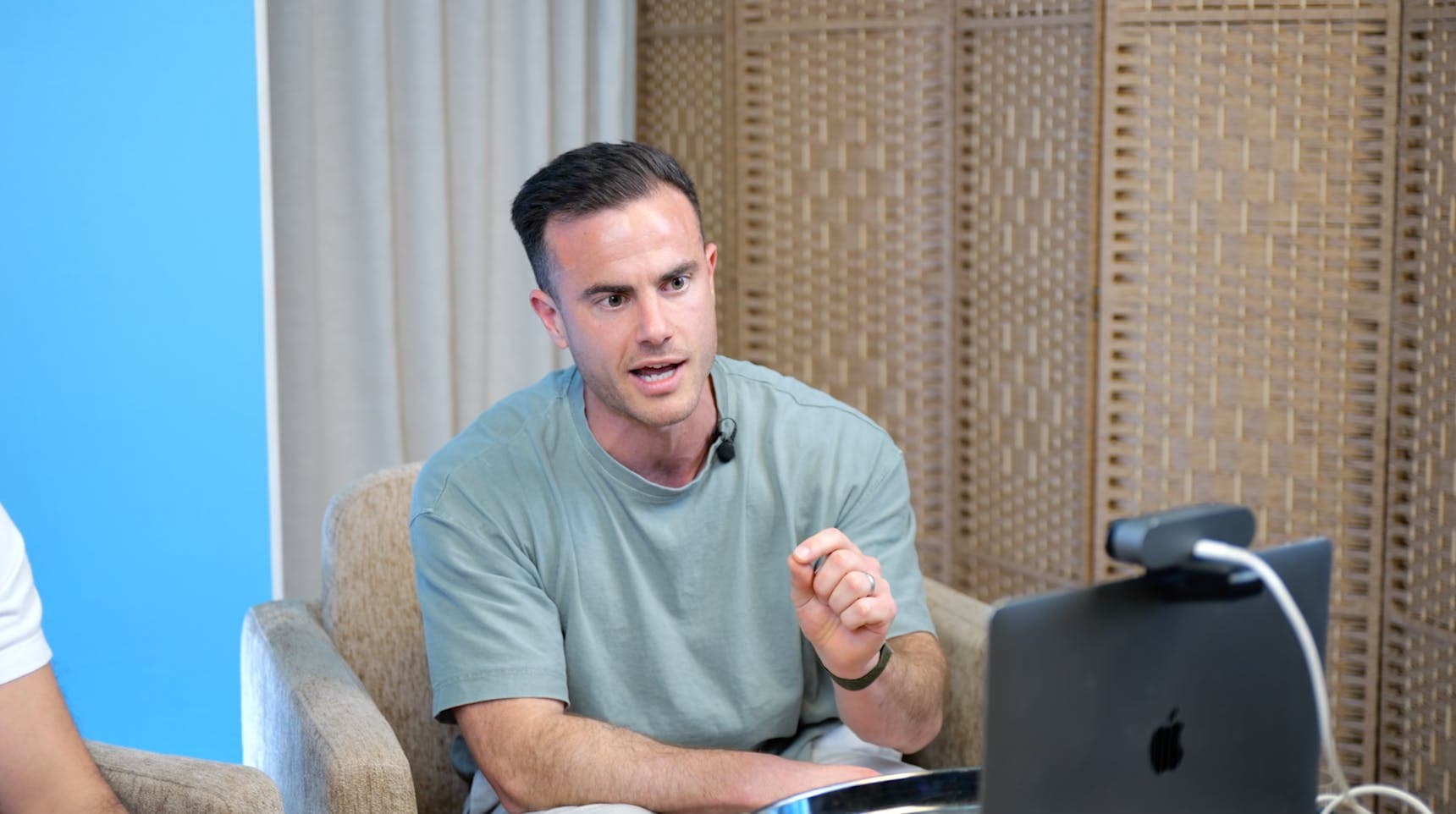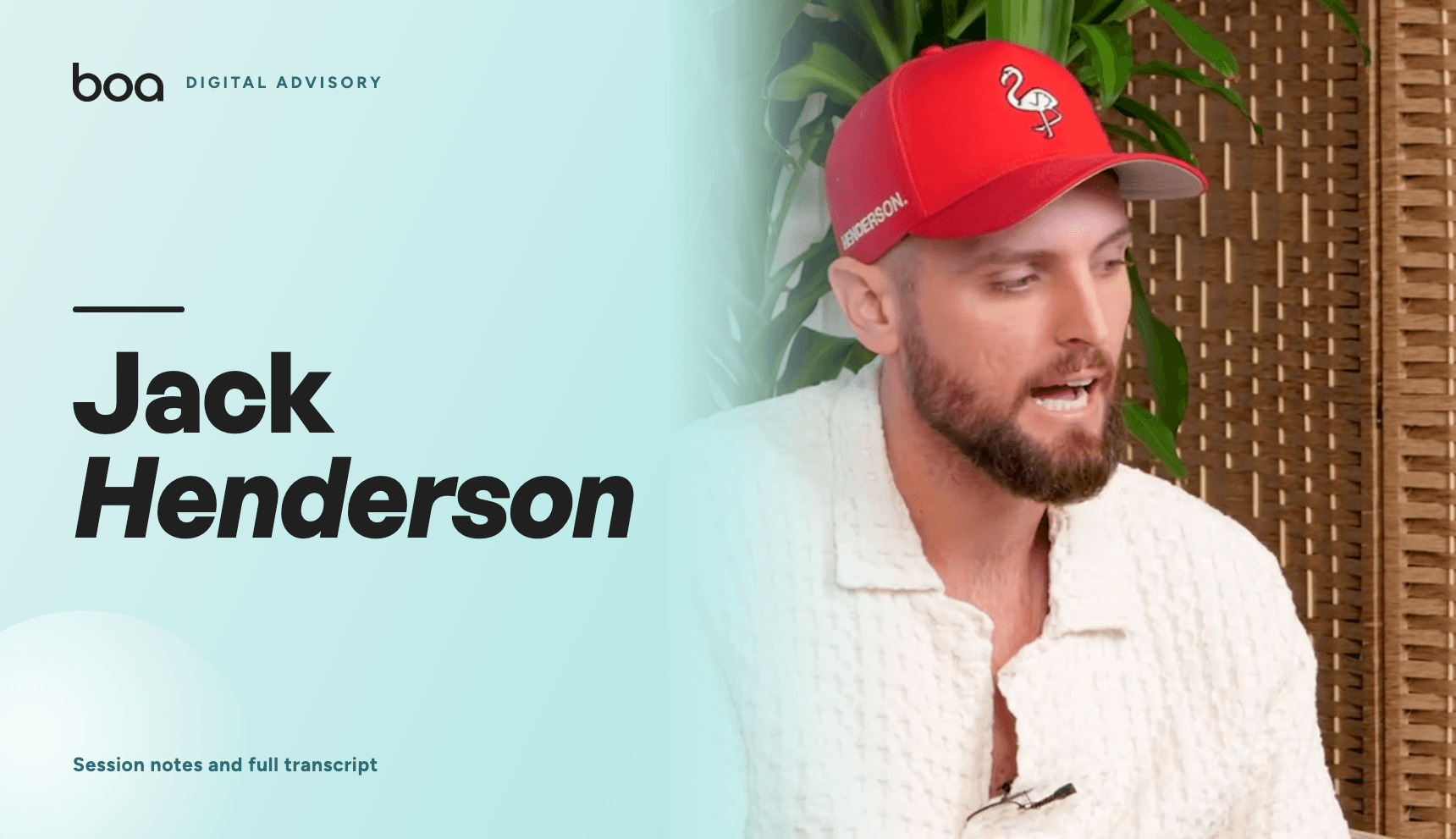
Digital Advisory
Jack Henderson on Building a $25M Business and a Property Base
With Jack Henderson, Founder and CEO at Henderson Group (Henderson Advocacy) · Hosted by Dan · 47 min
What this session covers
Jack Henderson built Henderson Group to about 120 staff and just over $25 million revenue in four years. He explains why his first hire was a videographer, how he replaced himself role by role, why he killed referral partnerships for paid media, and how to buy your first investment property while running a business.
Content that gets views and content that makes money are two different things, and most founders only build the first one.
Key takeaways
- 01
Hire a videographer before an assistant
Jack's first hire at Henderson was a videographer, not an associate, PA or EA. He started with an iPhone and a camera on a tripod with his partner filming, editing on a laptop, which he found too slow to do volume. Bringing media in-house early meant marketing sat at the top of the funnel from day one, even when he had 600 followers and people thought walking around with a videographer was strange.
- 02
Separate reach content from converting content
Jack's best performing posts are controversial or mass-market topics (a post on the new $3 million super contribution cap did very well) but they do not book calls. The content that converts is specific to his niche of small business owners and high-paid PAYG earners, and it usually gets fewer views. Track the direct correlation between content and booked calls, and do not let a social media hire optimise purely for views.
- 03
Post two to three times a day across three platforms
Jack aims for one post in the morning, one at midday and one at night. Instagram and TikTok take the same short form content, so one asset covers both. LinkedIn gets written content, where he says organic reach with no connections or followers is unusually strong. A copywriter reviews his best performing video content and writes LinkedIn copy off the back of it, which he sometimes edits before posting.
- 04
Replace yourself starting with the grunt work
Jack broke his B2C sales process into outbound, discovery call, sales meeting and fulfilment. The first hire was for the 100 to 150 outbound dials a day, because that freed the most time and doubled call volume rather than just shifting it. Then sales calls, then buyer's agents to service clients, then managers so he was not needed in the office daily. The strategy role was the last one he handed over.
- 05
Only talk about what you have actually done
Jack's trust-building rule is to speak only about things he has personally experienced, because nobody can compete with your own truth. He pairs that with what he calls Alex Hormozi's proof over promise: heavy use of video testimonials, written testimonials and getting clients onto podcasts. As his portfolio and business grew, the amount he could credibly talk about grew with it.
- 06
Do a paid job trial before anyone starts
Everyone who joins Henderson now does a paid job trial first, because everyone interviews well and you cannot read someone properly until they are in the flesh. The trial shows how resourceful they are in the actual work environment. Jack compares it to going on a date before getting married. He also fires fast now, with a general manager who is cutthroat about it, on the view that one bad person spreads like a cancer through an organisation.
- 07
Do not hire friends
Jack says hiring friends was a terrible idea because they see you as a friend rather than a boss, so you cannot discipline them and they carry less respect for your authority. Early on, if someone wanted a job he would say start tomorrow, and that was the whole process. The fix was a structured interview, a trial, and explicit checking for culture and values fit.
- 08
Build lead flow so you stop depending on referral partners
Jack started on 100 percent referrals and outbound, and hated it because the business relied on someone else's relationship, meant kissing a lot of babies, and did not scale. He switched entirely to paid media and now generates roughly 400 to 500 leads a day. The flip is that brokers and financial planners now come to him, because he holds the names and numbers everyone wants.
- 09
Use every first home buyer exemption, then rent it out
Jack's advice is to take the first home buyer concessions while you can, including the 5 percent deposit with no lenders mortgage insurance and no stamp duty, because once you buy one property you are never a first home buyer again. You must live in it for the required period. After that period ends, he would rent it out as an investment and rent where you actually want to live, which is exactly what he did with his first property.
- 10
Buy the best asset you can afford, in the best location
Jack's framework is that the number one way to make money is not to lose it. Regional buys, hotspots and off-the-plan apartments carry higher upside and a matching downside, and he points to mining town horror stories and buyers who make nothing for 10 or 11 years after a boom. Starting at $600,000 rather than $3 million does not change the principle, only the price point.
- 11
Check borrowing capacity before you plan anything else
For a business owner with equity in a home, Jack's sequence is: speak to a bank or broker first to find your real serviceability, because most people assume it is higher than it is. Business owners can count PAYG income they pay themselves plus profit from the business, which gives a boost. Only once you know borrowing capacity can you work out how much equity to release for a 20 percent deposit plus costs, and that dictates where and what you can buy.
- 12
Give the work away free to get your first case studies
For a new buyer's agency, Jack said skip paid ads entirely (he did not run them until 24 months ago) and focus only on what gets the first clients. That means friends, family and referrals, and serving people free to collect testimonials and case studies. His logic: why would someone pay you the same fee as a more experienced operator? Runs on the board make future client acquisition faster.
How the session runs
- 2:28Inside Henderson Group: 120 staff, $25M revenue
- 3:33Why personal brand matters and how it starts small
- 4:41First hire was a videographer, not an EA
- 7:48Replacing yourself in the sales process
- 11:09Building trust: proof over promise
- 13:40Speed of execution beats analysis paralysis
- 16:16What gave Jack confidence to buy property at 16
- 20:02Blue chip versus high yield, and not losing money
- 21:18First home buyer exemptions, then rent where you live
- 22:45Q&A: content that converts versus content that gets views
- 24:27Why Jack killed referral partners for paid media
- 26:25Posting cadence and platform mix
- 29:10Scaling a portfolio: serviceability and patience
- 31:39Stepping back from the end customer
- 34:05Specialisation over diversification, and CAC versus LTV
- 36:53Where the buyer's agent industry is heading
- 39:36Investing with equity when you already have debt
- 41:10First 30 days of a new agency
- 43:42Paid job trials and firing fast
Mentioned in this session
- Henderson Advocacy
- Henderson Group
- TikTok
- YouTube
- Gary Vaynerchuk
- Alex Hormozi
- Chris Gray
- Michael Lane
- Success Resources
- Forbes Australia
- Frank Greef
- Goldman Sachs
- H&M
- Louis Vuitton
- Ben Handler
- Angus Ferguson
- Simon Cohen
- mykaboodle.com.au
- Marlowe Property
- Western Sydney
Questions founders ask
Jack says as often as you can without posting purely for the sake of it. His team now runs two to three posts a day, one morning, one midday, one night. Instagram and TikTok take the same short form content so one asset covers both, and LinkedIn gets written posts where organic reach is strong even with no followers. Start by sharing what is actually happening in your life and work.
Jack used referrals and outbound to start, but deliberately moved away from them. His view is that referral partnerships make your business dependent on someone else's relationship, require constant relationship maintenance, and do not scale. He now runs entirely on paid media generating around 400 to 500 leads a day, which has flipped the dynamic so brokers and planners approach him.
Jack says use the first home buyer exemptions while you are eligible, including the 5 percent deposit with no lenders mortgage insurance and no stamp duty, because once you buy one property you lose access permanently. Live in it for the required period, then convert it to an investment and rent where you actually want to live. Most people cannot afford to buy in the suburb they want to live in, and this is the path he took himself.
Henderson now runs a paid job trial with everyone before they start. Jack's point is that everyone interviews well and nobody is as good at reading people as they think. The trial shows resourcefulness in the real work environment. They also fire fast when someone is not a culture or values fit, because one bad person spreads through the organisation.
He would use it as a 5 percent deposit, which under the current scheme means only about half the money is needed since you can buy up to around $900,000. That leaves roughly $50,000. He would either add value to the property through renovation or use the remainder to start a business.
Full transcript
The complete conversation, as recorded, with every speaker attributed.
Boa host0:00
Most of you know that our mission at BOA is to make quality networking and advisory accessible to every entrepreneur in Australia, regardless of where you're located or your stage of business. And that's exactly what we're doing here today. We're going to be learning from Jack Henderson, which I'm sure a lot of you might know because Jack has a very big personal brand presence and obviously he's built a very big business too. And I'm going to be interviewing Jack on two topics, one on business because he has built a very successful one, and the other on property because that's what he's an expert in. So my questions will be based on those two topics, but like all Bower Advisory sessions, it's more important that we get to the Q&A, we get to you. So I would love for you all to write questions as we're talking. And they can be questions personal for yourself because the, Odds are if it's valuable to you, it's valuable to everyone else here, or at least a lot of us here. So please write down questions and type them in the chat and our team text them to me and then I'll basically call you out or read it out when it gets time to the Q&A. So make sure you throw your questions in the chat. Jack, thank you so much for being here. Thank you. Now Jack is the founder and CEO of Henderson Advocacy, which is like one of our country's fastest growing buyers agency. And with a, in a country where property is like basically the country's largest form of wealth for everybody, that's a big deal. Jack is from Western Sydney. He dropped outta school at 15. He built a very large property portfolio, $35 million property portfolio by the age of 27. And since starting his agency has purchased just under $1 billion of property. For clients who are wanting to build wealth and make smart investments in Australian property. So that's a lot of experience and he's got a lot of knowledge. So we're gonna really focus on that. Now, it's actually Awesome Money Jack's first time meeting. So I'm gonna be learning a lot about Jack today as well. But Jack, I just thought that your business is quite broad as well. You're in a few different businesses. Yeah. And you've built a very large kind of following and personal brand in the media and social media. Can you just give us, just a quick kind of synopsis of your businesses and kind of how they started and why you got into them.
Jack Henderson2:28
For sure. So it started off as Henderson Advocacy, which was the buyer's agency, as you mentioned, but that now is just one part of the overall business. So essentially the company's the Henderson Group and what we see ourselves as is a full 360 wealth creation or wealth management firm. So inside of the organisation now we've got finance, we've got the advocacy, we've got advisory, we've got a building company that only services our clients. We've got asset management on the back end and there's constantly things for ancillaries getting added to the group. We've got about 120 staff across the group. We'll do just over $25 million this year in revenue. So yeah, it's growing, growing pretty quickly.
Boa host3:09
That's a lot of staff. That's a lot of staff. I want to get to that because I didn't know that. I'd love to ask about how you scaled and how you manage. But first I want to start with, and so you're very well known, everybody knows you.
Jack Henderson3:20
And some good, some bad.
Boa host3:22
I don't know, being known is being known. And for people who— so my question is, how important is personal brand for business growth, and what advice do you have for those just starting from scratch?
Jack Henderson3:33
Yeah, well, I mean, um, it becomes— I mean, it's very important is the short answer to it. But when you start out, you know, when I started creating content, I had 700 followers on Instagram. I used to get 10 likes on a post, and 9 of those were from friends and family. The other one was myself, usually liking my own posts. So when you start, it doesn't feel important because no one sees your shit. Like, you post videos, no one looks at it. But eventually over time, you know, you start to build a following. And again, I've got, you know, a few hundred thousand followers now online, but you don't need that many to start really generating business from social media. Like, if you have 1,000 raving fans that love everything about you in your niche, you can make a significant amount of money through organic social.
Boa host4:12
That's a good point.
Jack Henderson4:13
Yeah, it's a key part of our business because when you've got a good organic social following, the media loves you. So, you know, if we have a post that goes viral, generally it'll get picked up by one of the news channels, and then you'll get free PR off the back of that. Your paid advertising efforts do much better when you've got a really good organic following. Your CPLs are much lower.
Boa host4:33
So there's a lot of benefits.
Jack Henderson4:34
Yeah, there's a lot of benefits, but it's a lot of work and it costs a lot of money to get there.
Audience member4:38
Yeah.
Boa host4:38
And can you just talk about that process? So the work and the money?
Jack Henderson4:41
Yeah. So when we start, or when I started, it was just telephone or my iPhone creating content. And my partner used to set up just a camera on a tripod, like a normal video camera and record content. And then we just edited it on a laptop. Very slow, very hard to do volume, but it was a start. And then I worked inside of another organisation for 12 months before I started Henderson. And my first hire was a videographer, and that was just sort of piggybacking off the back of what Gary Vaynerchuk always talks about, which is you need to build a brand, you need to have, you know, essentially your own internal media company. So I started with a videographer, not an associate, not a PA or an EA.
Boa host5:19
Which actually makes sense if you think about on a business level, because essentially you're starting with marketing, you know, which is the top of your funnel. Exactly. If you do that well and you can catch the, you can catch the clients, it makes it, it makes it a lot easier.
Jack Henderson5:32
But again, at the start, for coming into an industry where no one knew who I was, like a lot of external noise was like, oh my God, this guy walking around with a videographer, new to an industry, no one knows who he is. They're like, people thought I was a wanker. I mean, a lot of people still do, but like more so back then.
Boa host5:48
But it's less. Wanker with a lot of followers and a good business now.
Jack Henderson5:51
Now, yeah, yeah. But back then when you got 600 followers and you're walking around with a videographer, it's a bit weird.
Boa host5:55
Yeah, so.
Jack Henderson5:56
But it's been a key part.
Boa host5:58
So you mentioned that one of the key elements to your business succeeding early on. One of the, you know, key strategies was starting with a videographer as your first hire. You've got 100— I can't remember what you said, 125, 150 staff. You've purchased— you've got a big business spanning kind of multiple disciplines. And what were other strategies you believe you did well at the start that enabled you to scale and get to the point you are now?
Jack Henderson6:28
I mean, there was a few of it. A lot of it's the cliché stuff, right? It's like essentially we're in a sales and marketing business, so we market. And then I was the guy on the phones doing all the outbound calls, selling, then essentially servicing the clients and making most of our clients raving fans, which then brought referrals and that compounding effect. Again, another cliché one that everyone says, but it's hiring good staff. And I think you don't really know what good staff are until you actually hire someone good because they like, you know, they do not just incremental leaps in the business, but they're like astronomical leaps inside of your business. So, you know, just hiring a lot of people over time and getting a lot of stuff wrong and then eventually get one right and you're like, wow, that's what a good staff person looks like or a good person inside of the organisation. I think, you know, being authentic again is really important. Like, every single discipline now, regardless of the industry you're in, is very saturated. There's a lot of people out there, a lot of people doing content. So trying to be the same as everyone else is going to get you the same results. And generally, most people aren't doing that well in business.
Boa host7:35
And being yourself is the easiest way to be different.
Jack Henderson7:37
Yeah, that's right. And then you stand out. Obviously, everyone has their own beliefs and opinions about things. You share those opinions and beliefs. Some people will agree, some people will disagree. But that's what's allowed me to grow relatively quickly.
Boa host7:48
Can we get to the— so you mentioned at the start, uh, that, you know, you were the salesperson, you were the one picking up the phones doing that. Now, that's for most businesses, particularly early stage businesses, that you, you are the salesperson, you're the one generating the growth. Often you're even doing the marketing, but, but, but definitely you're normally doing the sales. Yeah. Can you talk about the process of how you went from being the key person doing all the sales to kind of moving out of that and replacing yourself and working on your business, not in your business?
Jack Henderson8:20
Yeah, I mean, it happens slowly. So we started the business in 2021. It's 4 years now. And up until only last year, I was still involved in nearly every single client that comes through the organisation. So with sales, you're doing everything. Most sales processes are relatively similar if you're in a B2C business. You're doing outbound to get leads, you're then doing discovery call as such, you're then doing a sales meeting, then your fulfilment of the client. So essentially I just looked at what was the first thing I could hire for that would give me the most amount of leverage. Generally that's the grunt work. So doing 100, 150 outbound dials a day takes a lot of time. So that was the first thing that I hired for, like who can replace me in that role that then would give me back a portion of my time because you still want to do the work because it gives you a higher amount of leverage because you've now got double the amount of calls getting made as opposed to just replacing yourself and then you stopping the calls. And then from there it was like, okay, I spend so much time doing sales calls, so who can then step in and do my sales calls? Who can then become a buyer's agent so I don't have to service all the clients? You know, then you start to get a team and it's like, okay, well, who can now start to manage these people on behalf of me so I'm not required to be in the office every single day so I can focus on BDM?
Boa host9:28
Then, you know, so essentially you're looking at who is the most important person I could hire right now for me to focus on what's most important for me.
Jack Henderson9:36
Yeah, I focus heavily on leverage. So what is going to give me the most amount of leverage? So the reason that videographers and media are so important is because I can post one video, get a few hundred thousand views. It takes me almost none of my time now. That's a huge amount of leverage. So I focus now on those things. But it's easier looking in reverse and going, this is how it happened. But in reality, when you're in the day-to-day and the doing, you don't— you're not thinking like that. You're just like, fuck, I need I need someone to help me with this. I need someone to help me with this.
Boa host10:03
Yeah. You're not executing like a master plan.
Jack Henderson10:06
Yeah, that's right.
Boa host10:06
It's when you look back, you can be like, hey, that's what happened. But when you're in it as a business owner, as everyone here, you know, if you don't feel like you're kind of executing this flawless plan, that's all right. That's not how it is.
Jack Henderson10:17
It's like the opposite of that.
Audience member10:18
Yeah.
Jack Henderson10:18
It's very choppy and changing and things happen. Things go to plan, things don't go to plan. You hire great people, you hire not so great people, you know, you get things wrong. But it's that concept of just constantly trying to get the highest leverage out of your money and out of your time inside a business.
Boa host10:35
Amazing. And now your industry, and to be honest, sales in general, the most important, one of the most important things in sales is building trust with people. In your industry, it's especially important because it's probably the largest investment they're making. So there needs to be a large element of trust. I think trust has a lot to do with someone's ability to make a sale or someone's ability or someone's reason for choosing a company. What advice do you have for our BOA members on how to build trust for your company and how to build trust within a sale to obtain a new client?
Jack Henderson11:09
So, I mean, I can only talk about my own experience, but for me it was just only talking about things that I had done or that I had been a part of. So what I see online all the time is people talking about shit that they have no idea about and that they've never experienced themselves and acting as if they are experts. Um, so the way that I've built trust with people is I only talk about things that I have done, and some people will resonate with that, some people will not. But, um, if you talk about your own personal experiences, it's hard not to trust that because you're talking about your own stuff, right? Like, it's your truth and your reality. Um, you've got all the other stuff like tonality, like how you have your sales process, like, you know, making sure you get a huge amount of proof from your customers. Alex Hormozi talks about proof over promise. So, you know, we're heavy on video testimonials and written testimonials and, you know, anything we can get our clients involved in, podcasts, etc., is very important. But the number one thing from my point of view is just only talking about your personal experiences because no one can compete with that. And the more that you do in your own life, the more you have to talk about. So as I've grown my business, as I've grown my portfolio, as I've grown my own experience, I can talk about more shit.
Boa host12:15
Yeah, the more content you have.
Jack Henderson12:16
Yeah, but when I started, it wasn't like that.
Boa host12:18
You reference, you know, Alex Hormozi, Gary Vee. So you do take a lot of inspiration from these people and would recommend others to. For sure.
Jack Henderson12:26
I mean, I see these kinds of people as digital mentors. I'm a part of Alex Ormosi's mastermind now. So I guess it's more of a personal-ish relationship. But when I started, Gary Vee was just the guy that talked about branding. So every podcast he was on, every single bit of written content he put out, I would read. Before that, it was Chris Gray, who was essentially my property mentor in the East. And same thing.
Boa host12:47
I know Chris.
Jack Henderson12:48
Yeah. So, you know, I got started in property was, No way. It was through Chris.
Boa host12:51
Yeah, he was a Cub member like in 2016, it was a long time ago.
Jack Henderson12:55
Now he's just retired and enjoying, enjoying the good life. But that's how I've always been. It's like, who is in the position that I want to be in? How can I learn from those people? Make sure it's not just learning but also implementing and executing because, you know, there's that term mental masturbation, which is essentially just learning, learning, learning and doing nothing. So it's very important to execute and then finding that next person because eventually you will exhaust what you can learn from one individual.
Boa host13:18
Now, guys, I'm loving all the questions too. They're fantastic. Please keep throwing them in there because we'll get to Q&A very, very shortly. On my last business focus question, looking back at what would you have done differently in the first 12 to 24 months of starting your business?
Jack Henderson13:40
There isn't too much. And the reason I say that is because I'm in a position now that when I started, I never thought I would be in. You know, if I look back at my goals that I wrote 4 or 5 years ago, you know, that would reflect today's date, I am leaps and bounds ahead of that. So what I thought—
Boa host13:55
I wouldn't change anything.
Audience member13:56
Yeah.
Jack Henderson13:57
Like, you know, obviously what I've done is what I've done and it's all sort of complemented. If I would have done things differently, I probably would be in a different position. Who knows whether that would be better or for worse, but there's nothing that you can change. I think there's a lot of stuff that I've learned from and then implemented off the back of, you know, there's lots of things that I've done that didn't work, and then you go, well, I'm not going to do that again, or if I do that thing, it's going to be different. Um, yeah, it's, it's, it's that constant education that— and the faster you do things, that, that's probably the number one thing actually, do things faster. The faster you learn and execute on something, the faster you get the feedback loop. You know, there's people who sit in analysis paralysis and go, oh, I'm not sure about that, or I don't want to post a bit of content, or I don't want to do that outbound call, or I don't want to do X, Y, and Z. It's going to take you a lot longer to get that feedback. Where now I've got an incredible general manager inside of the organisation who, you know, I thought I was fast at executing, like he's on another level. And a lot of shit is wrong, but the best part about it is we find out it's wrong really quickly.
Boa host14:49
Yeah, yeah. Speed is essential and it's very easy, like everybody here I'm sure can relate, it's very easy to like contemplate what to do for months on end and then you just do nothing. You'd rather just even choose the wrong thing, realise it's wrong, and then you at least you know which one's right and to commence the correct path. Yeah, 100%.
Jack Henderson15:06
It's a, you know, and I, the thing from doing lots of things like this and talking to a lot of people, I always, when I talk about things that I've done or I'm doing, you know, I always see people go, oh, I wish I was, what do they say? I wish I did that, or like, you know, I was thinking about doing that, or whatever it is. And like, so many people have these amazing ideas. You know, we just bought a wedding venue, and every time I talk to someone about a wedding venue, 99% of those people will go, oh, I've thought about doing a wedding venue, such a great idea, but they never do it. I thought about it and I was like, oh, what's the worst that can happen?
Boa host15:37
I sell it.
Jack Henderson15:38
And it's been this incredible success, but it's because I did it. I had no experience in, you know, in weddings and stuff like that.
Boa host15:44
Just do it is the lesson.
Jack Henderson15:45
Just do it and then work it out.
Boa host15:47
Now, in your property journey as an investor wanting to build an asset base for yourself, you started very young. Which begs the question, what gave you the confidence to actually start? Because I know a lot of people here today might be thinking about, you know, getting into property, but it is scary. You know, you're juggling cash flow and sales and risk. And, you know, so I guess what gave you the confidence to jump into property?
Jack Henderson16:16
Well, it probably wasn't the confidence to get into property. It was probably I was just scared of the alternative, which was being poor forever. Like, because doing nothing guarantees you that outcome, right? So I didn't want that. I know I didn't want that and I had a fear of that. So, you know, the alternative to that was give yourself the highest probability of not being poor forever, which was investing in property. And I mentioned Chris before, same thing. I was 16 years old living in Western Sydney. I'd jump on a train, I'd come into the city, I'd go to these buildings in the city from— I was a construction worker at the time and I'd sit in on seminars and listen to this guy talk. And then I'd go to, you know, all of these big knowledge— what are they called? Michael Lane's business he used to have.
Boa host16:56
Michael Lane, Success Resources.
Jack Henderson16:57
Yeah, you know, all those seminars. I don't know how many of those things that I went to.
Boa host17:00
He owns Forbes now.
Jack Henderson17:01
Yeah, that's right. Forbes Australia.
Boa host17:02
Yeah.
Jack Henderson17:03
And that stuff gives you more confidence, just like doing things like this because you hear other people's successes and I've never looked at anyone else as being superior or inferior to me. I just believe that if someone else can do it, I can too.
Boa host17:15
I think that's a fantastic mindset that I think all business owners need. No one's inferior or superior. They're just doing things different. To what I'm doing. So can I do things more like them to, to, to get into that direction? And then, you know, take inspiration and lessons from. Yeah.
Jack Henderson17:30
And I think if you're around other entrepreneurs as well, it makes you, you understand that more. Because the more I've gotten around ultra successful people who have sold their companies for hundreds of millions of dollars, or they've, you know, done these incredible, um, fitness, you know, challenges or whatever it is, you just realise that they're no different to us. You know, some, sometimes you, you— I used to have this habit of putting people on a pedestal, like Wow, how incredible is that person? And the reality is, you know, they've all got red blood and the same thoughts as all of us.
Boa host17:56
So I think it's an important lesson. And so then if, you know, jumping into property was more like, I don't want to stay where I am, I want to move forwards. A lot of people, or pretty much everyone here today has a business. Like I said, we are juggling cash flow and growth. So with, you know, with that all in mind, how do you know when it's the, the right time to jump in?
Jack Henderson18:18
Never going to be the right time. I mean, you don't want to drain your business of all your cash and then, and then not have a business in 12 months' time. But like in business, it's never going to be the right time to hire that person. It's never going to be the right time to increase your ad spend. It's never going to be the right time to do anything, right? You just have to do it. You know, I think there is a downside to investing in property when you're running a business and it does cost money. It does require extra cash flow. It does require some attention, which takes away from your business. And I know I've got a good friend of mine, Frank Greef, who like is very pro-business and very, you know, not pro-property. And his belief around that is because if I use the capital that I could use in my business in property, it's tying up opportunity cost. But he's a whiz in business and not everyone is a whiz in business. So I think it's about what you want. You know, I also see a lot of people who grow these awesome businesses. They don't exit out of them. They never take money off the table. Something changes in the economy and all of a sudden they don't have anything outside of their business. And they were starting from scratch again. I've seen many of those stories.
Boa host19:14
No, I completely agree. I think that, and you know, I've got a large network, I guess, myself. But one of the key things that most extraordinarily wealthy people say is that your property always protects you in the bad times, you know, 'cause business can go through issues, always does go through issues.
Jack Henderson19:31
Yeah.
Boa host19:31
There's bad economies, there's COVIDs, there's all sorts of things. But when you've got a strong property base kind of protecting you And that always saves you.
Jack Henderson19:39
And it can make business easier, you know, like if people want to get facilities now, for example.
Boa host19:43
If you want to borrow money.
Jack Henderson19:44
That's right. You can go and get, you know what, $250 grand or something unsecured.
Boa host19:47
Yeah.
Jack Henderson19:48
For a lot of businesses, that can't get you too far. If you've got asset security behind you.
Boa host19:52
Now you often talk about blue chip versus high yield property. Which strategy is smarter for someone looking to build long-term wealth from a lower starting point?
Jack Henderson20:02
Well, I mean, it's still that's still one strategy. Naturally, if you're starting out, you're not going to start with a $3 million property. You're going to start with $600,000 property, but you still want to have that same mentality about buying the best asset you can afford in the best possible location. And my framework around investing, regardless if it's property or anything else, is the number one way to make money is to make sure you don't lose it. So you can invest regional, you can invest in hotspots, you can invest in lots of these things, and you can also make money by doing that. But you can also lose money. We've all heard the horror storeys around mining towns. We've all heard the horror storeys around people who get into a location after a boom and they don't make any money for 10 or 11 years, or the off-the-plan apartment thing, which my parents unfortunately had to go through. So by choosing strategies like that that do have higher upsides, they also naturally have the, the alternative, which is a higher downside or a larger downside. So I invest in blue-chip properties in good quality locations because there is a lower risk that I will lose money, which means over the long term I should make more money because I'm not losing what I have made.
Boa host21:00
And so for those just getting started, what's better to buy? Would you recommend, sorry, if you're just getting started in the property world, to buy a home where you live or to rent where you live and potentially buy an investment property that might be strategically better?
Jack Henderson21:18
So I think if you're a first-time buyer, you should definitely use the first-time buyer exemptions that are all around the country. You know, Labor have just brought in the new 5% deposit, no lenders mortgage insurance and no stamp duty, which has been on for a little while, but they made it seem like a new policy. You should definitely take advantage of those things if you are a first home buyer, because as soon as you buy one property, you are no longer a first home buyer ever again. So you'll never get access to those things. You will have to live in that property for a period of time. But as soon as that period of time is up, I personally would rent that property out, turn it into an investment, and then go and rent where I want to live, because most people aren't going to be able to afford to buy a home where they want to live. So it's exactly what I did. You know, I bought my first property, was classed as a first home, and I've never lived in it since.
Boa host22:02
And last question, because guys, I can see there's a lot of questions there. So if you want to pop one in, pop it in now because we're about to move to them. The last one, if you had to start all over again with $100K and no assets, how would you deploy it in today's property market to build wealth over the next 5 to 10 years?
Jack Henderson22:18
I'd use the $100K for a 5% deposit. Which you would only use half of that because you can really only buy up to $900 grand. And then I'd have $50 grand left over. Either I'd add value to that property or I'd go and start a business.
Boa host22:29
Okay.
Jack Henderson22:30
Yeah, it's like, it's, it's really simple. So.
Boa host22:32
All right. Thank you, Jack. Team, we're going to move to the questions now. Can I call out Cruz? Do you want to jump in and ask your question? I hope I said your name correctly.
Jack Henderson22:45
So the first one was, Have you noticed anything about your best performing content on Instagram and is there a trend? Yeah. So there's two things I've noticed. Generally, the best performing content isn't the best converting content. So like you can create content to get views and likes and comments, which generally is controversial stuff. It's stuff that the masses understand. It's stuff that affects the masses. Like we did a post yesterday about that new $3 million super contribution cap., that did really, really well. Um, but that content doesn't make me money. So, um, generally you need to have content that gets reach and content that converts. And the content that converts the best is content that is specific to my niche. So my niche are small business owners or high-paid, um, PAYGs. Um, and I need to create content for those people. Um, which if you look at my content on my, on my, uh, on my Instagram or TikTok or YouTube, whatever, it's generally not the content that does the best, but it's the ones that makes me the most amount of money. And I can see see the direct correlation between content that books calls and content that just, you know, gets a lot of people going mad in the comments.
Audience member23:53
Which—
Boa host23:53
but so there's two strategies. One is like get attention, and the next one is once you've got attention, create content that actually converts.
Jack Henderson23:59
Yeah, but I guess the hard thing about that is any social media person you're going to go to, all they're focused on is views, views, views, views. Um, but views don't necessarily mean money, and, uh, we obviously pay our pay our bills with money, not views. So it is sort of a two-pronged approach, but it's very easy to get caught up in just creating content that gets views because it's that dopamine hit.
Boa host24:22
Yeah, it feels nice. Yeah. And Cruz, you got another question, mate?
Jack Henderson24:25
Yeah, man, I've got a few.
Audience member24:27
I'm pretty—
Boa host24:27
Well, just do the second one and then we'll get to the last one at the end.
Jack Henderson24:31
Pretty stoked about talking to you, mate. So how do you handle relationships with referral partners? And if you have multiple referral partners in the same profession, How do you go about that? It's a good question. So when I started off in the industry, 100% of our business was referrals or outbound dialling, of which we'd get the details from referrals. I hated that business model personally. And the reason I say that is because your business is essentially reliant on the relationship of someone else. So you've got to kiss a lot of babies and pat a lot of heads to get referrals off people. And it's a very fake relationship from my point of view. I had something happen in my life and it was like this big moment where I said my business from this point moving forward will never rely on referrals again. And from that I've become obsessed with paid media and that's all we do now. So I rely zero on referrals. If I get them, amazing. But they're generally from clients, not from referral partners, because you're fishing in the same pond as everyone else, right? Everyone's going after the brokers, the accountants, the fucking financial planners and all these other people. And yeah, it's fake. It's not scalable either. So referrals are good to get started, but it's not a way to scale the business. You need to bring everything in-house and you be the key. But the awesome thing that I've discovered now is because we have the presence and the lead flow, like we're generating about 400 to 500 leads a day through paid media. Not all of them are good, obviously, but now we are the people everyone wants referrals from. Every broker reaches out to us, every financial planner reaches out to us because we are the epicentre of attention now and we have the names and numbers of the people who, you know, we need to have. So that's the business. If I was in your shoes or starting again, that's how I'd start it.
Boa host26:14
Thanks, Cruz. Lucy asks, how many times a day should someone be posting to launch their personal brand and what's the best platform? Instagram, TikTok, both?
Jack Henderson26:25
Um, as many as possible while also balancing that with not just posting for the sake of posting.
Boa host26:32
So as many quality as possible.
Jack Henderson26:35
Yeah, that's right. And I think the way to do that is just to start out posting about things that are happening in your life. Hey, I just caught up with this client. Hey, I just did this thing. Hey, yesterday my son or daughter did this and it made me think of. So just sharing personal stories. I mean, Instagram and TikTok, it's the same style of content, so you can essentially get one post can go across both platforms. And then LinkedIn as well is like the organic reach you get on LinkedIn with having no connections or followers is wild. So I'd be pretty heavy on that. So it's essentially just doing short form content for Instagram and TikTok. So you go on both of those and then I'd have written content on LinkedIn and that'll go.
Boa host27:11
And doing it as much as you can daily.
Jack Henderson27:13
Yeah, that's right. I mean, we post now, I don't know how many times a day, it's wild, but I think 2 to 3 times a day, like one in the morning, one in the midday, one in the night. If you can get into that cadence.
Boa host27:21
Is that what you were doing at the start?
Jack Henderson27:23
Yeah, as much as I possibly could. So I would do like, you know, we'd have the media team produce content for us. And then I also still now, and I did this at the start, do just organic posts off my stories. I did one before I come here around a CGT thing that I spoke to someone about yesterday. Then posts will go live during the day without me needing to think about it because it's getting posted for me. And then I'll do LinkedIn posts as well. So now I have a copywriter that writes all my LinkedIn copy off the back of video content that's already been posted. So he goes through and looks at all the video content that's done the best, then writes a copy post off the back of it. Sometimes I edit it, sometimes I don't, and then I post it to LinkedIn. Amazing. So you can like, you know, you can create a system around it where it doesn't really require a huge amount of attention.
Boa host28:02
And Simon?
Audience member28:04
I have been investing in real estate since I was 18 years old, but my track is a bit less glamorous than yours, even though I aspire to be like you. And so far I've only I have about 2 residential properties and a vacant land which I'm currently investing. And I'm just really stuck and I would like to ask you on your advice for 2 questions. Is that, first of all, how do you take, you know, obviously we start with the one property, but then how do you scale that to a multi-billion dollar portfolio like you did? And also, secondly, is that in regards to a business strategy and a bit and business model. Did you have like a fixed business model and a fixed investing plan from the start, or did your business model sort of evolve over time as you get more experience? And what would be your advice, just to stick to a vision or sort of shape that vision as time progresses? Yeah, thank you. Sorry for the silly questions.
Jack Henderson29:10
They're not silly, man.
Boa host29:11
They're good.
Jack Henderson29:12
So I'll answer question 1 first, which is around the property. It's two things. One is the ability to continue to increase your income because to buy property you need access to debt and to get access to debt you need serviceability. So unfortunately there is no way to get around serviceability. You need to earn more money. So if you can earn more money, you can scale much faster. Now, unfortunately, not many people can just continue to grow their income year in, year out. It's just not reality. So because of that, you also then need to balance patience, right? Like the reality is you don't need to do lots to be really wealthy over a long period of time. If you start young, you said you started at 18, I believe. If you invest for 30 years and you get to 48, you can be wealthier than 99% of the Australian population by just simply buying assets every 3, 4, 5 years over a 30-year journey, never selling them and getting to that point in time. And it's not sexy. You know, it doesn't feel like you're making leaps and bounds, but it's just time and compounding allows for that to happen, right? So if you can't grow your income, just understand patience is very important. But while you're being patient, why not work on increasing your income? Because that makes it easier. The second part to that is the business strategy. So the business strategy continues to evolve as I learn more. Like, I'm still very new in business. I know I don't know a lot. I only know very little. So I'm excited to learn more and more because it makes business funner and more successful. But our business strategy has changed dramatically. So when we first started, we were in the eastern suburbs. We were the owner-occupier buyers agents. I was competing with the Simon Collins of the world. And it was fun for the first 12 months. And then I got over that because there's no scale in it. You are the business. If something happens to you, there is no business. And that's when we pivoted in the investment model. I find it much funner, it's much more scalable. And then you start to learn things like, you know, we focus heavily now on two metrics inside of our business. How much does it cost to acquire a customer and how do we make that customer worth more to our business than anyone else so we can pay more to acquire them? So that's what I'm obsessed about now. But 2 years ago, I didn't even know what CAC and LTV meant. So you learn more and more as you go through business. And that's why being a part of these kind of groups is so important, because you hear something like this, then you go away, you research it, you implement it. The business strategy changes constantly because the world changes constantly. And, you know, I guess us as business leaders change constantly with how much we know and how much capital we have behind us and all that stuff.
Audience member31:31
Thank you for your insight. That was really helpful.
Jack Henderson31:34
Thanks, Simon.
Boa host31:35
You're the man, Simon. At 18, I was not buying properties. Jacob.
Jack Henderson31:39
Hi, Dan. Hi, Jack. Thanks for your time. I'm a mortgage broker, so I won't reach out to set up a referral arrangement.
Boa host31:47
Thanks for the heads up there.
Jack Henderson31:49
I guess just interested to know, sort of as you've scaled, obviously massive staff numbers now. At what point did you sort of disconnect from, I suppose, interacting with the end customer? And if you still do speak with every end customer? No. So I don't speak with every customer. I still speak with a lot of our clients, but definitely much less than what I did even only 12 months ago. I think it happens gradually. So my role went from being like we spoke about before, the whole thing from end-to-end sales, fulfilment, post- client success, whatever you want to call it, to just doing fulfilment, no sales, to then not doing any of the fulfilment and only strategy. And then naturally it was the strategy role that I got replaced in last. And now I really only talk to clients when I either need to talk to clients, there's an issue that I need to resolve, or I have some free time and I can. But it doesn't mean that I'm not involved in other ways. So it's a hard thing. And also I probably could have done it much earlier, but we have this, well, I personally had this limiting belief of like, oh, people are using us, people are paying these fees because they want Jack Henderson. But then I removed myself from the process and our business has only grown. So again, it was a limiting belief and not reality. But yeah, unfortunately with scale, that's what happens, right? Like Goldman Sachs was originally a person, you know, now it's, or people, two people, and now you wouldn't even know who those guys are. And it's one of the largest investment banks in the world. So like that's just how business evolves.
Boa host33:23
Evolves. Yeah, it comes down, comes down to people, process, and, and also culture. Yeah, you know, the culture. If your team acts and treats people the same way you would, you end up— they end up having a relationship with the person that's better than your relationship with the person, and that becomes what's valuable, and you've got to try to replicate that. Um, um, thank you, Jacob. Um, Ryan?
Jack Henderson33:47
Yeah, thanks, mate. Um, so my question was, given how much success you guys have had, how do you decide when to either double down on a core business vertical or start exploring other services?
Audience member34:00
What's generally your criteria for diversification?
Jack Henderson34:05
I believe in specialisation over diversification. We might seem like a large business, but in reality we're a very, very, very small business in the grand scheme of things. So we've got so many, there's 550,000 real estate transactions a year we do. Not even 1,000 of those. So there's so much room for scale that I don't even need to think about anything else for a very, very long time. The reason we have those other verticals inside of our organisation now is not because we've lost focus. It's because, like I said before, cost per acquisition and LTV are two very, very important metrics. So there's two ways to scale in our business model. One is to have competitive fees with everyone else in the marketplace and try to scale on volume. So try and do 200 or 300 or 400 or 500 clients a month. The issue with that is you're competing with everyone else. And then when you're trying to buy property, you're trying to buy property where everyone else is buying as well. That's why a lot of our style of business model is low fee, serving the everyday Australian because there's scale in volume there. That's not our model. Our model is much more high ticket, much more niche client base. They pay us much more than they would pay a normal buyer's agent. But our value to those people is significantly greater than if they went to the alternative, which is cheaper. So we are lower volume. And if you think about, we think about it in like the luxury brand space, you could either be like, I don't know, H&M or you could be Louis Vuitton. H&M would sell a significant amount more volume than Louis Vuitton would sell, but Louis Vuitton would make a significant amount more money than what H&M would make just simply because they've got much stronger gross margins. So we focus heavily on serving our niche client, adding as most amount of volume we can or the value we can, sorry, And that's why we vertically integrated those other things because we were buying a property for them and then we refer them to a builder, we refer them to a broker, we'd refer them to property management at the end. So we were already giving that business away. So we just brought it internal and that's why we're sort of 360 wealth creation now as opposed to just a buyer's agent. But again, Paul Mosie, you know, like I said, I'm spending so much time with him and his team at the moment. All they do is do more and do it better. Like before you do new, do more and better, more and better, more and better. So we can do a lot more and a lot better with what we're currently doing.
Boa host36:14
It's a really good question, actually. We're probably— I mean, Jack, if he's willing, he's going to come back and do another chat in the near future. And I think that would be a topic worth going deeper into. Like, if you are going to enter another vertical, what's the best way to actually do it? Because that's a whole topic in itself. Samantha?
Audience member36:33
Hey, Jack.
Boa host36:34
Hello.
Audience member36:34
Thank you for this. I've been following it for a while and I think what you've done for the industry as a whole has been wonderful.
Jack Henderson36:41
Thank you.
Audience member36:43
Where do you see the future of the buyer's agent industry? Like, are there insights from where you're sitting now that you can share kind of on where you see our model?
Jack Henderson36:53
Yeah, well, I mean, we can, we can just talk about the real numbers, you know, up until only a few years ago. And this is probably thanks to Ben Handler. You know, buyer's agents were responsible for maybe 2% of transactions. It wasn't actually tracked all that well. Now I spoke to a guy by the name of Angus Ferguson the other day and he was saying that the new data now is, you know, sort of 8 to 10% of all transactions in Australia are initiated with a buyer's agent or selling agent, which like to go from 2 to 10%, it's 500% growth in an industry within a few short years. So to think that it's not going to grow a long way beyond that is, you know, it's probably naive.
Boa host37:31
In the US is actually much higher as well.
Jack Henderson37:32
It's like 85-ish percent. Buyer and seller, different fee model. But yeah, I mean, there's a lot of growth in the industry. But with that, if you look at the counterpart being selling agencies, it's going to become much harder because there's a lot more competition. Fees will start to compress because that's what people generally try and compete on is like, oh, I can do it for a lower fee, which means it'll become a less profitable business model. So it's going to get harder, it's going to get more competitive, but there's going to be a bigger pie to go out there and get. Yeah, but I think like serving a niche, finding out who your niche is because people always think, oh, if I only serve nurses in these 3 states, there's not enough business to do. But it's like there's more than enough business to do if you just serve a niche and then no one can compete with you because you own that niche. So I think that's going to become very, very, very important is like finding who you serve, who you can add the most amount of value with, who you resonate most with. And just dominating that as opposed to trying to be something to everyone.
Audience member38:33
Yeah. And that's very similar to how the real estate agents are. I mean, they are very suburb specific. You will find on one suburb they've got like 7 out of 10 listings. You go to the next suburb, they're nowhere to be seen.
Jack Henderson38:45
Yeah, that's right. That's their niche essentially, right, is the suburb. Yeah, but it's going to become more and more challenging. There's no doubt about that for sure.
Audience member38:54
Yeah.
Boa host38:55
Yeah, thank you, Samantha.
Audience member38:56
It was—
Boa host38:57
was that everything or did you have more?
Audience member38:58
Yeah, yeah, no, that's fine.
Boa host38:59
Now I'm going to ask Bella's question for her because she's requested it. Um, hey Jack, Bella here from mykaboodle.com.au. We sat down at the founders table together last year at Frank's— Frank Griefs, who hosts founders tables. Um, sorry, I'm a bit sick and I've lost my voice, so I can't ask the questions over camera. So Dan, if you don't mind asking for me, I've already got a home built and it's got a couple hundred of equity. Both hubby and I have businesses and we do pay ourselves from them and want to look at investing what we would be— we want to look at investing. What would be your advice to start with debt already?
Jack Henderson39:36
Well, yeah, I mean, you don't have to use your own capital, which is the good thing now because you've just bought your own. I mean, you would have bought the first property with your own cash, so you shouldn't have to touch any money in your business or any of your personal money. You just simply use the equity out of that home. The number one thing you need to do is go speak with a bank or a broker to get an understanding of how much you can service, so how much borrowing capacity you have, because often people think they will have a lot more than what they do because of the way the banks work it out. But the awesome thing about running businesses is you can include your PAYG income that you pay yourself, plus you can then include the profit that comes out of your business, which naturally gives you a boost. And then essentially, once you know what your borrowing capacity is, that then gives you an understanding of how much equity you need to release from your property to to have a 20% deposit plus your costs. And then based on that, that will then obviously dictate where you can buy and what you can buy.
Boa host40:22
And she's got a second question, which is, I would love to know how you juggle multiple businesses at the same time and does it take away from the first business? Would you recommend?
Jack Henderson40:31
That's a good question. So we don't have multiple businesses in the sense that like they're all segregated. It's one business. So like my building company is in the same office as my buyer's agency, so is asset management, so is finance. So we're all, it's just one agency, sorry, it's just one business and we have different departments the way that I think about it. But I guess the corporate structure is they're set up as different entities. So yes, it would take away from, I mean, with the wedding venue, that's a completely separate business and that does take a lot of my time, a lot of my focus, a lot of my money. So that is a separate business completely, but it's more of a passion project than a business. I enjoy it, but everything else is under the one banner.
Boa host41:07
And Dylan, do you want to ask your question?
Jack Henderson41:10
So starting out Marlowe Property, and I am doing everything at the moment. As you said, content creation, you know, finance, renovations, still working full-time, and I'm spread out obviously pretty thin across those, plus trying to get clients via referrals and building up social media, paid ads, any kind of recommendation First 30 days of the business. Yeah, yeah. Just very important, obviously. Yeah. Don't try and do too many things at once. Like, I didn't do paid ads until 24 months ago. Wasn't even on my, you know, wasn't on my viewpoint. Just focus on what's going to get you your first client or clients right now. And generally that's going to be from either referrals, even though I said I don't do them now, I did when I started. It's going to be from friends and family. It may be serving people for free so you can get some case studies and testimonials off the back of it. You just want to start to get momentum. So at the end of the day, like you got to think, why is someone going to choose you as a buyer's agent, pay you the same fee that they can go and pay someone else who's got lots more experience than what you do? Like that's just a reality. And it was the same with me when I started. So you need to try and get some runs on the board. And to do that, like doing things for free is the easiest way. If you've got friends or family or people that you know that are out there searching for property, I agree. Try and help them. Try and get a testimonial off the back of it. Start to get some, some proof because that's going to then make future client acquisition even faster. Don't worry about paid ads or any of that stuff.
Boa host42:52
Yeah, I agree. And you know, that's something that a lot of businesses do. Like even Cub, Cub started with 5 free people, then it went to $300 a month, then it went $600 a month, then it went to $7,000 upfront, then it went to $10,000 up, you know, like you start and you get, build the confidence in the product and it does grow and scale. Um, a final question, and thank you guys, these questions have been amazing. Fern?
Audience member43:14
Hi, Jack. Hey, Dan, how you doing?
Boa host43:16
Good, how are you?
Audience member43:17
Hello. Pretty good, pretty good. So yeah, I just was wondering, because you talked about your learning, Jack, um, looking back and seeing the difference between a great quality hire and one that maybe not so great. Obviously at the time it was hard to discern the difference, but now could you see flags like that maybe were missed at the time of good versus bad?
Jack Henderson43:42
Yeah, I mean, it's very, it's very hard. Everyone interviews well, right? You can only ask a certain amount of questions. You think you're an expert at body language and reading people, but the reality is we all have no idea until someone's there in the flesh. So what we do now, and Kay's just started with this, he's behind the camera, We do a job trial, a paid job trial with everyone who starts with us before they start, because you get to then see people in the work environment and you get to see how resourceful they are. You get to have a taste tester before you— it's like going on a date before you get married, right? So we always do that. We also fire very fast now. I was terrible at that because I used to feel bad for people. My general manager now is very cutthroat, and it's a good thing for the individual because you get them out into where they should belong, you know, in another organisation doing the work that's meaningful for them. And it doesn't then affect your core business because, you know, essentially one bad person in an organisation is like a cancer. It spreads and it can kill an organization. So you need to cut that shit very quickly. And I'm not good at that, but now I have people that are much better at it than I am. So in short, looking back on it now, there's lots of things that we do now that we didn't do. If someone wanted a job, I'd say, yeah, start tomorrow, and they'd start. That was it. That was how you got a job at Henderson. I used to hire a lot of friends as well. Terrible idea because they see you as a friend and they don't see you as a boss, so you can't discipline. You know, they don't really have that much respect for you as a boss, I found. So now it's really, yeah, we obviously do our interview process. We get people in for a job trial first.. We make sure that they are culture fit and values aligned as much as you possibly can. And if they're not, we're not attached to it. We go, we fucked up, that person needs to go and we need to go hire another one of those people, which we do constantly. So like it's a trial and error, which again, you never get it. But the awesome thing is when you start to hire really good people, they then attract other really good people because they have friends and they have family and then they have old networks. And when we're looking for roles, like, hey, I know this guy or this girl, who, uh, who I used to work with, maybe they're open to it. Um, and then the awesome thing now is we have like our core culture, which is everyone's very, very aligned with the values that we have, how we work, what we do. Um, so if someone doesn't fit in, I don't even have to make the call now. It just happens organically. They're sort of self-selected.
Audience member46:03
Yeah, yeah. Okay, cool. Thanks.
Jack Henderson46:06
My pleasure.
Boa host46:06
Thank you, Fern, and thank you everybody for being here today. I know we didn't get to every question, but like I said, We're going to be calling Jack up and get him to come in for another session because there were a lot of questions today. Jack, on behalf of all of our Bower community and myself, I want to thank you for being a legend and giving us your time and your knowledge and being so generous. And to all of you amazing people that are out there starting businesses, growing businesses, and a part of Bower to meet each other, grow your network, and basically make impact in the world, I want to tell you how grateful we are to have you just in this country, on this earth, and and being you, you are the whole reason BOA is around. And I mean, Jack agrees, that's why he's here as well, sharing knowledge and passing it on. So I hope you all have the best day ever and you're a legend. Thank you, appreciate it.
Jack Henderson46:57
Thank you, man. Thanks guys, go kill it.
Boa host46:59
See you, team.
Watch the full sessioninside Boa.
Session notes are free. The recordings, the live advisories and the founders in the room are for members.