Digital Advisory
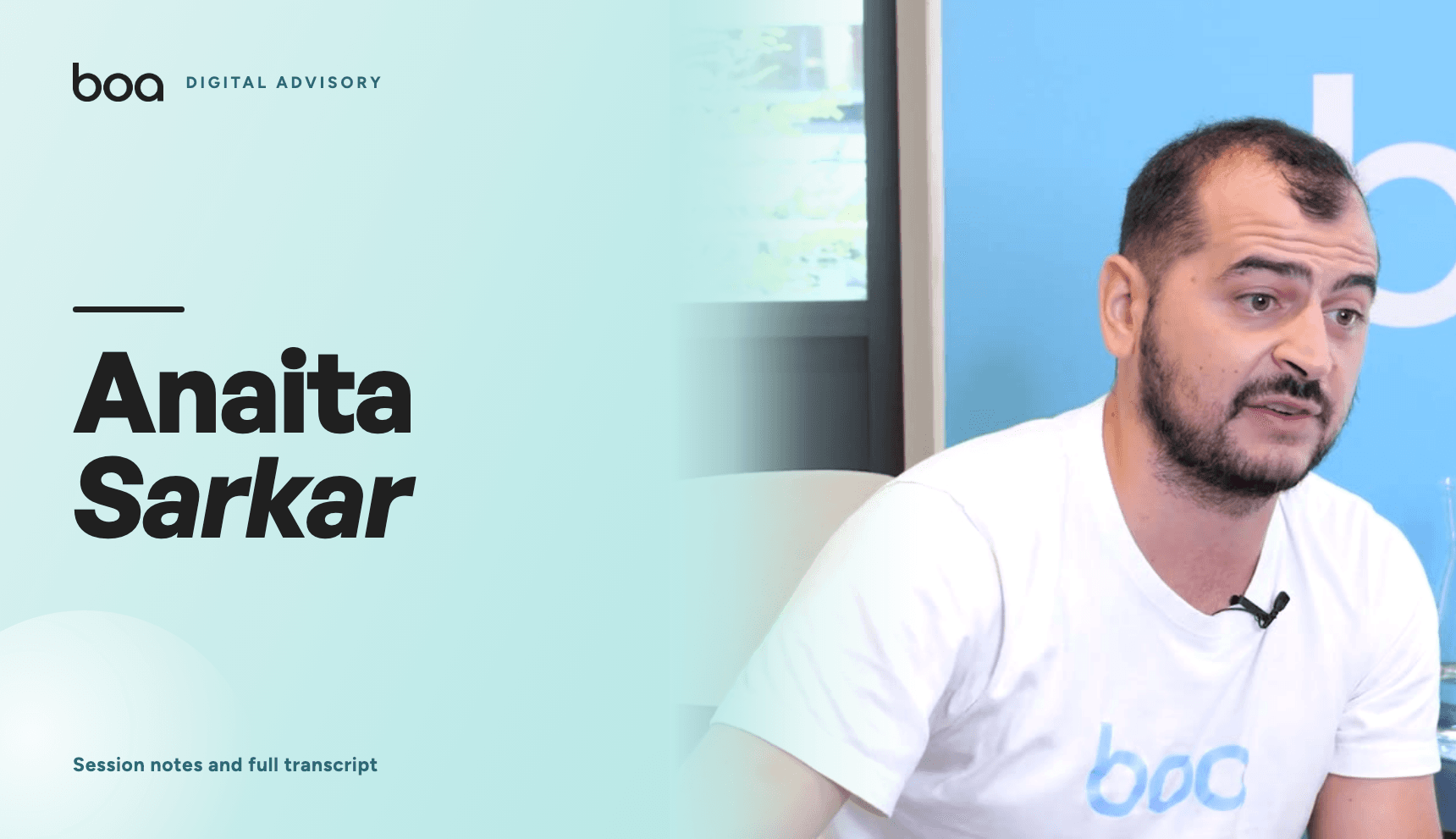
Anaita Sarkar on Ecommerce Margins, Content and MER
With Anaita Sarkar, Co-founder at Hero Packaging · Hosted by Daniel Hakim · 41 min
What this session covers
Practical ecommerce advice from Hero Packaging co-founder Anaita Sarkar: how to test demand before launching, what to do after a discount-heavy Christmas, the metrics that decide whether paid ads are working (MER, cost per acquisition, ROAS), and why raw founder content beats polished AI-written posts. Built for Australian ecommerce operators.
Test demand with a $10 a day ad and a giveaway landing page before you spend a cent on inventory, then keep paid spend at 15 to 20% of daily revenue so the business actually makes money.
Key takeaways
- 01
Test demand with a giveaway landing page and $10 a day in ads
Before Hero Packaging launched, Anaita built a landing page offering a free compostable mailer and ran a Google ad to it at roughly $10 a day, then counted signups. Do the same for every new product: get the smallest quantity possible, pre-sell it, and only commit to inventory once signups prove demand exists.
- 02
If you will not spend money on ads, you must spend time
Anaita's rule is time or money, ideally both. No ad budget means content every day, markets, events, blog posts, SEO and being in rooms with the right people. Saying you have no ad budget and also hate making content is, in her words, the dumbest thing she has heard, because a business needs one of the two inputs.
- 03
Build one gathering place for customers, even if two people show up
A Facebook group, a broadcast channel, a Saturday running club. Anaita points to activewear brands running weekly run clubs: even at two attendees it gives you content, face time with customers and a reason for people to feel they would miss out if they left. She argues community is the difference between a brand with longevity and one with none, because every business has direct and indirect competition.
- 04
Assume your Christmas buyers are discount buyers and plan January accordingly
Customers who first bought at up to 70% off will not pay full price next time, so January is a retargeting month. Run two separate Facebook retargeting audiences: people who visited over the holidays but did not buy, and people who bought and can now be cross-sold a complementary product.
- 05
Rewrite your email flows to be product-specific instead of generic
Replace "thank you for purchasing, please leave a review" with a flow that names the exact product bought, recommends the complementary product other buyers chose at something like 15% off, includes reviews and viral content, and adds a short video of the founder thanking them. Anaita also says to check the average gap between first and second purchase and time the flow to land at that moment.
- 06
Launch newness in January to March, not in the discount season
People still spend in the low period, they just spend less, so give them something novel at an entry price point (merch, a small novelty item, a bundle). Anaita cites Who Is Elijah launching a new fragrance at the end of January then following with 100ml at the 50ml price in February, plus Gimme Store selling low-price branded caps. October to December is for discounting, the first quarter is for innovation.
- 07
Run creative campaigns in your quietest months because you will not have time later
Hero Packaging shot a "secret admirer" campaign in the city with Rachel from TBH in the quiet period, on purpose. Anaita's logic: by April, May and June she is heading into end of financial year and cannot disappear to run a stunt, and since she is the whole marketing department the creative work has to be scheduled into the low season.
- 08
Fix margin at the supplier and freight level before you touch quality
After a January net margin of 9%, Anaita and Vic sent Vic to China to renegotiate cost per unit with suppliers face to face and changed freight forwarders to cut freight roughly 10%. They also lifted prices on some products by 4 to 7%, which is only a few cents per unit, while watching sales volume closely for any drop off.
- 09
Keep paid spend at 15 to 20% of daily revenue
Anaita tracks marketing efficiency ratio daily: total paid spend divided by revenue. On $100 of revenue a day, that is $15 to $20 across Facebook and Google combined. Higher gross margins buy you a bit more room, lower margins mean hold the line at 15%, especially once you are paying for warehousing and one or two staff.
- 10
Cap cost per acquisition at 30 to 40% of average order value
On a $100 average order value, a CPA above $30 to $40 is a warning and $80 is far too high, on TikTok or Facebook. Do not excuse it with "they will come back for a second purchase", because you want profit on the first order. Anaita's second metric is ROAS, with a 2 to 3x minimum at all times.
- 11
Post two TikToks a day and copy what already works in your category
Anaita's maths: roughly 1% of videos go viral, so 200 videos gets you two hits. Film seven seconds of whatever you are already doing rather than making one polished video a fortnight. Search your niche on TikTok (for example rosacea skincare), sort by most likes in the last three months, and recreate those videos twice a day.
- 12
Let the mistakes stay in, because AI has made polish worthless
Anaita spotted a five-star review as ChatGPT-written from the paragraph structure alone, and AI videos are filling her feed. The counter-move is raw, ugly, mistake-led founder content, typos included, so people can tell a human made it. Daniel notes Boa members told the GM they trust his posts precisely because of the spelling errors.
- 13
Your face in the content matters more than matching your target market
For founders who look nothing like their buyer, Anaita points to Beginning Boutique and White Fox Boutique, where the founders are not the 16 to 18 year old customer. Use gifted product with UGC creators and micro influencers for audience-matched content, and put the premium, glamorous imagery into paid ads. Organic founder content stays human, because polished content will not perform.
- 14
Do not assume Klaviyo is the answer, and use LinkedIn where nobody is trying
Anaita is leaving Klaviyo because it has become too expensive and says a cheaper platform can send the same emails. Separately, LinkedIn gets her more impressions and reach to the customers she wants than any other platform, precisely because most posts there are boring achievement updates. Post video (the platform is pushing it and now gives video analytics) and creative founder content.
How the session runs
- 2:16Boa local chapters and how the Q&A works
- 2:56Sell Anything Online: test demand before you launch
- 4:38Time or money, and building on other people's networks
- 5:30Community: two people is still a community
- 7:10Keeping momentum after a discount-heavy Christmas
- 10:55Zig when others zag: the secret admirer campaign
- 13:462025 trends: activations, LinkedIn, founder content, AI
- 19:05TikTok: two videos a day and the 1% rule
- 21:59Q&A: lifting profit margin without cutting quality
- 25:24Daniel on scale first, then finding profit
- 29:45A simple daily cash in, cash out spreadsheet
- 31:12Q&A: organic versus paid split and MER benchmarks
- 32:51Q&A: founder content when you do not look like your buyer
- 35:21Q&A: Klaviyo costs, email flows and standing out on LinkedIn
- 38:17Q&A: TikTok ads versus Facebook, CPA and ROAS targets
- 40:45Where to find Anaita and the Marketing ATM podcast
Mentioned in this session
- Hero Packaging
- Sell Anything Online
- Marketing ATM
- Cub
- Boa
- Klaviyo
- Google Ads
- TikTok
- ChatGPT
- Who Is Elijah
- Fate the Label
- Brittney Saunders
- Gimme Store
- TBH
- Girls with Gems
- Beginning Boutique
- White Fox Boutique
- Kim Kardashian
- Jess Rufus
- China
- New York
- Stretch Me Co
Questions founders ask
Anaita Sarkar built a landing page offering a free compostable mailer and drove about $10 a day of Google ads to it, then measured signups. If people will hand over an email address for the free version, there is demand worth testing further. Order the smallest quantity possible, pre-sell it, and build a group of early customers before committing real money to inventory.
Anaita looks at marketing efficiency ratio daily, which is total paid spend divided by revenue. She suggests 15 to 20%, so on $100 of daily revenue that is $15 to $20 across Facebook and Google together. If your gross margins are high you can push a little more, and if they are thinner, hold at 15%, particularly once warehousing and staff wages are in the mix.
Keep cost per acquisition under 30 to 40% of average order value, so under about $30 to $40 on a $100 order. Anaita treats $80 as far too high on either TikTok or Facebook and warns against justifying it with the promise of a second purchase, because you want to be profitable on the first order. Her ROAS floor is 2 to 3x at all times.
Anaita says cost per new customer is generally better on TikTok, but return on ad spend is higher on Facebook. If you already have some comfort with Facebook, start there, since consumer behaviour around Instagram shopping is still strong. TikTok ads work when your content is genuinely stopping the scroll, so the creative has to be right first.
Treat holiday buyers as discount buyers and retarget them in two segments: browsers who did not buy, and buyers you can cross-sell a complementary product to. Fix your email flows so they name the exact product purchased and include reviews, viral content and a founder video. Then launch something new and novel at an entry price point, which is what Who Is Elijah did with a late January fragrance launch.
Anaita's view is that customers care far less about this than founders think. Beginning Boutique and White Fox Boutique both have founders well outside their buyer's age bracket and still perform. Use gifted product with UGC creators and micro influencers for audience-matched content, put polished premium imagery into paid ads, and keep your own founder content human and unpolished.
Full transcript
The complete conversation, as recorded, with every speaker attributed.
Daniel Hakim0:00
Thank you all for being here today. We'd love for you to put in the chat who you are, what's your business, and where you're located. It'd be great for everyone here to be able to see who else is on this call so you can connect on BOA as well. If you think you guys might be suitable for a great conversation or to expand your networks, that's what BOA is all about. I'm sure you all know our mission is to make quality networking and advisory accessible to every entrepreneur. At every stage and in every location of Australia. And that's what we're here today to do, to learn from a true e-commerce icon and industry expert. Most of you have probably read Anita's book, Sell Anything Online, or follow her and take in her content. She's truly amazing, so we're very lucky to have her here. Before we commence the questions, so I'm going to ask a few questions that I've prepared and then we're going to move to group discussion Q&A. So if you think of any questions you want to ask while we're talking, write them down because you are going to have the time to ask it. And how does it work? Okay, type it in the chat. I'll see it and I'll call out your name and then you can ask Anita directly. Guys, I don't know if you've seen, but I've been blasting our local networking chapters all over Boa. That is because they're going to be awesome. So you need to get involved with them. The chapters are going to give all of us the ability to connect with entrepreneurs and business owners in our local area for monthly meetings to help us grow our network and grow our business through supportive communities. So make sure you stay in the loop of the local chapters. And if there's not a chapter yet, or hasn't been one announced in your local area, whether it be where you live or you work, let us know because we will start one. As you can see with the number of people here today, BOA is growing very fast. We have a lot of amazing businesses joining every day. So if there's not a chapter in your location, there will be very soon if you just let us know. So I am going to— so welcome.
Anaita Sarkar2:06
Thank you. There is not a chapter in my location.
Daniel Hakim2:08
Where is your location?
Anaita Sarkar2:09
So mine is North Shore. So you've got North Ryde, got Northern Beaches, and Mist It launches next week.
Daniel Hakim2:16
We had a baller event last week and a lot of people complained to me about that. So, yeah, yeah, yeah. So there is an amazing chapter in the North Shore. It's starting next week, I believe. Laura's telling me not to— okay. Now, I just want to start on your book. Now, it's everywhere. First of all, I obviously fly a lot between the clubhouses and I'm seeing it at the airports. I'm seeing it everywhere. But it has become a very important resource for entrepreneurs across the country. To teach them how to be more successful in e-commerce, like sell anything online. If people haven't read it, or for those that have, what are the most important takeaways that everybody should know from that book?
Anaita Sarkar2:56
Okay, it's a really hard question because obviously there's a lot of answers to it, but I would say that whether you are starting a new product, which a lot of these people— I know a lot of these brands, you're not starting a new product, but you are launching new products all time. Please, please make sure that there is demand for the product, and there is a way to test demand using ads. So I highly, highly recommend that you always test demand before you launch anything new. So for Hero, um, and I have spoken about this before, but for Hero, what we did was we basically had a landing page where we gave away free stuff. So that is the strategy— giving away free stuff. Um, and we ran a Google ad to it, like $10 a day, and saw how many signups we got to get that free compostable MAYLA. So when you are starting any new, like launching new product, launching a new business, get the smallest amount possible, make sure that there is demand for it, pre-sell it, uh, and build a community around it. So that's the first thing. I've been always testing demand. Second thing, I've got my phone, I've actually made notes for you guys as well. Um, second thing is always, uh, time or money concept. So, you know, with— if you don't have money for ads, if you don't have money to spend on influencers on Google Ads, on Facebook Ads, you have to spend a lot of energy being around the right people, networking. You have to go to events, you have to be at the markets, you have to create content all the time, you have to work on your blog post, your SEO, you have to do all the free things possible. But free things take so much time and energy. So if you tell me, hey, I don't have money for ads, but I also don't want to do content, it's so annoying and I hate content, you'll— that's the— that's— I don't want to say this in a mean way, but that's the dumbest thing I've ever heard. Because you have, like, for a business, you either need money time, or both, ideally, right? That's the second thing. And then the third thing I would say—
Daniel Hakim4:38
Just, can I just summarise that one bit? So you're saying, so if you don't have the money to spend heaps of money on advertising, you need to put in time, is essentially that? Yes. Yes, so you've got to do the things manually yourself, put in the time to push it.
Anaita Sarkar4:51
So, you know, when I say time, what does that look like? It's like content creation, okay? So for Boa, okay, how are you getting exposure to Boa? I'll tell you because I already know. So with Boa, what you're doing is you're leveraging other people's networks in order to get access, like, to, to, for them to download it. Because you saying download Bolo, you'll probably get maybe 50 people doing it. If you're leveraging all these founders who have such a good personal brand, how are you, how are these e-commerce businesses going to replicate that for their own brand? Can they leverage other people's networks? If you're going to do that, you have to put in the time and the energy to make that network of your own.
Daniel Hakim5:27
Um, and I build those relationships too. Yes.
Anaita Sarkar5:30
And then, and not to ask them to do anything, but over time they will help you. They will help you grow your business. Okay, the third thing is, is to build a community. And we— the community, that word is getting quite annoying. And so what I mean by that is have a platform where all of your customers are gathering together. So like, what does that look like? Do you have a Facebook group? Do you have a broadcast channel? Do you have some place where they can all come and meet? So, you know, a lot of these activewear brands, what they do is every Saturday they'll do a running club. A club. And the reason they do that, even if 2 people turn up, it's their community. It's there for content, it's there to meet their customers, and then they get to like do all these other activities together. They get discounts. But that community, I don't care if it's 2 people or 5,000 people, you have that and you've got longevity in your business. So the book is basically structured in that, you know, you've got— you can access all these new people, so brand awareness, and then once you've got them, how do you get them to purchase again? And then the last bit of the book is how to build a community. That is the secret sauce of any business because there is no business right now that has no competition. Like, I don't care whether you think you've got no competition, you've got direct competition and you've got indirect competition, and you need to stand out. And I think in order for people to remember you, being part of a community makes them feel like they don't want to miss out.
Daniel Hakim6:54
So basically, test demand before you launch and potentially waste money. If you haven't got the money to spend big ads and things like that, put the time and build a community. It doesn't matter how small the community starts, but start building a community.
Anaita Sarkar7:09
Right.
Daniel Hakim7:10
Now, most ecommerce brands have like a sales bump over the holiday period, which we all kind of just went through, or we all did just go through. What advice do you have to keep that sales momentum into the year?
Anaita Sarkar7:24
So you have to think about the fact that people purchase from you for the first time during the sales period, probably because you ran a discount. So they either could have waited and then gone, okay, they're going on sale, so I'm going to make sure I purchase. Or, you know, they— you hit them with an ad, it says up to 70% off, and they made a purchase. So they've come with you and shopped with you because of that discount. It's a really dangerous way to acquire a new customer because the next time you get them to come and purchase and you're like, hey, I've got this other cool product at full price, they're like, "Piss off." So, what do you do after a holiday period? And, you know, October, November, and December is what I'm talking about. It's probably your biggest month ever. In January, it is really time to retarget them, and these strategies are nothing new, and I bet you all know what I'm talking about. It's a really good reminder though. You need to target them on Facebook ads. So, there are two types of targeting here, and I'll go a little bit more specific So you've got people who have come to your website and not purchased over that holiday period, and then you've got people who have purchased and then you want them to purchase again, potentially not the same product, but you want to cross-sell them in January. Okay. So Facebook retargeting is a really big thing. Fix your email flows. You know, if someone has purchased from you and they, you have to come back and then you want them to purchase again, or you want them to be part of the community, or you want them to leave a review, or you want them to follow your personal brand or whatever it is. Fix your email flows because a lot of us have, "Thank you for purchasing, please leave a review." What you should be having is, "Hey, you purchased this specific product. Heaps of people also purchased this complementary product and I'm giving it to you at, you know, 15% off or whatever. But then also, here are the reviews, here's all our viral content. Oh, and also here is a video of the founder being like, 'Hey, my name is Daniel from Boa and I'm the founder. Thank you so much for making a purchase.'" So email flows are a really good one. And then the last thing I would say, which is super like, you know, a lot of brands that you know have done this, is to introduce innovation or newness in January because people are spending less and we know that they do spend, but they spend less. What is a little novelty item that you can come out with in a low sales period? Even if it's an entry-level price point, like a merch item or something novelty that they feel like they can still shop with you, but it's not like at that full-priced item. Some of the really good brands that are doing newness and innovation at the moment is like Raquel and Adam from Who is Elijah. They've come out with a new perfume fragrance and they specifically launched at the end of January in a low period. I think it's called Chemical Addiction or something. Then what they did in February was they launched a promotion which was get 100ml at a 50ml price point. So you can test all these new fragrances. Another example, Sally Ovomida Maha. They did for Swish, um, uh, like a new product, an NAD product. Then Who Was Elijah came out again and created a bag. So newness in this period is so important because in the holiday period you're focused on discounting. We're not trying to always launch new products in that period. People are going to buy from you anyway. January, February, March should always be about like something exciting and bringing people in and doing things that is like novelty and fun again.
Daniel Hakim10:44
So basically, when there's less, in the periods of less sales, be more innovative. Yeah. Be like, cause a bit of talk. Yes. Cause that word of mouth. Do something a bit different to what you typically do. Stand out.
Anaita Sarkar10:55
Stand out. Yeah, zig when others zag. That's what we're gonna say. So what I did yesterday for Hero Packaging was we did this like secret admirers campaign. I mean, I say this a lot, but Hero Packaging, like, our products are boring as shit. Like, they are. It's compostable mailers and boxes and stuff like that. So a lot of of our competitors are really boring. So I know that the way we can stand out is to be really interesting. So we did a secret admirer's campaign for Rachel from TBH. We went into the city and like kind of did this really creepy campaign. Go and have a look at her TikTok account. But we did that because we know that now is the time to do that stuff because come April, May, June, and we're going into end of financial year, I'm not going to have any time to go into the city and run marketing campaigns. So, and because I'm the entire marketing department, it's me doing it, so I need to do things really creatively in low periods.
Daniel Hakim11:48
That's what I do. Well, I mean, that brings up a topic though that extends low periods and enters more business strategy in general, which is being different to your competition. And like you said, you're in compostable or sustainable packaging. And so, you know, most sustainable packaging was probably really boring and ugly and websites were crap. And you could look at Cub the same, like most members clubs for premium networking were like ugly old guys in rooms and it was just all very like networking was ugly and Cub came and made it new and modern and premium and beautiful. And so sometimes it's about like, okay, doing what you said before, is looking at the competition, looking at the market, saying, who are we like, or who's in our space, and how, where do we fit in the arena of that space? How can we look different in a way that I would like myself? I always think, look at how you would like it, and that's exactly what you did.
Anaita Sarkar12:51
So, yeah, being different and like through content, also through, if you're comfortable with it, with a personal brand, like talk, build, build, build in public. Like, I cannot say it enough. When Hero went through such a difficult time, we won't talk about it on this, but we went through a difficult time, the thing that saved the business was my personal brand. And by talking about it on TikTok, on my personal brand, I was able to like bring a lot of traffic to the Hero website even when Hero wasn't doing so well.
Daniel Hakim13:18
So, so, and starting this year— last year was a very hard time for business.
Anaita Sarkar13:22
Yeah.
Daniel Hakim13:23
All I do is speak to business owners all day. Yeah. And I was hearing that literally from everyone, and obviously the economic statistics were telling us that. This year I have felt a newness to the kind of business world. People are feeling better. What trends do you see in e-commerce in 2025? Like, what are you expecting and how can all of us prepare for that?
Anaita Sarkar13:46
I would say, in just in response to the first part, I think you're seeing a lot of good stuff, but I think that businesses are still struggling. So I'll start there. So I think a lot of people put stuff online that looks amazing. And even like for our marketing campaign yesterday, I had someone come to the warehouse yesterday and say, oh, it looks like you're doing amazing. And what I wanted to say was, like, in the morning I barely got any sales and I almost started crying because, you know, these things, you only put the good stuff online. So don't, don't just look at that. Businesses are still struggling. I get messages all the time saying, I'm having really shit month. So I'll start with that. So 2025 trends, this is what I'm seeing. We'll come to AI later, but AI is obviously a big thing. We'll touch on that a little bit later. First thing is, like I was talking about community, the in-person activations. So more meeting your customers face to face. Is that a pop-up activation? Is that a market? Is that a little event that you do? Is it a wine club? Is it having a coffee catch-up and talk to the founder? You know, like, look at what Fate— Brittney Saunders— and I will never not mention Brittney Saunders, but Brittney Saunders with Fate the Label, instead of doing an Once a trip, she did a customer trip. What can you do to get in front of your customers and make them feel super, super special? So more in-person activations. Like I said before, the newness and innovation is so important. So, you know, how can you create something that is like very exciting? Could it be merch for your business? Like that sort of stuff really excites people. A really good example of that is, you know, Gimme Store. Gimme Store is a small business that sells jewelry, and she's come out with merch which says like, I think, gimme more or gimme something, you know, on caps and stuff. I just thought it was really brilliant, and people are buying it. It's a low price point. Um, I actually wrote here, zigging when people are zagging. So that's what we spoke about before, being different, and how to be different is, um, through content. Okay, there's nothing like— and when I say content, when you create a video or an image that looks different to all your competitors. It's not just on social media that gets you that 4 likes. I'm talking about put it on your website as a toll storey video. I'm saying put it in your emails. I'm saying to run it on your Google Ads because Google Ads prefers video content. So use content and be different, but put it on multiple platforms. Use LinkedIn, and I bet 100% of you don't use LinkedIn enough, but LinkedIn gets me more impressions and more reach to to customers that I need than any other platform. So I think that's really interesting. Um, another trend is like, not a trend, but a continuation of founder-led content because Facebook ads is getting so expensive. Um, having that human approach. So, you know, after a holiday sales period, they've come, they've shopped with you. Something that you can do is to bring them into the sphere of your brand, and that's through your face. Actually, there's something that you should probably do more of.
Daniel Hakim16:42
There's a lot of things I should do.
Anaita Sarkar16:43
Yeah, yeah. Um, yeah, I don't think you do it enough. And I, I think like getting people to understand who you are. So like on my stories, I'm going to be talking to Daniel from the Bolla app. So they all knew my DMs that they knew Bolla, but they're like, who's Daniel? I'm like, who's Daniel?
Daniel Hakim16:57
He's a fucking legend. Yeah.
Anaita Sarkar16:59
Um, so more founder content, more like understanding who is behind the brand. Um, again, it comes to that time versus is my thing. And then the last thing I'll say is this: AI is really, really important, but because AI is infiltrating every single bloody thing that we're doing— like the other day I saw a review come through, 5-star review, was really nice, well-written. I could tell immediately it was ChatGPT written review, like a full paragraph of it. And customer service was like, how do you know it's AI written? I'm like, that's how ChatGPT writes. People aren't that smart. Yeah, that's not what I said. Um, but you know, it was, it was written like that and I thought, wow, it's gone everywhere. Even content now, there's like AI videos that's taken over my TikTok feed. So the trend will be more making mistakes in your content as a founder, having the really raw, ugly, um, mistake-led videos are so refreshing to people when they're not like perfectly written by AI. The script is AI, your mouth is even AI, and then You know, if you make a mistake, it's like, oh my God, she's a real person.
Daniel Hakim18:04
Well, I'll tell you some, like, just with that in mind, this is true for Boa, and a few Boa users reached out to Kirsten, or was talking to Kirsten at events, and Boa's GM, and they were like, I really love how genuine Daniel is. Like, I know it's him posting because he's got so many spelling mistakes in his Boa posts. I am posting, and I'm dyslexic. Is all hell.
Anaita Sarkar18:27
But that's the thing, a lot of value— you know, this is what happened to Kim Kardashian, this is how you relate to Kim Kardashian. Back in the day, you know, a lot of PR teams used to write for like celebrities and she used to go on these rants. Look, I used to follow her back in the day.
Daniel Hakim18:41
I still do.
Anaita Sarkar18:41
Yeah, I mean, she's a good businesswoman, but she used to do these rants on her storeys and you knew it was her because it was packed full of mistakes and you were like, this is her writing that. It's not some PR team, it's not a marketing team. And I think that we're going more into that mistake, raw, ugly kind of stuff this year.
Daniel Hakim19:00
Yeah, so don't look stupid on purpose, but just be genuine.
Anaita Sarkar19:03
Kinda like just a little bit stupid.
Daniel Hakim19:05
But I just did want to touch on something. I loved all those things there— in-person activations, innovation or newness, use LinkedIn, and be genuine. Mistakes are okay. Yes. I love all those points. You did say that Facebook is getting more expensive, and therefore people are having to look for new ways to get out there. You didn't mention TikTok though. Is— do you encourage people to use TikTok? And has TikTok started taking away from Facebook's kind of power in the field? Yeah. Is that a really dumb question?
Anaita Sarkar19:40
Yeah.
Daniel Hakim19:40
Or being genuine?
Anaita Sarkar19:42
Yes, like I didn't mention TikTok, I don't know why, but TikTok is one of the greatest ways that you can be found. And I think what brands do is they create like these videos and like it's going nowhere, it's getting me no leads, it's getting me no— I mean, I'm getting like 100 views, it's not doing anything, no likes, but you're not creating enough. So if you have a look at Rachel from TBH, um, the way that she does her content is that, you know, you look at her feed on TikTok and she's done 6 videos that day and you think, oh my God, that is so overwhelming that I cannot make 6 videos. But you are doing a billion things in the day. Recording 7 seconds of it and putting it on TikTok, being like, "This is what I'm doing today," and filming that will get you so many more views than having a polished video anyway. And it's about the fact that 1% of your videos will go viral. So out of 100 videos, 1 of them will get more views than anyone else or anything else, and out of your competitors. But you have to create 200 videos for 2 to go viral, you know what I mean? So you have to keep on going, and it's not about doing 1 and then doing 1 2 weeks later because that one didn't really work well. It's about doing 2 a day, and that's, that's what people don't like when I say it. It's that with TikTok, it has to be a lot of content. And people say quality over quantity, but actually I think it's just quantity. It's showing the product in its raw form. It's about you making it. It's about you going, oh my God, I really fucked this up. Like, what am I going to do today? Like, have a look at Rach's content. I can't tell you enough how well she does at that. Even like Leah from Girls with Gems, like, these people know what they're doing. Go look at that. And I would say with TikTok, go and search the industry that you're in on TikTok. So if you're in skincare, search skincare, or if you do specifically rosacea skincare or something, type it into TikTok. Sort it by the most likes in the last 3 months and just recreate those videos. Like, this is what I would do if I were you, and I would do that 2 times a day, and there is absolutely no way you're not going to grow as a brand.
Daniel Hakim21:50
Now I am going to move to questions. Yeah. Kicks, can you please send me all the questions? I haven't got them yet. I've got one. Bella, do you want to ask the first question?
Anaita Sarkar21:59
Hi, I'm a big fan, been following you for a while. Got your book here, been reading it, love it. Um, anyway, I was— I saw them on your Instagram, um, storeys the other day that you're focusing this year on your P&L and like making more profit in the business. So I just wanted any advice like you have with strategies, how you're helping to improve like profit margins in like your e-com business without like cutting like costs into, you know, like the product or sacrificing on quality or customer experience. Um, that's the first one. And then just the second one would be Any advice, like, from a mum to mum? Um, I've got a baby under 6 months, so, you know, if you could go back to that time, what would be like one thing daily that you would focus on? Um, yeah, okay, both really good questions. I'll start with the profit question. So with profit, yesterday I had a meeting with Vic, who is my husband and co-founder of Hero, and we had already spoken to our accountant um, and we, uh, we then had to have a meeting yesterday because our January profit net margin was 9%. And I thought, okay, yes, it was a low month, but I, I know exactly what got us to the 9%. And there was this one bit of revenue that made us profitable. Without that, we would have been in a loss. And I, I was really not happy with that situation. So what we decided to— I know you said not to cut expenses and what to do— that is the first place start. So what we're doing is we're sending Vic to China to meet all the suppliers to negotiate a lower cost per unit. So this is really like specific, but we've got lower cost per unit of everything, and we're changing our freight forwarder to make sure that our— even our freight is like 10% cheaper. So with the same amount of revenue, we're just going to make more margin. For some of the products, we're actually increasing the prices by about between 4 to 7%. %. And when you look at it per product, it's only a few cents, which is really good. But that's what we're doing to basically improve our margins if we don't increase revenue. But when you increase prices, you just got to be really careful because obviously you might get lower sales and you've got to keep a really close eye on that. But just certain things like that, that's what we're doing with our profit. And, um, for a long time I didn't look at the numbers and I— it was really bad, right? Like it took 6 months to screw everything up and it's taken 2 years to come out of that hellhole. So I look at that really, really closely. I'm also looking at how much it costs me to acquire new customers on Facebook now, and it's getting really, really expensive even though it's a low period. I thought it would be more expensive during, you know, November, December, but it's getting really, really expensive right now. So I'm trying to figure out new ways to access new audiences, and that's why I did the marketing campaign where I'm trying to access founders who have a business or audience as well. So I tried to do that. Um, in going to your second question, which is the mum side of it, I'm really bad at this because I— so I have 3 kids, and, um, I have— I, I had my first and second, and then I started my first business. And I would say this is really like a cop-out answer, okay, but I have a very good partner, um, and that was the best decision I've ever made. And I'll say that all the time, but choosing the right partner was a really good thing for me because he does a lot of the It's a real balance. How would you answer this question? Because I find— you just had a baby.
Daniel Hakim25:24
Yeah, yeah, but I'm doing a pretty poor job at that. So, but I can answer the— I get— well, I can't answer, but I can tell you what I was taught about the profitability thing. And there's a lot of merit to it. There's a lot of nonsense to it as well, I guess, but there's a lot of merit to it. And that was that at the very start, it's not about focusing on profitability, it's about focusing on scale. It's like you want to get more revenue. It's revenue is the key. When you have more revenue, it's very easy to cut your costs and then instantly you can make money. If you don't have much revenue and you're fighting for a dollar with very little revenue, it's much harder. So I didn't focus very much on profit, for example, for Cub for like honestly almost 8 years. Cub's 10 now, but for a very long time I focused on, I just knew I needed more size, I needed more scale. I needed more members, I needed more money. And once you get to a certain stage, it becomes a lot easier then to find profit. Like, an example would be this week— no, I'm sorry, last week I was in a finance meeting, and Cub currently spends— it's not actually Cub, it's events organised through our members. So Cub currently spends $2 million a year on restaurants, on restaurant bookings, like members going to restaurants together and doing paid events together. Now, Cub has never had a margin on that. We've never charged for that. We've only ever made our money on the membership fee, probably at the start anyway. I said to him, that's crazy. We should, we should start putting a margin on that. There should be at least 10%, 15% on that. There's $200 grand right there, which is not a huge amount of money in the whole scheme of things, but it's $200 grand that pays for 2 people's wages. Um, but that's only possible because it has the scalability for me to 20%. You see how that keeps going? That's only possible because of the scale, and the scale's only possible because all I focused on at the start was the revenue, was growing revenue. When you have revenue, everything's sweet. When you don't have revenue, everything's a disaster. So, um, that was what I was taught and, and, and, um, and did. And the other thing is extending your product range. You know, Kubb has Kubb is a premium product, it costs $10,000, so it's got to be a premium product. Not everyone can spend that, so we launched an early-stage business membership, or we've got an early-stage business community that's $4,800 for earlier-stage businesses that aren't yet eligible to Kubb. So just by adding that, we were able to add additional revenue without any additional expense. I didn't have to hire salespeople, I didn't have to do any marketing, I didn't need anywhere else to host the events. I already had everything. So sometimes it's about building the infrastructure, which you can then find other things to sell utilising that same infrastructure. And that works very well for e-commerce because, you know, you're building your website, you have your marketing, you've already built your database of clients that you've had. Um, um, and, and, and same with Bubba. You know, Bubba has to make revenue at some point. I, we can't— I can't keep personally keep funding it without revenue. Like, at some point it needs to become a business model. Now I have to find that, and I think I'm— I think I've found it, what we're going to do moving forwards. But, um, but again, it's, it's leveraging what we know how to do. It's leveraging networking, it's leveraging our database, it's leveraging all these things to create a very affordable networking experience or a free networking experience, you know. So I'm adding layers onto the business of what we already do, um, to, to add profit margin. But it was only after I achieved the scale from the original thing, uh, they were like from cut.
Anaita Sarkar29:07
Actually, I would say I agree but kind of disagree when it comes to e-commerce because I used to think the same way, um, but then, you know, we got into a situation where we really weren't making a profit and we, we had to go out of business because the cash has to come from somewhere. And so if you can't keep funding it as a small business, you're running out of money. Where is the inventory payment going to come from? You've got to have cash in your business. So I think revenue is important and building up your email list and scale is important, but I do think that from the beginning, always taking note of your gross margins, your net margins, and making sure that they're quite healthy. There's no point in starting a business if it's not there.
Daniel Hakim29:45
Very, very true. And, and actually, a simple tip to, to manage the money better, like what I did at the very start, is the P&L and the balance sheet and all this crap. It's fucking like, what's going on? Like, you accountants selling you things, it's all confusing. I simplified it at the very start. I said, okay, I just want to know exactly on a daily basis how much money went out, how much money came in, and how much money is in the bank account. And that's— and I had a report, it's basically a cash flow report, but, but I had— I just had it simply on a spreadsheet. I had accountants send me the daily numbers and I tallied it monthly. So I was able to see and how much— yeah, and so how much went out, how much in, how much out, how much in bank. And that way you can literally see, am I plus or minus currently in the month? Where do I need to get at the end of the month to be plus? And how much money I have in my bank account? So that was an easy thing I did at the start, and honestly that changed my life when I started doing that. Next question, sorry guys, that was an extended answer.
Anaita Sarkar30:42
Diana? Diana?
Daniel Hakim30:44
I love your work at EWP. Thank you. I just wanted to know, as a new brand, and I guess depending on what course you do, they love to say different things, which I know you're across. What's a realistic sort of percentage split of sales to be from organic content versus paid marketing? Obviously, as the business continues, you want more organic, but just in that sort of early first year or two, realistically, what's that split?
Anaita Sarkar31:12
You actually have to go backwards a little bit and go— so it's marketing efficiency ratio, which is basically your— the amount you spend on paid advertising divided by the of revenue that you have. Yeah, I look at it on a daily basis. So for example, let's say making $100 a day of revenue, you don't want your— I mean, when you're starting out, maybe a bit more if you've got high margins, great. But I would say that a 15% MER, so like $15 to $20, should be on paid advertising. That's to acquire people and to like really grow the business. In an e-commerce business, if you've got a margin of say 80% gross margin, and then you've got to pay for, let's say, warehousing space, or you've got to pay for staff, like you've got one staff or two staff members, um, you don't want to overspend on your paid ads. And so you want to go organic can get me a lot of brand awareness, and paid can be middle of funnel, which is really like all these people have found me and they've reached the website but they didn't purchase. Facebook ads can then retarget those people to convince them, and they're much cheaper because it's dependent on the size of the audience. So I would say like as a I don't know about the split, but you need to do— so I don't know what Stretch Me Co does. Stretch Me Co needs to do a lot of content, um, and I want to be seeing your content come up in my feed. I'll follow you. Um, and I think that you need to think about what is your revenue on a daily basis and then do about 15 to 20% total paid spend. That is across Facebook and Google. Okay, but if your margins are higher, a little bit higher, you can spend on marketing. If your margins are lower than that, keep it at 15%.
Daniel Hakim32:49
Great, thanks. Um, Karish.
Anaita Sarkar32:51
Hi, thank you so much. This session is so great. Um, my question is about, um, so you mentioned like make a lot of founder-led content, which I love doing, but what if you don't look like your target audience? So for example, for our brand, we really want to establish ourselves in that premium luxury category, and I'm like the sustainability advocate, so I may not look the part all the time. So on our socials, um, yeah, like Do you think there needs to be a balance of more lifestyle content as well as founder-led, or do you think founder-led content is what's going to be driving sales this year? I think that you are thinking about it all wrong and you think people care about stuff that they don't care about. Like, I, um, I think that there are so many brands out there whose target market is not what they look like. Like, take for example Beginning Boutique. So the founder of Beginning Boutique Sarah, she is— she's not an 18-year-old, right? And she— that brand is doing so well. So what that she does really well is she gets a lot of UGC creators and like micro influencers to obviously gift product seed to. So she's got that content for the audience that she wants to target, but then she has her own personal brand. And if anyone wants to follow her, I think it's like Sarah BB or something. Um, she does it really well and she talks about the behind the scenes. Same thing with like White Fox Boutique. As the couple gets older and older and their target market is like— I went to New York and there's like 16-year-olds wearing their stuff— they're not going to be the target market. But are they not going to succeed because of that? Absolutely not. It's about who you— who shows up in your content. So if you want to humanise the content, who is showing up in that content? And I'm telling you right now, even if it's you showing up in that content with whatever sustainability talk you want to talk about, you will, you will be okay because it's not only going to be your organic content that gets stuck. Your paid advertising, all of that stuff can have the target market in mind. You can have the premium imagery, you can have people who are like glamorous and luxurious and they are rich and they're wealthy and whatever, having that in their homes. But the content, the content, if you put in like really polished content, it will not do well. You put yourself in there, it will do well.
Daniel Hakim35:04
Do well.
Anaita Sarkar35:05
So I think paid spend you can target, content is like people have to understand you as the founder.
Daniel Hakim35:11
Got it. Thank you so much. And maybe you could be blended, you could be luxury and sustainable, you know, it's a point of— it becomes a point of difference. Um, Alaka.
Anaita Sarkar35:21
Hi, I'm Alaka here. I hear all your podcasts. Marketing ATM is one of my favorite. It's always on in my car. Oh, that's so good. Thank you. So the first question comes from there, because every time I hear you, you say that email marketing is very important. You should always be on the email. But when I go to my startup e-com businesses, they say they don't want to spend on Klaviyo as a platform, and it is always a problem for me to explain them that becomes easy instead of paying, paying so much to us to use other platform and do everything. So it's always a different situation for me to explain them. So do you have anything that you can suggest how to tell our clients and explain this? Or any other suggestion. And the second question is, I always find that when I see a lot of founders putting a lot of content on the LinkedIn, we just scroll past to it. I heard that you said founders' content is very important, but even I scroll past if I see every day the content. It has to be some strategy there, right? Please throw some light into it. Okay, Klaviyo email marketing. Um, I can't speak specifically on Klaviyo because I'm in the process of actually leaving Klaviyo because They are getting way too expensive. So whoever is telling you that is correct. You've got to be very careful with your email platforms. And for a long time it was Gold Standard, and I've realised that there is a way and there's another platform that is going to be better and cheaper for me, and I can still send the same emails. Okay, so, but I will say that with email marketing, you know, something that I think we all need to focus on is we're always thinking about, okay, what email campaign can we send this week? What's going to be interesting for people to read? What's the open rate? Like I think we should focus on email flows more because right now what we've got is we've got our welcome flow, our thank you flow, our reviews flow, our post-purchase flow, our win-back flow. All fine, all great, gotta have them, but can you make it a little bit more interesting? Like, can you get people to do something cooler than that? Like, you know, are you showing your viral videos in your email flows? Are you being really product-specific? Have you looked at the time difference between the first purchase and purchase, and are you sending the email at the right time for the second purchase and the third purchase? Like, I think that email flows will make you so much money, and I think that you don't necessarily need to use Klaviyo. It's just you need to have as many email flows as possible, and it puts less pressure on the email campaign. So that's the first one. Second one with LinkedIn, the reason LinkedIn is so boring and you're scrolling is because all the posts are pretty boring. LinkedIn is a boring place to be. And, uh, you know, when you're like, hey, I, I've done this and I've done that and I've achieved this and blah blah, what I want you to do is, like I said, we're going to zig when others are zagging. So you're going to do really creative content on there, you're going to do your founder content on there, you're going to have a video on there. They're pushing videos, they're giving video analytics now. Like, um, do things differently and you will stand out. That's my answer.
Daniel Hakim38:12
Um, and thank you, Alaka. And Leanne?
Anaita Sarkar38:17
My question was on TikTok. We haven't run TikTok ads yet or before, and it's a platform that I know we need to work on. Just looking at the cost per acquisition, obviously Facebook's getting higher. What's the Facebook acquisition— sorry, the cost per acquisition like on TikTok at the moment? TikTok is better than Facebook for— so cost of new customers is a lot better on TikTok. I think that the conversion though is like, I think return on ad spend is higher on Facebook. And I think if you are going to choose between TikTok and Facebook, depending on what industry you're in, depending on what product you sell, I still think Facebook is a better place to start and, and better place to advertise. So I think TikTok works if you've got the right content and you know what you're doing in terms of like getting stopped in the scroll and making sure you're doing things. But if you are comfortable with Facebook or you've done Facebook ads before, I do think that that's the right place to to start. I think a lot of people are still doing the whole Instagram shop. They're very comfortable. Their consumer behaviour is still really good for Instagram shopping. With TikTok, I have shopped a few times, but I do think that the ROAS is better on Facebook ads. So, yes, and I would just say one thing here as well. So, cost per acquisition and ROAS are the two kind of metrics I look at when it comes to TikTok ads and Facebook Facebook ads. And when I'm looking at cost per acquisition, I want to make sure that, say for example, your average order value is like $100, then your cost per acquisition is less than 30 to 40% of that. I think anytime it goes higher, if you start to see a cost per acquisition of like $80, whether it's TikTok or Facebook, it's getting way too high, you know, like even if it's getting up to that. And people are like, oh, but it's a first purchase and they'll come back for the second. We don't want to rely on that. We want to be profitable on that first purchase. And then the second thing I look at is ROAS, and ROAS is being a little funny at the moment, but I would say 2 to 3x ROAS minimum all the time. So whether you're on Facebook or TikTok, that those are the metrics I look at.
Daniel Hakim40:18
Thank you, guys. That is it for today. I hope everybody enjoyed it. We're so grateful, uh, that you gave us your time today, and, and I'm so grateful that you're on Bower and that you're connecting with each other. Um, please make sure you're attending more of the events. We have a huge event schedule this year, especially the local networking chapters. Um, and actually, do you want to do a shout out to your podcast? If you want to keep listening to Anita and keep learning from her, um, you can find her podcast.
Anaita Sarkar40:45
Yeah, so we have a podcast, me and Jess Rufus, called Marketing ATM, and we talk about— it's like 30-minute episodes where we just talk about what's really cool in marketing right now. All over the world. So please listen to that. And then if you want to find me, you can find me on Instagram, LinkedIn, obviously TikTok @sellanythingonline, or hero.packaging.
Daniel Hakim41:05
Thank you all. See you guys. Have a wonderful day. Bye.
Watch the full sessioninside Boa.
Session notes are free. The recordings, the live advisories and the founders in the room are for members.