Digital Advisory
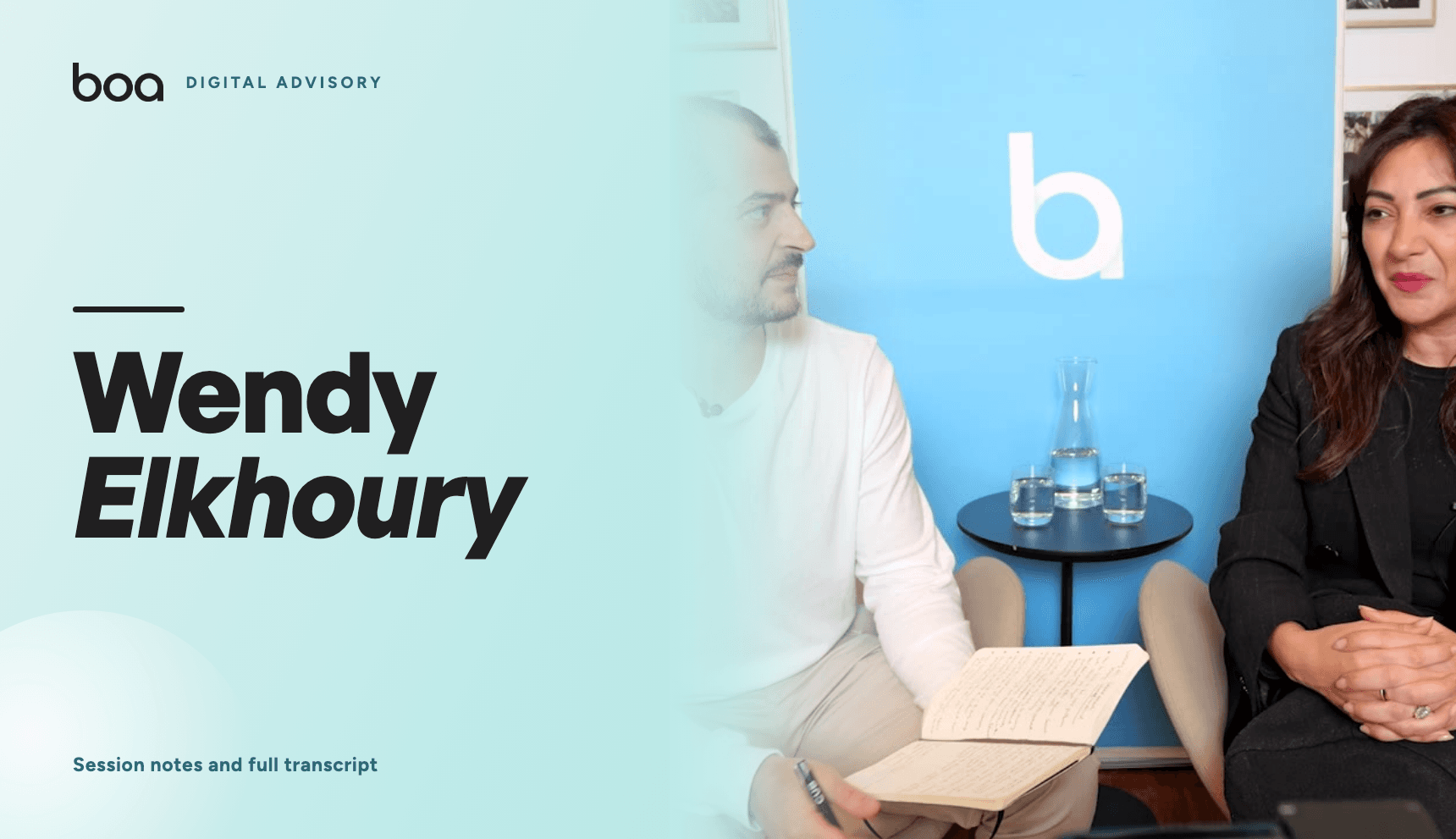
Wendy Elkhoury on Building a Two-Sided Marketplace
With Wendy Elkhoury, Founder at Wedded Wonderland · Hosted by Boa host · 36 min
What this session covers
Wendy Elkhoury built Wedded Wonderland into a wedding marketplace spanning 54 countries and over 2,000 couple enquiries a month. She explains how to test a marketplace idea on social media before building tech, why the demand side comes first, how to vet suppliers, and how to run separate content channels for businesses and consumers.
Build the demand side first, because once you own the customers the suppliers will come to you.
Key takeaways
- 01
Test the marketplace on social media before you build any tech
Wendy started Wedded Wonderland on Facebook around 2011-2012, simply talking about the suppliers she was meeting and the problems brides had. She treats social as a live survey: throw questions out, see what businesses and couples respond to, and use the answers as your product research. Only after years of that did the tech platform and concierge get built.
- 02
Build the demand side first, then go to suppliers with proof
Wedded Wonderland deliberately serviced couples first. Once couples were asking for weddings in Mallorca, proposals in Paris, photo shoots in Lake Como and weddings in Tuscany, Wendy could approach venues and vendors and say she had specific couples looking in their area, backed by search data. Her framing: "if you have the demand, it's far easier to be able to connect with the businesses that can service that demand."
- 03
Cover the supply gap with a free concierge so you never lose a lead
Wedded Wonderland's concierge is complimentary for couples, which means even when a listing does not exist for a request, the team can go and find a vetted supplier. That removes the classic cold-start problem where a customer arrives, sees an empty category and leaves. The concierge also does the vetting work the customer cannot do from the other side of the world.
- 04
Lead with education when your customer is a first-time buyer
Weddings are a first-time purchase market, so couples do not know if a florist should cost $5,000 or $50,000. Wendy ran masterclasses and workshops for both consumers and businesses from 2013, and published price comparisons across countries because couples were pricing Australian weddings against Instagram content from the Philippines and Indonesia. The same applies to beauty, real estate and baby products.
- 05
Close the loop instead of sending people down the rabbit hole
Most wedding platforms sent couples to another directory, another content page or Pinterest, generating more inspiration and no decision. Wedded Wonderland answered the three questions couples actually have: is this supplier within my budget, are they available, and do they work in the market I want. Build your product around answering those, not around more browsing.
- 06
Split your B2B and B2C audiences into separate accounts
Wedded Wonderland runs @WeddedWonderlandNetwork for businesses and @WeddedWonderland for consumers, plus @ProposalsInWonderland and @HoneymoonWonderland to catch couples earlier in the journey. LinkedIn carries the B2B message, Pinterest works as a traffic driver, TikTok has multiple channels. Same source footage, different framing: a runway clip becomes "how you launch an international brand" for businesses and "check out this dress" for consumers.
- 07
If you only have one Instagram account, use broadcast channels to segment
Wendy's fix for small operators running a two-sided business on a single account is to create one broadcast channel for the businesses you serve and another for consumers. That gives you two direct daily conversations without splitting your main feed or diluting your follower count. It also gives you a data source on who your customer base actually is.
- 08
Treat the feed, stories and TikTok as three different formats
Wendy's shorthand: the Instagram feed is your gallery, stories are your conversation, and TikTok is your reality TV show. Decide how you show up in each rather than posting the same asset everywhere. Founder-led and humanised content is what is currently leading, so ask yourself: if you hired yourself as an influencer for your brand, what would you be saying and doing?
- 09
Hire ambassadors, not one-off influencers, in long-consideration markets
Weddings have a long shelf life, so a single influencer post does nothing. Wedded Wonderland calls its creators ambassadors because they need to show up consistently over the whole consideration period. If your buyer takes months to decide, budget for repeated presence rather than a single campaign burst.
- 10
Write down your supplier vetting criteria before you list anyone
Wendy's suggested starting criteria for a new marketplace: respond to customers within 24 hours (because buyers planning a wedding or a renovation are anxious), be findable online, genuinely service the regions you are targeting, and provide some form of price indication. Wedded Wonderland now vets every vendor and venue against a criteria set before they can service its couples.
- 11
Launch a niche marketplace with 70 pieces of FAQ content and a guide
Wendy's advice to a member starting a renovation marketplace: take the top 10 frequently asked questions in the category and make 7 short-form problem-solution videos for each, which gives you 70 pieces. Then build an ebook or guide as the sticky asset, plus a broadcast channel to collect data on who is actually turning up. Pick one niche first, for example home renovation versus flipping for investment.
- 12
Keep the end customer as the lowest common denominator across every deal
Wedded Wonderland works B2G with tourism boards, with multinational hotel groups and with micro businesses, but the bride does not care about economic impact reports or enterprise contracts. She wants three venues in her budget, in her region, with what she is after. Wendy runs different messaging on LinkedIn versus TikTok, but every arrangement is judged on whether it serves the couple.
How the session runs
- 1:38Why two-sided marketplaces are the hardest to build
- 2:30Spotting the gap: micro suppliers with nowhere to be found
- 5:21The real customer problem is not price, it is education
- 7:36Launching on social media as a live survey
- 9:16Standing out in a crowded wedding market
- 12:55Closing the loop instead of more inspiration
- 15:07Common social media mistakes and the ambassador model
- 17:23Marketing to both sides and the cost of doing it
- 18:46Demand first, then supply: how the balance was struck
- 22:04Twelve years in: the pivot from media to marketplace
- 24:11What the first three years actually looked like
- 26:27Q&A: selling to three or four sides of a market
- 29:00Q&A: which channels carry B2B versus consumer content
- 31:17Q&A: starting a renovation marketplace from scratch
Mentioned in this session
- Wedded Wonderland
- Wedded Wonderland Network
- Proposals in Wonderland
- Honeymoon Wonderland
- Uber
- eBay
- Airbnb
- TikTok
- Westfield
- Dubai Tourism
- Mallorca
- Paris
- Lake Como
- Tuscany
- Mexico
- Philippines
- Indonesia
- YouTube
- Will Abdo
Questions founders ask
Wendy Elkhoury built the demand side first. Once Wedded Wonderland had couples asking for specific destinations, she could approach venues and vendors with real customers and search data rather than a pitch. In her industry suppliers are relatively easy to find in any market, but customers only appear during a narrow window of need, so demand is the scarcer asset.
Wedded Wonderland runs a complimentary concierge for couples. If someone asks for a wedding in a market where there is no listing, the team goes and sources and vets a supplier instead of showing an empty result. That means the business wins the customer whether or not the supply side has caught up.
Wendy runs @WeddedWonderlandNetwork for businesses and @WeddedWonderland for consumers, with LinkedIn skewing B2B and Pinterest used as a traffic driver. The same source content gets reframed for each audience. If you only have one account, she recommends setting up two Instagram broadcast channels, one for businesses and one for consumers.
Take the top 10 frequently asked questions in your category and produce 7 short-form problem-solution videos for each, giving you 70 pieces of content. Add an ebook or guide as a sticky asset and a broadcast channel to collect data on who is engaging. The responses tell you whether the real problem is price, product, proposition or finding trustworthy suppliers.
Wendy suggested four starting points: a commitment to respond to customers within 24 hours, a findable online presence, genuine ability to service the regions you target, and some form of price indication. Response time matters most because buyers in high-anxiety categories like weddings and renovations are time-pressured. Case studies with starting-from prices help fill the grey areas where quoting is hard.
Full transcript
The complete conversation, as recorded, with every speaker attributed.
Boa host0:01
But today we're here with a new friend of mine, Wendy El Khouri. Wendy is a true leader in the wedding industry. So Wendy is the visionary founder of Wedded Wonderland, a global wedding marketplace that connects couples and wedding suppliers across 54 countries with a digital community of over 3 million people. Now, two-sided marketplaces like customers and businesses or suppliers are notoriously difficult. And today's advisory session is going to be about, all about that, talking about building two-sided marketplaces. And there's many types of two-sided marketplaces, and many of our BOA members are running and starting businesses just like that. So Will, thank you again. Shout out to Will Abdo for his thing. Guys, also, I would love to ask you a quick favour too. For any of you who attend many of our advisory sessions like this, we host them every week. We are having our investor meeting in a couple of weeks where I've gotta go show all of our Bower investors how much our community is benefiting and loving what we're doing. I'd love for you to throw into the chat, just, I guess, if the advisory sessions have been valuable to you, how they've been valuable to you, or how much you love them and why you love them. And if you wanna throw anything else about Bower in there, you can too. And we will give, put them as, we'll use them as direct quotes in our presentation to investors. So if you could take the time to do that, we would greatly appreciate it. And Wendy, welcome.
Wendy Elkhoury1:38
Thank you.
Boa host1:38
I'm gonna jump straight into this session. Now, I just, as I just mentioned, two-sided marketplaces, like they're actually known to be the hardest businesses to run because, you know, it's like an Uber or an Instagram or an eBay or a, I could list more of them, but what's the one where you stay in houses again? Airbnb. Airbnb. You know, these are all two-sided marketplaces. So two-sided marketplaces are something the most valuable companies in the world, which is why people always attempt to do them, but they're also the most difficult companies to actually build. So, um, I guess a lot of these conversations today is going to be around how you actually did it. So can you take us, I guess, um, to the start of your journey and share the things that you did at the very start that you think contributed to the success, uh, of, of, of, of the two-sided platform?
Wendy Elkhoury2:30
Sure. Morning everyone, confirming you can all hear me. Hello, hello. Okay, so Wedded Wonderland started with the idea of connecting consumers to businesses every single day to alleviate the stress of finding what you're looking for. We work in an industry which is a first-time purchasing market. More often than not, people have not planned a wedding before. And alongside that, it's a long shelf life industry, which means that people don't make decisions on the spot. So they don't find a venue and say, yes, I'm going to book that venue, $50,000 today. So there's a time period and a consideration period around, around identifying firstly what you need and to making a decision. So we realised very early on, I was actually working in the wedding industry, that there were a lot of small micro businesses we were working with that were incredible that had no space online to present their offering and to find the consumer. And we had couples coming in, I was working in a wedding venue where they were looking for the florist, for the makeup artist, for the dress designer, and they didn't really know where to search. Now I'm talking about 2011, 2012, you know, early Facebook days. And I started Wedded Wonderland really on social media as a starting point, talking about the service providers that I was coming across, the problems that brides in particular had. They're generally the decision maker when it comes to, what's it called, when it comes to planning a cultural wedding, a luxury wedding, a destination wedding.
Boa host4:14
I can confirm that is true.
Wendy Elkhoury4:15
Yes, so this is kind of where we recognised there was a problem. And from day one, we started presenting local service providers as well as international. So day one, we were considering and looking from a global lens at what was happening in the wedding market.
Boa host4:31
Okay, but so to summarize, you were already in the wedding space.
Wendy Elkhoury4:36
Yes.
Boa host4:36
And you quickly realized, wait a second, there's a lot of small businesses, you call them micro businesses, but there's a lot of small businesses that wanna serve the wedding industry of whom can't get any exposure.
Wendy Elkhoury4:48
Yes.
Boa host4:48
They're looking for exposure, they're looking basically to connect with people are, who are getting married.
Wendy Elkhoury4:53
Yeah.
Boa host4:54
Um, and then you realize, so that was okay, problem one. You found the problem of the, of, of your businesses, of that side of the marketplace. You then realize, okay, well, on the flip side, um, uh, the couples are looking for, they're probably looking for the best pricing, I assume, on things. And sometimes in weddings, like, they always overcharge you. Sometimes in weddings you might know a florist, but they're charging too much. Can I go see all the other florists?
Wendy Elkhoury5:21
Yeah.
Boa host5:21
For example, who 'Who can service my wedding?' Was that the problem of that side, or what was the problem of that?
Wendy Elkhoury5:26
The problem of that side was actually knowing what questions to ask, because again, a lot of people think that in the wedding industry people are overcharging. But what are you actually comparing that to? Because this is the first time you're engaging a florist, this is the first time you're engaging a makeup artist. So I think it's really important, um, from, from a business perspective and consumer, is the education piece. And so we always led with education and we were doing masterclasses and workshops in 2013 for consumers and businesses because we realised that the consumer doesn't really know what they're doing. It's like buying a property for the first time. There's a lot of information overload and it's a time-sensitive time as well because you're engaged, you want to plan a wedding, you've got 9 months to do it. You have to make a decision. Am I making the right decision? Do I actually know if a florist should be $5,000 or $50,000? I have no idea what I'm looking for, right? So this is where the education piece comes in.
Boa host6:26
So I guess what's the problem that you solved for the couples getting married on Marketplace?
Wendy Elkhoury6:31
It's the education and transparency around product price proposition, I think is really important. A lot of people when they're planning their wedding are looking for value for money. They don't want to get you know, uh, ripped off. Um, but at the same time, we realised that there's a massive gap in actually knowing, um, quality, value, and price, and what the cost of things actually are. And the hardest thing in the wedding industry— people are looking at Pinterest and Instagram and seeing these incredible weddings from the Philippines or Indonesia and not realising that the costs of goods and services in Australia versus the rest of the world is quite different. So we started doing price comparisons around the world as well.
Boa host7:13
Oh, very cool. And so I just want to get So you found the problem for both sides of the marketplace. You then launched it without spending too much money. You launched it on social media. Can you tell us what the thinking behind that was and how you actually launched it on social media? Because I think that's a great way to actually trial if it's a legitimate business before investing in apps. And I've done that too.
Wendy Elkhoury7:36
Yeah.
Boa host7:37
Before investing in apps and technology. And yeah, can you run us through that early part?
Wendy Elkhoury7:43
I just wanted to start the conversation. For me, it was all about the community, knowing that we were speaking to businesses and couples every single day, having them actually respond to a lot of the content that we were sharing. And, you know, it's the quickest and easiest way to identify what your couples, what your consumers, what the industry's after. So asking a lot of questions, it is a survey. Social media for me is data, it's question time. What are you really looking for? How can I assist you? So a lot of that, you know, identifying the problems in market were by throwing questions out and being confident enough to be able to have a platform to be able to respond to those.
Boa host8:27
I love that. So it really was a great way to confirm it's a good idea. And literally by communicating with your target market.
Wendy Elkhoury8:34
Exactly.
Boa host8:35
Excellent. And guys, please don't forget, I forgot to mention the start, or I did, but I was on mute. If you have questions throughout for Wendy, throw them in the chat. They can be specific to your business. The odds are if it's something that you're interested in or something that will benefit you, it'll benefit others. So please throw your questions in the chat throughout and we'll get to Q&A very shortly. Now, the wedding industry is a crowded one. Many industries are very crowded. To be honest, these days most industries are pretty crowded. So what do you think you did that enabled you to kind of break through a crowded industry or at least stand out in a crowded industry?
Wendy Elkhoury9:16
I think it came down to being very active, very dynamic, not being afraid to have the conversation online, being present, creating a feedback loop between the two-sided marketplace. So this is what couples are looking for, industry, what do you have to say? This is what the industry wants to say, couples, what are you thinking about? So it was always an open dialogue. And I think from that perspective, organically sharing what was happening in market in real time is what gave us the edge.
Boa host9:45
So when, so are you saying you were sharing these conversations on social media?
Wendy Elkhoury9:49
Yes.
Boa host9:50
Okay, so you were basically like, you were giving the couples the inside scoop of the wedding industry. So by following you, they kind of were in the know of what's going on, what's good.
Wendy Elkhoury10:01
That's exactly right.
Boa host10:02
And, and that, and no one else was doing that at the time.
Wendy Elkhoury10:04
No one was doing that. I think people were too afraid. I still think there is this, you know, gap in the wedding industry of actually, you know, because we're 80% service-based, there is a gap in wanting to share the cost of goods, in wanting to share, um, you know, the, the stress of planning a wedding. And we need to talk about that, otherwise we can't solve the problems of the market.
Boa host10:25
And, um, Was there another platform that people could go to at the time that kind of did a similar function to yours? So like what I'm trying to figure out is, were there other platforms but you won because you were being dynamic, building a personal brand on social media, being transparent and providing that different value to what the platform actually does? You're providing that information and then you took over and ended up beating those platforms or were there not another platform and you filled that gap?
Wendy Elkhoury10:54
There's a lot of wedding platforms out there and there were a lot of magazines when we first started and that we're moving into digital. I think the difference is that we always were leading with the idea that we wanted to develop technology to solve a problem. And the problem is the quickest and easiest way to connect with a business in order to be able to book them for your wedding and finding the relevant information for that and vice versa. So we did that initially through content. We hosted a lot of events. We showed up in a lot of different spaces and places. We organised and orchestrated a lot of collaborations, a lot of, um, takeovers, um, a lot of, um, interview pieces, all of that, which I think, uh, really built out that global ecosystem of us having that, that conversation online. Now obviously we have listings of venues and vendors and tourism boards globally, but that, that came with the notion of what opportunities are we providing our couples, what, uh, what destinations are we talking about, which service providers do we want them to know about today, and how can we deliver that from a value perspective. And from a couple standpoint, again, it's all about, I'm looking to plan my wedding in Mexico, where do I even start? And now our concierge actually facilitates that conversation.
Boa host12:10
Yeah, and potentially it means you don't need to get a very expensive wedding planner or something like that, or you could find your wedding planner.
Wendy Elkhoury12:16
Or you can find your wedding planner, but it's all about that, you know, the unknown when you're starting that wedding journey and going through that, and our tech platform now actually being able to solve that.
Boa host12:27
But I think what's important to note there is that it's a crowded industry. It had lots of platforms, it had lots of personalities, whether they be dress designers or wedding planners, but you found a unique, I guess, communication. Like you found something, information that the market, that the customers weren't receiving elsewhere otherwise. You found what you can deliver that's unique to what other people—
Wendy Elkhoury12:55
We wanted to close the loop. We didn't want to continue sending them down the rabbit hole. We didn't want to send them to another directory or another, you know, content page or Pinterest or, you know, all of these kinds of platforms where they just continue to find more inspiration and more service providers and not actually solving the problem of, is this person within my budget? Are they available? Do they work in the market that I'm looking for? These are the actual questions that couples have. And that's what we wanted to solve.
Boa host13:23
And now you built a large, I guess, community online.
Wendy Elkhoury13:26
Yeah.
Boa host13:27
This ties into what you've been saying, but how did you do that? What do you think you did well that enabled you to build a large online community? What would be the secret that others could use?
Wendy Elkhoury13:36
I think it's problem solution. I really believe that, you know, we're a very aspirational industry. Wedding content goes viral. It's very easy to build a following. There are so many platforms now in the wedding space. It's very crowded in terms of a lot of You know, brides at the moment are overly stimulated because there's so much in our space. I think that the important thing is whether you're a micro business or whether you're looking to expand is what problem are you looking to solve and speak about that every single day in order to connect with your consumers with incredible content, of course. But what are you actually doing here? Yeah. Why are you showing up today and what are you looking to deliver as a message that's going to assist that couple to get that little bit closer to wanting to work with you or understand what they need.
Boa host14:27
Yeah, but so no matter what your industry is, if you're constantly talking about helping people solve a specific problem and giving them information as to how they could solve it and how, what their lives would be like after it's solved, that's, that's, that's the key.
Wendy Elkhoury14:40
Especially if you're in an industry where the consumer hasn't purchased from your industry before. So this is the beauty sector, the real estate market, the wedding market, a lot of the times the baby market, you know, the first time you're having a baby, you have no idea what to buy or what to do, right? And then you go to your second, you're like, all right, I got this sorted. I didn't need half that stuff. But it is, it is that education piece in these types of markets that's really important.
Boa host15:07
And what are common mistakes you see businesses do on socials, on social media these days?
Wendy Elkhoury15:12
They don't know what their underlying message is. They don't know how to align their product with their messaging. And so they look a little bit scattered. It's very difficult to determine who they are and what they're offering actually is. I think in the service industry, it's a lot more difficult to actually communicate your offering online. When you have products, it's easy. Your e-com, here's my product, here's an influencer using it, let's rock and roll, right? So product is easier and it's lower, more often than not, price point. We're working in a high price point market, a price sensitive market, a service-based market. How do you work with influencers? How do you work with content creators? You know, so I think that it's a challenge.
Boa host15:53
But I do think that that rule that you said applies to everyone, which is you need to align your core message, which is the problem that you're solving and how you solve it, to your actual product.
Wendy Elkhoury16:03
Yeah, and actually have a strategy. You know, like I'm going to use my, you know, I refer to the Instagram feed as your gallery, the storeys as your conversation. TikTok as your reality TV show. How are you going to show up? You know, if you were to hire an influencer for your brand, what would you want them saying? And what would you want them doing? We refer to influencers in our market as ambassadors because we're long shelf life. We can't hire an influencer once to talk about Wedded Wonderland and off they go. They need to be consistently showing up for us. So if you were to hire yourself as an influencer for your brand, what would you be saying? What would you be doing? And create a strategy around that because Right now, as we know, uh, content that is led by founders and by business owners is what— and humanising your product is what is leading the market in any capacity, right? So show up for yourself. If you were to hire yourself, what would you be saying and doing for your brand? Yeah.
Boa host16:59
Now, a challenge that two-sided marketplaces or businesses have, yeah, is that you've got to market to two different groups of people, very challenging, businesses and customers. And does that mean you have to have like essentially double the marketing spend? And how do you go about crafting compelling messages that, that, that are relevant to each of those sides of the marketplace?
Wendy Elkhoury17:23
So essentially, we are a B2B2C platform because without aggregating businesses, we can't service consumers. Without having consumers, we don't have businesses to service, right? So we have split the B2B marketing on the Wedded Wonderland network with Word at Wondaland, which we now focus more on the consumer. And that was a decision over time that we had to make in order to be able to speak to businesses directly, consumers directly. So, now we create, yes, pieces of content specifically for businesses and for consumers. We ensure that we are speaking to both parties. And yes, it does mean a bigger budget, bigger marketing spend, utilising all of our brand partners. So, anyone who's a customer of yours is an advocate of yours, consider them that way. Just like you asked for testimonials through this, anyone that you, any customer that you've serviced that you're happy, you know, they're happy with your service or vice versa, they are somebody who can speak on behalf of your brand. So always consider what that looks like for the next person that's gonna come through.
Boa host18:25
And was there ever a time that you might maybe had too many of one side of the platform? So like, you know, you had too many businesses, but you didn't have enough customers to purchase off them, or you had too many customers and not enough businesses, so there was no point the customers coming. How did you balance that? How did you grow consistently on two sides?
Wendy Elkhoury18:46
So we started with the idea of servicing the couples first because with their demand, we were able to increase supply, right? So we would have couples come and say, I wanna get married in Mallorca. I wanna organise a proposal in Paris. I need to be able to organise a post-wedding photo shoot in Lake Como. I want to be able to have my wedding in Tuscany. So by building out organically what the consumer wanted, we could then easily go to the industry and say, hey, we have a couple for you. We have a number of couples who are looking in your area. We have the data to back the fact that now, you know, consumers are looking more into the Middle East than they were 5 years ago. So let's make sure that the product that we're listing, the venues and the vendors, actually align with what our couples are looking for.
Boa host19:33
But what if you had too many customers and there weren't enough suppliers online. Did that ever happen?
Wendy Elkhoury19:39
We can always find the supplier because through our industry, there are always, you know, there are enough planners and florists and, you know, service providers in each market. It's about identifying who's going to be able to service the customer. The difficult part in the wedding industry is finding the couple because you have to find them at a time when they need that product. Because once they've booked their venue, they're not going to go book 5 other venues.
Boa host20:03
Yeah.
Wendy Elkhoury20:04
So that's the problem that the entire industry faces is where are the couples and how can I make sure they find me at a time that they need me?
Boa host20:12
Okay, so by you getting all the customers essentially, then all the suppliers wanted you because you had the customers.
Wendy Elkhoury20:19
That's right. So now we actually vet the businesses that we work with, the vendors and the venues to make sure that they meet a certain criteria to be able to service our couples globally. And we listen to our couples their intentions of where they're looking to get married and understand from an online behavior, 'cause I think it's so important to follow the data. What are people searching? What are they looking for? Where are they going? And be able to do that product market fit dynamically ongoing because it changes. Political situations, economic situations shift the behaviours in the wedding market. So we need to be mindful of all of that when people are making decisions.
Boa host21:02
And was there a side that was harder to get? For example, harder to get the customers than it was to get the businesses?
Wendy Elkhoury21:08
Uh, it's harder to bring on businesses for the reason that they need to understand what the proposition is. You know, working with a global platform in the wedding space and them identifying the fact that we're not a directory to drive 100 leads a month and hopefully you can close one. We're here to drive quality connections with consumers and From a consumer perspective, that was easier because our concierge is complimentary. And so couples come to us and say, "What? You can actually connect me with someone on the other side of the world and you guys have done the vetting for me?
Boa host21:42
This is amazing." Look, but I think that's an important element. So even if you didn't have all the providers there, you had a free concierge so they could reach out with what they were looking for and your team could then find them providers anyway. So it was almost a guaranteed win whether or not your businesses were there or not.
Wendy Elkhoury21:58
It's push or pull, right? So if you have the demand, it's far easier to be able to connect with the businesses that can service that demand.
Boa host22:04
And how long do you think it took, or how long did it take the business to reach a point of profit or a point of, or a point of where you were like, okay, this is successful, it's working? How long has it been in operation?
Wendy Elkhoury22:19
Wedded Wednesdays has been in operation now for close to 12 years.
Boa host22:23
So how long did that take? What—
Wendy Elkhoury22:25
The business model shifted. So pre-COVID, we were operating as a media platform that was running campaigns, advertising, and events. Um, and post-COVID, we're working a lot more in that two-sided marketplace space, um, with Concierge and with our network in connecting. So it really— the success of the media and the event side of things was there, but we were realising that businesses were coming to us from all over the world, couples were coming to us from all over the world, and we thought we have a much bigger problem to solve here. And then when we had, um, Dubai Tourism approach us to launch Destination Weddings, we thought, okay, hold on a second, because, you know, I've been, um, speaking at international conferences and events since 2016. But once you have governments start to approach you and say you need to open up ecosystems for us, that's what really changed the game. And we realised there's a much bigger problem to solve. So I think in business, you— success is determined by where you are and where you're going. So we were very successful as a media platform pre-COVID. Now that we're working in a global perspective, I think once we have over 2,000 couples that contact us monthly, as you said earlier, we work with 54 countries. But I think once that ecosystem can work from a tech perspective with some AI enablement and obviously having, you know, still that human high-touchpoint concierge, I think that's when I can go My job is done.
Boa host23:52
I guess the point I'm trying to make is for early stage businesses that are at the start of the business.
Wendy Elkhoury23:58
Yes.
Boa host23:58
You know, they might've been in operation for 2 years, 3 years, and it's not where they thought it would be or wanted to be. What was your first 3 years like? Did you get it to where you wanted to be or, you know, that's kind of—
Wendy Elkhoury24:11
I think it's so hard to benchmark where you can take your business in the first 3 years. A lot of it is throwing things at it and seeing what, you know, the consumers are going to respond to, what businesses are going to respond to in a two-sided marketplace. What are people willing to pay for? You know, because I mean, Wedded Wines Line started as— and I'm sure many of you can relate— as a passion project for me where I really wanted to solve a problem in market. And so I was doing a lot of things in industry to PR the brand, to build out that goodwill that we weren't getting paid for. And then you have to start realizing, well, I've got a team here, I've got staff, I need to start, you know, ensuring that some of the things that I'm doing are profitable. So where is the profit going to come from? How can you consistently build that? I think, you know, being in a one-time purchasing market, how can I repeat this behaviour to make it better, to continue the success of that? As a business owner, we have a win and then we go, yeah, I won that. And then you don't actually reflect on how did I get that business and how do I continue building off that. So I think success is in the consistency. The first 3 years was small businesses, big businesses, brands, events. We were partnering with Westfield, we were doing, um, you know, 2,000 people expos. Um, so there were all sorts of products, and then we had to streamline what was actually going to work for us.
Boa host25:34
And what would be the most important advice you would have for anyone starting or operating a two-sided business or marketplace?
Wendy Elkhoury25:45
Is know first and foremost that there's going— there is a demand and supply chain on both sides and how you're actually going to be able to manage that through an online platform or an ecosystem or a concierge, whichever which way you're gonna go about it, is are you gonna have enough businesses? And are you going to have enough customers? And how— what is— does that connection look like? And where do you make money, um, in order to remain profitable and viable in between? Because essentially, whether you're large scale like us or small scale, you are the middleman. So you need to ensure that those both sides are actually dynamic enough to be able to come to you to solve a problem.
Boa host26:23
Um, we're going to move to questions. Ben, do you want to go first?
Wendy Elkhoury26:27
Sorry about that, guys. Um, the one question we do have, maybe it's potentially a 3 or 4-sided marketplace, but just the kind of the theory behind it. Would you say you need to sell kind of what each one wants to hear? Like, this, this party wants to hear XYZ, this one that they want is ABC. What do you think you need to actually distil their name further? So there's like a common thread, you're building your online community around that and that kind of brings everybody in.
Boa host27:05
Or do you have like different strategies for different, different sales pitches for different, the different markets?
Wendy Elkhoury27:11
So I think you need to think about your ecosystem, right? So we work B2G, for example, business to government. Our couples, a bride is not even wanting to know about the fact that we're trying to solve economic, you know, impact and building out reports B2G, right? So for us, the lowest common denominator in everything that we do is that we have couples that want to get wedded somewhere in the world and we need to solve that problem for them in facilitating what that looks like. The contracts and the obligations B2G or be it even enterprise multinational brands that we work with, hotel groups that we work with, again, The couples, they don't want to know about that. All they want to know is give me 3 venues that can actually meet my budget and are in the region that I'm looking for and, you know, have what I'm after. So we always think about them because without them we actually don't have a business, right? So whether we're B2G, B2B, again, working with a microbusiness or a multinational business, the couples are the ones that we need to take care of and look after and everything else will follow. And we have different marketing strategies on LinkedIn versus on TikTok for different reasons because we're speaking to different audiences and need to be able to attract them and keep them sticky within our ecosystem.
Boa host28:33
Thanks, Ben. And this flows well to the next question.
Wendy Elkhoury28:36
Lana. Hi.
Boa host28:41
Oh, we can't really hear you, Lana. Is it possible you got closer to your computer or— Can you hear her?
Wendy Elkhoury28:54
I can hear you, yeah, I'm just going to get a little bit closer. Alright, go ahead. My question, you spoke about content. Yeah. And for the two sides of the business, so my question is, where do you post that content? Is that all in the same place or do you have two different channels? For the different parts of the business, whether there are 2 or 3 parts of the business.
Boa host29:18
So do you have a different Instagram account, for example, for consumers and a different one for businesses? Or do you know?
Wendy Elkhoury29:24
Yes. So on Instagram we have a @WeddedWonderlandNetwork, which is specifically for businesses, @WeddedWonderland, which is for consumers. Um, and then we have @ProposalsInWonderland and @HoneymoonWonderland because we're on the journey of love with our consumers and we want to be able to ensure from a proposal perspective, we're getting them early. Um, uh, on TikTok we have a number of channels. On LinkedIn it's more B2B. Um, on Pinterest obviously it's a traffic driver. Facebook. So we take an omnichannel approach to our content. But what we do— and this question was actually, um, we were talking about it on our way in— we, for example, I was just in the Philippines, um, speaking at a masterclass. Uh, content that I am speaking to businesses about is more suited to LinkedIn and our B2B channel on Instagram. However, the content on the runway and the fashion show is more suited to the consumer. So we take all of that content and we try and figure out what channels to make that work on and who are we actually speaking to. It can be the same content, the same clip speaking to businesses, for example. So this is how you launch an international brand with the same clip of a runway versus to the consumer, which is cheque out this dress. So it's all about the conversation that you're trying to start, but knowing that you're working on the right platform to actually have that conversation. My suggestion for those who just have the one Instagram account is to create broadcast channels. If you are working in the two-sided marketplace, create a broadcast channel for the businesses that you're speaking to, create a broadcast channel for the consumers, so you can have those direct conversations on Instagram in particular, because that's where you're going to be able to to speak to those audiences daily and build out those communities. Great.
Boa host31:11
And final question, Mrs. Sarom.
Wendy Elkhoury31:17
Hello, thank you, it's Bree. I should change my name.
Boa host31:21
I don't know, I just read out what I got sent.
Wendy Elkhoury31:25
I just wanted to know, I'm looking at doing something very similar, it's in the renovation space, but solving the problem for consumers and connecting them with businesses. The right businesses. What would you, what advice would you give someone who's looking to start a community in today's social media landscape? So biggest problem that people have with renovating is what? Uh, education. So understanding what questions they need to ask.
Boa host31:56
Yeah.
Wendy Elkhoury31:56
And trusting the suppliers to finding people that they can trust that are serving their needs, not their own. Mm-hmm. Okay. So are you looking to launch this, um, online for Australia-wide? Or yeah, okay, Australian-wide. Okay. So have you started building out relationships with service providers who you know you would refer?
Boa host32:15
Like builders?
Wendy Elkhoury32:16
Builders. Okay. More starting on the customer side, focusing on trying to build a community and looking at ways to educate them and provide them with valuable information. Okay. So what I would do is the top 10 frequently asked questions in renovation, right? I would be building out 7 pieces of content for each of those FAQs. That's 70 pieces of content. I would then be looking at creating maybe an ebook or a guide on things to consider when you are renovating and go really niche. So are you focusing on renovation of homes and renovation on like flipping property for investment? Like what is it that you want to focus on first as the first problem? And then what will happen from creating those content pieces and actually pushing that out there is understanding what the consumers are really struggling with. Is it the price? Is it the product? Is it the proposition in market? Is it the fact that they can't find the service providers that they're looking for? You may then start to consider whether you want to set up a concierge service where you're connecting them with businesses or you're listing them out online. At the same time, you need to start connecting with those businesses and really identifying what your vetting process is going to be. What do I want these businesses to actually be able to do? Am I going to set up a strategy whereby they have to respond to customers within 24 hours if they work with me as a starting point? Because there is a level of anxiety when planning a wedding or when renovating a home. So is that going to be my first vetting criteria? Is the second that they need to be found online? Is the third that they can service the regions that I'm after? Um, and understanding where they can actually work. And the fourth is, can I get some sort of price indication from them?? Right? Because this is where there are the grey areas in weddings. There's grey areas in renovation. You know, how much does it cost to replace that frame? There are so many considerations around that frame before you can actually quote that. So, can I get some case studies where I can actually share examples of the work of those that are renovating alongside me, the business owners, that I can have a starting from price that is available online? I can educate people around what it means to replace a frame and go from there. But I would really be, the first thing is building out content around FAQs and starting with short-form content, video pieces, problem solution, and then creating some sticky pieces like ebooks and guides, a broadcast where you can start to pull some data and actually understand who your customer base is at the same time. Thinking, okay, if I'm going to solve this problem, what do I actually need from the businesses I'm going to be partnering with? And what kind of business do I want to be sending them?
Boa host35:01
Thank you, Mrs. Sirota.
Wendy Elkhoury35:02
That was really, really helpful. Thank you.
Boa host35:04
Thank you.
Wendy Elkhoury35:04
My pleasure.
Boa host35:05
And thank everyone so much for being here today. We love you all. We love business owners. And the fact that you've showed up today to connect with someone like Wendy and to take the time to learn, it speaks volumes about yourself and how you look at business. You're looking at it like a winner, which, which we love. Every advisory session we ever host will now be live— sorry, will now be posted in full on the BOA's content library. So you can cheque all the past sessions out there. They're awesome. You can also shut your app and keep listening to it like YouTube. So just in case you didn't know that you can do that. So if you're going for a walk, you can play it, turn it off, and it keeps playing even while the app's not open. Um, it's a good little feature, so cheque it all out. Check out some of the past ones. And thank you all for being here. Have a wonderful day. Thank you, Wendy.
Wendy Elkhoury35:53
Thank you. Thanks, guys. Have a wonderful day.
Boa host35:56
Thank you all.
Watch the full sessioninside Boa.
Session notes are free. The recordings, the live advisories and the founders in the room are for members.