Fireside Chat
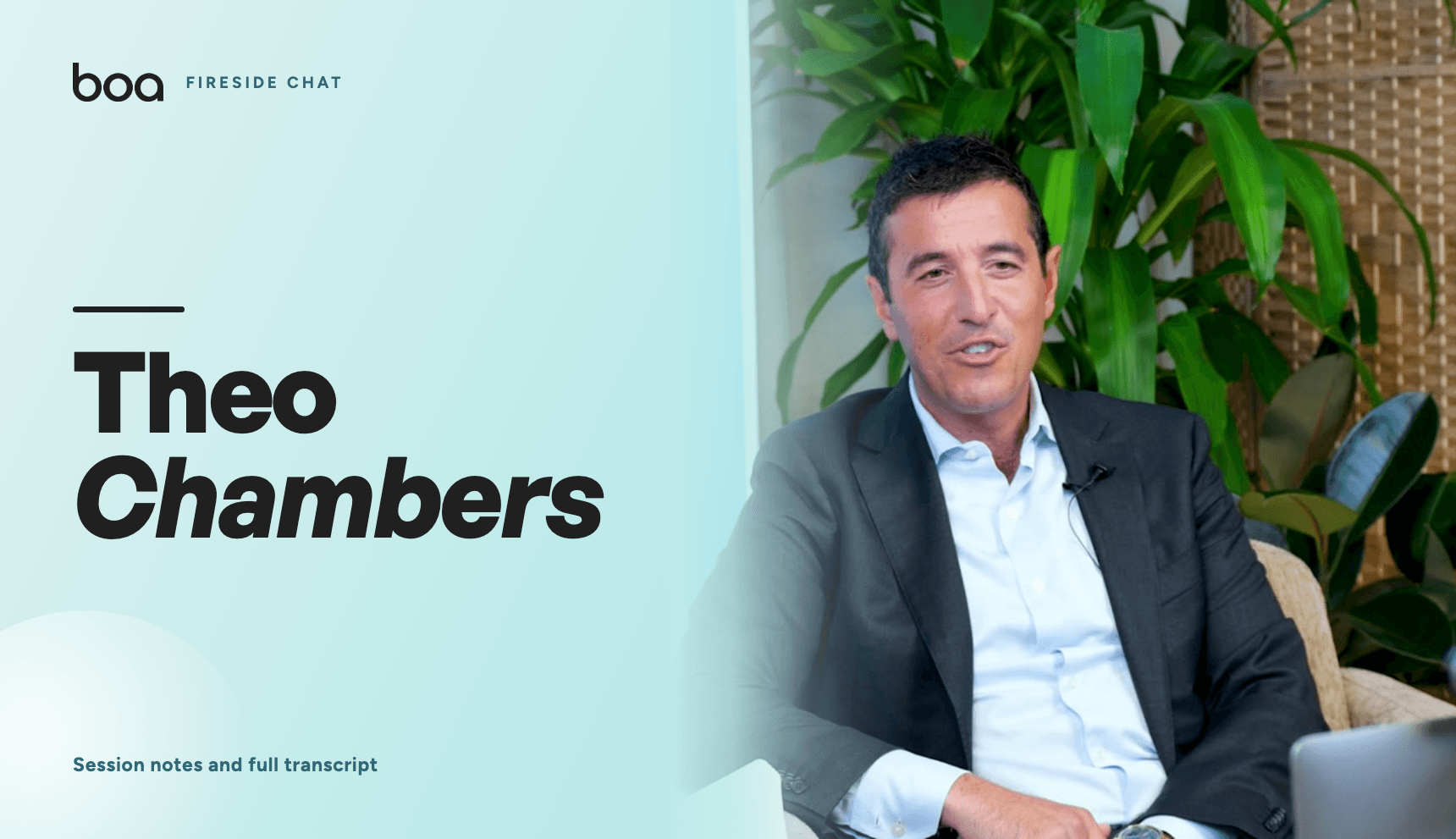
Theo Chambers on Building Wealth Outside Your Business
With Theo Chambers, Founder and CEO at Shore Financial · Hosted by Daniel Hakim · 40 min
What this session covers
Theo Chambers of Shore Financial explains how business owners build wealth outside the business: debt recycling to make home loan interest tax deductible, concessional super contributions, rentvesting, and a ten year property compounding case study. He also covers scaling a service business through partnerships, defined co-founder roles and systems built ahead of demand.
Business gives you cash flow, but the wealth comes from what you do with the profit, so keep showing a profit, pull money out and put it into property, shares and super along the way.
Key takeaways
- 01
Recycle your home loan debt to halve your interest cost
Theo's method: park savings in the loan account redraw (not the offset), then draw that money out for investment purposes. On a $1.3 million home loan, pulling $300,000 out of redraw to buy property, shares or another investment makes $300,000 of that loan tax deductible. On the top tax bracket, 6% interest effectively costs you 3%. He calls making the entire home loan deductible over time one of life's biggest hacks, and notes it is general advice you must validate with an accountant or financial planner.
- 02
Contribute to super yourself, because nobody else will
Business owners skip super because it is voluntary for them, then hit 50 with nothing in it. The concessional cap is $30,000 a year. In the top tax bracket you get roughly half back as a rebate, so $30,000 in costs you about $15,000. Earnings inside super are taxed at 15% and 10% on capital gains, and in retirement phase both income and gains are tax free.
- 03
Show a profit or the bank will not lend to you
Theo's step one before buying anything is making sure the business actually shows profit, because that is what drives serviceability. Growing revenue on digital marketing spend, followers or engagement means nothing to a lender. Banks will not lend against revenue growth. If you suppress profit to avoid tax, you also suppress your borrowing capacity.
- 04
Run the $150k to $5m property compounding maths
Shore's case study: start with $150,000, buy a $750,000 investment property. Using historical growth rates of around 7% capital growth, after four years the accumulated equity funds another 20% deposit. Then repeat every two years using combined portfolio equity. After ten years that is about six properties and a $5 million portfolio. If the cash flow is not enough to retire on, sell one or two to pay down debt and lift the yield on the rest.
- 05
Rentvest if you cannot afford to buy where you want to live
Rather than sitting on cash and renting a better place in Sydney, put the deposit into a market with stronger yields and growth. Theo points to Brisbane, which has outperformed Sydney, is more affordable, has a booming CBD and the fastest growing city population in Australia. Perth and Adelaide also carry higher rental yields that can cover the interest expense, though he warns to watch which markets are running and which have stabilised.
- 06
Buy your home for the capital gains tax exemption
Theo's argument for buying rather than renting long term: your primary residence is the only capital gains tax free asset most people will ever hold. The area you want to live in is usually sought after, so over the very long run you cannot go wrong. Other areas may beat it over short periods, but the tax treatment is unique.
- 07
Define co-founder roles before the resentment builds
Shore started with three partners all sharing the workload and delegating informally. By 25 to 30 staff, two or three years in, the workload was uneven and it became encompassing. Theo's fix was to formally define roles and pay accordingly, with him becoming manager of the business. Do this as early as possible in the establishment phase, not after friction appears.
- 08
Build systems for the capacity you will need, not the one you have
Design the role, task or process for the volume you will hit later, not today's volume. Theo's example: if a factory step handles 100 milkshakes a day, work out now what it takes to run 200 or 300. Otherwise demand arrives and you are running around plugging holes, which degrades the service you already sell. Review everything regularly, because processes that looked scalable often are not after a couple of years.
- 09
Win partnerships by being faster than the incumbent
Shore built its pipeline through strategic partnerships with real estate groups and now has 2,500 real estate partners. The point of difference in 2013 was basic responsiveness: most brokers took two or three days to get back on a referral while agents wanted an answer immediately. Ask who already touches your buyer, then be the partner who calls straight away and keeps them updated.
- 10
Use the CRM your industry already has but ignores
Broking is a mature industry with decent aggregator-supplied technology that most operators never use fully. Shore used its CRM to give real estate partners live visibility, letting agents log in and see a summary of their whole referral pipeline. Simple, already paid for, and it beat everyone else's service standard.
- 11
Reinvest profit for the early years without running at a loss
Shore pulled out no profits for the first five years but the business was still profitable on paper. That distinction matters: reinvested profit still shows income a bank can lend against, and you are not tipping fresh cash in to fund growth. Today the business runs at around 26% to 30% net profit margin, with one-off items like tech projects kept below the line.
- 12
Judge marketing on brand awareness, not just tracked leads
Theo's exception to the profit rule is marketing. Facebook can measure lead forms but cannot see who rang your main line or spoke to a staff member because they had heard of you. So assess ad spend by asking whether it is creating brand awareness you can justify the cost of, and accept that marketing is not 100% measurable.
How the session runs
- 0:00Shore Financial from 3 staff to 110 and $200m a month
- 1:57Values-aligned hires and defining co-founder roles
- 5:04Building systems ahead of the capacity you need
- 8:03Standing out among 19,000 brokers and 12,000 brokerages
- 11:01Scaling through 2,500 real estate partnerships
- 12:52Why profit matters more than the growth story
- 15:42First steps to getting into the property market
- 17:41Rentvesting and looking at Brisbane over Sydney
- 19:02The compounding case for super contributions
- 20:29The $150k to $5m ten year portfolio case study
- 24:27Debt recycling explained with real numbers
- 29:04Rate cuts, inflation data and the property outlook
- 31:59Q&A: profit margins across 13 years of scaling
- 34:01Q&A: what actually counts as an asset
- 37:31Q&A: when unprofitable marketing is still worth it
Mentioned in this session
- Shore Financial
- Commonwealth Bank
- Reserve Bank of Australia
- Michelle Bullock
- Australian Bureau of Statistics
- ASX RBA Rate Tracker
- Investing.com
- ChatGPT
- Simon Cohen
- Brisbane
- Perth
- Adelaide
- Sydney
- Queensland
- ASIC
Questions founders ask
It is the practice of turning non-deductible home loan debt into deductible investment debt. You accrue savings inside the loan account redraw (not the offset), then withdraw that amount for investment purposes such as property, shares or other assets. That portion of the loan then becomes tax deductible, which on the top tax bracket roughly halves the real interest cost. Theo stresses this is general advice and you should confirm the structure with your accountant or a licensed financial planner.
Theo says yes, and that owners are the worst offenders because super is voluntary for them rather than mandatory. The concessional contribution cap is $30,000 a year, and top bracket earners get about half of that back, so $30,000 in effectively costs $15,000. Growth inside super is taxed at 15% and capital gains at 10%, and in retirement phase both income and gains are tax free. Leaving it until 50 or 60 means you lose the compounding that made it worthwhile.
Because lenders assess serviceability off profit, not revenue. Many owners either suppress profit to reduce tax or pour everything into growth and digital marketing, which builds revenue and followers but no lending capacity. Theo's own business reinvested profits for five years but stayed profitable on paper, which kept the borrowing ability intact. If the business shows no profit, there is nothing to borrow against.
Theo backs it where you cannot afford to buy in the area you want to live. Rather than sitting on cash, put the deposit into a market with better yields and growth. He points to Brisbane, which is more affordable, has a booming CBD and the fastest growing city population in Australia, and has been outperforming Sydney. Perth and Adelaide also offer higher rental yields that can cover the interest expense.
He expects at least another two or three rate cuts, with the borrower rate landing around 4.5% to 5%, in line with the historical average since the GFC. Falling rates put upward pressure on prices, though he does not expect another boom like the one driven by 2% mortgage rates, because households are hurting under a new norm of living expenses. Supply shortage, migration and wage growth (with the average Australian income at $110,000) still support prices.
Full transcript
The complete conversation, as recorded, with every speaker attributed.
Daniel Hakim0:00
Thank you all for being here today. And as you know, our mission at BOA is to ensure that every Australian business owner has access to the network and to the advice needed to take your business to that next level and to accomplish your ultimate ambitions. And today we're gonna be learning something very important from a very good friend of mine, Theo Chambers. Theo founded Shore Financial, in 2013 with just 3 staff. And today the firm has grown to over 110 people and they do $200 million per month in home loan applications, which is a lot of home loans. They've also been ranked Australia's number 1 independent mortgage brokerage every year since 2016, which is a huge feat in itself. And that makes Theo not just an expert in scaling a service-based business, which is part of the conversation today, but it makes him an expert in property investment and in getting finance and home loans. So we want to touch on all those topics. Our theme of the day is building wealth beyond business. So business is essential for your cash flow, for your life, but how do we make sure with our business we're setting ourselves up for the future? You know, how are we building wealth? And that's what we want to learn from Theo today. He was actually just giving me a little quick short advisory session. I was like, oh, we got to get in. But Theo, thank you so much for joining us. Hey, first of all, thank you so much for being here.
Theo Chambers1:31
Thank you for having me.
Daniel Hakim1:32
Now I want to start just with your business, just given a bit of an overview of the business. Now, as I mentioned, you started in 2013 with 3 people and today you're very much larger. In your opinion, what were the things you did very well earlier on that set you up for success, that enabled you to get to the size that you are now?
Theo Chambers1:57
Well, something I've often said in webinars and podcasts we've done together in the past, but I probably could have elaborated in a bit more detail, is there's always good people behind a good business. So that's not just I'm saying me and my business partners, but our first wave of hires were some really great like-minded individuals that shared our values. And funny enough, our values were really in line with this theme of this webinar in the sense that it was all about wealth creation. And going a bit above and beyond with our service offering to our clients. So we really sort of ask questions that weren't really in our job description to make certain things like tax considerations along their property journey to optimise wealth creation. So that was a systemic thing that myself and my business partners felt that we want in our business as a part of our service, as you know, advice that's holistic around creating wealth in property, which isn't typically the job description of a broker. And then the first wave of brokers that we hired, they shared those values and that, like I said, became a bit of a systemic thing. The other key thing that I was alluding to that we haven't spoken about in the past that I feel is such a crucial thing that people don't do in businesses. If you've got business partners, I think a really crucial requirement that you need to do from as early on as possible in your establishment phase is defining roles between you and your business partners. We didn't initially do it from the get-go. Initially, you start a business with, I had 2 business partners at the time, so it was 3 of us. You start a business with 3 people and you're just all sharing the workload, having a crack. You do this, I'll do that, and you're sort of delegating. After a couple years, once there's, I think, for us, we probably had about 25, 30 people after 2, 3 years. There's quite a lot of work to do. And then if someone's doing more than another person, it can get a little bit encompassing. So then you need to have appropriate conversations to then define roles. And if someone's gonna be doing more than somebody else, like for myself, I became the manager of the business, just get paid accordingly. And then there's less friction with business partners and it's more supportive of growth.
Daniel Hakim4:16
Okay, so keys that led, that set you up for success long-term were hiring kind of with a purpose or with a mission.
Audience member4:23
Yeah.
Daniel Hakim4:23
So rather than that we're selling home loans, you know, our mission is to help people build wealth.
Theo Chambers4:29
Are you passionate about this wealth creation journey?
Audience member4:31
Yeah.
Daniel Hakim4:31
And early hires essential and then defining roles, whether that be with business partners or be with your first hire.
Audience member4:38
Exactly.
Daniel Hakim4:39
Ensuring that, you know, you are responsible for this, I'm responsible for this. So there's no conflict and crossover. Now when it came to scaling though, so you started with 3, you got whatever you have now, a lot. So you've scaled dramatically. What were the most important lessons that you've learned that you could share with others in scaling a service-based business?
Theo Chambers5:04
So we were always, I guess, big thinkers. We always wanted to grow the business and we had big ambitions. And we always thought that we were doing things that were sustainable for growth. So what I mean by that is systems and processes that we thought could be scalable. However, along the way, a lot of systems and processes we implemented, we eventually found out after a couple of years that this isn't sustainable or scalable. And so you've got to constantly review what you've put in place. Also, just the world changes, right? Technology's made a big difference to our systems and processes. It's made it more scalable in a lot of ways, but sometimes not so sustainable with the cost of various tech that you can license. But yeah, I guess what I've learned about some of those scalable systems and processes is get ahead of the requirement for more capacity. So I guess that is relevant.
Daniel Hakim6:00
What do you mean by that? Get ahead of the requirement for more capacity.
Theo Chambers6:04
So it's probably relevant for both products and service-based businesses. Where instead of designing a role or a task or, like I said, a system or a process for the current volume of product sales or service output that the business holds, get ahead of what it might be needed to do later. So let's say you're selling milkshakes and you've got a process with some staff member that handles a certain part of the factory and currently that can handle 100 milkshakes per day or something like that. Get ahead of needing it to be scalable to 200, 300 and knowing what's going to be needed to get it there rather than you've got the demand for it and then you're quickly running around trying to plug the hole of demand, which then sometimes depletes your service offering.
Daniel Hakim6:55
So really the key for you towards scaling has been systems and operations and a constant reiteration of them because I understand that it's easy to fall in the trap. You write a process or you write some ops and you're like, done, it's fixed. Someone should do it like this from now on. But it just doesn't work because the business changes and evolves and you get better at doing things. So systems and ops are something that's forever evolving. And in your opinion, you should be actually having them good enough for 2 years in the future at least type of thing.
Theo Chambers7:25
You hope at least, right? Plan accordingly, but also at the same time, things change.
Daniel Hakim7:30
And guys, please, I forgot to mention the start, but as always, throw your questions in. And if you want to throw in where you are in your business, we'd love to be able to what your business is too. But throw your questions in because, and write them as we're talking so you remember because at the end we'll have the open discussion Q&A. Now final question on your actual business. Like there's a lot of mortgage brokers out there, right? And a lot of mortgage brokerage edges. Yeah. So what have you learned on how to stand out in a crowded market as a business?
Theo Chambers8:03
So the numbers on that is there's 19,000 mortgage brokers and there's 12,000 brokerages. Wow. So that's over 50%, more like 60% of the mortgage broking industry are basically one-man bands, right? And that in itself is a way to stand out because if you just overwhelm your team, maybe overwhelm's not the right use of words, but if you just empower your team with amazing resources that they wouldn't typically get operating on their own as a one-man band, sort of sole trader type operation, then naturally they should stand out because their ability to, to my point earlier, handle capacity, service to 20, 30 applications a month as opposed to 5 or 10 because they've got all this support and resources, that itself makes them stand out. Because a lot of people that are running a business on their own, have to figure it all out on their own, and that can be overwhelming. And like, you know, if you've— especially in broking where it's problem solving, typically every scenario for each individual is a problem you need to solve. You have to solve the problem on your own. So in a team, if you've got great resources and support and you encourage collaboration, then the team problem solves it.
Daniel Hakim9:20
So, but essentially you analyse the data in your industry? And you said, wow, most industry are one-man-band operations. One-man-band operations often lack systems and processes and service requirements. Just professionalism can be. So if we create an environment where brokers can come, they have everything they need, their life is easier, they don't have to worry about doing the little bells and whistles because your brokerage was handling it. It's gonna attract you more brokers, but also they're gonna have a better experience with the clients because your systems are ensuring it.
Theo Chambers10:00
So I wouldn't say that we strategically made that decision and establishment to create a brains trust as such.
Daniel Hakim10:08
But it is what happened.
Theo Chambers10:09
It is what happened. And when we recognise that the support is making these brokers really successful, then we just double down on the support, right? Our strategy when we first launched the business was just to go above and beyond with a service offering for our real estate partners, 'cause that's where we get most of our business is strategic partnerships with real estate groups. We've got 2,500 real estate partners and a lot of brokers back then at the time in 2013 were giving a very inferior service to real estate agents. Like just like, as basic as not, you know, calling a lead straight away and updating the agent. Some, you know, an agent will give a broker a referral and they sometimes, you know, get back to them 2, 3 days later. You know, agents are very fast-paced, want an answer right now.
Daniel Hakim11:01
And that's a good, I guess, addition to the systems of scaling that you used. You scaled through partnerships 'cause real estate agents were giving you people who just purchased or were wanting to purchase properties. But also you did that by being the best possible partner.
Theo Chambers11:15
And that's a really good point actually about systems that we use. So that was a point of difference. It's amazing that when we joined the industry, or I was in the industry already prior to starting a business, but back when we started a business in the industry, it was amazing how it's quite a mature industry. Broking's been around for decades, but people aren't embracing technology at their fingertips. So a lot of even those one-man-band operations still have decent technology provided by their aggregator. But they don't just use it to its full extent, full capabilities. So CRM systems, for example, a way to go above and beyond in keeping our real estate partners updated is just by using a CRM system properly, giving them visibility on where things are at. And they can also log into the system and get a summary of the whole pipeline of referrals. So that's quite a simple thing that a lot of people want to do.
Daniel Hakim12:06
Yeah, but in essence, everybody here could be thinking, well, who are the type, what are the companies that I could partner with that could help me find clients or could help me scale? And then how How can I be the best partner to them? How can I be the chosen provider of my service or chosen partner for that group? Which I think is always a powerful way to scale. Now, a lot of people, like, how important is it to start thinking about building wealth outside of business early on in your business? Because I know a lot of people are like, but I'm not making that much money yet. I'm still early in business. I'll do it once I'm a couple of years, once I'm making more money. In your opinion, when should people start planning to build wealth outside of property?
Theo Chambers12:52
So this is something that I'm passionate about and it goes, I guess, back to those values that we made systemic in our business because I guess I had a bit of an advantage because I was looking after people's finances basically since 19 years old when I worked at Commonwealth Bank for a few years and I always got inspired by seeing clients and then I became a broker after working at the bank. So I was being a broker for 16 years, call it, and I always got inspired seeing clients, you know, create a significant amount of wealth in property. They played the slow game. And it was funny that, you know, your income doesn't correlate to your net worth. There was people that were not earning much that had a lot to their name, and there was people that were earning a lot that had not much to their name. And so I sort of, practise some of the beliefs I learned along the way, including my own sort of family beliefs who are in business. And I think there's something that's happened in the last 5 or 10 years with this whole tech boom around, you know, you don't need to focus on making a profit just as long as you're growing revenue and scaling up, you know, it'll pay off in the long run. And the dangerous thing about that, to your point, is what happens if it doesn't pay off in the long run and you haven't pulled out money along the way and invested it and bought property or bought some equities or whatever investments that you can make along the way. Then you put all this time and effort into a business that might not be saleable because let's say AI came along and was a disruptor to your plan. I think this concept of profits don't matter as long as there's growth can be challenged and it's only relevant for certain, I guess, businesses in certain industries with a certain strategy. I think it's really crucial to make sure that that you do maintain a profit through your business journey and along the way, do something with that profit. Buy a home, buy an investment property, put some money in shares, or most importantly, I think this is maybe something we're gonna talk about later, but business owners are guilty of not putting money in super because it's not mandatory. It's voluntary as a business owner. And I feel that a lot of people do that 'cause they wanna maximise cash flow. They get to 50, 60 and they realise they've got no money in super.
Daniel Hakim15:04
Well, let's kind of get to that. So, so I mean, essentially property becomes like your, your nest egg. It almost becomes like your life savings and it's your security because if your business goes bad, you may still have some great investment properties you've, you've done over a 5 to 10 year period. Property is a long game. Business is also a long game. So it's good to have them running next to each other. But for people wanting to look at, okay, but how can I start setting myself up to even get into property? You mentioned the super thing, but what are the first steps people can do to prepare to be able to get into the property market?
Theo Chambers15:42
Yeah, so, well, I guess step one, like I said, was making sure you have a profit. That's crucial for your serviceability so you can actually go borrow money from a bank.
Daniel Hakim15:51
Yeah, so if your business isn't showing a profit, the bank's gonna say, well, look, I'm not gonna—
Theo Chambers15:55
You can't borrow money. Right, so.
Daniel Hakim15:58
And often businesses don't want to show a profit because they don't want to pay tax too.
Theo Chambers16:02
Or they're caught up in a growth story. And sometimes you can throw all this money at digital marketing, for example, and it can be getting you leads and you can be growing in revenue. But if it's not profitable, what's the point, right? If you're just growing followers on socials or growing engagement, there's only a purpose of doing that if you're pulling a profit out of the exercise. So, and the banks clearly think the same thing because they're not going to lend you any money based on revenue growth. So I think, yeah, making sure that you have a profit along the way so that you can borrow money to buy a property. There's a lot of noise out there with this subject about whether you should buy a home or rent best. I believe that buying a home is valuable because it's the only tax-free asset you'll ever get in your lifetime unless you do one of these ASIC schemes or some unique exemption to capital gains tax. Generally, your home is the only capital gains tax-free investment you can make. And generally also where you want to buy is probably where you want to buy to live is probably a sought-after area. And long term, you can't go wrong. Sure, there's other areas that are probably better investments over a short period of time, but long term, long, long term, you can't go wrong.
Daniel Hakim17:16
Would you change that theory, though, for someone, for example, with an early stage business who live in Sydney and they're thinking, God, well Sydney's property prices are—
Theo Chambers17:27
They can't afford where they wanna live.
Daniel Hakim17:29
I can't get into it or it's too high. Would you then say, well, wait a second, maybe rent in Sydney, you probably get a better house and look in other areas that are lower cost but have good future growth like a Queensland or something like that.
Theo Chambers17:41
I like that strategy. So that's the typical rentvesting strategy, which is sort of all over social media and even on the news these days. And yes, I do believe in it because that is a common conundrum, you can say, where people can't afford to buy in the area they want to live. And so instead of just sitting on cash and if you did have savings, instead of, you know, just keep renting a better place, it's probably good to put some of that money away towards an investment. And there are some markets like Brisbane that have continuously showed ongoing growth that's outperforming places like Sydney because it's a more affordable place to live and the CBD itself is booming and the population is the highest growing population in Australia as a city. So yes, if you've got some money to invest and it's not enough to put down as a deposit on your home, looking at other markets and rentvesting is a wise strategy.
Daniel Hakim18:36
Is a wise strategy. And just back to the things to do to prepare to be able to purchase. So you mentioned making sure your business is actually showing a profit. So the bank, 'cause banks obviously judge business owners by their business. It's a lot harder than someone that has maybe a job. You've said always don't forget your super because it's a tax-effective way to build wealth and invest wealth.
Theo Chambers19:02
It's underestimated how firstly people don't realise it and all of a sudden they're in the grind, then they have a family and then next thing they're 50. It happens, you know, life rushes past you and and then they get to 50 and they go, geez, I probably should start putting money in super. Now there are little things you can do at that age, like a downsizer contribution, but you would have had a far greater effect if you started sooner because the compounding effect of investing in your super in a low tax environment, there's multiple ways that it compounds. Firstly, the growth in there is only taxed at 15%, but then your contributions that you make to it are also deductible off your income. So if you're in the top tax bracket, it's now $30,000 a year that you're allowed to contribute as a concessional contribution. And if you're in the top tax bracket, you're essentially getting half that back as a rebate. So it's really costing you $15,000. So if you were doing that every year for 10 years, and then on top of that, that portfolio is growing and they get taxed at 15%, by the time you do hit 50 or 60, you've actually got some good wealth for retirement.
Daniel Hakim20:10
Okay, amazing. And now can you, I heard you once, you were sitting with Simon Cohen. I can't remember what you guys were doing, but you were basically telling a storey of painting the picture of how simple it actually can be to grow your wealth through property. And I thought that was brilliant 'cause I was like, wow, like even for me, I was like, I need to start investing in property more. Can you share that?
Theo Chambers20:29
Yeah, so I guess it's relevant to that revvesting strategy, but we were also just making it a broad investing, sort of content as such where yes, sometimes it is more opportunity seek. Whilst I believe buy your home if you can afford it, I also believe don't then go buy investments in that same market because there can be other markets that will have better returns as an investment property. So most importantly, I guess the number one thing is, is in Sydney, typically the yields aren't the best, the rental yield. So the rate of return that the rent is giving you against the property value. In markets like Brisbane, Perth, Adelaide, you've gotta watch which markets are running and which ones have sort of stabilised and whatnot. There's much higher rental yields, which can cover the interest expense. So we did a case study that you are referring to where we looked at historical growth rates for the last 10 years. And we said, if you were to start off with $150,000 and you were to buy a $750,000, I think it was a $750,000 investment property using historical growth rates. After 4 years, the equity in that property should be significant enough to cash out and buy another property for the same value. So the growth would've accumulated enough for a 20% deposit again. And then every 2 years after that, you can do the same thing using the combined portfolio equity to buy another property every 2 years. And then after 10 years with that $150,000 using historical growth rates, there's no—
Daniel Hakim22:08
No guarantee in the future, but if we look back in the past—
Theo Chambers22:11
Yeah, no aggressive assumptions. But also bear in mind historical growth rates were only like 7% capital growth. So it's nothing outrageous. Using that data, $150 grand should turn into a $5 million portfolio. After 10 years.
Daniel Hakim22:25
Which is a significant amount of wealth.
Theo Chambers22:27
And what you could do if the cash flow of that portfolio isn't enough to retire on, then at that point in time you just sell 1 or 2 of the properties to pay down the debt. So then there is more aggressive cash flow for you to retire on.
Daniel Hakim22:39
See, I love that. Just can I try and reiterate that and correct me? So you need $150 grand to buy a $750,000 property.
Audience member22:47
Yep.
Daniel Hakim22:49
You invest that $150,000 for the deposit.
Theo Chambers22:51
Well, you could actually, you could buy a property for $150,000 with less. We're just using the sweet spot.
Daniel Hakim22:57
Let's use $150 grand.
Audience member22:58
Yeah.
Daniel Hakim22:59
And in 4 years' time, you'll be able to, you'll have enough equity in that initial property that you'd be able to use the equity to purchase a second property.
Theo Chambers23:08
In 4 years.
Daniel Hakim23:09
Yeah. In 4 years. And then every 2 years from that point, you'll get another one. You'll have enough. So you'll be, so you'll end up somewhere.
Theo Chambers23:15
I think it's 6 properties after 10 years.
Daniel Hakim23:18
Yeah. 6 properties with a personal equity holding of around $5 million.
Theo Chambers23:22
Overall, we apply growth rates at relevant periods that it's a $5 million portfolio.
Daniel Hakim23:27
See, when you say it like that, it's like I need to start getting 150.
Theo Chambers23:32
And so if you did it in super, there's a couple caveats to super because you can't use equity in super to borrow against, but you could still achieve a similar strategy in super. That whole portfolio is capital gains tax-free in retirement. The income is tax-free as well in retirement. So you only pay 15% income tax before retirement and 10% capital gains. And then once you're in retirement phase, the gains are tax-free and the income's tax-free.
Daniel Hakim23:58
In your super.
Theo Chambers23:59
In your super. That's why it's so crucial.
Daniel Hakim24:01
And then the— So you need to be building your super now.
Theo Chambers24:03
You need to be building your super. And the other thing is, if, like I said, if you're earning above $180 grand, your contributions are basically 50% off. Look at it that the government is matching you dollar for dollar on your contribution. So your ability to save deposits in your super is also far greater.
Daniel Hakim24:19
You were mentioning a concept to me before we jumped on called debt recycling. Can you share what that is and how people here today could use that?
Theo Chambers24:27
So this is what I reckon one of life's biggest hacks and I've been doing it my whole life and once again that was something I guess I learned off clients along the way. Sophisticated sophisticated clients that were strategic with their wealth creation journeys. It's a common term that's thrown around a lot, once again on social media. Sometimes it's thrown around the wrong way and incorrect advice that people are saying. Essentially, to dumb it down to a summary, your goal is to use your primary residence debt and make it tax deductible. So what I mean by that is your owner-occupied home, The loan on the home is not tax deductible. And this is where there's some sort of messaging out there that says, you know, don't go buy a home, buy investment properties because the interest on your home, you've got to pay with net after tax money, which is a fair point, right? However, let's say you go buy a $2 million property and you owe $1.3 million on it or whatnot. If you accrue cash against the home, against the offset, against the home loan, Well, technically it's actually got to be in the loan account, not the offset account. You can pull the money out for investment purposes and then start expensing the interest on your home loan against your primary residence as tax deductible. So let's use numbers on that. We said $1.3 million loan. If you put $300,000 into the loan account, into the redraw, not the offset, into the redraw, over time you accrue that and then you pull that $300,000 out and bought a property, bought shares or bought crypto or whatever it may be, as long as it's investment purposes, then $300,000 of your $1.3 million loan becomes tax deductible, which effectively, once again, if we say you're in the top tax bracket, it's halving your interest expense, it's halving the cost of your interest. So if you're paying 6%, it's really costing you 3%. And where it becomes really advantageous is if you use that $300 grand to go invest it in an income-producing investment. So even if you go buy shares that are giving you only 4 or 5% dividend yield, like a dividend, it might be less than the interest cost, but net after the interest, once you get your rebate, it's almost covering itself and then you're getting capital growth on the actual shares as well. There's also lots of investments like commercial syndicates where you can get 7% to 10% return on your money. So there's like a healthy arbitrage on the debt that is actually what it's costing you and what you're getting as a return, which is your profit. So over time, the goal with debt recycling is to make your entire home loan tax deductible, which basically means you're halving the actual cost of your interest on your home loan.
Audience member27:15
Wow.
Daniel Hakim27:16
And so I don't want to make this a plug for Shore or anything like that, but if people did want to learn in more detail how to do that, they could, that your brokers could help them?
Theo Chambers27:25
So this is the point where I give a disclaimer that this is general advice and this is technically advice that you need to speak to a financial planner or an accountant about.
Daniel Hakim27:34
Yeah.
Theo Chambers27:34
Okay. That's why there's some people out there that are spruiking this advice that, you know, aren't technically licenced and they're giving inaccurate advice. We do have financial planners that can give this advice.
Daniel Hakim27:45
But you can speak to your accountant.
Theo Chambers27:46
We typically plant the seed of this conversation for them, for our clients to then go back to their account and validate. A viable solution or strategy for them. But your accountant is probably the go-to person.
Daniel Hakim27:59
Okay, awesome. But in essence, I can halve the amount or I can halve the cost of my mortgage.
Audience member28:05
Yeah.
Daniel Hakim28:05
Of a part of my mortgage.
Theo Chambers28:06
Yeah. The interest, whatever the proportionate amount that you invest that's been against your home loan, the redraw, that's how much of the loan you can invest. And what's really good about that strategy is that a lot of people think, well, I don't want to tie up all this money in my home because that's another common point people have where, you know, why put all this wealth and capital tied up in my primary residence that doesn't give me an income? It's a valid point. But with this strategy, if you put the money into the redraw and then go invest it, you're actually not really tying up the money in your home, but you need to have the ability to do so.
Daniel Hakim28:39
Yeah, honestly, this will probably change my life.
Audience member28:41
Amazing.
Daniel Hakim28:43
Now we have a few questions, so I just want to do one more question for you and then we'll jump to their open conversation. But which question should I choose? Well, actually, look, let's just get your opinion on the property market over the next 12 months and also where you think interest— what's going to happen with interest rates.
Theo Chambers29:04
Well, today is prudent timing for that question because tomorrow we have quarterly inflation coming out from the ABS and that is the more important inflation that the RBA monitor to make a decision on the cash rate. The whole reason that we didn't have that rate cut last month in July was because Michelle Bullock wanted to see the quarterly data. It was the monthly indicator up till July that people were thinking, oh yeah, we're definitely going to get an interest rate cut in July. In fact, the ASX RBA Rate Tracker was was pricing in a 97% chance of a rate cut in July and it didn't happen. And the whole point that she emphasised was that the quarterly data is much more comprehensive and we need to make sure that inflation is trickling down before we make another cut. So that's tomorrow, comes out.
Daniel Hakim29:56
And you get it from the ABS website?
Theo Chambers30:00
Yeah, just Google it.
Daniel Hakim30:01
Or just ChatGPT.
Theo Chambers30:03
I use an app called Investing.com, which is all data announcements globally comes on that, which is quite, quite interesting. But the next RBA meeting I think is in about 2 weeks. So then Michelle Bullock will react to tomorrow's data.
Daniel Hakim30:20
And now the property market has been softer this year, I would say, and correct me if you think I'm wrong, but where do you see it going the rest of the year? Is now a good time to buy?
Theo Chambers30:34
So I guess going back to your question, I didn't probably answer properly. I think there's at least another 2 or 3 rate cuts to come. Historically, decreasing interest rates always puts upward pressure on property prices. It's just, it's a fundamental of the affordability of the property. Do I see another crazy boom like we just went through? No. I think people, households are definitely hurting. There's a new norm of living expenses. And also that crazy boom was off the back of 2% borrower rates to mortgage holders. We're not going down to that level. We're going to probably land around 4.5% to 5% as the borrower rate, which has been the historical average you could say for the last like 10 years, 15 years since the GFC. But yes, there's some other fundamentals of downward pressure, a downward trajectory in interest rates will put upward pressure on prices. But in Sydney in particular and a lot of parts of Australia, there's still a fundamental supply shortage for housing.
Daniel Hakim31:36
And with a lot of migration.
Theo Chambers31:37
A lot of migration, a lot of demand.
Daniel Hakim31:40
So you still see it pushing up.
Theo Chambers31:42
And we've had wage growth. You know, the average Australian salary now, the average Australian income is $110,000 a year.
Audience member31:48
Really?
Theo Chambers31:48
Yeah. And so there's people that can afford to buy these properties even at high prices.
Daniel Hakim31:53
Okay, I get that. We're going to move to questions. Jacob, do you want to ask your question?
Audience member31:59
Sure, thank you. Um, thanks for coming on too, by the way. Uh, just interested in how you have gone over the years from when you started the business, I think it was 13 years ago, and where, you know, the profitability percentage sat when you only had 2, 3, 4, 5 staff members to where it is now, obviously a number of years down the track and you've gone through a significant scale. How has the profitability changed and how have you managed that?
Theo Chambers32:25
Really good question. And I'm going to sound like I'm going to contradict myself from what I said earlier, but we didn't actually pull out any profits for the first 5 years. Now there's a difference between not pulling out profits and running at a loss, right? The business was somewhat, let's say profitable for the 5 years, but we reinvested the profits, right? So We didn't, I think that is, so what I, to my point about serviceability, there's still income on paper that you can show to a bank and borrow against. And we're not losing money and having to constantly put more money into the business for growth. But then those profits we just reinvested and that really helped for the first 5 years. I think your question was around ratios though. I think at the moment we're sitting around a 30% net profit margin. Maybe just tad under that, about 26%, 27%. I can't say it's always been around that level because it depends how you look at profit because there's obviously some things that are below the line with EBITDA. So we normally pull out like projects like tech. If they're non-recurring items, they're below the line, they're once-off expenses. So if we look at it that way, I think we've always aimed for about 25%, 30%.
Daniel Hakim33:47
Thanks, Jacob. Hannah, I know you've done a few questions. Why don't you throw in your two favourite ones?
Audience member33:52
Thank you so much, Theo. I really love that you're here sharing all of this with us. I was curious to know, how do you define an asset?
Theo Chambers34:01
That is a great question. So I think assets should be somewhat tangible. Why I say should be somewhat tangible because property and shares are somewhat tangible. Property is definitely tangible. Shares, you still own script and a value of a certain company that is tangible. The thing that people might say is not really tangible is crypto, for example. But I do see crypto as an asset. And we've seen recently in recent weeks that I think in America, the government are actually recognising it as an asset and they're going to start storing it as a part of their reserves. But yeah, they're my obviously 3 go-to type assets. Property, shares and crypto. House contents, jewellery, all that type of stuff, watches, I don't believe are assets. Cars, not really an asset. I don't believe assets are assets when they depreciate. Does that answer the question?
Audience member35:06
Yes, absolutely. Thank you so much. And a second point I'd love to ask you is what was the benchmark of growth or the profit point in your business journey that was the measure of when you yourself began to build your own individual wealth?
Theo Chambers35:21
Well, I was always making sure I tried to build my own individual wealth the entire time because I was still a broker within my own business. For the majority of the time. So I still had a decent income from being on the tools as such. And I made sure my own personal income, I always was quite heavily geared into property because then it made me work harder. And also then I didn't get frivolous with my income and go do silly stuff. You know, I always made sure a healthy portion of my income was going towards my property debt. That's why people say that, you know, I think a third of Australians or close to 40% of Australians were defined as being in mortgage stress. And mortgage stress is, I think, where you have 30 to 40% of your gross income going towards your mortgage repayments. I encourage that benchmark of your overall income going towards your mortgage repayments personally. So yeah, I don't know if that answers your question, but I guess I was focused on it the entire time because still to this day, anything could happen and I might not have a business I can sell.
Audience member36:31
Absolutely. Thank you.
Daniel Hakim36:33
Yeah, I like that concept is property you run alongside the business. It's your safety net, but also your future wealth.
Theo Chambers36:40
Well, there's so many business owners, and this is something that I was lucky enough to learn off my own family, my father and my grandfather were both business people in liquor retail. And they both always used to say to me, and this is a common thing in business that people say, it's not the money you make from business that's the real wealth creator. It's what you do with the ability, with that income from the business. And it gives you a means to buy property. And if you just constantly grow your property portfolio, you make more out of the property than you do out of the business generally.
Daniel Hakim37:12
That's actually something my old man always said too.
Theo Chambers37:15
Yeah.
Daniel Hakim37:15
He said, business is for your cash flow, property's where you make your money.
Theo Chambers37:18
And the cash flow is how you buy the property.
Daniel Hakim37:20
How funny is that? And we'll do last question just because of time. Ben.
Audience member37:31
Hey, thanks for your time, and Daniel. I like your point about each activity, everything you're doing, you measure the profitability. Even if it's driving revenue, if it's not profitable, cut it. But there are some things, I know there's ways to measure marketing and stuff like that, but you might not see for 6 months' time when things take off. Are there other factors you would kind of put into things like that to say, you know what, it's not profitable now, but there's some other things I'm looking at?
Theo Chambers37:57
Yeah, it's a really good question. When you, if you want to tie it specifically to marketing, because, you know, despite that I just said that, once again, I'm going to sound contradicting. I also still put money on towards certain marketing initiatives that aren't profitable. But whilst we live in this new age and era where we have all these fancy tech companies like Facebook that can really measure ad performance. The, the old concept has never dissipated that marketing is one of the hardest things to actually measure because Facebook might measure leads, but it's not really measuring brand awareness and what it's doing in the marketplace. Sure, you could say, well, engagement's that, but not really, because it— how does Facebook know how many people are actually calling your main line or just speaking to one of your staff members directly? I know lead forms can track some of that, but it doesn't capture what's happening in real life with that brand growing brand awareness from your marketing initiatives. So I guess you've got to assess your ad spend and things like that with that view. Is it creating brand awareness that I can justify that cost? Yeah, it's not, it's marketing's still not 100% measurable and it shouldn't always That's one thing that's probably a bit of an exception that you don't always need to make it profitable.
Audience member39:19
Awesome, thank you. Awesome.
Daniel Hakim39:21
Well, Theo, I want to thank you so much for your time today. Guys, I want to thank you for your time. We're so grateful that you took time out of your busy days as business owners to join us. I hope that was, there was a lot of insights and learnings for everyone. I know there was for me. In fact, I'm going to harass Theo now once we hang up with some other questions and myself.
Theo Chambers39:41
I've just got a new client.
Daniel Hakim39:42
Yeah, 100%. But, um, um, we love you all. BOWERS to support business owners, and I'll see you at the next event. Thank you so much.
Theo Chambers39:51
Thanks for listening, guys.
Daniel Hakim39:52
See you.
Watch the full sessioninside Boa.
Session notes are free. The recordings, the live advisories and the founders in the room are for members.