Fireside Chat
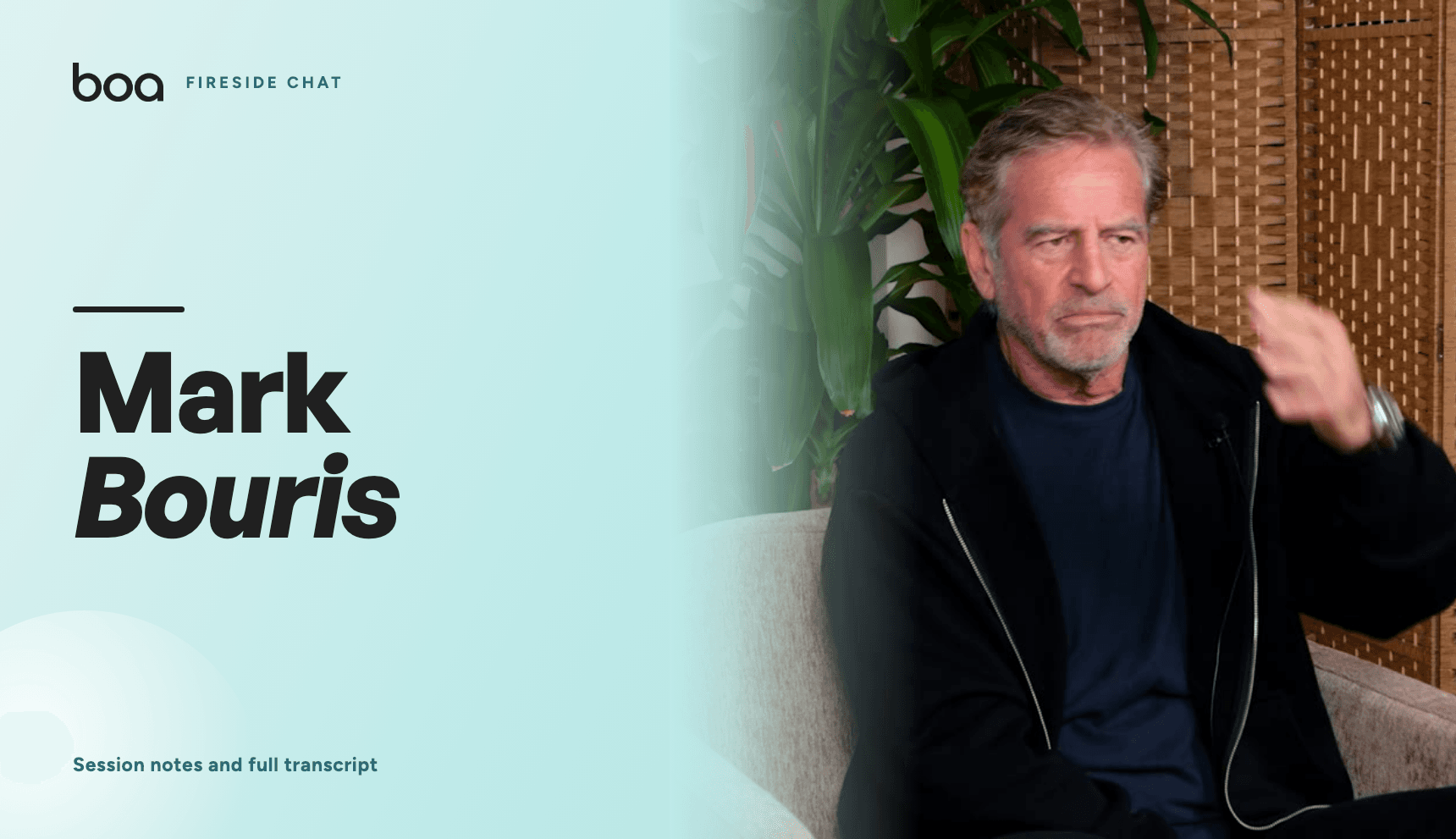
Mark Bouris on Leading a Business Through a Downturn
With Mark Bouris, Founder and Chairman at Yellow Brick Road · Hosted by Daniel Hakim · 55 min
What this session covers
Mark Bouris explains how to run a small business through a slow economy: match your cost base to current revenue, work out your cash runway, track GDP, unemployment and inflation yourself at the ABS, and build reserves or redraw capacity before you need them. Practical for owners feeling the squeeze right now.
Cut your costs back to match today's revenue, then spend the quiet months getting ready to take market share the moment interest rates fall.
Key takeaways
- 01
Re-cut your cost base to today's revenue, not last year's
Bouris says the first move in a downturn is the one thing you control: costs. Your cost structure was geared to revenue from six months ago, so if you are seeing lower revenue, delayed contracts or postponed projects, re-gear costs to the revenue you have now. Cut the cloth to suit.
- 02
Work out your cash runway on flat revenue and a fixed cost floor
Asked how to tell if a business will survive, Bouris pointed to burn rate. Assume today's revenue line does not improve, then work out which costs you genuinely cannot reduce. If that maths leaves you with less than six months, and you have no savings, no bank borrowing and no investor, that is the point to consider closing the books for a while or taking a job rather than burning to zero.
- 03
Get your economic data from the ABS, not the papers
Bouris says ignore politicians and go to abs.gov.au yourself, any hour of any day. The three numbers that matter are unemployment, GDP growth and inflation. He notes normal GDP growth should sit around 2.75 to 3.5 per cent per annum, and Australia is sitting just above zero, with a per capita recession meaning living standards are falling.
- 04
Follow two economists who disagree with each other
Bouris reads only two sources: Christopher Joye of Coolabah Capital, a markets and bond trader, and Stephen Koukoulas, a former chief economic adviser to Julia Gillard who examines ABS statistics daily. Both are prolific on X. He picks them deliberately because they are diametrically opposed, so you get the markets view and the policy view rather than one bias.
- 05
Build your reserve out of redraw, not just profits
Bouris keeps something aside in good times because he knows tough times are coming. He points out the reserve does not have to be cash savings. Get extra borrowing approved on your home loan and leave it undrawn in redraw or offset. If you have $100,000 approved and only spend $50,000, the other $50,000 is your buffer.
- 06
Recruit while your competitors are frozen
Yellow Brick Road cannot write loans without brokers, so with rate cuts expected Bouris is out recruiting while everyone else has stopped. He has linked up with the recruitment agencies banks appoint to outplace redundant mortgage staff, runs seminars for those people and attends himself to pitch why they should join. Trained, educated people are on the market right now.
- 07
Know the two levers of scale: retention and attraction
Bouris works on broker retention every single day, good times and bad, and layers attraction on top when he wants growth. The attraction piece is a messaging problem: work out why someone would join you rather than the business down the road, and what movement they are joining. If your distribution is people, scaling the business means scaling the headcount on the ground.
- 08
Treat energy like cash: build reserves before you spend them
Bouris frames burnout as physical burn rate. You cannot avoid spending energy, so become efficient at spending it, and your body is not efficient unless it is fit. He is not talking about marathons. Build physical and mental practices in the good times so you have reserves when the pressure hits.
- 09
Cut the coffee, alcohol and late nights before you cut anything else
The traps Bouris named for stressed owners: too much coffee, too much alcohol, too many late nights, not enough sleep. He rejects the cost excuse for not exercising. Walk, run, use the park at lunch instead of a sandwich, go in the dark in an old trackie if you do not want to be seen. If you are too tired, go to bed an hour earlier.
- 10
Stop venting to family and find a business peer instead
Bouris is blunt that your mum, dad or best friend does not really care about your business problems and cannot offer anything valuable. He suggests finding someone of a similar size in a business community, even in a completely different industry, and proposing a shared whiteboard day at each other's premises. The point is knowing you are not the only one suffering.
- 11
Sell a delayed payment deal when your prospects have no cash
For a video and brand storytelling founder whose small business leads cannot spend, Bouris suggested targeting businesses that will do better when rates fall, such as mortgage brokers, and pitching them on getting their brand in front of consumers before the floodgates open. Then remove the price objection: 'you don't have to pay me now, let's do a delayed payment program'. Right now what you have to sell is your time and your brain, with upside down the track.
- 12
Expect startup capital to stay tight until rates fall
Bouris explained why Australian funds are not writing startup cheques: with high rates they can buy a bank hybrid and hit their return without risk. During COVID, at 0.1 per cent, they had no choice but to take startup risk. He also warned the proposed tax on unrealised gains above $3 million in super will pull high net worth money out of angel allocations, so look offshore, at markets like the UAE, or wait for rate cuts.
How the session runs
- 1:47The real state of the economy, and why to ignore politicians
- 6:31Why founders need a trusted source and a peer network
- 9:16First move in uncertainty: control your costs
- 14:00Compressed cycles and preparing for the rate drop
- 17:31Building reserves through redraw and offset accounts
- 19:13Burnout as a burn rate you can manage
- 20:53The traps: coffee, alcohol, no sleep, no exercise
- 24:21Scaling in a downturn: how Yellow Brick Road recruits
- 28:28Q&A: productivity, unions and building around government
- 34:01Where Australians are putting their wealth now
- 37:36Q&A: why startup funding has dried up in Australia
- 44:06Q&A: winning bigger clients when small business is broke
- 47:55Q&A: the NAIRU, 4.5% unemployment and RBA rate cuts
- 50:18Q&A: the metric that tells you if you will survive
- 52:02Closing: cycles always turn, work out how to get there
Mentioned in this session
- Yellow Brick Road
- Wizard Home Loans
- Boa
- CUB
- Australian Bureau of Statistics
- Coolabah Capital
- Christopher Joye
- Stephen Koukoulas
- Jim Chalmers
- Julia Gillard
- Chris Minns
- Reserve Bank of Australia
- X
- Australian Financial Review
- Sydney Morning Herald
- Fox News
- New York Times
- Eagers
- ANZ
- Tim Tszyu
- Adelaide
- Brighton
- UAE
- Melbourne
- CUB Awards
- Boa Premium
Questions founders ask
Bouris says focus only on what you can control, and that starts with costs. Your cost base was set against revenue from six months ago, so if revenue is falling or contracts are being delayed, re-gear costs against current revenue immediately. Once costs are under control, start planning how to expand ahead of competitors who did not act.
Calculate your cash runway. Assume revenue stays flat at today's level, work out which costs you genuinely cannot cut, and see how many months you have. Bouris says six months is the number to watch. If you are under that with no savings, no borrowing capacity, no investor and no family support, it may be time to stop spending, pause the business or take a job.
Bouris says do not trust politicians and do not rely on the Fin Review, the Sydney Morning Herald or news channels. Go straight to abs.gov.au for unemployment, GDP growth and inflation, which are updated and free. Then follow two opposing economists on X, Christopher Joye of Coolabah Capital for the markets view and Stephen Koukoulas for the policy and ABS data view.
Bouris explains it is about the alternatives available to fund managers. When interest rates are high, a fund can buy a bank hybrid and hit its return without taking startup risk, so it does. During COVID, with rates at 0.1 per cent, funds had to take risk to earn anything, which is why so many raises closed between 2020 and 2023. He also warns that the proposed tax on unrealised gains above $3 million in super will remove the pool of high net worth money that typically backs early stage deals.
Bouris treats burnout as a physical burn rate, the same way you treat cash. You need to be fit for your body to spend energy efficiently, and you should build those practices in good times, not when the pressure hits. Cut coffee, alcohol and late nights, sleep more, and use free options like a walk at lunch or a run at the beach rather than using cost as an excuse.
Full transcript
The complete conversation, as recorded, with every speaker attributed.
Daniel Hakim0:00
Well, first of all, thank you all for being here today. As you know, our mission at BOA is to make networking something you look forward to, is to provide the highest quality networking and advisory to every entrepreneur in Australia. And that's exactly what we're here today to do. In fact, we've got the best in the business here with us, the biggest supporter of small business in Australia, Mr. Mark Bouris. Mark has been, he is a great friend of mine. He's been a great mentor of mine for a long time, and he's actually a great mentor to a lot of people people in Australia. So, um, thank you so much for being here. Well, um, today's topic is going to be, uh, very much focused on, um, leading and managing ourselves as business owners in tough times. Now, a lot of business— businesses are having a tough, tough times at the moment. I was even telling Mark just then before the camera came on that this is some of the quietest months I've seen Cub, um, go through really ever in 10 years. So, so there's some things happening in the economy, um, and a lot of business owners are feeling that. And so today's going to be all about Mark's advice on managing those times and things we should be doing and how we should be managing ourselves, our teams, and our customers. And I'm going to ask a few questions. We're then going to get into Q&A as always. So please, as the discussion's happening, ask your question in the chat because when it comes time to Q&A, I just go through the— I go through who's asked the question, I'll call you out, and then it'll be open conversation for you to ask your question directly to Mark as well. That's pretty much everything. So thank you all for being here today. Mark, I wanted to start today's session on just getting your opinion on the current state of the economy and business environment.
Mark Bouris1:47
Well, I think the first thing is, in terms of the state of economy, if you just look at just data that's floating around the place— and I should preface my answer by saying to you, do not listen to what politicians are saying. So When Jim Chalmers says, look, Australia is doing really well, we've done this, we've done that, we're not doing really well. When he says we're doing well relative to other economies around the world, no, we've actually— our actual growth in GDP, that's one of the measures of how well we're going, is actually made up. We have dropped from 30th best in the world to 60th best in the world. So we are not doing well relative to the rest of the world, and we're not doing well generally. So that's the first thing. Never trust politicians, secondly, because obviously they've got an agenda. The second thing I think we should remember is that in terms of Australia, what are the things that best measure our growth or our economic prosperity? And obviously GDP is one of them. And it's an easy number to find out. If you go to abs.gov.au, ABS, Australian Bureau of Statistics, abs.gov.au, you can get any day, 24 hours a day, any day of the week, any time of the year, you can see what our GDP growth is because they'll give you the measurement. And the 3 important measurements they tell you is unemployment number, GDP growth, and inflation. They're the 3 things you need to know. Inflation is pretty much under control, but GDP is really poor, um, very, very poor. Um, and in Australia, we have 2 very ordinary measures of how well Australia is going economically. And the first one is GDP. So our economic growth is on a on an absolute number is going backwards, and we're just above zero. Normally, we need to be between 2.75% and 3.5%, around that territory, growth— growth per annum I'm talking about. And the other big number that's really important to us is productivity. Australia is one of the least productive countries in the world in terms of productivity measurements. And these are the same measurement methodologies used around the world. And this is also at the abs.gov.au. And our productivity since this government's been in power for the last 4 years has gone backwards at a very rapid pace. And that's largely because what this government's done is all they've done where they've increased employment, they've done it at the public service level where there's very little productivity, that people are hard to get to work, no one ever turns up to work. And I'm not having a crack at people who are in government. But generally speaking, there's very little productivity associated with them. So our private sector is not employing people. So people like us, we are not employing people. The government is employing people. That's pumping up in a sort of a— it's not false, it's true, but a nonproductive way. It's pumping up our employment numbers, making us look much better than we really are. So economically, by all measurements, Australia is doing very average. In fact, way below our normal run rate over the last 30 years. Secondly, what's going on globally at the moment, and of course, we've got the Middle East geopolitical issues, we've got the Ukraine-Russia geopolitical issues, we've got our geopolitical issues in relation to China and the Pacific area, in which, you know, that's our territory. And then we've got Trump doing all these tariffs, or put them on, take them off, put them on, take them off. It's created a massive amount of uncertainty. Uncertainty is probably the worst thing you can have for economic environments when it comes to small businesses. Small businesses just say, no more spending. I'm not spending on anything. I'm not going to invest any more money. We're here at your brother's podcast studios. Someone like your brother Thomas, you'd probably say, well, hang on, I'm not going to spend more money on another studio because I don't know what's going on. So uncertainty is a big deal, mate, at the moment. And until something happens in the uncertainty territory, which is, we don't know. You never know with Trump and he's here for another 4 years. So anything could happen. So right now that might account for why people are putting their hands in their pockets, not spending. Consumerism in Australia, like retail sales at an all-time low. So yeah, it's not good.
Daniel Hakim5:58
Yeah, and it does feel that way. I can feel that way in business and I'm sure many people here have kind of noticed that. It is, at the same time, it's reassuring to hear that because sometimes if you're told everything's good, the economy's stable, the country's stable, but your business isn't performing how you'd want it to or it's gone down, you might think, oh shit, it's me, I'm running a bad business. But it's very likely that it's being heavily impacted by all the things that you've just very simply explained.
Mark Bouris6:31
And that's why it's important to have networks. Daniel, because in a network you can find out what your cohort is feeling too. I mean, these sorts of conversations you're saying, our business is down. I can share the Yellow Brick Road lending business is down. And I'm sure lots of people here who listen can say to you something's going wrong in their business. So when you come to dealing with tougher times, you've got to have a certain mindset. And part of that mindset is Knowing what's going on. Like, if I want to know about what's going on, like, if I feel like, wow, geopolitically, am I— do I feel at risk here in Australia relative to what's going on in Middle East? I've got to find a trusted source of information. And part of my mindset around that is to feel like I at least know what's going on. Like, I have a sense of I can get updates. So is it, you know, Fox News or is it the New York Times or whatever it is? I find a trusted source where I can get my data. So in business, you've got to find a trusted source where you can find at least correct information. And I, you know, everybody should have a trusted source. And then you want to have another place where you can share that information like this, or it could be just one of your business neighbours to have a chat.
Daniel Hakim7:47
Yeah, because I find, well, to be honest, I find more value in speaking to my friends in business about the environment than I do from listening to the news. Because when I speak to my friends in business, I'm actually hearing about what's happening in business live in their businesses. And more often than not, unless it's like a unique industry that's benefiting from something that's going on, more often than not, everyone's kind of goes— is going through the same up or the same down. Or that— so you have that kind of security in knowing, okay, it's not just me. Um, and, um, Yeah, I text you all the time.
Mark Bouris8:25
You come and see me, what's going on?
Daniel Hakim8:26
What are you feeling?
Mark Bouris8:27
And then I think that you're in a special position, but like, not so much relative to me, but you have this relationship, but that's sort of what Beau is about. Like it's about sharing these relationships, bringing people in to talk to your audience.
Daniel Hakim8:42
Creating that national community so we can all have our finger on the pulse of what's going on in business. And these are the questions we can be posting into the feed. But to get back to the topic, so uncertainty is definitely the a huge hindrance on business because you don't know what to do. You don't know how to make a move. And when you do make a move, then you're terrified because you've done it, you've committed to spending money and your business is going down, things like that. How do you think businesses, like when uncertain times come, what's the first thing you believe business owners should focus on? Like what should they do?
Audience member9:16
Costs. Costs.
Mark Bouris9:18
And only focus on what you can control. So I'm talking about the first thing. So the first thing is get your cost structure relative to your revenue structure appropriate. So you've got to cut the cloth to suit. So if you think things are uncertain and you're all of a sudden starting to experience lower revenues or delayed revenues or delayed new contracts or people postponing things, etc., then you've got to make sure you straight away get control of your costs because your original costs, like from, say, 6 months ago, were geared towards your revenues. So you're now going to get costs geared towards your revenues again. That's the first thing. The second thing I always do is, I mean, and I have to say this to everybody, you need to understand that nothing stays the same. So we live in a cyclical world when it comes to business and the cycle in our business world is that what'll happen now if we actually go through some sort of recession or we continue having continue to have low GDP numbers, et cetera, poor productivity, the Reserve Bank will drop interest rates. And Australia has an unusual structure. In this country, no one is on fixed rates, or very rarely. Most people are on variable rates. It's quite tough in Australia on variable rates when interest rates are going up, because it hits us hard relative to other countries. Most other countries are all on fixed rates. Australia's unusual. 95% of Australians are on variable rate. In America, 95% of Americans are on fixed rates. So when interest rates are going up or down, they're already fixed for 30 years, not for 5 years, for 30 years. That has a less effect. Here, it has a massive effect. So not only does it have a massive effect on rates going up, it has a massive effect on when rates are coming down. And that's why— and the Reserve Bank knows this economic data better than all of us. And one thing the Reserve Bank does is that they will start to reduce rates at a fairly rapid rate, similar to the way they put rates up at a very rapid rate. When inflation was a bit rampant. So it's important to be in the know. So again, you've got to find a trusted source of this information. What is the proper economic data that I should be honing in on? And it's not in the Fin Review, it's not in the Sydney Morning Herald, it's not on Fox News, it's not on, you know, I don't know, whatever news source. You've got to go to places like, pick someone like Chris Joy from Coolabah. And Chris Joy, probably one of the best economists in the country. You can go to Coolabah, I think it's called Coolabah Capital. It's a website, you can go on there. He's posting stuff all day long. Or follow him, Chris Joye, J-O-Y-E, on X. Chris Joye, you know, you follow what he says, he's prolific on X. Or Steven Koukoulas, K-O-U-K-O-U-L-A-S, another economist. Follow him on X. They're giving you economic updates every single day about, and it's all around about what the Reserve Bank's gonna do. Everything is. So, oh, okay, well the Reserve Bank's gonna put interest rates down in July, which is what everybody's, betting for at the moment. There's like an 85% bet right now in the money markets, interest rates are going to go down again in July and again in late August. So once this happens in Australia, people in Australia respond very, very quickly, very quickly. And right now the capital markets are sort of predicting 100 basis points reduction in interest rates. Like, that's 1%. For every 1% interest rate reduction, you just quickly work out how much is someone going to save if they're on an average mortgage in Sydney of a million bucks. They're going to be saving around about $800 a month. That goes back into the economy. Rarely do people actually put that in their pocket and save it. They usually put it back into the economy. So you can start to see how the cycle will work. So the second thing I do, I know the cycles change, and if you want to benefit from the change in the cycle, you've got to get ahead of the cycle. So whilst I'm saying save costs now, start to plan to be ready to expand. When things loosen up. And, uh, you know, because nothing stays the same. As much as it goes up, it'll come down, and it'll go up and it'll keep coming down. But you need to understand that in, in Australia, at least these days, they're quite volatile. So ups happen more regularly and downs happen more regularly. And before, they used to be more spread, so the ups and downs were like that. Now they're more compressed, a bit like the weather. It's more compressed, it's more volatile. We get more rain and more heat and more cold and whatever. And it's the same as the economy. So the cycle economy compared to before is compressed. So the second thing I do is think, okay, how can I take advantage of my competitors who might be crapping their pants and might be under a bit of pressure because they didn't control their costs? How do I now take advantage of our marketplace ahead of them? That's what I always do.
Daniel Hakim14:00
And so when things are, uh, more compressed though, they are— I guess you'd call it more volatile. It goes up, it goes down, it goes up, it goes down more often.
Audience member14:09
Yes.
Daniel Hakim14:10
How do you, um, what's the mindset you should be maintaining and how do you stay calm?
Mark Bouris14:15
I think it's like any— then like if, you know, if you're in the boxing ring and, uh, and you know you're going to be, you know, fighting somebody who's got a certain style, um, well, if you don't know their style, you're not going to be prepared. So you've got to know their style and you've got to study them. You know, Tim Tszyu right now would be— well, he would always remember what his last fight was like against that big tall guy that he's going to fight again. He knows that style, so he's preparing for that style. So if he's sparring for people that style— so in business, and now that we know the style of the economy, it's going up and down, that straight up allows me to prepare, or knowledge of that allows me to prepare for how I'm going to respond instead of sort of being caught on the back foot all the time. You've just got to be prepared. And business, people in business must always have great sources of information and great places to share it with. And that's why, I mean, I don't want to keep coming back to BOA because I'm not here trying to blow smoke up BOA's butt.
Audience member15:13
Okay.
Mark Bouris15:13
I'm just not, but I'm actually here to say why, you know, I'm an investor and why I believe in BOA as a business, because it is something that the business community really does need to have in terms of managing the mindset in a new world. It's not just about, oh, how do I get IT done? It's about how do I have a mindset of managing my business overall in the current world, in the current economic world. This is so different. Our economic world is so different since COVID I've never seen it like this before. And I now must accept the way it is. And I have sources that I am always tapping into. And I mentioned Chris Joyce, Steve Koukoulas, one of the Committee on the Economy. There's two people. No one else. I don't actually read anyone else's stuff, just those two. They're diametrically opposed. Koukoulos, who I do a podcast with every month, and I put a podcast out with him every month. And he's very much a Labor-style guy, very much socially minded. He was Julia Gillard's chief economic advisor during the Gillard period. Koukoulos, quite— prolific on X, doesn't mind to share his opinions, mental when it comes to data. He's examining the ABS statistics every single day. He pretty much does all the work for you. And then Chris Joye on the other side is a real markets guy, very, very aggressive, the biggest trader in Australian Commonwealth bonds in the world, in the world, in his mid-40s, unbelievably successful guy. He comes from it from a completely different angle. He comes from the market's point of view. So the economy—
Daniel Hakim16:50
But so the lesson is to be following people like that to get information. They're independent source of information.
Audience member16:56
Correct.
Mark Bouris16:56
And don't read the papers.
Audience member16:58
Yeah.
Daniel Hakim16:59
And so because these cycles move quicker, can that give, or should people feel a better sense of certainty that, OK, it is bad right now, but it will take a quick change to be good again? So you can have that peace of mind knowing the good is coming. And also—
Mark Bouris17:16
Certain about the uncertainty.
Audience member17:17
Yes.
Daniel Hakim17:18
Do you think that it's probably in these type of times it's better to also make sure you do have a little bit of a cash reserve if you can get one in your business? Because you know, okay, if the times are good, a bad time might be coming quickly. Let's just keep a little bit of cushion.
Mark Bouris17:31
Which is what I always do. I always, in good times, I'm always putting something away for when it may get a bit tough. Yep. So, because I do know it's gonna get tough. Nothing lasts forever as I keep saying, you know, like, but these days it even lasts even a shorter period of time. So your window to reserve something is very, very important. Now that may not be reserving profits. What you might have is a better management of your line of credit or a better management of your— you might go and get more borrowings approved on your home loan, which you don't spend, you leave in your redraw account or you leave in an offset account, or you have just the ability to draw more money on your mortgage. Now, The deal is if you've got like $100 grand, you can actually extra money approved on your mortgage and, but you've never drawn it. And then things are good. You might spend $50, but keep $50 of the redraw for bad times. So I'm not just necessarily saying, oh, it's just gotta come outta your savings. It can come out of your, any funding source. It doesn't really matter where it's coming from, but always have something like that in reserve. Now, if you just started, you don't have a property, you don't have a redraw account, you just kicked off, then you don't have any spare money. What you have to be prepared to do then is actually really be prepared to cut back on your costs. Now, I know so many people, mate, who want to go and employ people and think, oh, I'm the boss, I'm the founder, I'll get this person, this person. No, you've got to be prepared to make sure you understand every part of the business. So if it's in the way of saving costs is that you have to be prepared to put people off, and it's always a tough decision, and go and do the job yourself. And if that means working 16 hours a day, mate, that's what you do.
Daniel Hakim19:13
And on that topic, that is something that happens a lot in the tough times. So how can people manage burnout? Burnout's like a big topic of today. Is burnout something you just have to expect in those tough times? Or like, what are your thoughts around burnout?
Mark Bouris19:31
Well, it's a bit like putting money in the bank, mate, because burnout is, You will, you can't, you will suffer burnout just like your business, just like your business will suffer, um, cash burnout. You can actually suffer physical burnout, like from energetic point of view. So therefore, build up your reserves and manage what you spent, your expense, physical expenditure is. So, and therefore you must become efficient. In order to become efficient in physical expenditure of energy expenditure in your personal self, you need to be fit. Your body's not efficient unless it's fit. Now, I'm not saying you've got to be running marathons and shit like that. In fact, I'm not— I'm saying the opposite of that. You've got to build an optimization physically, and physical optimization and mental optimization. So in good times, start to build up practises that help you resist or manage much better an event of burnout, both physically and mentally.
Daniel Hakim20:32
And what do you think some of the traps people fall into in tougher times? You know, because you do panic, you're like, oh shit, like, you know, things aren't going well. And if you are someone who doesn't have any cash reserves or any overdrafts or any property or anything like that, it could be very terrifying. What are the traps those people need to avoid?
Mark Bouris20:53
Too much coffee. Too much alcohol, too many late nights, not enough sleep. And don't tell me you can't afford to go to the gym. Go for a walk.
Audience member21:00
There's—
Mark Bouris21:00
that's all bullshit. There's a million ways to exercise. You can go for a walk, go for a run. I don't care how cold it is. You don't have to go inside a warm heated gym. You can put a, you know, your oldest trackie on that, you know, it doesn't look like flash, still exercise. If you don't want anyone to see you, do it in the dark, you know, when no one's around. There is absolutely no excuse for not being physically fit. And I don't care if you say to me, I'm too tired. Well, that means go to bed an hour earlier. And you say like, I've gotta work to midnight. Well then work out another time. And at lunchtime, instead of going, going, going and feeding your face with sandwiches and stuff like that, miss out on the sandwiches and go for a walk in the park or something like that. This, it's Australia's fantastic for this sort of stuff. We've got so many free places. Get to the beach. It's all free.
Daniel Hakim21:42
But essentially it's don't fall victim to—
Mark Bouris21:45
Don't be the victim.
Daniel Hakim21:46
Trying to escape.
Audience member21:47
Yeah.
Daniel Hakim21:47
Don't be the victim. Try, try. And, and, but also because the feeling of when business isn't going good, good. I often anyway describe it, and I'd be curious of your thoughts in the comments, but it feels like when, when finances aren't going for good or business not going for good, it almost feels like even though you're not doing extra, there's like a blanket over you, and it's like a blanket of like stress that kind of like— and it actually makes you tired even though you're not doing anything. Um, but basically avoid doing the things that are going to make that worse. Alcohol, no sleep, overstress, too much coffee, too much coffee. Distract yourself with exercise. Keep your brain healthier. Remove, correct me if I'm wrong, I'm just repeating what you said, but remove other distractions, like remove even a bit of like maybe there's good socializing, but there's also bad socializing. Toxic stuff.
Mark Bouris22:36
Get rid of it.
Audience member22:37
Yeah.
Daniel Hakim22:37
And just slim up your life essentially.
Mark Bouris22:39
Like, like I'm suggesting you do with the business too.
Daniel Hakim22:41
Yep.
Mark Bouris22:42
You slim your business down, slim your life, all that stuff in your life down. And, you know, get rid of people in your life— like, don't get rid of them, but avoid people in your life who just cause you, you know, brain damage. Like, don't have anyone around you who's like that. Like, and that's, that's pretty selfish, but it's the only way to be, unfortunately. I mean, you have to be this person. And then there's one final one. This is really important. You've got to have family, friends, like, you know, like socialising is really critical. And but you also need to have business socializing. I just do not accept. There is— you can't sit down with your mom or your dad or your maybe your best friend and start telling them about how shitty your business is because to be honest with you, they don't care. And nobody really cares. And they're not going to offer you anything valuable. So, you know, you're better off getting with communities like this. I don't care which community you're in.
Daniel Hakim23:32
Boa and Cub.
Mark Bouris23:33
Boa and Cub. But and then actually talk to those people. At least you're sharing and they're sharing. They don't really care. But at the same time, they're listening and you can at least feel as though, well, hang on, I'm not the only person in the world suffering like this.
Daniel Hakim23:47
And just because we have a lot of questions, I just go for it. I want to just do one more question for you. It was something— so I actually posted on Bower, like, what topics you want me to cover with Mark or whatever. This was the main topic, but a lot of people also said scale, how to scale. Now I want to talk about scaling in terms of tough times, like what you just mentioned. In the tough times, it's a good opportunity to try to get ahead of your competition or plan for scale. Can you kind of elaborate more on that? Like what could people be doing in a time like this in an effort to be prepared to take advantage of a bad time or of a good time when it comes?
Mark Bouris24:21
I'll actually give you a practical example. So my Yellow Brick Road business is a business that relies upon people because I have to have people out there to do broking. And my industry is very fierce in terms of attracting new brokers into our business. And I don't write any business unless I've got new brokers. So one broker will do so many loans a week. There's an optimization process, takes a certain amount of time to train that individual and they've got to retain them. So two things, I make sure I'm working all the time, every day, good times, bad times on retention of people. That's important. And then during times like now, because I know interest rates are going to come down in July, August, maybe 3 or 4 times this year, potentially, definitely a couple more times next year. If everything keeps going the way it is economically, I'm talking about. Therefore, I'm gonna get a lot more, the Australia, the nationally, there's gonna be a lot more applications for loans 'cause interest rate's gonna be much cheaper. And therefore I wanna make sure I get more than my market share of that. I actually wanna grow my share of that. So I wanna scale my business. To scale my business, I need to attract more brokers. So right now we are working on attracting brokers. I'm always working at retention brokers, but I'm working on attracting brokers. So I've gotta work out why is it that someone would rather join me than join the one down the road, whoever that might be. And what is it that they are joining us for? Like, they want to be part of a movement, like we're trying to help people out, or what is it, that messaging piece. So I'm always out there during times like this, getting ready for the good times that are around the corner by making sure that I, in order to scale my business, I must scale the people who work for me. Physically on the ground. So my distribution, what I call my distribution, must reach scale. And right now I'm in the marketplace. Everyone else in the— is, uh, not doing this. I'm out there trying to get more people to join my organization, doing the opposite.
Daniel Hakim26:17
And there's probably more people to hire because more people are getting fired at the moment or leaving.
Audience member26:21
Yeah.
Mark Bouris26:21
And so banks are putting people off, banks are putting, you know, uh, mortgage lenders off, whatever you call them, then within the banks. They're getting redundancies. I know they've got redundancies. So we've actually linked up now, for example, with recruitment agencies who the banks appoint to outplace these individuals. And we hold seminars for these guys and girls, and I go along to the seminars myself and I talk to them about the reasons why they should join our organization. And then we're basically just trying to steal these really good, highly educated, well-trained people to join us.
Daniel Hakim26:54
And if the company's not in the position to be hiring people, you don't have staff yet, um, is that is focusing on then operational efficiencies and improving, like, you know, improve the way your marketing happens, because everything gets tougher. You've got to improve your marketing, you're going to improve your sales process, you're going to improve your potentially your service to your clients so you don't lose them, because they, they don't— you want them to cut you.
Mark Bouris27:18
You can retain stuff. Yeah. So right now, if you're not in that position in terms of scale, like, in other words, you're very small, just maybe a startup You're going to have to do a lot more stuff, but it's not about continuing to do the same thing as you've always done. You've got to start whiteboarding stuff. And I actually, unfortunately, if you're out there on your own, I think it's really tough. I think everybody needs someone to bounce something off, whether it's a co-founder or just someone to share information with. And sometimes if you're in a group like this and let's say you find someone who's in a similar size to you, like you're running your business, they're running their business, that you might actually ask them, look, have you got anybody to bounce things, ideas off? I wouldn't mind someone to bounce my ideas off. Maybe we can just share a whiteboard day. I can come to your business or one of these people's business. I don't know anything about your business. You might be making leather shoes and I don't know anything about that. But I— you might say to me, Mark, are you on your own? Would you like to share some stuff with me? I'll come and listen to what you're going to say, give you my view. You've got to find someone to share stuff with.
Daniel Hakim28:16
Yeah, have a network.
Mark Bouris28:17
Yeah, I've got to have one.
Daniel Hakim28:18
We're going to move to questions. Um, Daniel Haas, do you want to ask the first question?
Audience member28:28
Hi, Mark. I actually, in fact, Seth, asked a number of questions and I can't remember what the first one was.
Daniel Hakim28:34
You can ask any of them. The first one was about productivity. How could the country become more productive?
Audience member28:39
Oh yeah, look, I listen to everything about you and I've just put my final point below, which was thank you, because this is the most positive and productive thing I've heard in about a month. And I am going to stop listening to politicians because they drive me crazy, and I just am sick of people telling me to work harder because I don't think I can work any harder than I'm currently working. But anyway, in terms of productivity for this country, what can they do? Because they're saying they won't play with industrial relations, which as a small business drives me absolutely batty. Um, we've got Labor for the next 4 years and As a Gen X, am I actually going to succeed at all in this, in my generation, or should I just give up and go back and be an employee because it's the next generation that might benefit from the work we do now? Because it just seems like, how do we recover the small business economy right now?
Mark Bouris29:31
Yeah, it's a very good point. Well, the issue for us here at federal level is the federal government's not even interested in small business. They could care less. And they're only interested in the employee industry. They're more interested in employees and particularly only employees and in particular employees related to a union because that's their game. And the unions in return are interested in giving their employees the best outcomes. So in other words, it's not about making the business more productive for the union. It's about saying to an employee, look, I'm going to give you a roster day off every month. If you've got bereavement leave, you're going to get bereavement leave. If something happens, if you're not feeling great today, you don't have to go to work, you're still going to get paid. So the unions are out there trying to make their position best outcomes. And this, unfortunately, I'm not here to bag politicians, but unfortunately this is a fact. This particular party is very beholden to the trade union system. And, you know, we are talking about a government that's left. It's well known it's left. And like, like everybody in the Labor Party is left. I mean, I, I know in New South Wales, the New South Wales right, I would vote them, like Chris Minns, I would vote him in to be Prime Minister tomorrow because he's New South Wales right and he's got nothing, he's nothing like the left of the federal Labor Party, nothing like it. And so we are, but we are stuck with it. And I, but, and I think though, I think, you know, the last conversation that Jim Chalmers raised yesterday was that he's now interested in looking at the tax system. Now, of course, he didn't say anything about that before the election. So the first thing they're looking at doing is taxing the superannuation. You know, people who've got more than $3 million of assets in superannuation. They're going to tax unrealised capital gains. He's now saying he's holding a summit next month. I think it's next month or maybe August, but he's holding a summit. August.
Audience member31:14
August. Yeah.
Mark Bouris31:15
He's holding a summit. And one of the things is now on the agenda is tax reform. He's saying tax reform. Now our system does need to be reformed, but not the way he's going to reform it. So I think these guys are going to shoot themselves in the foot. Now everyone keeps saying, oh, the Labor Party's going to— they've got 6 years. I wonder whether or not they're going to get so carried away with their arrogance that they might actually only have themselves a 3-year term. I'm hoping that will be the case. And I'm actually hoping therefore, as a result of losing the election in 3 years' time, that we can get back into a better party. Now, what does that mean for people in business? Well, I'm not going to rely on the government to do anything for me. And so I've now got to build my own strategies outside of— I'm building a strategy for my Elevate Grow business, for example, outside of government making any reforms for the next 3 years. Now that might mean I might say to myself, well, my business is at a mature level, maybe I'll sell my business, take the cash and then reinvest in 4 years' time. But what I'm trying to make here is, and I'm at a different stage than most people, but What I'm trying to— my point I'm trying to make here is I've got to accept that this party is not going to improve productivity. They will never improve productivity. In fact, their job is not to prove productivity. That's their job. Their job is to keep it down, down because that's who they represent. They represent the unions and they got voted in, don't get me wrong. So that's their job, that's their mandate. So I accept that position and therefore I build around that my strategic outcomes and I work on what I'm going to do around that. So it might mean The best industry to be involved in for the future in Australia, as far as I'm concerned, is anything to do with property, real estate. Because one thing this party has also managed to do is they've killed off supply of property because the non-productivity affects new properties coming in the market, which means maybe the best thing to do is have plenty of money in your pocket, sell your business, get plenty of money, go and buy real estate. Because one thing is going to happen is that real estate will grow at a faster rate than anybody's business. I mean, these are just examples of the way we deal with this, we will not fix productivity, none of us.
Daniel Hakim33:26
Now I do want to move to the next question. Thank you, Daniel. And we've got a few questions, so we'll have to keep them—
Mark Bouris33:31
Sorry, keep going.
Audience member33:34
Ryan?
Daniel Hakim33:36
Yeah, thanks.
Audience member33:37
I think we— I had two questions. One was on, I guess, how you're seeing Australians change their view on wealth building, which I think you probably just touched on there. So I'll ask that one. And the second one was business related. So The first question was, how are you seeing Australians currently approaching building wealth as opposed to say, how we've viewed it in the last 10 years?
Mark Bouris34:01
I think if we just put super aside, like people putting their money in superannuation every year and superannuation managers investing your money, that's share portfolios. Just put that stuff aside, like outside of superannuation. I think that people's view on wealth creation today is about property. It's all property related. It's all property, buy real estate, buy real estate. Now, if they're buying real estate, they're saying, okay, I can't afford to buy real estate in Sydney, okay, I'll buy in Adelaide. My most productive branch in Australia, not by loan number, but by the number of loans, is in Adelaide, in a place called Brighton, Adelaide. They do more loans than anybody else. And I talk to them all the time. Most of the buyers who are borrowing money in Adelaide to buy property in Adelaide aren't even coming from Adelaide. They come from Sydney, Melbourne, Brisbane, but they're buying property in Adelaide because people understand that there's the lowest vacancy rate in Australia outside of Canberra. It is the cheapest real estate. You can still buy a house for $400,000 or $500,000 in some parts of Adelaide, other part, you know, $600,000, $700,000. That's the sweet spot for borrowing money too. So people have realized, people are pretty smart, generally speaking, they've realised the sweet spot for borrowing money, the sweet spot for spending money in terms of buying real estate, and where is the lowest vacancy rate? So I'm always gonna get a yield and who's got the best yields? So Adelaide's got the best yields. So property, property, property for me at the moment. Share markets are too volatile. You don't have enough. So I'm not a big share market. I am, I do invest in share markets, but I do it through advisors. I haven't got a clue outside of that. I couldn't tell you where to invest your money in terms of share markets. I know where I'm investing my money, but other than that. And I'll give you a good example. One place I do invest my money is a group called Eagers. Now Eagers is the biggest seller of cars in Australia by far. It's a listed public company. But one of the big things about Eagers is they own all the car dealership sites and those, just their property portfolio.
Daniel Hakim35:58
The value of the sites.
Mark Bouris35:59
The property portfolio is just huge. But also everyone has to have a car because Australia's infrastructure requires cars. We don't have enough good train systems and, you know, going, you know, travelling to Brisbane or whatever. Everyone needs cars. So that's a good example of a stock that I will buy because of the fundamentals. So Australians are jumping all over things like Eagers, like Eagers share price has just gone mental. So that's really important, knowing what Australia's views on where they invest their money for wealth growth.
Daniel Hakim36:30
Thanks, Ryan. Norbert?
Audience member36:34
Hey, good to meet you guys. Um, yeah, my, my question is really just more about— I'm a couple of years into a startup, um, as per usual doing the dance with fundraising, which has been a great time to be doing fundraising at the startup at the moment. Um, I've recently found out that the proposed superannuation tax changes having a profound impact on family offices and their investment into the startup ecosystem and small businesses. Fortunately, we've sort of got our footprint in both the Australian market and the UAE with expansion plans beyond that. So we're sort of We've got a bit more breadth than Australia for our investors, but it's been really slow and really hard to just get people who would normally open their wallets for good market traction and penetration.
Daniel Hakim37:36
And so what's the question? Is it how the superannuation tax has impacted?
Audience member37:41
Yeah, I'm just like, for people like me, like where, you know, if we are looking for investment in Australia for businesses that are sort of at that in-between stage, I'm keen to hear Mark's views on where to go because there seems to be a gap in the market for people like me.
Mark Bouris38:02
Okay, so this is a— there's a lot of people who are feeling the same thing about startup funding. So Australia is not really a startup funding environment because what happens the way the startup funders, like the venture capitalists, for example, or whoever you might be talking to, the private equity groups, et cetera, and/or just the high net wealths. Australia offers too many good alternatives to those people during high interest rate periods. So if I've got a fund and it's a venture capital fund and interest rates are currently— if I can buy a hybrid from ANZ Bank or whatever that is and I've got the fund, I'll invest that money into that fund instead of putting into a startup right now. The time I invest in startups right now— sorry, the time I invest in startups is when interest rate's really low and I can't get good returns by just leaving the money in the fund. I've got to go and take some risk. Otherwise my shareholders or the people who invested in me, my investors are going to start putting pressure on me. So you got to understand the mindset of a fund manager who would ordinarily invest in organisations like yours. And Australia is really tough in startup funding. It's not an easy place to get. Funding. And during COVID it was because interest rates are 0.1%. So everybody was putting money into startups because they're going, gee, I'm not going to earn 0.1%. If I put my money at 0.1%, inflation is even greater than 0.1%. After, if I'm earning 0.1%, I'm paying tax on 0.1%, I'm really earning 0.5%. Like, it's nothing. It's not even— it's 0.5% or 1%, half of 1%. It's stupid. So therefore, I might as well go and invest in a startup, which is what happened during the period. And you'll hear storeys from people say, oh, I raised money during 2020, 2021, 2022, 2023. But you, and you're going, well, hang on, why haven't I been able to raise the money in Australia? It's because of the dynamics of the investor market. Australia is not a great place for startups. There's not a good— and most startups, most startup investors today, or most investors today into new businesses like yours are looking for a profitable runway. They're saying, oh, what's my return? I want to get, I want to yield.
Daniel Hakim40:10
They're investing in more established companies.
Mark Bouris40:12
Yeah, they want to yield. Yeah. I think the best place to get money for startups is overseas. So, you know, like you have much more mature markets, much bigger markets compelled to invest the money because they've got money sitting there eating its head off. They've got to invest the money. Places like the UAE or Middle East, and particularly the UAE, given that you already got some exposure to UAE, may be more valuable for you to think about. Or alternatively, just say, I'm not going to raise any money for the time being. As interest rates come down, the startup investors will start to become more keen about reinvesting into businesses like yours. Now, you made a point about the superannuation thing, and I should just mention this to everybody else in the room who's probably not aware of this. People with more than $3 million worth of assets, let's say they got $5 million worth of assets in the super fund, ordinarily called a high net worth individual. They normally, the mentality of those people say, you know what, I'll invest $4.5 million in property and share markets, property and stocks, but I'll keep $500,000 back. And that $500,000, what I'll do is I'll start to invest that into some startups. I'll put in 10 lots of $50,000 into 10 different startups or whatever the arrangement is. Now, all of a sudden, they have to pay now because— and they were paying very little tax or 15% tax on their returns. Now, with the new legislation that's being proposed by Jim Chalmers, which by the way has already gone through the lower house, only has to get through the Senate, will get through the Senate. The only argument in the Senate right now is between the Greens and Labor who control the Senate, because the Greens are saying this new tax threshold of $3 million is too high, we want it at $2 million. That's the only argument, so it's going to go through. And so what it's basically saying for everyone else in the room, because you already know the answer to this, but what it's basically saying is that These people with more than $3 million of assets will have to pay tax on the excess, whether they realise a profit or not. They've got to pay tax on the excess. So the $2 million excess, you've got to pay 30% tax on that. So all of a sudden, you know, that $500,000 I just told you about, 30% excess on that example, $5 million, $3 million, $2 million, 30% excess, $600 grand. That $500 grand's gone, doesn't exist anymore. So that $500,000, they're going to say, well, hang on, we're not going to invest that into startups. We're just gonna, we're gonna realise that asset, take the $500,000, pay the tax, or $600,000, pay the tax. And we're just gonna stick to other things like stuff that gives me a proper return. So don't expect those people to invest in you.
Daniel Hakim42:44
We'll leave it there.
Mark Bouris42:45
Ben.
Audience member42:49
Yeah, thank you. Cheers, Mark, for your time. Pumped to be here. So my question is, I've been in the video storytelling business since I was 16, so 13 years now. Something that I'm hugely passionate about. It's really my purpose at the end of the day. Essentially, in these hard times, like, or uncertain times, like, I'm finding it especially hard. And I don't have those sort of credit lines and all that sort of stuff. I suppose I'll probably haven't had those people to bounce ideas off and things at times. But essentially what I was interested in getting your thoughts on is what you would do to position myself, I suppose, to consistently attract some high-quality clients. I do get the odd people that find me maybe through my website sometimes or through my network. I've built a good network around Melbourne and I've got a couple hundred warm leads, but a lot of them are small business, so they're struggling at the same time as well. So I'm not finding them to be especially ready to pump money through video.
Daniel Hakim44:06
So is your question how to make your company more appealing to larger businesses to find clients?
Audience member44:12
Yeah, I suppose like, yeah, how, you know, is it a visibility thing? You know, like, is that what I need to focus on and, you know, try to get seen by those bigger companies or—
Daniel Hakim44:24
What type of business are you in? To give Mark some—
Mark Bouris44:27
Branding, a branding business.
Daniel Hakim44:28
A branding?
Audience member44:29
Production storytelling.
Mark Bouris44:30
Okay, well, look, that's a good question because I said to you earlier, people, businesses, small businesses should be looking at how they're going to, in the next 6-12 months, how they're going to leverage these lower interest rates. In other words, how they're going to prepare themselves to take advantage of what's going to happen when the floodgates open in like the next 6-12 months. So one of the big ways to do that is during these periods is actually build up your brand and actually know that, hang on, it might— let's say my business again, the Homelands, um, let's assume that nobody really knows me, um, and I— but I've got a really good infrastructure, I know how to do what I'm doing, um. If I was thinking, if someone had told me what I've just told you guys, I'd be saying, well, hang on, what one way maybe I can do this is actually get my brand in front of consumers so that when the floodgates do open and people can now afford to borrow money as a result of the Reserve Bank doing what they're doing, that they're going to choose me. And why, why would they choose my brand? Well, because I've got a good story. I'm telling a good storey about why they should choose me. Now, whether that's B2B or B2C, it doesn't really matter. The point still remains. Your business is about showing people how to message the storey about why a consumer or another business should use them. So I think one of the things you could do is you could find out, okay, which businesses will do better if interest rates do come off, for example, in the next 12 months, 6 to 12 months, which businesses will do better. And obviously mortgage brokers is a good example, but which businesses will do better? Which business should be investing now in their brand to be a standout brand relative to when the time comes that people will choose them ahead of everybody else? And you maybe approach those organizations, say, okay, um, I was listening to Boris the other day on a Bower, uh, podcast, and, uh, he said this about people in your industry, and you maybe should be— perhaps, can I come pitch to you as to how I think I can improve your branding with messaging? And maybe you might even say to that individual or that organization— there might be smaller organizations— you might just say, look, you don't have to pay me now if you can't afford it, but let's do a delayed payment program. 'So maybe we're in, you know, 3 months' time, you can pay me.' Because right now you've got your time to sell, your time and your brain. So find out who needs your time and your brain and why, and convince them the advantage of being with you. And if you make it, it's like— I hadn't— pardon the pun, but a no-brainer. I should use this bloke because he's going to do my messaging, he's only going to charge me like a small amount of money with some upside down the track. You know, in other words, if it works, I'll back you, you back me, you pay me only if it works. I don't know, maybe that's just one way of going about it.
Daniel Hakim47:10
We'll go to the next question, but Ben, also CUBB's got its big CUBB Awards coming up, and the person they use for the video production of the awards has moved overseas, so I can't promise you're going to get that one. But if you contact CUBB, they are looking for someone to do the awards. Um, sorry, and also Ben Callaghan, that question was for you, and Ben Plunkett stole your stuff. Stole your spot, so jump in there, Ben.
Audience member47:31
That's okay. Thanks for your time, guys. I might be able to help you in a few months, Mark, when I'm retaining and training mortgage brokers. We're automating self-employed income. We'll move on. My question though is, I heard you speak about a year ago, there's a lot of change, didn't you, the last year, about the unemployment rate gone 4.5%? Well, that was the target, get to 4.5% to drive down wages, to drive down inflation. Yeah. Do you think that sort of session has changed? Do you think they've changed their— or maybe they just don't care about it as much now? Or do you think it's another data point we should focus on more?
Mark Bouris48:07
Well, Ben's point is he listened to me speaking about what are the data points that the Reserve Bank looks at in order to work out where they should reduce interest rates. And the Reserve Bank has this thing called the non-accelerating inflation rate of unemployment. Basically, it's a model that sort of says What is the level of unemployment— or it's a bit more complicated, but anyway, what is the level of unemployment? Right now it's 4.1. What is the level of unemployment after which employees don't put pressure on employers to get more wages, which then says to employers, because they can control their costs now, which is mostly wages, they don't need to put up their prices, which ultimately means inflation is not going to go up or down. So it's called a NAIRU. And the Reserve Bank's model, along with Ben saying, which was shared with some other, some people including me about a year ago, was 4.5%. So the Reserve Bank took the view they don't want to be, they're looking for when unemployment gets to 4.5%, at which point they definitely would start to think as a data point that they should start to reduce interest rates. But I think since that conversation, the Reserve Bank would still probably hold that view on the model, 4.5%. They haven't reviewed it, by the way. Or revised it publicly at least. But there are more compelling reasons right now for the Reserve Bank to reduce interest rates. There's global uncertainty because at that time when I spoke, I don't think Trump was in, the tariff whole tariff situation, our GDP numbers just fallen off the cliff relative to that period of time, particularly on a per capita basis. Per capita basis, Australia's in a recession. We are in a per capita recession right now, which means our standard of living's dropping. Which is a bad thing. The Reserve Bank doesn't like to be measured on that stuff. So there are a number of other data points, Ben, which have overtaken that 4.5% unemployment sort of optimization number for the RBA. And whether or not they've changed their mind on that, I don't know the answer to that, but it's a good point you make. But I just think everything else has just gone so far ahead down the wrong direction. The Reserve Bank definitely will reduce rates on July 8th, I think.
Daniel Hakim50:10
And thank you, Ben. And we'll go to one more question because we are over time. Alina.
Audience member50:18
Hi, Ben. I just wanted to ask, so in this type of kind of crisis that most of the business dealing right now, what would be like a metric or some kind of a sign that you can detect whether your business is actually not going to survive the crisis?
Daniel Hakim50:38
Wow.
Mark Bouris50:40
That's a big question and broad question.
Daniel Hakim50:43
Well, I mean, it would be your burn rate of cash.
Mark Bouris50:46
Yeah.
Daniel Hakim50:46
As opposed to—
Mark Bouris50:47
What's my cash runway look like? So investors refer to this as your runway. So based on your current revenue numbers and your cost base, and if you can't reduce your costs, that is if you can't adjust your costs and you've got to know your costs, you must know your run rate. What is my cash burn run rate? In other words, will I be out of money in 3 months' time and I've got no I've got no savings available. I've got no ability to go and borrow some money from a bank. I definitely won't be able to get an investor. My family can't support me. At that point, you know, you don't wanna wait for that 3-month period or that 6-month period. I reckon 6 months is probably the right number. And you, and you really should assume nothing will change in the revenue line. So don't assume, oh, interest rate's gonna come down or my revenue line's gonna change. I, I would just assume Today's revenue line to, um, and, uh, then make an assumption. What costs, what are my ongoing costs based on what I can and can't reduce? You know, don't assume your current cost base, but say, what, what am I stuck with? I can't reduce. And have I got 6 months left in me? If I haven't got 6 months left in me, then, um, maybe it's a time to just, just close the books down for a while and perhaps seek a job or just, just don't, just don't spend anything. That's that. I mean, it's pretty brutal. But you've got to be careful.
Daniel Hakim52:02
And guys, thank you all for being here today. I just wanted to finish with one last thing. You mentioned the cycles are closed, so the interest rates are probably going to have to be— they already started dropping, they are going to have to drop. Do you think that the economy and the business environment, regardless of all the politics stuff, will get a lot better and easier once the interest rates drop?
Audience member52:20
100%.
Mark Bouris52:21
So guys, I don't want you to walk away looking for sharp objects, okay, from today. The point of all this is I talked about our mindsets. Our mindset has to be we live in cycles and we always have. We've never not had cycles and we have unbelievable systems in this country, which are incredibly efficient in terms of adjusting the economy. Just like I said, all of a sudden, all of a sudden, it's only been the last 6 months, things got really tough. They were getting tougher 6 months ago, 7, 8 months ago, but they're getting really tough the last 6 months. And then we went through an uncertain period during the election period, which that's always the case. And now we have even more uncertainty because of global stuff. One thing you can be certain of is that the Reserve Bank will loosen the grips on us and things will return to good times. So you've got to just work out, can I get there?
Daniel Hakim53:12
You've got to hang in there.
Mark Bouris53:13
How can I get there? Get a second job, get another job part-time if you want to run your business, but you have the ability to do something else. Just got to get there. Adjust my costs, reduce my rents. I don't know what it is. You've got to hang in there if you've got a good concept, a good business, and, and it will happen. Things will turn around. And that's the whole business game, is knowing the long-term view on how things work. And that's the whole point of having one of these conversations.
Daniel Hakim53:37
And I think that comes with experience too. Like, I messaged my old man and said, fuck, I had a bad month last month. He goes, that's business. The next month or in 2 months, you have a good one. That's just how it works. And I think that's a good way to leave it. Yeah, totally. I saw someone comment saying, Mark, you should do this every month. We can't do it every month, but Mark does have a— you have a monthly economy. Yeah, I do.
Mark Bouris53:57
Me and Koukoulas do a podcast. I don't even know what it's called, but if you go into—
Daniel Hakim54:01
I'll send it to everybody. I'll find it and send it to everybody here today. Also with BOA Premium, which is launching very, very soon, we will have a mentor of the month every month. And this mentor will do sessions like this, but more just purely Q&A on a specific topic where you'll have the ability to ask, uh, the best minds in Australian business, a different mind every month on multiple different occasions throughout that month, and personalised advice for your business. So we're going to be doing a lot more, uh, things like this. So stay tuned for Premium, it's going to be mad.
Mark Bouris54:33
Hang in there, guys.
Daniel Hakim54:34
Thank you, everybody.
Watch the full sessioninside Boa.
Session notes are free. The recordings, the live advisories and the founders in the room are for members.