Fireside Chat
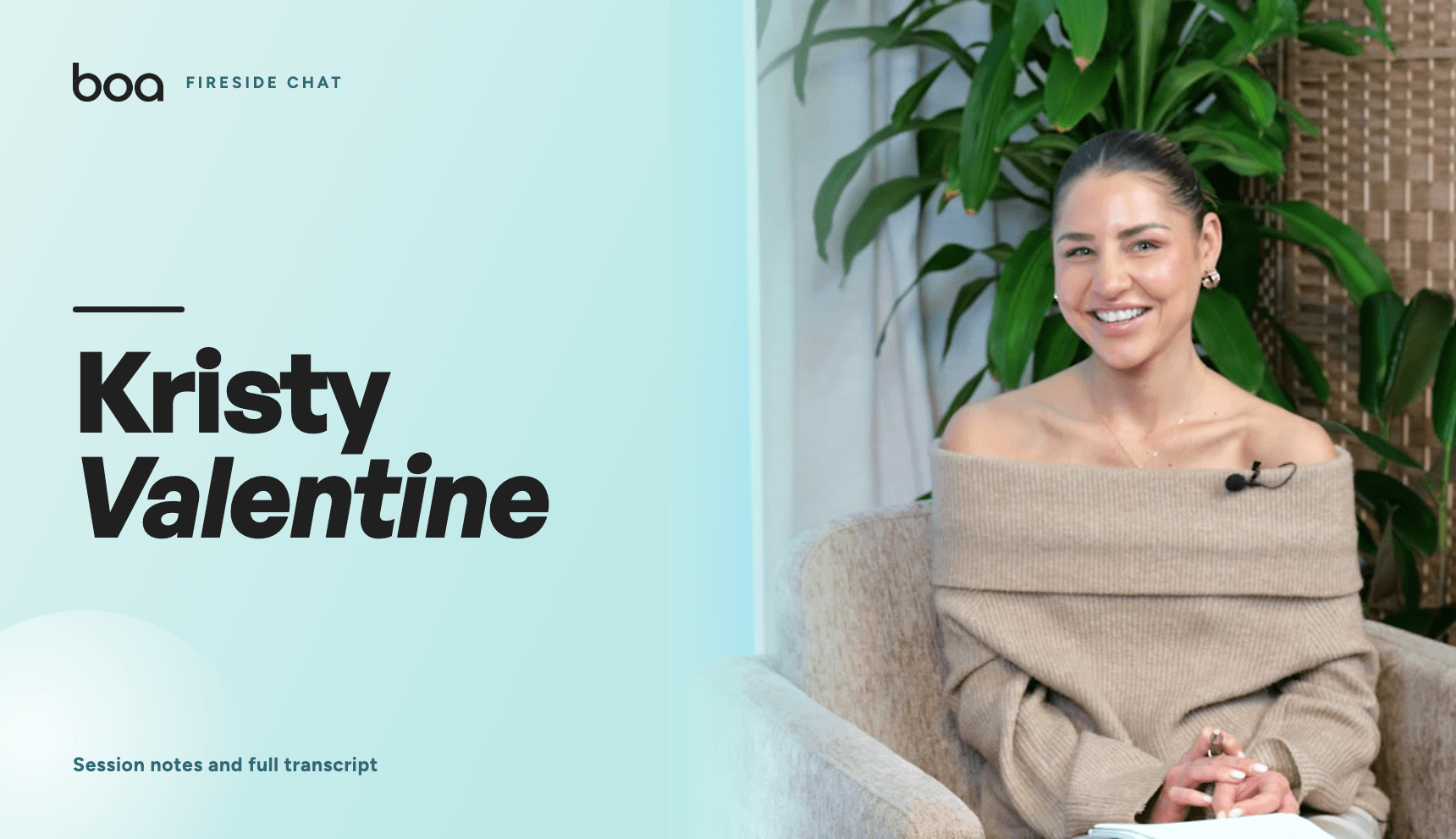
Kristy Valentine on Selling Dr. Dough After 8 Years
With Kristy Valentine, Founder at Dr. Dough · Hosted by Boa host · 36 min
What this session covers
Kristy Valentine built Dr. Dough into a delivery-only doughnut gifting business shipping 50,000 doughnuts a week, then sold it after eight years. She covers director guarantees, why a doughnut shop hired a CFO, the two non-negotiables she set before approaching buyers, and what acquirers actually check. For founders thinking about an eventual exit.
Set your legal structures, accounting and financials up on day one, because a buyer turns over every stone in due diligence and you cannot retrofit clean books later.
Key takeaways
- 01
Compress your two to five year plan when a shock hits
When COVID arrived, Kristy had just launched and already had the infrastructure in place. Rather than freeze, the team executed everything in their two to five year plan inside two weeks so they could handle the volume, reaching 50,000 doughnuts a week. Her mentor's line when she thought she had lost everything: "it's not an adventure if you know where you're going, so get on with it."
- 02
Hire a real accountant, not a cowboy, from the start
Kristy is blunt that finances must be in order from day one: compliant, up to date, ATO happy, payroll never skipping a beat. Her point is that this is not something you can switch on later when you want to sell. An acquirer turns over every stone in due diligence, and if something is not right you will not even be considered.
- 03
Pay for a CFO earlier than feels sensible
A doughnut shop with a CFO sounds absurd, and Kristy admits it was very expensive and a heavy line on the P&L. She invested anyway. Without it, Dr. Dough would not have been in a position years later to be considered for acquisition at all.
- 04
Understand director guarantees before you sign anything
Kristy's number one non-obvious item for new founders is director guarantees. Not everyone realises there are ways around signing them and you do not necessarily have to. She has heard from founders of 20 years and more whose guarantees came back to bite them at exit because they assumed guarantees were just part of doing business.
- 05
Ask your lawyer for options, not just the rules
Kristy's view is that lawyers do a good job of telling you the rules but do not always walk you through your options. Invest in legal advice when setting up entities, and push to understand what you can and cannot do, including what happens if the business does not work out. Separate entities so that if one thing goes wrong, the others are still protected.
- 06
Approach potential partners yourself instead of going to market
Kristy never listed Dr. Dough for sale. She approached a couple of companies directly, about a year or two before the sale happened, to explore whether there was a way to partner. The eventual sale process with the acquiring company ran roughly nine months.
- 07
Write down your non-negotiables before any sale conversation
Kristy had exactly two. First, the incoming party had to be the right fit and had to be able to grow Dr. Dough faster than she could alone, with more resources behind it. Second, the team stays together. She did not want someone to take the business and pull it apart after eight years of learning what works.
- 08
Expect your valuation to be higher than the paper valuation
The most common founder mistake Kristy names is valuing your business at more than it is worth on paper, because you have lived the blood, sweat and tears. Go in prepared for that gap. The numbers, not your attachment, will set the price.
- 09
Know what buyers actually check: financials and team
Buyers want to see the business is profitable and that there is a future in it. Then they look at the team: is it strong enough to continue the business, and is there a plan if the founder is no longer involved. Kristy cited a statistic she had heard that in the US around 80 percent of acquired businesses fail once the founder leaves, which is exactly why acquirers probe team strength.
- 10
Use the numbers to kill things faster
Asked what she would change, Kristy said she would make faster calls. If something is not working, do not let emotion argue for keeping it going longer. Use the data, because it is black and white and it will usually make the decision for you.
- 11
Be Captain Obvious in your customer-facing communication
For a pre-launch founder worried about trust, Kristy's answer was consistency and clarity across every customer touchpoint. Never make the audience assume what you do. Be crystal clear and repetitive about what the product is, what it does and how it benefits them, then get into the detail later.
- 12
When raising, sell yourself before you sell the plan
Kristy's framing: investors are backing you first. Be the spokesperson, know the business back to front, and stay clear on the vision without being distracted by industry fluff. They also want to see a clear and solid plan and that you are someone who accepts feedback and can be worked with, and communicating that well takes practice.
How the session runs
- 0:00Launching just before COVID and 50,000 doughnuts a week
- 1:36Why Dr. Dough is a gifting business, not a shopfront
- 2:16The sacrifices founders do not see coming
- 3:55Running Dr. Dough, Work Inc. and High End at once
- 6:44Hiring wisely in a startup and carrying the team's livelihood
- 8:00Legal structures, director guarantees and clean finances
- 10:36Why a doughnut shop invested in a CFO
- 11:20Brand authenticity as an extension of the founder
- 12:23How the eight year exit actually happened
- 13:58What buyers look for: financials and team strength
- 15:33The valuation gap most founders get wrong
- 16:48What she would do differently: faster calls, use the data
- 19:51Start with the end in mind and treat business as endurance
- 22:13Q and A: the Australian startup ecosystem versus overseas
- 24:53Q and A: the non-required things founders should know
- 29:00Q and A: building trust pre-launch with no track record
- 31:03Q and A: how early should you think about an exit
- 33:50Q and A: approaching investors for scale-up funding
Mentioned in this session
- Dr. Dough
- Work Inc.
- High End
- Lauren Kennedy
- ChatGPT
- ATO
- The Mentor
- Mark Boris
- Shopify
- WordPress
- Magento
- Sweden
- Stockholm
- Australia
- Boa
Questions founders ask
Kristy says the preparation starts at the beginning, not at the sale. Legal structures and financial systems shape how you run the business and cannot be turned on later. In her case, she began exploratory conversations with potential partners about one to two years out, and the actual sale process with the acquiring company took around nine months.
Financials first: is the business profitable and is there a visible future for it. Then the team: is it strong enough to keep the business running, and what happens if the founder leaves. Kristy referenced a statistic she had heard that around 80 percent of acquired businesses in the US fail after the founder exits, which is why acquirers scrutinise whether the business can survive without you.
Kristy's point, offered as her experience rather than legal advice, is that many founders do not realise there are sometimes ways around signing director guarantees and that you do not necessarily have to. As a director you are personally liable for anything you sign, including leases. She has heard from long-time founders whose guarantees came back to bite them at exit because they treated signing as a normal cost of doing business.
No. Kristy is clear that if you have built a business you are happy with, that makes money, sustains your expectations and lets you grow a team comfortably, an exit does not have to be part of the plan. What helped her was knowing an exit was possible at some point, which shaped how she built and treated the business. Her own sale was not about leaving, it was about resources and keeping the team together.
Kristy's advice to a pre-launch founder was consistency and extreme clarity. Every customer-facing touchpoint should say the same thing, and the audience should never have to assume what you do. Be Captain Obvious about the product, the benefit and the reason it exists, and save the clever marketing for later.
Full transcript
The complete conversation, as recorded, with every speaker attributed.
Boa host0:00
Let's kick things off. We were having a chat before and you were telling me some pretty incredible things. So you started your business in COVID, you were delivering 50,000 doughnuts a week. Yeah. Which is wild. Like, that's actually crazy.
Kristy Valentine0:15
It was incredibly wild. So I guess the good thing is we started just before COVID So we had all of the infrastructure set up so that fortunately when COVID hit, we were able to hit the ground running. And it really meant that anything within our 2 to 5 year plan, we executed in 2 weeks so that we could, so that we could be able to nail those volumes. But I think the key thing is at the start of COVID if anyone had a business during that time, you would know that in the beginning, we were all like, what the hell? We don't know what's happening. Everyone either thought I'm going to lose everything or, you know, this could be an opportunity. And I remember in the very beginning thinking, I've lost everything through no fault of our own, the business is gone. And I was talking to my business mentor and I sat there and said to him, oh my God, everything's gone. And he looked at me dead in the eye and he said, it's not an adventure if you know where you're going. He said, so get on with it. And that's exactly what we did. So we looked at the infrastructure and everything that we had already set up and in place. And we said, well, we are a food business, we can continue to trade, we deliver, we're not an in-store retail footprint. So yeah, we went from—
Boa host1:36
Which is actually quite a unique like structure to have for like a food business.
Kristy Valentine1:42
Yeah, absolutely not typical to a doughnut store at all, but we are gifting. So I think you could think of Dr. Dough as the same way you would think about gifting someone flowers for their birthday. So people gift doughnuts and it's a really fun way to connect.
Boa host2:00
Yeah, I love, and a delicious way.
Kristy Valentine2:02
Yeah.
Boa host2:03
Okay, so we actually touched on this as well, like your 4 AM wake up and everything else, but aside from that, what were some tough choices or sacrifices early on that most new business owners don't expect?
Kristy Valentine2:16
I would say that there's a lot of sacrifice and sometimes you don't actually realise exactly what that sacrifice is going to be until you're in it. I think a lot of times people, when they are starting a business, they think, well, what's the worst case scenario if this doesn't work out? You know, I'll go back and live with mum or, you know, something similar to that. But I think that what you need to be prepared for is when you are thinking of what's the worst case scenario, you have to think, am I actually willing to actually do that in worst case scenario? But Yeah, so lots of sacrifice. I remember in building Dr. Dough, every single cent was reinvested back into the business, and I'm really glad that we did that, and I wouldn't change anything about the sacrifice or the struggle. But, uh, 2-minute noodles were on the menu almost every single day because we simply could not afford to do anything. Um, you know, the sacrifice is not only, um, the, the menu of 2-minute noodles, but, um, you know, not seeing friends or family. And I didn't get to watch my nieces grow up. And so many people will say to you, oh, just, you know, you work so much, you're tired, just take a holiday. And I'd be like, man, I wish I could, but, you know, the, the sacrifice is that you are there 7 days a week. Yeah, it's your baby. Yeah, it is your baby. We were talking about that. Um, and yeah, whether you like it or not, you have to turn up.
Boa host3:50
Yeah. And you know, a lot of people are in the same position in our Boa community, so I'm sure they can understand.
Audience member3:55
Yeah.
Boa host3:55
Um, so you've juggled a few businesses at once. You've got High End, um, Work Inc., and I know a few other things as well in the works. How did you stay focused and manage the stress? Um, and like, maybe you'd want to touch on, um, Work Inc. and, um, High End as well.
Audience member4:11
Yeah, sure.
Kristy Valentine4:12
Um, so I'll start there. Um, I'm involved in a few different industries, um, and that's partly because I just love the variety and I learned so much from being in those other industries, and I can bring that back to and apply those to anywhere.
Boa host4:27
They're transferable.
Kristy Valentine4:28
Yeah, absolutely. Whether it's fashion or offices or donuts, there's always something that, um, yeah, that can be transferred. Um, so, and I think the, the other reason I do that is because I love being surrounded by smart people. It's energizing. I learned so much from them. So for example, at the coworking space, Work Inc, I've worked there with the founder for 8 years now. And he has been an entrepreneur his whole life. And I feel like working with him has been the equivalent of doing an MBA. So I've been really fortunate to, I guess, take that learning.
Boa host5:04
A lot more hands-on.
Kristy Valentine5:06
Yeah.
Boa host5:06
Yeah.
Kristy Valentine5:07
So that's been great. And then at High End, which is a fashion tech brand, Lauren Kennedy, the founder there, is probably the smartest person that I've ever met in my life. And that's what really prompted me to wanna be there. And then Dr. Doe, I founded that. I have the most incredible team. I'm so fortunate. Hi, Tom and Mercy. So yeah, so I just love being around them. But your question about managing the stress, So, um, I don't know, maybe I'm not the best person to ask, but I feel like, um, you sort of— well, for me, the way of managing the stress is actually getting comfortable with it. You said this yesterday. Yeah, and understanding that, um, you are always going to have pressures, whether it's financial, revenue, operational, staffing, um, all of those things are relatable to every single business no matter what you do. And all of those things are always up in the air, but I think you need to prioritise and be comfortable that there are so many things going on, but yeah, you just, yeah, I really think just understanding that there's always going to be a lot of things that are going on that you need to get to, yeah, by prioritizing.
Boa host6:28
Yeah, I mean, you've kind of touched on my next question. I've got, what were the most important things you did to grow your business without burning out? Maybe I reword that to what are the 3 key things that helped you manage the burnout to grow your business?
Kristy Valentine6:44
I think definitely what really comes to mind is the team. And being a startup, you can't necessarily afford to just have, you know, endless resources. So you need to bring people on when you're ready or when you're at the cusp of, of, of needing to take that next step. And sometimes it is difficult to understand when that point in time is.
Boa host7:08
But you've just gotta like go with it.
Kristy Valentine7:10
Yeah, but I think when you are choosing your team, do that really wisely, especially in a startup where you spend every moment with them. And like I said, I'm incredibly thankful for my team. Yeah, we, we show up for each other every day. And I think as a business owner, you carry the pressure on your shoulders that your team's livelihoods depend on you. So again, it's, you know, it's not a question about should I turn up to work today, it's no, I've got to turn up to work today. And I think we just have that reliance on each other, but that appreciation. Yeah, I love that.
Boa host7:54
Yeah, that's great. Looking back, what legal or financial decisions helped protect you and your business the most?
Kristy Valentine8:00
Yeah, sure. So I'd say there's two things. I think always invest in legal advice when you're setting up your business entities. And I think you always go into business with great intentions and, you know, you're always positive that it's going to work out, but you also need to be cautious of, well, what happens if it doesn't work out? And setting up, having the right legal structures and business entities and Really being intentional about understanding director guarantees and all of those things and what your rights are. I think sometimes lawyers do a really great job to tell you the rules, but they don't necessarily talk to you about all of your options. So I think, yeah, really understanding what you can, can't do, that's super important.
Boa host8:51
Yeah. Do you think, like, particularly as an early stage founder with like limited funding and everything else, there's a cheaper way to go about it. Yeah.
Kristy Valentine8:59
Well, I'm not saying ChatGPT is the answer. However, it might be. It wasn't a resource to me back when I was setting up the business entities, but now when I look at, you know, like the resources that are available, it's a great tool to use, especially if you're feeding it the right prompt. So yes, I definitely think that there are more affordable ways to do that. But I think the legal structure is really important so that if something goes wrong,, then your other business entities or, you know, all of that are still protected. And the other really super, super critical thing is make sure that your finances are in order. So you don't want a cowboy for an accountant. You really want to make sure that that person is keeping you compliant, up to date, is keeping the ATO happy, making sure that, you know, you don't skip a beat when it comes to payroll and making sure that your staff are looked after and all of that. That is super duper critical. And I think not only for the startup of a business, but I think if you are considering whether one day you want to exit your business, whether that is selling, passing the business on, you need to have those things set up from the start because it's not something that you can turn on later. It is incredibly, incredibly difficult. And if someone is acquiring your business, they will go through the due diligence of turning every single stone over. So if something isn't right, then, you know, you won't even be considered. And it is a huge investment.
Boa host10:36
Definitely.
Kristy Valentine10:36
We were a doughnut store, and you probably wouldn't typically expect that a doughnut shop would have a CFO, but we invested in that, and it was very expensive, and it is a huge expense on the P&L. But had I not done that, we wouldn't be in a position way down the track to then be able to even be considered for acquisition of the business.
Boa host10:57
Exactly, yeah. So it's little things right at the beginning of the journey that make the most impact.
Kristy Valentine11:01
Yeah, yeah, definitely. And I think it really governs the way that you build your business. So if you set up those foundations from the beginning, you are almost treating your business like, I don't know, I'd say kind of even manifesting where you want the business to go. Love that.
Boa host11:20
Yeah, yeah, it's absolutely true. Um, so how did you build strong brands in very different industries and keep them feeling authentic? Because they are very different industries. Eating doughnuts while dressed in fashion.
Kristy Valentine11:33
Yeah, yeah. Well, I think that, um, your brand is a reflection of you, and that is where the authenticity comes from. Um, and, you know, I'll give the example of Dr. Doe. We are fun, We're playful, and I think that is a reflection of who we are as a team and what we reflect, whether it's in organic socials or all of the customer-facing touch points that you see of Dr. Doe. But I don't think that, like, yeah, you can't fake that. The authenticity comes from sort of the top down. So I think that that is incredibly important to understand that Your business is actually an extension of you.
Boa host12:15
Yeah, I 100% agree with that. When did you start thinking about selling your business and what steps did you take to get it ready?
Kristy Valentine12:23
So I would say that from the very beginning is when we knew that there would be some sort of exit. I owned my business for 8 years before selling.
Audience member12:34
That's amazing.
Kristy Valentine12:35
But in the process where I was thinking about, you know, do we sell the business? I didn't put the business up for sale. I didn't go to market. I actually approached a couple of other companies to see if we could, if there was some way that we could partner. And I decided to go out and have those discussions probably about a year or two before we actually did sell the business. And I had two non-negotiables. One of them was that we wanted to make sure that if we did sell Dr. Doe, it would be the right fit with the incoming party and for Dr. Doe, and that we would be able to continue to grow and evolve Dr. Doe more quickly than we could do ourselves. Yeah, with more resources behind us. And the other non-negotiable was to keep the team together. So that was really important to me. So I'd say, yeah, probably in the last couple of years, But then the company that's purchased Dr. Doe, we probably were going through that sale process probably for about 9 months.
Audience member13:45
Wow.
Boa host13:45
Yeah. Just enough time to have a baby.
Kristy Valentine13:47
Yeah, exactly.
Boa host13:50
I love that. So what do buyers really look for when they consider buying a business and how can new owners prepare early?
Kristy Valentine13:58
So I'd say that financials are a huge one, I guess. It not only values your business, but they want to know that the business is profitable and that they can see a future for the business. And then I'd say they would really look at the team. Is the team strong enough? Will they be able to continue the business?
Boa host14:18
That's why it's also important to hire right from the beginning.
Kristy Valentine14:21
Yeah, absolutely. I think I heard a statistic the other day, don't quote me on this, but it's something like In the US, 80% of businesses that are acquired, when the founder leaves, 80% of those businesses fail. And I think it's just, you know, it's because the founder is such a huge part of the journey and the vision of the business and the brand. I have no intention on exiting Dr. Jum. I'm so excited that there are so many new things happening with the business, but Where was I going with this?
Boa host14:58
So what to— sorry, what buyers really look for when considering buying a business.
Kristy Valentine15:04
Yeah, so definitely strong team, that, you know, the founder is involved, or that there is a plan that if the founder is not involved anymore, that the business can still continue and succeed.
Boa host15:17
Yeah, I love that. So what's one thing most people get wrong about selling a business? And I think like what you touched on before, ensuring you have all the legalities and financials in place from the beginning and all those little things like definitely help.
Kristy Valentine15:33
I'd probably say that every founder will probably value their business at more than it's probably worth on paper.
Boa host15:41
Just because you've seen their blood, sweat, and tears. Yeah, correct.
Kristy Valentine15:44
So be prepared that, um, that your personal valuation may not reflect the actual valuation. So yeah, be prepared for that. But I would also say in our circumstance, like I wanna stay involved in the business, I want my team to remain involved in the business. It was really important to us that it was the right partnership. We didn't want someone just to take it, pull it apart. And because, you know, after having the business for 8 years and living, breathing, growing it every single day, We kind of know what works now, what doesn't. So yeah, so you want to make sure that that sort of DNA sort of remains in the business.
Boa host16:23
Yeah, but even the passion you have behind it, like, I think it's really important to have that as a founder, whether you're looking to sell or not. And that's probably what buyers also look for, like the passion behind it, why you feel like it's such an authentic business and successful one.
Kristy Valentine16:38
Yeah.
Boa host16:39
Now guys, don't forget to pop your questions in the chat because we'll shortly move to the Q&A. If you could start again. What would you do differently from the launch to exit?
Kristy Valentine16:48
I don't know, that's a great question. Although at the start I mentioned the 2-minute noodles and the struggle and sacrifice and all that.
Boa host16:54
Hey, if it's the chicken flavor, it's all good.
Kristy Valentine16:57
Yeah, that one made a regular appearance. But I wouldn't actually change any of the struggle, sacrifice, any of that, because I think that it just, it does help to make you more well-rounded in the end. I'd probably say, Sometimes it is a bit of really go with your gut and if something isn't working out, make a call early. Don't let emotion play into, you know, or maybe we should keep this going for longer if it's not working, you know, and always use the numbers to really back up. It's black and white and they will normally assist you in making that decision. So use the data, but I'd say, yeah, just for me personally, it would probably be about making more quicker decisions But I definitely think that although it was incredibly hard going through the struggle at the time, I don't know, it really is character building.
Boa host17:53
Yeah, and I guess like, it's like anything in life, like you never really look back and regret it or wanna change it. You just like, it's like character building.
Audience member18:01
Yeah.
Boa host18:01
Yeah. How has your approach to business changed since moving into a leadership role outside of your own business?
Kristy Valentine18:09
I think it's just been great to take things from all of the different industries and apply them in different ways. To take the learnings from the people around me. Yeah, I think, um, yeah, I think I'm one of those like freaks or weirdos that can't just do one thing. Like, I just thrive on doing different things and then having the ability to apply them in different areas.
Boa host18:34
Yeah, I love that. One of the things we do at our chapter meetups is we problem solve. So someone will share a challenge in their business and someone's been through it in their own, but it's a completely different industry and you're able to help each other.
Kristy Valentine18:46
Yeah, and we know, all of us here know, how hard it is being a business owner or a business leader. So that's why I thank you and Daniel and Laura and Jake and the team behind the scenes here for pulling this together because it's already hard enough. So if we can assist each other by problem solving or being inspiring or, yeah, just offering a solution or some advice, I think that that's incredibly important. I will just say that I do remember that in those hard days of the struggle, One thing that I can definitely say got me through is listening to the Mark Boris podcast, The Mentor, because when you are in a position where it's really lonely being a business owner, you're there listening to the storeys of founders going through the exact same struggle. And to me, that was like the light at the end of the tunnel to think, oh my God, this person, you know, they did this and they achieved this and they went about this problem in, you know, a different approach. And I think that that was really inspiring and one thing that, that helped to get me through.
Boa host19:51
Yeah, I 100% agree. I mean, I've touched on all the podcasts that I listen to, and it actually makes you feel a part of something. Okay, and finally, what's your best advice for someone building their business now who hopes to sell one day?
Kristy Valentine20:05
Um, I think you should definitely start with the end in mind. And again, like I said earlier, the way that you envision your business and setting it up a certain way from the beginning sort of governs the way that you will run the business. So yeah, set up your financials, set up your legal structures, and just be aware that being in business is endurance.
Audience member20:30
It is.
Kristy Valentine20:31
It's a long marathon. I know. And so many people say that, but it is absolutely true. You, you know, you have to show up every day whether you, whether you want to or not. But I do think that it's the endurance and resilience that, that will, I guess, get your business through the hard times. And the longer that you can stick at it and be more strategic, then I think, I think that definitely helps and gets you on your way to, to being successful. Definitely.
Boa host21:04
And one last thing to add to that, like we were chatting about it, no business has been an overnight success. Like, there's always been so much grit and grind in the back end of everything before you see them be really successful.
Kristy Valentine21:16
Yeah, so absolutely. Um, you know, there's so many circumstances where you might open Instagram and you see someone who seemingly is successful overnight. Uh, that very rarely happens. There is so much grind where you have to go through, um, I guess wearing all of the hats, whether you are your own legal team, HR team, cleaner, Accountants. Yeah, exactly. Absolutely anything. You have to sort of be well-rounded. Yeah, yeah, that's good.
Boa host21:46
Okay guys, we're going to move to the Q&A now. So Mats, you having a question? Yeah, I have two, but I'll take the first one, and it was, um, That's okay. Did you want me to read it out and you can— Yeah, what do you think about the startup ecosystem in Australia? And Mats, why don't you tell Kristy a little bit about your business just so she gets to know you? Oh yeah, yeah, I'm a business angel from Stockholm in Sweden and I've been working with a lot of startups here in Australia.
Audience member22:29
Yep.
Boa host22:31
Okay, cool.
Kristy Valentine22:33
Um, I think that, um, like I said, I'm very appreciative of BOA and what you guys are creating because, um, yeah, I think that the business landscape in Australia, um, is tough. Um, in my experience, support has been available when you actively go out and get it, um, and you are asking the questions and, um, yeah, actively seeking people to mentor or to assist you. But otherwise, I think there's, uh, in Australia, I don't know if there's enough understanding of exactly what goes into building a business. Um, so, you know, people don't like— it's not that they don't mean well, but, um, but it can be very discouraging when, um, I don't know, sometimes it seems that it's like that tall poppy syndrome thing. Definitely. Yeah.
Audience member23:24
Yeah.
Kristy Valentine23:25
Um, but I do know that in dealing with or speaking with whether it's investors overseas or things like that, very quick to make decisions. And I think that there's probably a lot, a bit more speed and turnaround overseas versus Australia. I don't know, I think they would probably be my observations.
Boa host23:50
Yeah, because I'm, when I compare it to Sweden, which is the most innovative country in the world. We have so many good startups, um, and they also have a government to understand that this is the next, um, thing for the society. So of course they pamper them and they also give them kind of a highway. And I notice here in Australia the struggle because run out of the money. Yeah, that's, that's really bad. But you have all the components, but it's not really connected. Yeah, I definitely agree. Yeah, that's a very good observation, Mats. Um, Nate, should I take the next question also? Uh, sorry, Nate, we might just— Mats, uh, Mats, we'll come back on your second question if that's okay.
Audience member24:45
Awesome.
Boa host24:46
Thank you. Hey Nate, did you want to give a little bit of intro about yourself and your business and then ask Kristi your question?
Audience member24:53
Yeah, sure. So I'm a software developer for 20 years. I've started my business where I offer technical solutions to non-technical businesses. So it might be setting up a Shopify site, WordPress, Magento, the scale depends on what you need. And you've caught me just as I'm putting out some marketing flyers. I didn't realise I'd be on camera. But my question was just around— you were saying the accounting and legal structures are super important to get in place at the beginning to help with the full growth of the business. I wanted to know what some of the non-required things were when you start a business.
Kristy Valentine25:43
Probably the one that comes to mind immediately is director guarantees, which I'm not legal advice or accounting advice or anything like that. So like, I want to be careful about what I say, but we'll put a little disclaimer down the bottom. But you know, one thing that not everyone realises is that there are ways around signing them and you don't necessarily have to. That was a big one that I learned very early on. And, you know, even founders that have been in business for like 20+ years will tell me that when they're exiting a business, all of the guarantees sort of come back to bite them. But they just think that it's like a part of doing business. So I don't know, that's probably one example that I have. But does that sort of answer your question, Nate? Is that what you—
Audience member26:38
Yeah, it does for sure. Um, in my experience, like, my career was always working for someone else, of course, and so I never really got a sense of the overarching elements that go into a business. And so it's super interesting just getting awareness in those things. Yeah, normally, you know, there's a legal team and a marketing team and all these different people. But as an entrepreneur, you kind of have to know all of those things.
Boa host27:04
Yeah.
Audience member27:05
In various ways. So yeah, thank you.
Kristy Valentine27:07
And I think the reason I bring up the director's guarantee is because as a director, you are personally liable for anything that you sign, whether it's a lease, a guarantee, you know, any of that. So you just have to like understand what you're actually doing when you're, when you're taking on that obligation.
Audience member27:25
Hmm, and so would you say that the legal side of things really comes in place once you have staff? Like, can you get by without a legal structure before having staff? Ah. Because you're already liable in terms of having money?
Kristy Valentine27:43
Yeah, I think so. In my experience, the legal side started to come into it first of all with leases. Taking a commercial lease, which is typically, it depends on your business or industry, but typically a 3 to 5 year thing. So you wanna make sure that you are protected upfront and you know what you're getting into. And then I think, and then as we grew and we had different businesses that we were operating, then I think the legalities came in where it was keeping each entity separate. And understanding what the benefits of doing that versus, and also there's a downside to doing that too, but weighing up, I guess, what you, what's more important to you.
Audience member28:34
Yeah, cool. Thanks so much for answering those questions. I better bid ash, keep doing stuff, but thanks so much.
Boa host28:41
Thanks, Nate. Thanks, Nate. Bye-bye. So next we have, sorry if I don't pronounce this correctly, Shabnam. Yes, hi.
Audience member28:53
Hello.
Kristy Valentine28:54
Hi.
Boa host28:54
So did you want to give a little intro of your business, um, and then ask you a question?
Audience member29:00
Yeah, definitely. Uh, so this is the first time I've been in this sort of business. We are building a barefoot children's shoe brand and we're still pre-launch. So as someone who has no sort of credibility experience And given that my focus gamers are parents, I'm just concerned about that trust element. You know, I'm a parent myself, so I can definitely relate. But what would you say is crucial to building trust with your customers in the initial years of the business, initial days? Is it mostly just social media and how you show up?
Kristy Valentine29:37
Um, yeah, I think that, um, yeah, definitely how you show up and how you communicate, um, what you're doing, what the benefits are. I think, you know, we were talking before about that authenticity, and that will definitely show through what you put out to the world. And I think just making sure that all of your customer-facing touchpoints are consistent and obvious. So making sure that the audience is not assuming what you do, just be really clear. And I also say Captain Obvious about what it is that you do, just so that there isn't any of that ambiguity around, um, around what it is, and that the message is just super crystal clear.
Boa host30:21
Because I hate it when I look on someone's social media and I don't know what the business is. Like, I'm actually looking in their tag things to find out if I can learn more, but there's just no indication.
Kristy Valentine30:30
Yeah, you want to know up front, like, what is it, what does this do, how could it benefit me? Um, and then, you know, you can get into all of the other details later, but I think definitely just being crystal clear and consistent in your communication.
Audience member30:43
Yeah, perfect. Now that makes sense. So just don't be too clever with your marketing, I guess.
Kristy Valentine30:48
Yeah, yeah, simple. Yeah, there's a time and a place for that, but yeah, but I think definitely simplicity.
Audience member30:55
Amazing, thank you so much.
Boa host30:56
Thanks. Thank you. Mats, would you like to ask your second question?
Audience member31:02
Yeah, thank you.
Boa host31:03
Thank you. Um, yeah, that's something I've noticed both in, uh, here and, and Sweden, uh, you many of the startups is lacking of an exit strategy. And, and once— why that is important is, of course, if you— if your vision is just to sell the business, that's another vision that you want to have it over time, or this is what you're going to live with for the rest of your life, or whatever you have. But I think that is something that tends to be Yeah, missing or, and so on. But I heard that you said that you were quite early. How early were the exit thoughts?
Kristy Valentine31:45
I think from starting the business, always knowing that at some point there would be an exit. Um, but I'm not necessarily saying that an exit should be part of everyone's strategy. I think if you can build a business that you are happy with, um, that is making money, that is sustaining, um, like, you know, your expectation and you can, you know, you can comfortably, you know, grow your team and that sort of thing. Like, I don't necessarily think that everyone always has to have an exit. It's really gonna be what you're comfortable with. And again, for me, exiting, well, not necessarily exiting, but selling the business was not about leaving it completely. It was about achieving those two non-negotiables, which were, I wanna make sure that we have more resources to grow the business further and faster than we could on our own. And the other thing, like I said, was keeping the team together. So I think, yeah, understanding that there would be an exit at some point sort of helped to shape the way that I treated and built the business. But really getting serious about, looking at taking that step to actually sell the business came really sort of late in the piece. But fortunately, I was set up and in a good position to be able to sell the business.
Boa host33:10
Yeah, because what I meant was like, if you haven't thought about it and suddenly someone approaches you and says, I'm gonna buy it for $1 million, and you say, okay, that seems good, and you say yes, and then afterwards you see the worst was probably $3 5 million. So that's what I meant. If you prepare for it, you can kind of adjust that over the time, but at least you have the strategy.
Audience member33:33
Yeah, yeah, that was—
Boa host33:35
yeah, great. Thanks, Mats. Now, I don't know if this is the right way to word this, but someone sent through, rather than preparing your business for sale, how would you suggest a business approach the market to attract investors or some other funding to assist with scale-up?
Kristy Valentine33:50
Um, so with Dr. Joe, we didn't actively go out seeking investment or funding. Um, that's a good question. Um, I'd say that, you know, you need to be the spokesperson for your business, um, and make sure that you know it back to front. And you have to be, I think, crystal clear on the vision and not get distracted by, you know, the fluff or, you know, other things happening in the industry.
Boa host34:24
Yeah, stay in your lane.
Kristy Valentine34:26
Yeah, yeah, yeah. Like when someone is talking to you about investment, they will want to, first of all, they are believing in you. So that is the number one thing. They are investing in you as a business owner and a belief that you can grow and make the business successful. And yeah, the other thing is they will want to really understand that you have a clear and solid plan, that you're willing to accept feedback, that, you know, that they're going to be someone that you can work with. So I'd say that, yeah, just, you know, you are the spokesperson. So if you are seeking that investment, make sure that you know your business back to front and that vision and that you can communicate that, and that comes with a lot of practice.
Boa host35:14
Yeah, that's a good answer. Yeah. Okay guys, well, thank you so much, Kristi. Honestly, so many gems this morning. Like, yeah, I just think you're incredible entrepreneur, a hybrid entrepreneur. Um, you are honestly so successful in everything that you do, and we're very grateful that you joined us this morning. So guys, if you do want to watch, rewatch, relearn, um, today's session, it will be on the video content library. And we would love to hear your feedback after the session. See you later. Thank you.
Audience member35:45
Bye. Thanks, guys.
Watch the full sessioninside Boa.
Session notes are free. The recordings, the live advisories and the founders in the room are for members.