Fireside Chat
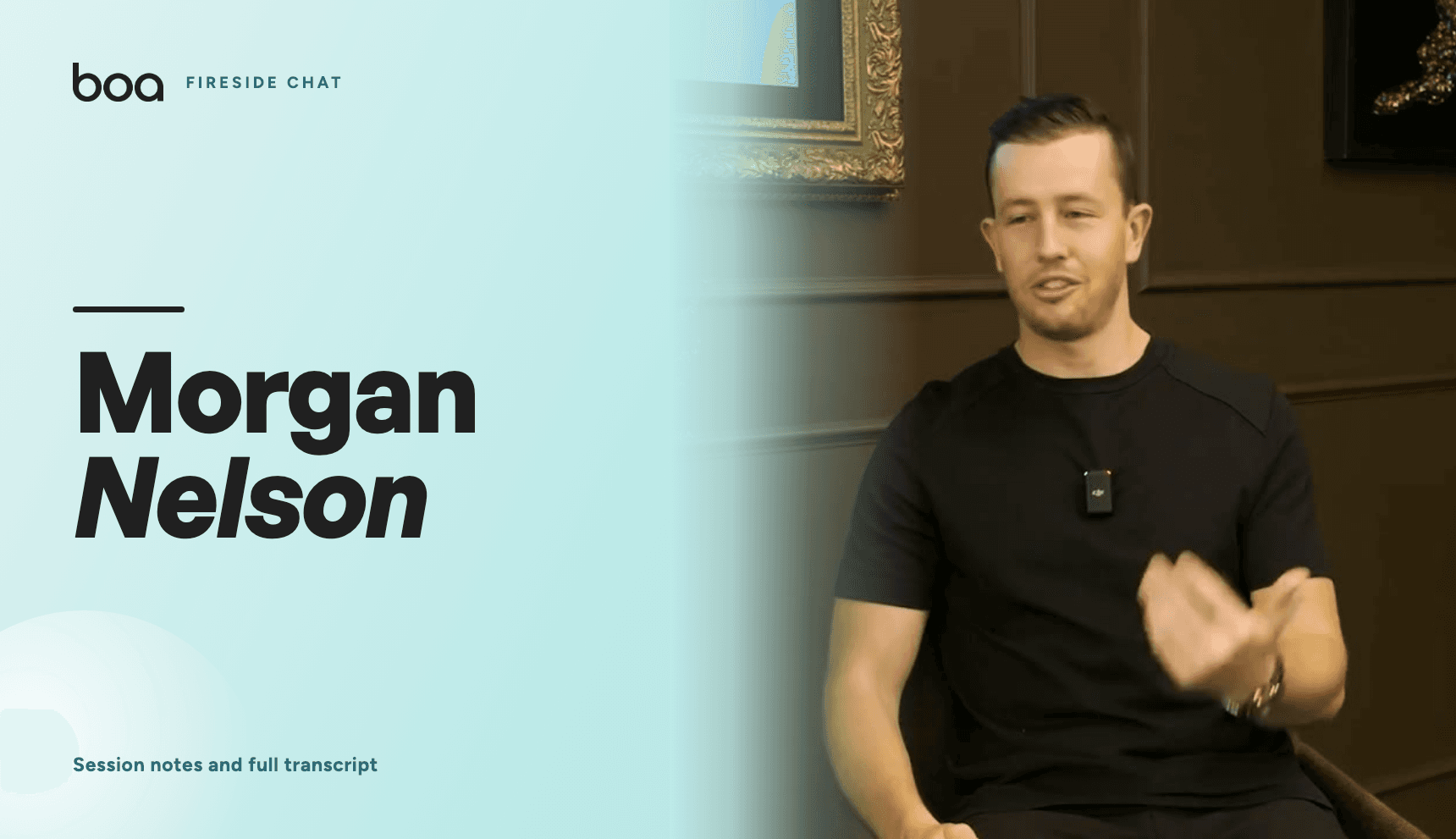
Morgan Nelson on Fear, Self-Worth and Selling
With Morgan Nelson, Founder and Host at Dream Out Loud · Hosted by Boa host · 49 min
What this session covers
Morgan Nelson breaks down why fear, imposter syndrome and low self-worth stall business owners, and what to do about each. Covers his three steps to transformational change, the pattern interrupt he uses on bad thoughts, a three-task daily plan for overwhelm, and the sales shift from salesperson to consultant. For founders who sell.
Attach your self-worth to the behaviour you control (the asking, the calls, the reps), never to whether the other person says yes.
Key takeaways
- 01
Run the three steps: awareness, understanding, reconditioning
Morgan's model for changing any behaviour has three parts. First, notice the pattern as it happens ("I'm doing that self-worth thing again"). Second, trace where the story came from, because most 40-year-olds are being run by a decision a 7-year-old made. Third, recondition through repetition, like the gym, doing the scary thing again and again until your brain has evidence you are someone who acts anyway.
- 02
Peg your self-worth to the action, not the outcome
You cannot control whether a prospect says yes, so never make that the measure of you. Morgan puts his self-worth on the behaviour he can control: pushing through the fear and asking. If you close 20 percent and you need four sales this week, do not chase a better close rate, book 20 conversations instead. Conversions usually lift anyway because you feel better about yourself.
- 03
Test your self-worth by asking a stranger to buy you something
In Morgan's Mind Money program he sends people out at lunch to ask a stranger to buy them something. Some come back thrilled with a free dinner. One person cried after asking for a free cup of water at Hungry Jack's. His point: if you cannot ask a stranger for a cup of water, you will not ask a client for $5,000. Use the exercise as a mirror on what you believe you deserve.
- 04
Use a rubber band as a pattern interrupt on limiting thoughts
Morgan wore a thick rubber band on his wrist and snapped it every time he caught a thought he did not want. The small sting breaks the flow of the thought, then he consciously redirected it: "I don't know if I can do this" becomes snap, "of course I can do this." Human behaviour is patterns because the brain wants to save energy, so the interrupt has to be physical and repeated.
- 05
Plan the day with three tasks, your bare-ass minimum
Morgan does not start a month, week or day until it is planned. Each day he picks the three highest-impact tasks that move the needle and ignores everything else. Get them done by 10am and the day is already a win. On bad days, do the three and take the rest off, because you still kept your word to yourself. Most people stretch small tasks out by worrying about them first.
- 06
Change your environment to kill imposter syndrome
Morgan cites the Asch line experiment: paid actors picked the obviously wrong line, and by the fifth or sixth round the real participant agreed with them. Environment overrides your own eyes. So surround yourself with people who think your doubts are stupid, rather than people who think your ambitions are. Imposter syndrome itself is normal at any new level, and its absence means you have stopped growing.
- 07
Stop future pacing the outcome you do not want
Fear is the anticipation of pain in the future. Before he exits the plane skydiving, Morgan closes his eyes, comes back into his body and visualises only the joy and the next step. Apply the same in a sales meeting: do not run the film of them saying no, just stay present and listen to what they are actually saying. Belief gets built from state, intention, evidence and visualisation, and future pacing is the one that ruins most people.
- 08
Fix the talk ratio before you fix your script
Reviewing a rep's lost deal, Morgan read the Fathom transcript at 2x and stopped early: the prospect said a few things, the rep said a lot. The prospect had already described problems the product solved. The fix is asking better questions so the buyer does most of the talking. Silence has power, and over-talking kills otherwise winnable deals.
- 09
Sell as a consultant helping someone buy, not as a closer
Morgan reframes sales as service: people do not like being sold to but they love to buy. Ask what they are actually looking for, where they are now, what is stopping them and what success looks like. On glassware, that means asking whether it is for clients, home, kids or wine, then confirming the spec: crystal, four-pack, that budget. Then show two or three options that fit.
- 10
Close with "so what do you want to do next?"
Morgan's favourite closing question is not "let's sign you up" but "cool, so what do you want to do next?" It removes the closing feel and lets the buyer state the decision. He also quotes Chris Voss: the worst thing you can get someone to say is yes, because they feel they have been got. Try "so you're against getting this set up today?" and let them agree by saying no.
- 11
Start the day doing something you do not want to do
Morgan does an ice bath on his deck daily and has never once been excited about it (his record for pacing the living room negotiating with himself is 20 minutes). The value is not the cold, it is spending the first 90 seconds overriding your own resistance. Even if the rest of the day falls apart, you did the hard thing you controlled. He stacks the gym and his most annoying task first for the same reason.
- 12
When self-worth blocks you, shrink the goal instead of forcing it
Morgan's answer to someone whose self-worth stops the reconditioning stage: stop trying to climb the whole mountain before you have boots on. He sees employees of 20 years who have never earned more than $80,000 declare they will make $1 million in year one, and the identity alarm bells go off. Slow the car down before you throw it into forward. Ask what you know you should be doing and are not, then do the smallest version of it.
How the session runs
- 1:30What mind control for entrepreneurs actually means
- 4:12Inside the Dream Out Loud Method and the five laws
- 6:55Fear, the six needs and the reptilian brain
- 10:28The coffee shop reframe for rejection
- 12:46Three steps to transformational change
- 18:50How belief is built and why future pacing ruins sales
- 21:34Imposter syndrome and the Asch line experiment
- 24:38The rubber band pattern interrupt
- 28:14The bare-ass minimum: three tasks a day
- 31:21Why founders think sales is bad
- 33:19Talk less, ask better questions, be a consultant
- 39:04Chris Voss on why yes is the wrong answer to chase
- 40:07Q&A: daily habits for mental resilience
- 45:00Q&A: when low self-worth blocks the reconditioning
Mentioned in this session
- Dream Out Loud
- Dream Out Loud Method
- Club Brisbane
- Gold Coast
- Harvard University
- Asch Experiment
- Hungry Jack's
- How to Win Friends and Influence People
- Jeremy Minor
- Chris Voss
- Fathom
- Matilda
- Brisbane
- Navy
- CIA
- Trump
Questions founders ask
Morgan says self-worth should sit with the behaviour you control, not the outcome. Use the coffee shop reframe: a waiter who asks "would you like a coffee?" and hears no thank you does not throw a tantrum, they move to the next table. Track the number of conversations you have rather than the yes rate. Conversions usually climb once the pressure comes off.
Change who is around you. Morgan cites the Asch line experiment, where a person watching actors pick an obviously wrong line eventually agreed with them, to show environment beats your own judgement. Surround yourself with people who think your doubts are stupid rather than people who think your ambitions are. Then use a physical pattern interrupt, like snapping a rubber band, each time the thought surfaces.
Morgan uses what he calls his bare-ass minimum. Plan the month, week and day in advance, then pick the three tasks that genuinely move the needle and treat those as the definition of a successful day. Everything else is either delegated or pushed to next week. He asks his team of each task, "does that have to get done today?" and most of the time the answer is no.
Talking too much. Reviewing a lost deal, Morgan looked at the call transcript and saw the rep speaking far more than the prospect, even though the prospect had already described problems the product solved. Swap the ratio by asking better questions about where they are now, what is stopping them and what success looks like. Then confirm the spec and show options that match.
Morgan's definition is doing the thing you said you would do long after the feeling in which you said it has gone. He does a daily ice bath he has never enjoyed, plus the gym and his most annoying task first thing, purely to bank evidence that he follows through. Low self-esteem comes from repeatedly breaking your own word. When a genuinely hard period hits, your mind draws on that evidence.
Full transcript
The complete conversation, as recorded, with every speaker attributed.
Boa host0:00
Um, guys, we are going to start today. Now, most of you know that our mission at BOA is to make a high-quality, enjoyable networking and advisory available to every business owner in the country, regardless of their stage of business or where they're located. And today we have the opportunity to learn from someone very, very special, um, uh, Morgan Nelson. Morgan is a specialist in mind control for entrepreneurs And don't worry, he's going to explain what that is. I was just asking him about it. Um, he's also the host of a number one ranked podcast, Dream Out Loud, and he's a self-made multi-seven-figure business owner. Um, his business is, uh, is, is truly incredible. He was just briefing me on it, and I'm very excited, um, to, um, to have the opportunity to interview Morgan for everyone today. And Morgan, first of all, welcome. Um, Actually, before we start the interview, guys, we are going to do Q&A too, so make sure you write down your questions. I'm going to ask Morgan a few questions as always. Write down your questions. The team texted, texted to me, so I pick up my phone. So if I'm, if I'm on my phone, I'm not texting anyone, I'm seeing your questions, and I'm going to ask, I'm going to ask you to ask Morgan directly. And today's conversation is all about overcoming mental obstacles, um, the psychology of persuasion and sales and how to remain consistent and basically master yourself. Morgan, thank you so much for being here today, brother.
Morgan1:27
Thank you so much for bringing me in here. I love, I love this whole place you got.
Boa host1:30
Yeah, Cub Brisbane is a beautiful club. It's actually my favourite right now. Um, now Morgan, I kind of briefly said it there, but what is mind control for entrepreneurs?
Morgan1:39
Yeah, so I guess, so what got me very fascinated in this entire place of actually trying to always figure out where did it begin for me, and I think everything, everything that we do in life comes from either something we got or didn't get during growing up. And I think if we were to really be honest, where probably the obsession of mind control and understanding just humans came from was trying to understand myself so much as a teenage boy. It's like any dudes can play, you know, I think everyone tries to understand themselves more growing up, right? And ever since I was young, I just try to understand myself more and more and more. And then when I was 21, I started in business and I started to understand, so self-development I started to get into. And as I started growing my first business, I came up against all of my own barriers of fears, limitations, the doubts, the concerns, the worries about what people are going to think. And you've got, you know, list all of the other things that entrepreneurs and business owners go through. And I found ways I could sort of get into my own mind and overcome it. And throughout the last few years, people keep asking me, what do you do? What do you do? And I'm like, if I was really put into a nutshell you know, I teach people how to control their minds so they can control their life and create their dream life. And it sort of turned into this whole like mind control expert thing because one thing I'm absolutely obsessed on is human influence, you know, and that is such a broad topic. But a lot of people want to understand human influence, how we can influence other people for sales, for marketing, for leadership, um, you know, how can we essentially persuade someone to do something that we want them to do, hopefully ethically. In order to do that, we first gotta be able to control ourselves. You know, we can't— you know, one of my mentors has spent 2 decades doing secret intelligence for the Navy, right? He trains all the 3-letter agencies you can imagine, and he trains these people. One thing he says to me, he's like, if I put you into an aeroplane and I gave you the checklist, the safety checklist, does that mean you can fly an airplane? Like, no, not at all. He's like, so you need a lot more than just the skills. A lot of people are out there, they're trying to find the skills. What's the script I say to close the deal? What's the script I say? How do I— what do I have to say to myself? And they're looking for all these skills, but it doesn't matter about the skills or the checklist that we have until we can really understand what's happening inside of here. So one thing he works on is— and still when he works with people like in CIA— is helping them understand themselves more to develop a higher level of confidence. Because if you're not confident enough to execute on the things you know, then you're not going to do anything with the things you know. So everything that I do is help people really master their mindset so they can really tap into a high level of confidence, a high level of self-image, and really master themselves. Then they can go out there and create the ripple effect they want to have.
Boa host4:12
Now guys, um, I know a lot of you know Morgan already in his businesses, but, but Morgan, would you mind also sharing? Because you put on these giant seminars, uh, like 3-day seminars, some of them, um, basically teaching people how to leverage their mind to scale their business. Can you just give us just a very brief insight into your business and into what you're operating at the moment?
Morgan4:33
Yeah, so I run a few different businesses, but our main one is transformational education for entrepreneurs and business owners. So we have lots of different seminars because I can't get everything in one weekend, unfortunately. But our main program, the Dream Out Loud Method, stemmed from my 5 laws of how to create your dream life, you know, having the right vision, the right environment, the right timing, the right vehicle, and the right you. And a lot of this all comes down to understanding how do we become the right you, which all comes down to our beliefs, our values, our identity, how we view ourselves in the world. So essentially what I do is I take people for 3 days and start to tear down the walls of their own psychology, you know, tear down the walls of their own patterns, what they understand, their own self-image. Their identity so they can really, I guess, put themselves back in a situation, in a place that they want to be. And so I always give the example that in our new studio that we just built on the, on the Gold Coast, so they came and installed air conditioning the other day, and at the end of installing it, he gave me a manual. He goes, here's the manual so you can know how to use it. I said, well, what, what's there to know? I'm like, isn't there a remote? On, off, temperature up, temperature down. Fan speed up, fan speed down, like what else do I need to know? He's like, it's pretty much it. I'm like, why do I have an owner's manual then? He goes, oh, it just comes with every model. I'm like, that's so insane that you give me an owner's manual for an aircon unit where there's only 3 things you ever do with an aircon, but when you're born, no one ever gives you an owner's manual on life. No one ever gives you an owner's manual on yourself, on how to emotional control, emotional mastery, psychology. No one ever gives you an owner's manual. So what I like to explain to people is in my 3-day Dream Out Loud Method programme is I like to help them really understand themselves to a degree where they feel like they have an owner's manual to their life after. They know how to literally manufacture the results they want on this, on this planet. So that's that one. And then there's, there's business programs, there's speaker training programs.
Boa host6:25
But basically you're educating people and have programmes to help people master themselves, to master their business and their life.
Morgan6:33
Educating and unlearning.
Boa host6:36
Yeah.
Morgan6:36
Yeah.
Boa host6:36
I imagine that I need a lot of unlearning personally.
Morgan6:38
Most people do. Most people do, right? Like we're like 95% of who we are is all been programmed in us between 0 and 7. So most people are being a 40-year-old business owner, but they've been— it's like, would you get into an aeroplane if there was a 7-year-old behind the seat? Probably not. But that's what's happening in our life.
Boa host6:55
So now I want to talk to you about a few mental limitations that come up for business owners all the time. I'm sure everyone here today has experienced fear in business. Fear is one of the things, like, first of all, starting a business is scary. Like when you start a business, you're basically becoming a new person. Like, you, you don't realize, but you're entering a completely new lifestyle. And the fear of what people are going to think of you, the fear of are you capable of doing it, the fear of asking someone to buy your product, you know, business just has so much fear, um, to, to overcome. What tips do you have in overcoming fear? And do you see that fear gets in people's way of success?
Morgan7:32
100%. Fear is the number one reason that stops everybody from doing everything, and it stems from because all we're all trying to do at the end of the day is get our needs met. That's it. So we have beliefs, we have values, we have this identity, this self-image of ourselves, how we see ourselves, but every single one of us is trying to get our needs met. And our needs, the best way to explain it is if I put your head underwater, what's the only thing you eventually care about? It's air, it's breathing. It's the only thing. If I hold your head underwater, eventually the only thing you care about is breathing because you need air. And we all have, we have 6 different needs actually, everyone's trying to get them met. People have a need to feel significant, to get approval, to be accepted, to, people have a need to be seen as someone who's strong and powerful, or need to be seen as an intelligent person, or someone has a need to be seen, literally this is how shocking it is, somebody has, some people have a need to be seen as the victim. And they have these different needs that have to get met, okay, like they need air, So in order to get a need met, they have a deep fear of not getting their need met. Every single need has a higher level fear attached to it, so fear of rejection, fear of being not accepted, fear of being, oh, um, uh, pranked, fear of being like lots of different things, fear of being seen as stupid. So these are all these really hardwired fundamental fears that people have already built into them that they're not even conscious. 99% of people are not conscious of these fears, but they rule our life every single day. Because what we need to understand about our brain is there's 3 sections of the brain. The first one is our reptilian brain, okay? This is the thing that goes back tens of millions of years old when we were out in the tribe hunting, and as a tiger jumps out, it's the brain that says run away or fight this thing. And everything, every one of our decisions is made there already. Then we'll justify it with our prefrontal cortex and logic you know, put logic on it and that's how we can make sense in this modern world. So all these fears that play out are all there because we've put logic on it. So let's say for example, well, I don't want to— so, so we were talking before how you don't really like public speaking, right? So there'd be some sort of super deep unconscious fear there where it's like, but if I do this, then this, and it'd be interesting. Everyone's going to think I'm an idiot. But how you move through is the question you asked. How you move through the fear is number one, is being aware of it. Number two, understand where this fear came from. And you already said like, one time I did this speech and it scarred me, right? So we can understand where probably this major sort of thing happened in our life that created this 'I don't like this' thing, right?
Boa host10:02
And that's causing us to think a certain way. So if you have a fear of like, for example, asking someone to buy your product, like to close at the end of a sales pitch, like Why are you fearful of that?
Morgan10:15
It's a self-worth thing, fear of being rejected by someone. Yeah, and there's a meaning and emotion attached to it, that's the thing. So if somebody has a fear like, well, what if some— this person says no? So what?
Boa host10:28
So what?
Morgan10:29
You know, one of my mentors said to me, he's like, he goes, if you don't ever want to get rejected, go sell ice cream. Like, just don't get into business, don't get into business, go sell ice cream to somebody.. And one of the best reframes, it always comes down to looking at it from a different perspective. And he said to me is this, this is what really helped me get over my fear of selling to people. Because I really literally thought if I got rejected, it's going to like paralyse me. And he said, he's like, if you were a waiter in a coffee shop and your only job was to go up to someone and say, hey, do you want some, do you want a cup of coffee? They're either going to say yes please or no thank you. And if they say no thank you to you, are you going to throw a tantrum? And be like, oh my God, I got rejected. No, you'd probably just go to the next table. Because if you just understand that your self-worth isn't attached to the thing itself, your self-worth is actually attached to the outcome that you can, sorry, it's attached to the behaviour you can control, which is the action, right? You'll always, you'll increase your self-image.
Boa host11:25
So your self-worth is in asking.
Morgan11:28
100%.
Boa host11:29
Not in them saying yes. Your self-worth is actually in you trying, starting the business, asking for the sale, um, um, all things you can control is yourself.
Morgan11:40
All success is a direct reflection of our own self-worth. Whatever we believe we're worthy of receiving, we will accept. Everything underneath that will reject or not see it as an opportunity for us to take. So it was— so we ran a programme last week called Minor Money. And one of the activities I make people do, and they lose their shit when I ask them to do it, I say, your task this lunch break is to go and ask a stranger to buy you something. And people, like, you see the panic that most people have. Some people come back in absolute tears, and I'm like, I just asked you to ask a stranger to buy something, that's it. Because they all come back in and we start really unpacking their self-worth, like, where, where, because that puts the mirror in front of them. It's like, well, are you worthy of asking a stranger to buy you an ice cream? And then you see some people who have this high level of self-worth and they're like, "Oh, I got a free dinner." That's incredible, right? And then some people come back, like last weekend we had someone crying because they felt so bad asking someone at Hungry Jack's to give them a free cup of water, right? I'm like, so this is the level. So if you can't ask someone to give you a free cup of water, how are you going to ask a client to pay you $5,000?
Boa host12:46
So how do you overcome this fear then? How do you overcome fear in business? Any type of fear?
Morgan12:51
So there's 3 steps to transformational change. First one is awareness. Okay, so we can't intervene with the world that we can't see. So we've got to become aware of these patterns that are playing out that aren't serving us. So any sort of fears, these limitations, these doubts, anything that's stopping us. So we become aware that, oh, I'm doing that self-worth thing again. I'm afraid to speak to someone about my product. I'm afraid of this. Oh, bring awareness to it. In magic, they say technique shown is a technique blown. If a magician shows you how to do the trick, you're not impressed anymore. You're like, ah, loses its power. So the exact same thing can happen if we actually put the flashlight on, on our own problem and we become aware of it and we start to understand it, which is number 2. So number 2 is understand the pattern a little bit more. Where did this come from? Where did I create this? Because you're not born like, you're a new kid, is born already like so, so adventurous. It's, it doesn't have any limitations yet, right? Like your kid and my kids, June and June, like what's gonna happen? You see a 3-year-old kid would just run around there, go up to a stranger, hey, you're my friend. Let's be friends. No fear of rejection. But then one day, little Sally in the, in the schoolyard says, no, I don't want to be your girlfriend. And ah, creates this massive storey in this drama, right? This is how we start to create these things in our life. So we need to understand where this actual, this fear originated from, where it came from, and we start to unpack it. Because most people living their life as a 40-year-old, but they're being run by a 7-year-old. If we can understand the moment where we actually created these stories, because all we do is create, we create storeys because we're in this, our brain wants to create some sort of certainty as a base level of who we are. We need to figure out who we are in this world, who, what's our identity, who are we, what's our self-image. Once we have these belief structures created, we won't actually question our belief structures. But this is the craziest thing, we won't question them, but we keep acting in ways to confirm what we believe to be true about ourselves, even if the thing we believe to be true isn't something we want. Because our brain craves certainty, not discomfort. There's discomfort in growth, so we'll crave certainty, so we'll keep acting out ways who we believe we are so we can get this certainty, right? So we need to start to understand where it came from. If we can start to look back on it from a 40-year-old, from a 30-year-old, from a 25-year-old, whatever, and start to see and actually start to rationalise it a little bit differently. Well, I'm not a 7-year-old anymore. Is that really what Sally meant? Or was I just, you know, is that really what happened? We can create different storeys and different meanings. And the third one is through reconditioning. So reconditioning, so again and again and again and again. I sat down with one of Australia's top neuroscientists for learning a few weeks ago, and we talked all about how we can break neuropathways in our head and recreate neuropathways in our head, and essentially breaking limiting beliefs and limiting storeys and recreating new ones. I was going through my training with her, and she was like, yeah, all this stuff would work. Like, what you're doing right now is creating better neuropathways in people's heads. But one of the things is through repetition. It's like going to the gym. If we go to the gym, okay, one, you become aware you're not fit. Two, you start to get some understanding about what are some things you need to do to get fit. Okay, you gotta do bench press, you gotta understand these things, you gotta diet, then you start to do a little bit of conditioning. But if you only do it one time, it's gonna go out the door. But if you show up every single day and again and again and again and again and again, start to recondition this behaviour over and over and over. So every time you feel the fear, you just do it anyway. You're gonna start to actually build evidence inside of our head that we are someone that when fear pops up, we just do it anyway. People are resistant to doing it because they think they need the outcome. But, so let's, let's put it in a sales context. Getting the deal, closing the deal isn't the outcome. We think it's the outcome. The outcome, because that's an outcome you can't necessarily control. Right? I can't close 100% of people. I'm very good at influencing people to do things. I can't close 100% of people, so I'd never put my self-worth attached to that outcome. But what I put my self-worth into is the behaviour that I can control. So what I can control is when I feel scared to close the deal, I can control push through the fear and just do it anyway, because on the other side of that, I'm going to feel so much better about myself that I did the thing that was scary. Now, if we can build a life of all this evidence that we did the thing that was scary. So if you do nothing but public speaking for the next year, I pretty much do, right? This is why you can get up and do it. You're like, well, it's not that you're like, I don't love it, but you're not immobilised by it, right?
Boa host17:15
Something you said just then I want to highlight that you, so, you know, yes, keep doing the thing that you feel fearful of. So be aware of something you're fearful of, rationalise it, see why you think that way. And if it does or doesn't make sense, probably doesn't make sense. And then 3 is just basically beat it into resistance. Keep, keep trying. Keep doing the thing you're scared of. But one thing I want to highlight is you said the sales, right? I can't hold myself, um, I can't hold my self-worth on someone else's actions. Yeah, I can't sign everyone, for example. So, you know, my close rate might only be 20%, so of the 10 people I'm getting, 2 are buying, but I need I need 4 to buy this week for me to, you know, make money or break even. Well, then what I can control is that I meet 20 people.
Morgan18:05
Yes.
Boa host18:05
You know what I mean? Yes. So you can still achieve your actual targets.
Morgan18:10
You change the results that are 100% in your control.
Boa host18:13
Yes. By focusing on what's in your control.
Audience member18:15
Yeah.
Morgan18:15
And then funny enough, what will, what will probably start to increase is your sales conversions because you'll feel better about yourself.
Audience member18:20
Yes.
Morgan18:21
Everything is a self-worth game and a self-image game. So if you're like, I need to get 4, okay, well I'm going to just, I'm going to do, put in more sweat equity. I'm going to speak to double the amount of people that I usually speak to.
Boa host18:30
What I can control.
Morgan18:31
Yeah. And you might be like, shit, I didn't, oh my God, I've limited myself for so long. I thought I could only get 10 prospects per week. Now I've gotten 20. What else is possible?
Boa host18:39
Right guys, um, I'd love for you to put in the chat, um, uh, things you're fearful of in business or fears that are limiting you in business, cuz I'd love to talk about them, uh, in a second when we get to the Q&A as well.
Morgan18:50
Another thing with fear is So it's important to understand fear. Okay, so fear is an emotion. So I wanna break this down as they write, right? 'Cause fear is an emotion. All emotions are the subject of an original thought, so a belief. So then we go look at what creates a belief. What creates a belief is, first thing is our state, our emotional state, how we're feeling inside. If we're in a resourceful state, we're gonna create an empowering belief. If we're in a shitty state, we're gonna create a not very empowering belief. Second one is intentions. Third one is evidence. Fourth one is visualization, future pacing. So now let's look at sales for a second. These four things will create belief structures. So if, if we go into a sale and we're in like this state of like, oh, you know, or in a desperate state, I need to get sales this week, right? And then our intention is I'm going to close this person. My intention is I need to get money, not because I'm abundant, but because I don't want to be broke. Right? Not a very good intention. Then we've got some good evidence, we've closed some deals before, but we're future pacing the prospect not saying yes, and we're future pacing the outcome that we don't want. What this is going to do, we are going to— we're not living in the present anymore, we're going to the future and creating it, creating a feeling, bring it into the present, then we're bundling it all up and we're— it's going to strengthen the belief that we already have about ourselves, that this might not work, we couldn't do it, etc. But future pacing is the thing that screws up most people because they don't see the world as it is. They see the world as worse than what it is. So I really learned this through, um, through skydiving. I skydive for a hobby, right? So what does an entrepreneur do? What does a high-risk, adrenaline-seeking entrepreneur do on their days off? They jump out of aeroplanes for fun. And I learned all this through, through skydiving. Like, my first jump, I was actually petrified. But then my second jump, I was like hold on, I gotta remember all the things I teach. So as we're getting up in the aeroplane and we're about to exit, I'm coming back into my body because I understand that fear is the anticipation of pain in the future. If I'm being fearful, I'm expecting to die. But if I'm being certain and courageous and calm and peaceful, I'm in the present. So every single time before I exit the airplane, I close my eyes and I come back into my body and I just visualise the joy I'm experiencing. I visualise my next step. That's it. Just my next step. So in a sales conversation, what screws up most people is trying to go right to the end. I'm gonna close this person, what are they gonna say? I used to do it as well. And what changed the game for me was just be super present and just focus on actually listening to what they're saying. And all I be is I just try to be a— I help them buy. If I listen properly, we're having a conversation about some sort of sale anyway, like what's the biggest problem they're having? So tell me all about it. At the end of it, I'm either gonna have a solution or I could probably point in the right direction. But either way, I take all of their— I take it off the plate. I'm just present listening.
Boa host21:34
Now, fear is, is, is probably the main thing, but something that always comes up to me in talking to business owners is imposter syndrome. Like, people are like, oh, am I actually capable of doing this? Or like, am I going to be caught out, you know? Or is everything I've done so far, is it all going to go away? Like, I hear it so much by so many people. Have you done much work on imposter syndrome?
Audience member22:01
Yeah.
Boa host22:01
Like what cause, what is it and how do you kind of get rid of that?
Morgan22:05
So these, these are the thoughts that will come up before the fear, right? So these are, these are beliefs, these are ideas, these ideologies, things that we live by. Um, you know, but imposter syndrome, it's, it's important to know why, why it comes up, right? Think back, we're living on a 10 million year old brain right here.
Boa host22:21
Okay.
Morgan22:21
And all we want to do, think back in the tribal days, all people want to do was go out there, hunt, bring their food back for the village so they can survive and keep reproducing. It's the only two things we care about.
Boa host22:30
Sounds like a nice life, right?
Morgan22:31
It's pretty good, right? Survival and reproducing, right? Um, anything that threatens these two things, uh, we will do anything to avoid because we're motivated by two things: gaining pleasure, avoiding pain. So if we are with the tribe, right, if we are with the tribe growing up We are, we have a high chance of survival if we're with all of our brothers. If we're by ourself, we have a higher perceived fear of dying because we're an easier prey. Now we're going to look at how it's evolved throughout the years. Imposter syndrome. Okay, I'm going to put myself out there. If I put myself out there, what could happen? Maybe I get rejected, people won't like me, I'll get kicked out of the tribe, then I'll die. That's horrible. So therefore I won't do any of those things. I'm going to stay small. I'm gonna say exactly where I am. Let me share, and I promise I will land this plane for you, but this, this is crazy for people to understand. If they get this, their minds will be blown. Harvard University did this study, it was called the Asch Experiment, okay? And they put people into a room, they got 3 paid actors, one of them was a real person, and they put 4 lines on a board. One of the lines was double the length, and they put ABCD, ABCD, D was the line that was double the length. And they told the actors, all you need to do is put a line around A, okay? And they asked the people, they say, okay, which line is different? All the actors, they circle A. And the real person comes in, clearly knows it's D, and he's like, what the hell are you talking about? It's D. They reset the room, they did it again. Each time they did it, the real person came in with more and more doubt. Imposter syndrome. Well, actually, doubting his own reality, okay? Is it D? I don't know, I swear it's D. By the time they got to the 4th, 5th, or 6th time, every single time the real person changed his answer and goes, yeah, it's A.
Boa host24:17
To be the same as everyone else.
Morgan24:18
To be the same as everyone else. And this is what happens. We are living in this world. There is something a lot more powerful than just our own mind. The thing is, it's our environment. So the best way and a fast way to get over imposter syndrome is to surround yourself with people who think the thoughts you have are stupid. Right? You'll find either way. I used to have—
Boa host24:38
my whole team thinks all my thoughts are stupid, so I'm in the right place.
Morgan24:41
Yeah, like I used to have people around me that used to think my ambitions and dreams were stupid, and if I surround myself with them, they'll eventually convince me that they are. But then if I surround myself with people that convince me that my beliefs and my imposter syndrome and I doubt myself is stupid, then eventually I'm going to believe that they are, you know. So our environment is the thing that's really going to control the imposter syndrome that's happening inside of our head. But The fastest way that these guys can literally take something right now and get and, and transform with it is one, awareness. Come away, I'm doing that thing, I'm saying that thing to myself again. Number two, if you can interrupt the pattern, okay, this is all, all human behaviour is patterns. We are lazy people, we are lazy. Our brain consumes two-thirds of our body's energy every single day. It needs to save energy, so we are lazy. It'll form patterns in everything we do. So including our thoughts. So if we become aware, I'm saying that thing to myself again, interrupt the pattern. You know what I used to do? I used to get these little rubber bands, you know, those little thick rubber bands, and I'll put them on my wrist. And every single time I have a thought that I didn't like, I would snap it. And it would hurt a little bit. And I'd associate a little bit of pain, but I'd interrupt the flow. I'd create discomfort in the thought itself. And every single time I think, I don't know if I could do this, snap. And I would recondition it and tell it to go another way, right? So, "I don't know if I can do this." I'd snap, "Of course I can do this." And it's just literally a pattern interrupt, tell the thought to go another way, start to recondition this in my behavior, you know? And first time I used to give rubber bands out to people in the audience, and I'm like, "You have my full permission, every time you have a crazy thought, snap that band." And then all you can hear is people just snap, snap throughout the whole weekend, right? And I'm like, "But be careful of the mind." that you might want to say to yourself, um, I don't want to snap the band because people might think I'm thinking a bad thought. Like, stop thinking about the people, snap the fucking band, right? You know, so these are some things that we can get in. But you know, one, imposter syndrome is, is normal for every single person. We all have it because it's— we're going to a whole new level. If you don't have it, I would be alarmed because if you don't have any sort of imposter syndrome, that would tell me you're completely comfortable, you're not growing. And in fact, I think that's probably the worst thing. So if you're a sociopath or you're a sociopath perhaps, right? But if you're growing and you're trying to get to a new level, you'll always have doubts. There will always be doubts because it's a new territory you haven't been yet. So my advice would be, one, be in an environment of people. That's why I love what you guys are doing here. Obviously, like, you guys are in the right environment here. Be around with people that believe the exact opposite of the things that you tell yourself because you eventually start to brainwash yourself to believe in yourself. So I joke with people like, come spend 3 days with me, I'll brainwash you into believing in yourself a little bit more, right? So if you let the environment actually start to shift these thoughts, that's gonna help. You can start to interrupt your own pattern with something like a band. I was gonna say one more thing, but I forget, but—
Boa host27:30
Well, something that causes a lot of like fear of kind of uncertainty what to do is like when you start a business and you're kind of doing, I mean, I'm sure everyone relates to this, you're kind of doing everything, especially at the very start. Like there's just so many things to do. And to be honest, that never changes. Like even now, this, like if I focused on everything that I'd had to get done, like I would feel overwhelmed and I just wouldn't know where to start. And what advice do you have to business owners to kind of try to eliminate a lot of that noise and to like, you know, break things down, focus on, you know, I guess specific things and, and not have the mental pain of like, oh my God, there's so much I need to get done, what do I do?
Morgan28:14
Yeah, so I, I call this my BAM, my bare-ass minimum. For some reason it comes in threes, everything comes in threes for me. So I don't start my month until it's finished, I don't start my week until it's finished, don't start my day until it's finished. I plan my stuff, I plan my months. Well, now my assistant plans for me, but I used to do it all myself. Um, but I— so let's say for example today I know I've got things to do today, and I have 4 different companies. I also have a baby on the way. We're traveling. I go on a cruise tomorrow. There's so much happening. There's a million thousand things that I could worry about, but I know that if I focus on all of them, I'll get paralysis of analysis and do nothing. So all I focus on every single day is my bare-ass minimum. What are my 3 highest, most important tasks that are really going to move the needle today? That's it. And if I just get those 3 things done, today was a very successful day. And if I get them done by 10 o'clock, amazing! Keep doing more if you want. Or if you get done— because sometimes we have shit days. Sometimes there's days we like, I just don't want to do anything.
Audience member29:18
Great.
Morgan29:18
On those days, just do your 3 things and take the rest of the day off. Because what you can do is you can be playing golf later and just hanging out by yourself, but you know inside of your head that you are still disciplined enough to do the important things.
Audience member29:29
Yep.
Boa host29:30
Right?
Morgan29:30
So I just focus on the 3, nothing more, nothing less. And funny enough, I came up here yesterday to Brisbane, I had so much to do, and I literally sat by the pool for 2 hours, and I'm like, I gotta get these— and I wrote 4 things— I'm like, I get these 4 things done. And then I did them all in 2 hours. I was like, holy shit, that was a very productive 2 hours. So if you can— most people just create way too much time to get little things done because they spend all this time worrying. So I just chunk up and I find the 3 biggest things if I get done today, today would be a very successful day, and I focus on just those. And funny enough, if you get them done, it usually creates a lot of dopamine, you feel really great, and you want to keep doing more. But that, that way, you know, you've done the most important things first. And I teach this to my team as well. So my assistant, the other day, we were getting ready for an event. I forget where we're going, we're going ready for a big event, and he's like, I'm, I'm so worried, and blah blah blah, he's freaking out. I said, tell me, I'm like, what have you got to do? He goes, I've got to do this and this and this. And it was like something that could be done next week. And I said, that has to get done today, does it? Well, no, I could probably do that after the event. Good, then delegate to next week. What's next? I'll go do this. I'll get your car detailed. My car can fucking wait another week, dude. And I'm like, okay, well, I can move it. What else? That's about it. So what you're telling me is actually you're calm, so just do the things you can do here for the event.
Audience member30:46
Oh yeah.
Morgan30:47
Yeah, right. So we get so overwhelmed with that.
Boa host30:50
Um, now guys, we do have to go to Q&A very soon. I just want to ask one more question before we do, so please throw in any questions you have in the chat because I'm gonna, um, I'm gonna ask you to ask them directly. But I just want to have one last question on sales and the psychology of sales and persuasion. So I guess, what would you say is the biggest misconception people have about sales and influence? And what is the like kind of number one tip or fundamentals people should go into a sale with or a sales meeting with?
Morgan31:21
Hmm, that's good. Probably the biggest misconception would be that sales is bad. People, people often have this, you know, and it's, it's a storey and all this is a belief. And if you ask me where did, where did the storey get implanted young for me growing up that sales was bad, it literally came from watching the movie Matilda when I was a kid. Because Matilda's dad was the used car salesman, super bad, right? And we create this condition, they're like, oh, that's what sales is, it's bad, it's evil, you know, it's bad. And, you know, so I see a lot of people get screwed up with that, thinking that it's bad, thinking it's something I'm doing to someone. But if you really understand and you understand the product you're selling is something that can genuinely change someone's life, then you've got a moral obligation to do anything in your power to influence that person to to use the product. Because a lot of people just cockblock themselves with their own excuses as to not getting the thing that they actually need. They come to you, they're already having a conversation with you about a problem. They've already seen you as potentially as someone to solve that problem. It's your job to communicate in a way that they can understand that your product is the solution to their problem. That's it. So sales isn't something you do to someone, it's something you do for someone. And if you can understand that, that you're literally— sales is service, you know. This is why the number one paid people, highest paid profession in the world, is salespeople, right? Some of my friends, they have a job, but they make multiple 7 figures a year in sales, right? So because you're literally— you're serving, you're doing something. The world would stop evolving, they would stop— it would stop moving, right, if sales stopped. Everything is sales. What Trump's doing right now is sales. It's negotiation, it's doing deals. If I do this, will you do this? Everything is all sales. So that's why the biggest miscommunication— what was the second part of the question?
Boa host33:07
Which is what— so then if that's the kind of misinterpretation of sales, what's the— what can you— how can you— what can you do to just improve your ability to sell?
Morgan33:19
Yeah, so one, you gotta love your own product. If you're selling something, if you're selling something that you don't enjoy, it's going to come across in your communication. 93% of communication is nonverbal, right? Meaning the things we don't say, our tonality, our body language. Your body— our body language is about 55% of communication. Okay, now if you're incongruent and you're trying to sell something you don't believe in, they're going to read it. They're going to read it straight away. They're not going to understand it logically, but their body will understand there's something off here. So number one, you got to really actually genuinely believe that your product, your service is something that could change someone's life. If you're in front of the right person. If you can believe that and actually sort of embody that, then it's gonna be read. So I would say that's one of the first things, you gotta do that. Next thing, seek to understand before being understood. That's one of the first things I think, I think How to Win Friends and Influence People talk about that one.
Audience member34:12
Great book.
Morgan34:13
Seek to understand before being understood. I was just doing a sales review on my team yesterday. He's like, I don't know, this lady, she didn't close today. I swear she was gonna close. I don't know why she didn't close. I said, send me your thing, I'll have a look. And he sent me the Fathom, right? So you can say it gives the whole transcript. First thing I looked at, because I got on 2x speed, I'm looking, I just see the transcript. She says a few things, he says a lot of things, she says a few things. I said, bro, I'm not gonna listen to the rest. You gotta swap this ratio. That's the biggest killer. You don't shut up. Stop talking so much. There's so much power in silence, right? So I'm like, you've got to, you've got to ask better questions. I want that has her speaking. Because I was listening to it, I was like, yeah, she is telling me that these are her biggest problems, these are her goals, this is where she's at. Literally, the thing she's looking for is exactly what we can deliver. She should be buying this. But why did she not? Well, because you just— you, you, you overdid it. You talked, I talked, I talked, I talked.
Boa host35:07
You didn't give her the opportunity. So you didn't give yourself the opportunity to serve her, because to serve somebody, you have to listen to their needs. To how they want to be served. And, and I guess that's kind of what you got at the start. Sales is actually a service. You're not selling for the purpose of selling. You're selling for the purpose of solving a problem and helping someone. And if you approach a sale with that, then it's less scary. It's less scary to ask for the sale because you're not asking for the sale, you're asking to help solve their problem. Yes. And that's a change of mindset.
Morgan35:38
The, the biggest, the biggest mindset shift I've had that's changed the game for me in selling to anybody was this: going from being a salesperson to being a consultant, right? If you go to go buy a nice car, they're not trying to sell you the car. They're actually trying to help you make a buying decision. So I went from being like, hey, let me try and get this deal, to be like, hey, tell me exactly what you're actually looking for. Let me just see if there's something— if I can help you make a decision, then hey, that's what I want to do. Because people don't like being sold to, but they love to buy. Everyone loves to buy. So I went from being this trying to interrogate you, to ask you questions, to try and close you down and tie-downs and all this shit, to genuinely just being a person who is trying to really understand what is you're actually looking for. So if you do have a problem, so let's say for example, I don't know, what's something we can sell?
Boa host36:34
That chair?
Morgan36:35
The chair, right? I was gonna actually say the glasses, 'cause I sat down with Jeremy Minor, who's like probably, I think Jeremy Minor's like best sales trainer in the world. He's a great guy. And we were talking about selling glasses, and so I did a podcast interview with him, and he's like, well, tell me, like, I'm not even sure you'd even want a glass like that. Why are you looking for a glass? He's like, well, I'm not even sure this is even for you. Tell me, what are you in, how come you're looking for a glass? And then the guy started telling him, well, I'm really looking for something to drink out of.
Boa host37:00
To entertain with, to impress clients.
Morgan37:02
Are you looking to impress clients, or just like for home? Is it for the kids? Is it for wine? What is it specifically? And it's about really just trying to figure out what exactly, 'cause my understanding is I know more about this product than you, so I just wanna try and understand exactly what you're looking for so I can just point you in the right direction. And as soon as I would figure out exactly what they're looking for, exactly where they are currently right now and the things that are stopping them, and then what success looks like for them. I say, so let's say you did find the perfect glass today. What is it exactly like? How do you know it's the perfect glass? They're like, well, it's gotta be crystal glasses, it's a 4-pack, and it's going to be about this price.
Boa host37:38
Amazing.
Morgan37:38
So as long as we can get you crystal glasses, 4-pack, around that budget, that's something you're keen on getting today?
Audience member37:43
Yep.
Morgan37:43
Great, then hey, let me show you what we've got. We've got this one, we've got this one, and this one.
Boa host37:48
So you're changing from a salesperson to a consultant. That's a mind—
Morgan37:52
I'm just trying to help you buy. I'm trying to just make— I'm just trying to help you get out, cuz you got confused. If you knew exactly what it is you want and where to get it, you just get it. You wouldn't need me. All I'm trying to do is help you figure out exactly what it is you need where you can get it. And then my favourite closing question always is not, so let's sign you up, or anything like— it's, cool, so what do you want to do next? And then they will usually— I want to drink out of my glass. Uh, I'll get them. Great, do you want one or two? Two. Don't know why, but two. Great, you get three, it's a package if you want. Give a gift, right? Yeah, it's my favourite question because it takes all the closing feel that it takes it away. They don't, they don't. Chris Voss, FBI negotiator, right? He's a friend of mine and he said to me, he goes, "The worst thing you can ever get anyone to say is the word yes." Because as soon as they say yes, they feel like they just got gotten. So if you can say, "You ready to make a deal today? You ready to buy today?" "Yes." Even if they want to, they feel like you just got them. So make them say no or make them make the decision. So, so His favourite quote is, so you against getting this all set up here today? No, I'm not against it. Let's do it. Great, then let's get it going, right? So you agreed the answer is yes.
Boa host39:04
Sneaky, sneaky one, right?
Morgan39:05
Never heard that before. So you agreed, so you agreed to what I'm saying by actually saying no, I'm not against it. That's my favourite thing.
Boa host39:12
Yeah, I like that. No one's ever said that to me before. That's a great tip. Yeah, I want to get to the Q&A. Ryan, do you want to ask, um, uh, your, your question?
Morgan39:22
Yeah, sure.
Audience member39:23
Thank you. So my question was obviously professionals in particular, everyone to be honest, but professionals in particular are always extremely busy, extremely time poor. So generally, like when I'm coaching, etc., like I'm encouraging like 30 minutes of physical activity a day, at least an hour with family and friends, but then 10 minutes of some form of grounding or meditation just because I think you can combine everything together, you get a much better result. So based on like kind of quick wins for people, things they can do in their daily life without kind of needing too much external support, what are some kind of general neuroscience-backed tools that you have people do in their own time?
Morgan40:07
To get what outcome? For health?
Audience member40:11
To be honest, it's probably just more like mental resilience. So like, yeah, professionals, that seems to be kind of the buzzword at the moment that everyone's looking for, for better mental, mental resilience.
Morgan40:22
Yeah, yeah, yeah. Uh, look, so I'm gonna say the most cliché thing that— but I was doing this way before it was cool— is ice baths. Like, you know, for multiple reasons. I think many people know they should be doing it, um, but I have an ice bath on my deck and I do it every single day, and there's not a day goes past where I'm actually genuinely excited to get up and do it. Matter of fact, the longest I've ever paced my living room and tried to negotiate not doing was about 20 minutes one day. All right, I'm like, because the thing is, when I, when I get into the ice bath, it does multiple things. Number one, you have a dopamine rush, right? So you get more dopamine from 3 minutes in an ice bath than you do from cocaine, right? Which is the biggest created drug to boost dopamine. You get way more than a line of cocaine, and it lasts about, so it boosts over 400% dopamine and will last about 4 to 5 hours, right? So an ice bath in the morning is like killer, it's amazing. But what I like for mental resilience is because for the whole 3 minutes, or especially the first minute and a half, you're literally negotiating with your mind to stay in there. And that's why I like it because every single day when I get in and I do it, I don't, it's, it's starting my day doing something I really don't want to do but I do it. So even if the rest of the day goes to shit, I've still done something today that I was in control of, like the sales thing. I'm not in control of if you say yes, but I'm in control of the action I do. So I always make sure that I do the thing that I said I was going to do. This is probably the biggest things.
Boa host41:51
But is the lesson there not so much the ice bath? Yeah, must feel good after that, but is the lesson there more starting your day doing something difficult that you actually you know, would prefer not do, but you force yourself to do, and that creates a daily mental toughness.
Morgan42:07
That's the thing. It's like I just do that.
Boa host42:09
Like the gym.
Morgan42:10
Yeah, yes, I do the gym first thing. I do my most annoying tasks just first thing in the morning, get them out of the way, get them done. But the biggest thing for me, just for mental toughness, is that because it's— no one likes it. It sucks. It's actually really shit. But if you can just overcome, if you can like tell your brain to pause you overcome that discomfort and you do it anyway, what is gonna— this, these are little things that boost self-esteem. So for people who want to increase self-esteem, because this is the main thing we should be focusing on, is it's as simple as doing the thing you said you were going to do long after the feeling in which you said it has gone. The reason majority of people don't get the results they want on this planet is because they have a low self-esteem. The reason they have a low self-esteem is because they keep falling through on their word.
Audience member42:55
Right?
Morgan42:56
10,000 years ago, there was no such thing as a courtroom. There was— if I said, right, if I— it's not even 1,000 years ago. If I said to you, I will meet you on this land on this day, I'll meet you there in winter, right? You don't have to worry about, is he going to meet me there? You're just there, right? Because I gave you my word. But then what happened was one day somebody wasn't there and they're like, what happened? So they go, well, you said you're going to be there, so now we have to have a third party witness this conversation because, you know, he said this, but we have a third party that can agree, right? And then eventually that didn't happen. Then they start— then they put a written contract, then you had to sign it, then you had to put your name. And for literally still to this day, your signature is a very powerful thing, even though it's stupid. I got kicked back on a thing I had to sign the other day because I said it's scribbled. They go, that's not your exact signature. I'm like, it's a made-up freaking thing of line and it means nothing, right? I do everything on electrical, right? But then eventually now we have courtrooms because people don't follow their word anymore. This is exactly why, right? So if you can literally just follow through on the thing that you said you were going to do, this is going to boost so much self-esteem and mental resilience because when the time comes to do something that's actually challenging, actually hard, your mind relies on all the evidence that you've given it to, to show that you're someone that can actually handle tough situations. Okay, and if we continually follow through on things that are hard, when a hard time actually does come, like let's say business goes through— if COVID hits again tomorrow, we'll see a lot of business owners who call themselves business owners get wiped out because they're like, oh shit, right? Because when it got a little bit hard, they stepped back. Okay, so it's all about just, you know, the ice bath is just one thing. And I hate to say because everyone talks about these days, but I've known a very long time, but just because that I do it because it's something that I hate doing but I know it's good for me and I do it because at the end of the day I feel good that I did something that was hard. And so the biggest thing would be, you know, following through the things you said you're going to do, even if when the time comes to do it you don't want to do it.
Boa host44:54
And now we're about out of time, but Pia, would you like to ask your question?
Audience member45:00
Yes, of course. Thank you. For now, I wanted to know what do you suggest just when the lack of self-worth is stopping someone from reconditioning their behavior. So it's good, the awareness stage, you get through that, the understanding one as well, but then comes the reconditioning and then your self-worth kicks in and says, well, nice that you want to do that, but don't do it. Not for yourself, for everyone else, but not for yourself.
Morgan45:33
So this is, so it sounds like, you know, I said about the 6 needs before, so this sounds like a pity need, right? We all have 6 needs that we need to get met, most, and everybody will have a primary one and a secondary one. Secondary one is the pity one, so essentially the question that these people ask is, do other people understand how bad I've had it? Because if they understand how bad I had it, then they would feel sorry for me. So the fear, the fear they have is actually being forgotten. Okay, so the, the reason they have this need is so they actually have some significance and people understand them and things like this. So if they actually did the work, they'd feel like people forgot them. Okay, my dad's— my dad, right? He's like, well, if I had nothing wrong with me, then no one will love me. And if I'm not loved, then I'll be outcast. If I'm outcast, then I'll die, right? This is where it all trickles down from. So all this comes from understanding that you're doing the thing again. You're doing the thing again. Well, and you know, and it's really understanding that people actually do love you and want you to be your happiest and best self. And your happiest and best self is the person who does the work. Also, what might be a thing is to not try to climb the entire mountain yet. A lot of people get tripped up because they're trying to climb the entire mountain when they haven't even put on boots yet. It's like, I see business owners, they've been a, they've been an employee for 20 years indoctrinated into the system, and then one day they go, that's it, I'm starting a business tomorrow. It's a complete different identity. And they go, not only am I gonna start a business tomorrow, but in my first year of business, I'm gonna make $1 million. It's like, whoa, whoa, whoa, hold on. You've never made more than $80 grand a year in your life. You've been in the system so long, now you think you're gonna make $1 million. Your identity goes, er, hold on. And it sends off all the alarm bells like this isn't gonna happen. So the best thing to do is to start super small. Start super, super small and go, what are some things that you could actually start to do that could increase your self-worth? This can start with one. You know, building any sort of evidence. So number one, doing things like I said before with the ice bath, doing things that are a little bit tough to do now that someone with high self-worth would actually do. The best thing to do is to ask yourself, what are the things I know I should be doing that I'm not doing? Start by doing those things. But you can start by just little tiny incremental things. You know, most people's car is in reverse and they think they just go smash the gear into forward straight away, but if they do that, it's gonna explode their gearbox. Sometimes what you can do is just stop, stop the action of going backwards first and let the car slow down and then start going backwards, right? It's not about like massive action going the opposite direction straight away. It's first acknowledging where am I doing these little things and just starting to actually stop those first, like do them less, okay? But a lot of it is, you know, a lot of the self-worth is built— the lack of self-worth is built by avoiding the things that are a little challenging. So it's just getting into the mind. You know, if you want to go extreme, come skydiving with me.
Boa host48:23
We actually have a skydiving BOA event coming up.
Morgan48:25
Oh yeah, you're coming? What is this?
Boa host48:27
We've got it coming up.
Morgan48:28
Can I come?
Boa host48:28
I know, we're going to throw a bunch of business influencers and BOA members out of the plane and watch them pitch and film them. Yeah, but guys, I want to thank everyone for being here, um, today, and especially Morgan. Thank you so much for, um, being so generous with your time and, and with your knowledge. And to all of our members, you know we love you. We're so grateful that you're part of BOA at this early stage, and we hope you enjoyed today's session. See you guys, have a wonderful day.
Morgan48:55
Amazing.
Boa host48:55
Thank you, brother.
Morgan48:56
Thank you.
Watch the full sessioninside Boa.
Session notes are free. The recordings, the live advisories and the founders in the room are for members.