Digital Advisory
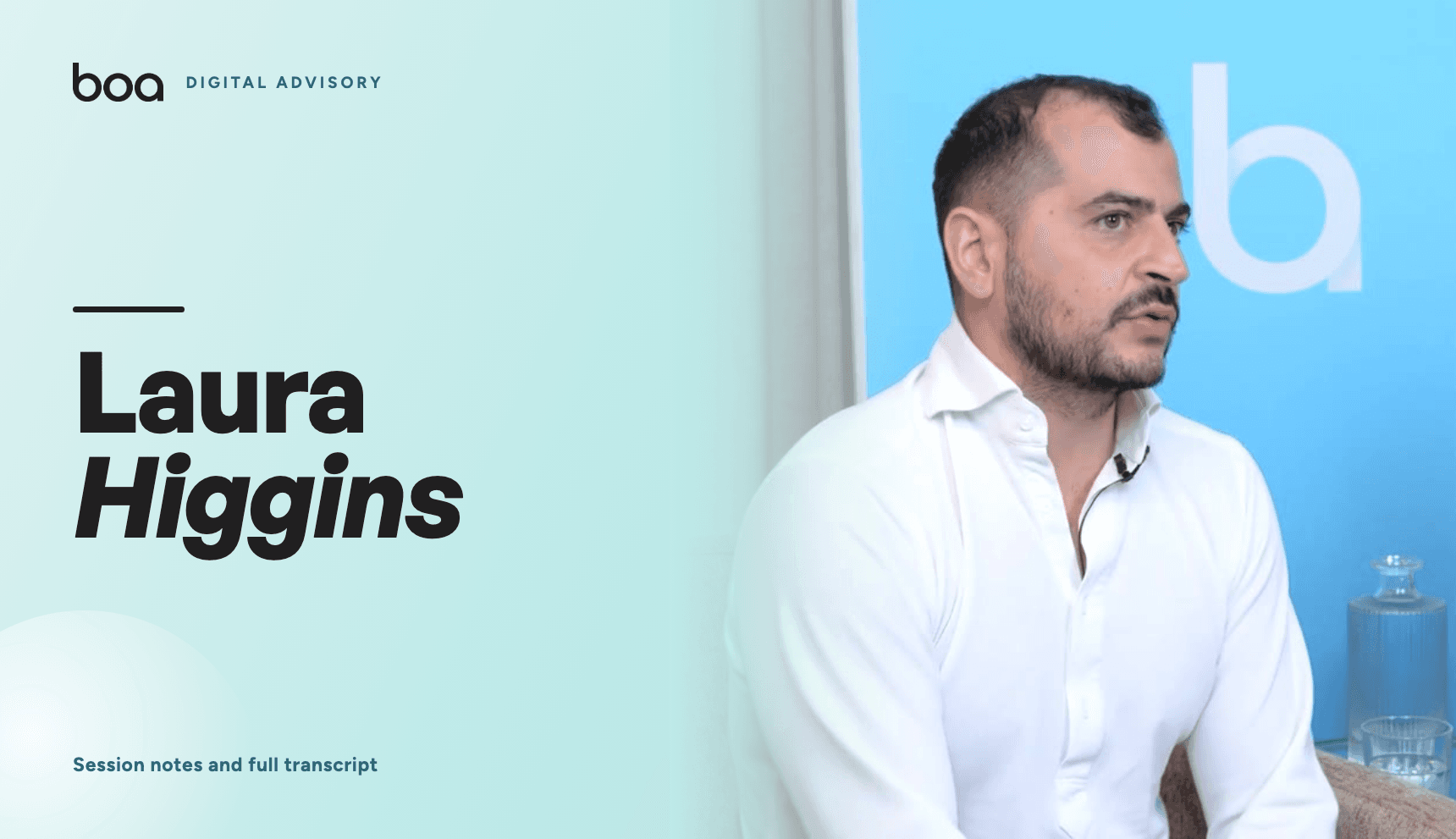
Laura Higgins on Selling Without Feeling Pushy
With Laura Higgins, Founder and Business Coach at My Business Playbook · Hosted by Daniel Hakim · 50 min
What this session covers
Laura Higgins shows Australian founders how to identify the real constraint in their business, sell from a service mindset, qualify prospects before a call is ever booked, and build content that makes the sale a formality. Practical for solo operators, service providers and product founders chasing stockists.
Most founders are busy solving the wrong problem, so find the one constraint (leads, conversion or capacity) before you spend another dollar or hour.
Key takeaways
- 01
Find the actual constraint before you buy more leads
Laura's example: you feel short on clients and immediately decide you need more leads. Break the customer journey and funnel into numbers first. You may find that lifting conversion by 10 percent puts you exactly on your goal, so the fix is conversion, not traffic. Solving the wrong problem keeps you busy without moving the needle.
- 02
Make the sales call about them, not you
Laura's rule: when you make it about you, you are selling. When you make it about them, you are serving. She opens with "what is the big problem for you right now, how can I help?" Her analogy is someone struggling with grocery bags and a baby on their hip. Offering to carry a bag is not pushy, it is what a decent human does.
- 03
Aim for a 6 or 8 out of 10 close rate, not 10
Laura says a 100 percent conversion rate means you are either not niche enough or not expensive enough. She wants people to push back on price and to occasionally say it is not the right fit. She also tells prospects when she is not the right fit for them. Rejection is part of the process, not a signal you are bad at selling.
- 04
Ask two questions at the top of every sales call
After a short intro Laura asks: why are we having this conversation now, and why did you reach out to me? The first surfaces urgency, so when the "timing isn't right" objection appears later you can say "here's what you told me earlier, is that still true?" The second gets them articulating why they chose you over a competitor, which means they sell themselves on you.
- 05
Qualify in the booking form, not on the call
Laura's team qualifies on revenue via the Calendly booking questions, so the salesperson knows before the call whether the prospect suits the startup program or the higher-level one. She also asks how urgently they want the problem solved: within 7 days, soon, within a month, or a month or more away. If the answers make it clearly a bad fit, cancel or reroute them with a freebie and a referral rather than burning the call.
- 06
Treat the follow-up as a welfare check, not a chase
Laura's wording: "Hey Daniel, we had this conversation a month ago, I'm just circling back, are you still struggling with that problem?" Either answer is a good outcome. That is as complicated as the follow-up needs to be, and it removes the slimy feeling that stops most founders following up at all.
- 07
Build content across know, like and trust in that order
Know is your niche and the problem you solve, stated so clearly that content cuts through. Like is your personality, perspective, hot takes and story, not more how-to tips. Trust is proof: testimonials, case studies, event photos, user-generated content, media features. Laura notes people trust less now because of AI content volume, so proof carries more weight than it used to.
- 08
Sell the outcome, not the deliverables list
Laura's example: a web designer says you get five pages, full functionality and SEO, when what the buyer wants is to be seen online and have the site represent their brand. Good copy uses the structure "we will do this thing so that you get this outcome". People buy the benefit, so lead with it and put the features underneath.
- 09
Approach dream stockists with a hit list of 15 and a real gift
For a candle founder chasing stockists, Laura suggested listing 10 to 20 dream retailers, putting budget behind sending each one a beautiful gift, and including a handwritten note naming exactly why you love their work. Then ask for the conversation. Daniel added a sequencing tip: start with the less important names so you get better at the pitch before you approach the ones you really want.
- 10
Add scarcity so stockists feel like they are auditioning
Laura frames positioning like dating. Rather than pitching as available to everyone, say something like "we're working with five stockists in New South Wales over the next 12 months". The scarcity flips the energy so the retailer is selling you on why they should carry the product.
- 11
Use the Eisenhower Matrix to cut overwhelm in the morning
Laura's advice for a founder drowning in tasks: write everything down and score each item on importance and urgency. Important and urgent gets done first. Urgent but not important gets delegated or dropped down. Neither gets deleted. She pairs this with an audit of where your time goes across both business and home, because meal prep, gym and kids all draw from the same pool.
- 12
Automate everything except lead generation
When a photographer moving into marketing services asked which tools to use, Laura said do not automate the lead gen because that is what drives growth. Streamline project management, delegation and delivery instead, and bring in freelancers early so delivery is not on you. She flagged ChatGPT (set up properly with your tone) and Phantom Buster for LinkedIn outreach. Matt added his own method: ChatGPT deep research, prompted to return 20 named people in an industry with verified emails in separate columns, in about five minutes.
- 13
Share the offer plainly and get scrappy
Laura's single most important action: post something as direct as "I've got an opening for 3 clients next month, would you like to work with me?" DM your Instagram followers, connect on LinkedIn, call people, work your past leads. Most founders stop asking because they fear rejection, and asking is what generates quick cash.
How the session runs
- 1:04Stuck? You are probably solving the wrong problem
- 2:43Starting at 23: running a business is its own skill
- 6:22Selling versus serving, and the grocery bag test
- 9:20Rejection, follow-ups and the timing objection
- 14:19Qualifying prospects in the booking form
- 17:23Content that builds know, like and trust
- 22:39Marketing mistakes: features, comparison, ChatGPT voice
- 25:01Tripling revenue in three months, and the identity lag
- 28:02The one thing to do this week: share your offer
- 29:34Q&A: cold outreach versus in-person for a product brand
- 32:26Q&A: do you need a personal brand?
- 34:04Q&A: beating overwhelm with the Eisenhower Matrix
- 40:02Q&A: differentiating a marketing agency with a 1% edge
- 42:30Q&A: tools, automation and protecting lead gen
Mentioned in this session
- Shopify
- Meta
- Calendly
- ChatGPT
- Phantom Buster
- YouTube
- TikTok
- Forbes
- Rick Rubin
- Allan Dib
- The 1-Page Marketing Plan
- My Business Playbook
- Cub
- Boa
- Home Hive
- Sydney
- New York
- New South Wales
- Croatia
Questions founders ask
Laura Higgins' test is simple: when you make the conversation about you, you are selling, and when you make it about them, you are serving. Open by asking what their biggest problem is right now and how you can help. Framed that way, not making an offer is the unhelpful act, because you are withholding a solution you know works.
Ask about urgency before the call. Laura's booking form asks how urgently they want the problem solved: within 7 days, soon, within a month, or a month or more. On the call she asks "why are we having this conversation now?" If they later claim bad timing, you can point back to what they told you and ask whether it is still true.
It depends on the business. Laura says an early-stage ecommerce company does not need one, though it can make sense for larger product brands. For service providers, coaches and speakers it usually does, and she found her own business took off when she shifted from a company brand to a personal brand. The trade-off is exit: if you want to sell the business one day, you are selling your name.
Laura says you only need a 1 percent edge. Start with niche, because going one degree more specific builds more trust in that market rather than shrinking it. Then identify one genuinely distinctive thing inside your offer, such as turnaround speed, a specialist tool or a channel you are excellent at, and highlight it in your marketing and your sales process.
Not lead generation. Laura argues lead gen drives growth and should stay with the business owner in the startup phase. Automate or delegate project management, delivery and admin instead, and bring on strong freelancers so delivery is off your plate. Tools she named were ChatGPT (configured with your tone) and Phantom Buster for LinkedIn outreach.
Full transcript
The complete conversation, as recorded, with every speaker attributed.
Daniel Hakim0:00
We are gonna kick off. First of all, thank you all so much for joining us this morning and giving us your time. I know how valuable that is. As you probably know, our mission at BOA is to make quality networking, advisory, and community accessible to business owners across the country, to all of us. And today we are very lucky to be sitting with Laura Higgins, who is one of Australia's leading scale coaches and advisors. Particularly for entrepreneurs that are creatives in the creative space. Laura helps businesses get to that 6 and 7-figure mark from zero or from already functioning. She's a professional speaker, podcaster, and an expert marketer, and her podcast is called My Business Playbook, and it's awesome. You should totally cheque it out, and I'm sure we can talk more about it today. Thank you so much for being here.
Laura Higgins0:53
Thank you for having me.
Daniel Hakim0:54
Now, my first question actually is, is a big one, but what advice would you give someone who feels stuck in their business and isn't seeing the growth that they'd want to see?
Laura Higgins1:04
Oh my gosh, okay, I have so much to share around this. I think sometimes we can solve the wrong problems. Has anyone experienced this where you're like, oh, I feel stuck, my revenue isn't growing, or I'm not getting enough clients, or I'm not getting enough customers? It must be that I don't have enough leads, or it must be that my content isn't landing, or it must be that I'm not selling well enough. And we can very quickly make a snap decision that the problem is X. And what I've learned is that we have to very strategically identify, well, what is the actual constraint right now? Because we can get busy solving a problem that's actually not going to move the needle. It's not gonna have the impact. So an example would be, you might be finding that you're not getting enough clients, and immediately you go, I need more leads. But if you actually dig a little deeper and you look at your numbers and you broke down, okay, what is my customer journey? What does my funnel look like? If you broke that down and looked at the numbers, you might actually identify, you know what, if I could increase my conversion rate by 10%, I'd be exactly where I wanna be. I would be hitting my goals. And so we can very quickly identify, that's the problem I need to solve. I don't need more leads, I need to convert better. And so that's just an example, but I think it's really easy for us to get busy solving the wrong problems.
Daniel Hakim2:28
Yeah, that's great advice. Now, what were you doing before the current business? So, were you in a rut at one point? And how did you, what was that kind of turning point where you were like, you know what, I need to find a way to scale and then set you on that path to do so.
Laura Higgins2:43
Yes, so, uh, I started my business at the age of 23, and I ran a social media agency. So that's where I started. It was in 2017, and social media was just taking off as a business kind of strategy. Instagram Stories were like just a new thing, which is really ageing me right now. So I started my business at 23, and I was good at my craft. So I was good at creating content, I was good at marketing, I was good at writing copy, I was good at design, but I didn't know how to sell. I didn't know really how to get leads. I didn't know how to acquire customers. I didn't know how to deliver in a way that was streamlined and scalable. I didn't know how to hire a team. Like, there was so much that I didn't know about running a business, and so when I first started, I was really shocked, and I don't know if there's anyone here who's like in that startup phase. I was really shocked at how much time and energy was required to actually keep the business alive. Does anyone relate to that? It's like you're kind of like, I thought I was just gonna do my craft. I've noticed there's someone here who is doing like selling perfume. It's like, I thought I was just gonna be selling perfume. I didn't realise I'd have to become amazing at Shopify, amazing at Meta ads, amazing at all these things. And so I think the big learning for me when I first started was I cannot operate like a freelancer, I cannot operate like a technician, I have to operate like an entrepreneur. And so for anyone here who is in that spot where that you feel the tension, you feel the gap of like, I do not know how to run a business, I want you to know that that's A, totally normal, you've never done it before. B, running a business is a skill. And so I had to learn, okay, in the same way that designing graphics is a skill, learning how to run a business is a skill. And so I had to learn the skill. And so I would go to like business workshops, I would join coaching programs, I would invest in myself, when I was making no money, I would put myself in rooms like this, like it's so good that you're in a room like this, and I would learn as much as I could because I realised if I don't know how to run a business, I don't have a business, I have a hobby. And so for me, that was a big learning, and yeah, definitely when I was in that startup phase.
Daniel Hakim5:15
I, I, I, that's such an important point that people don't talk about all the time. It's like when you start a business, you're pretty shit at business. You know what I mean? Like, it takes time to get good. It's like when you start jiu-jitsu, you're not gonna be good at jiu-jitsu straight away. Like, it takes years to do it. If you were to compare, like, when I think back to myself even for the first 5 years at Cub, you know, it was a disaster. Well, sorry, I was a disaster. It was because it takes time to perfect that craft. But one of the most, like, in my opinion anyway, and I'm not sure if it's yours, but I'd be curious, the first thing you need to learn how to do is sell your product, is sell. Because if you don't sell, you have no money. If you have no money, there's no point being good at business anyway, because you got no money. You can't, you need money to fund things, to do things. Now, a lot of people, particularly at the earlier stage of business, a lot of people are afraid of selling because they're afraid of being too pushy or, you know, kind of coming across in a sleazy way. I don't think sleazy is the right word, but pushy is probably the right word. What advice do you have for people in how to sell without being fearful of being pushy, or how not to be pushy?
Laura Higgins6:22
Oh my gosh, okay, so I'm a creative. I don't know if anyone here is a creative, but I— everything in me was like, I don't want to have to sell. Like, I don't have to sell, I just want to do beautiful work and I want the product to speak for itself. Does anyone else relate to that? So I was really like, okay, crap, I've got to figure out how to sell. And everything in me was afraid of being salesy. So everything you're saying, 100%. The thing that I've learned is that when you make it about you, you're being, you're selling. When you make it about them, you're serving. So every time I sit down and have a conversation with a prospect, I'm like, okay, Daniel, what is the big problem for you right now? How can I help? And that, like, do you guys feel like that sounds salesy? Or does it just sound like I'm helping? The goal is that we just, we just are like, hey, I'm here to serve, I'm here to help. And when we approach selling from that standpoint, and when we actually say, listen, you're struggling with this problem that I know how to help you with, when we approach it from that lens, it then becomes, well, if I don't make an invitation to to help you, I'm actually kind of a jerk if I don't help you. Think about it like, imagine someone's carrying, they've got all these grocery bags, they're carrying all the bags to the car, they're trying to get their keys out of the car, they've got a baby on their hip, they're like struggling to get into the car, and you walk up to them and you're like, hey, like, do you need some help? Can I, can I take one of those bags for you? Can I unlock the car for you? Like, how can I help? That's what a good human does. And so, like, we have to position it as, okay, I'm just here to help and I'm not here to push. I'm just here to make an invitation. And so when we approach selling from that lens, we can just, like, breathe and relax, and it becomes a human-to-human, like, how can I help you, rather than how can I get you to buy my thing.
Daniel Hakim8:21
Yeah, I, I, I, I, I really like that switch. It makes it less intimidating to sell because you're there to solve— I mean, you're not just saying, hi, what problems do you have, I'll solve all of them. Like, you obviously solve a specific problem. That's why they're talking to you. You might smell bad with the perfume thing. So you're solving the problem. Or the problem might be that other perfume, quality perfume is too expensive. Here's a cheaper quality alternative or whatever it may be. But switching from a sales to a service mindset in the sale, I really think that's something everyone can do. But, you know, still follow-ups to sales and touchpoints. Are essential because if you offer to help someone solve a problem once, you're less likely to convert the sale than if you've had 3 opportunities to offer. So what is your advice in terms of follow-ups and touchpoints? The stuff that may be also considered pushy.
Laura Higgins9:20
Yeah. We have to get very comfortable with rejection. Rejection is part of selling. And if you have 100% conversion rate, it means that, uh, you're either not niche enough or you're not expensive enough. So I'm actually not looking for, I convert 10 out of 10 prospects into clients. I'm not looking for that. I'm looking for, okay, what would it look like if I converted 6 or 8? What would that look like? We actually want people to push back on price. We want people to say, Oh, this isn't the right fit for me. And we also want to say, hey listen, after our conversation, I don't think we're the right fit for you. Like, it goes both ways. So we actually want to be in a position where we are also qualifying the prospect too. So the first thing you need to know is that rejection is part of the process. The second thing is that following up again is a service. So it's, hey Daniel, we had this conversation a month ago, I'm just circling back, 'Are you still struggling with that problem?' And if Daniel's like, 'Yeah, you know what, I still am,' or, 'No, I've sorted it, I'm good, thanks so much for connecting,' it's not, it's not, again, it's not that salesy, pushy, slimy thing. It's just, 'Hey, just checking in. I'm just, I'm just being a good human. We had this conversation, you had this problem, are you still struggling with that?' Like, that's as simple as the follow-up needs to be.
Daniel Hakim10:43
I think a lot of sales is timing as well. Is it the right time for that person to make that purchase?
Audience member10:49
Yes.
Daniel Hakim10:49
So the more times you give them as options to say yes, the more likely they are to say yes.
Laura Higgins10:56
Yes, and it's the other thing too, and when we talk about how marketing integrates with sales, because the two are like, they're like besties. So marketing and sales, they are your moneymakers in your business. And I would say, if your business isn't growing, or if it isn't where you want it to be, how much time are you spending on the moneymakers? Marketing and sales. Those are your moneymakers. So if we think about how those two connect, the marketing, we want to create what I call conversion content. And conversion content is like, okay, how do we get the right people to go, I need what Daniel's selling, I need to be part of BOA because of XYZ. So we want to create content that primes them so so that when we get to the sales call, it becomes like a no-brainer, heck yes. So there's a really beautiful connection between your content, your marketing, and your sales process. And so the other thing that you'd said, Daniel, is like a lot of people get the, oh, this sounds amazing, but it's not the right time for me. Who else gets that objection? Just give me a me in the chat if you get that objection where you're like, Sounds great, but can we circle back in a month or so?
Daniel Hakim12:13
I reckon it's the number one objection. Yeah. That would, even for Cub, it would be timing.
Laura Higgins12:19
It's timing. So one of the questions that we ask in our, like, if they book a call, they fill out some questions ahead of time. One of the questions we ask that's super simple to help you to gauge timing is like, how urgently do you wanna solve this problem? Now, in the next 7 days, soon, in the next month, or later, a month or more from now? So those questions help us to gauge, okay, what is the urgency for this person? What's happening timing-wise? And so when I hop onto a sales call, I'm always, I do my little intro and then I say, cool, so talk to me, why are we having this conversation now? And why are you reaching out to me? Now that question works so well because immediately it says, if they say to you, I'm reaching out to you now because I need to get this problem solved ASAP because of XYZ, immediately we know, okay, timing is right. And so later when they say, actually the timing isn't right, we can go, no, no, no, what, here's what you said earlier, is that still true? Oh yeah, no, you're right, I did say that. So we're asking like, why are we talking now? Why is this a now thing for you? The second part of the question is, why are you— why did you reach out to me? And the reason we want to ask that question is we want to get a gauge of, okay, like, why are they choosing you above a competitor?
Daniel Hakim13:44
Yeah, from the options available. Yeah, what makes you unique?
Laura Higgins13:47
Yes, and they actually start to sell themselves on, oh, I reached out to you, Daniel, because I love what Cub does, because I saw something on Instagram. I loved your energy online, and all of a sudden they're selling you on you.
Daniel Hakim13:59
Yeah, yeah, it's kind of, and also I want to just circle back to the qualifying. You were talking about qualifying a lot. Do you qualify before you actually have a proper sales meeting? So will you call them before? What's the qualifying process that you recommend people take?
Laura Higgins14:19
Yeah, that's a great question. In our world, you can qualify on different things, but in our world, we qualify based on revenue. So, we can send them, let's say someone is starting out, and we're like, okay, cool, we have a great programme for people starting out. And we know immediately, if you're in the startup phase, this is the programme for you. So, we qualify just in the form. So, if you use Calendly, or any of the other calendar programs, you can actually ask the question, ahead of time. And so then we know, okay, if they're earning a certain revenue, we know that they're a good fit for our higher-level program. And so our salesperson knows, okay, this is where we should direct them. So it depends on what your qualifier is. Maybe you only work with a certain type of niche, or maybe you only work in a certain location. You can actually qualify before the call, and if, if it's not the right fit, And if you're like, there is absolutely no way this is going to be the right fit, you can cancel the call. You don't actually have to do the call, or you can— a lot of the software now, you can actually redirect them somewhere else. So if you know from the outset, based on their form answers, you can actually route them somewhere different and say, hey, listen, we're not going to be the right fit. Here's some other people we recommend. Um, or give them a freebie, give them some value, but just go, hey, we're just— based on your answers, we're not going to be the right fit.
Daniel Hakim15:40
I also think there's kind of, there are two ways to qualify this. One is qualifying the fact that they want your, like they want the problem that you solve fixed. And the other one is, are they the right client for me? So like, if you were to put that into a call, and we'll use Kubb as an example, it would be like, do you want to meet other accomplished business owners? Yes, I do. Why do you wanna meet other accomplished? Like, how will that have a positive impact on you? Well, it will help me find clients, learn, and build relationships with people that are on the same path as me. And then you could be like, what would be the result? What would be a consequence by you continuing without a strong network? And then, oh, well, this would be bad and I'd struggle with this. And so that would really qualify someone in the sense that, okay, they want the problem I'm solving. And then it's a question of qualifying them as a person, like for Kubb, it might be, you know, Kubb members typically have a revenue of over a million. Like, you know, do you fit in that basket? And they'll say no, and then, you know, or yes. And so having those two different qualifications, I think is really easy to do. And doing them in a vet call before you take the person's time coming in for a full meeting and wasting your own time with a meeting that may not be correct. Yeah, is, is really good. I'll move to, to my next question. Now, a lot of sales happens— like, a lot of the selling happens before the sales meeting.
Audience member17:10
Yeah.
Daniel Hakim17:10
And before the qualification meeting. Happens in the marketing. So what tips do you have, um, on, um, uh, con— like, on, on content creation? What type of content will lead best to a sale?
Audience member17:23
Yes.
Laura Higgins17:24
Okay, so what we're seeing in content Actually, just really quickly, I wanna get a sense of where are you, like what social media channel are you mostly hanging out with, hanging out on? Drop it into the chat just so that I know. We've got LinkedIn, Instagram, LinkedIn and BoA, LinkedIn.
Daniel Hakim17:43
Yeah, BoA, who said that?
Audience member17:44
Yeah.
Daniel Hakim17:45
Genius.
Laura Higgins17:46
Instagram, okay, cool. So we've got a bit of a mix, awesome. This is really good. So what we're noticing in, particularly in Instagram, and I think a lot of this could be applied to LinkedIn as well, is that there is so much noise online. Does anyone feel that? Like, you go on Instagram, you go on LinkedIn, you go on Facebook, and there is just so— there's so much content, there's such a volume of content. And so the question is, well, how do we cut through that noise? And I think it really comes down to how do we become known How do we, how do we become liked and how do we become trusted? And so essentially all marketing is, is building know, like, and trust. And so becoming known is about, okay, who is my niche? How do I, how do I speak to them? How do they interact with me? How do they know that I'm the person to help them or my product is the right fit for them? Okay, so it's really zeroing in on your niche from the beginning. It's also about your message. So What is the problem that you solve? The more crystal clear we can be on the problem that we solve, the more our content is going to cut through. And again, that's going to help us in our sales process, because if we can help people to become problem aware, then we can position our solution as the natural next step. Okay, so that's really about the know piece. The like piece is one of my favourites because it's about you. It's about your personality. It's about your authenticity, your perspective, your story. And I don't know about you, but I don't need someone giving me all the how-to educational tips. I actually really want to know their perspective. I want to know their controversial hot takes. I want to know what, like, why they do what they do. And so The more we can show our face, the more we can connect with people, the more we're gonna build this like piece. And when people like us, we become more relatable. And I think that's really important to cut through the noise. And then the third piece is, well, how do we build trust? And the way we build trust is showing proof. So an example would be, like people came to this Inner Circle event you did, um, showing proof of people enjoying the event. So photos showing people enjoying your product or service, testimonials, uh, case studies, user-generated content— all of this builds this proof that you are good at what you, what you actually say you do, right? So we're also in a market where people trust less and less because there's so much AI content out there, there's so much noise out there. So we really need to be building proof into our business. And so that's how we build credibility. So we've got the know piece, which is like, okay, who are you for? What is your message? What is the problem that you solve? What's your, what's your product? What's your offer? There's the like piece, which is all about you, your story. Maybe it's about your family if you want to include that. And then we've got the, the trust piece, which is about proof. It's about credibility. It's about showing that you can do what you say you do.
Daniel Hakim21:09
And you You actually do that. I actually was looking through your Instagram page yesterday.
Audience member21:14
Yeah.
Daniel Hakim21:15
And your Instagram page does that. So it's probably a good, like everyone should cheque out Laura's Instagram because like I think it's your top 3 pinned tiles. Yeah. I found them to be very much the no. So after I had like swiped through and read all of them, I was like, okay, I know exactly what she does. I know exactly how she does it, who she does it for. Like, and then as I kept scrolling, then it was like a lot of the like, you know, like I was like, okay, these like, you know, I'm on her journey with her. And then there were scattered throughout a lot of trust things like, you know, wins and testimonials and things like that. And I was like, so your Instagram is actually a really good example for everybody to cheque out.
Laura Higgins21:55
Well, sorry to interrupt you, but the other thing about trust is trust could also be, uh, maybe you've been featured in a magazine or a newspaper. Like, there's also trust that is from like publications. Yeah, and media. So it can be testimonials, but it can also be, hey, I've been featured in Forbes, or whatever it is. So all of those things just stack that credibility, which is so helpful.
Daniel Hakim22:22
Um, what would you say are the biggest mistakes you see entrepreneurs make in their, in their marketing, especially in relation to content marketing, and mistakes in relation to not being very strategic to end up with a sale?
Laura Higgins22:39
Yeah, okay. Um, I think a lot of people in their marketing, they speak to the features, not the benefits. So an example, you might be a web designer and you might say, when you work with us, you're going to get a 5-page website, fully functioning, you're going to get SEO, you're going to get this and that, when actually what the person wants is to be seen online. They want their website to represent their brand. So we have to go beyond the features of our service or our product and into the benefit. It's Like, great copywriters will always kind of talk about, we're going to do this thing so that you can get this outcome. And so the reason people buy is the benefit, the outcome that they get. So selling the outcomes, not the, the features and the, you're going to get all these things, the deliverables. Um, the other mistake I think too, and I'm seeing a lot, is getting in your head about your marketing and your content. I don't know if you experience this, but if you scroll and you look at everyone else's content and you compare and you, you start thinking, I'm not good enough, that person's gone viral, that's— that person's done this and I'm just not very good. Does anyone else? Raquel's saying he's guilty. But we can have this like comparison thing too, and I think it's so important to just go, all right, I'm just gonna put that down and I'm just gonna do me and I'm gonna show up as my full self. And I think that that's so, so important. So, um, getting out of your head, getting out of your own way. And the third thing I will say is, uh, again, coming back to that noise thing we spoke about earlier, if you want to cut through, you've got to be original. You've got to show up as yourself. You've got to be— Rick Rubin says the best way to be original is to be yourself. And so I think the the more we can inject our personality into our brand, the more we're going to cut through. And so if all of your content feels like ChatGPT wrote it, it's not going to cut through. And so we want to see more of you, your personality, your, your voice as well.
Daniel Hakim24:51
Um, now you've obviously scaled your own business, and what were the biggest problems that you came into personally in scaling and how did you solve them?
Laura Higgins25:01
Yeah, I always say that, um, every next level in your business requires a next level version of you. And so we had a period where I think it was in 2023, our business tripled. And so we went from $40K to $50K a month to $100K a month, $120K a month. Yes, that's what we hit. And very— it happened in maybe like 3 months, and so it was very, very fast growth, and I felt like my identity was playing catch-up. So I really had to work on my mindset. I had to work on my relationship with money, um, the ability to delegate. I had to really work on these soft skills because I had the tactical business skills, but I, I had to really work on a lot of the mindset stuff, the beliefs. Um, people pleasing was a big one for me. I don't know if there's any people pleasers here, but, um, those were the big things I had to work on because I also learned that if I was good, my business was good. But if I was burnt out, if I was stressed, if I didn't have boundaries, if I was caught in comparison, if I had weird beliefs about money my whole business was going to— it's going to sabotage my whole business. So really digging deep and doing the personal development work has been so important.
Daniel Hakim26:31
And so you, um, doubled or tripled your revenue in a very short— in only a few months. What specifically were the things that you did that you feel led to that? Because that's the dream for, for, I mean, every business owner. It doesn't matter what your revenue is, you'd like to triple.
Laura Higgins26:47
Yeah, we'd all like to triple our revenue. And what's interesting is a lot of our clients that work with us they triple their revenue in, in 12 months. And so we've kind of figured out, okay, there are a couple of big things. Uh, one of the big unlocks for me personally was I hired a salesperson. So I was doing all the sales myself. I outsourced the sales. We brought someone in-house to do that. That immediately opened up capacity because I, I could only take on so many calls. So my capacity was the constraint. Um, so that was a really big one. We started doing events. That was also another big thing. So we started getting all of our community together. We do events in Sydney. We did an event in New York. We started doing these events and that just got the word out and people could see the—
Daniel Hakim27:33
Created buzz, you mean? So it created more word of mouth about your business?
Laura Higgins27:36
Yes, and sales, because people that would come along would be like, how do I become part of this? And we'd be like, well, step into our office. And so those were probably two really big unlocks. And then the other unlock for me was was mindset.
Audience member27:51
Awesome.
Daniel Hakim27:51
Now I just want to ask one last question before we get to the Q&As. Um, what is one thing everyone here today can do to start attracting more clients or selling more clients?
Laura Higgins28:02
Oh, the one most important thing, uh, share your offer. So whatever your service is, whatever your product is, share it with the world. Get scrappy. Like, if you've got to DM people that follow you on Instagram, connect with more people on LinkedIn, if you've got to call people, if you've got to connect with your past leads. Get scrappy. Do the work to get in front of the right people. So share your offer. Don't hide it. Don't feel like you're being salesy or pushy if you share how you can help people.
Daniel Hakim28:33
And to be clear, what do you mean by share? Like your offer? Like what's an example of— like an example how you would share your offer?
Laura Higgins28:40
For example, an example would be, um, doing a post on Instagram or LinkedIn and being like, hey, I've got an opening for 3 clients next month. Would you like to work with me? It's like so simple, but it's just like, hey, I, I'm working with a handful of clients this month to do XYZ. Would you be interested in working with me? So actually, like, asking, asking. I think that's the thing. We can stop asking. We can, we can, we can get a bit complacent, or we can get scared of rejection. And I think Ask people for the sale, invite people to take the next step with you, follow up your leads. Those are the ways you're going to make quick cash right away.
Daniel Hakim29:23
Let's get to questions. Natalie, do you want to ask your question? If not Natalie, then Krish, why don't you jump in and I'll ask Natalie's question for her at the end. Hello. There you are.
Audience member29:34
Hi, my question is, so we mentioned there's lots of noise online. Do you think we should still persist with cold calling and emails, or do you think the best way to sell product is to pitch in person?
Laura Higgins29:45
Person. Uh, what kind of business do you run, Krish?
Audience member29:49
Um, so I have a zero-waste candle, so it's a physical product, and it's all about educating and showing. Yeah, I think touch, feel, smell is really important, but it is very mission-driven.
Laura Higgins30:00
Okay, beautiful. And so right now, you're— how are you getting sales right now? What's the biggest driver?
Audience member30:07
So our main focus right now is the website, D2C. However, I do want to focus more on B2B, so getting more stockists as well as corporate gifting clients, because we've got a huge potential there with our engraving feature.
Laura Higgins30:19
Oh, beautiful. Okay, cool, cool, cool. So if, if the goal is stockists, then, and if you feel like people really need to see, touch, feel the thing, I would come up with a list of like maybe like a list of 10, 15, 20 names of dream stockists that you'd love to work with. And I would be sending them a beautiful gift and saying, hey, listen, I specifically love your work because of XYZ. I'd write them a handwritten note, and I would devote that— I would devote a bit of spend behind this and say, hey, I'd love to have a conversation with you about how we can, um, get more— get our candles into your store. There's a really cool mission behind it, and I'd love to talk about that. So I would find, like, almost create a hit list and I would over-deliver to those people. Um, that's kind of where I would start.
Daniel Hakim31:16
And, and I would start with the ones that are lesser important first. When you're selling, you like, you want to sell to the one that you like, you, because you get better as you go. So you want to practise on the lesser important ones and see if you can get their attention and move your way, move your way up the ladder.
Laura Higgins31:32
Um, I love that. And one other thing, Krish, that could be cool is Positioning. So much of this is, it's kind of like dating. Like, it's kind of, the positioning is important. And so what we want to do is we want it to kind of feel like you're, you're a little bit hard to get as well. So if the energy that you bring into that sales call is, hey, we're going to be working with 5 stockists in New South Wales in the next 12 months, like actually adding a bit of scarcity, adding a bit of like Okay, I, I don't work with everyone, and almost you could almost make it feel like they're kind of auditioning to work with you. So it's like, oh, I want to stock you, like, please let me stock you, and you're like, okay.
Daniel Hakim32:18
Um, now I'll ask Natalie's question for her. It was, do you believe you need to build a personal brand online to build a successful brand?
Laura Higgins32:26
Uh, Natalie, was Natalie a designer? I saw her name somewhere. Um, It depends on what your business is. So obviously if you're running an e-com company and you're just in the startup phase of that, no, you do not need one. I think when, you know, there are big brands that having a personal brand makes a lot of sense if you're an e-com or product business. Um, if you are a service provider, it does depend on your business. So for me as a coach, uh, and like speaker being a personal brand made a lot of sense. I will say, when I moved from a company brand to a personal brand, my business really took off. So there is— it's easier to scale, or not easy to scale, but it's easier to grow quickly online with a personal brand. That's definitely been my experience.
Daniel Hakim33:18
And it may be easier to sell people on yourself than selling them on a company, an organization.
Laura Higgins33:24
And then it's the pros and cons too, because if one day you want to sell your business, you're screwed. You really, you're selling your name. And so I think it's about, for you Natalie, thinking about what makes the most sense for you and your business and your work that you do.
Daniel Hakim33:42
Amanda, what I'll do is I'll ask your question for you because I don't think people can hear you, but it was, can you give examples that benefited you to overcome stresses noise. So if you want to elaborate on that, Amanda, elaborate on it in the chat, in the chat, and, um, and we can keep going.
Audience member34:04
Okay.
Daniel Hakim34:04
Oh, that's better. Way better.
Laura Higgins34:06
That's better.
Audience member34:06
I'll just put some headsets in now, so that's fine. So good morning. Um, lovely to meet you, Laura. I'm just wanting to— I'm creating an app called Home Hive, and I guess it's an all-in-one family app to effectively reduce the overwhelmingness often associated with household management. I am definitely at the very beginning of this startup, so there's a lot of noise. Um, and I guess for me, what examples did you— like, actual examples that you did to overcome those stresses, those noise, and I guess that changed that mindset? Like, was it like walking or giving time for yourself, or, you know what I mean?
Laura Higgins34:46
Just, yeah. When you say noise, do you just mean that you've got a lot of things that you need to get done and it feels busy and overwhelming?
Audience member34:55
Oh yeah, definitely.
Laura Higgins34:56
Okay, okay, cool.
Audience member34:57
I just want to make sure that we're changing that mindset from, like you said, to be an entrepreneur. Yes. You know what I mean? Like, it's— it was just like, I have no idea where I'm doing, or—
Laura Higgins35:08
okay, so big things that are gonna— your biggest constraint when you start out is, is going to be your time, because you're probably not at a point where you can delegate and get team in and like financially, that doesn't work as well, right, when you're just starting out. So what we need to do is we need to unlock more of your time. And so I would be looking at, okay, which parts of the business are taking the most time, taking the most energy, um, which parts are draining me, which parts are energising me. So I would do just a quick audit of like, okay, what, what does that look like? What's the current kind of state of the union of the business? I would also do the same thing with your home life. I think sometimes we forget that, uh, doing meal prep, going to the gym, like, if you have kids, looking after kids, like, all of these things, cleaning the house, all of these things are also taking your time. So what we want to do is we don't want to compartmentalize. We want to go, okay, the business stuff is here, home stuff is here, where is the time suck, and how could I find some more time? What could I automate? What could I delegate if possible? Where could I get some support at home if possible? And then what, what's most important? Another thing that is really helpful, and this is for anyone who's in overwhelm, um, there's this great, uh, framework called the Eisenhower Matrix. Has anyone heard of the Eisenhower Matrix? Just give me a wave. So essentially it's, we categorise You can Google it to find the photo of it, but you can categorise any task into important or urgent. And so what we want to do is we want to— if there's a bunch of things that are stressing you out in the day, maybe in the morning you just do like draw on a piece of paper and you say, okay, these are all the things that I've got to do. You categorise them as how high are they on the importance scale and and how high are they on the urgency scale? And what very quickly you can look at and go, alright, it's actually important but it's not urgent. And so I'm gonna put that in that box over here. Maybe it's important and urgent. Awesome, I'm gonna do those things first. Maybe it's urgent but not important. Okay, I'm gonna put that down and I'm maybe gonna get someone else to help me with that. And maybe if it's not important and it's not urgent, we're going to delete it. We're not going to do it. Okay, so thinking— it'll make more sense if you actually Google the Matrix, but I find that helps me to go, not everything is urgent, not everything is like a burning building, right? And so we can actually identify what's going to move the needle, what's going to have the biggest impact. And if it's only 3 things that I do today, what would, what would have the biggest impact for me?
Daniel Hakim37:59
Amanda, I can also tell you like what I do is, is pretty simple too. It's just what is the most important thing I need to do for the business right now. Yeah, that's honestly what I— that's what I do. And if I was doing it in like a quarterly, um, meeting type thing, I'll put up what are the 3 most— I don't say 3 biggest issues because they're not always issues, they might be importance in just 3 most important things. Um, and then I'll list what are 3 things I can do So under each of those 3 important things, I'll list what are 3 things I can do to make that thing happen or to help that thing happen. But what is the most important thing? Honestly, it doesn't matter how big your business gets, it still becomes, okay, what's the most important thing I need to focus on right now?
Audience member38:39
This—
Daniel Hakim38:40
there's an endless amount of things you can focus on, but not honestly, 90% of them zero matter. Like, they're not going to affect anything. There's the 10% that will, and you, you'll know what's the most important thing, trust me. Just think about what's the most important thing. Um, um, also, um, um, so Sky, it's your company, I assume it's not your, not your name, but I saw that you wrote something that, so, um, they've got a question. Hey Laura, I own a marketing agency in a, in the second year. I feel like my offer is very similar to other marketing agencies. What advice could you please give to differentiate yourself? And someone also replied, I can't remember who it was, but they replied that someone gave them, offered me 1 month free trial, which I said yes to, and then it worked. The reason I wanted to bring that up was a Boa person messaged me on Boa saying, uh, you know, I'd love to do your, uh, I'd love to do your guys, um, say thanks, Laura, TikTok for free. I'd love to do your TikTok for free. Um, and I said yes because I was like, I like that they were willing to do that. And obviously that's gonna convert into pay. If they do a good job, we'll then have to start paying them. But so I thought that was a good idea. But do you wanna maybe, or actually, so Skye, would you like to come on the screen and give us some more context or otherwise Laura can answer your question. What's your actual name?
Audience member40:02
My name is Skye. Oh, okay.
Daniel Hakim40:04
You're so Skye.
Laura Higgins40:06
So Skye.
Audience member40:09
But I guess what I'm looking to ask is, You know, Mark Aitken, we all, we'll do a similar, we have a similar offering where we help people grow and scale and become more credible on social media based on me as a person, or is it based on, um, niching, hyper-niching down and really just focusing on that niche, which I don't do, by the way.
Laura Higgins40:33
Yeah, I, I was going to ask you about your niche. So the first thing I think about when I'm trying to differentiate the offer, you only need a 1% edge. Like, that's all you need. You just need a 1% edge that's going to give you a bit of difference to someone else. Um, and so the first thing I would look at is niche. How do your people know that you're for them? We can think, when it comes to niching, we can think, oh my gosh, I'm going to lose work, I'm going to minimise my market. But actually, you build more trust and credibility in your market when you're more niche. So you don't need to go hyper niche, but just going like one degree more niche could be helpful. Um, the second thing is like, what is one thing you do in your offer that is unique and different? What is one thing you could include or add? Or maybe you're already doing it, but you can actually highlight a bit— it a bit more in your service. So think about maybe you deliver things in a certain timeframe. So maybe you're like, oh, we ship work really quickly, or we specialise in this particular tool, or we are amazing at Facebook ads. So finding out like what is something that you're very good at inside that offer and then really kind of highlighting that in your marketing and in your sales process as well. Again, you only need to be 1% different.
Daniel Hakim41:56
And, um, Laura's podcast has some great episodes that you should cheque out as well. But also there's a book that I read about niching that I still think it's the best book. And I mean, um, um, oh shit, I forgot his name. Laura, um, One Page Marketing Plan.
Laura Higgins42:10
Oh, Alan.
Daniel Hakim42:12
Yeah, Alan Dib. Yeah, he's the best. I love Alan Dib. He's a fantastic guy. In his book, One Page Marketing Plan, was the best book I've read. Like, it's very simple book and it's literally all about niching. I, I actually love that book. So, and Alan's an amazing human being. Last question. Matt, do you want to ask your question?
Audience member42:30
Hey team, thank you very much. Yeah, I just wanted to ask if you had any recommendations for simplifying business. Obviously, there's a million and one things that need to be done, and I was just wondering what automations and tools you applied or felt were game-changing when you were scaling just to help get some stuff off your plate. And Laura, love the podcast, by the way. I think it's awesome. And yeah, just wanted to hear your thoughts.
Laura Higgins42:56
What, what kind of business do you run, Matthew?
Audience member42:59
So I, um, I've been a full-time event photographer my whole life. Um, I am now looking towards scaling into a marketing strategy agency.
Daniel Hakim43:10
Amazing.
Audience member43:10
I've been spending the last couple of months doing so, and I've landed one client in Croatia, which was super random via cold email. Um, but right now I'm just trying to, yeah, work out how to simplify things, how to get more leads. Because yeah, freelancing sometimes is pretty hard when you don't really know when your dollars are coming up all the time. So try and get some retainers and recurring revenue.
Daniel Hakim43:37
You should cheque out an upcoming BOA event as well on recurring revenue. It's in the event, it's live in the events page too. She definitely, I refer you to that. But sorry, Laura.
Laura Higgins43:47
Yeah, no, that's amazing. Okay, so it sounds like for you, Matthew, what's the big challenge at the moment for you? Like, if we think about what we said at the start of the call of like, what is the constraint for you right now? What, what do you think that is?
Audience member44:05
Um, well, currently I'm, I mean, when you're scaling and you're doing something like completely new and trying to learn a million and one skills at once, it's obviously a lot of shit you have to learn very quickly. Um, and I'm finding that with like a marketing agency agency, being a photographer my whole life, I had just— it was like, for me, it felt as simple as just getting out there, taking my camera, shooting events, and getting better at that skill over time. But when you're doing like a marketing agency, you have to learn so many other new skills in a very short period of time. So I'm like learning how to delegate, learning how to generate leads. So it's quite— there's quite a lot of things going on at the moment. The specific thing I am working on is generating leads. Leads. So I'm learning how to do cold email. I'm, um, I've started a YouTube channel.
Laura Higgins44:56
Great.
Audience member44:56
And got a couple of things that I'm like focusing on, even cold DM a bunch of people on BOA. So, um, yeah, I'm even posting on BOA and stuff as well. So, um, yeah, like I'm, I'm mostly, well, my current problem that I'm facing at the moment is lead gen. Yeah. Um, and I guess my question was a extension of that, just in terms of simplifying everything when you're in that scaling process where you're learning new skills.
Laura Higgins45:24
Yeah.
Audience member45:24
If you add any like softwares and stuff, would you recommend it?
Laura Higgins45:27
Yes.
Audience member45:28
Okay, cool.
Laura Higgins45:29
So in terms of lead gen, um, this is an annoying answer to the question, but my thing would be looking at— because marketing, marketing and lead gen are, I believe, a hat that the business owner should wear, especially in the startup phase. So yes, there are tools that are going to help you. ChatGPT is going to help you a bunch, um, so long as you set it up really well with your tone and all of that stuff. There are tools, there are lots of, um, there are actually lots of cold outreach tools. There was one for LinkedIn, I think it was called Phantom Buster. Which was quite clever, so that could be worth looking at. Um, but I would also be looking at, all right, what, um, which— because you mentioned delegation, you mentioned team, you mentioned like you're launching a new offer, it sounds like you've got a lot on your plate. And so maybe it's a similar thing to Amanda going, okay, what is the most important thing I can do today? Can this part be like— can elements of it be automated?
Audience member46:34
Awesome.
Laura Higgins46:35
Um, but I would not be looking at automating the lead gen because that is the part that is driving the growth in the business. So I'd be looking at the other areas. Okay, project management— how can I streamline that? Delegation— how can I streamline that? Um, how can I get some amazing freelancers on board straight away so that I don't have to worry about delivery? That's going to help you a bunch as well. So I would actually be looking outside of your lead gen because I think the lead gen is just going to like you can have the best offer, you can have the best process, you can have the best freelancers in the world, but if you don't have leads, you've got no clients. So I would be focusing attention on lead gen and I'd be looking at how can I streamline that part.
Audience member47:17
Mm-hmm. And that's, that's, oh no, I was just gonna say to give you like, like if anyone's like doing lead gen at the moment, like, um, I, I would just give like a 15-second tip. So like on ChatGPT, I've like got it to use like deep research feature and I've like given it a prompt where I've said like name 20 people in this industry that I'm searching for. Don't send me them if they don't have an email and give me like 3 different columns of like what they do, their contact. And if you can't find their email, don't send it to me. And I use the deep research feature and that will get you leads.
Daniel Hakim47:52
Wow.
Laura Higgins47:53
So that's amazing.
Daniel Hakim47:54
I didn't know that.
Audience member47:55
Big win. That was a really, really good one. And I was able to get like 1 or 2 yeses yesterday just because I was like, make sure that email is legit. And yeah, it was pretty good. Like that used to be a job and ChatGPT can do it now.
Daniel Hakim48:08
Yeah, that's amazing.
Audience member48:09
It takes about 5 minutes to like generate the leads via deep research, but it's pretty good.
Laura Higgins48:13
So that's awesome. So then Matthew, could you then go, all right, I've got an email script for this cold DM, cold email. I want ChatGPT to then go a step further than that and go, can you write me the script for each of those people?
Audience member48:28
So yes, I've been toying with that. I mean, I am doing that manually. I'd probably like to automate that at some point, but I guess for now I kind of have to just suck it up and look at doing it manually for a bit. But yes, I am.
Daniel Hakim48:42
Guys, we do have to finish the call now just because we are out of time in the studio. But Matt, it actually sounds like you've already solved your own problem. The most important thing you can do is lead generation. I completely agree with Laura that if you are going to look for automations or outsourcing, it is for the stuff that is not lead generation. Um, and, and like, again, there should never be too much for you to have to do. It's just that you think you need to do too much stuff. That's always the problem. Like, when your business gets bigger and bigger and bigger, trust me, there's like an endless amount of things. If I had to think of everything that goes on in the business, like in Cub, for example, there'd be too much for me to do. But I don't think of those things because I think about the things that I have to do. And that is essential. And I think also at the early stage when money and budget is a problem, partnerships are essential, especially with a marketing agency. And you can use Bower and DM, people send copy requests, you can search per industry and per location. The search is powerful on Bower, so I highly agree with that. And LinkedIn's good too. Guys, I wanna thank you all so much for giving us your time today. We're so grateful to have you part of the Bold community. And of course, a big thank you to Laura for sharing her expertise and her time with us all today. I'm wishing you all an absolute brilliant day. Thank you, guys.
Laura Higgins49:59
Thanks, Daniel.
Audience member50:00
Thank you.
Laura Higgins50:00
You guys are amazing.
Daniel Hakim50:02
Catch you guys soon.
Watch the full sessioninside Boa.
Session notes are free. The recordings, the live advisories and the founders in the room are for members.