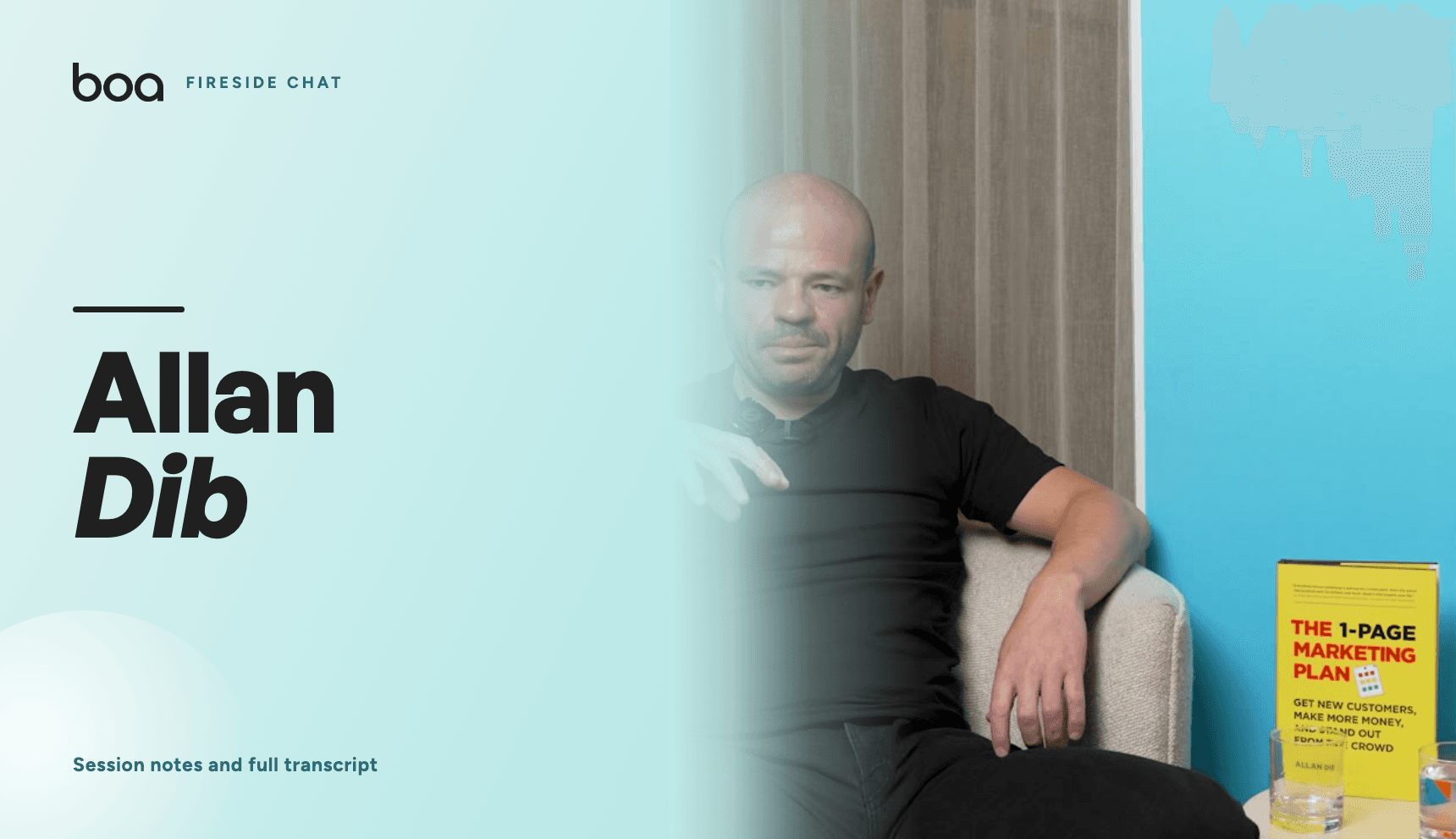
Fireside Chat
Dain Walker on Building a Brand That Stands Out
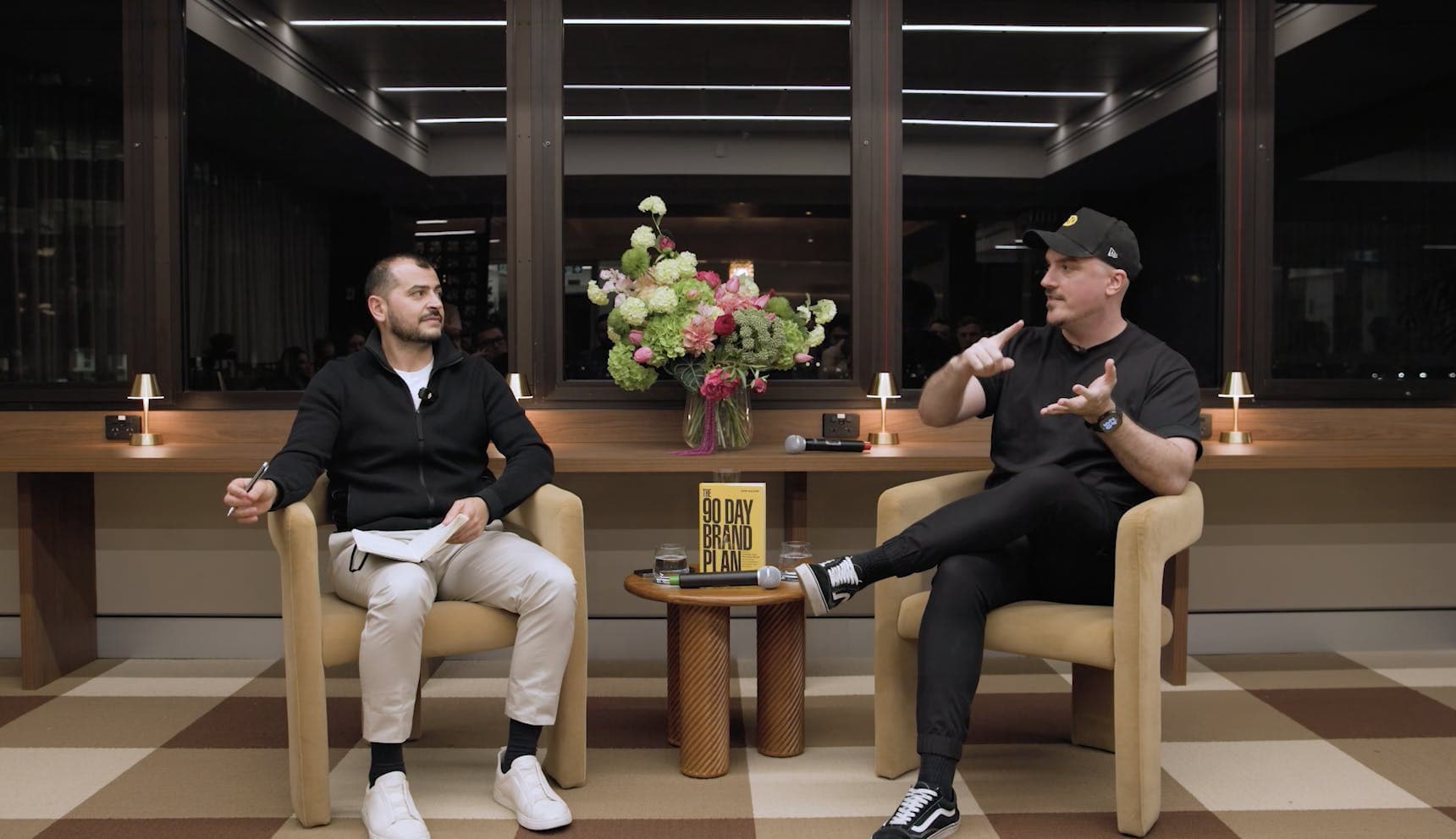
With Dain Walker, Founder and CEO at RIVYL · Hosted by Daniel Hakim · 55 min · 18 December 2025
What this session covers
Dain Walker, founder of RIVYL, breaks down how brands earn trust (relevancy plus credibility), how to mine your sales calls for a core message, why generic "quality service" language kills differentiation, and how to start a personal brand in 90 days. For founders and service business owners tired of blending in.
Your core brand message is already hiding in your sales conversations: find the exact line that made a prospect say yes, and build everything around it.
Key takeaways
- 01
Mine your sales calls for the line that actually activates buyers
Dain's shortcut to a core message: rewind to the moment in a sales conversation where the prospect lit up and said yes. Ask what exactly you said just before that. That phrase, not a brainstormed tagline, is the emotional core of your messaging. His team opens strategic workshops with "take me through the sales process, what's the sales language, what activates people".
- 02
Treat trust as an output of relevancy plus credibility
Dain argues you cannot chase trust directly. Trust is what happens when the market sees you as relevant (same language, same beliefs, same problem) and credible (proof that counts in your category). Credibility in financial services looks nothing like credibility in beauty, so define what proof your specific pool respects before you build assets.
- 03
Ask your audience what they want, then bucket the answers
Before writing his book, Dain posted a mock-up cover on Instagram asking what people wanted to learn about personal branding. Over 1,000 comments came in. Cam sorted them into buckets and they collapsed into five problems: I'm scared to start, where do I start, is it worth the time, people will judge me, and I'm overwhelmed. Run the same exercise and let the buckets become your messaging pillars.
- 04
Delete the generic language everyone else uses
Dain's list of phrases to Ctrl+Alt+Delete: best quality product, we do it because we care, trust us because we're trustworthy, best customer service, disruptive, innovators, pioneers. The language is not wrong, it is common, and common is how you fit in. Let customers conclude you are high quality from the experience rather than claiming it in a headline.
- 05
Do not assume how your market wants to be spoken to
James Jebbia noticed skaters in New York were wearing Gucci, Versace and Louis Vuitton, not skate labels, while skate shops were cramped and covered in stickers. Supreme was built on treating skaters as buyers of status symbols and giving them a premium space. Check what your customers actually buy and value rather than what your industry assumes about them.
- 06
Brand for where you want to be in five years, not where you are
Dain built RIVYL around skate, metal and graffiti because that was his taste at the time. Four years on, working with fashion, beauty and investment clients, the site no longer serves him. His advice: build the brand for the future position and it starts attracting those customers now. You can present at a Tom Ford level of polish before you are at that level of business.
- 07
Post for 90 straight days to kill the fear
The 90-day frame exists to solve fear, judgement and the is-it-worth-it question. Get on camera, write scripts, publish for 90 days and by day 90 it is just another day. It also gives the algorithm time to learn who you are and who to serve you to. Start ugly rather than waiting for the perfect strategist, budget or plan.
- 08
Put a face in front of a service business for the multiplier
You can build a service business without a personal brand, but Dain frames it as skipping free marketing. Studies he cites suggest people are 20 times more likely to buy from a personality than a corporate logo. His maths: same effort producing content, one dollar back versus twenty. Neil Patel feeding SEMrush through stages, PR and TV is his example.
- 09
Do not let yourself become the product
Answering a question about Kerwin Rae, Dain warned that when the product-market fit is access to the founder, the business is exposed if that person leaves. At RIVYL he deliberately disconnected the two: you are buying the team and the branding outcome, and he may or may not be involved depending on what you pay. Build a conduit customers buy that sits outside you, then let your profile add the halo.
- 10
Pair a strength with a vulnerability to make a two-word brand
Chris Doe started personal branding at 47 and calls himself a "loud introvert". He opens talks by telling the room he is an introvert and about to be weird for ten minutes, which breaks the tension and gets a laugh. Dain's instruction: take your obvious strength and your obvious weakness, say both out loud, and own the vulnerability before anyone can use it against you.
- 11
Draw the circle and accept who you repel
Naked Accounting runs a bright yellow site with a video of a man walking his office naked with a bottle of wine and copy full of innuendo. It repels plenty of people and it has built a team of about 30. Dain's frame: draw a circle around your audience on a map, message only inside it, and stop worrying about the circles outside. A strong brand has to deter people.
- 12
Play before you optimise, and pick a brand architecture on purpose
Dain puts the chaos and play at the start of strategy, before anyone asks about ROI. If you need to serve two very different markets, choose a structure rather than muddling: a branded house where everything looks the same (FedEx), a hybrid where a shared spirit links varied businesses (Virgin), or a house of brands sitting under a parent (Coca-Cola and Sprite).
How the session runs
- 1:57What actually builds trust in a brand
- 4:30Building relevancy and the Supreme story
- 8:06Find your core message inside your sales process
- 12:07Standing out: Zag, John Deere and Liquid Death
- 17:19The generic language to strike out of your business
- 19:38Why founder-led brands beat corporate logos
- 23:24The 90-day plan for starting a personal brand
- 26:17Cringe, opinion and Brittany Saunders at Fate
- 30:58Brand for where you want to be in five years
- 34:04Q&A: personal brand in a service business
- 38:32Q&A: the risk of becoming the product
- 43:35Q&A: Naked Accounting and choosing who you repel
- 50:19Q&A: authenticity, the two-word brand and Chris Doe
Mentioned in this session
- RIVYL
- Supreme
- Gucci
- Versace
- Louis Vuitton
- Saint Laurent
- James Jebbia
- Starbucks
- Howard Schultz
- John Deere
- Porsche
- Marty Neumeier
- Zag
- Steve Jobs
- Apple
- Liquid Death
- Dyson
- Hoover
- Michael Jordan
- Nike
- Jack Henderson
- Marvel
- Disney
- Batman
- Spider-Man
- Iron Man
- Brittany Saunders
- Fate
- Gary Vee
- Flight Story
- Stephen Bartlett
- Neil Patel
- SEMrush
- Vin Jiang
- Boa
- Born of Ambition
- CUB
- John Symond
- Aussie Home Loans
- Kerwin Rae
- Tad James Co.
- Naked Accounting
- Johnnie Walker
- FedEx
- Virgin
- Coca-Cola
- Sprite
- Chris Do
- Eminem
- 8 Mile
- Andrew Schulz
- The Lion King
- Trainspotting
- Gladiator
- Braveheart
- Tom Ford
- New York
Questions founders ask
Dain Walker says the shortcut is your own sales process. Notice the moment a prospect emotionally activates and decides to buy, then rewind and identify the exact thing you said. That line is the core of your messaging. Howard Schultz did a version of this at Starbucks by asking customers why they came in every day and hearing "this is my third place", which became the global campaign.
Yes, but Dain frames it as leaving free marketing on the table. He cites research suggesting people are 20 times more likely to buy from a personality than a corporate logo, and content on Instagram or a podcast costs little to produce. If the founder does not want the spotlight, someone else can fill the role, including customers or members positioned as the heroes.
The danger is when the founder becomes the product-market fit, meaning customers are buying access to that person. Dain pointed to businesses that unravel after a founder departs. His fix at RIVYL was to separate the two explicitly: clients buy the team and the branding outcome, and his involvement depends on the engagement. The personal brand should add a halo, not be the product.
Dain's answer is 90 days of consistent posting. That period is designed to dissolve the fear of starting, the fear of judgement and the doubt about whether it is worth the time. It also gives the platform algorithms time to learn what you make and who to show it to. You will finish knowing what you like and dislike without needing a coach.
Dain's strike list includes best quality product, we do it because we care, trust us because we're trustworthy, best customer service, disruptive, innovators, pioneers and empowering the customer. The problem is not that the claims are false, it is that everyone says them, so they fall on deaf ears. Aim for language that makes someone think they have never seen that before.
Full transcript
The complete conversation, as recorded, with every speaker attributed.
Daniel Hakim0:00
Today we are joined by someone who lives and breathes brand strategy and has become one of the leading voices and experts in Australia on that topic. And he doesn't just, um, he doesn't just talk the talk like a lot of people do. He actually walks the walk. He's got 750,000 followers online, people who follow him for his branding content and advice, and he speaks on stages around the world in front of thousands of people. And with, with some of the biggest names on earth. Um, and he's an expert in making brands stand out in a crowded market and in building a personal brand that opens doors for you. He's the founder and CEO, CEO of Rival, his branding agency. He's become a very good friend of mine as well and has actually done a lot of our branding for us, so I can tell you he's excellent at it. Um, but can we give a huge round of applause to Dane Walker, please.
Dain Walker0:58
Thanks, man.
Daniel Hakim0:59
Now, the conversation today is very much going to be on the topics of building a brand that stands out in a crowded market and in building a personal brand. I've got 10 questions that I wanted to ask Dane myself, and then we're going to move to Q&A. So please, as we're speaking, I can see some people have notepads. They're the smart people. Um, but write down questions if you have them, um, and ask questions that are about your business specifically too. So, you know, you can ask for personalised advice, um, and I encourage you to do so because if it's valuable to you, I'm sure it's valuable to others here today. So, so please do so. Um, we were originally going to give anyone that asked the question a free book, but I screwed that up with the whole move to the front thing.
Dain Walker1:45
So I think we still have We have some speakers.
Daniel Hakim1:49
I'm gonna kick off with the first question. So Dane, first of all, thank you so much for flying here today.
Dain Walker1:54
Dude, I love and appreciate you. Thanks so much for having me.
Daniel Hakim1:57
What are the key elements of a brand that actually drives sales and builds trust? Because you know, it's very easy to get caught up in, I need the perfect brand, but like what actually are the parts you need? What are the parts that actually drive sales and build trust?
Dain Walker2:11
That's a great question. I think, guys, like when it comes to business, I guess by a raise of hands, who's trying to have themselves look trustworthy to clients? Whether it be personal branding or business branding, we all want to be trusted. But what I think about trust is trust seemingly is kind of the outcome or the result. Something happens, therefore I trust you. I think what I tend to look at with content creation or branding or marketing or advertising, it's 2 things I look at. Number 1 is relevancy, like how relevant is this to my problem? How relevant is this language to how I speak? Do these guys share the same belief system I believe in? And I think it's, you know, you can use coercion, but I think it's so much more important to really try to resonate on the same vibration as the people you're trying to market to. So like if you're in a market where you're trying to speak to people that are, you know, from a financial background, there's probably a certain acumen, whereas if you're talking to metalheads about, you know, punk rock music, it's a very different communication style, a very different visual design direction. But to come back to the, I guess, the question, it's what builds trust. It's relevancy paired with credibility, and credibility shifts depending on the industry that you're in. So credibility in the financial sector versus credibility in the beauty sector is quite different. So I think you have to look at what's relevant to the target market at the same time as what builds credibility within that pool. The combination of relevancy with credibility typically builds trust, which is the outcome of those two things kind of clashing with the audience.
Daniel Hakim3:50
And obviously the more trust someone has with your brand, the more likely they are going to buy.
Dain Walker3:54
Absolutely. I think, you know, some people are, depending on where you sit, I'm the type of person that's probably going to be trusting from the jump. So, um, my partner, she's the opposite. So if I meet someone, I'm like, I trust you immediately until you prove me otherwise. And then some people are like, I don't trust you whatsoever until you prove otherwise.
Daniel Hakim4:13
But so trust equals basically relevance plus credibility. Yeah. Now, how do you actually build relevance? So when you're looking at your brand, are you looking at the market you're focusing on? What is your, I guess, framework to deciding how to make your brand relevant to these people?
Dain Walker4:30
That's a great question. I think relevancy is what's familiar, what seems like it makes sense to us. Relevance is, for example, if you look at the market as different clusters of people, you can't really put people in the same room together and have them all agree. In order to get people to really buy in and feel like this is familiar to me, this is relevant to me, you really have to make sure that you know who you're speaking to and what exactly you're trying to telegraph from your mind into their mind so that they go, wow, okay, this is for me. So like if you're thinking about, you know, let's just say personal branding and Dan, you're a funny guy. I think when you make funny, engaging, entertaining content, someone could watch that content and go, that's really funny. Then there's relevancy paired with that. But then if you're also a credible character, someone who's achieved or accomplished something, Those two things make you relevant and familiar and credible. That's when the exchange of trust is given.
Daniel Hakim5:32
So I assume one way to build relevance is to have a brand message that speaks to your audience.
Dain Walker5:41
100%. So you gotta know who the audience is and you have to know what it is that you're trying to deliver to them. It can't just be like, here's my product, please buy it. It has to be, hey, I know you believe in this stuff, I know you care about these things, I know you do these activities, you have these behaviors, you have these belief systems. I'm going to link how we solve a problem and make it relatable to you and how you see the world. So like if you take, you know, we have a great case study around this, whereas are you guys familiar with the brand Supreme, the skateboarding brand in New York? So if we take the brand Supreme, James Chabiah, when he started it, he noticed that when he was at a skate park in New York City, he noticed that the skateboarders weren't wearing skate brands, they were wearing Gucci, Versace, Louis Vuitton, Saint Laurent, and he's like, why aren't skate brands speaking about this to this community? So the assumption was that skateboarders are graffiti artists that buy cheap things. The reality was there were people that were buying luxurious status symbols. So the skate shops locally were graffitied, stickered, dense. He went to Louis Vuitton, Versace, and Gucci and was like, they're spacious, gorgeous places like this. And he's like, man, if we could make a skate shop feel premium that's going to be more relevant to what the culture actually wants versus a divorce. So it's so important that you know who your target audience is, but you also don't assume how to speak to them based on the current landscape. You have to really try to go, who are we speaking to and what are we trying to say to them? That's relevancy. It's finding something that will actually emotionally connect with the person who's paying attention.
Daniel Hakim7:17
And I think the example you just gave is a very strong example of identifying a gap in a market. And when you identify a gap in a market, you're better able then, and you understand the gap that you're filling, you're better able to then create that core message that then relates to the people. Do you have a process in how someone should kind of, um, build that core message? I can tell you personally, I'm sure you guys all done it too, but you know, we've been sitting around for 10 years trying to figure out Cubs core message. You know, we're always, ah, change it, changes every year. We're like, we never have mastered it. And, and I think it's a forever thing. But do you have a framework for, like, do you have a shortcut for me and for everybody here that a way we could think about actually creating our core message, one that does stand out in a crowded market?
Dain Walker8:06
You make a really good point there. I think the core message for me, if there were a shortcut, it's in the sales process. So for those of you that run a business that you're involved directly with the customer that is asking you questions, And I don't know if you've been in the situation where someone asks you a question, you try to answer it, and it just kind of doesn't really work. Like, oh, they didn't really activate. So you're in the sales process, you're trying to activate the person on the other side to go, yeah, like, I need this product. When you have that yeah moment, it's, what did I say? So what I try to do is I try to rewind to what was the thing I said during the sales process that activated the person to have an emotional reaction that was like, I want to buy this. And it's like, ooh, what is that? That tends to be the best core part of the emotional sequence. And if we use an example, I'll talk about Starbucks briefly. When Howard Schultz was working in the coffee space, he realised that just by conversing with people and saying like, why do you come here every day? And like, what do you get out of Starbucks? And what's the point? He heard this recurring message, which is Man, this is like my third place. Like, I go to work, I go home, this is my other destination. And he's like, huh, like, that's the reason they bought it, that's the reason they activated. So then how do we take that and make that the entire marketing campaign for the entire business franchise model globally? Which I think is sales and messaging is about activation. So if I'm telegraphing or sending out a radio sequence to the world to say pay attention to what I'm doing, What are we trying to do? We're trying to activate the market to go, I'm going to buy this, I'm going to click this, I'm going to look at this, I'm going to dive in. Well, how do we do that? We need to pay very close attention to what is currently activating your market. And that usually for our team and for our clients, we dive into their sales process. So when I'm sitting across from a client in a strategic workshop and not to impress you guys, but to impress upon you, we've done nearly 2,500 workshops and the recurring thing—
Daniel Hakim10:09
I hope you're impressed.
Dain Walker10:10
Yeah, please be impressed. But I think within 2,500 workshops, what I found is the best shortcut is like, take me through the sales process. What's the sales language? What activates people? What lights them up? That's the messaging. And if you can take those ingredients, that's basically the core ingredients to making your brand cake.
Daniel Hakim10:30
I do love that. I've never ever thought about building a brand message or a core message. From observing your sales, uh, like a, uh, your sales cycle or your, or your pitch. And I think that's a genius way to do it. Whatever struck, whatever chord you see, whatever strikes that emotional chord, whatever you just said, it's something about that. Yeah, I love that.
Dain Walker10:51
And your market will tell you. And if I could riff on this just a little bit further, like with the book, for example, um, Cam and I, when we were writing this book, we put a post up and we basically said if we're going to write a book about personal branding What do you guys want to learn? And we had over 1,000 comments on the post, and Cam went through all the comments and he put them into buckets, and he was like, they're the same 5 things. And it was, I'm, I'm scared to get started, number 1. Number 2 was, where do I start? Number 3 was, is it worth the time? Number 4 was, people are going to judge me, I'm going to feel yucky. And, and then the final one was, which was, I'm just so overwhelmed by so many things like, what do I do? And it's like, even if you—
Daniel Hakim11:33
so where did you get these questions from?
Dain Walker11:35
So, so we put a post on Instagram and I just, I made a mock-up graphic before this existed, and I said in the caption, uh, if I was to write a book about personal branding, what would you want to learn? And we had 1,000 comments in that thread. And even though there was 1,000 comments, it constituted to 5 different problems. So sales is problem solving. So just to get a layer deeper here, if you can go into what it is that the problem is that you solve and how you explain that to people, that should be your core message.
Daniel Hakim12:07
Mm-hmm, I love that. Now, how can we show our brand stands out in a crowded market? Now this is something, I mean, we all see there's a lot of buyers agents, marketing companies, IT services businesses, consultants of some sort. I'm sure there's all that in here today. Um, I could have gone on, but the truth is that there's a lot of every type of business. Um, and so making sure that you don't look like every type of all the others is pretty much step one. I'd argue it's the most important thing. So how can people go about making sure they don't look like the others? What— how do you deconstruct that process? And, and, and if you were to start from scratch and build a brand that stands out I ask this question horribly.
Dain Walker12:53
You know what I'm asking. I'm with you, man. You asked it perfectly. I understand what you're saying. So it's like, you know, how does a brand stand out? And like, what are the fundamental components of doing that and why do that? I would say like there's a Chinese proverb that says the nail that sticks out gets hammered. And I love this because in branding, if you're the nail that sticks out and gets hammered, get hammered with what?
Daniel Hakim13:17
Attention.
Dain Walker13:18
What does tension equal? Well, if you can activate the attention— sales, money, moolah. So for me, I think it's, it's okay, let's just theorise we want to do that. I think it's human nature to not want to stand out. I think it's human nature to look at the, um, what's the convention that's accepted and how do I slot into that convention? Because if I could just accomplish that, I'll have the same success as everyone else. If you're wanting to be exceptional and absolutely crush your market, you have to be willing, first and foremost, willing to be someone who's happy to stand out. Now you can stand out visually, you can stand out culturally, you can stand out with how you write things. It could even be the photography or the website experience, or even just the onboarding experience in your business. But I think, how do you do this and why would you wanna do that? I think it's, if you, if you have an established convention in your market, whatever industry you guys are in, whether it be a personal branding or what have you, you could say, well, there's 1,000 people doing this, but how can I bring something that is, uh, some, some form of novelty? And I think that not much novelty exists in branding today. And what I mean by novelty is like play, fun, candor, something that's storytelling, something that is kind of fun to experience. So like if you take a brand like John Deere, uh, it's a tractor company, but they made tractors feel like a novelty component. They made the brand feel experiential and fun and bright and optimistic and engineering-centric, but they, they differed from the rustic, grungy, tough, masculine space, and they went elegant. So they took something that was seen as rough and rugged and they made it feel like a Porsche. And I think that if you look at any industry, you don't have to be radical, but you just have to take a different stance. The last thing I'll say on this is, is how do you stand out? Marty Neumeier, who worked with Steve Jobs and Apple, wrote a great book about this called "Zag." And he said, whenever on zigs, you wanna zag. When the whole market goes this way, how do you stand against the grain and do something different? And probably the most famous example of this as of recent is Liquid Death. You know, in an industry where everyone just bottles water, they put it in an aluminium can and made it metal and then raised $700 million in equity in like 6 years. Yeah, I wish I thought of that one.
Daniel Hakim15:45
But I do relate to the feeling of when you're particularly at the start of a business, but which evidently dictates what goes on into the future is, the feeling of wanting to look like what's existing and what's successful existing. Like, I remember at the start of CUB, I wanted to look like the existing big clubs, so we look like them. However, um, it's counterproductive to, to standing out because you just look the same as everyone else, and therefore why would someone come to you because you're just new and small? If you look the same as them, they're bigger and more established, they're probably better. So I think once you identify, well, how are we different from others? In Cubs case, we were the new generation of leadership community. We were more modern than the old kind of stuffy men's only clubs. So looking that way was important to us. And in terms of networking, networking was ugly back then. We made networking beautiful and premium. So making the brand very premium was very good. But I think at the start, it's easy to conform. Once you understand the gap you fill and how you differ, you then kind of unlock your point of difference. You can really stand out and cop that hammer.
Dain Walker17:01
I would agree with that. I think you kind of did the Dyson of the vacuum space. So I sold vacuums for a year and I don't know if anyone's ever had a Hoover or a Sauber or a Wertheim or whatever, but like Dyson made vacuuming sexy. I feel like you guys have made networking kind of fun, playful, and sexy instead of being stiff and corporatized.
Daniel Hakim17:19
And I'm just using Cub as an example. Yes, because I know, but everyone can relate to their businesses. Um, now what are the biggest mistakes you see businesses do? Like, what are the big no-nos? You should— if someone's here doing them, we should kick them out because they shouldn't— it should not be done.
Dain Walker17:33
Okay, cool. Um, I'm going to give you guys some, uh, some communicative language that you need to strike out, Ctrl+Alt+Delete out of your business. So great question, what are the big no-nos in branding? I think that if you imagine, or like it like a video game. There's too many people looking at branding from an NPC generic perspective, and that typically lands in this kind of communicative language. So, um, and we've talked to thousands of business owners, and it's usually, we, we have the best quality product, like no one's as good as us, and we do it because we care, and you should trust us because we're trustworthy. We have the best customer service, and we have the best service, and we're disruptive, and we're innovators, and we're pioneers, and we want to empower the customer. This language is, is not a bad collection of language, it's just common. So if you're talking about standing out, well, that's a great way to fit in.
Daniel Hakim18:30
It's hard to prove because everyone's gonna say I have good service and I'm whatever.
Dain Walker18:34
And, and the age-old debate is like, yeah, but our product is good and we are innovative. And it's like, that's okay, but that language is just falling on deaf ears. And I think that the things that you guys need to be mindful of is when you create language Have it feel like, I've never seen that before. I never experienced this before. Like, if you imagine going to a party and I'm sure you guys have been in an event or a party where someone's talking to you and you're like, God, stop talking to me. But then you notice someone in the corner is talking about something interesting and you're like, there's novelty over here. I want to go play over here. I think so many brands aren't really bringing unique one-of-one language. So whether you're a personal brand or you're building a corporate brand, stop using generic conventional language.
Daniel Hakim19:19
Yeah, so you're saying communicate your uniqueness.
Dain Walker19:22
100%.
Daniel Hakim19:23
Communicate what makes you unique. Yes. That, that you can— that, that is evident. It's not something that everybody else has. Yeah, it's really your point of difference.
Dain Walker19:31
And people can still make the assumption like, wow, this is a great quality product and these guys are innovative. You don't have to say it, it should be understood. Yeah.
Daniel Hakim19:38
Now let's move to personal branding because it's something that a lot of people are interested in, um First of all, why should people care, or should they care about having a personal brand? And how can having a personal brand help grow your company?
Dain Walker19:52
That's a great question. I think the, the writing's on the wall right now when it comes to personal branding. I, and if I could wind back the clock for you guys just for a minute here, I've been talking about personal branding since 2018, which back then the common phrase was influencer. Uh, then it turned into personal branding, and now it's like the founder-led content creator era. So, so what I'm telling you guys is, 6 years ago when I was talking about this, people were saying to me, Dane, explain this personal branding stuff to me. 4 years ago, I'm, I'm looking at this personal branding stuff, should I do it? 3 years ago, I really should start this personal branding process. 2 years ago, I 'Oh my gosh, look at all these people creating personal brands and building massive companies.' Now it's like a, 'Oh shit, like everyone's crushing it, uh, building companies that are attached to a personal brand.' Now it's not a new concept. If you look at, uh, Michael Jordan and Nike, like that combination was a marriage made in heaven between a personal brand and a company. But why, why is it so crucial? I would say this, it's back to relevancy. A person is way more relatable and familiar and likeable and interesting, trustworthy and trustworthy than a corporation. The studies are coming out now that people are 20 times more likely to buy something from a personality than they are from a company corporate logo. And the key difference between personal branding and corporations, just to delineate the two, is personal branding is more about storytelling. It's more about not being perfect. It's more about having an opinion, having a hot take, whereas being a corporate brand is about delivering on a promise and looking like you can get the job done. When you put those two things together, that's where the magic happens. It's like, wow, it's like a relatable, interesting storey that I can connect with and they can get the job done.
Daniel Hakim21:46
Backed by a trust—
Dain Walker21:47
a trustworthy brand, backed by a trustworthy person that I, that I connect with. So it's like, why would you want to not have both of those ingredients combusting in your market? Versus having one or the other side.
Daniel Hakim21:59
So then if you were to start— if you were someone who wanted to build a personal brand and you want to start from scratch, what advice do you have towards doing that?
Dain Walker22:08
Great question. I think if I were to start a brand from scratch all over again, I would almost rinse and repeat what I did verbatim. Um, and what you personally did, what I personally did, and what I personally did is I started with personal branding first. I was entertaining, educating my, my field of expertise. I was trying to activate a market. So it's easy to sell to people who are already activated versus having a business and then trying to activate the market. So I— my thought process is almost like if I were to start all over again, I would change a few things around my personal brands. I would have hired support sooner. I would have built a personal branding content creation team earlier, and I would have taken it more serious in 2018. I think if I were able to go back to 2018 now, I would have made 2 or 3 times as much content. I would have hired 2 or 3 times the amount of support for that part of my business than I, than I am now. And I'll probably regret not doing more now in 5 years' time. But I would say that the value of personal branding and why you guys should do it is it's going to radically amplify your message and activate way more people than paid ads ever could.
Daniel Hakim23:24
And so your book's actually called The 90-Day Brand Plan.
Audience member23:27
Yes.
Daniel Hakim23:28
And do you want to give us a summary of those 90 days? Is it because that 90 days is about the first 90 days of building your personal brand? 100%. Yes. Kind of give us an overview of that.
Dain Walker23:37
I, I liken the book to getting in the deep end and figuring it out as you go. So the whole reason we wrote the book was to deal with 5 key problems. Number 1, Number 1 is, you know, I'm terrified. Like, I'm just genuinely scared to start this journey 'cause I don't know what's gonna happen. Number 2 is like, is it worth the time? Like, if I put in 5 hours a day, 3 hours a day, 2 hours a day, 1 hour a day, whatever it looks like for you, is it worth all of that energy, stress, and time and effort? 3, people are gonna judge me. So I'm gonna get, you know, faced with ridicule. My friends are gonna think I'm an idiot or what have you. Like, these are the common problems that people are faced with with personal branding. The reason why I attached it to 9 to 5 90 days is I think it takes 90 days to deal with those problems. Like, if you post media or get in front of a camera or write scripts or think of ideas for 90 days straight, by day 90 it's no longer a scary thing. It's like, ah, it's just another day. Like, the whole point of doing something for that amount of time is to take away the stress, the pressure, and also to give yourself time to figure it out. So many people don't start personal branding because they think they have to have the perfect model before they start. They're like, man, when I get the time, when I get the money, when I get the strategist, when I get all this stuff lined up, I'll then— I'll start. But if you start ugly and do it anyway, and even if it's a steamy mess, after 90 days you would go, well, holy crap, I've learned a lot about what I don't like, what I don't want to do, and and all the things I should be avoiding on your own without needing a coach or anything external.
Daniel Hakim25:15
Um, I've read the book, and one of the things it also says is that you need to also be consistent with your posting to give the algorithms time to actually learn who you are, what you put, the content you're posting, so it can then serve it to, to audiences interested and then grow your account.
Dain Walker25:33
Exactly. You have to train the system.
Daniel Hakim25:35
I also What I loved about the 90-day plan too was I related very much to when I talk to people when they're starting their business. I say, don't start a business unless you're going to commit for 5 years. Doesn't matter how shit it is, but you got to do it for 5 years. Because if you do it for 5 years, at the end of 5 years, you'll be so happy you did it. You'll be in a situation where you're like, this is mad. But you don't have to wait 5 years building personal brand. You just have to wait 90 days. So that's what I really liked about, about the book. Now I've seen a lot of personal brands out there. I know most people that have personal brands and there's a lot of cringy personal brand content out there. Now do you have to be cringy or can you do it without being cringy as well?
Dain Walker26:17
That's a great question. I think I'm cringy as hell. I think you—
Daniel Hakim26:21
I didn't have you in my cringy bucket.
Dain Walker26:23
Oh really? No. I feel like most of the stuff I do still now is cringe, but I think we're harsh critics on ourselves. I think as anyone endeavours on the personal branding journey, you're just gonna really rip yourself to pieces. And I think we just have to have some, honestly, like some kindness for ourselves through this process. But the whole cringy thing, I think there's, you know, in the Gen Z space, they're making fun of us millennials for being, uh, quote unquote cringy. I would lean into it. I think that everyone's got their quirks, everyone's strange, everyone's weird. But like, if you're not something new and interesting, then, then what are you? Like, why would you want to even blending in the first place. Like, if I said to you, um, Dan, what's your— what's your favourite movie?
Daniel Hakim27:06
Oh, Lion King 1.
Dain Walker27:10
Me too. I— that's my favourite movie.
Daniel Hakim27:13
It's just— I mean, it's pretty much everyone's. It's the top.
Dain Walker27:15
What's your favourite movie?
Audience member27:19
Great film.
Dain Walker27:21
Trainspotting. Trainspotting is a great— that's my favourite movie too.
Daniel Hakim27:24
I've never even heard of that. But see what I said, like Gladiator or Braveheart.
Dain Walker27:31
But you see, what's happening is like, if, if you just immediately align with people, you're not interested, you lose altitude. I think people want to see people who are opinionated. We're talking about this before, Jack Henderson, really opinionated, really doesn't care what people think of him. And I know people that disagree with him violently and they still love him.
Daniel Hakim27:49
And he's a mutual friend of ours, and, and he actually comes up at my top of my cringe list. Um, but it just works so well. Like, the almost— the more cringe you are, I think it works. And if you're making money, who really cares? Like, there's— because you're making money because some people like it, you know. Just because some people don't doesn't mean, um, doesn't mean some people— a lot of people do. So I, I learned a lot from Jack. And me and you're going to have a talk about movies after this.
Dain Walker28:15
Yeah, it's a great movie though.
Daniel Hakim28:17
Now I've got, um, 2 more questions, so please, if you have questions, have them prepared because we're going to move move to you. Um, and what you kind of mentioned a few already, but are there any brands that you think we should cheque out right now that you think are absolutely killing it, whether it be brands or personal brands? Yeah, I think Jack Henderson is, is one.
Dain Walker28:37
Jack Henderson is a great example of someone who's just heavily opinionated.
Daniel Hakim28:41
So I—
Dain Walker28:42
you have a podcast, as, as do I. What I've noticed is the episodes of the podcast that get the retention and the best engagement from the viewers are the people that are very opinionated. Whether the audience agree or not, we love to listen to stuff we don't agree with. And whether it's rage bait or hate bait or, you know, uh, watching an episode of Jerry Springer or what have you, like, we love to feel stuff. And I think that just being a character and, and having, I guess, wearing the outfit of not being perfect is important because in personal branding, our favourite personal brands are people that have defects. Like, look at— okay, let's take Marvel as another example. Marvel, Disney, our favourite characters all have flaws. Batman has a flaw, he's very violent. Uh, Spider-Man is super insecure. Iron Man is hiding behind his suit. Like, imperfect characters are way more interesting than, than perfect characters. And I think the pressure on personal branding is to be a perfect character. But back to your question about who I'm watching right now, who I think is absolutely crushing it, I've, I've shared her name a few times, but Brittany Saunders and Fate, and what she's doing in that combination is epic. She had a YouTube channel, she hadn't monetized it for years, but she finds genuine passion in entertaining other people. And then weirdly enough, she decided to embark on the journey of building a business and committed for 5 years, uh, and then opens, you know, Fate, which is a fashion brand built around her style and her taste. But that entire company has been built on the back of her content. We're talking, I think she's at 7 or 8 retail stores now. She's on news, she's on television, she's blowing up in media. She has a podcast and a radio station channel, all the rest of it. But she's linked her storey to a label and it's gone crazy. And the funny part about it is now people buy and wear Faith and they have no idea who she is. So there's a, there's a point by which your brand continues to outscale you and the fear is that you're going to hold the business back. It's not the case. Your personal brand will feed your business and it'll get to the point where it feeds itself.
Daniel Hakim30:49
Now my last question, I need to change it because I think you've answered it through things, but it was if you had to rebrand tomorrow, what's the first thing you would do?
Dain Walker30:58
Oh yeah, I got something else for this.
Daniel Hakim31:00
Okay, so I don't have to change it?
Dain Walker31:01
No, you don't have to change it. That's a great question. I would say if I were to rebrand tomorrow, and I'll be very honest with you guys, so When I started Rival, I'm a skate kid, I like metal music, I like going to punk concerts, I like graffiti and art. So when I started my agency, I was like, I think that stuff's cool, I'm gonna be authentic and make this, you know, Hell's Angels version of branding, which I thought was rad. And then I hired a bunch of people that see the world the same way I saw it, and then the company continued to scale over the last 4 years. Now we're working with fashion brands, beauty brands, um, big corporate entities, corp— you know, investment funds, etc. You know, we work together with BOA. And if you look at my website right now for Rival, it looks very wild, weird, and crazy and creative, which is fantastic, but it's no longer serving me. I think if I were to go back to the beginning, I would have probably constituted a more elevated higher version of what I created, because I created the brand that fit my mindset at the time. I would endorse you guys to build the brand of where you want to go. So don't brand for the now, brand for where you want to be in 5 years. And I know this is a, a touchy subject because when I bring this up with people in workshops, they're like, whoa, whoa, like, this is where we are right now. And I'm like, no, no, you need to build the brand for where you're going, and you will have that brand. And it might not make sense right now, but you need to build for the future. And weirdly enough, if you brand it the way it needs to fit in the future, you'll start attracting those customers now. So the whole idea of branding is like, can you reach into the future and pull it closer to the now? Because you can do that with design, you can do that with copywriting, you can do that with content. You can create whatever perception or position in the market you want, even if you're not there yet. Your argument might be that I'm an imposter, I'd I am not at that level yet, but you can brand at the Tom Ford level now if you so choose.
Daniel Hakim33:02
I actually think that aligns very well with one of the best pieces of advice I've ever had, just for business in general. I have a friend named John Simon. He started Aussie Home Loans and he helps me out with— he actually invested in Boa as well. And he said to me a few years ago, He said, if you want to get as big as you want to be, you need to start acting how you need to act if you were that big now. You need to start setting up the business as if it would be set up at the point. And I really, I promise you, this was a few years ago. I did that and it, and it grew very much. So it is exactly translatable with branding as well. And that's advice that John's pretty good at business too. Yeah, can we give Dane a huge round of applause, please? Now, who wants to go first with the question?
Dain Walker33:59
You guys can ask anything, by the way.
Audience member34:04
So I run a marketing agency. I think a lot of people here run service-based businesses, and what intrigues me is branding for product-based businesses versus service-based service-based. So you mentioned Liquid Death. You can build a really cool product that's like super contrarian to the status quo versus service-based. My question is, can you build a brand without personal branding in a service-based business? Because the service-based businesses out there, it seems very like boring, I would say, across the board, versus the ones that actually stand out. You look at Gary Vee, yourself, um, for service-based, it's actually just attached to a personal brand and then the company as well. So yeah, can you actually build a brand without—
Dain Walker34:50
I think it's a great question. I think, um, I'll steal a line from my friend Vin Jiang, and he said that there's no right or wrong way to get to 10. So 5 5 10, 100 90 10. There's no right or wrong way. You can certainly build a business in the service space without a personal brand. I think you're really just missing out on free marketing. Like, like, here's the thing, like Gary Vee talks about this all the time, like Instagram is free, having a podcast for the most part is free, producing media is free. Now if you could get a 20x multiplier on that free content versus not, which one would you choose? Well, I would go with the 20x every time because it's like, well, if I'm going to all the effort of creating media as a personality and it's going to get 20 times the reward of trying to do it with the corporate logo, man, I'll take that every day of the week. It's like putting a dollar on the wall and getting $20 out instead of putting a dollar on the wall and getting a dollar out. Like, I want the multiplier. So I think the fastest way to add steroids to a service-based business is putting yourself in front of it. Now, the fear that usually kicks in is like, but I don't want to be, you know, having a pile of clients that's saying, well, you're not on the calls anymore. What's happening with that? Well, that's when you have to make sure you have a great onboarding process, you have a fantastic team around you. Like, no one's expecting, you know, um, to work with Flight Story and speak to Stephen Bartlett. They're, they're like, the guy's super credible, surely he's got a good team, I'm just happy to work with his team. So I think you can add like a, an aura or a halo to your service-based business just by putting yourself in front of it and being a face that people can relate to. And I think one of my favourite examples of this is Neil Patel. So even though he runs SEMrush, like, people love him and he gets to speak on stages and get paid to all around the world. He does PR and television appearances and he's like feeding his service-based business like you would not believe just because he's a personality, he's willing to share his opinion on things.
Daniel Hakim36:49
Yeah, I'll share something that actually Dane did for us. So, I mean, all of our Cub members know about BOA as well, but it's our platform that provides quality networking to business owners at every stage. Now, we called it, and it's because we wanted to serve all business owners in Australia. Now, we were like, oh, I was like, I'm a genius. Business Owners App, BOA, that sounds great. Like Business Owners App, whatever, BOA sounds cool too. But then, you know, we were launching and I don't know, I just, it wasn't working. I didn't like the name and I went to Dane and his team and they did, they redid our brand. We haven't launched this brand yet, but they blew my mind. They turned it from Business Owners App, which I think we can all agree was, it is an app for business owners, but it's just not great. But he made it Born of Ambition. And I was like, holy shit, I want to be part of that. I'm born of ambition. And I thought that's a great example of a brand that's a service-based thing that I thought the born of ambition, you know, you start a business and you become someone who's born of ambition. And I just thought that was a really great way to speak to all business owners and to feel a sense of, what'd you call it, relation, relevance. Um, for a thing, and that's a service-based business. So, so I thought that was a good—
Dain Walker38:14
yeah, and you can, you can use other proxies. Like, for example, in, in Boa's case, you're using a lot of your members as the heroes, right? Or as the personal brands. Or you can use, you know what I mean, like you can use other parties. It doesn't have to be the founder, but someone should fill that role.
Daniel Hakim38:30
My man, quick question.
Dain Walker38:32
I think it's a great segue. I'm glad I didn't go first because you answered parts of it, but I just want to ask a question. In personal services industry, the personal brand of the founder or the CEO is very well attached, and I strongly believe in that. Have you seen an example where if the personal brand falls off for whatever reason, and I'll probably be a little bit more specific in a bit, that the company reputation falls off as well? And I'm not talking about someone doing criminal stuff or or something unethical, if the personal brand falls off, you have a risk that your two things are sort of so much in bed with each other that your company and your people around the company could actually fall off as well. Yeah, it's a great point. I think that there's cases where they go both ways. So like, for example, Neil Patel, you know, he's not, he's not getting the velocity of scaling as a personality that he did. But SEMrush is massive now. So there's a certain point where you have the money to continue to just radically scale by other means. Because to answer your question maybe a slightly different way is there's only 5 ways to sell, right? You can pay for media, you can make content, you can partner with other people, you can cold outreach, and then you've got like kind of like guerrilla traditional kind of marketing. So like you don't really have any other options. And I think that you've— a personal brand is one pillar to that. That's a really potent pillar, but you can kind of bleed it into the rest. I think when a— when a— let's take Gary Vee, for example. He was really hot in 2016, and then he kind of plateaued in like 2022, and now he's got like another spike again. Um, I, I've just seen his companies continue to scale though because he's at critical mass. So there's a certain point where you have enough money, enough resources, enough credibility, enough networking that they add so much firepower to your business that even if you fall off a little bit, it's, it's not the end or the demise of the business. Yeah, it probably expands this a little bit more, and I'll probably provide a little bit more context. Um, probably going to talk about a little bit sensitive matter, so I apologise to, to anyone. Um, I recently— I'm not too sure if anyone's heard of Curve and Ray. Yes, I'm familiar. Yes, you, you're probably aware of what's happened. Yes, a classic example. I was a customer a customer of Kerwin Rae's business, like as in from the receiver's end. And a classic example where a personal brand, strong brand, linked with business mastery, strong brand with Kerwin Rae's, with things that have happened with most people, if you're not aware, go research it up. With his departure, that whole company is now falling apart. I, yeah, I can answer because I understand some of the inside and outside of what you're talking about here. So I think in the event where, um, the case you're talking about is in a business, you have to be very conscious as a personal brand to not become the product, right? So the product-market fit in that case was people wanted access to him. And I think that what is different about Neil Patel or Stephen is there's a— there's another conduit that people are looking to purchase. So the product-market fit is something external to the person, but the person adds a halo or an influence to that. So another successful example of this is Tad James Co., which is an NLP practitioner, um, uh, company that's thriving far after his departure. So I, I think in that particular case they were the product, uh, but I think you have to be wary as a personal brand to not literally make yourself the product-market fit. I think that's That's the answer I was looking for because somewhere in my head I was so— so I'm signed up for that personal brand, company brand together. Yes. But somewhere that's kind of given me a little bit of a reality cheque as well, going, how close do you become? So you don't become synonymous to each other. Because I understand that people were buying it because they're like, I want access to him. I think, I think that what I've done at Rival is I've disconnected that. I'm like, you're buying my team and you're buying the outcome of the branding. I may or may not be involved depending on how much you want to pay. But great question. I think you've answered the question. Thank you.
Audience member42:44
Thank you.
Daniel Hakim42:47
Please, sorry, go ahead.
Dain Walker42:49
If you guys could share your names as well.
Daniel Hakim42:50
Yeah, yeah, please share your names and maybe even your business.
Audience member42:52
I'm Martina. I do leadership and team performance coaching, and something resonated really, that unconscious bias towards conformity when we, you know, in our marketing kind of development. And so there is some common language around in our industry that we use to communicate what we do, and there is also a certain professional tone to that. Now, you talked about create your own language that stands out. Okay, so two questions: can you give me a three-step process of the thinking process I need to go through, or an example of how you did that for, let's say, a financial advisor, right? Because that's boring.
Dain Walker43:35
How do you make it?
Audience member43:37
Yeah, exciting.
Dain Walker43:39
Yeah.
Audience member43:40
Also, how do you evaluate you're not getting too casual in the process?
Dain Walker43:45
That's a great point. I think, uh, you know, when we, when we go through the brand strategy process, sometimes creativity can look like chaos. And what you have to endure through the creation process is to play. So many business owners, when they pay for someone to come in to do their branding, they're like, get me the ROI, get me the results. Like, whoa, whoa, like, let's just slow it down a notch. Let's talk about what social impact you want to have. It's not relevant. I want to make money. It's like, cool, but like, let's just zoom out for a minute. We'll get to that. But I think too many business owners try to skip the foreplay and go straight to the bedroom, so to speak. But to answer with a case study, I think one of my favourite examples of something in a boring industry that's crushing it— we didn't have anything to do with it— which was Naked Accounting. If you go to nakedaccounting.com, it's bright yellow. Literally, the, the video on the top of the landing page is a dude walking around his office butt naked with a bottle of wine, and it just says, welcome to Naked Accounting. And you scroll through it and it's outrageous copy that's full of sexual innuendos. You're like, surely an accounting firm can't get away with this. But he's got a team of like 30 people and they're dominating just because he's willing to put— to be different, to be— yeah, I'm not gonna say the other thing, but yeah, to stand out and be different. And I think that if you're looking at doing this, just play in the creation stage. I would say there's always a point in a strategic process, even when we're working together, where there's kind of chaos. Take the chaos part and put it at the beginning and play at the beginning. Like when you're playing with your brand strategy for the future, like decide the 5-year, like we want to be on this Mount Olympus in 5 years, Let's get crazy right now around potential possibilities and play with that because so many people just aren't willing to stop and, and just mess around before they make a decision. Great question.
Daniel Hakim45:41
Yeah, please.
Audience member45:42
Further on that, if you're targeting a certain avatar type person and you're playing with that, you're obviously either going to be putting, pairing or if someone's naked and doing accounting, they could literally cut the whole thing.
Dain Walker45:59
100%, yes.
Audience member46:02
So how would you go around that? You're obviously choosing to disregard some.
Dain Walker46:08
Yes, I think that there's probably two parts to this question. So how do you make sure that when you're doing branding, you don't turn off the audience you wanna turn on? Which comes back to the question of like, well, who do we want to turn on? And in Naked Accounting's case, they wanted to talk to people that had a sense of humor, that were youthful by spirit, and they wanted to talk to young and up-and-coming business owners. And that strategy works wonders. What you have to remember is like, people surprise you. So like, I've sat with billionaires of Fortune 500 companies that work for banks and investment firms, and they talk about the most crazy movies, pop culture, memes, and they're still a human being. So even though we're in a professional sector, I think bankers are some of the craziest, loosest party people I've ever met. But it— you have to just remember, behind the, the, uh, institutionalised landscape of like, this is our industry, it's a human being. And if you can telegraph in an emotion that is going to activate them to want to buy, and you understand what, what needs to activate in their head to give you their money, then you just have to be okay with the fact that there's people that won't connect with that. And it's like, you just got to decide who you're for and really, like, double down on it.
Daniel Hakim47:23
Really double down.
Dain Walker47:24
Like, if you're looking down on a map, draw a circle around, this is my audience, and everything I message and say and do is in that circle. And I'm not going to think about what if, like, these other circles don't like it. It's like, well, it doesn't matter because these people love it. That's the point. You really want to be important to the people that you really want to sell to.
Daniel Hakim47:43
I think a really strong brand has to deter people, you know, because for it to be so appealing to the people at once, it needs to be unappealing to others.
Dain Walker47:53
100%. Um, and sorry, please, just on that, that if you had, um, I'll use negative again. And your name? Sorry, my name is Ace. Nice to meet you, Ace. Um, if you had the Naked Accounting brand, you had one, your co-founders in business, you had one guy walk around wine bottle, stark naked, other bloke wants to build an extremely professional, I'm targeting high net worth, I'm targeting lawyers, I'm targeting everyone. Can you have those two people having separate personal brands with the same common goal? Yes and no. I think there's cases on both sides of the fence and it's back to the many ways to get to 10 analogy. I think with, with branding, there's no bulletproof silver streak way of doing something. There's always going to be ways to break the system and ways to kind of get out of that. But I would say conventionally, if you want to exist for two markets, traditionally people end up creating two different categories or two different tiers, whether it be Johnnie Walker Blue and Johnnie Walker Black and Johnnie Walker Red or Johnnie Walker, or, um, you know, um, even, even, even luxury brands have different layers. So it's either you break into layers or you create a sub-brand or a sister brand. Um, a sub-brand being like it sits underneath, uh, a sister brand meaning it's kind of laterally. So like, uh, if you take, if you take the— there's 4 different types of brand, uh, systems. The first system is what's called a branded house. So everything in the house looks like the same thing. So like FedEx, it's— they do a bunch of different stuff, it's all— it all looks like the same system. Then you have more of a, uh, a hybrid system, which is like Virgin. So you have Virgin Active, Virgin Records, Virgin Airlines, and Virgin Video Gaming is quite different to Virgin Airlines, but they can kind of exist in the same universe because it's the rebellious entertainment spirit that exists in both of them that pulls them together, together enough but also separates them enough. The final thing is a house of brands, which is like Coca-Cola, Sprite, you know, coconut water, and, you know, underneath the Coca-Cola Company, God, they got like 200 different companies. You just have to decide which system you wanna play with and which one strategically fits what you're trying to do.
Daniel Hakim50:13
Now we have time for one last question. So yes, Rachel's, my man, please.
Audience member50:19
Mate, my question is around personal brand and authenticity. So when do you tweak your authenticity to supermarket? I did have an instance last year where a client of mine who's a retailer was questioning my ability. And I'm quite laid back. I don't have a big ego and I don't talk myself up, but I do deliver. I care about my client. They're a new young retail brand. I think they wanted more energy, so they're questioning my ability. Tried a new design company, but then came flooding back to me, right? But during that time, I'm thinking, do I need to work on my personal brand? Am I too boring? And I'm like, well, that's not overly authentic. But through that process, I found weaknesses. So I'm trying to now work out what personal development to want to take to fix those weaknesses while still being authentic. So I don't want to talk And what was your name?
Dain Walker51:15
Sorry, Daniel. Nice to meet you, Daniel. Great question. So I think, okay, in the case of you feel like— you said yourself you feel like you're, you're not that charismatic or entertaining. You just made the whole room laugh. So I would say you're a funny guy, and I would say that you might be giving yourself a false read. Um, what we have to be careful of is not to constitute our entire strategy based on one feedback from one person who said one thing, right? Yeah, so, so I would say, but within that question, if you think about, okay, authenticity, well, what is that, right? Like, what, what, what is it? What is it really? Yeah, it's alignment, right? So it's like, I don't want to be someone fake or false, or I don't want to look like something I'm not. So I think in your case, there's two ways to approach this. Um, the first one is what we call a two-word brand. So Chris Doe, who I've spent a considerable amount of time with, who's an amazing guy, and if you don't know who Chris Doe is, please Google him. He has this amazing process that he refers to the 8 Mile scene with Eminem and Papa Dot, where he's like, yeah, I grew up in a trailer park. Yeah, my mom is X and I'm a loser and I'm white and all the rest. He basically puts his baggage out into the, into the, into the you know, onto the stage, and then his opponent has nothing to throw back at him. He's like, I own my vulnerabilities better than you could ever hurt me. And I think that Chris had this amazing thing that he did to invert his brand. So he started personal branding when he was 47, uh, and he said to me, he's like, Dane, I'm a painful introvert. And every time he gets on stage, he says What's up to all my introverts in the house? And no one says anything. And he goes, guys, just letting you know, I'm an introvert. And you could experience the tension in the room just now. For the next 10 minutes, I'm gonna be really fucking weird 'cause I'm freaking the fuck out right now. And everyone laughs. And then he's like, but I'll warm up and I'll be okay soon. And he joked that his two-word brand is I'm a loud introvert. So he took his weakness and he exposed it and made everyone laugh and created a moment. So that could be your opening line, is you could be the laid-back— yeah, but, but take a strength and a vulnerability and put them together. So Chris was like, well, I, um, you know, I'm a loud creative type, but I'm introverted. So I'm, I'm actually strong at being loud but also introvert. So you take the strength and the weakness, you put them together. The second part of this is, um, advice I got from Andrew Schultz, and he said to me, to be a comedian is going up on stage, and every time you do a set in front of a live audience, you're taking another brick out of the wall and you're revealing more of yourself to the audience. Personal branding is a journey of revealing yourself over time because you might not know all the things you're authentic at right now, but through the process of producing media, producing content for 90 days, and getting out there and just jumping off the cliff and building the plane on the way down, you'll learn a lot about yourself that you might not yet realize. You might activate parts of your ego that you're not feeding right now. Doesn't mean they're not you, it just means they're a part of your future state.
Audience member54:29
Yeah.
Daniel Hakim54:30
Guys, can we give Dane a huge round of applause for his time?
Watch the full sessioninside Boa.
Session notes are free. The recordings, the live advisories and the founders in the room are for members.