Fireside Chat
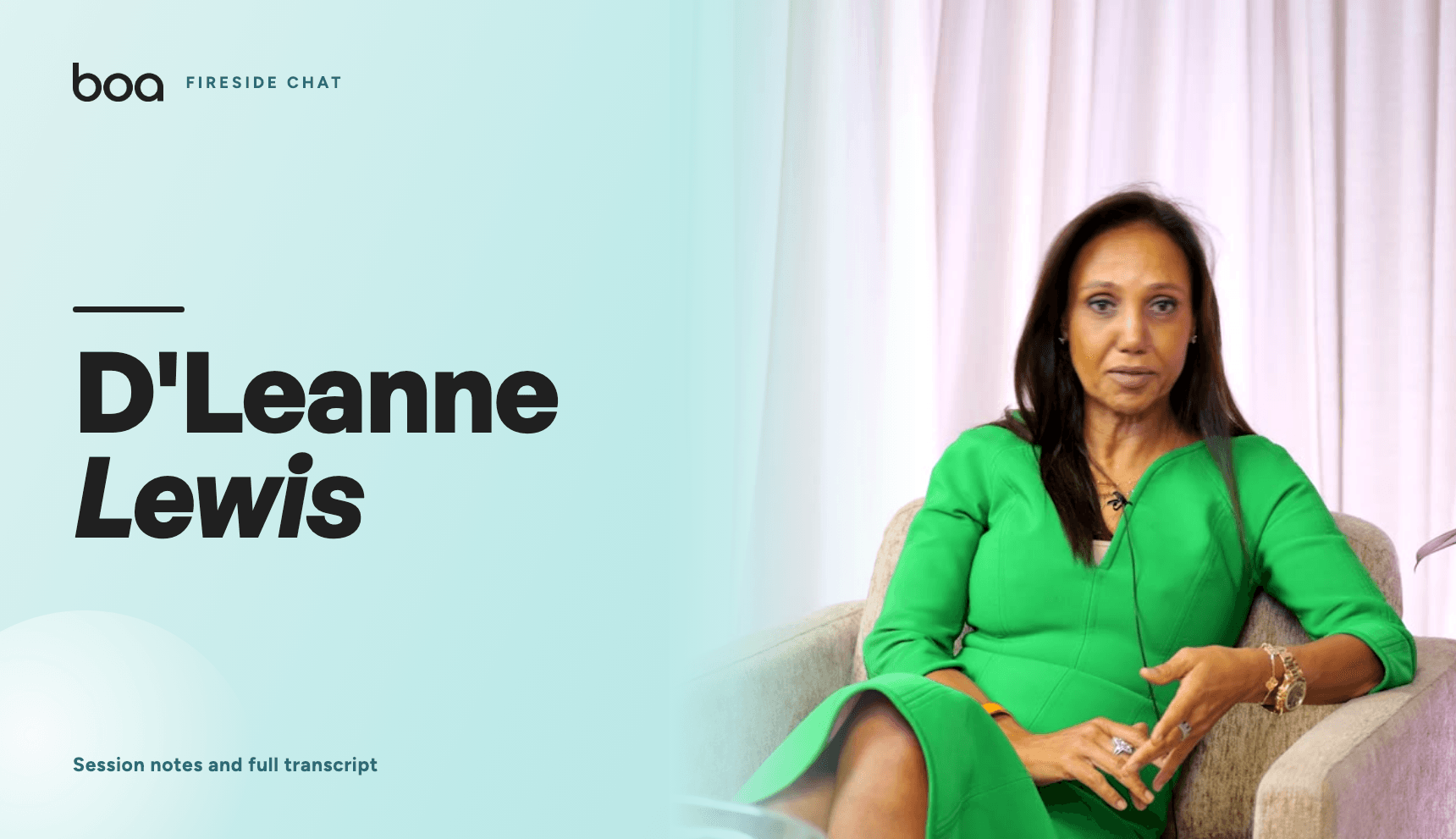
D'Leanne Lewis on Winning Work Without Commission Breath
With D'Leanne Lewis, Real Estate Agent at Laing+Simmons Double Bay · Hosted by Kirsten Scott · 26 min
What this session covers
Sydney agent D'Leanne Lewis breaks down 33 years of relationship-driven selling: how to be remembered without "commission breath", what actually weakens a negotiation before it starts, why buyers pay for value not price, and the daily gratitude and meditation habit that stopped her burning out as a single mum running a listings business.
You win work you have no right to win by out-serving people with more experience, then keeping a written record of every pitch you lost so you learn why.
Key takeaways
- 01
Kill the commission breath before you walk in the door
D'Leanne says clients can smell when a call is about your commission, not their outcome ("here come the shiny shoes"). Her fix is to spend the first part of any meeting on things that have nothing to do with the transaction, because the connection is what makes the relationship real. If you cannot do that honestly with a particular client, tell them you are not the right person for the job rather than performing a false version of yourself.
- 02
Make people think of you first, even for a plumber
Her mentor Billy Bridges taught her that if someone is thinking about real estate, they should be thinking about you. D'Leanne extended that: she wanted people to call her if they needed a gardener, a plumber, or help for their mum. She worked Sundays and seven days a week, not to build a brand, but to make her name the default in one category.
- 03
Beat experience with enthusiasm and a call funnel
With no runs on the board against shinier, older competitors, D'Leanne competed on effort: hardest working, most enthusiastic, best service, not stopping until the job was done. Practically, that meant hundreds of calls out of the office to get 10 people through, working those 10 to bring 5 back, working the 5 to get 2 back. If you are new, the numbers and the hours are the only proof you have.
- 04
Cut your fee to buy the chance, then over-deliver
At 24 in Queen's Park she was up against three agents quoting 1.4 to 1.7 per cent, including a coach who publicly told everyone never to go below 2 per cent. She offered 1 per cent to win the listing, then set a suburb record on the sale. Early on, the point is building the relationship and the name, not squeezing the most financially out of one deal.
- 05
Do not cry wolf in a negotiation
D'Leanne names two things that weaken you before you speak: not enough preparation, and not being genuinely prepared to walk away. Say plainly "I really like it, I'm not sure I've got the budget, keep me in mind" instead of playing games. But every time you threaten to walk and don't, the threat loses value for the time you actually mean it.
- 06
Negotiate from goodwill, not from needing to win
Her framing is that a negotiation run from "I need to win" produces worse outcomes than one run from goodwill and authenticity. State your real position, keep the other side's outcome in view, and let the deal be a decision rather than a contest. She has run this approach across 33 years of transactions.
- 07
Sell the feeling, because value beats price at every level
D'Leanne has repeatedly sold homes to buyers who paid well above the odds, and her line is that what feels expensive now feels cheap in five years. Nobody buys the cheapest, they buy the best fit for them. Whether it is a one-bedroom flat or a $50 million house, the buyer has to feel themselves in it, so stop arguing price and start showing fit.
- 08
Keep a written list of every pitch you lost
D'Leanne records every property she did not win and why, so she remembers the reason and does not repeat it. She also asks for feedback directly. Her warning is about ego: agents tell themselves they lost on commission when they actually lost because they were not good enough that day.
- 09
Never assume you own a relationship you have earned
Thirty-three years of history is not a reason for anyone to hire you. D'Leanne says she cannot walk in and cite four previous sales as her pitch, she has to give a fresh reason every time: results, energy, and current market data. Turn up unprepared for a long-standing client and, in her words, you are not the right person for that job.
- 10
Hire for the traits your own clients interview you on
D'Leanne treats herself as an employee her clients interview, so she hires for exactly what they demand of her: enthusiasm, authenticity, discipline, resourcefulness, being proactive and the ability to pivot. Age is not a criterion. She applies the same test to architects and designers on her own home build: does this person align with the goal.
- 11
Meditate then spend two minutes on gratitude
About seven years ago, depleted as a single mum of three in a seven-day industry, D'Leanne started meditating and calls it the single thing that changed her. She finishes every session with one to two minutes of thankfulness, and does the same with her daughters each evening, naming a high or one thing they are grateful for. Her rule is you cannot pour from an empty cup.
- 12
Treat critics as white noise and start a database on day one
Her closing advice: don't let insignificant people have significance in your life, and remember roughly 90 per cent of what you see on social media is curated. Learn from peers without treating what they say as gospel. Asked what she would do differently, she named starting meditation earlier and starting a database earlier, because launching without a list means launching to nobody.
How the session runs
- 0:00Quickfire round and the power of "yet"
- 1:55From legal secretary to accidental driver in Double Bay
- 5:41Billy Bridges gives her a desk, a phone and good luck
- 6:06Three ways to build authority: visibility, value, authenticity
- 8:33What weakens you before a negotiation starts
- 9:27Why buyers pay for value, never price
- 11:36Competing without runs on the board
- 13:29The 1 per cent listing in Queen's Park
- 17:18Hiring for the traits clients demand of you
- 18:57Keeping a list of every listing you lost
- 21:50Meditation, gratitude and not pouring from an empty cup
- 24:06Back yourself, and ignore the white noise
- 25:48Q&A: what she would have started earlier
Mentioned in this session
- Sydney CBD
- Sydney Morning Herald
- Double Bay
- Blacktown
- Laing+Simmons Double Bay
- Billy Bridges
- Bondi Junction
- Queen's Park
Questions founders ask
D'Leanne Lewis names three things: be constantly visible, focus on giving value and insight to clients, and build authentic relationships. The goal is that whenever someone thinks about your category, they think of your name. She worked seven days a week early on purely so people would remember her when real estate came up.
Walking in underprepared, and threatening to walk away when you won't. D'Leanne says every empty threat drains the value of the real one. She recommends stating your position honestly ("I like it, I'm not sure I have the budget, keep me in mind") and negotiating from goodwill rather than a need to win.
By out-working them and being clear about what you offer instead of a track record. D'Leanne promised the hardest work, the most enthusiasm and the best service, then did the volume: hundreds of calls to get 10 people through a property, working those 10 to bring 5 back, then 2. At 24 she also cut her fee to 1 per cent to win a listing against three more experienced agents, and set a suburb record on the sale.
D'Leanne started meditating about seven years ago after realising she was depleted as a single mum of three in a seven-day industry. She closes each session with one to two minutes of gratitude, and runs the same practice with her daughters at the end of each day. Her framing is simple: you cannot pour from an empty cup, so invest in yourself mentally, physically and spiritually.
Ask for feedback and write it down. D'Leanne keeps a list of every property she did not win and the reason why, so she remembers not to repeat it. She warns against the ego excuse of blaming your commission when the honest answer is you were not good enough on the day.
Full transcript
The complete conversation, as recorded, with every speaker attributed.
Kirsten Scott0:00
So, um, let's dive right in. I want to do a really quick fire round of this or that just to kind of relax things and get this or that. Yeah.
D'Leanne Lewis0:07
Okay. Okay.
Kirsten Scott0:08
Are you ready?
D'Leanne Lewis0:09
Yes. Jillian is ready. Coffee?
Kirsten Scott0:12
Early bird or night owl?
D'Leanne Lewis0:14
Both. Yeah, it kills me. Okay, I have a goal that I'm going to go to bed at 10:30. Yeah. And regularly I get to bed 11:30 to 12, and it's crazy. And I wake up at 5:30, so— wow, I'm both.
Kirsten Scott0:26
She's a powerhouse.
D'Leanne Lewis0:27
3 kids.
Kirsten Scott0:28
Uh, calling or texting?
D'Leanne Lewis0:30
Calling. Always. Yes.
Kirsten Scott0:32
Podcast or book?
D'Leanne Lewis0:34
Book. Sorry.
Kirsten Scott0:37
10 warm referrals or 100 cold leads?
D'Leanne Lewis0:40
10 warm referrals.
Kirsten Scott0:41
Uh, your current non-negotiable daily habit?
D'Leanne Lewis0:44
Meditation.
Kirsten Scott0:45
Yeah, I love that. Um, and one word describe your business journey so far?
D'Leanne Lewis0:52
Exciting.
Kirsten Scott0:53
I love— most people say chaos, so we'll go with exciting. Yeah, I love that.
D'Leanne Lewis0:57
You know, I think that what you put into your mind becomes your reality. If you're constantly thinking your journey is full of chaos, that you're going to be existing in a world full of chaos. If I wake up in the morning and I tell my kids this all the time, is that what you believe actually is what you become. And so if I think— and my daughter Nava's got this wonderful thing in her classroom— is that I can't do it yet. It's the power of yet, right? I'm not there yet. I don't understand it yet. I'm You know, like everything is yet. It's not the final— our life is not binary, right?
Kirsten Scott1:36
She's becoming.
D'Leanne Lewis1:37
Yeah. And we are as well. Like, I'm 54, I'm still becoming. Yeah, right. Isn't that cool? Anyway, no, that was—
Kirsten Scott1:43
I love that.
D'Leanne Lewis1:43
We digress.
Kirsten Scott1:44
That's a great word.
D'Leanne Lewis1:45
More questions?
Kirsten Scott1:46
Yeah, let's dive in. Okay, so can you take us back to the beginning? How did you first get into real estate, and at what point did you realise you wanted to build a name and authority for yourself in the industry?
D'Leanne Lewis1:55
Oh my goodness. Okay, so, um, I've told this storey so many times and it still never gets old because I remember different parts of the journey. Um, I was 20, I was working as a legal secretary, um, in the city, Sydney CBD, and I was just— I moved out of home at 18. My parents lived in Blacktown. I couldn't wait to hit the big smoke, you know. And so I basically ran away from home with my boyfriend. I lived with him, which was a really bad move. Um, but, um, I I got a job working as a legal secretary in the Sydney CBD, and after a year I started getting issues. So I looked in the Sydney Morning Herald at lunchtime and there was a little ad that was before internet, people, and there was an ad looking for a secretary to director of sales. So I applied for the job. I got it really easily and I thought, gosh, that was a bit easy. So I left. I started— I didn't even know where Double Bay was, and I got this job, and they— I assumed it was working as a secretary, and I didn't think I needed my car. And after the second day, they said, where's your car? And I said, at home. Well, you need it. And then I realised after a few months driving around that this, um, director of sales had lost her licence for drunk driving, and I was basically hired as the driver. And other than get frustrated with the fact that I'd essentially been hoodwinked into becoming a driver, um, I just started listening to the conversations that she was having in the car with clients. And I got to go to open for inspections, I got to meet people, and it became the ultimate learning journey because I wasn't stuck in an office. I was actually learning from, um, one of the best agents at the time, a female agent, about what it took to be really good at what you did. So I'm sorry, this has just come off. And it was an amazing journey because I learned so much and probably more than I would have learned had I been stuck in an office. So eventually, after about 12 months, 18 months, mind you, I was only 21 at the time, 22, nearly 22. I asked if I could get into sales, and both my boss and also the head of Lang Simmons Double Bay said to me, no, you're too young. Girls don't do it. There were no girls of colour that did it. Certainly there weren't girls at 22 years old that were doing it. And resoundingly, it was not— you can't do it. And I thought— I remember thinking to myself, it was like a red flag to a bull. I was like, bugger this, I can. And so I left. And there was a lovely gentleman called Billy Bridges that gave me a chance, right? And he was a jockey. He had his own agency and he was, if any of you searched Billy Bridges, he was a character. He was absolutely, he was really naughty. It was lots of fun. And, um, I started there. I was basically given a desk and a phone and he is like, good luck. And that's what happened. There were no, um, there were no podcasts. There weren't any training abilities. There was nothing. It was sink or swim. And I swam. Didn't sync. And he helped me a lot to understand what you needed to do to become somebody in real estate, which is just give service, give service, and give more service, and do it with a smile. And, um, he taught me that if someone wants to think about real estate, they want to think about you.
Kirsten Scott5:41
Yeah.
D'Leanne Lewis5:42
What is going to make them think about you, Delene, and remember your name? And even if they wanted a gardener or plumber or someone to help their mom, whatever, I want them to call me. And that became my MO. I used to work Sundays. I was working 7 days a week, not because I wanted to build a name, but because I wanted people to remember my name when it came to real estate.
Kirsten Scott6:06
Yeah, I love that. That kind of takes me into the next question. So for founders trying to build authority in the industry, what are 2 to 3 practical things they should focus on early?
D'Leanne Lewis6:17
Um, be constantly visible. Mm-hmm. Yeah. So, um, I think I'm relating it back to my journey. I needed people to remember my name. What was going to help them remember my name was being constantly visible, give insight, give assistance, give service wherever you can. Whenever they think of an industry, you want them to think of you. I love that. Um, focus on providing value. To your client. Again, it's part of being visible. And, um, 3, which is probably the thing that served me the most over the last 33 years I've been working, is, is work on providing and creating authentic relationships, right? Because, you know, people— we call it commission breath. They know when you're calling and you're not being authentic. And commission breath, it is commission breath. Yeah, here they come again. Yeah, here come the shiny shoes. You know, you want to build authentic relationships and Most times I'll go into properties and we'll talk about things that got absolutely nothing to do with real estate because you're learning to get to know each other. Connect. Absolutely. Yeah. And the valuable connections are the ones that are the most authentic. And those are the ones that have seen me create, sustain, develop, nurture over the last 33 years some amazing relationships. Now, also, when I go into a situation with commission breath, I feel disingenuous, and I just don't feel like that is who I am. I don't perform well. Um, actually, I feel like I'm performing. Yeah. And I'm not myself.
Kirsten Scott8:04
The difference, right?
D'Leanne Lewis8:05
Yeah, yeah, absolutely. And so it's not the person I want to be. I don't want to live that path with that person. And I'd rather say to the person, I don't think I'm the right person for the job, um, rather than just be a false version of myself.
Kirsten Scott8:23
Yeah, I think they are great tips. Um, okay, so in high-stake negotiations, what are the biggest mistakes that weaken someone's position before the conversation even starts?
D'Leanne Lewis8:33
Not doing enough preparation. Yep. Um, you also need to be able to walk away. Yeah. So if you are negotiating, uh, negotiating out— negotiate out of a place of authenticity. So I say to people, instead of trying to play games, just say, I really like the house, I'm not sure that I've got the budget for it, but I really want you to keep it in mind. So be authentic in your negotiation, but also be prepared to walk away if it's not going to be the right place for you. Don't cry wolf, because the more you say you're going to walk away, the less value it will have when you actually do need to walk away. Um, and, and negotiate from a place of goodwill rather than I need to win. Yeah, yeah, yeah, I love that.
Kirsten Scott9:20
Okay, so what have luxury buyers taught you about perceived value, positioning, and pricing that founders could apply to their own business?
D'Leanne Lewis9:27
They don't, don't buy based on price. You buy based on value, right? And so, so many times I've sold to people that have paid way above the odds for the home, but what feels expensive now feels cheap in 5 years. And I've always used that when I've purchased property over the last 33 years. I bought my first house when I was 22, and it was, it was like $390,000, and it was in Bonney Junction. I thought, oh my God, this is such a huge amount of money. Over 25 years I've got to pay this back. And within 2 years I'd bought against it to buy something else. And so I, I, I climbed up the property ladder to where I am now, and I'm still climbing, and I'm probably not going to stop climbing for quite a long time. But I, I always bought based on what, um, I think the eventual property would mean to me. Um, so those are fairly strong lessons that I've always worked with.
Kirsten Scott10:30
And you know what, I think that applies to every industry, whether you have like a product or service-based business. People are always going to buy on value rather than price.
D'Leanne Lewis10:38
You don't buy the cheapest. No, you buy the best for you.
Kirsten Scott10:40
Definitely.
D'Leanne Lewis10:41
And everybody's idea of what the best is for them is— it's so subjective, right? But, um, I always say to people, you can't sell something to someone that they don't want, right? So it's not about value, it's not about the cheapest, it's about does this work for me? Can I feel that it works for me. And I mean, like, obviously there's different industries, it works differently in different industries, but for me in my industry, I know when someone feels the home, right? And it could be a one-bedroom apartment, it could be a $50 million mansion. You can't say it's the cheapest, so therefore it's the best. It has to work for them, their family's needs, their needs. They have to feel themselves in the property.
Kirsten Scott11:28
Yeah, that's great. Uh, when founders are still in their early journey, how can they negotiate more confidently without feeling they need to prove themselves?
D'Leanne Lewis11:36
It's not about proving yourself. I mean, I, I remember when I first started, I felt like I needed to prove myself because I was looking at what everybody else was doing and I was comparing myself against everybody else. And comparison is the thief of joy, right? It's, it's not creating the best value, it's showing your value to the person. So the way I started is I said I was going to work the hardest, I was going to have the most enthusiasm, I was going to give the best service, and I wouldn't stop until the job was done. And that level of propelled me forward against a lot of my competitors that were shinier, smarter, more experienced, older. They had the runs on the board. So what was going to make somebody give me their home versus, you know, the 5 or 10 other guys that were going for? And at that stage, it was just only my enthusiasm because I didn't have any runs on the board. But when I'd go into a property, I think, okay, so what's going to show this person that I have the database and I would get into my office and I would make hundreds of calls so I could get 10 people in and then I'd work those 10 people so I could get 5 of those people back in. I work those 5 people to get 2 of those back.
Kirsten Scott12:51
It's always the numbers game, isn't it? It is.
D'Leanne Lewis12:53
But it's the hours that you spend delivering for that client and having them see that you can deliver and you've got the energy to deliver and you've got the authenticity to be you keep your word. Um, and if I say I'm gonna do something, still now, 33 years later, I will do it. If I say you can have something within the next hour, I will make sure that that happens. Yeah.
Kirsten Scott13:17
I love that. And it does come back to relationships as well, because even though you might not be acting on their behalf in that di— uh, specific time, like down the track, they'll come back to you because they realise the energy that you previously put in.
D'Leanne Lewis13:29
Yeah. And I think sometimes, and not everything is a success story. No. There's so many times that I have failed, or if I make a mistake, I'll put my hand up. And I will say, this is on me, I will do better next time. And you also have to be able to take constructive criticism as well and say, okay, you know what, I understand what you're saying, I don't agree with you, but I will take it on board and I will, you know, let's try and work it out, let's navigate. Sometimes you have awful conversations with people and you have to be able to reset. Yeah, they're having a bad day, you're having a bad day, we are all human beings on this journey, and you have to be able to empathise and say, okay, this is about them, it's not about me. And sometimes you do mess up and you have to say, call them up and say, listen, I didn't do this right, I can do this better next time, just give me a chance. I remember there was one property, I was probably 24, and it was in Queen's Park, and I really wanted this listing, and I was up against 3 other really, really good agents. And I remember at the time there was all these guys, the coaches, saying, oh, you know, I don't do anything less than 2% and don't, don't drop your fee. And I remember thinking, it's easy for you to say. And I went up against one of the guys that was a coach and had been telling all the people never to go less than 2%. And anyway, he was sitting there 1.5% including GST, and the other person was sitting 1.4%, the other person was sitting 1.7%. And I remember thinking to myself, these people are the ones that are saying that they never drop their fee. Yes, they're dropping their fee. And the owner said to me, look, Delene, I really want to go with you, but this guy's got more experience and he says he's got the database and he owns the area. And I was like, I'll do it for 1%. I'll do it for 1%. And he's like, okay, okay. And I knocked that sale out of the ballpark. I set a record for the area. I was so excited that they just gave me a chance, right? And I was just like, I'm going to do it. And you know, the fact that they gave me that chance, I think the whole point is you talk about founders. The point is building the relationship, right? Not squeezing the most out of it in terms of, um, the financials. You have to start somewhere, and how you start somewhere is you build your brand, you build your name. What's going to make people come to you is your level of enthusiasm. What makes you you? What makes you different? And right then I was like, I have nothing to lose, I'm going to go for this, going all in, I'm going all in. And you know, so many of those coaches that said, oh, I drop my fee less than 2%. Well, that was all BS. It's like social media, like half of it, I'm sorry, 90% of it is curated. It's not real. And we get into our heads thinking, this is what I'm supposed to be, this is what I'm supposed to do. You let insignificant people become significant to your life because you think what they're saying is gospel, and it's not. And it was only through that lived experience of mine at a very early age, thank God, I realised that I'm not going to be pigeonholed into what I'm supposed to be doing in terms of what I'm supposed to be doing in terms of my social media, or I'm supposed to be doing in terms of what I dress like. I'm going to be me and I'm going to be the best version of me. And the people that I will attract because I'm being authentic, it's going to make my journey all the more fulfilling.
Kirsten Scott16:57
Yeah. And I also— that helps you become the authority in the space because you're not looking sideways, you're just looking straight ahead.
D'Leanne Lewis17:03
That's right. And obviously you've got to learn from your peers. Yeah, but you don't have to believe everything they say.
Kirsten Scott17:08
No.
D'Leanne Lewis17:09
And they're real estate agents.
Kirsten Scott17:12
Um, okay, so when hiring early, what traits or standards do you think founders should prioritise first?
D'Leanne Lewis17:18
Um, well, I think that the hiring should reflect your goals. It should be in alignment with what you want to achieve. And so, um, I always believe you've got to learn from others around you. That is how you learn, right? This journey of ours, you never want to stop growing. So it's not about age, it's about enthusiasm, it's about authenticity, it's about ability to be disciplined, right? Um, what are the other things? Resourceful, proactive. Those are the things that I think make a good employee. And I am an employee for my clients who interview me.
Kirsten Scott18:07
That's exactly right.
D'Leanne Lewis18:08
So what are they looking for in me? I want that in my team. I want us to be able to pivot. I want us to be enthusiastic. I want us to be resourceful. I want us to be proactive because that is what my clients expect from me. And so when I'm interviewing people to work for me in terms of my home that I'm building or my designers that I want to employ, my architects, whatever, it's the same thing, is that the team around you have to align with your goals and, you know, I don't expect everybody to like me, but I like me and I like the person that I've become and am continuing to become. And so I want people around me that are willing to grow as well.
Kirsten Scott18:49
Yeah, I love that. Okay, so in relationship-driven industries, what do people underestimate the most about building long-term trust and reputation?
D'Leanne Lewis18:57
What do they underestimate the most? I think they underestimate its value because the only value you end up having is those long-term relationships that you both build. But I don't think that you can be complacent in them. Just because you've got the relationship doesn't mean you own the relationship. And the relationship, like any relationship, takes hard work, right? And my business is results-driven. Someone can like me, they might know me for 33 years, but unless I'm performing and creating results, then they're not going to use me. And I can't say, well, I've known him for 33 years and I sold his last 4 places, and so therefore you should use me. I've got to give them a reason to use me. And what is that reason? My results. What is that reason? My level of energy. What is that reason? My level of intelligence in my marketplace, knowing my data. So if I'm sitting in front of you, if I come and I'm not ready, right? I don't care how many times I've sold for you, I'm not the right person for the job. And I keep a list of all the properties that I have not got the listing for, so I remember why I've lost that.
Kirsten Scott20:19
I love that.
D'Leanne Lewis20:20
It's, it's, you know, like people say, I know you've got to only talk about the positives. In order to learn, you've got to look at your failures and say, what could I have done better in that instance? And it reminds me not to do it again.
Kirsten Scott20:35
Yeah, it's kind of, um, I know sometimes if a service-based business doesn't get a client, like they don't win a client or whatever, I'll say ask for feedback on the reasons why.
D'Leanne Lewis20:43
I always do.
Kirsten Scott20:43
Keeping a note of that and just making sure you do differently next time.
D'Leanne Lewis20:46
That's right. And people make excuses, you know, it's the ego. Oh, they didn't use me because my commission was too high, or they didn't use me. No, they didn't use you because you weren't good enough. Yeah, right.
Kirsten Scott20:56
It's okay to see you need to improve.
D'Leanne Lewis20:58
It's okay. And I fail all the time. And even I say to my girls when they're studying or whatever the results they taken their exams or tests, it's not about the mark, it's about the effort. If I see you putting in the effort, then that's winning to me, right? And I think that is how you go through life in, in your journey in life. It's that you don't always need to be number one because you won't always be number one. It's not possible, right? Um, it's more about being the best version of yourself all the time for you, because at the end of the day, you only answer to yourself.
Kirsten Scott21:37
Yeah, guys, we are going to move to the Q&A shortly, so if you have any questions, just pop it in the chat and the team will pick it up. Um, so as your business and profile grows, were there any habits, routines, or boundaries that helped you stay grounded and avoid burnout?
D'Leanne Lewis21:50
Yeah, I think, um, probably about 7, 8 years ago, like, I've got 3 kids and, um, they're 10, 7, and 3. And so being a single mom, number one, I'm outnumbered, but number two, in my industry, it's just not possible to work the levels that you're supposed to work and be a single mom and do everything and so without burning out, right? And so I realised that something needed to shift. And about 7 years ago I started meditating and that is singularly the, I mean, I train all the time anyway, but it was singularly the thing that shifted me into becoming mindful of my journey. And you can't pour from an empty cup and I was pouring from an empty cup because I was getting so depleted And what meditation does for me is that it gives me an opportunity to be mindful of myself, to work out what parts of me is feeling stressed, anxious. Also, at the end of my meditation, I always practise a minute or two of thankfulness, of gratitude, because it's very easy to keep on, particularly in the society, wanting more, you know, and you're totally— yeah. I just don't— I want to project myself forward, but I also want to be thankful for the things that I have. And because I'm practising that level of gratitude every day, some things that I'm not even thinking about during the day, it comes to me and I think, okay, I can be thankful for that. Even though it's a very small thing, it actually, it, it, it instils in me a level of calm, that in all the madness— some days are really terrible— there's always something good. And, you know, I talk to my girls about this at the end of every day. We talk about what our highs were, or just one thing that you're grateful for today. There's always something, you just need to find it.
Kirsten Scott23:53
Yeah, I love that you said that, because I think you're actually not only a better, like, mum or partner or friend or whatever it is, but you're a better person to your clients.
D'Leanne Lewis24:01
Yeah.
Kirsten Scott24:02
And you work better as a founder or business owner or whatever it might be.
D'Leanne Lewis24:05
Absolutely.
Kirsten Scott24:06
Um, and the final question for founders listening today who are on the edge of the next move, what's one practical piece of advice you'd give them?
D'Leanne Lewis24:17
Back yourself. Back yourself. Um, but more than back yourself is you put yourself first. So look after yourself, invest in yourself mentally, spiritually, and physically, because you can't pour from an empty cup. I said this before. It is really important to nurture yourself because in this life it takes— being a founder, it takes a out of you, right? It's a constant strive. Um, it's all on you. It's all on you. Yeah. And unless you are investing in yourself mentally, um, physically and spiritually, um, you'll dissolve. You'll dissolve. And you won't be good to anyone around you. I think the other thing— I was listening to this wonderful podcast yesterday on my run. It— and I'm touched on this before— it said don't let insignificant people have significance in your life. There will always be someone that says, um, something something negative about you. And at the end of the day, it's just white noise, right? If you're living your authentic life and true to your authentic self, it will not matter what they say. Obviously learn, but don't let them cast a dark shadow of your journey.
Kirsten Scott25:29
Yeah, that's great advice. Thank you. Now guys, we are going to open it up to Q&A. Um, Jane, would you like to go first? And if she doesn't want to ask, I can ask you a question for you. Um, she's asked, looking back on your career, is there anything you wish you'd done differently or started earlier?
D'Leanne Lewis25:48
Yeah, I wish I'd started meditation earlier for sure. And I'd also wish I started a database earlier as well.
Kirsten Scott25:54
Yeah, yeah, a lot of people say that, um, particularly like when they're pre-launch, building up that client list first so you don't like launch to crickets essentially.
D'Leanne Lewis26:02
Yeah, absolutely. You just need to have a plan. You have to have a plan.
Kirsten Scott26:06
It's great advice. Guys, does anyone else have any questions? All right. Did you have any last tips?
D'Leanne Lewis26:18
No, I think that we've covered it all.
Kirsten Scott26:19
Thank you. Yeah, that was amazing. Well, thank you for everyone for joining us this morning. It was great to have you, and we will see you all soon.
D'Leanne Lewis26:27
See ya!
Watch the full sessioninside Boa.
Session notes are free. The recordings, the live advisories and the founders in the room are for members.