Fireside Chat
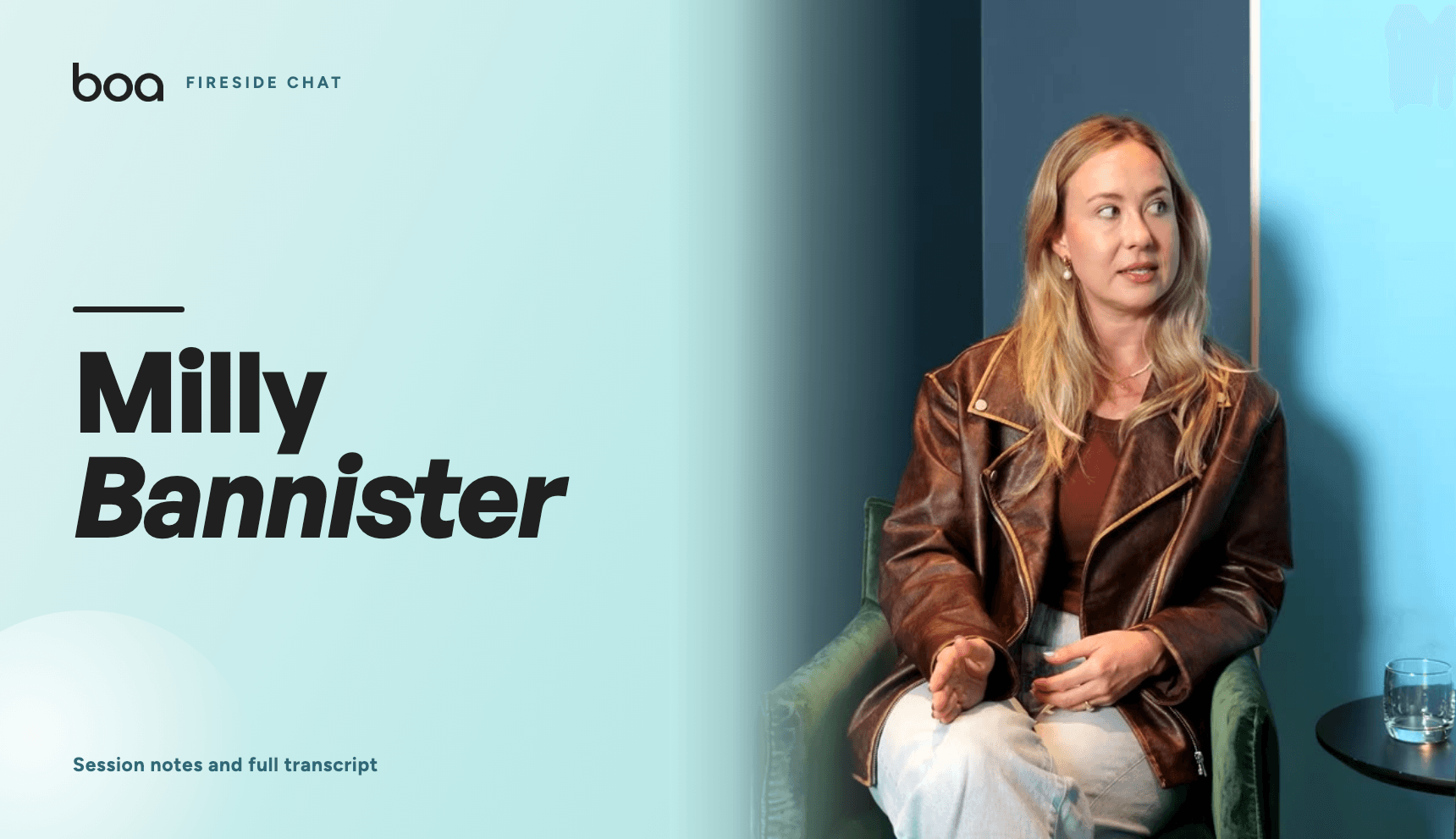
Milly Bannister on Building a Brand Gen Z Actually Trusts
With Milly Bannister, Founder at Allkind · Hosted by Boa host · 42 min
What this session covers
Allkind founder Milly Bannister shows how to build a brand young Australians trust: co-create culture rather than copy it, put the founder story ahead of the product, and design campaigns that pair online reach with offline moments. Also covers loneliness, burnout, and setting vulnerability boundaries. For founders selling to Gen Z or managing young teams.
Stop guessing what your youngest customers want, hire them, ask them for a feed tour, and co-create the culture instead of borrowing it.
Key takeaways
- 01
Ask your youngest customers for a feed tour
Milly hosted two 15-year-old work experience students for two days and used the time to ask a million questions, listen to how they spoke, and get a tour of what was actually showing up on their algorithm. Her rule: if you are targeting young people, hire young people, and if you are targeting new mums, hire a mum. There is no point guessing when your customer is sitting right there and usually happy to tell you.
- 02
Run customer calls about the brand, not just the product
Milly pointed to Davey from Boring Without You Skincare, who runs calls with customers who want to give feedback. Not about the formulations, which are already sorted, but about the brand and the way it speaks to people. Ask questions you cannot guess the answer to, like whether they want the newsletter the day before a launch or on launch day.
- 03
Co-create the joke instead of borrowing it
Big brands come off cringe when they use Gen Z language without knowing where the meme came from or being in on the joke. Milly's point: young people are marketing machines who create culture themselves, so the brands that land are co-creating culture with their demographic rather than tapping into it after the fact. She named Rhode by Hailey Bieber as the extreme example of a brand creating culture rather than chasing it.
- 04
Stop pushing uphill on a channel that will not open
Allkind's training is built by educational psychologists and backed by a university, but schools kept rejecting the direct language around self-harm and panic attacks. Rather than keep selling to principals, Milly dropped that channel and went straight to social media, where a single video reaches thousands of young people and the tone lands better because the context suits it. If a gatekeeper keeps saying no, check whether you can reach the end user directly.
- 05
Pair online reach with one offline finale
For the Good Mate Championships, Allkind put six teams across Australia behind creators including Ella Watkins and Georgia McCutcheon, who competed over a month to get the most young people trained. The finale was a live-streamed event at Instagram HQ with an MVP battle and a trophy, plus a six-metre mural on Crown Street. The campaign reached over half a million young people digitally and lifted training intake by 400%, and the content and creator relationships still get used.
- 06
Treat your audience as co-owners of the story
Milly's framing is to stop looking at Gen Z, millennials or Gen X as a demographic and instead treat them as collaborators or co-owners of the story. The point of telling your founder story is so people see themselves in it and want to back you. Give them a role in the campaign, like a team to join, so they have something to share to their own community.
- 07
Lead with story, then translate it for the audience
Asked where to start on a campaign, Milly said the story first, then how you translate it for that audience. Set the higher-arching goal aside once it is defined and aligned with your business values, then come back to the story and the why. The strategy is what carries you from the story to the goal, and the strategy itself can be storytelling. Tell people the why before the what.
- 08
A niche can be an interest, not a demographic
For a service business selling to mixed generations, Milly warned against trying to speak to everybody, which makes a brand look weak and translucent. Build authenticity through characters instead: hire creators, or bring real stories from your community into the content. And remember a niche can be an interest that spans ages 15 to 85, like running, rather than an age bracket.
- 09
Use the seven-day, seven-year test on founder worry
When the mental load hits at night, Milly zooms out and asks whether this will matter in seven days, seven weeks, seven months, seven years. Her shorthand is that it is PR, not the ER. She also says hustle will never beat clarity, and every time she has chased more offers and more output the message got messy, the team got confused and revenue did not follow.
- 10
Build a mini board of two or three founders, in the calendar
Milly's advice on connection is that quantity never measures up to quality. Networking rooms can leave you visible and still lonely. Instead pick two or three people, book a coffee or a coffee Zoom every fortnight in the calendar, and act as each other's mini board of advisers. Drop the "I'm totally fine, I've got this" line and say the week has been an absolute shocker and why.
- 11
Go first with vulnerability, then keep showing up
The fastest way to build connection is vulnerability, not trauma dumping. If you are going through something, ask your peer whether they have faced it and what got them through. You may have to offer first, but you will usually get it back and a layer comes down. Vulnerability only works with proximity and consistency, so doing it once and disappearing does not build anything.
- 12
Draw your line in the sand before you are asked
Answering a member worried about oversharing, Milly said to decide in advance which topics are on the table and which are off, and treat that as completely valid. Sacrificing your boundaries for connection or for the algorithm is bad for you and for the business. Vulnerability does not have to be personal trauma either, it can be the thing that lights you up, right down to complaining that your lawn is looking dry this week.
- 13
Give in-person community events clear roles and an incentive
For anyone building a youth or founder community, Milly warned against "just show up and share your experiences", which is daunting for socially anxious people. Give the event structure, clear roles and a reason to come, such as a networking round where people are paired with someone working on the same challenge, so attendees know what they walk away with. Online, watch the friction: Allkind runs its inner circle in an Instagram broadcast channel rather than asking young people to download another app.
How the session runs
- 1:10From journalism to founding Allkind
- 4:22Why schools said no and social media said yes
- 7:00What Gen Z values: founder story and culture
- 9:41Hire your customer and ask for a feed tour
- 12:47Why storytelling beats data alone
- 13:55The Good Mate Championships campaign
- 19:47The loneliness pandemic and third spaces
- 22:45Clarity over hustle and the seven-year test
- 26:25Building a mini board of two or three peers
- 28:25Leading a Gen Z team by example
- 29:59Kevin: structure and roles in youth communities
- 33:09Antonella: content for mixed generations
- 36:25Where to start a campaign: story, audience or goal
- 38:09Amy: vulnerability without losing boundaries
Mentioned in this session
- Allkind
- TikTok
- Nine
- Brisbane
- California
- Rhode
- Hailey Bieber
- Boring Without You Skincare
- Brittany Saunders
- Sophia Amoruso
- Good Mate training
- Good Mate Championships
- Ella Watkins
- Georgia McCutcheon
- Instagram HQ
- Crown Street
- South by Southwest
- Sydney
- Boa
Questions founders ask
Milly says the problem is brands borrowing internet language they were not part of creating, so they use words and memes without knowing the origin or being in on the joke. The fix is co-creating culture with your demographic instead of tapping into it, which usually means hiring young people, bringing real community stories into your content, or working with creators who already speak that language. Rhode by Hailey Bieber was her example of a brand creating culture rather than chasing it.
The Good Mate Championships ran six teams from around Australia, each led by a creator, competing over a month to get the most young people through Allkind's free 60-minute peer-to-peer mental health first aid training. It finished with a live-streamed final at Instagram HQ with an MVP battle and a trophy, plus a six-metre mural on Crown Street. It reached over half a million young people digitally and lifted training intake by 400%, and the content and creator relationships still get reused.
Milly's first answer is that hustle will never beat clarity. Every time she has tried to do more, add offers and get more done, the message got messy and the team got confused without more revenue. For the mental load, she zooms out and asks whether the problem matters in seven days, seven weeks, seven months or seven years, and she keeps a small group of industry mentors and other founders rather than carrying it alone.
Milly says the line is yours alone to draw and you should decide in advance which topics are on the table and which are off. Sacrificing your own boundaries to connect, or for the algorithm, is not good for you or the business. Nobody is going to sit across a coffee table and demand your childhood trauma, and vulnerability can just as easily be a small honest detail about something that matters to you.
Milly points to hyperconnectivity replacing in real life connection, giving people visibility and soft surveillance online without intimacy. She also blames the loss of third spaces, with clubs and hangout spots defunded or closed and not adapted to how young people live now. Cost of living adds a social recession on top, when a movie ticket is $35 plus parking rather than $10. She says one in three young people feel lonely every week, making them the loneliest demographic in Australia.
Full transcript
The complete conversation, as recorded, with every speaker attributed.
Boa host0:00
So I'm going to kick things off. I'm here with Millie Bannister. She's the founder of Allkind, which is a social enterprise redefining the way that young people experience and talk about mental health. Honestly, pretty incredible. Before we jump into it, I thought I'd do a quickfire round of this or that just to get to know Millie a little bit more. So are you ready?
Milly Bannister0:20
Yes, I'm ready.
Boa host0:21
All that you need to do, just whichever word feels more aligned. No pressure. Okay, so coffee or tea?
Milly Bannister0:27
Coffee.
Boa host0:28
Okay. Text or calling?
Milly Bannister0:29
Text.
Boa host0:30
Yep. Morning hustle or late night grind?
Milly Bannister0:32
Oh, probably morning.
Boa host0:34
Yeah, same. Podcast or book?
Milly Bannister0:37
Book.
Boa host0:37
Mm-hmm. LinkedIn or Instagram?
Milly Bannister0:40
Instagram.
Boa host0:41
Or BoA? Nah, I'm kidding. We'll come back to that. Adapt quickly or stick to the plan?
Milly Bannister0:46
Adapt quickly. Mm-hmm.
Boa host0:47
And share the journey or highlight the outcome?
Milly Bannister0:50
Share the journey.
Boa host0:51
Yeah, I love that. So I think it's really cool to think about things like that sometimes because it redefines like how you move forward with different things. I think coffee or tea in particular, like the coffee gets you fired up and ready to go. But so let's jump into it. What inspired you to start AllKind and what was your journey like in the early days?
Milly Bannister1:10
So I actually studied journalism up in Brisbane and I hated it because I didn't really get to be as creative as I thought I would get to be. My best mate is a reporter for Nine and she stuck to that track and she knew what she wanted to do and she's great at news writing. I wanted to put too many flowery words. I wanted to make things look pretty and for that industry it's not quite right. So I moved over to media and comms and did a gap year over a— not a gap year, I did a, um, what do you call it, an exchange year over in California, which was great. And interestingly, at that time, that was kind of the rise of the travel blogger, back when Instagram was not owned by Facebook and you could just post static images and you would go viral. And it was like the glory days of social media if you wanted to work as, um, you know, in social media marketing or influencer marketing. Um, and so I started my personal brand then. Um, And then eventually I really wanted to create a brand outside of myself that was leaning more towards social impact. And given I was in my early 20s and I was doing a lot of developing and understanding about myself and the world at that point, uh, I guess it was, yeah, developmentally appropriate of me to be asking questions about why have I always been on SSRIs and antidepressants, and why did this affect me so much, and why am I chronically anxious, and all these pieces were kind of coming together for me. And it was also the time that we started talking about the #therapyiscool movement and started really kind of making the taboo, um, open and interesting on social media. And for some people, that became their entire brand. And now it feels very normal for us to open social media and see people, you know, without makeup in the middle of some sort of mental health challenge. But at the time, that was quite novel. Um, and so I started asking people around me, kind of, you know, um, like mentors and psychologists and counselors, kind of all of this. It's like filling the gaps of what I was missing. And then realised that there was a whole generation who had grown up online and had this gap in front of them in terms of what the older generation was willing to talk about versus the reality that they were living. And I decided, why don't we go kind beyond awareness on Instagram and therapy is cool and actually start teaching young people the skills that they need to, um, prevent, you know, mental health crises in themselves and also the people around them. So that's kind of my long-winded storey of how I got here. And then I've been running this charity since COVID time, so yeah, almost 5 years now.
Boa host4:05
Yeah, I love that. You've definitely been at the forefront of that, and I think particularly during COVID that's when a lot of it really came to the surface.
Milly Bannister4:11
Yes.
Boa host4:12
So yeah, it's a scary time. Um, so the business landscape is always changing. What's one expected challenge you face as an early founder and how did you navigate it?
Milly Bannister4:22
I think just the, the fact that you have to be doing, you know, if you are a social media-led business, which we are given our demographic is really young and that's where we interact with them. Um, and even though our, um, you know, our content, our Mental Health First Aid training, it's it's developed by educational psychologists and it's backed by a university. It's really hard for us to get into schools because of that generational gap, and a lot of schools and principals are still not willing to accept that young people are already talking about self-harm and panic attacks, and they don't want the kind of straight-up language that we offer in their schools because they think that it's going to exacerbate things, which from research we know is not the case. So anyway, we decided to give that up and go straight to social media, and that has really changed the game for us. We started like— we stopped pushing shit uphill and just went, we can actually just create a video that will reach thousands of young people instead of land better as well, land so much better given the context. And we can talk the way that we want, we can look the way that we want. But in saying that, the challenge has been in such a fast-moving algorithm product platform environment, you have to constantly be asking what grabs attention. Like, we are no longer—
Boa host5:49
the trends, even though it's to do with mental health, you still have to be on that train.
Milly Bannister5:53
You've got to be seen. And we're no longer just in this kind of information age, we're in the attention age. And to be asking what grabs someone's attention this week will potentially be different next week. And that's been a real challenge of mine. I think as a business owner, you just want kind of like structures in place and you want a plan for at least the next quarter.
Boa host6:16
Yes.
Milly Bannister6:17
Um, day-to-day. Yeah, not day-to-day changes, but ultimately, you know, there are strategies around, you know, your identity as a brand and your authenticity and your founder storey that can kind of carry you through those seasons of change because that kind of stuff, like the human storey never really changes.
Boa host6:35
Exactly. And I mean, you've kind of answered my next question because as a founder, obviously there's challenges that you have to navigate, but particularly when you're in a business that's like trying to fix like and leading with purpose. Yeah, there's a whole other range of things that come up and like you've just mentioned, like you're trying to educate people while still getting their attention and everything else. So what do Gen Z audiences value most in brands and leaders today from your experience?
Milly Bannister7:00
Obviously authenticity and trust, of course, that goes without saying. I really do believe that the founder storey carries a lot of weight. I think we forget to kind of talk to, you know, young people and Gen Z, I guess, if that's who you're targeting. And also, you know, millennials, maybe even Gen X. Now we've grown accustomed to this like level of honesty and peer-to-peer information receiving. And so the founder storey will always beat, you know, just this commercial faceless story. And there is data to support that. The brands doing best do have this founder storey behind them.
Boa host7:45
Or rather than just sending like a newsletter or something like that, real connection.
Milly Bannister7:49
Yeah, it's bringing it back to the human piece. That's just how our brains are wired through that storytelling element. So important. But we forget, I guess, to stop looking at you know, Gen Z, Millennials, Gen X, whoever, as a demographic, and instead treat them as like this kind of collaborator or even co-owner of that story. Like, the whole point of telling your founder storey is to be relatable and for people to see themselves and to back you in and want to support your, your business and buy your product because there's a deeper meaning behind it. Like, we're all craving meaning, um, in a world where we're constantly firehosed with information. We just want meaning. We just want bring it back to the, the human, uh, story. And alongside that, I think showing up in culture is really important as well. Like, uh, Gen Z obviously has a really strong internet language and culture, and the best brands— you know, if we look at Rhode by Hailey Bieber, obviously that's an extreme example, but she's really showing up in culture, she's creating culture. And we forget that particularly young people are these marketing machines themselves. They are creating culture that often, you know, the big brands will try and like tap into, but it will come off quite cringe because it's like, you don't even know what that word means. You don't even know where that meme came from. You're not in the joke. You didn't co-create that joke. And so if a brand can be co-creating culture with its demographic, that's where you get that real kind of like— that's where it really lands, I think.
Boa host9:32
Yeah, no, I agree. And I think for us, we're trying to do the same with Boa because we have so many different demographics how do we choose like our top 3 kind of niche? Yeah, lean into that.
Milly Bannister9:41
Yeah.
Boa host9:41
Um, so okay, you work with a lot of people that are a lot younger, whether that's Gen Z, Gen X, Millennials, whatever that might be. What do you think is your top 3 things like as a way to connect with them? Like, is there something on social media specifically that you guys do that you feel really works? Um, if it is like via a newsletter, is there something that you try to incorporate in there really to like engage your audience? Like, what would be—
Milly Bannister10:04
we hire young people. If you're trying to target young people or you're trying to target new mums, hire a mum, hire a young person. Um, we always welcome kind of like as much feedback as possible. We had two beautiful 15-year-old work experience local girls into our office for two days last week, and we just soaked up as much as we could. We asked them a million questions.
Boa host10:34
Go out to that, like, to your community to be like, we know our community.
Milly Bannister10:38
Well, they found us and they've come to every single one of our events, and then they kind of just were like, can we do work experience with you?
Boa host10:45
Yeah.
Milly Bannister10:45
Um, and we were like, absolutely. We won't take you for the whole week, but we'll take you for, you might, 2 days. Well, no, I was just like, maybe you want to do something like a little bit more like corporate for a few days and then come to us because we're very uncorporate.
Boa host10:59
Yeah.
Milly Bannister10:59
Um, but we, we asked them a million questions and we just like listened to how they spoke. We asked for a feed tour of what was showing up on their algorithm.
Boa host11:09
It's so true because I wouldn't have any clue to start with that.
Milly Bannister11:13
No. And like, what's the point of guessing when you have access to your customer and your customer is potentially really interested in giving you that feedback? I have a friend, Davey, from Boring Without You Skincare, and he actually donates a percentage of profits to mental health charities like us. And so he really nails that founder storey because he is kind of positioning his brand as, you know, beauty is nothing without you and your well-being, and beauty is mental health and vice versa. And he actually does calls with his customers who are interested in giving him feedback, not just about the skincare products, which are already amazing because he's done so much of that already, um, but about the brand and the way that they speak to their customer. Do they prefer to get a newsletter a day before the new product's coming out? Yeah, you can't guess that kind of stuff. And, you know, like, if you have access to your customers, that that can create a really interesting kind of two-way environment. Brittany Saunders is another great example of that. She just posted a video about her newsletter and how that, like, the next time she did it, it created like real tangible results. Totally.
Boa host12:26
Um, and I think that's exactly right. It doesn't matter if you have a service-based business or product-based business. Either way, you're trying to connect and build a community.
Milly Bannister12:33
Yes.
Boa host12:34
So it's best understanding them. Do you want a newsletter? What time of the day are you most likely to read Is the newsletter even worth it? Like, yeah, all the questions.
Milly Bannister12:42
Yeah.
Boa host12:43
So why is storytelling such a powerful tool for founders?
Milly Bannister12:47
It's our lizard human brains. You know, we have only been able to survive because of storytelling. And it truly, especially now when we have so much generated and AI-generated content, mis- and disinformation, it is so hard to kind of wade through the bullshit. Shit. And so we're really— like, never before are we craving real human stories. Um, and so data is great because it informs. And I, as someone who works in kind of the mental health space, I love possibly more than the next person a great statistic. Like, I love kind of bringing that to the forefront. It really sets the tone. It informs. But in order to create trust and build emotion, you have to be telling storeys and the two go together really nicely.
Boa host13:47
Yeah, I agree. So can you share an example of a storey or campaign that successfully resonated with Gen Z? I mean, I'm sure you're doing a lot of it.
Milly Bannister13:55
So yeah, we, we do do a lot of those and it's really fun as a founder to be kind of like keeping your finger on the pulse of, you know, like what what storeys are our demographic telling at the moment and what are they interested in, not just what's trending, um, going a little bit deeper than that. So we're always doing something, but I think probably our biggest campaign that we have done so far was around our only product at the time, which was our free digital, um, peer-to-peer mental health first aid training. So the gap that we found, and this is what our charity was founded on, was the fact that, um, you know, people were training adults how to support the young people in their lives— parents, teachers. Um, but no one was really, like I said at the top, trusting young people with that language.
Boa host14:47
Yeah.
Milly Bannister14:47
Um, and skills to be able to support each other safely through varying levels of mental health crises.
Boa host14:52
So this is the thing, they go to their friends and that's it. Yeah, absolutely.
Milly Bannister14:57
And I think everyone can relate to wanting to go to your peer first as opposed to going straight to your parents. That just doesn't happen. I mean, sometimes it does, but the data shows the majority don't. And so we were like, well, who's training young people. And I—
Boa host15:12
me at that age, I wouldn't know how to articulate it.
Milly Bannister15:15
No.
Boa host15:15
Support them.
Milly Bannister15:16
So yeah, and that can be really tricky too. I had, um, lived experience when I was 15 of supporting someone really close to me through an extremely traumatic experience, and that was so hard because I felt extremely isolated. I felt like I had to keep a lot of secrets. My own mental health really suffered, and it kind of really shaped who I am. And I don't regret that experience, of course, but I do wish that I had some level of mental health literacy because that would have kept me safe and that would have allowed me to support someone I care deeply about better. And so we worked with the psychologists that we continue to work with today— they're on our board— and a university, and we built this really like low barrier accessible 60-minute free peer-to-peer mental health first aid training, and you get your certificate. Yeah. And so anyway, we called that Good Mate training because essentially it's like, you know, if you want to upskill as a friend, do your Good Mate training because you're bound to experience someone kind of reaching out for help, or you might need to kind of notice some, some signs and behaviours that could prevent things going further. So that was our first and will always be kind of our core kind of product. And so we wanted to do a campaign around that. So we did something called the Good Mate Championships where we got 6 teams from around Australia led by creators like Instagram and TikTok creators like Ella Watkins and Lily and Georgia McCutcheon and like creators that obviously resonated with our target demographic. And so over a month period, they would go out to their socials and kind of, you know, Team Watkins, like, we're gonna win Goodmate Championships if we're the team that gets the most young people trained in Goodmate training. And then as a finale, they all flew into Instagram HQ, so we had some support from, from them and their team. And we did like a live streamed kind of like Goodmate Championships, and we had a battle for the MVP. And then we also announced kind of We've tallied the results and this team is the winner and their little trophy and everything. And it was— and we also had this big mural on Crown Street, like a 6-meter-high mural. And it just came together really nicely because there was these kind of offline touchpoints with online touchpoints. We came together for a big finale. There was team kind of like morale and like co-ownership involved in it, had cultural touchpoints in it too. So anyway, we reached like over half a million young people around Australia digitally early, and then we got thousands through Goodmate training and boosted our kind of, um, like intake by 400%. So the results were really great.
Boa host18:12
Yeah.
Milly Bannister18:13
But we also got really great storeys out of it. Like, we got human storeys from, you know, people who, um, we, we let some of the— we let the creators bring some of their community to Instagram HQ, and one girl travelled 8 hours to be there. Wow.
Boa host18:28
And yeah, I guess like, particularly for people in our community, they're all in like different industries. Some of them like in the awareness or charity space as well, whether others have like product-based businesses. If they're trying to connect with their younger audience, it's about bringing them in on that campaign, I guess. Delicious. Get them involved in it. Like, that's the way you like drive their awareness and get them involved in the community. And once they start sharing that on their socials, they're like reaching others within their community as well.
Milly Bannister18:59
Yeah, there's that storytelling element combined with like the community building. Yeah, combined with the social content too. It's a, it's a brilliant campaign when you can either start offline and then bring it online or vice versa. I think marrying the two together creates like a really holistic and strong story. Definitely. That lives on too. We still post a bunch of content, still have those relationships. So you've got all the access to the content. Yeah, yeah.
Boa host19:25
I love that. Now, guys, just a reminder, if you have any questions throughout, just pop it in the chat and the team will send it through to me. So at SXW—
Milly Bannister19:34
sorry, SXW SXSW, South by Southwest.
Boa host19:38
Yeah, I can never get that out. You spoke about a pandemic of loneliness. Yeah. So what do you think are the biggest factors driving this, especially for young people today?
Milly Bannister19:47
So mostly it's obviously like the hyperconnectivity and replacing in real life connections with social media. We have this kind of soft surveillance online. We have this visibility, but we don't necessarily have intimacy online. Like we don't really have like proper connections. It can be really great for finding community, finding interests, chasing goals, self-expression, all of the above. But it cannot at any point replace entirely real-life connection. And so then comes the kind of argument, oh, we'll just like get off your phone and get offline and like go do something. And it's like, well, that's really interesting when our systems have actually kind of removed the places and the patterns that make that connection possible, particularly for young people. We don't really have any third spaces anymore. They've kind of, you know, clubs and, um, like hangout spots are no longer funded. They've closed down. And yes, there hasn't been necessarily any interest, but perhaps that's because they haven't really adapted with, um, the changing kind of culture of young people. So Um, that is kind of like at its core why we are lonely. Um, but then there's this like exacerbating symptoms like the cost of living. So that's creating a social recession as well at the same time because we can no longer afford to potentially go to the movies with our friends because it's not a $10 ticket anymore, it's like a $35 ticket.
Boa host21:19
Yeah.
Milly Bannister21:19
And then paying for parking, and it's just, um, a lot of things at once. But it's a very serious issue. Young people are now the most lonely demographic in Australia, with, um, yeah, 1 in 3 of us feeling lonely every single week and potentially not having anyone to reach out to when we are facing mental health challenges. And we know that connection is kind of that number one driver of well-being. So if you're, if you're missing that as part of your kind of core pillars of what makes you well, um, then you're facing some, some real, some real challenges. So in order to kind of like combat that. We need like a multi-system approach, and it's not going to change overnight, of course, but we need to be firstly very acutely aware of what the reality is, particularly for young people, in terms of, um, this loneliness pandemic.
Boa host22:13
I agree. Um, now I want to move back to like young founders. Um, we have a lot of people in our community which are young founders, or they have staff members which are young founders. Excuse me. And, you know, as a founder, it can be quite hard. You're working long hours, you're doing a lot of it on your own, and it's hard to talk to other people around you that perhaps aren't other founders. So for those people that are early-stage founders, burnout and isolation are common. What strategies do you find are effective for balancing mental well-being and building a business?
Milly Bannister22:45
Well, firstly, I don't think that hustle will ever beat clarity.
Boa host22:53
Yeah.
Milly Bannister22:53
So I think like, for me, I kind of just missed that generation of like the girl boss era, like Sofia Amoruso kind of era, where it was like you would wear it as a badge of honor, you know. That is total— I'm Gen Z, if you can't tell, um, and that is like no longer the case for us. So, um, we are very much about clarity. It's like going, um, instead of a mile wide and an inch deep, we are, you know, you know, a mile deep and an inch wide kind of thing. I did the opposite hands for that, but you know what I mean. Um, yeah, it's just like I have fallen into that trap over and over and over of that kind of like must do more, get more shit done, put out more offers, make more money, all of that kind of stuff. But every time I learn my lesson and it's like, just keep it fucking simple, you know what I mean? Like, nobody benefits from you trying to do more than you need to do. Yeah, like the message gets messy, your customers or your community gets confused, your team gets really confused and burnt out. Like, there's just no point because it's not necessarily going to automatically result in sales or revenue. Um, if anything, it might just confuse your audience and end up kind of like dissipating. Um, so that's kind of like the first thing that I have learned. And then also, um, the kind of like zoom out approach, like, for me personally, like, a lot of stuff, you know, as a founder, weighs on you, particularly at nighttime, out of hours. The mental load.
Boa host24:34
Yeah, damn, there it is.
Milly Bannister24:36
Yeah, the mental load is no joke. Yeah, particularly when you've got other people involved and you're responsible for their, you know, potentially managing them or knowing what's on their workload and, and trying to do everything all at once. Like, you're still wearing all of the hats. Um, zooming out and, and kind of going like, is this going to matter in 7 days?
Boa host25:02
Maybe.
Milly Bannister25:03
7 weeks?
Boa host25:04
Yeah, maybe.
Milly Bannister25:05
What about 7 months?
Boa host25:08
No.
Milly Bannister25:08
7 years? Absolutely not. Like, really just trying to go like the whole 'it's PR, not the ER' mentality. Um, and I know that sometimes, you know, like, it can get really dire and really serious and and in those times, like, don't wear the brunt of that yourself because it can get really heavy really quickly. Um, reach out to people around you, like, arm yourself with this kind of like board of humans, like, um, not just family and, um, you know, your partner or whoever is extremely close to you, but, you know, industry mentors and, and people.
Boa host25:46
That's it.
Milly Bannister25:47
Yeah, other founders who are going through the same things. There's just no point doing it all and doing it all alone. It really is just— we've learned that lesson, we've learned it the hard way, um, and it's just not a thing anymore. So just like stop trying to do that.
Boa host26:04
Yeah. And just on that, so you've emphasised peer-to-peer support, um, and creating communities to support each other. What are some practical ways founders or community leaders can build deeper meaningful connections? Like if you were to say to them like your top 3 things you could go ahead and do this week just to support you in that way, what you suggest?
Milly Bannister26:25
Um, the fastest way to build connection is vulnerability. Um, obviously not like trauma dumping on someone, but I think, you know, like we said before, if you're going through something, why not, you know, ask your peer if they have experienced it before themselves and what they did to get through it? Um, I think that really— like, maybe you have to be the first one to kind of offer up that vulnerability, but it's more than likely you're to get that in response, and then you've broken down a layer. On top of that, you've got to have some level of like proximity or consistency as well. Those kind of connections can feel really surface level, you know. If you're in like— if you're going to networking events all the time, like, it can get really exhausting, and you can feel like you have visibility and you have a room full of people, but you still feel really lonely. And that's because, you know, quantity never measures up to quality. So instead of kind of like thinking that you need to have this massive army of people, it's it's like, what about just like 2 or 3 people that, you know, you can maybe catch up with, um, for a coffee or a coffee Zoom or whatever every fortnight or something, and pop it in your calendars and act as each other's kind of like mini board or advisors, but mostly for the sake of your mental well-being, you know? Like, drop the shit about like, I'm totally fine, like, I've got this, and just be like, you know what, like, this week has been an absolute bitch for these reasons.
Boa host27:55
Yeah, I've been letting it get like 10 times the worst on the tribe.
Milly Bannister27:59
Yes. Yeah, exactly. So vulnerability and then a level of consistency, because there's no point like doing it once and then being like, I'm good now, and then it not happening again. Um, and that's how you build those real connections with people.
Boa host28:13
Yeah, no, it's so true. Um, okay, and so for our founders that perhaps have like Gen Z or really young staff, um, how can they create workplaces or company culture that genuinely supports mental health.
Milly Bannister28:25
You've got to lead by example. I have, um, a really tiny team in Sydney. I only have 2 part-timers and they're both Gen Z. One of them is 23. And, you know, we had 15-year-olds in our office the other day. And for me, I am always conscious, and it comes maybe a little easier to me because I've grown up like this, as this kind new idea of what work looks like as a generation, but leading by example in terms of how you practise your own kind of well-being and managing your own burnout. There is no point you showing up and pouring from an empty cup. It's just not good for anyone. And you're kind of placing this expectation then subconsciously on your staff that they've got to do the same. And that is just not good for like anyone. It's not good for productivity, it's not good for your output, your any sort of public-facing things that you do. So yeah, it's really got to come from the top.
Boa host29:32
I agree, that's great advice. Now we've got quite a few questions here. Kevin, I want to start with you. Now I know that part of your business you do work with a lot of people, young people as well. So why don't you explain to me a little bit about what you do and then you can ask your Oops, are you there, Kevin? There we go. Hi, so yeah, I'm a youth mentor for Work Ready Youth Age 15 to 23, helping improve their confidence, social skills, so they know what kind of friends to hang around, which friends not to hang around, and their future direction as well. And that information is fed towards the parents so they learn things about their kind of— that they will reach in their about you. Um, and so part of things that I want to do is create a community for the youth to sort of connect in a more holistic nature of, oh, we're all in the same sort of boat, we get it, let's actually have real conversations. What are some things that you think are really important for us to implement in order to be able to have that sort of create that community?
Milly Bannister30:38
Have you decided what platform you want to do it on yet?
Boa host30:43
Um, so school is a virtual one, but then I do want to have an in-person one as well.
Milly Bannister30:50
Yeah, okay, great. Um, it's that— that's, that's a really hard one because it, it's kind of hard to expect young people to like download multiple apps because you've got so many for different, different things. Like for us, we've just put our community in a broadcast channel on our Instagram page, and that's kind of like our inner circle, and people can reply and stuff like that. It's not necessarily two-way, so it might not work for you, but that's just something to, to think about in terms of the friction that comes in with getting young people to do things, um, because they're already doing a million things at once and their focus is very much, as you would know, in many directions. Um, the— in terms of the in-person stuff, I think, um, it's really important, especially for socially anxious people, to have clear roles and a clear reason to show up rather than just this is, um, we're just going to hang for a couple of hours and you're just going to talk about, you know, your experiences and what you are facing and like kind of shared lived experience, like that's quite daunting for people. So having a structure and having clear roles for people really helps because you're not just showing up to a room and you have to kind of just talk to people.
Boa host32:09
It's like, we have the same thing with our boa meetups. Yes. When we had no structure, like, structure brings confidence.
Milly Bannister32:17
100%.
Boa host32:17
So I think, like, and it plays out in everything, but I imagine particularly with what you guys are doing.
Milly Bannister32:23
Yes, absolutely. And incentive. So, like, by coming, we're actually going to do, like, a little networking round, and we're going to do, um, pair you up with someone working in your same space or working on the same challenges in whatever it is, um, so that they can— they know that when they leave, they have X, Y, and Z. So it's, it's ultimately being super clear and making it as frictionless as possible for people to come, because that's kind of the only way that you can really get butts on seats in terms of both digital community and in-person as well.
Boa host32:59
Thanks, Kevin. Antonella. Hello.
Milly Bannister33:05
I wasn't expecting to speak.
Boa host33:08
Hi.
Milly Bannister33:09
Okay, so my question was just around the Creating content for the different generations and making sure that it speaks to everybody. If your target audience is mixed, and what would be your best advice? Would it be to have content that does speak to everybody or break it up into your content pillars and then make sure each piece speaks to the different generations because they are quite different? Can I ask what your product or service is? I'm a marketer, so I help— I'm a service business. Gotcha, gotcha. So you're working with a bunch of different, um, demos. Yep. Um, I think it's very obvious when a brand tries to be something that they're not and tries to tap into a demographic that they have no kind of, um, skin in the game or experience in. So I think potentially You can build that authenticity through characters. You can, you can hire people or creators, or you can bring in like real storeys from the community as well. Like, can they be part of the story, or is it simply just like working on that founder story? And yes, the founder might be 50, but do they have kind of this universal theme in terms of the underdog, or they want to change their life and they've done that through their business? Because ultimately, like, that kind of storytelling stands the test of generations because everyone can kind of see themselves in it somehow. The point is to just kind of like stick with that instead of trying to do a million things at once and like losing that. It just becomes really like, I guess, like weak and translucent when what you need is something that is very clear and strong because that attracts people. Rather than kind of like goes, well, what's happening here? I can see like a bunch of different things all combined in one, and that makes me lose confidence in the brand and the product and the service. I hope that helped. That's a hard question.
Boa host35:22
That was a good answer. I get it.
Milly Bannister35:24
It's— you don't want to please everybody. I guess if you can be strong in your own story.
Boa host35:29
Yeah. Yeah.
Milly Bannister35:31
Yeah.
Boa host35:31
Because you don't want to be chasing everyone. Like, I think it's coming back to that thing and we all hate the word, but find your niche. And I think with marketing, you can particularly do that. Like, you might do marketing more for, like, younger surf-based businesses, or maybe it's, like, someone a little bit more mature. But I wouldn't go past anything more than, like, two kind of audiences that you can focus on. Otherwise, you're spreading yourself too thin, your messaging's not getting out there. It makes it quite difficult.
Milly Bannister35:57
Yeah. And also, a niche can be, um, an interest, not a demographic.
Boa host36:01
Definitely.
Milly Bannister36:02
Because there are a lot of people who love to run.
Boa host36:05
Yes.
Milly Bannister36:05
Um, and speak that language that might be from ages 15 all the way to 85.
Boa host36:11
Yeah, I love that. Hopefully that helps, Antonella. Um, now I've got a question from Shannon. Um, he doesn't want to ask though. So when you're crafting a campaign or message, where do you start? The story, the audience, or the goal?
Milly Bannister36:25
Oh, definitely the story. Um, and then you figure out how to translate it to that audience. And then of course you kind of have Like, I mean, I feel like you've always got that goal as like this high-level kind of strategy and understanding. And I—
Boa host36:45
sorry, I guess like that goal to work towards, I guess.
Milly Bannister36:48
Yeah, that's it. And, and like, obviously that goal will be aligned with your business values and your objectives. And then the strategy is how you get from that storey to the goal. And the strategy can be storytelling. So I've like kind of like mixed it all up there a little bit, but ultimately like if you've set kind of that higher arching goal, set that to the side and then come back to your storey and your why. Like tell people the why before the what. I always love that saying. Um, that's great. I'm gonna use that. Yeah, that will kind of like, yeah, get you through, um, to the goal, if that makes sense. Yeah, no, that's how I would do it.
Boa host37:32
Yeah, like what I'm hearing is, um, you're always going to have your end goal, something that working towards, put it in the back of your mind, and then your actions will like lead to that. So you're going to come up with your story, your strategy, which leads to the end goal, but you're not necessarily focusing on that in like direct time.
Milly Bannister37:48
Yeah, pretty much. It's like a long game essentially. Yeah, yeah, yeah.
Boa host37:52
Um, guys, does anyone else have any questions for Millie? Awesome, that was amazing. Um, oh, oh, we've got—
Milly Bannister38:02
yes!
Boa host38:02
Oh, hi Amy, how are Thank you.
Milly Bannister38:09
I have a question. So in related to the community building, that I have to show a certain degrees of my vulnerability. So I'm Asian, I'm quite, you know, externally I'm extroverted, but I do have certain degrees, you know, like certain things I do not want to share. And then I know that, you know, I can block certain stories, you know, and write share who I am, my story, my wise and my upbringing and everything. And then how do I balance the vulnerability with my personal boundary? That, you know, because my well-being is the well-being of this friend, so I certainly do not want to sacrifice certain amount, you know, do not want to be exposed, but I still want to, you know, to connect. So I wanted to ask you how you balance that fine point of being vulnerable but not losing personal boundary. Yeah, that's a really great question, and I think it's really challenging now that we see an online space where a lot of people are really comfortable and willing to like just spill their guts. And I find that really hard too because there's now an expectation almost—
Boa host39:16
I don't really—
Milly Bannister39:16
yeah, almost for the algorithm as well. But in terms of what you share online and what you want to offer other people in, say, like a networking and a connection um, environment, that is a line in the sand that only you can draw in terms of, here's what I'm willing to talk about and here's what I'm keeping for myself. And that is 100% valid and okay. And that is actually going to keep you, um, more well than if you would have just sacrificed your own boundaries and go, you know what, I'm just going to do it to connect, or I'm going to do it for the algorithm. That's not good for you, um, or your business. So that's a line in the sand that only you can make. And maybe that's something that could like have more of a think about as well and kind of go, you know what, these topics are on the table and these topics are off the table.
Boa host40:06
And it helps her build confidence as a founder herself. Yeah, she's like, nope, these are my limits. Yeah, people will respect you for that.
Milly Bannister40:12
Totally. Yeah, absolutely. No one's going to be sitting across a coffee table from you demanding you tell them about any childhood trauma. Yeah, you know, like that, that doesn't happen. It's more two people coming together and saying, here's what I'm willing to put on the table, let's find the common ground. Because there is no doubt you will be able to find some common ground, as particularly business owners, with things that are not, you know, super personal and, and things that you have decided just to keep to yourself. Thank you. So I have all the autonomy?
Boa host40:48
Yes.
Milly Bannister40:49
And then confidently to, you know, I'm sharing, this is what I'm sharing. Yeah. And then, yeah, if, you know, not yet to be discussed, I can keep it to myself, not to overly expose just for the sake of— yeah, for the sake of connecting. Yeah, absolutely. And that can become, if you want it to be, part of your brand as well. Like, there are a lot of people that share the hell out of their lawn in their backyard because that is super personal to them and they— that's part of their storey and it lights them up. And that's, you know, oh, my lawn, it's really not going too well this week. Like, it's really dry. And that can be vulnerability, you know? Like, it doesn't have to be something super personal. It can be other parts of your storey that you're more than willing to put on the table. And only you can decide that. But that's something definitely worth every founder thinking about. Pleasure.
Boa host41:44
That was great. Um, any other questions for Millie, guys? No, I saw some things in the chat like, Matt, you had present over private. I think that's what I read. Popped up quickly, but it's so true. Yeah.
Milly Bannister41:58
Yeah.
Boa host42:00
Thank you so much for your time this morning. You've honestly dropped so many gems for us. We really appreciate your time.
Milly Bannister42:05
Thank you, everyone. Thanks for jumping on. It's a pleasure to chat and feel free to find me if you have any further questions as well.
Boa host42:12
And Allkind, A-double-L-K-I-N-D, definitely worth having a follow and a look at and sharing with anyone, particularly like our younger our audience, um, as a way to connect. Yeah, thanks everyone. Bye guys, thank you.
Watch the full sessioninside Boa.
Session notes are free. The recordings, the live advisories and the founders in the room are for members.