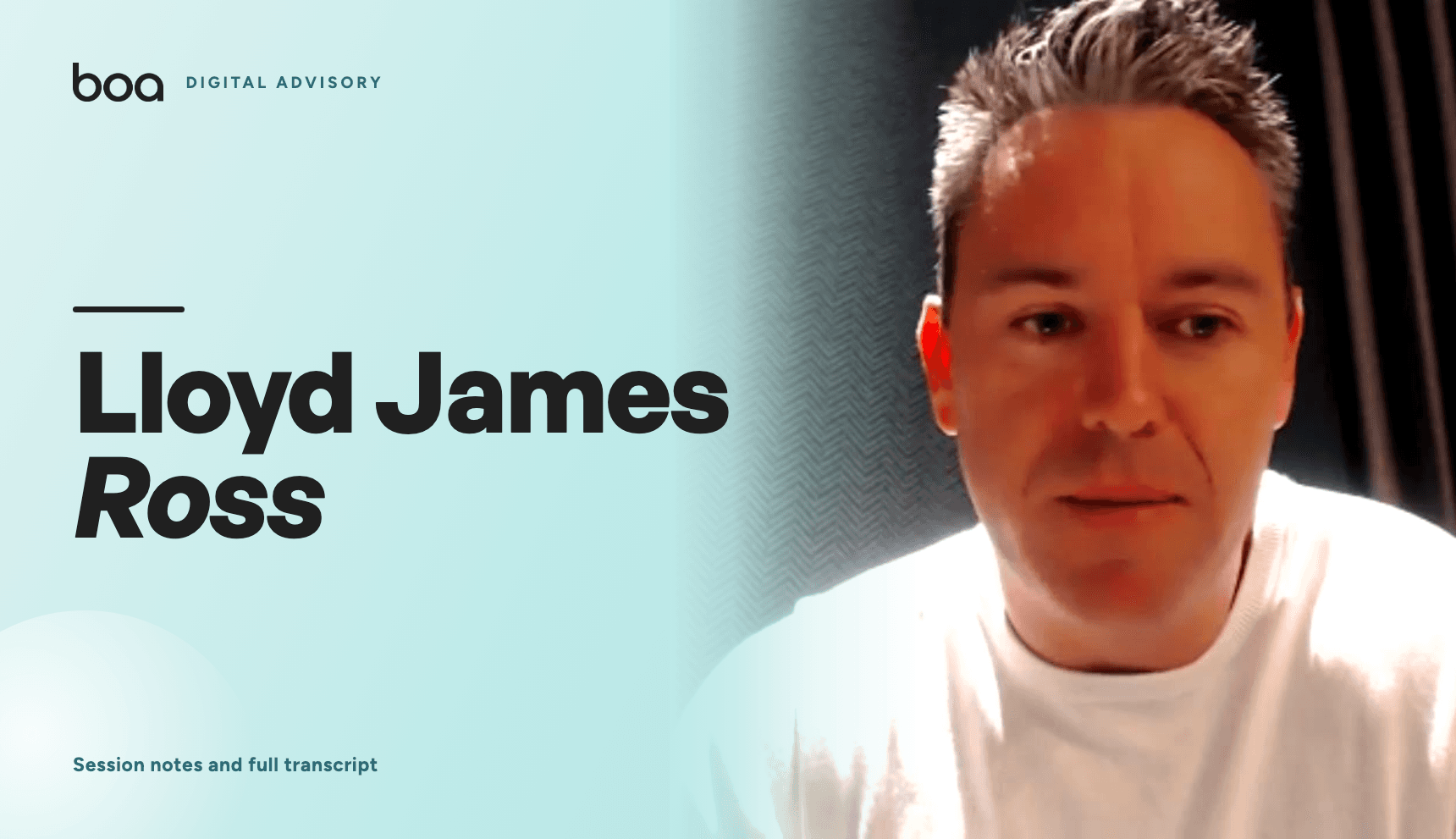
Digital Advisory
Lloyd James Ross on Buying Back Your Time With Partnerships
With Lloyd James Ross, Founder and Author at Become Time Rich · Hosted by Kirsten Scott and Laura · 55 min
What this session covers
Lloyd James Ross explains how founders win back time: delegate low-value tasks first, plug software into anything you do twice, and bolt on marketing, sales and content as profit-share partnerships rather than internal hires. Practical for service businesses under $500K through to multi seven-figure operators who are still wearing every hat.
Stop asking how you will do it and start asking who can do it for you, then pay that person well enough that they never want to work with anyone else.
Key takeaways
- 01
Split leverage into three buckets, not just borrowed money
Most people hear leverage and think financial leverage, using someone else's money to buy assets. Lloyd defines it as capital leverage, people leverage and systems leverage. Long hours happen when a founder has none of the last two. Audit which of the three you actually have before blaming your workload.
- 02
Write the can't, don't want to, shouldn't list
Lloyd's delegation filter is three columns: things you can't do, things you don't want to do, and things you shouldn't do. The shouldn't column is anything priced below your average hourly rate as an entrepreneur. Those go first. He points to Dan Sullivan's Who Not How: delegate everything but your genius.
- 03
Start delegating outside the business before you touch the business
The cheapest first step is getting someone else to wash your car and clean your house. Low-value personal tasks are the training wheels for delegation. If you never build the habit, Lloyd says you end up working 60 to 70 hours a week for the same money you would have earned in a 9-to-5.
- 04
If you do it twice, buy software for it
Lloyd's rule: doing something more than once is the clue that a system should be doing it. He runs roughly 30 pieces of software in one education business, built up over time rather than all at once. Software is the cheapest leverage going at around $20 a month, and unlike people it works 24/7 without emotions.
- 05
Ask ChatGPT which system should own the task
Rather than researching tools for hours, Lloyd prompts ChatGPT or Gemini with "I've got this task, what's the most effective system I can delegate to today?" He also flags Lovable (lovable.dev), where you voice prompt an app into existence. His brother-in-law built a car-friendly article reader called Audiofy in 15 minutes.
- 06
Hire an executive assistant the moment you hit $500K
Lloyd sees the same block in every business scaling from $500K towards seven figures: administration has not been outsourced. At that revenue you need someone booking your haircuts and executing the micro tasks. It is the single most important first delegation.
- 07
Bolt on partnerships instead of building departments
Lloyd's education business was built partnership by partnership: marketing first (funnels and Facebook ads gone off his desk before launch), then sales, then content. Each partner takes a profit share and brings their own team, including their own admin. He calls this the fastest route from $500K to $5 million because you skip hiring and developing internal staff.
- 08
Vet partners over years, not meetings
Lloyd knew his laundromat partner for 15 years before buying the business together. He watches behaviour traits and values, including how someone reacts on a golf course, whether they get emotional, whether they cheat. Red flags: a partier, a drinker, someone who needs the money all the time. Treat it like a marriage, not a transaction.
- 09
Recruit partners out of your contractor pool
Post a compelling consulting brief on Upwork and hire someone for a specific role, such as funnels, emails or ads. A superstar shows up as a superstar immediately, no one gets developed into one. When someone visibly removes your stress in the first weeks, take them for a coffee and ask, would you be open to a partnership, and what would make this compelling for you?
- 10
Give profit share, not equity, and pay generously
Lloyd pays partners a lot deliberately so they do not go and work for someone else, and so a big monthly cheque prompts them to lift their game. He worries about paying too little, not too much. He gives profit share rather than equity ownership and mostly works on handshakes, arguing that if the covenant breaks, the contract will not save you anyway.
- 11
Replace training videos with "do it, then show me before you ship"
Lloyd stopped recording how-to videos. He now throws the person in the deep end: go do this, bring it back before you execute, then fix it and ship it. That single checkpoint is the only verification the right hire needs. If they require constant micromanagement, they are the wrong person and you need an uncomfortable conversation fast.
- 12
For a new service business, create the problem of too many leads
Answering a six-month-old photography business, Lloyd said put the cash into client getting first, then figure out delivery. Delegate cold outreach to a VA at roughly $6 to $8 an hour with daily KPIs for LinkedIn and Messenger DMs and cold emails. Run Google Ads before Meta because people already search for a photographer in their area, and find the competitor who is winning and funnel hack them.
How the session runs
- 13:24Intro and quickfire this or that
- 14:52Why corporate broke, and the Beach House Paradox
- 17:15The three types of leverage and why founders hoard control
- 19:55Delegate everything but your genius
- 22:51Systems leverage: software, Lovable and AI agents
- 26:40What to outsource first at $500K
- 30:52Building an education business on partnerships
- 32:38Reading a partner's values before you commit
- 33:03Time over money, and the $100K book decision
- 38:18One principle: delegate faster, save 10 to 20% of profits
- 38:50Q&A: how to find and structure a partnership
- 45:04Q&A: trust but verify, and letting people make mistakes
- 48:29Q&A: first hires and ads for a six-month-old service business
Mentioned in this session
- Become Time Rich
- House Poor
- Wiley
- Who Not How
- Dan Sullivan
- Dan Martell
- Russell Brunson
- ClickFunnels
- Lovable
- Audiofy
- ChatGPT
- Gemini
- Claude
- Upwork
- Fiverr
- Google Ads
- Meta Ads
- Google Calendar
- Abu Dhabi
- Tokyo
- Japan
- David Goggins
- Sea of Cortez
- La Paz
- Mexico
- Gold Coast
- Icebergs
- Louis Vuitton
- Mark Forrest
- Sally Obermeader
- Bremen
- Hamburg
- Werder Bremen
- teamLab
Questions founders ask
Low-value personal tasks such as car washing and house cleaning, because they build the delegation habit cheaply. In the business, Lloyd says administration goes first, and by $500K in revenue you need a dedicated executive assistant handling bookings and micro tasks. After that, work through a list of things you can't do, don't want to do, and shouldn't do, where shouldn't means anything below your average hourly rate.
Lloyd built his education business entirely on partnerships. Marketing was a partnership from before launch, which removed funnel building and Facebook ads from his desk immediately. Sales came next, then content with a team he had watched for two years. Each partner takes a share of profit or loss, which reduces financial risk, and each brings their own team including admin support.
Lloyd does not. He gives profit share rather than equity ownership of the company, and mostly operates on handshake agreements rather than heavy contracts. His reasoning is that if someone breaks the covenant, having a contract will not really matter. He does insist on paying partners well and on time, because that is what builds trust and keeps world-class people from going elsewhere.
A superstar shows up as a superstar almost immediately, so you will know within a couple of weeks. Lloyd's process is to skip the training video, hand over the task, and ask them to bring it back before they execute. If someone needs constant checking and micromanagement, they are the wrong person and you need to have the hard conversation quickly. Otherwise, let them make mistakes, as long as they do not repeat the same one.
It depends on whether people already search for what you sell. Lloyd told a photographer to start with Google Ads because nobody needs educating about photography, they simply search for a photographer in their area. Meta Ads work better for people who are not actively searching. He recommends testing both and measuring which produces the higher ROI and lead volume.
Full transcript
The complete conversation, as recorded, with every speaker attributed.
Lloyd James Ross0:28
Hello, Kirsten, how you going?
Kirsten Scott0:31
I'm good, how are you?
Lloyd James Ross0:33
Great, nice to see you.
Kirsten Scott0:34
Nice to meet you. How's Japan? Thank you so much.
Lloyd James Ross0:39
I apologise for the not being able to be there in person. I was like, oh shit, I gotta be here.
Kirsten Scott0:44
What time?
Lloyd James Ross0:44
I told him do that, um, 7:20.
Kirsten Scott0:50
Oh, well, we really appreciate you jumping on so early.
Lloyd James Ross0:53
Of course.
Kirsten Scott0:54
Are you, um, gonna come along to the Inner Circle event on the 26th of March?
Lloyd James Ross1:00
It's in Sydney, right?
Kirsten Scott1:01
It is, but I would really love for you to be there. We've got like Mark Forrest, Sally Obermeader, like all of the people like yourself that we've ever worked with. We basically bring everyone together for an agenda-less event. Um, it's honestly just an opportunity for you guys to meet each other and enjoy each other's company. We put drinks, canapés, everything on.
Lloyd James Ross1:23
Whereabouts in Sydney is it?
Kirsten Scott1:24
Uh, it's in the CBD, um, just above Louis Vuitton at, uh, 70 King Street.
Lloyd James Ross1:31
Okay, okay, let me have a look at that then.
Kirsten Scott1:34
Oh yeah, you got your work for the day.
Lloyd James Ross1:37
Yeah, what, what, what time is it? Is it an evening thing?
Kirsten Scott1:40
It is an evening, it'll be 6 till 9.
Lloyd James Ross1:43
Okay, all right, leave it with me.
Kirsten Scott1:46
No pressure, but I just, um, I didn't— I know I hadn't seen your RSVP yet and I was like, oh, some people didn't see it in there. Yeah, they're like, am I doing an event? I'm like, no, we're just bringing you guys together as an opportunity to connect. We did our first one at Icebergs last year and it was incredible. We actually had like, yeah, it was honestly amazing. So we just want to do that once a year just for everyone that we are lucky enough to work with.
Lloyd James Ross2:12
Okay, good to know. All right, leave that with me. I'll see if I can swing that one.
Laura2:16
Awesome.
Kirsten Scott2:17
Now Laura will be joining us. I just might text her. She's our head of brand. Okay, um, so she's going to be managing everything for us in the back end, basically filtering questions. She'll text them through to me. This is kind of what we do in the live environment anyway, so people are kind of used to it. Um, but the way that it will work, I'll kick off and I'll introduce you. I then want to do a quick fire round of this or that. So basically I'll be like, tea or coffee, blah blah blah. We'll get more businessy as we go. There's only about like 10 there. It's just a way to warm up and get people to know you. And then we'll jump into the questions.
Lloyd James Ross2:52
Sounds good.
Laura2:54
Awesome.
Kirsten Scott2:54
So yeah, it's honestly nice and easy. I just thought I'd jump on early with you just so we can get—
Lloyd James Ross2:59
yeah, yeah, no worries at all. Yep, this is, uh, yeah, fun light work. Exactly.
Kirsten Scott3:05
You must be doing— are you over there for a conference?
Lloyd James Ross3:08
Yes, I was speaking a couple days ago, but, um, we're also— we all— we came earlier and went skiing as well. Um, Just in a seco. So, but we've been here 5 days in Tokyo, so good today, this afternoon back home.
Kirsten Scott3:22
Yeah, yeah, you're just like in and out.
Lloyd James Ross3:25
Yeah, that's good though. Have you been here before?
Kirsten Scott3:28
I haven't. I, um, I really wanted to do the cherry blossom season, and there's a beautiful museum over there that I want to go to as well, the, the TeamLabs one. Yes.
Lloyd James Ross3:38
Yeah, we went there the other day. It's really good.
Kirsten Scott3:40
Yeah, it just, um I love like beautiful things like that. Like I try to go to as many as the galleries as I can here. Um, but that one just looks so different. One thing I did want to ask, did you want me to introduce you as Lloyd James Ross or are you like Lloyd Ross? What would you prefer?
Lloyd James Ross3:57
Uh, well, my dad's name's Lloyd Ross and, uh, so I— Lloyd J, just anything to separate me from it. All those people get Lloyd J. Yep, they'll be fine. However you wish.
Laura4:09
Good morning.
Kirsten Scott4:10
Love it. Oh, this is Laura.
Laura4:13
Hi, so nice to meet you.
Lloyd James Ross4:14
Nice to meet you too. Where are you from?
Laura4:16
I'm from Germany.
Lloyd James Ross4:18
Oh, nice.
Laura4:19
I'm zooming in from Sydney.
Kirsten Scott4:21
I'm not that international.
Laura4:23
And you're in Japan right now?
Lloyd James Ross4:24
Yeah, I'm in Tokyo presently, but leave back to go to Gold Coast today.
Kirsten Scott4:28
This afternoon, been skiing and everything, so it's been everywhere, which is awesome.
Lloyd James Ross4:33
Yeah, we just missed the cherry blossoms, sadly.
Kirsten Scott4:36
So never mind, because it only goes— I think in my mind I was like, oh, it must go for a full month, but I think there's only like a couple of weeks that it really happens, right?
Lloyd James Ross4:44
Yes, spring in late March, I think.
Kirsten Scott4:47
Yeah, make the most of it.
Lloyd James Ross4:50
Did you need us to record this or it's already recording?
Kirsten Scott4:54
Yeah, so I've got it recording now.
Lloyd James Ross4:56
Um, and yeah, You don't need Gabby to record it?
Kirsten Scott5:03
That would be amazing if you have that available.
Lloyd James Ross5:06
She's just on my other account, you can see her there.
Kirsten Scott5:09
Perfect.
Audience member5:10
Hi!
Laura5:13
Um, Kix, do you want to make me host?
Lloyd James Ross5:15
Yes.
Laura5:16
Or—
Kirsten Scott5:17
perfect. Thanks, Laura. Guys, I'm just going to jump off for one sec. I'll be literally one minute.
Lloyd James Ross5:26
Go for it.
Laura5:28
So long have you been in Japan for?
Lloyd James Ross5:30
I've been in for 2 weeks actually.
Laura5:32
Oh, 2 weeks. All just pleasure, also a bit of business?
Lloyd James Ross5:35
Bit of business, bit of both. Sometimes like when you've got things to do, either talks or conferences or anything like that, it's nice to tack on a little bit of a personal, like, you know, week holiday prior, and then you go do the thing, then you go home. That's good.
Laura5:52
I feel like if you want to be an entrepreneur, like, that's kind of one of the reasons, right? So you can kind of manage this life.
Lloyd James Ross5:57
Yeah, that's right. I mean, because also being an entrepreneur, you don't really set aside 2 weeks or 4 weeks to go on a holiday. You end up just figuring it out on the way, you know. So it's good. That's right. Yeah.
Laura6:10
Oh, good.
Lloyd James Ross6:11
Yeah.
Laura6:11
Is it still really cold there now, or is it slow?
Lloyd James Ross6:13
I mean, freezing. Yeah, it's freezing. It was very cold. Lucky Tokyo. It's like 0 today, I think, or 2. Like, it snowed here the other day, actually.
Laura6:23
I didn't realise it was so cold for so long.
Lloyd James Ross6:26
I know, neither did I, but evidently it is. So, which is fine because when we went skiing, we had some fresh snow.
Laura6:34
So I guess for that, that's good.
Lloyd James Ross6:35
Yeah, yeah.
Laura6:36
I'm just wondering if it's impacting the cherry blossom season if it's so cold there right now, because I would have assumed it's a bit warmer for that.
Lloyd James Ross6:44
Yeah, it— well, the ski season goes till April. Um, it's also interesting. So yeah, the cherry blossoms will— it's a spring thing. So I guess, yeah, late March, early April. I'm not sure exactly, but it's coming up. We miss it, that's all.
Laura7:01
It's gonna be back next year and the year after, so I'm sure that's gonna be the time if you really want to see it.
Lloyd James Ross7:06
Yes, correct. Yeah. Have you been here before?
Laura7:08
I haven't, no. I've been wanting to go badly. Our, um, our our IT, so I've been with the company, I've been working for Kubb for almost 9 years now. And our IT who's been with me here the entire time, he just moved kind of to Japan. He's like back and forth now. And he's been trying to convince me to go. But because I'm from Germany, most of the time when I'm doing big travels, I'm trying to go see my family and then build it, like build my travels around.
Lloyd James Ross7:34
Where in Germany are you from?
Laura7:35
I'm originally from Bremen. I don't know if you know.
Lloyd James Ross7:38
Bremen.
Laura7:39
Do you like soccer? Um, it's literally the only reason— okay, the only reason anybody ever knows Bremen is to say really like soccer, because Werder Bremen is quite a known team. But, um, Hamburg is where I lived before I came here.
Lloyd James Ross7:53
That might be—
Kirsten Scott7:54
yeah, very beautiful.
Laura7:57
Not as beautiful as Sydney, but— or Australia in general, but it's a good place too.
Lloyd James Ross8:02
Yeah, of course, probably cheaper to live.
Kirsten Scott8:05
Laura, is this set up all visually okay on your end? And yeah, it looks great. Can you hear us all okay?
Laura8:11
Yeah, it's all looking perfect.
Lloyd James Ross8:12
This is the only light I have, it's like bearing down on me.
Kirsten Scott8:15
You look like the gods.
Laura8:18
Yeah, sorry, just for the recording, do you know if you're recording, um, on my computer? Yeah, but are you recording Gallery view, recording speaker view, do you know?
Kirsten Scott8:36
It's currently on speaker, what would you prefer?
Laura8:38
Okay, no, that's perfect. Yeah, that's all we want for sure.
Kirsten Scott8:43
I'm gonna close my participant thing because you will manage that. Awesome. So I'm excited, this is great. I've been trying to convince Lloyd to come along to our Inner Circle event. He's— yeah, he's Yes.
Laura8:58
Oh my God, you have to. It's gonna be such a fun day.
Kirsten Scott9:01
Yeah, honestly, it's gonna be so great. Yeah, over 60 people. There's actually 80, but I always expect a few. Yeah, yeah. And you have— you'll get to cheque out the new clubhouse in Sydney. It's stunning.
Lloyd James Ross9:14
Cool. Absolutely beautiful. Sounds enticing.
Laura9:16
You should honestly make it a little weekend trip to Sydney or something like that. Might as well.
Lloyd James Ross9:23
It's a little weekend off.
Audience member9:26
Definitely.
Kirsten Scott9:28
Um, cool. Okay, are you there with your wife at the moment, Lloyd?
Lloyd James Ross9:33
She is in the room, but she's, yeah, out of view.
Kirsten Scott9:36
I love that. She's welcome to join as well.
Laura9:40
There we go.
Kirsten Scott9:42
She's like, okay, we'll go. Oh no, it'll be good.
Laura9:49
Um, okay.
Kirsten Scott9:52
Um, so Lloyd, basically I've sent you the questions, but what I try to do if something comes up in the conversation, I'll just lead with that.
Lloyd James Ross10:01
Gabby sent me the questions, but I prefer—
Kirsten Scott10:03
yeah, yeah, I think so, because if we go like down a thing, or if you answer my questions, which people tend to do, they answer like 3 of them, I'm like, okay, where do we go from here?
Lloyd James Ross10:13
It's bound to happen, it's all good.
Kirsten Scott10:15
Yeah, um, and then what I'll do, Laura will be texting me the questions as we go, but if I'm getting quite a few of them, I'll actually like move through the questions quicker because we obviously want most of the value to be for people sending them through. Yeah. So yeah, nice and easy. I mean, I'm sure you've done a million of these things.
Lloyd James Ross10:33
Done a few of these. Yeah.
Kirsten Scott10:36
Someone I was speaking to the other day said to me that they'd read your book and they're like, yeah, I'll definitely be joining that conversation.
Lloyd James Ross10:42
Really? That's great.
Laura10:44
Yeah.
Lloyd James Ross10:45
Love that. Yeah. Love it. That's fantastic. Cool. I wonder which book they read.
Kirsten Scott10:52
Yeah, because you've got quite a few now.
Lloyd James Ross10:54
Yeah, we have two on, uh, self-published and one published title. Um, so we now have our fourth that's just come out. It's also self-published.
Kirsten Scott11:05
Amazing.
Lloyd James Ross11:06
We're scaling that. It's called House Poor.
Kirsten Scott11:09
Well, okay, then what's that one about? Like, are you—
Lloyd James Ross11:12
like, is it more It's about, um, it's about how most people are FOMOing into real estate because of the social stigma around renting and how it's making them poorer cash flow-wise. And so they're sacrificing a life well lived to own.
Kirsten Scott11:29
I literally listened to a podcast on this the other night.
Lloyd James Ross11:32
There you go. Yeah. So we just launched it. You'll— we're scaling it now. So we're just— the self-published titles are more effective to sell as an author than they are published because published, the publisher takes 85% of the revenue. And, uh, you know, it is what it is.
Kirsten Scott11:49
But totally. And your personal brand alone, like, I feel like where you're at now anyway, I don't think you need that. I think you're able to like promote it in a way and people have enough trust in you as a brand that they— you don't need that. Like, it's just honestly a waste of money.
Lloyd James Ross12:04
Yeah, it is quite expensive. We, we did the published title because we— for branding, you know, like if you're a published author with Wiley, for example, internationally. You know, it's—
Kirsten Scott12:15
sorry guys, I'm just about to let everybody in.
Laura12:17
We are 31 now. Um, I'm just gonna turn off my camera and my audio just because I'm in the Clubhouse, but have fun.
Kirsten Scott12:25
Okay, hi guys, how are you? Can you see us all okay? Now, a bit of a different one this morning. Lloyd is currently in Japan. He had a last-minute trip there, so we're very grateful to have him with us here today. It's nice and early over there, so we are going to jump right in. And this morning will work just the way it does any other time. Put your questions in the chat and Laura will send them through to me, and when we get to the Q&A, you have an opportunity to ask them. So don't be selfish, put as many in there as you can. But we are joined by Lloyd James this morning. He's one of Australia's leading marketing strategist and has helped thousands of founders and experts grow their businesses smarter, offers high-converting funnels and marketing systems that drive real revenue. So thank you, Lloyd, for being here this morning.
Lloyd James Ross13:24
Great to be here. Hello, everybody. Thanks for having me.
Kirsten Scott13:29
Awesome. Now, in usual Boa style, we are going to start off with a quickfire round of this or that. So are you ready, Lloyd?
Lloyd James Ross13:36
I'm ready.
Kirsten Scott13:39
So tea or coffee?
Lloyd James Ross13:41
Coffee.
Kirsten Scott13:42
Early mornings or late nights?
Lloyd James Ross13:44
Early mornings.
Kirsten Scott13:46
Podcast or book?
Lloyd James Ross13:48
Uh, book.
Kirsten Scott13:53
Deep niche or broad audience?
Lloyd James Ross13:56
Broad.
Kirsten Scott13:58
Data or intuition?
Lloyd James Ross14:00
Data.
Kirsten Scott14:02
Planning everything or figuring it out as you go?
Lloyd James Ross14:04
Figuring it out as I go.
Laura14:07
Everyone.
Kirsten Scott14:07
Building a personal brand or building a company brand?
Lloyd James Ross14:11
Building a personal brand.
Kirsten Scott14:12
Systems or creativity?
Lloyd James Ross14:15
Systems.
Kirsten Scott14:17
Big risk or play it safe?
Lloyd James Ross14:20
In the middle.
Kirsten Scott14:22
And share the journey or highlight the outcome?
Lloyd James Ross14:26
Um, bah. Highlight the outcome.
Kirsten Scott14:32
Yeah, I always get one on everyone on that one. So you're, you're safe. All right, let's jump in. So you speak a lot about becoming rich. What happened in your own journey that made you chase real revenue alone without that— sorry, journey that made you realise chasing revenue alone wasn't the answer?
Lloyd James Ross14:52
Well, I think people experience that and work it out for themselves if they're in some sort of 9-to-5 corporate role. Because in corporate— well, for me personally, when I was in corporate, it didn't matter if I worked harder or I was smarter or I developed myself. I was always at the whims of some sort of political connection inside the corporate framework or environment to then level myself up to a new role. I think what happened to me was there was this reshuffle in the company I was working for, the largest developer in the world actually in Abu Dhabi. There was a reshuffle The company was effectively going broke after it had like $18 billion in projects and then the GFC kind of hit it really hard and they did a big retrenchment. And so, when that happens, obviously everyone moves roles and I was moved into a role that was just fairly brutal under a guy that I didn't really respect. And at that point, I was like, what? Like, this is not going to be— this is not a long-term play. To be both wealthier and more time rich. And so I think that was the— that was what really compelled me to look at entrepreneurship and, you know, building my own, effectively becoming self-employed where I was building my own paycheck. And as part of that too, when you're an entrepreneur and you're scaling your revenue, it can be very easy to fall in the trap of playing the status game or letting lifestyle creep take you to a new level, whereas I think it's more effective to have more time and a bit of money than tonnes of money and no time. 100%.
Audience member16:31
Yeah.
Lloyd James Ross16:32
That's the philosophy, I think. I think you'll probably all agree with me because what's the point in having all the money if you have no— There's this thing called the Beach House Paradox, and it's where, let's say, a very high flying corporate, you know, someone who's super successful, um, making a tonne of money. Perhaps they're in like corporate finance or something, and they've got all this cash and they buy this beach house, and their family goes to the beach house, but they don't have the time to go and spend time with their family in the beach house. So I wanted to avoid the beach house paradox.
Kirsten Scott17:01
Yeah, I think everyone tries to avoid that, so 100% agree. Um, okay, so for many early-stage founders, um, they equate long hours with commitment. How do you help them rethink that mindset?
Lloyd James Ross17:15
Well, you only generate long hours as an entrepreneur if you don't— well, two, two things. Well, if you don't have any leverage. Now, most people think leverage is financial leverage where you're borrowing someone else's or using someone else's money to buy assets. That's everyone's understanding of leverage. But when I talk about leverage, what I mean is capital leverage, people leverage, and systems leverage. And the value for entrepreneurs to, to, to win back their time, or as Dan Martell says, buy back their time, is their inability to delegate effectively to others. So create people leverage in their business and to create systems leverage, so to delegate things to a system. And the reason they fail to do that is because they cannot relinquish control of having to wear every hat inside the organization, because innately in them, or it's level of insecurity in them to suggest that they're the best at everything. And it's quite tricky because what made them successful as an entrepreneur will not then make them successful to the next level. And so you do have to relinquish a level of control, and that's quite hard if you have the wrong person you're delegating to because then you have to micromanage them. And then it creates even more problems in your business. So what you've got to do is you've got to identify the areas of low value that you're still working in and you've got to find someone to do those tasks for you. And that's the first step of scaling your business while also winning back your time. And the challenging thing with that is you've got to keep doing it. Like, you don't just do it once and everything's settled and in place. As an entrepreneur, you've got to keep innovating and you've got to keep growing. And so that ability to delegate to systems and people, it never subsides.. And I think one of the first things entrepreneurs can do to start doing that, and it's very, very basic, but you can start to get someone else to wash your car. You can start to get someone else to do your, your cleaning of your house. And it's those low-value tasks that are the first ones to go. Um, and if you don't do it, then you're, you're going to find you're going to work 60, 70 hours a week for the same amount of money you could have had in a 9-to-5. And so forth.
Kirsten Scott19:31
So yeah, yeah, I love that. And actually, it kind of leads us into the next question. And one thing I want to touch on as well, as founders, we're not always the best person for that task or role. So for example, you might be brilliant at sales and you may not be the best person for doing that. So what do you think is the difference between being busy in your business and building something that actually creates wealth?
Lloyd James Ross19:55
Well, the challenge is, again, you think you're great at everything. Because you're the entrepreneur. And I think if you're great at sales, which a lot of entrepreneurs are, um, one of the most challenging roles to relinquish or delegate to is the marketing and sales part of the organization. It's just the most critical part. So there's a lot of risk in delegating it to a team or the right people. But what I've learned over time is that there are people out there so much better than you, and, and I didn't realise it at the time, but they really are. And like our sales team in one of our organisations is just so good. I mean, I couldn't be anywhere close to as good. I mean, they all enjoy it even. Like it's weird. So you got to find people that not only are better than you, but they just love it. And so one of my business partners, he just says, I just love— because we have got an accounting and advisory business, and he says, I just love accounting so much. I'm like, who are you? You know, so I think it's finding people who not just are better, but it's in their genius. And Dan Sullivan, who's one of the lead high-performance coaches, one of the leading high-performance coaches in the world, he says that in his book Who Not How, which is one of the best books you can read on doing this. He says you've got to delegate everything but your genius. And so whatever, you know, I know that Russell Brunson who's again probably the best marketer in the world, he ended up becoming the CEO of his company ClickFunnels, which is a billion-dollar company. And he ended up moving back out of that CEO role back into marketing, which he loved. So not— you don't want to delegate all the roles. You want to delegate the ones that you're perhaps ineffective at, that you can't do, obviously, that you don't want to do, great, and that you shouldn't do. So there's 3 things creating a list of things that you can't do, things that you don't want to do, and things that you shouldn't do. And things that you shouldn't do are things that are below your average hourly rate as an entrepreneur, and they're the things that you've got to start delegating away most effectively and finding people smarter than you, better than you, that, that's in their genius. Um, you know, and I'm helping a guy at the moment, he's scaling his multiple 7-figure business, um, in a certification business and he's just delegating or outsourcing his sales. And you can see the, the challenge with that as he's doing it. But today, yesterday, he found someone better than him, and that's like the holy grail of delegation. And they are out there. There are people better than you out there. And when you find them, it's the perfect collaboration. And that's really the only way you can scale.
Kirsten Scott22:40
Definitely. Yeah. Now I want to talk a little bit deeper about something that you speak about often, which is leverage. So how can a founder start building leverage from day one, even if they're small?
Lloyd James Ross22:51
Well, I think the easiest way to build leverage when you're small is to delegate to systems. And I mean, God, with now with what's available out there, I mean, I think we've got maybe 30 pieces of software in one of our education businesses that are running right now as I'm doing this, and they're just there, there in the background. Now, you don't build them all at once, but you find software and certain systems to plug in to alleviate a lot of the, the heavy lifting that you do. Um, you know, I mean, some of the basic ones when you get first get started are, you know, I— certain email responder system, you know, the bare essentials of doing things. And the rule is if you find yourself doing something more than once or, you know, repeatedly, that's a clue that you've got to identify some sort of system to do that for you. Now with like Claude Cowork and so forth that's coming out, I mean, this area is going to be just huge with being able to have so many tasks automated for you through agentic, like just through some sort of voice agent. Um, and again, but you know, people— I work with a lot of people in different capacities, and the fact of the matter is a lot of them don't even delegate to their diary. Like, like they don't even delegate to their Google Calendar and they're walking around with all these appointments and things in their head. And so it is a skill to delegate to a system. And in Australia, a lot of us, for some reason, we don't adopt technology quickly. I mean, you go to America, you go to somewhere where I am here in Japan, the adoption is so much faster. Um, and so I think we have an inherent distrust for technology because, you know, we remember the old dot printer back in the early '90s we wanted to kick and throw into the river. And so I think we haven't really got past that relationship with technology, and we're very— yes, yeah, tech trauma. And so we haven't got past it. But I would implore anyone who's looking for fast leverage, I mean, you can ask ChatGPT, you can ask Gemini now very quickly, I've got this task, what's the most effective system that I can delegate to this today? And you'll find it's the cheapest form of leverage because software is like, you know, $20 a month or something like that depending on what you use. So it's a lot easier than people, you know. People leverage is the hardest because people are difficult because they have emotions, whereas software is, you know, 24/7, 7 days a week.
Kirsten Scott25:19
No, it's, it's so true, and it's so easily available to us now. Like, it's crazy the amount of options that are out there.
Lloyd James Ross25:25
Yeah, absolutely. I mean, this is to give you guys this huge piece of value. This will blow your face off. You can now go to Lovable. How many of you, just show of hands, have heard of Lovable? Anyone? Kirsten has. Okay, so if you go to lovable.dev, you can voice prompt an app and it'll create an app of anything you want. And it's insanely good. Like, my brother-in-law, I showed him the other day and he went in his car and he said, man, I gotta call you. I said, why? He goes, because I, I, I want to read articles in the car but I can't because I'm driving. He said, I went to Level, created my own app, it's called Audiofy. You can download it. I'm like, what is it? He said, it just reads everything for you while you're in the car and I built it in 15 minutes. I'm like, oh my God.
Kirsten Scott26:14
So probably cost him like a few Like $20 or something. It's not expensive.
Lloyd James Ross26:19
Oh yeah, no, no, it's very, very affordable. It's incredible. I mean, so look, not that I'm suggesting you go out and build your own apps, but I would say that now in 2026, there's just never been a better time to create systems leverage in your life, in your business, and do it in your personal life and do it in your business life.
Kirsten Scott26:40
That's okay. So for someone under $500K in revenue, how should you— how should they be thinking about structuring their differently?
Lloyd James Ross26:50
Well, I think the first— again, we've got, um, I'm an owner of an accounting and advisory business, and it's interesting to work with business owners who are at that level and scaling towards, you know, 7 figures, multiple 7 figures. And the one thing that gets in the way every time is they haven't outsourced their administration. Like, at $500K, you need— like, I've got Gabby, she's on the call recording this— like, you need a Gabby. You need someone who is just executing, booking your haircuts, booking this, doing this, like it's just got your back administratively with what's happening. Because those little micro tasks that you think are important, which they are, you can't be doing them. And, and so at $500K, you've got to have a really good executive assistant or, or assistant of some sort to alleviate a lot of that stuff that you're doing. It's the most important one to to delegate first. Um, but it depends on how you're building your business too, because if you're— how I— how we've built all— we have 5 business companies, 5 businesses in different areas, and how we built them, we built them one at a time and systemized them and then opened up the other one. And we built all of them on partnerships. And so I think if you want a lot of leverage to start with without having to go and find your own administration team, then sales and marketing team, and then go finance and operations team, etc., and you want to— you don't want to develop it internally, the fastest way to scale without a question is partnerships. And so that's where you're really saying, hey, I'm good at this, I'm good at the delivery, uh, but I'm no good at sales and marketing, or I'm no good at marketing, can you do the marketing? You might get an ads person and someone can do all your sales funnels et cetera. And then when you get a lot of leads, you can say, well, I'm not the best at sales, can I partner with a salesperson? And so our whole education business is founded on partnerships. So we have— I had the marketing partnership was immediate before the business was started. It was a collaboration. And that immediately alleviated me of building our sales funnels and running our Facebook ads, et cetera. That was just immediately gone off my desk. And of course that's a partner share, so they share in the profits, right? Straight away, which is fine because I buy back all that time immediately. The next part to scale out was the sales, and that was quite tricky, uh, because when we actually did that, I was on a private yacht cruise in the Sea of Cortez in Mexico, and we left La Paz Harbor and I lost all phone connection. No SMS, nothing. And I had to kind of just wait 6 days to come back into harbour to figure out if the sales team was effective and, and worked. Thankfully it did. Probably a good thing I wasn't on my phone. And so once that, once that was done, it was like, okay, next part is our content. So if you look at my content, it's not done by me. And you get to this point where you go, you know, I can't be going to my car recording my podcast anymore. I can't be doing this. I can't— my brand doesn't allow me to do that anymore. So it's like, well, I don't want to go and work it out myself. And that's where most people get it wrong. They ask the wrong question. They ask the how question. Like, how do I do this? And that's the wrong question. The question to ask is, who can do this for me? And so we engaged a content team that punches out insanely good content. Uh, they're world-class content creators. So now if you look at that particular business, there's the marketing was outsourced as a partnership, the sales outsourced as a partnership, profit share, and the content is now a partnership. So it's like partnership, partnership, partnership, partnership. And what's great about that is they bring their own teams. So like, they will have an administrator in there to do this. They'll have— so you're really bolting on these teams rather than bringing in and developing an internal staff member or, or resource. Does that make sense? That's the fastest way to get from, you know, $500K up to $5 mil. Just boom. It just moves you very quickly.
Kirsten Scott30:52
Yeah, and it's a scary thing as well because when you're starting out, like, you obviously have very little, like, cash flow and you're not making much money. It's scared to, like, invest that money, but it actually is, like, a long— it actually, it creates long-term investment because you are having another team come in. You're— they're helping you with your time. You're able to focus on, like, those higher-level tasks to move the business forward.
Lloyd James Ross31:14
Yeah, well, the first Good thing about the first couple of partnerships that you develop, particularly in marketing and selling, is if it's a real partnership, they're participating in the profit or the losses. So you will circumvent a lot of financial risk with a partnership. Um, with our content team, it was different. Uh, it was— it's a paid thing, so that was— there was a little bit more risk in that. But you don't just get anyone. Like, I was watching this person I was watching this person for 2 years before I brought them in as, as that content team. Um, and also you look at— if you look selecting partnerships too, what you've got to look for is the nuances. You have to look for, um, their behaviour traits and their values early. So as one, we bought a laundromat business a while back, and, um, this particular gentleman I was in part— I'm in partnership with there, I've known him for 15 years, and in that time I've been able to learn about him, right? And you can learn a lot about someone if you play golf with them because you can, you can see how they react to things, how they're emotional or not, how they cheat or not, or whatever it is. So you've got to look for like these little success flags in their life of how they show up, how they behave. And a lot of people don't watch those things, um, before they select a partner. And it's very much like a marriage. Like, you don't just go and marry anyone on the street. You've got to go through the process of getting to know them and then are the values aligned, etc. It's very much the same as having a business partner.
Kirsten Scott32:38
Yeah, business dating essentially, like you're getting pretty much to know their traits.
Lloyd James Ross32:42
Yeah, like if they're, if they're a partier and a drinker and they need the money all the time and they just— it's just not going to work out. And so be very careful who you form a partnership with.
Kirsten Scott32:54
Yeah, I love that, it's great advice. Um, so how do you think time— poor time management can delay financial freedom?
Lloyd James Ross33:03
Well, time is— people often have this, they understand the notion that time is money. That's a very well-known, um, quote. The actual truth of it is that time is more valuable than money. And what's interesting about that is if you flip the equation and put time on the left, you know, with the more than sign against money, you start to prioritise time over money. And what's interesting about people in jobs is they're prioritising money over time. And if you flip that, it's like, well, I want to put time first. And that's, I think, what compels folks to get into entrepreneurship as well. They want to control their time or have optionality. But then when they get in there, they fall back in this mindset of, well, I'm going to be money, money, money, money, money. And it's easy to do because money is a valuable tool. And what you've got to do is you've got to actually strip away your, your love for the money and build this love for the time. And unfortunately, you've got to give money to get your time back. So you do have to actually place time on a higher level than money. And you've got to see— so you'll see, you'll just, you'll see so much money leaving your account. But you have to do that to win back your time. And if you don't, then, well, that— it's just not sustainable. Like, your marriage will start to fall apart, your relationships, your health will start to deteriorate. You will start to go, you know, insane. Like, you will know. You'll experience what's called burnout. And you'll get to a point where you're just like, I can't do this anymore. I need help. You know, and hopefully you'll maybe get a business coach or a consultant and they'll tell you, what the hell are you doing? Like, you can't do this. So the challenge is you've got to let go of the money. That's the trick. And you've got to not care about it as much as your time. And it's not easy. Do it on a small scale, of course, first, and then build into it. But there's times where I've had like God, what was the other day I spent— I mean, with our latest book, we published that through Wiley, but we had— we helped— David Goggins' writer actually helped us with that book. Um, and I think it cost me $100 grand. This is before, by the way, this is before AI, which is really irritating. So like, now it cost me $4 to do, but, uh, that's the, that's the nature of innovation. But it was $100,000. But what's interesting about it is that— what's interesting about the book, this is the Become Time Rich book, the one that's published, is that it would be remiss of me because at the time when I was writing it, I had lots going on. We were building and scaling like 3 companies at once and travelling and relationships and everyone's birthday. We've got a big family. You can all, I'm sure, understand what I'm saying here when you say you're busy, right? Like we're all busy. And so I was like, "Well, how am I going to write a book and publish a book when I've got all this going on?" And I thought it was the best chance to really prove the time-rich principles that I talk about in the book because if I can't do it now with what I've got going on, then I'm not aligned to my own values and my own rules and laws that I talk about in the book. So I'm like, "You know what? Let's use this as a test case." And so straight away I was delegating. I was delegating just as much as I could. And so that cost me money. That cost me $100,000. But the return on investment has been huge. It will be eternal. So it was a very— whilst it wasn't the easiest decision to make just to roll out $80,000 or $100,000, I had no— there was no other way. And, and so I think if you're at this precipice or you're at this fork in the road where you can't find a way to be productive and produce more under the stress of what you've currently got on your plate, you're just approaching it wrong, ineffectively. You're, you're doing everything yourself. And so I'd say delegate it all and pay the money, and all of a sudden you win back all your time, um, and you get the actual results of what you wanted to get as well. So you have both The answer is—
Kirsten Scott37:28
now guys, we are going to move to Q&A very soon, so please be selfish. Anything relating to yourself or your own business, please pop them in the chat. But Lloyd, so for ambitious founders who want both success and freedom, what mindset shift is non-negotiable?
Lloyd James Ross37:47
Relinquishing control, non-negotiable. You have to delegate to systems and people.
Kirsten Scott37:55
Yeah, and kind of just trust that process.
Lloyd James Ross37:57
Yep. And you have to, and you have to let things get out of control. So you have to embrace a little bit of chaos.
Kirsten Scott38:07
Yeah, that's great advice. Okay, and finally, if you could give every founder in our BoA community one practical principle to help them build wealth and freedom, what would it be?
Lloyd James Ross38:18
A practical principle to build wealth and freedom: delegate to systems and people faster than you are, and set aside 10 to 20% of your profits every year and diversify into other assets.
Kirsten Scott38:38
Yeah, I love that. That's great advice. Now guys, we are going to move to Q&A. So the way it will work, I will call out your name and you'll be able to ask Lloyd directly. Um, the first one we have is from Arvin.
Audience member38:50
Hey, um, good morning everyone.
Laura38:52
Hi Lloyd.
Lloyd James Ross38:53
Uh, my question is, um, what's your framework in choosing a partner, or if you're going to a partnership, and where do you find them? Great question. Um, I think what— someone asked me this on a podcast the other day, and I was like, I wish I had a— I do have a framework. It's actually in my book Become Time Rich. Um, There is a method to that. However, the truth of the matter is all of the partners have come to me. And I know that sounds irritating because you're like, well, that's not helpful. But there's a lesson in that in the sense that to find good partners, you must be a good partner. And, and I think the same thing goes with finding a spouse. You've had to find a great spouse is to deserve one. And And I think the same thing goes with business partners. And so, it's like, well, they came to me because I have certain standards and they're attracted to those standards. And I would say like, here's a great example. I had an opportunity coming up here in Japan. I had to go. I also had booked this with Boa and it was an in-person podcast. And the challenge I was, oh, well, I don't want to cancel, but what can I do to show up here and still provide value that's going to be a win-win instead of walking away from it? And that's just the nature of what I'm, how I am. And so those types of nuances are what will attract people to you. So do you show up? Do you bring value? Are you easy to deal with? Like that is probably the most undervalued trait of a partner. Are you just easy to deal with? Like, I mean, we've all had it before with, you know, former partners in relationships, like, oh my God, that's drama, like get out, right? But that's the same with business partners. And so be easy to deal with, show up, be reliable, be useful, add value, and while you're doing that, you will attract people that want your skills, that need your skills, and they will ask you for some sort of engagement in a partnership. Now if that doesn't happen to you, you are welcome to find partners. But how it would start out would be, well, first you would find someone to do a specific role. Like here's an example. Um, if you wanted someone to do your marketing, build your sales funnels, run your emails and your Facebook ads or whatever it is you're running, you could go to Upwork and you could put a very compelling job offer out there for— or, you know, consulting offer out there and get all these— we've found some wonderful people on Upwork, really like world-class people on Upwork. And as they're coming in and they're working with you, they will— if they A superstar will be a superstar immediately. Like, no one comes into the organisation and is developed into a superstar. That would just be great to start with. So what you're looking for is someone you've engaged as a consultant or a contractor to come in and do something in your business. And if they're amazing straight away— and you'll know they're amazing because they'll alleviate with someone, they'll alleviate your stress, they'll do things, they're like, oh my, they'll blow you away— and that's probably an a marker, a signal to say, hey, this person could be good as a partner. And then what you say is, hey, you catch up for coffee or virtual coffee if they're international, and you say, listen, would you be open to a partnership? And they'll say, what does that look like? And so, well, let's have a think about it. What would serve you? What would make this compelling for you? Because when you develop partnerships, it has to be win-win. Well, anything has to be win-win. And so it won't work And I think too many people are so afraid of partnerships because they've heard their parents from the '80s and '90s say, "Never get into partnership with anyone," because their parents somehow found every crooked person in the city to get in partnership with. And so, that's not my experience. And so, I would say that you've got to put them to the test first. If they're good, make an offer, but make it compelling for them too. So, you don't want to really be too harsh on the checkbook. You want to pay them a lot. I know that seems a bit counterintuitive, but I pay my partners a lot because they're world-class and I don't want them to go and work with someone else. And I want them to be super independent of how they think. So when I write them a big cheque every month, bang, they go, okay, how can I lift my game to make sure I'm providing value? So I've got partners that create ideas and things that I could never have come up with. So don't be worried about am I paying them too much? I'd be worried about paying them too little, within reason of course. You don't want to kill your business. But, but that's how I could see a partnership forming. It'll form over time, right? But, but be open to actually saying, hey, I'm prepared to share profits with you. But I wouldn't give them equity ownership of the company. I would just do a handshake deal with them, because most people think you've got to nail contracts down. I don't know, I don't think I have any contracts with my partners because— have you ever heard the saying blood is thicker than water? Yes. The actual full quote is, um, is the water of the, uh, the blood of the— what is it? The blood of the covenant is stronger than the water of the womb. That's actually the full quote. And what that means is a blood of a covenant— so an agreement with two people is actually more solid than family. So a handshake, a covenant, is more strong than a contract, because if someone breaks a covenant, it won't matter if you have a contract. It just doesn't matter, within reason. So I would say that it's okay to do handshake deals. Don't get too caught up in the details of a contract because if the handshake fails, the contract won't matter. It just doesn't matter. So I would say don't give them equity ownership, just give them a partnership, give them profit share, make sure you pay them on time and they will build trust and that's the most important thing you can do.
Audience member44:52
Thank you.
Kirsten Scott44:54
Thank you, Loi. Thank you, Arvin. David.
Lloyd James Ross45:01
Hello, Lloyd.
Audience member45:02
Yeah, great so far.
Lloyd James Ross45:03
Thank you.
Audience member45:04
Yeah, so my question was about, so yeah, really good points about finding the right partner, trusting them, then the ongoing monitoring. So sometimes when I've tried delegating, a quote that always rings true with me is trust but verify. So any practical tips for how you trust those really good people to do good things, but, you know, continue to cheque in and make sure they continue to do great things?
Lloyd James Ross45:24
Yeah. Well, part of the process is to bring in someone that, that needs as little micromanagement as possible. And so here's the challenge: if they come in and they do require lots of verification, lots of checking, lots of micromanagement, then they're not the right person. And unfortunately, you've got to have a really hard conversation quickly. That sucks. Um, but you are correct. How you would approach that would be— or how I've approached it is Um, I used to do it and then do a training video and then kind of show them how it's done, but now I don't do that anymore. I say, go do this and come back to me with it before you execute on it. And so you just give them and you just throw them in the deep end. Um, and part of the process is, hey, just come back and show me first and then fix it up and then ship it. And I think that's probably the only verification you would need at the beginning because the right resource should be able to pick it up pretty quickly after a few goes and run with it. However, you must— and one of my business partners is experiencing this for the first time, and it's quite funny to watch, but it's hard when you're doing it— is you've got to let people make mistakes. And you will hate it. Like, you're like,— it would just be brutal watching it unfold. It's like having a toddler with their little car and they're about to train crash in slow motion. You've got to let them touch the stove. Like, they're never going to learn. And so I said, one of my business partners is like, oh, he's good. I'm like, just let, just let it go. It's like, oh my God. And so you have to do that. And then when someone comes back and makes a mistake, you know, Gabby's on here. She's my EA. When she first started, she was like, oh, shivers, I did this. I'm like, that's okay, that's okay.. And then she gets it, right? But if I had been like, no, it would have been— I wouldn't have let her learn. And so, you got to let people make mistakes. As long as they don't make the same mistake twice consistently, then that's fine. But this is what I mean by you must relinquish control and you must have some chaos. It's going to happen.
Audience member47:39
Yeah. So, I guess, yeah, checking that idea before they release and then obviously you can see the outputs anyway. So, if you really don't like what's there, you're going to know pretty quick.
Lloyd James Ross47:45
Yeah, you'll know pretty quick because the client will tell you or something will happen. You're like, oh my God. But, but you know, you, you— this is why entrepreneurs get to 80% and execute. They don't get to 100%. And it's the same with delegation. You're just never— it's not going to be smooth. It's going to be fairly messy. Do your best. That's all you can do. But you'll know in your gut after, you know, a couple of weeks if, if this person is the right resource or not. But give them some time, and then if they're not partways. Yep, yeah, fair enough. Thank you. Yeah, don't get too, too caught up in the verifications, you know, within reason, depending on your business.
Audience member48:20
Yeah, if you're having to cheque in every 3 seconds, it's not worth it, right?
Lloyd James Ross48:23
Yeah, yeah, correct.
Kirsten Scott48:25
Thank you. Thanks, David. Um, Danny.
Audience member48:29
Hello. Hey, Lloyd, thanks for the call.
Lloyd James Ross48:31
Hey, Danny.
Audience member48:33
Cool.
Laura48:33
I—
Audience member48:34
what did I write in my question? Uh, for a new starter, so I'm talking like less than 6 months, with minimal cash flow, uh, what are the top systems or processes you would invest in? Or what would be the 3, like, top tasks, um, that you would delegate to someone else to allow you as a founder to focus on the marketing to get that cash flow?
Lloyd James Ross48:54
What's your— what, what type of business do you have? Photography. Okay, photography, huh? Service-based business. Um, 6 months in photography business, Well, the most important thing is client getting. That's the most important thing, client getting. You'll find a way to deliver if you overwhelm yourself with clients. So I would say your first problem to create— because entrepreneurship is about creating problems and then solving them— and so the problem you want to create is too many clients, okay? Too many leads. Yeah. So I would say get— create that problem first. And so how you create that problem first is Uh, all of your money is going into marketing spend. And so what I'd be doing would be putting together a marketing campaign that would be around, depending on your niche, potentially Google Ads, um, but some sort of paid ads, um, on a small scale. Because how you're going to generate most of your business is probably through referrals and word of mouth. What I would endeavour to do if I were you is to find out if you have 3 marketing tactics. Like, for example, cold outreach would be one. Then you have ads, which would be another one. Then you have referrals, which would be another one. I think the one to delegate first would probably be cold reach out. So you'd maybe get someone to come into your social media platforms and start— and, and even emails. Cold emailing, uh, works really well as well. And, and just put them on that role. You are in charge of cold outreach, DMs, emails, and your KPI is this many messages a day on LinkedIn, this many on Messenger, this many, this many, this many.
Audience member50:49
And using a VA to do that?
Lloyd James Ross50:51
Yeah, totally. Yeah, just— yeah, find like a $6 or $7, $8 maybe $8 an hour VA, and it's all outbound marketing.
Audience member51:02
Just, yeah, cool.
Lloyd James Ross51:03
Dominate that whole space and drum up business.
Laura51:08
Awesome.
Audience member51:08
That's what I'm doing. I've organised a campaign, um, at a shoot link to get like 5 founders to be available to come to the inventory, and I'm going to make it like a full production day with like hair and makeup and all that. So that could be a good way to start that on LinkedIn, and then use all the stuff that comes out of that to then get that out.
Laura51:27
Absolutely.
Lloyd James Ross51:28
Yeah, yeah. And depending on your type of business and the photography you do, uh, aligning yourself with referral partners can be super effective. It's just not fast. Like, for example, if, you know, you align yourself with real estate agents to do photography for housing, that's a great referral partnership, but those do take time to develop. And so you're, you're better off to develop referral partnerships yourself because they will need to know who to work with. So that's something you can't delegate quickly. But outbound, you can 100% delegate it. And even finding someone to do some Google Ads for you would be okay, quite effective too. You could, you could jump on Upwork or Fiverr and just find someone to start your Google Ads campaign.
Audience member52:10
Excuse my naivety here, Google Ads and Instagram Ads, can they be like repurposed to be using?
Lloyd James Ross52:16
Not really. Not really.
Audience member52:18
Okay.
Lloyd James Ross52:18
They're very specific. Like Google Ads is specific strategy and tactics and skill set, and then Meta Ads is a completely different skill set. And they're different. If you want to— Google over Meta? Well, well, photography is one of those things that's really— it's— people don't need to be educated about it. Yeah, it's like they— if they want a photographer, they go, I want a photographer, and they search for it on Google. So it's one of those businesses that probably lends itself to photographer in my area. So it's a, it's a very searchable thing. And I think that's probably why I, I, I'd encourage Google Ads as the first port of call for paid advertisement because people are already searching for you. Um, Meta Ads are more for like people that aren't searching for you. Yeah, kind of like if they're having a conversation in Messenger or DMs in Insta about photography, your ad can pop up. It's just that you're gonna have to test both and see which one generates the highest ROI and leads for you. So I'd say set aside some money for your campaigns in Google, set aside some, and test and measure. And also, just as a final tip, this is the one of the most important things you can do as an entrepreneur. Who are you modeling? Like, who are you copying? Who, who are you funnel hacking? Because there's a photographer out there who's a competitor who's already doing what you want to do. You just have to go and copy them as fast as possible and then beat them. So who are you funnel hacking is basically the— a very good question to ask, because the answers are out in marketing. The answers are all there. Like, you can't hide them. It's really— it's available. So I'd say, yeah, find someone who's doing what you're doing and go and copy them as fast as you can if they're successful.
Audience member54:04
Perfect. Thank you. That's great.
Kirsten Scott54:07
I love that, Lloyd. Who are you funnel hacking? I'm definitely going to be keeping that one in mind. Look, guys, we don't have any other questions and we are just about out of time. So I want to say a very big thank you to Lloyd, particularly coming to join us all the way from Japan this morning. So thank you. And thank you everyone for jumping on. Always a pleasure to see you all. So we will see you all soon.
Lloyd James Ross54:30
Thanks, guys. Thanks for having me.
Audience member54:32
Bye.
Lloyd James Ross54:33
Bye-bye.
Watch the full sessioninside Boa.
Session notes are free. The recordings, the live advisories and the founders in the room are for members.