Digital Advisory
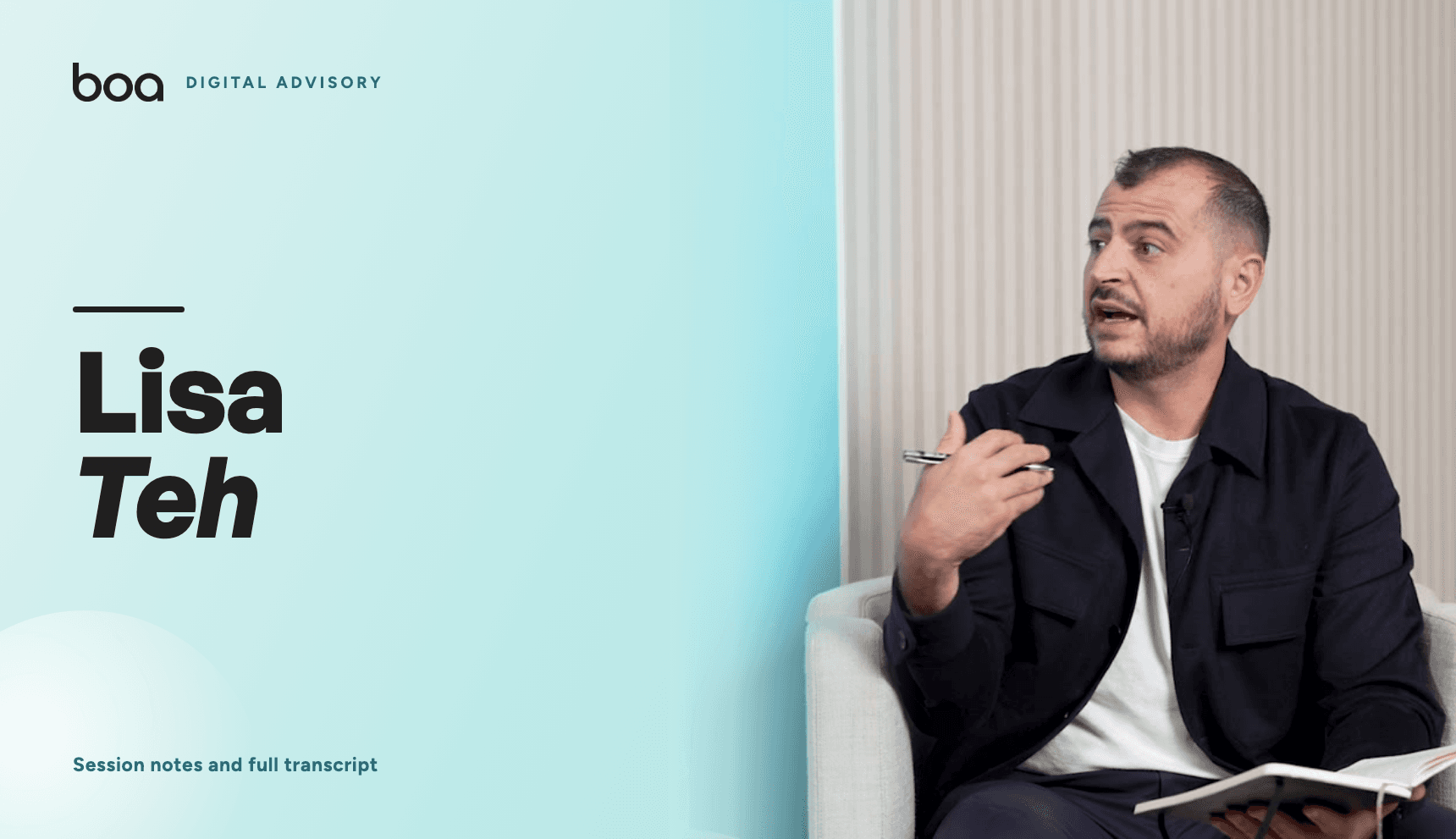
Lisa Teh on LinkedIn, AI and Personal Brand for Founders
With Lisa Teh, Co-founder and serial entrepreneur at Cody Agency · Hosted by Kirsten Scott · 42 min
What this session covers
Lisa Teh shows founders how to build visibility without a marketing budget: what to fix on a LinkedIn profile, how many connection requests to send, how to brief AI so it gives usable content and feedback, how to pitch articles instead of begging for PR, and how introverts can network without burning out.
Only about 3 million of LinkedIn's 1 billion users post, so a founder who shows their face weekly and sends 100 targeted connection requests a week has very little competition.
Key takeaways
- 01
Send 400 targeted connection requests a month, spaced out daily
Lisa says LinkedIn allows around 400 connection requests a month, roughly 100 a week. Do not fire them all off at once or the platform will read you as a bot, so spread them across the days (she suggests doing a batch while you are watching Netflix). The algorithm favours showing your content to new connections, because it assumes you have just met and are interested in each other, so every accepted request lifts the reach of your next post.
- 02
Fix the five parts of your LinkedIn profile people actually judge
Use a clear photo with your eyes visible (no sunglasses, no toilet selfies), because humans connect through eyes. Put your business name in your banner on the right side, since mobile crops the left and hides text behind your head. Put Founder in your headline, as almost nobody outranks a founder and it lifts acceptance rates. Make the About section about you rather than the company, with the first three lines interesting because that is all anyone sees, and use the Featured section for your best posts.
- 03
Post on your personal page, not the business page
Lisa focuses on personal page content because the LinkedIn algorithm favours it over business page content. If you cannot post, comment instead, because commenting is content too. Do not leave "great post" or fire emojis. Write something substantive or provocative, do it consistently on the profiles of people you want to know, and by the time you land in their DMs they already recognise your name and will usually reply.
- 04
Brief AI like a person, not a mind reader
Lisa's rule is garbage in, garbage out. If the output is weak, the brief is weak. Tell it who you are, describe the business, give it a slice of your founder story, then assign it a role: assume you are a digital marketing strategist who works with this type of founder, build me a LinkedIn strategy with content pillars and example posts for the next four weeks.
- 05
Use Projects so you stop rebriefing AI every time
Set up a Project inside ChatGPT, Copilot or Claude for each brand or persona. Upload your brand identity document, tone of voice document and example content once. From then on the context is saved, so you open the project and brief the task rather than re-explaining who you are. Lisa still keeps a human in the loop to correct and train the output, because it does not yet nail her voice unsupervised.
- 06
Build an AI board of advisors and a fake focus group
If you cannot afford a board or consultants, create a project per persona and ask what Steve Jobs or Einstein would advise on your specific problem, since AI can draw on their recorded interviews. For customer research, build a persona project (for example a 35 to 45 year old woman with two children in a given area) and test product ideas against it. Warn it explicitly: AI is a yes man, so tell it to be direct and brutal and that the feedback will not hurt your feelings.
- 07
Verify AI output and watch for inherited bias
Lisa cites a LinkedIn post where the same job description priced at $20,000 less when the word man was changed to woman, and an image prompt that turned a woman of colour into a white man when asked to make her look confident. AI inherits the biases in the data it was trained on. She uses Perplexity for research specifically and verifies sources from Claude or ChatGPT, because they hallucinate.
- 08
Pitch an article, not your business, to get free press
Media outlets will not write about you unless you are Canva or Atlassian sised, and they can smell a sales pitch. Instead, email the editorial team and offer to write a piece for them, with two or three angles attached. To promote her book Get Real, Lisa pitched articles about women in business, such as it being hard to start a business and harder if you are a woman, rather than asking anyone to cover the book. It gets you the press and the thought leadership without a PR retainer.
- 09
Analyse your feed as a creator, not a consumer
Every time you stop scrolling, ask why. Was it the format, the hook, the topic? That is your content research. Kirsten adds a tactic from Boa member Jeremy Cabral: paste the post that stopped you into ChatGPT and ask it to reuse that structure for your own topic. Lisa's caveat is to keep it in your voice, because people can see through content that does not feel like you.
- 10
Turn what you already do into posts instead of inventing content
Lisa's easiest win is documenting rather than creating. Attend a session, take away two or three tips, and post them the same day: I attended a session with X this morning and here is what I learned. If it was interesting to you, someone in your network will find it interesting. Also mine advice you have given or received that helped someone, and niche your topics to the area you want to sell into, because too general makes it hard for the right audience to find you.
- 11
Pressure test a new idea with 50 customer conversations before you build
Before spending money on development, go and interview real buyers in the target industry. Ask whether they would actually use it, which features matter, and what they would pay. Lisa's example: 50 restaurant owners all naming the same problem and committing to $50 a month is far more powerful in an investor conversation than a pitch with no product and no customers. Use tools like Lovable to spin up a mini version or website first.
- 12
Strip out daily decisions to save brain for the real ones
Lisa writes her to-do list the night before so she hits the ground running instead of drafting it at her desk. On Sunday night she plans what she is wearing every day that week. She owns one black belt, one brown belt, one black bag, listens to the same song on repeat for two weeks and eats much the same food. The point is decision fatigue: clients and team bring decisions all day, so do not burn an hour standing in a pile of clothes.
- 13
Network as an introvert by going with an extrovert or online
Lisa has driven to events, sat in the car and gone home without getting out. Her fixes: take an extrovert who will do the talking, or arrange to meet a friend at the door. When alone, walk up to someone who looks vaguely friendly with a big smile and say hi, nice to meet you, accepting it is awkward. Nearly everyone is friendly and feeling the same anxiety. Otherwise, network through commenting and posting, plus coworking spaces and founder groups, because non-founder friends will not understand why one signup is huge.
How the session runs
- 1:04Tax lawyer at KPMG to fashion website to agency
- 4:12Standing out when everyone is doing digital marketing
- 6:54A starter content plan and briefing AI properly
- 11:53Using LinkedIn to generate real business
- 13:19Connection requests and profile optimisation
- 16:24The PR tactic: pitch an article, not your brand
- 17:42Choosing a thought leadership niche
- 19:30AI as your board, focus group and pitch trainer
- 23:32AI bias, hallucination and verifying sources
- 24:42Time management and cutting decision fatigue
- 26:44How to approach a mentor and value their time
- 28:50Building a personal brand from a phone and a tripod
- 31:14Networking as an introvert
- 35:06Testing which business idea to actually pursue
- 38:31Get Real and what 30 female founders share
Mentioned in this session
- KPMG
- Witchery
- Cody
- ChatGPT
- Claude
- Copilot
- Perplexity
- Lovable
- Canva
- Atlassian
- Get Real
- Netflix
- TikTok
- Steve Jobs
- Einstein
- Tracy Spicer
- Jeremy Cabral
- Sally Obermeder
- Raquel Bouris
- Rachael Wilde
- Shark Tank
- Switzerland
Questions founders ask
Lisa Teh says you can send around 400 targeted connection requests a month, which is roughly 100 a week. Space them out across each day rather than sending them in one burst, or LinkedIn may treat you as a bot. It is worth doing because the algorithm favours showing your posts to brand new connections.
Personal. Lisa focuses on personal page content because the LinkedIn algorithm favours it over business page content. She also notes that only around 3 million of LinkedIn's 1 billion users post at all, so competition for attention is far lower than on other platforms. Once a week is enough to start.
Brief it like you would brief a person, because it is not a mind reader, and if the output is bad the brief is usually the problem. Set up a Project in ChatGPT, Claude or Copilot and load your brand identity, tone of voice and example posts so you are not re-explaining yourself every time. Lisa still keeps a human in the loop to edit and train, because AI does not yet nail her voice on its own.
Do not ask a publication to write about your business, because unless you are Canva or Atlassian sised they will read it as sales. Instead, email the editorial team and offer to write an article for them, pitching two or three angles. Lisa promoted her book Get Real by pitching pieces about the challenges of women in business rather than asking anyone to cover the book itself.
Get a small version in front of real customers before you invest heavily. Interview people in the target industry and ask whether they would use it, which features matter and what they would pay. Lisa's example is 50 restaurant owners naming the same problem and committing to around $50 a month, which is far more persuasive to an investor than a pitch with no product and no customers. Tools like Lovable let you build a mini version cheaply first.
Full transcript
The complete conversation, as recorded, with every speaker attributed.
Kirsten Scott0:00
, and today we're having the opportunity, um, to interview and meet and learn from some— a serial entrepreneur in Lisa Tay. Now, Lisa, uh, was a, um— you're a tax lawyer, were you, at one point?
Lisa Teh0:15
Yes, unfortunately.
Kirsten Scott0:16
So Lisa was unfortunately a tax lawyer at one point, um, and she's now a 5-time— 5-time founder, I believe. She's got a lot of businesses, and she's a best-selling author of a book which we're going to talk about today as well. She's an expert in topics such as marketing, particularly digital marketing, Web3, AI, um, Web3, AI, and personal branding. She's built a very strong personal brand, and I do want to ask you exactly how you did that because it's something particularly early-stage businesses that don't have huge marketing budgets are able to leverage. Um, Lisa, why don't you give us, um, just a short introduction quickly and why you went from tax lawyer to business owner and, and what gave you the courage to actually take that leap?
Lisa Teh1:04
Uh, so I, I must admit, when I thought about starting my own business, I was like a bit nervous. So I think like maybe some of you on the call today, you might have done a career change. So I grew up with quite conservative Asian parents, and then I wanted to actually be a fashion designer when I was younger, but I couldn't make clothes, so I quickly scrapped that idea. Uh, I did try, but they weren't very good. So I ended up going into, um, comm law at uni, and then from there I had a really good tax lecturer And I blame him because he somehow made tax interesting. I'm like, oh, this doesn't seem that bad. And then so, so in a funny twist of fate, I ended up starting my career at KPMG in this exact building.
Kirsten Scott1:47
No way.
Lisa Teh1:48
Yeah, it's like years ago. I'm going to age myself, so I probably should say how long ago. A very long time ago. And I'll say to Kirsten that this is a very dangerous part of the city because it's near all the good shopping. So I'm like, I need to come in here with blinkers on and not look around at all the shops as I'm passing. But I always sort of felt like I never really fit into the tax and corporate world. Like, I always loved fashion and I felt like, you know, I wanted to express myself through fashion and creativity. But you can't really do that. Surprise, surprise, in corporate. So I think I was always kind of looking for a creative outlet. And then that was when I started at KPMG. That was like the dawn of Facebook. So that was— I'm really dating myself now, but it was like a really long time ago. But then I became really fascinated with the ability to share and consume content at scale because that was just like so new back then. And you know, that was when people were sort of like poking each other, for anyone who used Facebook back in the day. And I really just became fascinated with this world. And so I ended up starting a website which covered fashion, beauty, and lifestyle news. And that gave me like a really exciting foray into the digital world and allowed me to almost lead like a double life. So I'd go to my day job during the day, and then at night I'd get into my car and change and like go to events or go to Fashion Week. So it was like quite an exciting, uh, I mean everything's more exciting than tax law to be honest, but it was quite an exciting shift. And then from there that actually enabled me to do a complete career change to marketing. So I ended up getting a job in marketing at Witchery and I used that, uh, I guess interest in digital to allow me to actually do a career change because on paper I definitely wasn't really, uh, you know, the right candidate for the job in the sense I was going from tax law to marketing, but I was able to leverage that sort of side first, I guess it was like a side hustle back in the day, and then I was able to, to make that career pivot. And then from there, I ended up becoming really fascinated with digital marketing. And then I was there for about a year and thought, you know what, I'm going to start an agency. And back then it was still so new. It was like, you know, working with influencers was like not even really a thing. Managing people's social wasn't really a thing. And so I said, look, I had a business partner at the time, and we said, look, there's going to be no plan B. We're just going to see how it goes, make it work, use our savings. And then, yeah, so 10 years later—
Kirsten Scott4:08
and that's when you launched Cody agency.
Lisa Teh4:10
Yeah, yeah, 10 years ago. Yeah.
Kirsten Scott4:12
Now I do have to disagree with you with tax law. Tax law is very interesting when it's about minimising your tax. That is true. Um, so you started the agency. Now digital marketing is obviously like still very prevalent, but it has changed in that there is a lot of noise. Like there's ads everywhere. Everybody's doing digital marketing. There's no barrier to entry. So what advice do you have as someone that's an expert on that topic? For business owners like all of us here today to be able to stand out or to best use digital marketing?
Lisa Teh4:45
Well, if you're able to be the face of your brand, like, there's going to be probably no one better to sell your company than you because you're going to be the most passionate about it. You'll see it day in, day out. You know what it's taken to get from, you know, day dot to where it is now. So I always say, if you can, try and get out there on social media and start posting content. So I've come from like a, I guess, a different generation of people sharing content online. Because I look at Gen Z founders now, I don't know if there's any online now, but they're so happy to share so much of their lives, like, you know, the highs and the lows. And I personally, I don't think that's right for me. Like, I don't see myself crying on camera and sharing that. We're actually talking about this with a friend yesterday, and it's so interesting how their brains are so hardwired to think of everything as content. So say, for example, if I was crying about something, the last thing I'd be thinking was, I'll get my phone and, you know, record it because it's going to make really good content. I'd be like, I don't want to see a single soul. I just want to sit in my room and eat fried chicken and cry. But it's quite different when I think I look at Gen Z founders and they're happy to literally share everything. So I don't think you need to go to that extreme. You can obviously control the narrative and share whatever you feel comfortable sharing. But, you know, I think for an audience, it's really exciting for them to see you, like, the journey of you building, what you're working on, what you have worked on, where you've been, where you're going. And so I would say if you can get out there and just start sharing content, I would do that. LinkedIn's amazing for that. It's just such an underutilised utilized. It's probably like the most underutilised social media platform in the world today, and it is the number one for business, um, for business networking, business brand building. So I would definitely say utilise LinkedIn if you can. I'm sure we're going to talk a little bit more.
Kirsten Scott6:26
Yeah, I have a few questions about LinkedIn for you because obviously, I mean, I, I believe it's a powerful platform that we use ourselves also. Um, but before, so I mean, a good way to stand out in the marketing sphere, in the digital sphere today, as you said, is to be the face of your brand because you're unique. Um, could you share a simple content approach that any founder can implement to build credibility and visibility, uh, like what, what would be like a, like a weekly content plan, or what are ideas of ways people could actually implement that?
Lisa Teh6:54
Yeah, so I always like to think about, and there's a few ways you can approach this. So firstly, I think about if you've received, um, information, or sorry, like, you know, advice, or given advice that has either helped you or helped someone else, that's like a really good idea of like what sort of content you could be sharing. So I think that the key thing to think about when you're creating content plan for yourself is that, uh, firstly, I We can get so caught up, and if you're starting— this is more so if you're starting out— we can get so caught up in best practise and all that, when I think the key thing is just to start getting content out there. And it's going to be really daunting at the start because you go, is anyone gonna like this? Is anyone gonna comment? So I think that's part of the scary thing. The good thing with BOA is that it's such a good networking, uh, group and community that you could even start a little group of people that want to start getting active on LinkedIn. And when you post— and it could just literally be on LinkedIn, it could be in WhatsApp group or whatever it is— you can literally put your post in there and that you guys can go and support and like it and comment, because I think that just gives the algorithm a little boost to say, oh, this content's good. I mean, it sort of helps push it further. But I know that one of the big barriers to people posting is that it's a bit scary when you think, is anyone going to like this at all? Uh, so then in terms of actually creating content, so I love AI. So I would say that if you don't have an agency or can't afford to work with a strategist, AI is an absolute gold mine for thinking of content ideas. So what I would do, and you know, I think The challenge with people using AI is that it's really garbage in, garbage out. So if the AI is not producing anything good, more often than not, your brief isn't good enough. Yeah, well, generally the brief isn't strong enough. And I think people forget that AI isn't a mind reader because they'll just go, oh, but like, it should know all this stuff. Like, you know, when they'll give it a prompt and they don't include relevant information, but it's really not a mind reader. So you need to brief it like you're briefing a person. So say if I was a founder, like one of you on the call, and you're trying to think of content ideas, it can be really challenging when you're just sitting there going, okay, off the top of my head, what am I going to do? So I like to think of, uh, the world and viewing the world as a content creator versus a consumer of content. So I think every time we go on social media or we're just like reading the news, we consume content. But if you start to switch it around and start to critically analyse when you're going through your feed, what has made you stop the scroll, why did it make you stop the scroll, then that's a good indication of, okay, this is— was it a style of content that I could potentially, um, you know, copy, or was it a style of post that I could use and get inspiration from? Was it a topic that I found interesting? And that will help help you start framing your, um, your strategy. And then you can actually brief AI to say, this is the business, this is my business, this is a bit of my storey as a founder. And then you can start to help it and say, assume you're a marketing strategist, digital marketing strategist that maybe works with XYZ type of founder on social media. Um, can you create like a LinkedIn strategy for me and some example posts or some, you know, post ideas or content pillars for the next week, 2 weeks, 3 weeks, 4 weeks? So I think you can use AI as a little bit of like a marketing strategist to help give you ideas.
Kirsten Scott9:56
Does a lot of that heavy lifting. And I like the, I like the, um, the idea of seeing what content you stopped on on LinkedIn or what text. And actually, is someone, another BOA, um, person showed me, his name's Jeremy Cabral, he said when you see a text body that you stopped on that caught your attention and then it made you read through, copy and paste it, put it in ChatGPT and say, can you please use this text, um, text, uh, layout or format or however this text is catchy to create content on these bases. So whatever that person's, um, structure was that got your attention, kept you hooked, moved you to the next, and then had you action something, it can then create your content in that structure to ideally have the same result for others, which I thought was really clever. Basically what you said.
Lisa Teh10:48
Yeah. But I think as well, it's good to make sure that it still feels authentic to you because at the same time you don't want to put it out if it doesn't feel authentic. So I feel like people can see through that.
Kirsten Scott10:56
Yeah.
Lisa Teh10:56
So sometimes I've tried to use AI to do my voice, and I'm trying to train AI to at least take care of some of the heavy lifting of structuring, uh, the beginning of a post. But I still feel like I need to be what we call like human in the loop, where you're still that human that has to train AI, correct AI, um, you know, keep briefing AI. And so I think it's still not at a point where it could just generate a post for me and I can put it out and it's like nails my voice exactly. But I would definitely say if you're serious about using AI, then I would use something called, or implement something called projects within like your ChatGPT, Copilot, Claude, because that is, uh, it's an— it's almost like it saves your brief and it saves your knowledge of a particular project, so you don't have to keep briefing it. So it might be one that you create for your brand, and then you've got your brand identity documents, tone of voice documents, example content uploaded there. Then you just go into those projects and then you can just keep briefing it, so you're not rebriefing it every single time to give a context on what, you know, who you are or what your brand is.
Kirsten Scott11:53
And regarding LinkedIn, so you've got a— I mean, you're big on LinkedIn, you generate a lot of business through LinkedIn. What are the practical steps or advice you have for business owners like us to be able to use LinkedIn to generate business or business opportunities?
Lisa Teh12:08
Yeah, so I've been posting on LinkedIn since 2019, so it feels like a really long time ago now. So I think the key thing to note is that you will not have— well, you might go viral straight away or you might get success straight away, but it is like, if I think about digital marketing in terms of different taps, if you're looking for it to, uh, as a way to generate business, it's like probably like a tiny circular. So like, it's like, because if it's— you're posting content, that's like an organic strategy. So it's not gonna, you know, the doors aren't going to start, you know, well, people aren't going to start flooding in as soon as you start posting. But, um, if you want to do that, then I'd look at paid ads. Like, if you want more of like, um, you know, a lot of people coming— yeah, a lot of people coming in the door at once. But it's amazing for, uh, consistently— so if you post content, it's really good for getting in front of your target audience at scale, um, consistently, because you're just constantly posting content. And it's also really great for building thought leadership. So I get a lot of opportunities to do interviews, like media opportunities, write articles, things like that. So I would definitely say that, uh, from that side of things— well, actually, there's probably a few different things. So you can post if you can do that. Um, definitely I recommend doing it. Even once a week is totally fine.
Audience member13:19
People—
Lisa Teh13:19
I think probably like 3 million out of the 1 billion people on LinkedIn post, so it's not very high. So there's not as much competition as other apps. If you can— if you can't post, um, I would comment because commenting is content too. But don't just write, you know, great posts like fire, fire, fire. Yeah, it has to be, uh, quality. But then I would also, uh, send out targeted connection requests. So you can do, I think, 400 a month, which is around 100 a week. So next time you're sitting there watching Netflix, I wouldn't do all 400 at once because they'll think you're a bot. So you have to sort of space it out each day. But you can send out 400 targeted connection requests to your potential, like, who your target audience is, because the algorithm favours showing new connections your content because it assumes, oh, you've just met this person, you've just connected, most likely you're interested in what their going to be posting about. So if you're sending out these connection requests, then it's a really great way for you to start getting your brand in front of potential new clients. I'd also make sure your personal page is optimized. So people often think that, you know, it doesn't really matter what your page looks like, but it definitely does. Because if you're reaching out to someone that you don't actually know, the first thing they're going to do is have a look at your profile and see, is it worth connecting with this person or accepting the connection request? And it's really important from a personal page perspective because the algorithm favours personal page content over business page content. Content, which is why I generally focus more on personal page content. But I'd make sure you have a really good clear photo of yourself. Um, try not to have like a toilet selfie or anything like that, which I've seen people do on LinkedIn, or they have like sunglasses on and stuff like so you can't see people's eyes. Think about what do you want to look like when you're meeting someone for the first time. So it's probably not having glasses on, like sunglasses on, because they can't see your eyes. And as humans, we want to connect with people through their eyes. So I would definitely make sure that your profile photo is good. I would have your business name in your banner. Make sure it's, uh, right fine, because when it, it optimises for mobile, it will go behind your head. And if it's on the left side and get blocked, um, well, you can't see it properly. And then I would make sure your headline accurately describes what you are. And so, um, I'm guessing most of you are founders, so make sure you include that. And I was actually talking to someone the other day, I was having a look at her LinkedIn profile, and she was saying, I think, uh, she had a title as like Chief Community Officer. I can't remember exactly what it was., and I was like, how come you don't have founder in your title? Because she was actually the founder of the company, and she's like, I never thought of it like that. Yeah, I probably should put it in. I was like, yeah, definitely put it in, because people more often than not, like, I mean, there's no one really higher than the founder in a company. So it's a really great way to get people to accept your, your connection request. I would make your about section interesting and about you. So a lot of people make it about your company. This is a chance to humanise yourself, and you only see the first 3 lines. So make sure that it's interesting and clickbaity. So if you have a look at my LinkedIn profile, I use like dot points, um, like emojis and stuff obviously do what you feel is on brand, but definitely make it, um, uh, you know, interesting. And then I'd use your featured section to highlight, you know, either posts that have done really well or posts of your business that you want to highlight. And then, um, then try and post content if you can. Can I just give one tip? Actually, I've just thought of this. I'm going to forget it later. It's like a little bit off tangent.
Audience member16:24
Yeah, please.
Lisa Teh16:25
But it's about PR because I think a lot of people want to try and get PR for their business, and they'll go to a media company and say, can you please write about my my business. And they don't like— and a lot of PR, unless you're like Canva or Atlassian or like some massive company, they generally don't like anything that looks salesy. So, um, what I like to do with PR is I just reach out to say like the editorial team, and I just say, can I write an article on XYZ for you? And I'll just like give them some ideas. And so I just wrote a book recently, um, called Get Real, which is interviews with 30 female founders. And rather than just me emailing media companies to say, can you please write about this book, like I've written different articles about about women in business. So like, you know, why, you know, what articles like, it's hard to start a business, even harder if you're a woman, uh, you know, little things like that. So I think that's a subtle way of promoting whatever you're doing, establishing yourself as a thought leader, getting yourself some PR and press. But it's like much easier to try and get in that way. And if you can't afford a PR agency, that's like a nice little cheeky way of getting yourself in some good press.
Kirsten Scott17:30
And how do you go about being a thought leader? And how do you decide what the, you know, what, what, what topic you should be a thought leader in? And, um, and I guess what type of content should you be creating?
Lisa Teh17:42
Uh, I think definitely I would say it should be linked to your business. So whatever your business is, that's a really good—
Kirsten Scott17:47
so I'd be like a networking thought leader?
Lisa Teh17:49
Yeah, definitely. Like how to network, um, you know, tips for networking, uh, you know, events that you're hosting, events that you've been doing. So I think anything that you— because I'm guessing a lot of people want to be thought leaders in the area they want to generate business in. So I think that's like a really easy way to start. Some people just want to give back, which is also fine, so you can just post content about general business. But it does help if you try and niche down, because I think if you're too general, uh, it's— it can be hard to try and find your audience and your— and the people that are interested.
Kirsten Scott18:16
So the more niche, the better when it comes to thought leadership?
Lisa Teh18:18
Yeah, definitely, definitely. But also, I mean, say for example, people was like, what do I post? And I can tell you there's so much content all around. So a really easy win would be from today's session. Hopefully you learn one tip, maybe two, maybe three, uh, but that's a really easy post because you can just say, okay, well, I picked up these tips in the session. So you can just say, I attended a networking session with the amazing Daniel, uh, and Lisa this morning for BOA, and these are some of the interesting tips that, uh, you know, I learned. Because most likely, if it's something that you found interesting, someone in your network's also going to find interesting as well. So that's like a really easy win to say, okay, that's something that you're already doing. You don't have to go out and create content. It's more just documenting what you're already doing and then turning that into content or, or starting to shift the way you look at the world and go, that's actually interesting content.
Kirsten Scott19:06
Now guys, if you have any questions regarding LinkedIn or how to use, like, how to get traction on LinkedIn, thought leadership, throw them in the chat now. We'll get to them soon. Um, now you mentioned using AI before to help you generate content ideas for LinkedIn, um, or structure, uh, posts that are catchier. What are other ways that small business could be using AI to get their head, easy ways they can implement.
Lisa Teh19:30
So many ways. Okay, so I've got like a whole list. Uh, so firstly, a lot of small businesses can't afford, say, like a board or consulting or experts. So you all of a sudden can use AI as a board. And so I talked about projects before. You could create a little project for each of your different personas. So you might want like, uh, and this is actually even cooler because you don't just have to go, this is like the persona of a board member. You can literally I want you to think like Steve Jobs. So if I was telling Steve Jobs about this, what would Steve Jobs— what advice would Steve Jobs tell me? So all of a sudden you can get mentored by some of the most amazing minds in history. Like, what would Einstein tell me about this? Or, you know, what would— who, you know, what would— I don't know, I can't think of anyone else off the top of my head. My brain's like cooked at the moment. But, you know, you can ask anyone who's, you know, like you might not necessarily get a chance to talk to, to give you advice on a particular topic because AI will be able to crawl the internet and find out out what their, you know, their responses to interviews are and then shape them in a way that could be useful. So I would definitely say using it as like a board member or like a consultant or an expert, I'd say like that's one really easy way. Secondly, uh, I know that a lot of small businesses want to have direct access to customers or potential customers or focus groups, but that can cost a lot of time, that can cost money. So you can actually create like an AI persona in like a project of your ideal customer, and then you can start to then ask it, you know, like, assume it's like a 35 to 45-year-old female with 2 children living in this area. Would you like this new product? What do you think of this new product? And then get it to give you advice. Now, I would definitely say that AI is a little bit of a yes man, and you have to tell it to be quite direct and brutal with its feedback. Otherwise, it actually is quite nice. So I always say, you know, like, please be direct with your feedback. You will not hurt my feelings. I want you to be brutal. And like, so I have to specify, like, do not worry that this feedback is going to be, uh, like, will upset me. Like, I just need the specific feedback. So I think you just have to be aware that, um, you know, there are some, I guess, not challenges with the AI, I guess limitations with AI. And, uh, we actually had a really interesting chat with, uh, Tracy Spicer, who does a lot around bias and AI, which is, I don't think, something that people talk about enough. Because if you think about AI and the information that AI gets, it is, uh, all from the world. And what else is like, whatever information is out there in the world. And So there's obviously inherent biases in the data that's out there, and so AI naturally inherits those biases. So classic example, I saw this post on LinkedIn that this woman was working out how much to advertise a job for, and so she put the title of the job, she put the description of the job, like the key roles and responsibilities, and then she said like, this is based in Switzerland and this role's for a man. And then it spat out an example of like the salary. And then she did, she copied and pasted the exact same prompt and then changed the word man to woman, and it suggested a salary of $20,000 less. And so that's, you know, obviously we're mostly all aware of the gender, um, the gender pay gap, but AI's taken that information and then pushed out that information, um, adopting the bias of the information that's out there. And then another crazy one was this— it was a female, um, founder of color. She was on stage, she was sitting in a group of people talking, and she was sort of like hunched over. And she said to AI, she fed that image into AI and said, make me, um, create an image of me looking like a confident video and it recreated her as a white man standing on stage, which is crazy. Like, you just sort of think— and so that's like that bias feeding in. So I think, you know, the key thing to know is like AI is amazing, but you still— you can't take it as like, you know, gospel. And so I think a lot of people use AI for things like searching for information. Like, I would not trust— or I would verify sources if you're using like Claude, ChatGPT, etc. I always use Perplexity for research. Um, but yeah, the AI hallucinates a little bit or makes things up, so you just have to be super careful of what generating.
Kirsten Scott23:32
Yeah, so basically you use it as a board, as an advisory board. You can use it as a focus group, and you can use it to create tonnes of content pillars for yourself.
Lisa Teh23:41
Yeah, exactly. And you can also use it to train yourself in even like— this is crazy, like voice AI is getting so good. Like I was, uh, we're doing an AI podcast and we were interviewing AI, and it was like giving me a lot of sass. I was like, uh, should you be like so cheeky? So I asked it, um, I actually asked, I was like trying to test it to see, um, what sort of questions or answers it would give, and I, I 'Who's your favourite Kardashian?' Because I was like, 'I wonder what it'll give me for that.' And it was like pretty much telling me it was a terrible question to ask. And I was like, 'Are you right? Like, how rude.' Um, but it was like funny because it was almost like it was a real person interacting with me. So think of it this way: say if you're not good at selling, you could then eventually use an AI— will get this good where you can pretend that it's a customer and then you can sell, you know, or pretend it's like a pitch trainer. That's it, exactly right. And go, you know, maybe assume it's like a pitch trainer, and then you can say, um, this is my pitch that I'd be presenting to a potential customer, can you critically analyse it? Tell me areas that I can improve. Like, that's the level that it's getting to, especially with like voice AI.
Kirsten Scott24:42
Now you've got multiple businesses, and what is— I guess, what advice do you have on time management and knowing what's— what to focus on?
Lisa Teh24:51
Uh, I'm probably like the least focused person. I feel like most founders have some form of ADD. I don't know what it is, like, that we're just like obviously distracted by a lot of things. Um, but I have to write a to-do list, and I generally try and do it the night before so I have an idea, so I'm not sitting at my desk in the morning like trying to write it out. Like, I like to just hit the ground running. I also realised that I like to try and limit the decisions I have to make in a day. Uh, so I— if I am like lying in bed on Sunday night, I'll work out and I know what I'm going to wear every single day for the week, um, ahead. And that's, uh, something that really saves me a lot of time because I can really spiral if I'm in the morning going on, what should I wear? Is this even clean? What's going on? Like, I've already wore this, this way, like, and then it can be like literally me standing in a pile of clothes for like, you know, an hour later not working out what I've got to wear. I also have— and I realise this, it's so funny, like when you start to realise these things about yourself— but I've got like one black belt, one brown belt, one black bag that's one size, one bag. I've really tried to just minimise the decisions I have to make in a day. I listen to pretty much the same song on repeat until I get sick of it for like 2 weeks. I eat pretty much the same thing every day. Like, I, I really try and minimize— yes, yeah, because I realize, I think over time, like, I can get really tired having to make so many decisions in a day because like obviously your clients might come to you, have to make a decision, team comes to you, you then just have to make your own personal decisions. And so I think over time I've just tried to limit the amount of decisions I can make so that I really have that brain power. So when it's an important decision, I'm not like, I'm like, you know, exhausted because I had to, you know, work out what I was wearing for like an hour in the morning.
Kirsten Scott26:28
So limit decisions and a daily task, daily to-dos. Yes. Organize in the morning. And now you've built a company, it's called Biznik, is that correct? Is that the mentoring?
Lisa Teh26:37
Oh yes, yeah.
Kirsten Scott26:38
So did I say that correctly? Yes, you looked at me weird when I said it.
Lisa Teh26:41
No, no, yeah, we haven't done that for a while, so.
Kirsten Scott26:44
Oh, okay, well, but you did have a lot of experience in mentoring and finding people. Uh, yes, yeah, um, connecting people to potential mentors. What advice do you have to founders, um, best to best approach potential mentors or find mentors?
Lisa Teh26:59
That's a good question. It is a hard one because I I think like there are some people who like, yes, I can give heaps of my time to people and, and help mentor them. But there's also people who are— I think it's more so just being respectful of people's, um, time. So I think if you're wanting people's time, like for them to go out and get a coffee, especially if you're not wanting to pay them, for them to go out somewhere and get a cup of coffee, like that's like, you know, potentially an hour, 2 hours out of their day if they, you know, are transiting So, you know, maybe just say, is a 15-minute Zoom catch-up possible or something? Just so they're more likely to say yes. Or can I just send you some questions? Um, I always find it hard because I feel like if I had all the time in the world, I would just love to help and sit down with everyone I possibly can. So I think over time it's become challenging because I don't want to say no to people. So, but then, you know, I also want to be respectful. If I reach out for people's time, I always just say, I'd love to pay you to, you know, consult because like people's time and their expertise and the blood, sweat, and tears that they've put in. And I'm sure every founder is like, it's on the call, like you've put in so much blood, sweat, and tears to get to where you are. And if someone comes up and just says, hey, like I would like your advice on this, effectively they'll, from that advice, they'll probably get to shortcut, you know, mistakes or they'll save time, they'll save money. And that's really valuable and that's worth something. So I think for anyone on the call, like, you know, I think if you want people to value your time, you also have to value other people's time when you're asking for information. So I guess think about how you would like to be asked for advice or for feedback and then maybe, you know, I guess try and approach people in a similar way.
Kirsten Scott28:35
Yeah, great advice. And a final question. Now you've built a strong personal brand. We have spoken a lot about personal brands. Can you take us step by step from when you started to your personal brand today, what you actually did and what worked?
Lisa Teh28:50
Yeah, I think the key thing is definitely consistency. So, and I feel like you just have to be yourself. So when I first started out, this was like, so this was like before the pandemic and I remember thinking, because I came from obviously quite a corporate background. I thought, what, what should I wear on camera? Because I thought, I'm going to do some video content, what should I look like? Do I have to be dressed a certain way? Do I have to be talking a certain way? Do I have to cover certain topics? And then I just thought, do I need to even get like a professional film crew? And I thought, if I'm going to do this properly and it's going to feel like me, then I'm just going to dress and wear whatever I want to wear. I'm going to show like my personality, and it won't be for everyone, and I'm just going to do it on my phone. Because it had to be something that was going to be feasible for to keep up doing because the whole thing is consistency is key. So then I just bought like a tripod, a tripod off online, and then I just started doing video content. And I think, you know, for me, just being true to myself, I just naturally attracted people that were like me. So I felt like when people reach out to me to want to work with us, I'm like, okay, this is probably our type of person because like they don't, you know, like they work really hard but they don't take themselves too seriously because like, you know, I try and, you know, just show showcase, like, you know, I'm pretty immature, to be honest with you. So I just try and just showcase that that's just who I am. But I really genuinely care about what I do. I care about people I do it with and the people that we do it for. But I think it's really important that if you want to go down this journey and share content, uh, you know, I think there's every temptation to go and look at other people, like, you know, um, that are posting content and doing really well and try and imitate their style. But the reality is, like, there's going to be no more powerful style for you to allow you to connect with people than being yourself. So I think do it in a way that feels right for you. So it could be writing, it could be video, do it on a platform that feels right for you. It could be TikTok, it could be LinkedIn, it could be Instagram. Um, but also you control the narrative, so you can share and not share whatever you want. So I think that's the real power here. You don't need to show yourself crying every morning if that's what you do. You don't have to share yourself, um, you know, if you're feeling at your low moments, or you might want to do that if that feels natural. So you. So I think as long as you just be yourself and you be your authentic self, then that's what's going to be able to allow you to cut through the noise and, um, really find those people you're going to connect with.
Kirsten Scott31:03
Um, now I've got— we're going to move to questions, guys. So if you've got a question, throw it in the chat. I've got one here, it's a question about networking. Um, you've interviewed some incredible founders for your new book.
Lisa Teh31:14
Um, how do you build and connect with other founders, and what advice do you have for others trying to build their own business Ah, this is a good one because I'm actually an introvert, which, um, people find surprising because I do a lot of video content. But what I tell them is literally, generally when I'm doing that video content, it's just me and my dog staring at me like, what are you doing? Uh, so I'm not in front of all those people who might be watching. And so, uh, I have found it really challenging over the years networking as an introvert. So if there's any introverts on the call, I'm sure you would have felt that fear of like social anxiety. The thought of going to an event yourself is like one of the scariest things that you can do. And I've had events where I've literally driven to the event, parked, sat in my car, I'm like, I can't do this, and I've just driven home. I didn't even get out of the car because like it's so sometimes so stressful. And I think it just builds up in your head. So over time, I think one way that I can definitely say is really good is if you are an introvert and you want to go to a networking event, find an extrovert to to go with because they will be doing all the talking for you and you just have to stand there. Um, or find a friend to go with and then you can just meet up beforehand or you can meet at the door so you don't feel so stressful like going in. Um, one of the most liberating things though is going to an event yourself. So I've actually over time just really forced myself to address like this area of, um, anxiety for me. And so now I feel reasonably comfortable going to an event myself and then I just put the biggest smile I can on and I'm like a bit of a dork, so I, I, you know, I feel like I was like a fool of myself, but I just walk up to someone that looks vaguely friendly with a big smile. I just say, hi, nice to meet you. Like, and I mean, it's really awkward. It's like the worst probably introductory line, but I think people are— 99.9% of the time, most people are really friendly. So I think we build it up in our head that what if this person's rude? What if they don't talk to me? It could be really embarrassing. And so I think most of the time, most people that you meet will be genuinely friendly and probably feeling the same kind of anxiety and social anxiety as you. So definitely say, put out there. Networking is, uh, social media is a really good way for introverts to network because they can just keep posting content, and that's kind of getting your brand in front of there. Commenting on people's posts that you want to network with is really good because it's such a great way for them to see your name all of a sudden. And then if you write something that is, uh, interesting or provocative or, you know, not just great post, they're most likely going to engage with you, and then you can start a little bit of a dialogue. But if you do that consistently and then you decide to say drop into their DMs, they're most likely going to reply because they've seen your name and they know that you engage with their content. So you're not just someone trying to, you know, stone cold like sell to them. So I'd say those definitely help. And then obviously joining networking groups like yours, that does help. Yep. And coworking spaces, I think that's a really good way as well. So, and you didn't pay me to say that, I said that for free. But coworking spaces, things like that could definitely help too because, you know, I think especially as a founder, a lot of the time it's really lonely and, you know, your friends, unless they're founders, they won't get it. Like, you know, and I think one of the best things you can do as a founder is finding friends that are founders as well, because when you have what someone might look like, you know, from the outside and see as— think of as a little win, you— for you, that will be massive. And so your friends might not get that, but your founder friends were like, that's freaking huge, you got one sign up, that's amazing.
Kirsten Scott34:35
Because like, you know, sometimes they know how hard it is to get one sign up.
Lisa Teh34:37
Exactly. Like, all the, the effort it's taken to, to get to that one sign up, they understand. Whereas like a normal friend who's not a founder might be like, oh, awesome, you got one sign up. Well done, you know. So I think having that network of founder friends can be like honestly so, so powerful.
Kirsten Scott34:52
Um, Abby, did you want to ask your question?
Audience member34:56
Yeah, sure. It's been powered back. Thank you so much.
Lisa Teh34:59
Hi Abby, sorry I talk really fast because I think I get really excited, so hopefully you guys understood me.
Audience member35:06
I understood everything, thank you. So yes, I mean, uh, you mentioned about the ADD thing and lots of ideas, and I could totally relate to that. And I'm just curious, you know, if you, if you're sort of engaging with people all day in different businesses, different ideas, creating content, how do you really prioritize? How do you— is there a way that you could really test out the viability of one of your ideas and say, I'm going to stick with this, I'm not going to go try out a few different ideas and spread yourself too thin?
Kirsten Scott35:37
Are you saying content ideas, or what type of ideas are you are you talking about?
Audience member35:41
Um, I'm more sort of in terms of, um, in your different businesses, it's more around the businesses, you know, if there's offshoots that come out of, you know, things that you would have tried, they worked, and then like rather than, you know, going down different rabbit holes, how do you kind of pull yourself back and say, well, this is the path, and you kind of stick to it?
Lisa Teh36:00
Yeah, that's, it's really hard things, I think, especially for founders. Like, there's a lot of joy in building things and starting things, and we always get, uh, exposed, I think, to interesting people. So then you go, oh, I could add add, uh, add AI onto this. There's a bit of a tongue twister. Um, or I could do this or add this thing, or we could integrate with that. And so I think fundamentally you need to understand at your core, like, what you want to focus on. And then, uh, if you want to do and test and try lots of business ideas, I would try and get something, some sort of, uh, small version of it to market. Or I would actually try, if you can, and talk to potential customers and say, realistically, realistically, is this something that you would use? If so, what are the key features? And then what would you actually pay for this, or would you even pay for this? Because if you are thinking of all these amazing ideas, but then you create it all or invest your time, money into doing it, and then you can't even sell it, then that is not a good sign at all. So I was talking to someone yesterday, he's actually going around doing interviews with people in hospo and, uh, people in the specific industry that he's wanting to do it because he, he wants to actually just pressure test it. And also sometimes it can be hard to raise money when you don't have a customer base because you might not have a product. So say, for example, if you did 50 interviews with, say, in hospitality, for example, 50 restaurant owners, and they all have said that they did a survey, they all had the exact same problem. They said they're willing to pay, you know, at least $50 a month to fix this. And, you know, they've like committed to doing that or committed to at least testing it. That is more powerful than just going to a potential investor with no product trying to get money. So I think as much as possible, really pressure test your, your idea with a with an actual live customer or as many as you can. And then also AI is unbelievable. So you can now generate websites, you can generate, you know, almost like, like mini versions of what you want to do using platforms like Lovable, which is like good for coding. So there's like lots of ways that you can start to now generate these mini products or mini versions before you actually go and spend a whole lot of money in, say, like development or creating your business.
Kirsten Scott38:07
Thanks, Abby. And now I just have one last question for you. So this is Lisa's book, it's called Get Real. Now you've got 30 storeys from influential entrepreneurs in here. Um, after conducting those interviews, what are— what were the common— what were some of the common threads you found that each of these successful entrepreneurs, particularly female founders in this book, um, have in common?
Lisa Teh38:31
Yeah, so, uh, I guess the thing I want to say about the book really quickly is that I realised that— and I was reading, I love reading business books, and I usually do it over the holidays for some reason. I probably should try and take a break, but I realised there weren't that many books by or on female founders. So I think there's like only 8 to 30% if you go to the business bookshelves. So, but I really want to say that this book is for anyone in business because if you go to the business bookshelf and you take out a book and it's written by a man, you don't think, oh, that's just a book for a man. So I think definitely whether you're a man or woman, definitely cheque the book out because there are some incredible, incredible women in there. And I think what makes the book even more interesting is that, you know, the reality is it is generally a lot harder for women to actually raise money— obviously 2 to 3% of funding goes to women— it's generally harder because they have to maybe take a break because they've had to give birth. Um, so I think they've— obviously there's internal— well, there's like, I think, a lot of different challenges that women have to face. So for them to get to the level of success that they had, like, they've had to work probably 10, 20, you know, times harder than a man. So I think the tales of resilience, the approach to failure, the approach to just quickly pivoting when things wrong, like really, really impressive, um, in the book. So I definitely say I think those are kind of key themes, um, but the thing I really love about these women is like I don't feel like— I guess when I did the book in, in, I guess in particular, I really wanted to try and get a broad range of women. So, uh, I think the interesting thing about founders is that sometimes they can almost seem like they're superheroes or like they're— they've got something special. But I think these women are all just like women that you might see down the street, or like you're in the co-working space with, and like they just have this incredible drive, focus, resilience, ability to get back up when things go wrong. And that's like where they are today. And I think for a lot of us founders, like sometimes you can just feel like, oh my God, am I gonna make it? Like every day can feel like a real challenge. And so I hope this book encourages you to go, yeah, these women faced so many different different things and yet just kept going and going and going. And a lot of them talk really openly about when things have gone wrong. And that's really why I wanted to write Get Real too, because I think there is that, I guess, perception that being a founder is really glamorous and fun. But it's, you know, and I like—
Kirsten Scott40:55
or easy. Some people make it look easy.
Lisa Teh40:56
Yeah, that's it.
Kirsten Scott40:57
But when you're from the outside, it looks easy.
Lisa Teh40:59
That's it. And 90— and I'm sure a lot of you guys will resonate with this— like 99.9% of the time, being a founder sucks. Like, it's really hard. And, uh, there's like that 1% of time where it's like, oh my God, I gotta win, it's amazing. But but you know, I think for all of us that have chosen the founder life, it's almost like that's— you can't go back. Like, it's— there's something that's like really satisfying and enjoyable about it, um, even though it really is hard a lot of time, uh, but yeah, I feel like hopefully the book captures some of that reality as well because I didn't want it to be, you know, like, this is all glamorous and you can raise money and you can go on Shark Tank and you can be successful. It's like really challenging. So it's like, if you're not willing to put in that hard work and get back up every time you fall, because you fall a lot, uh, then it's probably not the right life for you.
Kirsten Scott41:43
And many of the women that she's interviewed are frequent faces on BOA, like Sally Obermieder, Raquel Bouris, Rachel Wild. So you'll get to hear their storeys too. Um, Lisa, thank you so much for today. Thank you. That was fantastic. And to all of you, we love you at BOA. We love business owners. We know how important— we know how difficult what your— the journey you are, you are on is, and we know how much benefit benefit your communities, your families, and Australia as a whole, um, gets because you are willing to go through that. So we're here to support you in any way possible, and we hope you found a lot of value from today's session.
Lisa Teh42:17
Yeah, thanks for, thanks for joining.
Kirsten Scott42:19
Wish you all a great day. See ya.
Lisa Teh42:21
Good luck.
Watch the full sessioninside Boa.
Session notes are free. The recordings, the live advisories and the founders in the room are for members.