Fireside Chat
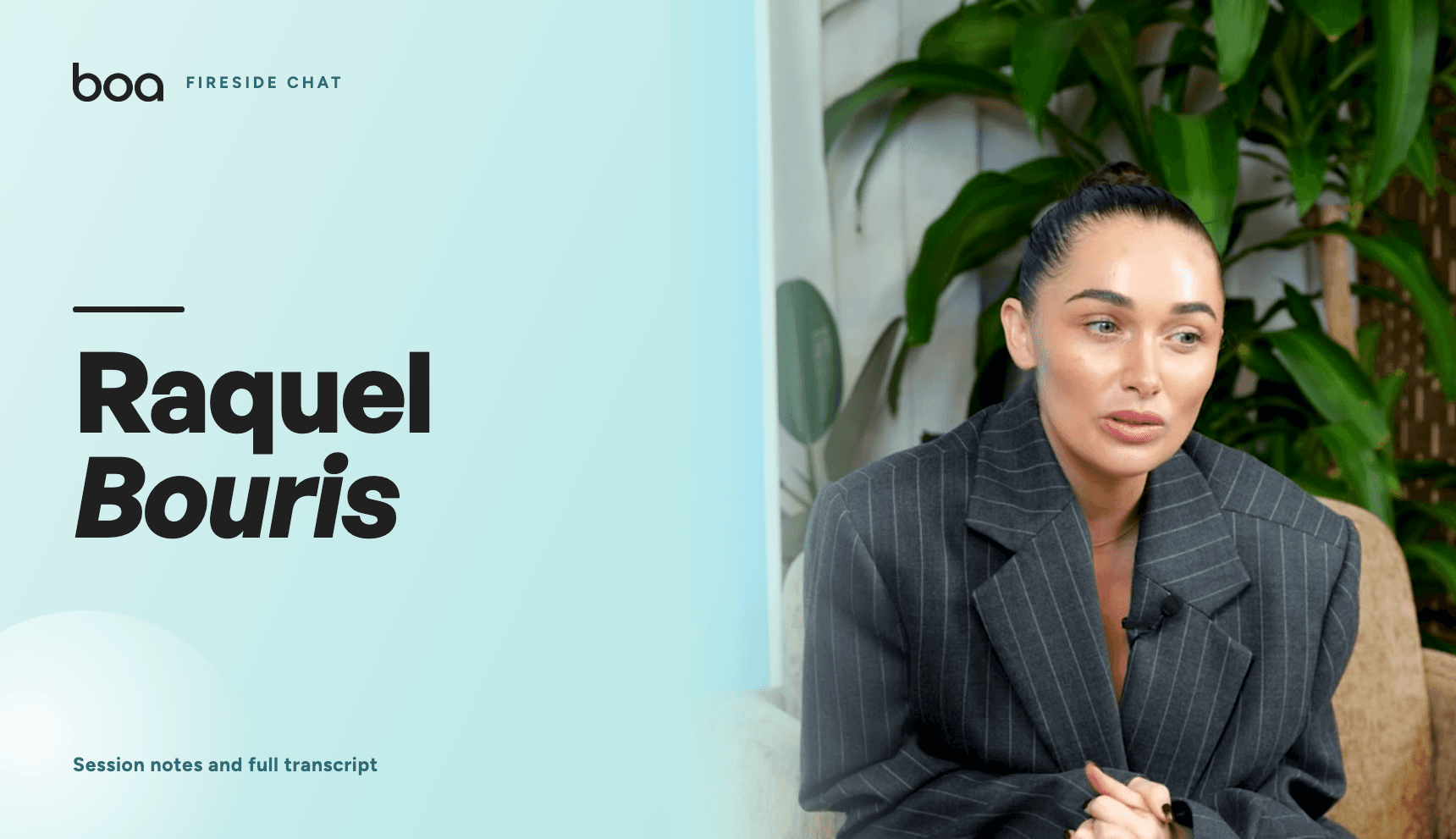
Raquel Bouris on Guerrilla Marketing for Who Is Elijah
With Raquel Bouris, Founder at Who Is Elijah · Hosted by Boa host · 46 min
What this session covers
Who Is Elijah founder Raquel Bouris explains how a no-budget brand cut through a saturated fragrance market: raw behind-the-scenes content, street activations, cold DMs to buyers, and samples in people's hands. She also names the retail partnerships that set her back and the brand clarity work she wishes she had done on day one.
If a retailer says nobody knows who you are, go and stand out the front of their stores handing out samples until they do.
Key takeaways
- 01
Film the work, then voice over it if the camera scares you
Raquel could not talk to camera in the early years, so she filmed herself filling perfume bottles in her garage and lounge room, then recorded voiceovers explaining what she was doing. That behind-the-scenes footage of moving warehouse to warehouse became what the brand got known for. If you are not confident yet, shoot first and narrate later, then let practice build the on-camera confidence.
- 02
Turn a retailer rejection into a sampling stunt out the front of their stores
Boots rejected Who Is Elijah with the line "you've got no brand awareness here, no one knows who you are". Raquel booked a flight five days later, took 500 discovery sets and her content girl, and stood out the front of three Boots locations handing samples to customers going in and out. She asked each person to go inside and ask staff if they stocked Who Is Elijah. Nine months later Boots emailed and agreed to stock the brand.
- 03
Use RocketReach to get buyer emails and post samples until they answer
Raquel calls getting a retailer's attention the easy part. Take out a RocketReach membership, pull the buyer's email and office address, post them samples and keep emailing until they reply. She also landed David Jones at about 18 months in by DMing their fragrance buyer on LinkedIn.
- 04
Check brand alignment before you sign, because a big order can cost you a better retailer
Raquel accepted a nearly $2 million order from Priceline. Sephora then pulled Who Is Elijah from almost all of its stores, and it took a couple of years to repair. She is now number four best-selling fragrance in Sephora Australia and New Zealand, and believes she would already be in Sephora US if she had stuck to Sephora and David Jones. Being in Boots also made other UK retailers say "you're a Boots brand, we don't want you".
- 05
Write a one-sentence answer to "who is your brand" before you scale content
When advisor Josh asked Raquel in late December to describe what her brand was, she could not answer, six years in. That gap is why photo shoots looked like they came from different companies. She then paid a branding agency to build a brand deck (brand DNA or brand bible) and now enforces it: everyone internal and external in the Who Is Elijah orbit must talk about the brand and make content only within those rules.
- 06
Run cheap local activations for the content, not the foot traffic
Who Is Elijah paid roughly $2,000 to a Bondi cafe (Harry's Bondi) to cover a set number of free coffees, handed out with a sample and a voucher. Raquel's point is that the in-person reach is not the return. The filmed content is, and you control how big the activation looks on camera versus how small it was in the flesh.
- 07
Build an ambassador program instead of paying influencers
Raquel never pays influencers and thinks it is a waste of money. She gifts to micro and nano creators, and is now copying US clothing brand Komfort, which she says pulls something like 6,000 pieces of user-generated content a week from an ambassador program with no paid influencers. This is the thing she wishes she had set up on day one, rather than gifting to big names and hoping.
- 08
Judge celebrity moments on revenue, not press
A paid creator TikTok tagging Sofia Richie led to Sofia commenting that she had ordered. Raquel flew from London to LA, hand-delivered the fragrance to security, and was invited to dinner at Sofia's house that same day. It generated press and a few investor meetings, but no meaningful money. Everyday people talking about the product is what actually moves the needle.
- 09
Compete on being different, because the content market is not saturated
Every perfume brand does the same aesthetic flat lays and topless celebrity ads. Raquel could not afford that, so she did the opposite: guerrilla stunts, street sampling, and next week, spraying brand new hoodies and t-shirts with the fragrance, wheeling silver racks around the city and filming people taking a garment and a sample. Her test from advisor Josh: if you are not pissing some people off, you are not doing it differently enough.
- 10
Raise your price by upgrading what customers can see
Who Is Elijah launched at $99 and now sells at around $180, close to double. Raquel funded that by reinvesting as money came in: better packaging (four iterations so far) and better photography. Because the category does not need customer education, the premium positioning had to be proved visually and then the price followed.
- 11
Do not let the founder leg carry the whole chair
Raquel describes the brand as a four-legged chair where the Raquel leg is very strong and the others are weak. If you go hard on founder-led content early, do triple the work on the other pillars so they eventually outweigh it. For Who Is Elijah those pillars include campaigns, ads and retail, which is about 50% of the business.
- 12
Get product physically into hands, in the smallest cost-effective format you can make
Raquel's constant is "I need to get my product into people's hands". The 2ml sample makes this cheap for fragrance, and she told a candle founder to work out the smallest viable sample size to do the same. She also told a new men's brand founder to film the journey from day one and build a strong UGC library before spending on Facebook ads.
How the session runs
- 0:00Seven years in, from garage side hustle to global
- 2:15Becoming the face of the brand by accident
- 4:18Starting with raw behind-the-scenes content
- 7:03Making BTS more premium as the brand grows
- 9:41The Boots sampling stunt in London
- 11:40Flying to LA for Sofia Richie
- 13:14Why she never pays influencers
- 16:43No budget as a marketing strategy
- 20:25Cut through by pissing some people off
- 22:58Biggest lesson: brand consistency and the brand bible
- 25:56Q&A: getting into David Jones and big retailers
- 27:34The Priceline order that cost her Sephora
- 28:47Why people buy from people
- 33:15Finding your why and the four-legged chair
- 40:44Pricing from $99 to $180 and premium packaging
- 42:13Founder page or brand page for founder-led content
Mentioned in this session
- Who Is Elijah
- Boots
- David Jones
- Sephora
- Priceline
- Sofia Richie
- Komfort
- RocketReach
- TikTok
- Harry's Bondi
- Bondi
- London
- Los Angeles
- British Airways
- Thom Browne
- Anthropologie
- Anna Wintour
- Chris Hemsworth
- Nomad
- Boa
Questions founders ask
Raquel uses RocketReach to find the buyer's email address and office address, posts them samples, and emails until she gets a reply. She landed David Jones at about 18 months in by DMing their fragrance buyer on LinkedIn. When Boots rejected her for lack of brand awareness, she flew to London and sampled outside three of their stores, and they came back nine months later.
Raquel says no, and she learned it the hard way. A nearly $2 million Priceline order led Sephora to pull Who Is Elijah from almost all of its stores, and it took a couple of years to repair the relationship. In the UK, being a Boots brand made other retailers refuse her. Her advice is to check brand alignment against where you want to be positioned, because going backwards is hard.
Raquel never pays influencers and considers it a waste of money. She gifts to micro and nano creators instead, and is building an ambassador program modelled on US brand Komfort, which she says generates around 6,000 pieces of user-generated content a week. Even a Sofia Richie moment brought press and investor meetings but no real revenue.
Film the work first and add a voiceover afterwards. Raquel did exactly that for years, showing herself filling perfume bottles and moving between warehouses without ever speaking to camera. She says it is much easier to explain what you are doing when you are not looking down a lens, and that practice builds the confidence over time.
Raquel does a bit of both, keeping most personal material on her own page and sharing anything that clearly involves the brand, like the branded Who Is Elijah taxi activation in London. Decide what level of content belongs on each. She also warns against becoming too founder-led, and suggests building other brand pillars such as campaigns, ads and retail so they eventually outweigh the founder content.
Full transcript
The complete conversation, as recorded, with every speaker attributed.
Boa host0:00
Do you want to just give us all a bit of a, just a very quick overview to kind of who is Elijah, like where you are at this point as a business and how long you've been in business?
Raquel Bouris0:11
So we will celebrate our 7th birthday in October, so almost 7 years, which is crazy. The first 2 years though, this was my side hustle. I still had a full-time job. I was in the garage, so I don't really count the first 2 years as proper business, but you know, it's been 7 years since we launched. Currently, we just moved to London. I just moved straight back because Australia is the best place to live and I'm never leaving again. But we are, you know, we're a global brand now. We, Australia is still our biggest market. We are launching into Europe next year. So I think Australia will very soon not be our biggest market, which I'm kind of excited about because it's, I love Australia.
Boa host0:55
Yeah.
Raquel Bouris0:56
You know, it's such a big world out there. And then we're going to go after US 2027. So then I feel like that's when I feel like I'm not a global brand, but everyone calls us a global brand. I think just because it feels so— just, we feel so Australia still, which is nice.
Boa host1:12
Well, when you're in the journey, do you— like, you've obviously achieved like so much already and in a very short period of time. Does it always feel like you're not where you want to be? Like, from the outside it might be like, wow, I know, you know, but do you always feel like, oh, I'm not exactly where I want to be?
Raquel Bouris1:30
Um, yeah, I do, I do feel 7 years in, I feel like a lot— we've made a lot of mistakes over the years, and it's actually a lot of what we're talking about today, um, for marketing and branding. I think that we should be a lot further ahead. Um, not a lot further ahead, but I do think that if I, if I could go back and do a lot of what we're going to talk about today differently, um, we would, we would be everywhere now, and I think we would be Yeah, maybe I've been bought out by now. I'm not sure.
Boa host1:59
I think that's a very important point because if that's what you're feeling in your business, that is probably forever what you're going to be feeling in your business. But let's get into personal branding. So what does being the face of your brand actually mean to you?
Raquel Bouris2:15
Well, for us, it wasn't a plan to answer your question before. It wasn't the plan at the beginning. I didn't even know what a personal brand was when I started Who Is Elijah. And it was almost like I wanted to, you know, Who Is Elijah is quite a mysterious name, no one knows who it is, it's not really anybody. So I sort of lent into that at the beginning. Um, I didn't have the confidence that I had now. If you asked me to do this 3, 4 years ago, I would have said no way. Um, I kind of forced myself to get confident in speaking in front of people and being the face of the brand. Again, it was an organic thing, it wasn't a plan. Um, but I don't— but I think what me being the face of Hills Elijah has done is really humanise the brand, and that is when we started to grow fast was when I started being the face of the brand and, you know, doing the content. And, you know, I think a lot of our— a lot of people buy our perfume that I see comments online. They buy it because they've seen my TikTok or my Instagram. And when I started, I didn't have a big following. I still don't have a big following now, but I think it's, you know, people buy from people. They don't always want to buy just a product.
Boa host3:18
But how did you overcome that kind of fear? Or, you know, I'm sure it's I mean, I haven't overcome it because I haven't really pushed a personal brand. But how did you overcome that fear of like putting yourself out there and being that face?
Raquel Bouris3:35
I hate giving this answer because it sounds so superficial, but I got veneers. I hated my teeth. I think we've spoken about this before. I didn't— I had— I just hated my teeth and it was my biggest insecurity. And like my wedding photos, I like looked like the most unhappiest bride on the planet because I won't smile because I didn't want to show my teeth. But that was something that I did for me that boosted my confidence instantly and it honestly, I changed overnight.
Boa host4:01
So do you have the dentist favorite? I'm kidding. No, no. But so when, let's go into getting started. What was the first thing you did to start building your personal brand? So you don't have a personal brand. Who is Elijah? Is there, how did you actually start building your, putting yourself as the face and building your brand?
Raquel Bouris4:18
Yeah. Content. So I started learning how to do, um, or not me personally doing content, I'm still bad at doing content, but working with people like content creators like Bella behind me right now, or in front of me right now, working with content creators to help make content of me with the perfume, talking about Who Is Elijah, and just telling, like showing the BTS actually was a pivotal moment on Who Is Elijah like 4 or 5 years ago now, showing them, showing people filling our perfume bottles, 'cause we literally like, I would buy the perfume in bottles and fill it in my garage and my lounge room. And I started showing that and then showing the journey from moving to warehouse to warehouse. So we just showed like the raw, unfiltered BTS of who was Elijah, me. Then I started doing guerrilla marketing activities and then just really showing all those crazy things. And we just, we don't look like the other perfume brands. We don't do things like the other perfume brands. Um, I just started showing everything that I was doing because I didn't have a big marketing budget. So we were doing stuff that was, you know, very raw and didn't cost a lot of money, or, you know, sometimes no money. But, you know, they're like those viral moments that got people's attention.
Boa host5:28
And— but I like the idea of, you know, you've got this beautiful product, this beautiful perfume, but people don't get to see what actually goes into that product being there. So Are you saying that when you start, like, one of the first successes you had in building traction online with personal branding is showing the behind the scenes of what it took you, like, what you were doing on a daily basis to actually get that perfume out?
Raquel Bouris5:54
Yeah, like, we were like literally showing me, like, filling perfume bottles. And, you know, back then I wasn't confident enough to talk on camera, so I would just do like a, you know, a nice video and then just do voiceovers and explaining what we were doing. I think that's a good place to start if you're not too confident yet. Just film the content and then just do voiceovers because it's so much easier to you know, say what you're doing when you're not actually talking to the camera. Yeah. And practise makes perfect as well. But yeah, definitely. I think that's what we got known for, was showing the BTS of who was Elijah. Like we were that, that made-in-the-garage success storey of Australia. I'm trying to move past that now to make it a little bit more luxe. But, you know, it got it. That got us to where we are today. And now we're at this new, this new level of going in this new way, direction into like a new level of where we wanna be seen, like sort of like luxury brand.
Boa host6:45
And that's, I guess, a natural cycle. Like at the start when you're small and you're starting out, you show the behind the scenes just, I guess, to win people over, to cheer for you while you're on this journey. But as you become more established and more of a premium brand, you wanna show that as well in your content. So now is your content changing?
Raquel Bouris7:03
Yeah, we still show behind the scenes, but where it's also a much nicer behind the scenes now. We're not in the garage, we have a nice office, but you know, we do a lot of travel now. So we're still doing this, we still do the same, but it's, it's a little bit more premium, like you said.
Boa host7:20
Yeah. And so you've got your husband Adam who works in the business with you as well. Um, how did you balance your time between content and personal branding and marketing? Or really content, personal branding, with, um, product development and, you know, business, the more boring business stuff. How did you split that?
Raquel Bouris7:43
Well, Adam, when Adam joined about 4 years ago now, I was doing everything— finance, creative, like literally everything. Then Adam joined and started to take over. So now he— I don't really deal with anything in business operations anymore, which is very good, um, but Product development, look, we're only doing 2 fragrances a year. I've already created fragrances for the next 2 years because I get really excited and we'll just— it's, it's not, we don't, it's not the hardest product to make. So I think I'm maybe not the best person to ask about product only because I feel like it's not a hard part of the business. Now my hardest part is probably making enough content, but also getting stuck in, like, I spoke to my team yesterday about the Who Is Elijah content, and it's starting to feel a little bit too aesthetic, and I don't like it when it's too aesthetic. I want it— I want, I want us to, like, go out on the streets. We're about to do this, um, thing next week. It's actually a really cool idea. I'll quickly tell it. So we bought a bunch of hoodies and t-shirts, and we're gonna, like, spray them in Who Is Elijah fragrances and walk around the city with, like, silver racks, and we're going to put one at a time and encourage people to come up and take, take the piece of clothing, it's brand new, so it's not used. Take the piece of clothing and a fragrance sample and film it. Like, can you picture how cool that's gonna look? So I'm kind of like push my team to like think outside the box. I don't wanna see just the pretty content that everyone else is doing. I think that's a big thing. It's like, don't waste time. I just feel like it's lazy, like doing aesthetic flat lays.
Boa host9:15
And well, I guess one of the things you're known for, and it's something that everybody here today could do, one of the things you're known for is doing the opposite to what the big established perfume brands do, which is more aesthetic. Chris Hemsworth standing there topless, spraying, you know, whatever. That actually worked on me.
Raquel Bouris9:32
That way. But you need that stuff as well.
Boa host9:35
The celebrities and that type of thing. You went, fuck that, we're not doing that. We're going more guerrilla style.
Raquel Bouris9:41
Yeah.
Boa host9:41
And you've done a lot of these campaigns and I'd love to just hear more. Like, that's the one you're doing next week is one of them. But I saw you in London standing at the front of retail, one retailer, I don't know what it is, you know, literally giving people perfumes and asking them questions and recording it. Can you, can you tell us, use that as an example as to one of the ways that you not just created great content and marketing, but that you got the attention of a major retailer in England?
Raquel Bouris10:08
So it was Boots. So Boots rejected us like 2 years ago, and their reasoning was, um, you've got no brand awareness here, no one knows who you are., and I woke up and it was 4:00 AM and I just said, fuck it. I texted my husband, he was at the gym. I'm like, I'm going to London. So I flew to London like 5 days later and had 500 of our discovery sets that has all the samples in it. And I stood out and I took my content girl with me and I stood out the front of 3 Boots locations. I like their nice locations and I handed out samples to all their customers going in and out of the store. And I was telling people, can you please go ask the Boots staff, do you stock Hills Elijah? Anyway, it got their attention. 9 months later I got an email from them and they decided to stock us. We're actually just about to exit them because it's not the right partner. All that for nothing. But it is such a cool way. What's that thing that I say? It's not rejection, it's redirection. So I'm like, if someone says they don't know you, fuck you, I'm going to fucking make you know me and I'm going to get on a plane. I'm going to stand out the front of your store and I'm going to give samples to everyone. And I think if I did that to every retailer, I'd probably get them.
Boa host11:14
Yeah. But I think that's a Fantastic example of almost free marketing. Yeah. And, and you got great content. I mean, the flights you had to pay for, but it was almost free marketing. And that, that also, you know, you got the attention of the retailer that you're trying to target, which, you know, so many, like, I just think that's a directly replicable marketing tactic that a lot of people could use.
Raquel Bouris11:38
Oh, the Sophia Richie storey is a good one.
Boa host11:40
Why don't you share that?
Raquel Bouris11:41
Yeah. So this one was at maybe 8 weeks ago when I was living in London and I, we met, we paid a content creator to make a TikTok saying about our fragrance Nomad. And we always say if Nomad was a person, it would be Sofia Richie, just like very like quiet luxury Sofia Richie vibe. And we made this TikTok and tagged her and her agent saw it and sent it to Sofia. Sofia commented on the video, "I just purchased," or "I just ordered." And I saw it in the morning and it was Saturday morning. So I was living in London, so I just said, again, fuck it, sorry husband, I'm gonna leave you again. I jumped on a plane 4 hours later, flew to LA, and I, that was, by the time I got there, it was Sunday. I hand-delivered her fragrance to her Monday morning LA time. And I then, I left, I gave it to security, nothing happened, it was all good. And then I was at the airport that afternoon to fly back to London, and I get a call from her agent saying, hey, Sofia wants to take you to dinner. So I got British Airways to take my bags off the plane, and I ran out of the airport like a crazy lady, and I went to dinner at Sofia Richie's house. House.
Boa host12:48
Um, and yeah, it was just so cool, all from guerrilla marketing, all from relatively free marketing. And, and so looking back, and you, when you were launching Who Is Elijah, you didn't have a big budget, um, so you weren't spending lots of money on ads and marketing. Um, what, what, what, what worked and what didn't work in the early days of, in regards to marketing for Who Is Elijah? What worked the best and what didn't work that you would avoid next time if you were to redo?
Raquel Bouris13:14
Yeah, uh, we were late to marketing, but if I'm talking about when we started marketing, which was probably like honestly like year 3, which sounds so silly. Um, back then, so what's that, that's like 4-ish years ago, like gifting, influencer gifting, but more like the, the micros or the nanos, what do you call them, micros, like the smaller ones. Yeah, the smaller ones. Even today, like, we don't really gift to big influencers. I never pay influencers. I think it's a waste of money.
Boa host13:42
Um, do you send products to existing clients to try so that they can post? Or so when you say micro influencers, do you mean clients of yours, everyday people, or do you mean like content creators, people that want to create content?
Raquel Bouris13:56
Content. But there's actually— I'm, I'm like about to go study this brand. It's called Komfort. Have you heard of Komfort? Everyone— don't— you don't even need to listen to me. I know nothing compared to these people. Komfort, it's called. It's like without the O at the end. They, um, they are only gifting to— they have like an amazing ambassador program, which is something that we're about to set up. So it's inviting people into their community. I guess they're assuming that they're gifting them the product and they are getting 6,000 pieces of content a week or something crazy like that from user-generated content from their ambassador program. No influencers, just like UGC people.
Boa host14:34
Wow. Okay. So the brand's called Comfort. What's— what's— what do they sell?
Raquel Bouris14:38
So comfy clothes. It's an American brand. They're doing like, what is it? Like hundreds of million US dollars a month. Like it's insane.
Boa host14:45
Oh wow, okay.
Raquel Bouris14:46
And so I'm like starting to study his, how he set everything up. And then we just want to go and replicate it. 'Cause I think if this is probably, I'm jumping ahead here, but that is something that I wish we had done day one. I think we were just too heavily reliant on gifting to influencers and hoping for the best.
Boa host15:05
And— So say that again. So what would you do if you were to restart today? What would you, what would you have implemented?
Raquel Bouris15:12
Um, like an ambassador programme and getting the everyday people to try our products, talk about our products online, and obviously word of mouth. Um, because, and you know, we're, we're selling a scent, so we're not selling a t-shirt, so it's even harder. Um, so we, you know, we need people to talk about the smell. And yes, we've had some big celebrity moments, but that none of them have made us a lot of money or like moved the needle that much. Like the Sofia Richie thing was awesome. We made no money out of that. We got a lot of press, got a few investor meetings, but nothing like—
Boa host15:48
it didn't move the needle financially. And you're saying, so what are the things that move the needle most for you financially?
Raquel Bouris15:55
Is honestly like the everyday people just talking about who is Elijah. And, you know, you need volume of content. You need volume of good content. And just, you know, um, putting it through the ad account, like, the content gets old so quickly. So I think just having like mass— not mass, you want, you want quality and quantity in terms of content.
Boa host16:18
Yeah. Um, now one of the things we mentioned before is that you market Who Is Elijah very differently to the other premium perfume brands, um, who are very traditional in their marketing. How did you can you walk us through how you actually analysed the premium perfume space and how you decided to, to be, to be different, to go in the complete other direction to what the others were doing?
Raquel Bouris16:43
I don't think it was a strategic thing. It was a I have no money thing, which is sometimes strategic, which is sometimes strategic. I mean, there was no way for me to compete in that sense with them. So I've just always had in my mind I need and I want to get my product into people's hands.. And you know, the best way to do that is getting out in the wild and, you know, showing up, putting my face out there, putting the product out there. I hated it at the start. You know, I used to be quite shy, but, you know, bringing people along with me to help, you know, give me the confidence and energy to, you know, hit the streets in Bondi and hand out samples and, you know, collaborating with, you know, a cafe or, you know, I think we've done it at Harry's Bondi a couple of times. Doing like collaboration. I think it costs about $2,000. We just pay for X amount of coffees to give out free coffees and give out like a free Who Was Elijah sample, a voucher. Like those sort of activations look really good. I'm always looking at what people are doing in like LA and London. I feel like there's some really cool like guerrilla style marketing activities that get done there. Some with a massive budget, some without. But yeah, I feel like looking outside of what people are doing in Australia, I get a lot of inspiration from.
Boa host17:53
Yeah, I feel like you really are the activation queen. Now that I think about it, because And like, you know, even we have like thought of doing activations even with Boa before. We haven't, we should be doing them. But sometimes you're like, oh, but really how many people are you gonna reach partnering with a coworking space or a cafe? But really it's not just about the people you reach on that day. Yeah. It's about the content you create from that day. Mm-hmm. And, and what that content then reaches. Mm-hmm. Like, so you can't just think, you know, this is too small to be an activation. It's not the point. You're doing the activation, you're, you're meeting, mm-hmm. You, like you said, I need to get my product in people's hands. Mm-hmm. And you've got a great product. So that works very well. But it's the marketing that then comes from that whole process, the content, sorry, that comes from that whole process that obviously gets out there and drives sales. Yeah.
Raquel Bouris18:39
And you, you know, you're, you know, we talk about Who Is Elijah is creating like the Who Is Elijah world and we want the Who Is Elijah to look and feel because it is so cool and you want people to like want to be in that world. And I think doing the activations, even if it looks in person, it's so small, you know, when you're filming the content, you can make it look so much bigger, you know? So you do have control control over what the masses see versus what the people there in the flesh see.
Boa host19:05
And guys, if you have any questions that you'd like to ask Raquel at the end, because we're coming to questions soon, if you have any questions to ask, personalised advice on your business or just ideas, put them in the chat because we will call you out. Now at the start too, you don't have a big budget for marketing, so you've got to choose, you know, ideally choose the best thing to do. How did you actually test what worked and what didn't work?
Raquel Bouris19:30
I think, you know, pretty quickly if something hasn't worked, but then something— sometimes something works, but then you do it again and it doesn't work. And it's so frustrating because you're like, why? It works last time. I think it's like there's no— there's no answer that someone can give you that, you know, is going to be correct every time. But I just think trial and error, unfortunately, is the best way to figure out what works. I like trying new things. I don't like to let things get redone over and over and over again. But if it still works, I mean, of course. Um, but I think it's just a trial and error, and it's the most— it's the hardest question to sort of answer because there's— yeah, there's just no right.
Boa host20:12
And now, social media is very noisy, right? There's a lot of stuff out there. You've cut through that noise. So what advice do you have to create content or marketing that does cut through the noise on social media?
Raquel Bouris20:25
To be different. And I think like you make it sound so simple when we talk about who is allergic. It's like I literally just did the complete opposite of what every other perfume brand was doing. It wasn't strategic, it was just, again, it was the budget telling me I couldn't do it their way, so I'm going to do it my way. But, you know, maybe there's something there in that, um, you know, just, I think just be different. And you don't want to— there's so many— every market is saturated, um, and that's kind of annoying when people always say that, but the market's so saturated. But I think The content market isn't saturated. Like I see every perfume brand doing the same thing. I see every swimwear brand doing the same thing, XYZ. I just think just be different and be like, if you're not pissing off a lot of people, then you're not doing it different enough.
Boa host21:08
Yeah, that's true. And when you say pissing off a lot of people though, what do you mean by that? Is it that people then you get a bit of hate online because you're kind of putting yourself out there or what do you mean by that?
Raquel Bouris21:19
Yeah, so we, Adam freaked, my husband Adam freaked out yesterday 'cause Bella and I did a photo shoot recently recently, and it was a little risqué, every— a little bit. So every, every— TikTok was fine, Instagram was fine, but, um, our community on Facebook absolutely hated it. Um, but, and, you know, Josh—
Boa host21:37
interesting.
Raquel Bouris21:38
Yeah, Josh, our, um, my— one of my advisors that we work with, um, you should actually get Josh on here. He's like the king of, king of branding. I learned a lot from him. Um, he, he said to— he's like, don't worry if you're, if you're not getting hate, you're not pissing off some people, then you're not doing your job good enough. So I think I used to get so scared when I'd see like a negative comment or, you know, I would go, I used to feel like I needed to change my whole business because of one person's negative feedback. But now it's like, can't please everybody. Yeah.
Boa host22:09
And what built that resilience? Is it just doing it? Like, is it just experience?
Raquel Bouris22:14
I think it's just experience. And I think it's, you know, listening to people that are more experienced than me just saying, you know, like this is, this is a good thing, you know, gets your engagement up. It's like, it's so bad how we think these days. But yeah, I don't know, just it started working. So I was like, well, I must be doing something right.
Boa host22:31
Yeah, but that's true. It boosts your engagement online, which furthers the reach of the content.
Raquel Bouris22:36
Yeah, free marketing.
Boa host22:36
Yeah, the more wild it is, the more, the more, the more marketing you get.
Raquel Bouris22:40
Yeah.
Boa host22:41
Now my final 2 questions. The first is what's your biggest lesson learned in marketing for your business? And the second, just to give you context, is what is, what has been your biggest lesson learned in personal branding? So let's start with the first. So what's your biggest lesson learned in terms of marketing your business?
Raquel Bouris22:58
This is one that we've learned this year. So the first 6 months of this year have been probably the hardest 6 months of the Who Was Elijah journey, just because it's been a year of learning. So we, what we haven't been good at, and this is the lesson, is being so consistent with our brand messaging and who we are. We've been a little bit all over the place. You know, 7 years of trying, or 6 years trying to find out who we actually are. And Josh, who I just mentioned earlier, so we started working with him in January. And he has really, he's worked with Anna Wintour, you know, the who's who of the branding world, fashion world. He was CEO of Thom Browne, CEO of Anthropologie. So he's got a great resume. But he just sat down with me in late December, he said, 'So who is Elijah? Like, tell me what your brand is.' And I'm like, I didn't, I didn't know how to answer. Like, I didn't know. And, um, I, I was such a shock that I didn't know how to answer. Like, I, I am who is Elijah, but I still didn't know who we were, and I didn't know how to put that into a sentence. So if you don't know that answer to who you are, how do you have a consistent brand message? And I look back at everything that we've done over the years and you know, we do one photo shoot that's like this and another photo shoot that looks like, you know, a completely different company, and we haven't been consistent. So now I'm like so strict on consistency. And even now, like, um, yeah, just— I think just not being consistent and not knowing who the fuck who was Elijah is.
Boa host24:32
Yeah, yeah, no, totally. Yeah. And, and what about in terms of personal branding? And just to reiterate, sorry, the main—
Raquel Bouris24:39
I guess the main lesson learned in terms of marketing your business is having a one-sentence answer for who And maybe it's not a one sentence answer, but you know, we just worked with a branding agency to create like our brand deck, our brand DNA, brand Bible. There's so many different names for it. And it did cost a lot of money. I wish I did it sooner, but we wouldn't have been able to do it sooner. I also think, you know, that a lot of it can be done without paying a lot of money as well. So I'm not saying don't go and spend all the money. I'm happy to share the deck, the final deck with everyone so you can get a visual. Yeah, happy to share it with everyone.
Boa host25:17
So in terms of personal branding, the greatest lesson or piece of advice?
Raquel Bouris25:21
Start earlier. Just start. Yeah, I don't think I, I don't think I have a lesson. I just think I just wish I did it sooner.
Boa host25:27
Thank you so much for this, guys. We're going to move to Q&A now. I've got a few questions here. I wanted to start with one. It's not the first one, but I think it's a really important one. We didn't touch on this topic today, but saying you're a master at— Josephine, do you want to ask your question about getting into retailers? I'll give you— you there, Josephine? Yes. Yep, there you are.
Raquel Bouris25:56
Hello.
Boa host25:57
Hi.
Raquel Bouris25:58
Yeah, thank you so much for the meeting. Yeah, I have written lots of notes, so it's a really good one. Um, just want to ask, you know, when you collab with, you know, the big big retailers, shops like David Jones.
Boa host26:15
Yeah.
Raquel Bouris26:16
What stage in your business, and is there a specific strategy you approach with them? And, you know, it's, it's really challenging that you approach them.
Boa host26:27
So how did you collab with them, and are they looking for you, or you went to them?
Raquel Bouris26:34
Yeah, um, with David Jones, we partnered with them quite early on we were about 18 months in. I, I do think I, I chased after them, so I DM'd their fragrance buyer on LinkedIn, and they have actually been amazing to work with. Um, but now we now get people chasing after us. And with retail, I've made a lot of mistakes in retail. I've partnered with the wrong retailers, like Boots, for example. Um, it was amazing, the cool gorilla, uh, thing that I did to get their attention was really cool, um, but it was the wrong retailer. So I'd say I'd be very, making sure the brand alignment with the retailer is like good and like where you wanna be, 'cause it's hard to go backwards. Like we, I stupidly partnered with Priceline a couple years ago. They gave me nearly $2 million order. Of course I wasn't gonna say no to that, but that really affected our partnership with Sephora Australia. We're only now just fixing that. It took a couple years, so.
Boa host27:34
And can you explain that? Is that because one is a, high-end brand and the other one's a discount.
Raquel Bouris27:39
So Sephora kicked us out of almost all of their stores when I went into Priceline. If I had stuck with Sephora and just did Sephora and David Jones and not done Priceline, we'd be— we're like number 4 best-selling fragrance of Sephora Australia, New Zealand at the moment. If I was that 2 years ago, I would have already launched in Sephora US. So taking that, signing the deal with the devil— and I love Priceline, I'm not saying anything bad, it's just the brand alignment is— it was not right. Yeah, I'd be much— these things that don't seem like such big mistakes really have affected me now. And I made these mistakes 2, 3 years ago.
Boa host28:16
And but so your advice in terms of getting into the big retailers and getting their attention, how, what advice do you have?
Raquel Bouris28:23
That's the easy part. RocketReach. So has everyone heard of RocketReach? Get a membership with RocketReach online and you can get anyone, any buyer's email address. You get their office address. Send them samples, email them until you get, um, you, you hear back from them. That's what I've done with pretty much everyone, and it works amazing.
Boa host28:43
Um, Ben, do you want to ask your question?
Raquel Bouris28:46
Thank you.
Boa host28:47
Thank you, Josephine. Thanks for today, guys. I thought this might be a bit general, but when you say, um, people want to buy from people, is that just them seeing you as an expert, or is it a bit of an emotional thing? Like, you're editing certain videos to elicit certain responses from people, or is it just they've seen you enough, enough of your content to be like, I know, I know Raquel, I trust her for a good reason?
Raquel Bouris29:15
Yeah, I think it's, um, it's definitely like an emotional thing. And, um, like, people, people buy from people. I think like when they, when they— where humans are very emotional creatures, and I think, you know, people, they've seen the hustle of me working, like being pregnant and filling perfume bottles, and they've followed me through this journey. And, and it's not about tricking people. Like, everything I've shown is honest. I'm not trying to trick people. I think being honest is key. But, you know, I think people, people do get attached to a brand story. Like, I, you know, we're all consumers ourselves. I'm much more likely to buy something if I have heard a, you know, a cool storey about the brand or they've done something really cool. Or it doesn't necessarily always have to be the founder, but I think You know, you see a lot of brands showing their team and like this, like the team become like, like the character of the brand. And I think it's just, it's just humanising a product.
Boa host30:15
It's like getting to know the people behind the business.
Raquel Bouris30:18
Yeah.
Boa host30:20
Thanks, Ben. Pam? Thank you. Pam, if you're not there, we can go to Steph Rose.
Raquel Bouris30:32
Hiya, my question was actually quite similar to what you touched a little bit earlier around how you knew that Boots, and not specifically Boots, but how you get to a point that you realise that your partner is not the right partner. And you did kind of touch that around your brand alignment. So I suppose to change the question slightly, how have you, like, as Who Is Elijah has evolved and you've grown and you've obviously been like hustling for or any kind of contract or revenue. How have you stayed true to the definition of what your brand is? And has there been any practical tool or advice that you've used to really help you refer back to and kind of cut out the noise? Honestly, this has only happened for me this year. We have only just stopped making mistakes at the end of last year. So we signed the contract with Boots last year and we launched with them. And I moved to London 'cause I wanted to be on the ground and doing the Raquel guerrilla marketing style things., and I, everyone, all the other retailers just said, no, you're a Boots brand, like, we don't want you. So that was obviously like a big realization, like, I really fucked up here. Um, so luckily Boots is letting us out of the contract sort of unscathed. Um, but I think again, if I, like, when Josh asked me in December, who are you, who is Elijah, me not knowing that for the past 5 years has made me say yes to. I've been chasing revenue and saying yes to every deal that comes up that's lucrative or whatever. And I wish that I hadn't. So I think this understanding who you are in the brand and where you want to be positioned and just not, don't get, what's the—
Boa host32:15
Don't fall for the hype.
Raquel Bouris32:15
Don't get distracted. Yeah, don't get distracted. Just like keep that tunnel vision because it set me back so much.
Boa host32:23
And I also think it's good putting on the record too that it's amazing that Boots Boots did let you out and like it shows how supportive they are to their team.
Raquel Bouris32:29
Yeah, because we'll want, when we sell to investors one day, investors will want to go back to Boots. And yes, I think, and that's another thing that I've learned lately. If you know, I think everyone builds their company to sell and you know, you want to leave some growth on the table for when those investors come and buy you. So Boots is a big one.
Boa host32:48
Mm-hmm. Bakari. Thanks, Steph.
Raquel Bouris32:54
I think you're on mute, Bakari.
Boa host32:56
Oh, there I am. Yeah, I was on mute. All right. I actually had two questions for you, if you don't mind. Sure. The first one was, given that people say people don't buy what you do, they buy why you do it. So how did you discover your why? And then how did you convey that to your audience?
Raquel Bouris33:15
So we've had a few different whys over the years. So when it started, I didn't know how, I didn't know what I was doing, but I didn't know why I needed to show that, but I was just naturally showing it. So our why was I wanted to disrupt the fragrance industry. I started showing the BTS of everything that we were doing, and this is obviously changing a lot over the years. Now we have like defined our why through the first 6 months of this year. We've been doing like a branding boot camp, I guess you could call it, and we're about to really change up how we do our messaging across content. So we're looking at, okay, so we've got our campaigns up here all the way down to how do we, how do our UGC creators talk about us? How do we talk about us online? Like every brand touchpoint, we're actually in the middle of sorting that out now. And I, you know, it's a big job, but I think it's, again, it's referring to this brand Bible that we have just built. Everyone that works within the Who Is Elijah Orbit, whether it's internal, external, it's like they have to follow these rules of our brand and only allowed to talk about us in this way, do content for us this way. Way and just make sure, making sure every message that is created or conveyed by anyone in our orbit follows our guidelines.
Boa host34:33
So is the why at the base of that?
Raquel Bouris34:35
Yeah, so the why, the why is in this deck. Um, it depends on like the internal why is obviously different to the external why. Um, like I'm not asking other people to convey my founder why, I guess. So there's me conveying my why and then there's like the who is like who the Who is Elijah? So there's a— because we're trying to also— we didn't get to talk about this, but we don't want Who is Elijah to be so reliant on just me either. So we're trying to get Who is Elijah to stand on its own. So we talk about Who is Elijah as a four-legged chair, and the Raquel leg is very strong, but the other legs are quite— they're quite weak. So we're really focusing on building the brand to stand on its own. It's something that we're learning at the moment. I know that like I'm, I focus on my why as the Raquel founder and getting the team and internal and external partners to know how to convey the why and the, and the who of who is Elijah.
Boa host35:43
That makes sense. That makes sense.
Raquel Bouris35:44
Sorry.
Boa host35:44
I'm an American starting an Australian brand called Look Products, right? Yeah. I've been here for 12 years. Oh wow. And I just wonder if you have any advice for an American trying to start I'm about to start a brand here for Australian guys, for blokes. It's called Bloke Products. Cool. And it's seeming authentic and, you know, I'm not— I am Australian, but I have citizenship. But like, yeah, I wasn't born here. I don't have the accent, you know?
Raquel Bouris36:08
Yeah. Just start filming the journey. Get out there. I only just started TikTok and it's— I'm so upset that I've only just started it. Start filming the journey to start talking about it. Like, focus on your UGC and get a really good library to start your Facebook ads.
Boa host36:23
Brands.
Raquel Bouris36:24
And if you're going to do retail, um, definitely do your research of who the best retailers are. But, um, DM me on Instagram and happy to chat further.
Boa host36:33
Thank you, appreciate it. You're welcome. Chris, do you want to ask your question?
Raquel Bouris36:37
Yes. Hello. Hi, I love your story, love your products, love your brand. Thank you. My question is about— so you mentioned, um, you look overseas to get inspiration of their marketing strategies. Um, I've also got a product that you need to smell. It's, um, refillable candles. So I was wondering, how did you go about that? Do you look online or do you go overseas to do research in person? Oh no, Instagram, TikTok, Pinterest— that we've got the world at our fingertips, which is so good. Um, I do travel, but I don't really travel for inspiration. I more so go travel to go and do what I've already been inspired to do, I think. But, um, I'm, I'm addicted to my phone. I'm on my phone 24/7. Um, I do not know what balance is. Um, but no, I get all of my inspiration just looking online, honestly. And yeah, gifting as well. Gift to people, get your candles in people's hands, obviously. And I would find, like, we're lucky with perfume, we got our little 2ml sample, so it's very easy for us to get a small part of our product into people's hands. I don't know if you can make like smaller, more cost-effective sample sizes to get them in people's hands. I don't know if that is a thing. But yeah, no, look for inspiration online. We're lucky to—
Boa host37:46
And what was the brand that you mentioned you're taking a lot of inspiration from at the moment? Comfort or something?
Raquel Bouris37:51
Oh yeah, look at what Comfort's doing. Honestly, it's like this— their volume that they have, um, grown to is wild.
Boa host37:58
Like, yeah, worth watching.
Raquel Bouris38:00
And, and their content is so simple. That's what— like, I— we spend so much effort on like these big campaigns and it gets no reach, and we do the most simple things and that's what works. And so they're, they're— go on their TikTok and Instagram today and I feel like it'll really inspire you and also show you how easy it is Yeah, you don't have to go over the top. You don't have to be over the top. No.
Boa host38:21
Um, Christian.
Raquel Bouris38:26
Hi.
Boa host38:27
Hi.
Raquel Bouris38:28
Hi, really nice to meet you. I really connect with, um, put your product on people's hands because I got some of your perfumes at a BoA event, and since then I'm a customer. Oh, thank you. I love all the smells, and that was such a smart move, and I can see where you're coming from every time that you say that. I'm just like, okay, Obviously I have a jewellery brand and it's a bit challenging to just give the product away, but we are doing something like small to just give away and just gonna follow that trend. But my question is about like, you have clearly brought a product to market that truly connects with people. And I'm curious on what you look at something new, how do you know it's worth investing in? And in your experience, how much of that success come down from the product itself versus the strength of your branding behind it? I think our, our product is what drove us to where we are today. I, because for the first 2 years I didn't really do any marketing. What got us, you know, those small successes in the beginning was because of the product. Um, now we, now we obviously, we amplify our growth by sort of our content and our marketing efforts, um, but But I do think that your product needs to be amazing for the rest of it to all work because we have, you know, you want repeat purchases. That's what really builds the brand and you want, what's called, that customer loyalty. So I think like you need to have a good product first and foremost and then everything else sort of amplifies the growth. Does that answer it? Yeah, yeah, yeah, yeah. I feel like, yeah, everybody I guess believes that they have a really good product and then you put it to the test and I smell your perfumes and they're like amazing.
Boa host40:15
Amazing.
Raquel Bouris40:16
Um, but yeah, sometimes it's a struggle to break into the market just as a new brand, you know, just bringing a new offering. Like, we are working with like a moissanite stones and people already is like, oh, diamonds and lab diamonds. And we are like, no, moissanite is just something totally different. So is there an educational part to your perfume that you felt like you needed to do to place it in a different, like, a unique proposition? Because I think like maybe that's something that it helps at the beginning.
Boa host40:44
Yeah, how did you position it as premium? Did you have to educate people why it was premium?
Raquel Bouris40:49
Um, we— how we got to premium— we went premium at the start. Um, we, we, we made our packaging premium, and we, we sort of, um, we— what's the word I'm looking for? Like, we went premium at the start. We, we changed what the outside— what everyone saw as we grew. As I got more money, I could get really good packaging, I could afford better photography. So we, we made look and feel more premium, to make it more premium. And we increased our pricing along the way. Look, our perfume isn't like my category. It's not unique. Like, we're not— the smells, it's not like the smells are completely different to other fragrances on the market. So there was no need for like an education. Like, there wasn't any need for education there. Um, but I do know what you're saying is we did have to sort of just prove, prove how premium we were, I guess. And that that, you know, people just accepted along the way. We've done like 4 different iterations of packaging along the way. If I showed you the first box that we had, you wouldn't pay $180 for it now. But we didn't charge that. We charged $99 when I first launched. So we've nearly doubled since I first launched our pricing, but we've increased everything else along the way.
Boa host42:03
And now I want to— we are out of time, so I'm going to ask the last question, but I'm actually going to ask it for Pam because she is here, but she's got a car full of kids, so she couldn't come off mute.
Raquel Bouris42:12
Oh, hi.
Boa host42:13
Oh, there she's back. Hi. You dropped the kids off, did you?
Raquel Bouris42:17
Hi, can you hear me okay? Yeah, how are you? Oh, yeah, good, thank you. So, thank you so much for all the information, Jen. It's really nice to hear all your insights, especially about the retailers. So, my question was about founder-led content and posting that on the actual brand page, like Instagram. My question is, can you—
Boa host42:42
is—
Raquel Bouris42:43
do you advise merging both, or do you recommend keeping the founder page separate? Um, because I found that a bit confusing, to be honest. Um, I'm one of those people that's quite shy anyway at talking to the camera, and I'm, I'm starting off at the moment, so I'm just trying to figure out which way is best. Um, so we do a bit of both. I keep— now I keep a lot of it just for my personal page, um, but anything that's like like we just did the taxi activation in London. So it was me with the branded Who Is Elijah taxi. So that of course was collaborated between the two of them. I think it's like, what level of content do you want on the brand page? And what level of content do you want on your founder page? If it's the same, then there's not that many questions of sharing it. But you know, yeah, I think it just depends. That's a big question. I think it depends on, what you want your brand to look like, and do you want it to be only founder-led? I made the mistake of being too founder-led, so I would— like those, the four legs thing that I was saying before— if you're gonna do that, make like, do triple of everything else. So it's not— but, but if you're just starting out, really use that to your advantage now, but just keep it in the back of your head, um, you know, as you, as you start to grow, bring in other other content pillars, um, that sort of—
Boa host44:10
other than personal branding.
Raquel Bouris44:12
Yeah, they're out— sort of outweigh the founder leg content.
Boa host44:14
Yeah, someone actually did comment asking what the 3 other legs were, or what some of them were, or something.
Raquel Bouris44:19
Yeah, oh, we're still figuring that out. Um, well, no, it's like, it's our campaigns. It's, um, it's our campaigns. It could— it's different for every brand, but our campaigns, um, our like our ads, um, and retail is obviously a big one for us. So it's just finding out like the 4, what would you call it? I don't know. I guess they're pillars, right? They're just the pillars for your brand and your business.
Boa host44:41
Yeah. Well, 4 content strategies or avenues that build brand awareness, drive sales, and create a relationship between your customers. Personal branding is an easy one because it's free because it's you.
Raquel Bouris44:55
Yeah.
Boa host44:56
So it's easy for us to—
Raquel Bouris44:56
I definitely put retail in there. Like retail is one of us. Like we're 50% retail. As well.
Boa host45:01
Online sales, e-commerce.
Raquel Bouris45:03
Yeah, yeah.
Boa host45:05
Guys, I want to thank you all for being here today, but we also, of course, want to thank Raquel for giving us her valuable time. She's very busy. She's always flying. Whenever I follow her on Instagram, I'm like, where are you? She's always flying around the place. We're lucky that she flew here to our studios today. And we absolutely love everyone here. Bower is all about supporting Australian business owners and Raquel being here to share her knowledge and her experiences as far in her journey, I think speaks so much about yourself. So thank you all. And also it's the first day of the new financial year, so you can look forward to kicking ass for this next financial year. So thank you all. Please get on BOA, stay in tune for our premium also launching very, very soon. You can have a full content library with the recordings of these things up there. And Kirsten actually texted me, Raquel's brand person, mentor Josh, he's actually already booked in for a mentorship session. So you're going to have that as well.
Raquel Bouris46:03
Make sure you watch that. He's on He's like guru.
Boa host46:05
Awesome. Thank you guys. Have a great day.
Raquel Bouris46:07
Bye everyone.
Watch the full sessioninside Boa.
Session notes are free. The recordings, the live advisories and the founders in the room are for members.