Digital Advisory
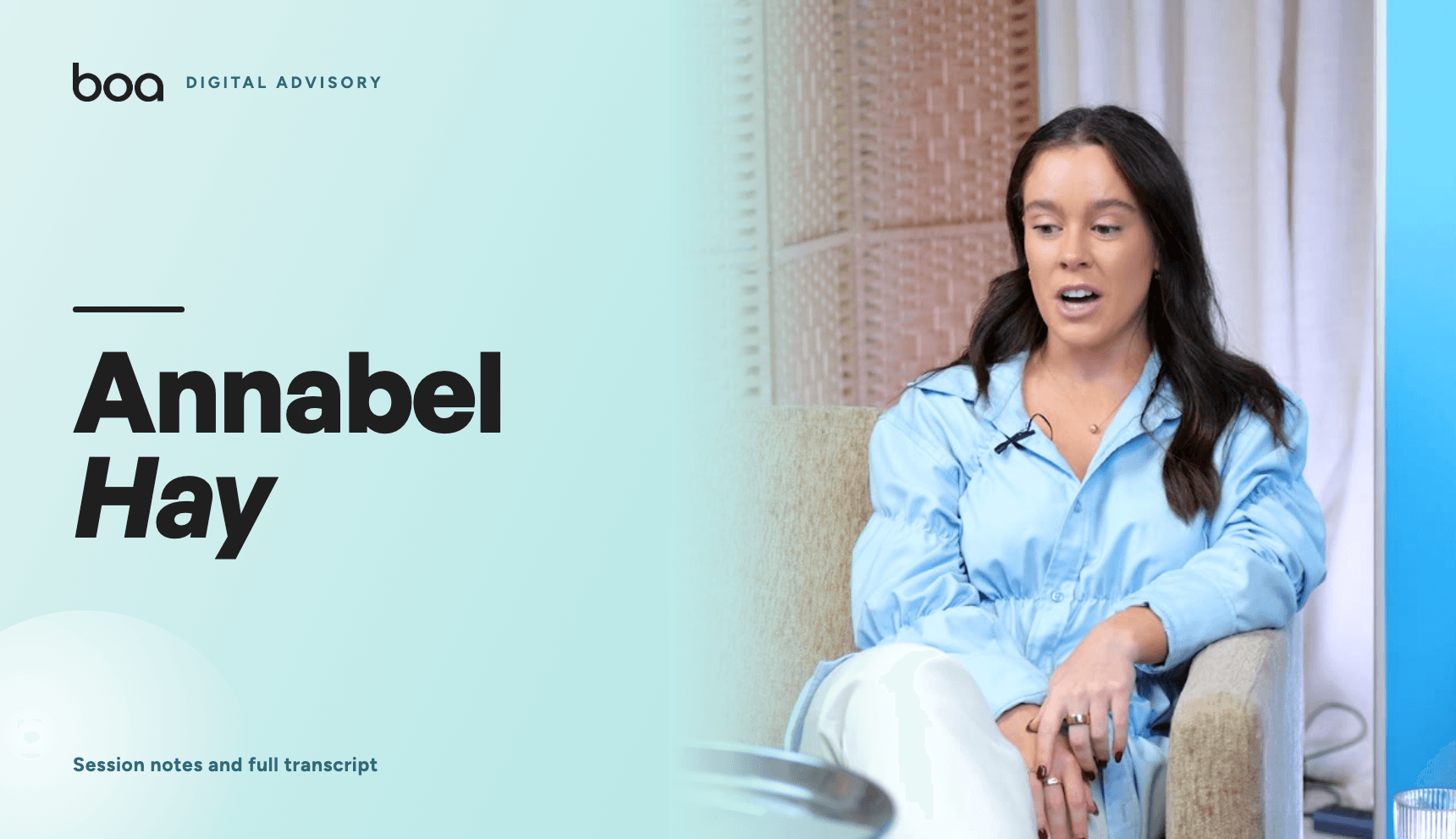
Annabel Hay on Guessing Buyer Emails to Win Retail
With Annabel Hay, Founder at Clutch Glue · Hosted by Kirsten Scott · 45 min
What this session covers
Clutch Glue founder Annabel Hay walks through the unglamorous mechanics of building a product business: cold-emailing retail buyers by guessing addresses, budgeting patents country by country, surviving a viral launch that had to be fully refunded, and entering the US state by state. Practical for first-time founders selling physical products.
Annabel Hay landed Priceline and CVS by guessing buyer email addresses on LinkedIn and sending 300 emails in a day, not by networking.
Key takeaways
- 01
Guess the buyer's email address instead of networking your way in
Annabel had zero retail contacts. She searched terms like "Priceline beauty buyer" on Google and LinkedIn to get names and titles, worked out the company's email format, then guessed. An out of office reply confirms the format is right. One day she sent 300 emails and the Priceline buyer replied almost immediately. Her framing: path of least resistance, and if they don't reply there are 365 days in the year, so email again until you catch them on a good day.
- 02
Pay for third-party QA before a batch leaves the factory
Clutch's first 5,000 units were sealed by a machine running too hot, which pierced the tube tops and caused leaks in transit. Annabel had to issue mass refunds on nearly all of the $160,000 made at launch, then pay again for new manufacturing and a new manufacturer. She had never heard of third-party QA inspectors who squeeze and check every tube before dispatch. Build a pre-launch checklist and don't let the excitement of holding a finished product make you ignore red flags.
- 03
Budget your patent in stages across the 12-month window
Annabel paid roughly $30,000 to $40,000 to lodge with the International Patent Office. About 12 to 18 months later the office confirmed patentability, which opened a 12-month window to lodge in each individual country. She ranked countries into priority one to four and spread the filings across quarters to match cash flow rather than paying around $300,000 at once. Miss a country in that window and you start the whole process again.
- 04
Sell while patent pending and while your trademark is pending
You do not have to wait for registration to go to market. Annabel confirmed you can sell as patent pending and that this still protects your IP. Same with trademarks: TM signals pending, R signals registered, and you can trade the whole time. She engaged a patent lawyer before she even had a final formula, which cost very little at that stage.
- 05
Enter the US one state at a time, not all at once
Annabel's biggest US lesson: trying to reach everybody is the worst possible use of your marketing budget. Pick the single state where your best customer sits, spend there, collect the data from your D2C site and Amazon, then build outward. She also found ad performance varies by state, with some responding better to an American accent and others actually preferring a foreign one, so test creative state by state.
- 06
Do your own customer service and treat complaints as product research
Clutch does not use AI for customer service. If a customer is nervous about using the product on a wedding dress, the team will draw and mark up exactly where to apply it and how much. Annabel runs most of the customer service and community management herself, which is how she knows what to build next, because customers tell her directly. Negative comments show where the education is failing, and Clutch then addresses those gaps publicly on TikTok.
- 07
Rehearse a pitch with hostile mock panels until it is boring
For Shark Tank, Annabel and her sister, who is Clutch's CMO, spent around 100 hours on the pitch and ran four mock Shark Tank nights. Each ran three hours, with old bosses and "shark-like" friends on a panel asking the most brutal questions they could think of. They also tested different wardrobe malfunctions on camera and picked the strap falling off the shoulder as the clearest on screen. By filming day she felt no nerves, just ready, and the pitch aired without a stumble.
- 08
Use D2C payment terms to fund the wait for retail
Clutch runs roughly 70% wholesale and 30% D2C and actively defends that split. Annabel says the payment terms on D2C are so much better that without it the business would be broke half the time. When a retailer pushes back or delays a range review, put the extra money into D2C, because it funds the gap and the sales data strengthens the next retail pitch.
- 09
Show a product pipeline to retailers, then expect them to only take one SKU
Priceline accepted a single hero product because Annabel could show new product development in the pipeline, proving Clutch was not a one-trick pony. Other retailers insisted on seeing three to six SKUs first. Now that Clutch has an extra large tube, a 5ml sample size and a new product coming, several of those same retailers want to start with just the 15ml. Plan for that flip and don't over-build range to win a conversation.
- 10
Prepare for the cash flow gap when a retailer brings your date forward
Priceline moved Clutch from a February range review to an ad hoc December ranging, which meant Annabel had to produce around 35,000 units almost immediately. She fronted manufacturing and marketing costs and waited roughly six months to be repaid. Her advice: get a good fractional CFO as early as possible and build a proper financial model, because founders go from $2 million in the bank to bankrupt on mismanaged cash flow.
- 11
Ship stock straight from the manufacturer to in-market warehouses
Rather than air freighting from Australia, Clutch forecasts demand per region and has the manufacturer send purchase orders directly to warehouses around the world, so Annabel never touches the stock. That keeps COGS low. The catch: each country with a warehouse needs a local business number, local tax filings, local accountants and separate Xero accounts per currency, which Clutch integrates through one platform to see profitability by region. Do it one market at a time, starting with the biggest.
- 12
Give negative feedback early instead of protecting people's feelings
Annabel says the hardest part of moving from doing the work to leading was HR. For the sake of being likeable she avoided hard conversations, and the issues then compounded. She now nips things in the bud immediately because it benefits both sides. She also had to spell out the values and pace she assumed everyone shared, since a family business to her is a 9 to 5 to a hire.
How the session runs
- 1:49How Clutch Glue started at Chinese Laundry
- 4:56Chaos as a first-time founder and two years in Hong Kong
- 7:07The viral TikTok, $160K in 12 hours, then mass refunds
- 11:13Priorities for a first product launch and customer service
- 14:09Shark Tank: the DM, the doubts, 100 hours of prep
- 18:59Cold-emailing buyers to win Priceline and CVS
- 22:45Leadership, hiring lean and giving hard feedback
- 25:45Holding sustainability standards as costs grow
- 27:47Advice: patience, cash flow and a fractional CFO
- 29:40Q&A: single hero product versus retailer SKU demands
- 32:06Q&A: when to protect IP and what patents really cost
- 35:28Q&A: building influencer and ad strategy in the US
- 40:09Q&A: global shipping, warehouses and local tax
Mentioned in this session
- Clutch Glue
- Chinese Laundry
- Sydney
- Bondi
- Hong Kong
- Melbourne
- TikTok
- Shark Tank
- Priceline
- CVS
- Amazon
- AusPost
- Xero
- ChatGPT
- Carmex
- Lucas Paw Paw
- Madonna
- Nourishing Bubs
- Romancy Games
- New York
- Poland
Questions founders ask
Annabel Hay had no retail exposure at all. She searched the retailer plus the buyer's job title on Google and LinkedIn to find names, worked out the company's email format, then guessed the address. An out of office bounce-back confirms the format works. She sent 300 emails in one day and the Priceline buyer responded almost immediately, and most of Clutch's global retailers have come from guessed email addresses.
Annabel paid around $30,000 to $40,000 to lodge with the International Patent Office. Roughly 12 to 18 months later the office confirmed patentability, which started a 12-month window to file in each individual country. Filing everywhere could total around $300,000, but she spread it across that year by ranking priority countries and filing quarter by quarter. If you miss a country in the window, you have to start the process again.
Yes. Annabel confirmed you can sell as patent pending and that this still protects your IP. The same applies to trademarks, where TM indicates pending and R indicates registered. You are not hamstrung by the filing timeline.
Do not try to reach the whole country. Annabel says there is enough money in a single state or subculture, so pick the state where your best customer sits and build out from there once you see returns. Use the data from your own site and Amazon to work out where that is. She also found ad performance varies by state, with some audiences preferring an American accent and others responding well to an Australian one.
Clutch Glue runs about 70% wholesale and 30% D2C and tries to hold that as its sweet spot. Annabel says the payment terms on D2C are far better and effectively keep the business solvent while waiting on retail terms and range reviews. If a retailer delays you, put the money into D2C, because the resulting sales data also helps you get ranged sooner.
Full transcript
The complete conversation, as recorded, with every speaker attributed.
Kirsten Scott0:00
So without further ado, let's jump in.
Audience member0:02
Let's do it. Yeah.
Kirsten Scott0:03
I've got Annabel Hay here with me this morning. She's the founder of Clutch Glue, which turned a wardrobe frustration into a sustainable global fashion brand.
Audience member0:13
Yeah, that's a big deal.
Annabel Hay0:14
Yeah, it happened.
Audience member0:15
Yeah.
Kirsten Scott0:16
Feels like overnight or?
Annabel Hay0:17
Definitely not to everybody else. Yeah.
Audience member0:19
100%.
Kirsten Scott0:20
All the blood, sweat, and tears that happen behind the scenes.
Audience member0:23
Exactly.
Kirsten Scott0:24
Now I want to get to know Annabel before we jump into the questions. So we're gonna do a round of this or that. Okay, so whichever stands out to you the most, I want you just to yell it out to me.
Annabel Hay0:34
Got it.
Kirsten Scott0:34
There's no judgement here. All right, so coffee or tea?
Annabel Hay0:39
Tea.
Audience member0:40
I love that.
Kirsten Scott0:41
Yeah. Uh, morning person or night owl?
Annabel Hay0:44
Morning. You will not— I'm not awake past night. What time do you go to bed?
Audience member0:47
9 PM.
Kirsten Scott0:47
That's perfect. Yeah, yeah, you're like, 9 PM? Uh, texting or calling?
Annabel Hay0:52
Texting.
Audience member0:53
Yeah. Okay.
Kirsten Scott0:54
Uh, Notes app or pen and paper?
Audience member0:56
Both.
Kirsten Scott0:57
Yeah, okay, a bit of a mix. Podcast or music?
Annabel Hay1:00
Music.
Kirsten Scott1:01
Love that. Oh, what vibe are you going?
Annabel Hay1:04
Uh, funky, always. Yeah, something disco, like, yeah, love it. You know, Madonna, always.
Kirsten Scott1:09
Oh my God, that's amazing. A clean aesthetic or bold branding?
Annabel Hay1:13
Bold branding. Yeah, I mean, obviously.
Kirsten Scott1:17
Uh, calm under pressure or thriving under chaos?
Annabel Hay1:20
I'd say I'm pretty calm under pressure.
Kirsten Scott1:22
Yeah, you seem nice and zen. Uh, doing it yourself or delegating early?
Annabel Hay1:28
Oh, I'd love to say delegating early, but doing it myself.
Kirsten Scott1:32
Um, I think that's like every founder.
Annabel Hay1:35
I think so.
Kirsten Scott1:36
Creative brainstorming or strategy deep dive?
Annabel Hay1:39
Creative brainstorming.
Kirsten Scott1:40
Yeah.
Audience member1:40
Yeah, I love that.
Kirsten Scott1:41
And share the journey or highlight the outcome?
Annabel Hay1:45
Share the journey. Yeah, that's where all the goodness is. That's where all the quality is, for sure.
Kirsten Scott1:49
I love that. Okay, so we're going to dive in. Tell us how Clutch Glue came about.
Annabel Hay1:54
Yeah, I mean, it's not your generic everyday, I guess, business story. Clutch came to life in a nightclub, actually, of all places. I'm not too sure where everyone on this call is from around the world, but I am a Sydney girl born and bred, and there is a nightclub that I used to frequent every Wednesday night. It's called Chinese Laundry. If anyone's been there before, yeah, I think it's a rite of passage to at least experience it once. And as everybody knows, it's very sweaty. It's pretty foul. I'm just over 5 foot tall and I can literally touch the ceiling with my hands up. So it's one of those places. And I, uh, was 19 years old at the time. I was at college, I was working full-time as a construction manager, um, and I was doing a full-time construction management degree. And I spent all my money on clothes and clubbing, like all of it. I had only disposable income, and that's what you do as a 19-year-old. And so I used to just— I was really discovering my sense of fashion at that period of time, and I was like buying all these crazy things. The only way that a lot of them would sit on my body the way that I wanted them to was with Fashion Tape. And I always found it particularly frustrating and not actually that useful. Um, it would always fall off when you sweat. I could never really get the placement quite right. It was just annoying. And all this single-use plastic and the whole thing. And there was this one fateful night I was going to Chinese Laundry. I was wearing this disgusting thing. I'd never wear it now, but it was like this pink plunging neckline jumpsuit thing. And, uh, I was going there with a bunch of my friends who took me about 45 minutes to fascinate myself into this jumpsuit, literally like tying it down, like trying to literally hold everything in. And then I wasn't getting the placement right. I was— it was ripping my skin off as I was like, you know, trying to redo it and the whole thing. And anyway, I arrive at the club finally, and then as soon as I arrived, it started to sweat and it all came off.
Kirsten Scott3:45
Oh my God.
Annabel Hay3:45
And I flashed everybody in the club.
Kirsten Scott3:47
The effort that goes through to get that all off.
Annabel Hay3:49
It was so frustrating. It just ruined my night. I spent the entire night like holding myself into this with my arms. And in a moment of sheer frustration, I was like it would be so much easier if I could just glue myself into my clothes. And then the idea just stuck. I quite literally, literally stuck. And I went home that night, I went back to college, and then I did a bit of research and there was nothing on the market that did what I wanted it to do, which was a sweat-resistant but water-soluble clothes adhesive. Seriously Strong is compatible with all fabrics. It's vegan, it's hypoallergenic, all of these things. Of course, there were glues on the market, right? Wig glue, superglue, like you name it. I bought all of them to try and see whether that could solve my problem. And it didn't. And so then I was like, well, irritation on the skin. Oh, it was bad. I've got scars from like all the road testing that I did until we got to where Clutch is. And yeah, 4 years later ended up globally patenting the world's first liquid fashion tape, which is crazy. So it was a long journey, but I think the 4 years of, you know, ideating and making sure I got my craft right is probably the most useful thing I've done so far.
Kirsten Scott4:56
And I mean, you're a first-time founder. Yeah. What was the most chaotic part of it and figuring out as you go?
Annabel Hay5:01
Like, all of it was pretty crazy, but I think too, being a construction manager, my phone never rung when I got good news ever. So I was pretty used to at a really early age knowing that there were going to be problems, not necessarily anticipating what those problems would be, but knowing that you were going to face them. And so that kind of it didn't really, um, break my stride when I would, uh, I receive all these problems, all these setbacks, because I was like, yeah, that's just kind of like part of the journey, riding the wave. Like, if you told me at that point in time before I started it was going to take me 4 years, I'd probably, you know, might have thought twice about it. Um, but now, you know, having been at the other end of it, we've been in business for 3 years now since then. We've almost been, um, as, as far out as we, as we were in. Um, so I think, I don't know, there's been some pretty chaotic problems. I'd I would say like the, some bit of trauma that probably springs to mind would be, um, for a couple years of that so that I could afford to bootstrap Clutch and pay for it, I moved to Hong Kong for 2 years during COVID um, just to afford to be able to pay for Clutch. And as, as we all saw probably in the news, China was pretty insane about, uh, the lockout laws and things like that during the manufacturing and that as well.
Kirsten Scott6:19
Is that why it was the best move?
Annabel Hay6:21
No, I was just, um, everyone was leaving Hong Kong at the time, and I was working as a construction manager at this point in time. So everyone was leaving, and I was like, with the company I was working for, I was like, hey, what's the best job I can get right now? And they were like, well, everyone's leaving Hong Kong, why do you— why don't you go? And I was like, perfect, I won't spend anything. No, literally. And so I just went over there. I was locked in my— I think the worst day, the worst period of time, 6 weeks, I was locked in my studio apartment and I didn't touch my front door for 6 weeks. But the work that I got done during that period of time was pretty cool. But I would say that that was like, I don't think I've ever felt, you know, inside a pressure cooker quite like that.
Kirsten Scott6:59
Yeah, that sounds really tough.
Annabel Hay7:01
Yeah, that was tough.
Kirsten Scott7:02
Yeah. So, okay, what was one of the early mistakes that you— that happened early on that helped you in the long run?
Annabel Hay7:07
Oh my God. So when we first launched, that was the 1st of December 2022 was our launch date. I found a local manufacturer actually in Sydney. There were only a couple of manufacturers in Asia Pacific that could make Klutch. A lot of them are really good at making things they already know how to make, things like shampoos, conditioners. They're all set up for that. But like a glue is pretty niche and a lot of them don't have the accreditation to be able to make it. But I ended up finding one in Melbourne and one in Sydney who could make Klutch for me. And at this point in time I'd moved back to Sydney and I remember we got this manufacturer to make 5,000 units. It cost an absolute fortune at the time. I remember like my unit cogs were crazy and we— I sold the day we launched, I sold probably 10, mostly to friends and family that I'd like force. I'd like quite literally force my dad to buy one who was sitting across the table from me, literally. And actually I was talking to Dad on the weekend about it. He goes, I actually never received that tube. And I was like, that's not true. I was like, you've got so many clutches. Anyway, so we launched, sold maybe 10, and then I was like, what am I going to do with the rest of these units that are just currently sitting in my parents' garage? And then we started posting on TikTok and then I was like, surely—
Kirsten Scott8:27
like quite early on when TikTok was developing.
Annabel Hay8:29
Seriously, it was still like pretty cringe to be posting on there. And there was this one fateful night 3 months later that I uploaded a TikTok video of a spaghetti strap falling off my shoulder., and then I clutched it back on and it just showed that it didn't fall off. It was 10 seconds and it's the worst video you've ever seen. And I woke up the next morning, that had reached 9 million people, over 420,000 likes. Um, and we'd sold out of all 5,000 units overnight. We made about $160K in 12 hours. And so I literally called all my friends, got them to come over to my share house in Bondi to pack all of these orders for me, which were bound for over 46 different countries. It was crazy manually putting them into AusPost directly. Like we had, no 3PL, like all of it. You can imagine it was a nightmare. And then a couple of weeks later we started receiving emails from people being like, hi, like my tube arrived damaged. And I was like, that's so interesting. Like, I wonder how this could be. And then I was like, oh, are they exploding like on the plane? Are they getting manhandled in the post? Like, I don't know. And then what we came to realise once we issued mass refunds, got people to return them to us so we could inspect them, it actually showed that the sealed part of the tube over the top, um, was actually pierced. The, the machines they use at the manufacturer was too hot, so it actually like oversealed them, which then caused these big explosions and leaks and stuff like that when they were getting used. So, um, yeah, mass refunds. Um, we ended up pretty much needing to refund all the rest of the money that we made, and then we had to obviously, uh, pay more money for more manufacturing and finding another manufacturer everywhere. Yeah, testing it again, the whole thing. So when you, when you initially launch and you have that virality for the first time, you're on top of the world. It's the best day of your life. And then 2 weeks later, it was the worst day of my life because I was like, has this business failed before I've even started? And also just the reputational damage of that. You just don't know. I was like, are these customers never going to trust me ever again? It just was really, really awful. And the biggest lesson with that, though, is I didn't understand because I'd never sort of come across the issue as a customer buying a tube of toothpaste or whatever it was. I'd never had something explode on me before. I was like, I didn't realise that so many people get third-party QAs to come in before the batch actually even leaves the factory to make, to cheque and squeeze every tube, make sure it's defect-free, all of these things that I just had no idea. No, chat wasn't a thing. And so there was just things like that where, um, now we have a really rigorous quality control process. So anything that might get past that is always a really exceptional circumstance. But yeah, there are just these bit of due diligence in there that I just never knew existed.
Kirsten Scott11:13
I want to touch on that for a minute. So we have a lot of first-time founders in our community and and a lot of them probably wouldn't know, particularly for a product-based business. What are like, what would you say are the top like 4 priorities when you are starting like something like this?
Annabel Hay11:27
Um, I would say that, you know, the quality definitely. I think that at that time when you're also finally seeing this tangible product that you spend so much time ideating in your head, marketing, branding, all of that, when you finally have something that you touch and you feel, it's incredibly exciting and you can kind of let that get the better of you where you end up ignoring a lot of red flags. Um, so I think that just making sure that you've got a little bit of a checklist before you go live is incredibly important. At least ChatGPT can help you with that now. So that's cool. But I would say, I don't know, look, there are issues though that you are just going to have to learn about and will be something that you're exposed to, unfortunately, with the customer telling you. And that's okay. The main lesson there is that your customer service is impeccable. We take serious pride in our customer service at Clutch. And, you know, when we go above and beyond, we don't We don't use AI to do any of it. We make sure that a customer's concerns and needs are tailored. And so if they're using it incorrectly or whether they're scared that they're going to, you know, they don't know how to use it on their wedding dress, we will quite literally draw and like mark up where exactly they need to clutch and how much and all of that. And I just think that that's something that I would say is really overlooked in your early stages of business is just trying to outsource the negative bits. And it's, and it's really hard to receive that negative feedback a lot of the time, but actually you can— that's like those— that sweet, sweet moment where you can actually interact with a customer on a personal level and get them back on side. And that's always then a big win. So sometimes I just say that people need to unfortunately expose themselves to the discomfort of the negativity to actually be able to, you know, turn, turn it into gold.
Kirsten Scott13:14
So I couldn't agree more. And like, your customers are ultimately the ones buying off you.
Annabel Hay13:18
So without a doubt, without a doubt. And in this day and age too, on TikTok, on Instagram, where I see, I open my Instagram every single day and I see a brand got cancelled or this or that. And it's just kind of like, you can get ahead of that if you are transparent along the journey.
Audience member13:34
Without a doubt.
Annabel Hay13:35
And we talk about it on our TikTok as well. Like, you know, we use those moments as learning to be like, okay, we're not educating our customers correctly on XYZ, which means that we need to change it in order to make sure that, you know, people know how to use it. And so yeah, there's a lot of learning and a lot of sweetness that comes from negative interactions that you do just need to welcome, unfortunately.
Audience member13:55
I love that.
Kirsten Scott13:56
That's great advice. Like, yeah, I think that's great. Now guys, I just want to remind you, if you have questions for Annabelle, to pop them in the chat, because when we get to the Q&A, you'll be able to ask her directly. Now we were touching on this before we jumped in.
Audience member14:09
Yeah.
Kirsten Scott14:09
The pitching side. Shark Tank, all of that goodness.
Audience member14:12
Yeah.
Kirsten Scott14:13
So let's jump back to Shark Tank first.
Audience member14:15
Yeah.
Kirsten Scott14:15
Can you tell us a little bit about that experience? Like how you applied and what it was like on the night?
Annabel Hay14:20
Totally. Yeah, totally. So what happened was I got a LinkedIn DM from a producer asking if I wanted to go on the show. And I said, how long had you been in business at that point? 18 months, I'd say.
Audience member14:31
Maybe.
Annabel Hay14:32
Probably. Actually, probably at this point it was about 12 months.
Audience member14:34
Yeah.
Annabel Hay14:35
And I got a LinkedIn DM from a producer asking if I wanted to go on the show. And I went back and I said no. And he just would not take no for an answer. And he was like, just give me your phone number. I'm just going to call you. And I was like, Fine. And he was like, tell me your concerns about like why you wouldn't want to go on the show. And I was like, to be honest, only the only Shark Tank pitches I've ever seen have all been inherently negative. And those are the ones that people do obviously engage with.
Kirsten Scott15:03
It's producing as well.
Annabel Hay15:05
It's a TV show, guys. Like, and that was kind of my main concern is that I'm going on to a TV show with 3 male sharks and 2 female sharks, but 3 male sharks, and I have to go and talk about my boob glue business. Like, I was like, I just can see it in front of my eyes going, this is just a recipe for them to make a beautiful show, but they're just going to take the absolute piss out of my business. And my business is a legitimate kind of imposter syndrome as well, though, right? Definitely.
Kirsten Scott15:33
Questions coming up. Definitely.
Annabel Hay15:34
And so, and he just kind of put my mind at ease where he was just like, that's not the way that I've ever thought about it. And I think that let's jump on a call with a few other producers and I'm going to get you to like do a bit of a pitch and we will give you some honest feedback. And I was like, perfect. So, um, at this point, I think the filming then was going to be sort of 5 months later. And we went through rounds and rounds and rounds and rounds of iterating the pitch, making sure that I was like screen tested, making sure that I could speak like all of these things that sort of come into it. And a few people do get rejected on the show just because they wouldn't make good TV. Like it is a TV show.
Audience member16:10
Yeah.
Annabel Hay16:11
And so I remember I gave— I was given my date and time to go in. It was August 2023, I think. 2024, August 2024. And we— yeah, August 2024 was my day that I needed to go in. And at this point we'd had about 5 months and I, my sister and I— my sister's my CMO of my business and she was like, if this— if you're to be taken seriously, you need to do the best pitch ever. And like, that was just the brief. It wasn't like, oh, you know, it'll be one of the good ones. It was like, no, this has to be the best fucking thing anyone's ever seen. And I just went, all right. And so we then spent 100 hours on the pitch. We did mock Shark Tank nights. We had about 4 mock Shark Tank nights that we put on ourselves where I got like Shark-like friends that I knew. My old bosses came and were Sharks, like on a panel. And fully, I'm not joking, we had 3 hours every single time of just being absolutely ripped apart by people asking me the most insane questions you've ever heard. And so we did that over and over and over again. The final— we did also a bunch of different wardrobe malfunctions. And the best one that we ended up thinking was going to be executed best on screen and things like that was the strap falling off your shoulders. A few of you might have seen. And then that was— we were like, right, we're ready to go. We did a final night 2 weeks before the filming. And I remember just leaving that being like, I just need this to be over. Like, I wasn't nervous, I wasn't excited. I was just like, this has just been a job that I've done forever. And so then turn up for filming and I have never felt so present and so ready to get something done in my life. And that really transferred on screen. You see the pitch go down without a hitch. I didn't say, um, I didn't say, ah, none of it. And what you see is exactly what happened on the show, albeit like it's obviously cut short. You're in the tank for 50 minutes where they can ask you literally anything and they've got no idea what your business is beforehand. The producers do, the sharks do not. They've never seen you before.. And so that was, I guess, a little bit scary. But after doing all these mock Shark Tank nights, I was like, I've answered every single question.
Kirsten Scott18:24
They literally look like your friends.
Annabel Hay18:26
Literally.
Audience member18:27
Literally.
Annabel Hay18:27
I was like, who is this man? Like, I don't care.
Audience member18:30
Yeah.
Annabel Hay18:30
And so then when at the end of it, when all the producers were like, that's the best thing I've ever seen, I was like, oh, haha, is it? Like, I don't know, you probably tell everybody that. And then it really wasn't until it aired then like 3 or 4 months later where I was like, oh shit, that was That was pretty cool.
Kirsten Scott18:43
Yeah, I love that. It's an awesome experience. It's great that a lot of people are like keen to get involved in things like that. And yeah, it's always important to share. Now you're obviously a global brand now, which is a huge deal. So can you tell us a little bit about that experience? What was the first retailer that you pitched to?
Audience member18:59
Yeah. Yeah.
Kirsten Scott19:00
How it all went down.
Annabel Hay19:01
Totally. So I guess the likes of your TikTok and your Instagram is that you don't get a choice being a local brand. Um, if anyone can see it from anywhere in the world. And so when we started getting demand pretty much from the US, being like, I need this right now and I can't pay for shipping and I need it to arrive tomorrow. I need it.
Kirsten Scott19:18
Customers were coming to you being like, when are you going to ship to the US?
Annabel Hay19:21
Actually, like, it was crazy. And so pretty quickly, like, we had a 3PL over there and we were getting stock over there and it was costing us a fortune, air freight, air freighting everything over. And it was this whole thing. And I was like, this is just a product that belongs on a shelf. It's not something that you necessarily need until you do. And so we were getting people being like, why am I just seeing this TikTok? I'm in the Uber on a night out.
Kirsten Scott19:39
And it's all through socials that you're getting this demand.
Annabel Hay19:42
Literally. And it all came from there. And I was like, well, that's enough, I guess, data from my side to be like, the demand's there. Let's try and get it into retail. And so I started— I had no exposure to any retailers ever before. And I remember being like, how do you get range? And so I just started guessing email addresses and I went on— LinkedIn is your best friend. If you quite literally type in like Priceline Beauty Buyer on Google and LinkedIn, it will come up. With like all of their names, what their titles are and the whole thing. And then I was like, right, I wonder what the cadence of the email address is. So then I just started guessing that. I've done that before. And then, and then like once it goes through or you get an out of office, that's the best one where you're like, that's it. So it's, it works. It's real. And then I just, I think this one fateful day I sent 300 emails and the buyer for Priceline replied almost immediately saying how funny somebody in marketing came up to me yesterday and said, we should stock this product, look at it. And so it was this perfect storm of kind of the exposure and the whole thing. And so, yeah, then we had a call with them and they were like, great, we'd love to have you on board. I think at this point the range review that they— we spoke to them in October and they were like, we can't range this until February. And we were like, okay. And then they were like, actually, no, that's not good enough. It's a summer, predominantly summer product. Let's get you in for December on an ad hoc ranging. So I quite literally needed to pluck I think it was like 35,000 units out of thin air, which was a lot at the time. You're fronting bills, you're fronting marketing, all of these things where—
Kirsten Scott21:13
what's going to sell?
Annabel Hay21:14
Yeah, I was like, what is going on? And by the time I'm repaid for the investment that I've made for this, it's been maybe 6 months. So I was like, how am I going to keep my business afloat for that long? Like, that was a really scary and real problem. And that was kind of my first introduction into cash flow.
Kirsten Scott21:27
Um, and at this point you're still just bootstrapping?
Annabel Hay21:30
Oh, bootstrapping. I was still working full-time as a construction manager. Like, we— I was not in this business full-time, but as much as I cared about it, obviously, like a full-time job. And then I was like, right, if that worked for Priceline, it will work for everywhere else. CVS was the largest one I've ever guessed, and they replied pretty much immediately being like, yep, get it in ad hoc ranging. We'll trial you in 400 stores. If it sells well, we'll put you into a couple thousand. And I was like, great. We ended up getting ranged. Their store metrics was 0.4 units per store per week is what they wanted us to sell. We ended up selling about 5 units per store per week, which is bonkers. Same for Priceline, became the number one best-selling product within a week of launch. So if it feels right to you and if your customers are demanding it, it probably is the right move.
Kirsten Scott22:16
Yeah, just let your gut lead the way.
Audience member22:17
Yeah.
Annabel Hay22:18
And it's been the same now for pretty much all the retailers that we've been across the world. Most of them have come from me guessing an email address. Some of them now approach us, which is great.
Kirsten Scott22:26
If there's any tip of today, always guess the email address.
Annabel Hay22:29
Always, always. And it's funny, people really try and like network their way into a retailer where it's like, nah, path of least resistance, guys. Just start guessing that email. And if they don't reply to you on that day, there's 365 days in the year, just email them them every day, and one day you'll catch them on a good day. I love that.
Kirsten Scott22:45
That's actually great advice. Now I want to talk leadership. So you've gone from working full-time as a construction manager to now owning a global brand. You've obviously grown a team. Like, that transition from working in the business to leading a business, like, tell us a little bit about that.
Annabel Hay23:01
Hardest thing, uh, I've ever done, to be honest. Um, and the HR of it all, I never expected really. I sort of like never really paid no dues about it because I think when I was a construction manager, like, everyone everyone on a construction site knows that they have a part to play when it comes to this finished product, and everyone treats everyone with actually a lot of respect, and they communicate, and, and all of that. And things are really fast-paced. Um, you— it was different then for me to have to set that tone for my own business.
Audience member23:30
Yeah.
Annabel Hay23:30
Um, and that's something where I realized, what are my values?
Kirsten Scott23:33
Like, what do I want the culture to be? Like, you are the one setting that.
Audience member23:36
Yeah.
Annabel Hay23:36
Yeah. And then I, I just— it was shocking to me that I obviously had to communicate that to people. Like, I was like, doesn't everybody just work like this?
Kirsten Scott23:44
Yeah.
Annabel Hay23:45
And, and, and my sister is the exact same as me, just like an absolute dog with a bone. And we just like very efficient people. Um, and I think that, um, that was then something difficult to be like, oh, we are hiring people that care less about this. Yeah, it's not, not a family business to them. It's, it's a job. It's a 9 to 5 to them. And then that's been something that I think, um, has been an uphill battle just um, try— I don't know, maybe being a female as well, where I care a lot about, um, making sure people feel good, and I don't like giving people negative feedback ever. And I think that that's been something that I've done quite wrong, is, um, for the sake of being likeable or for the sake of protecting their feelings, I haven't spoken out up about something that's then like manifested. And so now it's fine, like, you know, I, I know now that it's like, oh, it's better to just tell, nip things in the bud really early and just kind of get on with it, um, because that benefits both parties. Um, so yeah, that was something that I did wrong that now I've really changed, uh, changed my attack. And, uh, yeah, as much as it's still always uncomfortable giving people negative feedback, it's super, super, super important to make sure that people know that they're— what the right or wrong is.
Kirsten Scott24:53
Yeah. And it also comes down to hiring right. Like, you have to ensure the people that you're hiring maybe they've got some of the skills, but it's more that cultural fit, the drive, the ambition that's behind it.
Annabel Hay25:03
Totally, totally, totally.
Kirsten Scott25:05
Believe in the brand as much as you do.
Annabel Hay25:07
Without a doubt. And like, look, we're still a small team and I love having a lean team. Like, I don't want to hire heaps and heaps and heaps of people. Um, and I think running an FMCG business, there's a lot of systems now that you can utilise that at least replace a few bums on seats as well. So there's a bit of that. But, um, yeah, for me it's just like, let's try and make this team as efficient as possible. Um, and that's sort of how we decide to hire. We're kind of like always hiring and then never at the same time. It's like I always walk into a room being like, oh, you know, there could be someone interesting in this room that might be a really great addition to the team. But whether that is ever a resource that I need is a completely other thing.
Kirsten Scott25:44
100%.
Annabel Hay25:45
Okay.
Kirsten Scott25:45
So I want to talk about like the Glue's values as a brand, as it grows. You obviously have this beautiful sustainable brand. Like how do you ensure you keep that as you continue to grow? Like obviously costs and everything else change.
Audience member25:57
Yep.
Annabel Hay25:57
Costs do change and things like that. I think that, um, what, what has been really great is that, um, I'm able to set my own ethos within my brand. And so when I go to, whether it's a manufacturer, whether it's a retailer and things like that, and we say no, we don't have, um, like fail-safes or anything like that on the packaging because, um, we don't want any single-use waste or anything, um, that's always met typically with, um, an appreciation, um, because it helps their own environmental cues and there's a lot of demand for that. So as long as you're making it easier for everybody else, like on the retailer side of things, we make it easier to, you know, have better environmental cues. And then on the other side, when it comes to manufacturing, that's something that a lot of brands are demanding. So I think what I'm asking for in terms of sustainability is not unique. So that's definitely helped. But for us, you know, one of my favourite stats with Clutch is that we've sold, I don't know, a million tubes, a million of these 15ml tubes. And, uh, that accounts for about 36 tonnes of fashion tape waste from ending up in landfill by making the switch to Clutch. And so there are things like that which is really cool where it's like I'm also helping the end user without even them caring or trying. Um, so that's kind of a nice stat and something that I take quite seriously.
Kirsten Scott27:18
Um, a lot of pride in, like, there's a lot of pride with that.
Annabel Hay27:20
So as much as it's, uh, a lot more expensive to be actually using recyclable packaging and materials and things like that, um, it's super important to me. And like, honestly, for the sake of saving a couple bucks, um, unfortunately saving the planet, um, is worth a lot more money to me than that.
Kirsten Scott27:37
So I mean, we could end it there, but I do want to go into one last thing before— we've got a few questions coming through. What's one piece of advice for founders today trying to grow a global brand?
Annabel Hay27:47
I think just like be kind with yourself. I think you're allowed to make all these mistakes and be scrappy, definitely. But I would just say, I remember in the early stages where I was like, why Why aren't I like Carmex? Like, why aren't I in every single retailer? And why are these retailers taking so long? And like, why are people also not understanding my business?
Kirsten Scott28:06
Like, even why is this boob tape in all these retailers and I'm not?
Annabel Hay28:09
Literally, literally. Like, it was, it was a lot of that frustration, but I was like, no, like Rome wasn't built in a day. You just, it's always very easy to get frustrated or know what you're doing is right, but like, it's going to take a lot longer for the rest of the world to understand that and receive that and digest it. So I'd probably say there are a lot of moments where I just got frustrated with myself when and that's, that was completely beyond my control. So just do the best with what you've got. And I think that slowly but surely it will build. I think also too, if it became this like Carmex overnight, or if it became Lucas Paw Paw overnight, you would not have the infrastructure to deal with that. So like, as much as you want that, you actually can't. And so that's probably one thing too, where I'm like, just be gentle with that. And every day is a step forward. Just don't, just be a bit patient with it. And I would say the second most important thing, or slash the most important thing, is cash flow. Get a good fractional CFO as quickly as possible. Those people really, really help you, and having a really good financial model will help you. Because the worst thing that I hear a lot of the time is, you know, one day they've got $2 million in the bank, and then the other day they're bankrupt just because they haven't managed that cash flow correctly. So cash is king, guys. That financial literacy will keep you afloat. Like.
Kirsten Scott29:27
Yeah, that's awesome. Thank you so much.
Audience member29:29
Of course.
Kirsten Scott29:29
Now we are going to dive into some Q&A. Um, now guys, if you're comfortable enough, we would love for you to ask Annabelle yourself. So Diana, I have you first.
Audience member29:40
Big fan, bullets and shouting, gifted clutch to all my girlfriends. Yay, obsessed! Well, you have a similar, uh, product in the sense that there's one primary hero product and anything else you produce is sort of like an accessory to it, but on work, work in its own right.
Annabel Hay29:54
Yeah.
Audience member29:55
So I'm curious, you were pitching to retailers or distributors, how you got past any pushback around your product range. Is it big enough? You know, all that stuff.
Annabel Hay30:05
I tell you what's so funny, I think about this all the time. So at first, Priceline were fine with it as long as we showed that there was NPD and things like that in the pipeline where there was room for expansion. We're not just a one-trick pony. That's valuable to a retailer. Then we had, you know, we rolled out the extra large tube and now we've got a 5ml tube, a little one for little samples and things like that. And we're releasing a new product this year as well. So we sort of had that in the pipeline. But what's so funny is that there were a few retailers who were like, we just, we need to see at least 3, 4, 5, 6 SKUs. And what's so funny is that now we have that and can show that to them. A lot of them are like, okay, we're just going to start with the 15ml tube first. And I'm like, are you for real? You told me you didn't want it. Because we didn't have enough. And now you're saying that you just want this one product. That is just something that you're going to have to— that's going to happen to you.
Audience member31:04
I promise.
Annabel Hay31:05
I bet, I bet all my money on it. And it's frustrating, but unfortunately just it is what it is. And also that's what is so important about your D2C. Your payment terms with D2C are so good and really help keep your business afloat. Without our D2C strategy, like we'd probably be bankrupt half the time. So just like things like that where it's like, that's okay if a retailer is going to push back on that and, and there's going to be time between now and when you think you'll be ranged, just put extra money and extra investment into that D2C strategy because it will really help. And that data and analytics will also really help you then be able to probably get ranged sooner too. So, um, that's the way that I'd reframe that in your mind, is that it's an opportunity to sort of just get your other, your other funnels, uh, better.
Audience member31:52
What is your split between D2C?
Annabel Hay31:54
Our wholesale's 70% and our D2C is 30%, and we try and maintain that as, as best as possible. That's our sweet spot.
Audience member32:04
Kirra.
Kirsten Scott32:06
Thank you. So Michael can't ask because of his location, but at which point does intellectual property protection become relevant, critical to consider?
Annabel Hay32:14
Yeah.
Kirsten Scott32:15
Is it a great expense to do early, but leaving it too late exposes the business to unnecessary risks as well?
Annabel Hay32:20
Yeah, always protect your IP. It is incredibly expensive and it's something that seems almost a little bit trivial at the start where you're like, why do I have to spend hundreds of thousands of dollars on this? The way that I will explain this, we're talking about—
Kirsten Scott32:34
I think you did at the very beginning as well.
Annabel Hay32:36
I did.
Kirsten Scott32:36
The hard way.
Annabel Hay32:37
I did it right at the very beginning because I knew also with a novel, novel product, like no one's ever done a liquid fashion tape before. I was like, oh, there's so much here. Not just the formula. It's like the actual function of, of what it is. And so for me, I I, um, ended up, uh, speaking to a patent lawyer really early on in the piece when I, um, hadn't even really had the formula yet. I was working on something, so they sort of were there from the start. That doesn't cost much.
Audience member33:03
The—
Annabel Hay33:03
where the main IP costs come from, if this helps, um, uh, manage your expectations here, uh, what happens is when you have your formula or— and whatever it is, whatever you're patenting, you firstly, uh, it gets lodged to the International Patent Office, which is this I don't know, it's a thing, whatever. Then what happens is— and that costs maybe $30,000. I think $30,000 or $40,000 is what I paid for that back.
Kirsten Scott33:31
Wow.
Annabel Hay33:31
Way back then, right? Oh, it was, it was a disgusting amount of money.
Audience member33:34
Yeah.
Annabel Hay33:35
The only thing that cost me more than that was the manufacturing. So like that, that was a really big, big expense. However, then what happens is 12 months later, they normally about 12 to 18 months, the Patent Office comes back and says, Okay, we do think that this is patentable. Now you, for whatever countries you want to be protected in, now you can lodge it. So you actually have to plan ahead every single country you're then lodging that patent in. Um, now that's an incredibly expensive exercise in itself because you are lodging in every country. However, I would like to say that you have 12 months from that assessment coming back saying it's patentable to and put it in every single country you would like that protection. So you can prioritize, give or take, with your cash flow. So it's not you spending $300 grand right then and there. I spent it over that 12-month period and had prioritized— I'd prioritise what countries were priority number 1, 2, 3, and 4 is how I kind of split it in between quarters. And yeah, so if you end up missing any countries within that, tough luck. You then have to go back to the International Patent Office and do the whole thing again. So with that, you're allowed to sell your product patent pending, and that does protect your IP. The same with a trademark. You don't need to wait for the trademark to be completely filed. You can sell your product while it's still pending. That's also the difference between a, um, where you see some logos have TM and some have an R. The R means it's a registered trademark. So just know that you're allowed to sell, sell your products while that's all pending. You're not hamstrung by that timing.
Kirsten Scott35:11
It's awesome. Wow, I feel like we could even go down a rabbit hole with that.
Annabel Hay35:13
Yeah, it's crazy.
Audience member35:14
Yeah.
Kirsten Scott35:15
And the fact that you have to teach yourself that as a founder.
Annabel Hay35:17
Yeah.
Kirsten Scott35:17
Because no one else is telling you.
Annabel Hay35:19
And now it's just in my brain and I've got no one to tell.
Kirsten Scott35:21
So thank you for asking. I don't think you're a lawyer at that point, but that's fine. Now this is a great question, Liv, if you want to ask.
Audience member35:28
Hello.
Kirsten Scott35:31
Um, now first of all, tell her a little bit about your business and then dive in.
Audience member35:35
Yeah, sure. Okay. Um, I'm Liv. I have a business called Nourishing Bubs. We do a range of frozen, um, baby food, as well as we have an allergen introduction pack to make it easy to introduce allergens. Um, and we also do like toddler food, etc. So yeah, it's, um, national.
Annabel Hay35:52
We largely do D2C.
Audience member35:53
Um, we have recently launched in the US, um, and we are just with the allergen pack, which is our only amnia product. Um, and we have got our own website, but we've just gone live on Amazon. Yep. My main I guess, concern or obstacle at the moment is just like marketing in the US. Like obviously we can, we're doing digital ads, etc., on both Amazon and like our website, etc., but we do a lot of influencer marketing in Australia, which has been huge for us. We've been really lucky that we've never had to pay influencers. It's just been a really organic and great thing. And I guess for you, obviously completely different market, but I would say influencers are probably quite big for you. I just don't even know where to start in terms of like building the list in the US? Like, how do we even start with that? You know, it's obviously just such a big market. There's just so many people. Yeah. Yeah, they're a good one. You know, here I'm like obviously tracking like when people fall pregnant and then I'm following that sort of journey. Whereas I'm like, God, like I'm like stalking them. Like, but like in the US, it's just I don't even know where to start with that.
Annabel Hay37:01
Yeah, totally. So the biggest lesson that we learned in the US is is, um, it is, as, as you said, it is such a big country. And the problem with that is that you— it is the worst use of your money to try and access everybody. There's actually enough money in a, in a subculture or a tiny part, even a state. Pick one state that is your best customer and just do it state by state. That's what we've been doing. At Clutch, and that has been the best way to see return really quickly is just like, just focus on that one market and build it out from there. The worst thing that you can do with your money is just kind of like go everywhere and then nothing comes back. So just know what works for you there and collect that data. As you said, on Amazon and on, um, your own D2C, you'll get that data. So that's really, that is gold right there for you. So that's where to start and that is the most productive way to spend your money. Then build it out from there and build those flows out from there. We've also found, do some testing with your ads too. Some states in America like an American accent and then some states actually quite like us being foreign. So also trial and error a bit around those performance, your performance ads and your performance marketing and sort of just like see what works per state. So that's the way that I would categorise it. And that you'll see better returns from than that. I promise you it's a big place. Oh, it's such a beast.
Audience member38:36
And I mean, would you have used an agency there or like in the beginning to use an agency?
Annabel Hay38:42
We, so in terms of how we've gone about it, we have a performance marketer and CMO, my sister, who is based in Sydney and they do the American side of things as well. But we have an agency in for Amazon only and they are great and they do all Amazon internationally for us. So we don't even look at it. They just I have, uh, weekly meetings with them to just go through the data and see what's working, what's not. Um, so if you need, uh, if anyone here needs an Amazon agency, um, you guys can share my email after this. Um, and I'll put you onto them. They're amazing. They're based in Poland. And I'm telling you, it's the best $700 I spend a month, uh, for them to just do it. So just, uh, I'm more than happy to share that resource with you guys. Um, and then when it comes to PR and things like that, a different, broader, bigger strategy, um, we have a local PR firm that's based in New York. They're great. We turn them on and off like a tap. We don't always need PR, but sometimes when we do, when we've got a big launch coming up or when, you know, Shark Tank.
Audience member39:42
Exactly.
Annabel Hay39:42
Um, they've been really great for us too. So more than happy to share that resource too, but that's a bit different. Like we don't really see that conversion, um, in magazines. You can't track it. Right. So, um, for us, yeah, the best money that we spend is definitely on that performance marketing side of things.
Kirsten Scott39:59
Yeah, that's awesome advice.
Audience member40:00
Advice. Yeah, of course.
Kirsten Scott40:03
Yep, no worries. Thanks, Liv. Uh, Monica.
Audience member40:09
Hi guys, uh, amazing talk. I can't believe the overlap. My background's in architecture and construction as well and have an e-commerce business, so this has been awesome.
Annabel Hay40:19
Love it.
Audience member40:20
Um, so my business is Romancy Games, which is a spicy couple game that brings the spice from your favourite romance books to And my question is, I've kind of got a similar situation to you where people are reaching out from different countries saying, where can I get data? How can I get it shipped to me? And, you know, I'm shipping in the US and the UK, Canada, New Zealand. But how do you coordinate shipping prices when you're shipping globally?
Annabel Hay40:44
You said you started doing it from the very beginning, and I just don't want to, you know, undercharge shipping and then end up So in terms of your shipping, are you, are you shipping to these countries but from one place, or are you shipping locally to customers locally?
Audience member41:01
Only shipping from Australia internationally.
Annabel Hay41:04
So we ship, we have warehouses now pretty much all over the world to service those markets in market. What we do is quite literally do supply and forecast planning, and we ship, you know, for argument's sake, we know we'll sell, we'll sell 10,000 units, um, over in America, we, we, with the manufacturer, we will place the PO and it gets sent directly there. Like, I'd never see it. Um, and the same for all of our warehouses. So that keeps our COGS really low, um, and, and effective because we're shipping to all of those different warehouses. So I would say, like, that's the way that we have worked it from the beginning. Um, I'll be the first order when we had to, like, air freight it on pallets. So, um, So that's, that's the way that we go about shipping. Our COGS are different depending on the region. Um, obviously there are tariffs and things like that in America that do, you know, all add up. Um, but we just kind of bear the, bear the cost of that. Um, but it's totally up to you as a founder to, to know or to want to make more money or need to charge a customer more money per market depending on how much it costs you to get in there. So, um, completely at your discretion how you want to operate. Operate that, um, just in terms of our pricing. We just like to keep it all consistent. But yeah, we ship to our warehouses. The annoying part is when it comes to having warehouses everywhere, you need to have a business number in that country. So we have to file our taxes locally. We have like accountants in every single place that we have warehouses, and we have like different Xero accounts that then have like all of our finances are siloed per currency, and then we kind of use a platform that then integrates them all together so we can see it holistically. So that's the way that we manage that kind of, I guess, operational and then financial side to understand where we're profiting and where we're maybe not profiting so much. It's terrifying, but do it one at a time. Again, like, understand where your biggest market is, probably America, and then just go over there and do that first and then trickle them down. We didn't send all of these warehouses live overnight. Night. Um, it's been a very slow, arduous process.
Kirsten Scott43:14
Yeah, I have a question. So like, there's new founders like Monica, like so many. Like, how do you know when to take the next step? Who's guiding you to make these decisions to set up all these things? Like, are you finding this out yourself throughout the founders, or who's kind of like mentoring you through?
Annabel Hay43:29
Just like logic, really. Um, I think that what really helps is that I do most of our customer service and our community management online, and so you know what your customer is asking for. So it's pretty easy easy for me to know what they want because they tell me. Um, so that's also something that I think a lot of people don't like, again with that negativity where it's just like, I don't want to see it, I don't want to deal with the customer service, and I don't want to see the hate comments online. Like, that is where you can improve. They're telling you what's wrong. They're telling you what's wrong. Like, go and figure that out. So I think that that's, um, that's the only way that I know what the right answer is, is because they tell me.
Audience member44:06
Love it.
Kirsten Scott44:07
Well, um, that was amazing. Unfortunately, we are out of time, guys. Um, but I honestly had my mind blown this morning, and this has been the best way to kick off our digital advisories for the year. So I would recommend get your hands on some Clutch Glue. This stuff is insane, and obviously we'll be seeing it globally.
Audience member44:24
Yep.
Kirsten Scott44:25
But thank you for joining us this morning, guys, and we'd love to hear from you. So yeah, thanks again, and we'll see you all soon.
Audience member44:32
Bye! See ya!
Watch the full sessioninside Boa.
Session notes are free. The recordings, the live advisories and the founders in the room are for members.