Digital Advisory
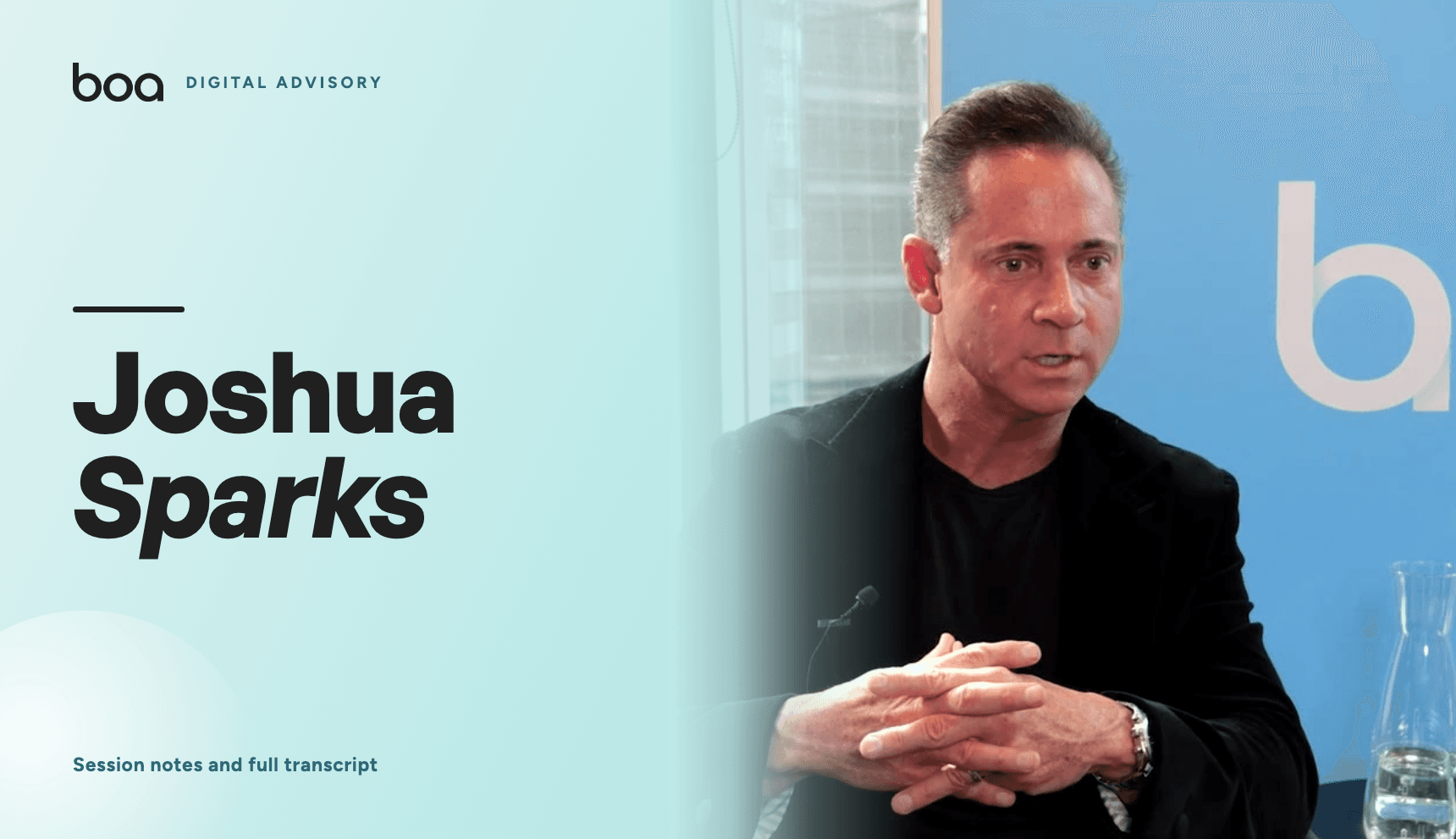
Joshua Sparks on Brand Promise and 3 Year Strategy
With Joshua Sparks, CEO at Together Studio · Hosted by Boa host · 45 min
What this session covers
Joshua Sparks explains how to define a brand promise you can actually deliver at every touchpoint, why strategy is the three year hill and tactics is tomorrow, and how to test a pitch with the WHAC method. Useful for founders building consumer brands, planning growth, or preparing a business for sale.
Work up to your brand promise from the foundations (reason for being, points of parity, points of difference, values, archetype) rather than trying to write the promise first.
Key takeaways
- 01
Build up to your promise, do not start with it
Sparks runs a brand pyramid workshop that takes roughly a day or two, and it works bottom up. Start with the central organising idea (your reason for being), then points of parity (the rational hygiene factors that get you on the field but never win the game), then points of difference (both rational and emotional), then your value set, then a single archetype, and only then the promise. Asked cold, most founders describe their offer ("we sell supplements", "we own hair salons") rather than a promise.
- 02
Write the promise as two words you can build product against
For MJ Bale the promise landed on "rugged elegance". The tailoring and knitwear could have drifted towards a soft English or Ralph Lauren feel, but founder Matt Jensen is the son of a sheep farmer with a farm in Barrow, so a tougher, functional element was authentic to him. Find the phrase that sits at the intersection of the category and the founder's real story, then make product decisions against it.
- 03
Audit every touchpoint against the promise
Once the promise is set, break it down across product, in-store experience, online experience, wholesale accounts, third party e-com platforms, all marketing, ambassadors and influencers. Every point where you touch the consumer either honours the promise or breaks it. Inconsistency is what fractures trust fastest, in brands the same as in personal relationships.
- 04
Keep the personality fixed and change the seasonal wrap
Treat the brand like a character in a film. The personality and promise stay consistent because that is the basis of trust. But a story where the hero slays the dragon and stops is dull, so refresh the wrap through seasonal campaigns and through different ambassadors bringing their own lens to what the brand means.
- 05
Use WHAC to pressure test your pitch and your brand
From the book The 3 Minute Rule: W is what is it, who is it for, why should they care. H is how does it show up and how does it work. A is are you sure (do you have social proof). C is can you do it (credibility, capacity, competency). Sparks calls the three W questions the most critical to answer first, and says a half hour pitch should be under three minutes of monologue and 27 minutes of dialogue.
- 06
Test the "are you sure" question with outsiders when you are pre-revenue
If you have no sales yet, social proof is hard, so buy objectivity instead. Sparks is engaged by startup brands purely to pull their assumptions apart and put them back together before they pitch investors. Three people in a room cannot test their own assumptions with any real objectivity.
- 07
Define strategy as the hill, then work back in 90 day blocks
Strategy is where you want to be in three to five years. Work backwards from that hill and ask what milestones you need at each 90 days, with named owners for each deliverable and KPIs attached. Tactics is the separate question of what you can do incrementally better tomorrow. Without the hill you have 360 degrees of possible direction and busy energy that goes nowhere.
- 08
Write your three year picture in detail, not one sentence
A strategic workshop takes a day or two and spells out what great looks like: revenue, profit, market share, customer base, single or multiple category, which geographies, what the team looks like, how much onshore versus offshore. It will be wrong the moment you write it, and that is fine. Like a financial model, it only has to be directionally correct so you can reassess and shift tactically each week, month and quarter.
- 09
Filter shiny objects with one question
Ask whether the opportunity brings you closer to the hill or takes you off the path. Sparks allows one exception: a genuinely short term cash generative opportunity when funding is tight. Ring-fence it, name it as a deliberate diversion of your three resources (time, money, people), and be clear it serves the longer term objective. He still discourages it because it goes wrong easily.
- 10
Hire people who will outgrow the role, and pay them properly
At Sass and Bide the founders owned design, styling, PR and events, and handed Sparks operations, geography, channels, distribution partners and production. He wanted every direct report to be smarter than him in their area, and four of his five direct reports later started their own businesses. The founders also paid him more than they paid themselves in the early years.
- 11
Watch the gap between your zone of excellence and your zone of genius
Zone of incompetence is fixing your own car. Zone of competence is cleaning your own bathroom when hiring it out is more efficient. Zone of excellence is what you are validated and well paid for but not fulfilled by. Zone of genius is where you are energised. Most founders get stuck in excellence doing work others could do, and starve the world-class work only they can do.
- 12
Solve succession before you try to solve a sale
If the founder is executive and the face of the brand, an exit gets hard: expect a long earn-out, a lock-in period, and penalties if the brand loses traction after you leave. Sparks has clients wanting to exit who have not solved this. Reduce the risk early by spreading the face across multiple ambassadors or micro-influencers, chosen per cohort, so no single person carries the brand's credibility.
How the session runs
- 2:02The common thread across fashion, lifestyle and wellness
- 5:14What a brand promise actually is
- 8:21Rugged elegance and the touchpoint audit
- 11:14The brand pyramid, worked from foundation to promise
- 13:10Strategy is the hill, tactics is tomorrow
- 17:41Writing what great looks like in three years
- 19:11Sass and Bide: clear founders, clear marching orders
- 22:06The WHAC method for pitches
- 24:01Zone of excellence versus zone of genius
- 25:35Traits of leaders who sustain success
- 28:17Handling shiny object syndrome
- 31:24Book recommendations for brand and purpose
- 34:24Changing brand voice versus changing personality
- 36:45Serving two very different customer cohorts
- 39:58Founder as face of the brand, and exit risk
Mentioned in this session
- Together Studio
- Sass and Bide
- Thom Browne
- MJ Bale
- Just Group
- Expedia
- Apple
- Nike
- Harley-Davidson
- Rolex
- Porsche
- Microsoft
- Surface Pro
- Android
- iPhone
- iPad
- Mac
- Ralph Lauren
- Urban Outfitters
- The 3 Minute Rule
- The Biggest Loser
- How Brands Grow
- Byron Sharp
- Zen and the Art of Making a Living
- The Hero and the Outlaw
- Steve Jobs
- Matt Jensen
- Sarah-Jane Clarke
- Heidi Middleton
- Tony Robbins
- Portland
- Japan
- Barrow
Questions founders ask
Sparks puts brand on the strategic side and marketing on the tactical side, with an overlap like a Venn diagram. Brand work sets the promise, personality and archetype that stay consistent over years. Marketing is the seasonal, campaign level activity that expresses that promise and can shift week to week.
Do not try to write the promise first. Work up from the central organising idea, then rational reasons to believe (points of parity), then points of difference (rational and emotional), then values, then a single archetype. The promise falls out at the top. Asked cold, most founders just describe their offer instead.
Yes. Sparks says all brands have multiple cohorts, and it is fine to have both experts and novices. The promise, personality and archetype must stay consistent, but the way you communicate should be tailored to each cohort's situation. The only real constraint is whether serving both will exhaust your resources.
No. Sparks says the idea that it must be the founder or CEO is not borne out by the data or his experience. You can use multiple ambassadors chosen for credibility with specific cohorts, including micro-influencers who are cheaper and more accessible. That also gives you flexibility and avoids being married to one spokesperson.
Sparks named four. How Brands Grow by Byron Sharp, an Australian academic, for mental and physical availability. The 3 Minute Rule for the WHAC pitch framework. The Hero and the Outlaw for brand archetypes. And Zen and the Art of Making a Living if you are still working out your purpose.
Full transcript
The complete conversation, as recorded, with every speaker attributed.
Boa host0:00
Today we're gonna be learning from someone very special in Josh. Josh is an expert in strategy and branding. He's the CEO of Together Studio, which is a boutique branding agency that's known for producing some of the biggest brands. But he's also been the CEO of companies like Sass Bide and Tom Brown, which are obviously both iconic brands in their own right. Josh has also been an advisor for companies like MJ Bale, Just Group, and Expedia. So we have a man here today that knows a thing or two about what makes successful companies successful and successful leaders successful. And obviously he's had a lot of experience in helping leaders like us all create strategies that guide us to long-term success. Which brings me to my final point, what today is all about. Today's got two main topics that we wanna focus on that we're gonna be learning. One is building an effective brand that increases your company value. So building a brand that makes your company more valuable now and when you want to sell it. And the second point is creating, how to create a strategy that creates long-term success. So basically, how do I know which direction I am in and how does that guarantee me long-term success? Josh, thank you so much for being here today. I wanna say, I know how busy you are, so thank you for spending the time.
Joshua Sparks1:23
My pleasure.
Boa host1:24
Now, you were just actually giving me a tip on the first question I asked. And I do wanna ask you, I think it's incredibly important. You've been the CEO and an advisor to brands in lots of different sectors from fashion, lifestyle, and wellness as some examples. Now they're very different industries, you know, is there a common, and you're a part of successful brands in each of those industries, is there a commonality between branding and strategy across industries or what was the connection between all of those? How were you able to be successful in all of those?
Joshua Sparks2:02
There is absolutely a common thread, I think, on both sides, from the brand side and the consumer side. So on the brand side, purpose-driven brands, those that are defined by a higher purpose, you know, essentially the promise of a better life, we're attracted to those brands regardless of sector. They're particularly prominent in fashion and lifestyle brands, health and wellness brands, other categories, eyewear, scents, skincare, etc., etc. So there's a commonality in terms of the importance of brand promise. There's also a commonality in terms of the customer. I mean, that customer is kind of, I guess, the way I would like to think of myself. It's an aspirational, ambitious individual who has a desire to challenge the status quo and really be a better version of themselves tomorrow than they are today. And through the way they curate their relationships with different brands in different categories, they're really self-expressing. And they're saying something to the world about who they want to be. So whether that's the way they dress every morning and the way they show up for work or social occasions, how they they take care of themselves in terms of their training and in terms of their nutrition, really their entire three-dimensional reality and how they're presenting it to the world, they're doing it in partnership with brands. And by the way, that includes friends of mine who claim they have absolutely no interest in fashion because that's a choice too. Choosing to wear a navy blue suit every day and a white shirt and a blue tie and fit in, that uniforming, that's a choice as well. And the thing that I love about these categories is that Even though many of us don't think of ourselves as necessarily creative on a day-to-day basis, every single day we choose to wear our uniform for the day, we're effectively engaging in an act of creative self-expression. And that's true whether it's eyewear, it's clothing, it's footwear, it's what laptop brand we use, what phone brand we use, what car we choose to drive, et cetera, et cetera. So whether we claim that we care or claim that we don't care at all, it's a choice. And I love the fact that we're on that very edge of a very intimate relationship with the consumer and we're encouraging them to self-express.
Boa host4:07
What I think is really important there is that while you were leading companies in different industries, the companies themselves were different as well. What was the commonality was the customer.
Joshua Sparks4:17
The customer.
Boa host4:17
That you were creating companies for the same customer, which I think you described it as like an aspirational customer. Yes. Person, someone who wants to look better, feel better, do well.
Joshua Sparks4:28
Yes.
Boa host4:29
Be healthier.
Joshua Sparks4:30
Yeah.
Boa host4:30
And I also love, which leads me to my next question, I love that you said that some, our brands as BOA people and business owners, our brands are, should be a partnership, a partner for our customer. So our customer is partnering with our brand to help, you know, kind of portray the image that they want of themselves in the world.
Joshua Sparks4:52
Absolutely.
Boa host4:52
And the way they want to view themselves. Now, I was reading your website and I found a great quote that I wanted to ask you about and that I thought everyone would be interested in. And it says, "Great brands make a promise to their customers of a more enriching life through the shared pursuit of an inspiring higher purpose." So what does that actually mean?
Joshua Sparks5:14
How can—
Boa host5:14
I know what it means, but what does it mean to you? And how can we as business owners show, deliver that message to our customers?
Joshua Sparks5:26
Okay, yeah, no, great question. So I think it's about purpose-driven brands for purpose-driven consumers effectively. So, you know, if we think about the best brands in any category, and obviously there's lots of brands that this doesn't apply to, but they tend to be the also-rans. If we're talking about the top brands in each category, most of us could define what that brand is promising. We might use different language depending on whether or not we're sort of trained in this space, or we're just coming at it as an untrained consumer. But either way, we get to the same place, that if we look at an Apple, or we look at a Nike, or we look at a Harley-Davidson, or a Rolex, or Porsche, or choose any of these brands that have a really clear sense of who they are and what they're promising, the consumer completely gets it. So I think the importance of that is that we're creating a relationship. It's non-transactional. So long gone are the days where branding is a monologue. For a long time, and certainly in the age of social media, it's a dialogue. So the consumer is a stakeholder in your brand identity, in your brand promise, promise. And it's about this virtuous loop of us creating this sense of aspiration, this promise of a better life, the consumer buying into it to some extent or another, feeding back to us as brand owners about what's working or what's not. And social media obviously has supercharged that whole process. And then this kind of virtuous wheel of brand IP value that you create through community. And it genuinely is a community. I mean, it really is a relationship that you have with your consumers. Now, the technical definition of a strong brand, if you talk to a branding professor at a university, do you have the power around price elasticity? Can you increase prices without pushback? Do you have permission to play in new categories? Do you have permission to play in new geography, et cetera, et cetera? All pretty dry and dull stuff. True, but pretty dry and dull. I think of it a little bit differently. I think, is there love there? Is there genuine affection for the brand? You know, given the alternative, would I fight to keep this brand that I have chosen to partner with. And I think we all have in our lives brands, I think that's true. I mean, if you're an Apple iPhone user or you're part of the Apple ecosystem with an iPad or Mac or whatever, you're pretty difficult to shift. I mean, Microsoft have been trying for a really long time with their Surface Pros are fantastic. The Android phone is technically extremely good. And they're just not enjoying the lion's share of profit that Apple does. And there's genuine brand love there.
Boa host7:50
Can I ask, so, I mean, I love the concept of viewing your brand as a partner to your customer to help your customer have the lifestyle they want or portray the brand that they want of themselves to the world. I really like that concept. But you did say, so your brand should promise, be a promise of a better life.
Joshua Sparks8:08
Yeah.
Boa host8:09
How do you actually deliver that? Like, how do you actually communicate that promise without sounding like, you know, like, oh, we can make your life better.
Joshua Sparks8:14
You know, like the Tony Robbins of branding.
Boa host8:16
Yeah. How can you actually, how do you, how do you portray that promise of a better life?
Joshua Sparks8:21
So I think it's a great question. And there's, so with clients, there's a whole workshop that we do around this that typically takes a couple of days to really unpack brand, but the really short version. So first of all, we wanna clearly understand what it is that we want to promise our brand, sorry, our consumer. So, you know, for example, one of my clients, MJ Bale, we speak about rugged elegance. So there's this notion that it's tailored product, it's suiting, it's beautiful shirts, it's nice knitwear. There's a certain elegance to it that could lean towards being a kind of a softer, more English or perhaps kind of Ralphie, Northeastern American sort of vibe, Ralph Lauren vibe. But Matt Jensen, the founder, he's the son of a sheep farmer. He's very connected to the land. He has a farm down in Barrow. He likes a tougher, more rugged functional element to the product. So we sort of landed on this notion, the brand promise is rugged elegance. So the first thing is you gotta figure out what's the promise. And, you know, different brands obviously have different lenses on what they can promise their consumer authentically and really truly deliver on it. And then it's a matter of breaking that down into touchpoints. So all touchpoints, we're talking about product, customer experience in-store if you have stores, customer experience online if you're online, customer experience through wholesale accounts or third-party e-com platforms, all the marketing, ambassadors, influencers, everything. So through every point at which you are touching the consumer, that you are honouring that promise. But also, you know, there's this core promise that remains true over time, but you wrap that in an ever-changing seasonal view. So imagine it in terms of a storyline. So we've got characters in the, let's call it a play or a movie. And those characters have a personality that is consistent. We start to develop an understanding of who they are. And we want them to be consistent 'cause that's the basis of mutual trust and confidence. Business relationship, personal relationship, brands, they're all the same. There's nothing that breaks trust and confidence faster than being inconsistent. You know, in a personal relationship, you'll hear something like, "Well, I just can't believe he acted that way. It's just not him." And it's a complete fracture of trust. So from a brand perspective, we wanna identify the personality and the promise and be very true to that. Through every touchpoint. But just like a storey would be pretty dull if the hero went out and slayed a dragon and that was the end of the movie, we want to make sure that the story, that the wrap that we put around that personality and promise evolves over time. So we do that through seasonal campaigns, we do that through different influencers or ambassadors having a different lens on what the brand means to them.
Boa host10:59
So can I stop you there? I don't want to— so I just want to focus very much on discovering what your promise is. So basically to effectively communicate your brand, you need to first figure out what that promise is.
Joshua Sparks11:12
Yeah.
Boa host11:13
Once you've got that—
Joshua Sparks11:14
so actually, it's like the way we do in the workshop is actually in reverse. So we start from the foundation, um, that, and, and then we move up to promise. So I've sort of flipped it because we don't have, unfortunately, 8 hours to do the, the full brand pyramid promise, uh, exercise. But basically, you start off with, um, you know, what is the central organising idea? What's our reason for being? You then work up through points of parity, so, or what we call rational reasons to believe. So these are points of parity are sort of hygiene factors. They get you on the field. They're not gonna win the game. We then talk about points of difference, both rational and emotional. We then move up through a, almost a value set, like the set of values that we wanna show up with. We then get to an archetype, potentially primary or secondary archetype. Best brands in the world are one primary archetype. And then we get to promise. And the reason we do that is that if I sit down with a client and just say, tell me what your promise is, it's really hard. It's like, well, we're, we're an eyewear or we're a, you know, we're a direct-to-consumer business that sells supplements or where we own a chain of hair salons and we want to go into medical injectables or, but that's the offer. That's not the promise. So to make it easier, we sort of work through this process to get up to promise.
Boa host12:28
So it is a process of basically finding your promise. And I assume— and then ensuring that what you're promising has— you're consistent with your user experience throughout the whole process. So for example, if we promise great networking every time, that, you know, if you're networking online, it's great networking, if you're networking in person, it's a great experience. And then how strategic is the promise? So I assume there is an element of strategy when it comes to your brand promise, because you don't want to promise something, for example, that perhaps is already taken in the market or promise something that is impossible for you to do.
Joshua Sparks13:04
Yes.
Boa host13:04
So is there an element of strategy when it comes to identifying your brand promise?
Joshua Sparks13:10
Yes, absolutely. Great question. So if you think of sort of strategy and tactics, brand is more strategic and marketing is more tactical. They overlap like Venn diagrams. There are of course tactical elements of branding and there's strategic elements of marketing. But if we had to sort of simplify it a little bit, that the brand work is largely strategic. And the simplest way that was ever discussed with me or, or educated, uh, to, to me in terms of the distinction between strategy and brand, think of strategy as where we want to be in 3 to 5 years. So this is the hill that we want to take. We work backwards from the hill in terms of understanding on 90 days, on 90 days, what milestones would we need to achieve in order to take that hill? And we look at owners of those deliverables or outcomes, we look at KPIs, etc., etc. Tactics is starting from where we are today and how can we be incrementally better tomorrow. The problem with just thinking tactically is there's always a way that you can slightly improve your rollouts, or you can slightly improve your distribution partner in Japan, or you can slightly improve your approach to recruiting the leadership team or whatever. That's all tactical and it's really important, But, but it assumes that you know in service of what. So tactically, we've got 360 degrees of potential direction. Strategy tells us the direction in which we're taking tactics. So when I'm talking to clients about the difference between strategy and tactics, strategy is a clear vision of an outcome that we want to achieve over a set period of time. Tactics is what can we do differently tomorrow in service of moving incrementally closer to that strategic outcome. So, so branding, super strategic.
Boa host14:49
And so you view strategy as basically where we're going and tactics is how to get there?
Joshua Sparks14:55
Strategy is identifying where you want to go to, and then there's a whole set of work around what that means. And then tactics is what can we do incrementally better tomorrow, function on function, cross-brand, marketing, uh, ops, um, HR, like every single division of the business has their tactical priorities and their KPIs, but they're all rowing in the same direction in service of a strategic outcome. Now, the more mature a business gets and the bigger a business gets, there's going to be a number of strategic outcomes. But when you're just getting going, it can be as simple as, we need to create brand awareness with this target customer around our specific offer, get product-market fit, and this is the way we're going to look at that, and achieve a certain level of traction to either impress our existing investors or to bring on some new ones. It could be as simple as that. It's tactically, it's like, okay, well, how are we going to do that? So what I find with a lot of, and I did this early in my career, I was guilty of it. So certainly no judgment, but what a lot of young entrepreneur, young entrepreneurs, or in fact, forget age, high energy, super motivated, ambitious entrepreneurs want to jump out of bed and do today incrementally better than they did yesterday. And that there's that impulse towards activity and action. And that's enormously productive if it's channelled in the right direction.
Boa host16:14
Okay, and the strategy is that direction.
Joshua Sparks16:15
That's right.
Boa host16:16
How do you view strategy in that case differently from vision, the vision of the company?
Joshua Sparks16:21
So vision is, you know, vision, it's a good question. Vision is typically summed up in a sentence or two. Strategy tends to be a bit more detailed than that.
Boa host16:31
So strategy is not just where we're going, but it's also the secret sauce and how we're going to get there.
Joshua Sparks16:36
Yeah, so for example, like to use the simple military analogy of that's the hill we want to take. That's the hill we want to take, and these are the reasons why. This is why it's important to us in terms of this overall effort. This is what it would mean for us from a resource perspective to take this high ground. Or so there's a, there's a lot more context to strategy. Vision can be really compelling and very motivating. It can also be a bit of a motherhood statement. It can just be a little bit fluffy, and I'm sure we've both seen examples of both. Strategy is a little more concrete. So a strategic workshop that I would do, for example, that was more business strategy, we would take a day or two depending on the business to unpack what great would look like in 3 years' time in a level of real detail. So great in what sense? Is it revenue? Is it profit? Is it market share? Is it customer base? Is it single category, multiple category? What geography? What would the team look like? How much onshore? How much offshore? So When we're mapping out what great looks like from a strategic perspective, it's not a one sentence statement.
Boa host17:41
So really literally write where you're going to be in 3 years in great detail.
Joshua Sparks17:46
Yeah. And as soon as you've written it, it's wrong, but it doesn't matter because it doesn't have to be specifically exactly correct. It has to be directionally correct. So we just need to know that, you know, like they say about financial models, every time I've ever seen a financial model, it's wrong. I just know, I don't know yet how it's wrong. So we might go slightly higher in rev, slightly lower. Our opex might be slightly higher, slightly— like, it's not about getting it exactly right. It's about knowing directionally this financial model supports our strategic objectives. Some will be up, some will be down, and we're going to be agile tactically because week on week, day on day often, but week on week, month on month, quarter on quarter, we're going to assess our plan again, see what is up and what's down, and tactically shift.
Boa host18:29
I do want to go, um, into your career.
Joshua Sparks18:33
Yeah.
Boa host18:33
So, um, um, you've, you've, you've run some big companies, some well-known brands, um, some have— you, you've, you've— Sassenbaid, one particular, you jumped in quite early on in its— yeah, it's good. What stage, how long were you in Sassenbaid?
Joshua Sparks18:48
They'd be going for about a year and a half, I think.
Boa host18:50
So very young, very young. Yeah. And that did become, um, um, while you were there as well, it did become a very big, well-known brand and successful company. Can you use Sussan Bayt as an example as to strategy, well, and good execution? Like what was, what made Sussan Bayt successful?
Joshua Sparks19:11
Yeah, great question. So I joined very early on and we did have a very good run while I was there. Sarah Jane and Heidi were incredibly talented, are incredibly talented, but speaking to the time then, had a very clear vision.
Boa host19:24
They're the co-founders?
Joshua Sparks19:25
Yes, yeah, the two co-founders. We knew them as the girls at the time, so I'll use that terminology. It's not meant to be in any way derogatory. We all had massive respect for them. So they had a very, very clear vision in terms of what they were trying to achieve. So from a brand perspective, a brand promise perspective, they knew who their girl was, what they were promising her, and why she should believe, like why it should be important to her. They were crystal clear on that from a very early stage. I think that made my job a lot easier, even though the business was very small, only a few employees from a revenue perspective, very early on, very small business. Because I had co-founders, so I was hired as CEO, I wasn't a founder or co-founder. So my job was to execute their vision. And they had a super clear brand vision, and they were also very open to me taking the reins commercially. So, you know, from a design perspective, 100% them, styling 100% them, PR and marketing events was all, I mean, we supported them in it, but they were very clear that they were decision makers on that. But from an operational perspective, a geography perspective, channels, distribution partners, production, et cetera, et cetera, that was all mine to run. And because they were very clear on what they were trying to promise, who they were trying to promise to, and why it should matter to her, I had very clear marching orders. So from a strategic perspective, even if that's all you're starting with, you know, what is it, who is it for, and why should they care? Like, those are the 3 most critical questions to ask yourself initially. Next one is, how does it show up? How does it manifest? So how do we bring this to market? The 3rd one we ask is like, are you sure? So it's a bit of a litmus test. Do we have any social proof that this is real?
Boa host21:11
How do you make sure that you're sure?
Joshua Sparks21:13
Yeah. So it really is about—
Boa host21:14
Do you need sales first and like, okay, we're right because the company's working or do you not have sales because the brand's not out there yet?
Joshua Sparks21:20
If you're pre-revenue, the are you sure piece is tricky, but that's where some mentors and some trusted third-party objective resources become really helpful. I mean, I do that for a bunch of startup brands where I'm literally engaged just to, for them to test out their assumptions. So, you know, pre-pitching investors, they want someone who's sort of been there and done that to pull it apart and then put it back together again. So that's, it is hard to do pre-revenue, but it is about testing your assumptions with a level of objectivity that's very difficult to do if you're just 3 girls in a room or 3 guys in a room. Anyway, back to SaaS and Buy. They were very, very clear that WHAC, which by the way comes from this book called "The 3 Minute Rule," but it's a great way to break down a pitch and therefore a—
Boa host22:06
What's WHA?
Joshua Sparks22:07
So W is what is it, who's it for, why should they care? They're all the W's. H is, you know, how does it show up? How does it manifest? How does it work? A is are you sure? And C is can you do it? And that's a very kind of, do you have the credibility? Do you have the capacity? Do you have the competency?
Boa host22:25
And what's your unique value?
Joshua Sparks22:27
Yeah, and to the extent that you haven't done this before, are you surrounding yourself with the right people? So, WHAC is just a very good way to think about it as a shortcut. So, I think that the success of SaaS and BYDE was in the girls having a very clear vision for what they were trying— all those Ws were very clear, and then allowing me to figure out the H, A, and C. And I was really clear that we were going to hire very, very clever people. I wanted all my direct reports to be much smarter than me at their specific area of expertise. Expertise. And in fact, we had a reunion, like, it's like a 15-year reunion or something after I left, 10-year reunion, whatever it was, I can't remember. But of my direct reports, 4 out of 5 went on to start their own businesses and very good businesses. So I love that. I love having, I love finding people that are so good, they're gonna outgrow the role and go and start their own business. And Sarah Jane and Heidi were very comfortable with that. Not all founders are, you know, a lot of founders are uncomfortable with paying people more than they're paying themselves. Sarah Jane and Heidi paid me more than they paid themselves, at least initially until we made the business really successful. And then they were paid very well. So I think there's a number of elements, but if I had to kind of summarise it for a short conversation, get super clear on the W's and then hire the right people to help you with the H, A, and C, 'cause you can't do it all.
Boa host23:49
Yeah, especially if you're potentially fantastic at like, design or something to do, but you maybe don't feel experienced yet in the business side of things.
Joshua Sparks24:01
Absolutely. And you can't, you know, there's that notion of kind of, you know, zone of incompetence, zone of competence, zone of excellence, zone of genius. So really quickly, zone of incompetence, fixing my car. I'm not gonna try to fix my car. Zone of competence, I can clean my bathroom, but I would rather hire someone else I just do it because it's going to be more efficient for me to work on other things. Zone of excellence and zone of genius is where most people make mistakes. Zone of excellence, you're really good at it and you've got a tonne of validation. You're well paid, you get a lot of compliments. When people talk about you, they typically talk about how good a job you do at that. Zone of genius, but it's not fulfilling. Zone of genius is often, you know, better at it, but you feel fulfilled and energised by it. So getting stuck in zone of excellence, and not spending enough time in zone of genius is really what holds a lot of people back. So the point I'm trying to make is Sarah Jane and Heidi were excellent at a bunch of stuff. And they could have done a heap of the work that I was doing and a heap of the work that my direct reports were doing. It's not that they weren't competent or they couldn't learn if they weren't already competent. It just wasn't their zone of genius. So when they did that bit that was zone of genius, they were world-class.
Boa host25:13
And so you've, I mean, you, you work with obviously Tom Brown and you did some work with leadership teams at Expedia, Just Group and things like that. You work with a lot of leaders. Basically a lot of really successful entrepreneurs as well. What traits do you believe these leaders had and do all leaders need to sustain success or to achieve and sustain success? What are the core traits that you found?
Joshua Sparks25:35
So there's lots of different personalities that I've worked with. I mean, Tom Brown is a completely different personality to Heidi or to a Matt Jensen or to other designers that I've worked with. So it's less about a consistent inconsistent personality. You know, some of them are really shy, some of them really extroverted, some of them naturally low energy, some of them high energy. The sort of things that we typically associate with leadership, which is this high energy, extroverted, walk into the room, heaps of charisma. In my experience, that is not necessarily correlated with long-term success. There's definitely leaders I've worked with who are like that, but some of the shyest, most understated, reserved individual I've ever worked with as leaders, have also been some of the most successful. I mean, Tom is quite reserved, quite understated, and he went from having a troubled business to selling it for $500 million US in a few years. So I wouldn't say it's about a personality type. I think it's more around a set of values or a set of principles. And I think if I— I don't want to keep bringing it back to brand, but there is something that's really true to this. It's about having clarity of vision, clarity of purpose. And there's different words we can use, you know, purpose, vision, mission. They're all to a certain extent interchangeable, even though people will tell you they're completely different. It's what gets you out of bed. It's having real clarity around the impact that you want to make in the world, some real humility about knowing that you can't do it all yourself, and, and an ability to recruit others to your cause. So there's nothing more inspiring to me than meeting someone who has a really clear sense of the dent they're going to put in the universe, to borrow Steve Jobs' term. But that notion of this is why I'm put on earth. But also that, because that's incredibly, takes a luxury of confidence, but at the same time, the humility to say, but I don't have all the answers and I can't do it myself. I need help doing something. I need help. And I'm prepared to share the upside.
Boa host27:26
And then I assume then the ability to find the help and to find the right people.
Joshua Sparks27:31
And don't hold on to time. Like, you know, it's, you can't, you can't win on your own. And bringing others into the fold, sharing the upside, being heaven forbid, a little bit generous in terms of comp and equity, you know, really motivating the team. It's extraordinary thing.
Boa host27:46
Now I just wanna go to a few questions. Jovana, would you like to ask the first question?
Joshua Sparks27:52
Sure. Thank you. And thank you for your time and organising this this morning. My question was, Going back to the strategy where you mentioned planning for 3 years, how do you deal with shiny object syndrome when things are coming up that you know that you need to kind of put that to the side and just get back to your strategy? Yeah, that's a really great question. If that makes sense. Yeah, no, it totally makes sense. The shiny object syndrome, I've never actually heard it described like that, but that's a great description. I think that is a perennial risk. The, the, the clearer you are on what you're trying to achieve, who you're trying to achieve it for, and why it will matter to them. If that is something that you feel genuine conviction around, then it is a lot easier to stay on track because the question simply becomes, does this bring us closer? Is this, is this propelling us and accelerating us further down the path that we want to be on, or is this taking us slightly off path or completely off path. Of course, in practice, that's, that's really the discipline that you need to have around that is really tough. And it's got to be balanced against a degree of opportunism and agility that is a small— when you're getting going as a relatively small business, sometimes you do have to take advantage of opportunities going to be short-term cash generative. Particularly if you're at the sort of economy we're in now where there's not buckets and buckets of funding flying around like there was a few years ago, sometimes there is a tactical imperative that might put strategy on pause. But you've just got to be really disciplined in, in kind of ring-fencing that and recognizing, okay, this isn't shiny object syndrome. We're not sort of rushing off on a random tangent for no good reason. This represents a short-term opportunity to generate funding or to generate cash flow or to develop a new relationship, whatever it is. That ultimately will be in service of our longer-term strategic objective, but we're going to have to divert for a minute or two. We're going to have to divert resources, time, money, and people, the three resources we have at our disposal. We're going to have to divert them short-term. I'd still really discourage it. I think it's very easy for that to go wrong, but if you can be highly disciplined and objective about it, I think you can manage both. Yeah, thank you. It is, it is a bit of a battle. Yeah, it's a battle.
Boa host30:16
Tamsin, if not, I can—
Joshua Sparks30:17
Sorry, I'm just trying to unmute my button.
Boa host30:20
That's okay.
Joshua Sparks30:21
And apologies, I'm a little bit fluid today. I just wanted to ask, you referenced a book just before that you, that had the WHAC method in there. What was the name of the book? It's The 3 Minute Rule. And it's actually, it was written by the original producer of The Biggest Loser, a Hollywood guy that went on produce about 30 or 40 shows. And his whole notion is that you've got 3 minutes or less. So it doesn't matter what the environment is, whether it's a B2B pitch or it's an investor pitch or, you know, consumer advertising, you've got a lot less than 3 minutes, but you need to be able to encapsulate everything that you're all about in 3 minutes or less. And his idea was, if you've got a half-hour pitch, you want 3 minutes or less. So you've got 27 minutes of dialogue and less than 3 minutes intensive monologue. And it's about starting to create rapport and relationship. What I found is that it works really well for B2C as well, but it's just a lot less than 3 minutes, which is why I don't talk about 3 minutes. Perfect, thank you.
Boa host31:20
Are there any other books that you've read, particularly on branding or strategy that you'd suggest?
Joshua Sparks31:24
Yeah, I think "How Brands Grow." That's Byron, I'm blanking on his surname. He's a South Australian academic. It's gone on to, I've seen it, I've seen it all over the world. I was in my CEO's office at Urban Outfitters. A friend of mine who's a great friend and mentor who was the CMO of Nike, global CMO of Nike, lives in Portland. He had it on his desk. His name is Byron Sharp.
Boa host31:51
Byron Sharp.
Joshua Sparks31:52
Sharp, Strong Sharp.
Boa host31:53
So he's Australian as well.
Joshua Sparks31:54
He's Aussie.
Boa host31:55
Even better.
Joshua Sparks31:56
And his, you know, it's a great book. It's a quick read. You read it in a night or two. But it's about mental availability and physical availability. And he's talking mainly about fast-moving consumer goods. A lot of his research was about, you know, FMCG categories, but the branded guys I know, as I say, I mean, you know, Urban Outfitters, Nike, Ralph Lauren, they've all referenced it. And the mental availability is what we might call around awareness and your clarity of promise and da-da-da-da. Physical availability is that there's just no substitute substitute for being convenient to your consumer. And e-com is sort of stuck at, you know, anything between 15% and 25%, depending on category for that reason, because the vast majority of people want physical proximity to the products they love. So anyway, that's a great read. I think if you're still sort of figuring out purpose, if you're a little bit earlier on, this is going to sound like a weird one, but just bear with me. Zen and the Art of Making a Living. And it's all about, our work, our work, our time on earth, and how we self-express through our work, you know, as, as an act of creative self-expression. And it's a little bit spiritual, but it's really, really good. And it has a whole bunch of exercises in it that are really directed at helping you find your ultimate purpose, which is a young entrepreneur. And again, age agnostic, any, any entrepreneur, most of us have written multiple business plans. You know, I've written many, many more business plans than I've ever actually started companies. 'Cause you're working through ideas and you're kind of workshopping internally and ultimately with a group of close advisors or mentors. Is this the one? You know, we all know the romantic equivalent of that, but in business it's true as well. You gotta find the one. And eventually, you know, you'll go on to hopefully have a few different businesses, but it's helpful in clarifying that. Man, I could keep going. Now, there's one more actually, one really quickly. The Hero and the Outlaw, which is about the use of archetypes in branding. And again, this is one that I've seen on the desks of CEOs of advertising, global advertising companies. It's a cracker.
Boa host34:00
Now, Krish asked me to ask a question on her behalf, which was, would you say it's difficult to then to change a brand's voice and personality? So basically, You know, at the start of a business, you could be through it, but at the start you're often trying to find your personality. So your brand might be portraying one thing, but you might realize, oh, this is the sector that I want to focus on, or that we're getting the most traction. Yes. This is what they want. This should be our brand.
Joshua Sparks34:24
Yeah.
Boa host34:25
You know, how hard is it to actually change or evolve your brand's— what did you say? Your brand voice and personality? Yeah.
Joshua Sparks34:33
So voice isn't hard to change because I think voice matures. You know, I think for all, if we think about it in, often it's really good to think about brands in terms of people or in terms of archetypes, personalities. We all are on a wonderful adventure called life and throughout our journey, our personal voice changes. We acquire wisdom, we learn new things, we have new experiences. So our voice matures and changes, hopefully.
Boa host34:56
Yeah, so we actually get better at communicating, which I agree, like at the start of, for example, CUB and even Boa in its short life so far, you do get better at communicating what you do. So that is natural. For a brand. So it's natural for people to totally, totally update how they— what they're saying, how they—
Joshua Sparks35:12
you want to get better, you know, you want to learn, you want to— it, as I said, it's a, it's a dialogue with the consumer. And through learning with— from the consumer, you get better at communicating, the connection becomes deeper and stronger. So I think tone of voice naturally evolves over, over time, and it should. Personality is a little bit tougher. I think if you've settled on archetypes for your brand, or an archetype, or potentially a primary and primary and secondary, but certainly no more than that. Changing that is typically a, it's a radical shift for your target market. It is that potential breach of trust and confidence. It is that moment when you realise the person that you loved is not the person you thought they were. So that's something to be careful with. But I think in terms of how that personality expresses itself to the target market, should, uh, can and should change over time.
Boa host36:03
And, uh, Domi, would you like to ask your question?
Joshua Sparks36:06
Yes, hello. Sorry, I hate to be that person who doesn't have their camera on, but a big night with a toddler means I'm not showing my face today. I can relate to that, Domi. Nonetheless, again, thanks for coming and speaking to us today, but I wanted to, um, better understand if it's like a failure at the outset if I choose for my brand and to service two types of customer. I'm in like a loyalty programme optimization space where I deal with customers who are real sort of experts in themselves and then real newbies to the area. What are your thoughts on that? No, I don't see that as an issue at all because what we're really talking about is two cohorts, like two different populations. It's more about consistency in who you are. So in terms of how you're addressing the market, all brands will have multiple cohorts. Sometimes they'll be as radically different as yours, you know, experts and novices. You think about medical services businesses, you think about gyms, you think about, I mean, fashion brands that like, there's always going to be different cohorts, some of whom are further up the curve in terms of their knowledge and awareness of the offer., and some of those of whom are a little bit earlier or perhaps even novice. So think of that in terms of different cohorts. And that's the way in which we communicate with those cohorts. So whilst the promise and the personality are consistent, it's always going to be Dommy showing up. You are who you are. It's, I know, I know you're not the brand, but just using that as an example, if it was you, you're always you. Um, you're, you're true to your vision and values for your life. You've got a set of principles that you live by, it's always you. But when you're addressing your toddlers or you're addressing a group of adults or you're addressing a group of, I don't know, mums at the daycare centre or whatever, you are tailoring your communication accordingly. So I know that's a bit of a clunky metaphor, but what I'm saying is that you as the brand or the brand, let's not talk about you anymore, the brand has to be consistent in terms of personality and promise. Or you start to breach trust. But then it's only respectful that you would tailor your message depending on the specific situation of the cohort that you're speaking to. So I don't see that as a problem at all, as long as it's not going to exhaust your resources. Um, you know, absolutely. Yeah, no, that's perfect. Fantastic. Thank you so much. No worries.
Boa host38:28
Could I also add, is it possible that even though they're different cohorts, they could be the same archetype? Yes. So therefore, like, the archetype of the brand you're building and you're aiming at is the same?
Joshua Sparks38:39
Well, the brand archetype should always be consistent, but it's true that even across the consumer or potential consumer, target consumer, there can be real similarities in personality. They're just in different situations. They come from different backgrounds, different ages, they've got different levels of wealth, but they're all buying into your promise because it represents something important to them. Yeah.
Boa host39:00
And final question, unless someone wanted to throw it in, but final question, Gary, Did you want to jump in and ask a question?
Joshua Sparks39:08
Sure. Can you hear me? Yes. Cool. I don't quite know if I'm articulating this the right way, but I'll try. So I'm seeing a lot of e-com coaches out there talking about brands having to be attached to a face of the brand, in particular because of authenticity and creating that promise. I can see the point of that, and that's why there's a lot of brands that have grown out, you know, big influencers. Do you see a risk with that business model from a scale, scalability perspective? And I ask that for two reasons. One is I don't want to be the face of— couple of companies and I hate being the face. I like to be the guy that kind of sits behind. Um, but just in terms of sustainability of, of a business that you're trying to grow, if you've got an intent to eventually sell, um, do you think that that business Is that really sustainable? It can be, but it does present challenges. So just going back to the initial point that you're hearing from coaches that e-commerce businesses need to have a face to the brand, I think there is absolutely some truth to that. It doesn't need to be the founder and there can be multiple spokespeople for the brand. So other brands approach that in different ways and they'll identify, I hate the term influencers, but let's call them ambassadors. They identify ambassadors ambassadors that have real relevance and credibility with a specific cohort of their target market, and they will represent the brand within that cohort. That's one way to do it. That gives you a lot of agility and flexibility, of course. You're not really marrying to, you know, any one spokesperson. You can have a spokesperson for the brand that is more of an advertising or marketing style spokesperson, or it could be a founder. So the idea that it has to be a founder or it has to be the CEO That's certainly not borne out by the data or my personal experience. A lot of founders love it. You know, a lot of founders want to do that. I personally don't have any social media profile at all. I like to stand behind my clients. I'm not, I'm not looking to build a profile for myself. So different people approach it in different ways. And it's just then, you know, for example, if we're talking about your personality or my personality, where we're more comfortable standing behind what we're doing rather than being out in front of it, then it's a question of, well, how do we reach the market and how do we reach the market with a level of passion and conviction and authenticity that I could bring naturally because, hey, it's my business. Is there a substitute for that? And maybe there's not one substitute. Maybe to do it elegantly, we need different substitutes for different cohorts, but there are multiple ways to do it. Yeah, I relate to that. I mean, that's the thing. I tend to, 'cause I work with retailers, change the sass and vibe. But we tend to find that when I get face-to-face time, et cetera, then that all shines through. But I don't wanna do any of that in the form of marketing 'cause in fact they enjoy the social media stuff. And to, have I got time to answer the second part of the question? Yeah, yeah, yeah. About succession. So yeah, so it does present succession issues. So whenever clients talk to, I've got a number of clients that are looking to exit their businesses at the moment. And they haven't solved for succession. We can't solve for a sale without first solving for succession. Now that's relatively straightforward if the founder is in an executive position. If the founder is in an executive position and the face of the brand and has created enormous credibility with the target market, and they want to sail off into the sunset with a really fat bank account, that presents some really significant challenges. So that's when typically you end up on a long earn-out, you are locked in for a for a period of time. There's often penalties if the brand loses traction in your absence. So I really encourage thinking about this earlier rather than later, because while there are pros to attaching yourself to the brand from an authenticity and credibility and just a passion perspective, there's also problems that that creates that ultimately will need to be solved. And the sooner you think about them, the sooner you can ensure that you— they're not gonna be big problems to solve in the future, Number one, thank you.
Boa host43:04
I've got a lot of friends who started, they started the company as the face of it, 'cause it was almost easier and it's better. It gives you like a really unique point of difference. Like, you know, this is me, this is why I've done this. Like people can relate to that.
Joshua Sparks43:19
Trust.
Boa host43:19
But then as they became more and more successful in terms of the business, they then, and they brought on investors and they started thinking about the future. They started to kind of retract themselves from the frontline and moved back. Like I know a lot of people that have done that. So like, even if you've started that way, you're doing that, you don't actually have to commit to that. I love the idea of, yeah, you don't have to be the face if you don't want to be, you can also utilise influencers who that is their job. That's what they do.
Joshua Sparks43:50
Yeah, exactly. And you don't need just one influencer. So you start breaking down the target market. Market by cohort. You can work with micro-influencers. They're a lot more accessible, a lot less expensive. So yeah, lots of different ways to solve for it. It's great that you're thinking about it though, because you know, this old cliché about we don't scale problems, we want to scale solutions. And that particular problem can get really difficult when it's scaled. Absolutely.
Boa host44:14
Guys, I want to thank you all for being here today and for being involved and for supporting Bowen and being part of Boa. And Josh, I want to thank you for an incredible session. You're an industry champion.
Joshua Sparks44:24
Thank you. I loved it. Thanks, guys. Thank you for your time.
Boa host44:27
See you all.
Watch the full sessioninside Boa.
Session notes are free. The recordings, the live advisories and the founders in the room are for members.