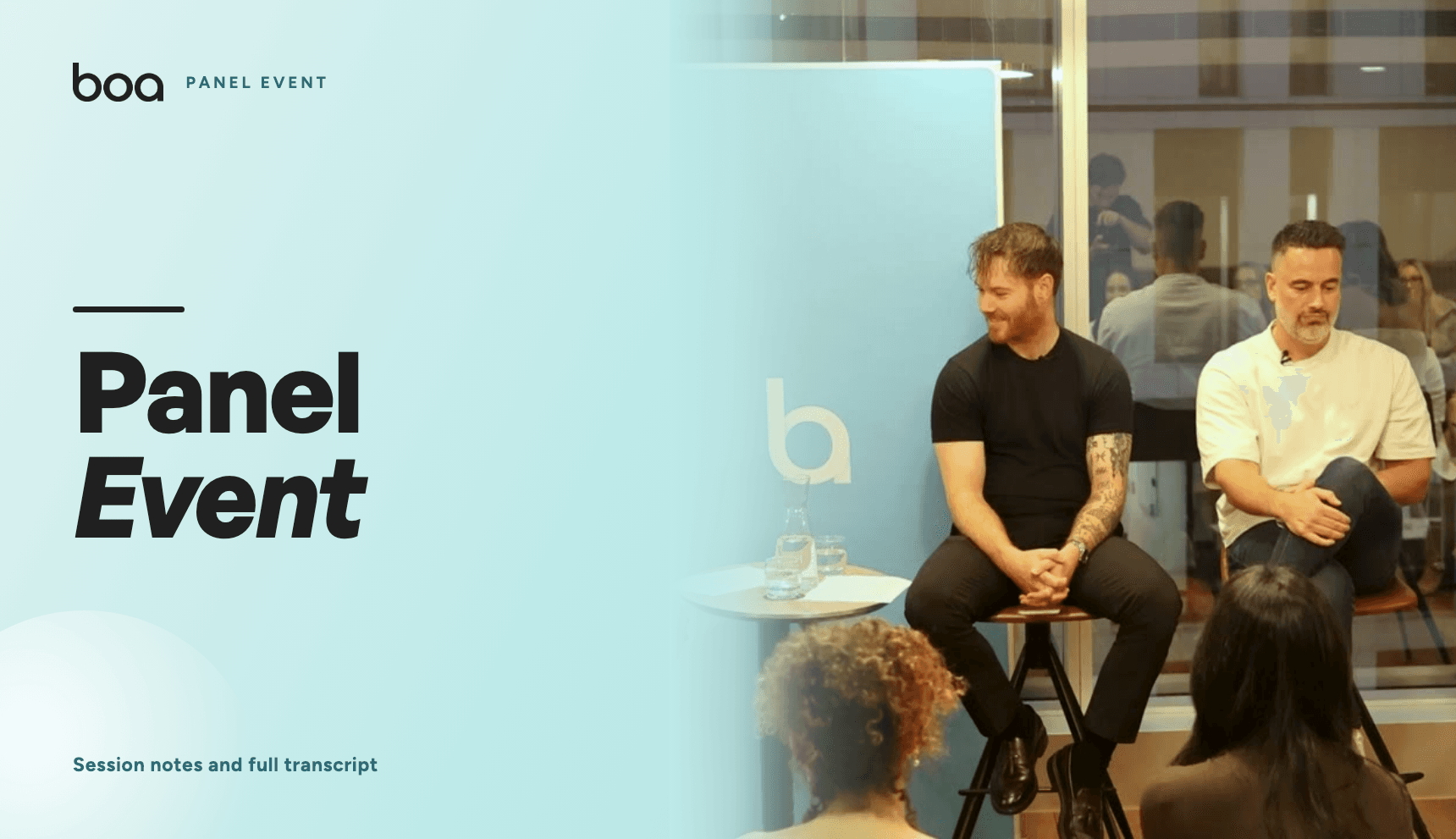
Panel Event
Bangn Body, SWIISH and Naked Sundays founders on building demand
With Priscilla Hajiantoni · 1h 16m
What this session covers
Three consumer founders break down how they built Bangn Body, SWIISH and Naked Sundays from kitchens and living rooms into Mecca, Sephora, Priceline and Ulta. Practical detail on product seeding at volume, TikTok Shop creators, founder-led content that outperforms polished ads, hiring your first marketer, and when a PR retainer is a waste of money.
A profile does not make people buy: what actually builds momentum is product in hands, volume of scrappy founder content and an owned database.
Key takeaways
- 01
Gift your entire first production run before you spend on ads
Priscilla gave away all 500 units of Bangn Body's first shipment to anyone who would take it, and did not run Meta or Facebook ads for over 12 months. The logic was recognition: by the time ads ran, she wanted roughly one in ten people to already know the brand so the ad worked harder. Naked Sundays did the same, running no paid media for the first two or three years and relying on seeding, press and events.
- 02
Test whether a manufacturer will say yes by calling until number 13
Samantha Brett had no manufacturing background. She Googled every sunscreen manufacturer and called them all, working on the assumption that twelve nos get you to a yes on the thirteenth. She then repeated the process with bottle manufacturers across China, India and elsewhere until she found one that could build a bespoke mister that would not spray into eyes. That bottle is now the reason the product ranks number one on Amazon US and Ulta US.
- 03
Recognise that a media profile does not convert to sales
Sally Obermeder is blunt that a following does not mean add to cart. People already have a box they put you in, and if you push a product at them they get annoyed. Because SWIISH started with smoothies rather than a product, the habit was show and share rather than sell, and that removed the selling pressure from the content. Consistency over the long game builds the tribe, not the profile.
- 04
Split Instagram and TikTok into front of house and backstage
Priscilla's framing: Instagram is your real estate and the front of the curtain, whether that is polished to justify your price point or deliberately scrappy. TikTok is behind the curtain, meet the team, meet the process, mistakes and all. Use Instagram Stories for personal connection with a sprinkle of TikTok energy, and let TikTok carry the raw material.
- 05
Face to camera on a makeshift desk still outperforms shiny production
Priscilla filmed scrappy Stories at her mum's house in trackie dacks with no makeup, showing samples and progress before the product existed. Those posts cut through when Instagram was all filters and motivational quotes, and she built community on the handle for almost three years pre-launch. Seven years later, face to camera creative is still the best performing and most cost effective ad Bangn Body runs.
- 06
Secure the handle before you commit to the name
Priscilla's launch checklist was two steps: Google the domain to confirm Bangn Body was free, then go straight to Instagram to check the handle. If the handle was taken, the name changed. She then started building followers on that handle while still in her corporate job, years before there was anything to sell.
- 07
Recruit micro creators by DM and offer product instead of budget
Priscilla still DMs creators with small but engaged followings whose content suits the brand, saying openly that there is little budget but she would love to send product in exchange for one video. Naked Sundays runs the same model at scale through TikTok Shop, with one US team member finding and gifting thousands of creators using a platform that connects to Shopify. These creators often have 50 to 200 followers, and on TikTok the follower count does not cap the reach.
- 08
Run a tracker so you can see every organic post about your brand
Naked Sundays uses Refunnel to see every TikTok and Instagram post mentioning the brand, including whether the poster was paid. That is how the team learned that the 500 people queuing from 6am at an Ulta in Miami, a city Samantha had never visited, all found the brand through TikTok. If you cannot afford a platform, Jessy's alternative is to scroll manually, search your competitors and let the algorithm surface the people posting about your category.
- 09
Duplicate the creative that works instead of chasing new formats
Priscilla watched a jewellery founder called Nikki run the same green screen format over and over: face close to camera, product behind her, debunking objections like hoops being too small for the price by arguing cost per wear because you never take them off. Every post looked identical, none were boosted, and the views climbed rather than fading. If a format is your special sauce, repeat it until the platform stops rewarding it.
- 10
Never outsource marketing or your numbers
Sally's rule is "I do what only I can do". Someone else can pack a box of super greens. Nobody else can feel that today is not the day to post the thing you had scheduled, and that instinct is not writeable into a job description. Priscilla adds that if you do hire agencies, learn enough about the discipline to challenge them, because set and forget with an agency reporting pretty stats that do not pay your bills is how businesses get into trouble.
- 11
Only engage PR when you have a genuinely newsworthy angle
Samantha has been through seven US PR agencies and four in the UK, and warns that a retainer is a nice to have you probably cannot afford at launch. As a former news reporter she is direct: journalists need a newsworthy angle, an innovative product or a strong founder story, and sometimes there is not one, which is fine. Sally waited from 2016 to 2022 before engaging PR because the rest of the ecosystem was not in place. Choose a publicist whose black book matches your category and ask for case studies.
- 12
Feed your agency like an internal team or the retainer is wasted
Jessy's point: agencies sit outside the business and only know what you tell them. If a customer post goes viral overnight, do not assume your publicist saw it, message them so they can pitch it that morning. Sally adds that before signing a retainer you need budget for the gifting and events the agency will want to run on top, otherwise you pay and get nothing back.
- 13
Ops and stock cover beat clever marketing every time
Samantha's unsexy advice: have product in stock, because your expenses stay fixed while you have nothing to sell. Priscilla lived the other side of this, sitting 4,000 orders in arrears when her 3PL could not ship and customers accused the brand of scamming them. When the Daily Mail piece drove nearly 2,000 orders in about 36 hours at two months old, her manufacturer of many years told her not to turn the website off and made stock for the following week.
How the session runs
- 1:18Priscilla on Bangn Body, Mecca selling out in 8 hours
- 3:13Sally on SWIISH, cancer diagnosis to 500 Priceline stores
- 5:25Samantha on launching Naked Sundays without a founder
- 9:33Why a media profile does not make people buy
- 15:00Priscilla on building community 3 years before launch
- 20:48Instagram as front of curtain, TikTok as backstage
- 25:50Seeding, micro creators and when to start Meta ads
- 29:26500 girls queue in Miami, and Refunnel tracking
- 35:50One piece of advice: stock, database, small tactics
- 40:09Q&A: from journalist to sunscreen manufacturer
- 44:12Q&A: hiring a marketer versus keeping it in house
- 52:55Q&A: kids, mum guilt and compartmentalising
- 58:04Q&A: what is actually working on TikTok right now
- 64:20Q&A: when a business is ready to pay for PR
Mentioned in this session
- Bangn Body
- SWIISH
- Naked Sundays
- Hyve
- Mecca
- Sephora
- Priceline
- Boots
- Ulta
- Channel 7
- Sunrise
- Sydney Morning Herald
- TikTok
- TikTok Shop
- Refunnel
- CreatorIQ
- Shopify
- Meta
- Figma
- Daily Mail
- Elle
- Marie Claire
- Vogue
- Amazon
- ChatGPT
- Miami
- New York
- Texas
- Los Angeles
- Bondi
- Like Minded Bitches Drinking Wine
- Natalie Barr
- Maha
- Sex and the City
- Carrie Bradshaw
- Bangn Besties
- Cabana Milk
- BodyTone
- Boa
Questions founders ask
Only when you have a genuinely newsworthy angle, an innovative product or a strong founder story. Samantha Brett, a former news reporter, says PR is a nice to have that most new brands cannot afford, and she has cycled through seven US agencies and four UK ones. Sally Obermeder started SWIISH in 2016 and did not engage PR until 2022 because the rest of the ecosystem was not ready. You also need budget for the gifting and events the agency will run on top of the retainer.
No. Sally Obermeder is clear that a profile does not mean people will add to cart, and that audiences can be turned off if they feel you are selling to them. Samantha Brett launched Naked Sundays with no founder attached at all because her Channel 7 contract stopped her posting, and it sold out in about two weeks off three press placements. Priscilla Hajiantoni had no profile at all and built community on Instagram Stories for three years before launch.
Gifting to large numbers of very small creators. Naked Sundays has one person in the US who finds and seeds thousands of TikTok Shop creators, many with only 50 to 200 followers, using a platform that plugs into Shopify. Because TikTok reach is not tied to follower count, a tiny account can go viral. Priscilla adds that repeating one format that works, like a green screen with the product behind you, tends to build views rather than fatigue.
Both Sally and Priscilla say marketing is the one thing you keep. Sally's rule is that she only does what only she can do, and the feel of what to post on a given day cannot be written into a job description. Priscilla ran all marketing herself until about a year before this session and found the first corporate marketing hire did not suit the pace of a founder-led business. If you do use agencies, learn enough to challenge their reporting rather than accepting it.
Get product into hands at volume. Priscilla gifted her entire first run of 500 units and ran no paid ads for over 12 months, waiting until roughly one in ten people would already recognise the brand. Naked Sundays also ran no Meta spend for its first two or three years, relying on seeding, press and events. Both brands now add community events, in-store appearances and low-cost activations on top of organic content.
Full transcript
The complete conversation, as recorded, with every speaker attributed.
Audience member0:00
I am Jessie. I am the founder of Hyve. For those that don't know me, I own a beauty, fashion, and lifestyle agency. But you're not here to hear from me. You're actually here to hear from these 3 amazing founders who I have the pleasure of having worked with. Now we've got on the far left, which is everybody's right, just to be clear, Priscilla from Bang and Body. Hands up who has seen The Firming Lotion, that yellow tube across Face. Great. I've done my job well. And then we've got Sally Overmeader, who is the co-founder of Swish, Australia's leading lifestyle brand. And I'm sure you are all very familiar with Miss Sal. And then we've got Samantha Brett, who is the founder of Naked Sundays. Hands up, who knows the SPF brand? Oh, great. This is fab. You've done your job. I've done my job. Semi. It's not all me. It is definitely all them. And we are going to dive into, I guess, how they got here so that you guys have a really, um, a deep dive into like what their lives are. So I'm actually going to pass to each of you so that you can give an introduction of how you started your businesses and where they are now. So P, do you want to kick us off? I'll try to be short and sweet. I can take this for as long as I can talk. So, um, yeah, founder of Bang and Body. I feel like it's been an absolute whirlwind. 7 7 and a half years now the business is in the world. I started from my mom's living, living room floor, which is quite surreal. I struggled personally with hormonal acne and eczema for 15 years, so this has definitely been a very personal, emotional, emotionally led business to say the least. And I think that's actually been the biggest driver for me because the passion and the perfectionalism in me makes me just keep striving to be better and to be able to give our customers the best experience possible. So very excited. Within, you know, 12 months, we were ranged in Mecca, sold out within 8 hours, 3 months worth of stock, which was just the most insane experience of my life. But definitely off the back of the wins, there's, you know, the challenges and the losses. And I'll never forget when we were 4,000 orders in arrears and pretty much told that we were scamming our customers because our 3PL couldn't send out the orders. So, you know, with wins comes challenges. So yeah, that's me. And where is the business now in terms of— obviously that was 7, 6 years ago when issues came into play. Yeah, we don't have those issues anymore. So where is the business now? Um, well, I'm very grateful. I have an incredible team and we are now stocked in Sephora with a global partnership pathway on the horizon, which is super exciting. Um, from a yellow tube has come now a range of potential— I think it's like 15 products with, um, diversities of fragrance-free and all the rest of it that comes with it. And yeah, I've got a team of 20. We've got our own warehouse fulfillment, so we ship everything ourselves, QA everything. And yeah, I'm really grateful, I guess. Yeah, you killed it. Um, so take us through Swish. Um, we are 10 years this November. We started, um, pretty much from my, from my kitchen. I had a stage 3 cancer diagnosis that in the middle of, I was like, if I survive, I want to basically build something where I help people feel amazing. I think that feeling of knowing how fragile life is and what a gift it is to be alive, and that you've only got one body, that has really kind of driven me to make sure that you feel amazing. We basically started not with no intention of building a brand. I was making green smoothies essentially in my kitchen so that I could help with my recovery. That process then led to us, as in, kind of doing a smoothie book, which is what put Green Smoothies on the map in this country. Even before that, nobody really put kale in a blender and nobody really blended spinach. But that process, by the time the book came out and it went to number one, everyone was having green smoothies and it took off like a wildfire. In a way, I and Maha, my co-founder and sister, had already moved on. We were like, okay, smoothies are amazing and the impact and benefits amazing, but actually you have to buy, chop, blah blah, everything. If you don't make it, it all goes off in your fridge. So I was like, how do we take this same concept and do a green powder, which now is not revolutionary, but 10 years ago was 100% revolutionary. No one knew what that was. So it was very much a labour of educate in the beginning. That was our whole thing because smoothies no one had heard of. It was like show, share, educate, then green powder, same thing. And so we didn't really set out to make a brand, just one thing kind of led to another. We then, um, rolled into other SKUs and have kind of grown from there. Like Priscilla, we've made every mistake, every mistake there is to make. We've fallen in every pothole but somehow clawed our way out. We're now in 500 Priceline stores. We've launched into Boots in the UK and we live to fight another day. That was a good way to explain it. And Sam, tell us about Naked Sundays. Yes. So I was actually working with Sally at Channel 7 and using Banging Body, and I saw both of these amazing women. Truly, Jesse knows this is true. And so I saw, and Sal would come to the office and she would, you know, there's bushfires and floods. She's like, nah, I'm on my laptop. I'm sending out EDMs. And I'm thinking, what's an EDM? And we didn't have ChatGPT back then. So I'm just trying to figure out what Sally's talking about. And, but I got to hear Sal's stories. I never heard about the downs. I heard about the ups. The downs we share with only other founders. Like once you're in, then we share the downs. Then I was like, wait, this sucks. Why wouldn't we all do this? But at the time it sounded so amazing and I heard all about Priscilla's amazing success. So I was at Channel 7, I was a news reporter. I had a different job to Sal. Sal was in the studio. I was out on the road at 3:30 in the morning in the freezing cold. I sometimes would feel like this is torture, but I was outside and I was live on TV. Sunrise I was on and it started at 5:30 in the morning. And if I was on a big storey and I was usually the lead storey of the day, it would go sometimes till 6 PM news that night. And sometimes I'd have to go away, so I, I wouldn't come home for days on end. And I was actually out in the sun doing my news reporting and full face of makeup. And I started to notice a trend whereby some of my colleagues, um, would be coming back into the office after being off for a couple of weeks and they had like gashes across their face, or one girl had staples on her head, or one girl had like a chunk out of her nose, and, and one guy had a huge chunk out of his cheek., and I was like, what is all this? And it turned out it was skin cancers that were being cut out because people weren't wearing sunscreen outside. So I thought, how cool would it be to create like a spray that you could spray over your makeup like rose water and it would smell amazing and have SPF and not ruin your makeup? And I went to manufacturers and they said it can't be done. Anyway, so I, I worked on it for 2 years and eventually I came out with a spray that I was happy with. I didn't tell anyone it was me. I don't even think I told you. You didn't. I launched it and, and I went to Jessie and I said, right, Jessie, I, I have a brand. I know I work with Banging Body and I also want press. And she said, great, well, let's tell everyone about you. And I said, no, no, I'll be fired as the lead Sunrise reporter talking about murders and fires and things in the mornings. You can't tell anyone it's me. And she goes, I can't launch a brand without a founder. And I said, just try anyway. So she's like, oh, anyway, we launched, sold out without a founder, without a founder, sold out in, in I think 2 weeks. Jessie got us into 3— I'll never forget the story, it's so iconic. So she got us into Elle, Marie Claire, and I think Vogue. And we just got— so we got 3 pieces of press. Mecca called me a week later, said, we want you in our store. You're launching this, this, um, this year. It was only me. I was the only person in the business, just me. And I had a full-time job on Sunrise Live on TV. So like, there's nowhere to hide. Like, you have to be on air. Like, I can't be working on the business. So anyway, then my husband and I had put all our money from our mortgage in. So now we had no money or no stock. So he said, either we sell out or we don't sell anything. Either way we're fucked. So, and here we are. And I did get my founder story. And then 6 months later, Mecca said, right, we want to put you on the website as the founder. And so I quit the job that I loved. So I know it's like the passion that you have to have to be a news reporter. Quit the job I loved and adored, but it was time. And yeah. And here she is. Yes. So those are our founders that you're hearing from tonight. Some interesting storeys that they do have. I I suppose I do want to go a little bit back, and I think Sal and Sam could actually answer this because you obviously had profiles within the media landscape, and then it was about turning your businesses into that momentum, not necessarily leveraging— as we know, Sammy didn't want to be front-facing, but, um, not necessarily leveraging that. But like, how did you initially, in those initial stages— and so you can start this with like, how did you gain that momentum from like a customer standpoint? I think in the beginning, and I say to people all the time, a, a profile does not mean people will buy from you. And I think that's a big misconception. I think a lot of people think if you have a following of any kind, that immediately when you put something in front of people, they'll just like add to cart, but they 100% won't. And in fact, what I actually think happens is often people have a preconceived idea of you and a box that they feel that you are in. And if you are trying to sell them something that they don't like, A, they get turned off. Like, they're actually now they're like pissed off with you because you're like trying to sell them something. And secondly, it's like they're not going to just— people aren't dumb. They're not, they're not sheep. They're just going to fall into line and just, just because you've decided you're going to do something, they're going to do it. So you actually have to— I think, and everyone talks about being authentic, be authentic, but I think it's true. You do, because actually what you want to do is not sell. And I think because we started really with smoothies and we weren't— I wasn't selling you a smoothie, you know. And I think that lesson was actually imperative for us because I think had we started with a product, we may have fallen into a hole of feeling like we needed to like, come on and sell you this thing and get you to buy it. And probably then we would have been wired in a different way, but we weren't. And so it was also the very beginning of socials where you just like, I say show and share because it is actually, it's, it's like children's, like show and tell. It's very, in a way, the more basic you can be and the more it allows you to just be like, hey, this is this thing we've done, this is why I'm doing it. And it's just like, this is my experience, this is what I'm doing. Do it, don't do it, buy it, don't buy it, make it, don't make it, I don't give a fuck, but I'm just telling you what I want to do, you know. And I think then if you remove the pressure of I'm selling, I'm selling, you won't come across as selling and you're much more genuine. And then people eventually will come if you're consistent. And if you're authentic, it's not hard to be consistent. If you're consistent, then you will build your tribe as you go. But I think you also have to know it's the long game. It is not quick. And a profile literally does not mean anything. And I suppose, Sam, that's why you didn't necessarily want to leverage your profile in the beginning and stayed behind the scenes so that the products No, I would have been fired. No, honestly, like I was not even allowed to post on social. That's true. We weren't. Yeah. Like the media landscape, Sam's right. We both worked at Seven and it was very like the network owned us. We weren't allowed to do stuff. So when people would be like, oh, you've got this powder, I'd be like, no, I don't. Don't say anything about it. What powder? You know, don't say anything about the green. It's true because we were, we couldn't. So yeah, handcuffed. Yeah, exactly. And so, but, but that was a good lesson for me because then I couldn't be, I couldn't push the products. And so I, from day one decided this is going to be, and I don't think it's a cliché, but I was like, this is going to be what the, it's a people, it's the people's product. So Jessie and I would hire, and back then this wasn't a creator economy like it is now. And so back then it was completely different. And so we. Would engage with what was then micro-influencers who have now become macro-influencers. But back then they were just, had very small but very engaged followings. And so we gave them the product. We said, try it out for a couple of weeks, see if you like it. And if you love it, post about it. And so they, to Sales Point, were so authentic in their love for this. And they would just say on Instagram, which was big, but I don't even think, no, we didn't have TikTok. So they would say, I genuinely love this product and I'm so excited that I have this mist. Where's it been all all my life. And so we started to get that sort of traction. And I remember saying to myself, great, if the people— if people— if other women can say that they had my issue, that they can't wear sunscreen over makeup or reapply, they can say it. I don't need to say it. So I guess I had the opposite experience of Sel. And then months and months and months went on, and I— it was almost a year before I did even one interview. I never did any panels, no podcast, nothing. I didn't post on Instagram. You wouldn't have known it was my brand. In fact, some people still don't know because I'm very kind of quiet in that way. Um, but, but, but that has been challenging too. So I launch a new product, I'm like, okay, I can speak about it. I'm the best person to speak about it, but I can't speak about it because it's been too many years now that I've never spoken about any of our products. So it's too late. Um, so, so I'll, I'll give you guys another perspective here. I would love to, um, be able to speak, but I can't because it's been too long now. And so brands can work without founder forward face— breast, Jessie hates it— but without, without a founder face and without constantly, um, being, being the face of your brand, they actually can work, I think. I also would add to that, that like, in a way, even if you are a founder brand, you can't rely only on the founder. I think that's also a really important thing because when people are like, oh, that's great, the founder will just roll out— well, you can't roll out constantly every minute of every day about, you know, product and every angle and every little, like, you have to drive it. You have to diversify. Yeah, totally. I think, P, you could probably lean in here because I know we do this with Bangin' from a, like, we do lean on you, but we also lean on, like, influencers at different points within the business. Yeah. So do you want to speak to maybe how you continue, like, with launches or just like as an always-on from a strategy? How do you keep building momentum? Yeah, that's a really good question, and I think it's the testament to these amazing ladies next to me who did have profiles and ideally didn't want to lean on that, you know, credibility or socialite to boost, you know, their, their businesses, which is so fair. I'm a nobody. I'm a Malburnian girl. You know, I was in my early 20s, no profile, no social media, nothing. Instagram had just launched. I'm not a creator at heart. I'm behind the scenes. That's how I was. I was so nervous. Didn't want to, didn't want to borrow it. I went to Jessie a year before I launched a product and said, I've got a product, I promise. She thought I was a hoax. She thought her old boss was out to get her. I didn't, because she's like, Priscilla, this just doesn't seem right. And I'm like, no, no, I promise. I promise. She's like, okay. But like, anyway, cause I was a nobody. She wasn't a hoax. Thankfully. It did feel like it. Um, but I think I can take it from the other approach. I actually forced, in the early days, forced myself to capture pieces of content that I didn't even know was content. Of just the journey of building the brand. And I didn't know if it would go anywhere. I didn't know what I was doing. And looking back, I think I actually was the starter, like the starting crew of founder-led content without knowing that it was founder-led content, because I feel for me, it was just tracking the journey. Maybe it was something that I would show my kids one day, or, you know, my grandkids, who knows? I just thought it would be cool to track it. And then I just started to post just randomly on storeys on Instagram and when Instagram started, I was still in my corporate job. I had just started thinking about the name, and I thought, okay, great, you Google the domain, make sure Bang and Body is free, and then you go straight to Instagram. Is it free? Because then if it's not free, we need to change the name. It's not going to happen. Um, and so got the name, and from that moment, for almost 3 years, I was building community on the platform, not knowing that I was actively doing that. I was just sharing a lot, like, and at that point it was picturesque, you know, Instagram was pretty, it was perfect, it was motivational quotes, it was things that had sense of community and belonging. And so that's what I did. And then as we got closer to launch, I would start to share more about the journey and what I was doing, and that it was going to be a skincare product of sorts. Um, and I actually started doing storeys and sharing the journey, but then also just putting the camera— I remember on my little makeshift desk that I had at my mom's house, just popped it there and I just said, hi everyone, so you know, I've got my next sample, or I did— it was so scrappy, so terrible, just nothing pretty about it. But I was getting so many followers and so much like cut through that I was like, whoa, this is actually working. Like the grids and Instagram is meant to be pretty. Like you saw all the filters at that point, you know, back 2019, it was so pretty. And here's me like just no makeup, just like in trackie dacks on stories. And people were like DMing me, what's this product? Tell me more. Tell me more. And so by the time that we launched, I had built this amazing community that that, you know, was really engaged. And working with Jesse, we were able to secure some incredible placements. But I think for me, I just think it's sharing your passion, you know, not overthinking it. You know, if you believe in it and you really care, like, that will translate. And for me, I had, you know, from since I was a tiny tot, like, early teens till my mid-20s, I really suffered terribly with my skin and that was a journey that I would hide away from. Like, I have a twin sister, her skin was perfect, my skin was terrible. So she was like my direct mirror every day, you know. Social events, I would be like, no, I'm— I don't want to go. I would hide away. And so I think at that point, you know, when I was in my corporate job and my mom actually gave me the inspiration to create something that would try finally help me, but also if I was feeling this way, hopefully it would help others. And That, that was the biggest blessing because I got to do something that truly mattered for me and that I could find a real solution that I was incredibly passionate about. And I wanted to ensure that it worked. That's why it took 3 years to formulate. And I went through multiple manufacturers, hundreds of thousands of dollars, all my life savings. My amazing husband over there believed in me from day dot. And I said, he was like, I think we've saved 4 years saving for a house. I think we've saved enough. And I said, oh, I've got another idea. Don't do anything yet. And we put every dollar of our life savings into starting Bang On. We moved back into my mum's house, and that's obviously where it really started. Um, but it's belief, it's passion, it's belief, it's hard work. And money does not get you out of bed when shit is hitting the fan. I can tell you that now. You've got to lean in for your heart, your passion, your purpose, and what is it that's actually going to make a positive difference. Because there are so many people there's enough room at the top. There are so many people doing similar things, but what makes you unique in what you're doing, that's what's going to translate to why people should believe in your vision. And that includes not only customers, that's team, that's partners, that's suppliers. You know, I've worked with Jessi for nearly 8 years, a year before Banggood even launched. I've worked with one manufacturer since the trialling days, which I went through multiple, but then when we locked one in, they've been our manufacturer for over 10 years. Haven't wavered, haven't, you know, for a business outside, that's a lot of risk to put that into one basket, but having relationships, people believing in people and really building partnerships with each other, that will take you so much further and faster to wherever your goals desire. Good one, P. Um, based on that, could you share what you think right now within market? Cause you guys have spoken about like the early days, how you got visibility. What do you think now helps brands get momentum and visibility? Yeah. Do you have something to share first? No, you can go first. Okay. Um, times have changed. I will say that first and foremost, we didn't have TikTok. I truly believe TikTok is the platform of choice at the moment. It's hard for, you know, millennials like me in terms of the Gen Zs are on TikTok and they know what's working. It's very hard when you've built a brand on Instagram shifting to a whole different platform. So I get that if like multiple platforms, you're like, oh, but I'm doing this and that. I totally get it. But I think what TikTok offers is the authenticity and the transparency that people so deeply desire. And I think with Instagram, I believe that's your real estate. Like that can still be a representation of your brand if it is really authentic and scrappy. Great. If it is polished and pretty and you're setting a standard for the price point or the positioning of your brand, fantastic. Take them behind the curtains on TikTok. And I think if you see it like that, real estate, front of curtain, you're, you know, you're displaying, that's your Instagram. Use storeys to connect, be personalized, add a bit of TikTok sprinkle, but TikTok is behind the scenes. Meet the team, meet the processes, scrappy and all, mistakes and all. People will just build that deeper connection that will not waver. And I think, like, with what the, um, girls were saying, like, it does take time. And I say to my team, do not be defeated by the views. You know, my, my amazing content girls are like, oh, so, like, you know, it just, it didn't get me. I said, great, it's an opportunity to try again. We're just going to keep trying, keep trying, keep trying until we stick it to what works for us. You know, looking at other people and just duplicating or copying what they're doing isn't going to work. It's— you've got to find your own special sauce that works for you. That might be, you know, showcasing your new range in a way that's unique just to you. It could just be face to camera, it could be dancing TikToks, dancing, could be walking through the factory, could be, could be absolutely anything. I feel I still have founder fear on social media. I really do. And I've done it for— forced to do it, like little pushes along the way for, you know, 8 years. Um, but I still get that, uh, from a personal lens. You don't ever really see me posting on my personal Instagram, but founder-led content, founder creatives, and creators are winning. And especially internationally. Doesn't mean you have to have big personal followships, but I think showing up for your brand in an authentic way, as if you were introducing something new to a friend and you were genuinely excited by it, that's how I would approach it. So would you agree? Yes and no. I love it. Yeah. Yes and no. I do think, I do think the landscape has changed and I do think one of the things that's also important is volume. I think it is also a volume game as well, whereas before, like 5, 6, 7 years ago, it was not a volume game because there was a lot less noise. So I do think before you had the luxury of, I've got one post today or whatever, that's That's 2 for the week. I just like, yeah, or multiple times a day. Or you really— I think it's— and I think also you do it if it's a driver for your business. And not every— it's not for every business, but if it is a driver for your business, it also warrants thought. So when people say to me like, oh, I just— I get to Friday and I feel like I just haven't had time to think about it, it's like, well, that's, that's crazy. You can't do that. You know what I mean? Like, that's sort of like saying I forgot to feed the children. It's in my mind, you know, like if it's a driver, it's a driver. You got to give it some thought. You got to plan ahead. You got to go, right, what am I doing? And what is that? And even if you don't know what you want to share, you know, like roughly, like I'm carving out this time and you've got— you have to put the effort in, you know. And I think when you look around, I think you're right. The worst thing you can do is look around at what everyone else is doing. You will lose your way. Yeah. I think that's the worst thing to do. And I think you're right, you want to find what's unique to you. And also, and again, if you can't— if you give it some thought, you'll be like— and you shut out the noise, you're like, what do I actually want to say? And you couldn't possibly be short of something to say because you went to all the trouble to launch a brand, to create something. Yeah. And you created it because you felt something or you thought something. So you, you absolutely have something to say. It's just that running a business is so full-on and there's so many other demands on your time. That it becomes not important, right? But actually it is important because, you know, I have a philosophy which is sales cures all, and all the other problems that you have will be cured most likely by sales. So if that is a sales driver for you, you've got to put the effort in, and it is a volume gain. It is a, um, you've gotta, you gotta think about it. Would you say, and Sam, you can chime in here, do you think it is to gain momentum at the moment, the only thing is like organic? Or do you think you need to diversify between opportunities? Yeah, I think it's hard because people spend so much money to launch anything into the world. So it's from the very beginning, it's being smart that, you know, having a product that is absolutely, absolutely phenomenal, that you believe in it and actually works, whatever it is. But then having budget or allocation to actually market it and put it into the world, that's another thing. And I think people forget, they put all the money that they've saved, all the money money into the business to just bring the product to life, but then there's nothing. And I think what needs to happen is, you know, organic social media is free. So I guess how you show up on those platforms is going to service you. I gave away my whole entire first shipment of Bangin', 500 units. I just gave, I just gifted to anyone that would take it. And then ultimately working with Jessie, being able to, again, like what Sam was saying, micro-influencers, now it's more creators, UGC. Be, you know, it could be anyone. It could be moms who, you know, don't really have a profile, but you can use their content on your own social media. It could be anything. So it's definitely a volume game, not only in content, but also in product seeding. You want to get the product in people's hands and it is a lot harder now. I'm not going to sugarcoat that. Back then you would gift and people would be so grateful. 99.9% of the time they're going to share it. Now. It's tough. You have to build relationships. Like I would be DMing, it's again a time thing, but I would be DMing people who have smaller followships who are starting out, who do good content that represent your brand and say, hey, I don't really have a lot of budget, but I would love to work with you. I would love to send you this product. You know, would you be happy to do, you know, one video for me or whatever it is? And then, you know, you have those relationships that hopefully will provide security because I understand sending 500 products out now. You're not going to get 500, you know, posts or visibility off that. But I do think in terms of organic support, if you're talking about it and you have other people talking about it, and then if you were to boost that digitally through Meta spend or ads, then you're going to get that momentum. Because for me, I didn't do Meta or Facebook ads for over 12 months. For me back then, it was like, okay, if I can gift the gifting strategy, if I could gift to multiple people, By the time that I would run ads, I hoped 1 out of 10 people would know who Bangabody is and they would become the advocate. They'd be like, oh, someone would be like, Bangabody. And they're like, oh, I know that brand. Yeah, it's really good. You should get it. So then the effectiveness and the efficiency of the ad would perform better because again, we're in a very crowded space and it's very noisy and it's very expensive. I totally get that. But to break through, it's finding really smart creative ways to be able to touch every aspect. Obviously with PR with Jessie, like being able to do low touch, high impact events. Like we've done, I wouldn't say it now because, you know, it hasn't been as great, but Bondi, we would be there handing out free things. But like, you know, there would be opportunities of like low touch activations that wouldn't cost much, but would build social presence on your pages and other people's. So that's another thing outside of PR, obviously through digital, which helps with SEO because you get credibility from other, you know, media networks, which do really well. And that's it. You're trying to find opportunities where you're not having to pay for every single customer that you acquire. Hmm. Sam told me, sorry, I forgot the question. What is the question? Obviously back in the day you shared your storey on like gaining momentum in the early stages. Now, what do you do to gain momentum? Yeah. We also didn't run ads for the first first, um, 2 or 3 years, I think. We didn't do any meta. We only, um, seeded products to influencers and did press and events as well. But I think where we've shifted and we're finding, um, success is community events. And Priscilla did touch on this, but I've just come back from Miami, Texas, LA, and New York, and we did multiple events in multiple cities. And we rocked up to an Ulta store in the US in Miami, who— where I've never been and don't know anyone in Miami— and 500 girls had been lining up since 6 o'clock in the morning to meet me, the came, um, and, and, and to buy products. We didn't give out any. There was no seeding. We hadn't seeded to these girls. They were customers. Now, where did they come from? How do they know about the brand? So we, we asked every person that was in the line, how do you know about Naked Sundays? I mean, I've never even been to Miami before. And they said TikTok. And so we have a programme that we can see every single person that has posted about Naked Sundays, um, every minute of every single day. It's very cool. I'll tell you guys about it. Yeah. Is it Triple Whale? It's called Refunnel. Is it Triple Whale? Listen, how many apps do we have? Let's go through the 25 that cost us, you know, hundreds of thousands of dollars. No, it's another one. It's called Refunnel. Um, but basically you can see, and so I don't often go in, but I went in when I was overseas and I could just see, I, I, I still get overwhelmed when I think about it. And I went through it today as well. And it shows every single post from TikTok and Instagram and, um, anyone that has an affiliate or anything that it shows you if they've been paid or if they haven't been paid and it's all organic to your point. And I'm going down and we're looking, Hannah's here as well. She's on our team and she does it sometimes and we're just like, what is happening? And we'll scroll through pages of pages and we're only on today. And that is how many people are posting about our brand. We don't even know how they find it or if their friends tell them. And that's obviously the magic sauce. Course, how do they find out about the brand? Did they see an ad? Did they get an EDM? Did their friend tell them? Did their daughter bring it to school? So to Priscilla's point, and this is my big philosophy as well, product in hands. Like, how many people can get their— how many people can get and use Naked Sundays so that they love it and they tell their friends? Because of course, I'm here tonight and I'm looking around, I'm like, oh my God, okay, Jessie looks incredible. So I'm gonna go after this, I'm gonna say, okay, Jessie, what are you using on your skin? And whatever it is, I'm going to buy. I'm not going to go on my phone and— well, this is me, I'm now over 40, so I'm not going to go on my phone and go, oh, who's on TikTok posting about something? Although if they post on banging, I'll definitely buy it. Other than that, I'm not going to go on and go, oh, what's that girl wearing? I'm going to ask my friends. I'm going to ask Sal, like, Sal, I'm not going to say her age, but oh my God, she looks incredible and she's older than me as well. And I'm always asking Sal, what are you having? And she's obviously saying Swish Collagen. And I obviously take it every day now, obviously. But it's true. She does take that. And now I do take that because, but that's because my friends are doing it. So how do these people all know from when I meet them in Miami, New York, Texas, and they're lining up around the block. It's quite incredible. And they've all got different stories. So I wish I could sit here and say, okay, the magic sauce is go on TikTok, seed to 50 people, buy your ads, do the funnel, send an EDM, like do the SEO. Like I wish every day I come to work and Hannah and I I and Lauren, who's here as well from our marketing team, we sit there like, right, what is the big new thing today that we can shiny thing? Like, oh my God, it's app loving today. Let's put money behind that. But at the end of the day, gotta have a good product that you put your heart and soul into. Gotta love your product. You gotta be obsessed with it. And then you gotta hope that it gets into hands and people tell their friends. And I can't tell you the magic sauce on that. It just has to happen. Don't you think? I sometimes say, I think the magic sauce is like when you go to a dinner party and you don't exactly know why it was so good, but it's like the people there, we were good and the vibe was good and the food was good and they had some music in the background. There was some candles and she had the table setting. So it's never kind of just one thing. It's actually this combination of things. Because to your point, you don't know, did they see an ad? Did a friend tell them? Was it a billboard? Was it, you know, was it a magazine placement? Like, it's who knows? Who the fuck knows? The world is so big, right? And people consume in so many ways that It's a bit of everything and you got to do all the things. Well, and I think about like all of your strategies, even though I'm only like one element of that. If I think about like when you've had a new product and what you've then done with it, like these ladies would seed to over 500 people per product. You might pay someone. That's one tactic. That's one tactic. You might pay people and you might do a community event and you might do an event. You might then seed to media and hope to God that they write about it. Um, please write about it. Otherwise I'm going to lose my job. But it's multiple things and that's just if I'm just looking at just the Google Ads, then it's the, then you content have to create your content, then you have to put it out on Meta, then you have to put it on TikTok, then you have to show behind the scenes you in the, in the, in the manufacturing, like making, mixing the product. It never ever ends. But we call it now the 360 launch plan. And, you know, we often fail because there's so many things in that 360 I just mentioned and not every product can have a 360. But when we do one and you do it well and you feel the magic and you feel it in the air and everyone's talking talking about your product all across social at one go, which happened to us yesterday. No, but it's like, it's a one, it's a one, it's a bloom. It's, there's so much that goes into it, like the amount of shoots that we've done and the amount of like just, and the events that we've done all around the world. It's called Mineral Milk, it's called Cabana Milk. Sorry, it's a beautiful milk sunscreen anyway. But you know, it did all come together, but that amount of effort, like that's taken us 6 months, a 9-month, you know, that's a 9-month project for one, for one product. Yeah. Anyway, so if right now you could— we've got to wrap because you guys are giving a lot, um, which is great, but we are then going to go to a Q&A. So before we go to that, if you had one piece of advice— very hard, I know, because what would it be, um, that these people could walk away with tonight? Sam, Sal, and be, what would it be? I will give an unpopular, unsexy opinion. I love it. Have products in stock because running out of stock is a bitch. And I think your ops team and your finance team has this such a boring answer, but it's really important. And Priscilla will back me up here because she's the ops manager as well, like me, behind the scenes. And if our ops is not working, we, we You can't seed and meta and all the fun events and everything if you don't have product. And also, your ops is not working. Your expenses are fixed. Your expenses are fixed. And you've got nothing to sell. That's bad. That's bad. And we've all been in those situations where we've run out of stock and we can't sell anything. And it doesn't matter how much marketing and fun things, if you don't have your products and your ops isn't— Worst. Right? It's the worst. So, um, I I would say invest in, as much as I go on about content, content, content, you've got to remember that you're building on rented land and you want to, you're always thinking, how am I going to get these people into my database? Always thinking, how am I going to get into my database? How am I going to, yes, I'm trying to build on Instagram. Yes, I'm building. Yes, I'm building. Yes, I'm building. But you're always building on someone else's property. So you've got to get them into your database. That's the only thing at the end of the day that you own. Yes, P. Yeah, I would say there was a lot of information. Don't let it overwhelm you. And we promise it wasn't a magic wand that made this happen. It didn't happen overnight. It's consistency, it's perseverance, it's commitment to what you're doing every single day. Like if you were to show up at a 9 to 5 job, you know, nothing wrong with that, but you show up, you do the work, and you work your way up the ladder. It's the same thing. You're showing up every day for yourself, for your business. And I think the one advice I would give is just never underestimate the small things that you can do. Like everyone wants to be grand and you've got to be, do these big enormous things. But I go back to the beginning and I'm like, small tactics that I did face to camera, they're the best performing ads. And I did that back 7 years ago and I thought I had to do all these other shiny things to the point to come back to the same thing I was doing 7 years ago that is making us the most money. At the most effective cost. And so never just underestimate that. And I think, yeah, you'll be able to use yourself as a tool to keep costs low because I know starting any business, it is a costly exercise. So wherever you can use yourself, your friends, your family, you know, your communities, like we have a Bang and Besties Facebook group and the amount of times we go in there, ask for feedback, you know, if anyone wants to do content, like we had this incredible customer who did a before and after our Reel that we were so surprised about. She was in the Besties group, but we didn't know that she had posted something and her neck transformation was incredible. And she posted on a Reel and now it's got nearly 2 million views. And we asked— is that the woman that's like 40 years old? Yes. I've seen that. Yes. And she is the biggest Bangin' brand advocate that we could ever ask for. And the amount of sales, organic sales that we've received from that one piece of content because she genuinely loved the product and in return of her posting, I just said, I have to send you top-ups. I have to send you, I've got to give you something. And she's like, no, I just need to tell people about the product. And every week she's like, I hope you're making lots of sales. I hope you make, like, she's just the most beautiful human because she so deeply believes in the product and the, and the business and the mission and the mission and me and her, you know, we message and so funny, we have the same birthday, which was so crazy. Um, but I was just like so stunned. I was like, wow. Like there are good humans in the world and they will back you up. And that was an incredible birthday gift, I should say. Yeah. I love it. Well, we're going to go to Q&A. I'm sure we're going to have a lot. So who would like to kick us off? Yes. I just want to say this has been absolutely incredible and hearing you all talk about your journey, just so inspiring and we're all ready to go at the moment. The spray-on sunscreen, which I mean, they're all amazing ideas. That one I have never known, knew that that was a product I needed. So how did you go from not, you know, not being in the manufacturing game to being a journalist, from the idea to the MVP and making it a viable product? Thank you. Yes, that's a great question. It was a firsthand problem. I— yeah. Um, so I don't do things in halves. So I thought to myself, if I'm going to do this, I'm going to give it every single thing that I have. And I went to Google and I started Googling, and then I called every single manufacturer. Let me take you back to when I was 21 and I was living in New York and I was a nobody, and I wasn't even a journalist yet, I was still at uni. And I decided I want to be Sex and the City Carrie Bradshaw. And I called the Sydney Morning Herald back in Australia and I said, I want to write a column for you. And they I'm like, what, who are you? And they hung up. And I called them every month for like, for like 6 months, and I was like, hi, I'm a really good writer. They're like, you're at uni, we don't— like, what do you— anyway, after 6 months, they, they, they, they caught— they answered the phone and they said, you can start on Monday and your column's called Sam in the City. Stop calling us. And I started the column and it became Australia, like biggest column. And, you know, we had like people writing in, and I wrote 7 books because of it. So anyway, it's a muscle. But my point is, it's a muscle. It's a muscle that I now had. Same thing at Channel 7. I went for a job. I was like, I want to be on Sunrise. They're like, you write about sex and dating, please stop calling us. And I did work experience, and I just did everything that I could. And finally I got there. And then I got my dream on Sunrise. I was like, oh my God, I'll work from 3 o'clock in the morning to midnight. And then I had this And I thought, okay, and I just pulled out the muscle and I go, all right, what's that muscle? And it reminded me, okay, call every manufacturer. You get 12 nos, the 13th will be a yes. And the 13th was a yes. Then I called every packaging person because our mister is now bespoke because you can't miss something and it not get in your eyes. We've created it ourselves. There's this perfect spray that is now the global, like it's number one on Amazon US, Ulta US. Like it's, no one can do it like that. But that's because I called every bottle manufacturer. In the world. There's China, there's India, there's— in the world to find the one that I wanted. And you just have to not— you have to back yourself and never give up. And I wanted this, so I just wanted the product. I couldn't even tell anyone I'd made it. I didn't even tell Sal. Like, I told no one. Didn't even tell my parents because, you know, I was like, I had this really good job. They would kill me if I left my job to go do a sunscreen. Like, they would have thought I was crazy. I was in my 20s as well at that time. Time. Sam did also call me and I also said no. I was in my 20s when I started. Yeah, so then I called Jessie and Jessie said, um, no. So I met Jessie and I said, I have this great idea. And she said to me, RIP, she goes, I'm busy. I don't like— you'll probably have another idea in a month. That's what she said to me. I was like, no, Jessie, you don't understand. I'm a really nice person. I said, this is the idea. She's like, nah, probably you'll have something else. I'm thinking, I've put all my savings into this. I've just spent 2 years of my life putting this together. What are you talking about? You have to, like these, both of these amazing ladies will tell you because I get inspiration from both of them. You let nothing stop you. Do you know how many people told me, silly idea, hate the name. I'm sure you guys had the same thing. Hate the name, hate the product. And so I started carrying around with me and I'd give it to the cameraman. We were driving to like the news storey of the day, the breaking news, and they were outside and they were all bald. And so they needed sunscreen for their heads. And so I have the spray and I said, I've got some, because they would put this white like this, right? And I'm like, hey, I've got some in my bag. And they're like, oh, oh, it smells. Oh, it's not sticky. Oh, what would it— oh, I need this. And I'm like, okay. And this was like a year before. Yeah. Oh, who's downstairs? The city hat's come out. Sam and the city hat come out. Yes. Hello. I actually want to know, are you behind your own creative and marketing strategy, or do you prefer to hand it over to the professionals? This is a great question. So Up until maybe, I would say, 8 months ago, maybe a year ago, I was doing all the marketing. I was the marketing person, so I did all the creative concepts, all the marketing plan, yearly overview plan, NPD briefing, like you name it. Everything was touched and everything was literally executed and completed by me. I will say it's really tricky. Marketing is the heartbeat of your brand. Brand. It is, it stems through every single vein. If, if that is disconnected, things will crumble really fast. And so that for me, like, was the hardest role to think of giving up because I also loved it and it's what I did. And birthing this business like that, that was innate for me. About, um, a year ago, we had this, you know, amazing advisor who was like, so I think it's time you really need to get a marketing person. Like, you've got this amazing, you know, international opportunity with Sephora. You know, you need to have your tribe. You need to start building this out, you know, to go global. And I said, okay, we'll start, you know, looking for people and seeing where we land. And we found this amazing person who was great. And in the end, I feel it— she could do it, she could do the job, it was great. But at the end of the day, I think where I probably went wrong is that she— and, and in the end, she did leave because because you're either a corporate girly or you're not. Working with a founder, working on a very fast-paced schedule, you know, hustling to any, even though I say, you know, yep, you come in for a 9 to 5, but your 9 to 5 isn't a 9, it's not a typical 9 to 5. Like you're thinking about 100 things in your 9 to 5. So that didn't work out. And so we're a bit on the hunt again. We're all just like, you know, so next month we get our new marketing girl and fingers crossed. But for me, I'm not too far away from it and I don't think I'll ever be. Be because it is the brand, it is me, it is everything I believe. Um, and so I think what I would also suggest is you can learn every aspect of your business. I was very scared of ads. I'll put my hand up and say that. It looked very scary. I worked with a lot of agencies that made me also feel more scared because they're like, oh no, no, it's, it's, don't worry about it. It's, it's too hard. It's, we'll just give you a report. And then the report obviously is a smoke screen and you're like, okay, all these stats look great, but that's not paying my choices. Like, I've still got bills to pay. So I think if I knew more about things that I didn't know, you could challenge the people you work with. And I think that's the biggest thing. You know, agencies are great when you know what they know, because you have a partnership. You can challenge them. You can give ideas. You can be like, hey, that's not really working out for me, or tell me more about it. Why should we go down this road? Where if you kind of have a set and forget mentality because you're paying them a service and they should just show up and do the job, that's when you can get into really sticky territory. That's what I would say. Just know what they know and you can partner and you can work and you could do great things. Um, because we have had a few doozies when it comes to agencies that almost made the business fall over. So that's the one thing I would say. Yeah. I would say, um, no, I would not outsource like for marketing. And I think you're right when you say it's the heartbeat. I have a saying, which is I do what only I can do. Do. So for example, am I the only person who can put the, um, the super greens in a box and send it out to the customer? No, somebody else can do that. So it's like, if there's only something I can do, then that's the thing I'm going to do. And that is absolutely the be-all and end-all. And because it's the, it's, it's your messaging, it's the feel, it's the vibe, like it's literally, it's the heartbeat, right? It's literally everything. So I think of a business like raising a child, you know, like it takes so much time, so much effort. The payoff's not immediate, you know. And so the marketing is like, that's worse than a child. It's, uh, it never sleeps. It never, it's relentless. It's relentless. And so I've got two under two. The marketing, it's so full on. And so it's like, I would never give it to anybody else because also I feel like the relationship with your customer, and I sometimes say this, Antonia's here, she does all of our socials and marketing with me and Like, we'll, like, say for example, we've got something prepped that we're going to post tomorrow, and that morning we'll go, today's not right. Like, you feel like, and you cannot hand that to someone. You feel something. So it's the thing, if you think of your loved one who comes in every day and says hello, but the way they said it today, you know something's wrong. It's like you just feel like today is not the day to post that. That's not going to work today. It's for 3 days' time. It's for tomorrow. It's like you feel this thing. And that is what allows you, I think, to, to your point about a campaign when it runs for ages. We did this thing with BodyTone, which is like the first ever, like 20 grammes of protein, no fat, no carb, no sugar, flavorless, add it to anything, right? And we worked on it for months and everything was like so intricately kind of planned and worked out. But it's a feeling. So much of it's a feeling. This today, that tomorrow, this in 3 weeks, this in 4 weeks. No, not that idiom. And you can't, to your point, it's not in a job description. It's a feeling. And that's the magic. I mean, it's not even just the marketing, but it's also the creative strategies as well, right? Totally, totally. I think if you can get ideas, I think obviously especially having a team, growing a team and enabling them to think the way you do, or like to come on the ride with you, I think collaborative ideas is very important and I think you'll be surprised surprised the ideas that you can get. Some not so great, but some are fantastic. And I think how you intertwine that into your beliefs and how you really feel based on birthing the brand, building the brand, the experiences of the brand. Like, I know now my team can come to me and I can look at, you know, we have a thing, it's called Figma, and that's where they put all their graphics, like all the EDMs, all the social planning, everything. And I can look at it for a campaign. We've got a new product launching next week. And so I can look at it for a campaign and go, yeah, tick, or nah, change this word, change that word. But they got to that point where I can just go, because I work with them and I've nurtured them and I've brought them along for the ride, for them to think the way the brand thinks, not even just the way I think. It's how do our customers expect to receive this content? You know, what is that standard? And so I think that's the beauty of it. And, you know, even with hiring, you can feel it innately. Like we hired a senior graphic designer. And we had a senior graphic designer before her. And when the previous one left, I was a bit scared. I was like, oh, you know, she really knew us. She delivered some great work. How are we ever going to find someone better? And, you know, I feel as we were growing, we're getting faster. And this other graphic designer just wanted more of a slower pace, which I respect. She wanted to go back into freelance, take her own ownership, fine. And then I thought, oh, how are we going to get the same feeling, you know, that, you know, And we hired this senior graphic designer who had such an insane energy about her and her efficiency is through the roof. And within a week of being at Bang On, she created a whole new packaging elevation that we're launching out now. One week into the job and she knew what I was thinking. And I'm like, Sid, how the psychic? Like, how do you know what I'm thinking? She's like, Kristalla, cause I just read, I just sit in the brand. I sit in the brand. I see you. I, I hear what you're saying and I want to be a part of that journey. So I think team spirit or collaboration, it doesn't have to be team. It could be friends, family, anyone that's willing to give you something, but it all starts and ends with you and then how you pay that forward. So, but you still essentially get involved. Yes. You need, you need, you need to have oversight at the bare minimum. I understand if you're time poor and I understand it's not your favourite thing to do, or it's not actually your or you're not that good at it, like you don't feel like you're better elsewhere, but you still need to have oversight for the brand ideation and the brand overview, um, because otherwise someone else can take it to a completely different road if you don't have that. Yeah, for brand direction. Exactly. I reckon the two things, like, I think you could outsource everything except the marketing and numbers. You must know your numbers. Numbers. You must know your numbers. That's just as important as the marketing. I think they're the two things I could pretty much give up anything except those two things. Yeah. Um, somebody else? Yes. Leaning on the kids component, I think all three of you have kids. Um, not yet. Um, what does that look like building these brands, raising the kids? How do you keep your own inner peace? And what's the thing that I love? Yeah, over here is chaos. Coming from a mum of two as well, I— it's so easy, you know. Yeah, you know, I, I, I, I was at Channel 7 whereby— and, and I was on a panel with Natalie Barr the other day as well, and, you know, I had amazing role models. I had Sal, I had Natalie Barr, I had these amazing women that— that job was next. That, that's harder than— I reckon sometimes was harder than being a founder. And so I saw these amazing women not skip a beat. And Sal had, you know, all the things going on with her health and everything, and still the most incredible mom, two kids. Like, I saw— and then she built a business, and I just saw that. And I saw Natalie Barr come to work every day, came to work at the same time at 3:30 AM, and and I saw her and she had 2 kids and she did that for 17, 20 years now. Her kids are 20 and she, she had kids throughout Sunrise. So I saw that and I thought, okay, anything's possible, right? And so you just make it work. And I hate to say, like, it's— there's very tough days, but I think— but it's also wonderful. But having the role models, you're like, you know what, we can do it. And I think the key is when you need to be at work, you, you're at work, and when you need to be at home, you're at home, and you can't feel guilty about either. Sal and I have a lot of chats about this because obviously you're feeling guilty. Like, my daughter just had exams and we— and she didn't study at all because I wasn't home, and she flunked the exams, and now I've got mom guilt for months. Like, this is not just an hour, this is like now months and months. Mommy, you didn't study with me, that's why I did badly at school. Like, oh my God. Like, yes, we did a good product launch, but it was that, you know, my poor child now doesn't want to go to school, she hates it. Like, oh my God. Gosh. So this is now months and months of mom guilt. But you can't— you just have to— when you're at work, you have to— you have to decide, I'm at work and I'm here. And you know what, the mother-in-law is going to pick up the child and she's going to make dinner, and it doesn't matter if she eats pizza, it's fine. Everything— everyone's going to be fine. And when I'm— and when she's sick, I'm at home. And if work needs me, I can't be there. I am— today I'm at home. You just have to compartmentalize. And because I've seen them do it for decades, I think it helped me me be able to see the role model physically in the flesh and know it's possible. I think also, like, you're exactly right, you do compartmentalize. I think Marcus once said to me, my husband, he was— when I said something about feeling guilty, and he was like, but why? You're not at the casino getting drunk on a Tuesday. I don't understand, like, why you feel bad about, like, working, like, building a business, being a role model. He's like, I don't get that. Like, like, explain to me why you feel bad. And I was like, oh, because, like, I'm not here, like, playing on the floor the toys and it's like, it should be fine, you know. Um, I think that the only thing I would say is the flexibility in having worked at Seven. I found that harder in a way with the children because you had to answer to somebody else. So you couldn't, you know, someone's on leave, you're now doing their show plus your show. You're like, you're, so you, your schedule was owned by someone. So the only thing I think that's better in having a business is you can The thing I've done is like move with the phases. So if I'm in a phase where, for example, um, drop-off is really important, I do drop-off. If I'm in a phase where it's like pick up homework, dinner, bed, bath, I do that. But then I'm back online from 9 PM until I'll send you an email at 1 AM. I'm like, I just need to see, you know, like that's very, very normal. So it's like, but then that's the trade-off, right? So it's like you pick and choose to make it work for you at every stage. But yeah, I don't feel bad anymore. And maybe also I see something I didn't see until very recently because my girls are a teeny bit older now, 14 and 9, is how like in awe they are, like in awe. So today, because they know Sam so well, right? And they love Naked Sundays. If I ever bring any home, they're like, that's my baby! They're fighting over it. So today I said, I'm seeing Priscilla from Bang and Body. And they were like, you know her? You know her? And I was like, you guys know her? And they were like, from TikTok. And I was like, what? But it's amazing how that, that's the slight payoff I never saw coming. I never saw that coming, how in awe they are of like rolling into Priceline. They're like, oh my gosh, I just did that, I just did that, that was easy, you know. Yeah, not, you know, that's a really nice payoff. It's really nice. Yeah, that's nice. Uh, one more question. Yes, up the back. Uh, thank you for sharing your amazing stories. You mentioned that there is no magic wand, you mentioned seesaws Sprinkles. Yeah, TikTok sprinkles. Practical advice for us dudes to catch up, like what's currently working on TikTok other than just treating it as a backstage? What is the currently working bit? That's a great question. I think Sam, you can take that because I'll take TikTok. Yeah, go for it. No problem. I've never been in front of a camera. I've never done any TikTok. I would totally be fired if I went on TikTok. Um, so we have tapped into TikTok Shop and we've tapped into creators. And our US team, which is one person by the way who does absolutely everything, and she's a dynamite, and, um, she engages with, um, I want to say thousands, thousands and thousands of TikTok creators. And so the TikTok creators— so are you international? It's just Australia? It works in Australia too? Yeah. So she's tapped into TikTok shop creators or TikTok creators are different to the old school, perfectly curated Instagram, let's pay them $20 grand for a 3-second post and, you know, and then it's all curated. No, these girls, they just, they will take the product and they will make you this cool, um, authentic content. And we get thousands upon thousands, but you have to gift them. And so there's platforms that you can get, like we have Refunnel and you can get that one and you just go in and you can just find the creators yourself, CreatorIQ, there's a million different ones and you go in and you just find all your creators, you sit, you connect your Shopify, it's so easy and you just start gifting and obviously they have to love the product and they have to use it, but we've been doing this for quite some time now. And so we have this huge community of people that are posting constantly on TikTok. And as Priscilla says, if they are posting on TikTok, so we're on Amazon in the US as well. If they're posting on TikTok, That's, what did you say, the magic wand? That's like the bottom of the wand. That's one little sprinkle, right? So that's just one sprinkle they post. And then you've got to have a beautiful, if you're on Shopify, you've got to have the beautiful store and you've got to have an amazing Instagram. You've got to have amazing backstory and you've got to have beautiful products. So the one sprinkle goes and then you've got to have the whole ecosystem that connects as well. You've got to engage with the creators. You've got to use their content and put it up on Meta and organically post. So that, that is where you start and you start and you find your people and you get, so you get a platform. It's not expensive and you find your people through the platform. You just literally type in whatever your brand is, whatever, whatever you're selling and you type in and you see who's been posting about it and you, they're so happy. It's back to the old school micro. They're very micro. These people have like 50 to 100, 200 followers. But they, their content's so engaging. And with TikTok, you don't need a following. Your post can go viral whether you have one follower, 1 million followers. And so we've seen this world just explode through this method. Yeah. Which we're not paying them for. Yeah. So it's very organic and real. Yeah. It's hard. We have one dedicated person that spends— doesn't she, Han? She spends her life on it. Yeah. Sorry. Hannah's our head of marketing and we're in awe at this person in the US who just like spends their life on TikTok finding these creators and sending them products, but it works. I'd also say if you don't have the opportunity to have said platform that Sam has mentioned, like if you just literally scroll, I think of this at night with my team often, being in PR, you don't really ever sleep because should a post go viral, we probably need to know about it because we're going to try and leverage it in the morning, um, constantly screenshotting shit and being like, guys, this is 8 AM, we gotta go. Um, so if you're just scrolling through, I often just think it's not— I'm never looking at like Sam's beautiful post. I'm like, yeah, yeah, let's get to the next person because the next person is like, why is that girl not using the product that she should be? And if she is using the product, great, that's coverage. Like, let's send it on to the client. That's how I'm looking at it. So if you just think and start scrolling or start typing in your competitor editor and start seeing who's posting. You'll just start to go into this like algorithm wormhole. Um, and just not be able to get out of it. Jessie's right. Sorry. You definitely don't need a platform and our superstar in the US doesn't use a platform. I use the platform. Um, it's, it's much easier, but she doesn't use a platform. She just scrolls, sees what other brands are doing and you get into the algorithm where you start to see all your people showing up, showing up that you can then contact. I would just say one thing, if it's not like, that's a great strategy from a people front, but if you're a one-man and won't actually show up on the platform. I will never forget there was a girl named Nikki and I would see her content everywhere. And her content, no joke, was a green screen. So she had her jewellery brand behind her and her face was this close to the camera, this close to the camera, because obviously showing her beautiful earrings was the thing that she did. That was her special sauce. So she would show up and if you would go on her page, every single post post was getting thousands upon thousands upon thousands of views to the point where she never pushed one TikTok post through any boosted channels. It was all organic and she was generating hundreds of thousands of dollars from these organic TikToks and they all looked the same. They all green screened her talking about it and also debunking, um, myths. So she would be like, oh, your hoops are too little for the price. And she would be like, yeah, but you never have to take take them off. So cost per use is da da da da da across a lifetime because you never have to take them off. You can sleep in them. You can do anything. So she became this mythbuster on her jewellery and it was, it was amazing. Like literally raw as can be, like no makeup, face to camera, all about her earrings, green screen about the earring and she'll be pointing and whatnot. But she just duplicated that multiple times and it never got tired on the platform. If anything, it just got more and more views and you'll see that. You'll see TikTok because if their special sauce is winning on a piece of creative, they're going to do it again. And they're going to see how far that they can push that content. So I think you can show up as yourself, green screens, face to camera, sharing the journey. There's a lot of different edits you can do within the platform, but don't be scared to dupe if you want to duplicate it and just try different things because that worked for her. Um, Kik, we just have one more question. Yeah, that's okay. Is that okay? One more. Last one. Everyone talked about PR, so this is for all of you. Perfect. So I want to know, when do you know you're ready? Especially when you said about when you talk to Jessica, you went back to all the raw, raw footage recording. Yes. So when did you know you should contact someone, or did someone tell you go to Jessica? And from the other At what point do you start? Yeah. And a person's talking to you. Yeah. Do you guys want to answer? I engaged Jessie a year before I had a physical product. Yeah. I was on— was it the Like-Minded? Yeah, it was Like-Minded Bitches. And so at that point you were just— you had just started. I was just starting. You were— we both were just starting out, but I didn't know at that time, but I knew Jessie was. Which is why I was so worried about my ex-boss. Yes. Because she thought, wait, am I being set up? Um, when I was scrolling through this Facebook group and there was some mentions of PR, but not a lot. So I just got curious. I'm a very curious person and I have to know more. And so I just was like, oh, PR. And then I started Googling and just learning more what PR can do for you. And then when I typed in PR, because there was like a search thing within the group, um, there was a few comments on different PR agencies, but I had like zero budget. I could not go to like a big agency. And, you know, they have 20, 30, 40 staff and hope to feel heard and seen. And so someone had mentioned Jessie and she was just starting out and I think you had one other client at that point and then there was me and I was like, Jessie, I'd love to work with you. I've got this brand and told her all about it and she was like, okay, cool. Like, when do you want to launch? And I said, oh, I'm thinking about maybe what I think it was 6 months at that point when I engaged with you initially. And then I got dragged out another 6 months. But once I had spoken to Jessie and I understood her like service and what PR does, and obviously I felt we just had this connection, like she was building her business, I was building my business. I knew that Jessie would ride or die with me. Like I wasn't just going to be a number. I wasn't just going to be put on the shelf to collect dust and hope that I would get a press mention. Jessie was going to hustle the shit out of getting something for me. And we just, it was kind of like a blessing in disguise that I didn't have a product for a whole year. Oh yeah. Because we strategized for a whole year. I had a sounding board. Board. I had someone who understood the industry, understood the e-commerce platform, understood what we needed to really drive that awareness. And yeah, I'll forever be grateful to be able to like connect and have that person without a product. And then by the time we had a product, we had this insane strategy. We got so many features, like full page features in magazines for free. Um, and then of course the Daily Mail, which I had no idea about. Out that Jessie was working on behind the scenes. And I woke up one Sunday, I remember 6 AM to my phone going zzz, zzz, zzz, zzz. And I'm like, who's calling me at 6 AM on a Sunday? And then I'm like, you know, looking at my phone going, oh my God. Next minute it's the Shopify, um, dings, but it was on silence. It was like zzz, zzz, zzz, zzz, and not stopping. Not, and I was like, Jake, I'm like, Jake, something's happened. Is the website broken? Are we giving it for free? Is the product $0? Because why so many sales? Selling, and they and the yellow tubes were flying within, I think it was what, just over a day. So maybe 36 hours. We did nearly 2,000 orders and I was 2 months old. The business was too much. On a Sunday, I called my manufacturer. Thankfully, again, a business that he had worked and his team for many, many years before his own business, but I was also one of his first customers. So he, I literally picked up the phone and I was like, so, um, this is happening. Do I turn off my website? He's like, don't you dare turn off your website. Like, we're making the product. Like, it's gonna happen. We're gonna give it to you early next week. You'll have the product. And so I just had all these amazing people to show up for me. And then 2000, it was like, literally, I would never forget it. It was just zzz. And then I went zzz, like, just did not stop. It was wild. And then I spent a week after, didn't sleep for a week, had family, friends, anyone who was willing to help pack orders on my mom's living room floor to get these orders out, but obviously the power of PR. And I think it's still like, you know, yes, times have changed, but what that can do for your business, it still matters. Whether it's, you know, the feature, whether you can boost that through digital, whether you can post that socially, whether you get SEO connection from that, where you get organic traffic, people typing in, whether it's SPF, whether it's collagen, whether it's greens, whether it's firming creams, whatever, you're going to be popping up to a legible, credible platform. And it's going to do wonders for you. But I think, I think to the question is really important. When do you engage PR? Because it is expensive and you can't have a new brand and you put all your money into it and then, and then pay for PR. That's like a nice to have. Yeah. I, I came from media and, and as a journalist you have PR company companies pitching to you every day, all day. So I knew what PR was and I also knew what Banging Body was and I also was very impressed by that. And I thought, all right, well, I also want to start a brand and I also want Jessie. And so I went to Jessie, but Normally that's not really— you can't afford it. No. And I don't— yeah. And Swiss— yeah, Swiss— you can't— yeah. Until, until Sam met Jessie. Yeah. And it's like, oh, but let me tell you another thing, and this is really important. We have 3 PRs, so we have UK, US, and Australia. We've been through— I've been with Jessie since 2020. That's crazy. Yep. I've been through 7 US PRs and 4 UK ones. They're not like Jess Eaton, you know? So I just think, be careful with your money. PR is not what it is cracked up to be. It worked for Banging because you have to have a newsworthy angle. And this is, as a news reporter, I'd say to PRs, guys, what are you pitching to me? Like, this is absolutely right. Like, I need a newsworthy angle for the news to cover it. And Sal and I know that. So we only go to PR when we know we have a newsworthy storey to tell. We know how it all works. Please just don't, just save your money, PR, like until you're ready. Newsworthy story, product that is innovative in the market. Sorry, you can speak more to this than me. And I just think it's important, like Jessie is a one in a million and we are obsessed with her. All PRs are not built the same. No, I agree with that. And it's not going to happen in this, in the sense that, um, this, this happened. So just, yeah. Please don't think that this is— yeah, yeah, it's, um, to finish off, um, PR is an amazing source, um, for anyone to kind of like work with, whether that's at the beginning or midway through your business. Um, things that businesses need before they start PR are things like ads. You have to have ads with John, because if we get the Daily Mail and you don't have ads, you can't retarget those people. Like, let's say they don't purchase at the minute, like what Priscilla had and they walk away, you want to be able to like retarget them. So ads is like super important. Obviously at the moment with, um, things like AI, um, rising, of course having PR to help you make sure that you're, um, showing up in things like when people are searching, right? What are you selling? Totally. And also, and unfortunately the news and selling— I know people pitch us the craziest things like, crazy, I have, I have this new product and it's like, well, what's newsworthy about it? And you really have to have that. You have to have an angle. And sometimes there is no angle and that's okay. PR is not for everyone at all times. But if you have an incredible angle or an incredible founder storey or an innovative product that no one's ever seen before, and what the fuck is the name? Like, obviously banging, but everyone would want to write about it. It's so cool. That's when you can see yourself having a PR. But until then, yeah, don't do it. Don't do it. Also, then when you're— I'm not trying to underdo this. No, no, no. But when you're also looking for a publicist, like, please go to somebody that has the black book. So if you're looking for someone in, I don't know, let's just use pet food. I always use it. I often have people come to me and they're like, oh, Jessie, you were recommended, um, to do something. Um, we have a pet food brand, will you work with us? No, I can't. I— my contacts are in beauty, fashion, and lifestyle. So look at the black book. Where is your product? Who is working with that? Who's the publicist? And what are they getting? What's the case study here? Because otherwise you are going to go to someone and they're not necessarily going to be able to hustle. I also would say, like, if you're going to be paying a retainer, which is what you're going to pay a PR agency, you, in addition to having a newsworthy story, you have to make sure that business can afford gifting because that's something you want your PR on top of, that your agency, that you want your agency to do. You also want to make sure then what else is that, can I have the agency do events, for example, if they're going to help you run events, can you afford to do them? Like, I think there'd be nothing worse than paying a retainer and getting nothing, you're getting nothing back. But that's also because you're not like, we didn't come to Jessi until 2022. We started in 2016. So we had no PR before that because we didn't have all those other things in in place. So I think also like you can't have a PR agent and expect them to produce a miracle unless you have these other part of the ecosystem. And also last thing on that, just based off what you said, make sure you feed the machine. Yes. Your agency is separate. They sit outside. We've just spoken about agencies and like whether to have them or whether to not. If you don't feed the machine, they're not going to do the work. Like that's the reality. I sit on calls so often. I'm like, okay, great. But can we do this? Can we do that? Like we're brainstorming constantly. Treat them like they're your internal team, because if they're not, they're not going to know what you know, because you're in your business every single day seeing things happen. If something goes viral, don't expect your publicist to pick it up. They might not have been scrolling on TikTok that night, unlike me. So tell them, tell them it went viral and hope to fucking God that they pitch it for you in the morning. Like, you've got to feed it. And I think you can be super strategic. You can test. You can say, hey, I want to do a project. I want to do— I've got this budget. I want to do a project. I want to get these features. I want to do a, you know, low-touch event. Whatever, see how they work for you in that moment. So you can test it out. You can see how it goes without like full commitment. I think there's no wrong in that, especially if you do have a story, you do have a new product, you do have something that you really want to get out there and finding the right person before getting, you know, married to them, you can date them and see how you go. And I think just low commitment, see how it goes. Um, but I do think there is, as we said, like the ecosystem and the holistic approach to business, you have to touch every single angle, every single platform. And all of the time at once. You know, that's the power. So there's a lot there. So easy. So easy. Yeah. So there's a lot, there's a lot there, but I would just say, you know, yes, you've got to be ready and you've got to, you know, know all the facts. Don't go in blind. We said that. You got to know everything. Um, but yeah, I think, you know, there's a time and a place for everything. Don't you think like to your point, because it is an ecosystem, I'm just saying, because it is, it can be overwhelming, right? And you do, we are saying you do all of the things all of the time, right? But to be fair, in the beginning, if you don't have the money and other things for PR, you would leave it aside so as to not waste the money on the retainer and instead focus on your organic and go, which is the one thing I'm going to do next? Is it like I've got my organic sorted, now I'm going to do Meta ads? And that's the two things that you're doing as opposed to like, let me throw money at everything because it's a waste. So it's like, I think it is hard because you're right, you do have to do everything, but you can't actually do everything. Everything at the beginning. You just can't. Yeah. And so pick and choose. Yeah, definitely. Well, um, we do have to wrap. No, you guys all have a heap of questions, and I think they gave a heap of answers tonight. Before I say thank you to them, thank you to Kik, who obviously put on tonight from Boa. And thank you to our three panellists who gave so much information today. And to you, to Jessie. Hey, thank you to you guys, um, for coming. We obviously all appreciate you, and good luck on your journeys, guys. Godspeed.
Watch the full sessioninside Boa.
Session notes are free. The recordings, the live advisories and the founders in the room are for members.