Digital Advisory
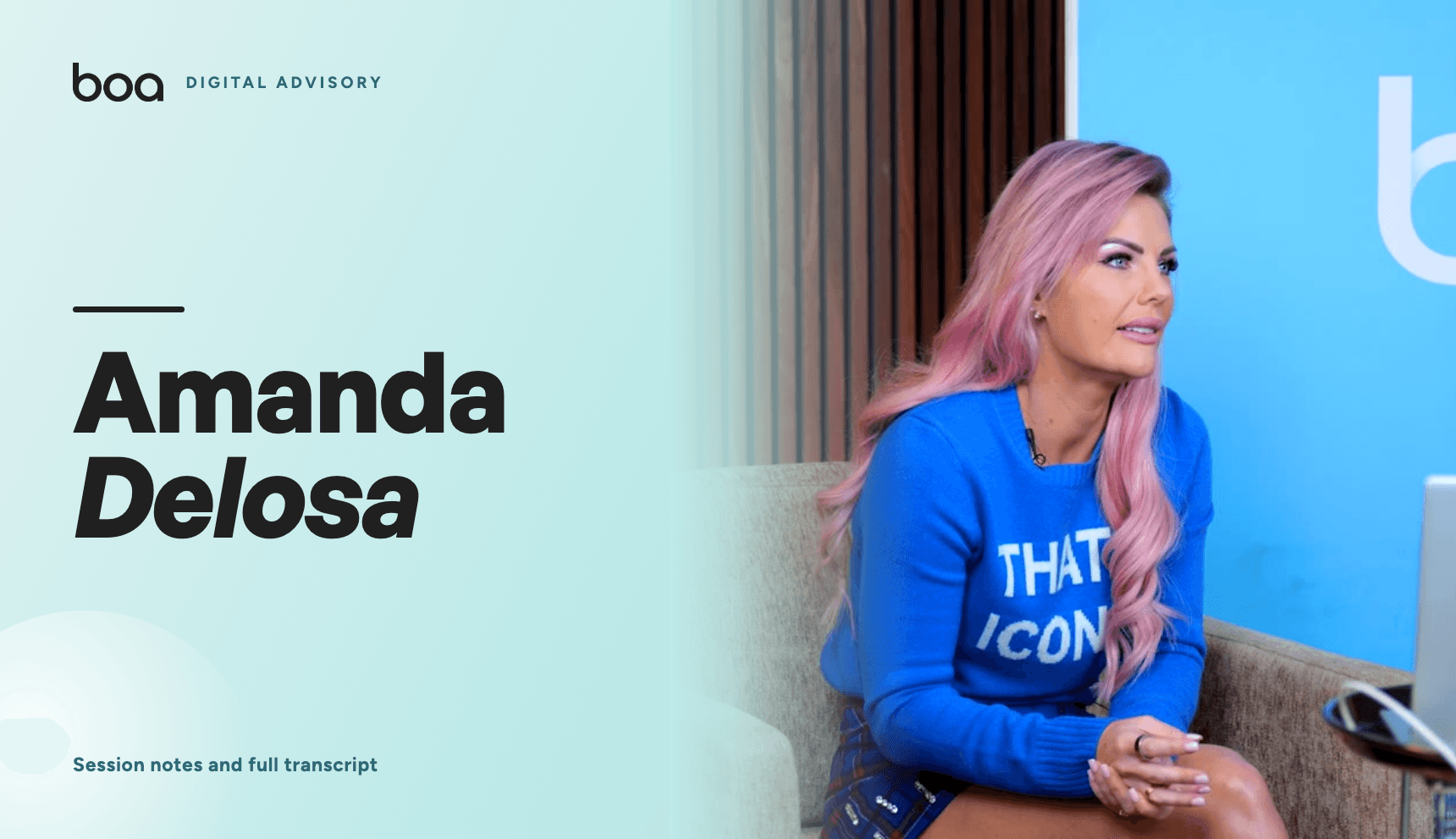
Amanda Delosa on Getting Your First Podcast Interview
With Amanda Delosa, Founder at Yellow Panda · Hosted by Kirsten Scott · 37 min
What this session covers
PR founder Amanda Delosa explains how Australian founders get visible without a big budget: land your first podcast interview, pitch journalists with struggle and triumph rather than awards, track views and saves instead of followers, and hire one videographer-producer before anything else.
One well-chosen podcast interview can generate both months of micro content and serious revenue, because an hour of bingeable listening sells you better than any press release.
Key takeaways
- 01
Treat your first podcast interview as an audition for the next ten
Amanda's method: listen to a few podcasts you admire and write down the questions that come up every time (your backstory, a time you thought you'd lose everything, your proudest achievement). Workshop punchy, succinct answers with anecdotes before you pitch anyone. Then chase one interview and treat it as the audition that gets you on other shows. She calls it a concertina effect, and it started for her more than ten years ago as a guest.
- 02
One podcast interview generated around $500,000 in revenue
Amanda went on Mark Boris's show Mentored during COVID. Listeners who sat through an hour of her talking arrived already sold, doing ten minute discovery calls and paying large invoices to start a strategy. She estimates that single interview generated roughly $500,000 in revenue. That is why she calls long-form the bingeable content: an hour builds trust that a reel cannot.
- 03
Cut one interview into three months of micro content
Any podcast interview you do can be snipped into micro content. Amanda says some founders get about three months of posts from one recording. So go after the big pinnacle piece first and break it down, rather than trying to invent fresh short-form ideas from scratch every week.
- 04
Never pitch a journalist your award or your book
Amanda says the two most common pitches she gets asked to make are "I've won an award" and "I've written a book", and media do not care. What lands is real stories of struggle and triumph, lessons taught through failure, or a genuinely unusual human interest angle. Read the last two or three articles from the publication you want, identify the themes, and pitch into those.
- 05
Write the subject line as the story, then lead with three bullets
Roughly 93% of pitch emails are deleted without ever being opened, so you have about a 7% chance of being read. Amanda sells the story in the subject line in as few words as possible. Then she opens every press release or pitch with three strong bullet points at the very top, often statistics, because journalists skim before they decide.
- 06
Track email opens, then follow up once and move on
Amanda uses HubSpot email tracking to see opens. If she can see a pitch has been opened ten times, she knows there is interest and follows up with something like "I've seen you've been showing some interest in this, is there any other information I can give you?" One follow-up is enough. Most journalists do not want to be chased by phone.
- 07
Bin the follower count, watch views, saves and DMs
Amanda calls followers and YouTube subscribers vanity metrics. The signals she uses are views and reach, saves (someone found it useful enough to keep) and shares. Then the commercial tests: are you getting DMs, are people coming to you for the exact thing you talk about, and are deals closing faster because trust is already built?
- 08
Have a view people can disagree with
The content that gets the most views is controversial, Amanda says, when you are swimming upstream against the traffic. Work out what you call bullshit on, then say it. She and Jack posted their views on homeschooling their daughter, it ruffled feathers and pulled out both sides, and it caught the attention of 60 Minutes, which led to a national television interview.
- 09
Use your own channels to publish what didn't make the edit
Media will chop and change your story. Amanda's fix is to continue the conversation yourself: she wrote an article for Mamamia going deeper into what did not make the 60 Minutes edit. Self-publishing keeps control of the narrative and gives producers something to find you with in the first place.
- 10
Run a six week experiment on one channel, twice a day
Advice Amanda brought back from Caleb Ralston (who built up the Hormozis' brand) for founders starting out: optimise one channel at a time. Post twice a day on that single channel for six weeks and track closely what is landing in the analytics. Do not spread yourself across LinkedIn, YouTube, Instagram and X at once.
- 11
Your first content hire is a videographer who acts as producer
Amanda says you can dominate with a two-person team. Hire one strong videographer first, who brings you hooks and title ideas, films, edits, repurposes micro reels and understands your brand, then add a backup video editor. Video editors are the number one skill set being hired for right now. Vet on portfolio: have they actually worked with businesses and personal brands, not just clipped timestamps? Avoid grabbing any cheap editor off Fiverr.
- 12
Script for a 12-year-old and hook in three seconds
Amanda's biggest fix for founder video is the scripting, not the camera. You have three seconds to hook someone, so the hook gets written first. Then strip the jargon until a 12-year-old would understand it. Use ChatGPT to refine your own words, but never copy and paste it in, because nothing destroys credibility faster than letting a tool speak in your voice.
How the session runs
- 1:07Real estate, politics and starting Yellow Panda
- 4:40Founders who refuse to be the face of the brand
- 5:58Why courses and cookie cutter agencies fail
- 8:17Finding your angle and taking a stance
- 9:56One message, tailored per audience and platform
- 11:35Metrics that matter: views, saves, DMs
- 12:47Founders as their own media brand
- 14:27Podcasts as the cheapest way to get noticed
- 15:42How to pitch media from scratch
- 20:02Q&A: pitching yourself with no profile
- 22:26DIY PR versus hiring a publicist on project fees
- 25:15Hating your voice and your face on camera
- 28:06Scripting, hooks and the ChatGPT trap
- 30:15Short form as the net, long form as the close
- 34:02Caleb Ralston's channel experiment and team build
Mentioned in this session
- Yellow Panda
- Next Season (NXT SZN)
- Ray White
- 60 Minutes
- Mamamia
- Mark Boris
- Mentored
- HubSpot
- Canva
- ChatGPT
- TikTok
- YouTube
- X
- Fiverr
- Netflix
- Boa App
- Coastal Girl
- Channel 9 News
- Australia Post
- Sarah Davis
- Caleb Ralston
- Alex Hormozi
- Fiverr
Questions founders ask
Amanda says a lack of profile should not hold you back, because guests without a profile are often more interesting than the same faces telling the same story on every show. Build a one page pitch doc in Canva with a photo, your background, your elevator statement and a list of talking points you can speak to. Add one unusual fact about yourself. Then start reaching out.
If doing it yourself is the only option, do it, and note that some journalists prefer hearing directly from founders rather than agencies. Amanda also favours delegating so you stay in your genius zone, and points out you can hire a publicist on a short project fee, for example buying a set number of hours to push one thing for a month. The test is what your time is worth and whether you are better off in the engine room growing revenue.
Forget follower counts and YouTube subscribers, which Amanda calls vanity metrics. Look at views and reach, saves (proof someone found it useful) and shares. The real proof is commercial: DMs coming in, people approaching you about the thing you talk about, and conversion rates improving because trust already exists.
No, they do different jobs in the funnel. Amanda describes short content as the net you cast wide to build top of funnel awareness, catching everything. The bigger pieces work at the consideration stage, where an hour of listening builds enough trust to convert. She has seen video sales letters running a full hour perform well in the US.
Amanda's reframe is that your voice and your face are what make you different, so turn them up rather than hide them. She uses the moon analogy: photos never do it justice, and most of us do not do ourselves justice on camera either. You also want content that filters people, keeping the right audience in and the haters out, because you will never be everyone's cup of tea.
Full transcript
The complete conversation, as recorded, with every speaker attributed.
Kirsten Scott0:00
Look, I'm going to kick things off straight away because I feel like we've got a lot to get into this morning. Um, I am here with Amanda De Losa. She is the founder of Yellow Panda, which is a leading PR agency helping brands get seen, heard, and remembered. And she's also the host of top-ranked podcast Next Season. If you haven't checked it out yet, I definitely recommend it. Um, but I'm going to dive straight in. So we are going to do a round of this or that just to get to know you a little bit better. So whatever word aligns the best, just scream it out. Okay, so tea or coffee? Coffee. Me too. Big bang launch or slow drip campaign? Big bang.
Boa host0:36
Yep.
Kirsten Scott0:37
Texting or calling?
Amanda Delosa0:38
Texting.
Kirsten Scott0:39
Same. Morning hustle or late night grind?
Amanda Delosa0:41
Morning hustle.
Kirsten Scott0:42
Podcast or book? Podcast. Uh, create a creative brainstorming strategy deep dive. Can't get my words out this morning.
Amanda Delosa0:51
Uh, I'd say strategy deep dive.
Kirsten Scott0:52
I love that. Big visionary goals or small daily wins?
Amanda Delosa0:56
Oh gosh, big visionary goals. The bane of my existence. Is it?
Kirsten Scott0:59
Oh, I love that.
Boa host1:01
Okay.
Kirsten Scott1:01
And share the journey or highlight the outcome?
Amanda Delosa1:04
Share the journey. Yeah, that's cool.
Kirsten Scott1:07
Okay. So can you share a bit about your journey, how you went from launching Yellow Panda to building multiple successful brands?
Amanda Delosa1:13
Yeah, it's interesting because we're just having a little bit of a side chat before we kicked off this morning, and I actually realised that I've probably been in the space for 20 years, so it's giving away my age quite a bit. But because my first sort of, I guess, like professional career was in real estate, a huge part of being in real estate was being able to promote yourself as a personal brand, even though back then there was no such even term for it at the time. But, you know, I remember being pretty creative back then and doing lots of different things. I had this crazy thing that I used to do, a community garage sale event where I would go to my patch, you know, where I was trying to, you know, obviously find places to sell and I'd offer for everyone to be able to be included in an advert and have like a consecutive day where everyone did a garage sale on the day and made it like a big thing. So the whole entire suburb essentially would be a garage sale. So you'd have like so many people coming through and then I'd have my Ray White signs with my names on their front lawn with balloons and that sort of thing. So it was just such a good, like, local grassroots. Yeah, like a campaign to actually get my name out there in such massive force and get media coverage and that kind of thing. So, you know, this is 20-year-old me sort of coming up with these sorts of ideas and going to my— back to my high school and teaching and doing mentorship for Small Business Week for students and that sort of thing. So like, I've always been sort of creative with that sort of thing, thinking outside the box.
Boa host2:25
Yeah.
Amanda Delosa2:26
But it wasn't until I did my communications degree at university, which I graduated with a double degree in journalism and public relations, and I was offered a job in politics. I didn't actually see myself ever working in politics. I completely changed my identity to belong there for the 6 or 7 years that I was there.
Kirsten Scott2:41
No pink hair.
Amanda Delosa2:42
We had dark brown hair, we had grey outfits. It was, yeah, very, very bland. But yeah, I sort of cut my teeth in communications working there and working in one of the most hottest contested seats of the 2013 federal election. So my job as a communications advisor back then was to literally organise like the press conferences and take the Prime Minister out to local businesses and that sort of thing, and ministers and all this sort of thing. So when I'd go out to small business and we'd sort of tee up having a Prime Minister or Minister come and visit, part of the process was actually getting to know their story, finding out how, you know, they were sort of showing up online, that type of thing. And so many of them weren't telling their stories. They weren't doing any social media. They had incredible, you know, small business storeys and human interest storeys that just weren't getting a run. So I found myself kind of just helping them out of a love job at first, just giving them tips and advice. To sort of help them get more sort of awareness. I realised that's where my passion really was. As politics burnt me out, I kind of become very disenfranchised with it. As you could imagine what it would be working in politics for a while. I want to choose my craft for good, not evil anymore. So I saved up 3 months worth of mortgage repayments and savings. Like I called it my oh shit fund. And I thought, you know, I'll go out on my own and I'll contract for a bit. And if worse comes to worse and it doesn't work, I'll just go back and get a job. And so my first, you know, goal was to replace my income in the first 12 months, which I did. And then beyond that, I just wanted to make sure I doubled my revenue year on year, which is, which is what I did. And then, yeah, during COVID had the biggest year on record with my business. Things really took off because what did everyone need during COVID They needed to stand out online. So that's where, you know, it kind of all really kicked off for me. And a concept that I was talking to people about, you know, back in 2017, '18, most founders had no idea what personal branding was or why they needed it. Today is seen as something that is, you know, we just can't not have it.
Kirsten Scott4:40
Exactly. Yeah, people want to know the authentic you. Yep. Yeah, I also love the fact that you went all in, which a lot of people in our community are currently in the same boat or they've been there before. Um, so what mindset shifts do founders need to adopt to set themselves up for success? So for example, how can they overcome imposter syndrome and find the motivation to truly build their personal brand?
Amanda Delosa5:00
Yeah, that's the biggest one. So there's a lot of founders who just plainly say, I don't want to be the face of my brand. I don't want to put myself out there. They might be an introvert, they might be shy, but unfortunately, like, it's your job to do that. You know, as a founder of a company and the leader of your organisation and the person who's, you know, supposed to be guiding this whole mission, you have to put yourself out there. And if you're not, you're essentially leaving money on the table. So sometimes you've just got to change the mindset and the motivation around like, why am I doing this? Yeah, it's scary, but I'm literally leaving money and opportunity on the table if I don't. Like you can still get there. It's going to take you so much longer and you're going to spend so much money on finding other ways to show up.
Kirsten Scott5:41
Yeah. It's really hard to compete in like a saturated market.
Boa host5:44
Yeah.
Kirsten Scott5:44
If others are getting their brand out, like their personal brand out there and you're not.
Amanda Delosa5:47
Yeah. Well, that's exactly it. Yeah.
Kirsten Scott5:49
Yeah. I love that. Um, what are the common mistakes founders make when starting to grow their personal brand? And do you think some burn out or give up even before they've like begun that journey?
Amanda Delosa5:58
I think it's just a strategy, uh, sort of. Answer for that one. A lot of— we'll put it this way— there's a lot of information out there on what you should be doing to build a personal brand. And if I see my role as someone who's been in this industry for around 15 years to be the one with the rock throwing at the glass houses. So you're not going to go buy a course and then all of a sudden be able to like crush it in a personal brand. You're not going to be able to go work with an agency who promises to create all of your content for you because it's just going to be cookie cutter, boring stuff that just doesn't land. You're not going to be able to be on every single platform and posting to LinkedIn, YouTube, Instagram, X, like all of them at once.
Kirsten Scott6:37
And it's also not your authentic voice if you are doing that.
Amanda Delosa6:40
Yeah, no, exactly. So a lot of it comes back to just the basics. It's really about like understanding who you are, what your message is and how you're trying to show up and be different. But then actually having a plan that you can then go out there and try and deliver this across whatever channel you choose. But being, I guess, realistic in what you can actually do yourself or being realistic or having really good understanding around the type of team that you need to do it. So a lot of people waste a lot of money and time on team and agencies and trying different people or hiring a social media manager or like whatever it might be. The best people in the industry, the people who are responsible— I mastermind with these people all throughout the US. I've done 3 conferences this year. A lot of experts in personal branding have been there. And, you know, even they're still figuring out how to sort of put the best teams together and what they should be doing and how many platforms.
Kirsten Scott7:28
Like this space changes between like industries and brands and everything else?
Amanda Delosa7:35
I think it changes just in that some are willing to go all in and they have extremely big budgets to do so. Some decide to dominate different channels as well. But the ones that, yeah, the ones that seem to be doing really well are the ones that are going all in and have built out really impressive teams. And so that's something that people need to be mindful of because I remember starting out in my business and seeing people crushing all the time online and just thinking I was a loser. Like, why is everyone else doing so much better than me? Why is everyone showing up everywhere and thinking like, you know, like it was with within me to be like on that level, and there was something wrong with me and I wasn't working hard enough. But when you really look at it, sometimes it's just that they have more financial backing, more support, more experts.
Boa host8:15
Yeah, helping.
Amanda Delosa8:16
Definitely.
Kirsten Scott8:17
It kind of leads us into the next question. So how can founders identify the unique storey or angle that sets their brand apart?
Amanda Delosa8:24
Well, this is like this whole like really understanding yourself piece. So I remember when I first started doing the personal branding work with clients, one of the biggest unexpected takeaways for them was how much they actually got to know themselves. Like, it was psychological, sort of spiritual, I guess, process in understanding, you know, their values, you know, what they care about, what they call bullshit on. That's a huge one. Like, honestly, like, if you see some of the content that actually lands and resonates and gets like the most views these days are controversial statements. It's when you're swimming upstream or you're going down the other side of the highway when the traffic's sitting there parked on the other side against you. So it's about actually having some balls, I guess, and being able to stand by some convictions. A good example of that that's worked out for myself and Jack is our views obviously on homeschooling our daughter.
Kirsten Scott9:16
Yeah.
Amanda Delosa9:16
And so some content had been going out on his channels around that. You know, it ruffles a lot of feathers, it kind of pulls the for and against out. That caught the attention of 60 Minutes and we ended up doing a 60 Minutes article— sorry, 60 Minutes interview with them, which is, you know, the biggest national television show in the country. So it just shows that if you have a little bit of bravery around it and be bold, that's the whole thing with personal brands.
Kirsten Scott9:40
Everyone's going to agree with you and that's okay. Yeah, yeah, yeah, definitely. And guys, just a reminder, if you have any questions for Amanda, pop them in the chat and you'll be able to ask her directly a bit later on. Okay, so how do you craft messaging that resonates with investors, media, and customers simultaneously?
Amanda Delosa9:56
Well, your message is essentially you, and so you don't want to be showing up as different people to all of these audiences. What you need to be thinking about is the audience and the platform and the style of communication more so than the message. So message should stay consistent. But then it's tailored to the audience. And I think another way of looking at that is thinking about what is in it for them as opposed to like just what you want to toot about your own horn. So whenever I write something or whenever I think of creating some content, even a press release, right, it's got nothing to do whether about whether I think it's good or it makes me feel warm and fuzzy inside. It's if you literally ask the question, what's in it for them?
Boa host10:39
Yeah.
Kirsten Scott10:40
What are they missing? What am I helping? What am I?
Amanda Delosa10:42
Yeah.
Kirsten Scott10:42
Like, what are they what are they actually going to get from this?
Amanda Delosa10:44
If it doesn't actually add value, make them laugh, or elicit some kind of an emotional response in them, then it's just not going to land.
Kirsten Scott10:51
Yeah, we always hear about those pillars— the entertainment, education, like all— yeah, the different ones.
Amanda Delosa10:57
Yeah.
Kirsten Scott10:57
And I guess it lands across all platforms as well. Yeah.
Amanda Delosa11:00
And even more so now because particularly the entertainment piece, you know, spending some time in the US recently and looking into some of the, you know, amazing examples of video content that's been created now, like, oh, it's insane. These are all-out productions, like every 2 to second something's changing. You've got the most random stuff going on. There's humour injected. They're like Hollywood blockbusters for founders, essentially. But these are the ones that they're getting the most views, essentially.
Kirsten Scott11:28
100%. I mean, I'm the sucker for it. Yeah. And other simple ways to test if your messaging is actually working.
Amanda Delosa11:35
I think seeing if you're getting DMs is a good way. Like, are people actually reaching out? In terms of analytics, I think the most important thing to do now is there's a lot of vanity metrics out there still. I think we need to forget about thinking about how many followers we have. We have to not be thinking about how many subscribers we have on YouTube. What we should be looking for is views and reach. Yeah, saves a good, a good indicator. Yeah, someone found that very useful. They've saved it. If they're sending it, another great thing.
Kirsten Scott12:03
Yeah, but yeah, essentially like at least for Instagram, it shows those analytics really clear on your own profiles.
Amanda Delosa12:09
Yeah, but it's like it's sales really. It's like, are you getting DMs? Are people coming to you for the thing that you're talking about in your content or are the conversion rates of the thing you're selling or doing seem to be closing a lot easier as a result of people having more trust in your brand. Definitely.
Kirsten Scott12:28
I mean, I know at least for Boa App, we see an influx of like new users come on board or premium takers or like whatever it might be.
Boa host12:35
Yeah.
Kirsten Scott12:36
Okay. So traditional PR often meant being in the media to get featured. How has this shifted towards founders and acting as their own media brand distributors to get, picked up?
Amanda Delosa12:47
Yeah, it's interesting. So some of the top entrepreneurs with millions of followers that are making the big bucks essentially all have their own media teams now. So they have their own media agency or media business within their organization. And we're still seeing traditional media pick up from that because, as the example that I gave earlier about the 60 Minutes interview, they're still looking at what you're doing online. So it's about self-publishing to be noticed. There's more control over the narrative and how you show up because even, you know, you know, 60 Minutes didn't include everything that I said in the interview, they're going to chop and change, you're going to edit you, you know, you've got more control over that. Um, but that's not to say, like, a good, a good takeaway even from that is if you ever— and this is a bit of a random thing— but if you ever are not misquoted, but if you don't get to get your full storey across in one sort of media outlet, you have the opportunity to continue that conversation through your social media channels. Or in my case, like, I've written an article recently for Mama Mia that dives deeper into what didn't, what didn't make the edit type thing. Um, so yeah, essentially it's about having more control, uh, and more opportunity to, to be found.
Kirsten Scott13:52
Yeah, I, I want to share another example. Um, we actually have a user, Coastal Girl, on our app, and they went, um, on Channel 9 News, I think it was, because Australia Post lost a whole thing of all their packages, like thousands of dollars.
Boa host14:05
Yeah.
Kirsten Scott14:05
And they reached out and they had all these interviews. And not only did they like have a bit of disruption being able to get in the news and do that, they were able to follow through on their social media with like the things that got missed like in the media. So I think it's really cool to be like that point of difference and then share your story.
Amanda Delosa14:20
Yeah, definitely.
Boa host14:21
Yeah.
Kirsten Scott14:22
So what are the most cost-effective ways to get noticed without having a dedicated budget?
Amanda Delosa14:27
I think the best thing anyone can be doing in this day and age is getting themselves on podcasts. And the reason being is I had my own experience with this. I know you guys are big fans of Mark Boris, but I went on his show, mentored during COVID and that one interview, which essentially we classify as bingeable content, because if someone's going to sit there and listen to you for an hour talk about something, by the end of it they're going to be pretty sold on you, right? But I literally had clients ringing, doing a 10-minute discovery call with me and paying like a massive invoice to start a strategy off the back of it. It generated one interview, generated probably $500,000 in revenue, uh, and then that interview as well, like any podcast interviews that you do, can then be snipped up, right, into all of that micro content. So some people can do one podcast interview and literally end up with like 3 months worth of content. So it's a smart way of doing it, like going after this big pinnacle piece of content that can be broken up into smaller pieces. Um, and yeah, I mean, before you do that though, there are some other steps, but I think we'll get to that in a second anyway. I think it might be coming up, but I would say like just go and find your first podcast interview.
Kirsten Scott15:28
Yeah, I think that's great advice.
Amanda Delosa15:30
Start one yourself. Yeah.
Kirsten Scott15:31
Because even if you're that like voice of authority, again, you can always like repurpose the content. Yeah.
Boa host15:36
Yeah.
Kirsten Scott15:36
So how do you approach pitching to media or partners when you're starting from scratch?
Amanda Delosa15:42
Very important to not be pitching them things that they're going to roll their eyes at. So I'll tell you straight off the bat, like they don't care if you've won an award or you've written a book. Like they're probably two of the most common ones that I used to get. People ask me, can you help me? I've just written a book, or can you help me? I've just won an award. It's like they don't care. What they care about are real storeys of struggle and triumph where you can show, you know, teach lessons through failure or really interesting, unique sort of human interest piece as well. Like, I think the main thing is know what kind of storeys land and you can do a little bit of research. You can literally go and look at the publications that you want to be featured in and have a look at maybe 2 or 3 of of the last, you know, articles that they wrote, have a look, identify some of the themes in there. And then when you reach out, you're just wanting to make sure that like your subject line in your email is like selling what that is in fewer words as possible. The statistics are around 93% of emails just get deleted and never even get open. So you've got like a 7% opportunity to even have your email read. Another thing I really like to do with any kind of press release or pitch out that I do is to have 3 really strong bullet points at the very top that basically could be statistics or like just stuff that like you just need them to know, uh, because a lot of the time they are just going to skim. They're going to just skim and delete or not even open in the first place.
Kirsten Scott17:04
So would you send that same email like multiple times, or what's the approach with like consistency?
Amanda Delosa17:09
Yeah, so I use HubSpot to email track so I can see the opens. So I will send it out and then I'll go and see like, you know, is someone actually mulling over this? Because like sometimes I can see something that's been open like 10 times, like I know they're interested. So that's a good tool to then go, hey, And you can tell them because a lot of people use HubSpot. It's not like a dirty spy, no, you know, secret agent type tool. But you can literally— I've seen that you've been showing some interest in this. Is there any other information I can give you? Something like that. Generally, like one follow-up is enough and then you can move on. Some journalists don't like being hassled on the phone either. I think most of us don't really—
Kirsten Scott17:45
in the junk after that.
Amanda Delosa17:47
Yeah, yeah. I think if it's a really good pitch and you email it to the right person, you follow it up. If it's going to land, that's, that's enough. Enough to get it across the line without turning into someone who's just harassing the shit out of them.
Kirsten Scott17:59
That's great advice. Um, don't be that crazy ex-girlfriend, basically. Yeah. Um, so if founders could only implement one, uh, practical strategy this month to boost their visibility, what would it be?
Amanda Delosa18:12
Again, we're going to go back to the podcast thing, but what I would suggest, and this is how I would do it, um, I would watch a couple of your favourite podcasts, um, whatever they might be. Listen out for the common questions that are asked. Now, they're generally things around like, tell me about your backstory, you know, tell me about a time when you thought you were going to lose everything, like, what's your proudest achievement to date? Like, there's these common questions that you get asked all the time. So it's important to workshop those and have really good, punchy, succinct answers with some, you know, clever anecdotes and stuff thrown in as well. Um, so do your research, almost like preempt your questions, write your answers, and then go after your first podcast interview and treat that as if it's an audition to get you on other shows. Because once you've done that first interview, that can literally be what creates all of these other opportunities. You know, it's like a concertina effect. I know it was for me. I started doing podcasts, gosh, probably like over 10 years ago as a guest. Um, and so now I think with my show, like being a host, I had so much practise being the guest that when I interview people, like, I'm really listening out. Yeah. Uh, I don't need to really prep.
Kirsten Scott19:17
Are you quite selective with how you approach, like, do you think about your own brand in terms of who you want to get on your podcast, or is it more about their journey and wanting to highlight that?
Amanda Delosa19:25
I definitely, for me, I'm very, I'm very like, I need to have values alignment and I'm all about having ethical people around me as well. So I can be quite selective on that. But in saying that, I don't want everyone who thinks like me. I love being able to sit down with someone and have like a debate or discussion that has a different opposing view. And that also makes for the best, you know, content as well. So yeah, but generally another thing that I look out for, and this is more of a strategic thing for anyone who is trying to build out a podcast, is literally looking for people who have decent following audiences as well. Because one of the best things you can do is just find people to collaborate with to like borrow their audience as well to get extra exposure.
Kirsten Scott20:02
Like collaboration is king, like leverage each other's communities. Yeah, yeah, I love that. Now guys, we are going to open it up to Q&A, so if you do have any questions, please pop them in the chat now. Um, Antonella, I know you have a question. So there, oh, there we go. Just around how can you be on somebody's podcast, you yourself don't have a profile.
Amanda Delosa20:32
I think it'd be pretty easy to create a profile. So I think the first thing would be to try and put like a one-page sort of pitch doc together of like who you are, your background, your CV, you know, the elevator sort of statement that you say when you enter a room and people ask you out. I think it's there. I think you probably just don't have the infrastructure yet to like formally pitch yourself, but I wouldn't let that hold you back because sometimes like the people who don't have profile yet could be like the most interesting person to speak to and not heavily saturated across everyone else's shows. Like, I hate seeing the same people on every single show because they tell the same story.
Boa host21:04
Yeah.
Amanda Delosa21:05
So I, yeah, I wouldn't let that hold you back. I would, I would get to sort of creating a one-page brief. You could do it in Canva, put a picture in there, you know, talk a little bit about yourself, what sorts of things that you could talk about. So call them the talking points. So like, I could speak to this, this, this, this, this, here's a very unusual fact about me. Like, there's, there's definitely ways you could put something like that together and start reaching out for Sure.
Kirsten Scott21:26
I also, um, Sarah Davis— thank you, uh, Sarah Davis. We had an event with her recently and she gets all random guests on hers. I know that Ian Headley, he's not on social media at all, um, but people like that— he's like in the forensic violence kind of space and people are really interested. So whatever you're an expert in, I'm like, share it and people want to know about it.
Amanda Delosa21:47
Yeah, even, even with me, there's been some, um, women who are like Obviously with my show, we look at a lot of women's issues, women who are like in their 80s who have had really amazing careers that are not on social media at all. But can you imagine their stories? And you know what I mean? Like there's still, there's still this need for people to come and share their wealth of knowledge if they don't have a profile.
Kirsten Scott22:09
I agree. Yeah. So get out there. Sandra, you want me to read it for you though? She's a bit shy. Thoughts on jumping on the podcast train? And do you own your own PR? Sorry. Thoughts on jumping on the podcast train and do your own as PR for your business?
Amanda Delosa22:26
Yeah, I think if the only option is to do your own PR to start out, then I think that's great. And I also know that some journalists actually favour hearing from founders direct than PR agencies. It's a bit of like you kind of got to try a little bit of everything. But I think that it's, yeah, like if you have to do it yourself, do it yourself. I'm also a big fan of delegating out the tasks to more professional people. That means you can stay in your genius zone. You've really got to work out like what your time is worth.
Kirsten Scott22:52
Worth?
Amanda Delosa22:53
Is it worth you actually doing all your own PR? Is it actually worth you doing all of your own podcast reach out? Or is it better off that you stay like an engine room of your business and grow the revenue there and outsource it? There are some options, you know. You can get a publicist on a contract, like a temporary contract. I sometimes do that, like just project fees. I'll be like, oh hey, I just want to have a— I just want to spend the next month really pushing this one thing. Can I just buy X amount of hours? So yeah, so there's, there's so, there's so much flexibility out there. It's really about understanding what works best for you. So you need to understand like like, where do you really need to be spending the core of your focus right now and not diluting yourself too much?
Kirsten Scott23:28
Definitely. And like, do you also think like if you're comparing like PR versus like founder journey on your socials and whatever else, like I guess if you don't really have the budget spend, you can just focus on like sharing more on your socials and building confidence in that space?
Amanda Delosa23:41
Absolutely. Like jumping on a camera and talking down the lens and sharing storeys is like one of the, the best personal development sort of practises that you can go through, because we all suck at first. Like you even go back and look at some of Layla's—
Kirsten Scott23:54
almost— these things, right?
Amanda Delosa23:55
It's so cringe, you know, when I get the reminders through on my social media of stuff that I was putting out 10 years ago, like, I'm like, oh my God, you've got to suck.
Kirsten Scott24:02
You're like, oh wow.
Amanda Delosa24:03
Yeah, you've just, you've just got to suck. You've got to be able to look back and laugh on you because laugh on yourself, because at the end of the day, it's about progress, not perfectionism. Like, you'll never be perfect, but you'll grow. And there's something really humbling about that. And also people respect you so much for being brave enough just to go out and give it a crack. Yeah. And the people who will most likely judge you will be be— and this happens a lot— will be family and friends. Yeah, it'll be people who are like, oh, you think you're like some big-time entrepreneur, like the tall poppy syndrome. Yeah.
Kirsten Scott24:34
And it's like, never any other founders. Never in my life have I looked at someone's storey and thought that.
Amanda Delosa24:38
Yeah.
Kirsten Scott24:39
But it is like the friends and family piece. Yeah, genuinely care about you, but it's like they're too scared to do it themselves, I guess.
Amanda Delosa24:44
Yeah, a lot of the time that's what it is. So you've just got to drown out the noise. And like, that's why it's good to have communities like this, right? Because you can literally go and find some people that could be accountability buddies who want to be on the same journey, and you can all egg each other on and stay in that like positive mindset of actually like doing it.
Boa host25:03
Definitely.
Amanda Delosa25:03
Without the other people who you would never go to advice forever drowning you out.
Kirsten Scott25:08
They're not in the same experience. No. Like they couldn't understand. Um, Michael.
Audience member25:15
So this is something I hear from people a lot that I try to help or work with, like, is when trying to encourage them to, you know, create posts or maybe get on a podcast or something. Yeah, but I don't like how I look. I don't like the sound of my voice. I'm just wondering if you've had any, like, I'm guilty of that, work with people like that and help improve their, not necessarily confidence. I mean, I think that they're all really knowledgeable about what they do and have a good storey to share, but I think just like that's a sticking point for them wanting to like be the centre and face of their brand or content that they create. Really?
Amanda Delosa25:53
Yeah, I think the reframing that is understanding the power of how epic is it to have this unique voice, how epic is it to look this certain way, because these are the things that define me and make me different to everyone else. So I'm just going to turn that up and ramp that up. And for people who don't like the way they look on camera and that sort of thing, I saw this really cool meme the other day, uh, how many people have taken a picture of the moon and gone, oh, it doesn't do it justice, Oh, you know, the moon is stunning. It is beautiful. We look it up, up at it and just go like, that is incredible.
Kirsten Scott26:23
Like, absolutely.
Amanda Delosa26:24
But you try and take a photo of it. Everyone will say it doesn't do it justice. So a lot of the time we're not doing ourselves justice. And it's so— you've just, you know, it's a, it's a confidence thing. It's like, just own it. Like, that's all you can do. You have a choice. You can either let it be something that limits you and holds you back, or you can run with it.
Kirsten Scott26:41
Yeah, it's a great analogy.
Amanda Delosa26:42
Yeah.
Kirsten Scott26:42
And to be fair, Michael, like, I'm definitely guilty of that. I hate sharing things or speaking like on my Instagram storeys and that, but If you look at other founders' things, not once do you think, oh, that person's voice or this or that. If anything, you're like encaptured by like what they're storytelling or whatever it might be. You never like judge that.
Amanda Delosa26:59
But in some instances, you might not like the way that they show up and you might not like their voice and you might not like their message and you might not like their face, but that's okay.
Audience member27:07
Yeah.
Amanda Delosa27:08
Because you also want to make sure that you're attracting people who actually like you.
Kirsten Scott27:11
Definitely.
Amanda Delosa27:12
You don't want people who are wishy-washy. So, I mean, it can also act as a deterrent. It's like. If this is the wall, we only want to let these people over the wall who deserve our time and our energy, and we want to keep the haters on the other side of the wall. So I mean, you know, we can't— we literally cannot please everyone. We're not everyone's cup of tea. We never will be. Um, so yeah, again, it's a superpower, right? It's a superpower to, to attract your own tribe in.
Kirsten Scott27:37
Yeah, I agree. Um, Caesar, did I see a question come through for you?
Boa host27:43
It is. Hi, Amanda. Hi.
Amanda Delosa27:47
That's amazing.
Boa host27:48
Amazing. Today has been so great. I love it. In your experience, what is the biggest mistake founders make when they try to communicate their brand storey on video or podcast? And to second that, what should they focus instead of make people actually be connected to them?
Amanda Delosa28:06
I think the most important thing is it's in the scripting. So having really strong hooks that actually resonate and that needs to be delivered like, you've got 3 seconds to really hook someone. So it really comes down to the strategic communication and scriptwriting first and foremost. Then it comes down to being in plain language that a 12-year-old could understand. A lot of the time, particularly people in industry, we fall into the trap of talking in jargon and not everyone understands different terms and that sort of thing. So a lot of it is about preparing scripts. You know, I know Jack, he spends a lot of time, you know, preparing his scripts for socials. I do the same thing. Like, I'll just sit down, I'll jam with things like ChatGPT to help me sort of refine it. Although I I also want to say we have to be really careful not to outsource our, um, our own opinions and thought process to ChatGPT. I have been seeing lately so many people copy and pasting ChatGPT into the copy of their social media scripts, or, you know, you can tell, you know, there's certain things that you're like, I know ChatGPT did that. Nothing is going to destroy your brand faster than not having credibility of being authentic to your voice and letting someone else speak for you on your behalf. Like, it's a big trap. So I think being really intentional that using your voice and the way that you speak and communicating in a way that will, you know, land with the 12-year-old and having a really strong hook and avoiding the waffle because people are time poor. One of the, one of the analytics that recently came out at Instagram that's favouring views at the moment is these 7-second loop reels because they're favouring replays.
Kirsten Scott29:38
Yes, I literally saw that this morning.
Amanda Delosa29:41
So yeah, short, succinct, to the point. Point, cooking. Hope that helps.
Boa host29:47
That's amazing. Thank you very much. That is good. I do a lot of training, grounded storeys for people, and what I found is when the people really tell, you know, authentic story, they resonate down below with the teams.
Amanda Delosa30:01
It's great. Keep it up.
Kirsten Scott30:03
Awesome. Does anyone else have any questions for Amanda?
Amanda Delosa30:11
Michael, do you have another question?
Audience member30:13
Yeah, yeah, I've just got another one.
Kirsten Scott30:15
Go for it.
Audience member30:16
I was thinking about this difference Ica talked about with the short attention span with like videos like Instagram or any TikTok, but then you've also got this really long attention span with like podcasts. Do you think like it sort of speaks to potentially contradictory behaviours in audiences, or is it complementary in some way because it sort of fits different needs for, for them to like listen to storeys or share stories?
Amanda Delosa30:47
Essentially, they function as two different sort of roles. So the shorter content is more about capturing people in the net. So we're going fishing and we're just going to catch everything, right? By the time we filter those fish through our net and we sort them out, there might be a couple of big giant goldfish, um, that would be interested in sitting down and bingeing on an hour's worth of our content, AKA listening to a podcast. So it's, it's kind of like the funnel process. It's like the shorter stuff is just to grow awareness, um, but those larger pieces help within the—
Kirsten Scott31:18
reel them in.
Amanda Delosa31:19
Yeah, so look at the marketing funnel. It's like awareness, top of funnel. So it's like all top of funnel. But when we get down to the consideration phase of a funnel where someone's looking to make a purchase or make a commitment to you, if they watch an hour of you and they grow and like and trust you in that hour, it's this— it's— they call it brand width. Then they're sold, you know, that, that serves the purpose of getting them through. And some of the video sales leads that— some of the best examples I've seen in the last couple of months since I've been touring the US have been an hour long. So it's like a video sales lead that goes for 1 hour, but like it's super entertaining and it might be something that looks like a Netflix blockbuster or it might just be literally someone sitting down and drawing frameworks on an iPad that they film from over the top, which I actually find so interesting. Yeah, you can go real lo-fi with it. I'll use another example too. I don't know if any of you have heard of the lawyer. She's @fadantalk. Have you heard of her? Yeah. Oh my goodness. So I was blown away. I heard about her storey recently and I've actually been telling a lot of people about this. She, during COVID couldn't go and do her family law because she's a lawyer, family law sort of info sessions at her local RSL. So she thought, I'm just going to jump on TikTok every day and talk to people. And that's literally what she does there every day without fail since then. She's shown phone up and just hit record.
Kirsten Scott32:33
She just places the phone there.
Amanda Delosa32:35
She is making a salad at her desk at work, talking about making a salad. I'm at work and this is what I do, and I'm gonna go get a wax later. Like, it's seriously like the most random stuff. That one video has 14.9 million views. Huge. Now she has been rewarded by TikTok because their algorithm awards people who are consistent and they never drop back. But she just does something so simple, like there's no editing, there's no flashiness. It's like, literally, have you got 5 minutes a day when something interesting— and it could be even more—
Kirsten Scott33:02
don't be wrong. Curated content does the best.
Amanda Delosa33:05
It does. She does Saturday Platter Day. She goes through the grocery store and jumps on and just like, oh, cheque out this random— it's seriously the most random stuff. I'm like, far out. Like, we kill ourselves trying to think of doing all these big picture flashy, you know, like logical marketing. Totally. You know, and it's something as simple as just jumping on TikTok. Like, I think that would be another thing too, um, for people who don't want to embark on the next thing that they do from here being trying to get on the first podcast, it could be like start posting on TikTok. If you're worried you can't commit to every day, start with 2 3 days a week, because so long as you keep the cadence up of what you're committing to, you'll be rewarded. Yeah. Yeah.
Kirsten Scott33:40
It's great advice. I definitely need to take that.
Amanda Delosa33:43
Yeah.
Kirsten Scott33:43
I'm sure a lot of people on this call do. Um, does anyone have any other questions for Amanda? Otherwise, one thing I did want to ask you, so you've obviously recently got back from the US.
Boa host33:52
Yep.
Kirsten Scott33:53
And I know that you did like quite a few masterclasses and worked with top experts.
Amanda Delosa33:58
Yep.
Kirsten Scott33:58
Is there anything off the back of that do you think like you should share with our community?
Amanda Delosa34:02
Yeah, I think it's, um, useful. I find it very fascinating and I'm always asking questions about like you know, like, who do you get to do this for you? Like, what should the team structure be? And, uh, one of the guys that spoke at one of the events, he actually, um, built up the Hormozes.
Kirsten Scott34:15
Oh my God, I'm obsessed with them.
Amanda Delosa34:18
So it was very interesting to sort of ask him their whole tagline.
Kirsten Scott34:21
I'm like, yes. Yeah.
Amanda Delosa34:23
And he's since gone out and he's doing his own thing now as a personal branding expert. Um, but he had some really good advice for people sort of starting out. It was only try and optimise one channel at a time and conduct like a 6-week experiment where you're posting twice a day on that channel and keeping a real steady look across like what's landing in terms of analytic tracking. Um, and in terms of the team required to do that, he said you can start with one good like videographer hire, but they're kind of a unicorn. You're gonna, you know, they're hard to find. You throw enough money at them, you'll find one. But, um, essentially they act as like a producer. There's someone who can literally come to you with the hooks and the title ideas. Um, there's someone who can film edit, repurpose for micro reels, do your one big, you know, and understand your brand.
Kirsten Scott35:11
YouTube.
Amanda Delosa35:12
Yeah, yeah, it's, it's amazing. So, um, and then he's complemented with a backup sort of video editor after that. And this editor, the first one, kind of follows them everywhere. As you can imagine, you watch these guys, like, they're getting followed everywhere. Um, but yeah, essentially, like, you can really dominate with a two-person team. But the, the number one skill set that people are hiring for, um, are video editors right now. But finding video editors and even going through the vetting process when you find someone, because a lot of people jump on Fiverr and just try and find like any old video editor to cut their reels, or they use like an AI tool that does it, but I'm not a big fan of that. Um, but the biggest thing you want to look out for is like their portfolio. Have they actually worked with business and personal brands? Yeah, because there's, there's some roles in organisations where a person's job is to literally sit in the office 8 hours a day, or at home, wherever they might be, and timestamp those, those magic moments in a conversation to go and then clip up. But you need someone who actually understands what's relevant, and that goes back to understanding the message piece around like, what is in it for them?
Boa host36:10
Totally.
Amanda Delosa36:10
Like, not how cool do I look saying this, but like, you know, what's going to land? What's going to be like an aha moment for someone?
Kirsten Scott36:15
Yeah, I couldn't agree more. Um, actually, Antonella is just asking the gentleman you just mentioned, what's his name?
Amanda Delosa36:21
Uh, Caleb Ralston.
Kirsten Scott36:22
There you go.
Amanda Delosa36:24
Awesome.
Kirsten Scott36:25
Um, well guys, that is the end of it. Thank you so much for joining. This is actually our last Digital Advisory of the year. So we are so grateful to have you with us today, Amanda. If you haven't already, make sure you cheque out her podcast Next Season. That's spelled NXT and season is SZN. I definitely recommend it, um, and we will see you all soon. Thank you. Thanks, guys.
Watch the full sessioninside Boa.
Session notes are free. The recordings, the live advisories and the founders in the room are for members.