Digital Advisory
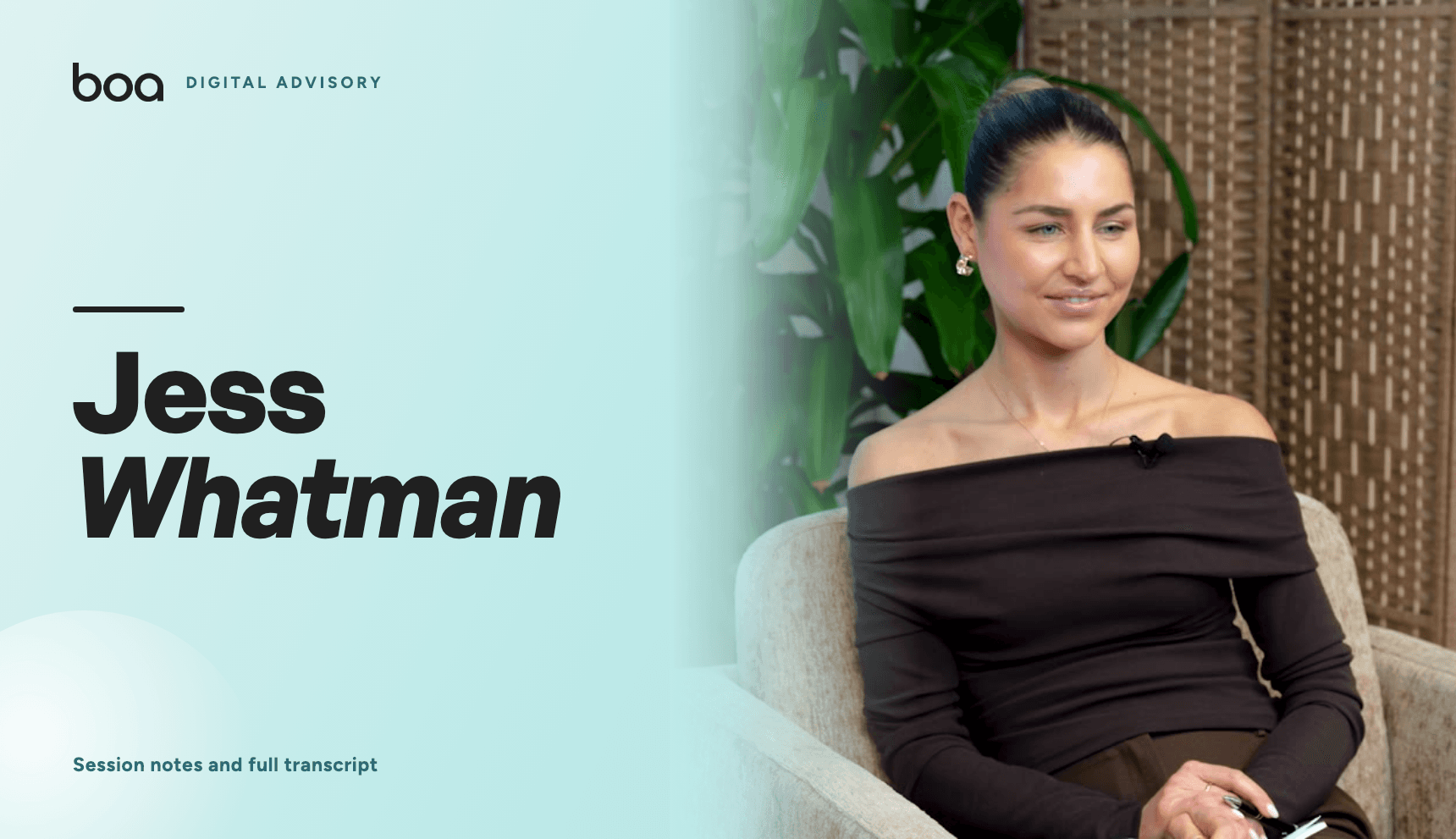
Jess Whatman on Hiring Your First VA the Right Way
With Jess Whatman, Founder at Agencync · Hosted by Boa host · 35 min
What this session covers
Agencync founder Jess Whatman explains how Australian founders buy back their time with offshore virtual assistants. Covers when to make the first hire, the $10 versus $100 task exercise, recording procedures in Loom in five minutes, end of day reports, tracking productivity with Hubstaff, and the recruitment filters that separate a good VA from a bad fit.
Split every task you do into a $10 an hour column and a $100 an hour column, then hand the $10 column to a VA before you get too stressed to hire well.
Key takeaways
- 01
Split your week into $10 and $100 an hour tasks on paper
Jess grabs a sheet of paper and draws a line down the middle, writing $10 in one column and $100 in the other. Every task she does across the day and week gets handwritten into one column. Recording a session where no one else can stand in is a $100 task. Sitting on her phone drafting replies to client emails is a $10 task her team can do.
- 02
Benchmark against your hourly rate before you touch any task
If your hourly rate is $250, do not do work you could pay someone else less than $250 an hour to do. Jess names the usual suspects: social media management, designing tiles in Canva, chasing invoices, data entry. Most of it can be done for $10 to $15 an hour by someone else.
- 03
Build a procedure in five minutes with Loom
When you hit a task you hate, open Loom (free plan, around 100 videos of up to five minutes) and press record on your screen while you do the task, talking as you go. One more click turns the recording into a written procedure. Your VA gets both the video of you explaining it and the written steps, and you have spent five minutes.
- 04
Aim to hand over 80% of a task, not 100%
Agencync sits with clients and maps where their hours actually go. If a task takes two hours a day, roughly 80% of it can usually be offshored while you keep the top 20% and the final check. Accept output that is not perfect. Tweaking a couple of things beats spending the full two hours yourself.
- 05
Run a daily end of day report before you buy project management software
Before Jess used any project management tool, she had VAs send an end of day report. At 6pm she could see what they had completed and what was sitting waiting on her approval. She would approve those items so the VA had work waiting when they logged on in the morning. Tools like GoHighLevel, Trello or Asana work once you are ready, but the report is the habit that matters.
- 06
Hire before you are desperate, not after
Jess's advice to solo founders watching cash flow: start the hiring process when you can see capacity filling up, not when you are already stressed. Desperate founders make the wrong hire or dump a pile of irrelevant tasks on a new VA. Hire early and you can start them on just two or three tasks without overwhelming anyone.
- 07
Give the VA lead gen tasks so they pay for themselves
Alongside admin, load the VA with a small amount of lead generation. Jess suggests LinkedIn outreach, DMs or building an email list. Money coming in from that activity covers the VA salary quickly, which solves the cash flow objection that stops most solo founders hiring.
- 08
Filter applicants with a one-minute video and a trial task
Agencync spent 18 months redefining recruitment. The job ad states they will only accept applicants who submit a one-minute video about their experience, which immediately screens out anyone who did not read the description properly. Shortlisted candidates then complete a trial task from the actual role. If they claim a skill, test it, and do not pass them through if they cannot prove it.
- 09
Use DISC profiling on the final two or three, not everyone
Someone can be excellent at the role and still clash with the founder's working style. Agencync runs DISC only on the shortlisted two or three, then presents each candidate to the client as a package: resume, intro video, trial task and DISC profile. That way the client sees skill and fit side by side.
- 10
Watch the clock as your performance signal, then fire fast
Agencync uses Hubstaff internally to track productivity, with alternatives like Time Doctor and Clockify. The practical red flag is simple: if a task should take 30 minutes and the VA is spending two hours, give them a couple of days to fix it, then move on. Hire slow, fire fast applies offshore exactly as it does onshore.
- 11
Keep a standing list of tasks for when there is nothing to do
Jess never wants a VA sitting there wondering what to do while she is in meetings. Beyond their normal tasks, they have a fallback list: engaging on her socials, outreach conversations, reconciling in Xero, chasing unpaid invoices. It keeps the day productive without you having to direct it.
- 12
Do not outsource your own face
Jess says the thing she wrongly tried to delegate was her personal brand. A VA can run aspects of social media, but the founder needs to be talking to camera and showing up in stories. Her business grew off her attending Boa and CUB events and networking in person while the back end admin and marketing sat with her team.
How the session runs
- 0:00From corporate real estate to hiring six VAs in Manila
- 2:51When a solo founder should make the first hire
- 4:02Signs you are holding on too long
- 5:00The one thing not to delegate: your personal brand
- 6:36What to have ready before the VA starts
- 7:22Recording procedures in Loom in five minutes
- 8:21Full-time, part-time or a one-off Upwork project
- 10:25Systems, end of day reports and not micromanaging
- 12:09Getting comfortable delegating everything on a screen
- 14:28Which industries use VAs, and Essentials vs Elite
- 16:04Case study: database clean-up to three assistants
- 19:07Q&A: knowing the moment to hire when cash is tight
- 21:12Q&A: tracking KPIs with Hubstaff and daily reports
- 23:39Q&A: green flags, trial tasks and firing fast
- 29:28Q&A: finding the bottleneck with the $10/$100 exercise
- 32:58Q&A: DISC profiling and culture fit
Mentioned in this session
- Agencync
- Philippines
- Upper North Shore
- Sydney
- Loom
- Upwork
- Canva
- GoHighLevel
- Trello
- Asana
- Hubstaff
- Time Doctor
- Clockify
- Xero
- JobAdder
- Seek
- ChatGPT
- Agency Academy
- Boa
- CUB
- Somar Martial Arts Academy
- New South Wales
- Sweden
- Zoom
Questions founders ask
Jess says as soon as you can afford it, and definitely before you are stressed and desperate. Desperation leads to the wrong hire or handing over a pile of tasks that are not relevant. If you can see your capacity filling up, start the process then and begin the VA on just two or three tasks.
Draw a line down a page. Write $10 at the top of one column and $100 at the top of the other. Handwrite every task you do across the day and week into one of the two columns. Anything in the $10 column goes to a VA, and if you think it cannot, you either have the wrong team member or no procedure written.
A clear understanding of the role and a couple of basic procedures. Do not wait until every process is documented. Jess recommends opening Loom, pressing record while you do the task and talking through it, then generating the written procedure with another click. Start with two or three tasks.
Agencync uses Hubstaff, which tracks productivity as well as time, and Jess notes Time Doctor and Clockify as alternatives. A daily end of day report is the simplest habit: review it in the evening, approve anything waiting on you, and the VA has work ready in the morning. If a 30 minute task is taking two hours, that is your red flag.
Do not write off the whole idea. Jess compares it to a receptionist who did not work out, you would not decide never to hire one again. Talk to your agency or go back to Upwork and try another person. Her business would not have scaled to multi-million dollars in three years if she had given up on the first attempt.
Full transcript
The complete conversation, as recorded, with every speaker attributed.
Audience member0:00
So Jess is the amazing founder of Agencync, and just like many of you, she started her role in corporate in real estate for 20 years before moving and starting her own business, which she now services over 400 founders across Australia. So that is huge, by the way. Congratulations. So yeah, do you want to start us, tell us a little bit about how Agencync started and what made you focus on helping founders grow? Yeah, so like you said, I was working in corporate real estate, so I, yeah, started my career 20 years ago and moved up, you know, from reception to property management, sales, and then I was managing a really large agency in the Upper North Shore of Sydney. And about 10 years ago, they sent me to the Philippines to learn about outsourcing and virtual assistants and how they could, I guess, stop paying so much, like, you know, Sydney wages for basics of admin marketing roles. And it was never about replacing jobs here in Australia, or as was about, I guess, levelling up those people to take on more dollar-productive work and get rid of all of that admin that they're doing and, you know, wasting so much time on. So I hired 6, um, when I went over to the Philippines. And yeah, I learned how to outsource and really restructure the office and the different departments. So there was, you know, sales, marketing, finance, all those different departments. Learn how to restructure the office and how they were working and then give all of that basic admin to people in the Philippines. And I just absolutely loved it. I, yeah, was working with 6 of them, managing them, and they're such beautiful people and they absolutely love the work. Whereas we find here in Australia, you know, you pay someone $100K to do some admin, they start to really hate, hate the role. And, and guess, like Yeah, so it just worked really well for them to be doing that role. And it got about 8 years later, and my boss at the time was, uh, wanting to sell his business. And I thought, oh my God, I thought I was going to work there forever. I absolutely loved it. And I thought, you know, I need to find something for me, something that I want to do. And I thought, I wonder if I could do this and make a business out of it. So I started, yeah, learning how to, um, how to hire people and Yeah, he actually allowed me to do that while still working for him, which was amazing. Yeah, so I did that for a whole year. I still had my full-time job with him as well as starting to take on some clients. And yeah, one thing led to another, and I was still working for him and I had 50 clients, and I was like, I've got to leave. When you say like bring on your own clients, were you still travelling back and forth to the Philippines to build that up? No, just online. Wow, yeah, that was the great thing about virtual assistants is you can just do everything on Zoom. 100%. Yeah, it's honestly like amazing technology and everything else. Okay, so for solo founders, how do you know when it's the right time to hire a VA or get help, especially early on? It's a tricky one because I, you know, I'd love to say as soon as you can, because when you're starting a business, you really need to focus on your area of genius and what is going bring in the clients. You know, you might need to focus on client work, but there's all that other stuff in the back end, you know, that all the admin, social media management. There's so many tasks, um, day to day, that if you can get rid of that stuff as soon as possible and learn how to buy back your time so you can focus on lead generation or, you know, bringing on clients and even being creative— I know that I get so bogged down in things sometimes. Yeah, yeah. So I know it's hard when you're starting out because it's a cash flow thing, but if you can buy back your time as soon as possible to focus on those dollar-productive tasks, in the long run you'll make a lot more money. Yeah, 100%. So what are some common signs that a founder is holding on too much and it's slowing them down? Yeah, uh, working really long hours, focusing on the basic things. You need to really think about your hourly rate and just say your hourly rate is $250 an hour. You shouldn't be doing any tasks that you could pay someone to do that is less than $250 an hour. So if it's a bit of social media management or sitting in Canva and designing some social media tiles or chasing up clients with invoicing or data entry, anything that can be done for, you know, $10, $15 an hour, you really need to be giving that to someone else. And then not micromanaging— obviously you need to make sure they're doing the role properly, but the sooner you can free yourself of those tasks and focus on the higher dollar productive things, yeah, your business will grow and you'll make more money. Yeah, that's so interesting. And then on the other hand of that, um, what's one thing that people, people often delegate too soon and regret later? For me personally, it was my personal brand. So I really tried to— I think it's great to have a VA doing some aspects of social media, but as a founder, if you're trying to grow your personal brand and grow your business, you really should be showing up on socials, talking to camera, showing up on your stories. I think a lot of people try and outsource that and it just, it doesn't work, or you don't have the quality of the content. So I like to say everything else, and that's really one, one of the reasons why my business has grown so much is because I've, you know, been going to the BOA events, been going to the CUB events, and showing up as a founder networking and leaving all that backend admin and marketing to someone else. Yeah. And so for yourself in your business, do you, when you're hiring these VAs or helping people hire VAs, do you help them understand what's the best task to hand off? Absolutely. Yeah, we get really involved with our clients when they come on board. We sit with them, we go through what role they're thinking that they need a VA for, but we also go through like, what are you spending a lot of your time on? And we look at, okay, yep, you're spending 2 hours a day on that, but you could actually outsource 80% of that role. And you might need to come in at the end of the day and have a look, make sure it's been done right, or just complete that top 20%. But if someone else is doing 80% of that work for you, you can come in and, you know, cheque off that top 20%, and you're going to get a lot more done in the day because you're not doing all of that work. Yeah. And then as a founder, like, focus on the high-level things. Absolutely. Yeah. So if someone's hiring for the first time, what are the key things they should have in place before bringing someone on? Yeah, a really good understanding of the role. And when we sit down with clients and we go through that, a lot of them are really overworked, you know, they're stressed, they know they need help, but they're not sure exactly what. So we do like to dive deep into what that role is. But when we're bringing on the VA, it's, it's like, okay, you need to have a really good understanding of that role and then have some basic procedures and I think a lot of people get really overwhelmed with thinking they've got to have all the procedures completed, but just start with 2 or 3 tasks. I was going to say, because a lot of our founders are really early stage or startup, and it's hard to even understand what their role is in the business. Totally. Yeah. So if you're sitting at your computer and you're thinking, okay, this is a task that I hate, or I want to give it to a VA, just bring up a programme called Loom., and it's a free program. You can record, I think it's like 100 5-minute videos. Press record on your screen while you're doing that task, and that'll start recording your screen. You can talk while it's recording, and then you can press another click of a button and it will create the procedure. So then you can handle— I'm writing that one down. It's so good because then you can give a video, a video of you talking, and also a written procedure to your VA, and you've done it all in 5 minutes. So it's a really good way of that VA hearing you talk about the task, having a written procedure, and that's what they have to go off to complete that task. So it's really quick and easy. Yeah, and it's very clear for them as well. So easy. Yeah. So how do you recommend founders get starting with remote hiring, and what makes for a great VA or remote team member? Yeah. How do you suggest founders start with remote hiring, and what makes a great VA— oh, sorry, a great— yeah, repeating my question. Yeah, that's okay. But essentially, yeah, like how— if either you're using an agency like yourself, um,, or if they're going out on their own to find a VA, like, what's the best approach? Yeah, I think starting out, I always like to say start with full-time if you can afford it, because then you've got someone that's dedicated to you, understands the business, can learn every little bit of the business. Um, but if you're just starting out and you can't afford full-time, we also have part-time packages. But you can also jump on something like Upwork and have a one-off project done. And that's how I started back in the day. It's like, just jump on, have someone on there, you know, complete, say, some social media tiles on Canva or some video editing and just start dipping your toes in the water and just understanding. It's like when something's new and you're like, oh yeah, I'll just try it out. You might not want to commit to an agency, which is totally fine, but just start trialing. And the one thing that I always say to people is if you try a VA and it doesn't work out or it's not a good fit, don't write it off completely because the end of the day they're a human being and they might not have been a good fit for you, but it's like you just can't write off a whole industry of people. You know, there's 7,000 islands in the Philippines. There's a lot of people there that are so— it's like going to a marketing agency and be like, okay, I'm never going to use one again. Yeah, a bad experience, or branding, or whatever it is. A receptionist on your front desk, yeah, never hire a receptionist again. Would you never open the doors to your business again? No, you'd go, oh well, that didn't work out, I'll just hire someone else. It's exactly the same with VAs. You just— okay, it didn't work out. Either talk to your agency or jump back into Upwork and find a new one. Because I cannot tell you, my business would not have scaled to multi-million dollars in 3 years by giving up on the first go. Like, you have to keep trialing, and sometimes you learn more about yourself and what you need and what your business needs, and so you just try again. Yeah, I love that. It's a good example. So we touched on this before with Loom, that programme that you mentioned, um, but what tools What systems do you recommend to keep remote teams running well without micromanaging? Yeah, so really good project management software. So whether you're using something like GoHighLevel or even Trello or Asana, whatever you're working with. And I guess a lot of founders probably just run around all day and they're not using anything themselves, but it's, it's really great to get in the habit of having a project management software, um, somewhere where you can put really clear tasks for the VA to go in and cheque and tick off and make sure, you know, they've got clear structure for the day. And then you can jump back in at night and go, oh yeah, they did that, that, that, and that. So yeah, if you're not using something— and then at least then you're not so like in the nitty-gritty of it all throughout the day anyway. You can give them— you're not micromanaging, you're allowing that space to like fill the role themselves. Yeah, when I started, I personally wasn't even using a project management software. I just had them do an end-of-day report, and that allowed me at the end of the day, at, you know, 6 o'clock, um, have a look at that list that they would send me and go, okay, they actually achieved quite a lot today, and whatever's left outstanding, they're waiting for me to approve. So it was kind of a good check-in for me. It's like, okay, if I go in and approve these couple of things, when they jump on in the morning, they've got tasks to continue with. Yeah. So it's just a really good thing for yourself and for your VA to get, uh, you know, in the swing of things by doing that end-of-day report every day. Yeah, that's so true. Yeah. Um, so you've seen many businesses grow with small teams. What do those founders do to avoid burnout? I'm sure there's been quite a few on this call. You just have to get really comfortable with delegating everything. Like, I always like to think, if something— if I'm doing something on a computer I shouldn't be doing it. Yeah, my VA should be doing that. Um, I like to think of what are the things in the day that only I can do. So only I can do this recording right now. Yeah, that's the best use of my time. Anything else, my VA or my team of VAs can do for me. So you've just got to get really comfortable. And I think a lot of people struggle with delegating or thinking, oh, no one else can do it as good as I can. That's Absolutely. Yeah, yeah, absolute BS. Like, absolutely. It's just you need to give them the process of how to do it and be okay with it not being 100%. Yeah. If you come in and you've just got to tweak a couple of things, that is so much better than you doing the 100% of that task that might have taken you 2 hours. Exactly. And like, majority of the time, other people don't even notice that you're like 90%— is there 100% or whatever it is. So for the first full year of my business, I was working in my full-time job and I had my VAs like emailing clients and doing the interviews with the VAs. And like, they pretty much— they helped me build my business. Yeah. Um, and so because I was working 9 to 5 for someone else, I had to have a team. And so you get really comfortable really quickly with allowing other people to do things for you. Definitely. And it makes your own work more enjoyable. Yeah. Yeah. So how should founders balance cost versus value when hiring their first VA? Yeah. I always like to think— well, I always tell clients, you need to make sure when you're delegating, don't spend so much time micromanaging. I think that's where a lot of people go wrong. They start delegating and then they micromanage so much that that's not the best use of their time. They need to go, I've delegated that, now what can I go and spend my time on to make more money? Or, you know, have coffee with a really important client that you might be able to get some referrals from. The relationship building side of it. Yeah. Yeah, I love that. Um, one thing I did want to ask, so, and we spoke about it before, I have a friend that's like a PT, an online coach, and it's not a normal industry that you'd think that you could use VAs, but she's done that to help grow her online business. What kind of industries are you seeing people use VAs for? Yeah, so about 50% of my clients at the moment are real estate because of my background and my connections and everything, but the other 50% I've got lawyers, accountants, we've got marketing agencies. It's literally— do you think like even people in e-commerce and just any kind of industry, anything that's done on a computer can be outsourced? Yeah. So it's— yeah, I mean, we, we get agencies, um, like marketing agencies saying, oh, you know, I can't get a video editor to do this or that. You absolutely can. You need to find the right person and then train them on, on the skills that they need. So we've got two packages at Agency Inc. We've got our Essentials and our Elite. Our Essential is like your great general admin VA or marketing VA that's really like task-driven. Our Elite package is more like operation managers or general managers. We've got some, um, uh, like engineering businesses. So it's really about finding out what that client needs and then going and find that right person. And I used to think that, you know, VAs were just sort of like a basic admin. It's not like that anymore. You can get highly skilled people, um, that, yeah, are just working in the Philippines. Yeah, like even in app development, I know that you can get offshore teams to come in and do like the dev side of things. And yeah, it's so impressive. Now guys, we are going to move to Q&A shortly, so if you have any questions, please pop them in the chat, um, and you'll be able to ask Jess directly. So can you share an example of a founder who scaled smart and what made their approach work? Yeah, so one client, and she gets sick of me talking about her, but I just love her and what she's done. So she started a real estate company in New South Wales, and she was really unsure about offshoring and what a VA could do for her business. So she just started with a one-off project, and that was some database cleaning. And so she was— we were looking at the data that she already had in her database and then looking at, you know, current data of who lives where and who were landlords. And we cleaned up that data. We got a VA to clean up that data, and she was like, wow, this is incredible. And then so she started after that with a full-time assistant for herself, and now she's moved to, um, 3 assistants. So she's got a property management assistant, a sales admin, and an executive assistant. Oh wow, so it's like kind of each tier of the business almost. And she's she's got a large onshore team of property managers and sales, but it's allowed her business to grow so much more because the people in the office are spending their time doing those higher-dollar productive things. Yeah, and probably things that they need to have their feet on the ground for. Absolutely, like the routine inspections, handing out keys, signing leases, and it allows the offshore staff to do the procedures of, you know, when someone signs a new lease And yeah, so it's just allowed her business to really scale. But that's just an example of someone that was really, I guess, hesitant of starting a VA and then started with a one-off project and went, okay, this is actually quite good. And now every time she needs to hire, she's like, is this an onshore or is this an offshore? Yeah, yeah, it's like, which side do I need to put it on? Because the, the price difference is, you know, $80K to $100K for a property manager or $25K, and it's like, do I need that person to actually be handing out keys, or can it— is it all admin? 100%. Yeah, I couldn't agree more. Okay, so finally, for founders who feel stuck or unsure about hiring, what's your best advice to help them take the next step confidently? You just have to try. It's like anything. It's like dating. If you went on a bad date, would you just go, no, all men are, you know, hopeless? I mean, it depends. Yeah, but you really need to give it a go and Yeah, like I said before, sometimes you learn more about yourself and what you need and what the business needs on the second or third time. And rely on people, you know, like myself that have done it before, I've done it hundreds of times, you know, reach out to them, have a chat, have a meeting. But you really— it is really only one of the ways that you can scale your business without having those huge overheads of, yeah, onshore staff. Yeah, because it does get very expensive, and even then you still run the risk of hiring the wrong person or anything else. And it's all those things that you don't think about at the time. You go, yep, I need that person. It might be $80K, but then it's super, it's the taxes, it's the leave loading, it's all these things. So if you don't have any of that with the offshore team member, yeah, it's a lot cheaper option. Yeah. Um, okay guys, we're actually going to move to Q&A now, so if you do have any questions, please pop them in the chat. Linh Minh, you had one? Yes, I had one. It's always like when you are a solo entrepreneur, it's very, it's like, I understand you saying about like, obviously you're like 8 and then kind of understand and then go for the offshore. Yeah. So it's like, like what motivates, what is that point you think like, you know, now I have to get someone to help me, you know, sometimes the cash flow is a kind of a problem as well. This is my day-to-day expense and I'm looking for clients, but what, like, you know, that moment, like that light bulb moment, so when it comes, like, I don't know, that's all my questions. Yeah, it makes sense. Yeah, it's hard to say because that kind of light bulb moment comes differently for everybody, but I always like to say to people, please try and do it before you get too stressed and too desperate because then you might make the wrong hire or you might, um, you know, give them a whole lot of tasks that aren't relevant. So if you can see your capacity, yeah, getting too much, start the hiring process then, because then you can easily give them 2 or 3 tasks to start with and it not feel so overwhelming. But definitely try and do it before you get too stressed or overwhelmed. But also, if you can add in a couple of lead gen activities for that VA, it might be reaching out to a whole people, you know, a whole lot of people on LinkedIn or DMs, or, you know, is there an email list that they could putting together, if you could add in a little bit of lead gen and they can start helping bring some money as well to the business, that's going to pay for that VA salary like really quickly. So yeah, it's all about just do it as soon as you can, pretty much. Yeah, that's my recommendation. Um, so I've got one from Sammy. What are your best tips for managing VA's KPIs? For example, do you recommend any specific tools or methods for tracking tasks and performance? Yeah, so we use a programme internally at AgentSync called Hubstaff. Um, it's a really great program. There's other things like Time Doctor and Clockify, things like that, that track time. The good thing about Hubstaff is it tracks their productivity, so you can see— and that's, I guess, the good thing about coming with an agency is we have, uh, virtual assistant managers that are tracking their productivity all the time, making sure it's not going into the red. Um, but definitely that end of day report helps a lot. And I like to always have a list of things to do when there's nothing to do. So if you're just— say for today I've got a few meetings booked in, I don't want any of my VAs sitting there going like, what am I doing today? So they've got their list of like normal tasks that they're doing, but if they've got free time in the day you know, they're on my socials, they're reaching out to people, or they're having conversations, or they might go through Xero and reconcile a few things, or chase a client for, um, you know, unpaid invoice. So little things. Yeah, it's always great to have a list of tasks to do when there's nothing to do, um, but definitely something to track time and project manage for sure. And just on that, so are you— could you— would you say that you can essentially upskill a VA? And then like, just like you would if you hired someone and they got a promotion or whatever else, do you find that that also happens with VAs? Absolutely. Yeah, yeah, yeah. We've got a few clients that have actually, um, because we've got our two packages, we've had a few clients either get another, like an Elite VA to come in and become that Ops Manager, or we've got some clients that have actually promoted, um, their current VA into more of an Operations Manager, and then they get another Admin VA. So they've realised that that VA has become so valuable to them that they, you know, need to promote them to more of an ops manager or general manager, and then they get a VA to come in and do that admin work because they, yeah, have realised that that VA that they had is so valuable that they don't want to waste their time doing that at all, basically. And it's creating company culture. Absolutely. So that's the good thing about VAs, you know, you get a great one, you upskill them, you train them, you pay them well, you treat them well, and you almost have them forever. Exactly. Now, Fern, you had a question. Yeah, I was just wondering, when you're trying to find the right VA, yeah, what is it that you notice is, you know, a green flag as far as, yes, this is definitely the right person for, for us to keep working with and invest more time and, yeah, effort into? It starts really at the recruitment process. Like, we've spent a good 18 months really redefining our recruitment process because, and there's so many agencies that will just put any job ad in the Philippines and get hundreds of thousands of resumes and pick a couple and go, yep, they'll do. But it really starts with adding a few things into that job description or that job ad of like, we will only accept applicants that provide a 1-minute video talking about their experience and Anyone that doesn't provide that, well, they haven't— their attention to detail is off because they haven't, you know, read the job description. But we, yeah, we put a really detailed job description. We make sure we're getting the right applicants, having those little things in there. We get them to do trial tasks of, you know, the actual role. And then, yeah, we shortlist them a few times. So green flags are definitely attention to detail, making sure they're not using ChatGPT for everything. Like, I love ChatGPT, PT. We even have training on that in our Agency Academy, but you have to— every business has to— absolutely, you've got to personalise it. Um, yeah, give them a trial task. If they are saying that they've got experience in something, test them out on it and don't let them through to the next round if they can't prove themselves. So it's these little green flags, but once you've selected one or two and you've chosen one for the role making sure that they're doing their end-of-day report, they're getting through things. You know, if you know that a task should take 30 minutes and they're spending 2 hours on it, give them a couple of— a couple of days to like, you know, nail it, nail it. And if they don't, fire fast. Like, I used to spend a lot of time with VAs. There's a saying, hire slow, fire fast. Totally. Yeah. Yeah. And that's— yeah, I think that's key with any hire, whether it's here or over there. But Yeah, you'll know. I think if you've got a couple of green flags and they're worth working with, absolutely try and upskill and keep them there. But if you've seen red flags and they're saying that it's taking 2 hours to do something that should take 30 minutes, then yeah, that might be a red flag. Yeah. Awesome. Great. Thank you. Thanks, Fern. Mats and Mats, do you want to give us a bit of background of like your business? I should have asked you guys because I think it helps when asking the questions. Yeah, a consultant management consulting firm. Great. Hi, Matt. Um, no, I worked with— I was on a business sale, so I worked often with the companies in the front line. And one company in Sweden called IPerU, which is combining the competence. You maybe have, for example, a company with 10 roles. You have an HR role you haven't fulfilled yet, you add it on the platform. It's kind of It's bigger than LinkedIn, so you kind of address that, that role, and then in the pool of the system you can find, or you can kind of find a consultant, or you can find a, yeah, employee or whatever. But I wonder if it's, it's any solution in Australia similar to that, uh, having a dedicated platform, do you mean? Yeah, to kind of help you out to find the right competences, the right sources. Yeah, yeah. So we use JobAdder for one of the platforms for, you know, putting the job ad out on, because there's obviously multiple employment sites where you can kind of like Seek, there's multiple ones like that. So we use JobAdder to get all the resumes and go through them and shortlist them. I actually created my own freelance platform like Upwork. Um, we've kind of just put a pause on it at the moment. There's some, um, legality issues that we've got to sort out in the Philippines just in terms of the taxes and things. But there's definitely— yeah, I mean, anything that helps go through literally thousands of resumes, um, to upskill, to do trial tasks, I think would be incredible. So is that something that you created in the, in Switzerland or? No, I'm not the owner. Oh, okay. Amazing. I've been with him for many years. Yeah. And I think that is something that we're trying to figure out how, I mean, you can, you can create the nicest CVs and everything, but these resources in this platform is verified by the customers, by others. So it's a lot of references. Checking and so on. So, well, I would love to have a chat to you and your friend. Yeah, yeah, you kind of got a real top-notch— Absolutely. And that's one of the things we probably struggle with is we get literally thousands of resumes and then it's making sure that they did actually work there, they can do what they say, that university degree, you know, is real. Yeah, so we do all of those checks, but it's so time-consuming. Solves. Yeah, sorry. Oh, and that's what it solves. That's what they saw. Yeah. Okay, well, I would love to have a chat to you and your friend. It sounds amazing. Yeah, absolutely. He, uh, the founder said that he's very interested to look in new markets, so perfect. Well, let's do it. Sounds good. Yeah, thanks, Matt. Uh, Isaiah. Hello. Hello. Hi. I got my question. So a little bit of a context with my business is it's family owned. I'm currently helping out my dad, who is the owner for a jiu-jitsu school, Somar Martial Arts Academy. Great. And my question is in regards to, as a founder yourself, how do you discover the bottleneck problems or even identify the high-level of tasks that need to be executed. I've gained a lot of insights with the action implementation, but I guess I'm a little bit a step behind. Yeah, in a way, to implement that is identifying first. So if you have any advice in regards to this as well. Yeah, absolutely. So what I like to do, it's a really, really simple task, but I just grab a bit of paper and I draw line down the middle. In one column I write $10 and the other column I write $100. And it can be any value, but what you're trying to separate is the $10 an hour task to the $100 an hour task. So when you go through your day and your week, everything that you do on an hourly basis, write down which column that goes in. So a $100 an hour task, for example, is me doing this. Like, no one else, no one in my team can do this. Yeah, so this is a $100 an hour task. Me being on my phone before this looking at client emails and thinking about what to respond, that's a $10 an hour task that my team can 100% do. And if you feel like they can't do it, it's because you either don't have the right team member or there's no procedure in place for them. So when I brought on my ops manager It was, you know, she's incredible, but there was a good couple of months there where she would cheque in all the time. What do you want me to reply? What do we do here? And that's just a learning curve. And now we've obviously got some AI tools to help, you know, collate all of the learnings and everything. But what you need to do is, yeah, obviously find the right team member and train them up so you've got like a second you, but then you really need to think about those $10 an hour tasks and $100 an hour tasks and get really brutal with it. Because there were times when I would think, no, I need to be the one interviewing all the VAs. Like, how— it's like letting go of control. Yeah, but then once you get the right recruitment manager who's got 20 years of experience of recruitment, and I didn't, and who am I to think that I'm better than that recruitment manager? So, you know, find the right person. Um, treat them well, like upskill them, pay them well, and you know, they take control of that task. And then all of a sudden you've got all this free time to network, meet new clients, do some lead gen, do those higher dollar productive things. And for me, I ended up having so much free time, I'm like, wow, okay, maybe I need to grow my personal brand because that's what's going to lead to more, you know, leads in the future. So then I started looking at doing podcasts and going on radio and things like that. So $100 an hour task, and you want it to be $1,000 an hour task. Yeah, but that's the only way. So really simple thing is just draw that line down the middle of the, the bit of paper and literally handwrite everything, um, that you do. Yeah, easy. Amazing, thank you so much. Thank you, Isaiah. And Fern, you had another question? Yes, yeah, so I was just, um, also wondering if if you use DISC profiling at all, or if you recommend something like that for trying to find the right fit. We do, because we're all pretty unique. Yes, we absolutely do. Yeah, and this is, this is something that my ops manager brought in. I didn't think too much about it, but when, um, and this is coming back to why we had to redefine our recruitment process so much, is because you can have someone that's amazing at the role, but if they're going to butt heads or clash or work differently to the client or the, you know, the founder. It's like they could be really great at their job, but they're not a good fit for that client or that office. So that was another element we had to bring into our recruitment process to make sure we're finding, um, yeah, the sort of person that they want in, in their office. So we absolutely use it and we recommend— we don't do it for every, um, every applicant. We wait till we get to really like the shortlisted 2 or 3 that we're going to present to the client, and then we say like, here's their resume, their intro video, their trial task, here's their DISC profile. So it comes to them as like a little package so they can look at everything. Yeah, yeah. I know with Cub, like, Dan has a meeting with our VAs like once a week, and you hear them laughing and having a good time while still like going through everything. So So I definitely think you can have the right personality and culture fit when you're working with VAs. Yeah, yeah, yeah. All right guys, thanks Fern. Does anyone else have any questions? That be it. Well, it was so great to see you all this morning and thank you for joining us. And just a reminder, if you do want to watch, rewatch, and relearn from this morning session, you can find it in the video content library on the app. So thanks again guys, and we'll see you all soon. Thanks.
Watch the full sessioninside Boa.
Session notes are free. The recordings, the live advisories and the founders in the room are for members.