Digital Advisory
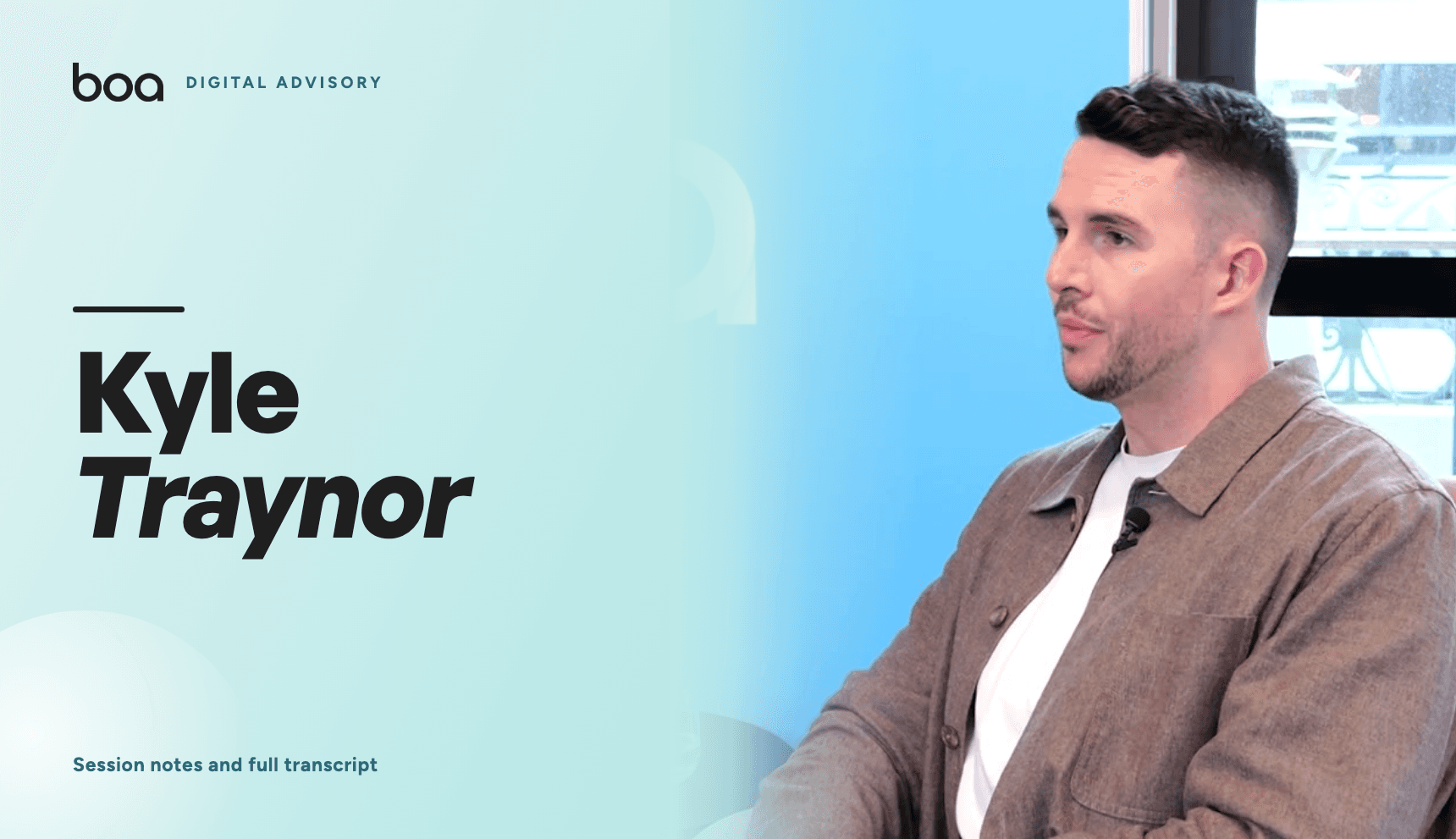
Kyle Traynor on Building a Podcast That Wins Clients
With Kyle Traynor, Founder at Startup Diaries · Hosted by Boa host · 30 min
What this session covers
Kyle Traynor explains how he built a podcast into an agency, and the systems behind it: the target value framework for deciding what to talk about, retention benchmarks that predict a viral clip, using Reddit threads and TikTok comment sections to find topics, and the four questions behind a personal brand. For founders starting a show or a content channel.
Ideas are the constraint in content, so spend half an hour every morning researching topics that have already performed instead of trying to invent them in your head.
Key takeaways
- 01
Define your target value before you record anything
Kyle uses a who, what, how framework. Who am I creating value for, what specific value am I creating, and how do I create it. For his own show the who was business owners in years one to three, and the what was education and inspiration. The how is the part you keep iterating on.
- 02
Give your show a mission specific enough to guide every episode
Kyle's mission was to eradicate the need for a paid course for people in their first three years of business. That is why he refused to skip over detail. When a guest says "we raised $10 million and then went to market", that is the moment to stop and pull the string rather than move on.
- 03
Go hyper-detailed on one subject per episode to stand out
Kyle knew he was competing with Diary of a CEO and the Hormozis of the world for the one to three podcasts a person listens to each week. Stephen Bartlett went emotional, so Kyle went the opposite way. If the guest's genius is marketing, spend 60 minutes on marketing in detail.
- 04
Prepare three or four fallback questions, not a script
Kyle spends the first five minutes on the story and why someone should listen to this person, essentially the elevator pitch version, then works through three or so similar anchor questions. The magic is not in the planned question, it is in the follow-up, which cannot be planned. Knowing your target value for that specific episode is what tells you which thread to pull.
- 05
Add a quickfire section at the end as a clip safeguard
Kyle found the snippets that went most viral on TikTok were emotional, so he built a quickfire block at the end of every episode to catch them. Questions like "what is one piece of advice for your younger self" and "what is one piece of advice for someone just starting a business". If the emotion did not show up naturally in the conversation, he still had usable social clips.
- 06
Hit 100% retention for three seconds and 50% past the halfway mark
Startup Diaries analysed every video across their channels and clients with over 50K views. The single commonality was 100% retention across the first three seconds, then staying above 50% retention beyond the halfway point of the video. Get the first three seconds right or nobody watches.
- 07
Aim to get listeners to the halfway point of an episode
Kyle cites loss fallacy, the same reason you finish a bad movie after an hour. The stats he quotes are that if someone reaches half an episode, 80 to 90 percent will finish it. So your job with a long-form episode is getting people past the 15 to 20 minute mark and to halfway, not holding them for the full hour.
- 08
Mine Reddit and Google Trends for topics that already worked
Type your topic into Reddit and the thread with the most comments and engagement sits at the top, which tells you what people actually argue about. Check the most searched questions on Google for the broader topic. Kyle's rule for all content is that you are re-engineering something that has already performed, not inventing from scratch.
- 09
Turn high-liked comments into your next video
When a client video on people management hit around 6 million views on TikTok, the comments filled with people arguing over whether employees or managers cause toxic culture. Kyle scrolls for comments with thousands of likes and rebuilds them into new videos. You can do this on anyone's account, not just your own, because the like count proves demand.
- 10
Find topics with two sides ready to argue
Kyle's view is the fastest route to a viral TikTok is a topic where two camps will fight in the comments. The video itself does not need to be controversial. The people management clip was not controversial, the comment section was, and that argument is what drove the reach.
- 11
Spend 30 minutes each morning writing five researched content ideas
Kyle's number one tip across social and podcasting is that ideas are the constraint. Do not sit with a pen and guess what might work. Go and look at what performed, articulate why you think it performed, then re-engineer it. Shoots get faster and easier when you turn up well researched, instead of scraping out three videos in three hours.
- 12
Answer four questions before you build a personal brand
What do I want to be known for, which dictates everything else. Where is my credibility, meaning why should anyone listen and what have you actually done. Who is this relevant to. And authenticity, which Kyle defines as leaning into what makes you unique. He points to a client who was polarising and only took off once he leaned into it rather than away from it.
How the session runs
- 0:12From consulting exit to a 12 month podcast experiment
- 2:01Why podcasting is the evolution of the blog
- 3:47Networking as the hidden gem of podcasting
- 4:16Does a small audience still make it worth it
- 6:53The target value framework: who, what, how
- 10:53Free-flowing versus scripted questions
- 14:20Quickfire questions as a clip safeguard
- 15:40Loss fallacy and the retention numbers that matter
- 17:07Researching topics with Reddit, Google and YouTube
- 18:59Why reaction videos work
- 21:59Posting cadence and the comment feedback loop
- 25:41Audience Q and A: new account or existing one
- 27:04The personal brand trilogy and authenticity
Mentioned in this session
- Pivotal Conversations
- Startup Diaries
- TikTok
- YouTube
- Google Trends
- Diary of a CEO
- Stephen Bartlett
- Toby Pierce
- Strong
- Michael Ramsey
- Catching Up with Cub
- Boa
Questions founders ask
Kyle's answer is to work backwards from first principles. Ask whether you need to connect with customers and potential customers, and whether a community around your business would be useful. If yes, podcasting is the best option available for doing that. The Boa host also frames it well: imagine the effort it would take to get 100 people in a room to hear you speak.
Use Kyle's target value framework. Decide who you are creating value for, then what specific value you are creating for them, then work on the how. For his show it was business owners in years one to three, and the value was education and inspiration. The who and what stay fixed while you keep iterating on the how.
Kyle says it depends on the individual, but he recommends going in with three or four fallback questions to keep structure. Spend the first five minutes on the guest's story and why people should listen to them. The real value comes from follow-up questions, which you can only ask if you know your target value for that episode.
Kyle's agency posts three times a day for clients. His minimum recommendation for anyone serious about growing an account is once a day, and twice a day is great. Momentum matters, and each performing video feeds a loop of comments you can turn into the next round of content.
Kyle says it does not matter much and it is a personal choice, but he would lean towards the existing account unless there is a reason not to. The upside is the people already there who will support you. He also warns against splitting your personal life out of your content, because the things that make you you are what make people connect with you.
Full transcript
The complete conversation, as recorded, with every speaker attributed.
Boa host0:00
Now I'm a huge fan of your podcast. I've said it before and I wanna talk more about that, but why don't we start with, just to give everyone a bit of an outline, why you started Pivotal Conversations and what it is as a company?
Kyle Traynor0:12
Yeah, actually, so when I started my podcast, that was originally called Pivotal Conversations. So that's the funny thing about it. And I started a podcast on the back of seeing video podcasting becoming really big in America, probably, I don't know, I think it was 2020, so a while ago now. And so I just thought I just really wanted to be in this space. I was like, this is going to be such a big thing. I was consuming so much content on YouTube and then I was like, I'm just going to start a podcast. And I was pretty lucky that I come off the back of exiting my previous business and was kind of had a bit.
Audience member0:48
What was that?
Kyle Traynor0:49
It was a consulting company. So was transitioning out of that and then basically was like, what do I do? I got a lot of spare time. So thought about why don't I just start a podcast? And I just gave myself 12 months to just totally figure out podcasting. Got a studio, got a full-time producer, and just that's all I did for like 12 months straight. And so that's when I ended up growing, you know, on the back of growing our TikTok to, you know, 100K, built the podcast up. And then transitioned the podcast into Startup Diaries because at the time I was interviewing a lot of founders. It wasn't just founders in the early days and I just knew the name for me was like, that's going to be the name of the agency that we build. And then we ended up launching the agency and then obviously Startup Diaries became turned into Startup Diaries.
Boa host1:44
So it's interesting. So you started a podcast which actually then just became a business. And you keep running your podcast, or at least it gave you the idea for your business.
Kyle Traynor1:52
Yeah, yeah. Like the podcast was its own thing and that was my sole focus. And to me it was just about understanding the industry and understanding the market for 12 months.
Boa host2:01
And so why do you think people should start podcasts? And do you think everyone should? Because a lot of people try, but I read a stat online today, which was, I think 90, you'll probably know this better than me, but 90-something percent of podcasts fail. Don't make it past the 20th episode. So why do you think people should start podcasts? Like what is the purpose of an entrepreneur like myself, for example, starting a podcast?
Kyle Traynor2:24
There's two kind of, there's two key things I would say about that. The first one is I'm of a belief that podcasting is the evolution of the blog. So—
Boa host2:34
Yeah, great, I like that.
Kyle Traynor2:35
Yeah, so like every company knows they have to have a blog and one, it's because they need to somehow connect with their customers and their community. And then the second part is there's a lot of really great benefits to having a blog like SEO and all these other elements where I think podcasting now is very much the same. Like, you know, it's probably the best community builder on the planet. You know, there's no better opportunity to connect with potential customers, to connect with any sort of community and provide value to that community. You know, podcasts, we just seen what's happening in the world at the moment with the role they're playing, even on a political stand— from a political standpoint. So it's just like, you know, podcasting is such a cut-through method that's being adopted worldwide. But then there's, you know, when you talk about video podcasting, there's just so many other benefits. Like I can get heaps of social content, you know, SEO in itself. I can transcribe an episode that can go on my website. Like there's just so many benefits to it.
Boa host3:30
So I think, you know, it can be used as a marketing tool, personal branding, to grow your network and meet successful people. You were just telling me before that, like Toby Pierce, before he was a client, you actually interviewed him on your podcast. And that was a great way into a relationship with him. So it's a great networking tool.
Kyle Traynor3:47
Networking is like, that is the, in my opinion, the hidden gem in podcasting.
Boa host3:52
Yeah, I agree.
Kyle Traynor3:53
It's just the people you meet, like the relationships you can forge. So I just think, you know, it's the evolution of the blog. There's so many benefits to it. Our belief when we started the business was that every business will have one. And a lot of people be like, you know, it's saturated. And it's like, yep. But like, what isn't? When something's good enough, it becomes saturated. And then beyond that, it's about being, how can I be unique and provide value in a unique way?
Boa host4:16
Yeah. Someone said to me once that, you know, just because you have a podcast, you might have 60 downloads per episode or 80 or 100 downloads per episode, but you've got to remember, imagine how much effort it would take to get 60 or 100 people in the room to hear you speak. So while your podcast might be small, it's actually not if you consider, like, think about those 60 or 100 or 80 people in a room with you on stage. The room would look big. So, you know, sometimes also, do you think there's a perception that your podcast has to be huge for it to be worthwhile? Or do you think that, you know, having a podcast that has 100 listeners per episode is still worthwhile.
Kyle Traynor5:01
I think if you just draw it back from podcasting, right? And just kind of just come back a step and say, do I need to connect with customers and/or potential customers? And do I need to create some sort of community around my business or is that gonna be helpful and useful? And then beyond that, if the answer to that is yes, then you don't have to ask yourself what options do you have? And I was always of the notion that when TikTok first come out, I was like, not for me, everybody's just dancing. How is a business owner, you know, like this is, no, this is just not for me. And then when I seen podcasting coming up, it was a big, you know, eye-opening moment for me and like, well, maybe this is how I get my foot in the door on something like this. So, you know, it's just, podcasting is a great, it is the best option when it comes to connecting with potential customers and building a community. So I think it just, I just draw it back to that and just first principles, just ask myself the questions that are like, if the answer to this is yes, then I need to start actioning it.
Boa host6:08
Community building for companies and brands is one of the hot topics that like we talk about a lot on BOA and the BOA members and audience really always love talking about building communities around your brand. 'Cause it's something that you know is so valuable to have, but it's like, how do I get it? And that's so true. You could look at, I mean, what's a better way to build communities than having a podcast where people can actually get to know you as a founder, as an entrepreneur, while you're discussing things that they're relevant, that speaks to them. So I guess my next question is how, how can you, uh, like what do you actually talk about? You know, like how can you make sure what you're saying on your podcast is the right thing to be saying and how, where do you get those ideas?
Kyle Traynor6:53
Yeah. So we use a principle called target value, and it's this idea that you want to— there's 3 kind of core areas to this, which is what— sorry, it's who, what, how. And we just break that down into target value means who am I creating value for? Like the specific audience that I'm trying to create value for. And then what's the specific value I'm trying to create for them?. And so for me, when I started my podcast, it was for business owners in between years 1 to 3, and I wanted to provide education and inspiration. So that was my target value. And then the kind of area in which you constantly iterate and progress and is the how. So how do I actually create that value? And so that's literally how you can sit there and start to decide what you're gonna talk about is you first gotta start with your audience and decide who you're gonna create value for. Then you go, what is that value? So again, I kind of draw, I'll give my, an example for my podcast, which was education and inspiration. But you take that a step further and I just had a mission that I wanted to eradicate the need for a course for people in their first 3 years in business. Like very rarely in your first 3 years in business, do you have spare cash to just be throwing it courses and mentors. Like, I just, I think that's, that's very rare, you know, like you've got to be doing pretty well and, and, you know, hopefully you are. But if you're not, you're kind of sitting there and you're like, well, you know, where do I get my information from? Like, how do I learn? How do I understand what I've got to do and take those next steps and learn from people's mistakes? And so then you come to the how. And so for me, it was like, it just was super high detail, right? So I found that And this is another really key point. You've got to think about your podcast as something that's going to be really unique. So how do I bring something that's different to the market or what's in the market? And it's very interesting. So at the same time, people are going to think I'm crazy for saying this, but at the same time that I was building my podcast, Diary of a CEO, Stephen Bartlett was building his. And yes, he is what he is now and he's gotten massive. But back when we first started, like he was up and coming. And so When I started to build mine, I go, I'm competing against this guy. And that's how you have to think. Like you're creating content, you've got to think about it. People are only listening to 1, maybe 2, maybe 3 podcasts a week. So therefore, by virtue, I am competing against these guys. I am competing against the Hormozes of the world. I am competing against these guys. So you need— and there's amazing content creators out there. So you just need to think about How can I bring something really unique? And so for me, he went down this really emotional route and that was like really, really great, right? And such a great podcast. I just went the opposite way. I said, I'm going to go hyper-detailed on specific subjects. So I would go, the person in front of me, you know, their area of genius is marketing. Let's talk about marketing for 60 minutes in detail. Like how, okay. 'Cause what you'll see on a lot of podcasts is like people just skip over it. They'll be like, oh, you know, we raised $10 million and then we went to market. And I'll just be like, okay, like you raised $10 million. Like there is like just something that you've glazed over there. And so, you know, that was for me is like I would pull on those little nuggets. So, but that target value statement, who am I creating value for? What's the specific value I'm trying to create for them? Really helps me mid-conversation on how to understand how to pull on those strings. Because the thing about podcasting as an art is you can prepare as many questions as you want, but it's really in conversation that the magic happens. So target value is a great way to understand who your customer is, what's the value you're going to create for them. And then the how is where you can go away and you can do your research and you can look at other podcasts and say, I want to do it a bit differently. Oh, I really like that., and I wanna bring that into what I'm gonna do.
Boa host10:53
And, and so what do you think are the pros and cons between a podcast that does it, that is more conversational, that doesn't have preset questions? Like for example, the Catching Up with Cub podcast, my podcast, I don't have any questions. I'm just, I'm just fucking talking and see how, see where it goes. Or which has its downsides. Or like, what do you think is the, I guess, how do you think they differ? Like free-flowing podcast, conversational, not prepared, or scripted with questions ready to go? What are the pros and cons? And which do you kind of recommend people?
Kyle Traynor11:26
I think it depends on you as an individual. Like I'm very much the same. So you put a million questions in front of me and I'll probably chuck them in the bin, but like everybody's a bit different. But my recommendation with that and something that I found really valuable for me was going in with like 3 or 4 that were like my fallback questions. And that was like, almost kept me in flow in terms of structuring my episodes. So I would always spend the first 5 minutes on the storey and like why someone should listen to this person. So like, just give me like the elevator pitch version. And then I would usually start with 3 or sorry, go with like 3 similar questions throughout that. But the target value piece, again, like I bring it back to that is like, that's really important to know because Really, it's the magic is not in the questions you plan for. The magic is in the follow-up questions from the original question. So it's like that follow-up question can't be planned.
Boa host12:22
Getting deeper.
Kyle Traynor12:23
You have to like be able to have a conversation and listen to someone and then in the back of your mind, keep in mind and being like, okay, so my target value for this episode is marketing. So when I hear him say something about marketing that I think my audience will find valuable. And my audience is people in years 1 to 3 in business. So, you know, if someone's starting a brand and, you know, I interviewed the founder of Strong, Michael Ramsey, and one thing that I found very interesting about him, he brushed over it, but he talked about this idea that he created a scent for their studios, right? To make the studio smell clean, right? And I just found that so fascinating. And then I pulled on that and I said, hey, can you tell us a little bit more about that and potentially some of the other ways that you how he did that. And then he went on this big tangent and talked about all these little 1%ers that he did with his, with his studios in terms of things that you just wouldn't think about that. Now they've got nearly 500, 600 locations worldwide. And this was him at location 10 that I interviewed him. And so you can kind of look back and so I wouldn't have known to pull on that string unless I'd gone in with a good understanding of what my target value was, not only for the whole podcast, but for that specific episode.
Boa host13:37
And I also think, like, the downside— for example, I know from experience, the downside to not having set questions, or at least some of them, is that you don't have those really great sound bites for social media. You know, when, like, you ask just this great question, it comes out beautifully and eloquently and short and simple, and then the person has, like, a really good response, and you want to put that on social media. Like, I never have those because I never have those questions. But what I think would be a great balance is like have a conversational podcast on whatever topics you want to talk about, but also have 3 questions that the person knows you're going to ask and that you're going to ask and you've practised asking them. And that way you've got those like really powerful soundbites.
Kyle Traynor14:20
It's funny, like, so when I was building my podcast and we were going viral on TikTok, what we found was the snippets that went the most viral on TikTok were emotional. So I actually put a quickfire section in at the end of my podcast as a safeguard where I would ask these really emotional questions. Like one of them was like, what was one piece of advice for your younger self? And another one was like, what was one— what's one piece of advice for someone who's just starting a business? And so I put those questions in at the end as this safeguard to catch some of those emotional moments that we would just like, you know, if they didn't appear in the podcast, I would at least have these safeguards that we could use for social clips, you know, Anyway, so it's funny you say that.
Boa host15:04
Do you find that emotional clips do better than knowledge-based clips? Like, I think I reckon they would. I don't have data on that.
Audience member15:15
You know what?
Boa host15:16
I'm completely guessing that.
Kyle Traynor15:17
But nah, look, it's not one or the other. Like there's certain properties of a social post. There's different reasons something can go viral. So emotion is one. Story is another one. So a really engaging story. I mean, all you're really trying to do, right? There's a few things. You're trying to get people hooked in the first 3 seconds. If you don't get that first 3 seconds right, no one's watching.
Boa host15:40
Of the episode?
Kyle Traynor15:42
The episode, your social clips. Even your episode. Like, so one of the things, so you gotta think about it, right? If you don't like, there's a thing called loss fallacy. And it's this idea, and we've all done it, that when you've watched a really bad movie for way too long, you still finish it, right? You don't turn it off. If you don't—
Boa host16:03
You've already sacrificed an hour.
Kyle Traynor16:05
Exactly right. And so the same thing exists in podcasting. The same things exist in social media. Your job is to get someone beyond the 15 to 20 minute mark of a podcast, or more importantly, just get them to halfway. The stats show that if someone listens to half an episode, like 80 to 90% of people will finish that episode, right? So if you can get to above 50% retention on any sort of video, you know, and then more importantly, you gotta get the first little chunk right. So for social, it's 3 seconds. If you don't get that right, like we look, we did research on all of our viral videos across all clients, across our channels, anything that had over 50K views, The one commonality was it had 100% retention for the first 3 seconds, and then it stayed above 50% retention beyond the 50% mark of the video. So, so over halfway it stayed above 50%.
Boa host16:58
And how did you find the topics to make the videos for? So how did you choose which topics to like, like how did you find viral topics?
Kyle Traynor17:07
Yeah, so the topics kind of comes back to what we talked about before, which is target value. But then it comes down to a few key areas. And from a podcast perspective, the topics almost create themselves because you are focusing on a certain audience, just focusing on a specific set of value for that specific value to create for that audience. And then you have to go away and do research into what things they're interested in.
Boa host17:33
But can you research what topics are working well right now and then repurpose them?
Kyle Traynor17:37
Yeah, definitely. You know, you can definitely use, like, we, I'll give you an example. We manage social accounts for entrepreneurs, right? And so what we are doing is we are, when we are coming up with their core topics, there's actually a set thing that we look at. We first look at what are the areas that you are deeply researched in, right? So what would you say you're the best in the world at or you can be the best in the world at? And what are you deeply researched on? And then the second part to that is like your experiences, right? So like what are the things that you're currently experiencing? Or more importantly, if you're interviewing a guest on a podcast, what are the things that they're currently experiencing in that are relative to or relevant to the audience? So when it comes to researching, there's other little tactics you can use, like using Google Trends. You can look the most searched questions on Google for that specific broader topic. Like if it's marketing, you can go and literally find out what the most Googled questions are on Google. You can go into Reddit. The key thing to understand about anything to do with content is it's all about re-engineering something that's already performed, right? So, so like—
Boa host18:56
So how can I make this hot topic relevant to my audience?
Kyle Traynor18:59
Yeah, and like, I'll give you an example, like, This is the prime example of reaction videos. So you've probably seen videos on social at the moment where you have someone who's watching a video and they already re— and then they react and give their opinion on that video. And you're like, why am I watching this? This is crazy. Like, this is— it's nuts. But the reason it works so well is because they're taking videos that have already gone viral. So that video might already have a million views. So we already know that it's great at getting my attention. So they just hijack that and they know that it's— they're gonna have their attention, right? So the first 30 seconds of the video is a video that's already performed and got a million views. So they know that you're going to watch that video, right? And then they just have to react to it and give their opinion. And the loss fallacy is already in play. And so reaction videos are the highest performing videos on social.
Audience member19:57
Oh wow.
Kyle Traynor19:57
It's crazy. So, but you take that as a principle and you go, cool, like my job and like our belief is that in any form of content to create a high number amount of, or a high volume of content every month is literally ideas are the constraint. So if you put all your energy and this is like my number one tip, number one tip across social, across podcasting, put all your energy into the shit you talk about, right? Into your ideas, into researching ideas and doing all the topics. The topics, right? Put all your energy into that because then when you go to shoot, you're well-researched. It's easy. How many times have you gone to shoot content, right? You haven't planned and you get there and you might shoot like 3 videos in 3 hours because like you're just not prepared. And then, and then, you know, so how do you go and find these ideas that have already performed? You can go on Reddit and you can find the most viral Reddit threads of all time on the topic that you're talking about. So if I go on marketing and I type in marketing in Reddit, by virtue, the one that's got the most comments and the most engagement will be at the top.
Boa host21:04
So Reddit's a powerful tool.
Kyle Traynor21:05
Reddit's powerful.
Boa host21:06
YouTube, do you, do you go through YouTube to find the hottest episodes of whatever?
Kyle Traynor21:10
YouTube, anything that has data, like you can do, you can use Reddit, you can use Google, you can use YouTube, you can go on social. And you can look at reels.
Boa host21:19
Write down all the themes of topics to talk about basically.
Kyle Traynor21:24
Yeah, exactly. That's why I like, and that's like, if you, honestly, I believe that if you're struggling to create content and it's something that overwhelms you, if you spend half an hour every morning writing down 5 ideas for content and just planning them out, and you do that by actually going out and doing research, not sitting with yourself and saying, you know, this is what I think could work. You go and look and you go, That video performed really, really well. Here's why I think it performed really, really well. How can I produce something similar or re-engineer that?
Boa host21:54
And how many times then would you post content onto your socials?
Kyle Traynor21:59
Yeah, we, so for our clients, we're doing 3 times a day.
Boa host22:03
That's a lot.
Kyle Traynor22:04
Why do you do that? That sounds super overwhelming and that's just like, that's like where you want to get to. Yeah. But like honestly, it's like, I think a minimum once a day if you really want to grow your account. If you can get to 2 a day, that's great. And then obviously anything more than that.
Boa host22:23
And then you get rewarded by the algorithm for posting more.
Kyle Traynor22:29
You definitely get rewarded for it. But like the other way to think about it is a rising tide lifts all ships. So one of the biggest things from a content creation perspective that can really drive your account is having momentum and people. 'Cause you actually gotta think about it. What, like for a video or a podcast on any platform, like whether it's social or a podcast, for it to be deemed successful and for it to perform, it has to be consumed, right? And so if you just draw it back, like someone's consuming this, you understand that that then becomes a feedback loop. So like if I get a video that performs really well, I'm going straight into the comments and I'm looking at the comments and seeing what I can take out of that comment and re-engineer that into a video. So like we had a video for a client the other day that got about 6 million views on TikTok and it was about people management, right? Business topic, people management. And it was, it was basically a lot of people arguing in the comments about who's responsible for toxic culture, employees or managers, right? And so the best way to go viral on TikTok is to find a topic where there's two sides that are ready to argue and you kind of create a video about it. But then what happens is, is when something goes viral, you end up having a heap of comments that come in and you can just react to one of those comments.
Boa host23:56
And make another video.
Kyle Traynor23:57
Yeah, so you can go in and what happens is, is like on TikTok—
Boa host24:00
Oh, I'm gonna get super controversial from now on on TikTok.
Kyle Traynor24:03
You don't even have to be controversial, right? Like that's the misconception. Question though, like this video wasn't controversial, it was the comments that were controversial, right? So, so, but what you do is you go down and you go, cool, this, this comment has 6,000 likes. That's clearly a topic that people want content on, right? So you can take that comment and re-engineer it and think about it. You don't even have to do this for your own videos. You could go find them anywhere, any person go into their comments, take a comment that's got the most likes on it and literally take that and then re-engineer that into a video.
Boa host24:39
That's genius.
Kyle Traynor24:40
Because you just know that people are interested in it. So a lot of people are trying to come up with things that, and that's the thing that's hard. Like I know that feeling, it is difficult to understand, to know what to talk about if you're just sitting there with a pen and paper and trying to do it up here. The best way to do it, and we have teams that do this, like we have teams that sit there all day and they're just going through and looking for ideas and populating those ideas for our clients because The hardest part is actually doing the research. But if you spend half an hour a day doing it, whether it's for your podcast— podcasting is the easiest barrier to entry in my opinion. It's the hardest to do well, like to get to the 1%, the highest, because it's, it's long-form content. But if you spend half an hour a day focusing all your ideas on the constraint, which is ideas, everything else gets easier. Shooting content, the performance, understanding what works.
Boa host25:30
Yeah, it's the biggest barrier.
Kyle Traynor25:32
Yeah.
Boa host25:33
Now I just want to move to the questions now, guys. And Bella, would you like to go first? Yep.
Audience member25:41
Um, so first one is I want to be building my own like personal brand out first, basically on Instagram, and I'm trying to decide whether I change the current one that I have, like my own personal one with my friends, family, a bit of business colleagues at the moment, or just start fresh and then do a new personal branding one based on that venture. Um, and then the second one, best advice to like pick yourself to getting on a podcast, like when you don't have that big following, like have a learning story, but obviously haven't shared that yet.
Boa host26:12
That's a good question. So the first one was, should I build my personal brand off my existing personal account or start a new account just specifically for my business personal brand content? And the second question was, what's the best way to pitch to get onto existing podcasts before you have that personal brand?
Kyle Traynor26:31
Yeah. So the first one I would say, I honestly don't think it matters too much. Like it's more of a personal choice for you. Like, do you want to like, I mean, the one thing you're going to have on the personal page is some preexisting people that will support you. So I'm all for that. I think the thing about building a personal brand, we break it down into like a trilogy of things you need to really think about, which I'll explain this now because I think it'd be very valuable for people. The first one is the first burning question you have to ask yourself is what do I want to be known for?
Audience member27:04
Right?
Kyle Traynor27:04
Because if you don't answer that question, it's very hard. Like it's honestly the number one question before you do anything. So the first thing you have to ask, what do I want to be known for? Because that'll dictate everything else. Then beyond that, you then have to go into ask yourself, where's my credibility? Right? So why should someone listen to me? Because they're not going to listen to you They don't care what you have to say until they know why they should actually listen to you. And that's a big and sometimes confronting question for everyone to ask because we do get a little bit of imposter syndrome. But the key to that is just really dumb it down to like, what are your experiences in? What can you talk about that you've done that you think your audience will find really interesting? So ask yourself that question, you know, where does my credibility lie and what are the things that I've done? And then just keep doing more cool shit. Like keep doing bigger and keep doing more and sharing that with your audience. The second thing is relevance. And then you need to understand why is this information relevant to the audience or who is this relevant to, right? So that's the third piece of the personal brand trilogy. And then the reason I'm actually telling you this is the third piece is authenticity. And authenticity really means like, How do I lean into what makes me unique?
Audience member28:25
Right.
Kyle Traynor28:26
And that's like, and that's different for everybody. You know, we have a client who's a really polarising guy, like super polarizing. And the day he started leaning into that instead of leaning away from it, he went nuts on social. And so that's an example. But you've got to find what's unique about you and what are the things that make you, you to and then, and then really lean into those things. Now, what is— and then when it comes to the accounts, don't stress about separating your personal life from your— from the content you're creating because your personal life— and I'm not saying, you know, you're per— I'm more like, what are the things that make you, you like, do you play sport? Are you into fitness and health? Like, do you know whatever it is you need to lean into those things because they are the things that actually make you, you. And that's what makes people like you. You know, your tribe isn't— they don't just care about what you say. They care about the things you do, like who you are. It's who you are, right? And that's what makes people connect with you as well. So, you know, in regards to splitting your accounts, I'm not a— I think it's more of a personal choice. I think I would just lean into like doing it on your current account unless— yeah, unless there's a reason that you shouldn't. But like lean into that and just kind of let yourself be authentically you. You're not having two personalities online. It just doesn't work. People want the real you, they want it now.
Watch the full sessioninside Boa.
Session notes are free. The recordings, the live advisories and the founders in the room are for members.